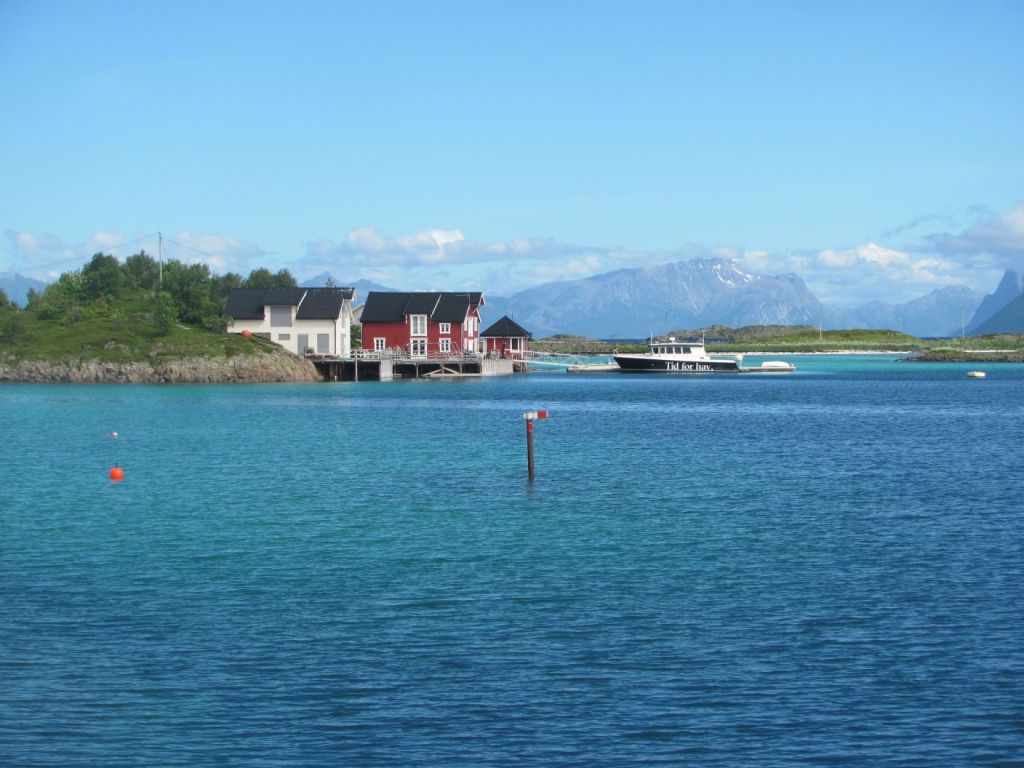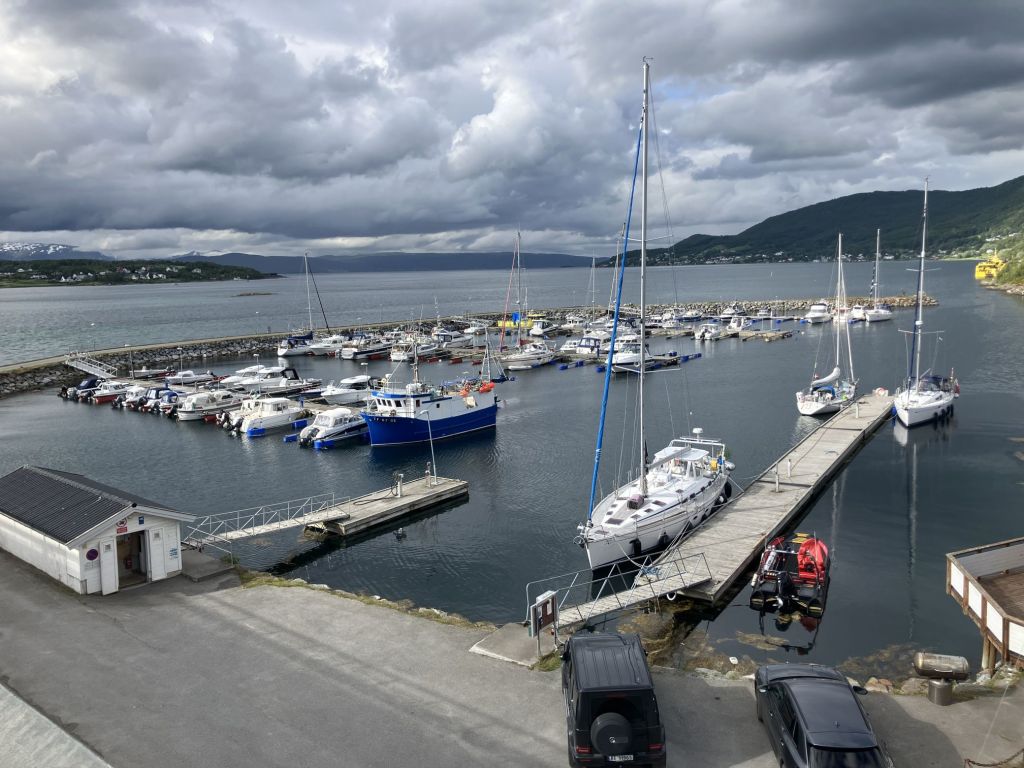
A preserved shop, a poet-priest, and the duck-women of Vega

“Another twenty minutes and we would have made it”, says the First Mate. “As it is we are going to get drenched tying up.”

We are just arriving at the island of Myken. We have had a pleasant sail down from the Fleinvær islands, but for the last hour we could see the dark storm clouds gathering in the west. Now the heavens have opened.

“There’s another boat already there”, shouts the First Mate through the rain. “With a Canadian flag. We’ll have to go on the outside of the pontoon.”

It’s Harley and his family in their boat Prudence. We had heard of them last year when in Trondheim, but so far had not met them.
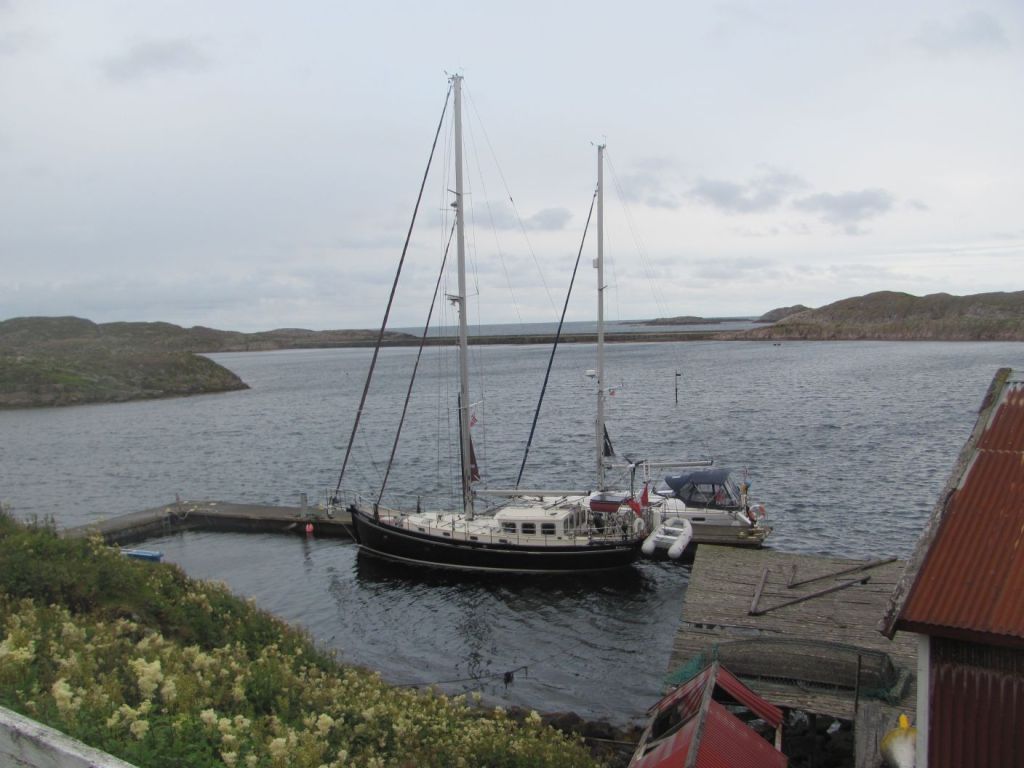
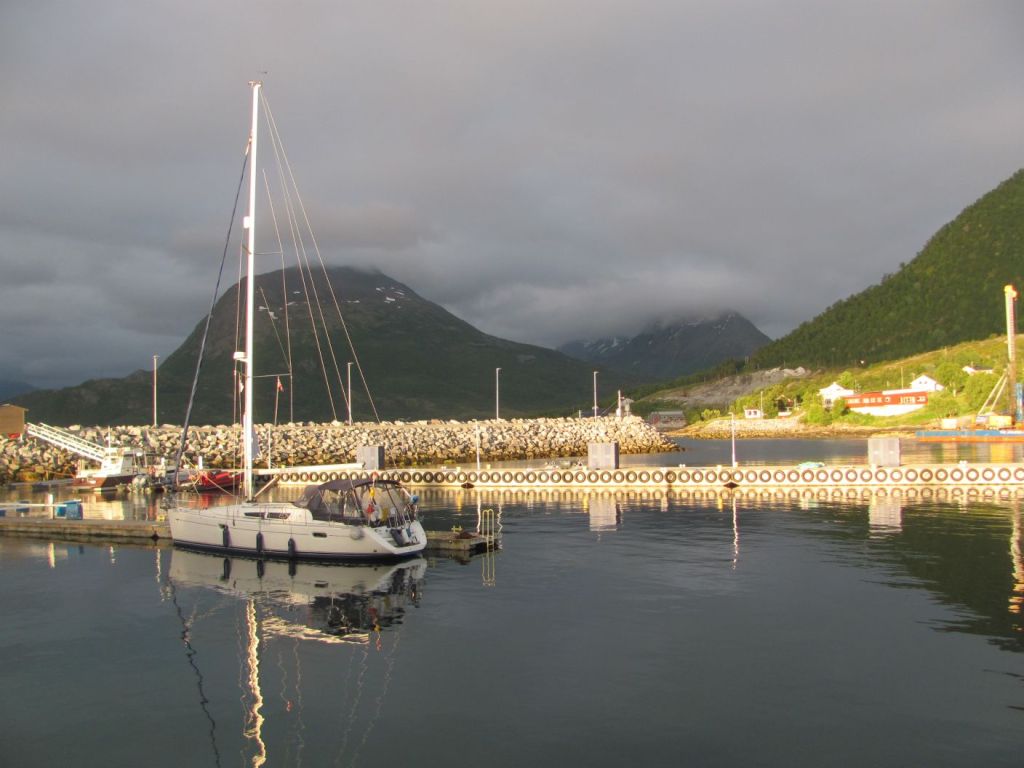
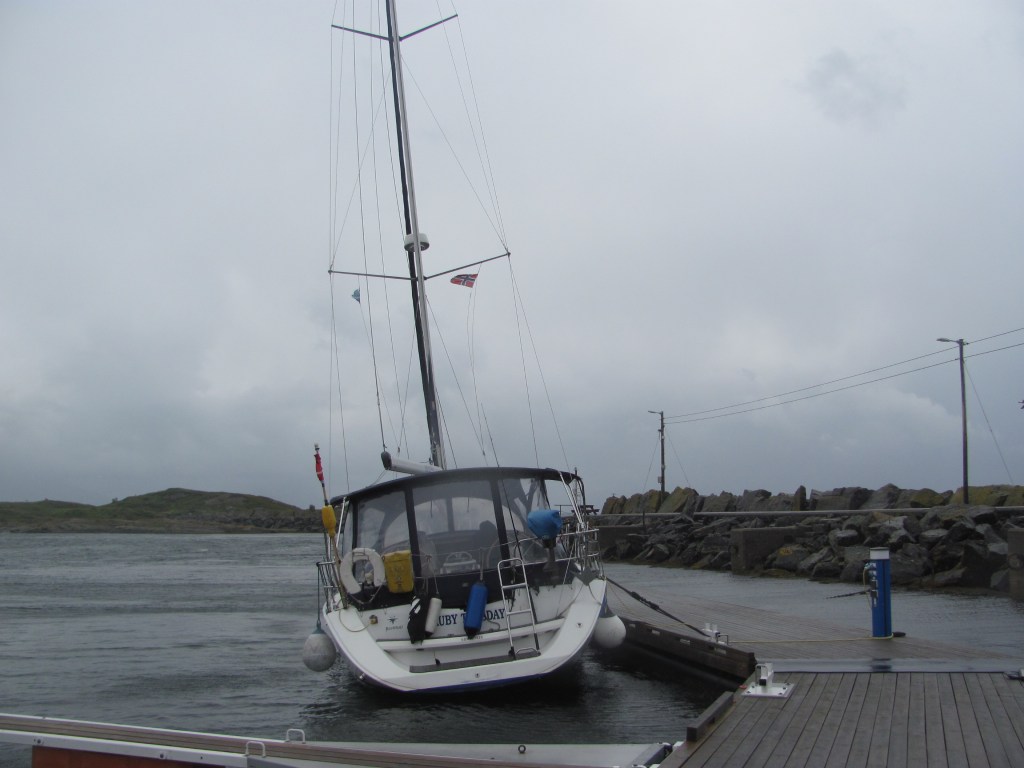
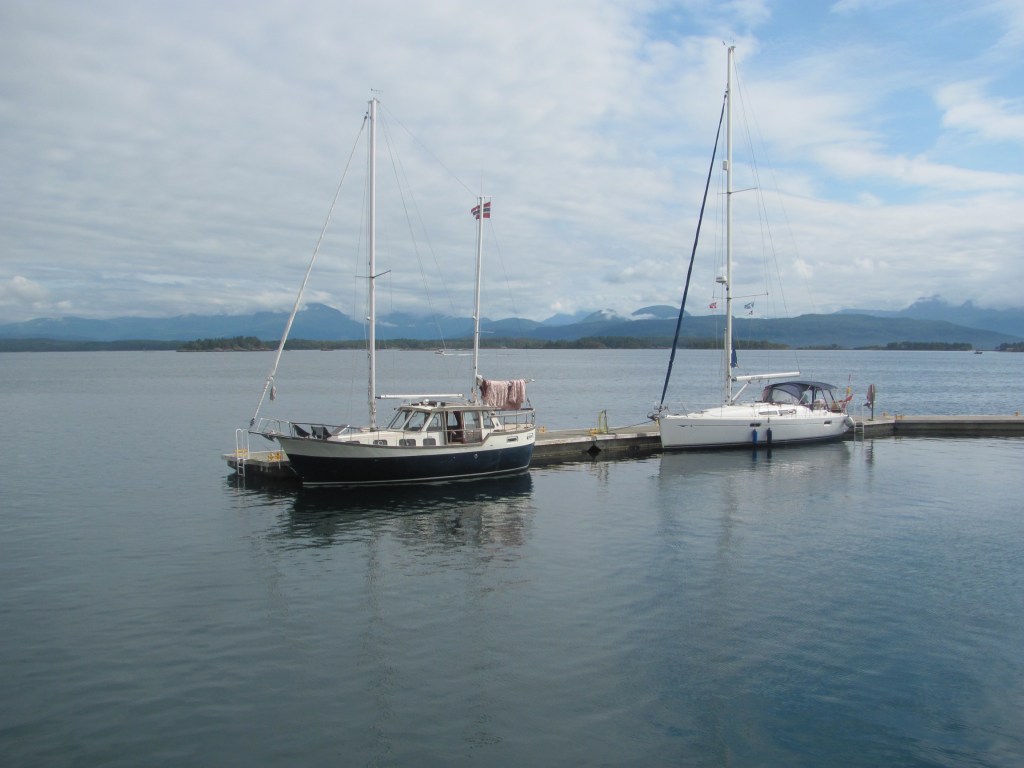
Prudence and Ruby Tuesday in Myken harbour.

“We’ve been here a couple of days”, Harley says. “But we are moving on first thing in the morning to Træna. It’s a lovely little island here, though. You’ll enjoy it. They have a distillery that’s worth a visit. And a restaurant and a museum. Everyone is very friendly.”

When we awake in the morning, Prudence has gone. After breakfast, we explore the village. There is a coffee morning in the grocery store.

“We meet here every morning for a coffee and waffle, and to do our knitting”, says one woman. “We’re trying to get a quilt finished by Christmas time. Visitors are welcome too.”
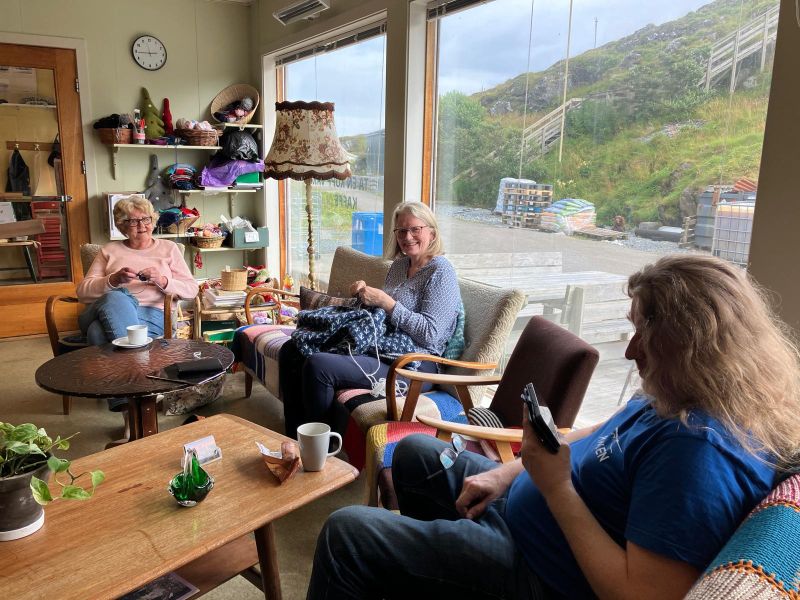
Daily coffee morning in the grocery store.

“There are only 16 permanent residents here now”, says another. “But a similar number of former residents who now live on the mainland still come every summer. And, of course, there are people like me that were born on the mainland, but who came here on holiday and loved it so much that they keep coming. I bought a small fishermen’s hut called a rorbu, and sell my glassware there.”

On the way back, we pass the distillery. At the other end of the village is the so-called ‘Distillery Cathedral’, a modern looking building where whisky tasting tours are offered.
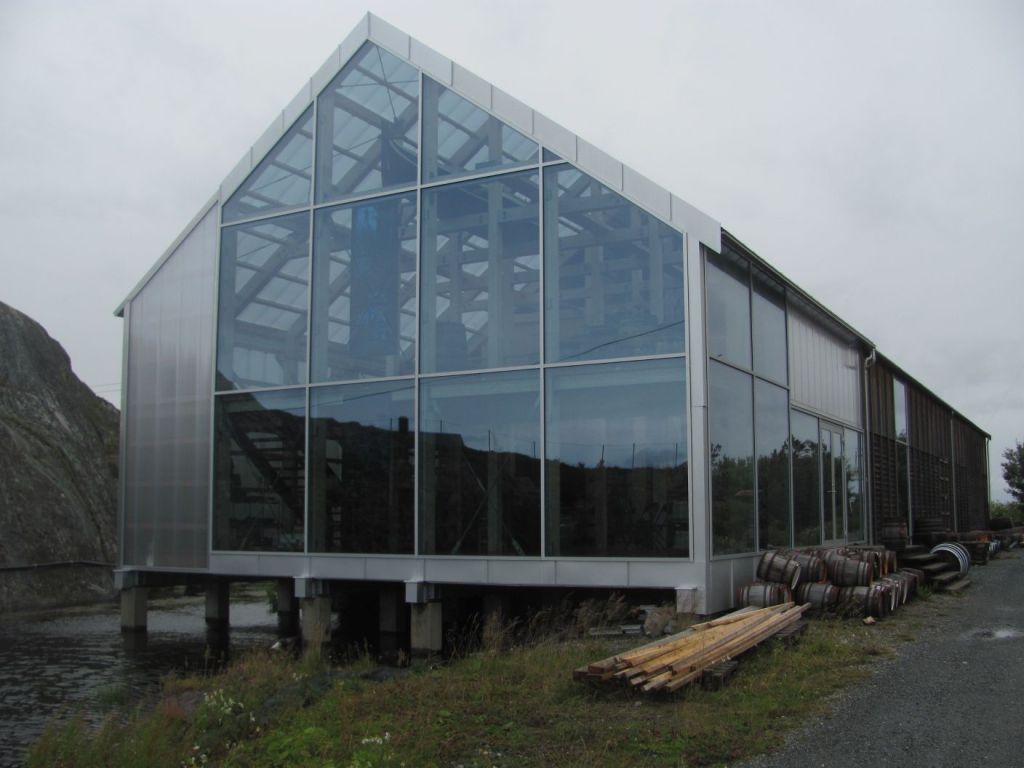
The ‘Distillery Cathedral’.

In the afternoon, we visit the Gamla Butikken, the ‘Old Shoppe’, at the end of the village. It used to be the village store, and has been preserved just as it was when it closed in the 1960s. Rather than the customers serving themselves and paying at the end, they tell the shop keeper behind the counter what they want, and he or she will go and fetch it.
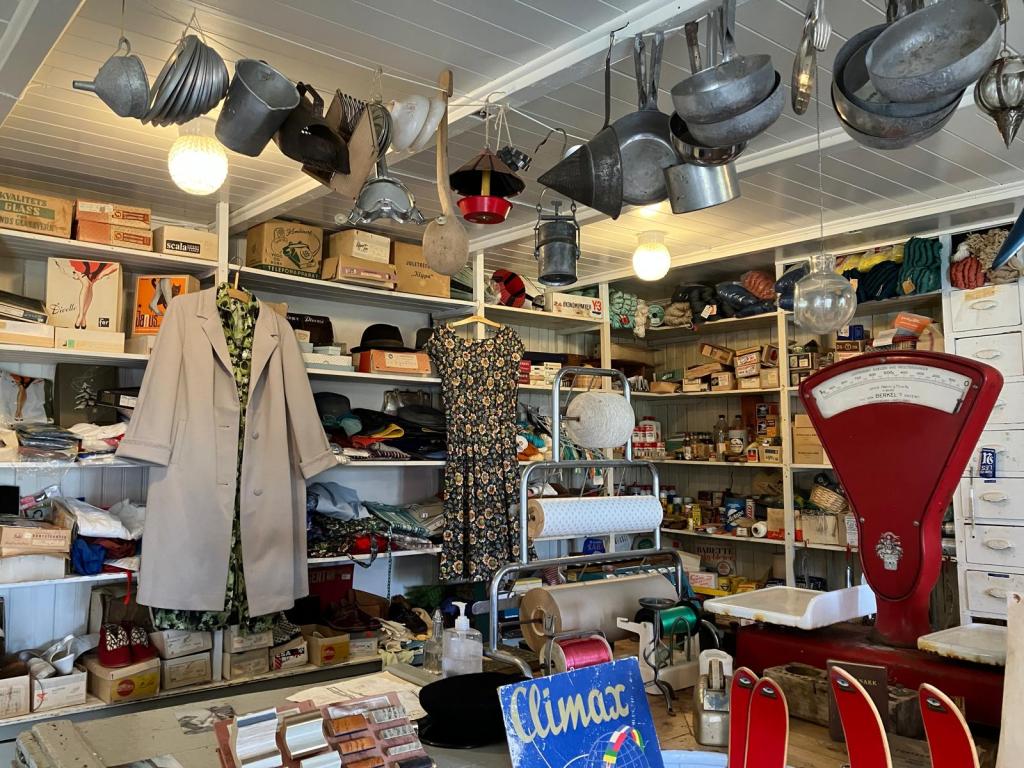
The Gamla Butikken.

“It was our grandfather’s shop, and his father’s before that”, Hannah tells us. “It’s been in the family for generations. When our grandfather died, our grandmother left it just as it was and locked it up. It stayed that way for many years, but one time when I was here I thought that it might be a good idea to open it as a kind of museum so that visitors can see what it is like in the old days. My grandmother liked the idea. The problem was that the building was becoming more and more derelict and it would have soon needed to be pulled down. She saw this as a way of preserving it.”

Hannah was brought up on the island, and still spends summers here, but lives in Bodø during the winter.

“What was it like being brought up on the island?”, we ask.

“I loved it”, she says. “There were quite a lot of people living on the island in those days, and there were several children my own age. We had a lot of fun.

“But the population started declining in the 1970s”, says her brother, who has joined us. “The government’s policy at that time was to do away with all these remote communities with their traditional low paying occupations, and persuade people to move to the cities where they could get better jobs and contribute to the nation’s wealth.”

“What about your father?”, asks the First Mate. “Was he involved in the shop as well?”

“No, he was a fisherman”, answers Hannah. “On a trawler. But he died while out fishing. Did you see the memorial in the middle of the village? He’s the one at the top. We don’t know the reason, but he had come off his watch at night, and was seen going downstairs to his cabin. But in the morning he was missing. His body was never found.”
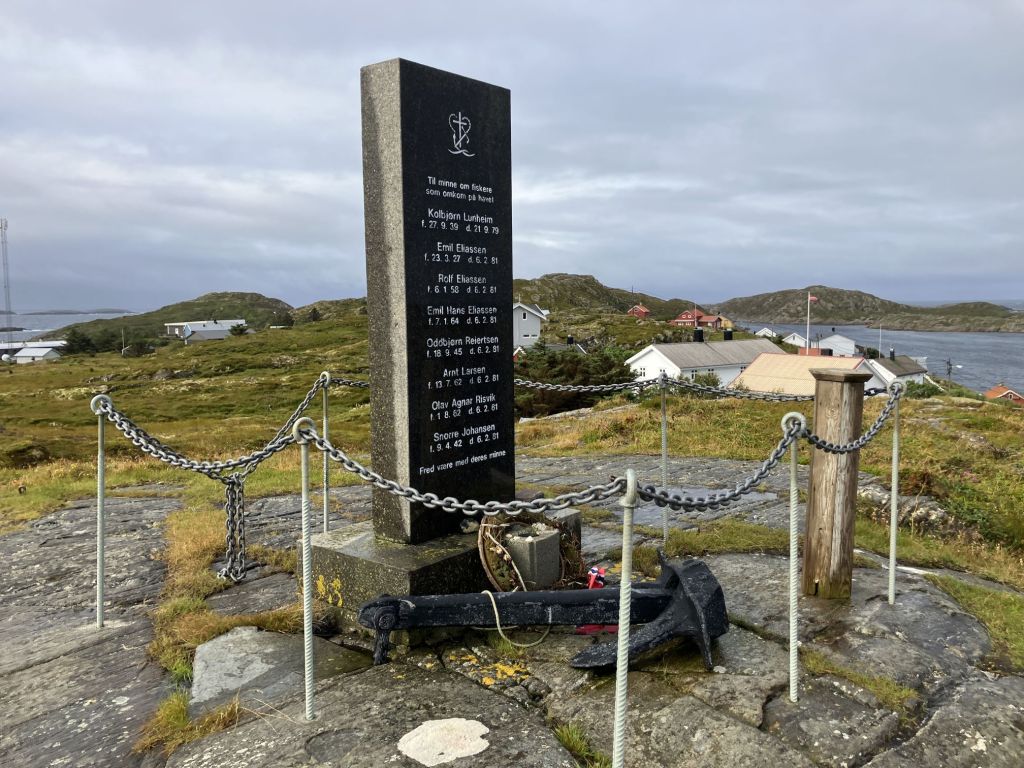
Memorial to those lost at sea, Myken.

“What happened?”, we ask.

“Well, it was presumed he had fallen overboard. But my brother here had a heart attack a few years ago, and we wonder if our father’s disappearance had possibly been something to do with his heart. Weak hearts can run in families, you know. But we’ll never really know for sure.”

“Who were the other names on the memorial?”, I ask.

“That was a boat that went down with all on board”, says Hannah’s brother. “A storm blew up, and they tried to make it back to safety, but they were too late. The storm caught them and the boat capsized. Not far from here. A father and his two sons and four others were lost. It was devastating for the whole community.”

“It just shows the perils of making a living from the sea”, says the First Mate after we leave. “I am not sure that I could have coped with it.”

—-

In the morning, we set sail for Sandnessjøen, 50 miles to the south. We pass Lovund on our starboard side doing volcano impressions.
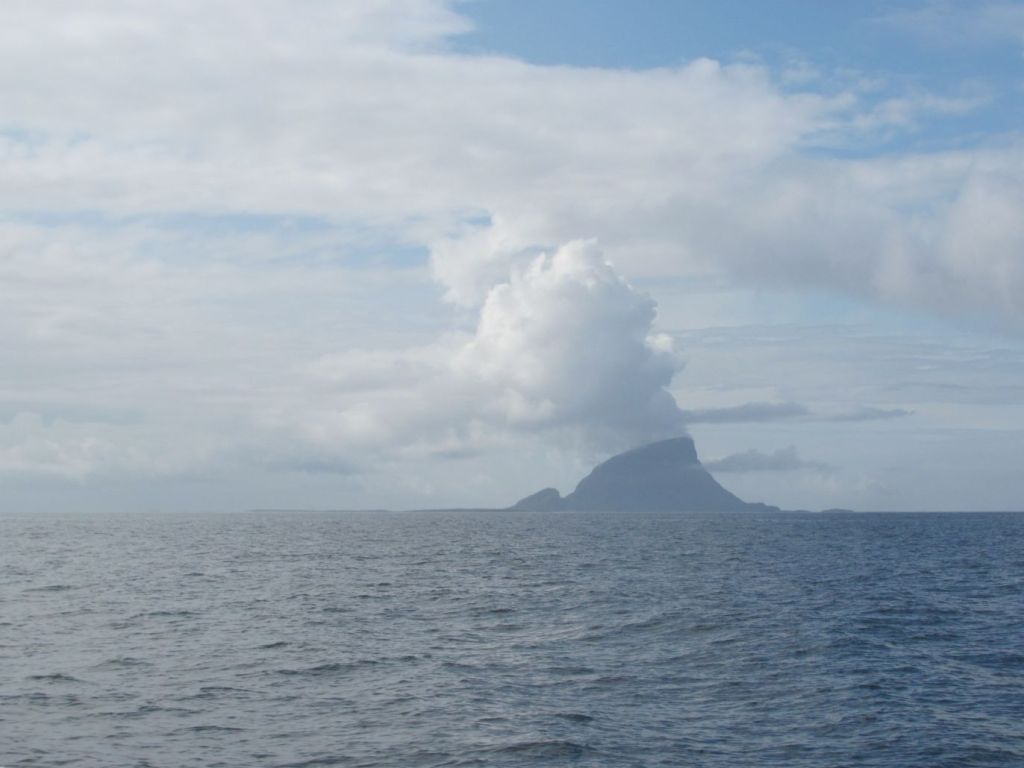
Lovund – volcano?

The wind strengthens in the afternoon, and we have a nice sail with the genoa only, arriving at Sandnessjøen in the evening.

The next morning we visit the Tourist Information Office to find out if there is anything we should see in Sandnessjøen.

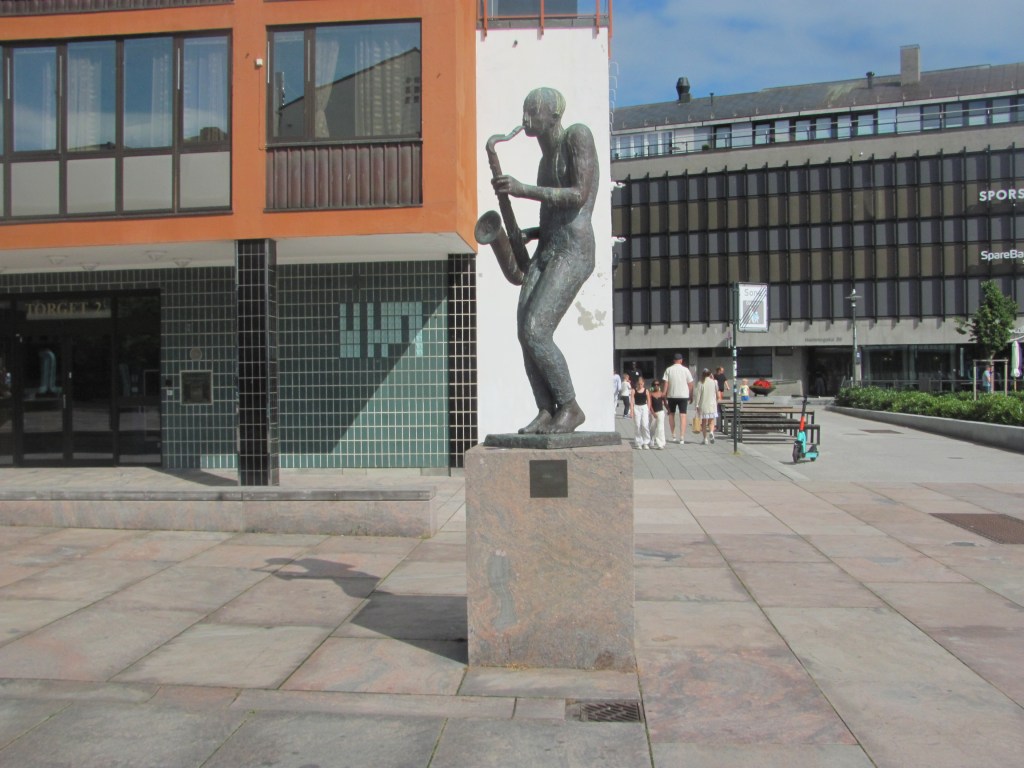
“There’s not much here”, the man behind the desk in the Tourist Information admits. “It’s mainly a setting off point for trekking and skiing in the Seven Sisters. But one thing that might be of interest is the Petter Dass statue in the town centre. He was a Lutheran priest back in the 17th century, who was born on the island of Dønna across the fjord from here. He wrote a lot of texts and hymns, which were used right up to the present. He is seen as an important literary figure who put northern Norway on the literature map, so the town has made quite a thing of him.”
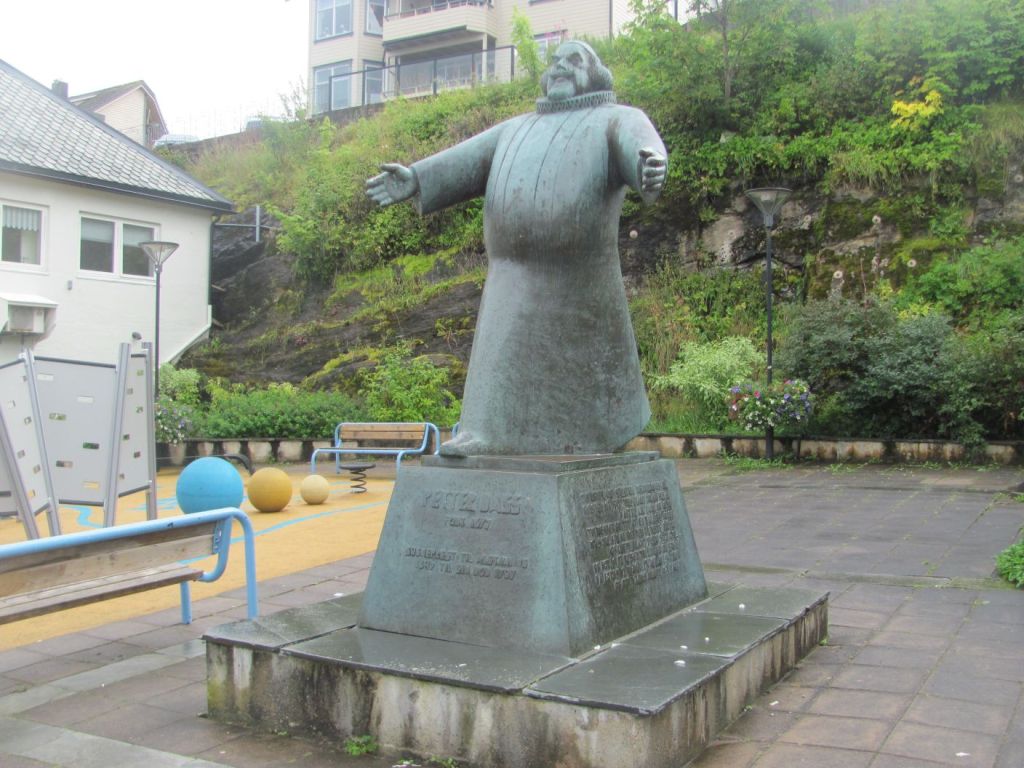
Petter Dass statue, Sandnessjøen.

“Yes, we keep coming across his name in our travels”, I say. “There was a Petter Dass walk on Lovund and a Petter Dass chapel on Træna.”

“Well, since you have your own boat, you might also be interested in seeing the giant statue they made of him on one of the skerries in the fjord”, the Tourist Information Man continues. “The base of it gets covered by the tide, so it really looks like he is walking on water. The story behind it is that the king requested him to give the Christmas sermon in Copenhagen, but for various reasons Petter didn’t receive the request until the day before Christmas. Myth has it that he made a deal with the Devil to fly him there in time in return for the Devil gaining the souls of anyone who fell asleep during the sermon. Of course, Petter gave such a powerful sermon that no-one fell asleep.”
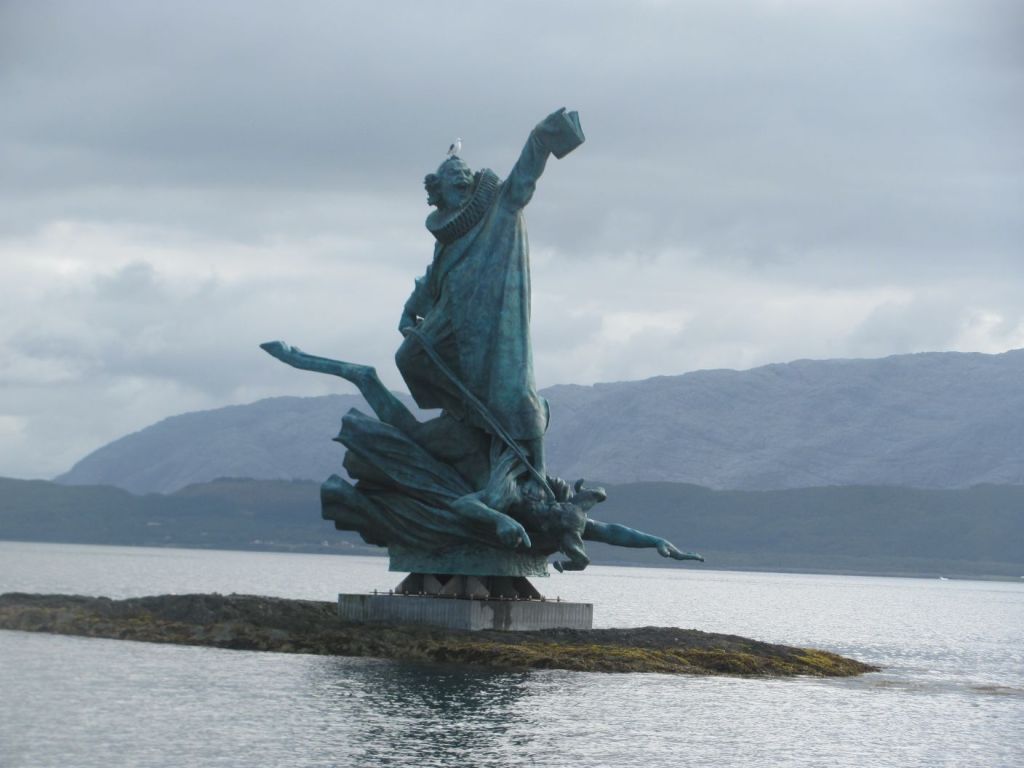
Petter Dass riding the Devil to Copenhagen.

In the morning, we push on southwards towards Vega. The wind is from the south-west, more-or-less just where we want to go, so we need to tack. It’s slow going, but we make some progress. We feel smug when we see other yachts pass us with their sails furled away and their engines running. Purists, us! Well, sometimes.
Between tacks, I recall a book that we had both read over the winter, Place of Tides, by James Rebanks. In it, he tells the story of Anna, one of the ‘duck-women’ of Vega. He spends a spring and summer living with her and her helper Ingrid, learning about her family, the history of the islands, and the decline of the eider-down tradition. It’s a delightful story about sense of place, loss of the old ways, and finding a way to live more deliberately and with purpose. We are both keen to visit Vega and learn more of this ancient practice and life on its archipelago.

The bulk of the island of Vega looms out of the haze, its top wreathed in cloud. We had initially planned to stay at the harbour at Igerøya on the east of the island, but the First Mate has been on the phone.

“I talked to the UNESCO Vega Archipelago museum”, she says. “They say the best thing to do is to come to Gardsøya on the north of the island. You can tie up right next to the museum. The problem with Igerøya is that you need to get a bus to the museum and they only run at certain hours. Gardsøya is much easier.”

I haven’t planned a route to Gardsøya, and to get there we need to thread our way through an intricate system of shallow channels and low-lying islands, all the time avoiding submerged rocks and drying mudflats. But we have good charts, and we decide to give it a go.

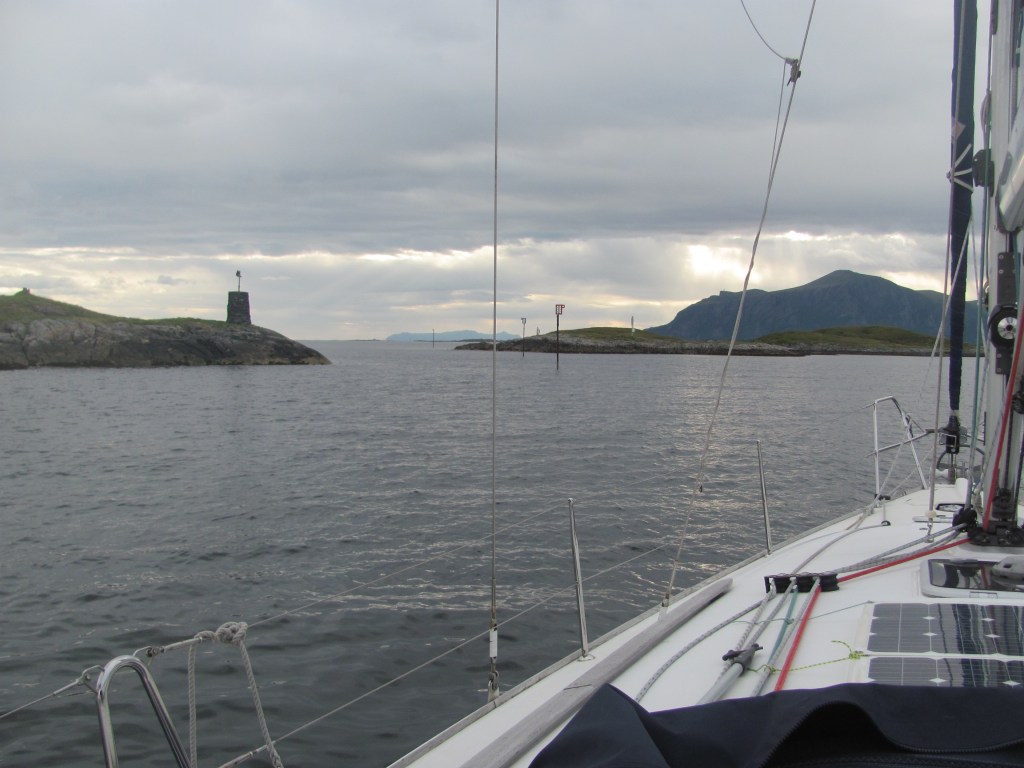
It’s a tortuous route, but at least it is well marked. We get good at identifying the marker poles and beacons and matching them with those shown on the charts. On either side, dark jagged lumps of rock slide past, and the depth falls on occasions to just a metre or so clearance below the keel. But somehow we make it, and soon we are edging our way gingerly into Gardsøya harbour and to the pontoon below the distinctive UNESCO museum. We are the only boat there.

“Well, that took a bit of concentration”, I say, breathing out. “But at least we made it.”
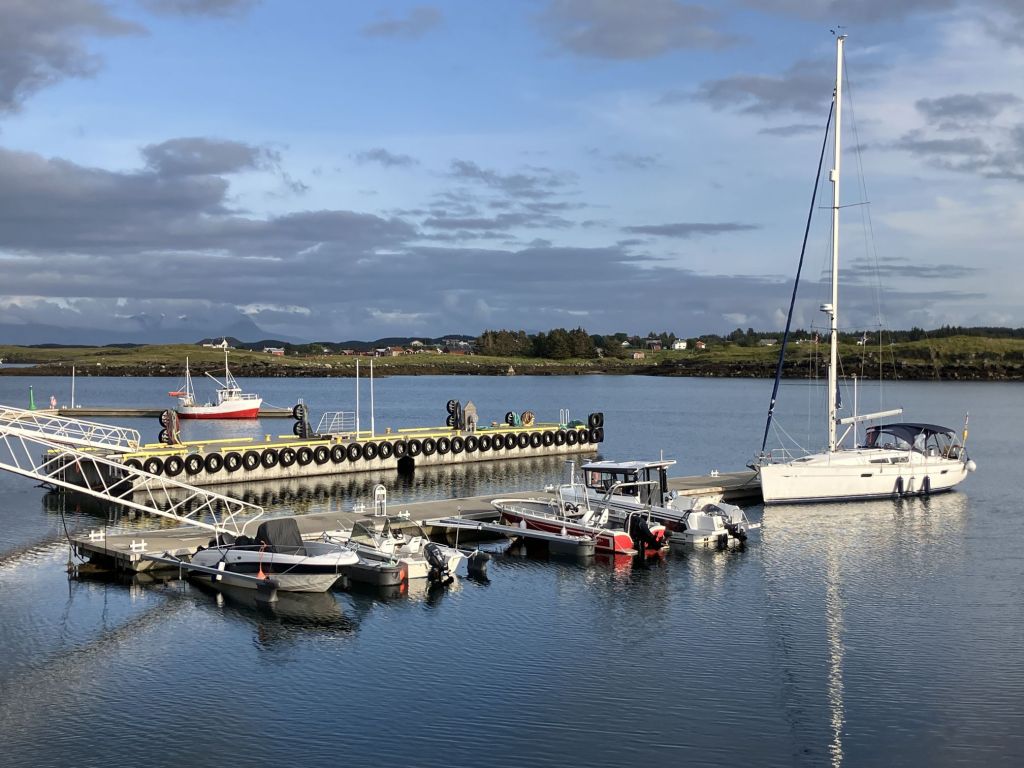
Gardsøya harbour, Vega.

Not long after we tie up, we see another boat entering the harbour.

“It has a British flag on it”, says the First Mate. “I wonder who it is?”

It turns out to be the Chairman of the Cruising Association, Nick, in his boat Spellbinder, along with his wife Sue, and two friends. We also belong to the Cruising Association.

“We were just thinking of having an eclipse-watching drink”, says Nick. “Would you like to join us?”

It’s partially cloudy, with patches of clear sky. Two G&Ts later, it’s completely cloudy, with no sun at all.

“Oh well”, I say. “It looks like the eclipse has been eclipsed. You can’t win them all.”
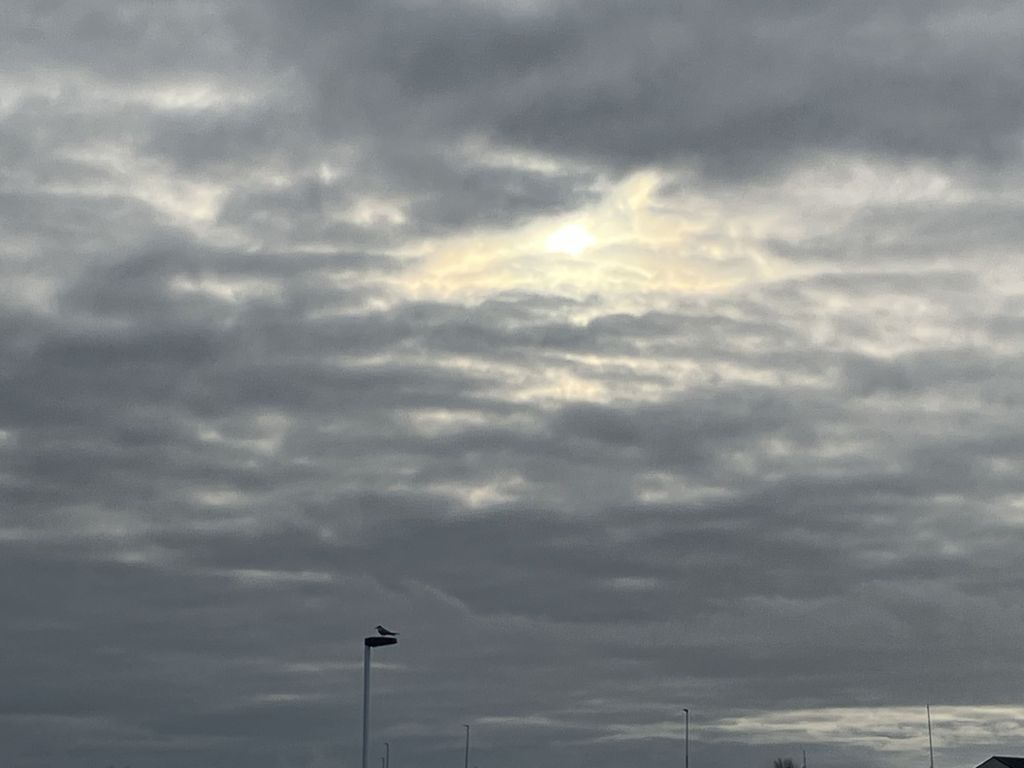
The eclipse that wasn’t. Even the birds didn’t care.

In the morning, we walk up to the museum.

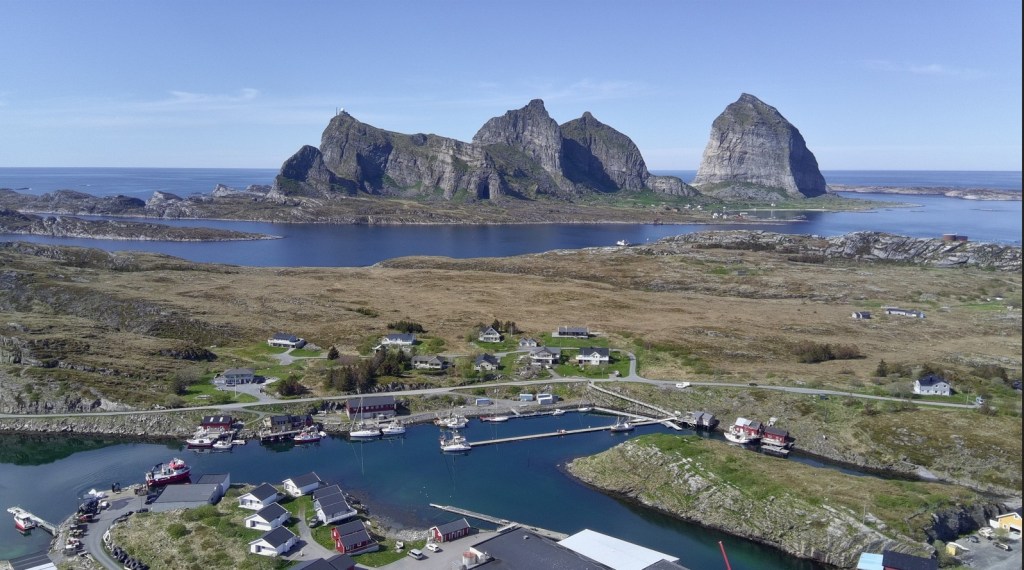
“The UNESCO Vega Archipelago museum is a tribute to the sustainable way that generations of fishermen/farmers have lived in an inhospitable seascape near the Arctic Circle, based on the now unique practice of eider-duck down harvesting, and celebrates the contribution made by women to the eider down process”, the museum brochure tells us. “The Archipelago was included into the World Heritage List in 2004.”
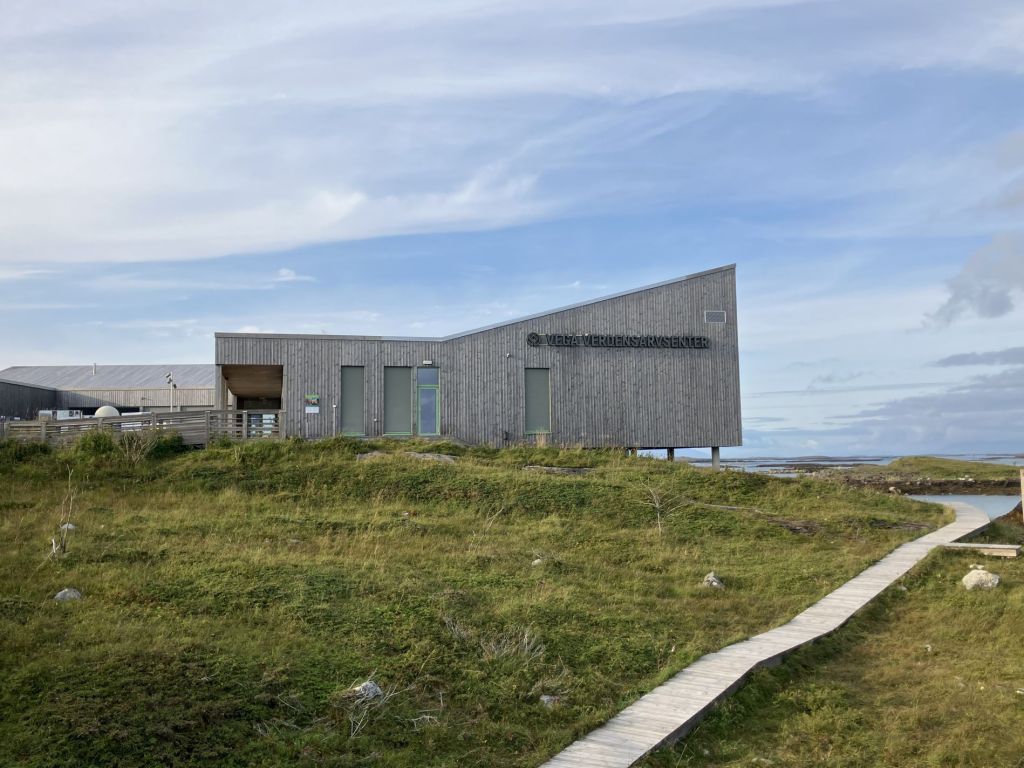
The UNESCO Vega Archipelago museum.

A film is just starting in the small cinema.

“After the ice retreated 20,000 years ago, the land started to rise”, it tells us. “Vega itself was settled by hunter-gatherers from Northern Europe about 11,000 years ago. But the low-lying islands and skerries didn’t really appear until much later. They weren’t settled until about 1500 years ago, when the fishing/farmer and eider-duck tending culture started to develop. By the time of the Viking era in 900 AD, the Archipelago was already an important centre for eider-down production. It has carried on since then to the present day.”
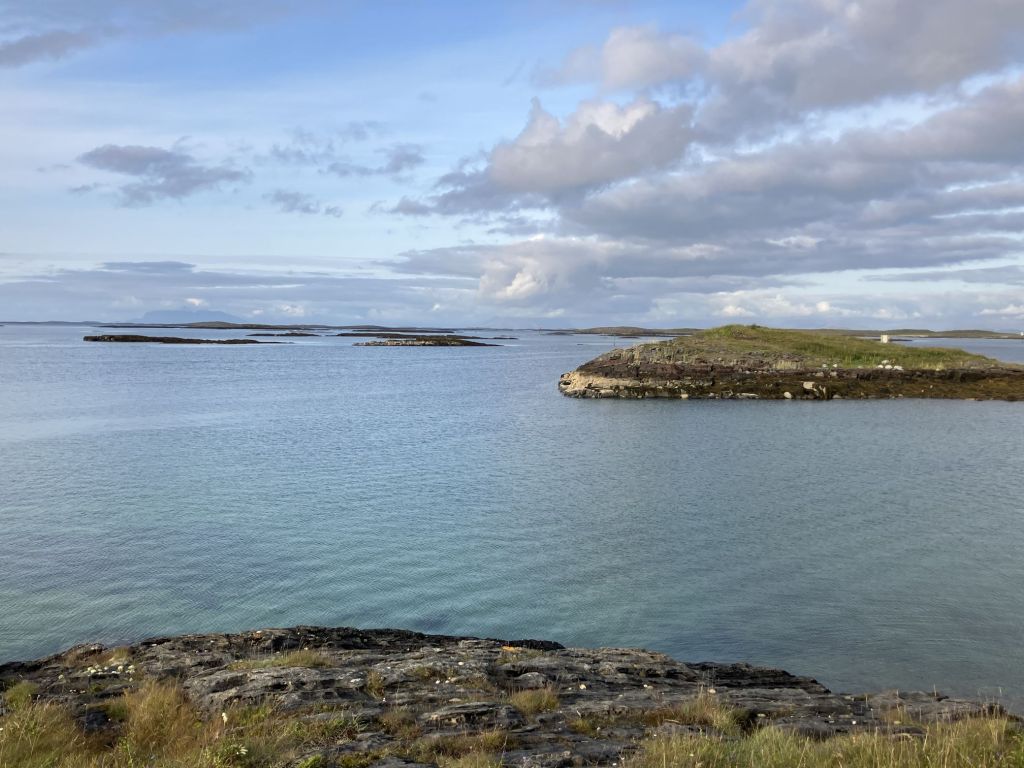
The Vega archipelago.

“The ducks return from their overwintering areas around March to mate, after which the females always return to the same breeding sites and the males leave”, the film continues. “The eggs are laid in May and June. After hatching, the ducklings stay in the nests for a few days before they venture to the sea, and swim with their mothers for the rest of the summer. Females and males meet up again in the wintering areas in late autumn to form new pair bonds.”
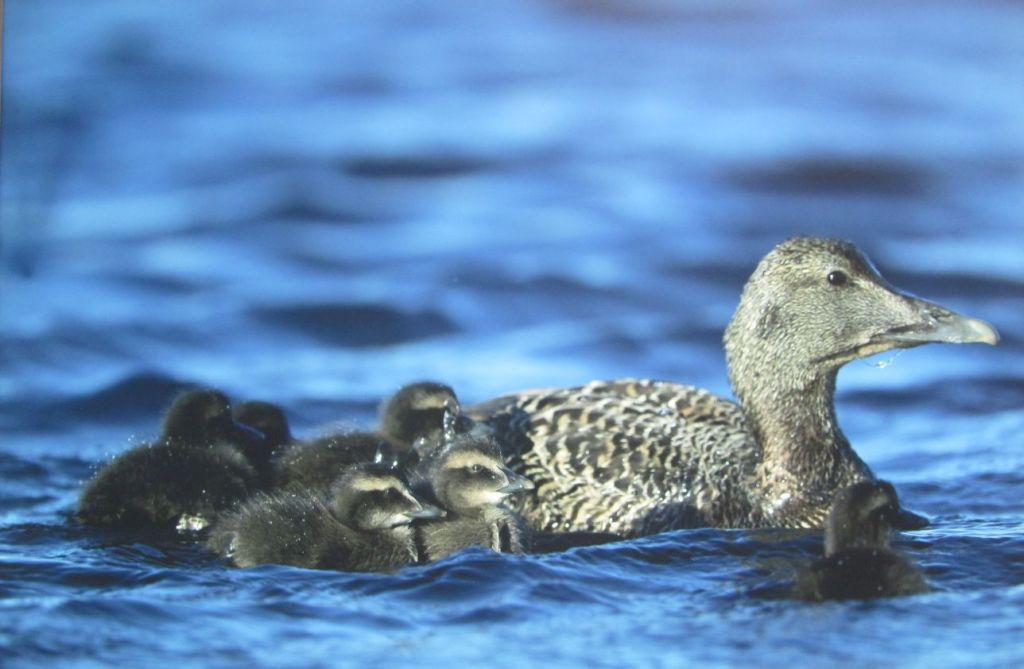
Eider duck mother and her ducklings.

“Over the years, the islanders learnt how to build small nesting houses to protect the birds, using seaweed to make the shape of the nest which the ducks line with their own down. At the end of the season after the ducks have left, they collect this down, clean it, and sell it. It takes 60-70 nests to make one eider down duvet. One duvet is worth as much as a cow. But it’s important to realise that these are wild ducks, not domesticated ones.”
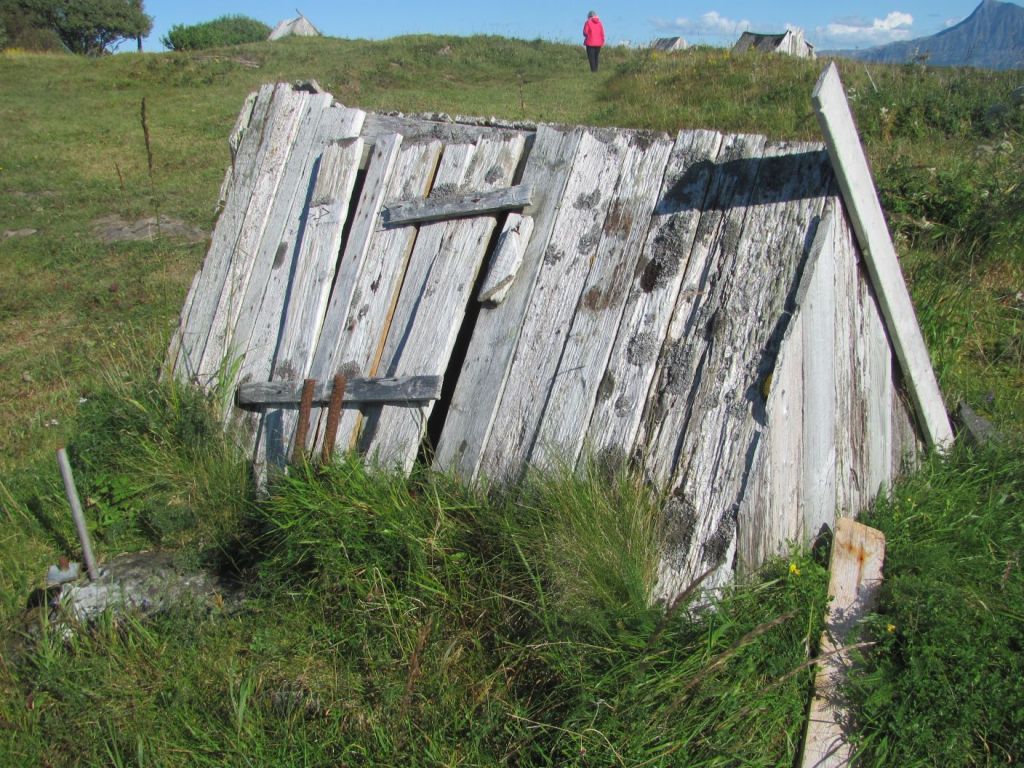
Eider duck house, Fleinvær islands.

“The population of the islands was at its peak in the 1900s. Then it started to decline due to government policies to encourage people to move to the cities for ‘proper’ work rather than persisting with these antiquated practices. But slowly this view changed, with the UNESCO World Heritage status now having given the archipelago a new lease of life.”

The film comes to an end, and we move on to the rest of the museum.

The section on the geology of the archipelago finally clears up a minor mystery for me. When we were on the Fleinvær islands, we had seen layers of rock that were pockmarked with cavities, but, not being a geologist, I had not been able to find a satisfactory explanation for what these were. Had they been where bubbles of gas were trapped in some volcanic lava long ago? It seemed unlikely, as most rocks on Norway’s coast are metamorphic rather than volcanic in origin.
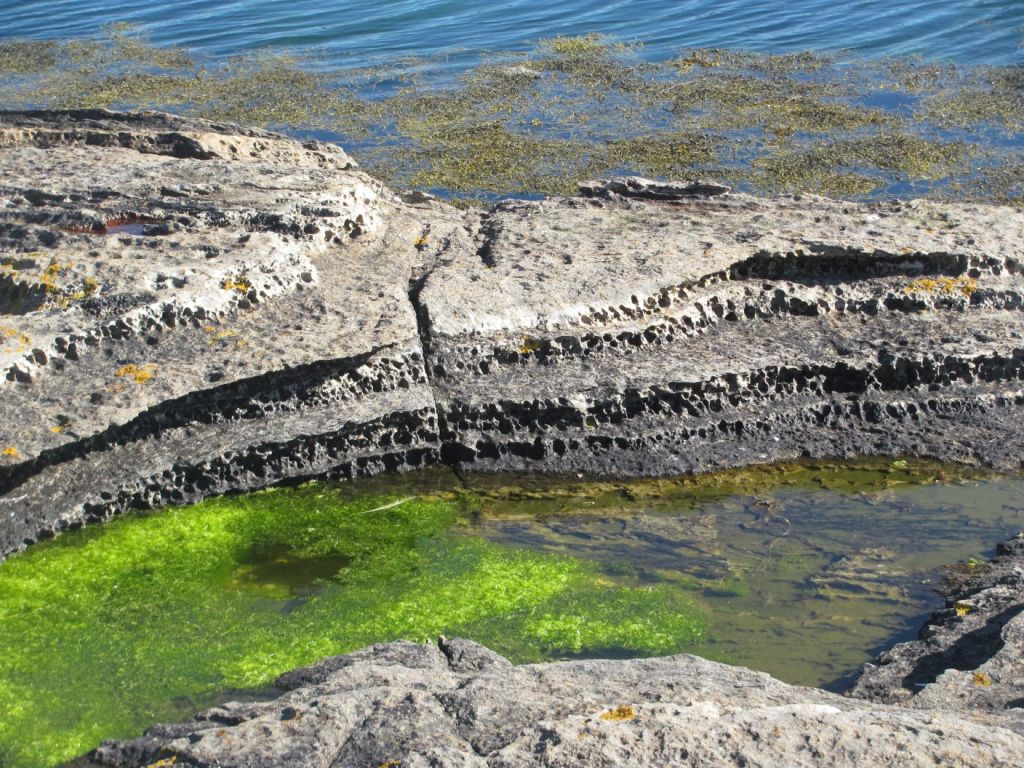
Layers of cavities, Fleinvær islands.

“The story starts 600 million years ago”, one of the panels explains. “Lime particles attached to slimy bacteria settled to the bottom of the ocean and were sandwiched between layers of sand and clay. Then when the two continents of Laurentia and Baltica collided millions of years later, the enormous pressures transformed the limestone into marble.”

“Marble is a relatively soft rock, so when these layers were exposed again, molluscs called piddocks burrowed into the marble to create a home for themselves to live in and to obtain raw material for their shells. Acid rain has since widened these pits and sharpened the edges.”

As we leave the museum, the man at the front desk stops us.

“Close your eyes and cup your hands”, he says. “I am going to put a ball of eider down in them.”

We close our eyes and wait. And wait. Nothing happens.

“You can open them now”, he says.

We open our eyes. In our cupped hands is a large ball of down. It weighs nothing.
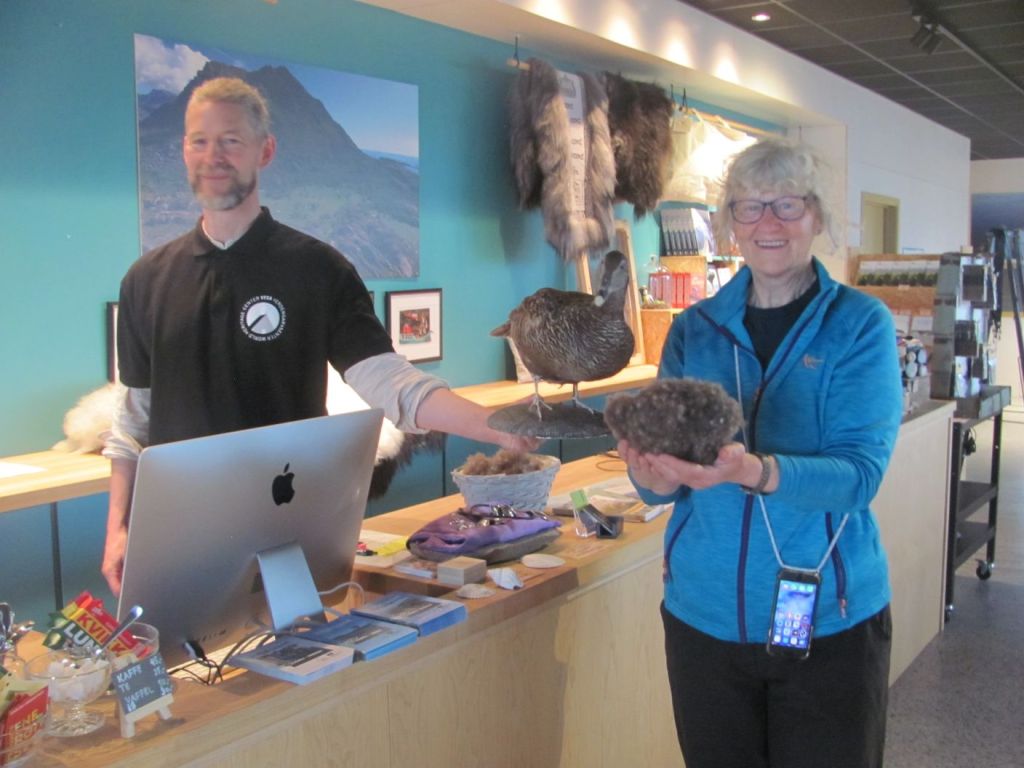
As light as a feather.

We walk slowly back to the boat.

“It’s interesting about the Norwegian government’s policies to move people away from the islands in the 1960s and 1970s”, says the First Mate. “It’s a similar story to what we heard in Myken. Discarding the old ways in the name of modernisation.”

“But I wonder if what they are doing now is truly sustainable?”, I say. “It’s good that these traditional practices are not being lost, but preserving them is dependent on an influx of money to keep them going. If budgets get tight, I wonder if that can continue?”

A communications hub, prosperous art, and a remote anchorage

We leave the next morning and sail down Tjeldsund, starting our long journey southwards. We have decided to leave Ruby Tuesday over the winter in Trondheim again, which even though itself is quite north, is still around 350 nautical miles away from where we are now.

The wind is from the west, and we manage a pleasant close reach. The tidal current is with us and we make 6 knots. It’s not long before we reach the Tjeldsund Bridge where the fjord narrows, and the current strengthens. Soon we are doing a speedy 7½ knots.

“It’s hard to believe we were just up there yesterday talking to that girl from New Zealand looking down at the boats passing by”, says the First Mate. “Now it is us that is passing by.”

Tjeldsund Bridge,

It starts to rain heavily, and the visibility falls.

“There’s an anchorage just up at this next bend”, I say. “Ulvika. We could anchor there for the night and continue in the morning. I can’t see anything through all this rain, and we are missing all the nice scenery.”

“Sounds like a good idea”, says the First Mate. “I’ll put on my rain jacket and get the anchor ready.”

We drop anchor in a little bay off the main stream of the tidal current, and chill out. The rain eventually stops. A boat full of fishermen drifts into sight.

“Things have hardly changed at all”, I say. “They look just like the Stone Age carvings that we saw in Alta.”

Timeless pursuit?

In the morning, we continue on down the Tjeldsundet. We catch the wind coming down the fjord and sail with the genoa only, making a respectable five knots. The clouds clear and we are left with a beautiful sunny day.

Sailing down the Tjeldsundet.

“This is the sort of sailing I like”, says the First Mate dreamily. “Not too windy, not rolling too much, and no heeling. Not to mention nice warm weather. This is the life.”

We eventually make it to Lødingen, a small town at the entrance to Tjeldsundet. Two pontoons are available for guest sailors. A small boat is tied up to the other side of the pontoon. As we moor, a man and three women arrive.

Tied up at Lødingen.

“We’ve just come over from Kjærfjorden to do some shopping for groceries”, the young man in his mid-twenties tells me, gesturing across the wide expanse of Tjeldsundet. “We have a family cottage over there where we are staying in for the summer. This is my mother and grandmother, and this is my sister. We are three generations here. Every summer we come and spend time with each other in the cottage.”

I ask him about the history of Lødingen.

“It’s interesting you should ask”, he says enthusiastically. “I have just been reading up about it. It started off as a fishing village, like most of the other small places around here. Then when the telegraph was invented, the government was under pressure to connect up a lot of the small villages. The argument was that fishermen could become more efficient by calling each other up to let each other know where the shoals of fish were. In the end, the government agreed and decided to make Lødingen the communications hub. Telegraph workers needed houses, shops and schools, so the population really grew.

“I suppose it is fairly central here”, I say. “Between the north of Norway, Lofoten, and Nordland. So it made sense.”

“Yes, and not only that”, he continues. “When the Hurtigruten ships started up in the 1890s, Lødingen became one of the main ports of call. So it then developed into a transport hub where smaller ferries from the surrounding areas would take passengers back and forwards to the Hurtigruten stops in Lødingen. That brought even more prosperity to the town. Even now it is still a hub for the bus services.”

Relics of a bygone past.

We chat for a while, before they clamber into their small boat, start the engine, and wave goodbye.

“That was pleasant”, says the First Mate. “And the grandmother is a sprightly old bird. Did you see they way that she jumped into their boat?”

I decide to walk over to the small boats marina on the other side of the village to check out the fuel availability. We need to top up. When I get back, the First Mate is talking to a man who has come down to fish from the pontoon. It turns out that he is a Canadian and has come over to Norway on a working visa for a year. He is working at a refugee centre nearby, teaching them the principles of Norwegian society before they are given permission to  stay.

The First Mate learns about refugees.

“Surprisingly, a lot of them say openly that they disagree with the equality of citizens in the West”, he says. “They think that inequality works best – you have a few people that are richer and more powerful and who rule over the majority of ordinary people. So they organise themselves around strong leaders into gangs, take their generous handouts from the state, then take to crime.”

“But surely, if they won’t agree to the basic values of Western society, they shouldn’t be allowed in?”, says the First Mate. “Or if they commit crimes, they should be arrested, tried and punished like everyone else?”
“That’s just the problem”, he responds. “There’s a lot of politics involved. Politicians want to be able to say that they are taking pity on the refugees from war-torn countries, and the police won’t do anything because they have learnt that they must be tolerant of refugee behaviour. So these gangs can operate just as they want, without much fear of retribution.”

“What countries do they come from?”, asks the First Mate.

“Unfortunately the vast majority that I am involved with are Ukrainians”, he responds. “But the government keeps quiet because they don’t want the Norwegian population turning against Ukraine. Don’t get me wrong – I have a lot of sympathy for refugees and immigrants, but in my job I do see some of the bad aspects.”

“It’s a pity”, the First Mate says later to me. “The behaviour of the few only give ammunition to those who oppose immigration, and make it worse for the genuine refugees. Surely they realise that? The authorities should be more careful about who they let in.”

“I suppose the cost and effort of making background checks on everyone who applies for refugee status would be prohibitive”, I say. “They are already pretty swamped.”

We leave Lødingen after topping up with fuel, and have a pleasant close reach across Vestfjorden until the wind dies in the mid-afternoon. We drift for a while and try our hand at fishing. I manage to catch two cod.

“That’s great”, says the First Mate. “We can have them for dinner tonight. I had been wondering what to cook.”

Crossing Vestfjorden.

We arrive in the small harbour of Tranøya in the evening, and tie up on the leeward side of the pontoon. The strong winds start to blow from the south-west. We snuggle into Ruby Tuesday.

Tranøya harbour.

“Phew, that was just in time”, says the First Mate. “It would have been pretty difficult tying up with the wind blowing us away from the pontoon. But now we are tied up, it is better for the boat to be blown off as it isn’t so hard on the fenders.”

“There are supposed to be strong winds all day tomorrow”, I say. “We’ll have to stay here. I think that I’ll put a couple of extra ropes on just to be sure.”

“I read that there is a trail of art sculptures here”, says the First Mate. “Tomorrow we can see how many we can find.”

In the morning, it is still blowing hard, but at least it isn’t raining.

“Look, here’s one of the sculptures”, says the First Mate, as we walk into the village centre. “It says that it is called Coastal Women, by Ingun Dahlin.

Coastal Women, by Ingun Dahlin.

“There’s another one over here”, I say. “This one’s called Stars Fishing in the Sky, by Harald Bodøgaard.”

Stars Fishing in the Sky, Harald Bodøgaard.

We reach the village shop. It’s an automatic one that operates 24/7.

“Don’t get caught in it like you did with the last one”, I say, remembering the time when we were on Rodøya island in May.

We buy some milk and bread, and continue our search for more sculptures. Luckily we had found in the shop a pamphlet with a map of where they are.

“Look, here’s one called All Those Too Many Things I Wanted”, calls the First Mate. “It’s supposed to represent that feeling you get when you want to do too much, but never get the time to do them.”

“I can relate to that”, I say.

Disse Alt For Mange Jeg Ville, by Anne Berit Nedland.

A woman on a bicycle stops to talk to us.

“The history of the village is quite interesting”, she tells us. “It used to be a fishing village, and did very well from herring fishing in the 19th century. But that collapsed in the early 20th century. Luckily Tranøy survived as it had also become an important pilot station to guide Swedish ships carrying iron ore down the Vestfjorden avoiding all the rocks and skerries. Pilots get paid well, so that’s why you see a lot of beautiful houses around here.”

“What is the story behind the sculptures?”, I ask.

“Well, the pilot service was eventually moved to Lødingen across the fjord as it had become a transport hub”, she answers. “But Tranøy declined again. So in the 1990s, someone came up with the idea of making art the focus of its revival. Artists’ galleries opened up, and they commissioned artists from around Norway to carve thought-provoking sculptures and erect them at different places around the village. Now Tranøy is famous for its art galleries and sculptures, with people coming from all over the world to see them.”

Tanker For To, by Annelise Josefsen.

“I read somewhere that the chapel is also part of the artistic revival”, says the First Mate.

“Ah yes, the little chapel on the hill behind the shop”, the woman says. “Yes, you should also go and see that. It was built in 2006, and dedicated to St Dorothy, an early Christian martyr traditionally associated with flowers and fruit. It was built by a local woman called Vibeke Stavøy, who was a gardener, wedding organiser, caterer and funeral director. She still owns it, but wants it to be available to anyone for quiet reflection and meditation. The view from it over Vestfjorden is superb.”

We climb the muddy path up the small hill behind the shop, and find the chapel. A woman and her dog are just leaving.

We sit looking out over the vastness of Vestfjorden with the Lofoten Wall stretching off towards the south-west, each in our own thoughts. It’s amazing how two villages have ridden the waves of change and managed to survive, I think to myself. Fishing, communications centre, and transport hub for Lødingen; herring, pilotage, and now art for Tranøy. What is it that has enabled them to do this – do they have something special, or is it something that any place undergoing change can do?

Reflection.

The winds have abated the next morning, so we sail for the harbour of Nordskop nestled on one side of a bay between two impressive mountains. As we approach, the heavens open, and we are engulfed in a deluge of torrential rain. Soaked, we tie up, and are just about to retire to a change of dry clothes and a heart-warming cup of tea.

“There’s a huge yacht just coming in!”, calls the First Mate. “It looks like she is going to tie up behind us!”

“It’s a charter boat”, the young girl on its bow tells us, as we take their ropes. “There are four of us on board. Two from Chile and two from Argentina.”

We learn later that the two Chileans have chartered the boat, and that the younger two Argentinians are employed to help sail it. I find the boat on Yacht Charter and am astounded to find that it costs €23,000 per week to charter. That’s serious money. And at 23 m in length, it is twice as long as ours. Even the mast looks twice as high.

“It makes our boat look like a toy!”, says the First Mate. “They must be very rich. Perhaps we should get to know them.”

Dwarfed.

When the rain stops, we explore the village.

“Come and have a look at this gate”, I call to the First Mate. “It’s got to be the most pointless I have ever seen.”

“Perhaps they ran out of money when it came to do the fence”, she says. “They might be saving up for it.”

As useful as a chocolate teapot?

We continue our journey south. The clouds clear, the winds are favourable, and we sail on a pleasant beam reach, weaving our way through the hundreds of islands studding the sea. We stop for the night in a small anchorage on the island of Hjelløya. There’s a buoy there for visitors, so we tie up to it. A sea-eagle watches us stoically from a knoll on the shore.

Hjelløya anchorage.

“This is a beautiful place”, says the First Mate. “I’ll get the wine out, while you tidy the ropes up. Then we can sit and watch the sun dip below the horizon.”

Hjelløya sunset.

We are no longer in the land of the midnight sun, partly because autumn is on its way, and partly because we are heading southwards. It still doesn’t get completely dark, more a twilight, but we have a definite feeling that the summer is fading.

“Look at the light on those mountains over there”, says the First Mate. “It’s gorgeous.”

Hjelløya sunset.

The phone rings. It’s our son in Australia. Even in this remote place we have reception.

“I was just ringing you up to see how you are”, he says.

The world suddenly seems rather small.

A popular pub, a colony of kittiwakes, and another naughty Royal

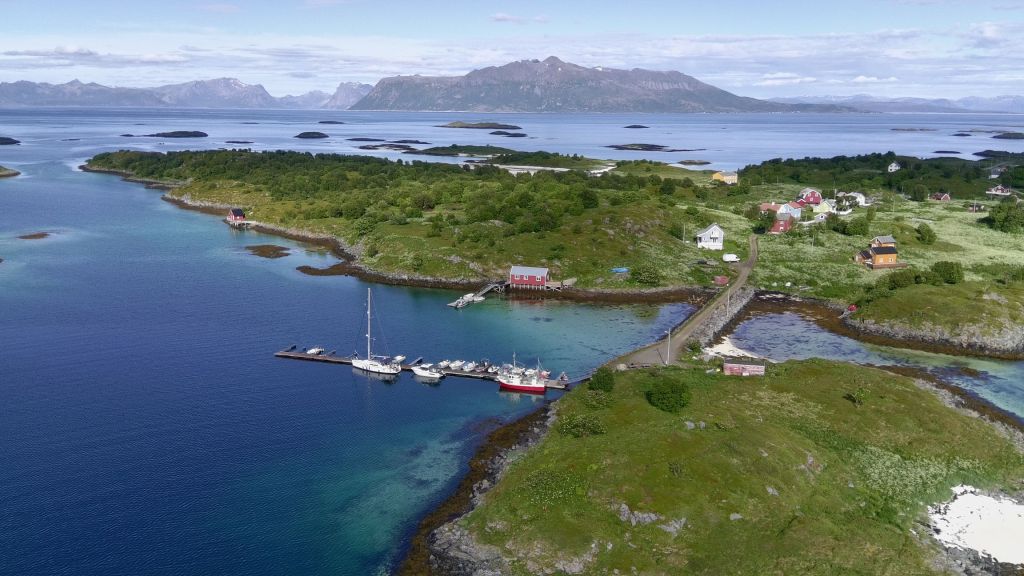
“Wow! This one is well-hidden”, exclaims the First Mate as we round a small promontory, and see the small harbour in front of us. “We would never have found it without the harbour guide.”

We have just arrived at the small island of Gårdsøya on the outer edge of the Bjarkøy archipelago. We had sailed from Andenes that morning, and had decided to stay here for a couple of days.

One side of the single pontoon is taken up with small motorboats, and a large fishing boat with the name of Kaare occupies the first place on the other side.

The small harbour on Gårdsøya.

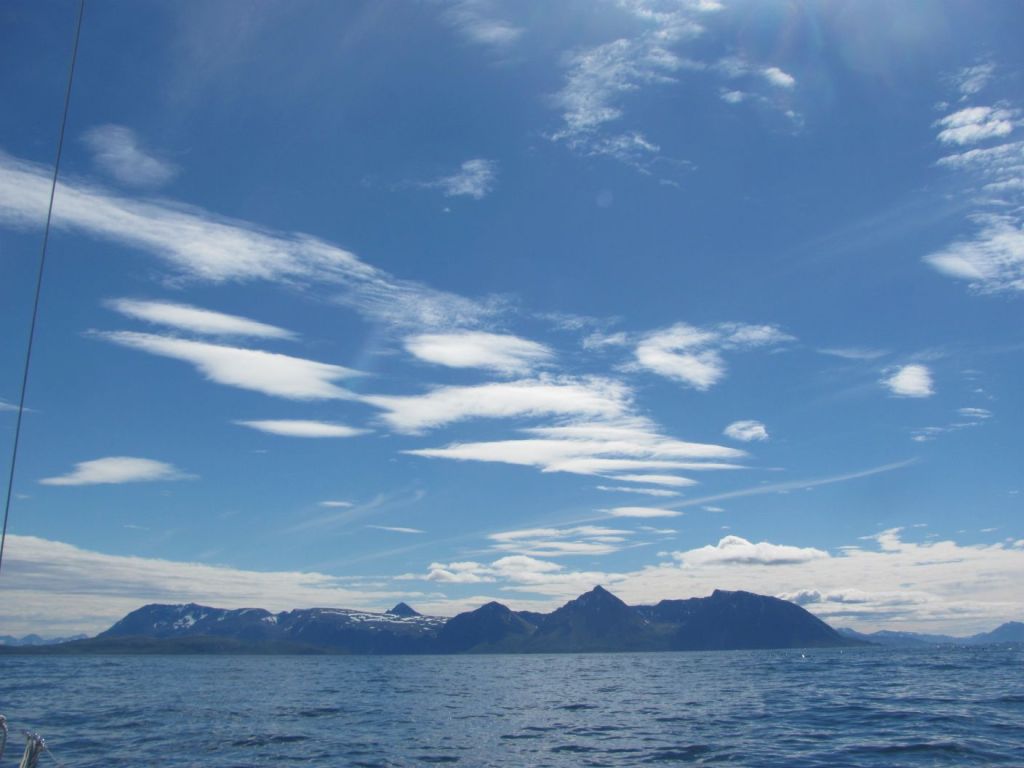
“It’s absolutely beautiful here”, says the First Mate, as we tie up. “Look at those cloud patterns. And there is an oyster catcher over there. And a couple of Arctic terns are swooping around. They must have a nest somewhere. And look at that shag sitting on top of that pole. I’ll make some tea. You rest your leg.”

Cloud patterns over the island of Grytøya.

I had pulled a calf muscle in my leg the day before while we were at Andenes, and while it is better today than yesterday, it is still quite painful.

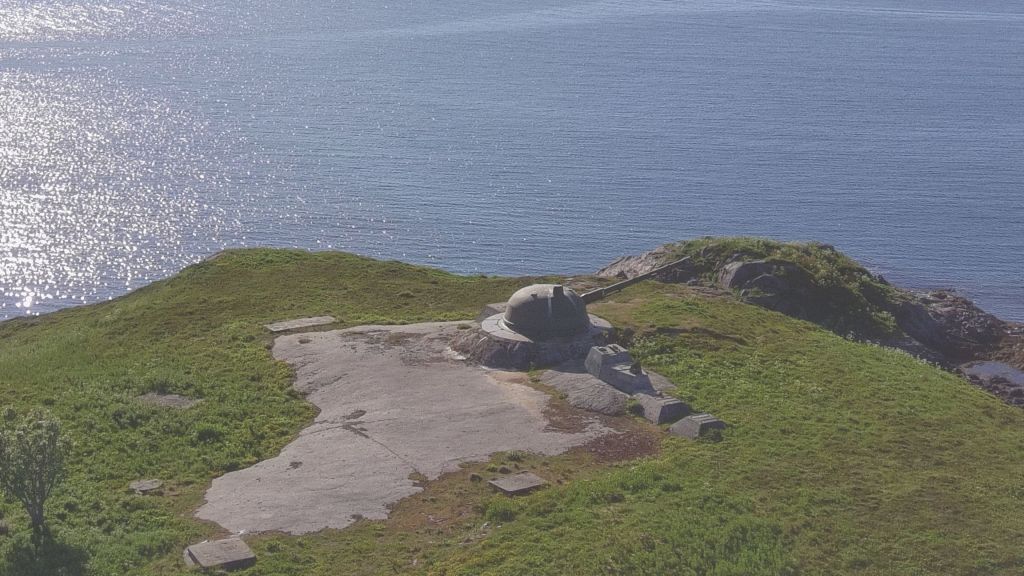
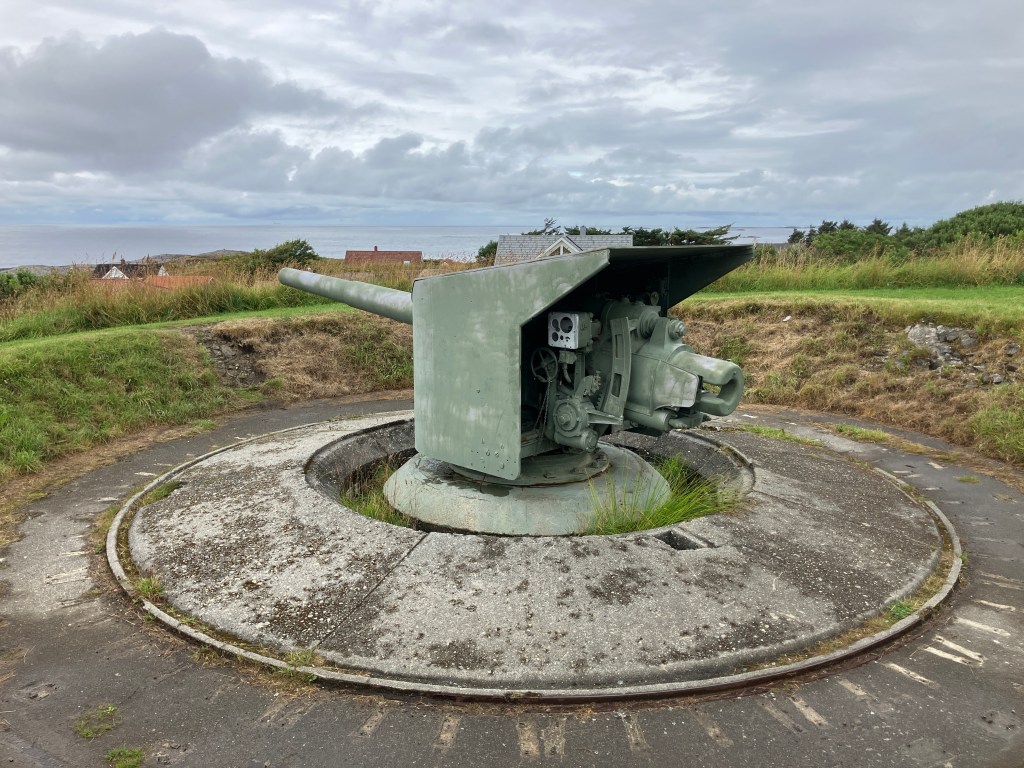
“There’s a gun emplacement over there on the neighbouring island”, I say, as we sip our tea. “German, from WW2. I’ll send the drone over to have a look.”

WW2 gun emplacement on Meløyvær.

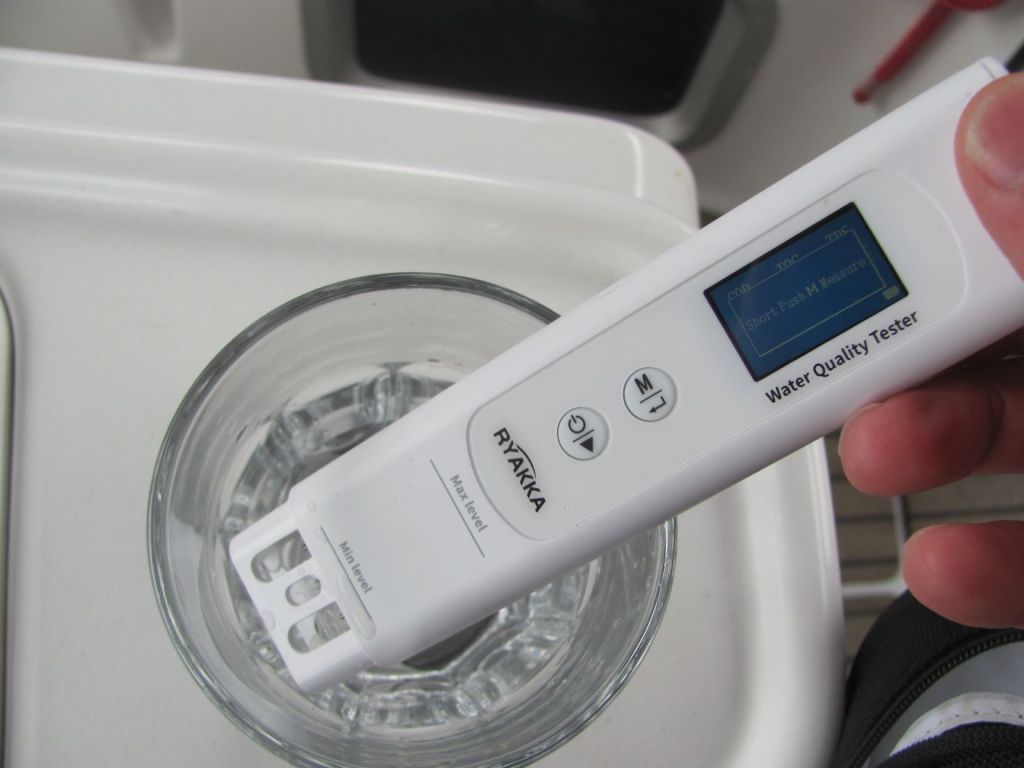
“We need to fill up the front tank with water”, says the First Mate. “You’d better get your little tester out and make sure the stuff from the tap on the pontoon is OK.”

Simon had convinced me last year to buy a small water testing device to check on the quality of water on the pontoons when we fill up our tanks. Nerds that we are, we assiduously take samples, test them, and avoid any water that doesn’t make the grade.

“You’d be amazed at the variation in water quality you come across”, he had told us. “And it’s not always in the way you might expect. Pristine looking places can have poor water, and run-down places can have excellent quality. You can’t be too careful with what you drink.”

It turns out that the quality of this water is classified as ‘Excellent’, so we fill the tanks to the brim.

Testing the water.

In the morning, we decide to explore the island. My leg needs the exercise.

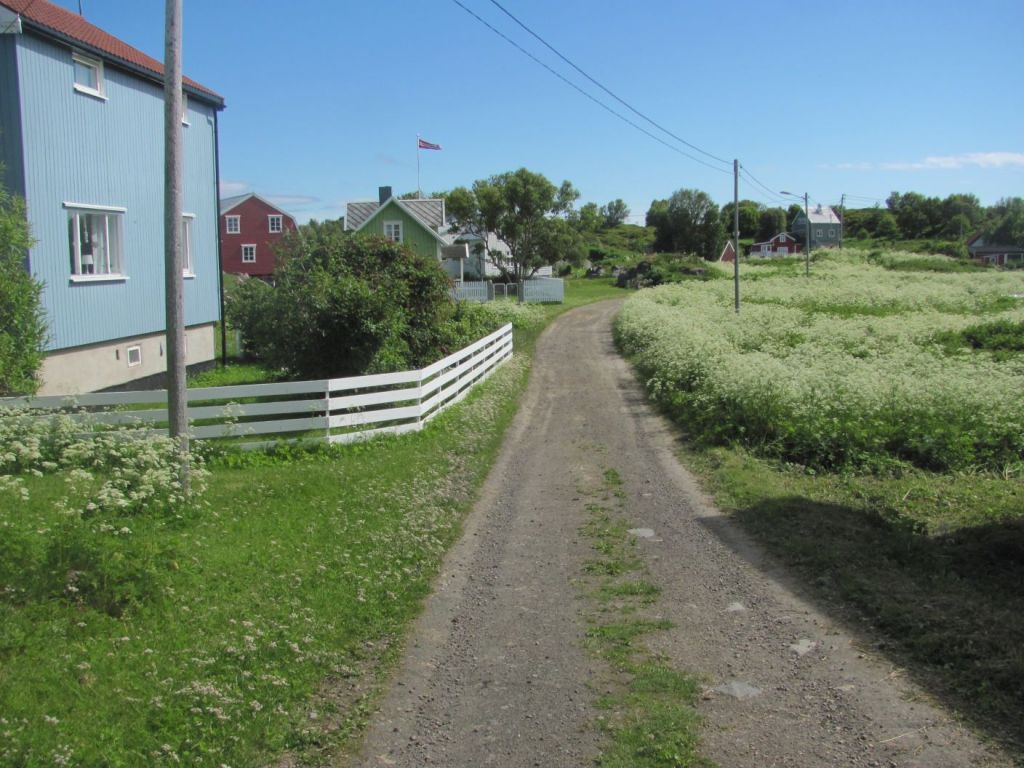
“Apparently there are seven permanent residents on the island”, says the First Mate, as we walk and hobble along the gravel track. “The rest of the houses are holiday cottages. And there are no cars.”

The ‘main road’ on Gårdsøya.

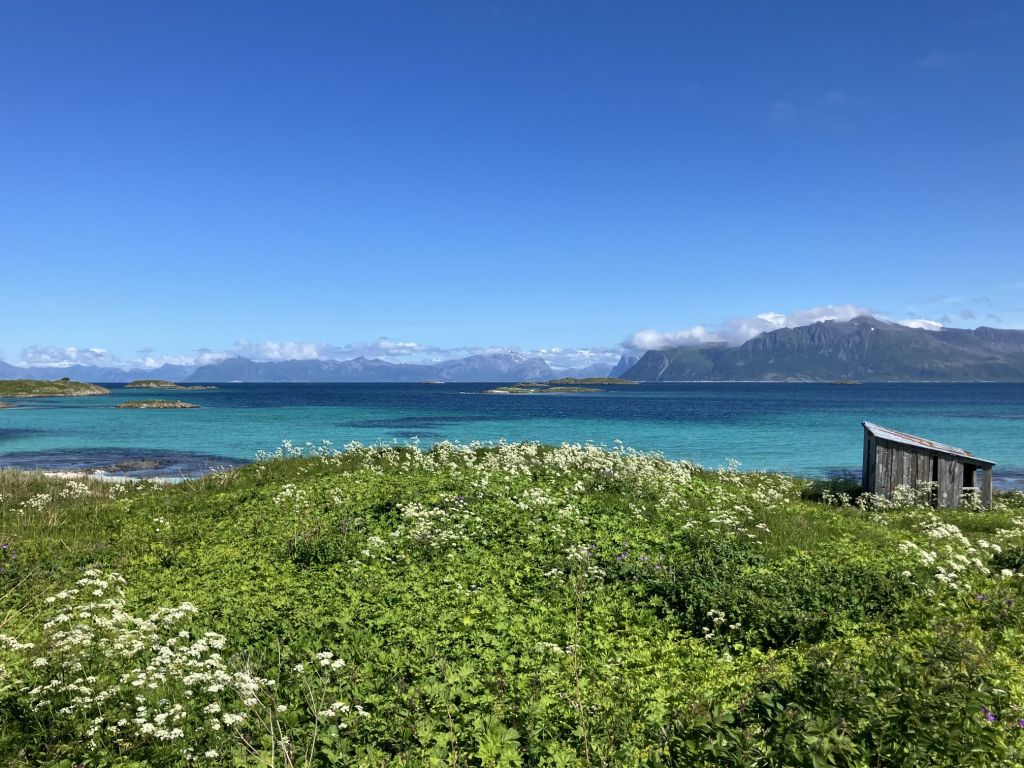
There are stunning views out towards Senja.

View towards Senja.

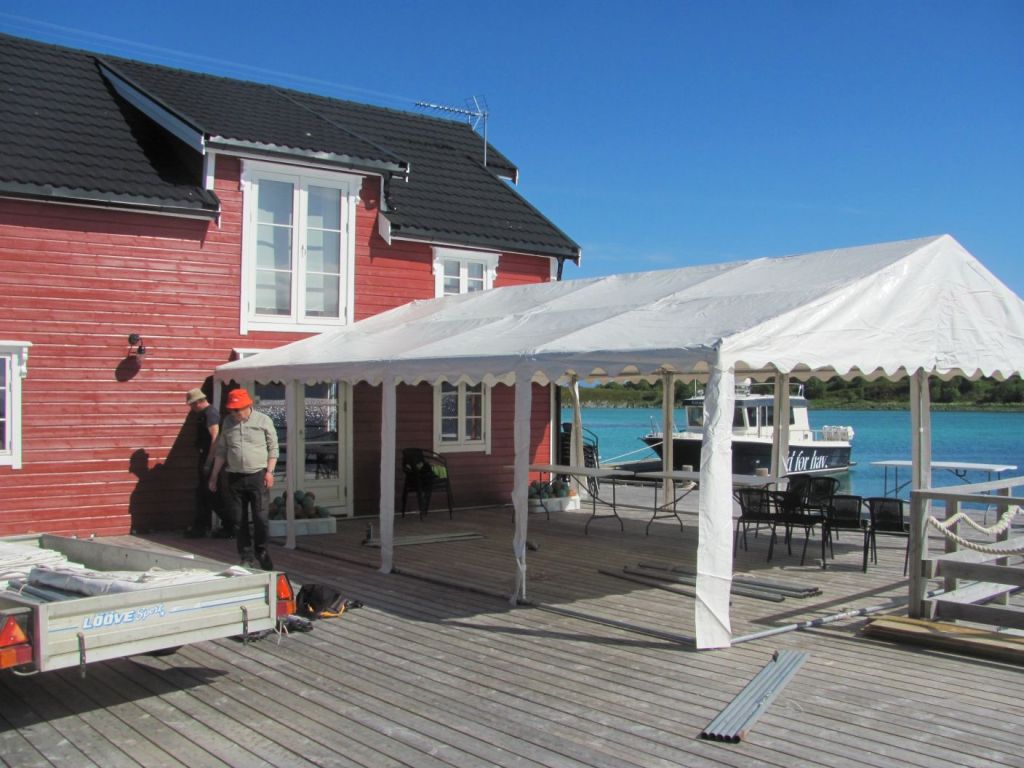
We come to a sign saying “To the Pub”. It’s a hot day, so we take the small path over the grassy field to a red building overlooking a small bay. Two men are working on erecting a marquee on the wooden decking at one side.

Wedding preparations.

“You’re looking hot”, says one of them. “Would you like a beer?”
“Well, we wouldn’t say no”, we say.

“My name is Trond”, he says as he leads us into the building. “As in Trondheim. I am the owner of the pub. We have a wedding reception booked for Thursday, and we are just trying to get everything ready for it. That’s what the marquee is all about. But I need an excuse for a break. What will you have?”
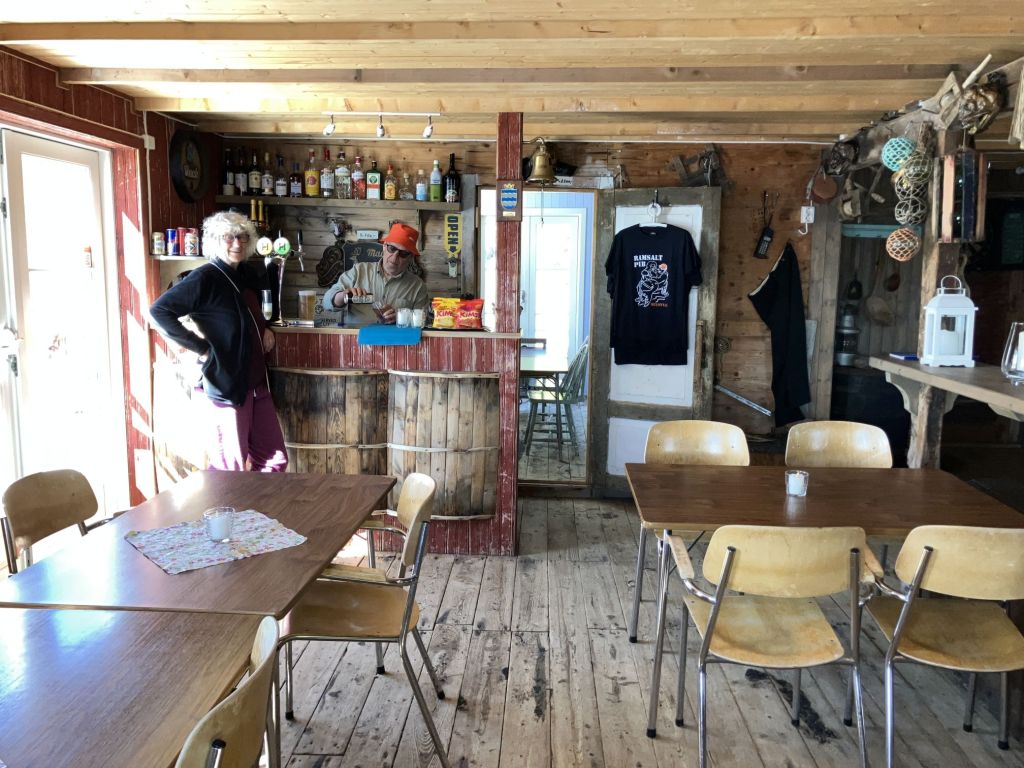
Inside the Ramsalt Pub.

He pulls a beer for me and a shandy for the First Mate.

“I was born on the island”, he tells us. “But I worked for a construction company in the oil sector. All over the world. I have even been in Scotland – Aberdeen, to be precise.”

We had already told him where we come from.

“When I retired from work, I decided to move back here, so I bought a fishing boat”, he continues. “You probably saw it at the pontoon where you are tied up. Kaare, she’s called. But I really wanted to give something back to the community, so I converted this old building into a pub where locals and visitors could come together and socialise. It’s called the Ramsalt Pub. I’m not really interested in making money from it, just providing a place where people can enjoy themselves. We’re open just on Fridays and Saturdays, and most evenings have live music and singing. Everyone joins in. It’s a lot of fun.”

The Ramsalt Pub.

“You have quite a collection of old fishing things in here”, says the First Mate, looking around the room.

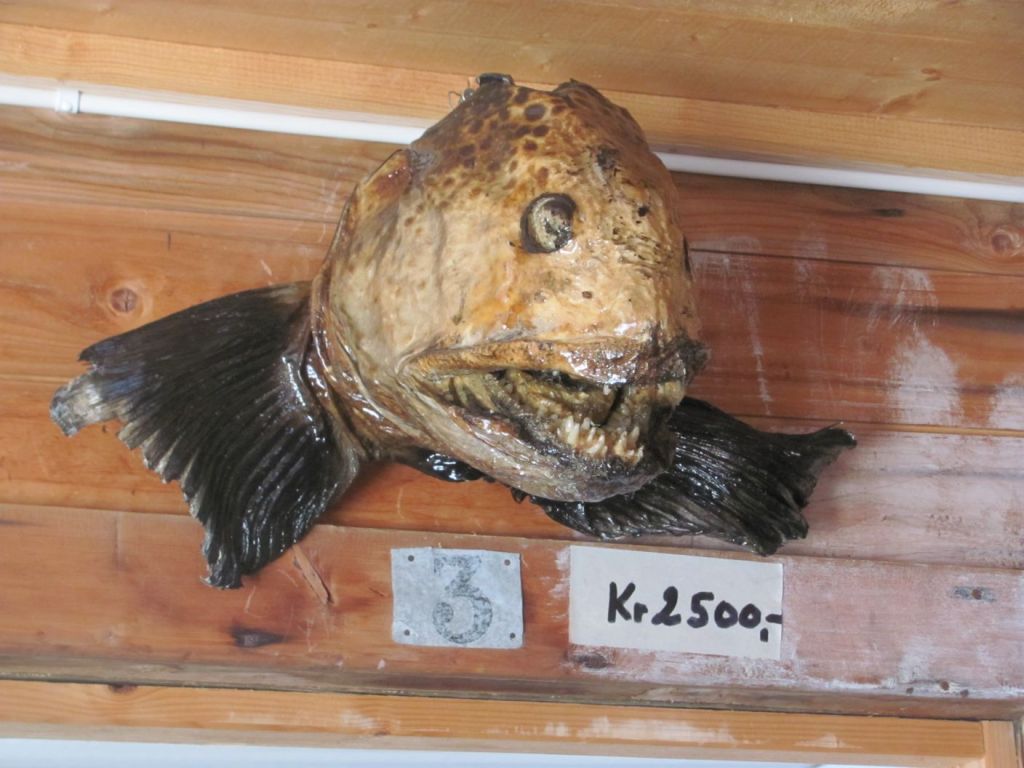
“Yes, they add a bit of atmosphere to the place”, says Trond, looking up at the head of fish mounted above the bar. “I wanted to contribute to preserving some of the island’s heritage.”

Adding to the atmosphere.

The conversation turns to international affairs.

“He’s got himself into a mess now”, says Trond. “And I am not sure how he’s going to get himself out of it without losing face.”

He is referring to the war in Iran.

“The whole war was ill-conceived and illegal in the first place”, he continues. “First of all, he rips up the perfectly good agreement that Obama had negotiated with the Iranians, then they bomb the site where the nuclear weapons were supposed to be being made, then they start more negotiations, which, by all accounts, were making some progress. Then without warning, they start bombing the place. And killing all those young girls at the school. That surely is a war crime.”

“Well, at least Europe didn’t get involved this time”, I say.

“And I am glad they didn’t”, he says. “No one wants Iran to have nuclear weapons, but when they are making some progress with negotiations, the last thing needed is to declare war. What has it achieved? The only result is that it has weakened America in the eyes of the world and strengthened Iran.”

“And now they don’t even have an agreement”, says the First Mate. “Only a Memorandum of Understanding.”

Drinks finished, we give a hand with putting up the marquee.

“Well, that was interesting”, says the First Mate as we walk back to the boat. “We always seem to meet such nice people in these remote places.”

We cast off the next morning. The shag is back on his pole, and watches us impassively as we pick our way slowly around the perches marking the shallows on each side of the entrance. We have decided to have lunch at a small anchorage on the neighbouring island of Helløya, where the sailing guide tells us that there is supposed to be a buoy to tie up to. We wend our way in through the narrow inlet, through the flock of kittiwakes bobbing on the water, only to find that a small boat is attached to the buoy. No-one seems to be on it, and a dinghy lies on the small beach opposite.

Spot taken!

“It’s funny how we hardly see any other boats around when we are sailing, but when we want to tie up to a buoy, it’s occupied”, says the First Mate. “I wonder where they came from?”

We drop anchor instead. It’s not the best of sets and we drag slightly, but we can keep an eye on it while we eat.

As we prepare lunch, I hear voices on the cliffs overhead. There are four people, looking down at us.

“They’re probably the owners of the boat”, I say.

Sure enough, two of them return to the dinghy and row back out to their boat. They collect something, then row back, this time passing near us.

“Hi, we just thought we would say hello”, they say. “We’ll be leaving soon, so if you want to use the buoy, it will be free.”

They are young, and the accent is Antipodean.

“Yes, we are Kiwis”, they say in response. “We have just bought the boat in Kirkenes up near the Russian border, and are sailing her back. We are heading back down to Oslo, but we have all summer to do it. We have some friends from Holland with us. And yes, it is a bit crammed in there.”

Ah, the carefreeness of youth!

We go through the time honoured Kiwi ritual of asking each other if we know so-and-so from our respective home towns. It is surprising how often it turns out that there are acquaintances in common. Or perhaps not surprising, given that New Zealand is a small country. But on this occasion, there doesn’t seem to be.

“We need to get back and collect the others”, they say. “We’ve left them on the shore. Enjoy your lunch and the sailing. Don’t forget to see the kittiwake colony around the corner.”

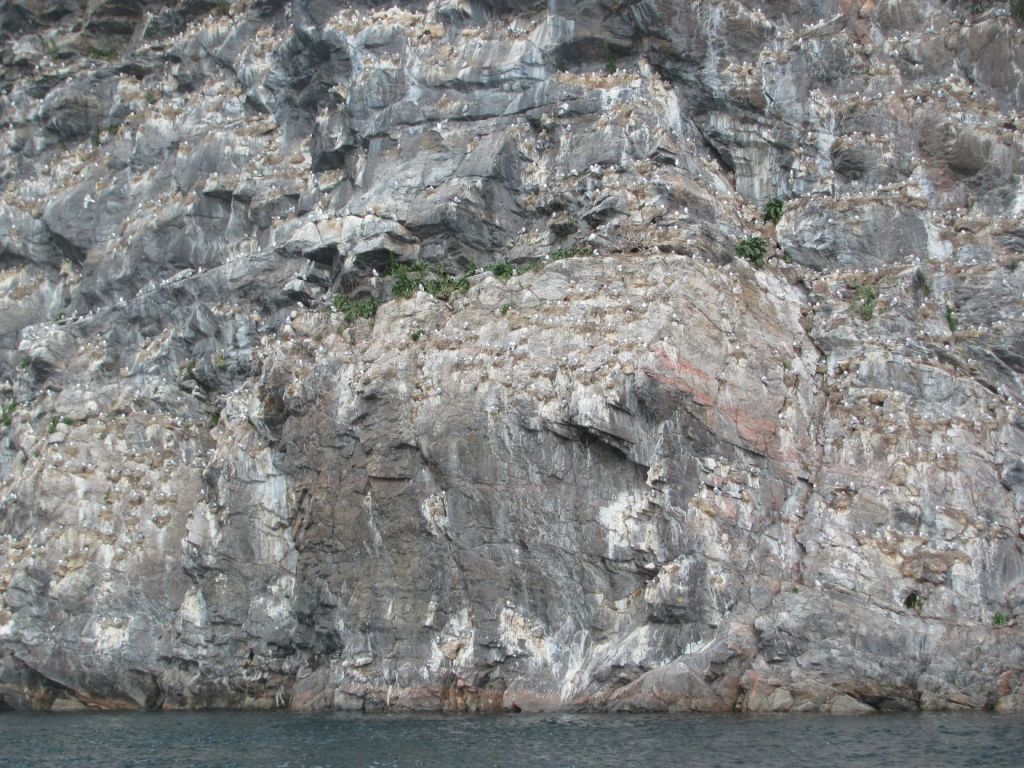
They are referring to a cliff on the southern end of the Sundsvollsundet Nature Reserve on Helløya that is a nesting site for the small white and grey seabirds. The smell and the cacophony of sound as we pass by it is overwhelming.

“It reminds me of Fowlsheugh In Aberdeenshire”, says the First Mate, screwing up her nose. “There are thousands of them.”

Kittiwake cliff.

We push on to Engenes. There the harbour is being totally reconstructed, but there is a spare pontoon to which we tie up.

“The shop closes in 20 minutes”, says the First Mate. “I’ll just nip up and get some bread and milk. Otherwise there doesn’t seem to be much here.”

Evening in Engenes.

It rains that evening, and into the next morning. When it stops, we decide to carry on, and reach the delightful small anchorage of Revshamna on the east coast of Senya in the late afternoon. The charts show a shallow bar at the entrance and it is nearly low tide, so we are a little worried that we will not be able to make it, but, in the event, we pass over it with a metre to spare. We drop the anchor in the middle of a deeper pool in the middle of the bay.

“What a beautiful anchorage”, says the First Mate. “It’s so sunny and warm. Let’s have a glass of wine and relax.”

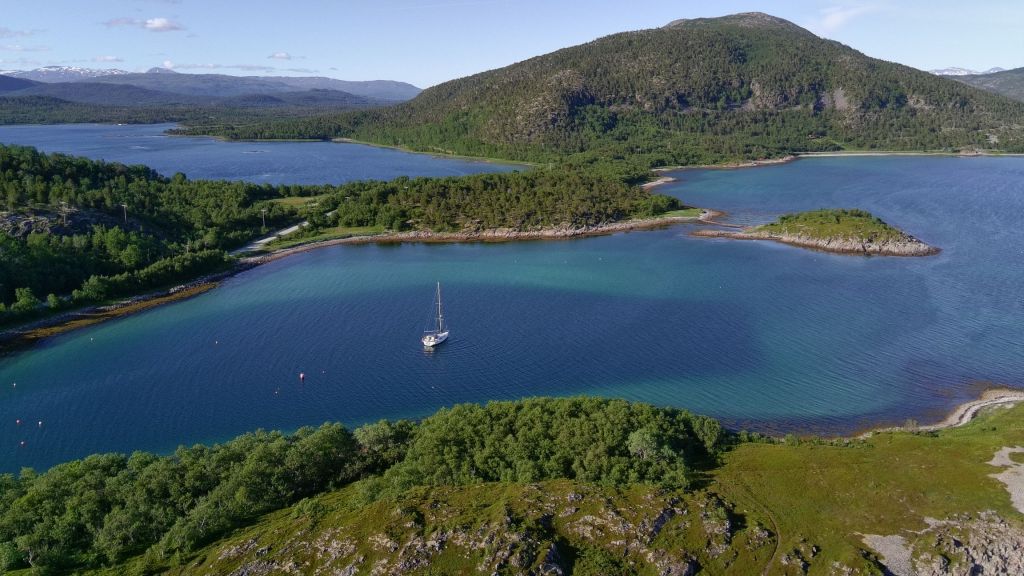
Anchored in Revshamna.

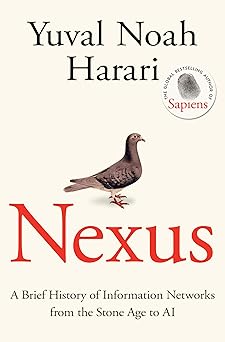
I pick up the book that I have been reading, Yuval Noah Harari’s latest, “Nexus”. In it, he argues that human history is best understood as the story of increasingly powerful ‘information networks’ rather than just technological or political progress. From oral storytelling and religious myths to writing, printing, and modern digital media, each new system for sharing information has allowed large numbers of strangers to coordinate with each other. However, each has also created new vulnerabilities—the spread of errors, propaganda, and collective delusions that can propagate across societies. What we call ‘civilisations’ are really just large networks held together by shared stories, not just facts.

“It’s an interesting viewpoint”, says Spencer, looking over my shoulder. “And a lot of truth in it. I sometimes think that you humans are not really interested in the truth of how things really are, but more in the comfortable stories that you tell to make yourselves feel good. Look at the lies that are told daily by the leaders of your most powerful countries. And yet they are just lapped up because it makes a good narrative and fits the perception that people have of themselves.”

“But surely with the advent of new tools like Artificial Intelligence, we will get closer to what is really happening?”, I say. “I find ChatGPT pretty useful for finding things out.”

Spencer snorts. “It’ll only get worse with AI”, he says. “AI is a fundamentally new kind of information system compared to the previous ones — it is the first that can generate, interpret, and act on information independently of human judgement. The risk is that this shifts power away from humans toward incomprehensible algorithms and the institutions that rely on them. This, in turn, risks undermining democracy, accountability, and even the idea of shared truth. I don’t mean that AI is inherently bad, just that it acts as a force that amplifies whatever incentives are embedded in it. How do you know, for example, that what you are getting from ChatGPT isn’t biased towards a particular world view?”

He does have a point. I don’t know.

There’s a splash in the water.

“It sounds like there are fish here”, says the First Mate, looking up from her Sudoku puzzle. “I might get the rods out.”

In the morning, it is raining when we wake up. We have a leisurely breakfast, by which time it has cleared.

“I think that we should push on”, says the First Mate. “Finnsnes is the next stop, and we need to do some shopping. We’re running low on several things.”

We arrive in Finnsnes. Originally just a small farming community, it has grown rapidly in recent years, and is now a significant centre for commerce in the region. We do some shopping to restock our provisions, and I buy a new fishing rod to replace the old one that is now worse for wear.

Finnsnes marina.

Back at the boat, I strike up a conversation with the skipper of the boat next to us.

“I see that your Royals are also acting up”, I say. Just like some of the ones in Britain.”

There is a report in this morning’s newspaper about Marius Borg Høiby, the son of Norway’s Crown Princess, being sentenced to four years in prison for rape, physical assault, and drug and driving offences.

“Yes, it has all been a complete embarrassment for the Royal Family”, he tells me. “He’s a bit of a troubled character. When he was born, his mother was a waitress and his father was in prison for drug-related violence offences. They weren’t even in a relationship, so she brought him up as a single mother.”

“How did he come to be part of the Royal Family, then?”, I ask.

“Well, our Crown Prince, Haakon, took a fancy to his mother, Mette-Marit”, he answers. “They were married in 2001, and so Marius became Haakon’s stepson. But he doesn’t have any titles, and he isn’t in the line of succession. He did work as a model occasionally, but otherwise hasn’t ever had a proper job. It seems that his step-father pays him an allowance to support his lifestyle. It would have been better if he had gone out to work and made something of himself.”

Crown Princess Mette-Marit (from Wikipedia)

“Isn’t his mother a bit controversial as well?”, I ask. “I read that she was part of the Jeffrey Epstein circle.”

“Yes, it seems from the Epstein files that she was a lot closer to him than she has admitted”, he says. “She claims that she didn’t know he was a paedophile, but she did stay in touch with him even after he was released from prison for that, so it is a bit difficult to believe her. So overall she is not very popular, and she has since been removed from patronage of various organisations. But she is very ill at the moment with pulmonary fibrosis and has just had a lung transplant, so at one level you have to feel sorry for her. But the whole affair hasn’t reflected well on Norway. I don’t think that she should ever be Queen.”

An enigmatic sculpture, a circle crossed, and a trapped crew member

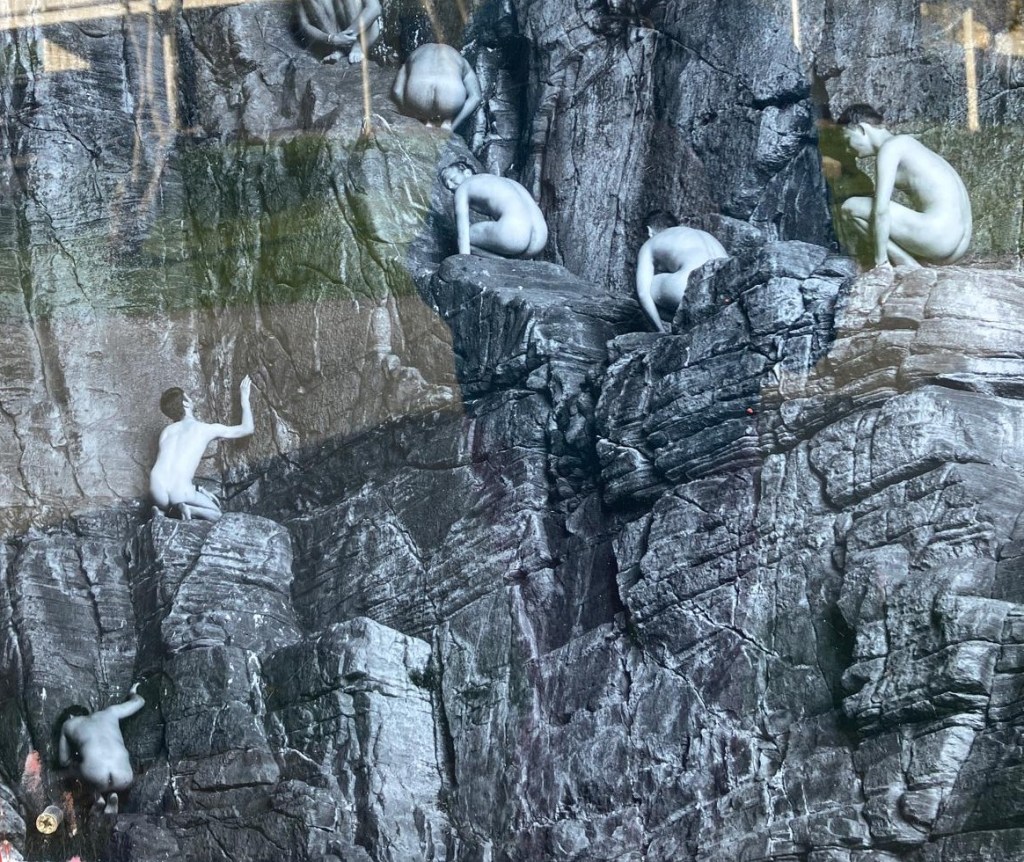
“Wow, I like these”, she says. “Oh to be young again!”

It’s a photograph of a group of young boys sitting naked in various poses on a large imposing rock.

We are on the island of Træna-Husøya after a pleasant sail from Lovund, the puffin island. We are tied up in the harbour, and are walking the 25 minute walk into the village to buy bread and milk. On the way, the First Mate has stopped at a house with photographs displayed in a glass case on the wall.

We’re both a bit old for that sort of thing, I think to myself. But I try to strike a pose like one of the boys to impress her.

“Are you having trouble with your knee again?”, she asks. “You’re standing kind of funny.”

Tied up in the harbour at Træna-Husøya.

We arrive at the supermarket 15 minutes before it closes at 1500. We manage to buy the milk and bread just in time, and reward ourselves with an ice-cream. We sit at the picnic tables outside the supermarket, enjoying the sun and watching a small motor boat coming in to tie up at the small pontoon below us. It seems to be a whole family – grandfather, Mum & Dad, and two children. They make a bit of a mess of tying up, but seem to have caught several good-sized fish.

“Pollack, I would say”, says the First Mate. “They look like the one that I caught last year.”

“It’s supposed to be the oldest continuously inhabited fishing community here in Norway”, I say, reading the harbour guide. “People have apparently been living and fishing here since Stone Age times.”

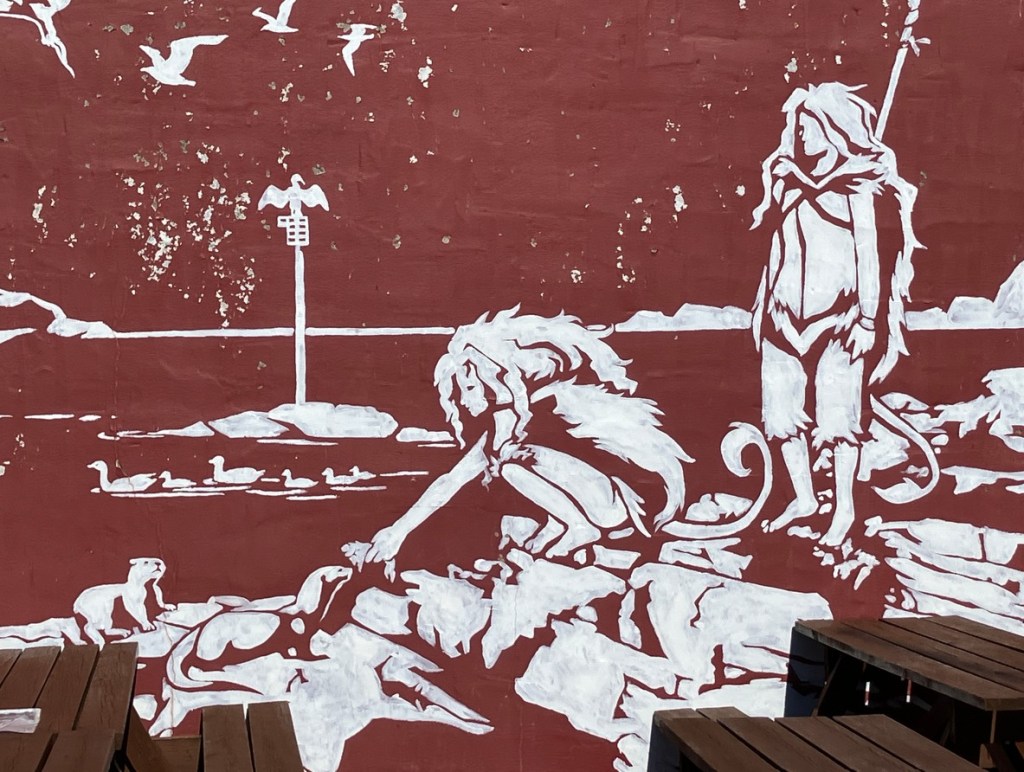
“That probably explains that mural over there”, says the First Mate. “Those two children feeding the otters.”

Mural: Early inhabitants of Træna-Husøya?

There is not much happening in the rest of the village. We come across a small café with a delicious aroma of coffee emanating from it, but which is just about to close too.

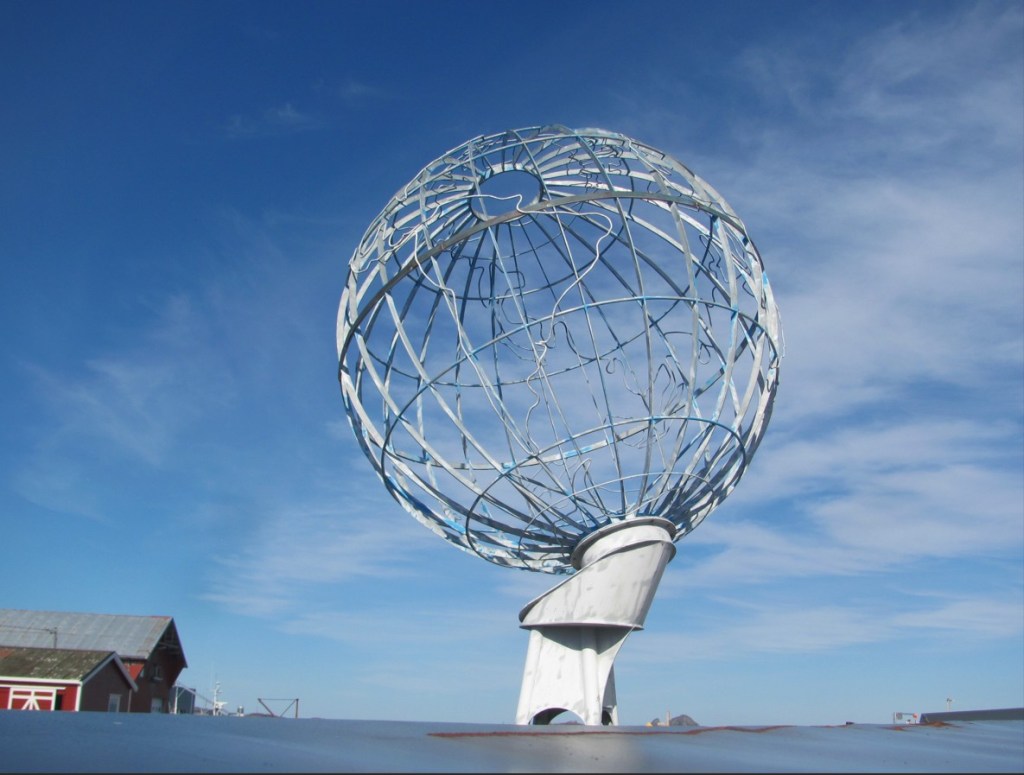
By the ferry pier, there is a globe mounted on a pedestal. “Welcome to Træna”, says the inscription at the bottom in Norwegian. “The realm that straddles the Arctic Circle.” Or words to that effect.

The Arctic Circle globe at Træna-Husøya.

“It’s not quite on the Arctic Circle”, I say, checking my phone. “We’ll cross that tomorrow, on our way to Rødøya.”

“I would quite like to see the Skulpturlandskapp”, says the First Mate, pointing at a road sign in the middle of the village. “I have no idea what it is, but it sounds interesting.”

We set off along the road towards the north of the island. We are soon out of the village, and pass a discordant cluster of modern buildings.

“Apparently it is a new hotel”, says the First Mate. “The Ytri Island Retreat. A lady back in the village was talking about it. It’s just been built, and the buildings are supposed to be in the same style as the fish storerooms that used to be there. Apparently it is very exclusive – it starts at around £500 a night to stay there. And the staff speak 14 different languages.”

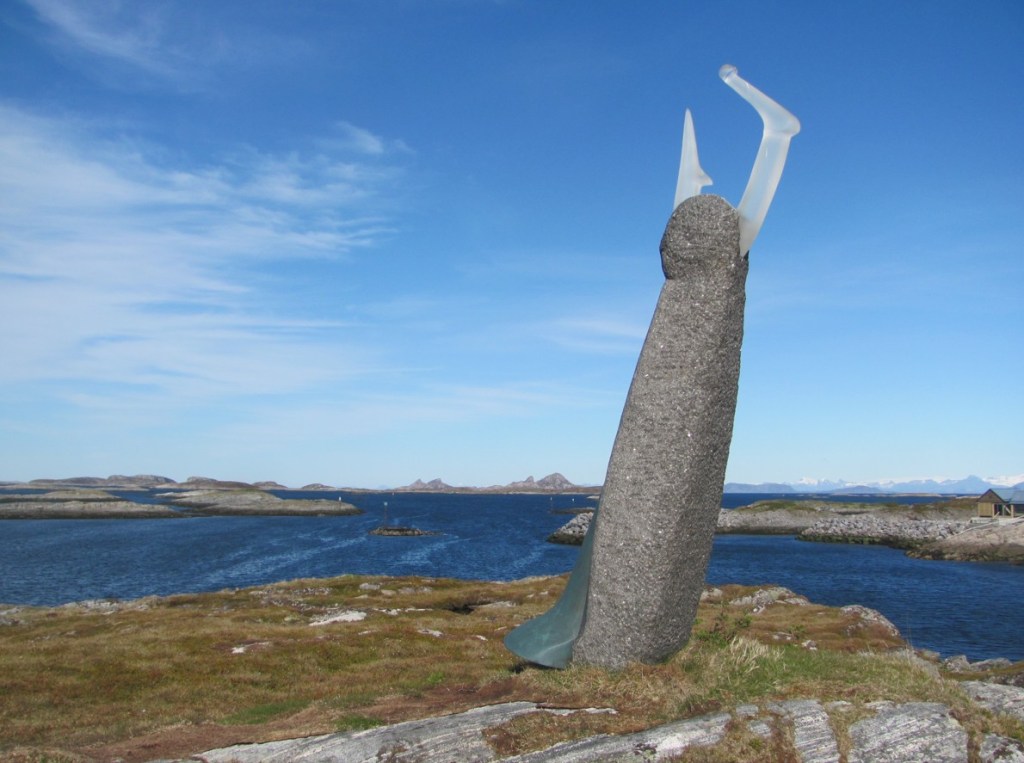
A little bit further on, we come to a sign at the side of the road pointing to Skulpturlandskapp at the wild and windswept tip of the island. We pick our way along the muddy path through the heather and eventually come to a rather suggestive looking sculpture. A younger couple are already there.

“What on earth is it supposed to represent?”, says the First Mate. “Surely, it can’t be what I am thinking it is?”

A prose, a song, a poem look yonder’

“I don’t know”, says the young man of the couple, looking a bit embarrassed. “But it’s rather inappropriate. There was a lot of opposition to it from the local community.”

His partner giggles.

We find out from Google that the sculpture is called ‘A prose, a song, a poem look yonder’ by the Norwegian-Zambian artist Anawana Haloba commissioned as part of the Skulpturlandskapp Nordland international artwork project.

“The project was to promote art in remote coastal communities”, the girl says, with a slight Spanish accent. “A lot of the islands here have sculptures that were created as part of the project. Not all are like this one, though!”

The couple are working at the hotel, and represent two of the 14 languages spoken there. He is from Czechia and she is from Columbia. They met in New Zealand working in the hospitality sector, and are travelling the world, working to pay their way. Having experience in the same sector makes it easier for them both to find work, often in the same establishment.

“We would love to go sailing around the world one day”, says the boy, a dreamy look in his eyes, when we tell him what we are doing. “We’ll have to save up hard to buy a boat. Neither of us can sail at the moment, but we really want to learn. It’s so cool that you have come all the way from the United Kingdom from here.”

The unbridled enthusiasm of youth.

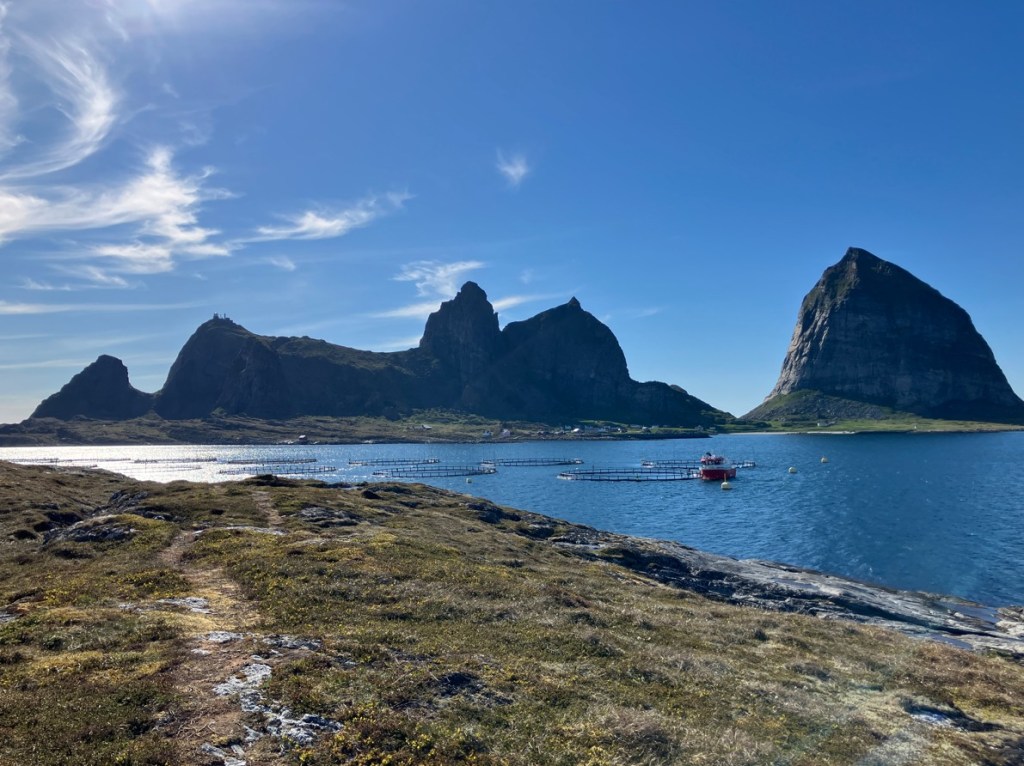
We continue our walk to the western side of Træna-Husøya to look across the sound to neighbouring island of Træna-Sanna and its spectacular inselbergs. Below us, we see a salmon farm being attended to by its supply vessel. Further on, we see two fishing boats making their way purposefully through the sound.

Looking across to Træna-Sanna.

We return to the village. Even less seems to be happening. We walk back to the harbour and the boat. Just as we arrive, the two fishing boats that we had seen earlier are entering, and tie up next to us.

“We’ve been catching halibut and ling”, explains one of the fishermen. “We’ve been out for the last two days and have caught four tonnes, and the other boat has caught 2½ tonnes in one day, so we are both happy. Here, you can have some.”

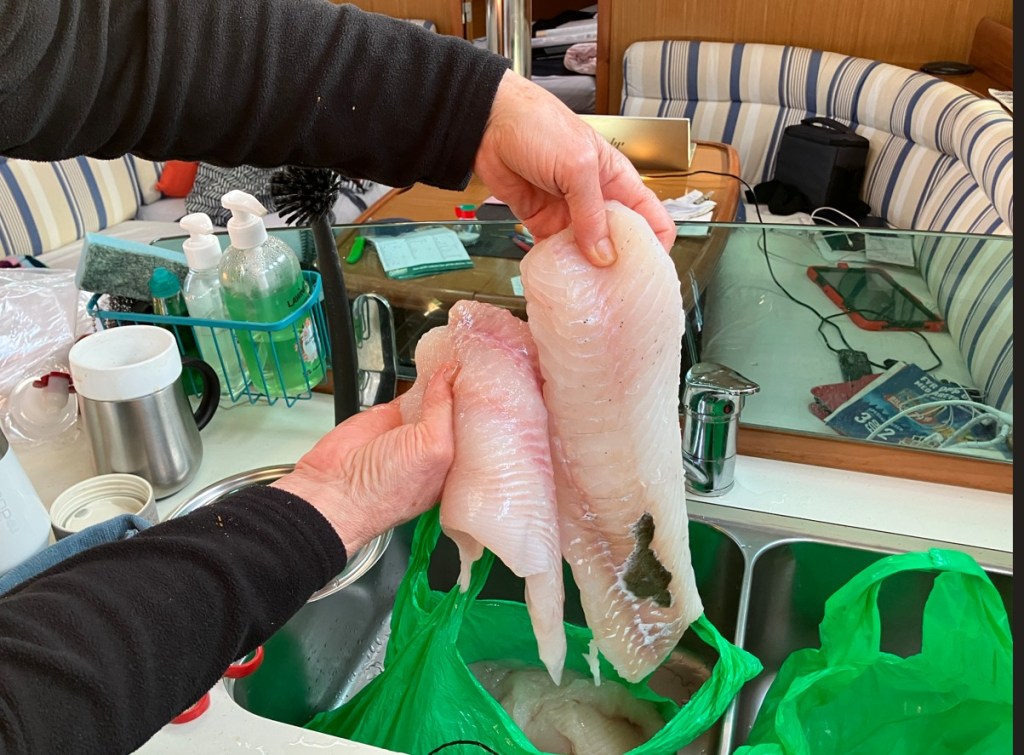
They give the First Mate a plastic bag full of fish, already filleted.

Our supper.

“That’s so very good of you”, she says. “They are so fresh. Where are you from? You don’t sound Norwegian.”

“We are from Poland”, he says, joined now by his co-workers. “We live on the island here, some of us for 14 years, but our real home is back in Poland. Our families are still there. Of course, we miss them, but the money here fishing is good, more than we could earn in Poland. That’s why we stay. But we go back to Poland every year for a summer holiday and to be with our families. It’s not an easy life, but we have got used to it. A lot of Polish people work in the fishing sector in this part of Norway as it is difficult for them to recruit Norwegians to do the work.”

We fry the ling for dinner. It is fresh and succulent, and goes well with dill sauce and boiled potatoes. The First Mate freezes the halibut to have later.

We leave around 0800 the next morning. It is foggy, but it soon clears to leave a glorious sunny day. There is a fresh wind from the starboard quarter, and we skim along at a good speed.

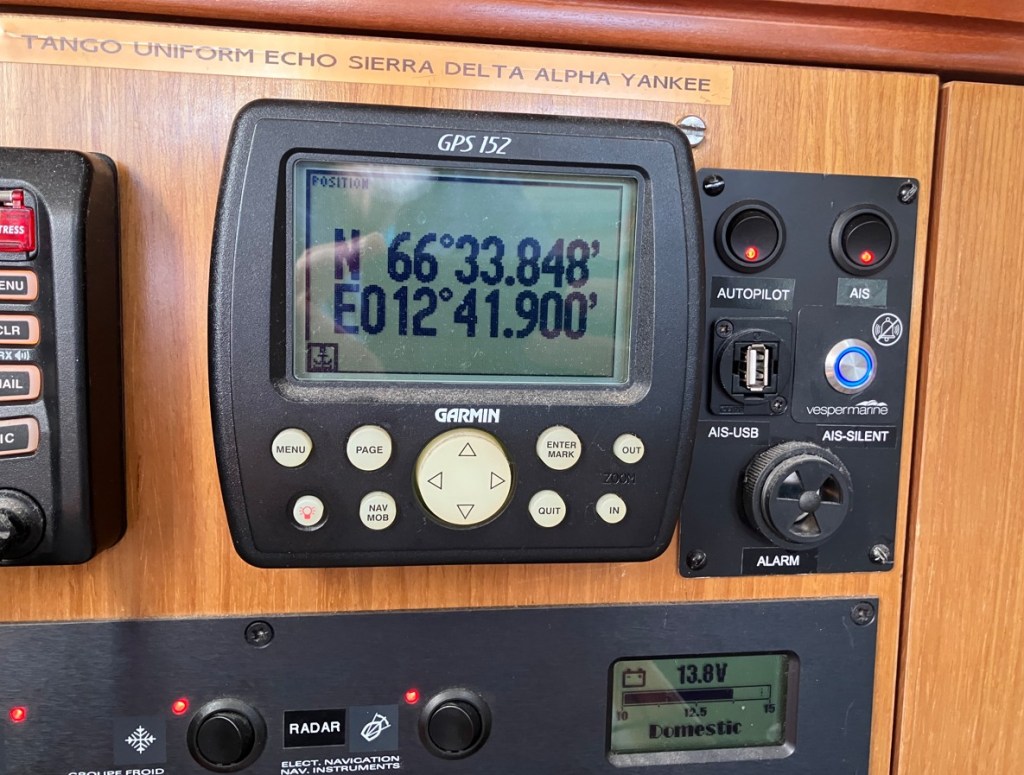
“We’re just coming up to the Arctic Circle”, I say. “Its current latitude is 66° 33’ 50.9”, the southernmost latitude at which the sun never sets at the June solstice. Once we cross it, we can say that we have been sailing in the Arctic.”

Crossing the Arctic Circle.

“Ah yes, that monument that we saw in the harbour at Træna said it was the village just below the Arctic Circle”, says the First Mate. “But you wouldn’t think that we are in the Arctic with this sort of weather. I was almost thinking of changing into my shorts. But why do you say ‘current position’? Isn’t it fixed?”

“It actually moves because the tilt of the earth’s axis varies because the distribution of the earth’s weight changes due to the moon’s influence on the tides”, says Spencer, butting in. “It’s moving north at the rate of 14.5 m per year. So if you were to come next year, you would have to sail another 14½ metres to reach it.”

“And it’s not that cold because we are now tilted towards the sun and because of the influence of the Gulf Stream”, I say. “The Gulf Stream brings warm water up from the tropical regions and help keeps here and the rest of western Europe warm enough for human beings to live in.”

We reach Rødøya and tie up to one of the three pontoons in the small marina. At the top of the marina is a hotel by the name of Klokkergården. It is still closed for the winter.

Moored at Klokkergården, Rødøya .

“We’ll be opening next week for the summer”, says a woman tidying up at the back of the hotel. “I am actually the owner. It used to be the boarding school for the municipality, but that closed in 1968, and the building started to fall into disrepair. For a while, it was even used as a barn. I was only a young girl at the time, but I thought that it was such a shame that such a beautiful house could be just left to fall to pieces. So I had a dream that I could restore it to its former glory, and run it as a hotel to pay for itself.”

“Which you obviously did”, says the First Mate.

“Yes”, says the woman. “When I got married, I managed to convince my husband of my dream, and together we worked on restoring it. Even though a lot of the house was dilapidated, the structure was made of strong Norwegian pine, and the roof of good Norwegian slate, so we were able to make use of that.”

“It’s amazing to think of the amount of work that you must have put into it”, I say.

“It was a lot of work, all right”, she says. “And a lot of people thought that we would never finish it. But I have a saying that ‘nothing is impossible, the impossible only takes a little longer’. We did eventually finish it, and that is what you are looking at now.”

“Why do you call it Klokkergården?”, asks the First Mate.

“Well, the headmaster of the school, who actually lived in the house, was also the local sexton”, she answers. “One of his jobs was also to ring the church bells to indicate the time. Klokker is the Norwegian word for clock.”

We decide to climb Rødøyløva, the mountain that dominates the island. Rødøyløva means ‘Lion of Rødøya’, as it is supposed to represent a resting lion. It kind of does, if you use your imagination.

Rødøyløva, the Lion of Rødøya.

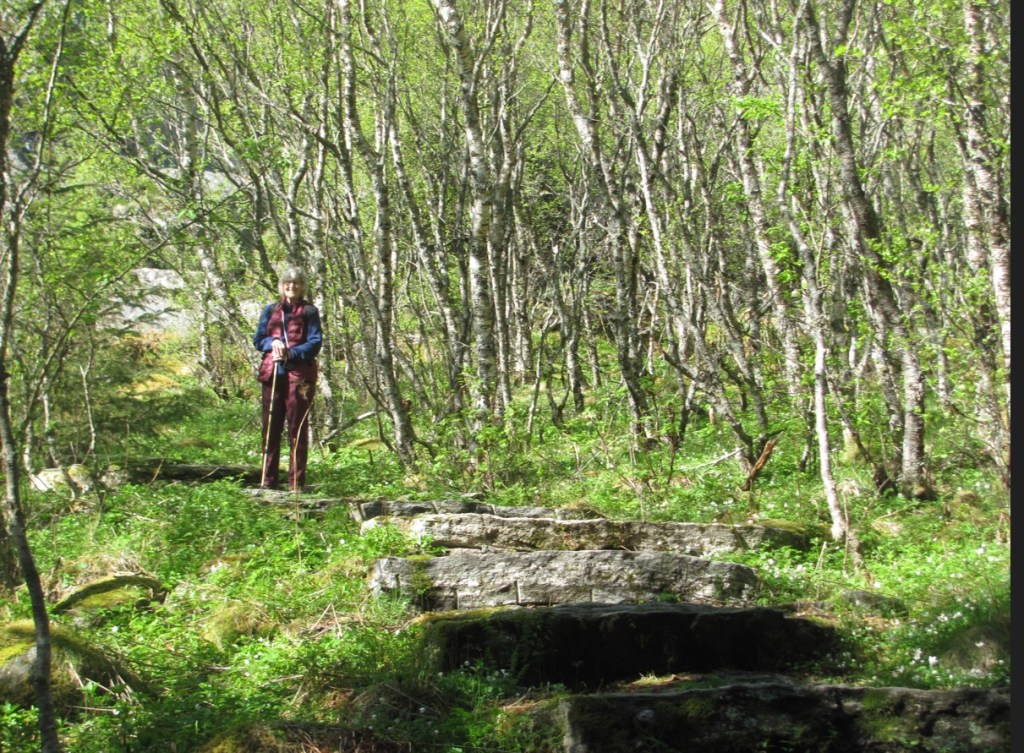
A path leads from the hotel to the bottom of a rocky stream where an impressive suite of stone steps starts.

“Did you see the name of it?”, I say, pointing to a small sign indicating the way that we are headed. “Sherpatrappa. It means Sherpa Stairs. It seems that they employed Sherpas from Nepal to build the steps as they have so much experience from doing that on mountain trails in their home country. There are about 1000 of them. Steps, I mean, not Sherpas. Teams of between four and eight Sherpas used the stones along the trail, and cut and shaped them by hand in situ.”

Beginning of the Sherpatrappa.

The steps are of varying heights. It is tough on our knees. But with regular stops, we eventually make it to the top of the steps, where it levels out into a saddle. The views on the way are magnificent.

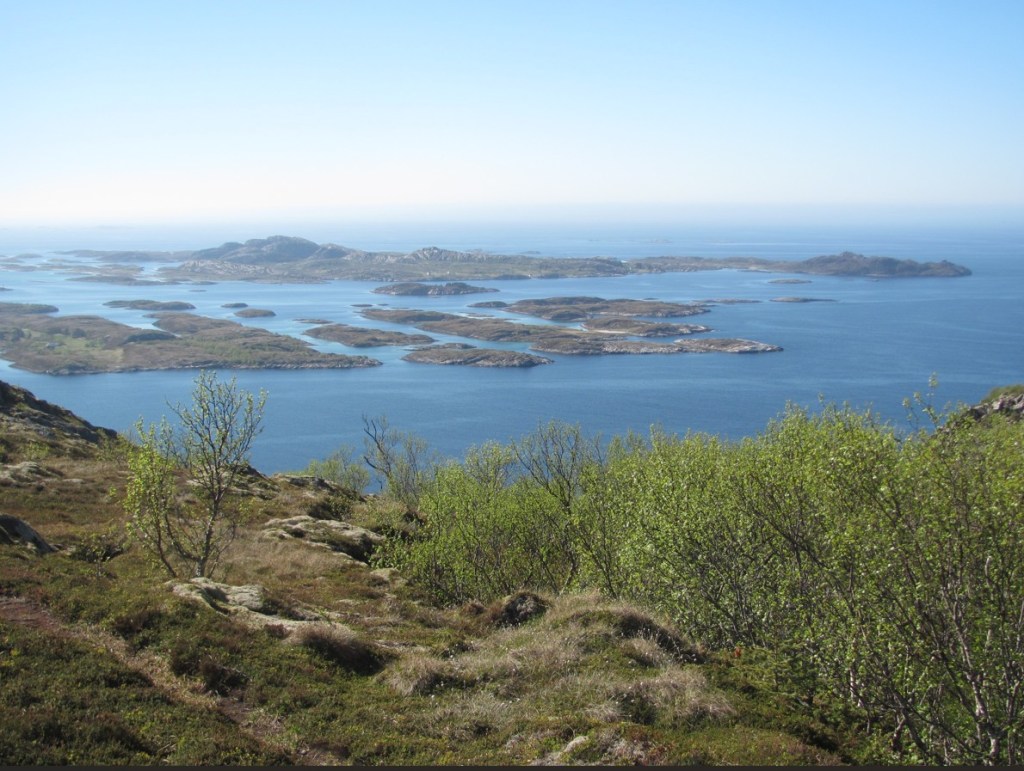
View from Rødøyløva.

We push on a bit further across the saddle, and start to climb again.

“The cloud is starting to roll in”, says another walker passing us on his way down. “You won’t be able to see much.”

He’s right. Already clammy tongues of cloud are reaching around the summit and starting to engulf us. The views disappear. We decide reluctantly to make our way down again.

“It’ll be even tougher on our knees going down”, says the First Mate. “Some of those steps were so steep.”

But it isn’t as bad as we thought, and before long we are back at the bottom, to find that a French boat has tied up next to us. They are on their way to Tromsø to meet others in their group. They have motored all the way from Ålesund non-stop as the winds were against them, and leave again early the next morning.

“I’m just going to cycle to the village”, says the First Mate, after breakfast. “We are allowed to use the bicycles by the side of the hotel if we are marina guests.”

I am busy on boat jobs, so she sets off by herself.

Half an hour later my phone rings.

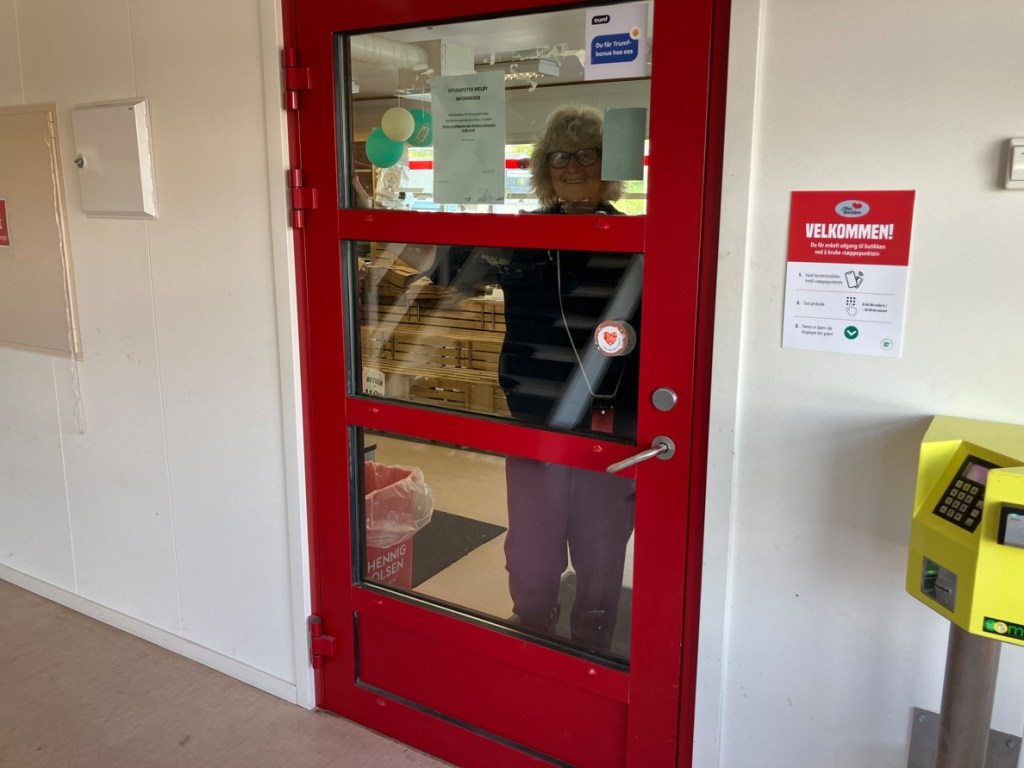
“Can you come and help me?”, a plaintive voice wails. “I am locked in the supermarket and can’t get out. There’s no-one else in here.”

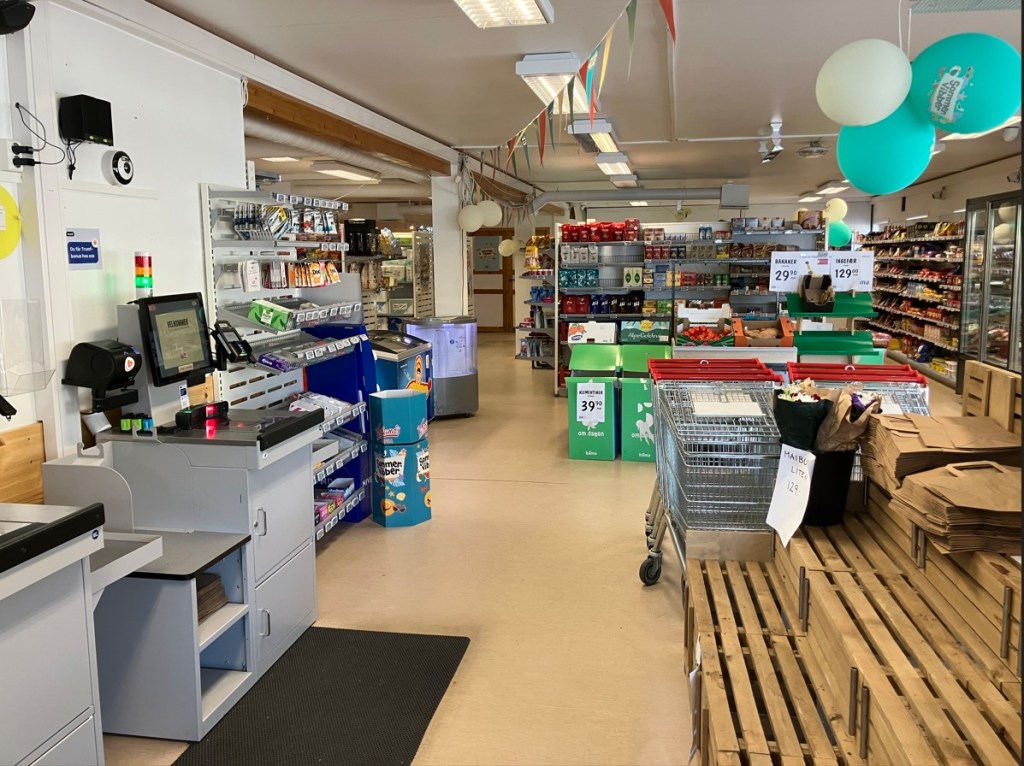
Norway has a growing number of unstaffed supermarkets dotted around the country, particularly in remote areas. You need to scan your credit card to enter and your receipt to exit. Inside the shop, security cameras are located strategically and are monitored centrally somewhere to ensure there is no stealing. It seems to work.

Unstaffed supermarket.

“Have you stolen anything?”, I ask, fearing the worst. Perhaps she was seen on camera doing something she shouldn’t, and the barriers had slammed shut. “Maybe the police are on their way to arrest you.”

“Nothing like that”, the Plaintive Voice answers. “The machine that scans the receipts has broken down. I can’t get the door to open to let me out. Can you come over? Maybe you can open it from the outside.”

The First Mate trapped inside the automated supermarket.

I take one of the bikes at the side of the hotel and clamber on. A cycle ride at speed doesn’t really appeal. After some frantic pedalling, my phone rings again.

“It’s OK”, says the Voice, not Plaintive any more. “Another customer has just come in and let me out. Apparently there is a notice saying that they know the machine isn’t working and that you are supposed to press a button to get them to let you out. But of course it is in Norwegian. By the way, why are you panting?”

I needed the exercise anyway.

Surviving Storm Floris, a notorious passage, and the Last Viking

“I think we should press on”, says the First Mate over breakfast. “Storm Floris is coming from the south-west in a couple of days, and we don’t want to be caught out. As nice as Molde is, it is rather exposed to the southwest and there’s not much protection in the harbour.”

She has a point. Storm Floris is approaching the UK and gusts of up to 90 miles per hour are being talked about. It’s only a matter of time before it reaches Norway. We really don’t want to be sailing in that.

“We can get to Bud today”, I say. “And then try and get around the Hustadvika before it comes. We could then shelter in the tiny island of Håholmen. Alternatively, we could stay in Bud itself – I’ve heard that it is quite well-protected.”

The Hustadvika is another of the officially designated ‘exposed or dangerous areas’ in Norway, and consists of a cluster of rocks, skerries, and small islands open to the vagaries of the Atlantic Ocean. Like the Statt and Godø, a benign weather window needs to be found to traverse it safely. Storm Floris doesn’t sound like it would be one of those.

Leaving Molde.

We set off. Once we are round the Julneset point and into Julsundet, we catch the wind from the southwest, and have an exhilarating sail past the islands of Otrøya and Gossa right up to Bud. We have had a month of glorious sunshine, and while we wouldn’t have wanted to see the fjords in any other way except that, it had meant that there was very little wind for sailing. It is great to be able to stretch our wings again.

Sailing again.

When we arrive in Bud, there is another British boat tied up to the landing. It turns out to be a father and daughter.

Tied up in Bud harbour.

“We’ve been up to the Lofoten Islands”, the daughter tell us. “Now we are on our way back again. We need to get the boat back to the west of Scotland where we keep it, but I have leave my Dad to do it on his own from Ålesund as I need to be back to work next week. I’m a vet.”

“I’m used to sailing by myself”, says the father, anticipating the question from the looks on our faces. “So it’s not a big deal, although I will miss her company. She’s a good sailor. But this Storm Floris coming is going to delay things a bit. I’d be sailing right into it.”

We spend the next day exploring Bud. It’s a small picturesque fishing village with a supermarket, café, church, and museum. It’s claim to fame is that it was where the last independent Norwegian Privy Council met to vote in 1533 to secede from the Kalmar Union with Denmark and Sweden, and to become an independent country and reject the adoption of Lutheranism as the national religion. Unfortunately that didn’t end well, and Norway ended up in being a province of Denmark for nearly 300 years.

Bud harbour.

“It’s amazing to think that if they had succeeded in seceding, Norway would still be a Catholic country today”, says the First Mate. “And not Lutheran like the other Scandinavian countries.”

Bud church.

We come to the coastal walk north of village. The sun is shining, there’s no wind, and it’s hot. We climb one of the rock outcrops and look out over the Hustadvika, the route we will be taking northwards.

Looking out over the Hustadvika from Bud coastal walk.

“It’s so calm and peaceful now”, says the First Mate, wiping her brow. “It’s hard to believe that a violent storm is on its way.”

In a sense, we could have set off this morning, but we had heard from some other sailors we are in touch with that our intended destination, Håholmen, is low-lying and quite exposed, so we had decided that discretion is the better part of valour, and that we would sit out the storm in Bud instead.

The peace and quiet is suddenly shattered by a frenzied cacophony of seagull cries up ahead. Several seem to be harrying another large bird, swooping and diving at it from all angles.

“It’s a sea-eagle”, I say. “They are warning it to stay away. Perhaps it lives near here, out on the skerries.”

We end up on top of the small hill overlooking the town where German troops built gun emplacements as part of a series of fortifications called the Atlantic Wall to resist an Allied invasion. As it turned out it was never used in action, and may have even contributed to Germany’s defeat by diverting troops for its operation away from mainland Europe.

WW2 fortifications.

The storm is forecast to reach us sometime in the night. We have been keenly following the havoc that it is causing in Scotland, knowing that we would be in for something similar. Already there are some preliminary strong gusts. I double up on the mooring ropes just in case one breaks or works itself loose.

Storm Floris on its way.

“I’ll put some rubber snubbers on as well”, I say. “That’ll stop sudden jerks stressing out the ropes. You can batten down the hatches.”

“I don’t think we have got any battens”, says the First Mate.

“I didn’t mean it literally”, I say. “I just meant to make sure all the windows and skylights are shut. It’s nautical-speak.”

Storm Floris.

As predicted, Storm Floris hits us in the early morning. I am awoken by the sound of the halyards whipping against the mast and the boat listing alarmingly to port as the winds howl over the harbour breakwater and catch the top of the mast. Luckily the breakwater protects the hull from the worst of the force, although from time to time, plumes of spray come hurtling over it, drenching the boat and joining the rivulets of rain already coursing down the canopy tent.

Ruby Tuesday listing from the wind.

We eat breakfast huddled in the cabin, listening to the wind whistling through the rigging. Outside we see a seagull struggling to fly against the wind, making no progress at all, giving up, and going with the flow. I check the windspeed to find that it is up to 42 knots. That’s a Force 9 gale. And that’s in the harbour – what is it like out at sea?

Windspeed up to 42 knots!

In the afternoon, I notice that I have forgotten to take down the courtesy flags and that they are starting to work their way loose. When there is a lull, I clamber out onto the fore-deck and manage to retrieve two of them, but the Scottish one has somehow managed to get itself stuck on the port spreader. Without climbing up, there is nothing I can do except pray that it will somehow hang on.

It doesn’t. Two hours later it is gone. I have a quick scan around the harbour on the off-chance that it might still be floating on the water or have blown onto a jetty, but nothing.

After two days of incessant lashing, the storm dies down. We consult the BarentsWatch website and calculate that the sea should have calmed down enough the next morning for us to attempt the Hustadvika. We have decided to do the inner passage through the rocks and skerries, the so-called Stoplane route, which although requiring greater care in navigating our way through narrow gaps, is more protected from the Atlantic swell.

We awake early and cast off. There is still some residual swell left over from the storm, but it is not rough. We wend our way through the twisting route, making sure that we approach each marker pole on the correct side. Jagged rocks pass only metres away from our hull. We eventually reach the narrowest part, between the two Stoplane islands that give their name to the passage, where the marked channel is only two boat-widths wide.

Navigating through the Hustagvika inner route.

Eira looks at the boat approaching. It is the same one that she had seen a few days earlier on her visit to Romsdalfjord, and again when the seagulls had harassed her.

I know who you are, she thinks. I have seen you before. But you are in my world now. Your kind may have driven us out from the land you have colonised in Romsdal, but this is our domain. Yet still your minds are set on bending nature to your will, of claiming the seas as your own. You say that we have no right to your livestock, why then do you assume you have rights to our fish? Have you forgotten that once there was enough for all; now your numbers and your machines take almost everything and leave little for the rest of us? But we are all part of nature, you are not set to rule over us. If you can’t or won’t learn that, the Doom will return; but this time it will be for us both.

White-tailed sea-eagle.

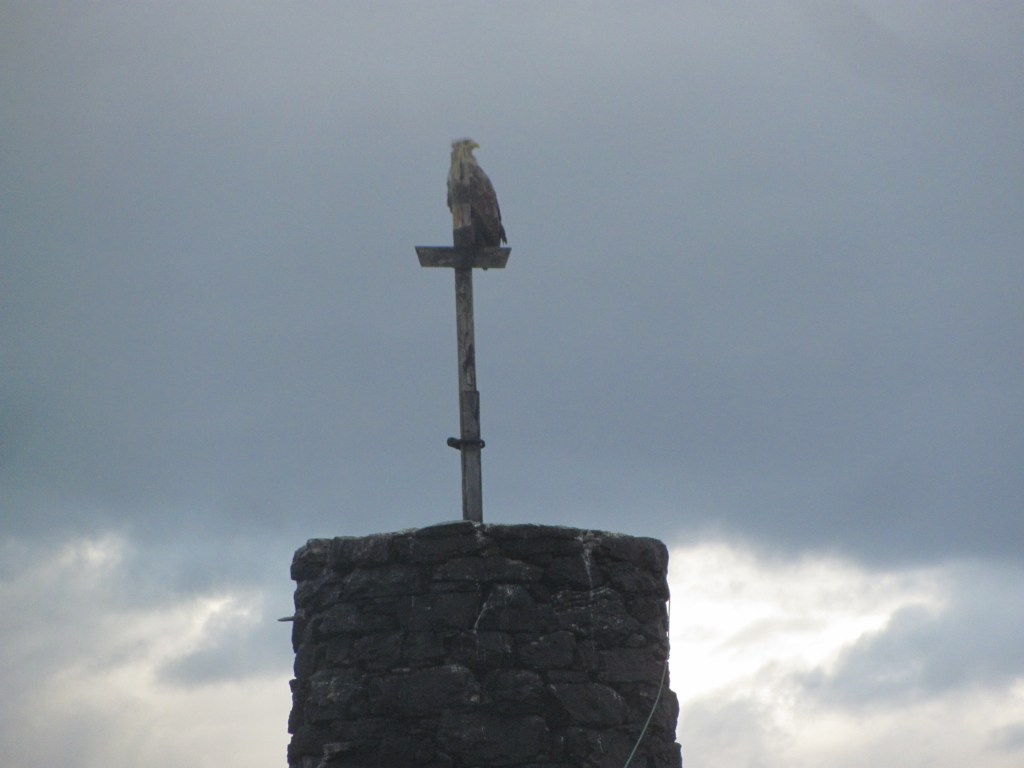
“Look, there are two sea-eagles on that pole”, exclaims the First Mate, pointing to one of the markers. “One’s just flown off.”

“They are beautiful creatures”, I say, trying to take a photo at the same time as I attempt to manoeuvre the boat through the narrow gap . “Especially when they fly. So big. I wonder what she is thinking about?”

“Deep philosophical thoughts, I am sure”, she answers.

Our route through the Hustadvika.

Eventually we reach Håholmen and find a berth at the small harbour.

The island of Håholmen.

Several people are milling about as though they are waiting for something.

“The boat back to the mainland is coming soon”, explains a neighbour. “A lot of people come over for the day, have a walk around the island, something to eat and drink, then go back in the evening.”

“Unfortunately, the restaurant is fully booked for tonight”, the receptionist at the hotel tells us. “It’s very popular. You need to book well in advance. But there’s a couple of videos you might be interested in in the small museum at the back. One’s of the history of the island, and the other is of the things that the previous owner, Ragnar Thorseth, got up to. If you want to see them, let me know and I can switch them on for you.”

We decide to have a cup of tea and then see the videos. On the way back to the boat, we meet another British couple.

“We’re sailors too”, says the woman. “But our boat is in Greece. We’re on a car tour through Norway, as it is too hot to be in the Mediterranean at the moment. We’re staying at the hotel. The food here is great – we ate at the restaurant last night. But we have decided not to go tonight, so you could have our table if you like. I’ll talk to Reception.”

A stroke of luck! We had heard good reports of the restaurant, and had been keen to try it. Soon we are booked in for the 6pm sitting.

We find our way to the small museum at the back. The receptionist turns on the video projector.

“Håholmen was founded in the 1700s and soon become a hub for fishermen and traders”, the first film tells us. “Around 1900, it was purchased by a Bård Bergseth, who lived here with his family, and maintained the fishing industry. In the 1990s, it was taken over by his grandson, Ragnar Thorseth, who turned it into a hotel and conference centre.”

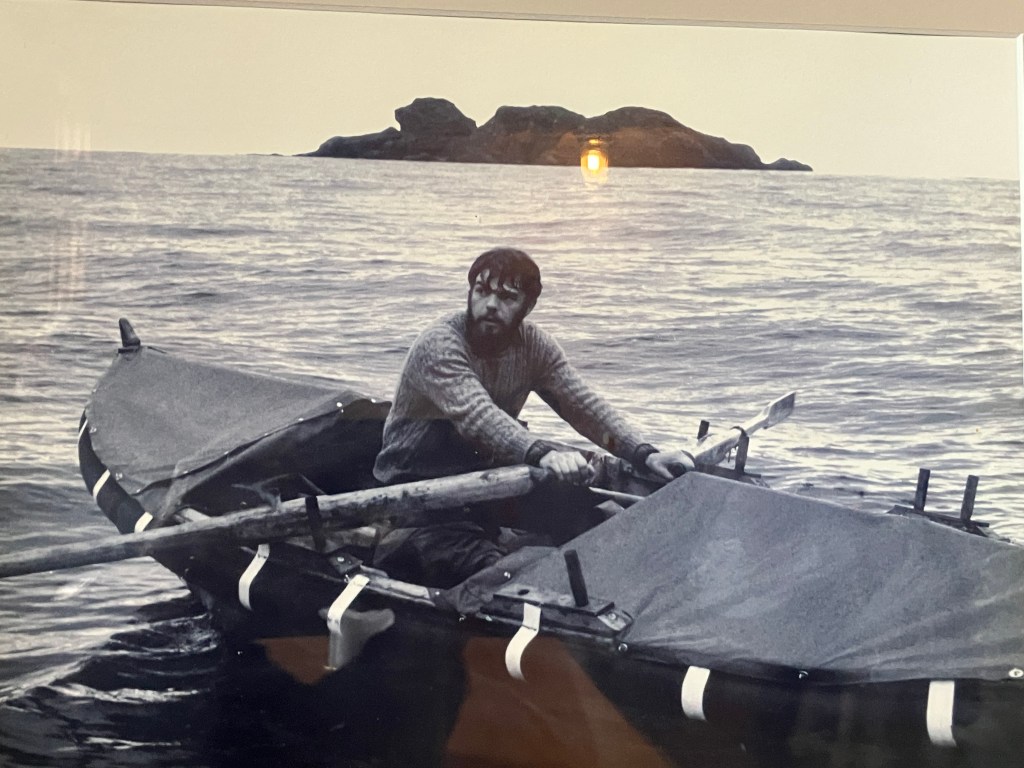
Ragnar Thorseth is a larger-than-life Norwegian adventurer, not all that dissimilar to his more well-known countryman, Thor Heyerdahl, we learn from the second film. In the 1960s, he had rowed single-handed from Norway to Shetland in an open rowing boat. Later, in the 1980s, he had built a replica Viking trading ship, the Saga Siglar, and had sailed around the world in her. He also managed to pack in a trip by boat through the Northwest Passage, an overland trip to the North Pole, and overwintering on Svalbard with his family. His exploits earned him the name of ‘The Last Viking’ in Norway.

Ragnar Thorseth rowing from Norway to Shetland.

“He still keeps coming to the island from time to time, even though it is now owned by Classic Norway Hotels”, the receptionist says as she comes to turn off the projector. “He lives on another island a bit further south from here. In fact he was here just a couple of weeks ago. In his Viking replica ship. He’s quite an amazing character.”

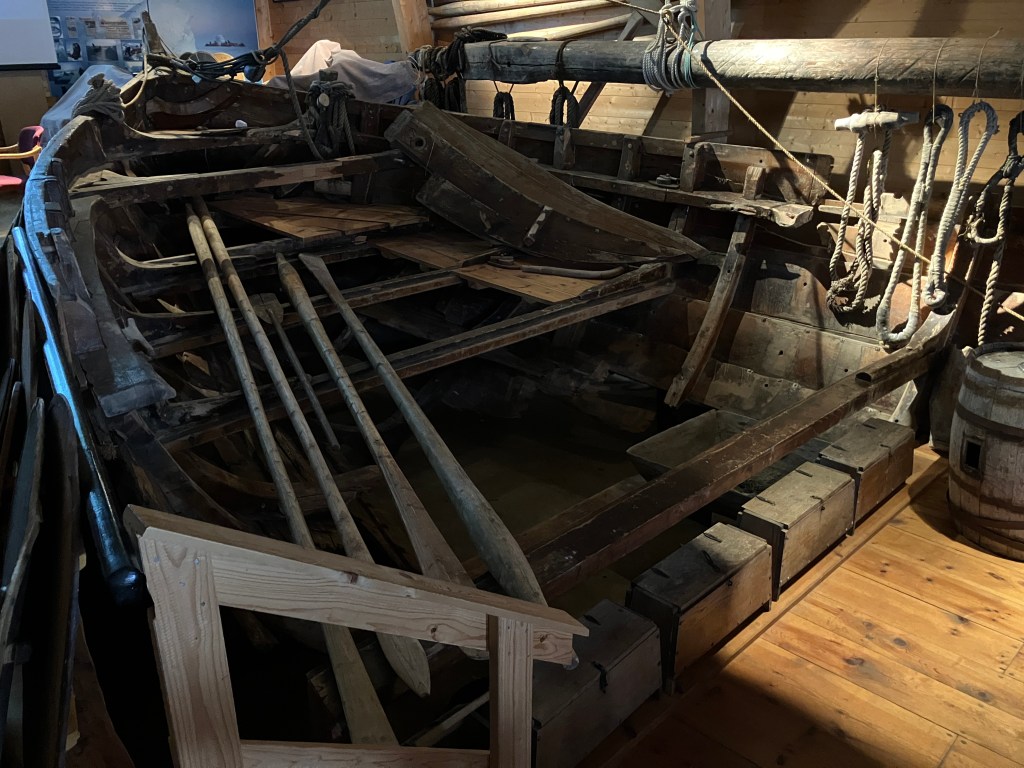
Remains of the Saga Siglar.

At 1800, we find ourselves at the restaurant. Knowing the history of the island, how could we have anything but fish? The First Mate goes for the monkfish; I decide to have the klippfish.

“Klippfish is a white fish, usually cod, that has been split, salted and then left to dry in the sun”, the waiter explains. “It is a traditional dish in this area. I can guarantee you will like it.”

He’s right. It’s delicious, with potatoes, minted green pea purée, cured pork belly bacon, and beurre blanc sauce, all rounded off with almond cake for dessert.

“I’m not sure that I am going to make it back to the boat”, says the First Mate. “I think I have eaten too much.”

“I’ll see if I can find a trolley”, I say.

A rock concert, a town of roses, and a new song

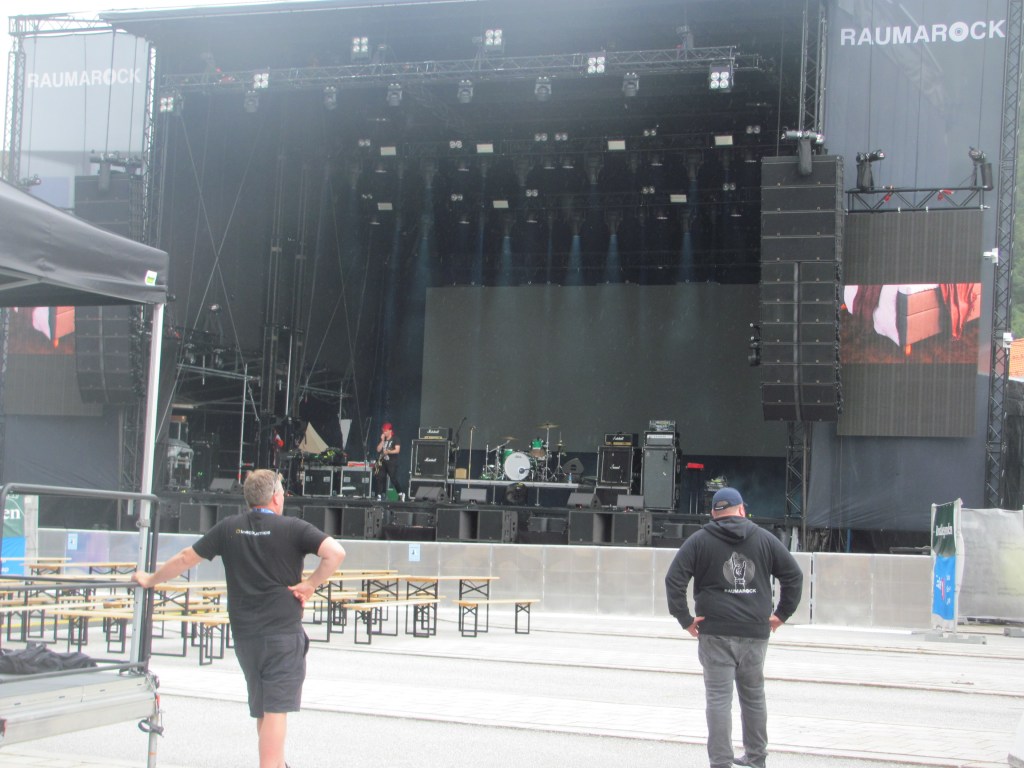
“There’s a rock concert on for the next three days”, says the captain of the boat tied up in front of us. “Rauma Rock. It’ll be really loud. We were here last night, and we could hardly hear ourselves think until about four in the morning. But the music was good. There will be even more boats coming tonight. It will be packed.”

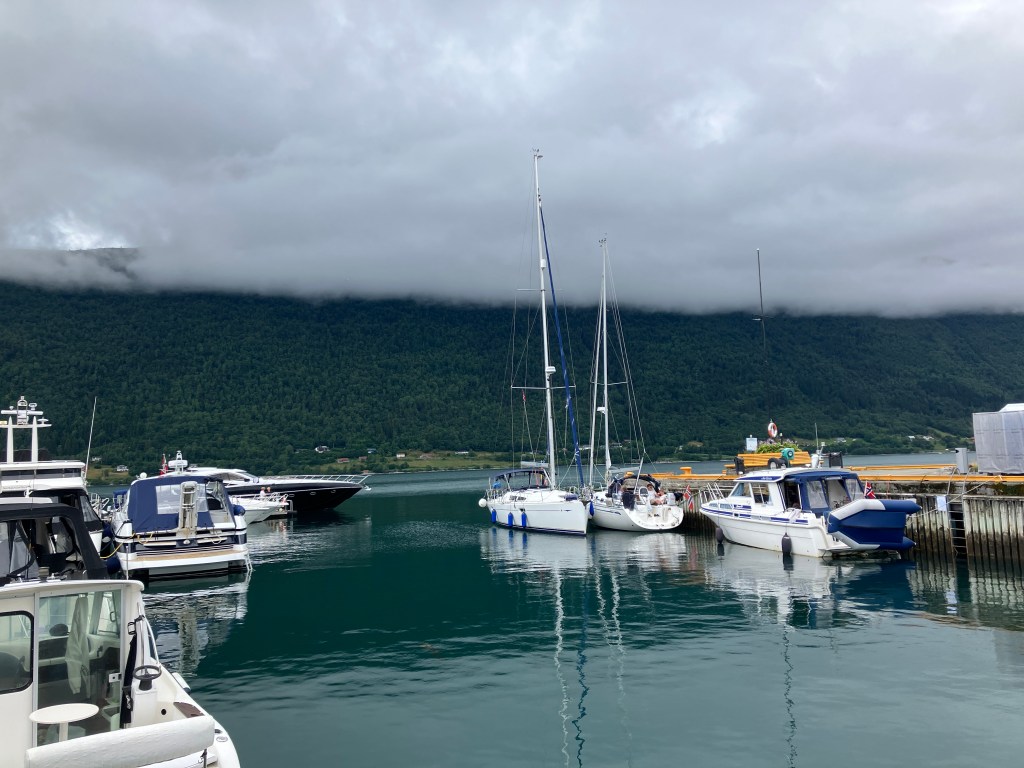
Andalsnes harbour.

We are in the tiny harbour of Andalsnes near the top of Romsdalfjord. There had been no berths free when we had arrived, and we had rafted up to another small yacht while we decided what to do. It was then that we had noticed that a large stage had been constructed on the quayside, with the twanging of guitar strings warming up emanating from it.

Rauma Rock warming up.

“I don’t really want to be kept awake all night”, says the First Mate. “I am at that age where I need my sleep. But it would be somehow nice to hear some of the music.”

“Me too”, I say. “My hearing is bad enough as it is with old age, without finishing it off completely. Why don’t we go and anchor a little bit further up, where can still hear the music, but it isn’t quite so loud? And we wouldn’t have to pay either!”

The last sentence is the clincher.

“Good idea!”, she says. “But let’s have a quick look at the town first to see what it is like.”

The First Mate explores the town centre, while I take a walk down to the Rauma river running through it.

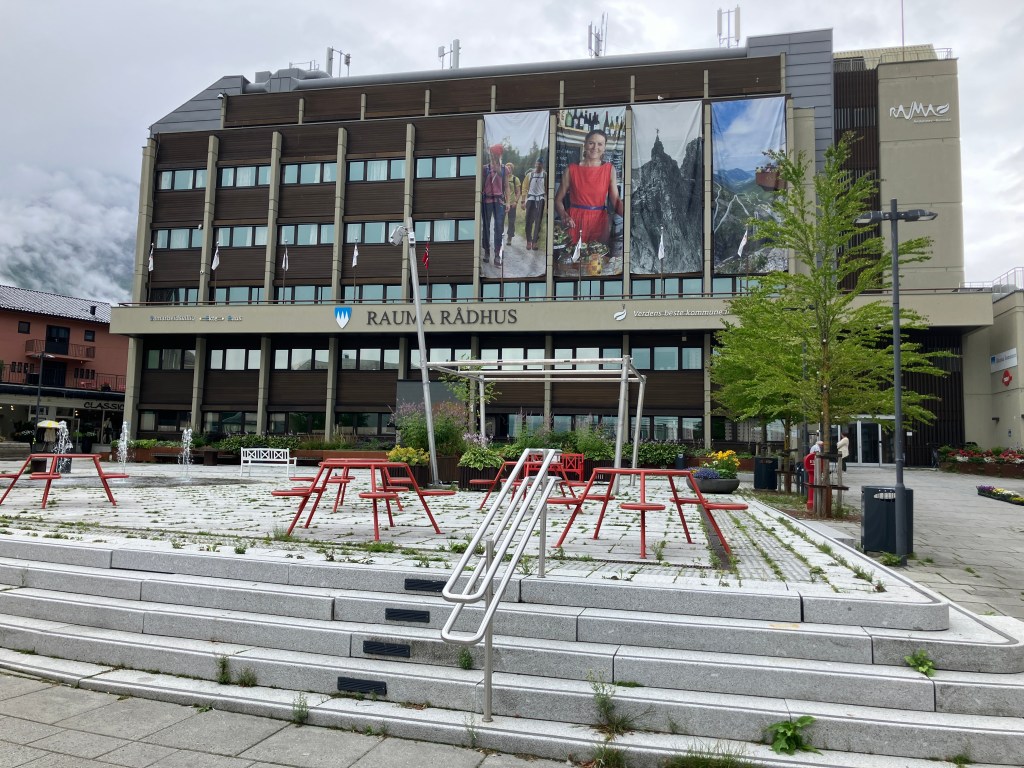
Town Hall, Andalsnes.
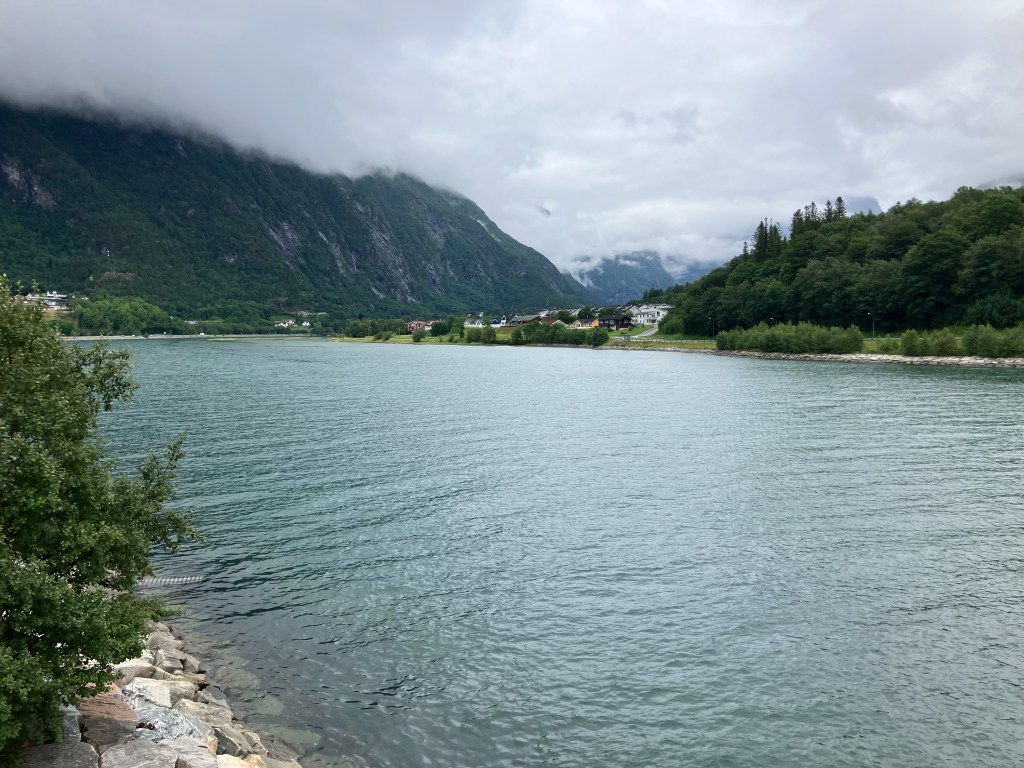
Rauma River in Andalsnes.

“Well, the town was pretty average”, she says, when we meet again. “I didn’t find it very inspiring.”

Later we motor a little further along the shoreline of the fjord and drop the anchor.

“Perfect!”, says the First Mate as we sit on deck with our glasses of wine watching the gondolas taking their passengers to the top of Mount Nesaksla, and listening to Rauma Rock getting underway. “That’s much more enjoyable.”

Listening to Rauma Rock from a distance.

“Andalsnes was one of the places that my great-great-grandfather visited”, I say. “Or at least Veblungsnes, which was the main settlement in those days. Since then, Andalsnes grew to be a town, while Veblungsnes remained a village. The Rauma river divides the two. In his letters he talks about the striking wonders of the Rauma river, but he says that he doesn’t have time to describe them.”

“The guide book says that the Rauma is famous for its salmon fishing, the emerald-turquoise colour of its water, its towering mountains, deep gorges, and sheer cliffs, and its waterfalls at Vermafossen and Slettafossen”, says the First Mate. “It was the inspiration for scores of Romantic artists, writers and explorers.”

“It would be nice to go and see it”, I say. “But we’ll never get in to the harbour now with all the boats that have been arriving.”

“We’ll have to come back another time”, says the First Mate.

In the morning we set off back along the Romsdalfjord. I keep a sharp eye out for sea-eagles.

Scanning the cliffs for sea-eagles.

Far above, wheeling on the updraft from the cliffs, Eira looks down on the waters of the Romsdalfjorden. She doesn’t come here often these days, instead spending most of her time with the other sea-eagles on the islands and skerries at the mouth of the fjord where the fish are plentiful. But from time to time she likes to revisit her birthplace and recall the stories that her father Clew and her mother Aran used to tell of Cuillin, the last of the great sea-eagles of Skye, who had flown alone from there to Romsdal to save her kind. And of her daughter Mourne who had returned to Skye with her motley collection of vagrants to repopulate those islands.

Out of the corner of her eye, she sees a boat heading for the tip of Okseneset and the shapes of two humans. They won’t be able to see her, she is too high and against the sun. She does not fear them in the same way that her parents had done – the Doom that she had heard in the old stories had passed now and there seemed to be a new understanding between her kind and the humans.

And yet, from time to time there was a niggling feeling in the back of her mind that the Doom had not gone completely. To be sure, few of the Romsdal eagles died these days by being shot or poisoned, but she had heard that there were increasing numbers flying into the high towers with rotating blades that had appeared in Møre og Romsdal. And then there was the rumour that was going around the Pairs that the eggs being laid were hatching earlier in the year, there seemed to be more rain than she remembered in her younger days, and the weather appeared to fluctuate more between extremes. But surely humans couldn’t be blamed for that, could they? Clever as they seemed to be, they were just too small and insignificant to be able to change the forces of Mother Nature herself, the might of the winds and rain sweeping in from the Atlantic, the strength of the sun’s light bringing warmth and life to the earth. Surely only Haførn, the mother of them all, had the power to do that …?

As she circles, she sees another sea-eagle gliding over the island of Sekken. She recognises from his flight that it is Arvid, her mate. She dips her great wings and flies to meet him, the humans in their small boat disappearing from her view.

Sea-eagle.

“Are you day-dreaming again?”, the dulcet tones of the First Mate interrupt my reverie.

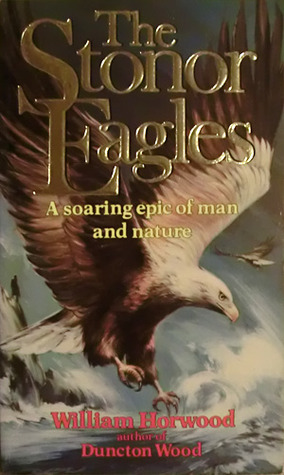
“I was hoping to see a sea-eagle”, I say. “I was just thinking of the book I re-read over the winter – The Stonor Eagles by William Horwood. It’s about how sea-eagles went extinct in Scotland in the 1930s through the farmers shooting them to stop their sheep from being attacked, and how they were reintroduced in the 1970s from Norway. Romsdal was one of the areas that they brought them from. I read somewhere that you do see them here.”

“I imagine that there would be more down towards the ocean”, says the First Mate. “That’s where the fish are, after all.”

We arrive at the town of Molde on the northern shores of Moldefjord, and head for the small municipal marina. It’s sweltering. A woman in a tank top and shorts helps us tie up.

“That’s my boat just in front of you”, she tells us. “I live on it throughout the summer and then go back to my apartment for the winter. It’s kind of like a summer cottage, but on the water. I don’t sail far – there are enough beautiful places to visit around here.”

Tied up in Molde town marina.

After a cup of tea, we decide to explore the town centre.

“It’s a pity we weren’t here a couple of weeks ago”, says the First Mate. “We could have gone to the Jazz Festival. They have one every year.”

Molde is well-known for its Jazz Festival.

“Look, here’s the Salmon Centre”, I say, pointing to a building in the town square. “We should go and have a look at it.”

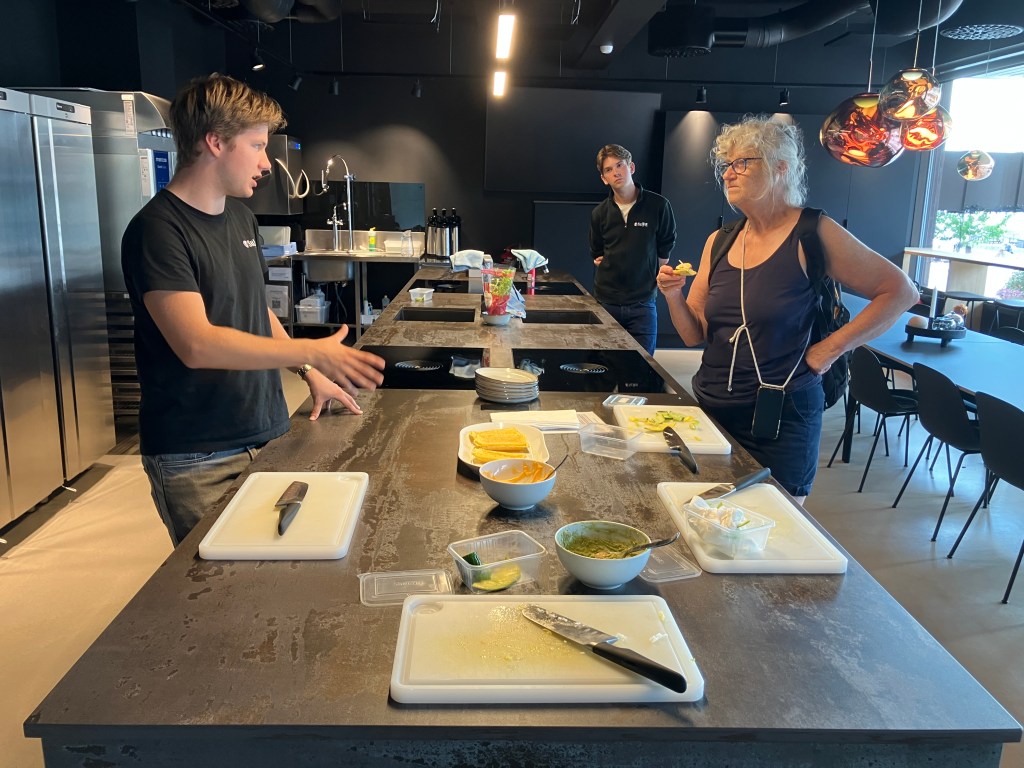
“It’s free entry”, says the girl at the reception. “And that includes a free sample of raw salmon, which you can use to make your own snack with taco shells and various dips.”

For the next little while we are absorbed in creating our own culinary delights, learning about the life cycle of the salmon from ‘roe to plate’, how the cages are made and installed, and how it is becoming more sustainable, including ways to prevent farmed salmon escaping to mate with wild salmon and weakening their gene pool.

Learning how to create our own salmon delicacy.

“That was fascinating”, I say, as we emerge. “I now know more about salmon than I ever thought I would.”

“Yes, it was”, says the First Mate. “Come on, let’s have a coffee and cake. Look, there’s a nice looking place over there. We can sit outside. You grab a table, and I’ll go and choose the cake and order.”

“Earl Grey tea for me, please”, I say.

“A nice little watering place.”

“Well, this is a nice little watering place”, says the minister to his companion as they sit down. “I enjoyed the walk around the town this morning. Such lovely weather. And what a nice smell from all the flowers they grow.”

“Molde is famous for that”, responds Mr Fairlie. “Especially the roses. Their fragrance is everywhere.”

Molde roses.

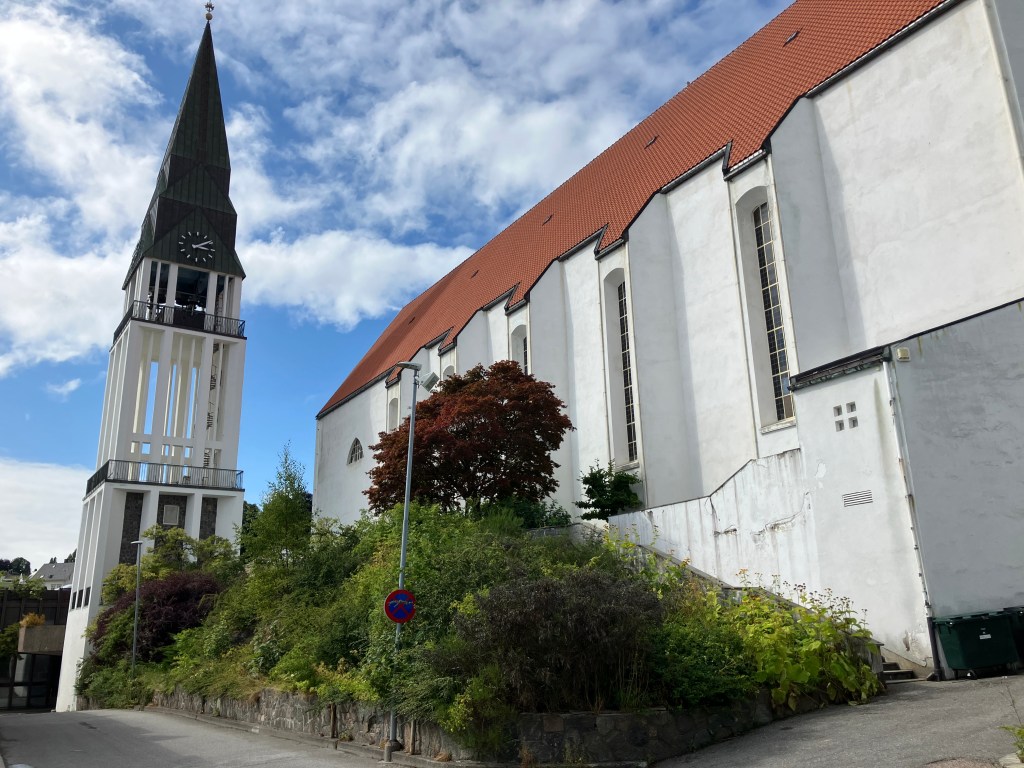
“I had a look at the new church”, says the minister. “Apparently the old one burnt down four years ago, and they just finished building a new one last year. I must confess that I like the look of the old wooden one I saw in pictures better than the new one. All red-brick now.”

“I suppose it will be more fire-proof, at least”, says Mr Fairlie. “That’s always the problem with wooden buildings in this part of the world. It’s only a matter of time before they get burnt down.”

Molde’s present day Domkirke (successor to the redbrick one!).

“And I have to say that I was impressed at the beautiful resting place of the departed here”, continues the minister. “With its small mounds of earth crowned with the loveliest flowers. The graves are tended with the fondest care and mothers come and sit by their loved ones’ dust for hours, with a book in hand or plying the needle, engaged on some piece of useful or fancy-work.”

Molde cemetery.

“Here we are”, says the First Mate, bringing a tray with the coffee, tea and a cheesecake. “What a nice spot. We can sit and watch the boats coming and going. But why are you putting in pictures of the cemetery? That’s a bit macabre.”

“My great-great-grandfather went to see it”, I say. “I thought I should too. He seemed to like that sort of thing.”

“You seem to be enjoying this cruise, at least?”, says Mr Fairlie.

“Immensely, but I have to admit I never feel relaxed on a boat”, says the minister. “Ever since I lost my younger brother Andrew at sea.”

“I didn’t know you had a younger brother”, says Mr Fairlie. “What happened?”

“He was on his way out to New Zealand”, replies the minister. “Another brother of ours, James, was already out there farming near Dunedin, and Andrew was intending to join him. He was a minister like myself, and had been in Canada but had fallen out with some of his superiors there. I don’t know what about. He always liked his drink and was a bit of a hothead, so maybe it was something to do with that.”

“So he was looking for a fresh start in New Zealand?”, asks Mr Fairlie.

“Yes, that sort of thing”, says the minister. “He was on board a ship called the Burmah sailing from London to Lyttelton. It seems it might have been overloaded, as in addition to the passengers, it was carrying a consignment of high-class horses and cattle. But it never arrived in Lyttelton. Another ship fourteen days out from New Zealand reported passing it in the Southern Ocean, and also that they had seen icebergs in the area at the time. So we are guessing that the Burmah must have hit an iceberg and sank.”

“What a story”, says Mr Fairlie. “Your poor brother. To have all his hopes dashed when he was so close to realising them. It’s a salutary reminder of the perils of sea travel.”

“Yes”, continues his companion. “But the story doesn’t end there. One or two years later some ship’s timbers were washed up on a beach to the south of Dunedin with the letter ‘B’ written on one of them. The supposition at the time was that it was from the Burmah.”

“And it’s sad to think of your brother James already in New Zealand waiting patiently for Andrew to arrive”, says Mr Fairlie. “Looking forward to seeing a member of his family again, then the slow realisation each passing day that his brother may not be coming. But never really knowing for sure.”

“No closure”, says the First Mate, as she takes the last of the cheesecake. “As we might say today. It’s a poignant story. But I can understand how your great-great-grandfather felt about the sea. I never feel at ease with it myself.”

“Who does?”, I think to myself.

In the evening, we sit on deck and eat our dinner. Suddenly three men from one of the neighbouring boats come over.

The music makers?

“We’ve been composing songs to amuse ourselves”, one says. “We’ve made one about your boat. We wondered if you might like to hear it?”

He presses the Play button on his portable stereo. A Scottish folk song plays.

Ruby Tuesday

She was born on the Clyde where the river runs wide,
Painted red like the fire of the morning tide.
With her sails full of dreams and her heart on the sea,
Ruby Tuesday’s the name, and she’s calling to me.

From whisky shores and bagpipes’ cry,
She’s chasing sunsets, kissing the sky.

Oh
Ruby Tuesday, rolling with the waves,
From Scotland to Molde, where the fjord light plays.
We’ll sing and we’ll dance as the moon shines through,
On a deck full of laughter and a sky so blue.

The gulls sing along, and the wind hums a tune,
As we sail through the night by the light of the moon.
There’s a fiddle on board, and the stories run wild,
Of whiskey and freedom and the heart of a child.

She’s got no fear of the stormy skies,
‘Cause
Ruby’s a queen with fire in her eyes.

Oh
Ruby Tuesday, rolling with the waves,
From Scotland to Molde, where the fjord light plays.
We’ll sing and we’ll dance as the moon shines through,
On a deck full of laughter and a sky so blue.

Raise your glass to the Northern light,
We’re sailing strong through the soft midnight.
Every mile that we leave behind,
Brings us closer to peace of mind.

Oh
Ruby Tuesday, you’re my guiding star,
From Scotland to Molde, no journey’s too far.
With the wind in your sails and the sky so true,
Every song that I sing, I’ll be singing for you.

It’s brilliant. Not completely factually accurate, but who cares about details? We’re touched.

Escaping the storm, a Devonian wonder, and a clenched fist

“It’s right behind us”, I call out to the First Mate. “It looks like we are going to get wet.”

We are coming into the small harbour of Leirvik on the northern shore of the vast Sognefjord. A storm is chasing us from the south, and we are trying to get to shelter and tied up before it reaches us. About 200 m behind us we can see the ruffling of the water’s surface as the wind reaches it, our world reduced to a writhing mass of greys and blues. Raindrops begin to fall around us, spattering on the cockpit cover and the cabin roof.

For the last hour or so, we had seen the heavy dark clouds gather over the mountains to the south, and watched them with trepidation as they moved slowly across the fjord, wondering when it would be our turn to be engulfed. This looks like it might be it. But somehow it misses us. At the last moment it veers off towards the east, leaving only the perturbed water and the few raindrops in its wake.

Storm clouds gathering.

“We’re not off the hook yet”, the First Mate shouts back, looking at the radar map on her phone. “There’s another one coming in. I’d say we have about ten minutes to get there.”

I push the throttle lever forward. We enter the small inlet, avoiding the salmon farms to starboard, and motor through the narrow marked channel leading to the harbour. Out of the corner of my eye, I can see the clouds appearing over the surrounding hills. Luckily there is a free space. We loop the lines around the cleats on the pontoon, quickly connect the power cable, pull down the sides of the cockpit tent, and retreat inside as the heavens open and the torrential rain starts.

“Phew, that was close”, I say. “I am glad that we didn’t get drenched. There’s something very nice about being warm and dry inside, listening to it pelting down outside.”

The rain stops in the early morning. We have a leisurely breakfast, top up with fuel, and set off northwards through Tollesundet. The wind is fitful, sometimes filling the sails and giving us a pleasant sail, other times dying to nothing so that once again we have to run the engine.

Catching the wind while you can.

“This topography plays havoc with the wind”, I grumble, as we take a line between the islands of Skorpa and Sula. “It always seems to be against you, whatever way you are going.”

“Just be thankful for the magnificent scenery”, says the First Mate. “And that we have the weather to be able to see it.”

In the late afternoon we reach the delightful little anchorage of Hatløy.

“Let’s stay here for the night”, says the First Mate. “It’s such a fantastic view. And there is no-one else – we have it all to ourselves.”

“Sounds a good idea”, I say. “It’s designated as a nature reserve and landing is prohibited from April to July for the nesting season, but we can stay on board.”

We drop anchor and chill out. A heron screeches from the reeds at the water’s edge, two ducks paddle by, looking expectantly for titbits. A cormorant flies overhead. There is a splash as a fish jumps and disappears again. It’s idyllic.

Anchored at Hatløy.

We carry on northwards the following day. The landscape widens, with more sea room and less feeling of being hemmed in by steep fjord sides. Nevertheless, it is still impressive. We pass the imposing bulk of Alden island with its Norskehesten mountain.

Alden island.

Norskehesten apparently means ‘Norwegian horse’”, says the First Mate. “But I can’t really see a horse in it. Perhaps from another angle. But it certainly is impressive. And look at the way the rock is twisted in this one we are just passing now. It looks a bit like a Swiss roll.”

Swiss roll mountain?

We eventually reach the bustling harbour of Florø. On the way in, we pass the iconic Stabben lighthouse.

Stabben Lighthouse.

“We don’t need to stay too long in Florø”, says the First Mate. “I just have the washing to do and we can stock up on provisions. Then we should press on to Maløy while this good weather lasts.”

The Fisher Boy of Florø.

The next day we enter the Frøysjøen fjord. As usual, there isn’t much wind, and what there is is against us, so we have to motor until we turn eastwards where we are able to catch it on just enough angle to unfurl the sails. Even though we are only able to make three knots, we find it relaxing to sit back and enjoy the scenery without the noise of the engine.

“There looks to be a nice little anchorage coming up”, I say. “Hennøysund. Tucked in behind an island. We can stay there the night.”

“Sounds good to me”, says the First Mate.

It is good. Surrounded by high mountains on each side, it feels as though it is just us and nature. That’s if we ignore the occasional muffled throb in the main fjord on the other side of the island of ship engines carrying cargo or passengers from Florø to Maløy.

“Even in Norway with its small population, you never feel far from ‘civilisation’”, I muse.

Anchored in Hennoysund.

In the morning, just around the corner from our anchorage, we find we are dwarfed by a massive cliff rising straight out of the sea.

Hornelen Sea Cliff.

“It’s the Hornelen Sea Cliff”, says Mr Fairlie in awe. “Nearly 3000 feet high. The highest sea cliff in Europe, by all accounts. Devonian sandstone. At one stage it was a sedimentary river basin. Then when the Baltica plate collided with North America, it was forced upwards.”

“Ah, you and your natural processes trying to explain everything”, says the minister. “I’d forgotten that you had a passing interest in geology. You’ve been reading too much of James Hutton’s ramblings.”

“Well, I have to admit I am a strong admirer of the work of our countryman”, rejoins his companion. “Through observation of the country around him, he came to the conclusion that the components of the land were once formed by the tides and currents under the sea into a consolidated mass, and then raised up out of the deep by unimaginable forces. And if that is true in Scotland, then it must also be true in Norway.”

“But where is God’s hand in all this?”, chides the minister. “Isn’t he the Creator of all things?”

“Far be it from me to disagree with such a learned man as yourself”, answers Mr Fairlie. “But as with any craftsman, He makes use of the natural laws to produce what He wants. It is the calling of geologists such as Mr Hutton to determine what those laws are.”

“Well, whatever its cause, it makes one feel humble just to contemplate it”, says the minister, looking again at the cliff. “We don’t have anything so spectacular in Scotland. I suppose people must have climbed to the top?”

“Apparently, you can walk to the top”, says the First Mate. “There’s a marked path you can follow. There’s a little harbour around the corner you can start from. It takes about four hours to get to the summit.”

“Shall we tie up and have a go?”, I say, tongue in cheek.

“Ten years ago I would have said yes”, she replies. “But now my knees aren’t up to it.”

Mine are the same.

“If the steamship were to stop, I would do it”, says Mr Fairlie. “But I don’t think that there is any chance of that. We need to get to Maløy by tonight. But it was worth seeing. Perhaps I might come back sometime.”

“Rather you than me”, says the minister. “I’m too old for that sort of thing now.”

We eventually arrive in Maløy and find a place in the small marina. There is a huge cruise ship tied up across from us.

Cruise ship, Maløy.

“I suppose that is the modern equivalent of the cruise steamship that your great-great-grandfather was on”, says the First Mate. “But I have read that Norway is bringing in tough regulations in 2026 that will require cruise ships and tourist boats to be zero emissions, particularly in the UNESCO World Heritage fjords like Nærøyfjord and Geirangerfjord. I wouldn’t imagine that they would have worried about that in 1889 with their coal-fired ships belching smoke and other nasty gases.”

“That’s true”, I say. “And I read somewhere that they will even be using sniffer drones to check up on emissions from cruise ships in the fjords. But I wonder how it will affect sailing boats like ours? It’s not easy to use the sails only in the fjords, what with the fallvind and the like.”

“I guess we will have to replace diesel engines with electric ones eventually”, she says. “Some sailing boats are already doing that.”

“And a lot of the ferries that we see around us are already electric”, I say. “Or at least hybrid. They are taking it all very seriously. Good on them.”

The next day we sail for the island of Silda, to the north of Maløy.

“It’s hard to believe that this was the site of a battle between the British and the Norwegians in 1810 during the Napoleonic Wars”, I say, remembering something I had read in the travel guide. “Two British frigates engaged with some Norwegian gunboats based at the pilot station on Silda. The British captured two of the Norwegian boats, while a third was scuttled by its crew.”

“Hey, keep your eyes on where we are going!”, shouts the First Mate as we enter the tiny harbour. “You almost hit that boat!”

Strategically placed at the end of the breakwater is a shapely young woman who seems to have mislaid her clothes. She seems blissfully unaware of the effect of her presence on the psychology of sailors who have been too long at sea. Not that that applies to me, of course.

“I was just concerned that she might be feeling the cold”, I shout back.

Feeling the cold?

Discussion over dinner that evening centres on the challenge tomorrow.

“I have to say that I am not really looking forward to rounding the Statt”, says the First Mate. “I’ve heard so many horror stories about it, it’s making me scared.”

The Statt is a peninsula that juts out into the Atlantic ‘like an angrily clenched fist’, as the Cruising Guide puts it. It is notorious for being dangerous in certain conditions, so much so that an escort service is provided for small boats wanting to round it. In fact, work has started on drilling a tunnel through the base of the peninsula large enough so that ships can sail through it and don’t have to go around it. With the Norwegian penchant for tunnel-building, I am surprised that it hasn’t already been built. Cost, I assume.

“We’ll be OK”, I say, not feeling as confident as I try to sound. “It’s just a question of picking your weather window. And with all this calm weather we have been having, there’s been nothing that could have made it rough.”

We study every weather app we can lay our hands on. One particular one gives the wave heights and wind speeds at the headland at three-hourly intervals. I painstakingly work these out for the week ahead trying to find a slot that has small waves and a southerly wind to blow us north around it as well as following the north-flowing current. Nothing is ideal, but there is a window that is relatively calm, albeit with a wind from the north.

“At least the wind is very low, so I think it should be OK”, I say. “We’ll just have to motor around it. Otherwise, we will have to wait a whole week before the wind changes to the south, and who know what the waves will be doing by then?”

“I hope you are right”, the First Mate says, not very enthusiastically. “How high does it say the waves will be?”

“It’s predicting a maximum wave height of 1.3 m”, I say. “That’s from the top of the wave to the bottom of the trough. And a 0.7 m significant wave height, which is the average of the top third of all waves. That’s not too bad. It’s a bit like the wash from a speed boat passing us. A bit bouncy, but tolerable.”

We set off in the morning. The sky is overcast, but at least there is not much wind. The sea is calm, but as we approach, the waves grow slowly in height, and Ruby Tuesday starts to plunge into each successive wave. The clouds thicken and seem to grow darker. A gust of wind rocks us from side to side. Or is it my imagination?

Eventually we reach Kjerringa, the peak at the outermost corner of the promontory. This is where two currents meet and the water is confused, with waves from one stream interacting with waves from the other. Ruby Tuesday pitches and rolls, not sure what is happening. Luckily it doesn’t last long, and we are soon back in more straightforward water.

Kjerringa, on the end of the Stattland penensula.

“We’re over halfway now”, I say.

Slowly but surely the waves subside. Before long we are turning the corner eastwards again, and the water suddenly becomes smooth and the sun comes out.

“It really does generate its own microclimate out there”, says the First Mate. “I read that somewhere, but I didn’t really appreciate it.”

“Well, at least we made it”, I say. “We can relax now.”

“For the time being”, says the First Mate. “We still have two more designated ‘dangerous sea areas’ to go. Godø and the Hustadvika.”

Our first fjord, midsummer revelries, and a national foundation story

“There’s another boat coming in”, calls the First Mate, as she ties us to the wooden quay. “I think it’s the one that was following us all the way up the fjord.”

We are in the small hamlet of Flørli near the head of Lysefjord, the first of the five large fjords of Norway. Yesterday, we had set sail from Tananger and had anchored overnight in a small bay called Vikavagen just inside the fjord entrance, and carried on up this morning.

Entering Lysefjord.

We had spotted the incoming boat first on the AIS, and since then we had kept an eye on it with the binoculars. As it approaches the quay, we see that is flying a French flag and that there are four young lads on it.

“One of them has a console in his hands”, says the First Mate. “Is he really playing games while the others are tying up?”

“I think it is a drone”, I say. “He’s probably videoing themselves coming in to the quay.”
Sure enough, we soon hear the high-pitched sound of a drone overhead. It hovers behind the boats tied up.

“I am taking a photo of you”, the drone pilot calls out. ”I’ll give you a copy. Smile!”

Snapped from the sky.

“We are all students on our gap year”, Drone Pilot tells us later as he transfers the photos to my phone by AirDrop. “We decided to do something different, so as we all like sailing, we bought the boat in August, spent a bit of time kitting her out, and set sail in October. We sailed down to Madeira, then across to the Caribbean, then back again. Then we sailed up to the Baltic, saw a bit of Sweden, and now we are doing Norway. After we get to Bergen, we want to sail across to Scotland before heading home again.”

There is an irrepressible enthusiasm in his voice that I find myself envying. What would I give to be young again, I think. Fit and strong, no aches and pains, no worries, no responsibilities, doing something exciting, and the whole of life stretching out in front.

“Come on”, says the First Mate. “You’ve done pretty well for yourself in terms of excitement.”

After a cup of tea, we visit the small museum in the old power station at the end of the quay.

Flørli village with the power-station and penstock on the left.

It was built in 1918, we learn, to bring water from the mountain lake Flørvatnet 740 m above sea-level through a penstock to the power station and its generators. At first, it was hoped that the power would be used by a steelworks, but the steel market collapsed globally and the steel company went bankrupt. Eventually the power station ended up supplying electricity to Stavanger city, until 1999 when a new power station was built inside the mountain. Now this one is derelict.

Control panel in the old power-station.

“Did you read about the small railway line they constructed when they were building it?”, asks the First Mate. “Apparently one of the trolleys got away on them and started careering down the mountain with nine people on board. Luckily they all managed to throw themselves off and the trolley kept on going and sank in the fjord.”

“They also built a set of wooden steps so that the workers could walk up”, I say. “Apparently one pair of brothers used to carry packs of up to 135 kg of materials on their backs up these steps. Quite a feat. Nowadays, the wooden stairway has been restored and you can climb to the top. There are 4,444 steps, the longest wooden staircase in the world. Shall we do it?”

“I don’t think my knee is up to it”, says the First Mate. “And it’s just been raining. The steps are too slippery.”

Flørli wooden steps and railway line.

When we get back to the boat, we discover that the wash from the high-speed passenger ferry has caused her to pitch up and down violently, and the anchor locker lid has been damaged by the anchor hitting the quay.

“It happens all the time”, says Tom, our German neighbour. “You need to make sure you are not tied too closely to the quay. You can use another rope to pull the boat closer when you want to get on and off.”

“Why can’t the ferry just slow down, so there is not so much wash?”, says the First Mate, irritated. “Now we’ll have to repair it.”

We set off the next morning back down the fjord. There’s no wind, but the sun is shining, and it looks stunning.

Lysefjord in the sun.

On the way, we pass the famous Preikestolen, a slab of rock shaped like a church pulpit jutting out from the cliff, 600 m up. Already we can see people on top having their photographs taken near the edge. We hadn’t been able to see it on the way up because of the low cloud and mist.

The Preikestolen from below.

In the evening, we reach Finnesandbukta on the island of Mosterøy, and tie up next to a wooden ship. It has a plate with the name Restauration on its stern.

“It’s a replica of the ship that sailed from Stavanger to New York in 1825, two hundred years ago, carrying immigrants to America, mostly Quakers”, our neighbour tells us. “It has become sort of an icon of Norwegian immigrants to America. They are planning to repeat the voyage in two weeks’ time, leaving on July 4th. Of course, this one makes use of all the modern navigational equipment.”

The Restauration being prepared for its voyage to America.

“I hope that their visas and everything are in order”, I say. “You hear of people having all sorts of trouble at the US border these days.”

“Funny you should say that”, he answers, smiling. “The original ship contravened American law by having too many immigrants on board for its size, so the company was fined, the ship confiscated, and the captain arrested when they arrived. But when President John Quincy Adams heard about it, he rescinded all of these. The immigrants were allowed to settle and became known as ‘sloopers’.”

After lunch, we borrow some bicycles from the nearby hotel and cycle up to Utstein Kloster, a medieval monastery. Originally a royal estate during Viking times, the monastery was established in the 1200s. After the Reformation in 1537, it was turned into a bailiff’s residence, and is now a museum and concert venue. It is the only monastery that has been preserved in Norway.

I sit in the courtyard and pretend I am a monk. The bees are buzzing in the flower garden, the birds are singing in the trees nearby, there is the smell of soup and freshly baked bread coming from the refectory. I think that I would quite like it.

Utstein Kloster, Norway’s only preserved medieval monastery.

We set sail the next morning, heading for Haugesund. Soon we are in the Karmsund Strait, the official start of the ancient North Way trading route from which Norway derives its name. To our left is the island of Karmøy, and to the right the Norwegian mainland. The wind is just enough off head-on for us to sail close-hauled, albeit slowly. Just as we pass the rather industrial-looking town of Kopervik with its massive aluminium smelting works, there is a ping on the First Mate’s phone.

“We’re right behind you”, the message says.

We turn around. It is Simon and Louise, whom we hadn’t seen since the foraging session in Smögen.

“We had planned to stay the night in Kopevik”, they tell us later. “But we found it so depressing there that we decided to carry straight on to Haugesund. Then imagine our surprise when we saw Ruby Tuesday on our AIS just in front of us!”

They motor on slowly to Haugesund. We decide to continue by sail as we are enjoying the sunny weather and don’t feel we are in a hurry. They arrive a bit before us.

“The harbour is completely full because of the midsummer revelries”, Simon radios us. “There is half a place next to us, but it has an iron girder sticking up out of the water, so there is a risk that you might hit it, especially if there is a strong wind.”

It doesn’t sound very appealing. The First Mate does a quick scan on her phone of other possibilities to tie up. It seems that there is a community pontoon on the nearby island of Vibrandsøy. We motor slowly over to it. It is full with small motor boats. No room for us.

“Let’s tie up against these tyres, and review the situation”, I say. “I am sure no-one will mind.”

Two elderly gentlemen approach. We eye them warily, expecting them to tell us that we can’t tie up here. But we needn’t have worried.

“As far as we are concerned, it’s fine to stay there”, one says. “But there are strong winds forecast for tomorrow, and it is a bit exposed there. There is a better place against the white boatshed around the corner. If you like, we’ll meet you around there and help you tie up.”

We motor around the corner. It is right next to the community pontoon. The two men appear, grab our ropes, and attach them to rings embedded in the concrete at each end of the shed. But our euphoria at having a place to stay overnight turns to dismay when we realise that there is no way off the boat as the boathouse doors are blocking our exit.

The two men look perplexed.

“We’ll try and make room for you on the community pontoon”, one says.

They push and pull the motorboats around until there is enough space for Ruby Tuesday on one side. We tie up. This time we can step off easily.

Tied up at the community pontoon on Vibrandsøy. Haugesund in the background.

“You can stay here as long as you like”, they say. “By the way, we are having a small midsummer get-together which you are welcome to join if you like.”

It’s very kind of them. We have our dinner, and then clutching a bottle of wine, we amble over to the gathering of 30-40 people on the grassy area between the houses.

“We are a club dedicated to restoring and maintaining traditional wooden boats”, one of the men says. “By the way, my name is Svein. It’s a royal name from Viking times. I have been working on helping to restore that old ship over there. We are planning to sail it down to the Mediterranean when it is ready.”

He points to a wooden ship near the entrance to the harbour.

“You Norwegians have always been sea-adventurers”, I say. “From the Vikings themselves, to Nansen, and to Heyerdahl. Not to mention that boat being restored at Finnesandbukta. Apparently, they are sailing it to America in two weeks.”

“Ah, the Restauration”, says Svein. “Yes, I was helping with that as well. And there’s also a local lad who keeps on trying to get to Greenland from here, but he’s tried four times now and has had to turn back each time for various reasons.”

“You must mean Eric Anderaa”, I say in surprise. “I follow him from time to time on YouTube. He must be away on one of his voyages at the moment?”

“No, he is still here”, responds Svein. “His boat is over in the main harbour. I think he might have given up on Greenland. This year he is sailing to Edinburgh. I am not sure when.”

Eric Anderaa’s boat Tessie in Haugesund.

The next day, the midsummer celebrations are finished, and everyone has gone home. The main harbour is almost empty. We move Ruby Tuesday over to be closer to the city centre.

In the afternoon we take the 209 bus that takes us a few miles south from Haugesund to the small town of Avaldsnes, from where we walk the 1 km or so to the Norwegian Historical Centre and St Olav’s Church perched on a hill overlooking the Karmsund. We had seen the church from the boat as we had passed.

“You’re just in time”, says an enthusiastic girl dressed as a Viking. “The next tour starts soon. Quick, the introductory film is just about to start.”

We take a seat in the front row. The film describes the rise of the sækonungr, the sea-kings, in the mid-700s – a coastal elite who did not own much land because of the inheritance system of the established manors and estates on the fertile inland areas passing only to the eldest sons. Instead, these sækonungr lived by using the infertile coastal islands to control maritime traffic, especially the trade in furs, down, walrus ivory, and whetstones from the Arctic. They gradually became wealthy in their own right, concentrating political power to themselves.

“Avaldsnes was named after one of these early sækonungr called Augvald”, the film tells us. “He had his seat of power here because the Karmsund narrows made it easy to control and tax ships passing through.”

“Later, another of these sækonungr was buried in the Great Mound here in AD 779. We don’t know for sure who it was, but it was possibly either Hjorleif the Woman-Lover or his son Half Hjorleifson. Not long after that the Viking raids on Western Europe began – the first raid on Lindisfarne monastery in the UK was in AD 793.”

The film ends, and we explore the museum. We learn of Harald Fairhair who won the Battle of Hafrsfjord in AD 872 against his main adversaries and in so doing unified the whole of Norway under one ruler. He chose Avaldsnes as his seat of power.

Harald Fairhair (from Wikipedia)

“I read that Harald Fairhair is a big deal for Norwegians, as he gave them justification and a sense of identity when they became independent”, I say. “It’s their foundation story.”

Unfortunately, it seems that modern scholarship has cast doubt on whether he even existed. Most of what we think we know about him comes from the Icelandic Sagas, which are not known to be terribly accurate in the details.

“Look, it says on this panel that the church outside is generally thought to have been built by Olaf Tryggvason, who forcibly converted people to Christianity by the sword and became Olaf I of Norway”, says the First Mate. “Perhaps not surprisingly, he wasn’t well liked, and was eventually killed in a battle orchestrated by his third wife and King Svein Forkbeard of Denmark.”

St Olaf’s Church, Avaldsnes.

“Marvellous names”, I think. “But if you live by the sword, you die by the sword.”

We decide to have a coffee at the cafeteria, and go and sit on a grassy mound outside. A sign tells us that it is the Cellar Mound. It seems that Augvald, the original king that gave his name to Avaldsnes, worshipped a favourite cow that gave him good luck in battle, so the two were buried in adjacent mounds when they died. The story goes that when Olaf Tryggvason opened the mounds, sure enough he found human bones in one, and cow bones in the other.

Olaf Tryggvason finding the remains of Augvald in the mound.

“It certainly makes a good story”, says the First Mate.

Crossing the Skagerrak, a blind alley, and a dodgy radio aerial

“We need to get an early start tomorrow”, I say. “The wind is from the north-west from about midnight, which is good for us as it will be on a reach and it should carry us more southards. The problem is that it is forecast to go then around to the south-west at around noon, which will then blow us north. So we need to get as much of the north-west wind as we can. I suggest that we leave at 0300 just as it gets light.”

We are planning the crossing across the Skagerrak from Sweden to Norway, a notorious piece of water that is essentially open sea. Depending on where we make landfall on the Norwegian coast it could be a distance of 60 to 90 nautical miles. As we are then heading south along the Norwegian coast and around the bottom, we want to get as far south in our crossing as we can.

“Ugh, I don’t like these early starts”, says the First Mate. “But I guess we have to do it.”

“Once we get going, you can go back to sleep”, I say.

We edge our way out of the harbour in the half dark, and with little wind in the protected area of Strömstad, we motor clear of the rocks and skerries north of the Koster Islands before raising the sails. As forecast, the wind picks up and we sail on a fast beam reach. Looking back, we see the sun begin to peep above the horizon.

Sunrise over Strömstad.

“It’s times like this that I really love about sailing”, says the First Mate. “It’s so beautiful. Now, if you don’t mind, I am going to try and get a bit more sleep. Let me know if you need anything.”

“Just a cup of tea before you go”, I say.

The land disappears out of sight behind us, and Norway is yet too far to be seen. We are alone on the sea. The miles slip effortlessly under the keel, interrupted only by the passing of the ferry from Kiel to Oslo.

At mid-day, the wind drops to almost nothing. We consider starting the engine, but moments later, the wind starts again, this time from the south-west. Just as predicted.

“I’m always amazed how quickly these wind changes can occur”, says the First Mate, awake now. “You’d think that the change would be much more gradual than that, going around slowly. But it often happens all of a sudden.”

“I guess we must be at the boundary of two airstreams moving in different directions”, I say. “We would need to look at the wind map.”

As anticipated, the change in wind direction means that we will be pushed further north now. I do some quick calculations and work out that we should be able to make landfall at Risør, further north than I had hoped, but not too bad. By all accounts it is a pretty town.

Soon we are edging our way through the islands and skerries guarding the entrance to Risør harbour and tie up on the outside of the L-shaped pontoon.

Tied up in Risør harbour.

“You need to report your arrival to the police if you have just come from Sweden”, the couple on the American-flagged boat in front of us tell us. “As well as the Customs. They came down to inspect us earlier in the afternoon. Luckily we had declared everything and paid the duty on it.”

We had heard that the Norwegian Customs were tightening up on the entry of foreign boats into Norway, and that it was highly advisable to be proactive and up-front in registering your arrival and declaring what you are bringing into the country. We had just heard a story of a British boat which had been heavily fined in the previous week for not completing their formalities correctly.

We had already declared online the small amount of alcohol we had in addition to the meagre limit we were allowed. I spend the rest of the day trying to phone the police in Oslo, but no-one seems interested. Eventually I reach the local police for the area.

“That’s fine”, the young-sounding officer on the other end says. “I’ll make a note of your arrival, and send you an email to confirm that you have entered correctly. Let me just find out if Customs want to come and see you. They are just in the next room.”

“No, they don’t need to see you”, he says on his return. “You are free to sail in Norway now. But don’t forget that if you want to leave your boat here over the winter that you need to ask them formally for permission after six weeks from the date of entry.”

“Well, that was all very easy”, says the First Mate, with a sigh of relief. “I thought they would at least come and search us, after what the Americans told us. We could have been real smugglers for all they know.”

Risør is a picturesque little town with all of its houses painted white. It has a strong maritime history, with many wooden boats being kept and maintained here, and an international wooden boats festival every August.

Risør.

We climb up to the Risørflekken, a patch of bare rock painted white, overlooking the town. The story is that it was created by Dutch sailors in the 17th century as a navigational aid, and is still visible several miles out to sea. Its white colour has been maintained ever since then.

“Not quite”, says the First Mate. “I read somewhere that they painted it black during the Napoleonic Wars to stop the English boats from seeing it.”

In any case, it gives a good view over the town and the harbour. We sit for a while and watch the comings and goings of the small boats.

Risør harbour from the Risørflekken.

“Did you see that there is a pub here called ‘The Peterhead’?”, says the First Mate on the way back.

I had seen it. Peterhead is a major fishing port in north-east Scotland, where we live, and where we had kept Ruby Tuesday for a winter during the covid pandemic.

“I asked the landlord how it came to be called that”, she continues. “Apparently it was because of the strong timber trading links between Risør and Peterhead in the 18th and 19th centuries. A lot of Norwegian pine was taken from here to be used for shipbuilding and house construction in Scotland.”

The Peterhead Bar in Risør.

The next morning, we head southwards from Risør. The wind is now from the north-east, and the Norwegian current is also flowing southwards parallel to the coast, so we have an effortless run down on the genoa only, passing Arendal, Grimstad and Lillestad. Past that, we have decided to take the Blindleia route, the inner route through the islands off the coast.

“The name translates as the Blind Alley”, I say. “There are a lot of nice anchorages on the way. The only thing is that it is very narrow in places, with the occasional sharp turn, so we will need to take it carefully. There is also a bridge at the beginning that has only 19 m clearance, which is a bit risky for our 18 m, but luckily we can join it a few miles further down. Better safe than sorry.”

“There seems to be a nice looking anchorage just close to where we join it”, says the First Mate. “It’s called Mortensholm. We could anchor there, chill out, and stay there the night.”

Mortensholm turns out to be a beautiful sheltered little inlet surrounded by steep rock faces and forest. Three or four other boats are already in there, and there isn’t much room for us, particularly as there is a large shallow area in the middle we must avoid. We find a place between two other boats and drop anchor. But our swinging around the anchor brings us very close to one of them, and the occupant glares at us, his privacy disturbed and his boat in danger. A small Jack Russell bounds onto the deck and barks aggressively.

As a clever forestalling manoeuvre, the First Mate engages the man in conversation. She’s good at that. It turns out that he has worked in Africa, and knows Zambia well. We have an instant rapport, and the imminent collision is forgotten.

“I was working for a mining company there as an engineer”, he tells us. “Diamonds. We were looking for diamonds. I was in South Africa, Namibia and Zimbabwe too. Eight years in total, but in the end I decided to come back. There’s something about Norway that I like. I bought myself a boat and I spend the summers just exploring here and there. If I like a place I stay a bit longer; if I don’t, I just move on. Charlotte here keeps me company.”

Hearing her name, the Jack Russell wags her tail in agreement.

“It’s funny, isn’t it?”, says the First Mate to me later. “I haven’t thought about Zambia for years, but here we have been talking about it in the last two blogs.”

In the morning, we set off southwards along the Blindleia, passing through narrow gaps only a bit wider than the boat and only a few centimetres deeper than our draft.

Gently does it!

We pass the small island of Småhølmene, the focus of a book we had both read over the winter called Island Summers, by Tilly Culme-Seymour. In it the author describes how her grandmother, a descendent the Norwegian shipping family, Olsen, buys the island just after WW2 in exchange for a mink coat, and, in true Norwegian fashion, builds a wooden cabin on it for summer holidays. She and her family then come every summer to escape their hectic, albeit somewhat privileged, lifestyle in England and enjoy the peace and freedom that their Norwegian island offers, a tradition that continues for at least three generations. It’s a charming enough story, at least the first part, giving a glimpse of relaxed Norwegian summers enjoying nature, fishing, swimming, sunbathing, cooking and eating. However, it seems to lose its way towards the end when the author and her boyfriend decide to stay the winter in the cottage, but in reality are there only from March to May, hardly the winter, even in Norway.

Making our way through the Blindleia.

We continue to weave our way through the rocks and islands of the Blindleia, through tiny hamlets clinging to the banks on both sides, and eventually reach Mandal, the southern-most town in Norway, at the mouth of the Mandalselva River. Mandal built its wealth on the back of salmon fishing and timber trading in the 1700s, and still has a well-established, self-contented charm about it, with its white-painted wooden houses and beautiful golden-sanded beach.

Main Street in Mandal.
Mandal beach.

We still have the infamous Lindesnes and Lista capes to negotiate. These two rocky headlands where the waters of the Baltic and the North Sea meet have been designated ‘Dangerous Sea Areas’ by the Norwegian authorities, as ferocious winds and high waves can build up suddenly, particularly from the predominant south-west. They are not to be taken lightly.

Luckily for us, the winds have gone round to the east, and are forecast to stay that way for several days. We need to make the most of them to go around the capes and as far as we can up the west coast before they turn.

In the morning, we set off from Mandal and head westwards, using only the genoa again and not the mainsail, due to the risk of the latter gybing. We had just heard a story of a boat the previous week which had gybed accidentally going around the Lindesnes due to a sudden change in wind direction, which had damaged its mast. Even with only the genoa out, we still make 7 knots, so we don’t complain.

In the event, we pass the Lindesnes and then the Lista without incident. The seas are choppy, but not dangerous.

Rounding the Lindesnes.

“Well, that wasn’t too bad”, says the First Mate. “After all I read about them, I was a bit worried that it was going to be pretty rough. But that was tolerable.”

We stop for the night at the small island of Hitra, and its beautiful harbour of Kirkehamn, so named after its iconic white-painted church standing on a small promontory jutting out into the harbour. As luck would have it, there is a wedding in progress, and the small marina is full of the motorboats of the guests. We have no option but to tie up on the far side of the harbour against some old tyres with no facilities or power.

Tied up in Kirkehamn.

“It’s only for a night”, I say. “But we can walk around to the church and restaurant and have dinner there to make up for it.”

The iconic church in Kirkehamn.

In the morning, the easterly winds are still favourable but are forecast to change in a couple of days, so we decide to leave at 0300 to make the most of them and to sail all the way to Tananger, a distance of more than 60 NM.

“The last few days have been quite long sails”, says the First Mate. “I’ll be quite glad when we get to Tananger, so that we can chill out a bit. But it is great that we have finally managed to get to the west coast of Norway in good time.”

Ruby Tuesday approaching Tananger.

We make it to Tananger in late afternoon. The wind is strong and it makes tying up to the jetty difficult, but there are several helping hands and soon we are secure.

On the way in, I had noticed that the VHF aerial on top of the mast was swinging from side to side, even though it still seemed to be working. The next morning, I send the drone up to have a look and take some photos, but it is still not clear what exactly has happened.

A wobbly VHF aerial.

“My guess is that the retaining nut on the bottom has worked itself loose”, I tell the First Mate. “But it seems to be still attached at least. We’ll have to find someone who can go to the top and have a look at it. I’m too old for that sort of thing.”

I phone every boat repair company in Tananger, but none have free time to be able to do it as it is the start of the boating season in Norway. Eventually, I find someone north of Bergen who says that he can look at it.

“Bergen?”, says the First Mate. “But we won’t be there for at least two weeks. I hope that it stays on until then!”

So do I.

A cement town, a wartime evacuation, and unexpected winds

“You can leave your car with a friend of mine”, says Ingemar, over a beer. “He has a big barn, so it will be under cover.”

We had met Ingemar on the Danish island of Christiansø last year, and had sailed along with him to Limhamn marina on the outskirts of Malmö, where he was also storing his boat over the winter. Limhamn was where he had been born and grown up, so despite now living in the south of France, he knew the place and its people well.

“It’s better than leaving it at the marina, where it is likely to get covered in salt spray from the wind”, he continues. “I always leave my motorhome with him.”

He has a large motorhome that he uses to travel around in when he is not sailing. We had been most impressed with it – it is fitted with state-of-the-art gear, and even has a small garage in the back of it in which he keeps his SmartCar for travelling around locally in when he reaches his destination.

A home away from home? (Similar to, but NOT Ingemar’s mobile home.)

The next day, I follow him to his friend’s place and park our car in the barn. His motorhome is already there. Several other cars are also in the barn, some classic, some covered in dustsheets. Our car will have others to talk to.

“Your car will be fine here”, says Ingemar’s friend. “I won’t move it from its place. Remember to disconnect your battery so that it doesn’t go flat.”

On the way back to the marina in his SmartCar, Ingemar talks about the local history of the area.

“Limhamn actually means Lime Harbour. There was a huge quarry, the Limhamns Kalkbrott, from which they used to extract limestone and take it by train to the harbour where it was converted into cement. I can remember as a young boy being woken every morning by the huge explosions as they blasted out the limestone. Our whole house shook. The cement was shipped all over the world – the ‘Christ the Redeemer’ statue in Rio de Janeiro was actually made using Limhamn cement.”

“Do they still make it here?”, I ask.

“Not any more”, he says. “Nowadays, most of Sweden’s cement is made on Gotland. They have turned the quarry here into a nature reserve with a lake in the middle which attracts wildfowl and other animals. Apparently the nature reserve has one of the very few populations of the European green toad left in Sweden. Look, the observation point is just off here. I’ll take you to see it.”

We stand on the edge of a giant crater and look down at the small lake and regenerating vegetation. On three of the sides of the rim are new-build housing areas, and on the fourth is the motorway to the Øresund Bridge.

Limhamns Kalkbrott.

All that material removed from the earth and used to make the cement to construct the hallmarks of modern civilisation, I think.

“Ironically, they have to keep pumping water out of it so that the whole area doesn’t become a lake”, says Ingemar. “It makes you wonder how sustainable it will be in the long run.”

—-

We set sail the next morning. We are a little nervous, not only because this is our first sail of the season, but also because it is the first proper test of everything on the boat after the winter repairs – particularly the engine which had had the heat exchanger removed. Will it all function, or did I forget to reassemble some vital bolt or screw, I wonder.

But everything works as it should, and we are soon sailing merrily northwards along the Øresund. It is just as well, as we had arranged to meet three other boats by a specific date in the small village of Smögen some 200 miles away well up the west coast of Sweden, and we already don’t have much time to get there. But at least we are finally on our way.

“Look, there’s Kronborg Castle over there”, says the First Mate, pointing to an impressive looking structure on the Danish side. “The town nearby is Helsingør, where we used to catch the ferry across to Sweden the times we drove to Stockholm.”

Kronborg Castle, Helsingør.

We cross the shipping lane at right angles to reach the Danish coast. Now the wind is on the nose, and we have to furl the sails and start the engine. Eventually we reach our destination for the night, the small town of Gilleleje on the north coast of the island of Sjælland.

“It looks like we’ll be here for a few days”, I say, perusing the weather charts and forecasts in the evening. “Strong north winds and lumpy seas are forecast for the next three days at least. We can’t sail into those.”

“Well, I am sure we can find enough things to do here for a few days”, says the First Mate. “It seems a nice little place. I read that there’s a good fish shop here with fresh fish from the fishing boats.”

Looking for fresh fish in the Gilleleje fish shop.

In the morning, I walk over to the shower block for my customary shower, taking with me the card we were given to access and pay for the toilets and showers.

“I am not sure how much money is left on the card”, the First Mate says. “I had rather a long shower last night, and I may have used quite a bit of it. But there is definitely some left.”

Outside a group of people are busy doing aerobics, led by an athletic hunk in his twenties.

“Legs up and twist”, he chants. “Arms straight in front, and bend. One, two, three four.”

Inside, I undress and wave the card in front of the reader. The shower starts. I stand underneath it and soap myself up. After one minute there is a click, and the water stops. I wave the card again in front of the reader. Nothing. There is a beep and a message appears on the reader display.

“Insufficient funds on this card to continue.”

Consternation! Dripping soapsuds and shampoo, I have no way of rinsing them off. The machine for topping up the card is at the yacht club, 100 metres away. And I can’t put my clothes on top of wet suds anyway.

The brilliant idea occurs to me that the only way is to rinse myself off at one of the basins in the common washroom. But what if someone comes in? I have to take the risk.

Starkers, I stand on my towel and slosh myself with water from the sink. The aerobics chanting outside ends, and there is the sound of the outer door opening. I just manage to wrap my towel around myself before the washroom door opens.

I avert my eyes from the curious gazes of the Athletic Hunk and several other sweating faces.

“Shower not working”, I mumble, pretending to be a foreigner not used to Danish bathroom technology. No one looks convinced.

The Athletic Hunk waves his card in front of the reader. The shower spurts out water perfectly. I pretend not to notice, dress, and beat a hasty retreat.

“I have a bone to pick with you”, I say to the First Mate when I get back to the boat.

“I told you there might not be much on it”, she says unsympathetically. “You should have topped it up before you went in.”

In the afternoon, we visit the Gilleleje museum, the central focus of which is the evacuation of Danish Jews to Sweden in October 1943. Two of the museum staff are sitting outside the café in the sunshine drinking coffee.

“The Jews in Denmark were left relatively alone for the first part of the war”, one of them tells us. “Mainly because Denmark had an official policy of cooperation with the Germans. But in October 1943, this arrangement broke down, and the Germans began arresting Danish Jews.”

“Suddenly, Jews from all over Denmark started coming to Gillerleje”, the second one tells us. “It’s the closest point to neutral Sweden, and they were trying to flee to there. Many came by train to the station here. You can find out more about it in the exhibition over there.”

“Local people hid the fleeing Jews in their lofts”, one of the panels tells us. “Then when a boat became available, they would be taken down to the harbour in the dark of night and put aboard the boat. Children were even sedated and carried down in cardboard boxes so they wouldn’t cry out and arouse the suspicions of any chance German patrols. The boat would then take them across to Sweden.”

Some of the refugees weren’t so lucky. Someone informed the Germans that there were Jews hidden in the loft of the church – a patrol was dispatched there, the Jews were arrested and taken to the nearby Horserød prison camp, and from there to Theresienstadt concentration camp in present-day Czechia, where many of them died.

The Gilleleje church where several fleeing Jews hid in October 1943.

“Look, here’s one of the boats that transported people across”, says the First Mate, pointing to a dinghy in the middle of the exhibition. “It’s so small. I wouldn’t have liked to be on the sea in one of those in the middle of the night.”

“You probably wouldn’t mind if the alternative was being taken to a concentration camp”, I say.

One of the boats used to evacuate Jews from Gilleleje to Sweden.

Later, we walk out to the outskirts of the town to see the memorial of the Jewish evacuation and of those who died.

Teka Basofar Gadol, it says in Hebrew. “Let the Great Ram’s Horn proclaim our liberation.”

The Teka Basofar Gadol memorial to Jews evacuated from Denmark to Sweden.

—-

“Well, I have to say, this is the type of sailing I like best”, says the First Mate, stretching out languidly in the warm sunlight bathing the cockpit. “A nice light breeze to keep us moving, no heeling, and no waves to make us roll from side to side. Bliss.”

We are on our way from Læsø to Marstrand in Sweden. The winds had changed, and we had been able to sail from Gilleleje to the island of Anholt and from there to the island of Læsø. We had originally planned to explore both islands in detail, but a quick scan of the weather forecast had convinced us that if we were ever to get to Smögen to meet the others, we had to press on. The next three days were to be strong winds from the north again, which would confine us to port. We weren’t too keen to do that. Today was to be light winds and smooth seas all the way to Marstand, so much so, I was expecting that we would probably have to motor some or most of the way. We promised ourselves that we would visit Anholt and Læsø on the way back and do them justice.

The First Mate is right though – it is pleasant. Except is doesn’t last long. After about half an hour, as I had expected, the wind drops to three knots and the sails flap listlessly. Shortly we are drifting along as less than two knots. At this rate, we might be lucky to get to Marstand by the morning. But at least the sun is shining.

I go downstairs to make a cup of tea. While I am down there, the boat suddenly lurches and begins to heel. Out of nowhere, the wind has picked up. I glance at the instruments – 18 knots! Where has that come from? I try to carry my cup of tea up the companion way without spilling it; by the time I get there, the wind is touching 25 knots and we are speeding along at 7½ knots.

“I thought it was supposed to be calm all the way”, shouts the First Mate. “We need to reef. We’re heeling far too much.”

We put in two reefs just to be on the safe side. The boat stabilises, but she is still hurtling along at almost undiminished speed.

A sudden wind takes us by surprise.

Driven by the wind, the waves slowly begin to grow. Unfortunately, they are an our beam, coming from the side, and Ruby Tuesday rolls as each one travels underneath us.

“I’m feeling a bit squeezy”, says the First Mate, starting to look green. “I think I’ll go below.”

“Queasy”, I say. “You mean queasy.”

“Whatever”, she says, disappearing.

Ruby Tuesday settles into an uneasy rhythm – rolling precipitously with each successive wave, but somehow managing a consistent seven knots. Clouds roll in and the sun disappears, adding to the melancholy. From time to time, the bow plunges into a wave, sending green water cascading over the foredeck and windows of the spray hood.

Crossing the Kattegat in high winds and strong seas.

A ship appears out of the haze. We are crossing a shipping lane and I have been keeping a watchful eye out for ships to avoid. The AIS tells me that our closest point of approach to this one is 75 m. That’s a bit too close. I adjust the autopilot two degrees to the south.

Ruby Tuesday, Ruby Tuesday”, suddenly crackles an Indian voice on the VHF. “Your course is very close to ours. We’re closing fast.”

“Ship calling Ruby Tuesday”, I respond. “I am aiming to go behind you.”

I adjust the autopilot a further two degrees to the south just to be on the safe side. A few minutes later we pass behind the giant cargo ship, and I am watching its stern disappear slowly into the haze again. The AIS tells me she is bound for Baltimore.

The hours pass. There is no let up in the windspeed and the waves are as high as ever. But we are making progress, uncomfortable as it is, and gradually Sweden comes into view. Eventually we reach the entrance to the fjord where Marstrand, our destination, is located. Like the flick of a switch, the wind suddenly drops and the waves calm down, and we sail sedately up the fjord with only the genoa up as we pass the imposing Carlsten Fortress on the hill guarding the entrance to the town.

Carlsten Fortress, Marstrand.

“Well, I am glad that is over”, says the First Mate. “I didn’t enjoy that at all. It was odd wasn’t it? When we set out it was calm, and here it is calm. Did we just imagine all those strong winds and waves in between?”

A good question.