Celestial mechanics, a Viking with bad teeth, and meaningful motorcycling

“Well, we have decided to head for Tunisia in the boat”, says Harry as he grinds the coffee beans with his traditional manual grinder. “We want to get there in time to see the solar eclipse in August 2027.”

We are at Harry and Beate’s place in Germany. Beate previously shared a flat with the First Mate when they were both single, and we have kept in touch with them since then. We share a mutual interest in sailing, and, indeed, had previously visited them on their boat in Makkum in Holland.

Harry & Beate with their boat in Makkum, Netherlands.

“The plan is to start off this year from Holland and enter the French canal system”, says Beate. “We’ll see how far we will get in the canals, leave her somewhere over the winter, then carry on in 2026 down to the Mediterranean.”

“Then in 2027 we’ll sail across the Mediterranean to Tunisia”, continues Harry. “I have just finished rewiring the whole boat, so she is in pretty good shape now. Everything works the way I want it to.”

Harry is used to doing such things. When we first met, he was in the process of converting a double-decker bus into a mobile home, with the kitchen and living room downstairs, and the bedroom upstairs.

“I’ve even been taking celestial navigation classes”, he continues. “Look here’s the sextant I have just bought.”

We go out on the balcony and I measure the angle between a block of flats and the power station cooling towers. It’s 87°. It could be useful.

“It all sounds very exciting”, says the First Mate. “Although don’t forget that it gets terribly hot in the Mediterranean in August. We were there a few years ago, and it was almost unbearable. I couldn’t sleep at night. But good luck anyway.”

We spend the next few days in the First Mate’s home town, visiting her family and friends. Her mother is now 91 and in a care home. The plan is that I then drive up to Ruby Tuesday in Malmö and start preparing her for the new season. The First Mate will then come up by train a week later and we will set off.

On the way up, I stop for the night with our friends Hans and Gisela in Denmark. Their son Arne and his girlfriend Evie are also there for a few days, back from Holland where they live.

“Perfect timing”, says Gisela, as I arrive. “Dinner’s almost ready. We’re having garfish that Arne caught today in the sea.”

I have never eaten garfish before, but I remember that they have a long nose.

“And the bones are green”, says Arne. “They contain some stuff related to haemoglobin called biliverdin that is bright green in colour. I hope it doesn’t put you off. Green bones look rather weird.”

Garfish (from the Daily Scandanavian)

Continuing the colour theme over dinner, the subject of Greenland comes up.

“What do the Danes think about America’s plan to annex it?”, I ask.

“Most people think that it is ludicrous”, says Hans, almost choking on a green fish bone. “America is supposed to be one of our allies, and here they are talking about taking Greenland by force just to extract minerals. The most ridiculous thing is that as an ally, they could have want they wanted through joint ventures anyway. No need to annex the place.”

“And it is also not true to say that Denmark has not done anything for Greenland”, says Gisela. “Of course, mistakes have been made in the past, but in recent years the Danes have spent a lot of money improving services in Greenland. And it is completely untrue to say that Greenland is not defended against the Russians. Greenland is part of Denmark, and Denmark is a member of NATO, so Greenland is well defended by NATO.”

“People are also trying to work out what it means for NATO”, says Hans. “Article 5 states that if one NATO country is attacked then the others would all help to defend it. The US is a member of NATO, so does that mean the US would help to defend Denmark against itself?”

Welcome to the new world order, I think.

The next morning, after breakfast, we decide to visit the Trelleborg Ring Fortress not far from Slagelse.

Trelleborg Ring Fortress (from Leibrandt via Wikimedia Commons)

“The fortress was built by Harald Bluetooth in the mid-980s”, one of the museum guides dressed as a Viking tells us. “Harald is credited with introducing Christianity to the Viking world, and with consolidating Denmark into one kingdom. For a short time he also ruled parts of Norway. He built his capital at Jelling, and constructed a series of ring fortresses to demonstrate his power to the German Emperor to the south. But he didn’t live long to enjoy it all – in 987 he was killed in a civil uprising led by his own son Svein, who was the one that invaded Britain.”

We wander out of the museum and head towards the Ring Fortress. On the way is a reconstructed longhouse.

Reconstructed Viking longhouse at Trelleborg Ring Fortress.

“Apparently there were quite a few of these inside the fortress itself”, says Hans. “Families must have been living here, but there never was a town associated with it. Presumably they were the soldiers’ families.”

Back at the small café, we sit in the sun and eat our ice creams.

“We haven’t been here for a while”, says Gisela. “It’s interesting to see the progress they are making in developing the museum.”

In the evening, I arrive at Ruby Tuesday. Spencer is there to greet me. Both he and the boat appear to have weathered the winter well. There is no mould inside and the air smells fresh. I check the data loggers that I had left running and find that the temperatures inside her had not dropped below zero over the winter. Our worries about snow and ice seem to have been unfounded.
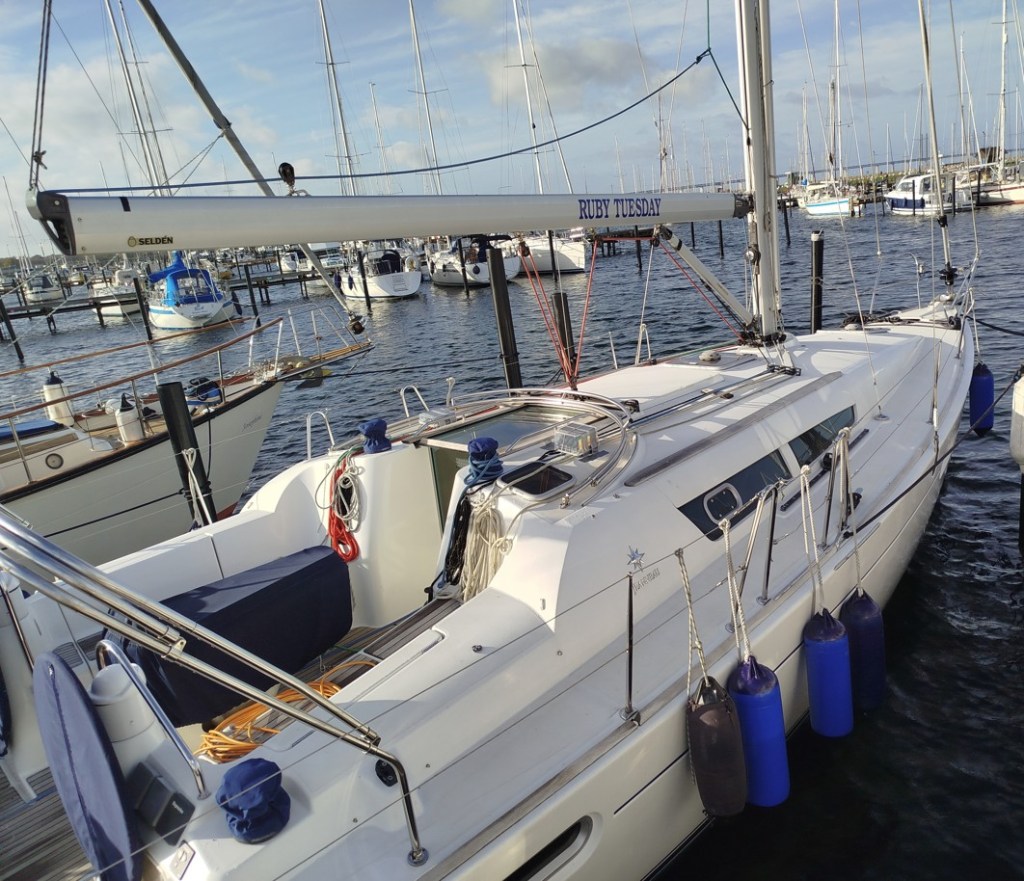
Ruby Tuesday in her winter berth, Malmö.

I spend the next few days preparing for the voyage. I had taken the heat exchanger home to clean and service it – just as well, as I had found that nearly half of the small cooling tubes had been blocked by scale. Soaking the unit in vinegar had helped to dissolve that and left it coppery clean. The job of the heat exchanger is for saltwater from the sea to absorb the heat from the coolant running through the engine, so it is essential that it functions properly to prevent overheating.

Servicing the heat exchanger – nearly half of the small tubes have been blocked by scale.

I also decide to check the anode inside the hot-water heater. We have never done that since we had bought the boat, so it is high time. Extracting the heater from under one of the seats isn’t too difficult, but undoing the nut on top of the cylinder is. It is corroded in position, and none of the tools I have are up to the job of freeing it. In the end, I have to borrow some larger ones from the harbourmaster. With a combination of these and brute force, it slowly comes undone. There is no anode left! No wonder it has corroded. I am sure that no-one has looked inside the cylinder since it was made. I decide to replace not only the anode, but also the heating element, thermostat and pressure relief valve while I am at it.

Servicing the hot water cylinder.

The First Mate arrives in due course. I collect her from the train station.

“I hope that you have got everything clean and tidy for me?”, she says, as I load her bags into the car. “I don’t want to start cleaning as soon as I arrive.”

Luckily it is dark when we arrive back at the boat.

The next evening, we drive over for dinner to some friends, Martin and Mia, who live just north of Malmö. We had first met them on the Swedish island of Borgholm when Martin had kindly given us a hand tying up, as well as a list of must-see places on the east coast of Sweden, which we had now seen most of. He had offered to kept an eye on Ruby Tuesday over the winter, visiting her from time to time to check that everything was OK and that the batteries were kept charged.

“That’s his second wife”, says Mia with a wink as we walk past the Porsche in the garage as we arrive.

“Well, a man has to have a few pleasures in life”, says Martin, grinning.

Over dinner, the conversation turns to Swedish politics. When we were sailing near Stockholm two years previously, it had been the time of the national elections, and the far-right Sweden Democrats had won a sizeable share of the votes, giving them a strong influence in government. I am curious as to how they have performed since then.
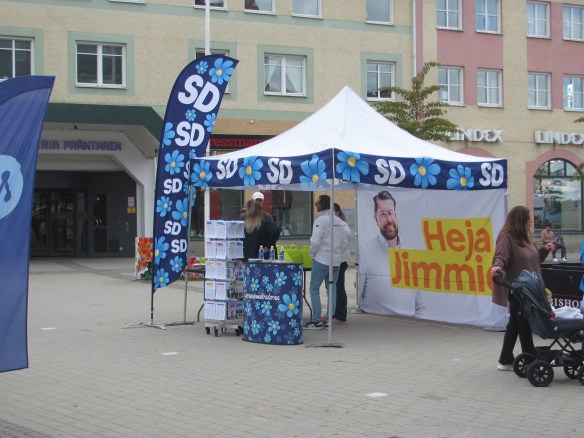
The Sweden Democrats campaigning in 2022.

“Well they have lost some popularity since then”, Martin says, as he serves the salmon. “Last year, for example, they were found to be using social media to spread disinformation and attack political opponents online. People were put off by that. Then, this year, the government proposed stricter gun control after the country’s worst mass shooting in Örebro, but the Sweden Democrats opposed that, saying that they had concerns for hunters and farmers. That further eroded a lot of people’s confidence in them.”

“People also think they focus too much on immigration and crime”, says Mia. “Sure, it was a concern two years ago when they were elected, but overall it is less so now. But the Sweden Democrats don’t seem to be able to move on from then.”

“The next national elections are next year”, says Martin. “It will be interesting to see whether they still have the same amount of support then.”

We have booked a slot to have Ruby Tuesday lifted out of the water to have her bottom seen to.

Lifting out Ruby Tuesday for a bottom inspection.

The next few days are spent washing, scraping, sanding and painting, and replacing the anodes. I am astounded at the state of the propeller anode – I fitted a new one only a year ago, and it has almost completed eroded away.

Aluminium anode almost completely eroded after one year.

“Sometimes if you are tied up next to a steel boat, that can happen”, explains Peder, the harbourmaster. “But at least it is doing its job.”

Soon Ruby Tuesday is back in the water to complete the preparations. In the afternoon, we receive a WhatsApp message from Simon and Louise, whom we had met on the Cruising Association Rally in 2023, and with whom we had explored Gotland together in 2024.

“Are you still in Malmö?”, they ask. “We have a rip in our sail, and need to have it fixed. Is there a sailmaker there? We’ll be there in the afternoon tomorrow.”

They arrive in time for coffee and cakes.

“I am not quite sure how it happened”, explains Louise. “I was sailing, and I wanted to tack, and I think the sail must have got stuck on something sharp on the self-tacking mechanism.”

We give them a hand in taking down the sail, packing it in a bag, and putting it in our car to take it to the sailmaker in the morning. The tear is quite small, but unless repaired such rips have a habit of getting much bigger quickly. It’s always better to get them fixed as soon as you can.

In the evening, we have dinner on their boat.

“As soon as we get back from this trip in October, I’m setting off for a motorcycle trip in Nepal”, Simon tells us. “It’s a sort of spiritual motorcycle ride with a group of other like-minded bikers. I came across this chap who organises trips combining motorbiking and discussions on spirituality. It sounded interesting, so I thought I would give it a go. I even had to be interviewed by him to see if I would fit into the group.”

“It sounds like something you could write a book on”, I say. “Did you ever read Zen and the Art of Motorbike Maintenance? In it, the author, Robert Pirsig, writes about a motorcycle trip he made from Minnesota to California in the 1960s with his son. The trip is interspersed with philosophical discussions on the pursuit of truth. He developed his theory of the Metaphysics of Quality in which quality is the driving force of the universe.”

“I like these philosophical discussions”, Louise says. “I am not religious now, but I was brought up as a Quaker. Both of my parents were members. We were taught that God doesn’t exist as a supreme being, but that something of what you might call God exists in everyone and emerges when people interact. Just meeting and having an interesting conversation like we are now is being part of God. Quakers believe that you find spiritual truth through your own inner experience of every-day life and human relationships, and for that reason we don’t have any need for ritual, ceremony or even clergy. They just get in the way of the relationship between yourself and God.”

“It all sounds very logical”, I say. “But I always thought that Quakers were a sect of Christianity. This sounds more like Humanism, I think.”

“Yes, they do follow many Christian traditions”, says Louise. “But a lot of Quakers wouldn’t describe themselves as Christians, more as members of a universal religion. And they don’t believe that the Bible, or any other book for that matter, is the ‘Word of God’, although they do think that it provides inspiration along with many others. So yes, a lot of their concepts are similar to humanist ideas, and in fact, a branch of the Quakers are actually affiliated to the Humanist Association.

“Wasn’t there a lot of resistance to them at one stage?”, asks the First Mate.

“Yes”, answers Simon. “George Fox, who was one of the founders, taught that all people have equal value. This didn’t go down too well with the rich landed gentry at the time, who saw it as a challenge to the established social order, and he was brought before the magistrates several times for blasphemy. His followers were officially persecuted for a time.”

“Well, that was interesting”, says the First Mate as we walk back to Ruby Tuesday. “I didn’t know much about the Quakers. You don’t hear much about them these days.”

“That’s true”, I say. “But their ideas certainly contributed a lot to the Enlightenment and to the way we think nowadays. Their condemnation of slavery, their campaigns for social justice, and focus on individual conscience and spiritual experience all align with the Enlightenment values of human rights, social reform, and reason. Quite an impact.”

Simon & Louise and us.

A near miss, a twisted torso, and different minds

“Look!”, shouts the First Mate, pointing to a steep cliff to our port side. “You can see Hammershus castle up there. It’s hard to believe that we were up there yesterday. It looks quite impressive even from down here.”

We had left Allinge in the morning, edging our way carefully out of the small harbour with its dog-leg entrance, and are just rounding the northern point of Bornholm Island. The wind is from the north-east, giving us a comfortable beam reach as we head for Ystad, back on the Swedish mainland. Between here and there, however, we must cross a Traffic Separation Scheme (TSS) for the big ships, which the rules say that we need to do at right angles to minimise the amount of time crossing it.

“It reminds me of the time we crossed the English Channel”, I say. “It was like being in a pinball machine – no sooner had we dodged all the ships coming from one direction, we had to face a whole lot more coming from the opposite direction. Let’s see if we can get across here without altering our course.”

“Be careful”, says the First Mate. “We don’t want to have an accident at this stage.”

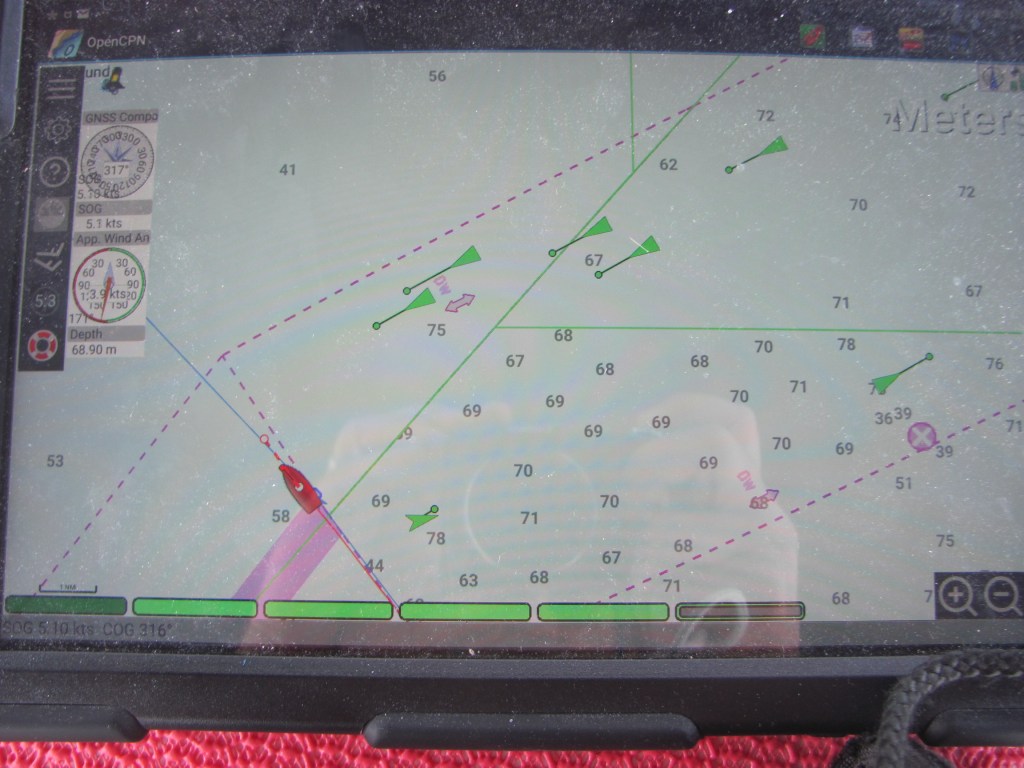
Running the gauntlet (we are the red one!).

We manage to make it through the north-bound lane without too much trouble. But traffic in the southbound lane is heavy, and there are five ships in a cluster that we need to avoid. The AIS tells me that we will pass behind the first three comfortably, but that we will pass in front of the fourth one with just 15 m as the Closest Point of Approach (CPA). That is a little bit too close for comfort! Hoping that the wind might strengthen and give us a bit more speed, or even drop so that we slow down, I keep an eagle eye on the AIS as we cross, but the CPA remains obstinately the same. As our paths converge closer and closer, I chicken out and decide to heave-to. As the ship passes about 100 m in front of us, we can see some of the crew leaning over the guard rails and smoking.

“Phew”, breathes the First Mate in relief. “That was pretty close.”

“Yes, I even noticed that it was Gauloises they were smoking”, I say.

Dodging the ships in the Traffic Separation Scheme.

Once clear of the TSS we alter our course to the east. As luck would have it, the wind shifts and drops, as does our speed.

“We aren’t in any hurry”, I say. “Let’s just take it easy and enjoy the sunshine.”

At a stately three knots, it takes most of the afternoon before we reach Ystad, our destination for the night.

“Better look out for that ferry over there”, calls the First Mate, pointing to something on the horizon. “It looks like it’s heading for Ystad too.”

“There’s plenty of time”, I say. “It’s miles away.”

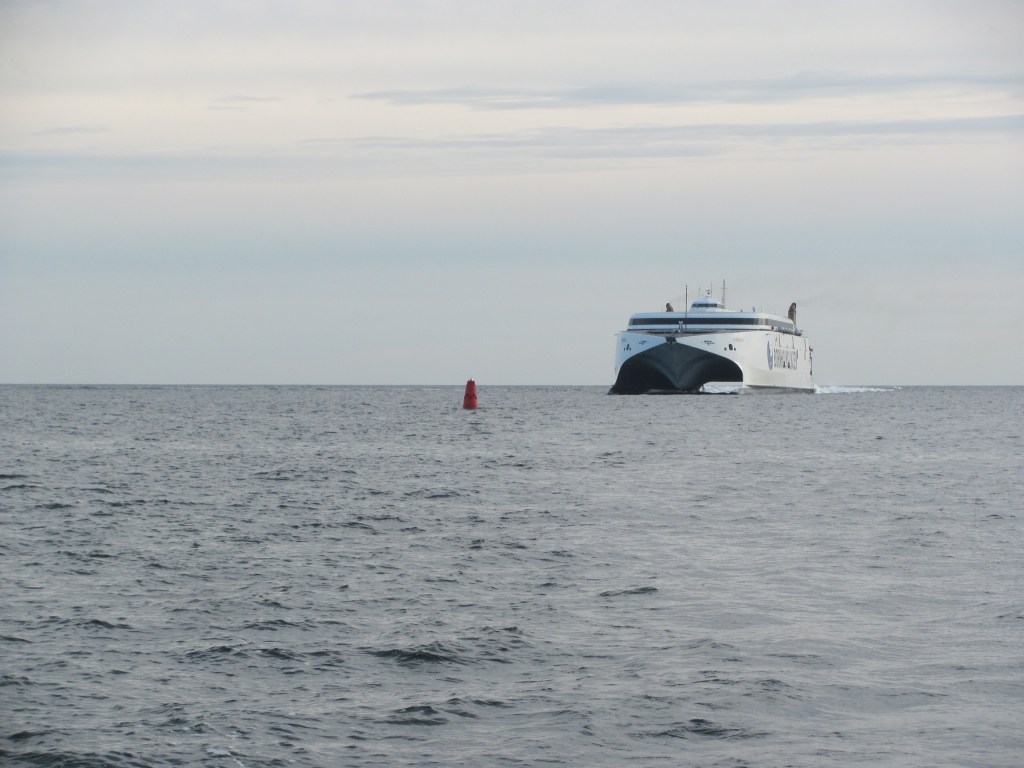
But it’s a catamaran and travelling fast. In a few minutes it is just behind us. It blows its horn to tell us to get out of the way. We motor as fast as we can to a red buoy, and take a line just outside it so that the buoyed channel is clear. The ferry slows down and cruises past us.

Getting out of the way of the ferry coming into Ystad.

Obsession is already there. We aim for the berth just behind her. Ingemar gives us a hand tying up.

“Ystad is a pretty enough place”, he says over a cup of tea. “It’s a former Hanseatic town, and the church and some of the old half-timbered houses are worth a look. It’s just a short walk into the centre of town from here. Ystad’s other claim to fame is that it is the place where the Wallander crime series is set.”

The First Mate has watched the Wallander series, but I haven’t. I make a mental note to try and see it on iPlayer over the winter.

In the morning, we walk into the town centre. We come across the Sankta Maria Kyrka, built in the 1200s in Brick Gothic.

Inside the Sankta Maria Kyrka.

“The guidebook says that the church still has a Tower Watchman”, says the First Mate. “His job is to climb the tower every night and keep an eye on the city. He blows a horn every 15 minutes from 2100h to 0100h to signal that everything is OK. If the horn doesn’t sound, it means that there is a problem, like a fire or something. It’s an old tradition from the 1700s that has been kept alive. Apparently, it has been the same family who have been doing it all that time.”

“I wonder what they do if he is sick or on holiday?”, I say.

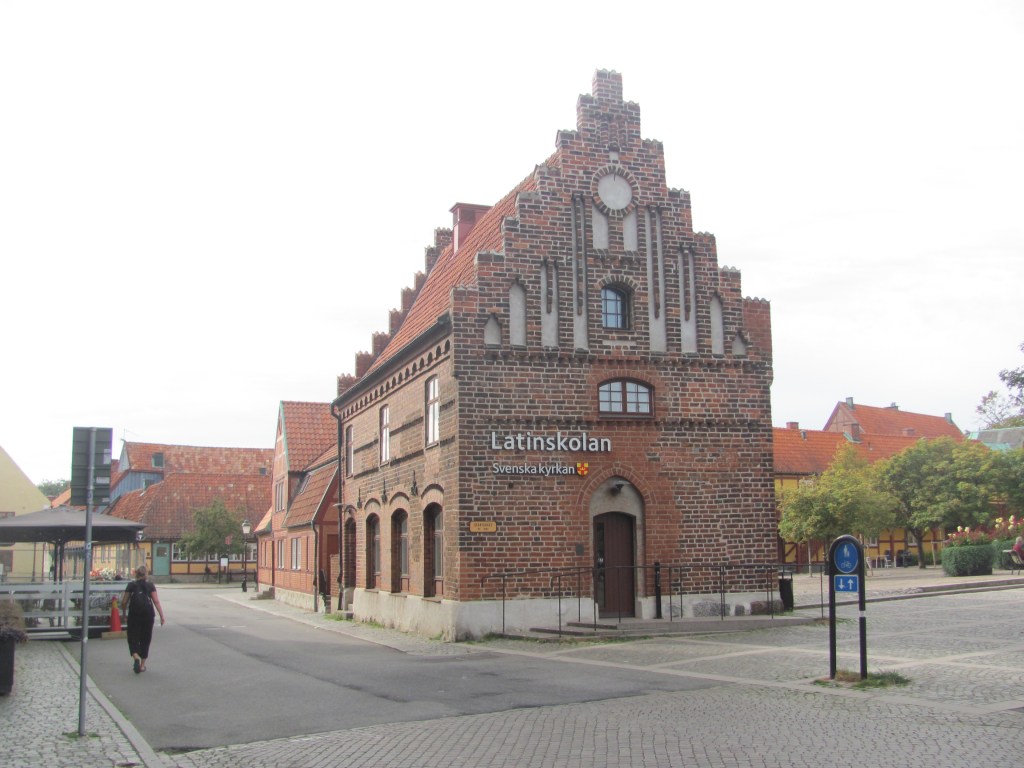
Next to the church is the Latinskolan, or Latin School, that was used in medieval times to teach Latin to the sons of clergymen and the local elite to prepare them to go to university.

The Latinskolan in Ystad.

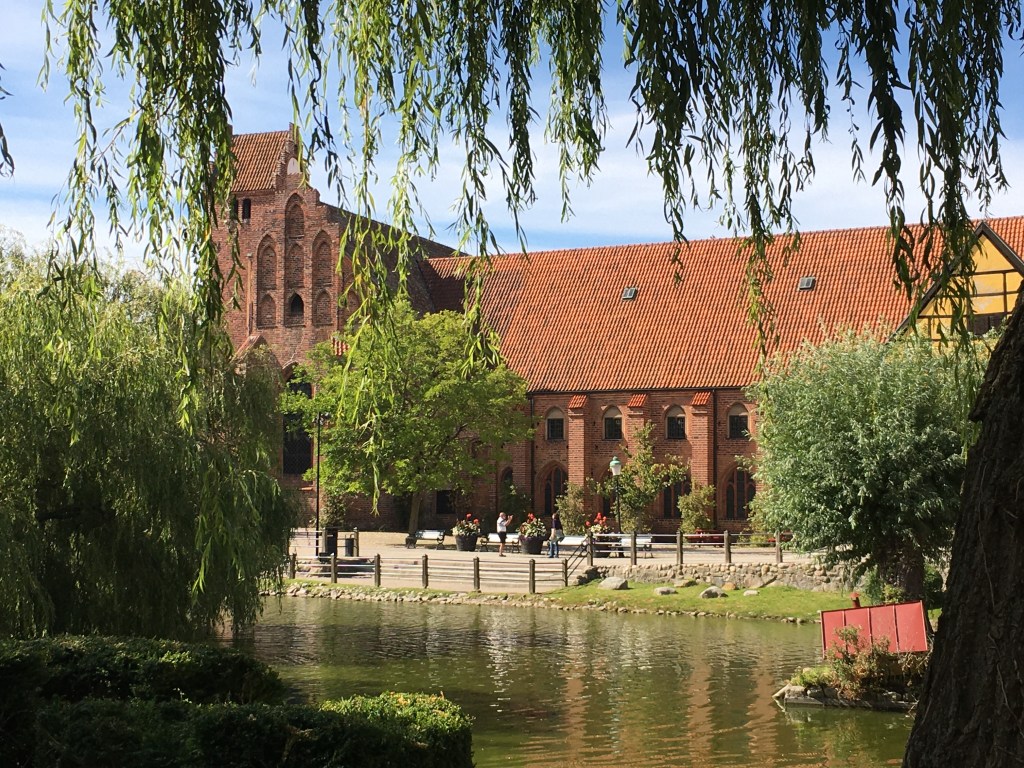
A little bit further on, we come to the Klostret I Ystad, or Greyfriars Abbey, originally a Franciscan monastery. There is a small museum attached to the side, but unfortunately it is Monday and it is closed.

The Klostret I Ystad.

“The book says that the Franciscan order wore grey habits”, says the First Mate. “Hence the Greyfriars name. They emphasised the simple life and travelled around the countryside preaching, caring for the poor and sick, and living off alms given to them by those who could afford it. The friary was a place they could come back to for meditation and contemplation.”

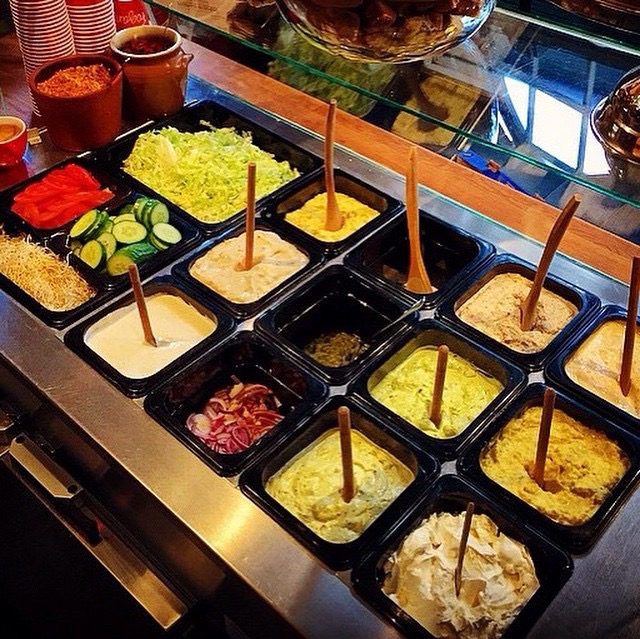
It’s lunchtime. We join the queue at a place called ‘Maltes Mackor’ that is famous for its tailor-made sandwiches, and eventually watch in mouth-watering anticipation as each of our sandwiches is ‘constructed’ with loving care.

Spoilt for choice (from Maltes Mackor).

“Well, it took a while”, says the First Mate, “but I have to say that it was worth it. They taste marvellous.”

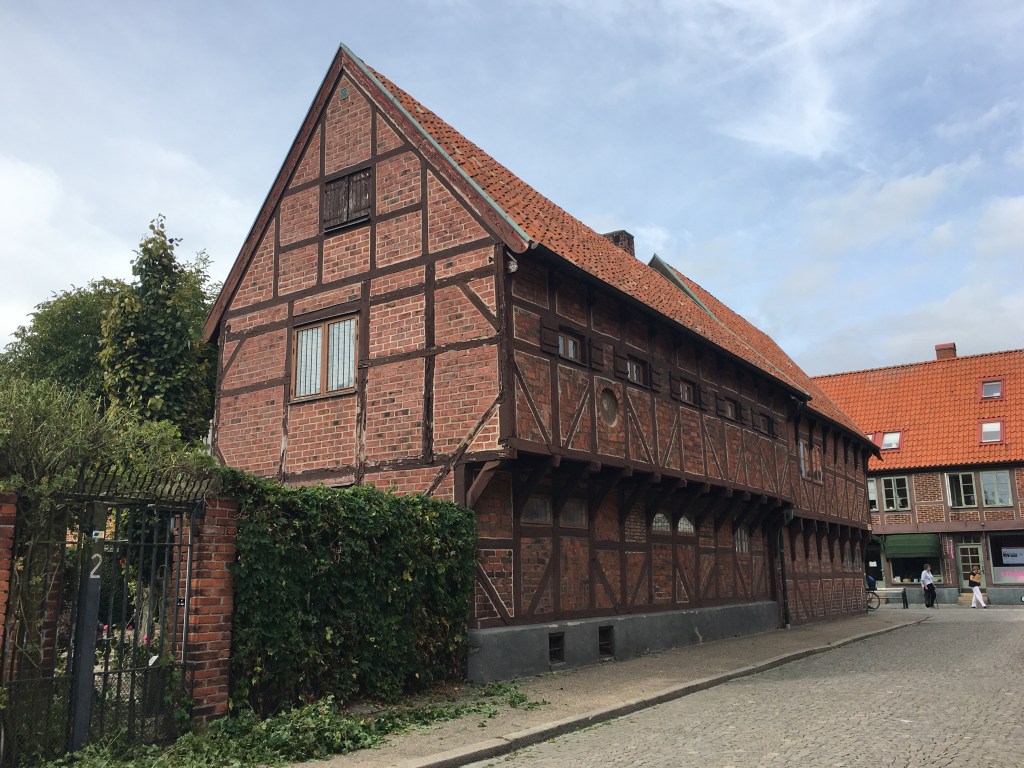
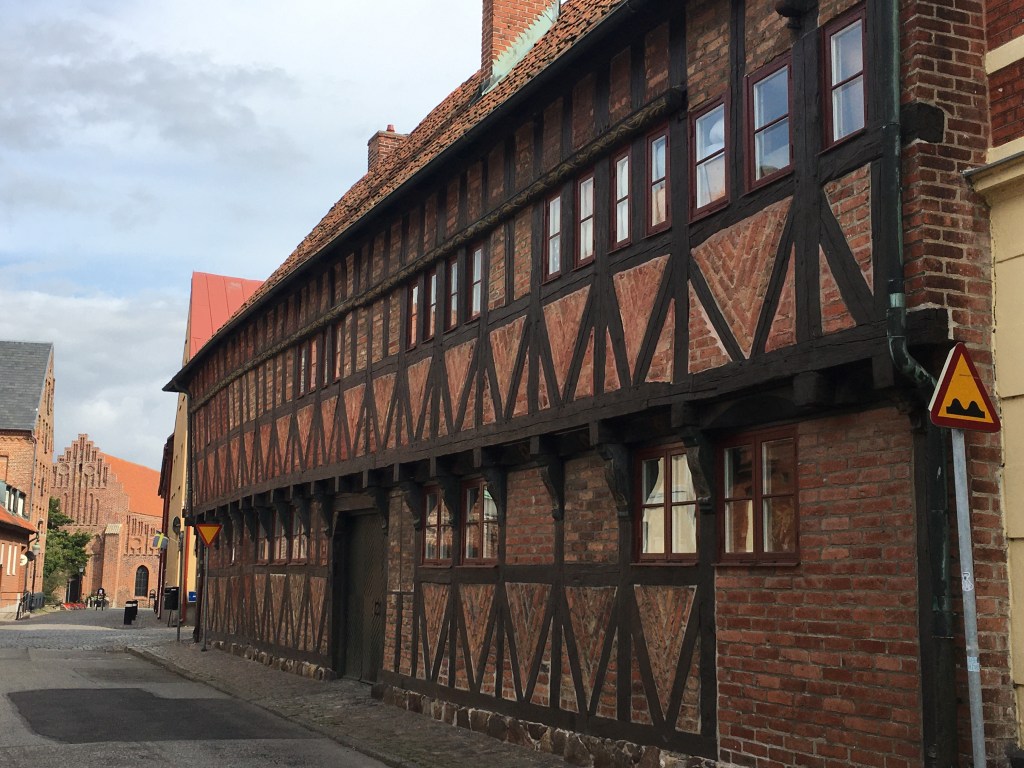
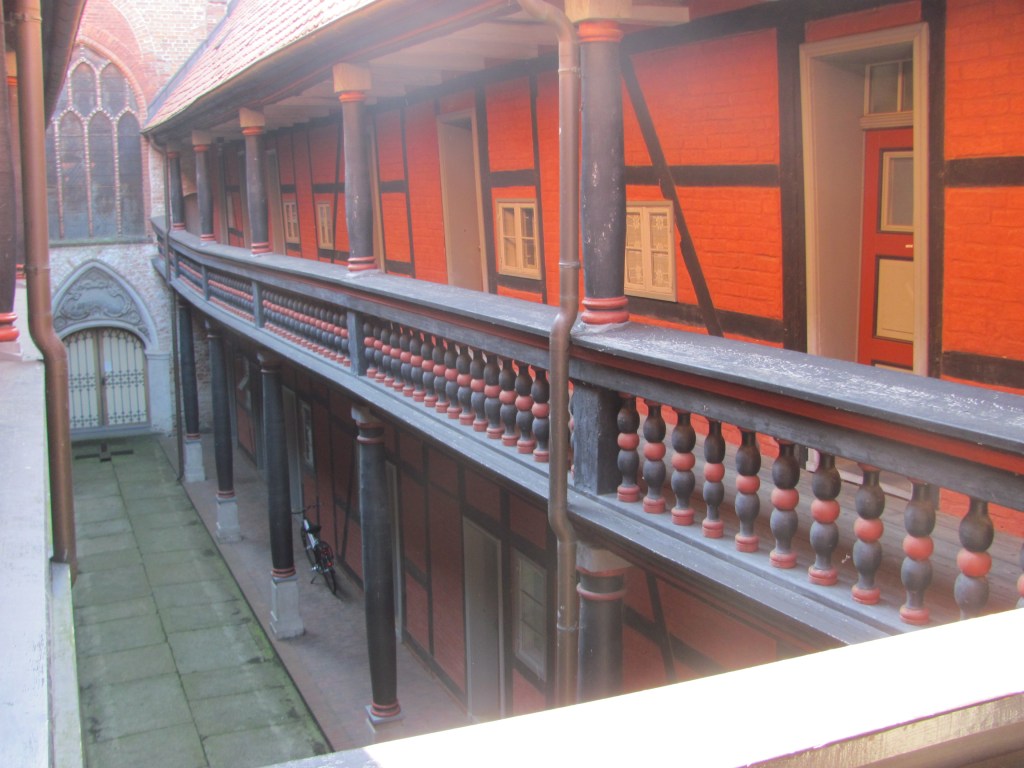
After lunch, we explore the narrow streets flanked with half-timbered houses. Per Helsas Gård was a farmhouse built just inside the city walls following their curvature. Nowadays, it houses a number of craftsmen, with an open air café in the old courtyard.

Per Helsas Gård.

Pilgrändshuset is a residential house joined to a warehouse dating from around 1500 AD.

The Änglahuset is another farmhouse, so called because of the decorative angel figures under the eaves.

Änglahuset.

In the evening, we ask Ingemar over for a drink.

“Did you hear that the Falsterbo Canal is closed for us?”, he asks, as he sips his Weizen beer. “They are repairing it. It’s open for south-bound traffic this week, but not northbound, then next week they are switching around. Unfortunately, we both need to go through this week.”

Falsterbo Canal was built during WW2 to allow Swedish vessels to continue sailing to and from the North Sea while avoiding the mines laid in the Öresund by the Germans. It is still maintained, but is now mainly used for recreational boats wishing to take a short cut to avoid the long way round through the Öresund.

“Yes, I read that somewhere”, I say. “We are planning to go round the outside and perhaps stop in Skanör for a night.”

Our route around Falsterbo peninsula avoiding the canal.

Obsession leaves at 0700 in the morning. We are a bit more leisurely, and don’t get going until around 1000. The wind is from the port quarter, but shifts to directly behind after a couple of hours. Sailing with the genoa only, we still make around six knots. As we reach the Öresund and turn northwards, the wind strengthens. I take out the mainsail, put in two reefs, and we still manage to make more than eight knots on a close reach. I glimpse Obsession on the AIS far ahead, already past Skanör, heading for Malmö.

Making good speed.

“8.2 knots!”, says the First Mate. “We don’t often do that speed. And with a double reef too. But it was heeling a bit too much for my liking.”

We stop for a night at Skanör, then set off in the morning for Malmö.

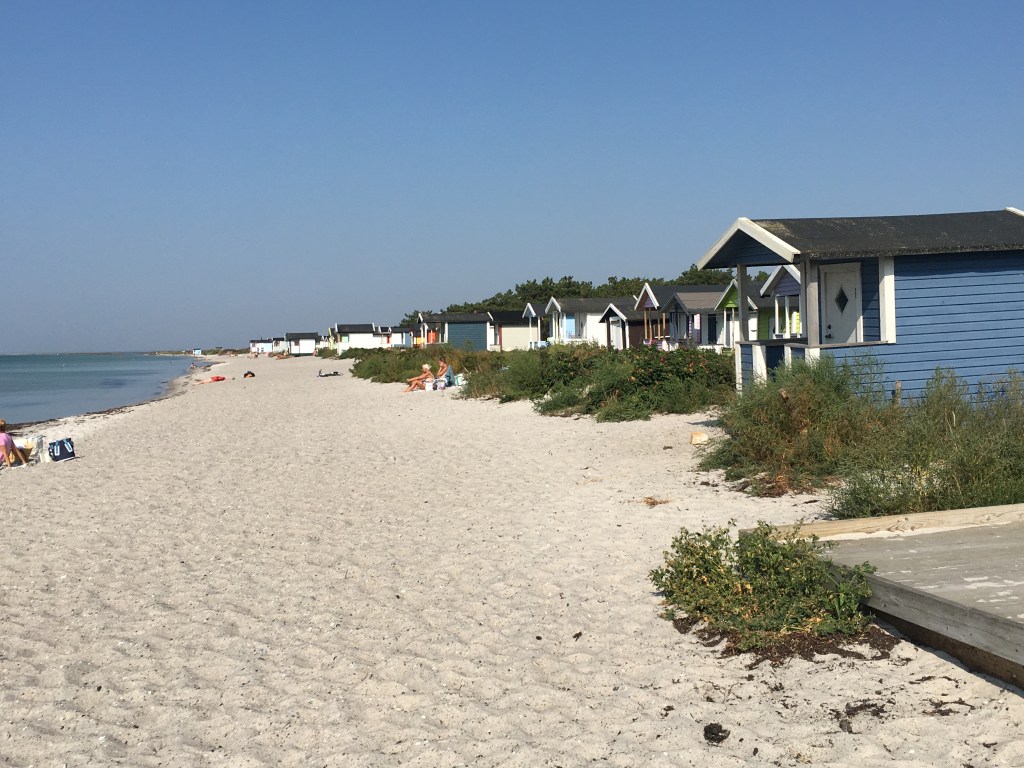
The beach at Skanör.

“This will probably be the last sail of the season”, I say. “I feel a bit sad that it’s all over for another season.”

“Me too”, says the First Mate. “Better make it a good one then.”

And it is. The wind is still an easterly, and blowing 24 knots, so we sail double reefed again. Before long we have passed the Lillgrund windfarm to our port, and are approaching the Öresund Bridge.

Approaching the Öresund Bridge.

“Keep an eye out for Saga Norén”, I call out to the First Mate at the bow. “They might be making another episode of The Bridge. And try to ignore the dead bodies, especially the ones sawn in half.”

With the wind blowing, she doesn’t hear me. Probably just as well.

We pass under the Bridge and arrive at the Limhamn marina in Malmö. The harbourmaster has asked us to tie up to the second pontoon. Ingemar sees us arriving and comes to catch our lines.

“I’ve just been servicing my heat exchanger this morning”, he says over lunch. “You need to do it every couple of years or so, or else the small pipes inside it will get blocked up with scale. I have rigged up a pump and some tubes that circulate phosphoric acid through the sea water side of the exchanger for an hour or so. That dissolves all the scale, leaving it nice and clean again.”

Rather than having a radiator like cars do, the heat exchanger takes in sea-water and uses it to cool the hot coolant circulating through the engine. That way sea water doesn’t come in contact with the engine to cause corrosion.

Ruby Tuesday’s heat exchanger.

“When was the last time we did that?”, asks the First Mate.

I have learnt that by ‘we’, she always means me.

“We haven’t done it since we have had the boat”, I say.

“It would probably be a good idea to do it”, says Ingemar. “Just to avoid problems.”

There is also a small leak in the cooling system that I have been meaning to do something about, and the mixing elbow that combines the warm sea-water with the exhaust gases also needs to be checked, so I decide to remove the whole assembly from the engine and take it home to do everything together. I spend the next couple of days getting it off. Like everything in boats, some nuts and bolts are almost inaccessible, and there is very little space for me to manoeuvre in the engine compartment.

“You need to lose a bit of weight”, sniffs the First Mate unsympathetically. “It’s all those peanuts you have been snacking on. I wouldn’t be surprised if you get stuck in there. Make sure you’ve got your mobile handy so you can call me.”

I finally manage to get the heat exchanger and the mixing elbow off. I change the oil and replace the oil and fuel filters. We pack away the sails, and take down the spray hood, cockpit tent, and the bimini. The new dinghy is deflated, rinsed in fresh water, and stowed. Clothes and other fabrics are stored in the vacuum packs and the air sucked out with the vacuum cleaner. Everything is ready for the winter.

Ruby Tuesday ready for the winter.

“You know, we should take the opportunity to explore Malmö”, I say one evening. “Now that most of the winter preparations are done.”

“I was thinking the same”, says the First Mate.

The next morning, we cycle into town to explore. Malmö was founded some time in the 1200s when southern Sweden was actually part of Denmark. One story is that the name comes about from a young woman being ground up in a mill, but this is almost certainly untrue. In the 1600s, the city became part of Sweden under the Treaty of Roskilde. Then, in the 1800s, it was the first city in Sweden to industrialise, with the main focus on shipbuilding and textiles, but it was slow to adapt to the post-industrial period after the 1970s. However, with the opening of the Öresund Bridge, it has taken off again and is rebranding itself as a hi-tech, educational and cultural centre. In 2020, it was the fastest-growing city in Sweden, with 40% of the population coming from a non-Swedish background.

We come to a bronze statue of a number of people sitting on the back of a giant fish, by the Swedish sculptor Carl Milles. Called “Emigranterna“, it represents the large numbers of Swedish people who left their homeland to emigrate to the New World in search of a better life. Emotions of determination, hope and apprehension line their faces as they head for an unknown future.

Emigranterna.

“It’s ironic that large numbers of Swedish people left from here to go abroad to make a better life”, says the First Mate, “and now Malmö is the place that many immigrants arrive from third world countries to make a better life here.”

“Even more ironic is that there were tensions between the Swedes and the earlier settlers in America”, I say. “Especially the English-speaking ones, who saw them as culturally different in terms of language and religion. The Germans and Dutch didn’t like them much either, as they competed for jobs. But now they are well integrated into American society. What goes around, comes around.”

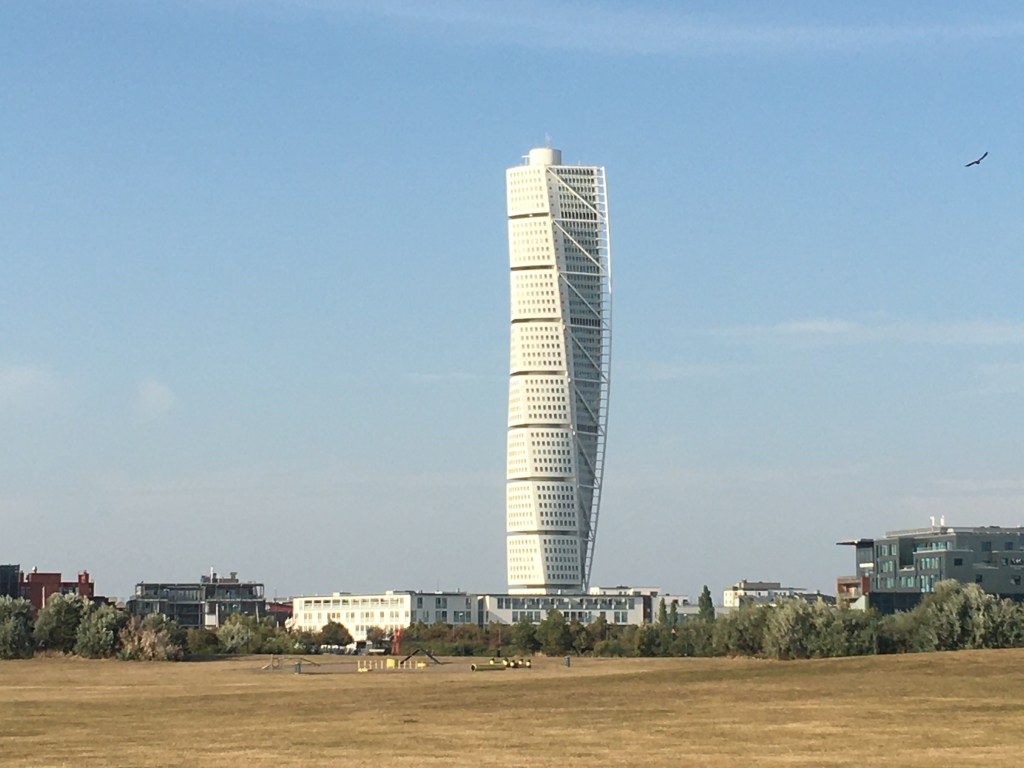
On the way back, we spot the ‘Turning Torso’, a 190 m high residential skyscraper built in 2005, and one of the tallest buildings in Scandinavia. It is the modern day icon of the city, replacing the shipyard crane that had previously been the Malmö icon, but since sold to South Korea.

“It’s certainly very eye-catching”, says the First Mate.

The ‘Turning Torso’.

—–

It’s the last day – the day that we are leaving to drive to Germany to see the First Mate’s family, and then back to the UK.

On the way back from the shower block, I see a quick movement of something black near the rocks of the breakwater. It’s a mink. It stops and regards me intensely. I stare back at it. For perhaps five minutes we regard each other with curiosity, neither of us moving. It doesn’t seem to be afraid, despite there being only two metres between us.

Our aquatic neighbour (from NatureScot).

What thoughts are going through its mind, I wonder? Do mink even have thoughts or a mind? Or emotions? Is it wondering what I am thinking? What would it be like to be a mink?

I think back to the essay written by Thomas Nagel “What is it like to be a bat?” that I had read during my student days. In it, he argues that consciousness has a subjective aspect that cannot be fully understood from an external, objective perspective. While we can study a bat’s brain physiology, we can’t fully grasp its subjective experience—what it is really like to perceive the world as a bat. We can imagine what it is like to be a bat, but that is still a human imagining what it might be like. Any attempt to reduce subjective experience to physical processes will always be incomplete.

And yet, there seems to be something shared in this brief encounter with the mink, even if it is just curiosity about the other. Is curiosity a shared experience? If so, there may be others. Or am I anthropomorphising?

“Come on”, calls the First Mate from the boat. “We need to pack the last things into the car and lock up. We’ve got a long journey in front of us.”

The mink scampers off to a gap in the rocks to re-join its world. I return to my world of other humans and their technology. The fleeting connection between very different minds is gone.

“See you next year”, I call after it.

Antique cars, an orca interaction, and a ship with a story

“Wassa time?”, says the First Mate, emerging bleary-eyed from the cabin. “Issh still dark.”

We are in the process of leaving Warnemünde to press on with our journey eastwards. The next major port of call is the city of Stralsund, another of the medieval Hanseatic cities. It is more than 60 NM away – while the winds are favourable in the morning, they are due to change in the afternoon, so we have decided to leave while it is still dark to make the most of them.

“Four-thirty”, I say. “I’m just going through our leaving checklist now. Most things are done, I just have to check the engine, roll the sides of the canopy up, and set the tablet and chartplotter going, then we can leave.”

We slip the lines and edge away from the pier, taking care not to catch the piles. All is quiet, the town is quietly sleeping, and there are no other boats yet moving at that time of the morning. We reach the red and green buoys at the entrance to the harbour, and turn eastwards. There is some swell as the wind has been blowing from the west for several days now, but luckily we are going with it. The sun begins to rise.

Sunrise as we leave Warnemünde.

“It’s gorgeous”, says the First Mate. “But I am still tired. I think I will try and get some more sleep until breakfast.”

I am left alone with my thoughts.

I think over my last conversation with Spencer, that power is the basis for all politics, whether it be communism, fascism, liberal democracy, whatever. According to this, ideological differences are just facades to disguise the underlying driver of power. To preserve peace between nations, a balance of power is needed.

But while it is difficult to argue with, does it explain everything? I can’t help thinking there is something in Fukuyama’s idea that it is part of the human psyche, the thymos, that craves recognition and fame, of wanting to be remembered by history for ‘being someone’.

At the end of the Cold War, the new thinking in Russia was that NATO and Europe were not a threat, that NATO was a defensive alliance not wanting to attack it at the earliest opportunity, and that Europe and the West were more interested in economic prosperity than territorial expansion. And within Europe the belief grew that strengthening trade links with Russia would create an interdependence that would make war not worthwhile and would guarantee everlasting peace.

But only a short time later where are we now? A war within the boundaries of Europe, tens of thousands of people on both sides killed, whole cities razed to the ground, horrific atrocities against civilians committed, a return to the Cold War. There was no need for this war on the basis of power and ideology: Ukraine was not a threat to Russia, it was not governed by Nazis. Instead, it seems driven by one man’s self-professed need to be remembered by history as another Peter the Great, in recapturing lands that ‘belonged’ to Russia in the distant past, and uniting all Russian speakers into a single domain once more. A return to a thymotic mindset that many had thought that the human species had outgrown.

I check the chart. We are passing the promontory of Dasser Ort over to our starboard. In GDR times, Dasser Ort was a naval port for the People’s Navy and was a restricted area. Nowadays it is part of a protected national park, and is a port of refuge only, with entry difficult anyway due to silting up. Here we need to alter our course to the east.

Passing Dasser Ort.

The wind is now directly behind us, and we furl the mainsail and run with the poled-out genoa only. Even so, our speed hardly changes – with the wind at more than 20 knots, we make about 7 knots. But it is rolly and not very comfortable.

Running with the poled-out genoa only.

“I wonder what bodden means?”, says the First Mate. There are quite a few of them marked on the chart. Kubitzer Bodden, Schaproder Bodden, Barther Bodden, Bodstedter Bodden, Saaler Bodden, Greifswalder Bodden. It must mean something.”

Ich habe keine Arnung”, I say. “You are the German.”

The entrance to Stralsund is through a buoyed channel just deep enough for our keel. We reach the first buoy and turn south. The waves are now on our beam, and due to the shallowing, are quite large, almost breaking. We wallow uncomfortably, trying to maintain the line between each red buoy and not drift off into the shallows on each side. The chart shows only 30 cm depth in some places.

Our route from Warnemünde to Stralsund.

Eventually we reach the relative shelter of Kubitzer Bodden, and with the wind more variable from the surrounding land, we motor the last leg into Stralsund. With the help of some friendly hands, we tie up at the City Marina at the entrance to the harbour. The majestic buildings of the old city rise up behind, providing a stunning backdrop.

City Marina with the old part of Stralsund in the background.

“I feel like a Hanseatic captain returning from his voyages in the wilds of the Baltic”, I say. “It must have been an amazing feeling coming home to a city like this.”

The First Mate has been chatting to one of the neighbours who helped us to tie up.

“You won’t believe it”, she says. “But our neighbour is from Hamm. He knows all the places where I grew up. Like us, he retired a few years ago and bought a boat to explore the Baltic. His wife still works, but she is coming tomorrow. It seems there is a special offer on at the moment – the government is offering a ticket for €9 a month that gives free travel on all buses and trains. They are trying to get people to use public transport more to wean them off Russian oil. I think I’ll get some for us. Tickets that is, not Russian oil.”

The next morning we explore the city. Stralsund is another Hanseatic city, formerly trading herring, grain and beer, and is similar in many respects to the others we had already seen. During the Middle Ages, it was part of the Duchy of Pomerania, then in the 17th century, along with Wismar, it became part of Sweden, and remained so until 1807 when it was captured by Napoleon. Then, in 1815 it became part of Prussia. Since 2002, it has been designated as a UNESCO World Heritage site.

We start in the Alter Markt, surrounded by the brick Gothic Rathaus or Town Hall on one side, and beautifully restored merchants’ houses on the other.

The Alter Markt with the Rathaus behind.
Merchants’ houses in the Alter Markt, Stralsund.

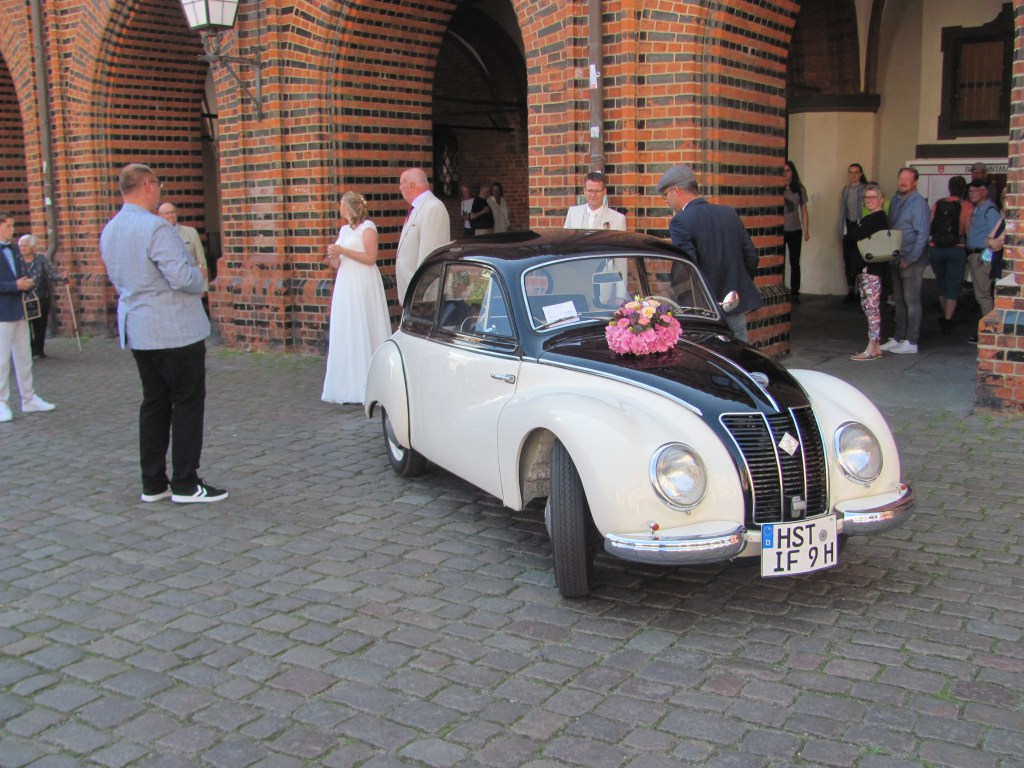
“Oooh, look”, says the First Mate excitedly. “There’s a wedding, and they have one of those old East German cars. How cool is that?”

Wedding in Stralsund Alter Markt.

It’s an old IFA car, built in the early 1950s with a three-cylinder two-stroke engine and front-wheel drive which could free-wheel to save fuel consumption. Much of the body was made from plastic due to the shortage of steel at the time. The bride is in white.

“And look over here”, I say. “There is a Morgan Plus 4, made in Britain. It was my favourite car when I was young, and I always wanted one but could never afford it. I had to make do with a MGB instead. Stralsund certainly seems to be the city of antique cars.”

A Morgan Plus Four in Stralsund.

“Well, it’s only two so far”, says the First Mate. “So I am not sure how you come to that conclusion.”

We reach the Kneipertor, one of the ancient gates to the city. It was here that General Wallenstein tried to enter and capture the city in the Thirty Years’ War in the early 1600s, but was beaten back. Then in 1790, Napoleon had a go, and this time managed to break through and conquer the city.

The Kneipertor, Stralsund.

We follow the city wall around and eventually reach the Neue Markt and St Mary’s Church.

“Why don’t you climb to the top while I have a look around the market?”, says the First Mate. “See if you can see me when you get there.”

“Do you want to leave your rucksack here?”, says the lady at the ticket desk as I pay. “You don’t have to, but it’s 90 m high and there are 366 stairs, so it might make it a bit easier for you.”

What is it about these church ladies that makes them think I am past it?

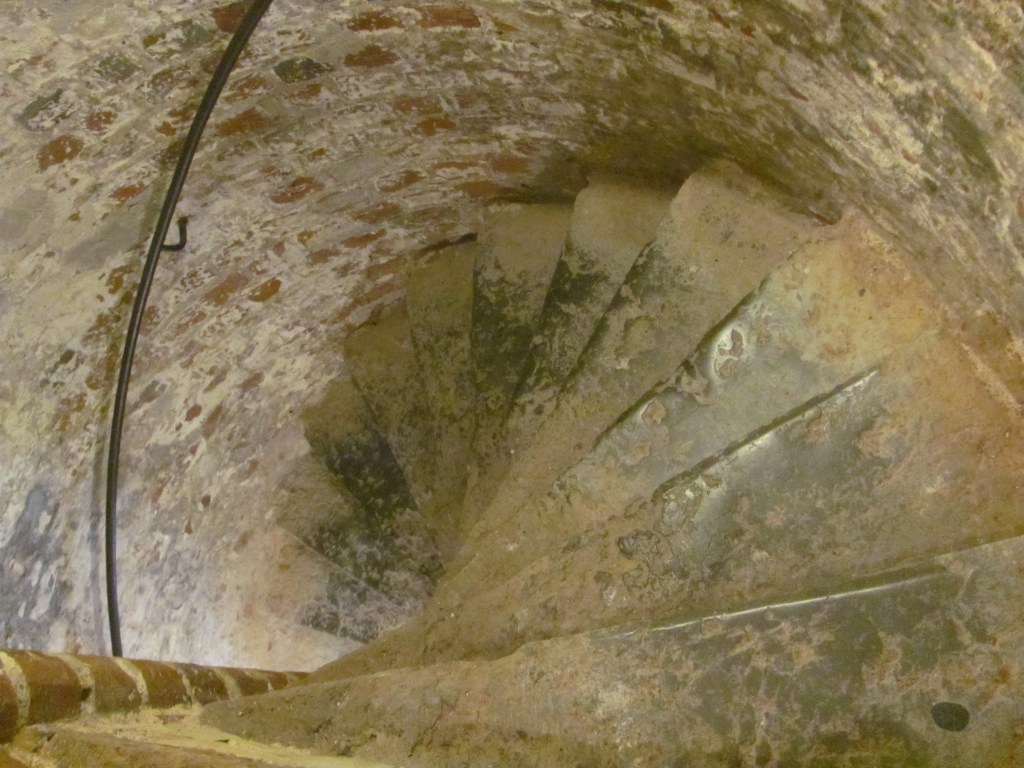
I start climbing the stone steps of the tower. There is only a flimsy handrail, and I start to wonder what would happen if I slipped. Would I roll all the way down, bumping from step to step, or would I end up in an ignominious heap on one of the steps? Pushing such thoughts to the back of my mind, I continue on. The ticket lady was right – there are a lot of them.

Some of the 366 steps to the top of St Mary’s Church, Stralsund.

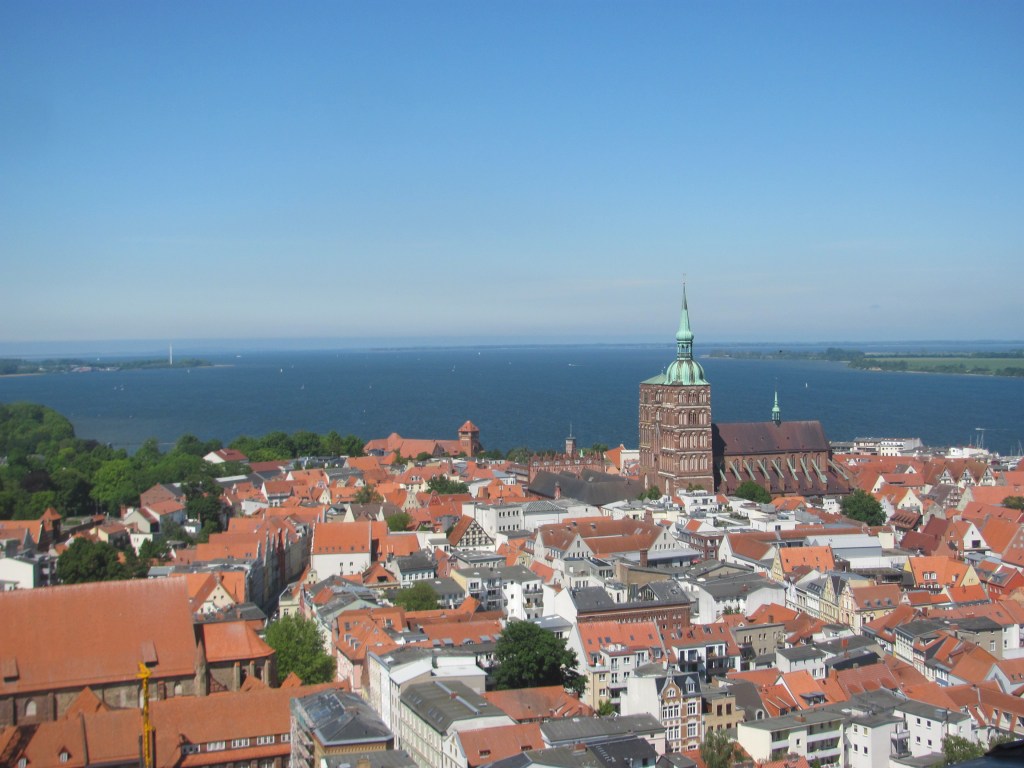
I arrive breathless at the top. I kid myself that it is because of the view out over the city and not the 366 steps.

View north from the top of St Mary’s church tower, Stralsund.
Stralsund bridge over to Rügen from St Mary’s church tower.

On the way out, I square my shoulders, flex my arms, and smile at the ticket lady, hoping that she takes my sweaty red face for the healthy radiant glow of youth. I don’t think she is convinced.

I re-join the First Mate.

“How was it?”, she asks.

“Terrifying”, I say.

We wander on and reach the Heilgeistkloster, the Holy Spirit Hospital.

“It says that this is the oldest public municipal hospital, where the sick, old, wounded, and itinerants could come for shelter”, says the First Mate, consulting the guide book. “It was first mentioned in 1256 AD. The church bit was built in the early 1400s, and this bit was extended in 1643.”

“Itinerants, eh?”, I say. “That’s us. We can come here if we don’t feel well.”

Inside the Heilgeistkloster, Stralsund.

We eventually arrive back at the harbour area.

The orcas circle confidently. The largest breaks off from the pack and propels herself towards the rudder of the yacht overhead. At the last moment, she opens her mouth and takes a bite, her sharp teeth breaking off the base, leaving a jagged edge. Her pupils flap their tails in excitement as she re-joins the pack. A nod from the teacher, and another repeats the exercise, then another, and another, until they have all had a go. The rudder hangs uselessly in the water, the broken pieces lying on the seabed below.

The teacher takes the lead once again, swimming strongly towards the yacht amidships. At the last moment, she swerves to one side, her weighty body catching the hull a glancing blow, diverting it from its course. As before, the young orcas wait for her to re-join them before they too follow suit. One, more daring than the rest, aims head-on for the keel instead, rocking the boat violently. Dazed from the contact with the lump of cast-iron, he swims erratically away, not daring to look at the frown of the teacher. He’ll have a headache in the morning.

The lesson ends. The teacher signals to each of her charges that it’s time to go. She swims one last time to the back of the yacht and holds herself out of the water with her tail, her cold dark eyes locking with those of the terrified humans looking directly at her.

“We’ll be back”, she says. “They have so much to learn.”

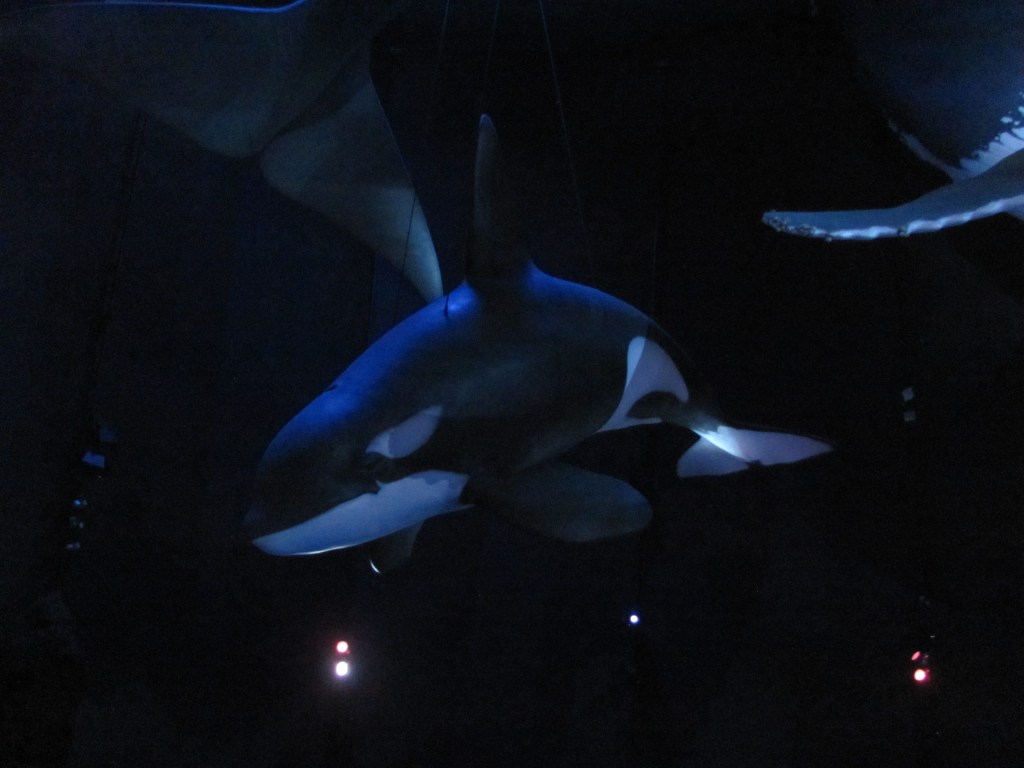
I suddenly wake up. We are in the Ozeaneum, the huge ocean museum near the harbour not far from where we are tied up. In the last room of the tour, we are invited to recline on body-curving ‘sea-beds’ and look up to the ceiling where life-size models of the giants of the deep, blue whales and orcas, are suspended. The comfort, warmth, darkness and soothing audio-visual music had conspired to make me doze off momentarily and daydream of the many recent reports of orcas ‘interacting’ with yachts in the Bay of Biscay. Theories to explain this behaviour include playing, learning to hunt, or stress from shipping noise, but so far no one really knows.

An orca hangs menacingly in the Giants of the Ocean exhibition.

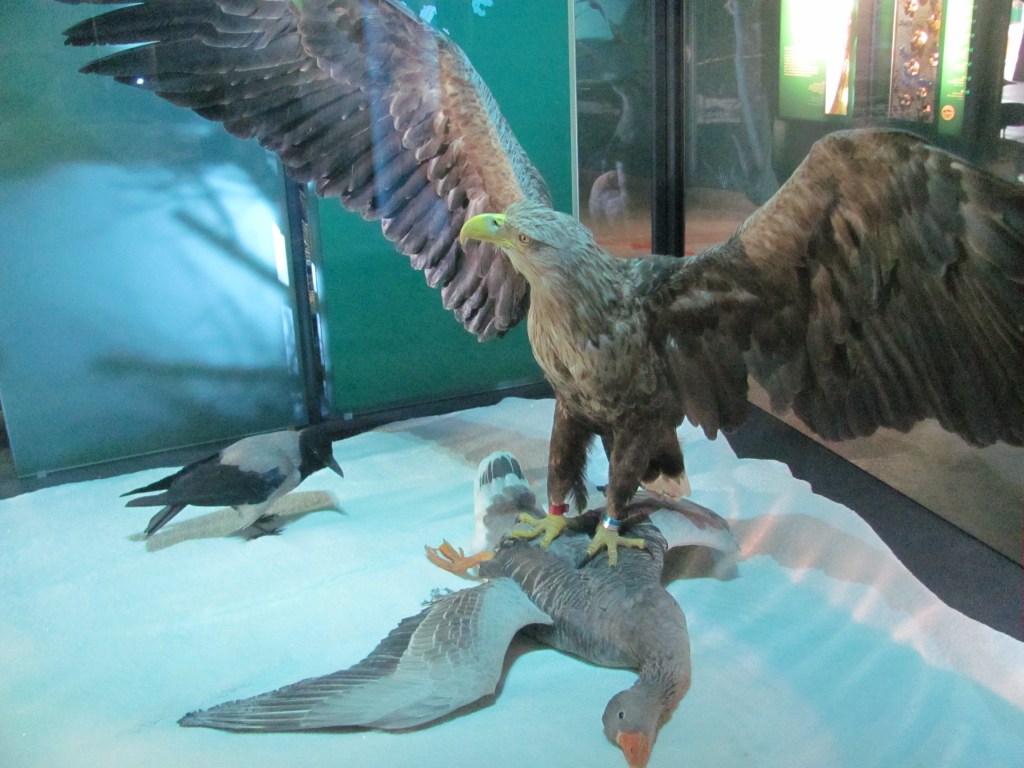
We had enjoyably spent the previous two hours following the orange trail around the exhibits learning about the Baltic Sea, the North Sea, and the world’s oceans in general. Realistic models of horseshoe crabs, puffins, penguins, and white-tailed eagles line the trail. Floor-to-ceiling aquaria display a plethora of fish of all sorts.

A white-tailed sea eagle with goose for dinner.
Aquarium in Ozeaneum, Stralsund.

In one, I spot a sturgeon, and decide to call it Nicola. It doesn’t seem very happy with that.

Sturgeon.

In another a cod and a turbot play hide-and-seek with one another. The cod isn’t very good at it.

Cod and turbot.

In a third, jellyfish float with a ghostly glow.

Jellyfish.

Outside again, we decide to have a fisch brötchen, a popular snack food throughout Germany, but particularly in this Baltic coast area. Both of us have become quite partial to them in the last few weeks. I order a matjes brötchen, a bread roll filled with herring fillet, raw onion slices, and a lettuce leaf, all topped with remoulade. The First Mate has a backfisch brötchen, a white fish of some kind deep-fried in batter and also wedged into a bread roll with the same toppings. I feel like a real German now.

Matjes fisch-brötchen.

“You know, the Ozeaneum was supposedly built to complement its historical surroundings”, says the First Mate. “But I think it must be the most obtrusive piece of architecture imaginable.”

The Ozeaneum museum trying to blend in with other Hanseatic buildings on the waterfront.
(Clue: it’s the white one).

“I agree”, I say in between bites. “But it’s very good inside. I found out all about boddens”.

“Don’t talk with your mouth full”, says the First Mate. “I must have missed that. What are they then?”

“Well, they are bodies of water that formed from depressions in the landscape caused by meltwater from the glaciers”, I say, trying to remember what I had read. “When the ice retreated, these depressions filled with both freshwater from the land and salt water from narrow inlets from the sea. Over time, sediment was deposited, so that they became very shallow with flat sandy sea beds. Most of them are no deeper than 5-6 m, usually less. Their coastlines are sandy and are still subject to erosion, and because their ecosystems are very distinctive, many of them are protected. Apparently they only exist in this area of the Baltic Sea east from Warnemünde and around Rügen. So now we know.”

“Well, there you go”, says the First Mate. “You learn something new every day.”

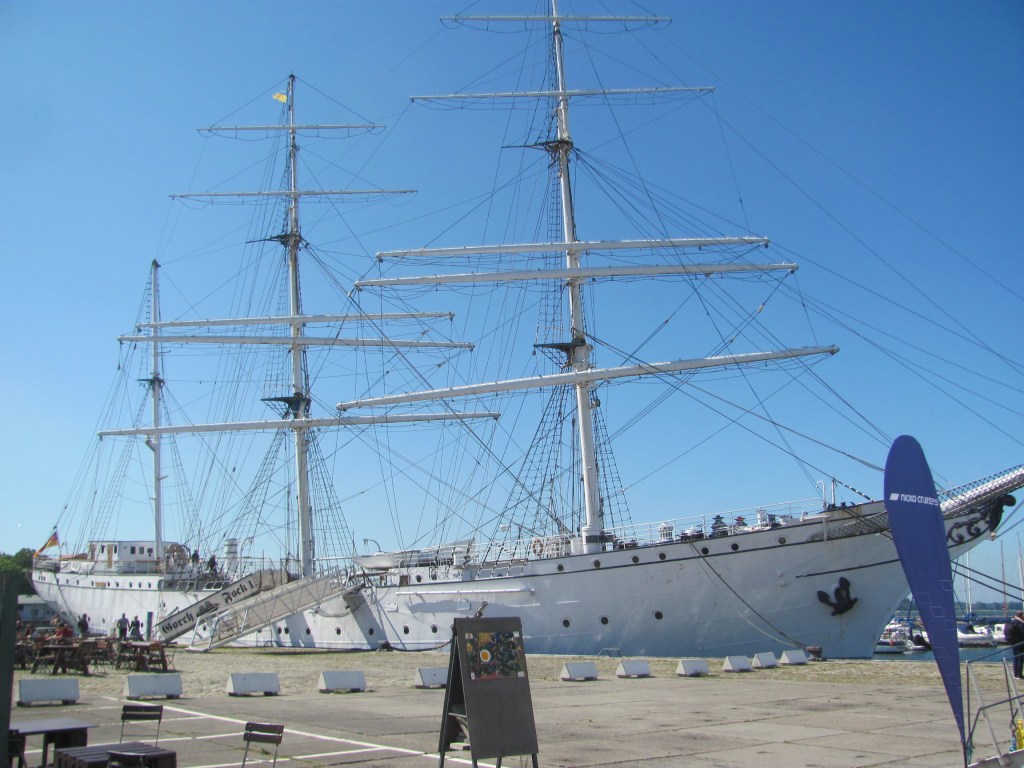
We finish our brötchen and wander along the quay until we come to an impressive looking sailing ship called the Gorch Fock.

The Gorch Fock training ship.

“Gorch Fock was a famous German writer”, says the First Mate. “His real name was Johann Kirnau, but he used Gorch Fock as a pen name. It must be named after him.”

She is right. The ship was built in 1933 as a training ship for the German Navy, but at the end of WW2 it was scuttled to prevent it falling into the hands of the Soviets, but they raised it anyway and took it as part of war reparations, where it eventually ended up with the Ukrainian Navy. In 2003, it was returned to Germany.

“It’s quite a story”, I say. “It’s sad to think that Russia and Ukraine were former allies, but that the larger has now invaded the latter and tens of thousands of people have been killed just because of Peter the Great pretensions. If the Gorch Fock could speak, I wonder what she would say?”