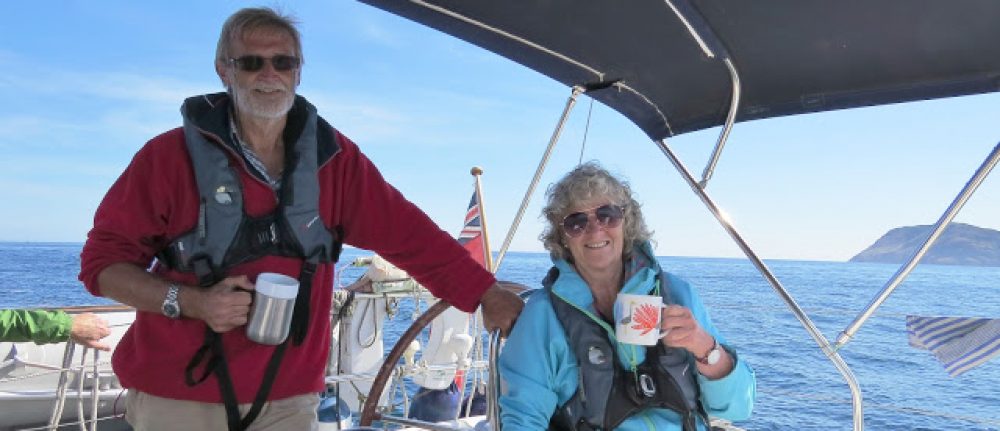
“Ruby Tuesday, Ruby Tuesday, Ruby Tuesday”, says the VHF radio suddenly. “This is sailing yacht Morwenna. I’m just in front of you. Are you receiving?”
We are just in the process of leaving Sandviksberget harbour, where we had spent a couple of nights waiting out strong winds, resting my ankle, and buying provisions for the next week. Now we are heading for the island of Halten, the northernmost island of the Froan archipelago just north of Trondheim, a passage of about 30 miles westwards from Sandviksberget. I had seen a boat crossing in front of us as we were leaving, but was too occupied avoiding the rocks at the harbour entrance to take much notice of it.
“Morwenna, this is Ruby Tuesday. Receiving”, I say.
“Ruby Tuesday, we haven’t met, but I think that I might have met people that you know”, says the VHF. “I’m James.”
We had heard of James several times from our sailing companions, Simon & Louise and others, but had not yet met him.
“I’m just going to stop for lunch in a little bay up ahead, then I am planning to sail over to the island of Halten”, he continues.
“That’s just where we are heading now”, I say. “We’ll meet over there. Enjoy your lunch.”
The wind is from the south-east, so once clear of the small rocks and skerries at the beginning, we enjoy a pleasant beam reach all the way to Halten. We arrive mid-afternoon and tie up to the single visitors’ pontoon underneath the lighthouse. A fishing boat is also there.
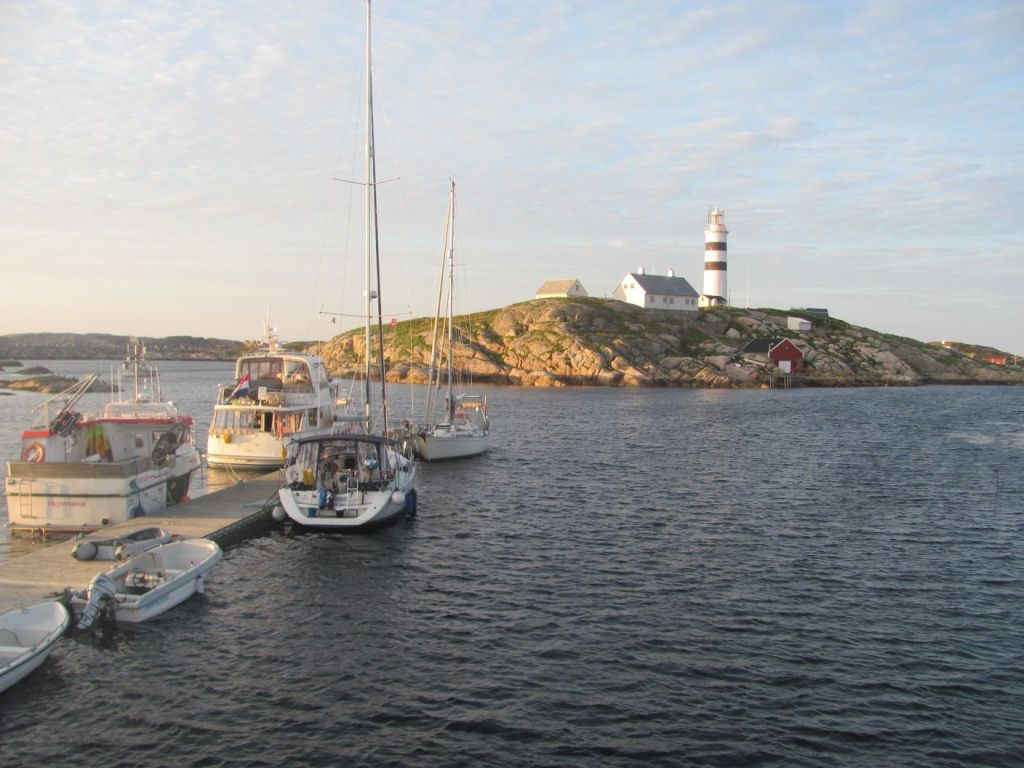
“We use this as our base”, the young skipper of the fishing boat tells us. “I was brought up on the island, but my family have now all moved to the mainland. We still have the house here, and still come every summer. But now all the summer residents have gone and it’s totally deserted apart from visitors like yourselves.”
“How’s the fishing been?”, I ask.
“Not too bad”, he answers. “We caught 1500 kg when we went out yesterday.”
I am amazed. That’s about 500 fish. Multiply that by all the boats out fishing, and it makes you wonder how there are any fish left.
“We have our quotas”, the skipper says, seeing my surprise. “They’ve worked out what each boat is allowed to take to make it sustainable.”
Morwenna arrives a couple of hours later. We give him a hand tying up.
“I just happened to see you on the AIS back there”, says James over a coffee. “We seem to have done a fairly similar trip this summer, and I have bumped into people who knew you, but we haven’t actually met, so that’s why I called you up.”
We had also seen the name Morwenna on our AIS occasionally, so it was good to put a face to a name.
“Are you sailing alone?”, asks the First Mate. “I thought I heard that your wife is with you?”
“Well, she was for part of the trip”, he says. “But her mother is not very well at the moment, so she wanted to go back and be with her. So I have been sailing single handed for the last few weeks.”
James turns out to be a retired doctor.
“You should get him to have a look at your ankle”, says the First Mate. “In the last episode you were wondering where on earth we might find a doctor around here. Well, here’s one.”
“Are you sure?”, I ask him. “You must get fed up with everyone asking you medical questions. You are supposed to be retired, not working!”
“It’s no problem”, he says with a smile. “It makes me feel that I can still be useful. Now roll up that trouser leg.”
He prods and kneads it for a few moments, every so often asking me whether it hurts.
“It’s difficult to tell”, he says eventually. “It’s certainly swollen a lot. It could be broken. Sometimes the ligament is torn from its attachment to the bone and might take a little bit of bone with it. You really need an X-ray to be sure. I would take it easy in the meantime, and go and see your doctor as soon as you get back.”
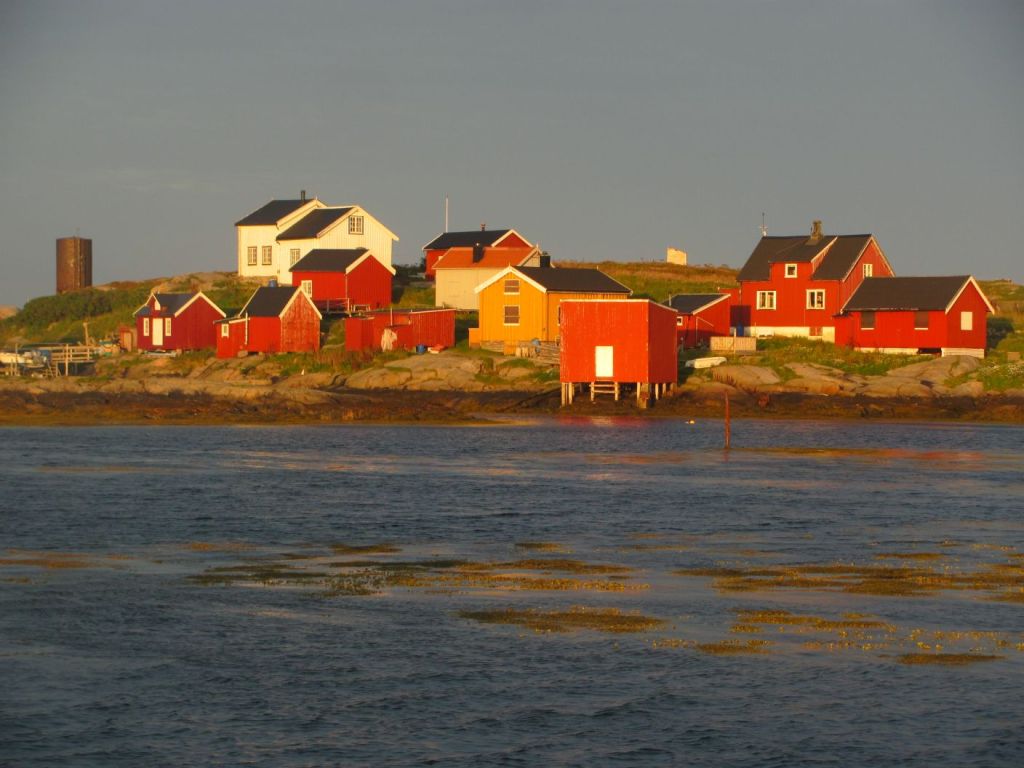
In the morning, we explore the island. It’s a ghost island. All the houses are empty.
We reach the main harbour, which is being carefully looked after by the resident population of kittiwakes.
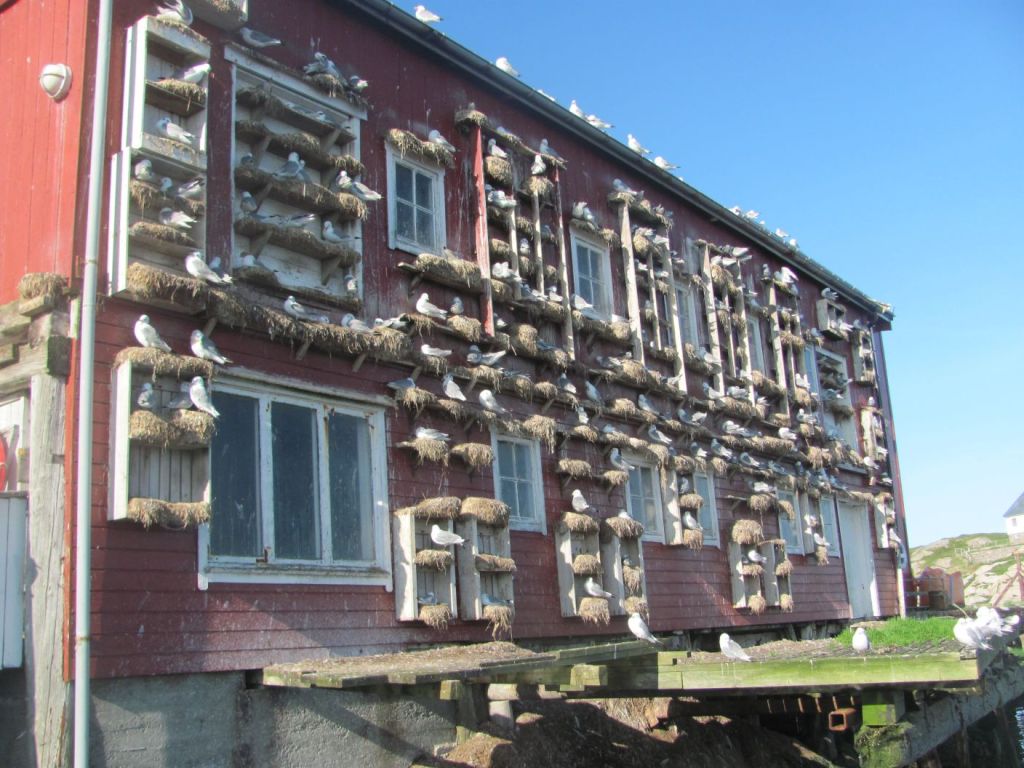
The old fish-processing sheds seem to have been converted into a museum of former island life.
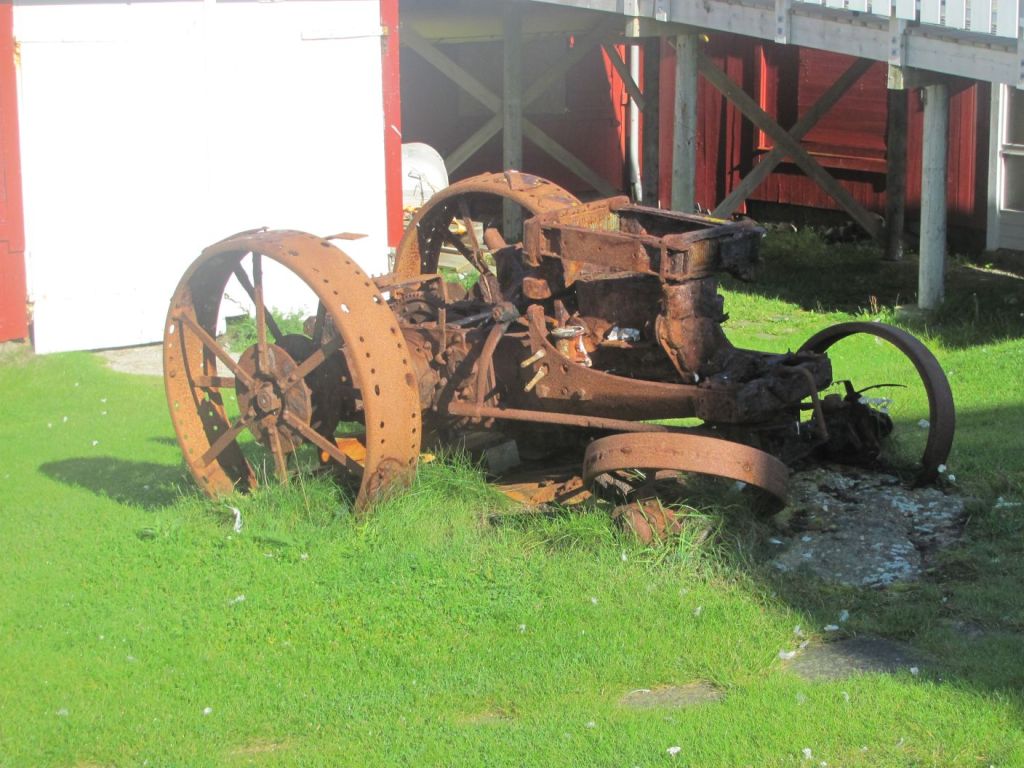
“I was just thinking of taking the boat out after lunch to that spot over there to do some fishing”, says James on the way back, pointing to the gap between two of the islands south of the entrance to the harbour. “Want to come?”
I grab my rod. We cast off and motor out through the narrow southern entrance of the harbour to the first of the two islands.
“Harley told me that it’s good fishing here”, says James. “He was here about a week ago.”
Harley was the Canadian that we had met briefly while in Myken a few weeks ago. It’s a small world, I think to myself. Eventually you meet up with everyone else.
“We sailed together for a while when we were in Lofoten”, says James. “He’s a keen fisherman. His philosophy is that if you don’t catch something in the first ten minutes then move on to somewhere else. It means that there is nothing there. I’ve been trying to practise that.”
The slight current drifts us slowly around the island. James catches a fish. It’s a saithe. I have no luck. Ten minutes are up.
“I’ll just motor over there”, he says, pointing to the second island. “Then we can have another go.”
This time it is better. I catch a couple of saithe and James catches a good sized pollack.
“At least we’ve got enough for dinner”, I say.
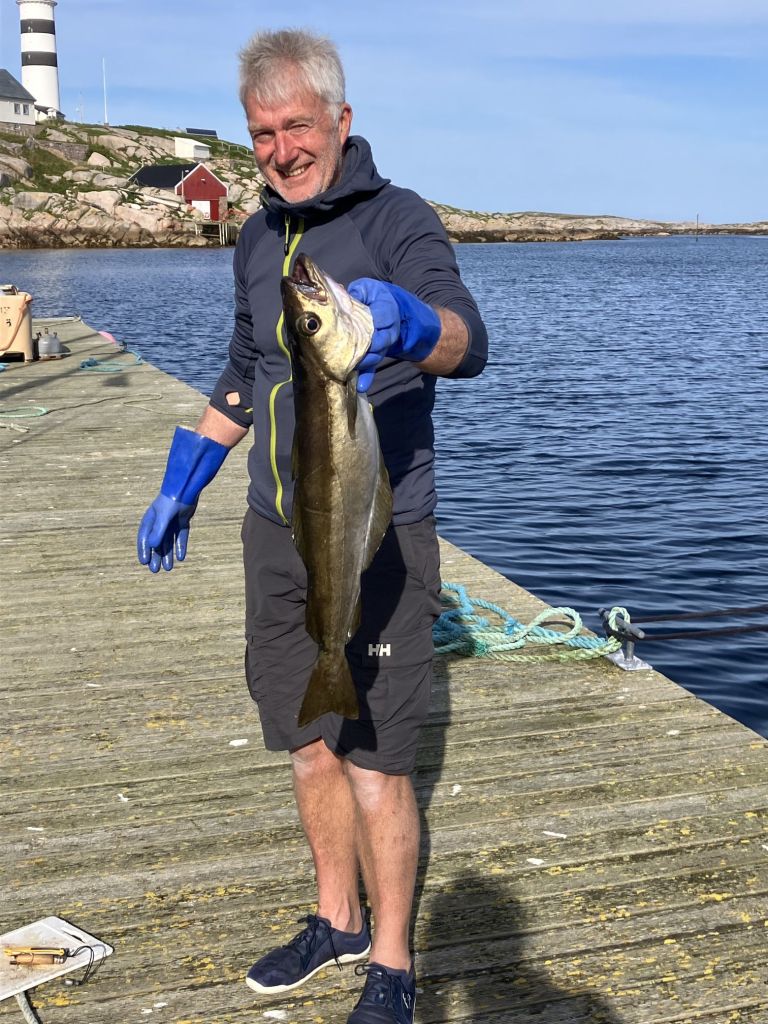
In the evening, the First Mate fries the pollack and makes a bearnaise sauce. It’s delicious.
The conversation turns to the UK National Health Service.
“It’s changed a lot since I was a young doctor”, says James. “There used to be time to get to know your patients and their families. Because you knew their health histories you could advise them on wider issues concerning their life, health and happiness. It was a more rounded way of treating them. Now, in the interests of efficiency, it’s all been reduced to 10 minute appointment slots. You only have time to treat them for whatever they have come in for. There’s no time to talk to them in depth about how they might lose weight, get more sleep or exercise, or stop smoking, for instance.”
“It’s true”, I say. “And they rotate around so quickly. I don’t go to the doctor very often, but when I do, I don’t think I have had the same doctor for a few years now. A different one every time. Of course, they can look up your medical history on their computer, but it’s not the same as knowing you personally for a long time.”
“What I don’t understand is why they don’t put more emphasis on prevention rather than cure”, says the First Mate. “Surely it must be cheaper in the long run to stop people from getting ill rather than treating them once they are ill?”
“It depends on what you are trying to prevent”, says James. “Certainly with things like giving up smoking that’s true. Stopping it reduces the risk of cancer, heart disease, strokes and respiratory illness. Educating people to stop it can be relatively inexpensive compared with treating the diseases it helps to prevent. And controlling high blood pressure and cholesterol levels can help prevent heart attacks and strokes.”
“I suppose the big problem is that the costs of prevention have to be paid for now”, I say. “Whereas the benefits only come much later down the line.”
“Exactly, and the benefits don’t always come to who paid the costs”, says James. “A local authority may pay for a prevention programme, but it may be the hospitals who benefit in the future through reduced patient admissions. And treating someone now is visible and can be quantified, whereas it is more difficult to do that for something that was prevented from happening. So it is complicated.”
“But to be fair, the government did advocate last year for a movement ‘from sickness to prevention’. But it is all a bit meaningless if doctors are under so much pressure that don’t have time for such things as offering advice on lifestyle or vaccination requirements.”
“I suppose Brexit didn’t help either?”, says the First Mate.
“Well, it certainly contributed”, replies James. “The number of doctors coming from the EU to work in Britain declined, but this was more than matched by the numbers coming from other countries, so the total number has actually increased since 2016. But the problem is that the demand for medical services has also increased over that time.”
It’s been an interesting conversation, and one that concerns us all. We tumble into bed hoping that there will be enough doctors if we need one.
We spent the next few days exploring the rest of the Froan island group south from Halten. Like Halten, the islands were traditionally home to bustling fishing communities, but most of them now have no permanent residents. Nevertheless, there are still large numbers of people that spend their summer holidays there, including former residents or their descendants. The islands have been designated as a bird reserve because of the significant breeding populations of eider ducks, European shags, and great cormorants, as well as the long-tailed ducks, common and yellow-billed loons, purple sandpipers, and black guillemots that overwinter there. Nutrient-rich kelp forests and shallow wetlands provide plenty of food for them.
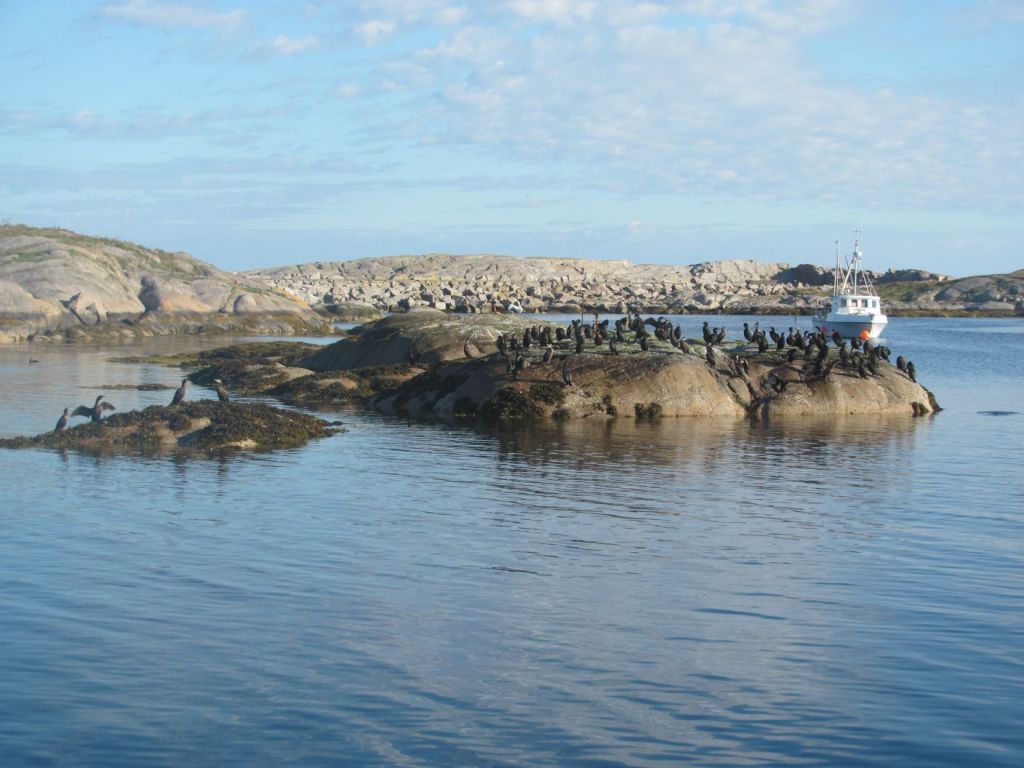
Sauøya is one of the islands south of Halten. We decide to stop for lunch there and tie up to the old wharf. A number of houses are dotted around the small harbour, but again not a person is to be seen. A notice says that the last ferry for the summer was last week.
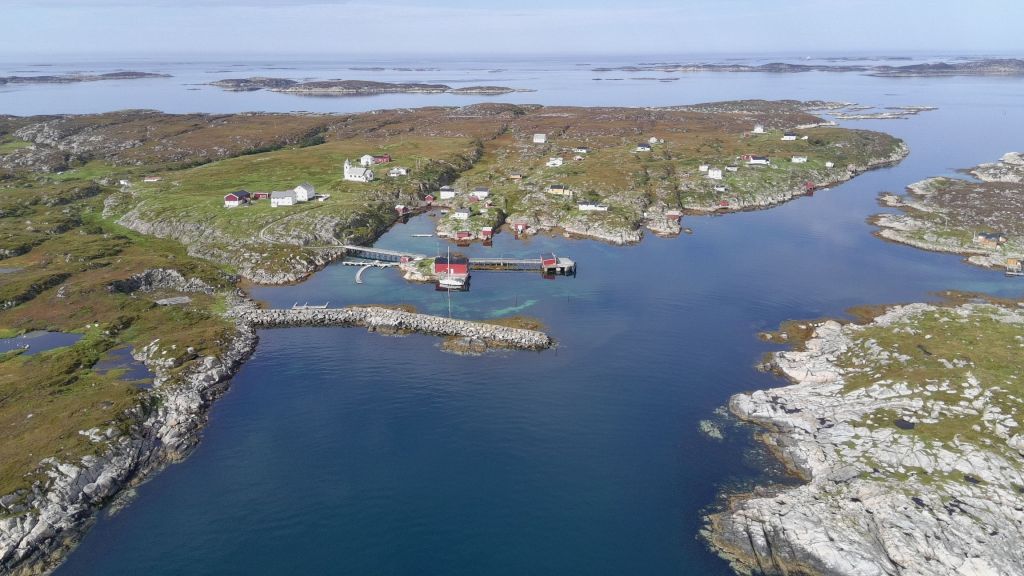
“We could go for a walk up to the church”, I say. “The harbour guide says that it was built in 1904. Apparently the islanders at that time were clamouring for their own church as the nearest one was on another island, Sletta, which was 30 km across open sea, and they were finding it difficult to get there, particularly in the winter. The local bigwigs, the Borthen family, raised the money, and the church was opened in 1904. Apparently 350 people attended the inaugural service, so it shows you just how many people lived on the island in those days.”
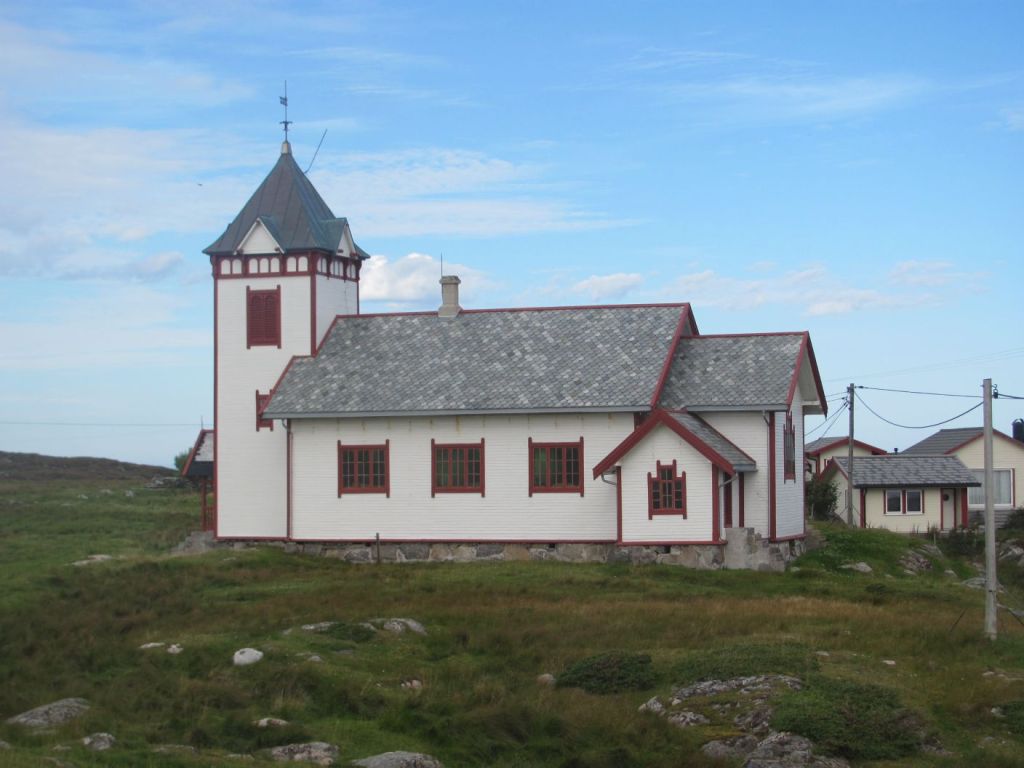
“Ah yes”, says the First Mate. “I was reading about the Borthen family. They first settled here in 1779, and ended up owning several of the Froan islands. They were the force behind the development of a lot of the fishing communities. And did you know that Sauøya apparently means Sheep Island, so it must have been where they grazed their sheep?”
A message has just come in on WhatsApp. It’s from James. He had left before us in the morning.
“I am just heading for Gjæsingen”, he says. “It’s the next harbour south from where you are. Apparently, there’s a pontoon there with power and water. I am thinking of staying the night there.”
Finishing our sandwiches, we push on. It’s not far, and soon we are approaching Gjæsingen.
“It’s tight, but if you just follow the poles in you should be OK”, says James via WhatsApp. “There is plenty of space on the pontoon.”
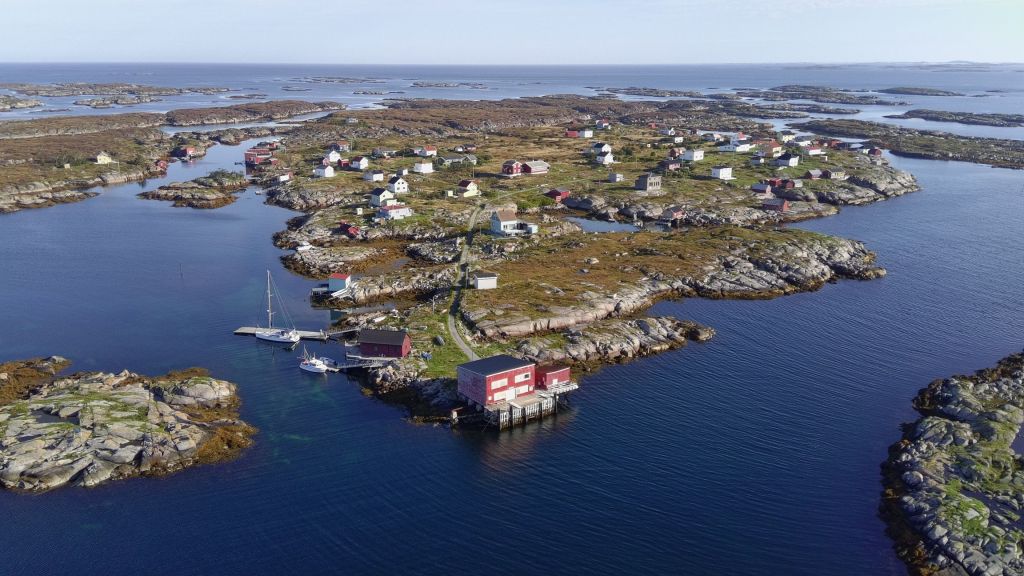
As we tie up, we spy a couple of people walking along the small road down to the harbour.
“Apparently there are three people who live here permanently”, says James, passing the stern line back to me. “Although I don’t know where they get their provisions from – there’s no shop. But there is a ferry from Dyrøy on the mainland, so I guess they must go there to stock up. There’s even a school here still, although it is more the community centre now, as there are no children to teach. It has a small café which is open during the summer months.”
“I still have a fish left of the ones that you two caught the other day”, says the First Mate. “Why don’t you come over to our boat for dinner again tonight, and we can finish it off?”
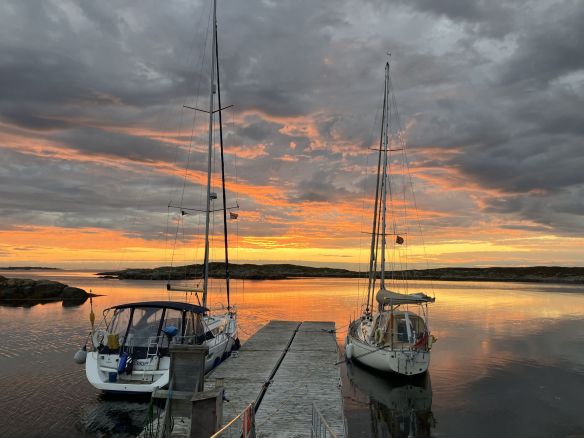
As we pick the last pieces of flesh from the bones, the sun decides to put on a performance for us to remember. For half an hour or so, rich gold, orange and red hues colour the western horizon, as though it is on fire. We sit and watch it, spellbound. Eventually it disappears for the night, and the cold descends.
“I have just been reminded of why I like to go sailing”, says James.
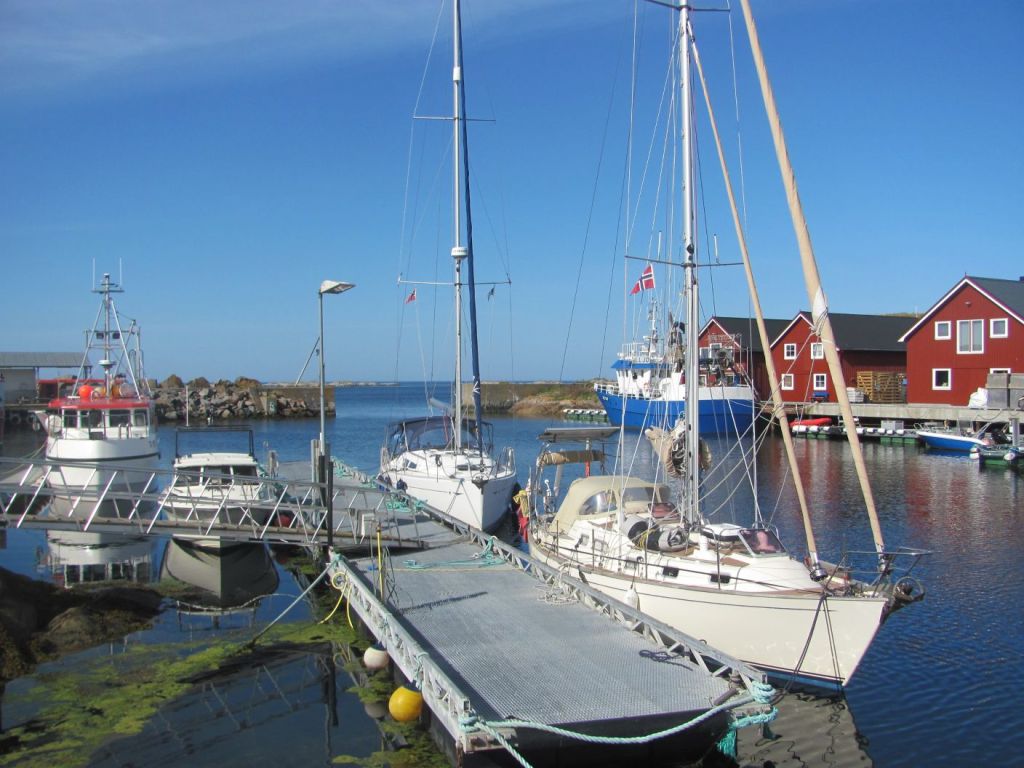
The winds remain from the south east in the morning, and we have a pleasant sail down to the next harbour, Mausund. A motorboat is just leaving, so we tie up in its place just behind Morwenna. The open jaws of some kind of fish look down at us from the nearby fish processing plant.
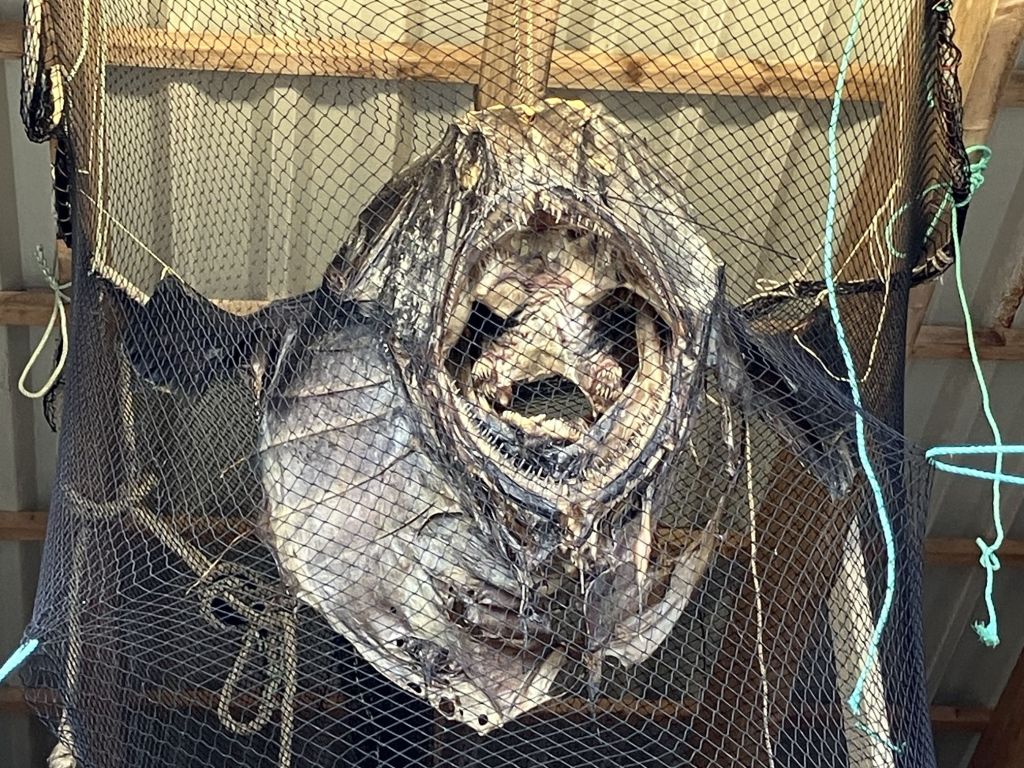
“Ugh”, says the First Mate. “It’s grotesque. I wonder what sort of fish it is?”
“I don’t know for sure”, says the owner of one of the motor-boaters tied up behind us. “I think it could be a wolf fish. Possibly an anglerfish. Either way it is pretty horrible. I wouldn’t like to meet one of those while I was swimming.”
We don’t disagree.
“Did you hear that King Harald has just died?”, says James, coming down the pontoon. “It’s just been announced.”
We hadn’t heard. But we knew that he had not enjoyed good health for some time, and that in the last few weeks had suffered from an infection of the bloodstream. I think back to the time that I had actually met him in Zambia while working on a Norwegian project, and had had to explain to him the work that we were doing out there. This was followed by lunch with him before he had boarded the small plane to fly back to Lusaka.
“I think you already mentioned that in the blog last year”, says the First Mate. “When we saw Queen Sonja’s house in Lillehammer Open Air Museum with Staale and Gunvor. Don’t repeat yourself.”
—-
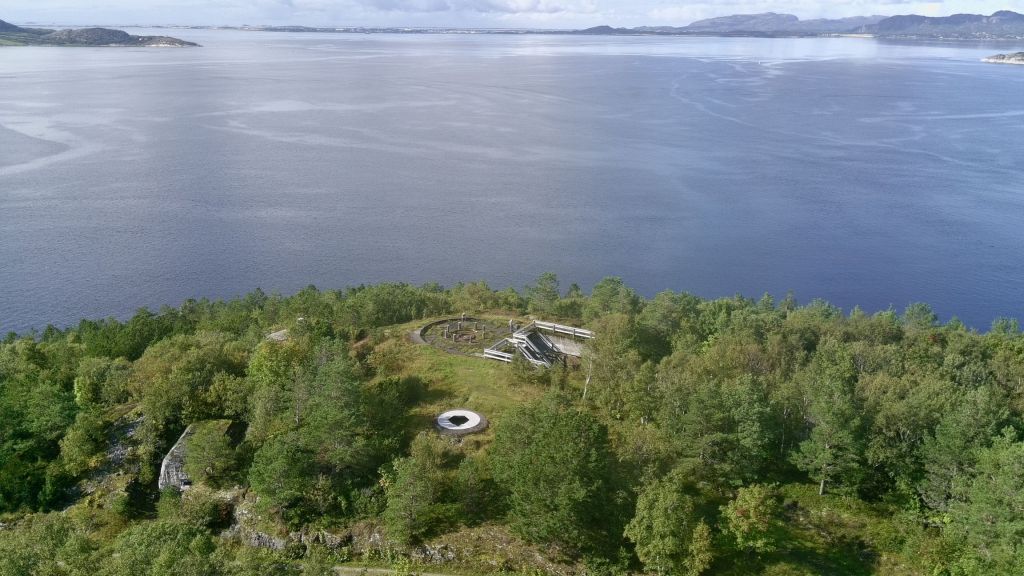
It’s nearing the end of the season. We had sailed yesterday from Mausund to Hasselvika, where we had walked up to the ruins of the German fortifications guarding the entrance to Trondheimsfjord, and watched the ferry coming from Trondheim.
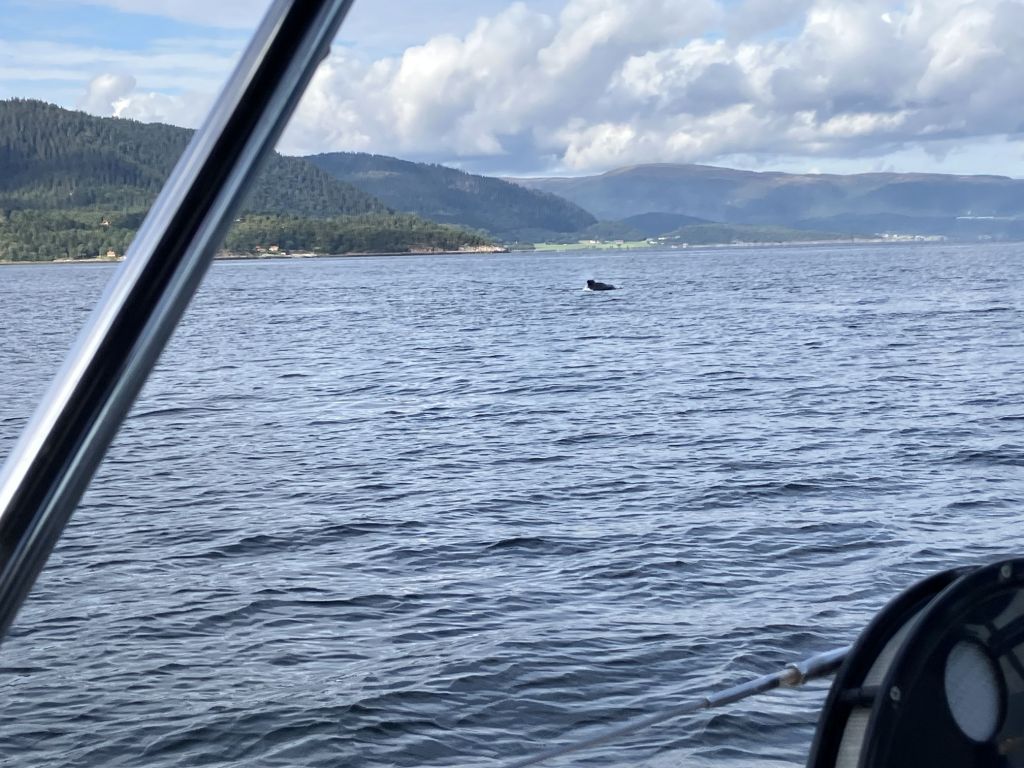
Now we are heading up Trondheimsfjord. It’s our last sail of the year. The wind is against us, so we need to tack from side to side of the fjord to make progress. But it is sunny and warm. Two harbour porpoises pass us. Hurry back, they say. It’s a fitting farewell to a stunning part of the world.
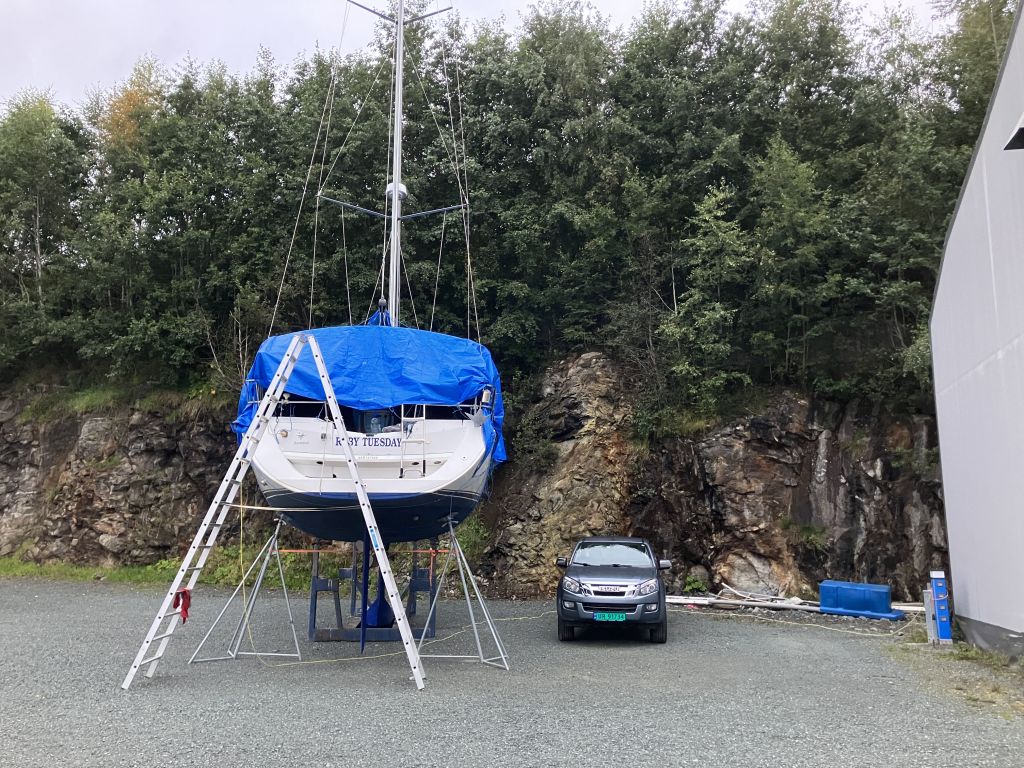
We spend the new few days preparing Ruby Tuesday for the winter. She is lifted out by crane and placed on cradles. We drain the engine oil and change the fuel and oil filters, pack and stow away the bimini, sprayhood and cockpit tent. The fresh water system and boiler are drained to avoid damage from freezing. We cover the whole boat with tarpaulins to protect her from the snow.
“Don’t forget that you have an appointment at the police station in Trondheim this week to pick up your Temporary Resident’s Permit”, says the First Mate at the weekend.
“It’s on Thursday”, I reply. “We can get the bus in to the railway station and walk from there. It’s very close.”
In the afternoon, I get an email from the Police Station telling me that my appointment has been postponed for two weeks as King Harald’s funeral is on the Thursday and they are closed. The problem with the new date is that it is after our flight home.
“You had better try and contact them to see of they have any other slots before we leave”, says the First Mate. “But it was difficult enough getting this one, wasn’t it? I won’t hold my breath.”
I send them an email. The next morning, there is a response in my inbox saying that there is a slot this afternoon if I can manage it. I look at my watch. I have a couple of hours to get there.
“You’ll just have to drop everything that you had planned for today and go and get it”, says the First Mate. “You need it to get out of the country. You wouldn’t want to have to spend the winter here in jail, would you?”

