A preserved shop, a poet-priest, and the duck-women of Vega

“Another twenty minutes and we would have made it”, says the First Mate. “As it is we are going to get drenched tying up.”

We are just arriving at the island of Myken. We have had a pleasant sail down from the Fleinvær islands, but for the last hour we could see the dark storm clouds gathering in the west. Now the heavens have opened.

“There’s another boat already there”, shouts the First Mate through the rain. “With a Canadian flag. We’ll have to go on the outside of the pontoon.”

It’s Harley and his family in their boat Prudence. We had heard of them last year when in Trondheim, but so far had not met them.
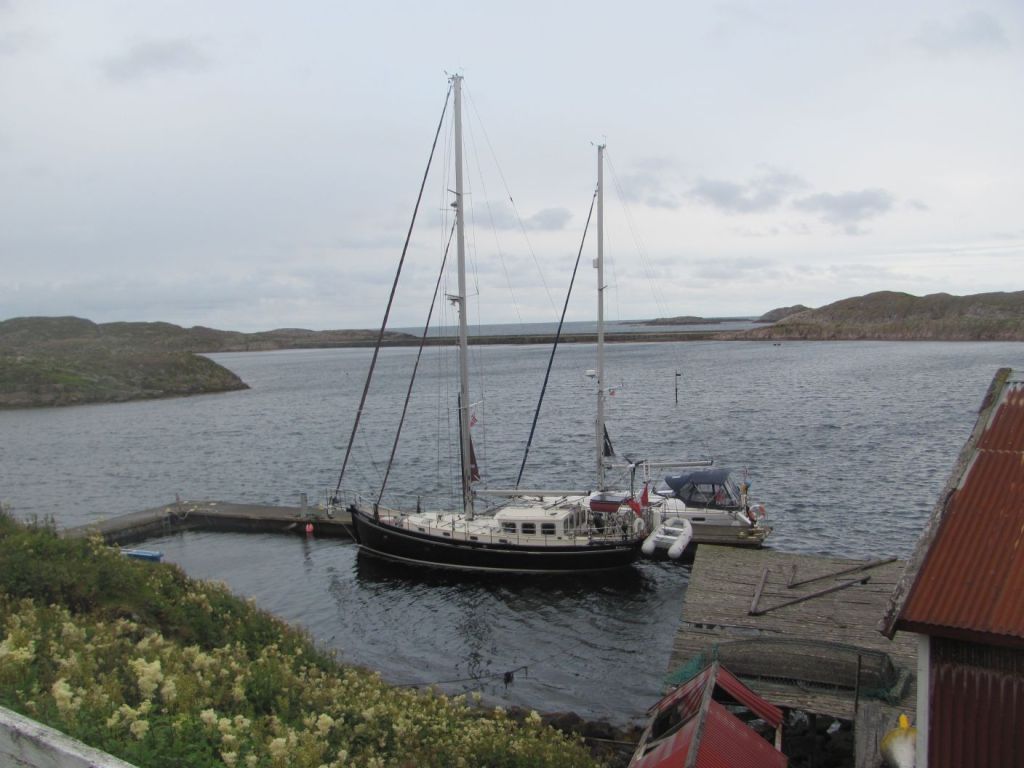
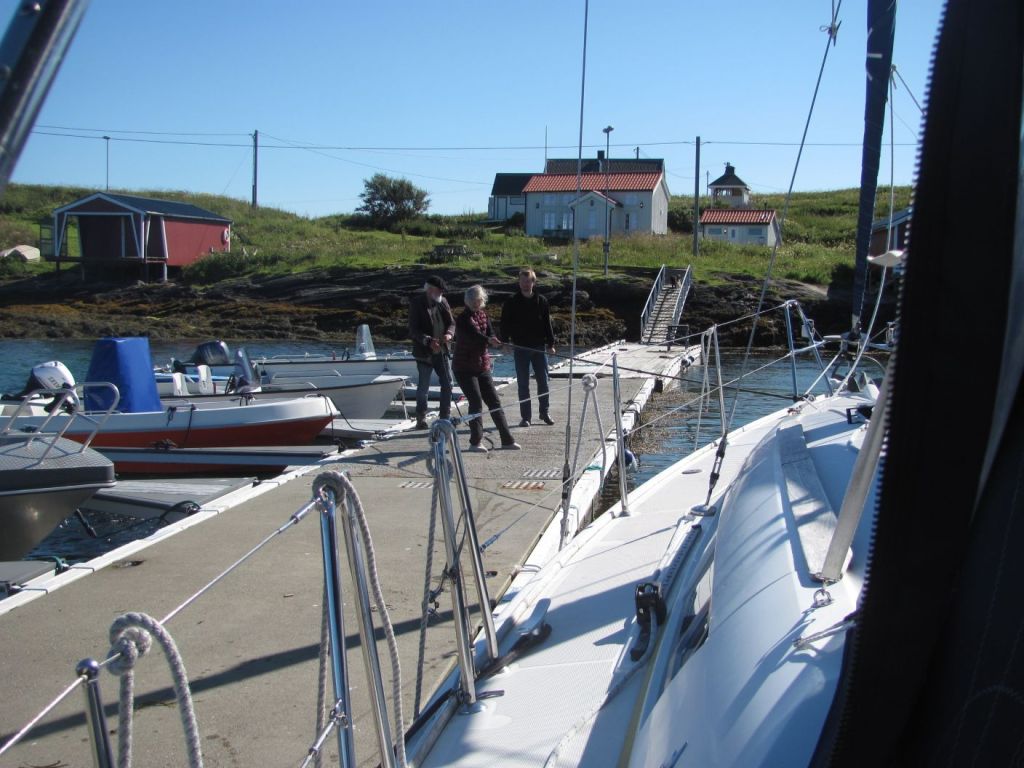
Prudence and Ruby Tuesday in Myken harbour.

“We’ve been here a couple of days”, Harley says. “But we are moving on first thing in the morning to Træna. It’s a lovely little island here, though. You’ll enjoy it. They have a distillery that’s worth a visit. And a restaurant and a museum. Everyone is very friendly.”

When we awake in the morning, Prudence has gone. After breakfast, we explore the village. There is a coffee morning in the grocery store.

“We meet here every morning for a coffee and waffle, and to do our knitting”, says one woman. “We’re trying to get a quilt finished by Christmas time. Visitors are welcome too.”
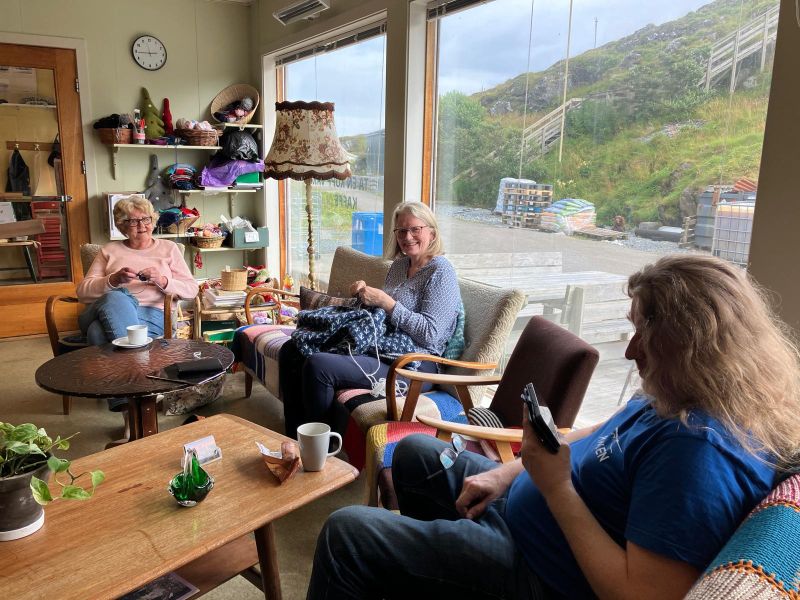
Daily coffee morning in the grocery store.

“There are only 16 permanent residents here now”, says another. “But a similar number of former residents who now live on the mainland still come every summer. And, of course, there are people like me that were born on the mainland, but who came here on holiday and loved it so much that they keep coming. I bought a small fishermen’s hut called a rorbu, and sell my glassware there.”

On the way back, we pass the distillery. At the other end of the village is the so-called ‘Distillery Cathedral’, a modern looking building where whisky tasting tours are offered.
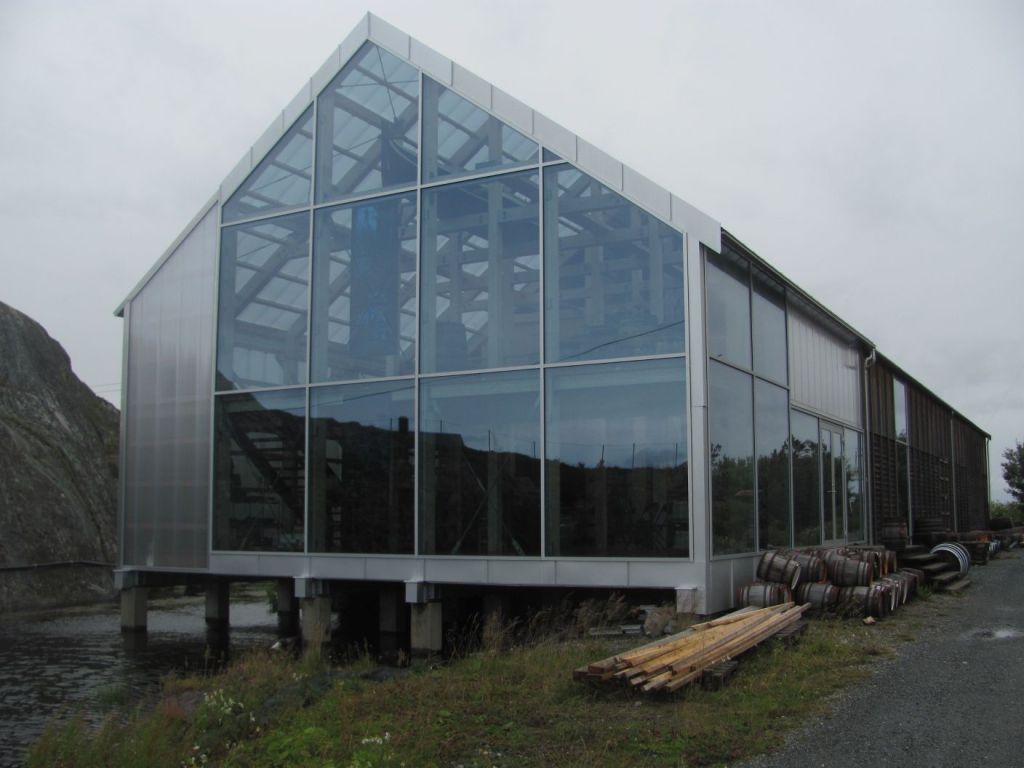
The ‘Distillery Cathedral’.

In the afternoon, we visit the Gamla Butikken, the ‘Old Shoppe’, at the end of the village. It used to be the village store, and has been preserved just as it was when it closed in the 1960s. Rather than the customers serving themselves and paying at the end, they tell the shop keeper behind the counter what they want, and he or she will go and fetch it.
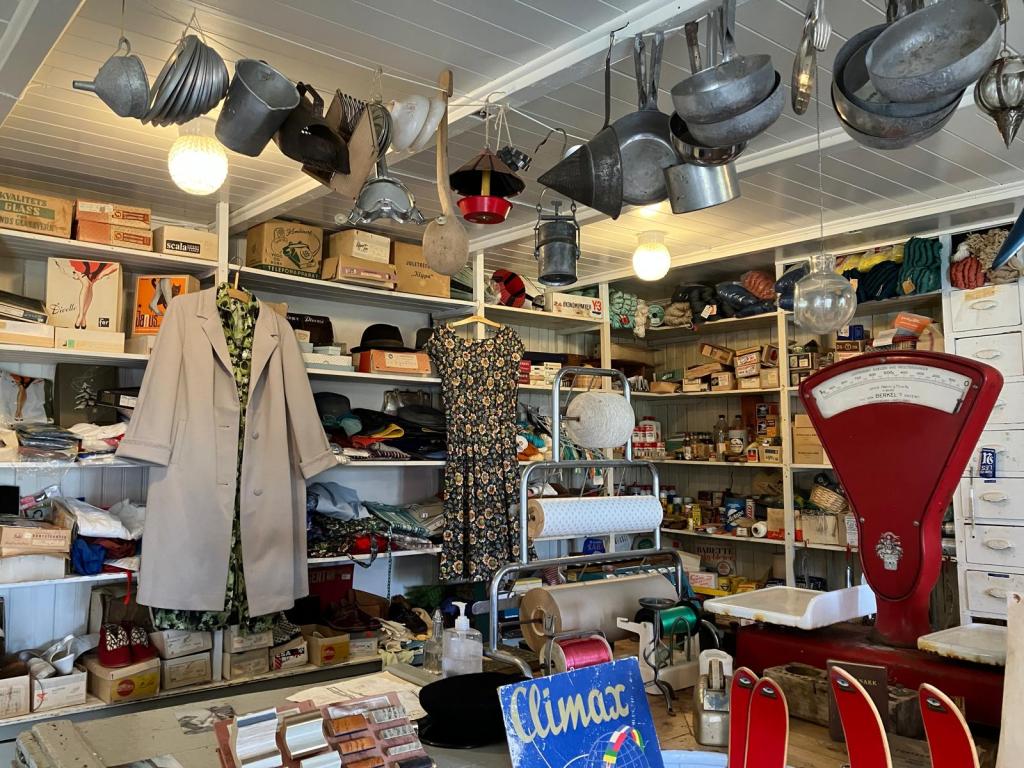
The Gamla Butikken.

“It was our grandfather’s shop, and his father’s before that”, Hannah tells us. “It’s been in the family for generations. When our grandfather died, our grandmother left it just as it was and locked it up. It stayed that way for many years, but one time when I was here I thought that it might be a good idea to open it as a kind of museum so that visitors can see what it is like in the old days. My grandmother liked the idea. The problem was that the building was becoming more and more derelict and it would have soon needed to be pulled down. She saw this as a way of preserving it.”

Hannah was brought up on the island, and still spends summers here, but lives in Bodø during the winter.

“What was it like being brought up on the island?”, we ask.

“I loved it”, she says. “There were quite a lot of people living on the island in those days, and there were several children my own age. We had a lot of fun.

“But the population started declining in the 1970s”, says her brother, who has joined us. “The government’s policy at that time was to do away with all these remote communities with their traditional low paying occupations, and persuade people to move to the cities where they could get better jobs and contribute to the nation’s wealth.”

“What about your father?”, asks the First Mate. “Was he involved in the shop as well?”

“No, he was a fisherman”, answers Hannah. “On a trawler. But he died while out fishing. Did you see the memorial in the middle of the village? He’s the one at the top. We don’t know the reason, but he had come off his watch at night, and was seen going downstairs to his cabin. But in the morning he was missing. His body was never found.”
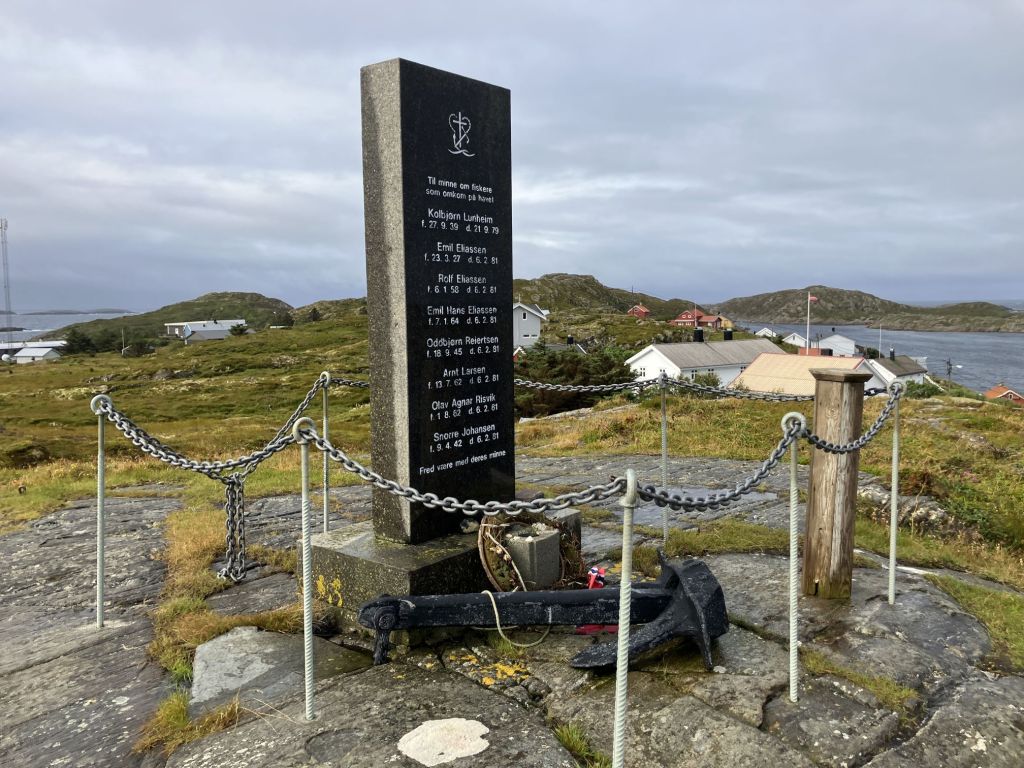
Memorial to those lost at sea, Myken.

“What happened?”, we ask.

“Well, it was presumed he had fallen overboard. But my brother here had a heart attack a few years ago, and we wonder if our father’s disappearance had possibly been something to do with his heart. Weak hearts can run in families, you know. But we’ll never really know for sure.”

“Who were the other names on the memorial?”, I ask.

“That was a boat that went down with all on board”, says Hannah’s brother. “A storm blew up, and they tried to make it back to safety, but they were too late. The storm caught them and the boat capsized. Not far from here. A father and his two sons and four others were lost. It was devastating for the whole community.”

“It just shows the perils of making a living from the sea”, says the First Mate after we leave. “I am not sure that I could have coped with it.”

—-

In the morning, we set sail for Sandnessjøen, 50 miles to the south. We pass Lovund on our starboard side doing volcano impressions.
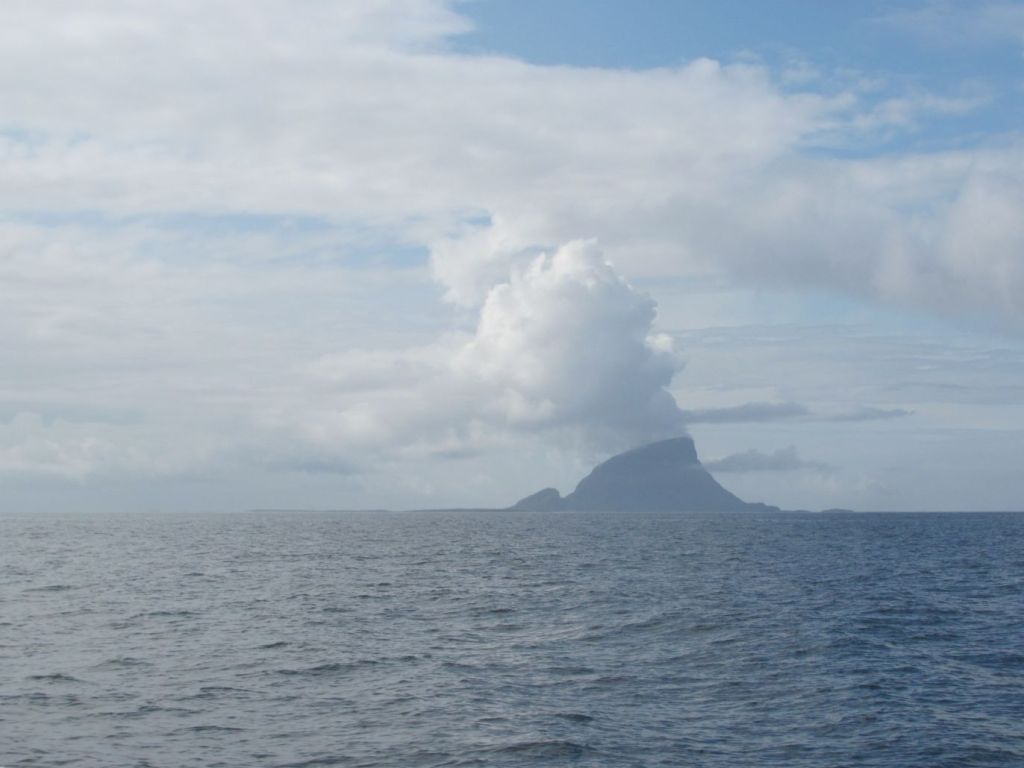
Lovund – volcano?

The wind strengthens in the afternoon, and we have a nice sail with the genoa only, arriving at Sandnessjøen in the evening.

The next morning we visit the Tourist Information Office to find out if there is anything we should see in Sandnessjøen.

“There’s not much here”, the man behind the desk in the Tourist Information admits. “It’s mainly a setting off point for trekking and skiing in the Seven Sisters. But one thing that might be of interest is the Petter Dass statue in the town centre. He was a Lutheran priest back in the 17th century, who was born on the island of Dønna across the fjord from here. He wrote a lot of texts and hymns, which were used right up to the present. He is seen as an important literary figure who put northern Norway on the literature map, so the town has made quite a thing of him.”
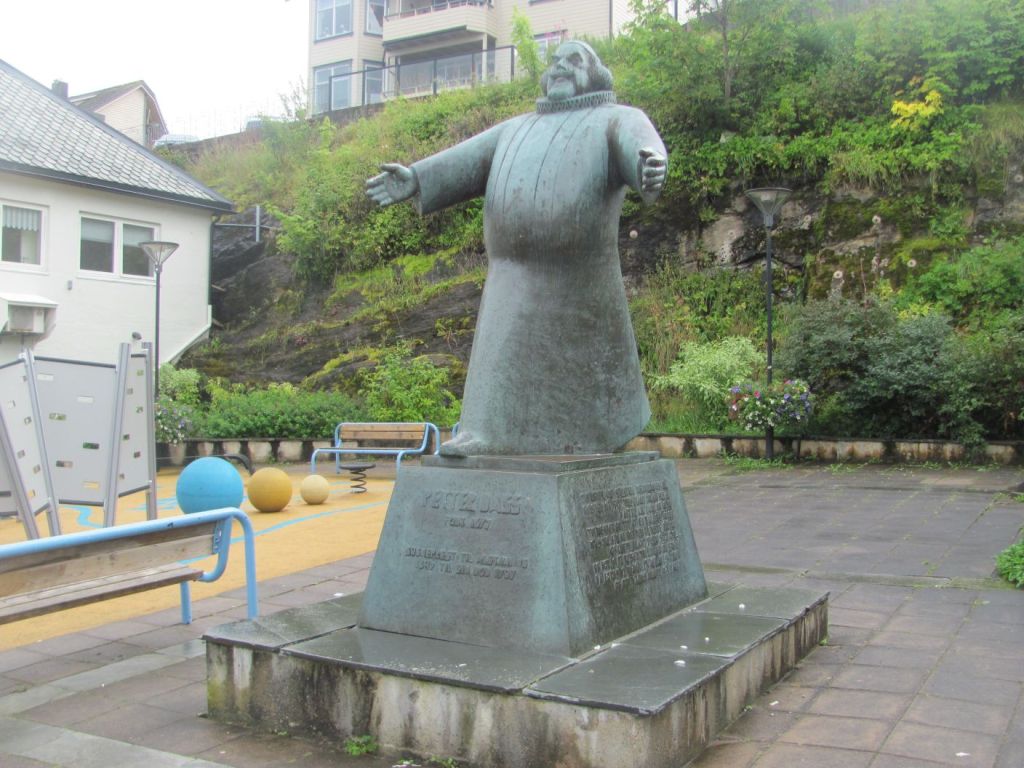
Petter Dass statue, Sandnessjøen.

“Yes, we keep coming across his name in our travels”, I say. “There was a Petter Dass walk on Lovund and a Petter Dass chapel on Træna.”

“Well, since you have your own boat, you might also be interested in seeing the giant statue they made of him on one of the skerries in the fjord”, the Tourist Information Man continues. “The base of it gets covered by the tide, so it really looks like he is walking on water. The story behind it is that the king requested him to give the Christmas sermon in Copenhagen, but for various reasons Petter didn’t receive the request until the day before Christmas. Myth has it that he made a deal with the Devil to fly him there in time in return for the Devil gaining the souls of anyone who fell asleep during the sermon. Of course, Petter gave such a powerful sermon that no-one fell asleep.”
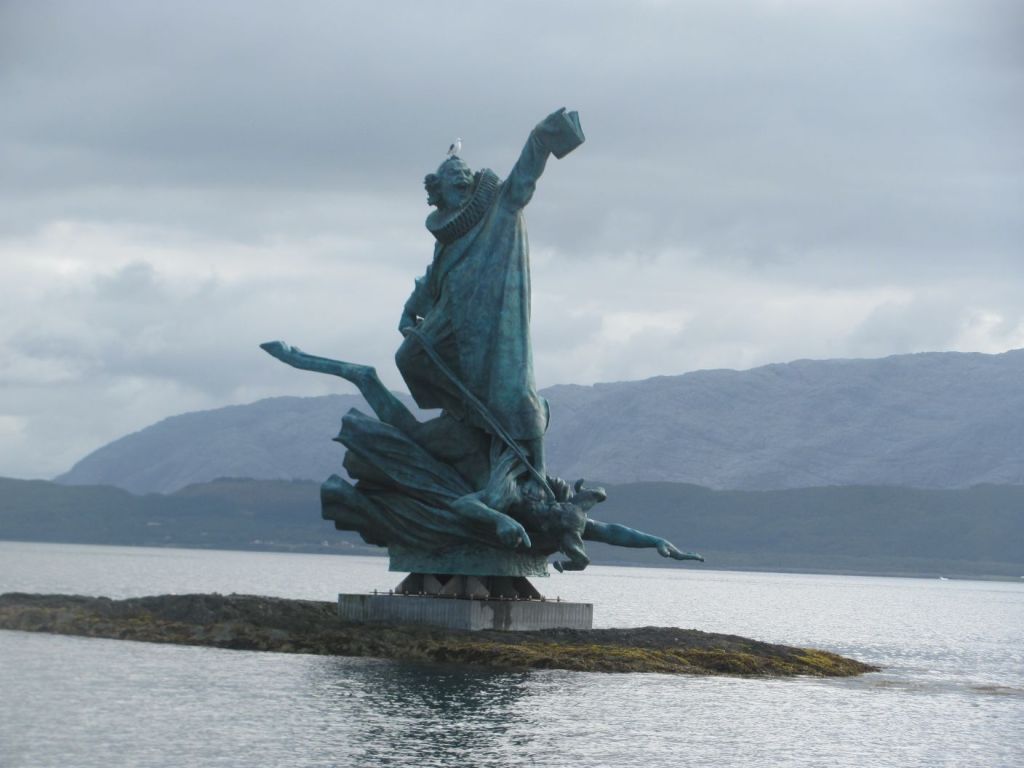
Petter Dass riding the Devil to Copenhagen.

In the morning, we push on southwards towards Vega. The wind is from the south-west, more-or-less just where we want to go, so we need to tack. It’s slow going, but we make some progress. We feel smug when we see other yachts pass us with their sails furled away and their engines running. Purists, us! Well, sometimes.
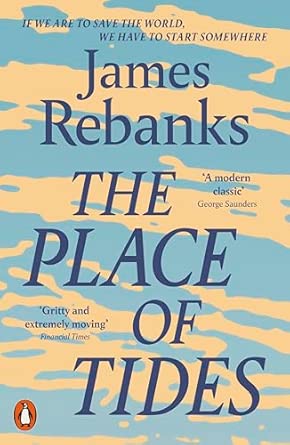
Between tacks, I recall a book that we had both read over the winter, Place of Tides, by James Rebanks. In it, he tells the story of Anna, one of the ‘duck-women’ of Vega. He spends a spring and summer living with her and her helper Ingrid, learning about her family, the history of the islands, and the decline of the eider-down tradition. It’s a delightful story about sense of place, loss of the old ways, and finding a way to live more deliberately and with purpose. We are both keen to visit Vega and learn more of this ancient practice and life on its archipelago.

The bulk of the island of Vega looms out of the haze, its top wreathed in cloud. We had initially planned to stay at the harbour at Igerøya on the east of the island, but the First Mate has been on the phone.

“I talked to the UNESCO Vega Archipelago museum”, she says. “They say the best thing to do is to come to Gardsøya on the north of the island. You can tie up right next to the museum. The problem with Igerøya is that you need to get a bus to the museum and they only run at certain hours. Gardsøya is much easier.”

I haven’t planned a route to Gardsøya, and to get there we need to thread our way through an intricate system of shallow channels and low-lying islands, all the time avoiding submerged rocks and drying mudflats. But we have good charts, and we decide to give it a go.

It’s a tortuous route, but at least it is well marked. We get good at identifying the marker poles and beacons and matching them with those shown on the charts. On either side, dark jagged lumps of rock slide past, and the depth falls on occasions to just a metre or so clearance below the keel. But somehow we make it, and soon we are edging our way gingerly into Gardsøya harbour and to the pontoon below the distinctive UNESCO museum. We are the only boat there.

“Well, that took a bit of concentration”, I say, breathing out. “But at least we made it.”
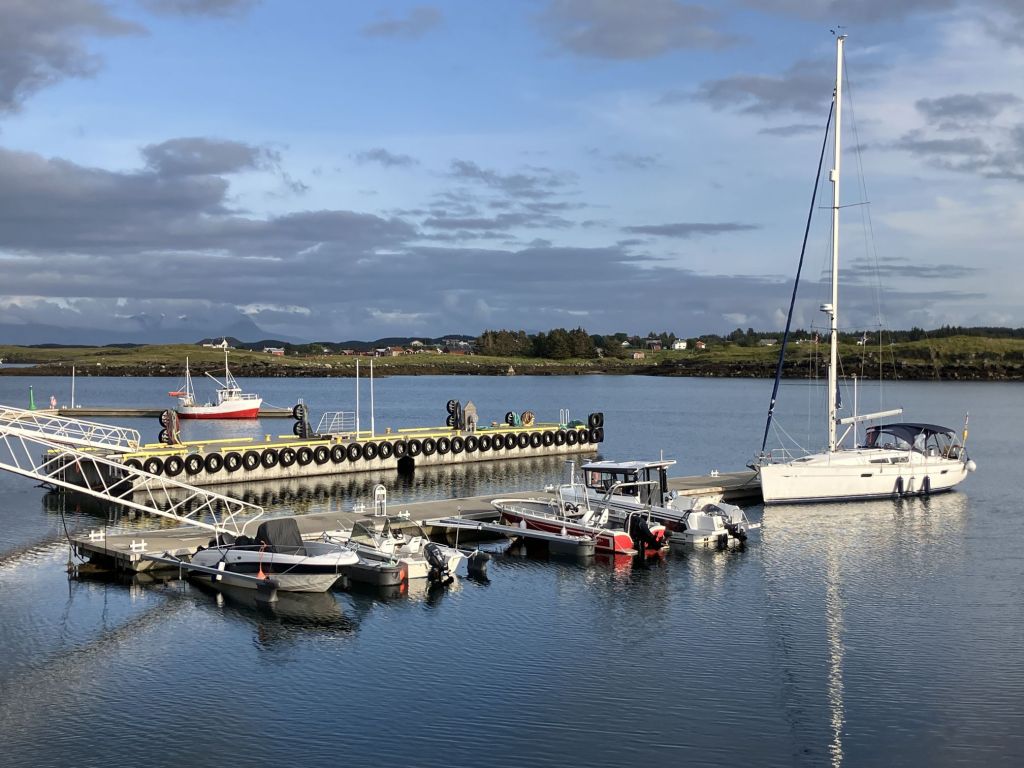
Gardsøya harbour, Vega.

Not long after we tie up, we see another boat entering the harbour.

“It has a British flag on it”, says the First Mate. “I wonder who it is?”

It turns out to be the Chairman of the Cruising Association, Nick, in his boat Spellbinder, along with his wife Sue, and two friends. We also belong to the Cruising Association.

“We were just thinking of having an eclipse-watching drink”, says Nick. “Would you like to join us?”

It’s partially cloudy, with patches of clear sky. Two G&Ts later, it’s completely cloudy, with no sun at all.

“Oh well”, I say. “It looks like the eclipse has been eclipsed. You can’t win them all.”
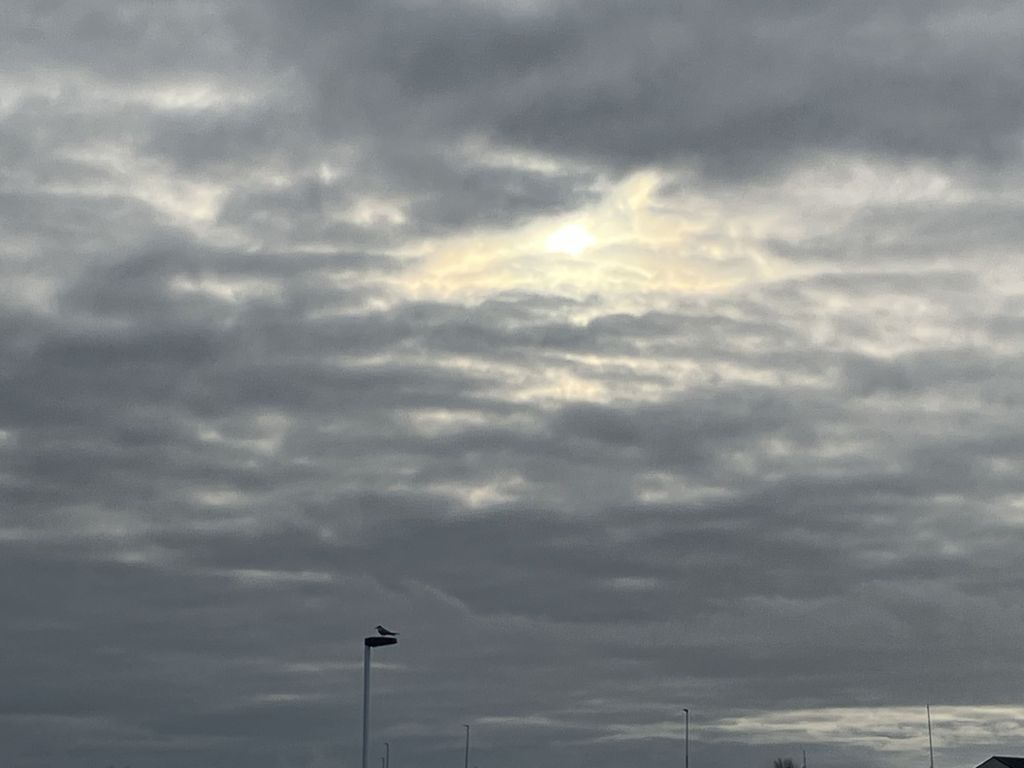
The eclipse that wasn’t. Even the birds didn’t care.

In the morning, we walk up to the museum.

“The UNESCO Vega Archipelago museum is a tribute to the sustainable way that generations of fishermen/farmers have lived in an inhospitable seascape near the Arctic Circle, based on the now unique practice of eider-duck down harvesting, and celebrates the contribution made by women to the eider down process”, the museum brochure tells us. “The Archipelago was included into the World Heritage List in 2004.”
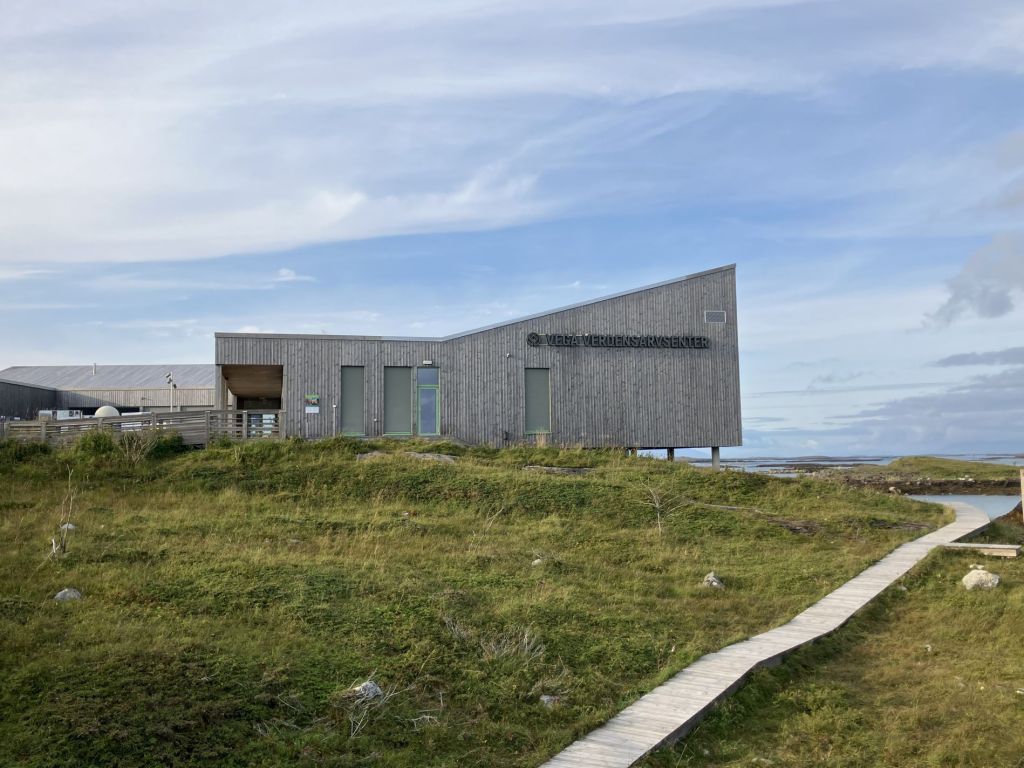
The UNESCO Vega Archipelago museum.

A film is just starting in the small cinema.

“After the ice retreated 20,000 years ago, the land started to rise”, it tells us. “Vega itself was settled by hunter-gatherers from Northern Europe about 11,000 years ago. But the low-lying islands and skerries didn’t really appear until much later. They weren’t settled until about 1500 years ago, when the fishing/farmer and eider-duck tending culture started to develop. By the time of the Viking era in 900 AD, the Archipelago was already an important centre for eider-down production. It has carried on since then to the present day.”
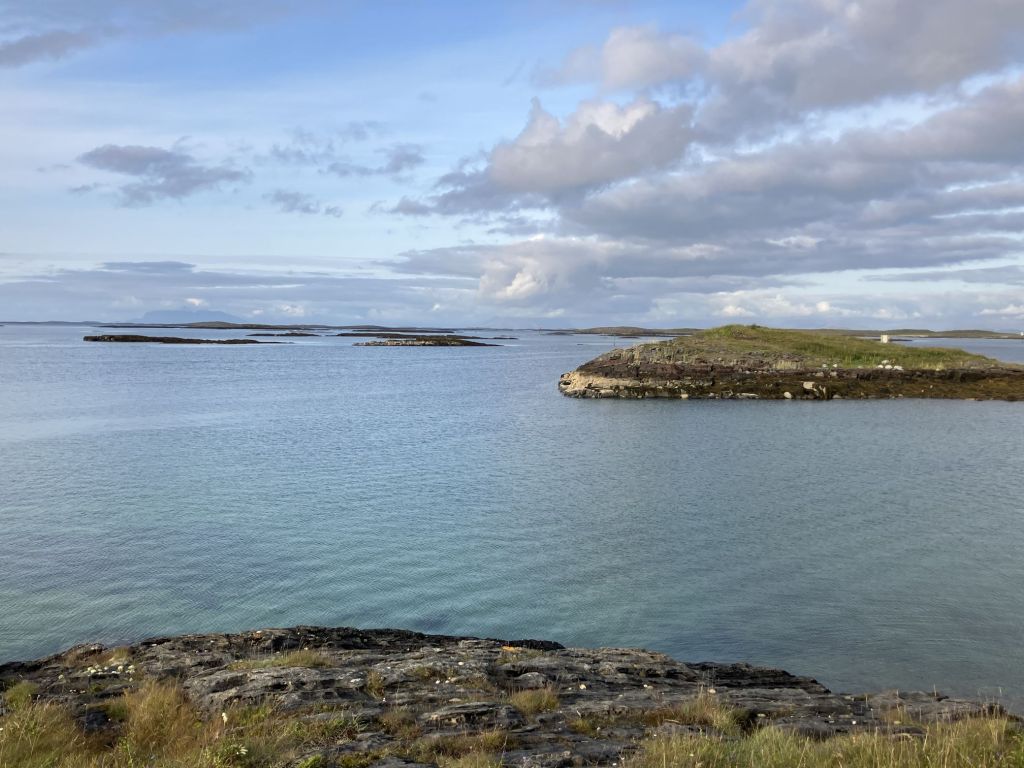
The Vega archipelago.

“The ducks return from their overwintering areas around March to mate, after which the females always return to the same breeding sites and the males leave”, the film continues. “The eggs are laid in May and June. After hatching, the ducklings stay in the nests for a few days before they venture to the sea, and swim with their mothers for the rest of the summer. Females and males meet up again in the wintering areas in late autumn to form new pair bonds.”
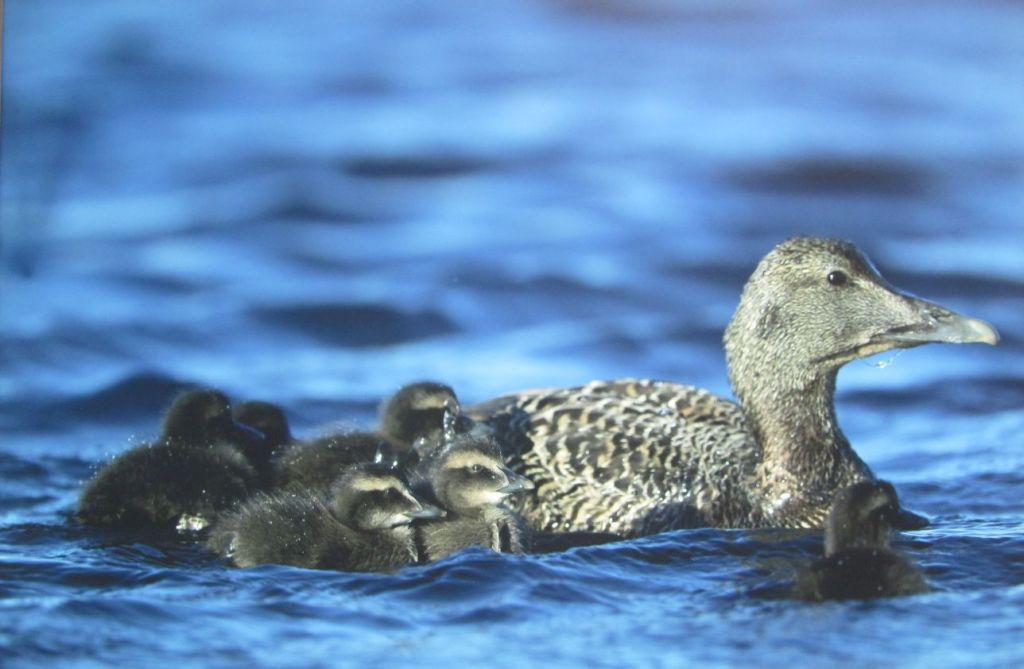
Eider duck mother and her ducklings.

“Over the years, the islanders learnt how to build small nesting houses to protect the birds, using seaweed to make the shape of the nest which the ducks line with their own down. At the end of the season after the ducks have left, they collect this down, clean it, and sell it. It takes 60-70 nests to make one eider down duvet. One duvet is worth as much as a cow. But it’s important to realise that these are wild ducks, not domesticated ones.”
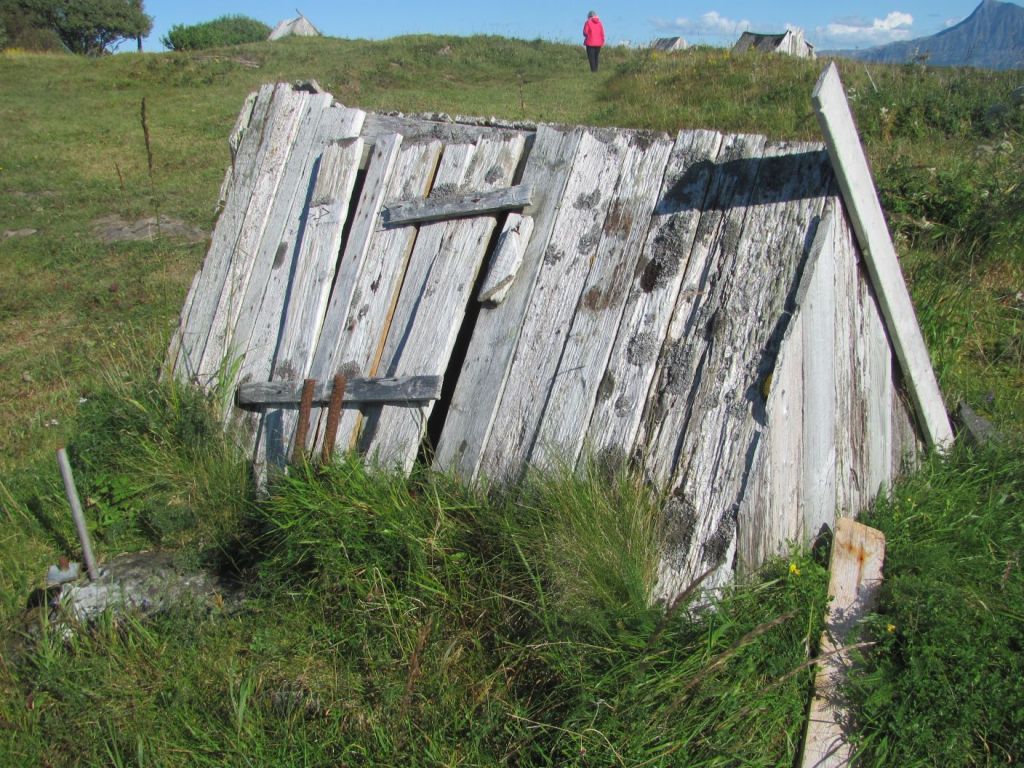
Eider duck house, Fleinvær islands.

“The population of the islands was at its peak in the 1900s. Then it started to decline due to government policies to encourage people to move to the cities for ‘proper’ work rather than persisting with these antiquated practices. But slowly this view changed, with the UNESCO World Heritage status now having given the archipelago a new lease of life.”

The film comes to an end, and we move on to the rest of the museum.

The section on the geology of the archipelago finally clears up a minor mystery for me. When we were on the Fleinvær islands, we had seen layers of rock that were pockmarked with cavities, but, not being a geologist, I had not been able to find a satisfactory explanation for what these were. Had they been where bubbles of gas were trapped in some volcanic lava long ago? It seemed unlikely, as most rocks on Norway’s coast are metamorphic rather than volcanic in origin.
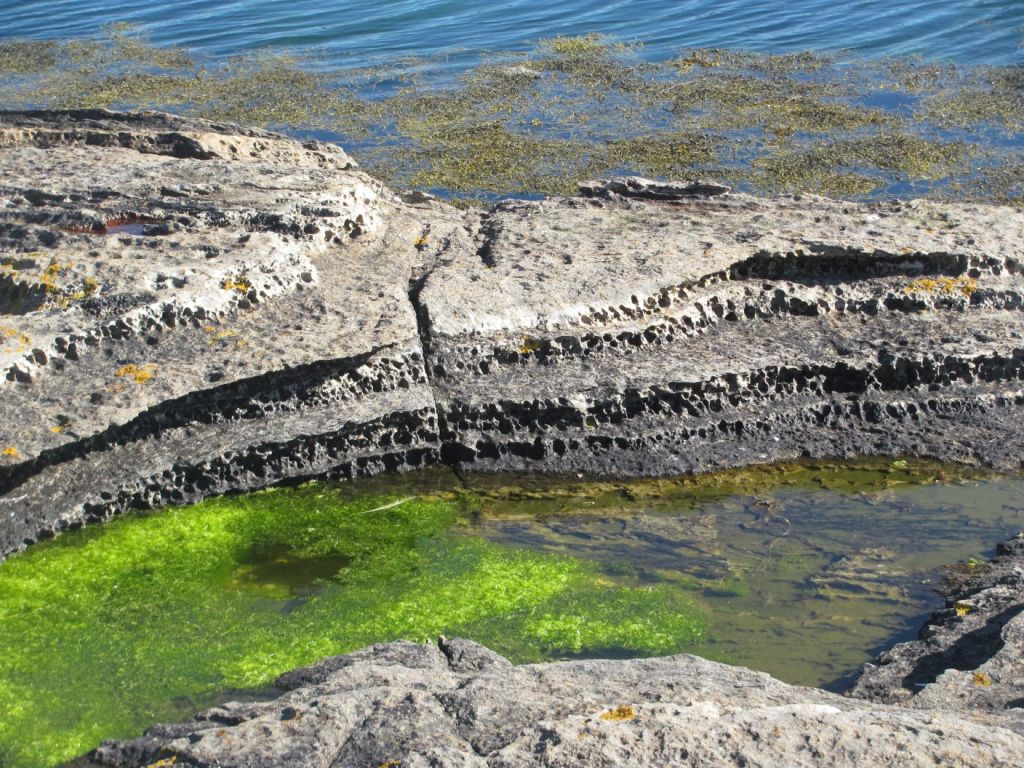
Layers of cavities, Fleinvær islands.

“The story starts 600 million years ago”, one of the panels explains. “Lime particles attached to slimy bacteria settled to the bottom of the ocean and were sandwiched between layers of sand and clay. Then when the two continents of Laurentia and Baltica collided millions of years later, the enormous pressures transformed the limestone into marble.”

“Marble is a relatively soft rock, so when these layers were exposed again, molluscs called piddocks burrowed into the marble to create a home for themselves to live in and to obtain raw material for their shells. Acid rain has since widened these pits and sharpened the edges.”

As we leave the museum, the man at the front desk stops us.

“Close your eyes and cup your hands”, he says. “I am going to put a ball of eider down in them.”

We close our eyes and wait. And wait. Nothing happens.

“You can open them now”, he says.

We open our eyes. In our cupped hands is a large ball of down. It weighs nothing.
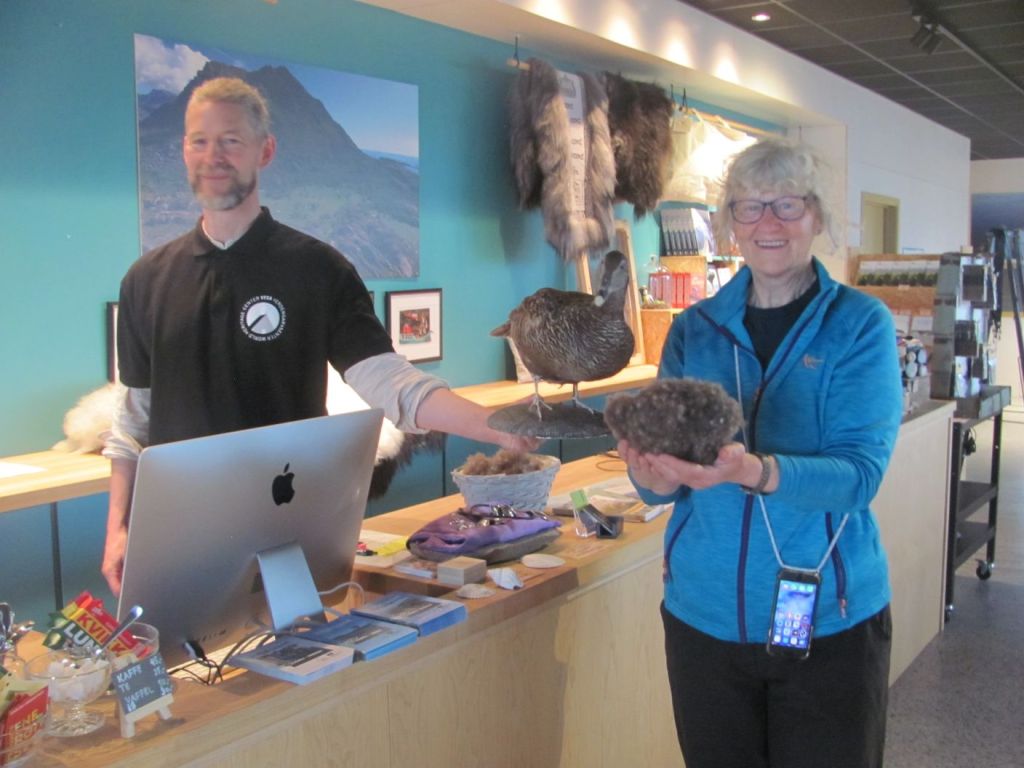
As light as a feather.

We walk slowly back to the boat.

“It’s interesting about the Norwegian government’s policies to move people away from the islands in the 1960s and 1970s”, says the First Mate. “It’s a similar story to what we heard in Myken. Discarding the old ways in the name of modernisation.”

“But I wonder if what they are doing now is truly sustainable?”, I say. “It’s good that these traditional practices are not being lost, but preserving them is dependent on an influx of money to keep them going. If budgets get tight, I wonder if that can continue?”
A maelstrom, Cold War games, and an island for artists

“We have to go and see the Saltstraumen while we are here”, I say. “It is supposed to have one of the largest tidal currents in the world. If you remember, we missed it on the way up because we had to take advantage of the favourable winds to get across to the Lofotens.”

We are back in Bodø, the administrative centre of Nordland. The Saltstraumen channel lies about ten kilometres southeast from the town.

“The maximum flow is at 1500 this afternoon”, says the First Mate, consulting her phone. “We can take the number 300 bus which arrives there at 1330. That gives us an hour and a half to explore the area and maybe even have a cup of coffee at the café there before we see it at its peak. There’s a bus back at 1536 we can catch.”

We have lunch and catch the bus. When we arrive, it is pouring with rain, so we take shelter in the café overlooking the channel. The First Mate orders coffee and waffles.

The Saltstraumen starts its flow,

“Apparently there is an old legend associated with it”, I say, reading a pamphlet I find there. “Back in Viking days, there was a powerful king called Raud the Strong who ruled an area around the stream. Rumour even had it that he had magical powers that could control the elements. Anyway, in the time that Olav Tryggvason was trying to Christianise Norway, Raul wanted to have nothing to do with the new religion, rather sticking to his traditional pagan gods. So Olav Tryggvason sent his men to capture him, and then ordered them to to force a snake down his throat until he converted to Christianity. Raud stubbornly refused, even when the snake gnawed its way out of his stomach. He eventually died, and Olaf supposedly confiscated all Raud’s lands and longship for himself.”

“It’s a bit of a gruesome story”, says the First Mate as she swallows the last piece of waffle. “I thought Christianity was supposed to be all for love and peace?”
“Well, yes”, I say. “But if people don’t want love and peace, they have to be taught to want it. The hard way, in some cases.”

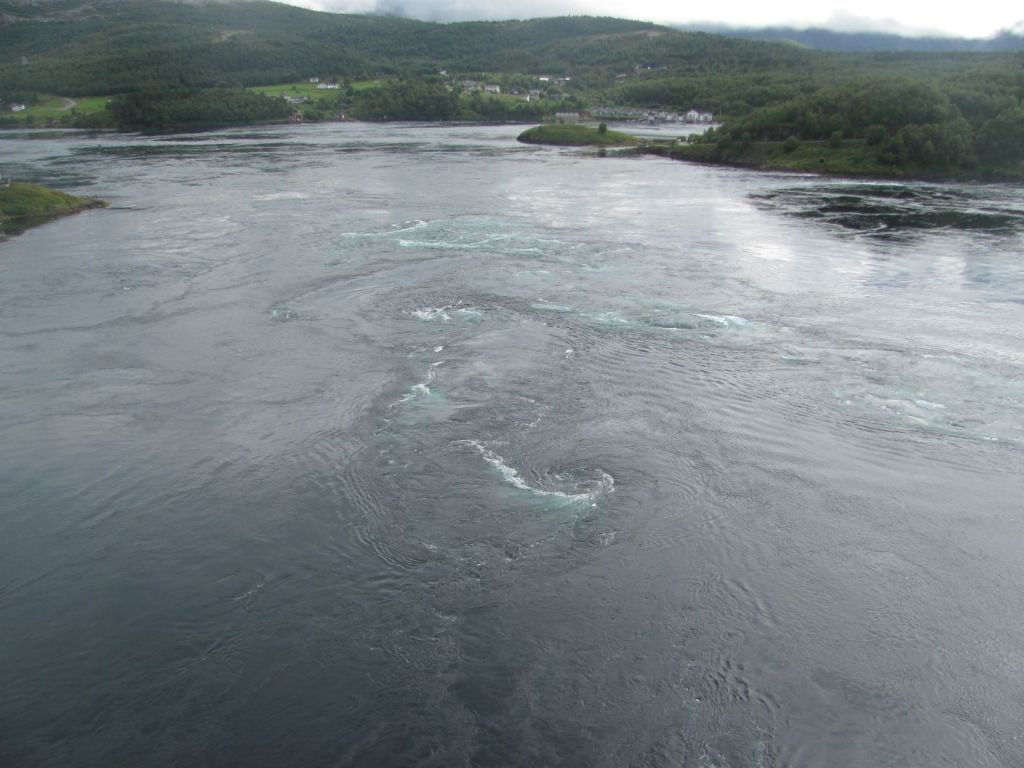
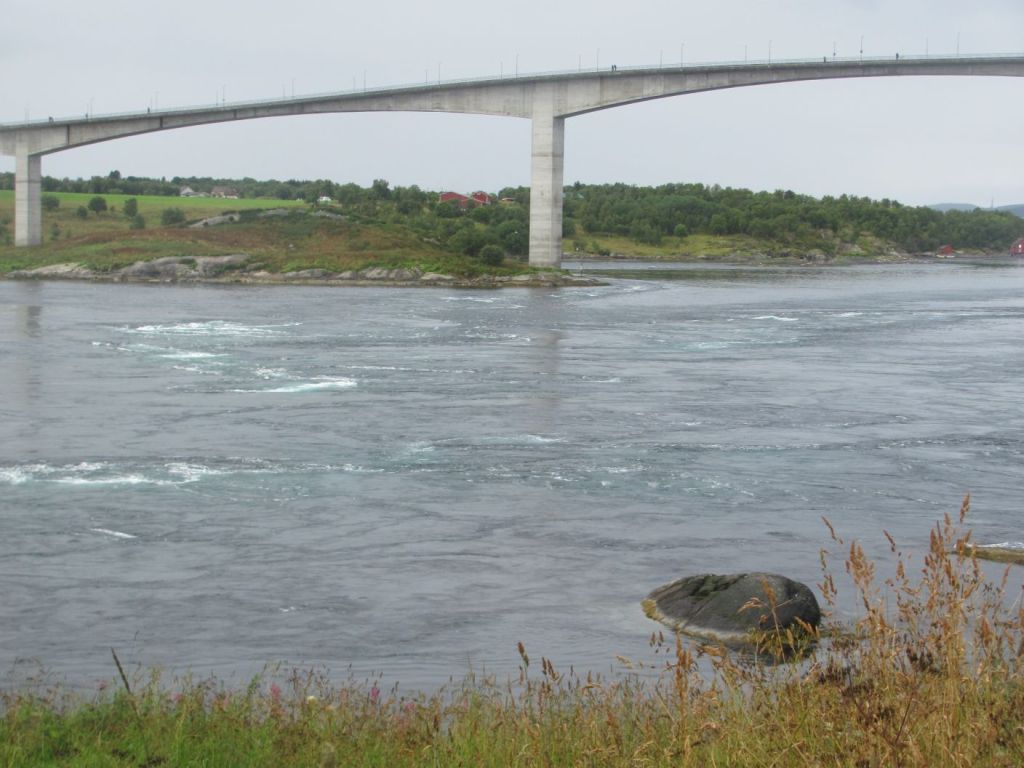
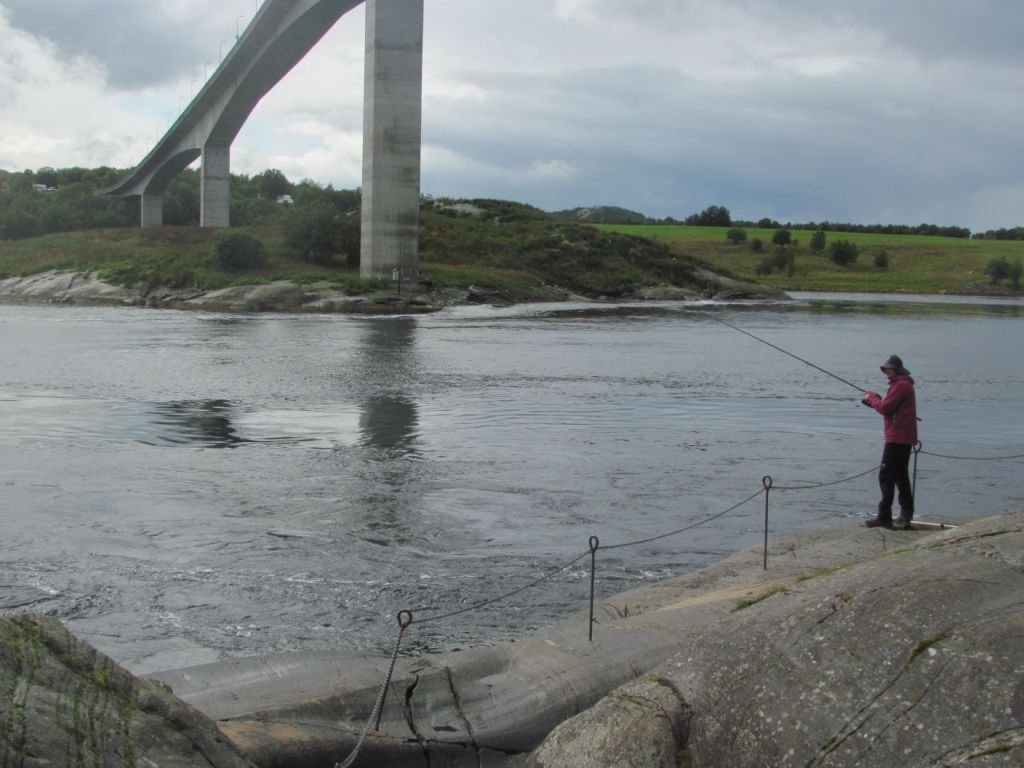
It stops raining, so we walk along the shore path towards the bridge. Several fishermen are there with their rods. Apparently it is a good place to catch cod as they swim upstream. The flow is impressive – 400 cubic metres forcing its way through the narrow channel every six hours at a speed of up to 20 knots.

Waiting for the cod to bite.

Whirlpools and maelstroms form here and there, some up to 10 m in diameter.

Whirlpools.

“I think I found the Corryvreckan in Scotland more impressive”, says the First Mate on the way home.

“The flow there is less”, I say. “But you get standing waves being set up because of the rock pinnacle in the middle, so it looks more frightening. Do you remember that time we tried to sail through it, but I got the tide times wrong, and we ended up going against the current. We had to take refuge in the little bay to the side of it until the tide changed.”

“I’ll never forget it”, she replies.

The next day dawns bright and sunny.

“I might go and see the Norway Aviation Museum”, I say over breakfast. “That’s another thing that we missed last time, because it was closed over the weekend.”

“I think that I’ll do a bit of browsing in town”, the First Mate says. “Aircraft are not really my thing.”

“Can I come?”, asks Spencer. “I am quite interested. I promise to behave.”

Spencer and I clamber on the bus that takes us to the museum on the outskirts of Bodø.

“Pets can go free”, says the bus driver.

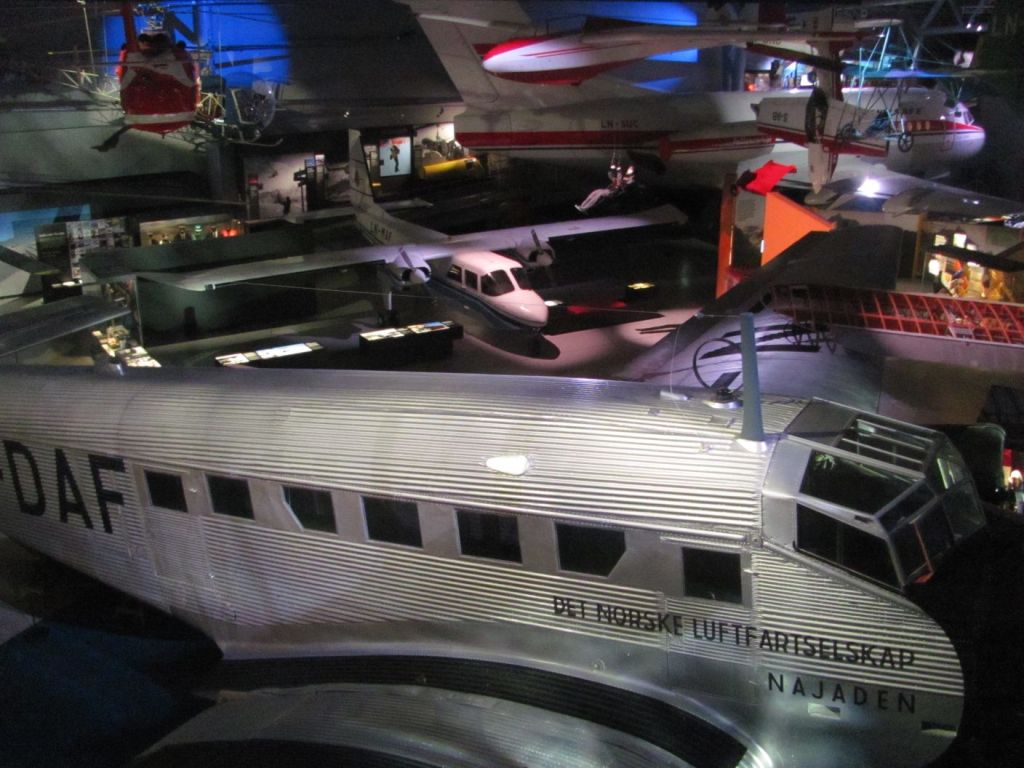
We spend the next couple of hours immersed in a fascinating collection of aeroplanes past and present detailing the history of military and commercial aviation in Norway.

Aircraft galore!

We learn about how the Nazis built airfields for the Luftwaffe to operate their Messerschmitts from.

Messerschmidt 109.

After the Second World War, the Cold War started. All sorts of powerful missiles were built to defend and attack the enemy, which is, of course, both unstated and stated, Russia. Neighbours who share a border, but who don’t trust each other.

Cold War toys.

“Wow! You humans certainly know how to destroy your own species”, says Spencer in astonishment.

“You spiders are no different”, I respond. “You often eat your young when times are tough. And what about the Black Widow who eats her own husband. We don’t do that sort of thing. Well, not as a rule anyway.”

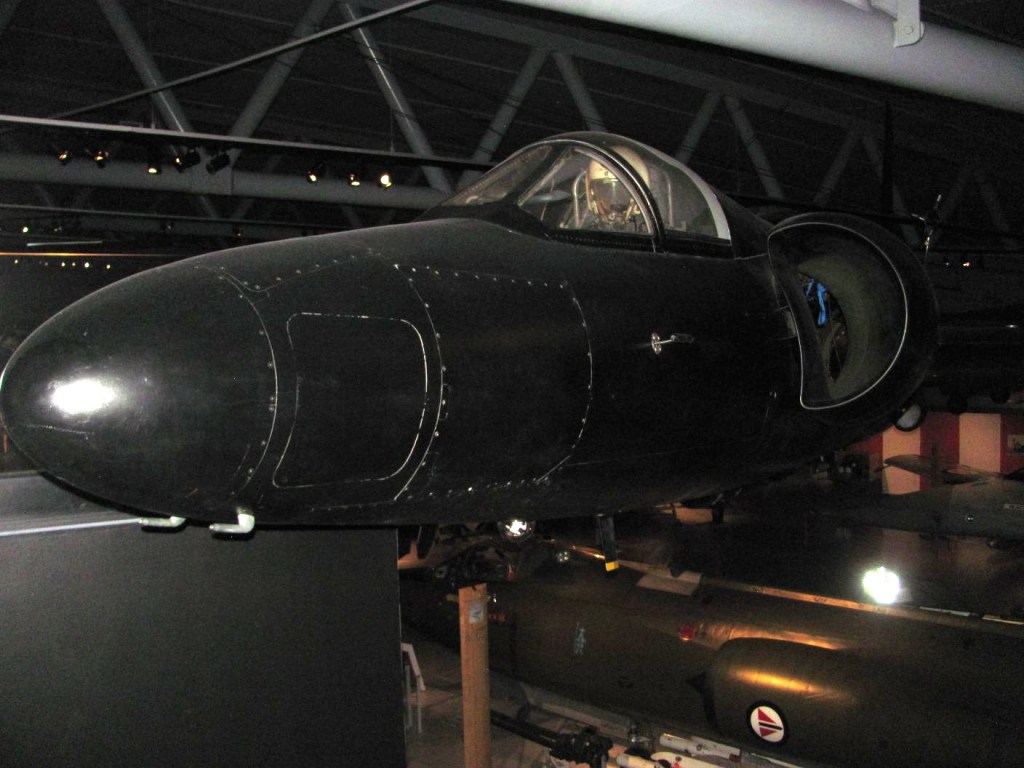
We learn that the U2 spy plane that was shot down over Russia in 1962 was actually heading for Bodø airport. I vaguely remember it being in the news when I was in school, but the details had passed over my head. At first, the Americans had pretended it was just a routine weather research flight, but when the Russians released photos of the air-force pilot and high resolution cameras recovered from the wreckage, they had to admit it was a spy plane. It was all a bit of an embarrassment for them and resulted in the cancelling of a summit meeting and a cooling of relations between the two countries for years.

U2 spy plane.

“Look at this one!”, calls Spencer, excitedly. “It’s all about the collision between a Soviet fighter aircraft and a Norwegian patrol plane in 1987. I haven’t heard about that one.”

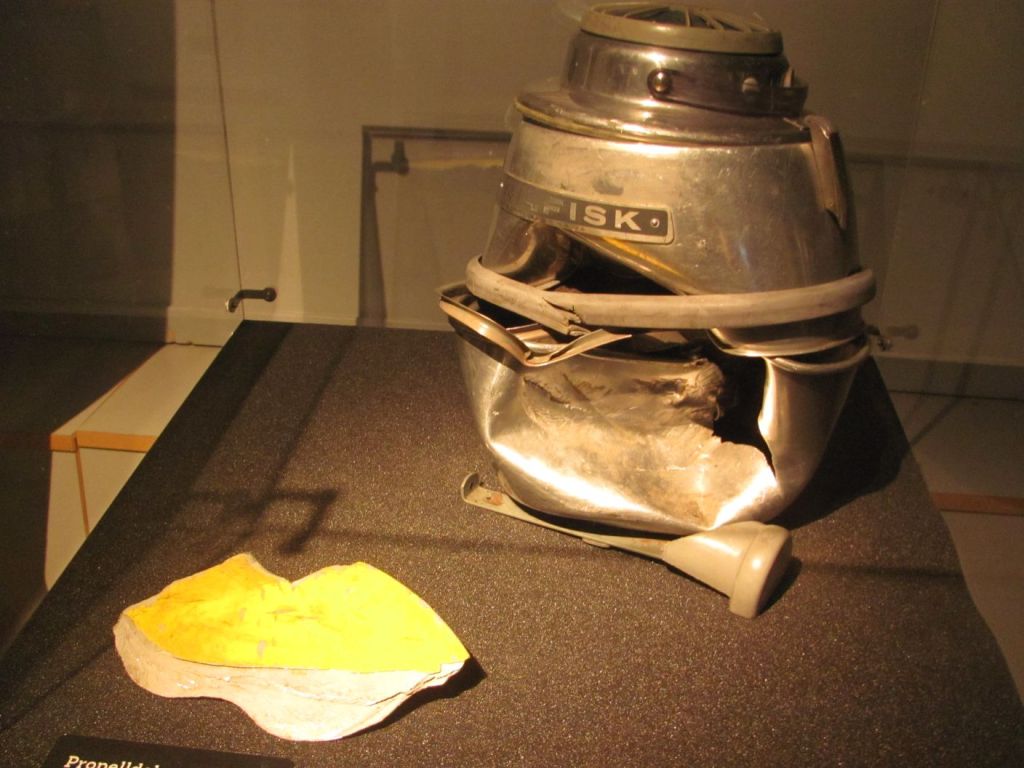
It is something that I knew nothing about either. Apparently the Norwegian aircraft was in international airspace observing Soviet navy manoeuvres when it was buzzed by a Soviet fighter to try and ward it off. The Soviet pilot had flown his plane underneath the Norwegian one, so close that the tailfin of the fighter actually came into contact with one of the propellers of the other. Pieces of the propeller ended up inside the Norwegian plane, actually embedded in a vacuum cleaner. Both planes landed safely at their respective bases. The Soviet Union officially apologised for the incident, although they did reward the pilot by giving him a medal for his work.

Propeller wingtip and vacuum cleaner.

“My mother used to have one of those vacuum cleaners”, I say. “I didn’t realise that it was tough enough to be able to stop a piece of propeller. Mind you, it did last for about 50 years.”

“Ah, they built things differently in those days”, says Spencer.

We move on to the civilian aircraft section.

“Norway’s constitution states that it is to be an undivided kingdom”, one of the displays tells us. “But that wasn’t true when it came to communication and travel in the early days. The remoter parts of the country were very poorly connected to one another, to the extent that it would often take several days to travel from the north to the south. With the advent of air travel, the government committed itself to connect every part of the country.”

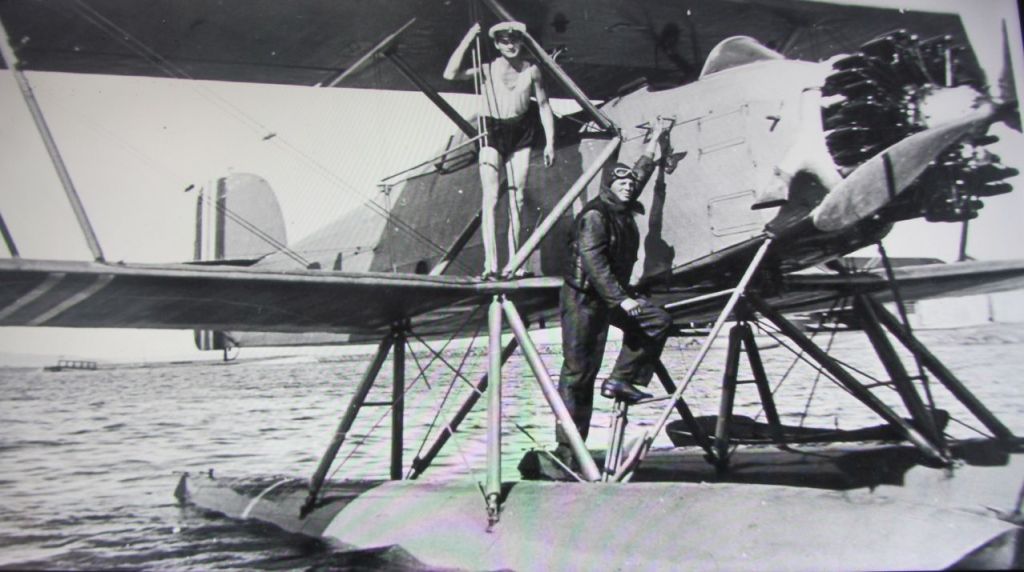
Early seaplane.

At first, this was by seaplane. But from 1935 more and more land-based airports were built, initially by the Nazis when they occupied Norway. In the 1950s and 1960s, much of this was funded by NATO to provide defence infrastructure during the Cold War. Several airports served both military and commercial purposes, Bodø being an example.

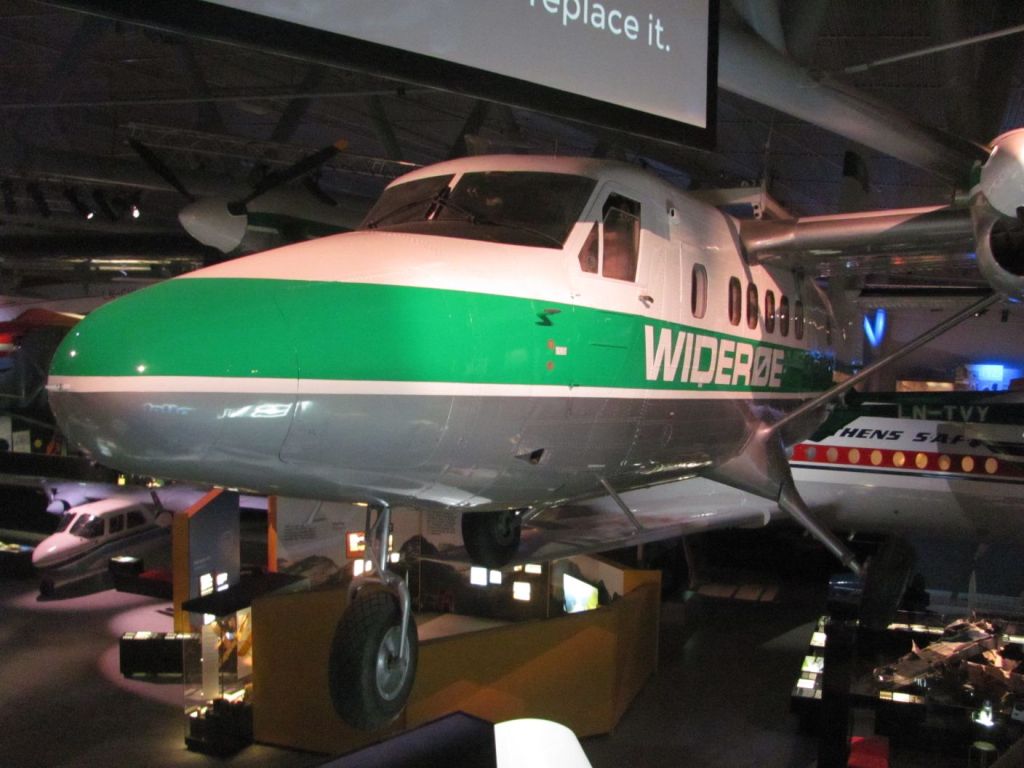
“It says that because of the terrain, many of the airports had to be STOL, Short Take Off and Landing”, says Spencer, gesturing towards a panel with his fourth leg. “And that the aeroplane best suited to this was the Twin Otter. Look, there’s one over there.”

De Havilland DHC-6 Twin Otter.

By the 1980s, air travel had become an integral part of the mass transport network.

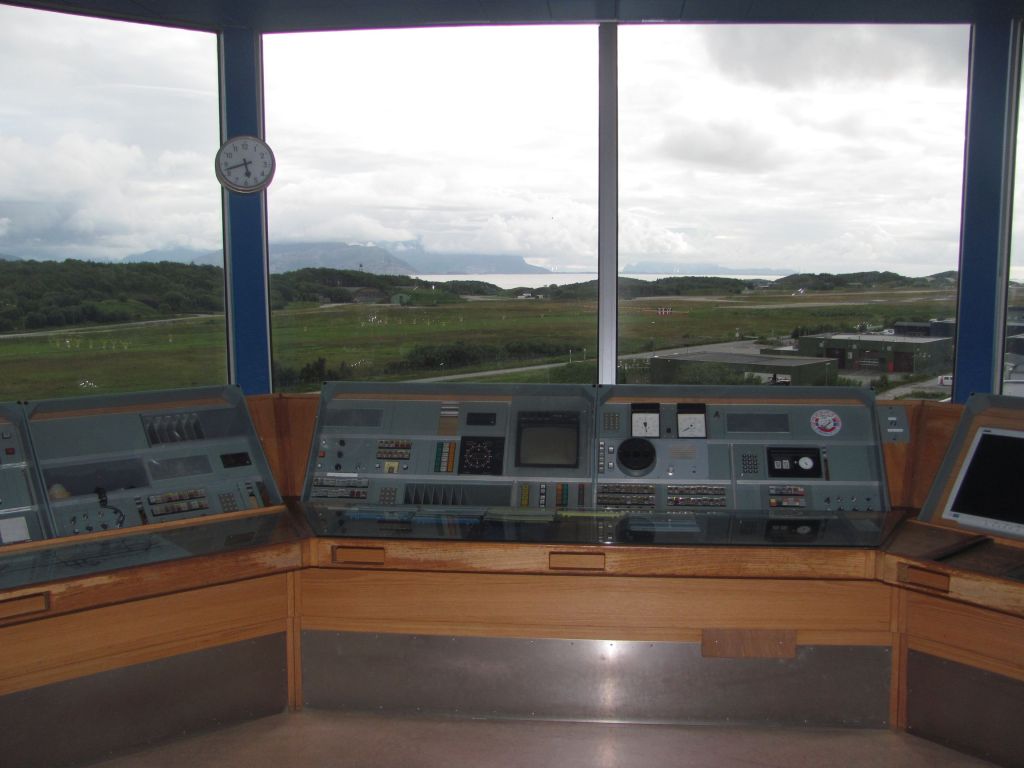
We come to the stairs leading to the control tower.

“It’s actually the old control tower for Bodø airport”, says Spencer. “Not a reconstructed one.”

I sit at one of the screens and pretend to bring in an incoming flight.

The old control tower at Bodø airport.

“SK 4104, Bodø Tower, runway 07, wind 060 degrees at 8 knots, cleared to land”, I say.

“Cleared to land runway 07, SK 4104”, says the pilot of SK 4104.

“SK 4104, after landing vacate left on Charlie and contact Ground 121.8”, I respond.

“Vacate left on Charlie, Ground 121.8, SK 4104”, confirms the pilot.

“Hey, didn’t you see that other plane still on the runway”, shouts Spencer. “They are going to hit.”

It’s too late. There is an almighty explosion as both planes are engulfed by flames. Fire engines race to the tarmac and begin spraying the wreckage with foam.

“It’s probably time we left”, I say to Spencer. “Perhaps we can find a back door we can sneak out.”

In the evening, the First Mate and I compare notes.

“Spencer behaved really well”, I say. “I might take him again.”

“Well, I went to a lunchtime concert in the town centre”, she says. “There was a young female singer and songwriter called Soetkin Baptist, originally from Belgium, but who has been living in Bodø for eleven years or so. She had a beautiful voice and was really into audience participation. She took us line by line through a song, so that by the end we could all sing it. At least the Norwegians could – I couldn’t understand a word of it, so I hummed along. But she had infectious passion and enthusiasm, and the audience really warmed to her. I really enjoyed it.”

Soetkin Baptist doing her stuff.

In the morning, we continue southwards. The wind is from our starboard quarter, so we start sailing almost as soon as we leave the harbour. It strengthens as we leave the Bodø approaches, and soon we are touching seven knots with the genoa only. Three hours later, we reach the Fleinvær islands, south-west of Bodø.

“There’s an anchorage shown in the pilot book that we can stay tonight”, I say. “Let’s try that.”

But the wind is too strong and the low flat islands offer little shelter.

“There’s a pontoon a bit further round on the island of Sørvær”, says the First Mate, consulting the harbour guide. “It might be better.”

Marginally better, as it turns out. We try to tie up to the leeward side where there is space, but we kept being blown off by the wind. After the fourth attempt, I am just about to give up.

A man appears walking his dog. He comes down to the pontoon and offers to help. Eventually we manage to secure a line to one of the cleats and tie up.

Struggling against the wind.

“Phew, that was a bit of an effort”, says the First Mate. “That wind is strong. Thanks so much for your help. Do you live here?”
“Yes, I am an artist”, the man says. “I am the only permanent resident on the island.”

The dog barks.

“Oh, yes, of course, you live here too”, says the Resident Artist, fondling the dog’s ears.

“I studied in Cardiff”, he continues, noticing our flag. “I loved it there. But here I find the peace and quiet I need for my work.”

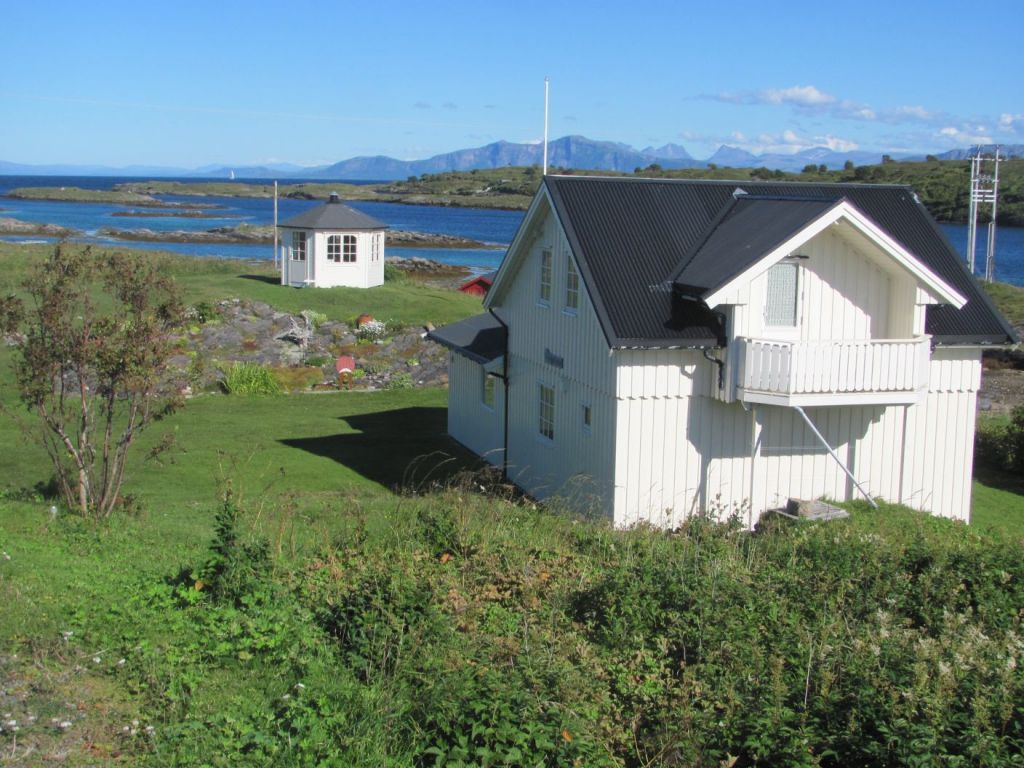
Later we go for a walk around the island. I can see why he finds peace and quiet here. Although there are several houses, and in good condition, almost all are empty. Many even have silent robot lawnmowers to keep the grass well-trimmed.

Empty summer houses.

“They are summer homes”, a girl we meet on the way tells us. “Most belong to people that used to live here. They moved to the cities for jobs, but the houses have been in the family for generations, so they come back in the summer. And some come back to look after the eider ducks, but even those are declining now. It’s sad.”

“Were you brought up on the island?”, asks the First Mate.

“Yes, I am the artist’s daughter”, she responds, somewhat wistfully. “I loved it here. I knew every inch of the island, and everyone knew me. There was only one other girl my own age, but we were the best of friends. Now I live in Bodø, but I still come back with my husband to stay with my Dad. We’ve been here two weeks, but we are going back on the ferry tonight. My Dad is cooking a farewell dinner at the moment, so I need to hurry back.”

“It’s interesting how we keep meeting people who were brought up on these islands in Norway and keep returning to them from the wider world”, I say.

“I suppose if you don’t have anything else to compare it with during your formative years, then that’s how your personality develops”, says the First Mate. “I would find it too quiet.”

“That’s because you were brought up in a town”, I say. “It’s what you know.”

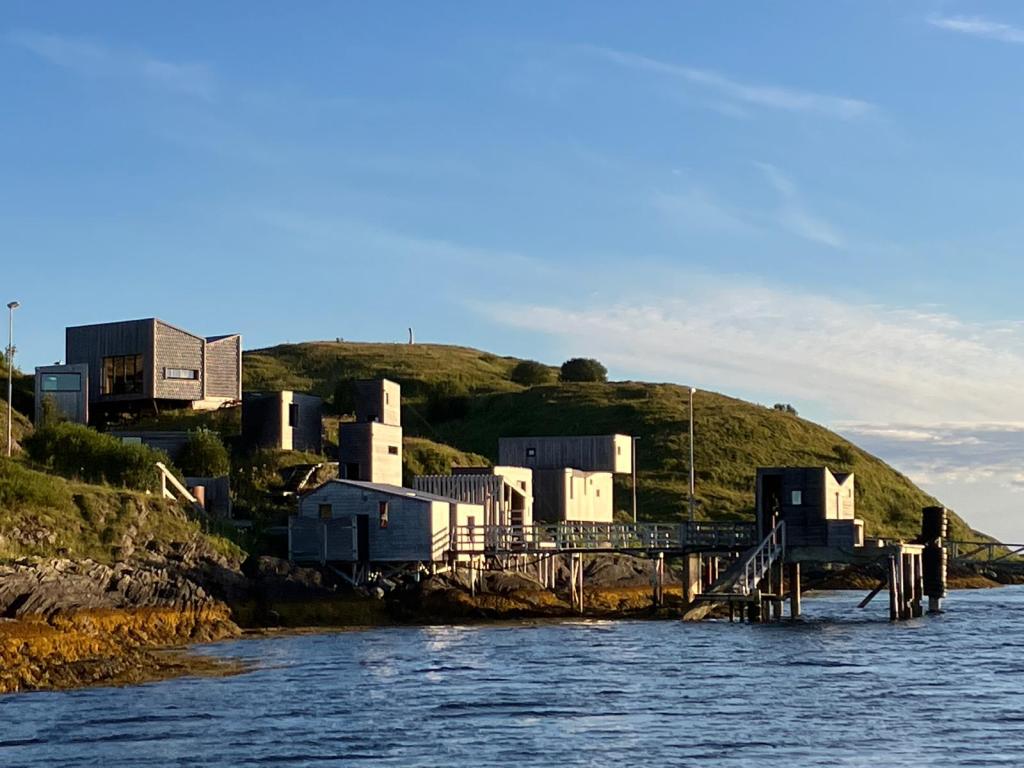
We eventually come to an eclectic collection of modern wooden buildings overlooking the sea, not far from the pontoon where we are tied up.

Arctic Hideaway.

“I saw these buildings from the boat”, says the First Mate. “What do you suppose they are?”

A door of one of the buildings suddenly opens and a girl comes out clad only in a towel.

“This is an artists’ retreat”, she says in response to our surprised faces. “It’s called ‘Arctic Hideaway’, and was the brainchild of Håvard Lund, the composer and musician. Artists come from all over the world to interact with other artists and be inspired by the island. Are Andreassen, the resident artist on the island, also comes and gives classes. We just finished a session last week, so the place is empty apart from my friend from Spain and myself. We are the caretakers at the moment. We are expecting someone to arrive tonight on the ferry, but we just wanted to have a sauna first.”

Another girl appears, also clad only in a towel.

It certainly is an island of, and for, artists, I think.

Later, as we sit in the cockpit of the boat sipping our wine, two stark naked girls emerge from the small wooden sauna hut on the jetty near the Artists’ Retreat and dive into the sea.

“Just keep drinking your wine”, the First Mate says. “You’re far too old for them anyway.”

A communications hub, prosperous art, and a remote anchorage

We leave the next morning and sail down Tjeldsund, starting our long journey southwards. We have decided to leave Ruby Tuesday over the winter in Trondheim again, which even though itself is quite north, is still around 350 nautical miles away from where we are now.

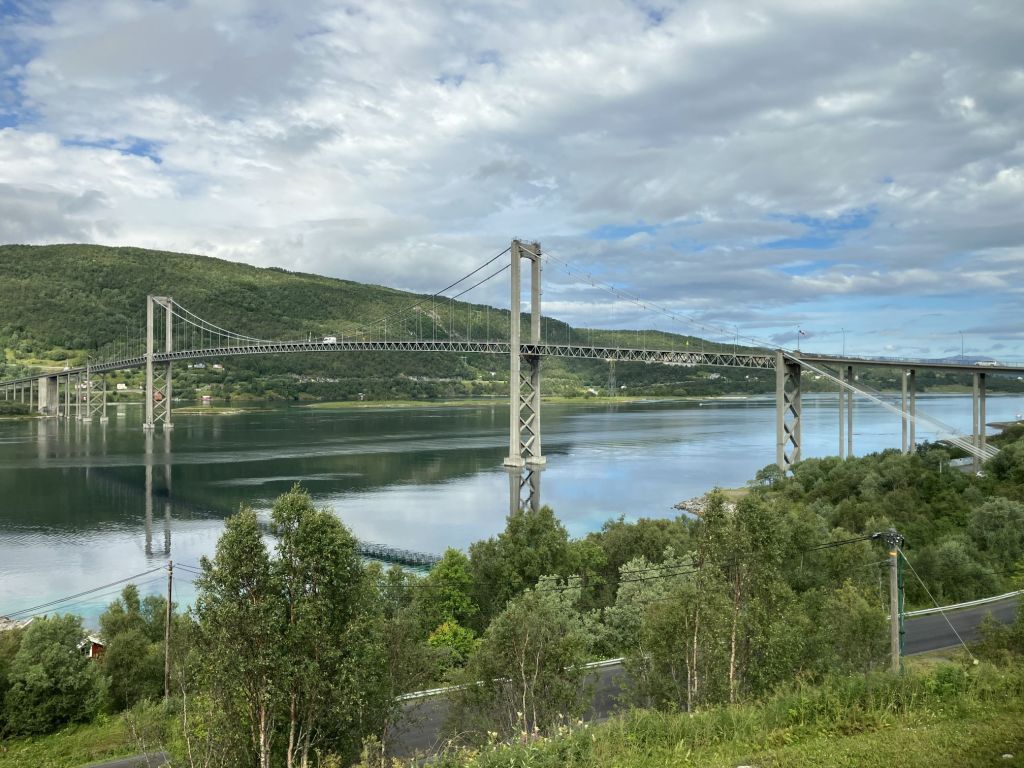
The wind is from the west, and we manage a pleasant close reach. The tidal current is with us and we make 6 knots. It’s not long before we reach the Tjeldsund Bridge where the fjord narrows, and the current strengthens. Soon we are doing a speedy 7½ knots.

“It’s hard to believe we were just up there yesterday talking to that girl from New Zealand looking down at the boats passing by”, says the First Mate. “Now it is us that is passing by.”

Tjeldsund Bridge,

It starts to rain heavily, and the visibility falls.

“There’s an anchorage just up at this next bend”, I say. “Ulvika. We could anchor there for the night and continue in the morning. I can’t see anything through all this rain, and we are missing all the nice scenery.”

“Sounds like a good idea”, says the First Mate. “I’ll put on my rain jacket and get the anchor ready.”

We drop anchor in a little bay off the main stream of the tidal current, and chill out. The rain eventually stops. A boat full of fishermen drifts into sight.

“Things have hardly changed at all”, I say. “They look just like the Stone Age carvings that we saw in Alta.”

Timeless pursuit?

In the morning, we continue on down the Tjeldsundet. We catch the wind coming down the fjord and sail with the genoa only, making a respectable five knots. The clouds clear and we are left with a beautiful sunny day.

Sailing down the Tjeldsundet.

“This is the sort of sailing I like”, says the First Mate dreamily. “Not too windy, not rolling too much, and no heeling. Not to mention nice warm weather. This is the life.”

We eventually make it to Lødingen, a small town at the entrance to Tjeldsundet. Two pontoons are available for guest sailors. A small boat is tied up to the other side of the pontoon. As we moor, a man and three women arrive.

Tied up at Lødingen.

“We’ve just come over from Kjærfjorden to do some shopping for groceries”, the young man in his mid-twenties tells me, gesturing across the wide expanse of Tjeldsundet. “We have a family cottage over there where we are staying in for the summer. This is my mother and grandmother, and this is my sister. We are three generations here. Every summer we come and spend time with each other in the cottage.”

I ask him about the history of Lødingen.

“It’s interesting you should ask”, he says enthusiastically. “I have just been reading up about it. It started off as a fishing village, like most of the other small places around here. Then when the telegraph was invented, the government was under pressure to connect up a lot of the small villages. The argument was that fishermen could become more efficient by calling each other up to let each other know where the shoals of fish were. In the end, the government agreed and decided to make Lødingen the communications hub. Telegraph workers needed houses, shops and schools, so the population really grew.

“I suppose it is fairly central here”, I say. “Between the north of Norway, Lofoten, and Nordland. So it made sense.”

“Yes, and not only that”, he continues. “When the Hurtigruten ships started up in the 1890s, Lødingen became one of the main ports of call. So it then developed into a transport hub where smaller ferries from the surrounding areas would take passengers back and forwards to the Hurtigruten stops in Lødingen. That brought even more prosperity to the town. Even now it is still a hub for the bus services.”

Relics of a bygone past.

We chat for a while, before they clamber into their small boat, start the engine, and wave goodbye.

“That was pleasant”, says the First Mate. “And the grandmother is a sprightly old bird. Did you see they way that she jumped into their boat?”

I decide to walk over to the small boats marina on the other side of the village to check out the fuel availability. We need to top up. When I get back, the First Mate is talking to a man who has come down to fish from the pontoon. It turns out that he is a Canadian and has come over to Norway on a working visa for a year. He is working at a refugee centre nearby, teaching them the principles of Norwegian society before they are given permission to  stay.

The First Mate learns about refugees.

“Surprisingly, a lot of them say openly that they disagree with the equality of citizens in the West”, he says. “They think that inequality works best – you have a few people that are richer and more powerful and who rule over the majority of ordinary people. So they organise themselves around strong leaders into gangs, take their generous handouts from the state, then take to crime.”

“But surely, if they won’t agree to the basic values of Western society, they shouldn’t be allowed in?”, says the First Mate. “Or if they commit crimes, they should be arrested, tried and punished like everyone else?”

“That’s just the problem”, he responds. “There’s a lot of politics involved. Politicians want to be able to say that they are taking pity on the refugees from war-torn countries, and the police won’t do anything because they have learnt that they must be tolerant of refugee behaviour. So these gangs can operate just as they want, without much fear of retribution.”

“What countries do they come from?”, asks the First Mate.

“Unfortunately the vast majority that I am involved with are Ukrainians”, he responds. “But the government keeps quiet because they don’t want the Norwegian population turning against Ukraine. Don’t get me wrong – I have a lot of sympathy for refugees and immigrants, but in my job I do see some of the bad aspects.”

“It’s a pity”, the First Mate says later to me. “The behaviour of the few only give ammunition to those who oppose immigration, and make it worse for the genuine refugees. Surely they realise that? The authorities should be more careful about who they let in.”

“I suppose the cost and effort of making background checks on everyone who applies for refugee status would be prohibitive”, I say. “They are already pretty swamped.”

We leave Lødingen after topping up with fuel, and have a pleasant close reach across Vestfjorden until the wind dies in the mid-afternoon. We drift for a while and try our hand at fishing. I manage to catch two cod.

“That’s great”, says the First Mate. “We can have them for dinner tonight. I had been wondering what to cook.”

Crossing Vestfjorden.

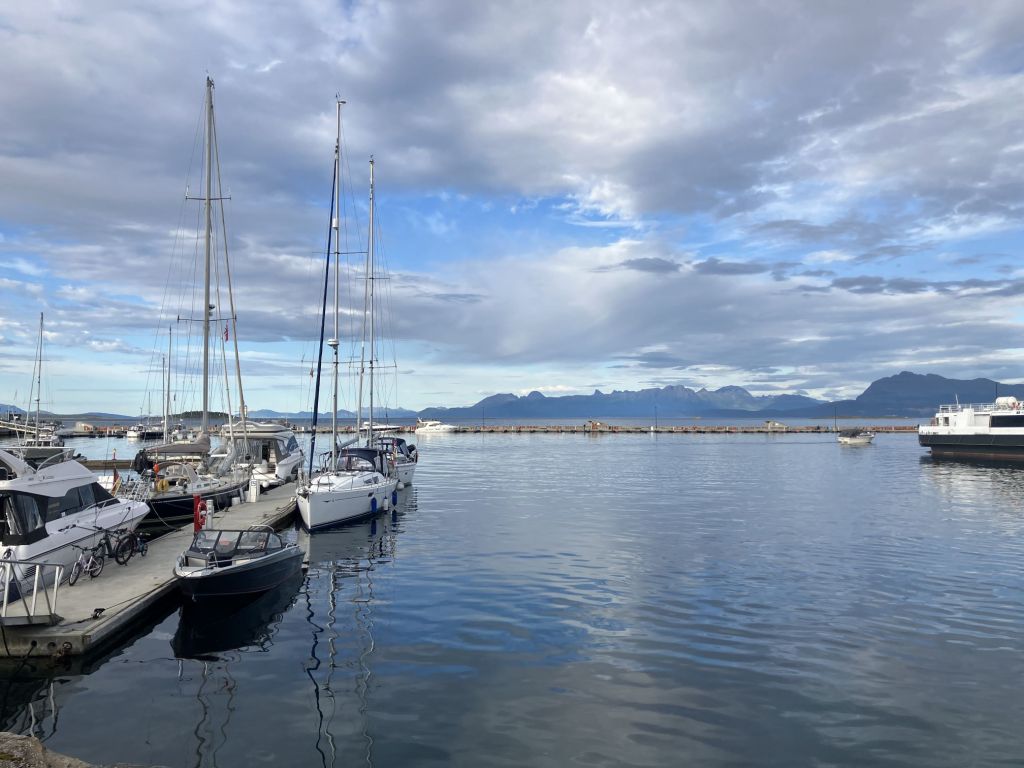
We arrive in the small harbour of Tranøya in the evening, and tie up on the leeward side of the pontoon. The strong winds start to blow from the south-west. We snuggle into Ruby Tuesday.

Tranøya harbour.

“Phew, that was just in time”, says the First Mate. “It would have been pretty difficult tying up with the wind blowing us away from the pontoon. But now we are tied up, it is better for the boat to be blown off as it isn’t so hard on the fenders.”

“There are supposed to be strong winds all day tomorrow”, I say. “We’ll have to stay here. I think that I’ll put a couple of extra ropes on just to be sure.”

“I read that there is a trail of art sculptures here”, says the First Mate. “Tomorrow we can see how many we can find.”

In the morning, it is still blowing hard, but at least it isn’t raining.

“Look, here’s one of the sculptures”, says the First Mate, as we walk into the village centre. “It says that it is called Coastal Women, by Ingun Dahlin.

Coastal Women, by Ingun Dahlin.

“There’s another one over here”, I say. “This one’s called Stars Fishing in the Sky, by Harald Bodøgaard.”

Stars Fishing in the Sky, Harald Bodøgaard.

We reach the village shop. It’s an automatic one that operates 24/7.

“Don’t get caught in it like you did with the last one”, I say, remembering the time when we were on Rodøya island in May.

We buy some milk and bread, and continue our search for more sculptures. Luckily we had found in the shop a pamphlet with a map of where they are.

“Look, here’s one called All Those Too Many Things I Wanted”, calls the First Mate. “It’s supposed to represent that feeling you get when you want to do too much, but never get the time to do them.”

“I can relate to that”, I say.

Disse Alt For Mange Jeg Ville, by Anne Berit Nedland.

A woman on a bicycle stops to talk to us.

“The history of the village is quite interesting”, she tells us. “It used to be a fishing village, and did very well from herring fishing in the 19th century. But that collapsed in the early 20th century. Luckily Tranøy survived as it had also become an important pilot station to guide Swedish ships carrying iron ore down the Vestfjorden avoiding all the rocks and skerries. Pilots get paid well, so that’s why you see a lot of beautiful houses around here.”

“What is the story behind the sculptures?”, I ask.

“Well, the pilot service was eventually moved to Lødingen across the fjord as it had become a transport hub”, she answers. “But Tranøy declined again. So in the 1990s, someone came up with the idea of making art the focus of its revival. Artists’ galleries opened up, and they commissioned artists from around Norway to carve thought-provoking sculptures and erect them at different places around the village. Now Tranøy is famous for its art galleries and sculptures, with people coming from all over the world to see them.”

Tanker For To, by Annelise Josefsen.

“I read somewhere that the chapel is also part of the artistic revival”, says the First Mate.

“Ah yes, the little chapel on the hill behind the shop”, the woman says. “Yes, you should also go and see that. It was built in 2006, and dedicated to St Dorothy, an early Christian martyr traditionally associated with flowers and fruit. It was built by a local woman called Vibeke Stavøy, who was a gardener, wedding organiser, caterer and funeral director. She still owns it, but wants it to be available to anyone for quiet reflection and meditation. The view from it over Vestfjorden is superb.”

We climb the muddy path up the small hill behind the shop, and find the chapel. A woman and her dog are just leaving.

We sit looking out over the vastness of Vestfjorden with the Lofoten Wall stretching off towards the south-west, each in our own thoughts. It’s amazing how two villages have ridden the waves of change and managed to survive, I think to myself. Fishing, communications centre, and transport hub for Lødingen; herring, pilotage, and now art for Tranøy. What is it that has enabled them to do this – do they have something special, or is it something that any place undergoing change can do?

Reflection.

The winds have abated the next morning, so we sail for the harbour of Nordskop nestled on one side of a bay between two impressive mountains. As we approach, the heavens open, and we are engulfed in a deluge of torrential rain. Soaked, we tie up, and are just about to retire to a change of dry clothes and a heart-warming cup of tea.

“There’s a huge yacht just coming in!”, calls the First Mate. “It looks like she is going to tie up behind us!”

“It’s a charter boat”, the young girl on its bow tells us, as we take their ropes. “There are four of us on board. Two from Chile and two from Argentina.”

We learn later that the two Chileans have chartered the boat, and that the younger two Argentinians are employed to help sail it. I find the boat on Yacht Charter and am astounded to find that it costs €23,000 per week to charter. That’s serious money. And at 23 m in length, it is twice as long as ours. Even the mast looks twice as high.

“It makes our boat look like a toy!”, says the First Mate. “They must be very rich. Perhaps we should get to know them.”

Dwarfed.

When the rain stops, we explore the village.

“Come and have a look at this gate”, I call to the First Mate. “It’s got to be the most pointless I have ever seen.”

“Perhaps they ran out of money when it came to do the fence”, she says. “They might be saving up for it.”

As useful as a chocolate teapot?

We continue our journey south. The clouds clear, the winds are favourable, and we sail on a pleasant beam reach, weaving our way through the hundreds of islands studding the sea. We stop for the night in a small anchorage on the island of Hjelløya. There’s a buoy there for visitors, so we tie up to it. A sea-eagle watches us stoically from a knoll on the shore.

Hjelløya anchorage.

“This is a beautiful place”, says the First Mate. “I’ll get the wine out, while you tidy the ropes up. Then we can sit and watch the sun dip below the horizon.”

Hjelløya sunset.

We are no longer in the land of the midnight sun, partly because autumn is on its way, and partly because we are heading southwards. It still doesn’t get completely dark, more a twilight, but we have a definite feeling that the summer is fading.

“Look at the light on those mountains over there”, says the First Mate. “It’s gorgeous.”

Hjelløya sunset.

The phone rings. It’s our son in Australia. Even in this remote place we have reception.

“I was just ringing you up to see how you are”, he says.

The world suddenly seems rather small.

Sacred drums, a lone hiker, and a battle for steel

“There’s a bus to the museum and stone church”, I say, looking up from the guide book. “I think I might take it.”

We are in Harstad, a somewhat ‘no-nonsense’ functional town. We had sailed down from the island of Senja the day before in stiff winds and rather choppy seas, and are relaxing over a leisurely breakfast.

Tied up in Harstad guest marina.
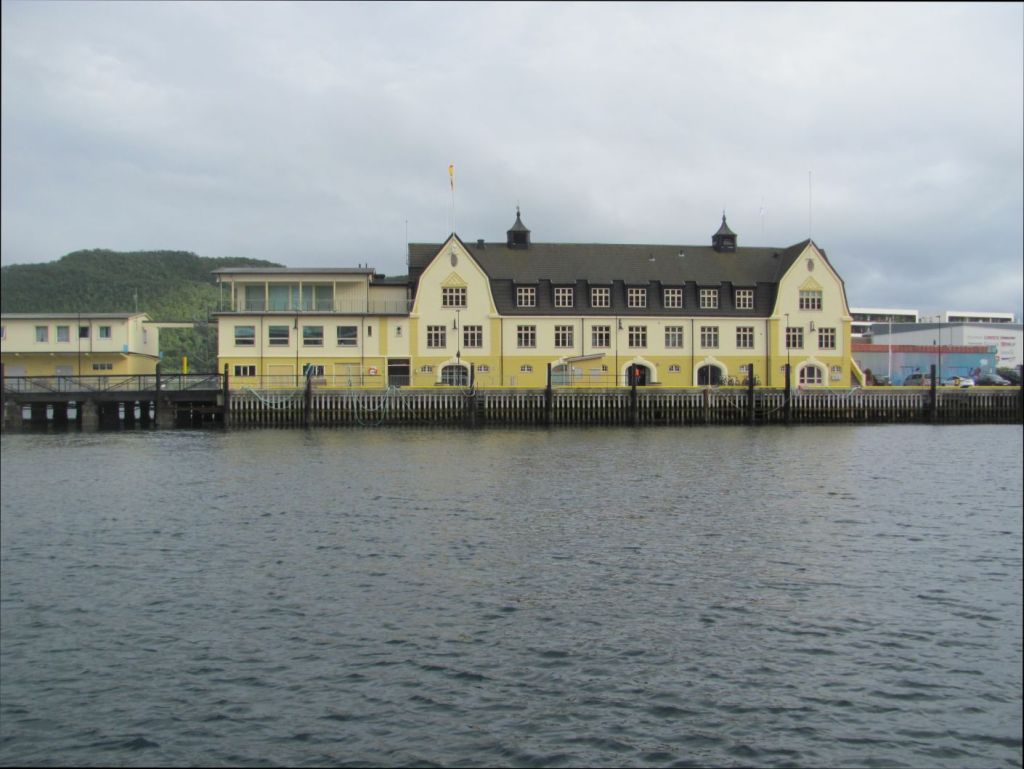
Former HQ of the Store Norske Spitsbergen Coal Company, Harstad harbour.

“You go”, says the First Mate. “I’ll stay here. I want to have a look around the town.”

I take the number 10 bus out to the Trondenes peninsula where the museum and church are located.

“We cover the history of the area from the Stone Age through the Viking and Middle Ages”, the girl at the desk tells me. “You can start through that door there and just follow the exhibits around. Don’t be frightened of the Vikings though. They are quite realistic.”

A Viking welcome.

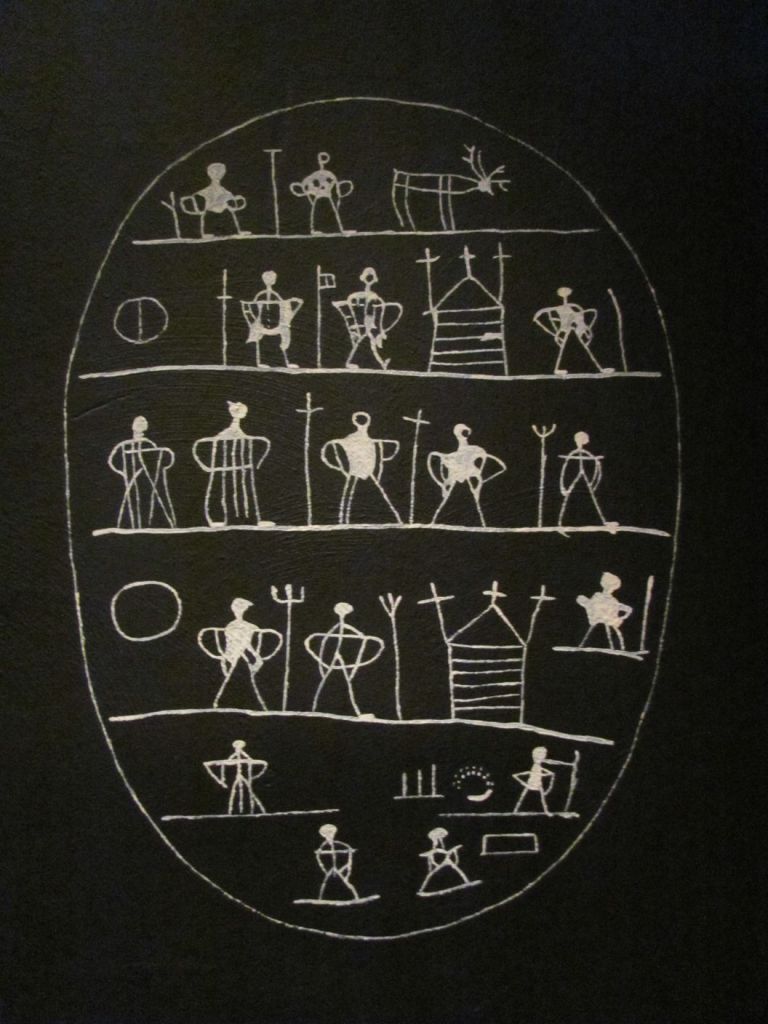
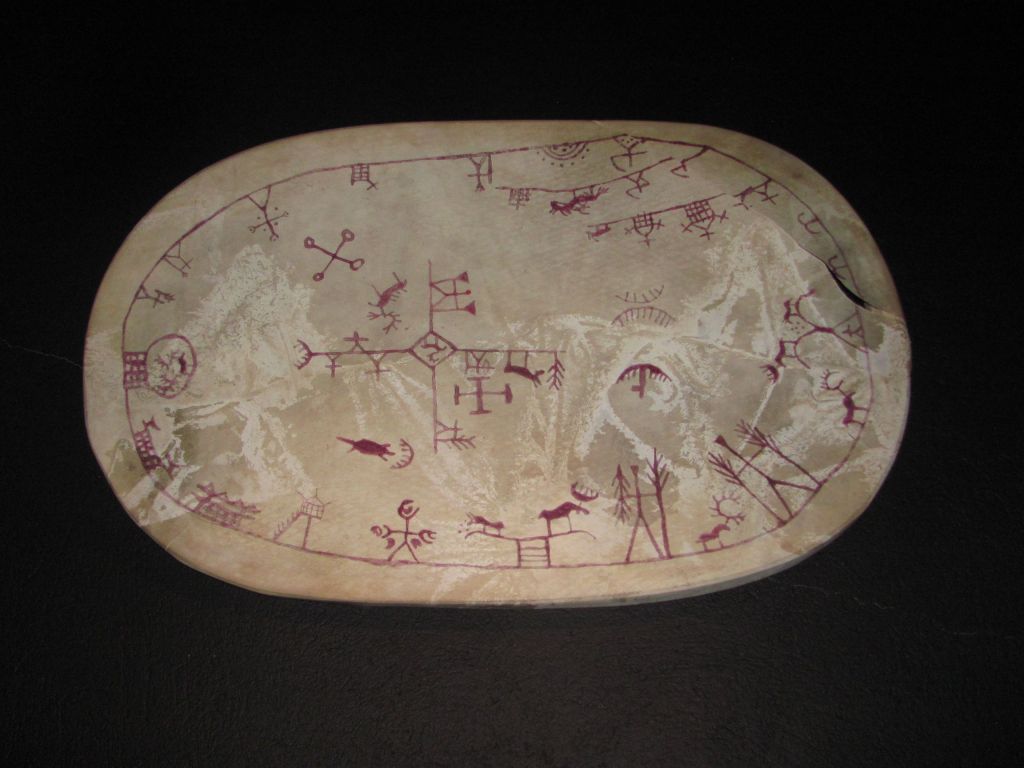
Of particular interest are Sámi drums. Made of reindeer skins stretched over a wooden frame or bowl, with various symbols painted on them, the drums are used by Sámi noaidi, or shamans, to enter into a trance during ceremonies, or to divine the future. Many individual households also have their own.

Patterns on a Sámi drum.

“The symbols represent a worldview of the cosmos, with the reindeer and their predators usually prominent”, the panel tells me. “Other symbols represent hunting, fishing and herding activities, along with mountains, lakes, people and gods. Often these are arranged in different layers representing heaven, life on earth, and the abode of the dead. When the noaidi went into a trance, he would be able to travel between these different worlds.”

Regrettably the early Christian missionaries saw the drums as sorcery and confiscated many of them. Those using them were sometimes even put to death, in an attempt to stamp out paganism. Fortunately modern Norway has a much more enlightened view to the Sámi traditional religion, and many of the drums that were confiscated have now been returned to their owners.

Sorcery?

“Unfortunately, the church is closed”, says the Front Desk Girl when I ask her the way to it. “But you can see it from the outside.”

I wander over and around it, but it’s a grey day, and I don’t see it at its best.

Trondenes stone church.

“You should at least tell your readers that it was built in 1435 to replace earlier churches, the first of which was built in the eleventh century”, says Spencer when I get back. “It’s the northernmost stone church in Norway.”

“I’m always amazed that they manage to find an -est for most things”, I say. “But yes, you are right. I should mention that. Wait a minute …”

It rains heavily in the night, but clears in the early morning to give a warm sunny day.

We decide to take the bus from Harstad down to Narvik to visit the War Museum, rather than sail there.

“Narvik is at the end of a long fjord which would add an extra 60 NM and three days to your trip”, ChatGPT tells me. “I’d recommend going by bus if you can.”

It’s a five minute walk to the bus station from the marina.

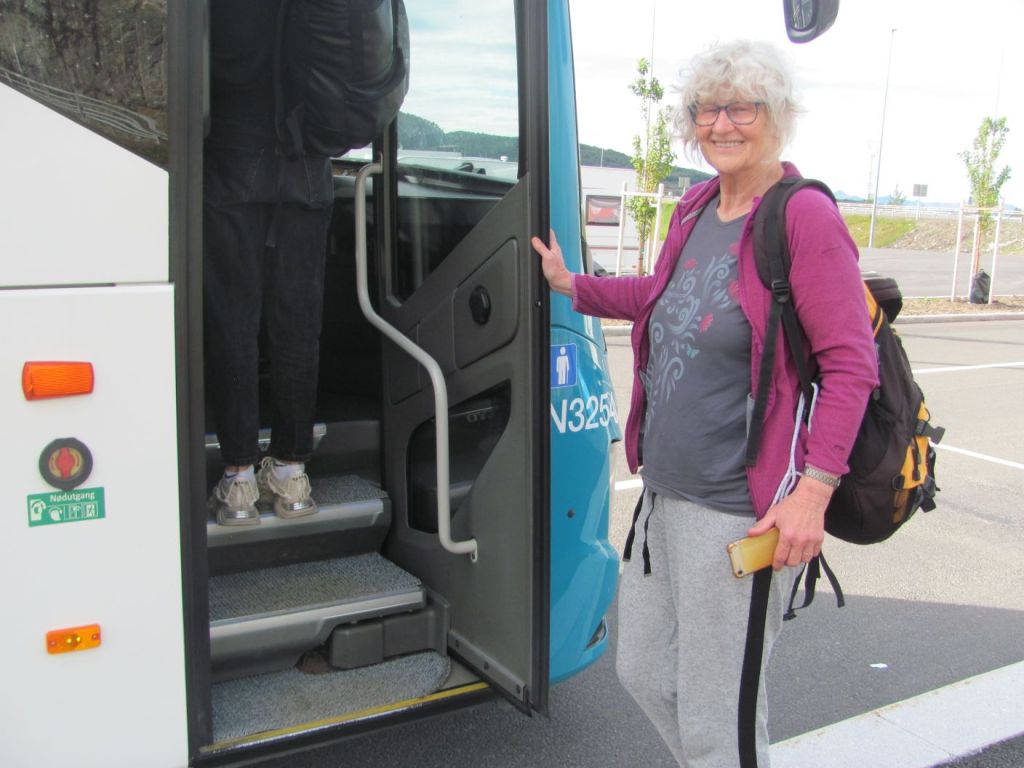
Catching the bus to Narvik.

“Excuse me, are you Kiwis?”, asks a voice as we clamber on. “I heard you talking and thought I recognised the accent. I’m a Kiwi.”

It’s a girl in her twenties. At the stopping place where we need to wait to change buses, we chat to her.

“I’m actually from Tauranga”, she says. “At the moment, I am living and teaching in Croatia. I’m just on holiday in Norway. My goal is to hike from Moskenes at the bottom of the Lofotens right up to Tromsø, avoiding roads as much as possible. It’s about 400 kilometres. I am doing it by myself, and staying in the DNT huts where I can. It’s taken three weeks so far. I had a few days off in Harstad to meet some friends, but am carrying on now.”

It’s obviously the thing for young females to hike alone along challenging routes in Norway. She is the second that we have met on our travels this year, the first being the Norwegian girl on the Svartisen glacier.

She picks up her enormous rucksack.

“I’ve got enough food in here to last me for five days”, she says, noticing my raised eyebrows.

“I like your solar panels on the top of your rucksack”, says the First Mate.

“Yes, they work surprisingly well”, she says. “I charge my phone and other electronic gadgets with them. Now, if you don’t mind, I need to get going. The trail starts from here just a couple of hundred metres up the road. There’s a hut I am aiming for about 20 kilometres from here. I’ll try and get there tonight. But my legs are tired, so I might have to sleep under the stars if I don’t make it.”

“I wish I was young again”, says the First Mate after she is gone. “There’s no way that I could walk 20 kilometres to a mountain hut carrying all that weight. Or really want to for that matter. But I have to admire her.”

“I am not surprised that her legs are tired”, I say. “What with the size of that rucksack.”

Waiting for the next bus at Steinlandsundet.

The next bus arrives and takes us through some beautiful scenery of forests, remote bays, and jagged mountains. Eventually we arrive in Narvik. It’s a five minute walk to the war museum. It’s part of the Narvik War and Peace Centre.

“The museum is in three levels”, the girl at the front desk explains, handing us our tickets. “The first level is on the actual battle of Narvik itself, the second is on the five-year occupation afterwards, and the third is more reflective on war and violence in general. You can start off on Level 1.”

“Sounds good”, says the First Mate. “Let’s go.”

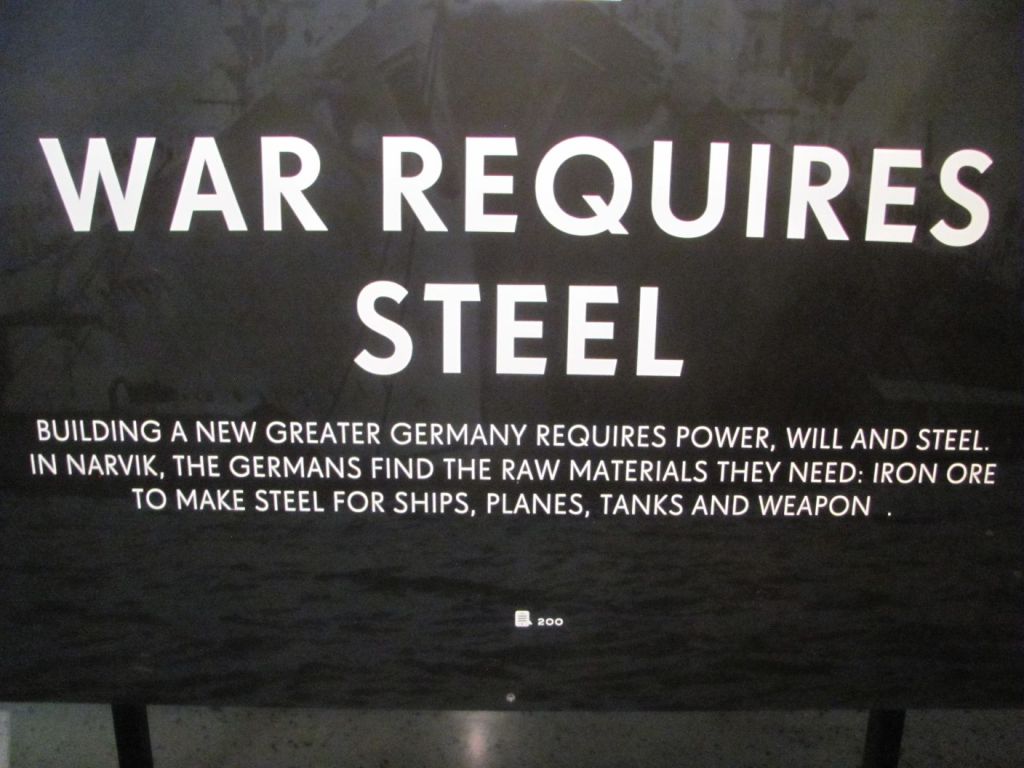
“War requires steel”, posters tell us, as a prelude to what the war in Narvik was all about. “And steel requires war.”

Hitler realised that if he was to make Germany a great nation with strong armed forces, he had to control the production of iron ore. Reserves in Germany were limited, and not of the highest quality, but neutral Sweden was a major exporter of high quality iron ore from her mines in Kiruna. The ore was taken across by rail to Narvik in Norway, as it was the closest port that remained ice-free in the winter on account of the Gulf Stream. Sweden had its own port, Luleå, but it freezes up during the winter.

“So, to secure supplies, Germany attacked Narvik in April 1940 by sea and captured it”, says the next poster. “But Britain also realised Narvik’s strategic value, not only because of the iron ore, but also as a base from which to control the shipping lanes of the North Atlantic. Battleships were sent to Norway to recapture the town and chase the Germans off.”

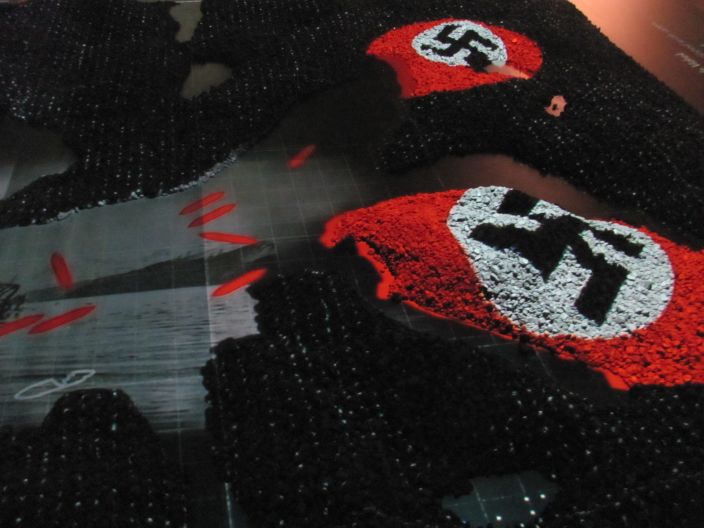
In the middle of the floor is a giant 3D model of the fjords and mountains surrounding Narvik.

Animated 3D model of the Battle of Narvik.

“A naval battle ensued between the Royal Navy and the Polish Navy on one side and the German Kriegsmarine on the other”, the voice-over says, as a projector shows the movement of the ships on the model. “Several ships on both sides were sunk. Many of these remain there to this day. A land battle also took place in the mountains around Narvik involving the Norwegians, British and French against the Germans. The British and her allies eventually regained control of the town.”

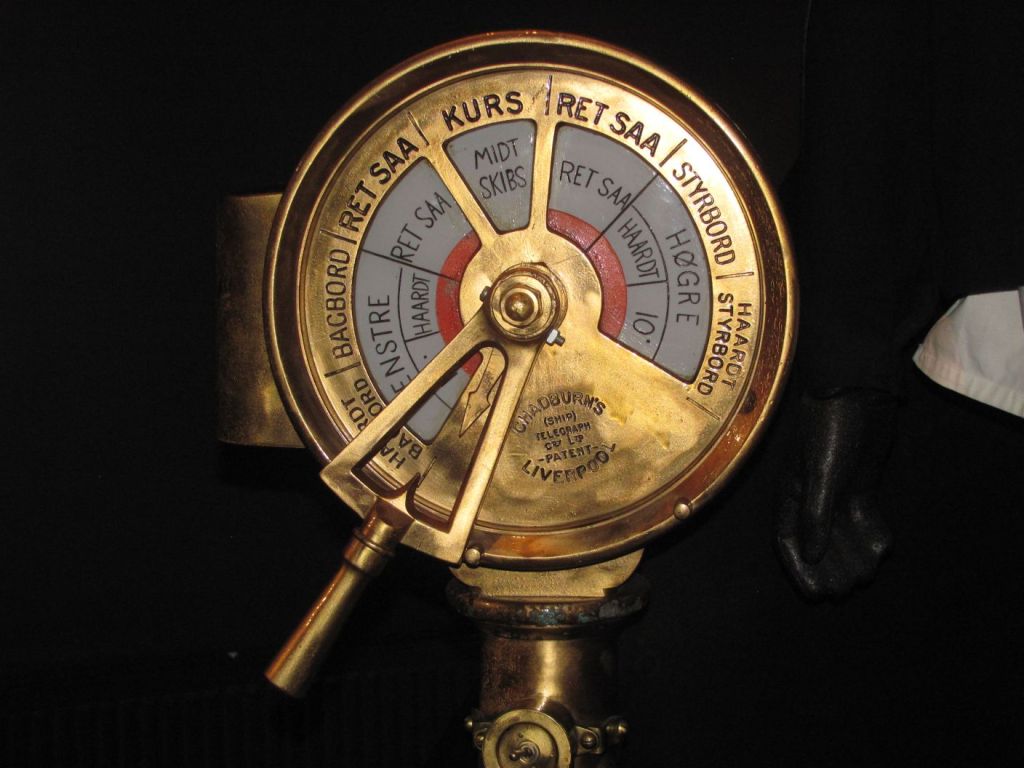
Engine room telegraph recovered from one of the sunken ships.

“But then the order came from London to withdraw”, it continues. “Extra forces were needed in France to stop it from being overrun. So the British relinquished control of Narvik in June 1940, leaving it for the Germans to retake and occupy for the rest of the war. Of course, the Norwegians weren’t very happy about this.”

Was that a good decision, I wonder to myself. By denying the Nazis steel to build their guns, tanks and ships, would the course of the war have been different?

“Yes, it would have” says Spencer, sitting on top of my backpack. “But probably not enough to have altered the overall outcome. High quality iron ore shipments from neutral Sweden to Germany would have been drastically reduced, for sure, as they could only come over the summer. But Germany had other supplies also, from occupied territories such as Luxembourg and Lorraine, plus its own reserves. It would have been more difficult for them without Narvik, but they would probably have managed.”

“But given that France eventually fell anyway”, I ask, “ maybe it would have been better to hold on to Narvik?”

“Possibly”, he responds. “But defending Narvik would have been costly due to the distance involved, and the need to cross the North Sea where there were increasing numbers of German submarines and warships operating. And in the event, Hitler committed large numbers of troops there to defend it, taking them away from other battlefronts. Academics have debated for years whether it was the best thing to do, and the jury is still out.”

We come to the level on the subsequent occupation. Life for ordinary Norwegians is discussed, including resistance to, and collaboration with, the occupying power. Many carried on with their normal jobs as teachers, railway workers, police, civil servants, and municipal officials, keeping essential services running. Many Norwegian businesses worked with the Germans building infrastructure, supplying food, repairing ships, and transporting military equipment. Some grew rich from such activities, others did it to survive.

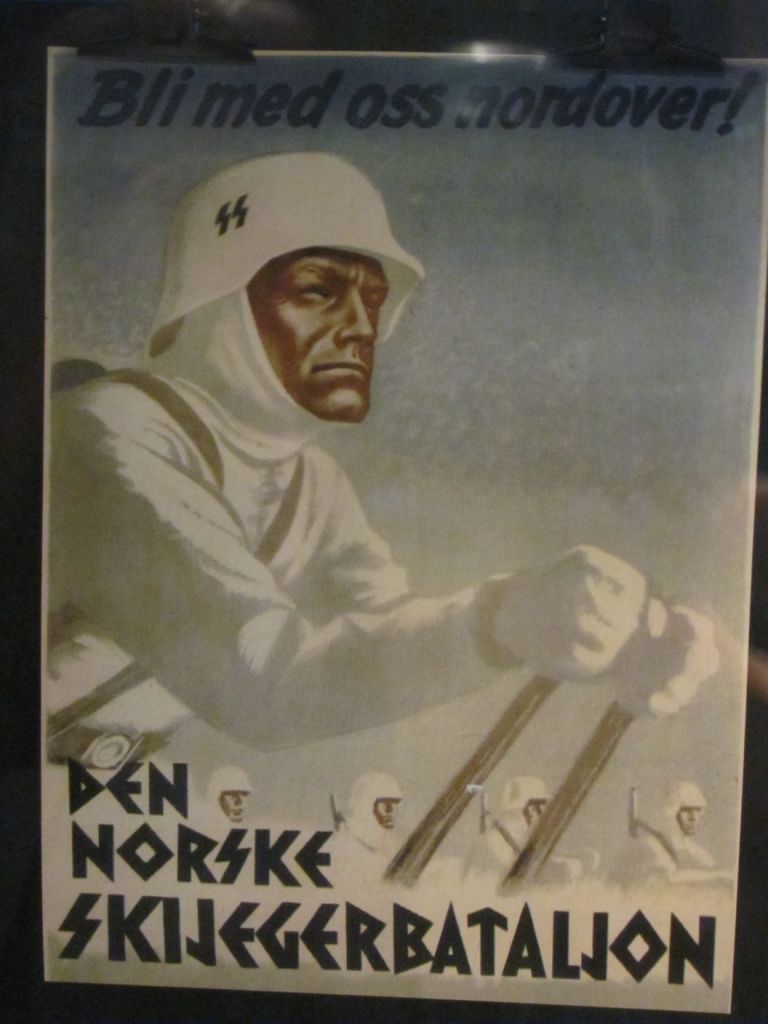
“But others actively helped the enemy”, the next poster tells us. “Some informed on neighbours and resistance members, some helped the security police, some even fought for the Nazis. Many women had relationships with German soldiers, with estimates of 12,000 children being born from such liaisons.”

Den Norske Skijegerbataljon, who fought on the side of the Nazis.

Punishment for collaborators after the war was harsh, ranging from fines and confiscation of property to prison sentences. Some were executed, including the prime minister, Quisling. Women suffered public shaming, head shaving, loss of jobs, and internment. Their children experienced discrimination.

Survivors tell their stories.

What would I have done under these circumstances, I wonder to myself. Would I have resisted at personal danger for my own life, or kept my head down? I am not sure. Is there any right or wrong side in war anyway? A lot depends on what the overall outcome is – if the Nazis had won, the collaborators would have been the ‘helpful ones’ and the resistance the ‘evil guys’. The victors write the history.

We move down to the Zona section. There the message is that Narvik was not just a battle for a railway and harbour, but that it was a small episode in the larger human story about how wars start, how they continue, and how they shape societies afterwards.

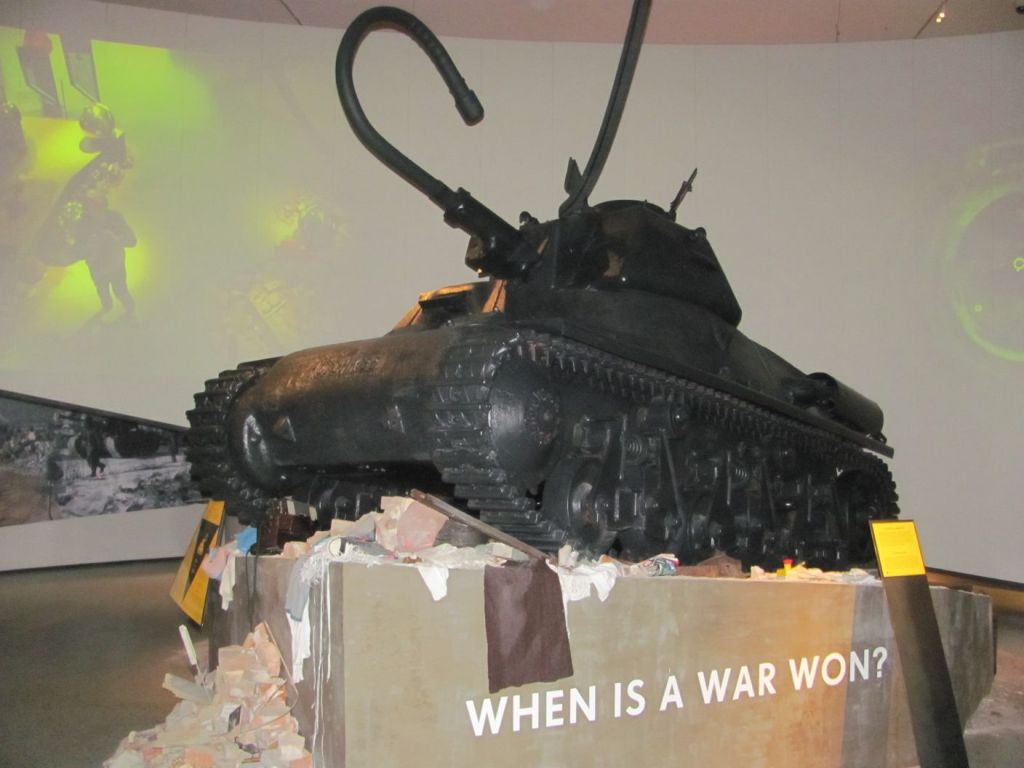
When is a war won?

The question is posed of when does a war actually end? The fighting may end when the shooting stops, but the aftermath has to be dealt with; survivors with trauma, societies dealing with collaboration and resistance, displaced people, and new conflicts arising from the old. The foundations of a post-WW2 order were put in place to ensure that such a war would never happen again – the partition of Germany, the creation of Israel, the strengthening of European cooperation, and the forming of the NATO alliance. But as well-intentioned as all this may have been, it has resulted in the Cold War division between the West and the East, the threat of nuclear war, and more recently has led to new wars in Ukraine, the Middle East, and Iran.

“It makes you wonder if the human race is doomed to a perpetual cycle of wars and conflicts”, says the First Mate. “I wonder if we can ever live together in peace?”

“Not as long as we have leaders who think their destiny is to enlarge their own borders and create empires”, I say. “They can twist the truth and con their people into believing what they are doing is right.”

We have reached the end of the exhibitions and take the lift back up to the reception level.

“Come on”, I say, looking at my watch. “We have to get the bus back to Harstad. It leaves in 20 minutes from the bus station. It’s the last bus of the day. We’ll need to hurry.”

We start walking, but the First Mate stops to take photos.

“We don’t really have time for that”, I say, keeping walking. I make it to the bus station with five minutes to spare. There’s no sign of the First Mate. I text her.

“I’ve gone to the bus stop where we got off”, she responds. “I thought that is where we would pick it up again.”

I tell the driver. “I don’t always stop at that one”, he says. “Only if there is someone there. You need to make sure that she flags me down. Otherwise I’ll go straight on.”

I text the First Mate. The bus sets off. From a distance I can see the bus stop. There’s no one there. Visions of staying the night in Narvik cross my mind.

Just as we are about to pass the stop, the First Mate appears from the doorway of a shop, and waves frantically. The bus stops.

“I just wanted to see if there were any bargains in there”, she says.