Sacred drums, a lone hiker, and a battle for steel

“There’s a bus to the museum and stone church”, I say, looking up from the guide book. “I think I might take it.”

We are in Harstad, a somewhat ‘no-nonsense’ functional town. We had sailed down from the island of Senja the day before in stiff winds and rather choppy seas, and are relaxing over a leisurely breakfast.
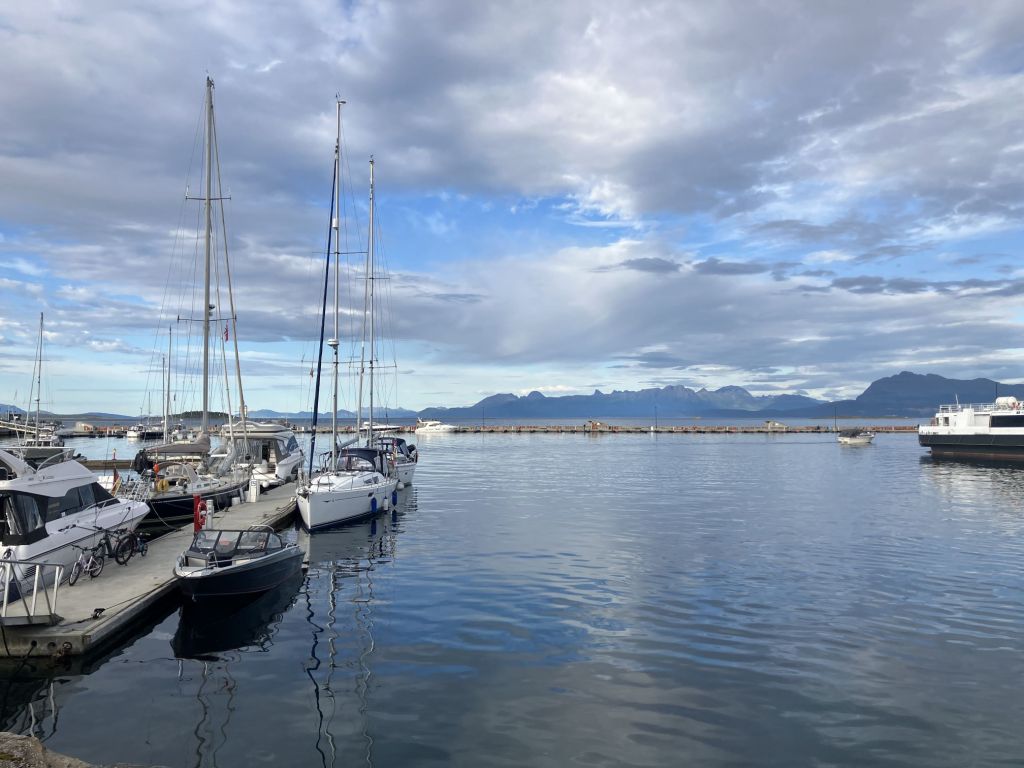
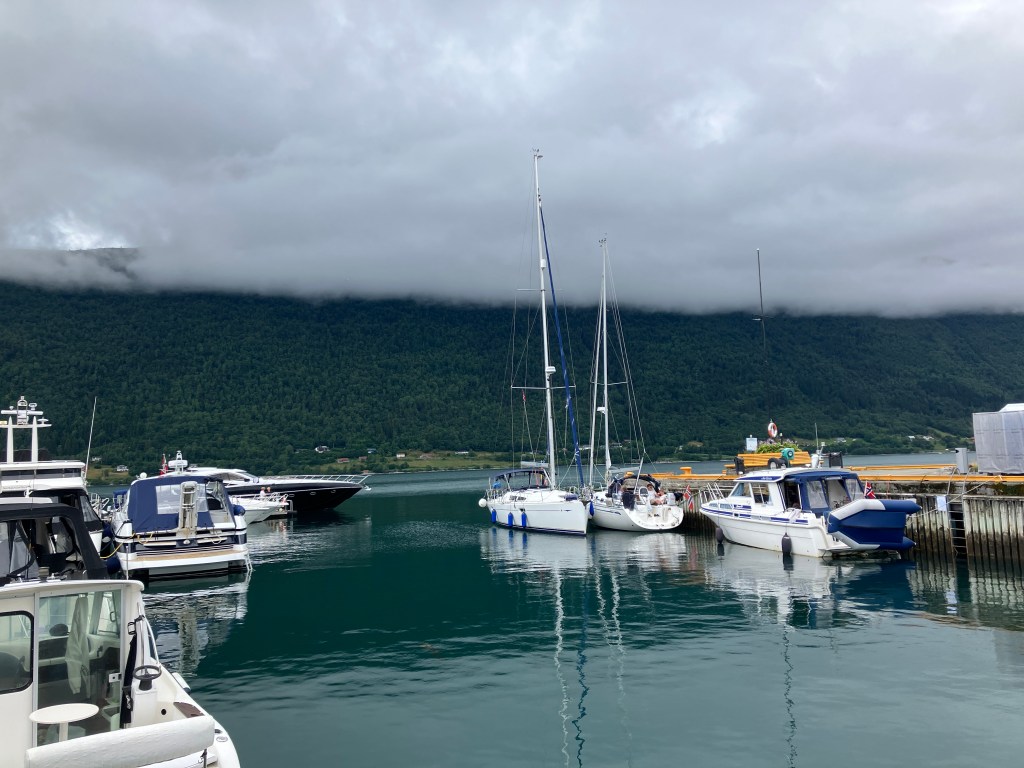
Tied up in Harstad guest marina.
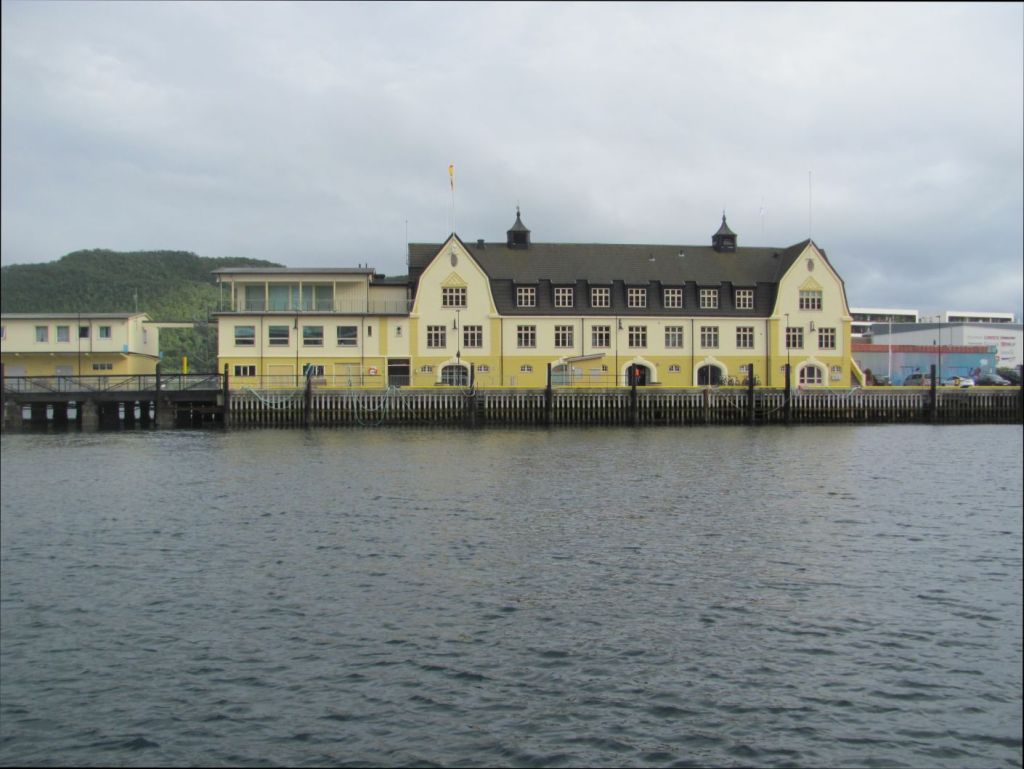
Former HQ of the Store Norske Spitsbergen Coal Company, Harstad harbour.

“You go”, says the First Mate. “I’ll stay here. I want to have a look around the town.”

I take the number 10 bus out to the Trondenes peninsula where the museum and church are located.

“We cover the history of the area from the Stone Age through the Viking and Middle Ages”, the girl at the desk tells me. “You can start through that door there and just follow the exhibits around. Don’t be frightened of the Vikings though. They are quite realistic.”

A Viking welcome.

Of particular interest are Sámi drums. Made of reindeer skins stretched over a wooden frame or bowl, with various symbols painted on them, the drums are used by Sámi noaidi, or shamans, to enter into a trance during ceremonies, or to divine the future. Many individual households also have their own.
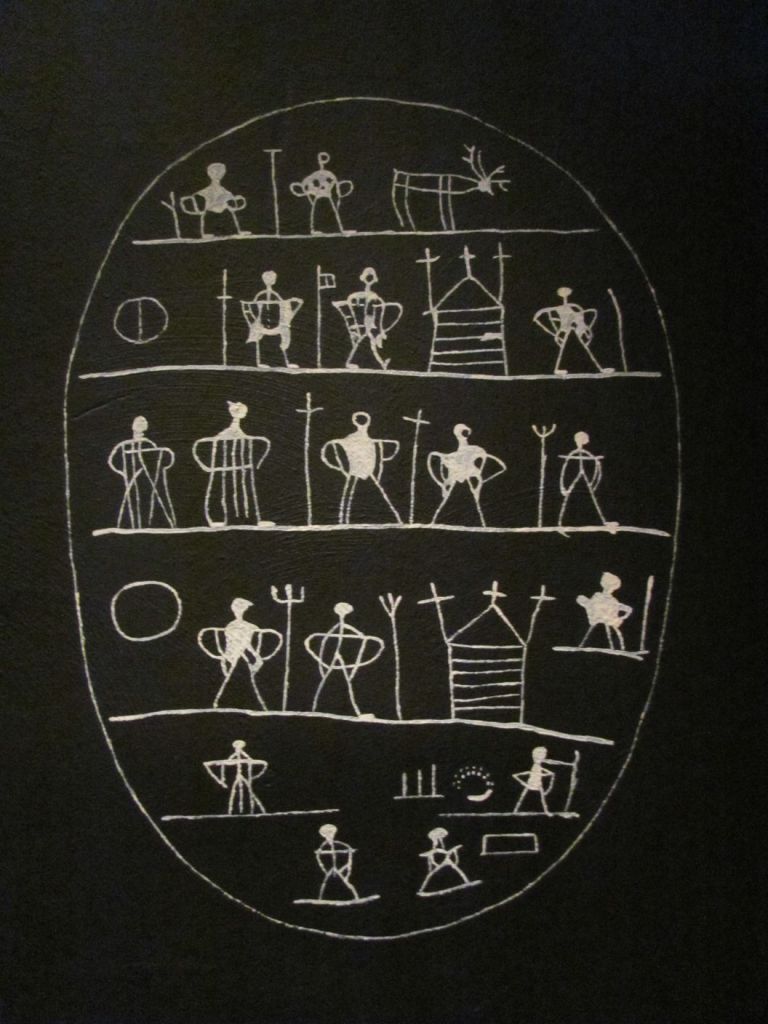
Patterns on a Sámi drum.

“The symbols represent a worldview of the cosmos, with the reindeer and their predators usually prominent”, the panel tells me. “Other symbols represent hunting, fishing and herding activities, along with mountains, lakes, people and gods. Often these are arranged in different layers representing heaven, life on earth, and the abode of the dead. When the noaidi went into a trance, he would be able to travel between these different worlds.”

Regrettably the early Christian missionaries saw the drums as sorcery and confiscated many of them. Those using them were sometimes even put to death, in an attempt to stamp out paganism. Fortunately modern Norway has a much more enlightened view to the Sámi traditional religion, and many of the drums that were confiscated have now been returned to their owners.
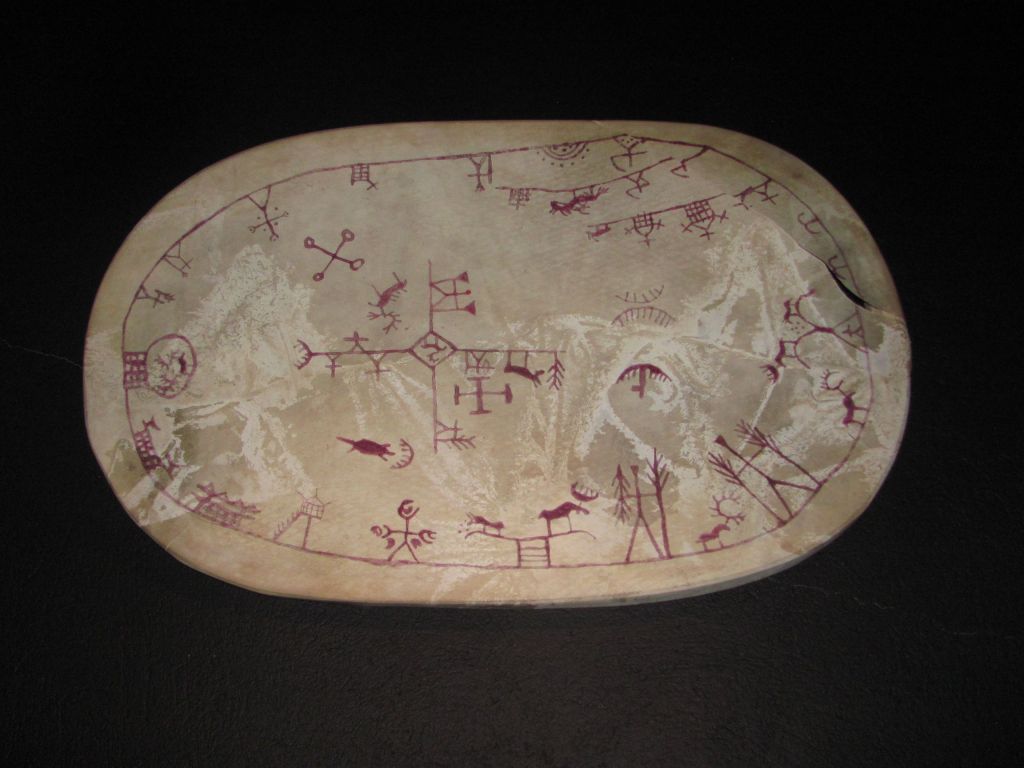
Sorcery?

“Unfortunately, the church is closed”, says the Front Desk Girl when I ask her the way to it. “But you can see it from the outside.”

I wander over and around it, but it’s a grey day, and I don’t see it at its best.

Trondenes stone church.

“You should at least tell your readers that it was built in 1435 to replace earlier churches, the first of which was built in the eleventh century”, says Spencer when I get back. “It’s the northernmost stone church in Norway.”

“I’m always amazed that they manage to find an -est for most things”, I say. “But yes, you are right. I should mention that. Wait a minute …”

It rains heavily in the night, but clears in the early morning to give a warm sunny day.

We decide to take the bus from Harstad down to Narvik to visit the War Museum, rather than sail there.

“Narvik is at the end of a long fjord which would add an extra 60 NM and three days to your trip”, ChatGPT tells me. “I’d recommend going by bus if you can.”

It’s a five minute walk to the bus station from the marina.
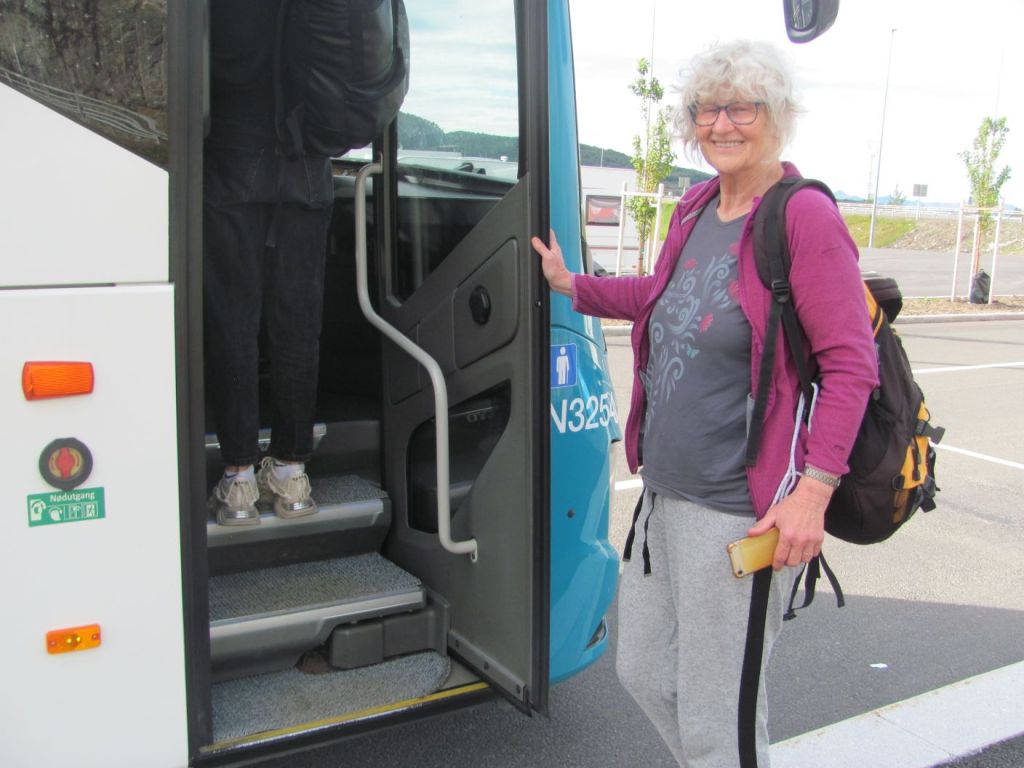
Catching the bus to Narvik.

“Excuse me, are you Kiwis?”, asks a voice as we clamber on. “I heard you talking and thought I recognised the accent. I’m a Kiwi.”

It’s a girl in her twenties. At the stopping place where we need to wait to change buses, we chat to her.

“I’m actually from Tauranga”, she says. “At the moment, I am living and teaching in Croatia. I’m just on holiday in Norway. My goal is to hike from Moskenes at the bottom of the Lofotens right up to Tromsø, avoiding roads as much as possible. It’s about 400 kilometres. I am doing it by myself, and staying in the DNT huts where I can. It’s taken three weeks so far. I had a few days off in Harstad to meet some friends, but am carrying on now.”

It’s obviously the thing for young females to hike alone along challenging routes in Norway. She is the second that we have met on our travels this year, the first being the Norwegian girl on the Svartisen glacier.

She picks up her enormous rucksack.

“I’ve got enough food in here to last me for five days”, she says, noticing my raised eyebrows.

“I like your solar panels on the top of your rucksack”, says the First Mate.

“Yes, they work surprisingly well”, she says. “I charge my phone and other electronic gadgets with them. Now, if you don’t mind, I need to get going. The trail starts from here just a couple of hundred metres up the road. There’s a hut I am aiming for about 20 kilometres from here. I’ll try and get there tonight. But my legs are tired, so I might have to sleep under the stars if I don’t make it.”

“I wish I was young again”, says the First Mate after she is gone. “There’s no way that I could walk 20 kilometres to a mountain hut carrying all that weight. Or really want to for that matter. But I have to admire her.”

“I am not surprised that her legs are tired”, I say. “What with the size of that rucksack.”
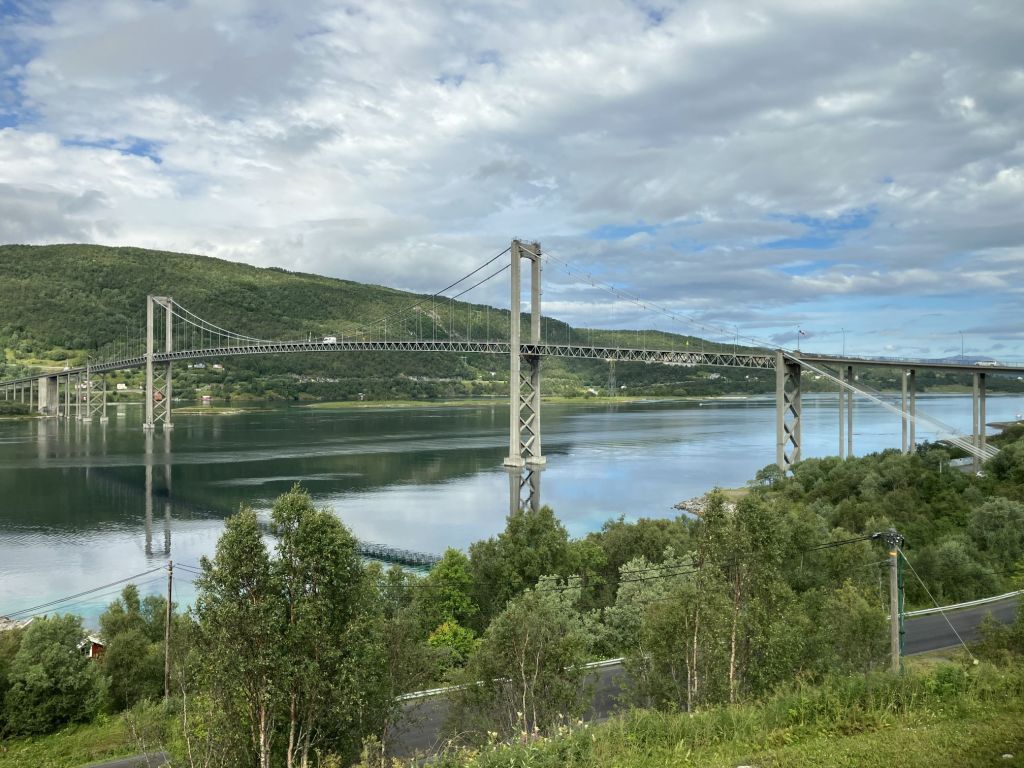
Waiting for the next bus at Steinlandsundet.

The next bus arrives and takes us through some beautiful scenery of forests, remote bays, and jagged mountains. Eventually we arrive in Narvik. It’s a five minute walk to the war museum. It’s part of the Narvik War and Peace Centre.

“The museum is in three levels”, the girl at the front desk explains, handing us our tickets. “The first level is on the actual battle of Narvik itself, the second is on the five-year occupation afterwards, and the third is more reflective on war and violence in general. You can start off on Level 1.”

“Sounds good”, says the First Mate. “Let’s go.”

“War requires steel”, posters tell us, as a prelude to what the war in Narvik was all about. “And steel requires war.”
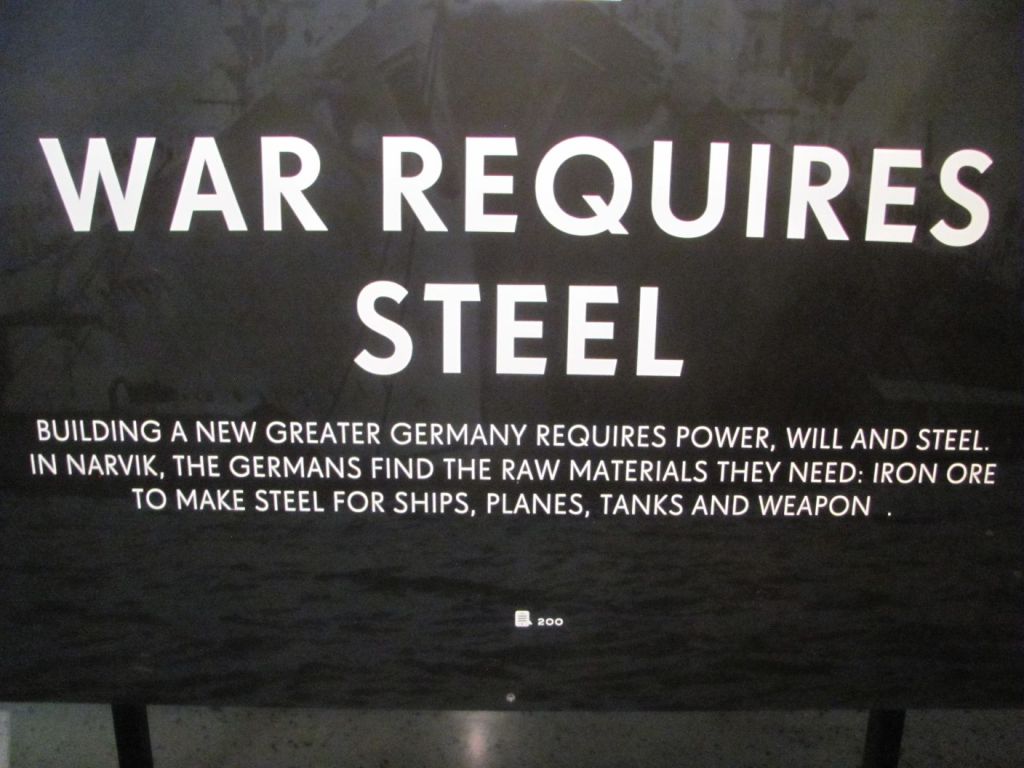
Hitler realised that if he was to make Germany a great nation with strong armed forces, he had to control the production of iron ore. Reserves in Germany were limited, and not of the highest quality, but neutral Sweden was a major exporter of high quality iron ore from her mines in Kiruna. The ore was taken across by rail to Narvik in Norway, as it was the closest port that remained ice-free in the winter on account of the Gulf Stream. Sweden had its own port, Luleå, but it freezes up during the winter.

“So, to secure supplies, Germany attacked Narvik in April 1940 by sea and captured it”, says the next poster. “But Britain also realised Narvik’s strategic value, not only because of the iron ore, but also as a base from which to control the shipping lanes of the North Atlantic. Battleships were sent to Norway to recapture the town and chase the Germans off.”

In the middle of the floor is a giant 3D model of the fjords and mountains surrounding Narvik.
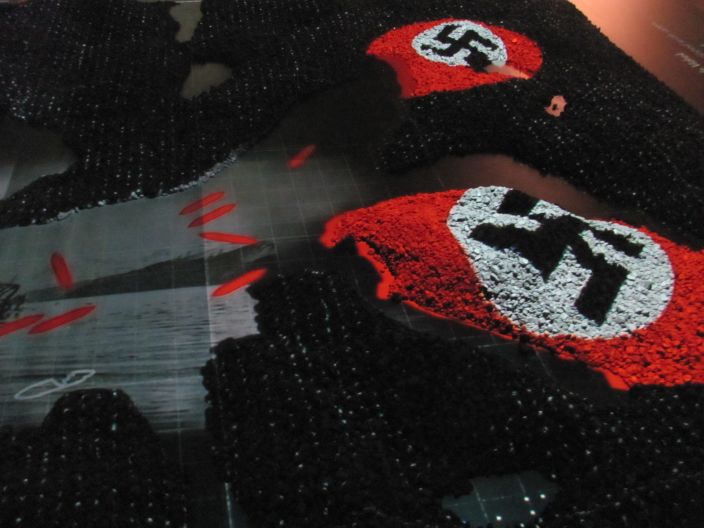
Animated 3D model of the Battle of Narvik.

“A naval battle ensued between the Royal Navy and the Polish Navy on one side and the German Kriegsmarine on the other”, the voice-over says, as a projector shows the movement of the ships on the model. “Several ships on both sides were sunk. Many of these remain there to this day. A land battle also took place in the mountains around Narvik involving the Norwegians, British and French against the Germans. The British and her allies eventually regained control of the town.”
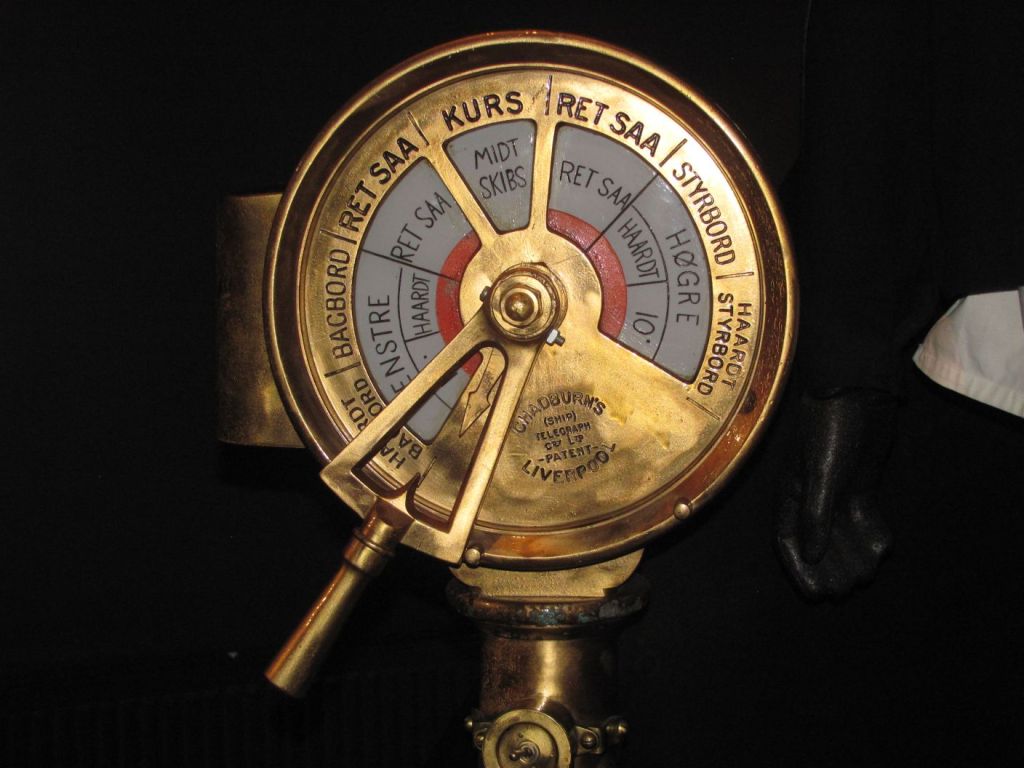
Engine room telegraph recovered from one of the sunken ships.

“But then the order came from London to withdraw”, it continues. “Extra forces were needed in France to stop it from being overrun. So the British relinquished control of Narvik in June 1940, leaving it for the Germans to retake and occupy for the rest of the war. Of course, the Norwegians weren’t very happy about this.”

Was that a good decision, I wonder to myself. By denying the Nazis steel to build their guns, tanks and ships, would the course of the war have been different?

“Yes, it would have” says Spencer, sitting on top of my backpack. “But probably not enough to have altered the overall outcome. High quality iron ore shipments from neutral Sweden to Germany would have been drastically reduced, for sure, as they could only come over the summer. But Germany had other supplies also, from occupied territories such as Luxembourg and Lorraine, plus its own reserves. It would have been more difficult for them without Narvik, but they would probably have managed.”

“But given that France eventually fell anyway”, I ask, “ maybe it would have been better to hold on to Narvik?”

“Possibly”, he responds. “But defending Narvik would have been costly due to the distance involved, and the need to cross the North Sea where there were increasing numbers of German submarines and warships operating. And in the event, Hitler committed large numbers of troops there to defend it, taking them away from other battlefronts. Academics have debated for years whether it was the best thing to do, and the jury is still out.”

We come to the level on the subsequent occupation. Life for ordinary Norwegians is discussed, including resistance to, and collaboration with, the occupying power. Many carried on with their normal jobs as teachers, railway workers, police, civil servants, and municipal officials, keeping essential services running. Many Norwegian businesses worked with the Germans building infrastructure, supplying food, repairing ships, and transporting military equipment. Some grew rich from such activities, others did it to survive.

“But others actively helped the enemy”, the next poster tells us. “Some informed on neighbours and resistance members, some helped the security police, some even fought for the Nazis. Many women had relationships with German soldiers, with estimates of 12,000 children being born from such liaisons.”
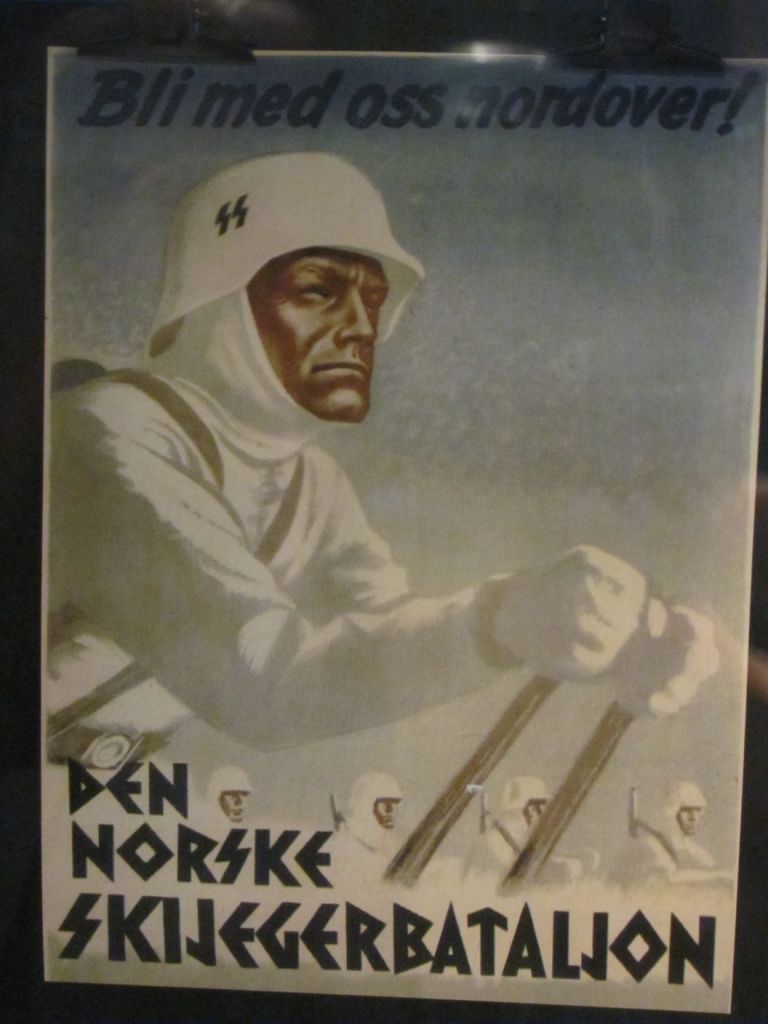
Den Norske Skijegerbataljon, who fought on the side of the Nazis.

Punishment for collaborators after the war was harsh, ranging from fines and confiscation of property to prison sentences. Some were executed, including the prime minister, Quisling. Women suffered public shaming, head shaving, loss of jobs, and internment. Their children experienced discrimination.

Survivors tell their stories.

What would I have done under these circumstances, I wonder to myself. Would I have resisted at personal danger for my own life, or kept my head down? I am not sure. Is there any right or wrong side in war anyway? A lot depends on what the overall outcome is – if the Nazis had won, the collaborators would have been the ‘helpful ones’ and the resistance the ‘evil guys’. The victors write the history.

We move down to the Zona section. There the message is that Narvik was not just a battle for a railway and harbour, but that it was a small episode in the larger human story about how wars start, how they continue, and how they shape societies afterwards.
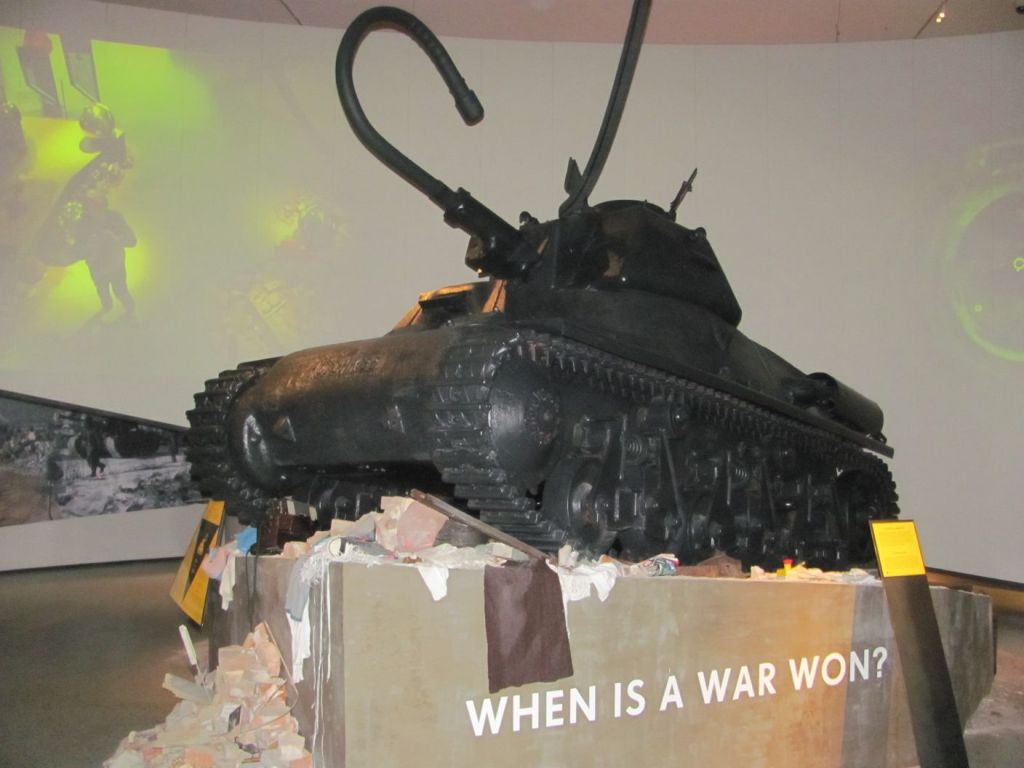
When is a war won?

The question is posed of when does a war actually end? The fighting may end when the shooting stops, but the aftermath has to be dealt with; survivors with trauma, societies dealing with collaboration and resistance, displaced people, and new conflicts arising from the old. The foundations of a post-WW2 order were put in place to ensure that such a war would never happen again – the partition of Germany, the creation of Israel, the strengthening of European cooperation, and the forming of the NATO alliance. But as well-intentioned as all this may have been, it has resulted in the Cold War division between the West and the East, the threat of nuclear war, and more recently has led to new wars in Ukraine, the Middle East, and Iran.

“It makes you wonder if the human race is doomed to a perpetual cycle of wars and conflicts”, says the First Mate. “I wonder if we can ever live together in peace?”

“Not as long as we have leaders who think their destiny is to enlarge their own borders and create empires”, I say. “They can twist the truth and con their people into believing what they are doing is right.”

We have reached the end of the exhibitions and take the lift back up to the reception level.

“Come on”, I say, looking at my watch. “We have to get the bus back to Harstad. It leaves in 20 minutes from the bus station. It’s the last bus of the day. We’ll need to hurry.”

We start walking, but the First Mate stops to take photos.

“We don’t really have time for that”, I say, keeping walking. I make it to the bus station with five minutes to spare. There’s no sign of the First Mate. I text her.

“I’ve gone to the bus stop where we got off”, she responds. “I thought that is where we would pick it up again.”

I tell the driver. “I don’t always stop at that one”, he says. “Only if there is someone there. You need to make sure that she flags me down. Otherwise I’ll go straight on.”

I text the First Mate. The bus sets off. From a distance I can see the bus stop. There’s no one there. Visions of staying the night in Narvik cross my mind.

Just as we are about to pass the stop, the First Mate appears from the doorway of a shop, and waves frantically. The bus stops.

“I just wanted to see if there were any bargains in there”, she says.
A ship in a bottle, a foreign spy, and sailing beyond the limit

“Waiter! Bring me a glass of red wine”, says the First Mate.

“Certainly, your Royal Highness”, I say. “And would the Shiraz be to your taste, ma’am?”

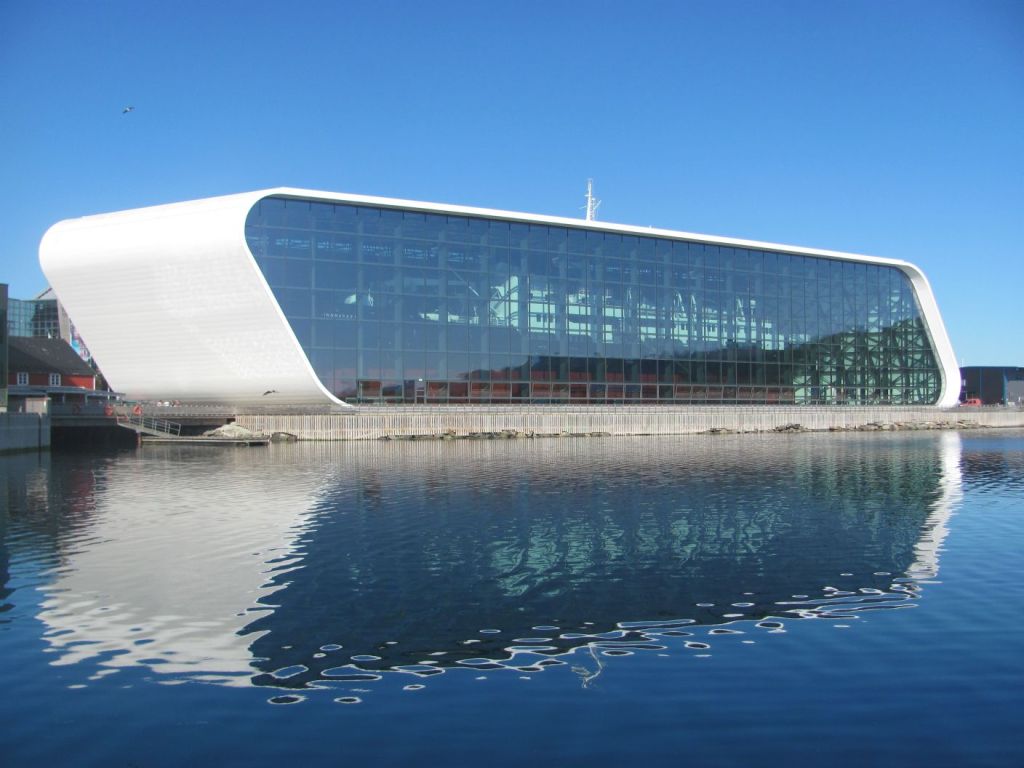
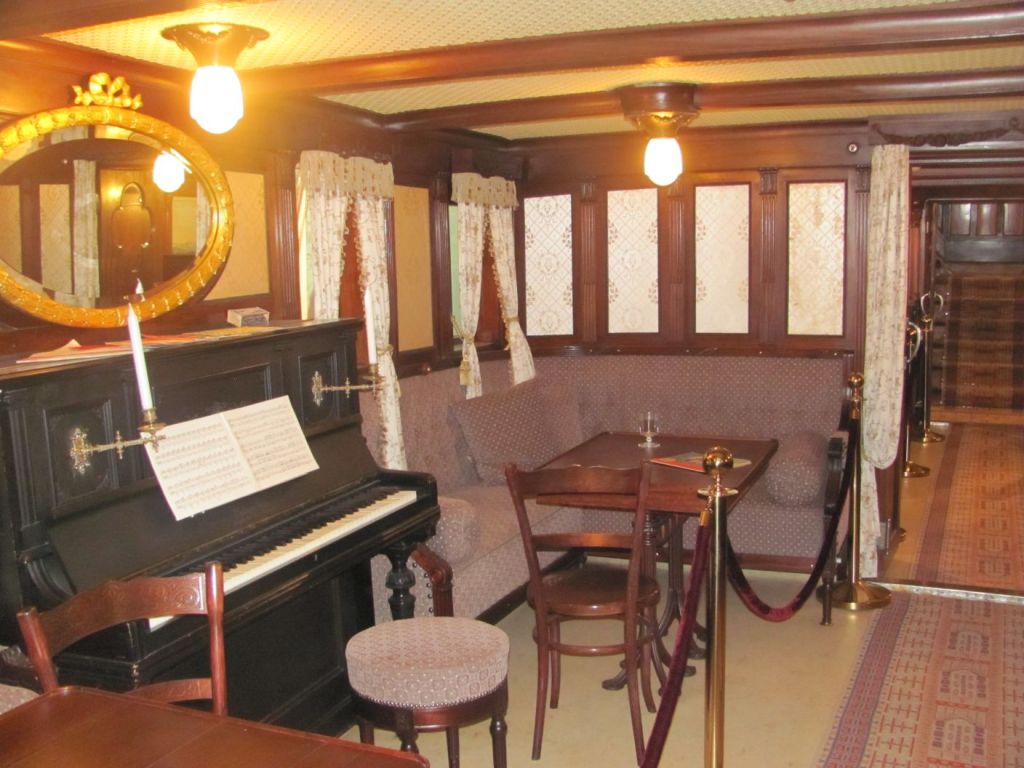
We are revelling in the luxury of the First Class lounge of the MS Finnmarken, one of the ships of the Hurtigruten line. Or at least it was. Nowadays, it is the centrepiece of the Hurtigruten Museum in Stokmarknes, covered by a giant glass enclosure to keep it safe from the elements.

First Class lounge of the MS Finnmarken.

“It’s really interesting to learn how it all started here in Stokmarknes”, says her Royal Highness. “Particularly as we keep seeing the Hurtigruten ships on our voyages. They’re quite iconic.”

They are indeed. We learn that steamship services were started by the government in 1826 to carry passengers, mail and freight up and down the coast, but these were slow, stopped at too many places, and didn’t sail at night. So in the 1880s, the government called for tenders to provide quicker services between Trondheim and Hammerfest with faster ships, stopping at fewer ports, and by sailing at night. But none of the local shipping companies were interested at first, as they considered sailing at night too dangerous.

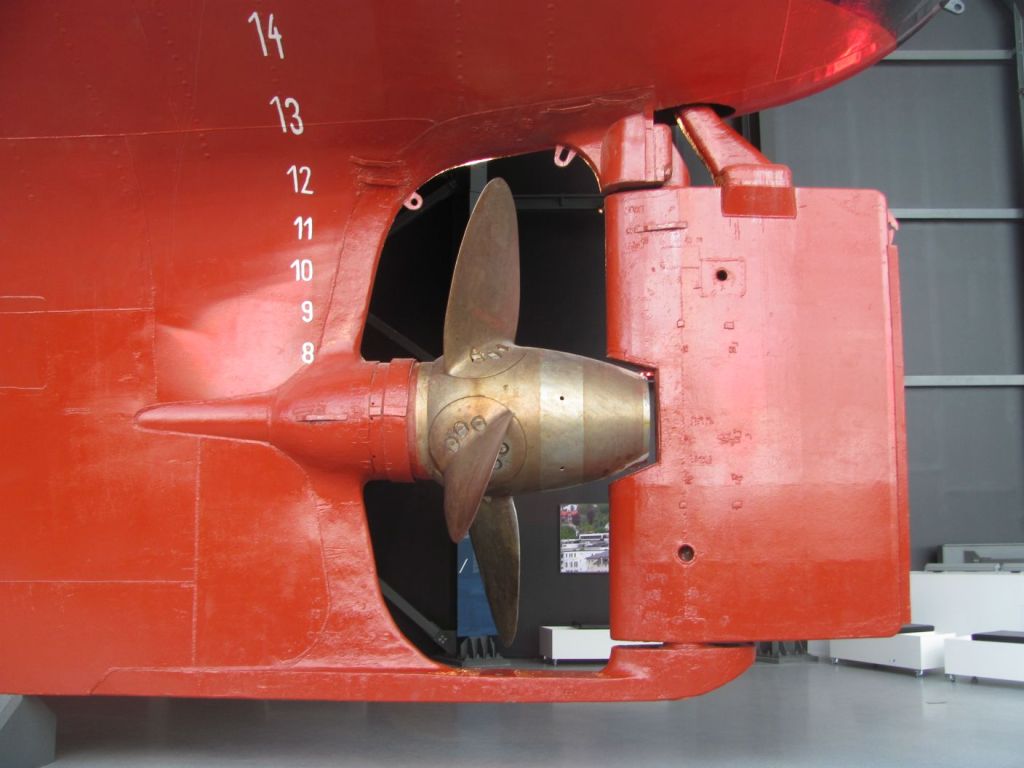
Propeller of the MS Finnmarken.

“Then one of the smaller companies, the Vesterálen Steamship Company, put in a bid which was accepted”, one of the displays tells us. “They had already made detailed sailing instructions of the unknown waters for themselves, and had less fear of sailing at night. And so in 1893 the Hurtigruten, or Express Route, was born. Mail delivery times fell from five months to seven days.”

The Hurtigruten ships helped open up the north of Norway to the rest of the country and the world. As late as the 1940s, most ports north of Trondheim were inaccessible by road. However, as roads were built and air services established, the need for the Hurtigruten declined. To survive, the company turned its emphasis in the 1960s to tourism, offering people a unique experience in comfort.

“I can see why the locals refer to it as ‘the ship in a bottle’”, says her Royal Highness, as we leave.

The MS Finnmarken in its glass ‘bottle’.

The next morning, we set sail for the next large town, Sortland. The winds are in our favour, and we have an exhilarating sail.

“Several people say that it gets a bit rolly in the main marina”, says the First Mate, studying the harbour guide as we approach. “Because of the ferry coming and going. But I’ve found another nice looking marina to the south of the town. It’s quite small, but they do have a guest pontoon. We could try that.”

We inch our way through the narrow entrance. It’s only a couple of metres on each side and 1.5 metres of water under the keel. But it’s enough, and we find a place on the hammerhead on the end of a pontoon to tie up. The harbour master comes over. We invite him on board for a coffee.

“I am a retired police superintendent”, he tells us. “I worked on cases all over this area. Mostly drugs-related. There’s a lot of it here. My name is Leif, by the way. As in Leif Eriksson, the first European to discover America.”

We talk about some of the Scandi-noir crime series that we have seen, and the fondness that Norwegians have for vanishing to their cottages at Easter time with a pile of crime novels to read. I mention that I had read somewhere the reason for it was because Norway is such a peaceful and crime-free country that people like to read about it in fiction.

He laughs. “I don’t really think that Norway is crime-free”, he says, taking another cinnamon roll. ”It’s just as bad as anywhere else. We’re just good at writing about it against the background of long nights and snowbound cottages, and making dark moody films about it.”

“But I am retired now”, he continues, “And I do photography. It’s always been a hobby of mine, but now I have time, I can do it properly. Mostly on the island of Andøya. It’s absolutely gorgeous there.”

“Yes, it is on our list”, I say. “We are planning to visit it after we leave here.”

“Tell you what”, he says suddenly. “I am not doing anything this afternoon. I would be happy to take you around Andøya and show you the best places that most tourists never see. It’s about a hundred kilometres up there and slightly shorter back. What about it?”

We are somewhat taken aback. A perfect stranger whom we had only met half-an-hour ago at the most, offering to take us on a 200 km round trip. And it was already mid-afternoon. Could this be for real?

We accept.

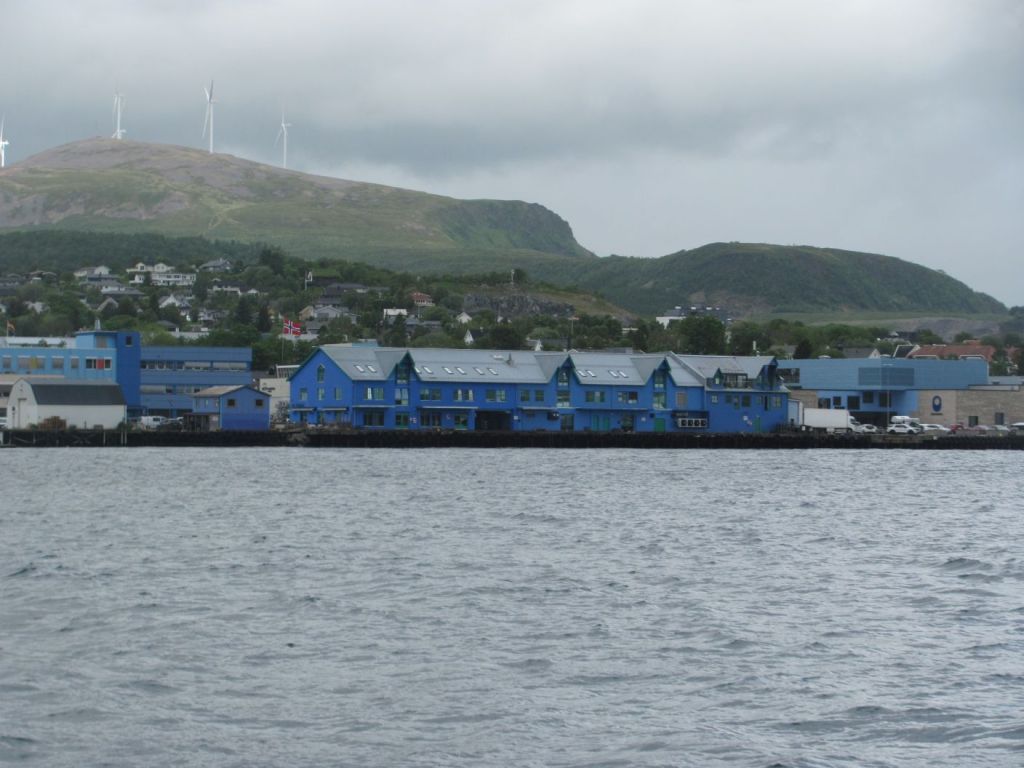
“You’ll notice that a lot of the buildings and houses in Sortland are painted in different shades of blue”, says Leif as we set off. “One of our artists had the idea of painting everything blue to symbolise the sea and sky. Of course, there was a lot of opposition from different townspeople, but somehow he convinced the local council to do it. Slowly local businesses and many residents grew to like it, and now it is quite a tourist attraction.”

The ‘Blue Town’.

I quite like it, I think to myself. It gives it a certain Je ne sais quoi.

“I sort of look on Andøya as my home even though I don’t live here”, Leif says, as we cross the humped bridge over the Risøysundet strait on to the island. “I come up a couple of times a week and know every nook and cranny. The landscape is stunning, and the light is different every time I come, so there is always something new to see. We’ll take the western road up as it is so much more wild, and come back down the eastern road.”

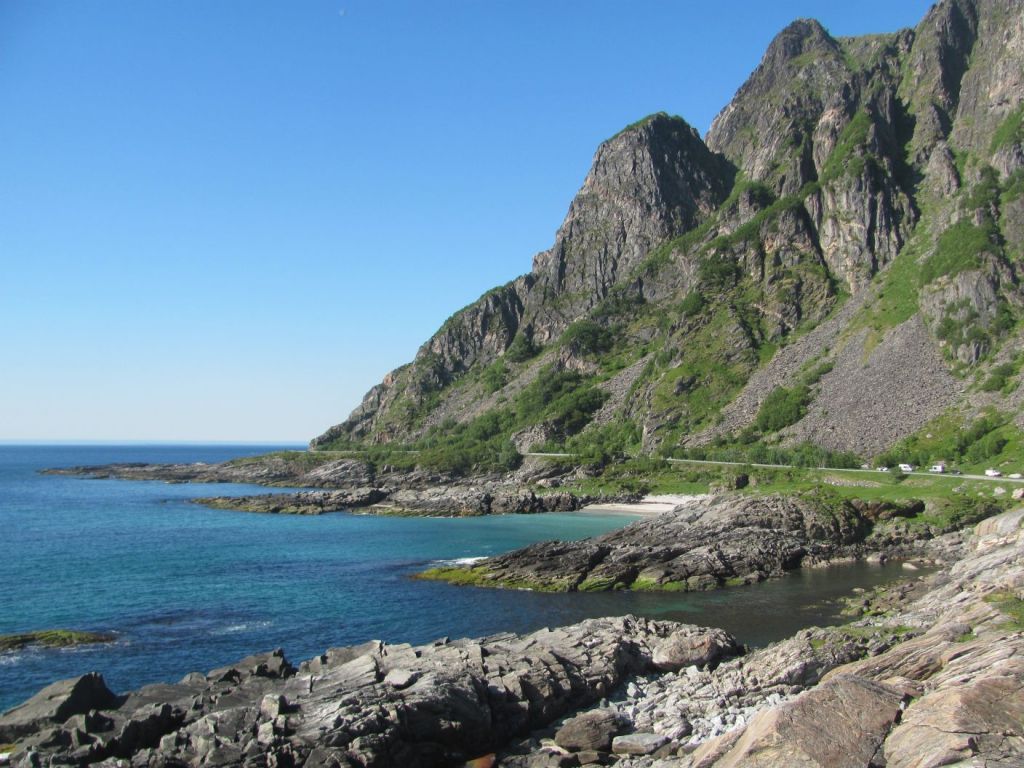
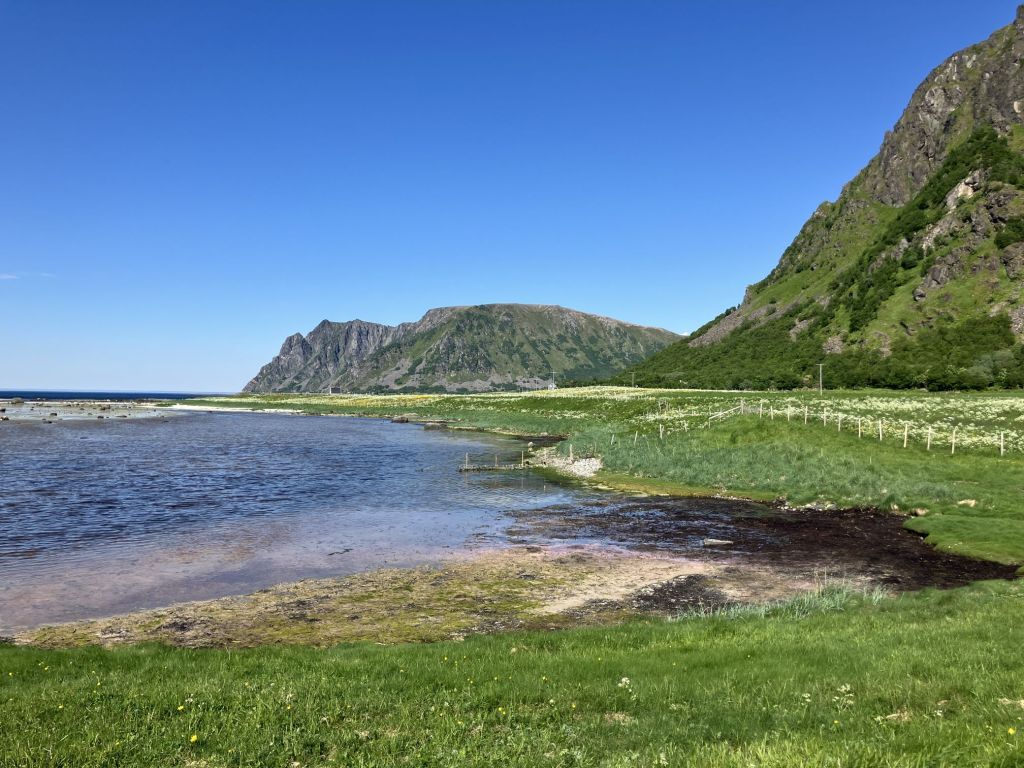
He’s right. The western road is wedged between the sparkling sea on the left, and high jagged mountains to the right that run the length of the island. We drive past stony beaches, their stones worn smooth by millennia of wave action, and past bogs and estuaries, the sulphurous smell of decaying seaweed assailing our nostrils. Far off to the west, we see the hazy outline of the island of Langøya, a white cloud hovering over it like a plume of smoke. It’s primeval.

‘Twixt mountain and sea.

Leif stops the car. “This is one of my favourite stops”, he says. “I’ve taken a lot of my photos around here. Shall we walk down to the beach?”

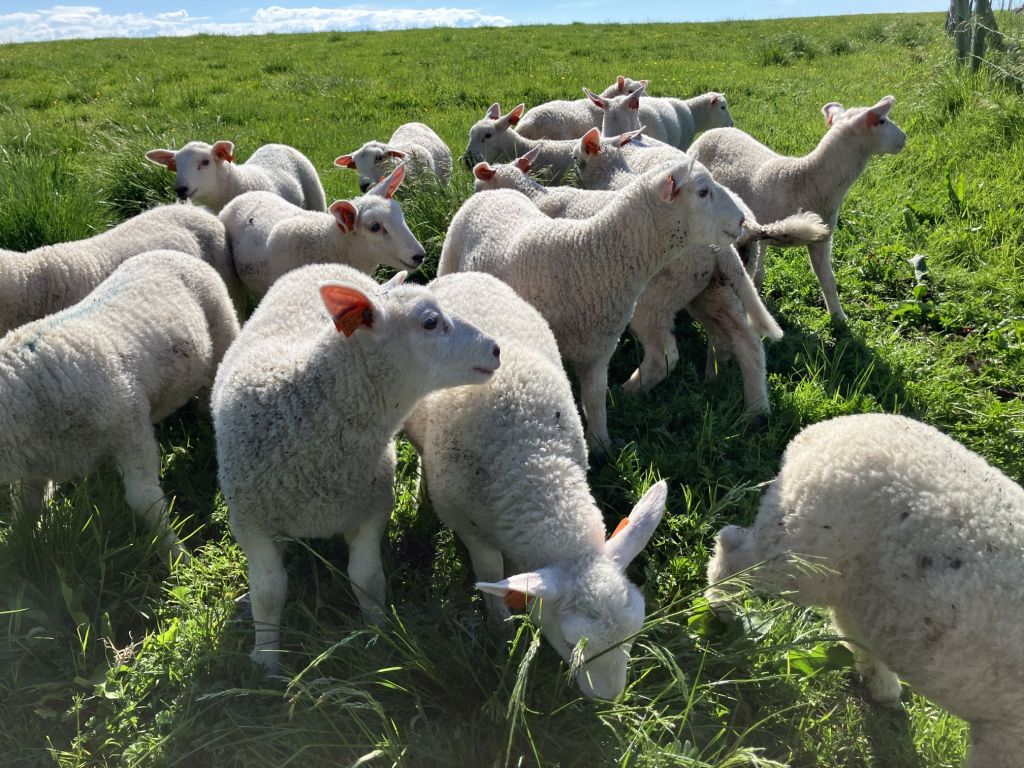
We follow a fence-line and cross a small stream. Immediately we are besieged by a flock of lambs, clamouring for attention, totally unafraid of us. We pet them, then try and move on. They follow us. Clearly they are familiar with humans, and we surmise that they have been weaned and missing their mothers, or orphans reared by hand-feeding from a bottle. Eventually they give up, and run back to where we first met them.

“Are you my Mum?”

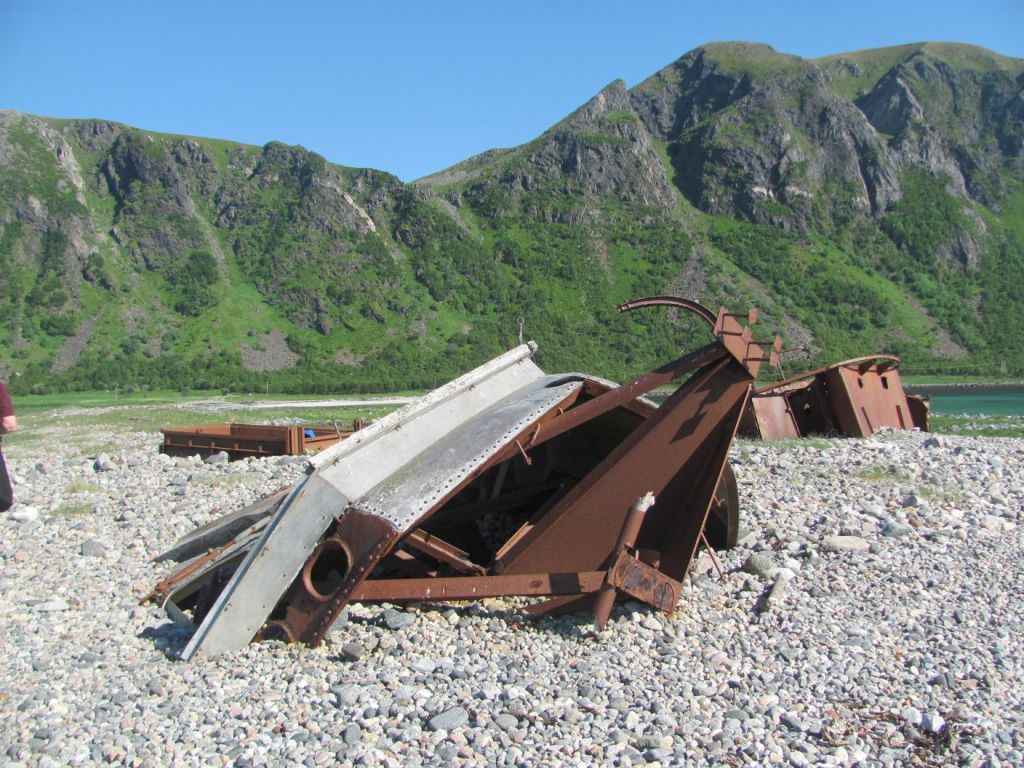
We reach a stony spit jutting out into the sea. On the stones lies the rusting wreckage of a fishing trawler, its parts strewn over the spit.

“There was a fierce storm here several years back”, Leif tells us. “This trawler was driven aground and broke up. Luckily no one was drowned. But the boat was destroyed.”

Victim of nature’s fury.

On the way back to the car, we pass a small backwater cut off by the low tide, and stop to watch oyster-catchers shrieking their high-pitched calls, and guillemots feeding in the shallows. A flock of barnacle geese flies overhead.

“Isn’t it beautiful?”, sighs Leif.

Island idyll.

I wonder about this unusual man who has befriended two strangers. He’s not what I imagined a police superintendent to be like. Part of me envies him for having found a part of the world that is so obviously home to him, and who sees beauty in it wherever he looks. And captures it through his photography for others to enjoy. What makes him tick? His job must have made him see the seedier side of life, perhaps he needs something now to balance that.

“I was married”, he tells us back in the car. “But am now divorced. I have a daughter who lives in Oslo. She loves coming back to Andøya to visit. But she wouldn’t live here. She likes the activity of the big city too much. That’s the problem up here – all the young people leave because the opportunities are so much better in the cities. Now, there’s something I want to show you here.”

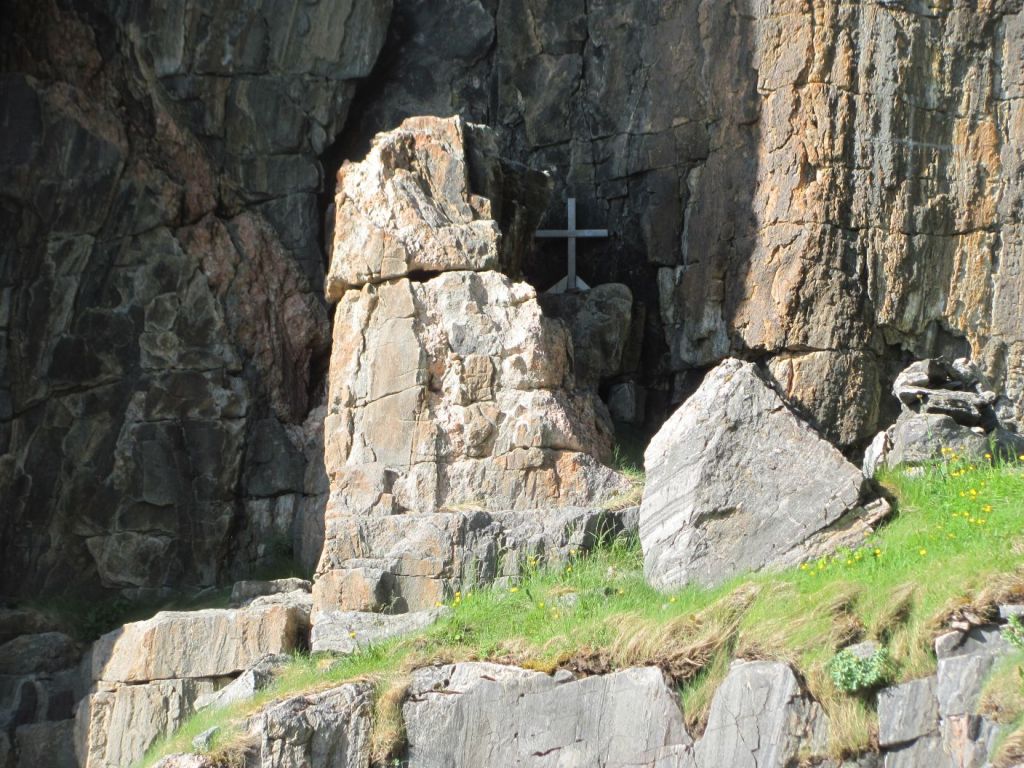
He pulls up to the side of the road. We walk down a short path to an outcrop of rock.

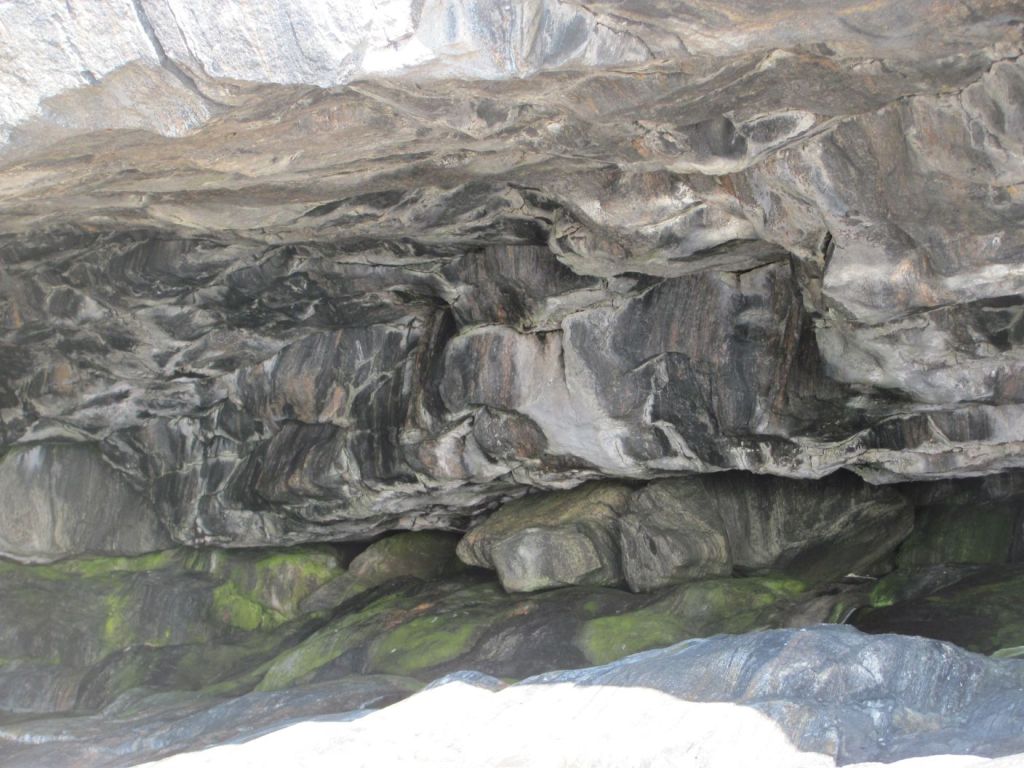
Natural pulpit.

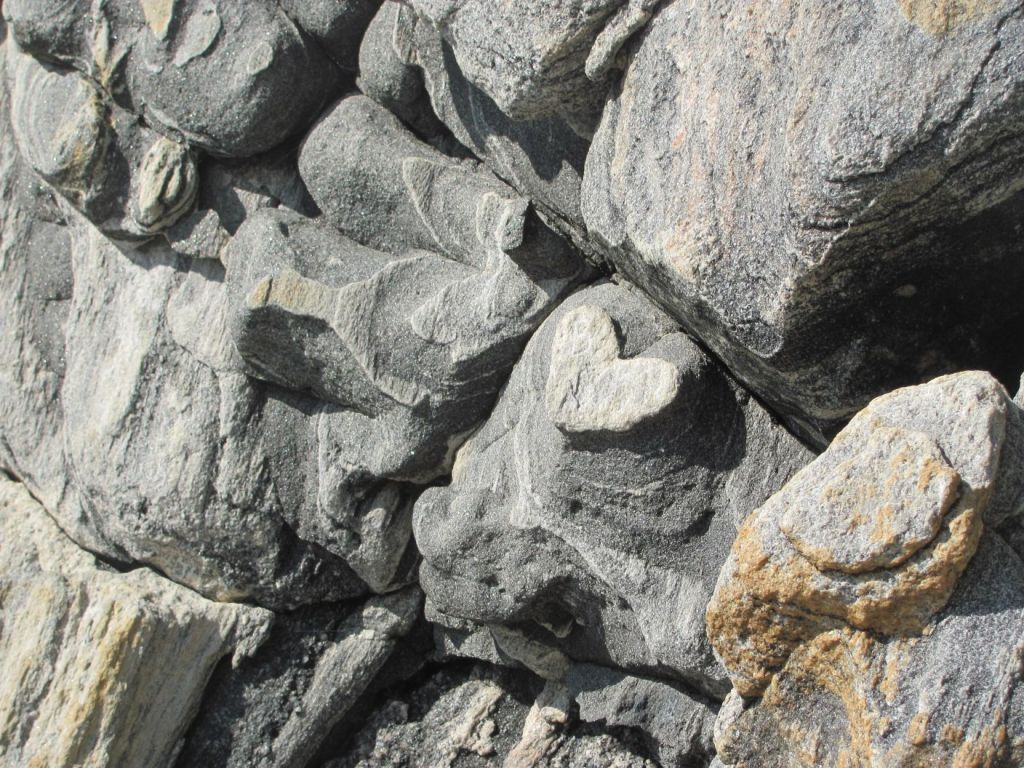
“It’s a small chapel”, he explains, pointing to a crucifix mounted on a ledge on the rock. “With a natural pulpit and altar. Bukkekjerka. It means Goat Chapel in Norwegian. It was originally a sacred site for the Sámi people who practised religious rituals here. They called it Bohkegeargi. More recently it has been used for Christian services. People even get married here. Look, there’s a shape of a heart in one of these rocks.”

For the newly-weds?

I sit on a rock and think of the ancient Sámi worshipping their gods in this sacred place –  Veralden-radien, the Ruler of the Universe and Sustainer of Life, Afruvvá, the Sea Goddess, Warner of impending storms, or Beaivi, the Sun God who brought warmth, light and new life. What has happened to all those gods now that the Sámi were converted to Christianity in the 1200s?

“Many Sámi kept their own gods even after they converted the Christianity”, says Leif. “Their thinking was that the Christian God only provided for them in the afterlife, whereas their gods looked after them while they were still living.”

It’s an interesting point of view, and somehow logical.

Sámi sacred site.

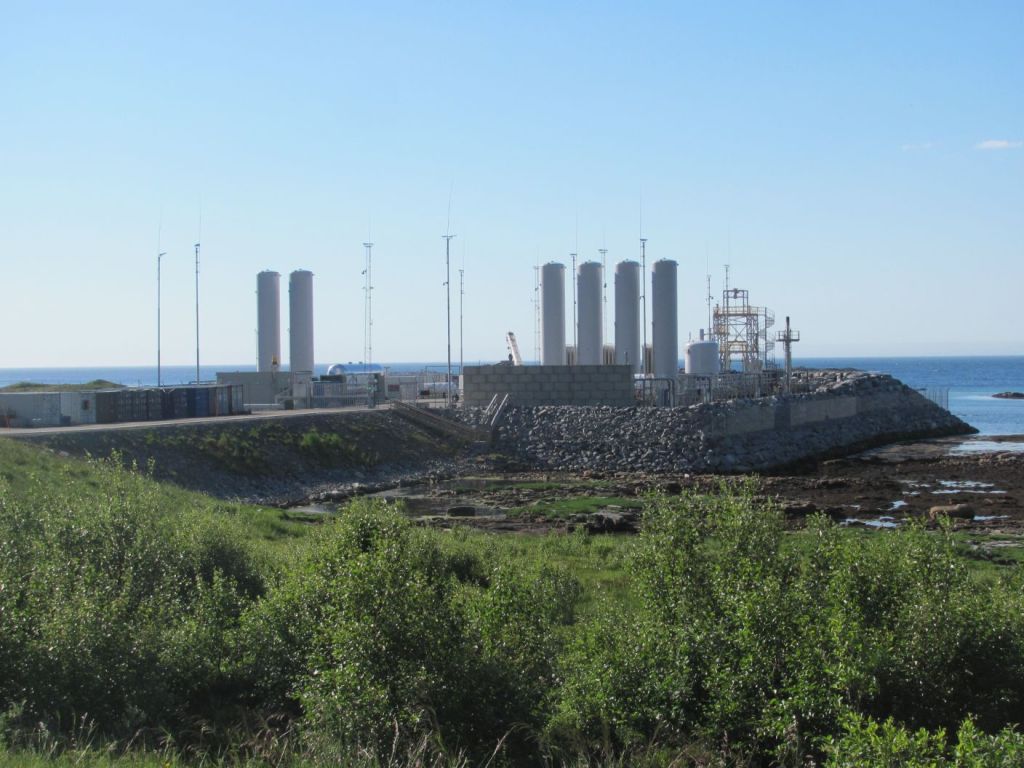
Further on, we pass the Andøya Space Centre.

“The first rocket was launched from here in 1962”, Leif tells us. “Not long after the Russian Sputniks. It is only used for launching small earth observation satellites for peaceful purposes. Nevertheless, back in 1995 one of the launches nearly caused a nuclear war as the Russians thought it was a nuclear missile launched from an American submarine. They went on to high alert, but then they realised it wasn’t heading towards Russia. Apparently they had been told that it was happening, but the message got lost in their bureaucracy.”

Andøya Space Centre.

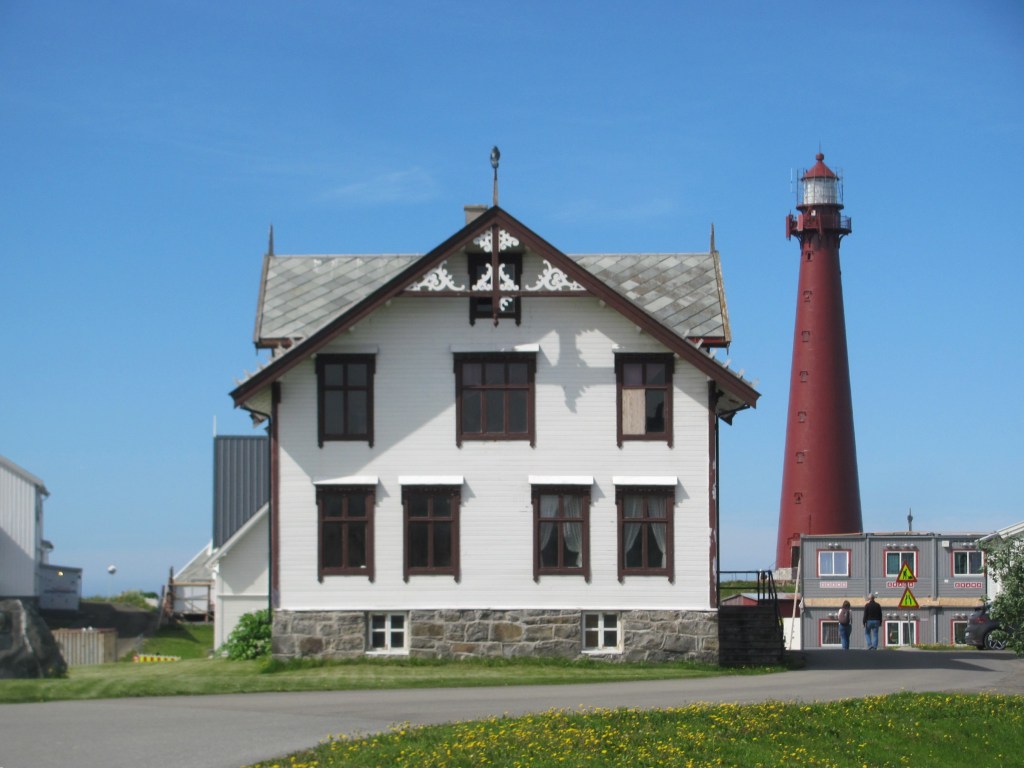
We eventually reach Andenes, a sprawling town of mostly military style housing. On the point is the iconic lighthouse visible for miles around.

Andenes lighthouse.

“I’m starting to get hungry”, says the First Mate. “Look, here is a pizzeria. Let’s get something to eat there.”

We order and sit down.

“Did you hear the story of the Chinese spy?”, Leif asks, as we chomp into our pizza slices.

“No”, we say. “What was that all about?”

“Well, just a month ago, they arrested a Chinese woman and charged her with trying to establish a satellite data receiving station near the Spaceport and military facilities”, he answers. “Apparently 22 tons of electronic equipment capable of downloading data from polar-orbiting satellites was imported and installed by a Norwegian front company. According to the papers, the woman bought a property nearby where the equipment was installed. She’s in prison at the moment, awaiting trial. It seems as though some Norwegians are also under suspicion.”

“It doesn’t sound very professional”, I say, spearing the last mushroom with my fork. “Importing 22 tons of electronic gear near to a military area and rocket launch site was bound to raise suspicions, surely?”

“Yes, you would think so, wouldn’t you?”, Leif says, “but that’s how it was reported. We are just waiting now to see what comes out of the trial.”

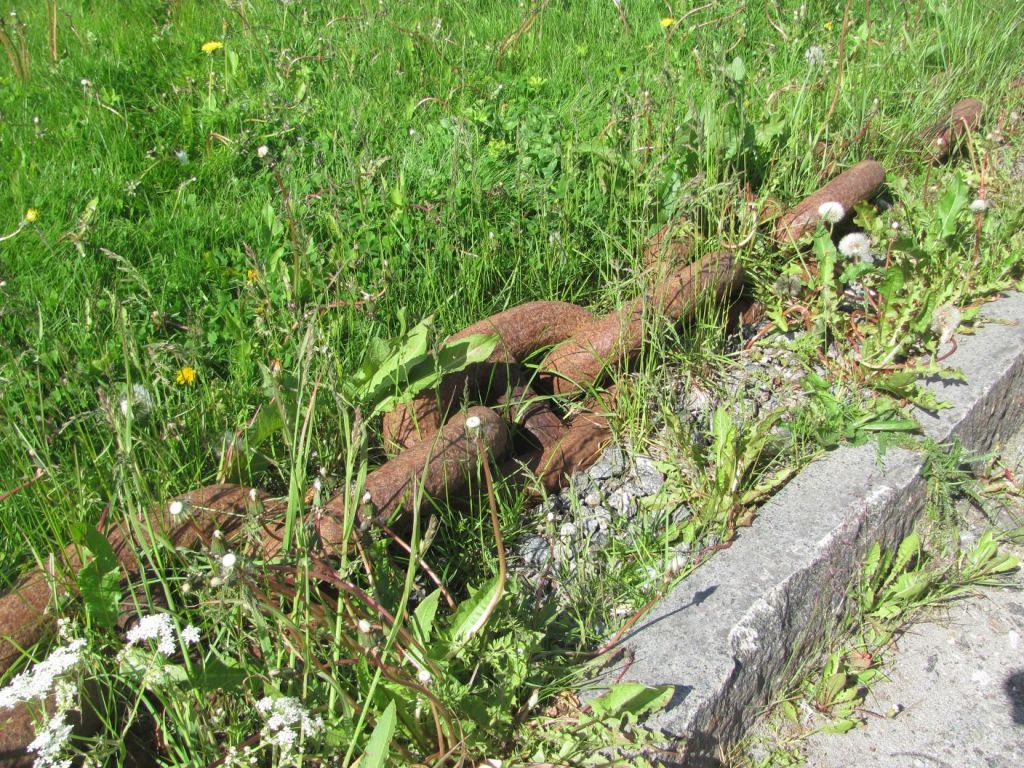
As we return to the car, we pass a rusty old anchor chain lying in the grass.

“That’s part of the anchor chain from the Tirpitz”, says Leif. “You know, the German battleship that was eventually sunk in 1944 near Tromsø. I have got one of the links at home.”

Part of the anchor chain from the WW2 German battleship Tirpitz.

“What a kind man”, says the First Mate when we are back at the boat that evening. “It was amazing how he wanted to show us his world. And seeing it from land with a local gives a very different perspective than from the sea.”

In the morning, we decide to stick to our plan of sailing to Andenes even though we had just been there the day before.

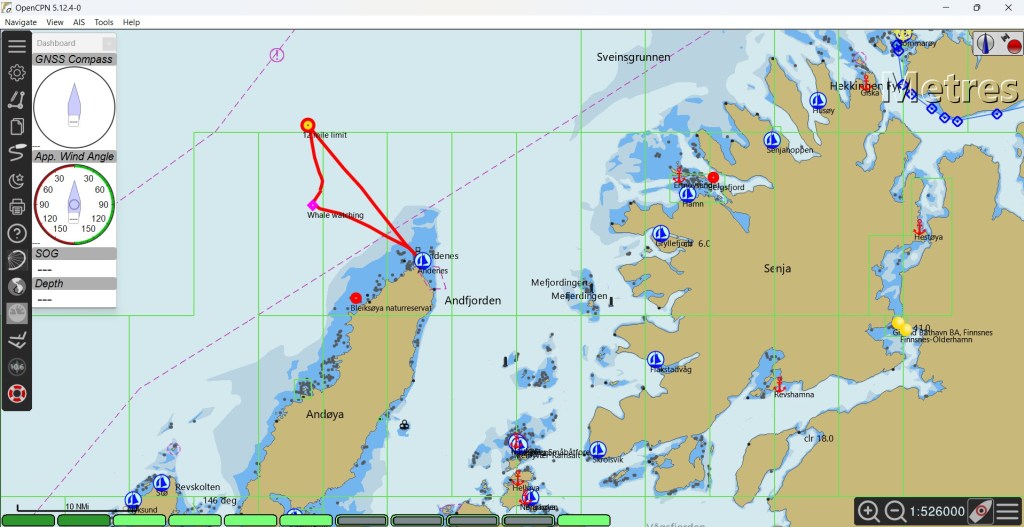
“It’s the easiest opportunity we’ll get to sail outside the 12 nautical mile limit”, I say. “That way we can reset the clock on the time we are allowed to keep Ruby Tuesday in Norway without paying duty. Don’t you remember that the police in Bergen told us we can do that?”

Two years in the maximum time we can import the boat on a temporary permit. However, sailing outside the limit, then back in again, counts as an export/import event thereby resetting the clock, giving ourselves another two years if we need it. We have to provide documentary proof that we have been outside the limit, so we photograph the GPS position, the chart-plotters, and the computer and tablet tracks.

Our ‘Customs Route’.

“Phew, I am glad that’s over”, says the First Mate, a slightly greenish tinge in her face caused by the swell. “Let’s go and see if we can see any whales.”

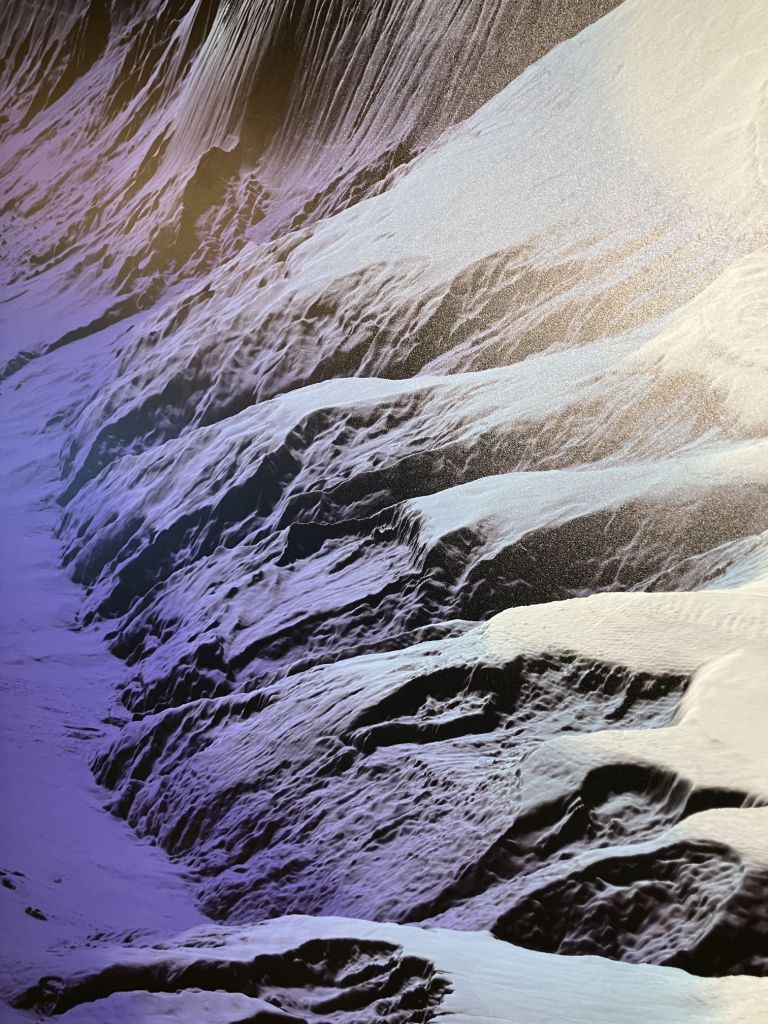
To the west of Andenes is the Bleikdjupet, a vast underwater canyon that plunges to more than 1000 m in depth. As the currents come in from the Atlantic, the sudden change in depth causes an upwelling of plankton, the favourite food of whales. All sorts of types gather here to feed.

Model of the Bleikdjupet, the vast underwater canyon west of Andenes.

We sail to the supposed hotspot and circle slowly for nearly two hours. Unfortunately, someone has forgotten to send the memo to the whales that we are there, and all we see is one minke whale. No sperm whales, orca, dolphins, or porpoises today.

“Well, at least a minke whale is not to be sniffed at”, I say. “It was exciting when we saw those in Scotland.”

A rock concert, a town of roses, and a new song

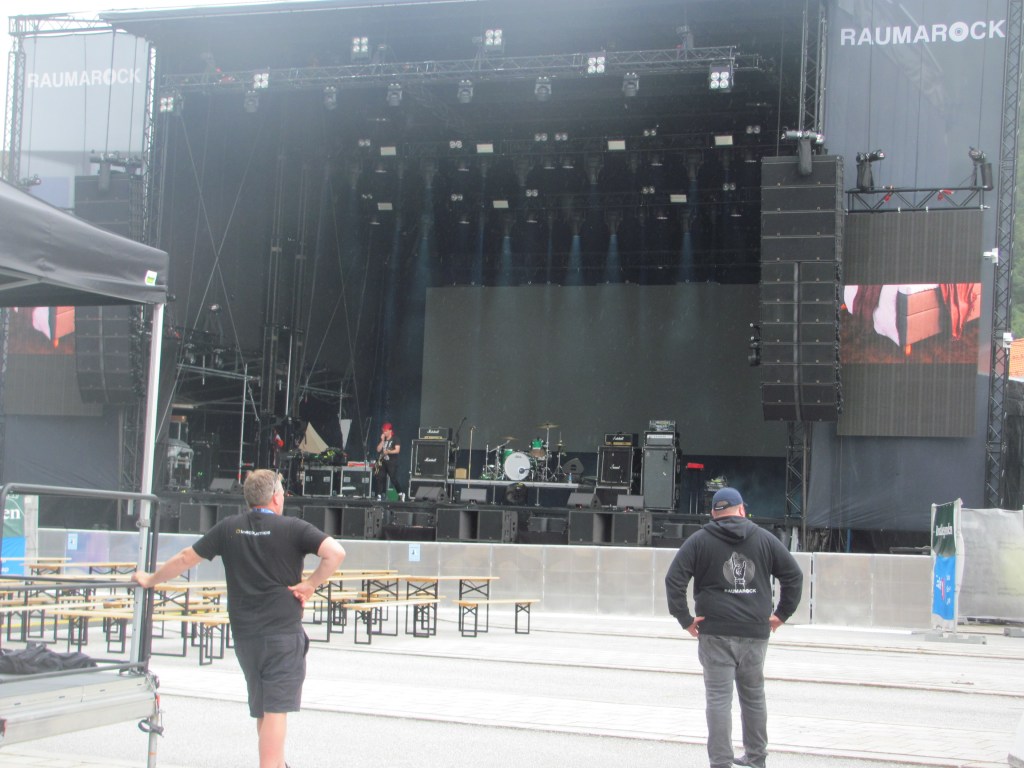
“There’s a rock concert on for the next three days”, says the captain of the boat tied up in front of us. “Rauma Rock. It’ll be really loud. We were here last night, and we could hardly hear ourselves think until about four in the morning. But the music was good. There will be even more boats coming tonight. It will be packed.”

Andalsnes harbour.

We are in the tiny harbour of Andalsnes near the top of Romsdalfjord. There had been no berths free when we had arrived, and we had rafted up to another small yacht while we decided what to do. It was then that we had noticed that a large stage had been constructed on the quayside, with the twanging of guitar strings warming up emanating from it.

Rauma Rock warming up.

“I don’t really want to be kept awake all night”, says the First Mate. “I am at that age where I need my sleep. But it would be somehow nice to hear some of the music.”

“Me too”, I say. “My hearing is bad enough as it is with old age, without finishing it off completely. Why don’t we go and anchor a little bit further up, where can still hear the music, but it isn’t quite so loud? And we wouldn’t have to pay either!”

The last sentence is the clincher.

“Good idea!”, she says. “But let’s have a quick look at the town first to see what it is like.”

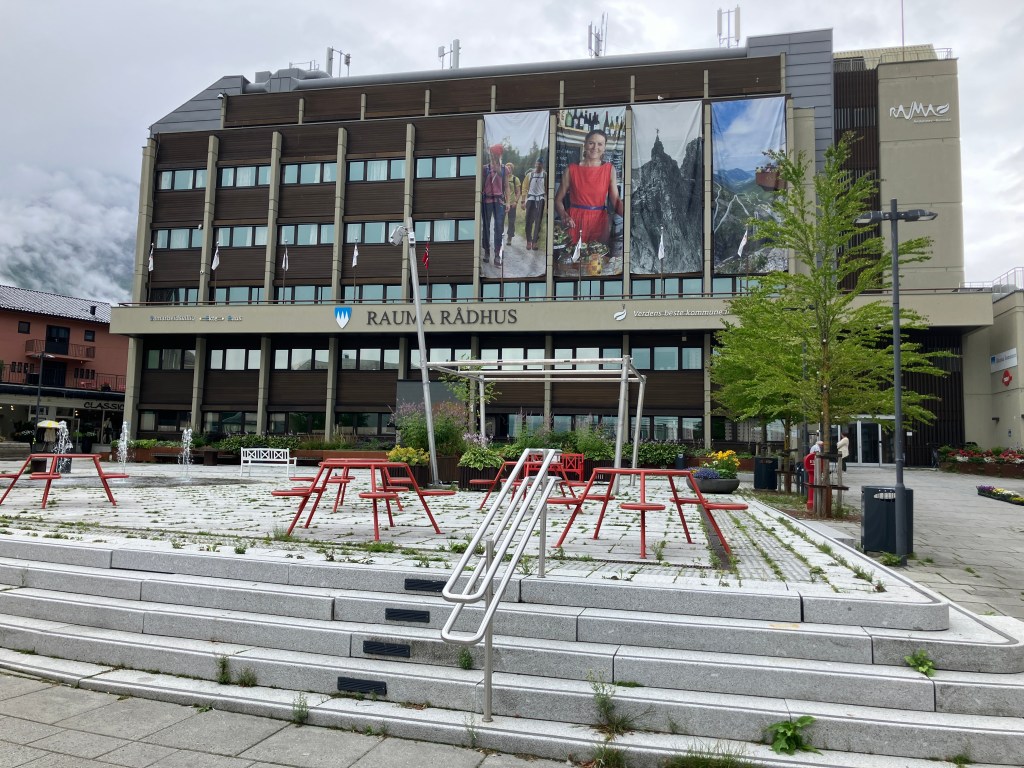
The First Mate explores the town centre, while I take a walk down to the Rauma river running through it.

Town Hall, Andalsnes.
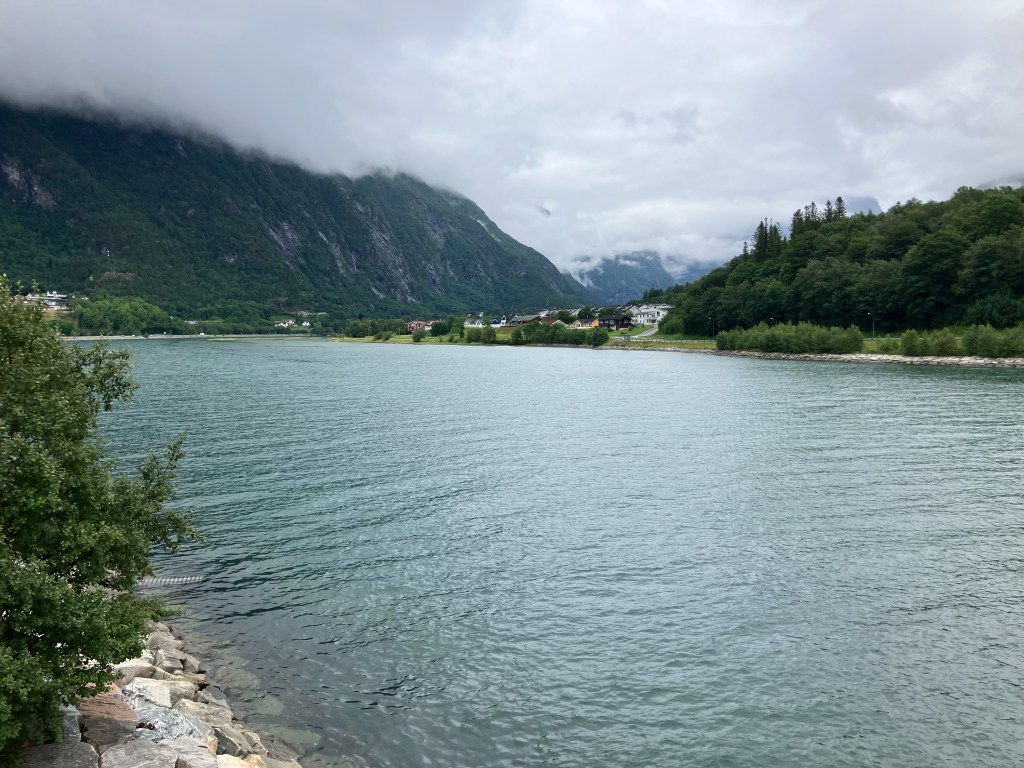
Rauma River in Andalsnes.

“Well, the town was pretty average”, she says, when we meet again. “I didn’t find it very inspiring.”

Later we motor a little further along the shoreline of the fjord and drop the anchor.

“Perfect!”, says the First Mate as we sit on deck with our glasses of wine watching the gondolas taking their passengers to the top of Mount Nesaksla, and listening to Rauma Rock getting underway. “That’s much more enjoyable.”

Listening to Rauma Rock from a distance.

“Andalsnes was one of the places that my great-great-grandfather visited”, I say. “Or at least Veblungsnes, which was the main settlement in those days. Since then, Andalsnes grew to be a town, while Veblungsnes remained a village. The Rauma river divides the two. In his letters he talks about the striking wonders of the Rauma river, but he says that he doesn’t have time to describe them.”

“The guide book says that the Rauma is famous for its salmon fishing, the emerald-turquoise colour of its water, its towering mountains, deep gorges, and sheer cliffs, and its waterfalls at Vermafossen and Slettafossen”, says the First Mate. “It was the inspiration for scores of Romantic artists, writers and explorers.”

“It would be nice to go and see it”, I say. “But we’ll never get in to the harbour now with all the boats that have been arriving.”

“We’ll have to come back another time”, says the First Mate.

In the morning we set off back along the Romsdalfjord. I keep a sharp eye out for sea-eagles.

Scanning the cliffs for sea-eagles.

Far above, wheeling on the updraft from the cliffs, Eira looks down on the waters of the Romsdalfjorden. She doesn’t come here often these days, instead spending most of her time with the other sea-eagles on the islands and skerries at the mouth of the fjord where the fish are plentiful. But from time to time she likes to revisit her birthplace and recall the stories that her father Clew and her mother Aran used to tell of Cuillin, the last of the great sea-eagles of Skye, who had flown alone from there to Romsdal to save her kind. And of her daughter Mourne who had returned to Skye with her motley collection of vagrants to repopulate those islands.

Out of the corner of her eye, she sees a boat heading for the tip of Okseneset and the shapes of two humans. They won’t be able to see her, she is too high and against the sun. She does not fear them in the same way that her parents had done – the Doom that she had heard in the old stories had passed now and there seemed to be a new understanding between her kind and the humans.

And yet, from time to time there was a niggling feeling in the back of her mind that the Doom had not gone completely. To be sure, few of the Romsdal eagles died these days by being shot or poisoned, but she had heard that there were increasing numbers flying into the high towers with rotating blades that had appeared in Møre og Romsdal. And then there was the rumour that was going around the Pairs that the eggs being laid were hatching earlier in the year, there seemed to be more rain than she remembered in her younger days, and the weather appeared to fluctuate more between extremes. But surely humans couldn’t be blamed for that, could they? Clever as they seemed to be, they were just too small and insignificant to be able to change the forces of Mother Nature herself, the might of the winds and rain sweeping in from the Atlantic, the strength of the sun’s light bringing warmth and life to the earth. Surely only Haførn, the mother of them all, had the power to do that …?

As she circles, she sees another sea-eagle gliding over the island of Sekken. She recognises from his flight that it is Arvid, her mate. She dips her great wings and flies to meet him, the humans in their small boat disappearing from her view.

Sea-eagle.

“Are you day-dreaming again?”, the dulcet tones of the First Mate interrupt my reverie.

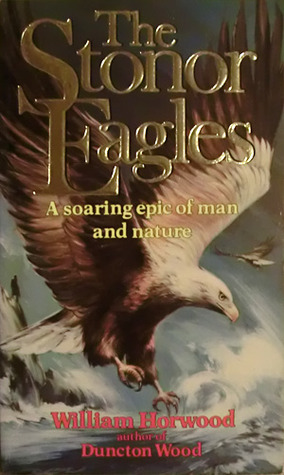
“I was hoping to see a sea-eagle”, I say. “I was just thinking of the book I re-read over the winter – The Stonor Eagles by William Horwood. It’s about how sea-eagles went extinct in Scotland in the 1930s through the farmers shooting them to stop their sheep from being attacked, and how they were reintroduced in the 1970s from Norway. Romsdal was one of the areas that they brought them from. I read somewhere that you do see them here.”

“I imagine that there would be more down towards the ocean”, says the First Mate. “That’s where the fish are, after all.”

We arrive at the town of Molde on the northern shores of Moldefjord, and head for the small municipal marina. It’s sweltering. A woman in a tank top and shorts helps us tie up.

“That’s my boat just in front of you”, she tells us. “I live on it throughout the summer and then go back to my apartment for the winter. It’s kind of like a summer cottage, but on the water. I don’t sail far – there are enough beautiful places to visit around here.”

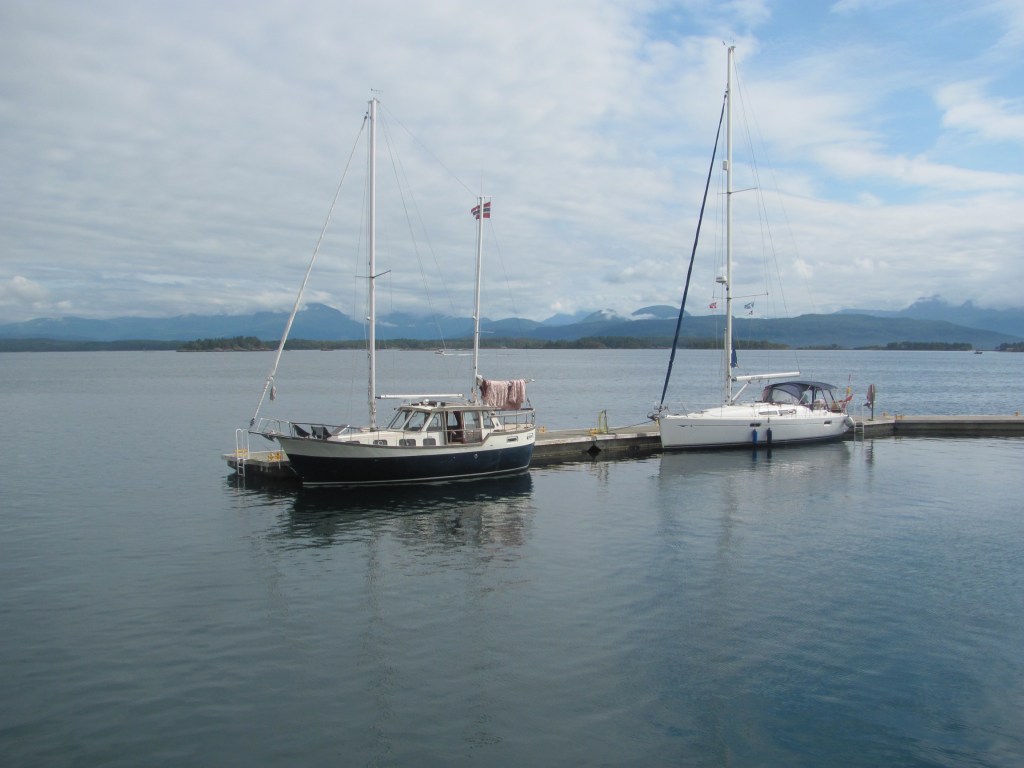
Tied up in Molde town marina.

After a cup of tea, we decide to explore the town centre.

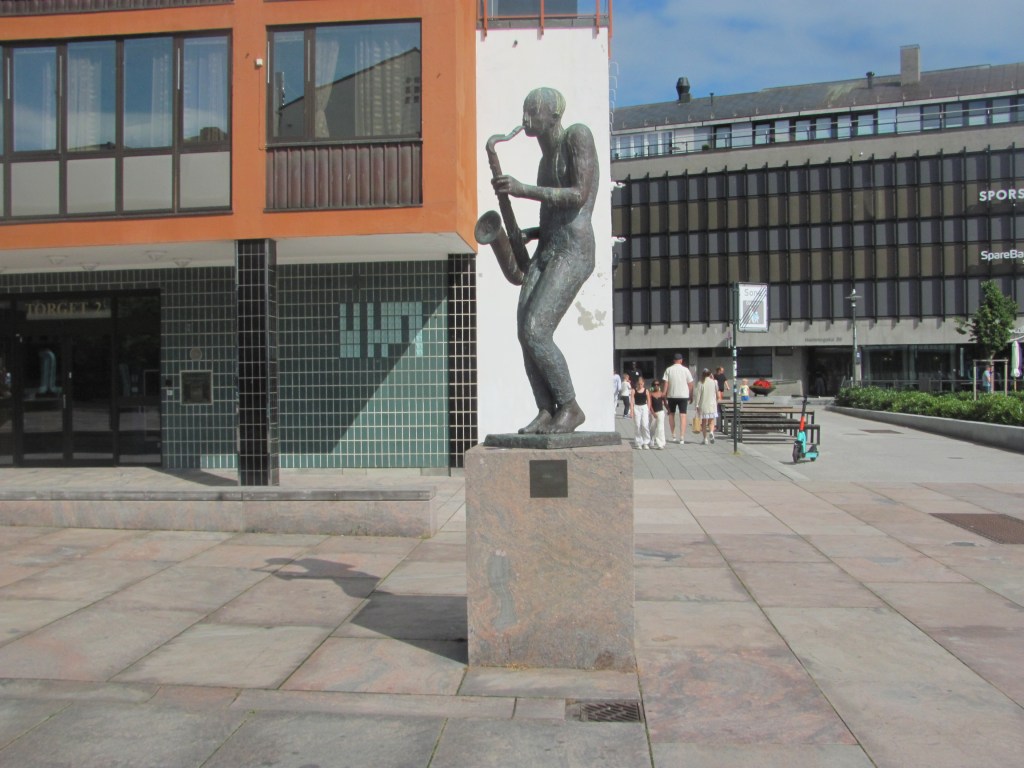
“It’s a pity we weren’t here a couple of weeks ago”, says the First Mate. “We could have gone to the Jazz Festival. They have one every year.”

Molde is well-known for its Jazz Festival.

“Look, here’s the Salmon Centre”, I say, pointing to a building in the town square. “We should go and have a look at it.”

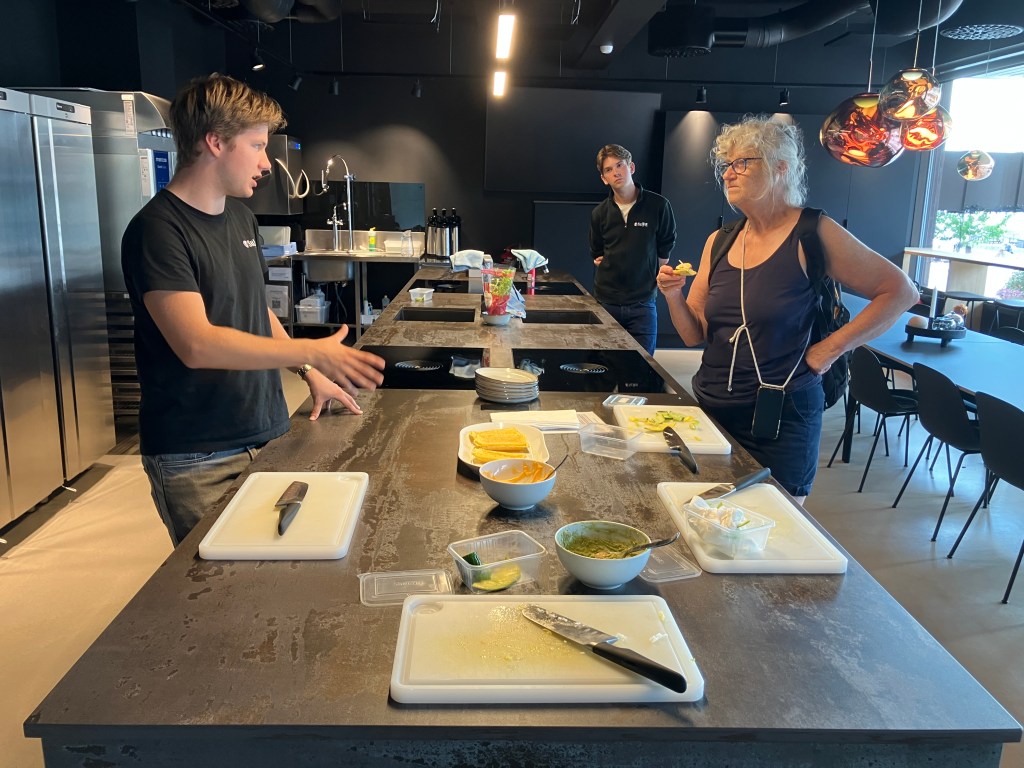
“It’s free entry”, says the girl at the reception. “And that includes a free sample of raw salmon, which you can use to make your own snack with taco shells and various dips.”

For the next little while we are absorbed in creating our own culinary delights, learning about the life cycle of the salmon from ‘roe to plate’, how the cages are made and installed, and how it is becoming more sustainable, including ways to prevent farmed salmon escaping to mate with wild salmon and weakening their gene pool.

Learning how to create our own salmon delicacy.

“That was fascinating”, I say, as we emerge. “I now know more about salmon than I ever thought I would.”

“Yes, it was”, says the First Mate. “Come on, let’s have a coffee and cake. Look, there’s a nice looking place over there. We can sit outside. You grab a table, and I’ll go and choose the cake and order.”

“Earl Grey tea for me, please”, I say.

“A nice little watering place.”

“Well, this is a nice little watering place”, says the minister to his companion as they sit down. “I enjoyed the walk around the town this morning. Such lovely weather. And what a nice smell from all the flowers they grow.”

“Molde is famous for that”, responds Mr Fairlie. “Especially the roses. Their fragrance is everywhere.”

Molde roses.

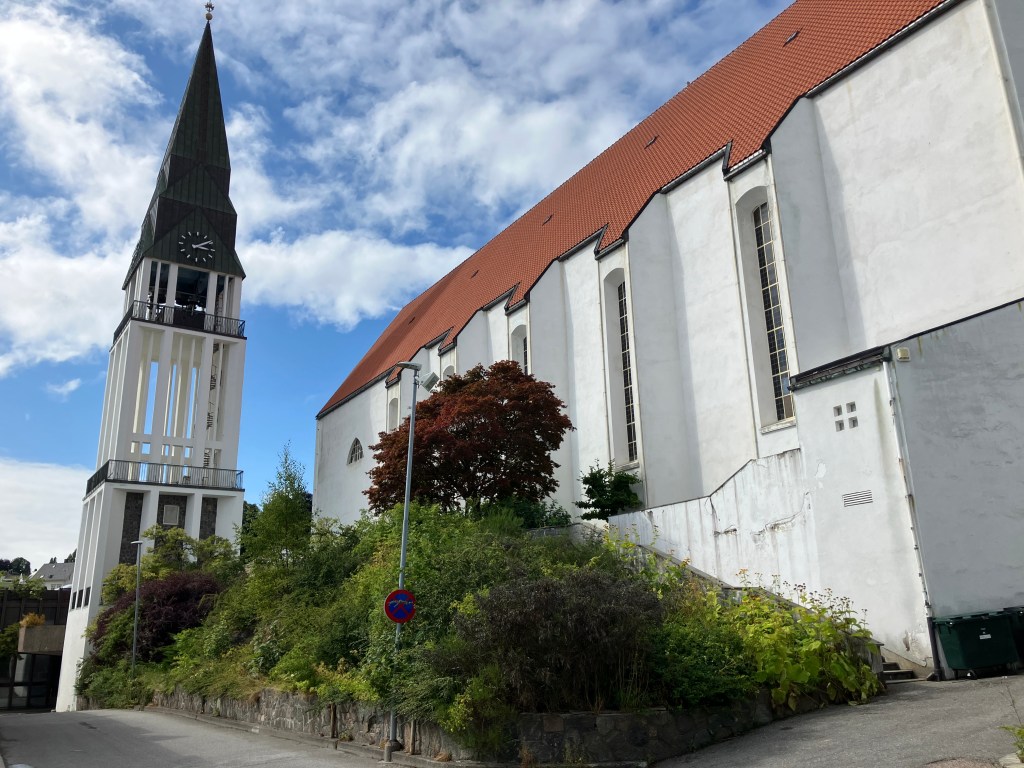
“I had a look at the new church”, says the minister. “Apparently the old one burnt down four years ago, and they just finished building a new one last year. I must confess that I like the look of the old wooden one I saw in pictures better than the new one. All red-brick now.”

“I suppose it will be more fire-proof, at least”, says Mr Fairlie. “That’s always the problem with wooden buildings in this part of the world. It’s only a matter of time before they get burnt down.”

Molde’s present day Domkirke (successor to the redbrick one!).

“And I have to say that I was impressed at the beautiful resting place of the departed here”, continues the minister. “With its small mounds of earth crowned with the loveliest flowers. The graves are tended with the fondest care and mothers come and sit by their loved ones’ dust for hours, with a book in hand or plying the needle, engaged on some piece of useful or fancy-work.”

Molde cemetery.

“Here we are”, says the First Mate, bringing a tray with the coffee, tea and a cheesecake. “What a nice spot. We can sit and watch the boats coming and going. But why are you putting in pictures of the cemetery? That’s a bit macabre.”

“My great-great-grandfather went to see it”, I say. “I thought I should too. He seemed to like that sort of thing.”

“You seem to be enjoying this cruise, at least?”, says Mr Fairlie.

“Immensely, but I have to admit I never feel relaxed on a boat”, says the minister. “Ever since I lost my younger brother Andrew at sea.”

“I didn’t know you had a younger brother”, says Mr Fairlie. “What happened?”

“He was on his way out to New Zealand”, replies the minister. “Another brother of ours, James, was already out there farming near Dunedin, and Andrew was intending to join him. He was a minister like myself, and had been in Canada but had fallen out with some of his superiors there. I don’t know what about. He always liked his drink and was a bit of a hothead, so maybe it was something to do with that.”

“So he was looking for a fresh start in New Zealand?”, asks Mr Fairlie.

“Yes, that sort of thing”, says the minister. “He was on board a ship called the Burmah sailing from London to Lyttelton. It seems it might have been overloaded, as in addition to the passengers, it was carrying a consignment of high-class horses and cattle. But it never arrived in Lyttelton. Another ship fourteen days out from New Zealand reported passing it in the Southern Ocean, and also that they had seen icebergs in the area at the time. So we are guessing that the Burmah must have hit an iceberg and sank.”

“What a story”, says Mr Fairlie. “Your poor brother. To have all his hopes dashed when he was so close to realising them. It’s a salutary reminder of the perils of sea travel.”

“Yes”, continues his companion. “But the story doesn’t end there. One or two years later some ship’s timbers were washed up on a beach to the south of Dunedin with the letter ‘B’ written on one of them. The supposition at the time was that it was from the Burmah.”

“And it’s sad to think of your brother James already in New Zealand waiting patiently for Andrew to arrive”, says Mr Fairlie. “Looking forward to seeing a member of his family again, then the slow realisation each passing day that his brother may not be coming. But never really knowing for sure.”

“No closure”, says the First Mate, as she takes the last of the cheesecake. “As we might say today. It’s a poignant story. But I can understand how your great-great-grandfather felt about the sea. I never feel at ease with it myself.”

“Who does?”, I think to myself.

In the evening, we sit on deck and eat our dinner. Suddenly three men from one of the neighbouring boats come over.

The music makers?

“We’ve been composing songs to amuse ourselves”, one says. “We’ve made one about your boat. We wondered if you might like to hear it?”

He presses the Play button on his portable stereo. A Scottish folk song plays.

Ruby Tuesday

She was born on the Clyde where the river runs wide,
Painted red like the fire of the morning tide.
With her sails full of dreams and her heart on the sea,
Ruby Tuesday’s the name, and she’s calling to me.

From whisky shores and bagpipes’ cry,
She’s chasing sunsets, kissing the sky.

Oh
Ruby Tuesday, rolling with the waves,
From Scotland to Molde, where the fjord light plays.
We’ll sing and we’ll dance as the moon shines through,
On a deck full of laughter and a sky so blue.

The gulls sing along, and the wind hums a tune,
As we sail through the night by the light of the moon.
There’s a fiddle on board, and the stories run wild,
Of whiskey and freedom and the heart of a child.

She’s got no fear of the stormy skies,
‘Cause
Ruby’s a queen with fire in her eyes.

Oh
Ruby Tuesday, rolling with the waves,
From Scotland to Molde, where the fjord light plays.
We’ll sing and we’ll dance as the moon shines through,
On a deck full of laughter and a sky so blue.

Raise your glass to the Northern light,
We’re sailing strong through the soft midnight.
Every mile that we leave behind,
Brings us closer to peace of mind.

Oh
Ruby Tuesday, you’re my guiding star,
From Scotland to Molde, no journey’s too far.
With the wind in your sails and the sky so true,
Every song that I sing, I’ll be singing for you.

It’s brilliant. Not completely factually accurate, but who cares about details? We’re touched.