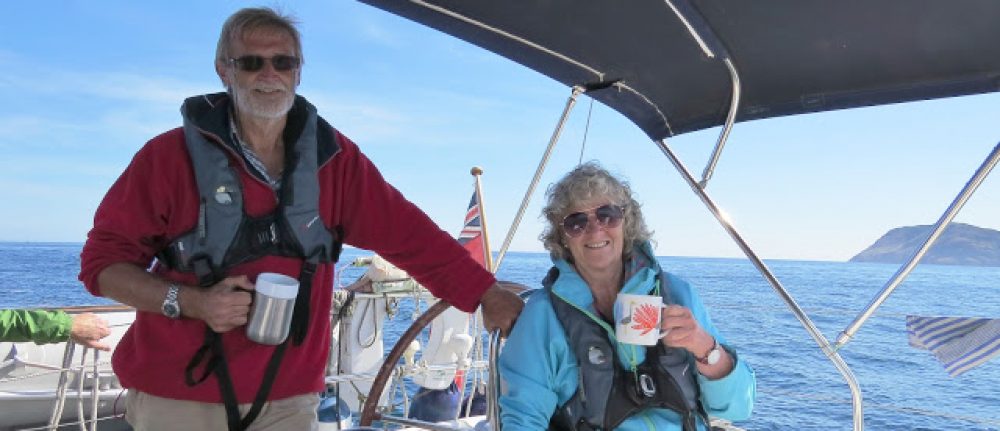
“Wow! This one is well-hidden”, exclaims the First Mate as we round a small promontory, and see the small harbour in front of us. “We would never have found it without the harbour guide.”
We have just arrived at the small island of Gårdsøya on the outer edge of the Bjarkøy archipelago. We had sailed from Andenes that morning, and had decided to stay here for a couple of days.
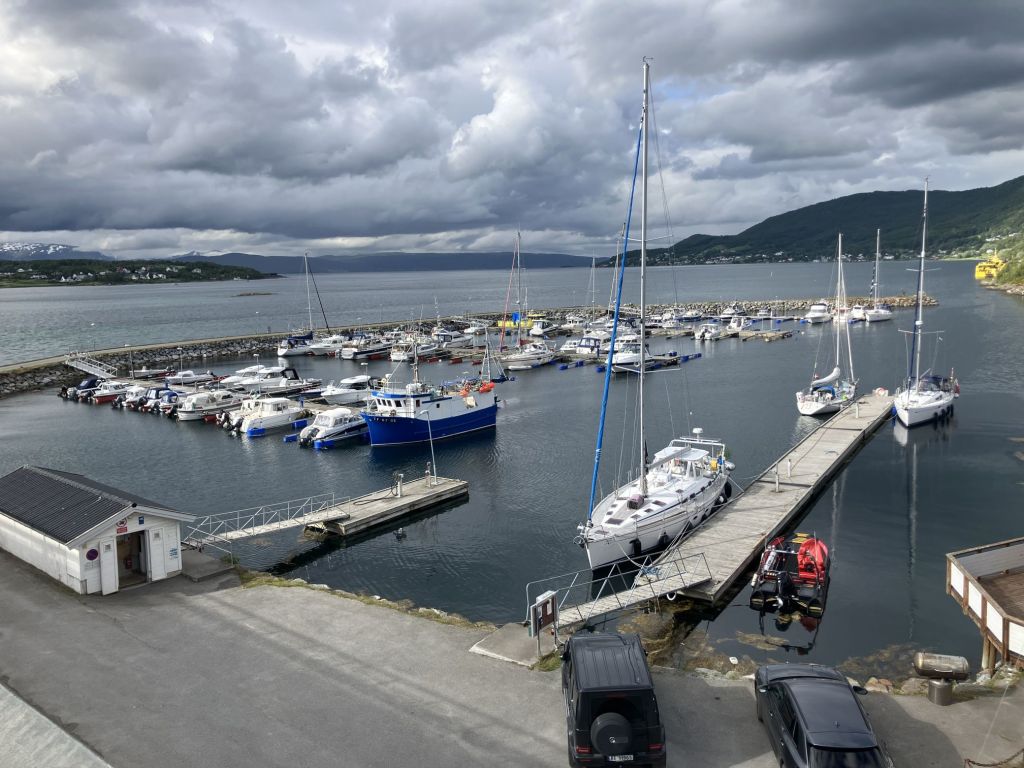
One side of the single pontoon is taken up with small motorboats, and a large fishing boat with the name of Kaare occupies the first place on the other side.
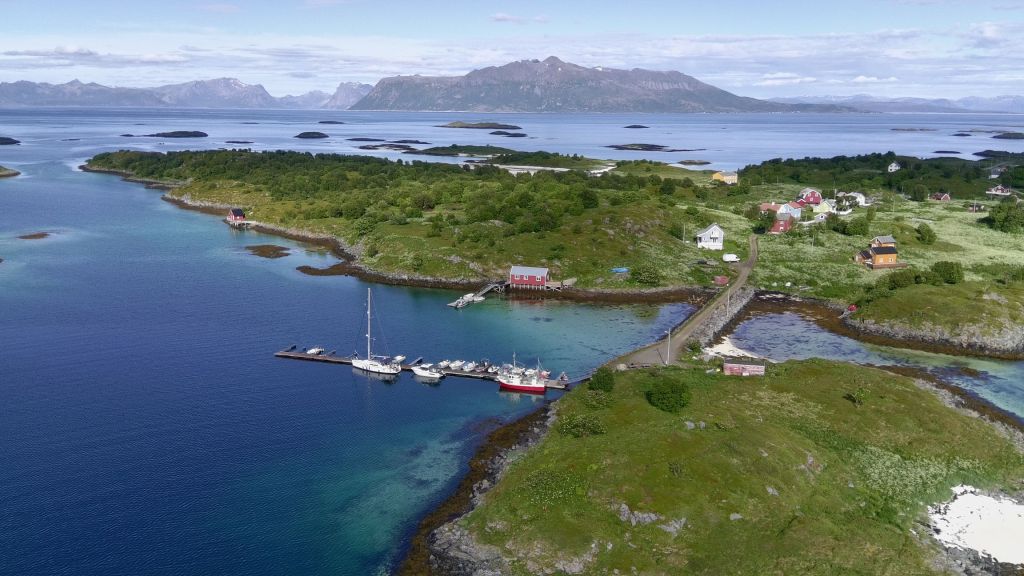
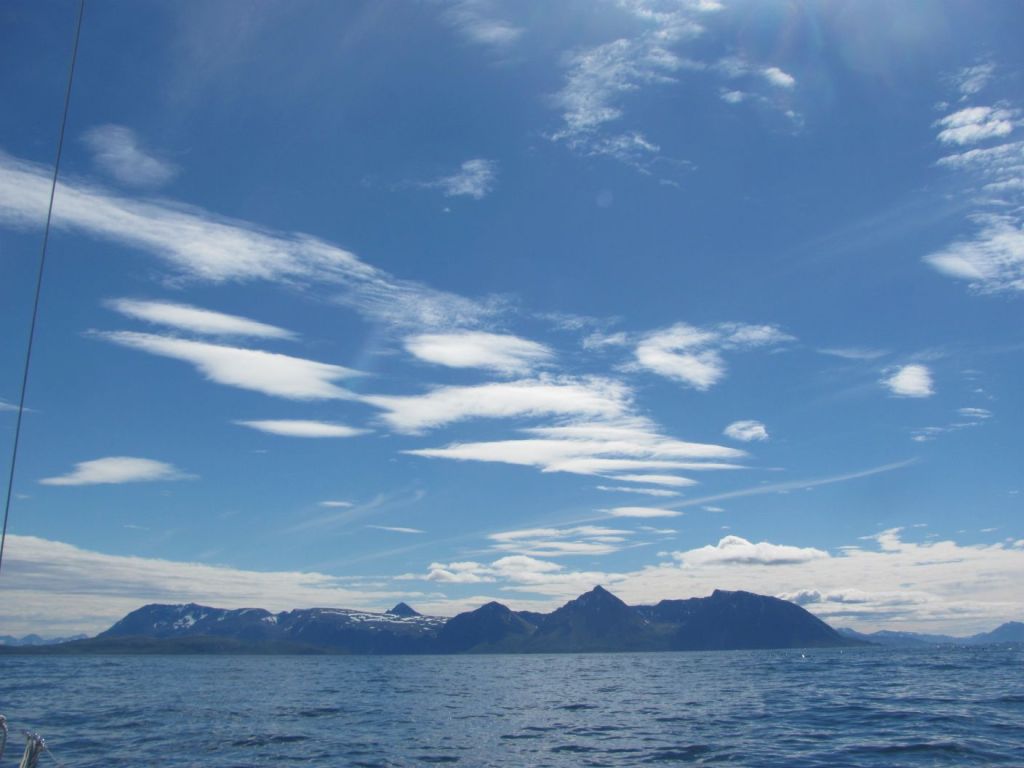
“It’s absolutely beautiful here”, says the First Mate, as we tie up. “Look at those cloud patterns. And there is an oyster catcher over there. And a couple of Arctic terns are swooping around. They must have a nest somewhere. And look at that shag sitting on top of that pole. I’ll make some tea. You rest your leg.”
I had pulled a calf muscle in my leg the day before while we were at Andenes, and while it is better today than yesterday, it is still quite painful.
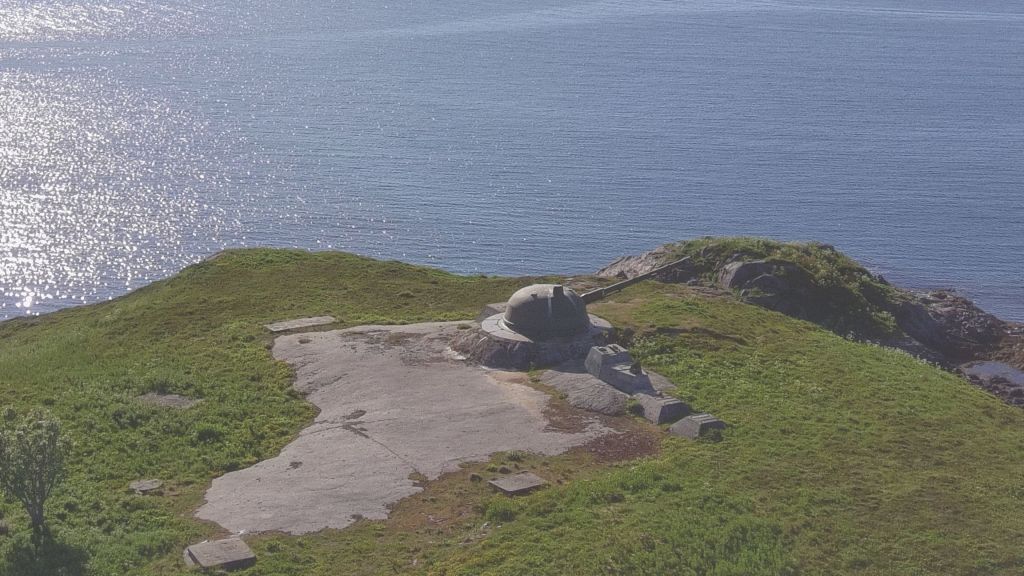
“There’s a gun emplacement over there on the neighbouring island”, I say, as we sip our tea. “German, from WW2. I’ll send the drone over to have a look.”
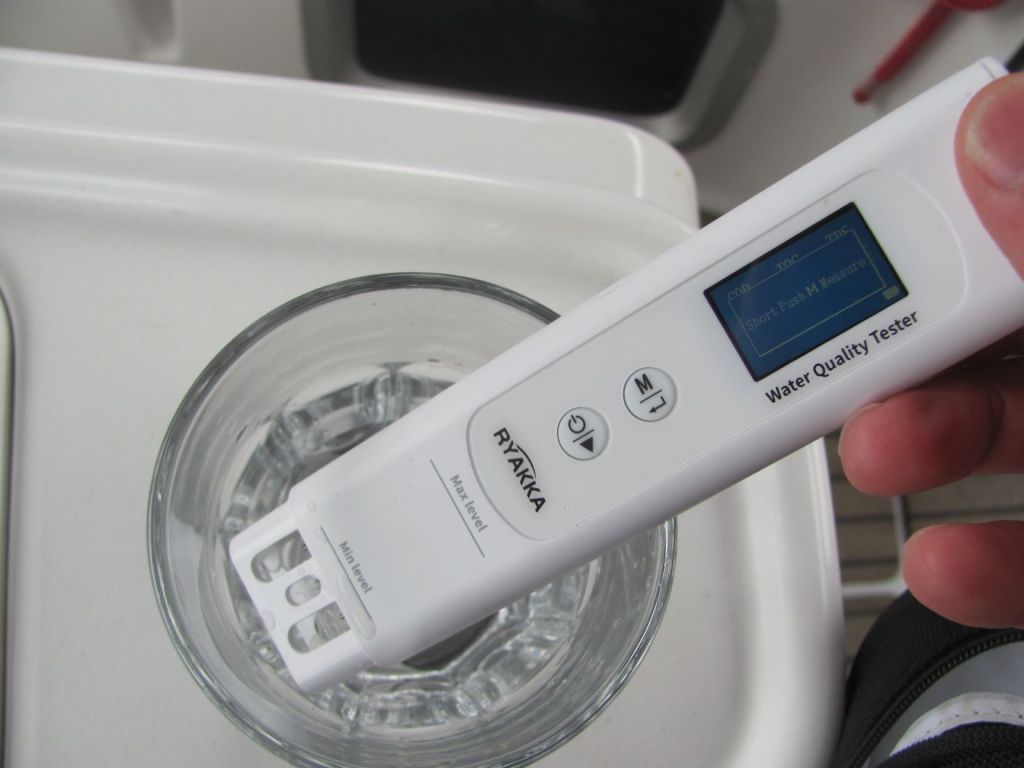
“We need to fill up the front tank with water”, says the First Mate. “You’d better get your little tester out and make sure the stuff from the tap on the pontoon is OK.”
Simon had convinced me last year to buy a small water testing device to check on the quality of water on the pontoons when we fill up our tanks. Nerds that we are, we assiduously take samples, test them, and avoid any water that doesn’t make the grade.
“You’d be amazed at the variation in water quality you come across”, he had told us. “And it’s not always in the way you might expect. Pristine looking places can have poor water, and run-down places can have excellent quality. You can’t be too careful with what you drink.”
It turns out that the quality of this water is classified as ‘Excellent’, so we fill the tanks to the brim.
In the morning, we decide to explore the island. My leg needs the exercise.
“Apparently there are seven permanent residents on the island”, says the First Mate, as we walk and hobble along the gravel track. “The rest of the houses are holiday cottages. And there are no cars.”
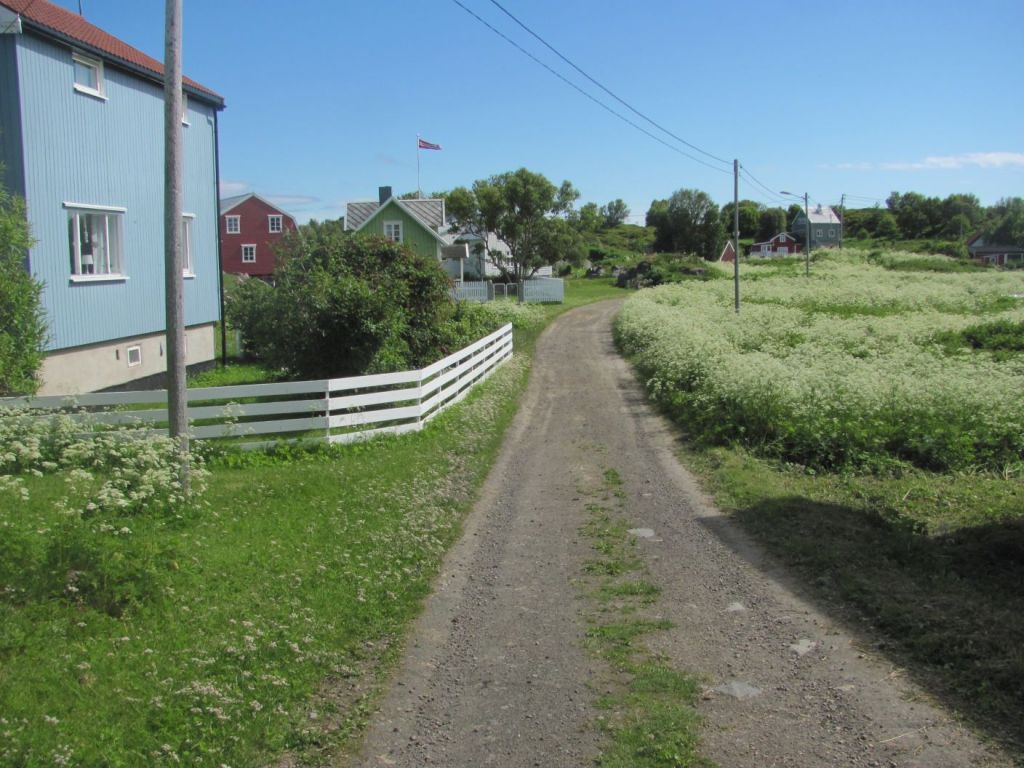
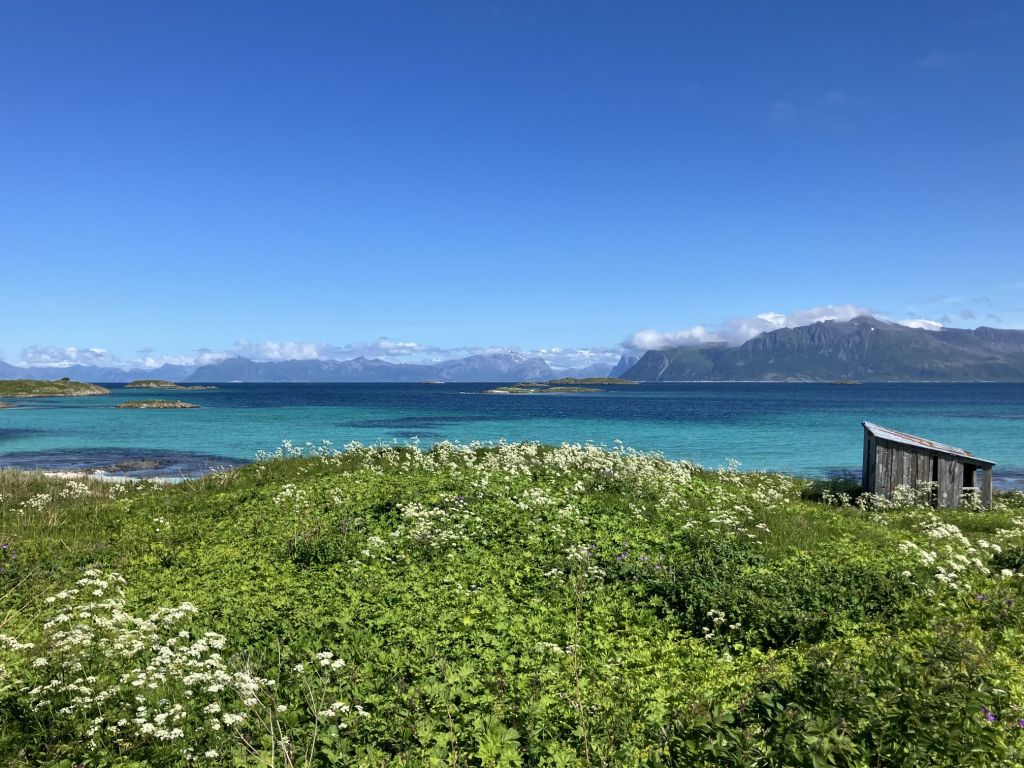
There are stunning views out towards Senja.
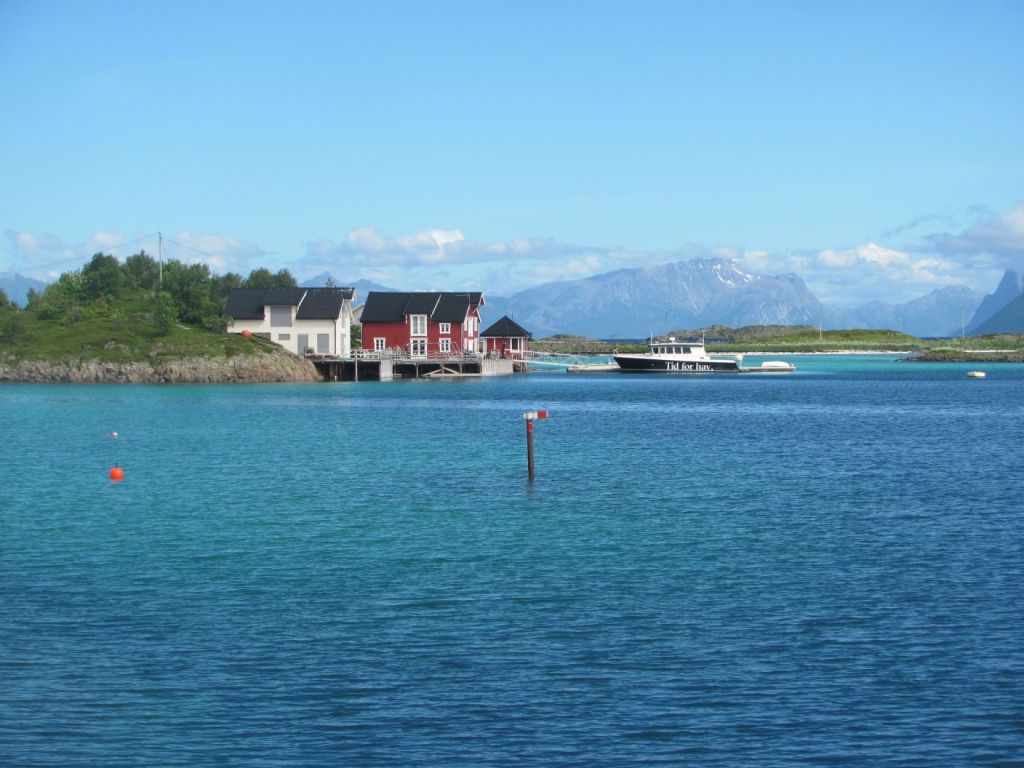
We come to a sign saying “To the Pub”. It’s a hot day, so we take the small path over the grassy field to a red building overlooking a small bay. Two men are working on erecting a marquee on the wooden decking at one side.
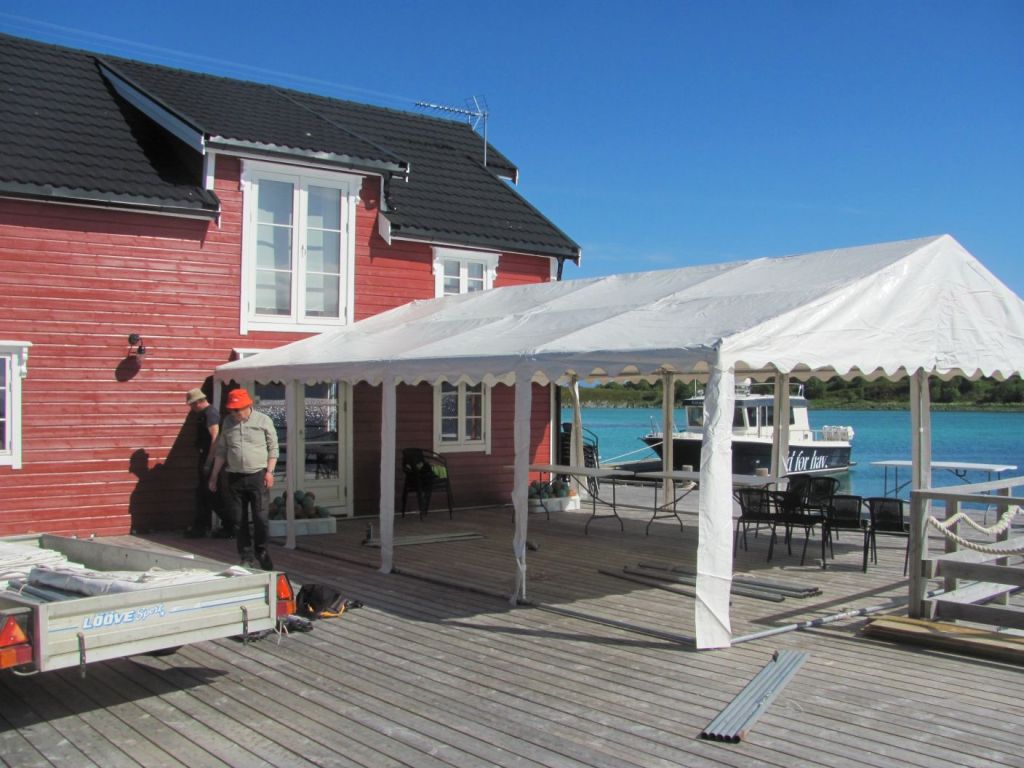
“You’re looking hot”, says one of them. “Would you like a beer?”
“Well, we wouldn’t say no”, we say.
“My name is Trond”, he says as he leads us into the building. “As in Trondheim. I am the owner of the pub. We have a wedding reception booked for Thursday, and we are just trying to get everything ready for it. That’s what the marquee is all about. But I need an excuse for a break. What will you have?”
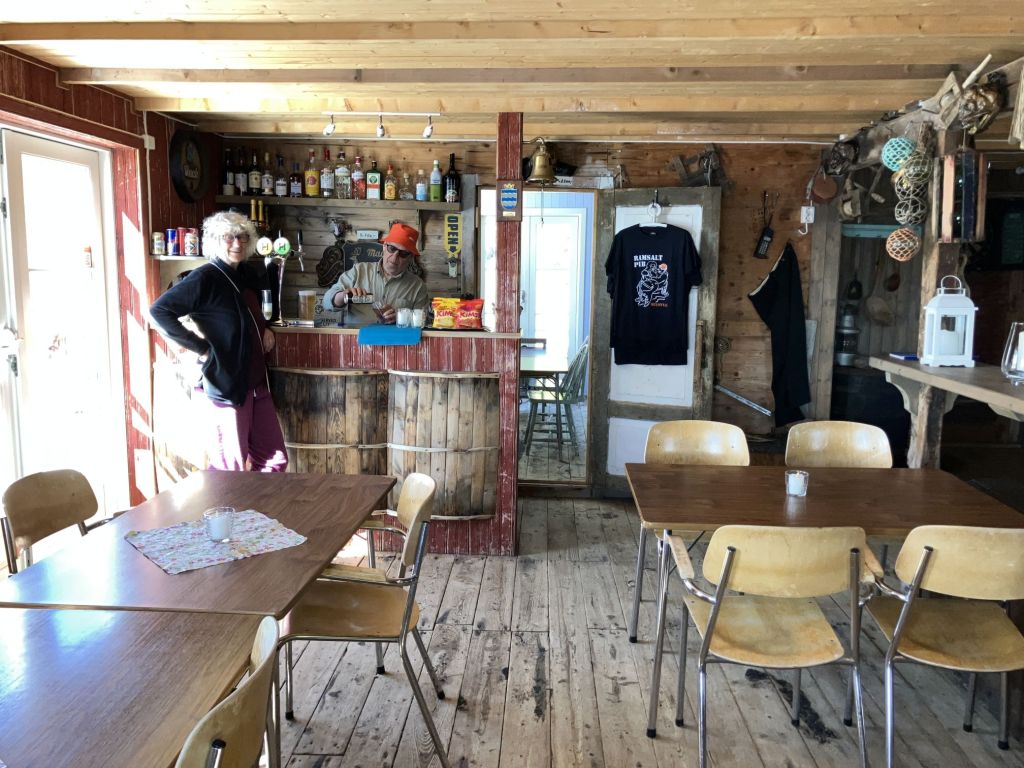
He pulls a beer for me and a shandy for the First Mate.
“I was born on the island”, he tells us. “But I worked for a construction company in the oil sector. All over the world. I have even been in Scotland – Aberdeen, to be precise.”
We had already told him where we come from.
“When I retired from work, I decided to move back here, so I bought a fishing boat”, he continues. “You probably saw it at the pontoon where you are tied up. Kaare, she’s called. But I really wanted to give something back to the community, so I converted this old building into a pub where locals and visitors could come together and socialise. It’s called the Ramsalt Pub. I’m not really interested in making money from it, just providing a place where people can enjoy themselves. We’re open just on Fridays and Saturdays, and most evenings have live music and singing. Everyone joins in. It’s a lot of fun.”
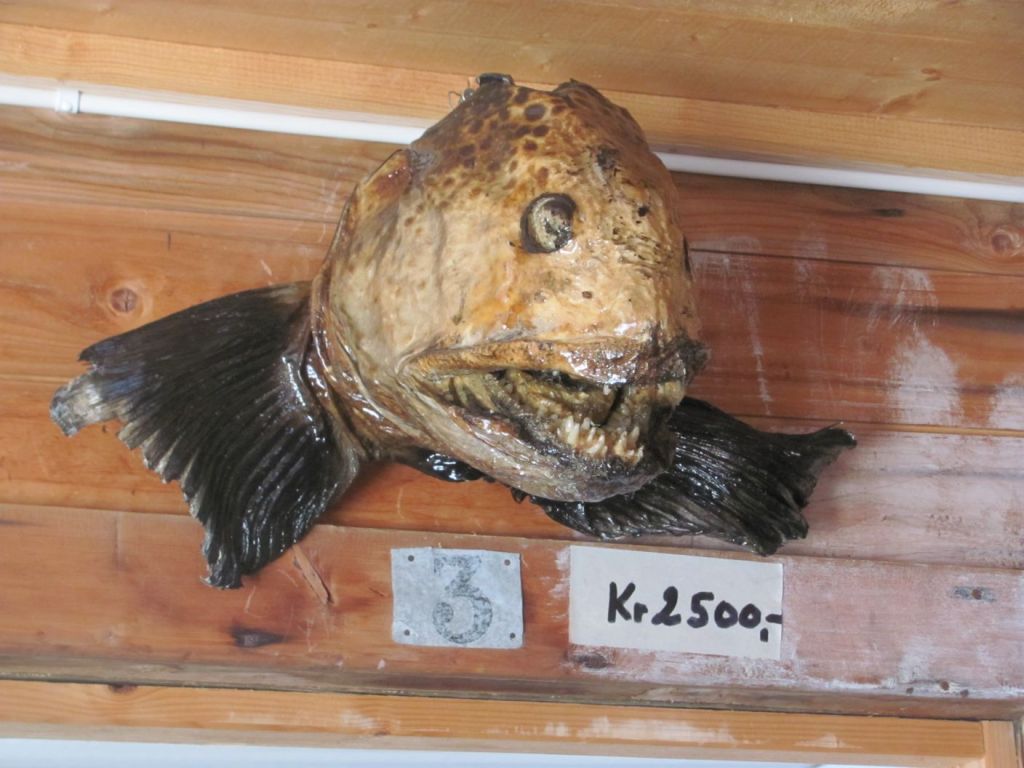
“You have quite a collection of old fishing things in here”, says the First Mate, looking around the room.
“Yes, they add a bit of atmosphere to the place”, says Trond, looking up at the head of fish mounted above the bar. “I wanted to contribute to preserving some of the island’s heritage.”
The conversation turns to international affairs.
“He’s got himself into a mess now”, says Trond. “And I am not sure how he’s going to get himself out of it without losing face.”
He is referring to the war in Iran.
“The whole war was ill-conceived and illegal in the first place”, he continues. “First of all, he rips up the perfectly good agreement that Obama had negotiated with the Iranians, then they bomb the site where the nuclear weapons were supposed to be being made, then they start more negotiations, which, by all accounts, were making some progress. Then without warning, they start bombing the place. And killing all those young girls at the school. That surely is a war crime.”
“Well, at least Europe didn’t get involved this time”, I say.
“And I am glad they didn’t”, he says. “No one wants Iran to have nuclear weapons, but when they are making some progress with negotiations, the last thing needed is to declare war. What has it achieved? The only result is that it has weakened America in the eyes of the world and strengthened Iran.”
“And now they don’t even have an agreement”, says the First Mate. “Only a Memorandum of Understanding.”
Drinks finished, we give a hand with putting up the marquee.
“Well, that was interesting”, says the First Mate as we walk back to the boat. “We always seem to meet such nice people in these remote places.”
We cast off the next morning. The shag is back on his pole, and watches us impassively as we pick our way slowly around the perches marking the shallows on each side of the entrance. We have decided to have lunch at a small anchorage on the neighbouring island of Helløya, where the sailing guide tells us that there is supposed to be a buoy to tie up to. We wend our way in through the narrow inlet, through the flock of kittiwakes bobbing on the water, only to find that a small boat is attached to the buoy. No-one seems to be on it, and a dinghy lies on the small beach opposite.
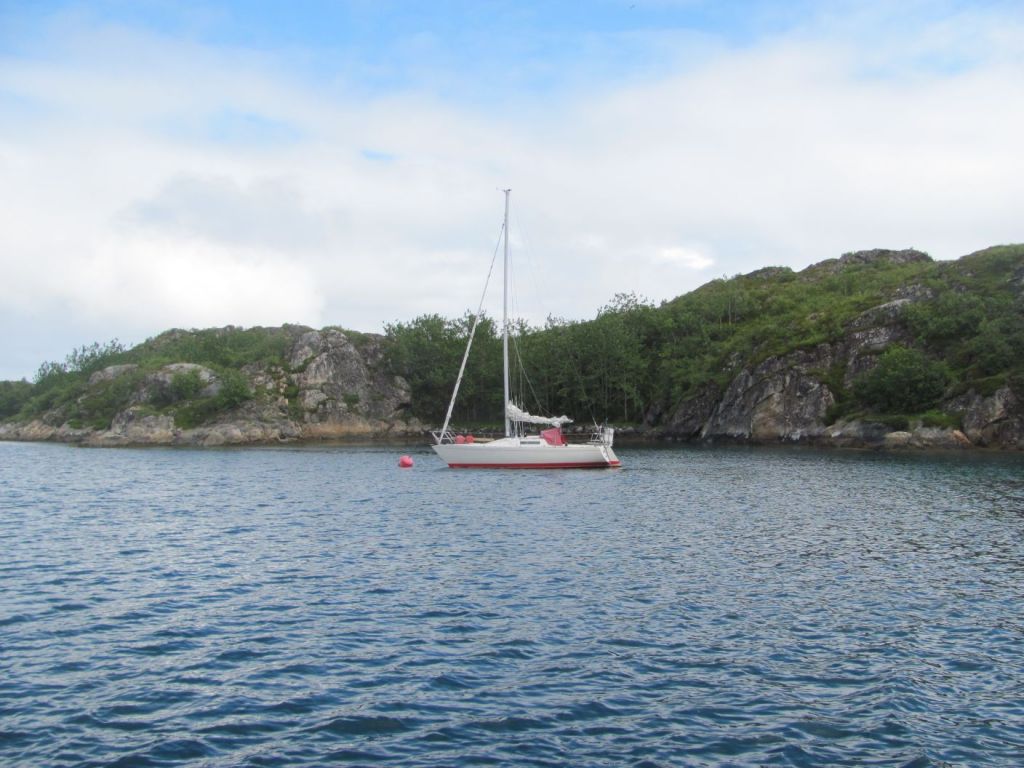
“It’s funny how we hardly see any other boats around when we are sailing, but when we want to tie up to a buoy, it’s occupied”, says the First Mate. “I wonder where they came from?”
We drop anchor instead. It’s not the best of sets and we drag slightly, but we can keep an eye on it while we eat.
As we prepare lunch, I hear voices on the cliffs overhead. There are four people, looking down at us.
“They’re probably the owners of the boat”, I say.
Sure enough, two of them return to the dinghy and row back out to their boat. They collect something, then row back, this time passing near us.
“Hi, we just thought we would say hello”, they say. “We’ll be leaving soon, so if you want to use the buoy, it will be free.”
They are young, and the accent is Antipodean.
“Yes, we are Kiwis”, they say in response. “We have just bought the boat in Kirkenes up near the Russian border, and are sailing her back. We are heading back down to Oslo, but we have all summer to do it. We have some friends from Holland with us. And yes, it is a bit crammed in there.”
Ah, the carefreeness of youth!
We go through the time honoured Kiwi ritual of asking each other if we know so-and-so from our respective home towns. It is surprising how often it turns out that there are acquaintances in common. Or perhaps not surprising, given that New Zealand is a small country. But on this occasion, there doesn’t seem to be.
“We need to get back and collect the others”, they say. “We’ve left them on the shore. Enjoy your lunch and the sailing. Don’t forget to see the kittiwake colony around the corner.”
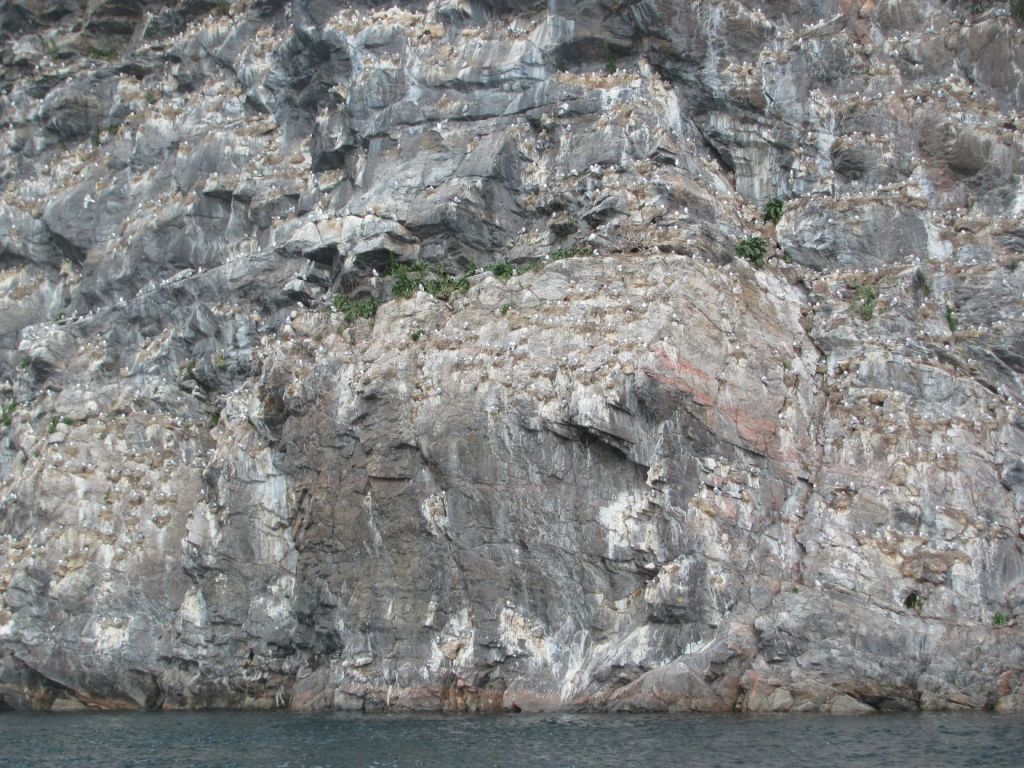
They are referring to a cliff on the southern end of the Sundsvollsundet Nature Reserve on Helløya that is a nesting site for the small white and grey seabirds. The smell and the cacophony of sound as we pass by it is overwhelming.
“It reminds me of Fowlsheugh In Aberdeenshire”, says the First Mate, screwing up her nose. “There are thousands of them.”
We push on to Engenes. There the harbour is being totally reconstructed, but there is a spare pontoon to which we tie up.
“The shop closes in 20 minutes”, says the First Mate. “I’ll just nip up and get some bread and milk. Otherwise there doesn’t seem to be much here.”
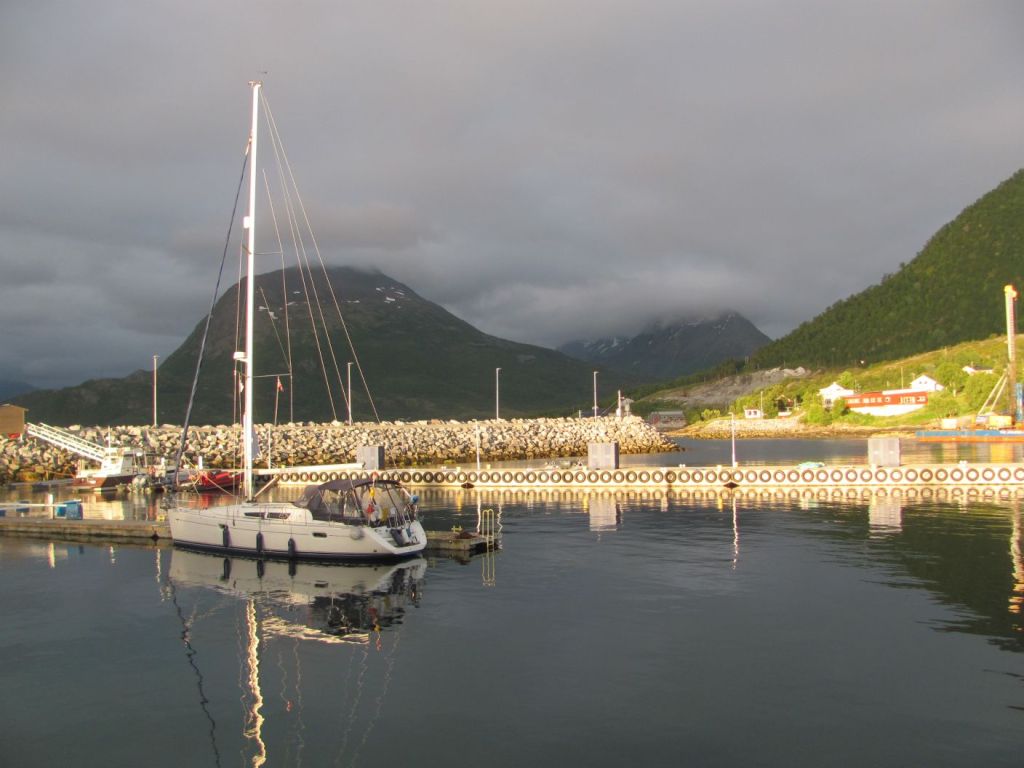
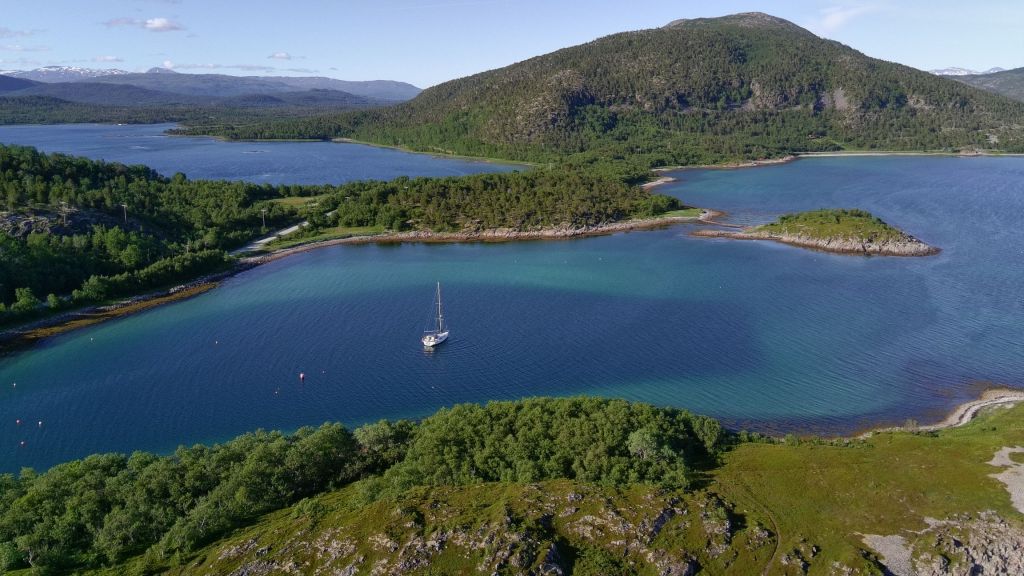
It rains that evening, and into the next morning. When it stops, we decide to carry on, and reach the delightful small anchorage of Revshamna on the east coast of Senya in the late afternoon. The charts show a shallow bar at the entrance and it is nearly low tide, so we are a little worried that we will not be able to make it, but, in the event, we pass over it with a metre to spare. We drop the anchor in the middle of a deeper pool in the middle of the bay.
“What a beautiful anchorage”, says the First Mate. “It’s so sunny and warm. Let’s have a glass of wine and relax.”
I pick up the book that I have been reading, Yuval Noah Harari’s latest, “Nexus”. In it, he argues that human history is best understood as the story of increasingly powerful ‘information networks’ rather than just technological or political progress. From oral storytelling and religious myths to writing, printing, and modern digital media, each new system for sharing information has allowed large numbers of strangers to coordinate with each other. However, each has also created new vulnerabilities—the spread of errors, propaganda, and collective delusions that can propagate across societies. What we call ‘civilisations’ are really just large networks held together by shared stories, not just facts.
“It’s an interesting viewpoint”, says Spencer, looking over my shoulder. “And a lot of truth in it. I sometimes think that you humans are not really interested in the truth of how things really are, but more in the comfortable stories that you tell to make yourselves feel good. Look at the lies that are told daily by the leaders of your most powerful countries. And yet they are just lapped up because it makes a good narrative and fits the perception that people have of themselves.”
“But surely with the advent of new tools like Artificial Intelligence, we will get closer to what is really happening?”, I say. “I find ChatGPT pretty useful for finding things out.”
Spencer snorts. “It’ll only get worse with AI”, he says. “AI is a fundamentally new kind of information system compared to the previous ones — it is the first that can generate, interpret, and act on information independently of human judgement. The risk is that this shifts power away from humans toward incomprehensible algorithms and the institutions that rely on them. This, in turn, risks undermining democracy, accountability, and even the idea of shared truth. I don’t mean that AI is inherently bad, just that it acts as a force that amplifies whatever incentives are embedded in it. How do you know, for example, that what you are getting from ChatGPT isn’t biased towards a particular world view?”
He does have a point. I don’t know.
There’s a splash in the water.
“It sounds like there are fish here”, says the First Mate, looking up from her Sudoku puzzle. “I might get the rods out.”
In the morning, it is raining when we wake up. We have a leisurely breakfast, by which time it has cleared.
“I think that we should push on”, says the First Mate. “Finnsnes is the next stop, and we need to do some shopping. We’re running low on several things.”
We arrive in Finnsnes. Originally just a small farming community, it has grown rapidly in recent years, and is now a significant centre for commerce in the region. We do some shopping to restock our provisions, and I buy a new fishing rod to replace the old one that is now worse for wear.
Back at the boat, I strike up a conversation with the skipper of the boat next to us.
“I see that your Royals are also acting up”, I say. Just like some of the ones in Britain.”
There is a report in this morning’s newspaper about Marius Borg Høiby, the son of Norway’s Crown Princess, being sentenced to four years in prison for rape, physical assault, and drug and driving offences.
“Yes, it has all been a complete embarrassment for the Royal Family”, he tells me. “He’s a bit of a troubled character. When he was born, his mother was a waitress and his father was in prison for drug-related violence offences. They weren’t even in a relationship, so she brought him up as a single mother.”
“How did he come to be part of the Royal Family, then?”, I ask.
“Well, our Crown Prince, Haakon, took a fancy to his mother, Mette-Marit”, he answers. “They were married in 2001, and so Marius became Haakon’s stepson. But he doesn’t have any titles, and he isn’t in the line of succession. He did work as a model occasionally, but otherwise hasn’t ever had a proper job. It seems that his step-father pays him an allowance to support his lifestyle. It would have been better if he had gone out to work and made something of himself.”

“Isn’t his mother a bit controversial as well?”, I ask. “I read that she was part of the Jeffrey Epstein circle.”
“Yes, it seems from the Epstein files that she was a lot closer to him than she has admitted”, he says. “She claims that she didn’t know he was a paedophile, but she did stay in touch with him even after he was released from prison for that, so it is a bit difficult to believe her. So overall she is not very popular, and she has since been removed from patronage of various organisations. But she is very ill at the moment with pulmonary fibrosis and has just had a lung transplant, so at one level you have to feel sorry for her. But the whole affair hasn’t reflected well on Norway. I don’t think that she should ever be Queen.”

