A rock concert, a town of roses, and a new song

“There’s a rock concert on for the next three days”, says the captain of the boat tied up in front of us. “Rauma Rock. It’ll be really loud. We were here last night, and we could hardly hear ourselves think until about four in the morning. But the music was good. There will be even more boats coming tonight. It will be packed.”

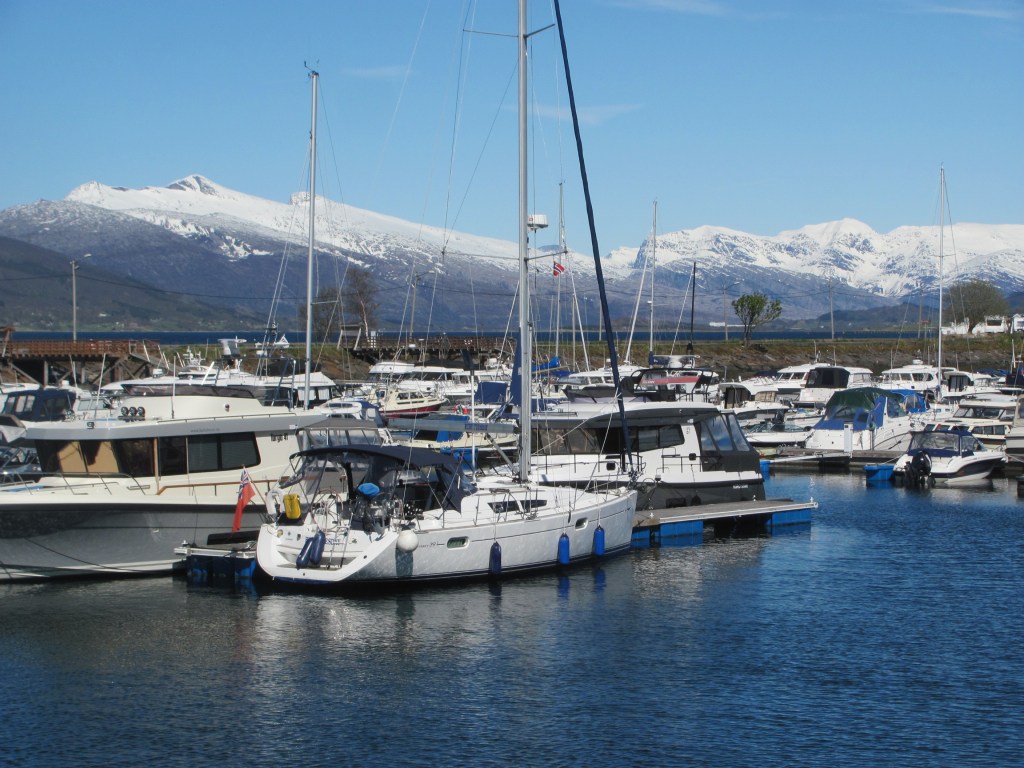
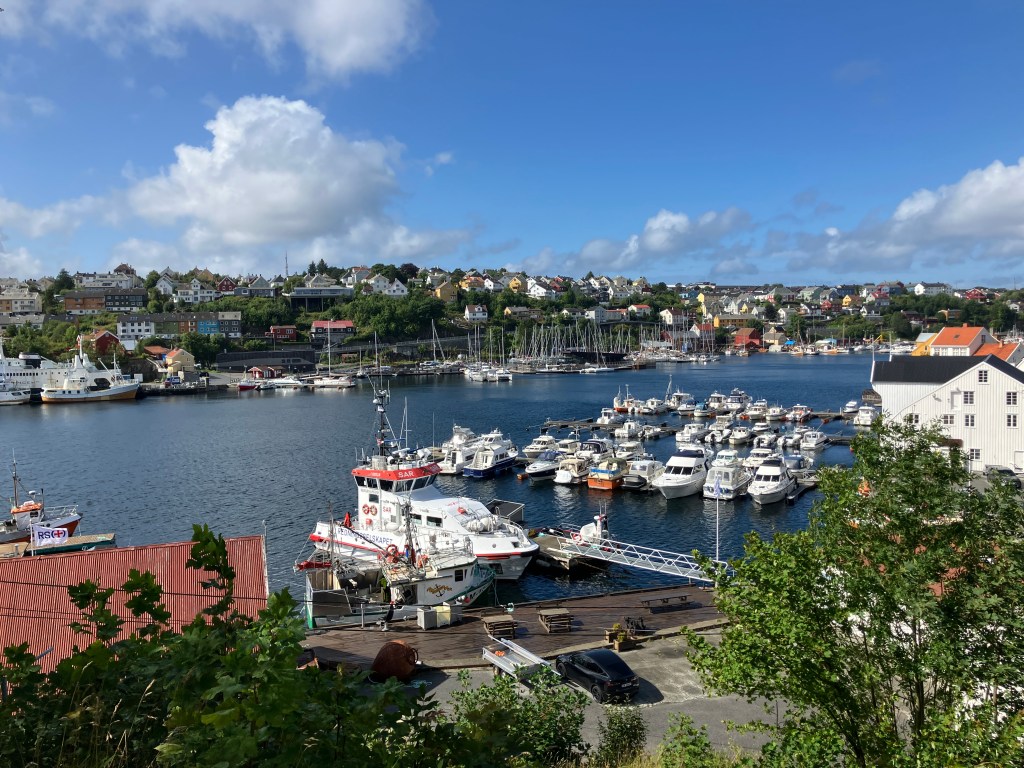
Andalsnes harbour.

We are in the tiny harbour of Andalsnes near the top of Romsdalfjord. There had been no berths free when we had arrived, and we had rafted up to another small yacht while we decided what to do. It was then that we had noticed that a large stage had been constructed on the quayside, with the twanging of guitar strings warming up emanating from it.

Rauma Rock warming up.

“I don’t really want to be kept awake all night”, says the First Mate. “I am at that age where I need my sleep. But it would be somehow nice to hear some of the music.”

“Me too”, I say. “My hearing is bad enough as it is with old age, without finishing it off completely. Why don’t we go and anchor a little bit further up, where can still hear the music, but it isn’t quite so loud? And we wouldn’t have to pay either!”

The last sentence is the clincher.

“Good idea!”, she says. “But let’s have a quick look at the town first to see what it is like.”

The First Mate explores the town centre, while I take a walk down to the Rauma river running through it.

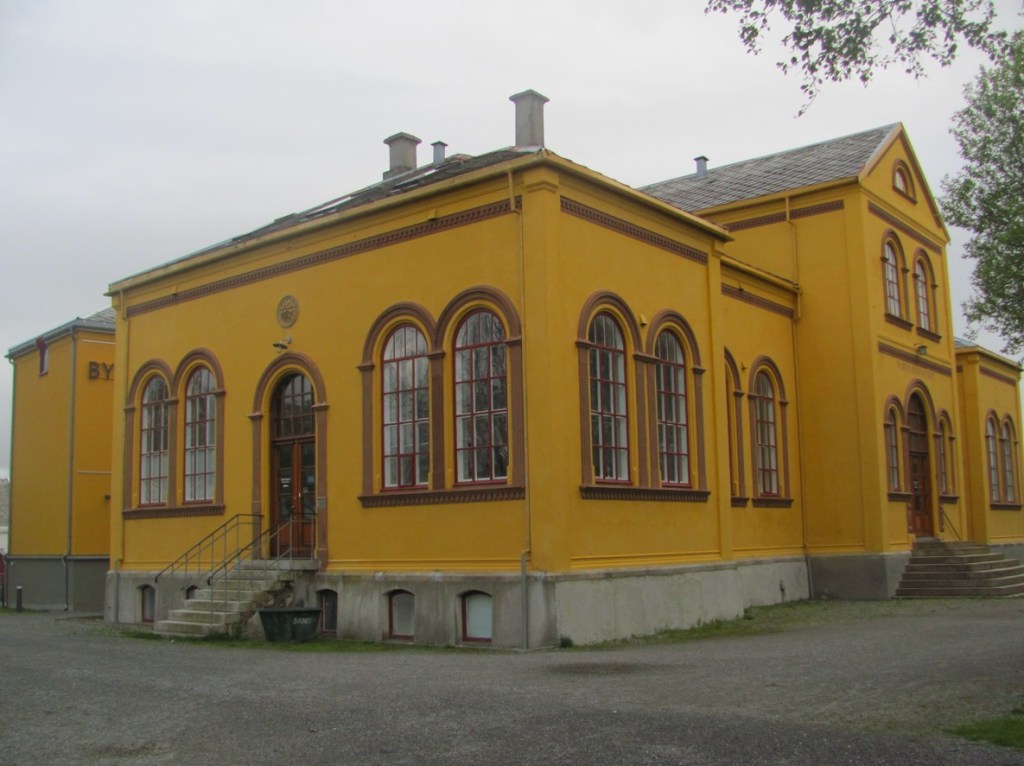
Town Hall, Andalsnes.
Rauma River in Andalsnes.

“Well, the town was pretty average”, she says, when we meet again. “I didn’t find it very inspiring.”

Later we motor a little further along the shoreline of the fjord and drop the anchor.

“Perfect!”, says the First Mate as we sit on deck with our glasses of wine watching the gondolas taking their passengers to the top of Mount Nesaksla, and listening to Rauma Rock getting underway. “That’s much more enjoyable.”

Listening to Rauma Rock from a distance.

“Andalsnes was one of the places that my great-great-grandfather visited”, I say. “Or at least Veblungsnes, which was the main settlement in those days. Since then, Andalsnes grew to be a town, while Veblungsnes remained a village. The Rauma river divides the two. In his letters he talks about the striking wonders of the Rauma river, but he says that he doesn’t have time to describe them.”

“The guide book says that the Rauma is famous for its salmon fishing, the emerald-turquoise colour of its water, its towering mountains, deep gorges, and sheer cliffs, and its waterfalls at Vermafossen and Slettafossen”, says the First Mate. “It was the inspiration for scores of Romantic artists, writers and explorers.”

“It would be nice to go and see it”, I say. “But we’ll never get in to the harbour now with all the boats that have been arriving.”

“We’ll have to come back another time”, says the First Mate.

In the morning we set off back along the Romsdalfjord. I keep a sharp eye out for sea-eagles.

Scanning the cliffs for sea-eagles.

Far above, wheeling on the updraft from the cliffs, Eira looks down on the waters of the Romsdalfjorden. She doesn’t come here often these days, instead spending most of her time with the other sea-eagles on the islands and skerries at the mouth of the fjord where the fish are plentiful. But from time to time she likes to revisit her birthplace and recall the stories that her father Clew and her mother Aran used to tell of Cuillin, the last of the great sea-eagles of Skye, who had flown alone from there to Romsdal to save her kind. And of her daughter Mourne who had returned to Skye with her motley collection of vagrants to repopulate those islands.

Out of the corner of her eye, she sees a boat heading for the tip of Okseneset and the shapes of two humans. They won’t be able to see her, she is too high and against the sun. She does not fear them in the same way that her parents had done – the Doom that she had heard in the old stories had passed now and there seemed to be a new understanding between her kind and the humans.

And yet, from time to time there was a niggling feeling in the back of her mind that the Doom had not gone completely. To be sure, few of the Romsdal eagles died these days by being shot or poisoned, but she had heard that there were increasing numbers flying into the high towers with rotating blades that had appeared in Møre og Romsdal. And then there was the rumour that was going around the Pairs that the eggs being laid were hatching earlier in the year, there seemed to be more rain than she remembered in her younger days, and the weather appeared to fluctuate more between extremes. But surely humans couldn’t be blamed for that, could they? Clever as they seemed to be, they were just too small and insignificant to be able to change the forces of Mother Nature herself, the might of the winds and rain sweeping in from the Atlantic, the strength of the sun’s light bringing warmth and life to the earth. Surely only Haførn, the mother of them all, had the power to do that …?

As she circles, she sees another sea-eagle gliding over the island of Sekken. She recognises from his flight that it is Arvid, her mate. She dips her great wings and flies to meet him, the humans in their small boat disappearing from her view.

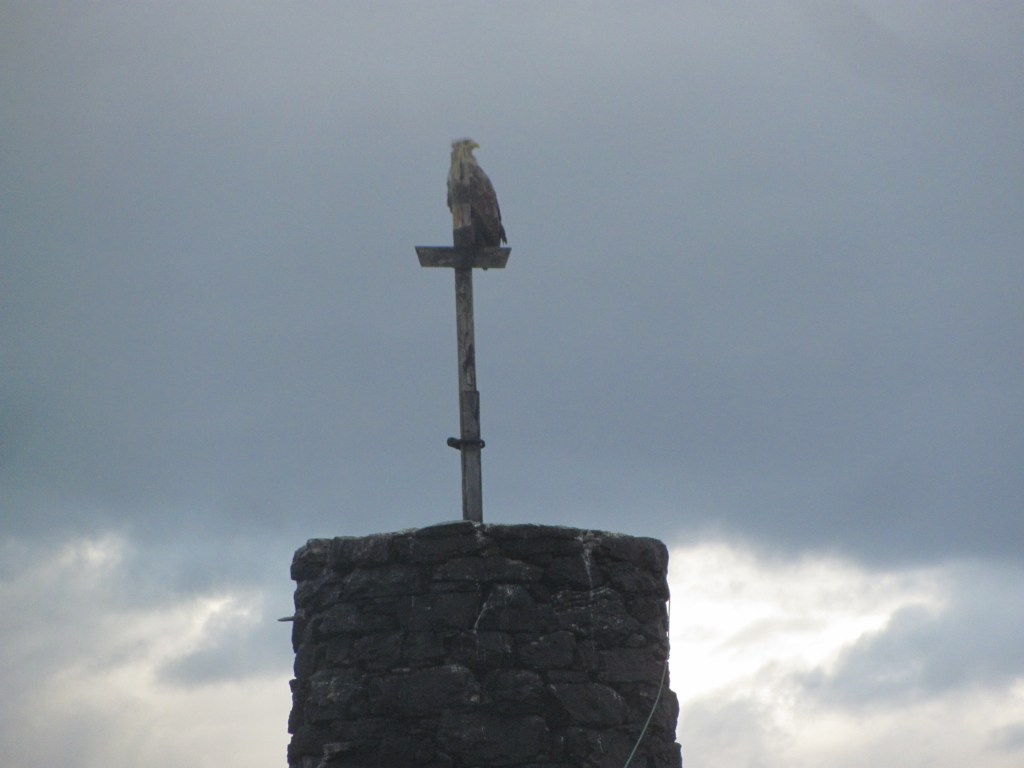
Sea-eagle.

“Are you day-dreaming again?”, the dulcet tones of the First Mate interrupt my reverie.

“I was hoping to see a sea-eagle”, I say. “I was just thinking of the book I re-read over the winter – The Stonor Eagles by William Horwood. It’s about how sea-eagles went extinct in Scotland in the 1930s through the farmers shooting them to stop their sheep from being attacked, and how they were reintroduced in the 1970s from Norway. Romsdal was one of the areas that they brought them from. I read somewhere that you do see them here.”

“I imagine that there would be more down towards the ocean”, says the First Mate. “That’s where the fish are, after all.”

We arrive at the town of Molde on the northern shores of Moldefjord, and head for the small municipal marina. It’s sweltering. A woman in a tank top and shorts helps us tie up.

“That’s my boat just in front of you”, she tells us. “I live on it throughout the summer and then go back to my apartment for the winter. It’s kind of like a summer cottage, but on the water. I don’t sail far – there are enough beautiful places to visit around here.”

Tied up in Molde town marina.

After a cup of tea, we decide to explore the town centre.

“It’s a pity we weren’t here a couple of weeks ago”, says the First Mate. “We could have gone to the Jazz Festival. They have one every year.”

Molde is well-known for its Jazz Festival.

“Look, here’s the Salmon Centre”, I say, pointing to a building in the town square. “We should go and have a look at it.”

“It’s free entry”, says the girl at the reception. “And that includes a free sample of raw salmon, which you can use to make your own snack with taco shells and various dips.”

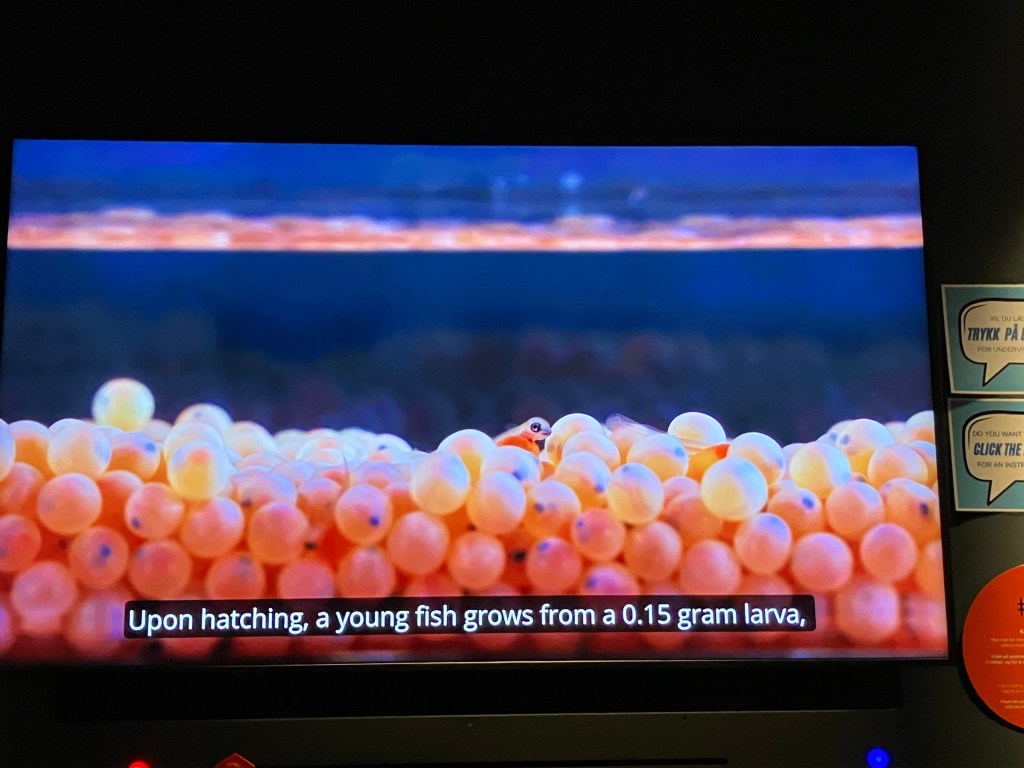
For the next little while we are absorbed in creating our own culinary delights, learning about the life cycle of the salmon from ‘roe to plate’, how the cages are made and installed, and how it is becoming more sustainable, including ways to prevent farmed salmon escaping to mate with wild salmon and weakening their gene pool.

Learning how to create our own salmon delicacy.

“That was fascinating”, I say, as we emerge. “I now know more about salmon than I ever thought I would.”

“Yes, it was”, says the First Mate. “Come on, let’s have a coffee and cake. Look, there’s a nice looking place over there. We can sit outside. You grab a table, and I’ll go and choose the cake and order.”

“Earl Grey tea for me, please”, I say.

“A nice little watering place.”

“Well, this is a nice little watering place”, says the minister to his companion as they sit down. “I enjoyed the walk around the town this morning. Such lovely weather. And what a nice smell from all the flowers they grow.”

“Molde is famous for that”, responds Mr Fairlie. “Especially the roses. Their fragrance is everywhere.”

Molde roses.

“I had a look at the new church”, says the minister. “Apparently the old one burnt down four years ago, and they just finished building a new one last year. I must confess that I like the look of the old wooden one I saw in pictures better than the new one. All red-brick now.”

“I suppose it will be more fire-proof, at least”, says Mr Fairlie. “That’s always the problem with wooden buildings in this part of the world. It’s only a matter of time before they get burnt down.”

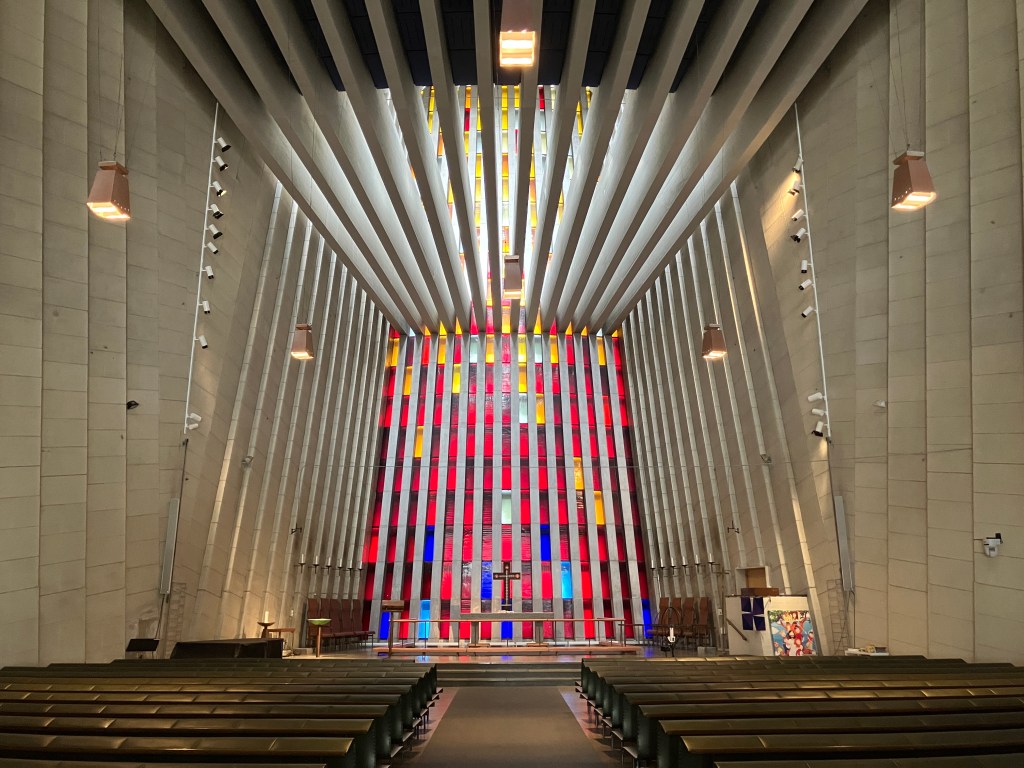
Molde’s present day Domkirke (successor to the redbrick one!).

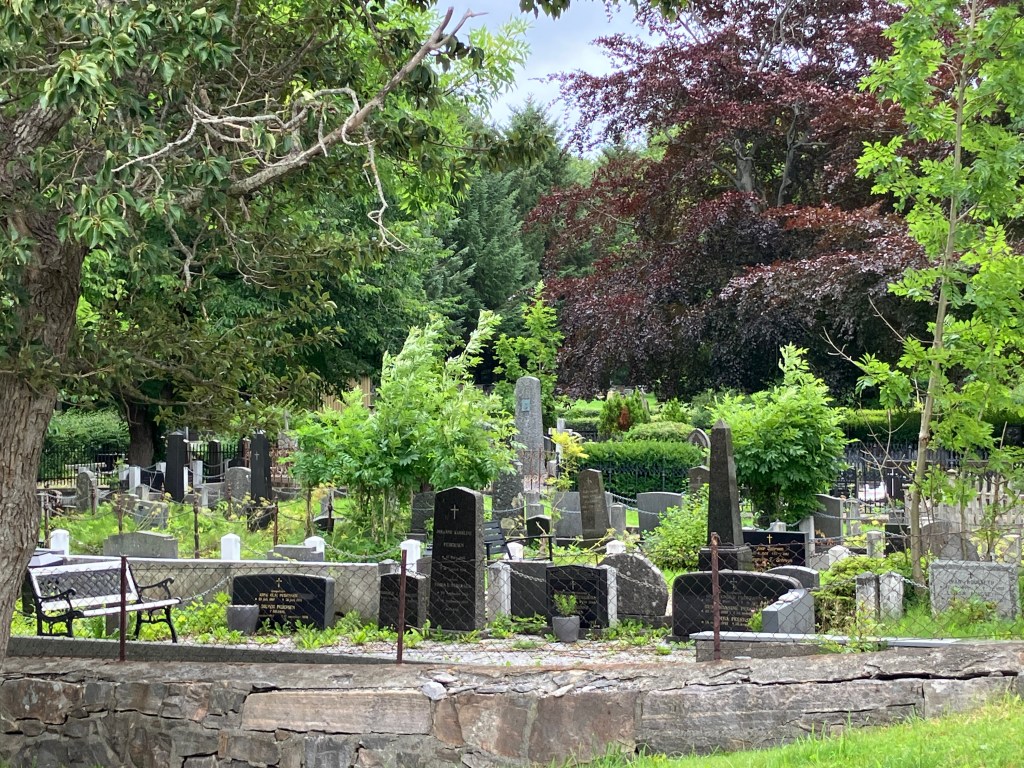
“And I have to say that I was impressed at the beautiful resting place of the departed here”, continues the minister. “With its small mounds of earth crowned with the loveliest flowers. The graves are tended with the fondest care and mothers come and sit by their loved ones’ dust for hours, with a book in hand or plying the needle, engaged on some piece of useful or fancy-work.”

Molde cemetery.

“Here we are”, says the First Mate, bringing a tray with the coffee, tea and a cheesecake. “What a nice spot. We can sit and watch the boats coming and going. But why are you putting in pictures of the cemetery? That’s a bit macabre.”

“My great-great-grandfather went to see it”, I say. “I thought I should too. He seemed to like that sort of thing.”

“You seem to be enjoying this cruise, at least?”, says Mr Fairlie.

“Immensely, but I have to admit I never feel relaxed on a boat”, says the minister. “Ever since I lost my younger brother Andrew at sea.”

“I didn’t know you had a younger brother”, says Mr Fairlie. “What happened?”

“He was on his way out to New Zealand”, replies the minister. “Another brother of ours, James, was already out there farming near Dunedin, and Andrew was intending to join him. He was a minister like myself, and had been in Canada but had fallen out with some of his superiors there. I don’t know what about. He always liked his drink and was a bit of a hothead, so maybe it was something to do with that.”

“So he was looking for a fresh start in New Zealand?”, asks Mr Fairlie.

“Yes, that sort of thing”, says the minister. “He was on board a ship called the Burmah sailing from London to Lyttelton. It seems it might have been overloaded, as in addition to the passengers, it was carrying a consignment of high-class horses and cattle. But it never arrived in Lyttelton. Another ship fourteen days out from New Zealand reported passing it in the Southern Ocean, and also that they had seen icebergs in the area at the time. So we are guessing that the Burmah must have hit an iceberg and sank.”

“What a story”, says Mr Fairlie. “Your poor brother. To have all his hopes dashed when he was so close to realising them. It’s a salutary reminder of the perils of sea travel.”

“Yes”, continues his companion. “But the story doesn’t end there. One or two years later some ship’s timbers were washed up on a beach to the south of Dunedin with the letter ‘B’ written on one of them. The supposition at the time was that it was from the Burmah.”

“And it’s sad to think of your brother James already in New Zealand waiting patiently for Andrew to arrive”, says Mr Fairlie. “Looking forward to seeing a member of his family again, then the slow realisation each passing day that his brother may not be coming. But never really knowing for sure.”

“No closure”, says the First Mate, as she takes the last of the cheesecake. “As we might say today. It’s a poignant story. But I can understand how your great-great-grandfather felt about the sea. I never feel at ease with it myself.”

“Who does?”, I think to myself.

In the evening, we sit on deck and eat our dinner. Suddenly three men from one of the neighbouring boats come over.

The music makers?

“We’ve been composing songs to amuse ourselves”, one says. “We’ve made one about your boat. We wondered if you might like to hear it?”

He presses the Play button on his portable stereo. A Scottish folk song plays.

Ruby Tuesday

She was born on the Clyde where the river runs wide,
Painted red like the fire of the morning tide.
With her sails full of dreams and her heart on the sea,
Ruby Tuesday’s the name, and she’s calling to me.

From whisky shores and bagpipes’ cry,
She’s chasing sunsets, kissing the sky.

Oh
Ruby Tuesday, rolling with the waves,
From Scotland to Molde, where the fjord light plays.
We’ll sing and we’ll dance as the moon shines through,
On a deck full of laughter and a sky so blue.

The gulls sing along, and the wind hums a tune,
As we sail through the night by the light of the moon.
There’s a fiddle on board, and the stories run wild,
Of whiskey and freedom and the heart of a child.

She’s got no fear of the stormy skies,
‘Cause
Ruby’s a queen with fire in her eyes.

Oh
Ruby Tuesday, rolling with the waves,
From Scotland to Molde, where the fjord light plays.
We’ll sing and we’ll dance as the moon shines through,
On a deck full of laughter and a sky so blue.

Raise your glass to the Northern light,
We’re sailing strong through the soft midnight.
Every mile that we leave behind,
Brings us closer to peace of mind.

Oh
Ruby Tuesday, you’re my guiding star,
From Scotland to Molde, no journey’s too far.
With the wind in your sails and the sky so true,
Every song that I sing, I’ll be singing for you.

It’s brilliant. Not completely factually accurate, but who cares about details? We’re touched.

Alpine farming, behind a waterfall, and a renewed acquaintance

“According to the harbour guide, there’s supposed to be a hammerhead on the pontoon”. says the First Mate, peering through the binoculars. “But I can’t seem to see it. That would have given us plenty of room, but there seems to be just the pontoon. And it’s taken up with motor boats. We may have to raft up alongside.”

We are approaching the town of Geiranger at the top of Geirangerfjord, another UNESCO World Heritage site. We had set off in the morning from Sandshamn, and had had a pleasant sail up Storfjord then Sunnylvsfjorden, with the wind funnelling along the fjord behind us, before turning left into the short Geirangerfjord. In the distance, we see an army of campervans lining the waterfront, all with their skylights open in a vain effort to keep cool.

Approaching Geiranger.

“Yes, there was a hammerhead here last year”, says the owner of the motorboat we raft up to. “But it was destroyed by the ice over the winter and they haven’t got around to replacing it yet. But I am quite happy for you to tie up alongside. You can get to the pontoon over the swimming platform at the back here. By the way, there is a thunderstorm due shortly if you haven’t heard already.”

Rafted up in Geiranger.

We hadn’t heard. Nothing was mentioned about it in the weather reports we had received.

“They are very spontaneous”, he says. “It’s because of all the heat we’ve been having.”

Sure enough, fifteen minutes later, the wind starts to blow fiercely and the heavens open. As if choreographed, all the campervan skylights slam shut as one. We just make it into the cabin without getting wet, and watch and listen in trepidation as torrential rain falls and lightening cracks overhead. The windspeed indicator reads 33 knots.

Waiting out the thunderstorm.

“I hope our mast isn’t the tallest thing around”, says the First Mate.

“I think the buildings over there are taller than our mast”, I try and reassure her. “Hopefully, the lightening will go for them first.”

Thirty minutes later, it is all over. The sun comes out, and the skylights on the campervans open again in unison.

“Phew, that was pretty intense while it lasted”, says the First Mate.

Geiranger.

In the morning, we walk up to the Norsk Fjordsenter, where there is an exhibition on the mountain farms in the area. We had often seen these mountain farms clinging perilously to the steep cliffsides as we passed far below in the fjord, seemingly cut off from the rest of the world, with many not even visibly linked to the sea. As we had seen grass but rarely livestock, we had wondered what they actually farmed and how they transported their produce to the markets.

A mountain farm. How do they get there?

“Traditionally these mountain farms kept goats”, a panel in the exhibition tells us. “Pastures on the steep fjord sides provided grazing for them. The farmers produced brown and white goat cheeses and goat’s milk butter, all made according to traditional methods. Nowadays these farms may also keep sheep, cattle and Norwegian fjord horses.”

Mountain goats.

We taste some of the brown goat’s cheese.

“I can’t say I like it that much”, says the First Mate. “It’s a bit sweet for me.”

In one particular farm, the only route to it involved a short pitch of vertical rock that could only be passed with a ladder. The story goes that when the tax collector came to assess and collect the farm’s taxes, the farmer would pull the ladder up so that he couldn’t ascend any further, and he would have to go away empty-handed.

Tax avoidance, mountain farm style.

“I suppose the farmer thought he wasn’t getting much benefit from the state, so why should he contribute to its funding?”, says the First Mate. “There’s a certain logic to that.”

Life was precarious. Landslides and avalanches would sometimes sweep away entire farms, carrying the people with them. The worst of these was in the neighbouring Tafjord in 1934, when 2 million cubic metres of rock broke off and plunged down into the fjord below, causing a massive tsumani with waves up to 62 m in height and killing 40 people.

“Did you read that the next one they reckon will occur is at Åkerneset?”, says the First Mate. “Didn’t we pass that on the way in?”

We had indeed. A massive crack several hundred meters long and slowly widening each year threatens to collapse into Sunnylvsfjorden. Projections indicate that it could generate tsunami waves up to 70–80 meters high, drowning towns like Geiranger, Hellesylt, and Stranda within minutes. Luckily it is heavily instrumented to give warnings of its imminent collapse.

I shudder. “Perhaps we ought to get going”, I say. “I wouldn’t want to be underneath it when it goes.”

The next massive landslide?

“You can walk up to one of the former farms that overlooks Geiranger town”, the woman behind the desk tells us. “It’s more for tourists these days, and there’s a restaurant there, but it gives you a good idea of what life was like in these remote mountain farms. You can then also walk on further to the waterfall if you like. You can even go in behind the waterfall for a memorable experience.”

“There’s a plateau more than 1000 feet up the side of the mountain behind us”, says Mr Fairlie to his older companion over breakfast. “And there’s a new road up to it that they have just completed this year. If you wish, we could take a stolkejarre and driver up there and see how they farm. There’s also a good view of the fjord on the way up.”

“I should like that”, says the minister. “As much as I like sea air, I need to avail myself of fresh air from the land for a short time.”

“Well, there will be plenty of that up there”, says Mr Fairlie.

“There’s a funeral on at the church today”, the driver of the stolkejarre warns them. “We may be delayed somewhat as the mourners arrive. The road around it is narrow and there isn’t much room for vehicles to pass.”

Geiranger church.

We take the footpath up to the farm. The funeral traffic is completely blocking the road into the town, and there is a considerable tailback. We squeeze past the best we can and start climbing the stone steps up the hillside to the farm.

“Wow, that was steep”, pants the First Mate. “I am really looking forward to having an ice-cream at the restaurant.”

It’s closed. There is a sign saying that the funeral wake is being held there. The same cars that were blocking the road far below are now all crammed into the small restaurant car-park.

Luckily we have some sandwiches and water, so we find a shady spot under a tree and rest before carrying on. Behind us some mountain sheep are chewing the cud for their lunch.

Mountain sheep.

The elderly gentleman and his younger companion are already sitting there.

“We’re on a cruise around the fjords”, they tell us. “We have a day here in Geiranger, so we decided to take a side trip up here. It does one good to stretch one’s legs and to enjoy the views. It’s such a beautiful country. We are from Scotland.”

“Amazing”, I say. “That’s where we live. And we are also cruising around Norway. What a coincidence!”

We finish our lunch, say goodbye, and push on to the waterfall. It’s impressive.

The Storsæterfossen.

We clamber down the rocky path to the side and edge our way gingerly along it until we are under the waterfall. It is a surreal feeling as tons of water thunder past us every second.

Behind the Storsæterfossen.

“It’s lucky there is a guide rail to hold on to”, I say. “It’s a sheer drop down there. I wouldn’t want to fall over.”

Soon we are damp from the spray in the air.

“Come on”, says the First Mate. “Take your photos, and let’s go. I’m getting quite wet.”

There is no sign of the elderly gentleman and his companion as we retrace our footsteps back down the path.

“They have probably gone back to their ship”, I say. “The ones we had lunch with. By the way, did you notice that the elder one looked a bit like me?”

“What on earth are you talking about?”, asks the First Mate. “We had lunch with a young German couple who were touring Norway in their car. Are you losing it, or is this just your vivid imagination again?”

On the way back down again.

The next morning, we cast off and motor slowly back along the route we had followed up to Geiranger.

“Look”, shouts the First Mate from the bow as she tidies up the ropes. “There’s the Seven Sisters waterfall. But there only seem to be five at the moment. I read somewhere that the number of sisters depends on how much rain there has been.”

Seven Sisters waterfall, Geirangerfjord.

Unusually, the wind is favourable when we reach Sunnylvsfjorden, and we are able to enjoy a pleasant sail back down the fjord with the genoa only. Normally in the fjords, because of the funnelling effect, the wind always seems to be against us, no matter which direction we are heading and which wind direction has been forecast.

A boat is coming up fast in front of us.

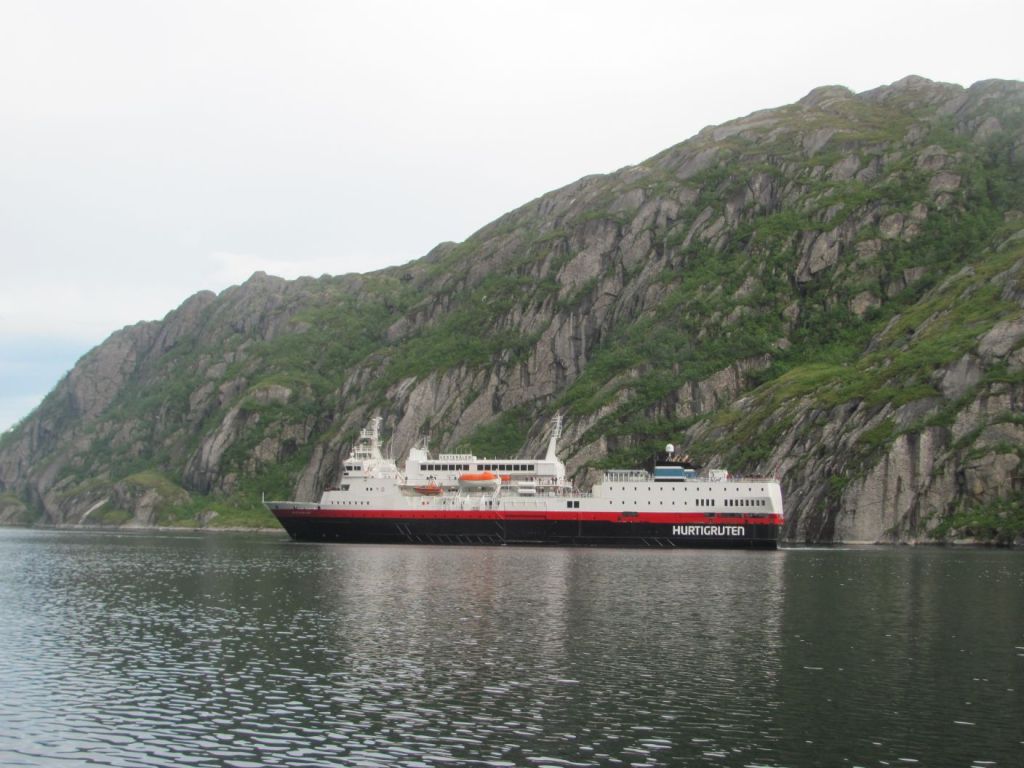
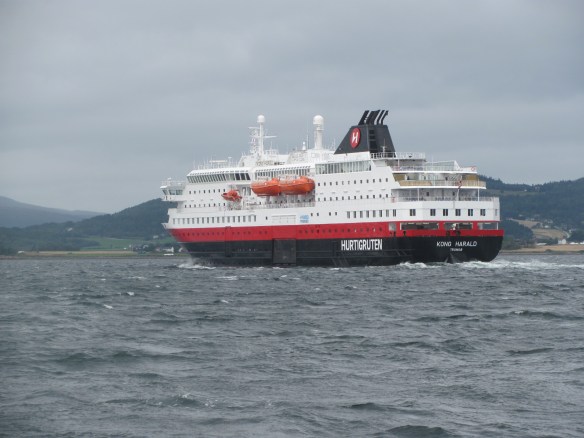
“It’s the Hurtigruten”, I say, peering through the binoculars. “It’s going to pass us to port.”

The Hurtigruten is the iconic Norwegian coastal express service operating between Bergen and Kirkenes near the border with Russia in the far north. Not only does it act as a daily passenger and cargo service, it is also possible to take scenic cruises on it.

“You are pronouncing it wrong”, says the First Mate. “It’s ‘Hurtig-ruten’, not ‘Hurti-grutin’. It means ‘Fast Route’, just like in German.”

The Hurtigruten.

In the late afternoon, we break our journey at the delightful little anchorage of Honningdal.

“It’s such a lovely peaceful spot”, says the First Mate dreamily, as we sip our wine in the cockpit in the evening. “With stunning views of the mountains and the fjords. If only those geese over there would stop being so noisy with all their honking, we could enjoy the peace and solitude.”

“Well, I suppose they are part of nature as well”, I say.

Honningdal anchorage.

“Those sheds on the shore look like they have Boris Johnson haircuts”, I say, pointing to a cluster of boatsheds on the other side of the small inlet. “I think I might send the drone over there and get a shot of them.”

“Careful you don’t hit the power wires”, warns the First Mate.

Does Boris Johnson live here?

We eventually arrive in Ålesund. There aren’t any spare berths at the small marina, and we have to raft up to another sailing boat with a Swiss flag.

“You look familiar”, says its skipper. “I think that we have met somewhere before. And I recognise your boat’s name. Ruby Tuesday. Out boat is called Sol Vita.”

We rack our brains. He gets there first.

“It was in Hanko in Finland”, he says. “Last year. Don’t you remember there was an armed forces flag day? My name is Christoph and this is Solvita. The boat is named after her, by the way.”

My memory stirs. “And we were both visited by the coastguard people as we were the only two foreign boats there”, I say. “They checked our VAT status, being a UK-registered boat. Then they went over to you on the other side of the pontoon.”

“We followed your route around the Baltic States”, Christoph says. “We nearly caught up with you in Riga in Latvia – we were in another marina, but we came to your boat one day to see if you were in, but you weren’t unfortunately.”

“That was probably the time we left the boat and took the bus down to Vilnius in Lithuania”, says the First Mate. “What a pity we missed you.”

“We left the boat in Latvia over the winter”, says Solvita. “I am actually Latvian. This year we have sailed from there, around Sweden and Norway, right to the top of Nordkapp in the far north of Norway. Now we are on our way back again. ”

We’re suitably impressed. That’s about 3600 nautical miles as the crow flies, not counting all the little bays, inlets and fjords they must have gone into. We are lucky if we manage to do half that in a season.

“We do do a lot of long passages”, says Christoph, seeing the looks of astonishment on our faces.

In the afternoon, we take the path to the top of the Aksla hill overlooking Ålesund. There are supposed to be 418 steps. I’ll take their word for it. The view from the top is stunning.

Ålesund from the Aksla viewpoint.

Later we are invited to Sol Vita for drinks.

“I studied law and then medicine at university”, Solvita tells us. “But I couldn’t really settle to a job in those areas. I had always enjoyed sailing ever since I was a little girl, and since I met Christoph I moved to Switzerland to be with him. We have been sailing every summer since then. A couple of years ago I had a go at writing a book. All in Latvian, I am afraid. It’s called ‘Purva migla’, or ‘Bog Fog’ in English, and is about a girl with a dark past who is trying to find herself. She travels far and wide in her quest, but starts to realise that the answers to the question of her past lie back where she came from.”

“It sounds interesting”, says the First Mate. “I like those sorts of books. You should translate it into English sometime.”

Escaping the storm, a Devonian wonder, and a clenched fist

“It’s right behind us”, I call out to the First Mate. “It looks like we are going to get wet.”

We are coming into the small harbour of Leirvik on the northern shore of the vast Sognefjord. A storm is chasing us from the south, and we are trying to get to shelter and tied up before it reaches us. About 200 m behind us we can see the ruffling of the water’s surface as the wind reaches it, our world reduced to a writhing mass of greys and blues. Raindrops begin to fall around us, spattering on the cockpit cover and the cabin roof.

For the last hour or so, we had seen the heavy dark clouds gather over the mountains to the south, and watched them with trepidation as they moved slowly across the fjord, wondering when it would be our turn to be engulfed. This looks like it might be it. But somehow it misses us. At the last moment it veers off towards the east, leaving only the perturbed water and the few raindrops in its wake.

Storm clouds gathering.

“We’re not off the hook yet”, the First Mate shouts back, looking at the radar map on her phone. “There’s another one coming in. I’d say we have about ten minutes to get there.”

I push the throttle lever forward. We enter the small inlet, avoiding the salmon farms to starboard, and motor through the narrow marked channel leading to the harbour. Out of the corner of my eye, I can see the clouds appearing over the surrounding hills. Luckily there is a free space. We loop the lines around the cleats on the pontoon, quickly connect the power cable, pull down the sides of the cockpit tent, and retreat inside as the heavens open and the torrential rain starts.

“Phew, that was close”, I say. “I am glad that we didn’t get drenched. There’s something very nice about being warm and dry inside, listening to it pelting down outside.”

The rain stops in the early morning. We have a leisurely breakfast, top up with fuel, and set off northwards through Tollesundet. The wind is fitful, sometimes filling the sails and giving us a pleasant sail, other times dying to nothing so that once again we have to run the engine.

Catching the wind while you can.

“This topography plays havoc with the wind”, I grumble, as we take a line between the islands of Skorpa and Sula. “It always seems to be against you, whatever way you are going.”

“Just be thankful for the magnificent scenery”, says the First Mate. “And that we have the weather to be able to see it.”

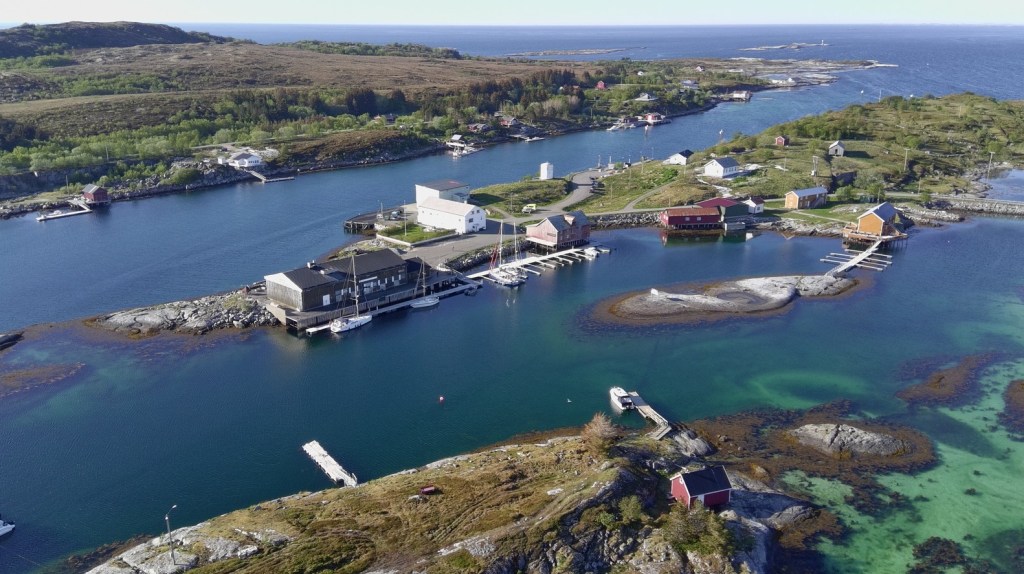
In the late afternoon we reach the delightful little anchorage of Hatløy.

“Let’s stay here for the night”, says the First Mate. “It’s such a fantastic view. And there is no-one else – we have it all to ourselves.”

“Sounds a good idea”, I say. “It’s designated as a nature reserve and landing is prohibited from April to July for the nesting season, but we can stay on board.”

We drop anchor and chill out. A heron screeches from the reeds at the water’s edge, two ducks paddle by, looking expectantly for titbits. A cormorant flies overhead. There is a splash as a fish jumps and disappears again. It’s idyllic.

Anchored at Hatløy.

We carry on northwards the following day. The landscape widens, with more sea room and less feeling of being hemmed in by steep fjord sides. Nevertheless, it is still impressive. We pass the imposing bulk of Alden island with its Norskehesten mountain.

Alden island.

Norskehesten apparently means ‘Norwegian horse’”, says the First Mate. “But I can’t really see a horse in it. Perhaps from another angle. But it certainly is impressive. And look at the way the rock is twisted in this one we are just passing now. It looks a bit like a Swiss roll.”

Swiss roll mountain?

We eventually reach the bustling harbour of Florø. On the way in, we pass the iconic Stabben lighthouse.

Stabben Lighthouse.

“We don’t need to stay too long in Florø”, says the First Mate. “I just have the washing to do and we can stock up on provisions. Then we should press on to Maløy while this good weather lasts.”

The Fisher Boy of Florø.

The next day we enter the Frøysjøen fjord. As usual, there isn’t much wind, and what there is is against us, so we have to motor until we turn eastwards where we are able to catch it on just enough angle to unfurl the sails. Even though we are only able to make three knots, we find it relaxing to sit back and enjoy the scenery without the noise of the engine.

“There looks to be a nice little anchorage coming up”, I say. “Hennøysund. Tucked in behind an island. We can stay there the night.”

“Sounds good to me”, says the First Mate.

It is good. Surrounded by high mountains on each side, it feels as though it is just us and nature. That’s if we ignore the occasional muffled throb in the main fjord on the other side of the island of ship engines carrying cargo or passengers from Florø to Maløy.

“Even in Norway with its small population, you never feel far from ‘civilisation’”, I muse.

Anchored in Hennoysund.

In the morning, just around the corner from our anchorage, we find we are dwarfed by a massive cliff rising straight out of the sea.

Hornelen Sea Cliff.

“It’s the Hornelen Sea Cliff”, says Mr Fairlie in awe. “Nearly 3000 feet high. The highest sea cliff in Europe, by all accounts. Devonian sandstone. At one stage it was a sedimentary river basin. Then when the Baltica plate collided with North America, it was forced upwards.”

“Ah, you and your natural processes trying to explain everything”, says the minister. “I’d forgotten that you had a passing interest in geology. You’ve been reading too much of James Hutton’s ramblings.”

“Well, I have to admit I am a strong admirer of the work of our countryman”, rejoins his companion. “Through observation of the country around him, he came to the conclusion that the components of the land were once formed by the tides and currents under the sea into a consolidated mass, and then raised up out of the deep by unimaginable forces. And if that is true in Scotland, then it must also be true in Norway.”

“But where is God’s hand in all this?”, chides the minister. “Isn’t he the Creator of all things?”

“Far be it from me to disagree with such a learned man as yourself”, answers Mr Fairlie. “But as with any craftsman, He makes use of the natural laws to produce what He wants. It is the calling of geologists such as Mr Hutton to determine what those laws are.”

“Well, whatever its cause, it makes one feel humble just to contemplate it”, says the minister, looking again at the cliff. “We don’t have anything so spectacular in Scotland. I suppose people must have climbed to the top?”

“Apparently, you can walk to the top”, says the First Mate. “There’s a marked path you can follow. There’s a little harbour around the corner you can start from. It takes about four hours to get to the summit.”

“Shall we tie up and have a go?”, I say, tongue in cheek.

“Ten years ago I would have said yes”, she replies. “But now my knees aren’t up to it.”

Mine are the same.

“If the steamship were to stop, I would do it”, says Mr Fairlie. “But I don’t think that there is any chance of that. We need to get to Maløy by tonight. But it was worth seeing. Perhaps I might come back sometime.”

“Rather you than me”, says the minister. “I’m too old for that sort of thing now.”

We eventually arrive in Maløy and find a place in the small marina. There is a huge cruise ship tied up across from us.

Cruise ship, Maløy.

“I suppose that is the modern equivalent of the cruise steamship that your great-great-grandfather was on”, says the First Mate. “But I have read that Norway is bringing in tough regulations in 2026 that will require cruise ships and tourist boats to be zero emissions, particularly in the UNESCO World Heritage fjords like Nærøyfjord and Geirangerfjord. I wouldn’t imagine that they would have worried about that in 1889 with their coal-fired ships belching smoke and other nasty gases.”

“That’s true”, I say. “And I read somewhere that they will even be using sniffer drones to check up on emissions from cruise ships in the fjords. But I wonder how it will affect sailing boats like ours? It’s not easy to use the sails only in the fjords, what with the fallvind and the like.”

“I guess we will have to replace diesel engines with electric ones eventually”, she says. “Some sailing boats are already doing that.”

“And a lot of the ferries that we see around us are already electric”, I say. “Or at least hybrid. They are taking it all very seriously. Good on them.”

The next day we sail for the island of Silda, to the north of Maløy.

“It’s hard to believe that this was the site of a battle between the British and the Norwegians in 1810 during the Napoleonic Wars”, I say, remembering something I had read in the travel guide. “Two British frigates engaged with some Norwegian gunboats based at the pilot station on Silda. The British captured two of the Norwegian boats, while a third was scuttled by its crew.”

“Hey, keep your eyes on where we are going!”, shouts the First Mate as we enter the tiny harbour. “You almost hit that boat!”

Strategically placed at the end of the breakwater is a shapely young woman who seems to have mislaid her clothes. She seems blissfully unaware of the effect of her presence on the psychology of sailors who have been too long at sea. Not that that applies to me, of course.

“I was just concerned that she might be feeling the cold”, I shout back.

Feeling the cold?

Discussion over dinner that evening centres on the challenge tomorrow.

“I have to say that I am not really looking forward to rounding the Statt”, says the First Mate. “I’ve heard so many horror stories about it, it’s making me scared.”

The Statt is a peninsula that juts out into the Atlantic ‘like an angrily clenched fist’, as the Cruising Guide puts it. It is notorious for being dangerous in certain conditions, so much so that an escort service is provided for small boats wanting to round it. In fact, work has started on drilling a tunnel through the base of the peninsula large enough so that ships can sail through it and don’t have to go around it. With the Norwegian penchant for tunnel-building, I am surprised that it hasn’t already been built. Cost, I assume.

“We’ll be OK”, I say, not feeling as confident as I try to sound. “It’s just a question of picking your weather window. And with all this calm weather we have been having, there’s been nothing that could have made it rough.”

We study every weather app we can lay our hands on. One particular one gives the wave heights and wind speeds at the headland at three-hourly intervals. I painstakingly work these out for the week ahead trying to find a slot that has small waves and a southerly wind to blow us north around it as well as following the north-flowing current. Nothing is ideal, but there is a window that is relatively calm, albeit with a wind from the north.

“At least the wind is very low, so I think it should be OK”, I say. “We’ll just have to motor around it. Otherwise, we will have to wait a whole week before the wind changes to the south, and who know what the waves will be doing by then?”

“I hope you are right”, the First Mate says, not very enthusiastically. “How high does it say the waves will be?”

“It’s predicting a maximum wave height of 1.3 m”, I say. “That’s from the top of the wave to the bottom of the trough. And a 0.7 m significant wave height, which is the average of the top third of all waves. That’s not too bad. It’s a bit like the wash from a speed boat passing us. A bit bouncy, but tolerable.”

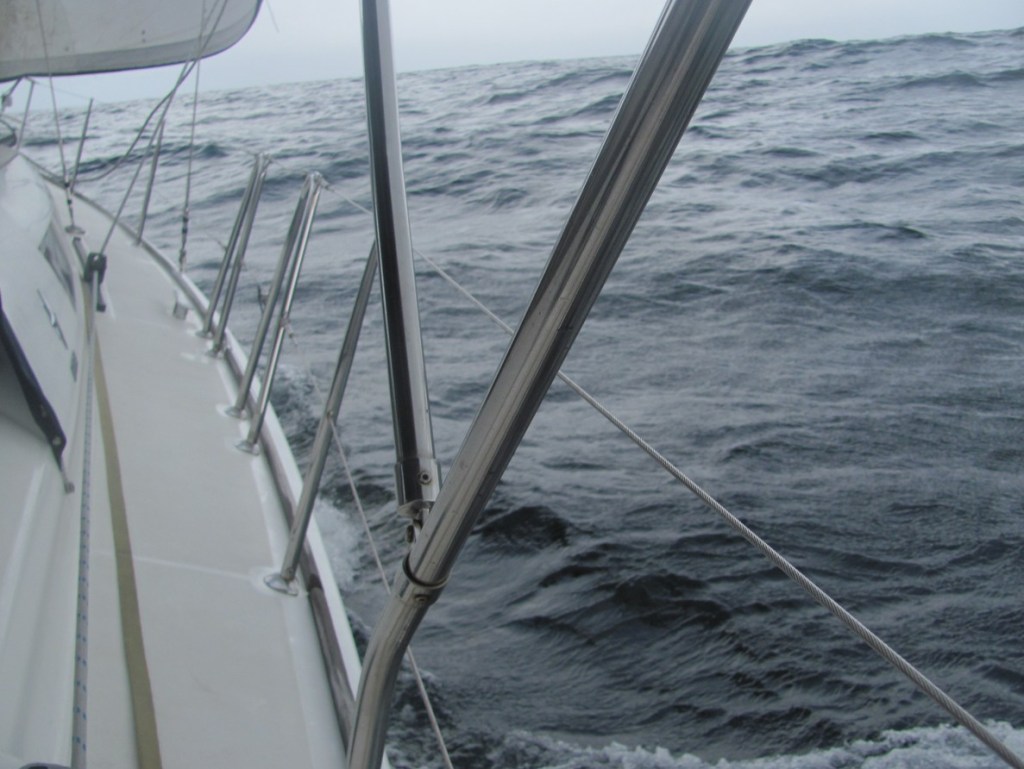
We set off in the morning. The sky is overcast, but at least there is not much wind. The sea is calm, but as we approach, the waves grow slowly in height, and Ruby Tuesday starts to plunge into each successive wave. The clouds thicken and seem to grow darker. A gust of wind rocks us from side to side. Or is it my imagination?

Eventually we reach Kjerringa, the peak at the outermost corner of the promontory. This is where two currents meet and the water is confused, with waves from one stream interacting with waves from the other. Ruby Tuesday pitches and rolls, not sure what is happening. Luckily it doesn’t last long, and we are soon back in more straightforward water.

Kjerringa, on the end of the Stattland penensula.

“We’re over halfway now”, I say.

Slowly but surely the waves subside. Before long we are turning the corner eastwards again, and the water suddenly becomes smooth and the sun comes out.

“It really does generate its own microclimate out there”, says the First Mate. “I read that somewhere, but I didn’t really appreciate it.”

“Well, at least we made it”, I say. “We can relax now.”

“For the time being”, says the First Mate. “We still have two more designated ‘dangerous sea areas’ to go. Godø and the Hustadvika.”

Two royal statues, an iconic church, and a hotel with a view

“Look”, says the First Mate. “You can see the place where we anchored last night, and the bridge that we came under this morning. And I think I can just make out Ruby Tuesday down there.”

We had arrived that morning at the small village of Skjerjehamn, not far from the entrance to the vast Sognefjord. Previously it had been a bustling trading port, transportation hub, and administrative centre, when ships were the most important modes of transport on the west coast of Norway. That all changed with the arrival of cars and the building of roads and tunnels. All that remains now of the settlement is the small harbour and some of the warehouses, one of them having been converted into a restaurant.

Skjerjehamn

We had set off after lunch, and had walked the path from the harbour over moorland to the summit of Vesterfjellet, a local peak overlooking Ånnelandsund. It’s a hot day, so we had packed some biscuits, apples and bottles of water, which we are glad to have when we reach the top.

“This direction is just as spectacular”, I say, pointing to the north. “All those islands and fjords. That big one in the distance must be Sognefjord. That’s where we will be sailing tomorrow if all goes well.”

View from the summit of Vesterfjellet.

On the way back to the harbour, we pass the statue of Olaf V, King of Norway.

Statue of King Olaf V at Skjerjehamn.

“The City of Oslo commissioned a famous sculptor by the name of Knut Steen to create a statue of King Olav V”, a woman tells us. “However, when it was finished in 2006, they didn’t like it as the outstretched arm was too much like a Nazi salute, and they refused to display it. It was put up for auction, and the owner of the local aquaculture company decided that it would fit very well in Skjerjehamn. He put in a bid, it won, and the statue has been here ever since.”

“Olav V had been a popular king, especially as he had been a focus of Norwegian resistance against the Nazis, as well as being a symbol of Norwegian independence”, says her husband, joining us. “So having him give a Nazi salute wasn’t seen as being in the best taste.”

It doesn’t really look like a Nazi salute, I think. His arm is bent, not straight. He looks more like he is waving goodbye to someone. But far be it from me to get involved in national sensitivities.

The next afternoon, we push on towards Sognefjord, stopping at the small town of Eivendvik to stock up with provisions. We decide to anchor overnight in the bay at Rutledal.

“This looks a good spot for fishing”, says the First Mate after dinner. “I think that I’ll have a go.”

With our fairly miserable record to date of catching fish, I am somewhat sceptical of any success. Still, if she wants to waste her time, that’s up to her.

She ties on a spinner, and begins casting.

“I think that I have caught something!”, she shouts after ten minutes. “Come and help me!”

I imagine it to be a piece of seaweed or an old tyre. Instead it turns out to be a fine specimen of a fish. A pollack, to be precise. We manage to land it without it getting away, which in itself is an achievement.

“We’ll have it for dinner tomorrow”, she says. “I’ve heard that pollack are best left for a day or so.”

The First Mate catches a fish!

The next day, we reach Vikøyri, a town halfway up Sognefjord.

Vikøyri.

“The guide book says that there is a traditional stave church here”, says the First Mate. “We should try and see it.”

Following a map the Visitor Information lady has given us, we walk up to the Hopperstad stave church. Unfortunately, a bus load of tourists arrives at the same time.

“Never mind”, I say. “At least we can join their guided tour. It looks like a young history student is doing it again.”

“They always seem so enthusiastic”, says the First Mate.

“They still have all their dreams in front of them”, I reply. “No wonder.”

Hopperstad stave church.

“The church was built around AD 1130”, the guide tells us. “After the Viking Period. Many of these type were built throughout Europe, but for some reason only those in Norway have survived. Out of the estimated 1000 there used to be, only 28 are now left.”

“Do you remember that one we saw in Lillehammer when we were with Ståle and Gunvor?”, I whisper to the First Mate. “We have only 26 to go.”

“Shssssh”, she hisses. “I am trying to listen.”

“You’ll see that the basic structure consists of eight-metre high posts held together with rafters, with vertical planks filling the gaps between them”, the guide continues. “Note that it stands on a stone base, which has protected the wood from rotting. Even so, it fell into disrepair, but luckily it was faithfully restored in 1880s.”

“What do the carvings on the gables signify?”, someone asks.

“I am glad you asked that”, she says. “They are the heads of dragons or serpents. A hangover from Viking times. You are probably familiar with the carvings on the prows of their long-ships, which were supposed to ward off evil spirits, trolls, and even bad weather. When Christianity came along, there was an initial fusion of Christian and Old Norse beliefs, so these dragonheads were supposed to protect the church in the same way as they had done the long-ships. Now, let’s go and have a look inside.”

It’s dark in the church, and it takes a while for our eyes to adjust.

Inside the Hopperstad stave church.

“Miscarried foetuses and children who died before baptism weren’t allowed to be buried in the churchyard”, the guide continues. “So they buried them under these flagstones you are standing on, hoping they would go to heaven anyway. This practice carried on right up to the 19th century, when it was discontinued because of the smell.”

There is an uncomfortable shifting of feet.

“I am surprised it took them several hundred years to notice it”, whispers the First Mate. “I wonder if church attendance was falling off?”

“And over here, there are some runic-like inscriptions”, continues the guide. “They are generally pleas by people for God to reward them with a good harvest or success in business. They are not true Viking runes.”

The next day we push on. We pass Vangnes with its giant statue of Fritjof the Bold, commissioned by Kaiser Wilhelm I of Germany in 1913.

“They certainly seem to like giant statues in these parts”, says the First Mate. “I wonder who Fritjof the Bold was?”

Statue of Fritjof the Bold at Vangnes.

It turns out that Fritjof was one of the legendary heroes written about in the Icelandic sagas, supposed to have lived in the AD 700s. The story is that he was the strongest, bravest and fairest in the kingdom of Sogn, the area we are in at the moment, and where the Sognefjord gets its name. On the other side of the fjord to Fritjof lived the king with his two sons, Helgi and Halfdan, and daughter, Ingeborg. The king and Fritjof’s father went off to war and were killed, so the four children were brought up by a foster family. Helgi and Halfdan eventually took over the kingdom, while Fritjof and Ingeborg fell in love. The two brothers were intensely jealous of Fritjof’s good looks and prowess, so they sent him off to Orkney, burnt his house down while he was away, and married off Ingeborg to an old king of a neighbouring kingdom, Ringerike. When Fritjof came back from Orkney, he befriended the old king, and just before the latter died, was appointed as the carer of Ingeborn and their child. After his death, Fritjof and Ingeborn marry, he becomes king of Ringerike, and declares war on his two brothers-in-law. He kills Helgi, subjugates Halfdan, and becomes king of both kingdoms.

“Sounds like a fairly typical functional family history for a Viking”, I think.

Kaiser Wilhelm I of Germany used to holiday in this area, and was so taken with Fritjof’s story that he decided to have the giant statue made and erected in a prominent place on the Vangnes spit where all passing sailors would be able to see it.

“Wilhelm had pretensions to being a great Emperor himself”, says the First Mate. “So I am not surprised he liked stories like this.”

Towards the end of Sognefjord, we turn right into Nærøyfjorden, our destination. The fjord narrows, with almost perpendicular cliffs on both sides. Trees cling precariously to any nook or cranny they can find. The water is a deep green colour, and so clear that we could see the bottom if it wasn’t 300 m below us. The tallest mountains still have pockets of winter snow and ice nestling on their northern slopes. It’s stunning.

Nærøyfjorden, UNESCO World Heritage site.

“No wonder it’s a UNESCO World Heritage site”, says the First Mate.

We reach Gudvangen, the small town at the top of the fjord. There is only one pontoon for guest boats. Luckily it is empty. We tie up.

“You can’t tie up there”, a girl teach kayaking skills to a group of people calls out. “One of the tourist boats comes in there. Sailing boats can only go on the other side.”

I had been going to tie up on that side originally anyway but it had looked a bit shallow for our keel, so I had chosen the other. In the event, there is 60 cm clearance – not a lot, but enough.

Tied up in Gudvangen.

The elderly gentleman asks the driver of the stolkjarre to stop at the hotel at the top of the pass for lunch. It had been a long morning – the two men had taken the train from Bergen to Voss, then a stolkjarre the rest of the way to Gudvangen.

“Stalheim Hotel”, says Mr Fairlie, his travelling companion. “It was only built four years ago. I’ve heard that you have the most exquisite views from here. Let’s see if we can have a table in the garden. It’s fine enough weather to sit outside.”

“I have never seen such natural beauty in my life before”, says the elderly gentleman, as they are shown a table near the edge of the precipice. “What a most wonderful valley! I am sure that nothing else in Europe can surpass it for grandeur.”

Stalheim Hotel at the head of Nærøyfjord.

“I think I will have the prawn sandwich, please”, says the First Mate to the waitress. “And a coffee.”

“Me too”, I say. “Except I’ll have tea. Earl Grey, please.”

We are at the Stalheim Hotel at the top of Nærøyfjord. Earlier in the morning, we had left the boat in Gudrangen and had taken the No. 950 bus up the valley to the hotel for lunch.

“It’s amazing to think that my great-great-grandfather was here in this very place in 1889”, I say to the First Mate. “Admittedly, it’s not quite the same hotel, as it has burnt down no less than three times – in 1900, 1902 and 1959. This one dates from 1960. But the view will be the same.”

“Well, it certainly is stunning”, says the First Mate, as our lunch arrives. “But I am a bit surprised that he came on this cruise without his wife. I wonder why that was? Do you think that they had had a row?”

“It was quite acceptable for ministers and professional men to go on cruises without their wives”, ChatGPT tells us. “It was more to do with the cost than anything untoward going on. A cruise like this would have cost £10 in those days, plus a few pounds extra for side excursions. With a minister’s annual stipend for a rural parish being around £150, it would have been quite expensive.”

“Men always seem to get the privileges”, she sniffs. “I wonder what she thought about it?”

Lunch overlooking the Nærøyfjorden.

“Have you heard how your son Quinton is?”, asks Mr Fairlie, taking a sip of his tea. “Where was it that he went again? Canada, wasn’t it?”

“Well, it was Canada”, the elderly gentleman replies, the emphasis on the past tense. “At first. He managed to get farm work there for a while, but he had an accident in a threshing machine and lost some fingers on his right hand, so he wasn’t able to work for a while. Then the Americans brought in their Homesteading Act in which 160 acres of land were given free to those who moved there. It was the time the Northern Pacific Railroad was being put through, so the area was opening up. So he decided to move down to North Dakota, build a house, and make a living from farming. By all accounts he is doing quite well there.”

“It’s funny how both your boys ended up farming”, says Mr Fairlie. “What with you being a minister and all. None of them interested in being a man of the cloth, then?”

“They used to spend a lot of time on their uncle’s farm in Ayrshire when they were youngsters”, the elderly gentleman answers. “My wife’s brother Quinton. That’s probably where they got it from.”

“Well, you have to admire them for leaving the Home Country”, says Mr Fairlie. “More opportunities there than Scotland, at least. I am sure they will both do well. Anyway, if you are finished, we had better move on. We have to negotiate the Stalheimskleiva road down from here now before we get to Gudvangen. It’s very steep.”

The old Stalheimskleiva road.

“It certainly is steep”, says the First Mate. “It’s bad enough walking down. Imagine taking a horse and trap down here. Look at the hairpin bends.”

“I read that they often used to walk down steep parts themselves, to spare the horses”, I say. “But I agree. If the horse slipped or skidded everything would just go over the edge.”

Taking a break on the Stalheimskleiva road.

Halfway down we stop to look at the Sivlefossen waterfall.

The Sivlefossen waterfall.

Eventually we reach the bottom with everything more-or-less intact, apart from some protesting knees.

“Sometimes I feel I am getting too old for this sort of thing”, I say.

“Me too”, says the First Mate. “But don’t worry. Here comes the bus. We’ll be back in Gudvangen in no time. Just be thankful we are not on a stolkjarre.”

A long tunnel, a retreating glacier, and a preserved manor house

“It’s incredible the amount of work that must have been done to drill this tunnel through the mountain”, says the First Mate. “And to think that we are going right underneath a glacier.”

We are on the bus to the town of Odda at the head of Hardanger fjord. We had left Haugesund the day before, and had had a pleasant sail with favourable winds up the Hardanger fjord, arriving in the picturesque village of Rosendal in the evening. This morning we had caught the bus and snaked our way along the coastline until the mountain sides had become so steep that the road had had to take other measures to continue.

“Yes, the Folgefonna Tunnel”, I say. “It’s more than 11 km long. That’s a lot of rock to move.”

Driving through the Folgefonna Tunnel.

We eventually emerge from the tunnel, our eyes blinking as they adjust to the light. Initial impressions are not positive. The first thing we see is a huge industrial complex on a small island in the middle of the fjord. It turns out that it is a Boliden zinc smelter.

The Boliden zinc smelter at Odda.

“You might have thought that they could have sited it somewhere it can’t be seen”, sniffs the First Mate. “Such beautiful scenery, and to be spoilt by this eyesore.”

“I suppose they needed to have somewhere near the water so that things could be shipped in and out”, I say. “And for the hydro-electric power to drive the plant.”

The bus arrives in the town centre and we clamber out.

“It’s lunch time”, I say. “There’s a small café over there. What about that?”

—–

The elderly gentleman picks up his pen, dips it in the inkwell, and begins to write.

“My dear Meg”, he starts. “Here at Odda since yesterday afternoon …”

Poor Meg. His eldest daughter. The others had all flown the nest, but not her. It had always been a puzzle to him as to why she had never found a husband. Educated, attractive, one would have thought the young men would have been queuing up. He had even used his influence to obtain a place for her as a governess with a wealthy family in the south of Scotland. But she had remained resolutely single. No grandchildren from her. However, every cloud has a silver lining, he thinks – he enjoyed having her around the Manse, helping with parish matters. She was good at it. And it meant that he could have this break and get away to see another part of the world.

He had enjoyed the cruise so far. The sail down the Firth of Forth from Edinburgh had been calm and pleasant. Despite this, he had felt queasy when they had reached the open sea, and had retired early. The next day hadn’t been much better, so he had dosed himself up with whisky and water and had another early night. On the third day, he had almost recovered and had stood on deck admiring the entrance to the Hardangerfjord before breakfast. Since then, he had been feeling as good as ever. So much so, that when they had arrived in Odda at the top of the fjord that afternoon, he had taken a ride in a stolkjarre up to Lake Sandvinvatnet and had seen two waterfalls, the Vidfoss and the Hildalfoss, and, across the lake, the mighty Folgefonna Glacier.

—–

“Come on”, I say, picking up the bill and going to pay. “Let’s get moving. There’s a nice walk along the river that will take us up to the lake.”

“Ready when you are”, says the First Mate. “By the way, what is a stolkjarre?”

“It’s a small two-wheeled horse-drawn buggy just enough for two people with a driver sitting up behind”, I answer. “They were common in Norway before cars arrived.”

As we head towards the river, we notice an outdoor exhibition of Knut Knudsen, a renowned Norwegian photographer born in Odda. He had made his name in the last half of the 19th century taking photographs of local landscapes, his work making a major contribution to the growing sense of a Norwegian national consciousness.

“Look, there’s one of a steamship anchored in the bay just where we came in”, shouts the First Mate. “That could have been the one that your great-great-grandfather was on.”

Steamship anchored at Odda (by Kurt Knudsen, date unknown). No zinc smelter!

It had become fashionable in Britain in the late 19th century for those that could afford it to take advantage of the growing number of steamship companies to tour the fjords of Norway. My great-great-grandfather had taken one in 1889, and luckily had written letters back to his eldest daughter Meg describing his trip. Even more luckily, these letters had found their way down the generations to us. We had decided over the winter to follow as much of his trip as possible during our own voyage.

We follow the river crashing and tumbling over the rocks, and eventually reach Lake Sandvinvatnet. We stand in wonder looking at the same scene that my great-great-grandfather had seen 136 years previously. To the left are the two waterfalls he mentions. But no glacier!

Lake Sandvinvatnet, Odda.

“You need to walk around the western shore of the lake”, the woman in the Visitor Information had told us. “To a small hamlet called Jordal. The glacier doesn’t come down as far as it used to, but you can see it from there.”

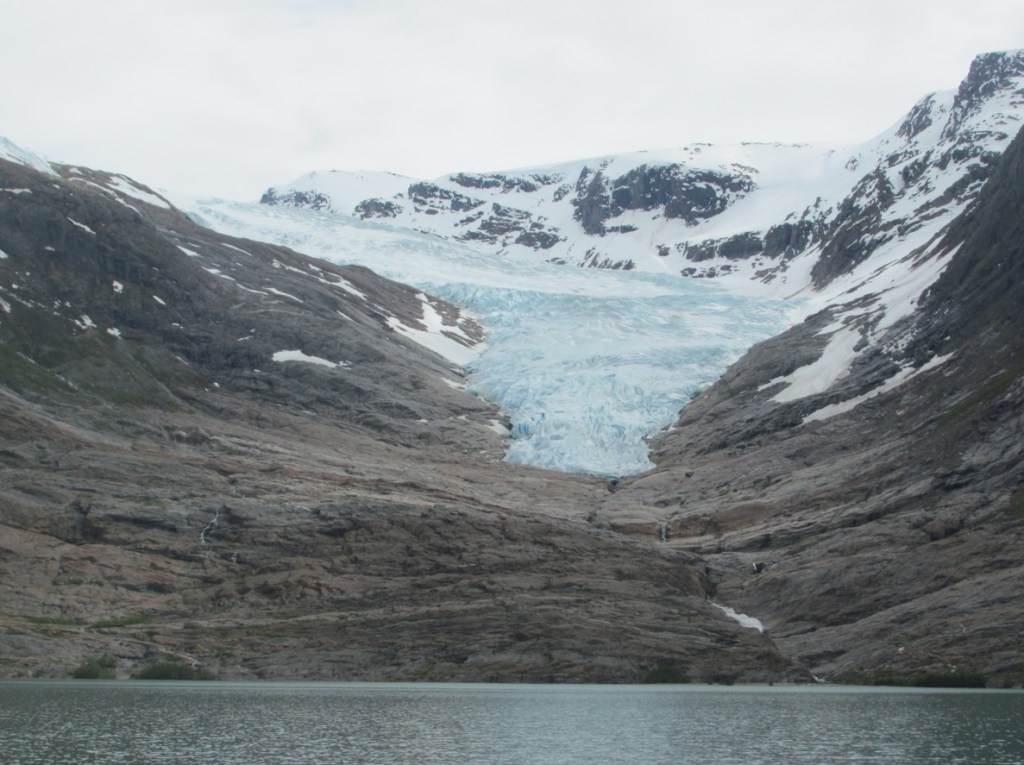
Sure enough, at the head of the valley, we see the mighty river of ice topping the rock like icing on a cake.

The Buarbreen arm of Folgefonna Glacier from Jordal.

“It’s hard to believe that when my great-great-grandfather was here in 1889, that he would have seen much more of it than we are seeing it now”, I say, as we walk back to Odda. “Proof of climate change, if ever one was needed.”

Retreat of the Buarbreen glacier.

In the morning, we visit the museum in Rosendal. First up there is a film on how the Hardangerfjord was formed.

“Its geological history starts about 400 million years ago”, we learn. “Then, the three continental land masses of Laurentia, Baltica and Avalonia all collided with each other, resulting in the pushing up of mountains from the southern part of the United States right across to Scotland and Norway, with younger rocks being forced underneath the older rocks. In Norway, this created a huge fault along what is now the Hardanger fjord, with the oldest rocks generally on the south-east side and the younger rocks on the north-west side.”

“It’s pretty amazing, isn’t it?”, whispers the First Mate in my ear. “I am glad I wasn’t around when all these collisions were going on. Think of the insurance!”

“Over time, water eroded this fault line, weakening it”, the film continues. “When the Ice Ages came, glaciers formed in this huge fissure, grinding it and scouring it as they moved slowly down towards the sea. Eventually the ice started to melt, with meltwater running under the ice and further gouging out the fissure, resulting in fjords that were around 1000 m deep. Sediments from the erosion filled in some of this, so that the Hardangerfjord is now around 800 m deep for much of its length.”

It’s fascinating stuff. It’s difficult to imagine the power of the processes that can move massive amounts of rock around like sand in a sandpit, sculpting new landscapes as they go. Albeit very, very slowly.

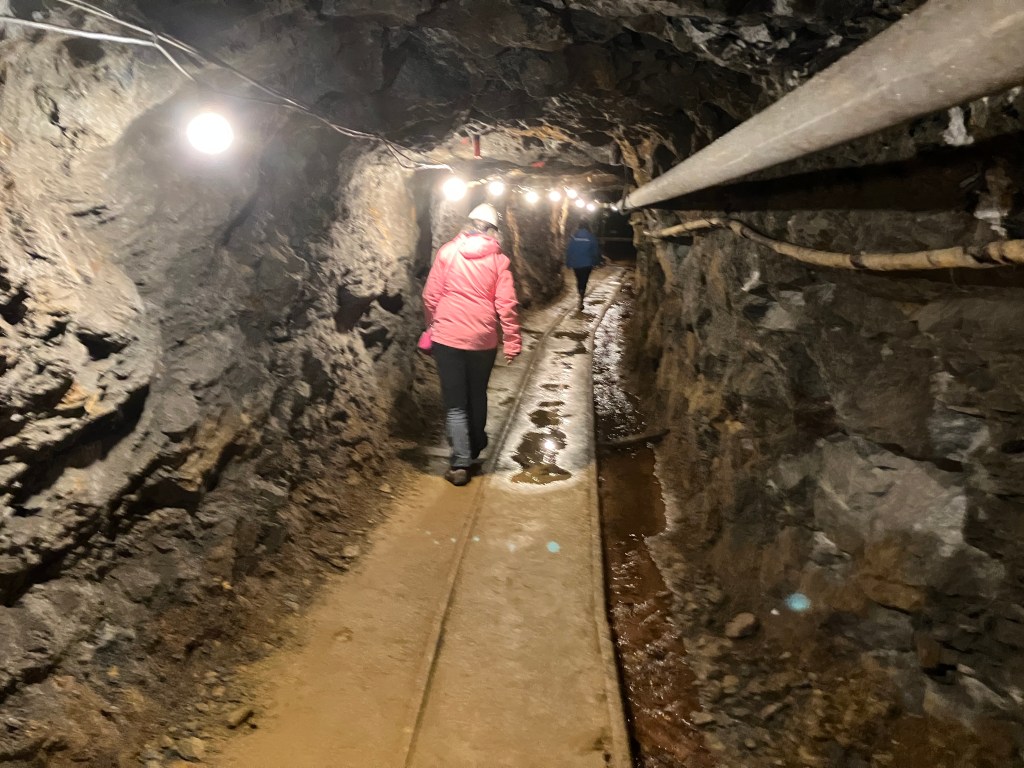
Undersea topography of the Hardangerfjord (from fjords.com)
“I am glad you enjoyed it”, says the friendly lady at the Visitor Information Office. “Now, the other place you should visit while you are here is the Rosendal Baroneit, a 17th century manor house. It’s just a short walk from here. You can’t miss it.”

We walk up the road to the east of the village, and eventually find a tree-lined avenue.

Rosendal Baroneit.

“We do guided tours in both Norwegian and English”, says the young man at the ticket booth at the gate. “But unfortunately there is only one tour left today, and it is in Norwegian. But perhaps if you ask the guide nicely, and if the other people agree, he might do it in English.”

We’re in luck. No-one objects.

“We actually prefer English”, says one woman as an aside to the First Mate. “My parents are visiting us from Kazakhstan and they speak more English than Norwegian.”

“Back in the 1600s, there was once a  Danish nobleman by the name of Ludwig Rosenkrantz who married the richest heiress in Norway, Karen Mowat”, the guide tells us. “The couple were given the farm as a wedding present from her father, who had more than 500 farms in western Norway. They decided that they liked it so they built the manor house. It was finished in 1665. Shortly after Rosenkrantz was awarded a baronetcy by the King of Denmark, Christian V, the only one of its kind in Norway.”

He takes us through to the library. Ancient tomes line the walls.

“I wonder if anyone has read them all?”, whispers the First Mate. “Or do you think they are just there to impress people?”

“Titles were abolished in Norway in 1821”, the guide continues. “Title holders were allowed to keep and pass on their assets, and keep using their titles for their own lifetimes. But the title ceased when they died and no new ones were allowed to be created. The house remained in private ownership until the 1920s, when it was donated to the University of Oslo. Now it is preserved as a museum of an important part of Norway’s cultural history.”

We are taken through each room in turn – bedrooms, dining rooms, drawing rooms, ballrooms, ladies rooms, and the more mundane kitchens.

Rosendal Baroneit.

“Well, you certainly get an idea of how the other half lived”, says the First Mate. “It has a certain appeal. You know, one of my wishes when I was younger was to have a house with a turret.”

“Perhaps we can have one built”, I say. “Then I could lock you in it like Rapunzel.”

“Well, that is the end of the tour”, says the guide. “I hope that you enjoyed it. While you are here, I suggest that you see the gardens. They are supposed to be the finest Victorian gardens in Norway. The roses are especially beautiful.”

Roses at Rosendal Baroneit.

“You’ll never guess who I have just had a message from”, says the First Mate checking her phone as we walk home. “Simon and Louise. They have just arrived. They saw on their AIS that we were here, and thought that they would pop in too. I’ll invite them in for a café und kuchen.”

“There are strong winds and rain forecast for tomorrow”, explains Simon. “This looks like a good place to sit them out.”

The café und kuchen leads to dinner, where the conversation turns to the state of the world.

“You know, I can’t understand why we haven’t evolved beyond wars and strife by now”, says Simon. We all know that they are evil and unnecessary, yet we still seem to have them. Why?”

“Ah, you must subscribe to the Enlightenment idea of continual human progress”, I say. “Human affairs are always supposed to keep improving. The Stephen Pinker idea. I used to too, but after reading too much of John Gray and looking at what’s going on in the world, I am having second thoughts.”

“But you would think that any political system that was predisposed to wage war would ruin its economy so much that it couldn’t survive and would get weeded out”, he replies. “Just like unsuccessful reproductive strategies in biology.”

“It’s an interesting point”, I say. “But I am not sure that human affairs work like that. Look at the Roman Empire and most other empires in history. They were able to keep expanding because the countries that they conquered and bought under their control provided food and men for them to keep expanding. That was able to keep going for quite a long time, but eventually the costs of administering such a large empire outweighed the benefits and it collapsed. A bit the same with the British Empire.”

“But why haven’t we learnt from history that that is what happens in the end, and just not bother”, says the First Mate. “WW2 showed us that war and empire building was pointless, and that if we had a system of rules that applied to all countries big or small, then we would all benefit. So for the last 70 years or so, we have had peace in Europe and everyone has prospered.”

“Unfortunately, our current leaders seem to have lost sight of that”, says Louise. “There seems to be a move back to the authoritarianism that we saw in the 1930s.”

“It’s an interesting question”, says Spencer later over a nightcap. “Whether you humans should evolve towards greater cooperation rather than warfare, I mean. I think that It is all about raw power and prestige, and not really about devising better systems. Your leaders always want to leave a legacy that gives them prestige in the history books. If they believe they have the power to achieve that, then they will try and do it. Putin has visions of being a second Peter the Great in reunifying the old Soviet Empire, but it looks like he might have overestimated his power to do it. Trump seems to want an American Empire of the USA, Canada, Mexico and Greenland. It remains to be seen if either has the real power to achieve either of those aims.”

“The Law of the Jungle”, I say with a sigh. “Survival  of the Strongest.”

Crossing the Skagerrak, a blind alley, and a dodgy radio aerial

“We need to get an early start tomorrow”, I say. “The wind is from the north-west from about midnight, which is good for us as it will be on a reach and it should carry us more southards. The problem is that it is forecast to go then around to the south-west at around noon, which will then blow us north. So we need to get as much of the north-west wind as we can. I suggest that we leave at 0300 just as it gets light.”

We are planning the crossing across the Skagerrak from Sweden to Norway, a notorious piece of water that is essentially open sea. Depending on where we make landfall on the Norwegian coast it could be a distance of 60 to 90 nautical miles. As we are then heading south along the Norwegian coast and around the bottom, we want to get as far south in our crossing as we can.

“Ugh, I don’t like these early starts”, says the First Mate. “But I guess we have to do it.”

“Once we get going, you can go back to sleep”, I say.

We edge our way out of the harbour in the half dark, and with little wind in the protected area of Strömstad, we motor clear of the rocks and skerries north of the Koster Islands before raising the sails. As forecast, the wind picks up and we sail on a fast beam reach. Looking back, we see the sun begin to peep above the horizon.

Sunrise over Strömstad.

“It’s times like this that I really love about sailing”, says the First Mate. “It’s so beautiful. Now, if you don’t mind, I am going to try and get a bit more sleep. Let me know if you need anything.”

“Just a cup of tea before you go”, I say.

The land disappears out of sight behind us, and Norway is yet too far to be seen. We are alone on the sea. The miles slip effortlessly under the keel, interrupted only by the passing of the ferry from Kiel to Oslo.

At mid-day, the wind drops to almost nothing. We consider starting the engine, but moments later, the wind starts again, this time from the south-west. Just as predicted.

“I’m always amazed how quickly these wind changes can occur”, says the First Mate, awake now. “You’d think that the change would be much more gradual than that, going around slowly. But it often happens all of a sudden.”

“I guess we must be at the boundary of two airstreams moving in different directions”, I say. “We would need to look at the wind map.”

As anticipated, the change in wind direction means that we will be pushed further north now. I do some quick calculations and work out that we should be able to make landfall at Risør, further north than I had hoped, but not too bad. By all accounts it is a pretty town.

Soon we are edging our way through the islands and skerries guarding the entrance to Risør harbour and tie up on the outside of the L-shaped pontoon.

Tied up in Risør harbour.

“You need to report your arrival to the police if you have just come from Sweden”, the couple on the American-flagged boat in front of us tell us. “As well as the Customs. They came down to inspect us earlier in the afternoon. Luckily we had declared everything and paid the duty on it.”

We had heard that the Norwegian Customs were tightening up on the entry of foreign boats into Norway, and that it was highly advisable to be proactive and up-front in registering your arrival and declaring what you are bringing into the country. We had just heard a story of a British boat which had been heavily fined in the previous week for not completing their formalities correctly.

We had already declared online the small amount of alcohol we had in addition to the meagre limit we were allowed. I spend the rest of the day trying to phone the police in Oslo, but no-one seems interested. Eventually I reach the local police for the area.

“That’s fine”, the young-sounding officer on the other end says. “I’ll make a note of your arrival, and send you an email to confirm that you have entered correctly. Let me just find out if Customs want to come and see you. They are just in the next room.”

“No, they don’t need to see you”, he says on his return. “You are free to sail in Norway now. But don’t forget that if you want to leave your boat here over the winter that you need to ask them formally for permission after six weeks from the date of entry.”

“Well, that was all very easy”, says the First Mate, with a sigh of relief. “I thought they would at least come and search us, after what the Americans told us. We could have been real smugglers for all they know.”

Risør is a picturesque little town with all of its houses painted white. It has a strong maritime history, with many wooden boats being kept and maintained here, and an international wooden boats festival every August.

Risør.

We climb up to the Risørflekken, a patch of bare rock painted white, overlooking the town. The story is that it was created by Dutch sailors in the 17th century as a navigational aid, and is still visible several miles out to sea. Its white colour has been maintained ever since then.

“Not quite”, says the First Mate. “I read somewhere that they painted it black during the Napoleonic Wars to stop the English boats from seeing it.”

In any case, it gives a good view over the town and the harbour. We sit for a while and watch the comings and goings of the small boats.

Risør harbour from the Risørflekken.

“Did you see that there is a pub here called ‘The Peterhead’?”, says the First Mate on the way back.

I had seen it. Peterhead is a major fishing port in north-east Scotland, where we live, and where we had kept Ruby Tuesday for a winter during the covid pandemic.

“I asked the landlord how it came to be called that”, she continues. “Apparently it was because of the strong timber trading links between Risør and Peterhead in the 18th and 19th centuries. A lot of Norwegian pine was taken from here to be used for shipbuilding and house construction in Scotland.”

The Peterhead Bar in Risør.

The next morning, we head southwards from Risør. The wind is now from the north-east, and the Norwegian current is also flowing southwards parallel to the coast, so we have an effortless run down on the genoa only, passing Arendal, Grimstad and Lillestad. Past that, we have decided to take the Blindleia route, the inner route through the islands off the coast.

“The name translates as the Blind Alley”, I say. “There are a lot of nice anchorages on the way. The only thing is that it is very narrow in places, with the occasional sharp turn, so we will need to take it carefully. There is also a bridge at the beginning that has only 19 m clearance, which is a bit risky for our 18 m, but luckily we can join it a few miles further down. Better safe than sorry.”

“There seems to be a nice looking anchorage just close to where we join it”, says the First Mate. “It’s called Mortensholm. We could anchor there, chill out, and stay there the night.”

Mortensholm turns out to be a beautiful sheltered little inlet surrounded by steep rock faces and forest. Three or four other boats are already in there, and there isn’t much room for us, particularly as there is a large shallow area in the middle we must avoid. We find a place between two other boats and drop anchor. But our swinging around the anchor brings us very close to one of them, and the occupant glares at us, his privacy disturbed and his boat in danger. A small Jack Russell bounds onto the deck and barks aggressively.

As a clever forestalling manoeuvre, the First Mate engages the man in conversation. She’s good at that. It turns out that he has worked in Africa, and knows Zambia well. We have an instant rapport, and the imminent collision is forgotten.

“I was working for a mining company there as an engineer”, he tells us. “Diamonds. We were looking for diamonds. I was in South Africa, Namibia and Zimbabwe too. Eight years in total, but in the end I decided to come back. There’s something about Norway that I like. I bought myself a boat and I spend the summers just exploring here and there. If I like a place I stay a bit longer; if I don’t, I just move on. Charlotte here keeps me company.”

Hearing her name, the Jack Russell wags her tail in agreement.

“It’s funny, isn’t it?”, says the First Mate to me later. “I haven’t thought about Zambia for years, but here we have been talking about it in the last two blogs.”

In the morning, we set off southwards along the Blindleia, passing through narrow gaps only a bit wider than the boat and only a few centimetres deeper than our draft.

Gently does it!

We pass the small island of Småhølmene, the focus of a book we had both read over the winter called Island Summers, by Tilly Culme-Seymour. In it the author describes how her grandmother, a descendent the Norwegian shipping family, Olsen, buys the island just after WW2 in exchange for a mink coat, and, in true Norwegian fashion, builds a wooden cabin on it for summer holidays. She and her family then come every summer to escape their hectic, albeit somewhat privileged, lifestyle in England and enjoy the peace and freedom that their Norwegian island offers, a tradition that continues for at least three generations. It’s a charming enough story, at least the first part, giving a glimpse of relaxed Norwegian summers enjoying nature, fishing, swimming, sunbathing, cooking and eating. However, it seems to lose its way towards the end when the author and her boyfriend decide to stay the winter in the cottage, but in reality are there only from March to May, hardly the winter, even in Norway.

Making our way through the Blindleia.

We continue to weave our way through the rocks and islands of the Blindleia, through tiny hamlets clinging to the banks on both sides, and eventually reach Mandal, the southern-most town in Norway, at the mouth of the Mandalselva River. Mandal built its wealth on the back of salmon fishing and timber trading in the 1700s, and still has a well-established, self-contented charm about it, with its white-painted wooden houses and beautiful golden-sanded beach.

Main Street in Mandal.
Mandal beach.

We still have the infamous Lindesnes and Lista capes to negotiate. These two rocky headlands where the waters of the Baltic and the North Sea meet have been designated ‘Dangerous Sea Areas’ by the Norwegian authorities, as ferocious winds and high waves can build up suddenly, particularly from the predominant south-west. They are not to be taken lightly.

Luckily for us, the winds have gone round to the east, and are forecast to stay that way for several days. We need to make the most of them to go around the capes and as far as we can up the west coast before they turn.

In the morning, we set off from Mandal and head westwards, using only the genoa again and not the mainsail, due to the risk of the latter gybing. We had just heard a story of a boat the previous week which had gybed accidentally going around the Lindesnes due to a sudden change in wind direction, which had damaged its mast. Even with only the genoa out, we still make 7 knots, so we don’t complain.

In the event, we pass the Lindesnes and then the Lista without incident. The seas are choppy, but not dangerous.

Rounding the Lindesnes.

“Well, that wasn’t too bad”, says the First Mate. “After all I read about them, I was a bit worried that it was going to be pretty rough. But that was tolerable.”

We stop for the night at the small island of Hitra, and its beautiful harbour of Kirkehamn, so named after its iconic white-painted church standing on a small promontory jutting out into the harbour. As luck would have it, there is a wedding in progress, and the small marina is full of the motorboats of the guests. We have no option but to tie up on the far side of the harbour against some old tyres with no facilities or power.

Tied up in Kirkehamn.

“It’s only for a night”, I say. “But we can walk around to the church and restaurant and have dinner there to make up for it.”

The iconic church in Kirkehamn.

In the morning, the easterly winds are still favourable but are forecast to change in a couple of days, so we decide to leave at 0300 to make the most of them and to sail all the way to Tananger, a distance of more than 60 NM.

“The last few days have been quite long sails”, says the First Mate. “I’ll be quite glad when we get to Tananger, so that we can chill out a bit. But it is great that we have finally managed to get to the west coast of Norway in good time.”

Ruby Tuesday approaching Tananger.

We make it to Tananger in late afternoon. The wind is strong and it makes tying up to the jetty difficult, but there are several helping hands and soon we are secure.

On the way in, I had noticed that the VHF aerial on top of the mast was swinging from side to side, even though it still seemed to be working. The next morning, I send the drone up to have a look and take some photos, but it is still not clear what exactly has happened.

A wobbly VHF aerial.

“My guess is that the retaining nut on the bottom has worked itself loose”, I tell the First Mate. “But it seems to be still attached at least. We’ll have to find someone who can go to the top and have a look at it. I’m too old for that sort of thing.”

I phone every boat repair company in Tananger, but none have free time to be able to do it as it is the start of the boating season in Norway. Eventually, I find someone north of Bergen who says that he can look at it.

“Bergen?”, says the First Mate. “But we won’t be there for at least two weeks. I hope that it stays on until then!”

So do I.

A cement town, a wartime evacuation, and unexpected winds

“You can leave your car with a friend of mine”, says Ingemar, over a beer. “He has a big barn, so it will be under cover.”

We had met Ingemar on the Danish island of Christiansø last year, and had sailed along with him to Limhamn marina on the outskirts of Malmö, where he was also storing his boat over the winter. Limhamn was where he had been born and grown up, so despite now living in the south of France, he knew the place and its people well.

“It’s better than leaving it at the marina, where it is likely to get covered in salt spray from the wind”, he continues. “I always leave my motorhome with him.”

He has a large motorhome that he uses to travel around in when he is not sailing. We had been most impressed with it – it is fitted with state-of-the-art gear, and even has a small garage in the back of it in which he keeps his SmartCar for travelling around locally in when he reaches his destination.

A home away from home? (Similar to, but NOT Ingemar’s mobile home.)

The next day, I follow him to his friend’s place and park our car in the barn. His motorhome is already there. Several other cars are also in the barn, some classic, some covered in dustsheets. Our car will have others to talk to.

“Your car will be fine here”, says Ingemar’s friend. “I won’t move it from its place. Remember to disconnect your battery so that it doesn’t go flat.”

On the way back to the marina in his SmartCar, Ingemar talks about the local history of the area.

“Limhamn actually means Lime Harbour. There was a huge quarry, the Limhamns Kalkbrott, from which they used to extract limestone and take it by train to the harbour where it was converted into cement. I can remember as a young boy being woken every morning by the huge explosions as they blasted out the limestone. Our whole house shook. The cement was shipped all over the world – the ‘Christ the Redeemer’ statue in Rio de Janeiro was actually made using Limhamn cement.”

“Do they still make it here?”, I ask.

“Not any more”, he says. “Nowadays, most of Sweden’s cement is made on Gotland. They have turned the quarry here into a nature reserve with a lake in the middle which attracts wildfowl and other animals. Apparently the nature reserve has one of the very few populations of the European green toad left in Sweden. Look, the observation point is just off here. I’ll take you to see it.”

We stand on the edge of a giant crater and look down at the small lake and regenerating vegetation. On three of the sides of the rim are new-build housing areas, and on the fourth is the motorway to the Øresund Bridge.

Limhamns Kalkbrott.

All that material removed from the earth and used to make the cement to construct the hallmarks of modern civilisation, I think.

“Ironically, they have to keep pumping water out of it so that the whole area doesn’t become a lake”, says Ingemar. “It makes you wonder how sustainable it will be in the long run.”

—-

We set sail the next morning. We are a little nervous, not only because this is our first sail of the season, but also because it is the first proper test of everything on the boat after the winter repairs – particularly the engine which had had the heat exchanger removed. Will it all function, or did I forget to reassemble some vital bolt or screw, I wonder.

But everything works as it should, and we are soon sailing merrily northwards along the Øresund. It is just as well, as we had arranged to meet three other boats by a specific date in the small village of Smögen some 200 miles away well up the west coast of Sweden, and we already don’t have much time to get there. But at least we are finally on our way.

“Look, there’s Kronborg Castle over there”, says the First Mate, pointing to an impressive looking structure on the Danish side. “The town nearby is Helsingør, where we used to catch the ferry across to Sweden the times we drove to Stockholm.”

Kronborg Castle, Helsingør.

We cross the shipping lane at right angles to reach the Danish coast. Now the wind is on the nose, and we have to furl the sails and start the engine. Eventually we reach our destination for the night, the small town of Gilleleje on the north coast of the island of Sjælland.

“It looks like we’ll be here for a few days”, I say, perusing the weather charts and forecasts in the evening. “Strong north winds and lumpy seas are forecast for the next three days at least. We can’t sail into those.”

“Well, I am sure we can find enough things to do here for a few days”, says the First Mate. “It seems a nice little place. I read that there’s a good fish shop here with fresh fish from the fishing boats.”

Looking for fresh fish in the Gilleleje fish shop.

In the morning, I walk over to the shower block for my customary shower, taking with me the card we were given to access and pay for the toilets and showers.

“I am not sure how much money is left on the card”, the First Mate says. “I had rather a long shower last night, and I may have used quite a bit of it. But there is definitely some left.”

Outside a group of people are busy doing aerobics, led by an athletic hunk in his twenties.

“Legs up and twist”, he chants. “Arms straight in front, and bend. One, two, three four.”

Inside, I undress and wave the card in front of the reader. The shower starts. I stand underneath it and soap myself up. After one minute there is a click, and the water stops. I wave the card again in front of the reader. Nothing. There is a beep and a message appears on the reader display.

“Insufficient funds on this card to continue.”

Consternation! Dripping soapsuds and shampoo, I have no way of rinsing them off. The machine for topping up the card is at the yacht club, 100 metres away. And I can’t put my clothes on top of wet suds anyway.

The brilliant idea occurs to me that the only way is to rinse myself off at one of the basins in the common washroom. But what if someone comes in? I have to take the risk.

Starkers, I stand on my towel and slosh myself with water from the sink. The aerobics chanting outside ends, and there is the sound of the outer door opening. I just manage to wrap my towel around myself before the washroom door opens.

I avert my eyes from the curious gazes of the Athletic Hunk and several other sweating faces.

“Shower not working”, I mumble, pretending to be a foreigner not used to Danish bathroom technology. No one looks convinced.

The Athletic Hunk waves his card in front of the reader. The shower spurts out water perfectly. I pretend not to notice, dress, and beat a hasty retreat.

“I have a bone to pick with you”, I say to the First Mate when I get back to the boat.

“I told you there might not be much on it”, she says unsympathetically. “You should have topped it up before you went in.”

In the afternoon, we visit the Gilleleje museum, the central focus of which is the evacuation of Danish Jews to Sweden in October 1943. Two of the museum staff are sitting outside the café in the sunshine drinking coffee.

“The Jews in Denmark were left relatively alone for the first part of the war”, one of them tells us. “Mainly because Denmark had an official policy of cooperation with the Germans. But in October 1943, this arrangement broke down, and the Germans began arresting Danish Jews.”

“Suddenly, Jews from all over Denmark started coming to Gillerleje”, the second one tells us. “It’s the closest point to neutral Sweden, and they were trying to flee to there. Many came by train to the station here. You can find out more about it in the exhibition over there.”

“Local people hid the fleeing Jews in their lofts”, one of the panels tells us. “Then when a boat became available, they would be taken down to the harbour in the dark of night and put aboard the boat. Children were even sedated and carried down in cardboard boxes so they wouldn’t cry out and arouse the suspicions of any chance German patrols. The boat would then take them across to Sweden.”

Some of the refugees weren’t so lucky. Someone informed the Germans that there were Jews hidden in the loft of the church – a patrol was dispatched there, the Jews were arrested and taken to the nearby Horserød prison camp, and from there to Theresienstadt concentration camp in present-day Czechia, where many of them died.

The Gilleleje church where several fleeing Jews hid in October 1943.

“Look, here’s one of the boats that transported people across”, says the First Mate, pointing to a dinghy in the middle of the exhibition. “It’s so small. I wouldn’t have liked to be on the sea in one of those in the middle of the night.”

“You probably wouldn’t mind if the alternative was being taken to a concentration camp”, I say.

One of the boats used to evacuate Jews from Gilleleje to Sweden.

Later, we walk out to the outskirts of the town to see the memorial of the Jewish evacuation and of those who died.

Teka Basofar Gadol, it says in Hebrew. “Let the Great Ram’s Horn proclaim our liberation.”

The Teka Basofar Gadol memorial to Jews evacuated from Denmark to Sweden.

—-

“Well, I have to say, this is the type of sailing I like best”, says the First Mate, stretching out languidly in the warm sunlight bathing the cockpit. “A nice light breeze to keep us moving, no heeling, and no waves to make us roll from side to side. Bliss.”

We are on our way from Læsø to Marstrand in Sweden. The winds had changed, and we had been able to sail from Gilleleje to the island of Anholt and from there to the island of Læsø. We had originally planned to explore both islands in detail, but a quick scan of the weather forecast had convinced us that if we were ever to get to Smögen to meet the others, we had to press on. The next three days were to be strong winds from the north again, which would confine us to port. We weren’t too keen to do that. Today was to be light winds and smooth seas all the way to Marstand, so much so, I was expecting that we would probably have to motor some or most of the way. We promised ourselves that we would visit Anholt and Læsø on the way back and do them justice.

The First Mate is right though – it is pleasant. Except is doesn’t last long. After about half an hour, as I had expected, the wind drops to three knots and the sails flap listlessly. Shortly we are drifting along as less than two knots. At this rate, we might be lucky to get to Marstand by the morning. But at least the sun is shining.

I go downstairs to make a cup of tea. While I am down there, the boat suddenly lurches and begins to heel. Out of nowhere, the wind has picked up. I glance at the instruments – 18 knots! Where has that come from? I try to carry my cup of tea up the companion way without spilling it; by the time I get there, the wind is touching 25 knots and we are speeding along at 7½ knots.

“I thought it was supposed to be calm all the way”, shouts the First Mate. “We need to reef. We’re heeling far too much.”

We put in two reefs just to be on the safe side. The boat stabilises, but she is still hurtling along at almost undiminished speed.

A sudden wind takes us by surprise.

Driven by the wind, the waves slowly begin to grow. Unfortunately, they are an our beam, coming from the side, and Ruby Tuesday rolls as each one travels underneath us.

“I’m feeling a bit squeezy”, says the First Mate, starting to look green. “I think I’ll go below.”

“Queasy”, I say. “You mean queasy.”

“Whatever”, she says, disappearing.

Ruby Tuesday settles into an uneasy rhythm – rolling precipitously with each successive wave, but somehow managing a consistent seven knots. Clouds roll in and the sun disappears, adding to the melancholy. From time to time, the bow plunges into a wave, sending green water cascading over the foredeck and windows of the spray hood.

Crossing the Kattegat in high winds and strong seas.

A ship appears out of the haze. We are crossing a shipping lane and I have been keeping a watchful eye out for ships to avoid. The AIS tells me that our closest point of approach to this one is 75 m. That’s a bit too close. I adjust the autopilot two degrees to the south.

Ruby Tuesday, Ruby Tuesday”, suddenly crackles an Indian voice on the VHF. “Your course is very close to ours. We’re closing fast.”

“Ship calling Ruby Tuesday”, I respond. “I am aiming to go behind you.”

I adjust the autopilot a further two degrees to the south just to be on the safe side. A few minutes later we pass behind the giant cargo ship, and I am watching its stern disappear slowly into the haze again. The AIS tells me she is bound for Baltimore.

The hours pass. There is no let up in the windspeed and the waves are as high as ever. But we are making progress, uncomfortable as it is, and gradually Sweden comes into view. Eventually we reach the entrance to the fjord where Marstrand, our destination, is located. Like the flick of a switch, the wind suddenly drops and the waves calm down, and we sail sedately up the fjord with only the genoa up as we pass the imposing Carlsten Fortress on the hill guarding the entrance to the town.

Carlsten Fortress, Marstrand.

“Well, I am glad that is over”, says the First Mate. “I didn’t enjoy that at all. It was odd wasn’t it? When we set out it was calm, and here it is calm. Did we just imagine all those strong winds and waves in between?”

A good question.

Celestial mechanics, a Viking with bad teeth, and meaningful motorcycling

“Well, we have decided to head for Tunisia in the boat”, says Harry as he grinds the coffee beans with his traditional manual grinder. “We want to get there in time to see the solar eclipse in August 2027.”

We are at Harry and Beate’s place in Germany. Beate previously shared a flat with the First Mate when they were both single, and we have kept in touch with them since then. We share a mutual interest in sailing, and, indeed, had previously visited them on their boat in Makkum in Holland.

Harry & Beate with their boat in Makkum, Netherlands.

“The plan is to start off this year from Holland and enter the French canal system”, says Beate. “We’ll see how far we will get in the canals, leave her somewhere over the winter, then carry on in 2026 down to the Mediterranean.”

“Then in 2027 we’ll sail across the Mediterranean to Tunisia”, continues Harry. “I have just finished rewiring the whole boat, so she is in pretty good shape now. Everything works the way I want it to.”

Harry is used to doing such things. When we first met, he was in the process of converting a double-decker bus into a mobile home, with the kitchen and living room downstairs, and the bedroom upstairs.

“I’ve even been taking celestial navigation classes”, he continues. “Look here’s the sextant I have just bought.”

We go out on the balcony and I measure the angle between a block of flats and the power station cooling towers. It’s 87°. It could be useful.

“It all sounds very exciting”, says the First Mate. “Although don’t forget that it gets terribly hot in the Mediterranean in August. We were there a few years ago, and it was almost unbearable. I couldn’t sleep at night. But good luck anyway.”

We spend the next few days in the First Mate’s home town, visiting her family and friends. Her mother is now 91 and in a care home. The plan is that I then drive up to Ruby Tuesday in Malmö and start preparing her for the new season. The First Mate will then come up by train a week later and we will set off.

On the way up, I stop for the night with our friends Hans and Gisela in Denmark. Their son Arne and his girlfriend Evie are also there for a few days, back from Holland where they live.

“Perfect timing”, says Gisela, as I arrive. “Dinner’s almost ready. We’re having garfish that Arne caught today in the sea.”

I have never eaten garfish before, but I remember that they have a long nose.

“And the bones are green”, says Arne. “They contain some stuff related to haemoglobin called biliverdin that is bright green in colour. I hope it doesn’t put you off. Green bones look rather weird.”

Garfish (from the Daily Scandanavian)

Continuing the colour theme over dinner, the subject of Greenland comes up.

“What do the Danes think about America’s plan to annex it?”, I ask.

“Most people think that it is ludicrous”, says Hans, almost choking on a green fish bone. “America is supposed to be one of our allies, and here they are talking about taking Greenland by force just to extract minerals. The most ridiculous thing is that as an ally, they could have want they wanted through joint ventures anyway. No need to annex the place.”

“And it is also not true to say that Denmark has not done anything for Greenland”, says Gisela. “Of course, mistakes have been made in the past, but in recent years the Danes have spent a lot of money improving services in Greenland. And it is completely untrue to say that Greenland is not defended against the Russians. Greenland is part of Denmark, and Denmark is a member of NATO, so Greenland is well defended by NATO.”

“People are also trying to work out what it means for NATO”, says Hans. “Article 5 states that if one NATO country is attacked then the others would all help to defend it. The US is a member of NATO, so does that mean the US would help to defend Denmark against itself?”

Welcome to the new world order, I think.

The next morning, after breakfast, we decide to visit the Trelleborg Ring Fortress not far from Slagelse.

Trelleborg Ring Fortress (from Leibrandt via Wikimedia Commons)

“The fortress was built by Harald Bluetooth in the mid-980s”, one of the museum guides dressed as a Viking tells us. “Harald is credited with introducing Christianity to the Viking world, and with consolidating Denmark into one kingdom. For a short time he also ruled parts of Norway. He built his capital at Jelling, and constructed a series of ring fortresses to demonstrate his power to the German Emperor to the south. But he didn’t live long to enjoy it all – in 987 he was killed in a civil uprising led by his own son Svein, who was the one that invaded Britain.”

We wander out of the museum and head towards the Ring Fortress. On the way is a reconstructed longhouse.

Reconstructed Viking longhouse at Trelleborg Ring Fortress.

“Apparently there were quite a few of these inside the fortress itself”, says Hans. “Families must have been living here, but there never was a town associated with it. Presumably they were the soldiers’ families.”

Back at the small café, we sit in the sun and eat our ice creams.

“We haven’t been here for a while”, says Gisela. “It’s interesting to see the progress they are making in developing the museum.”

In the evening, I arrive at Ruby Tuesday. Spencer is there to greet me. Both he and the boat appear to have weathered the winter well. There is no mould inside and the air smells fresh. I check the data loggers that I had left running and find that the temperatures inside her had not dropped below zero over the winter. Our worries about snow and ice seem to have been unfounded.

Ruby Tuesday in her winter berth, Malmö.

I spend the next few days preparing for the voyage. I had taken the heat exchanger home to clean and service it – just as well, as I had found that nearly half of the small cooling tubes had been blocked by scale. Soaking the unit in vinegar had helped to dissolve that and left it coppery clean. The job of the heat exchanger is for saltwater from the sea to absorb the heat from the coolant running through the engine, so it is essential that it functions properly to prevent overheating.

Servicing the heat exchanger – nearly half of the small tubes have been blocked by scale.

I also decide to check the anode inside the hot-water heater. We have never done that since we had bought the boat, so it is high time. Extracting the heater from under one of the seats isn’t too difficult, but undoing the nut on top of the cylinder is. It is corroded in position, and none of the tools I have are up to the job of freeing it. In the end, I have to borrow some larger ones from the harbourmaster. With a combination of these and brute force, it slowly comes undone. There is no anode left! No wonder it has corroded. I am sure that no-one has looked inside the cylinder since it was made. I decide to replace not only the anode, but also the heating element, thermostat and pressure relief valve while I am at it.

Servicing the hot water cylinder.

The First Mate arrives in due course. I collect her from the train station.

“I hope that you have got everything clean and tidy for me?”, she says, as I load her bags into the car. “I don’t want to start cleaning as soon as I arrive.”

Luckily it is dark when we arrive back at the boat.

The next evening, we drive over for dinner to some friends, Martin and Mia, who live just north of Malmö. We had first met them on the Swedish island of Borgholm when Martin had kindly given us a hand tying up, as well as a list of must-see places on the east coast of Sweden, which we had now seen most of. He had offered to kept an eye on Ruby Tuesday over the winter, visiting her from time to time to check that everything was OK and that the batteries were kept charged.

“That’s his second wife”, says Mia with a wink as we walk past the Porsche in the garage as we arrive.

“Well, a man has to have a few pleasures in life”, says Martin, grinning.

Over dinner, the conversation turns to Swedish politics. When we were sailing near Stockholm two years previously, it had been the time of the national elections, and the far-right Sweden Democrats had won a sizeable share of the votes, giving them a strong influence in government. I am curious as to how they have performed since then.

The Sweden Democrats campaigning in 2022.

“Well they have lost some popularity since then”, Martin says, as he serves the salmon. “Last year, for example, they were found to be using social media to spread disinformation and attack political opponents online. People were put off by that. Then, this year, the government proposed stricter gun control after the country’s worst mass shooting in Örebro, but the Sweden Democrats opposed that, saying that they had concerns for hunters and farmers. That further eroded a lot of people’s confidence in them.”

“People also think they focus too much on immigration and crime”, says Mia. “Sure, it was a concern two years ago when they were elected, but overall it is less so now. But the Sweden Democrats don’t seem to be able to move on from then.”

“The next national elections are next year”, says Martin. “It will be interesting to see whether they still have the same amount of support then.”

We have booked a slot to have Ruby Tuesday lifted out of the water to have her bottom seen to.

Lifting out Ruby Tuesday for a bottom inspection.

The next few days are spent washing, scraping, sanding and painting, and replacing the anodes. I am astounded at the state of the propeller anode – I fitted a new one only a year ago, and it has almost completed eroded away.

Aluminium anode almost completely eroded after one year.

“Sometimes if you are tied up next to a steel boat, that can happen”, explains Peder, the harbourmaster. “But at least it is doing its job.”

Soon Ruby Tuesday is back in the water to complete the preparations. In the afternoon, we receive a WhatsApp message from Simon and Louise, whom we had met on the Cruising Association Rally in 2023, and with whom we had explored Gotland together in 2024.

“Are you still in Malmö?”, they ask. “We have a rip in our sail, and need to have it fixed. Is there a sailmaker there? We’ll be there in the afternoon tomorrow.”

They arrive in time for coffee and cakes.

“I am not quite sure how it happened”, explains Louise. “I was sailing, and I wanted to tack, and I think the sail must have got stuck on something sharp on the self-tacking mechanism.”

We give them a hand in taking down the sail, packing it in a bag, and putting it in our car to take it to the sailmaker in the morning. The tear is quite small, but unless repaired such rips have a habit of getting much bigger quickly. It’s always better to get them fixed as soon as you can.

In the evening, we have dinner on their boat.

“As soon as we get back from this trip in October, I’m setting off for a motorcycle trip in Nepal”, Simon tells us. “It’s a sort of spiritual motorcycle ride with a group of other like-minded bikers. I came across this chap who organises trips combining motorbiking and discussions on spirituality. It sounded interesting, so I thought I would give it a go. I even had to be interviewed by him to see if I would fit into the group.”

“It sounds like something you could write a book on”, I say. “Did you ever read Zen and the Art of Motorbike Maintenance? In it, the author, Robert Pirsig, writes about a motorcycle trip he made from Minnesota to California in the 1960s with his son. The trip is interspersed with philosophical discussions on the pursuit of truth. He developed his theory of the Metaphysics of Quality in which quality is the driving force of the universe.”

“I like these philosophical discussions”, Louise says. “I am not religious now, but I was brought up as a Quaker. Both of my parents were members. We were taught that God doesn’t exist as a supreme being, but that something of what you might call God exists in everyone and emerges when people interact. Just meeting and having an interesting conversation like we are now is being part of God. Quakers believe that you find spiritual truth through your own inner experience of every-day life and human relationships, and for that reason we don’t have any need for ritual, ceremony or even clergy. They just get in the way of the relationship between yourself and God.”

“It all sounds very logical”, I say. “But I always thought that Quakers were a sect of Christianity. This sounds more like Humanism, I think.”

“Yes, they do follow many Christian traditions”, says Louise. “But a lot of Quakers wouldn’t describe themselves as Christians, more as members of a universal religion. And they don’t believe that the Bible, or any other book for that matter, is the ‘Word of God’, although they do think that it provides inspiration along with many others. So yes, a lot of their concepts are similar to humanist ideas, and in fact, a branch of the Quakers are actually affiliated to the Humanist Association.

“Wasn’t there a lot of resistance to them at one stage?”, asks the First Mate.

“Yes”, answers Simon. “George Fox, who was one of the founders, taught that all people have equal value. This didn’t go down too well with the rich landed gentry at the time, who saw it as a challenge to the established social order, and he was brought before the magistrates several times for blasphemy. His followers were officially persecuted for a time.”

“Well, that was interesting”, says the First Mate as we walk back to Ruby Tuesday. “I didn’t know much about the Quakers. You don’t hear much about them these days.”

“That’s true”, I say. “But their ideas certainly contributed a lot to the Enlightenment and to the way we think nowadays. Their condemnation of slavery, their campaigns for social justice, and focus on individual conscience and spiritual experience all align with the Enlightenment values of human rights, social reform, and reason. Quite an impact.”

Simon & Louise and us.

A near miss, a twisted torso, and different minds

“Look!”, shouts the First Mate, pointing to a steep cliff to our port side. “You can see Hammershus castle up there. It’s hard to believe that we were up there yesterday. It looks quite impressive even from down here.”

We had left Allinge in the morning, edging our way carefully out of the small harbour with its dog-leg entrance, and are just rounding the northern point of Bornholm Island. The wind is from the north-east, giving us a comfortable beam reach as we head for Ystad, back on the Swedish mainland. Between here and there, however, we must cross a Traffic Separation Scheme (TSS) for the big ships, which the rules say that we need to do at right angles to minimise the amount of time crossing it.

“It reminds me of the time we crossed the English Channel”, I say. “It was like being in a pinball machine – no sooner had we dodged all the ships coming from one direction, we had to face a whole lot more coming from the opposite direction. Let’s see if we can get across here without altering our course.”

“Be careful”, says the First Mate. “We don’t want to have an accident at this stage.”

Running the gauntlet (we are the red one!).

We manage to make it through the north-bound lane without too much trouble. But traffic in the southbound lane is heavy, and there are five ships in a cluster that we need to avoid. The AIS tells me that we will pass behind the first three comfortably, but that we will pass in front of the fourth one with just 15 m as the Closest Point of Approach (CPA). That is a little bit too close for comfort! Hoping that the wind might strengthen and give us a bit more speed, or even drop so that we slow down, I keep an eagle eye on the AIS as we cross, but the CPA remains obstinately the same. As our paths converge closer and closer, I chicken out and decide to heave-to. As the ship passes about 100 m in front of us, we can see some of the crew leaning over the guard rails and smoking.

“Phew”, breathes the First Mate in relief. “That was pretty close.”

“Yes, I even noticed that it was Gauloises they were smoking”, I say.

Dodging the ships in the Traffic Separation Scheme.

Once clear of the TSS we alter our course to the east. As luck would have it, the wind shifts and drops, as does our speed.

“We aren’t in any hurry”, I say. “Let’s just take it easy and enjoy the sunshine.”

At a stately three knots, it takes most of the afternoon before we reach Ystad, our destination for the night.

“Better look out for that ferry over there”, calls the First Mate, pointing to something on the horizon. “It looks like it’s heading for Ystad too.”

“There’s plenty of time”, I say. “It’s miles away.”

But it’s a catamaran and travelling fast. In a few minutes it is just behind us. It blows its horn to tell us to get out of the way. We motor as fast as we can to a red buoy, and take a line just outside it so that the buoyed channel is clear. The ferry slows down and cruises past us.

Getting out of the way of the ferry coming into Ystad.

Obsession is already there. We aim for the berth just behind her. Ingemar gives us a hand tying up.

“Ystad is a pretty enough place”, he says over a cup of tea. “It’s a former Hanseatic town, and the church and some of the old half-timbered houses are worth a look. It’s just a short walk into the centre of town from here. Ystad’s other claim to fame is that it is the place where the Wallander crime series is set.”

The First Mate has watched the Wallander series, but I haven’t. I make a mental note to try and see it on iPlayer over the winter.

In the morning, we walk into the town centre. We come across the Sankta Maria Kyrka, built in the 1200s in Brick Gothic.

Inside the Sankta Maria Kyrka.

“The guidebook says that the church still has a Tower Watchman”, says the First Mate. “His job is to climb the tower every night and keep an eye on the city. He blows a horn every 15 minutes from 2100h to 0100h to signal that everything is OK. If the horn doesn’t sound, it means that there is a problem, like a fire or something. It’s an old tradition from the 1700s that has been kept alive. Apparently, it has been the same family who have been doing it all that time.”

“I wonder what they do if he is sick or on holiday?”, I say.

Next to the church is the Latinskolan, or Latin School, that was used in medieval times to teach Latin to the sons of clergymen and the local elite to prepare them to go to university.

The Latinskolan in Ystad.

A little bit further on, we come to the Klostret I Ystad, or Greyfriars Abbey, originally a Franciscan monastery. There is a small museum attached to the side, but unfortunately it is Monday and it is closed.

The Klostret I Ystad.

“The book says that the Franciscan order wore grey habits”, says the First Mate. “Hence the Greyfriars name. They emphasised the simple life and travelled around the countryside preaching, caring for the poor and sick, and living off alms given to them by those who could afford it. The friary was a place they could come back to for meditation and contemplation.”

It’s lunchtime. We join the queue at a place called ‘Maltes Mackor’ that is famous for its tailor-made sandwiches, and eventually watch in mouth-watering anticipation as each of our sandwiches is ‘constructed’ with loving care.

Spoilt for choice (from Maltes Mackor).

“Well, it took a while”, says the First Mate, “but I have to say that it was worth it. They taste marvellous.”

After lunch, we explore the narrow streets flanked with half-timbered houses. Per Helsas Gård was a farmhouse built just inside the city walls following their curvature. Nowadays, it houses a number of craftsmen, with an open air café in the old courtyard.

Per Helsas Gård.

Pilgrändshuset is a residential house joined to a warehouse dating from around 1500 AD.

The Änglahuset is another farmhouse, so called because of the decorative angel figures under the eaves.

Änglahuset.

In the evening, we ask Ingemar over for a drink.

“Did you hear that the Falsterbo Canal is closed for us?”, he asks, as he sips his Weizen beer. “They are repairing it. It’s open for south-bound traffic this week, but not northbound, then next week they are switching around. Unfortunately, we both need to go through this week.”

Falsterbo Canal was built during WW2 to allow Swedish vessels to continue sailing to and from the North Sea while avoiding the mines laid in the Öresund by the Germans. It is still maintained, but is now mainly used for recreational boats wishing to take a short cut to avoid the long way round through the Öresund.

“Yes, I read that somewhere”, I say. “We are planning to go round the outside and perhaps stop in Skanör for a night.”

Our route around Falsterbo peninsula avoiding the canal.

Obsession leaves at 0700 in the morning. We are a bit more leisurely, and don’t get going until around 1000. The wind is from the port quarter, but shifts to directly behind after a couple of hours. Sailing with the genoa only, we still make around six knots. As we reach the Öresund and turn northwards, the wind strengthens. I take out the mainsail, put in two reefs, and we still manage to make more than eight knots on a close reach. I glimpse Obsession on the AIS far ahead, already past Skanör, heading for Malmö.

Making good speed.

“8.2 knots!”, says the First Mate. “We don’t often do that speed. And with a double reef too. But it was heeling a bit too much for my liking.”

We stop for a night at Skanör, then set off in the morning for Malmö.

The beach at Skanör.

“This will probably be the last sail of the season”, I say. “I feel a bit sad that it’s all over for another season.”

“Me too”, says the First Mate. “Better make it a good one then.”

And it is. The wind is still an easterly, and blowing 24 knots, so we sail double reefed again. Before long we have passed the Lillgrund windfarm to our port, and are approaching the Öresund Bridge.

Approaching the Öresund Bridge.

“Keep an eye out for Saga Norén”, I call out to the First Mate at the bow. “They might be making another episode of The Bridge. And try to ignore the dead bodies, especially the ones sawn in half.”

With the wind blowing, she doesn’t hear me. Probably just as well.

We pass under the Bridge and arrive at the Limhamn marina in Malmö. The harbourmaster has asked us to tie up to the second pontoon. Ingemar sees us arriving and comes to catch our lines.

“I’ve just been servicing my heat exchanger this morning”, he says over lunch. “You need to do it every couple of years or so, or else the small pipes inside it will get blocked up with scale. I have rigged up a pump and some tubes that circulate phosphoric acid through the sea water side of the exchanger for an hour or so. That dissolves all the scale, leaving it nice and clean again.”

Rather than having a radiator like cars do, the heat exchanger takes in sea-water and uses it to cool the hot coolant circulating through the engine. That way sea water doesn’t come in contact with the engine to cause corrosion.

Ruby Tuesday’s heat exchanger.

“When was the last time we did that?”, asks the First Mate.

I have learnt that by ‘we’, she always means me.

“We haven’t done it since we have had the boat”, I say.

“It would probably be a good idea to do it”, says Ingemar. “Just to avoid problems.”

There is also a small leak in the cooling system that I have been meaning to do something about, and the mixing elbow that combines the warm sea-water with the exhaust gases also needs to be checked, so I decide to remove the whole assembly from the engine and take it home to do everything together. I spend the next couple of days getting it off. Like everything in boats, some nuts and bolts are almost inaccessible, and there is very little space for me to manoeuvre in the engine compartment.

“You need to lose a bit of weight”, sniffs the First Mate unsympathetically. “It’s all those peanuts you have been snacking on. I wouldn’t be surprised if you get stuck in there. Make sure you’ve got your mobile handy so you can call me.”

I finally manage to get the heat exchanger and the mixing elbow off. I change the oil and replace the oil and fuel filters. We pack away the sails, and take down the spray hood, cockpit tent, and the bimini. The new dinghy is deflated, rinsed in fresh water, and stowed. Clothes and other fabrics are stored in the vacuum packs and the air sucked out with the vacuum cleaner. Everything is ready for the winter.

Ruby Tuesday ready for the winter.

“You know, we should take the opportunity to explore Malmö”, I say one evening. “Now that most of the winter preparations are done.”

“I was thinking the same”, says the First Mate.

The next morning, we cycle into town to explore. Malmö was founded some time in the 1200s when southern Sweden was actually part of Denmark. One story is that the name comes about from a young woman being ground up in a mill, but this is almost certainly untrue. In the 1600s, the city became part of Sweden under the Treaty of Roskilde. Then, in the 1800s, it was the first city in Sweden to industrialise, with the main focus on shipbuilding and textiles, but it was slow to adapt to the post-industrial period after the 1970s. However, with the opening of the Öresund Bridge, it has taken off again and is rebranding itself as a hi-tech, educational and cultural centre. In 2020, it was the fastest-growing city in Sweden, with 40% of the population coming from a non-Swedish background.

We come to a bronze statue of a number of people sitting on the back of a giant fish, by the Swedish sculptor Carl Milles. Called “Emigranterna“, it represents the large numbers of Swedish people who left their homeland to emigrate to the New World in search of a better life. Emotions of determination, hope and apprehension line their faces as they head for an unknown future.

Emigranterna.

“It’s ironic that large numbers of Swedish people left from here to go abroad to make a better life”, says the First Mate, “and now Malmö is the place that many immigrants arrive from third world countries to make a better life here.”

“Even more ironic is that there were tensions between the Swedes and the earlier settlers in America”, I say. “Especially the English-speaking ones, who saw them as culturally different in terms of language and religion. The Germans and Dutch didn’t like them much either, as they competed for jobs. But now they are well integrated into American society. What goes around, comes around.”

On the way back, we spot the ‘Turning Torso’, a 190 m high residential skyscraper built in 2005, and one of the tallest buildings in Scandinavia. It is the modern day icon of the city, replacing the shipyard crane that had previously been the Malmö icon, but since sold to South Korea.

“It’s certainly very eye-catching”, says the First Mate.

The ‘Turning Torso’.

—–

It’s the last day – the day that we are leaving to drive to Germany to see the First Mate’s family, and then back to the UK.

On the way back from the shower block, I see a quick movement of something black near the rocks of the breakwater. It’s a mink. It stops and regards me intensely. I stare back at it. For perhaps five minutes we regard each other with curiosity, neither of us moving. It doesn’t seem to be afraid, despite there being only two metres between us.

Our aquatic neighbour (from NatureScot).

What thoughts are going through its mind, I wonder? Do mink even have thoughts or a mind? Or emotions? Is it wondering what I am thinking? What would it be like to be a mink?

I think back to the essay written by Thomas Nagel “What is it like to be a bat?” that I had read during my student days. In it, he argues that consciousness has a subjective aspect that cannot be fully understood from an external, objective perspective. While we can study a bat’s brain physiology, we can’t fully grasp its subjective experience—what it is really like to perceive the world as a bat. We can imagine what it is like to be a bat, but that is still a human imagining what it might be like. Any attempt to reduce subjective experience to physical processes will always be incomplete.

And yet, there seems to be something shared in this brief encounter with the mink, even if it is just curiosity about the other. Is curiosity a shared experience? If so, there may be others. Or am I anthropomorphising?

“Come on”, calls the First Mate from the boat. “We need to pack the last things into the car and lock up. We’ve got a long journey in front of us.”

The mink scampers off to a gap in the rocks to re-join its world. I return to my world of other humans and their technology. The fleeting connection between very different minds is gone.

“See you next year”, I call after it.

A Royal Navy attack, Bob Dylan’s boat, and a detested fortress

“We’ll have to change the courtesy flag from Swedish to Danish at some point”, says the First Mate emerging from the cabin with a bowl of muesli. “Here’s your breakfast. I’ll make a cup of tea when you have finished it.”

We are on our way to Ertholmene, the ‘Pea Islands’. We had left Utklippan in the half light of dawn, even before the sun was up, carefully navigating our way out of the narrow exit to the guest harbour only a little bit wider than the width of the boat itself. All was quiet, as far as we could see we had been the first to leave. Even the intelligent rubbish bins had seemed to be asleep. A fresh wind was blowing from the south-east, so we had unfurled the sails almost straightaway. Silhouetted against the red light of dawn, the lighthouse seemed to be wishing us a safe journey, as it had no doubt done to many sailors before us.

Leaving Utklippan.

“That’s a beautiful sunrise”, says the First Mate, bringing out two mugs of tea and sitting down beside me. “You don’t see that often.”

“That’s because you are not often up at this time”, I joke. “It’s the best part of the day. Peaceful and quiet.”

She’s a night owl, I am an early riser. A perfect combination.

The sun rises over the Baltic.

We sail south-westwards on a comfortable close reach, the sea miles sliding smoothly under the keel. The hours pass.

“There’s a Swedish boat called Obsession following us”, I say, pointing to the chart-plotter. “I remember it being in Utklippan. It’s going faster than us, but I think that we have enough of a lead to get there first. We don’t want to lose our place at the ferry dock.”

We had called the harbourmaster at Christiansø earlier, to check that there would be enough space there for us. As it is only a tiny harbour, it can become very full at the height of the season.

“No problem”, he had reassured us. “The ferry goes at 1400h, so if you arrive just after then, you can tie up at the ferry dock. It’ll be free until 1000h the next morning.”

The wind strengthens, and moves round more to the east. We are now on a beam reach and doing 7½ knots. The sea also becomes choppier.

“Phew, this is a bit bouncy”, says the First Mate. “Can’t we go a bit slower? Look, there’s land ahead. It must be Christiansø.”

Christiansø is the largest of the islands of the Ertholmene archipelago, which belongs to Denmark. In fact, the whole archipelago is often referred to as Christiansø despite there being three other islands, two of which are designated as bird reserves and therefore out of bounds without a permit.

We round the south-eastern point of Christiansø, and the harbour suddenly appears, nestled in the narrow gap between two of the islands.

Approaching Christiansø harbour.

The ferry to the mainland is just leaving, and true to his word, the harbourmaster waves us to the place it has just left. About an hour later, Obsession arrives, and ties up behind us.

“I could see you on the AIS”, says the skipper. “I was trying to catch you up, but you had too much of a start on me. I’m Ingemar, by the way. I am on my way back to Malmö where I overwinter.”

I tell him that that is also where we have finally decided to keep Ruby Tuesday for the winter.

“It’s a good marina”, Ingemar says. “I grew up in Malmö. The harbourmaster is an old schoolfriend. He’ll look after your boat well.”

There doesn’t seem to be anyone else on his boat.

“I am sailing single handed”, he says, reading my thoughts. “I live in the south of France nowadays, and spend each summer sailing around the Baltic. I did the Stockholm archipelago this year.”

I am impressed. His boat is a 53-footer weighing 24 tonnes, dwarfing Ruby Tuesday. It can’t be easy to sail it by oneself.

Tied up in Christiansø harbour.

“Coffee’s ready”, calls the First Mate from the cockpit. “Drink it up quickly. I want to go and explore the place.”

Christiansø was built by the Danish as a military fortification during the Swedish-Danish wars in the late 1600s. Part of the fortifications were two towers, both of which have been renovated and now contain museums.

Store Tårn (Great Tower), Christiansø.

“The English attacked the island in 1808 in what is known as the English Wars of 1801-1814”, one of the museum displays tells us. “They destroyed several of the fortifications and captured some of the Danish ships in the harbour, but were not able to capture the whole island, so they withdrew.”

The British bombardment of Christiansø in 1808 (by Arne Skotteborg-Frederiksen)

I am somewhat surprised, as I was not aware of war between Denmark and Britain. But Google tells me later that it was all part of the Napoleonic Wars, and that France and her allies were trying to prevent British trading vessels from entering the Baltic Sea. As Denmark was an ally of France at that time, Danish forts were considered legitimate targets. The Royal Navy had bombarded the city of Copenhagen the year before in an attempt to seize the Danish fleet to stop it from being used by the French. They had then moved on to Christiansø to prevent it being used as a base for state-supported privateers to attack British merchant shipping.

“Don’t worry”, says the harbourmaster with a grin. “It’s all history. We quite like seeing British boats here nowadays. As long as they don’t try and finish the job they started in 1808. But we don’t get many coming anyway since Brexit.”

We take a quick walk around the rest of the island. A foot bridge joins Christiansø with the neighbouring island of Frederiksø.

The foot bridge joining the two islands.

On Frederiksø is the Lille Tårn, or Small Tower, now a cultural museum.

Lille Tårn, Frederiksø.

In the morning, we need to leave before 1000h to make way for the ferry’s arrival. Obsession leaves first, easing away from the quay, and we follow her out of the narrow harbour entrance. Immediately, the wind picks up from the south-west, and we zip along on a comfortable beam reach, heading for the small harbour of Allinge-Sandvig on the island of Bornholm, 13 NM away. After a couple of hours or so, however, we enter the wind shadow in the lee of Bornholm, and the wind gradually dies to nothing. We drift for a while, but with the sails flapping listlessly, we are reduced to furling them away and motoring the last few miles into the harbour.

Allinge harbour, Bornholm.

“What about coming over for a drink later on?”, says Ingemar, as he helps us to tie up in front of Obsession.

“Sounds good”, I say.

Tied up in Allinge harbour, Bornholm.

There’s just enough time before then to have a quick look around the town. Originally a small fishing settlement, Allinge prospered in the Middle Ages from the Hanseatic herring trade, with masses of Baltic herring being shipped to southern Europe for Catholics to eat on their ‘meatless’ days. In 1946, it officially joined with the neighbouring fishing village to become Allinge-Sandvig.

Nowadays, the colourful houses and streets exude charm in the typical Danish fashion that we had grown used to in southern Denmark three years ago.

The Allinge Technical School was built in 1895 with the aim of training craftsmen. Currently it is used as offices.

Former Allinge Technical School.

The Public Meeting Dome can be rented for various events.

The Allinge Public Meeting Dome.

An the way back, we pass one of the two smokeries in the town.

Allinge Smokery.

“Welcome to Obsession”, Ingemar says, as we clamber aboard. “Yes, I am retired. But I have been sailing most of my life. I started off running charters in various places, including the Caribbean. Later I started a company making desalinisation equipment for the marine industry, removing the salt from seawater to make fresh water. The company did very well, and we ended up fitting our gear on a lot of the luxury yachts. One superyacht, for example, owned by a Russian oligarch, had two swimming pools – one for the adults and one for the kids, with the water for each coming from our desalinators. Anyway, I sold the company a few years ago, invested the money, and now spend the summers sailing.”

“I bet you could tell some great stories about the rich and famous?”, prompts the First Mate.

“I could, but I am not allowed to”, answers Ingemar with a smile. “Most of the jobs we did are covered by non-disclosure agreements.”

“Getting back to the Caribbean”, I say, “I read a fascinating book recently on a sailboat that was hand-built there. On the island of Bequia. A friend of mine who lives in Australia recommended it to me.”

“I know Bequia well”, says Ingemar. “It’s my favourite Caribbean island.”

“The boat was built by a young Californian chap called Chris Bowman back in the 1970s”, I continue. “It was commissioned by Bob Dylan, but the agreement was that they would be joint owners of her. They named her Water Pearl. The book is called Me, the Boat and a Guy named Bob. It’s a good read.”

Ingemar’s brow furrows, as though he is trying to recall a memory from long ago.

“I knew Chris”, he says after a pause. “I was there on Bequia at the same time as him. I remember him building that boat. But didn’t she sink or something?”

“According to the book, she hit a reef at night at the entrance to the Panama Canal”, I say. “Despite their best efforts to rescue her, they couldn’t drag her off, and they had to leave her to break up. It was quite poignant really.”

”I wonder what Chris is doing now?”, asks Ingemar. “We didn’t keep in touch.”

“He lives in Western Australia”, I say. “My friend Tony met him at a book club meeting to which Chris was invited to come and talk about his new book. He married the girlfriend Vanessa of whom he talks about in the book, and they settled in Fremantle. She is Australian.”

“I remember her too”, says Ingemar. “It’s indeed a small world. I’ll have to buy the book.”

—-

The cold wind whips across the ramparts as the three figures furtively make their way through the dark shadows. Their years of imprisonment and the cruelty of their captor have sharpened their resolve, and now, with the fortress guard lulled by the monotonous night watch, the time for escape has come.

The woman unrolls the crude rope she had fashioned from bedsheets and drops it over the wall, trying to put the roaring of the sea below out of her mind. Weak from his illness, her husband ties it around his waist, and the woman and the servant slowly lower him over the side, the linen straining under the weight. Reaching the grassy mound at the base of the fortress wall, the man unties the rope and tugs it to signal that he is safe. The woman and servant follow, climbing down by themselves. The three pause for a minute to regain their breath, wrap themselves in the bedsheets for warmth, and with one last look at the ramparts to see if they have been discovered, disappear down the rocky path to the sea.

In his haste, the servant falls and twists his ankle, his cry echoing into the night. Lights and faces appear on the ramparts of the fortress, the alarm is raised. As the escapees pass a local inn, a dog begins to bark. The innkeeper, aroused from his sleep, is about to investigate, but, seeing the three white figures passing eerily by, believes he is seeing ghosts, and pulls the blankets tighter over his head.

The fugitives continue their escape, but they are hindered by the injured servant. Eventually, as dawn breaks, they reach the nearby harbour of Sandvig, but just as they are about to board a small boat that will take them to safety, the fortress guards appear. Their brief taste of liberty is over, and the couple are returned to the grim confines of Hammershus, their fate now darker than ever.

“It’s a good story, isn’t it?”, says the First Mate in my ear.

We are in the museum at Hammershus Fortress on the north-western tip of Bornholm, and I am reading a panel on the daring escape of one Leonara Christina Ulfeldt in 1660, a member of the Danish royalty who was imprisoned in the imposing fortress along with her husband, Corfitz, who had been accused of treason.

Hammershus Fortress ruins.

We had cycled over from Allinge harbour that morning, puffing our way to the top of the hill on which the Fortress was built in the 1200s. The largest in Scandinavia at the time, it was built when there were major struggles between the king and the church in Denmark, and served as a stronghold for the church. Over the years, various kings did manage to conquer it several times, but weren’t powerful enough to keep hold of it, and it was always surrendered back to the church. Until Frederik I, that is. In 1525, he decided that enough was enough, and chased the archbishops out of it for good.

“It’s amazing how powerful the church was at that time, isn’t it?”, says the First Mate. “They must have been terribly wealthy.”

Hammershus Fortress, Bornholm.

“Frederik I then gave it to Hanseatic merchants from Lübeck”, the next panel tells us. “However, despite their own wealth, the merchants taxed the local population heavily and coerced them to provide labour to extend the fortress. The people did rebel against them, but their uprising was brutally put down.”

Then in 1576, the King installed his own vassals there to use as an administration centre with courtroom, prison and gallows, with the proviso that they restore it, but they ended up taking the taxes from the local people to line their own pockets and letting the fortress fall even further into disrepair. It was during this time that Leonora and Corfitz Ulfeldt were imprisoned there.

The ‘Mantel’ Tower, where the Ulfeldt couple were imprisoned.

“Wow, you can sort of see why the local people on Bornholm had a deep loathing of the castle”, says the First Mate over a coffee at the end. “Everyone seemed to do all right out of it except them.”

“But I read that Bornholmians nowadays are quite proud of its dark history, and are helping to restore it again”, I say. “They think it is worth preserving.”

On the way back, we cycle past Sandvig harbour where the Ufeldt couple hadn’t escaped from.

“If the servant hadn’t twisted his ankle, they might have been able to get away”, says the First Mate. “As it was, she had to spend the next 22 years in solitary confinement.”

Sandvig harbour today.

We arrive back at the boat. Someone seems to be waiting for us.

“Wow, is that your boat?”, he says. “I was just admiring it. Have you come all the way from Britain? I saw your flag. I’m Jason, by the way, and this is Harold. He has been walking a lot today and is a bit tired.”

Jason & Harold.

Harold looks a bit dejected, but on hearing his name, manages a bark.

We tell them that we have sailed from Britain, but it has taken four years to do it. Our plan is to explore as much of Europe as possible by sea, but we are in no hurry. At the moment we are doing the Baltic.

Harold pricks up his ears.

“Wow, that is so cool”, says Jason. “I am a poor student from Copenhagen, but I have decided to take a year out and hitch-hike around Denmark first of all, then we’ll see how we get on after that. But I would love to do it by boat. You have inspired me to work hard and save up, and do something similar.”

Harold wags his tail.

“I think he’s spotted a mink over there”, says Jason. “There’s a few of them around.”