“There are some bicycles here that we can use”, says the First Mate. “They save walking in to the start of the path to the glacier.”
We have just arrived at the small Engen Brygge pontoon at the top of Holandsfjord, and are looking up at the Svartisen glacier. We are the only ones here, and could be the only people in the world.
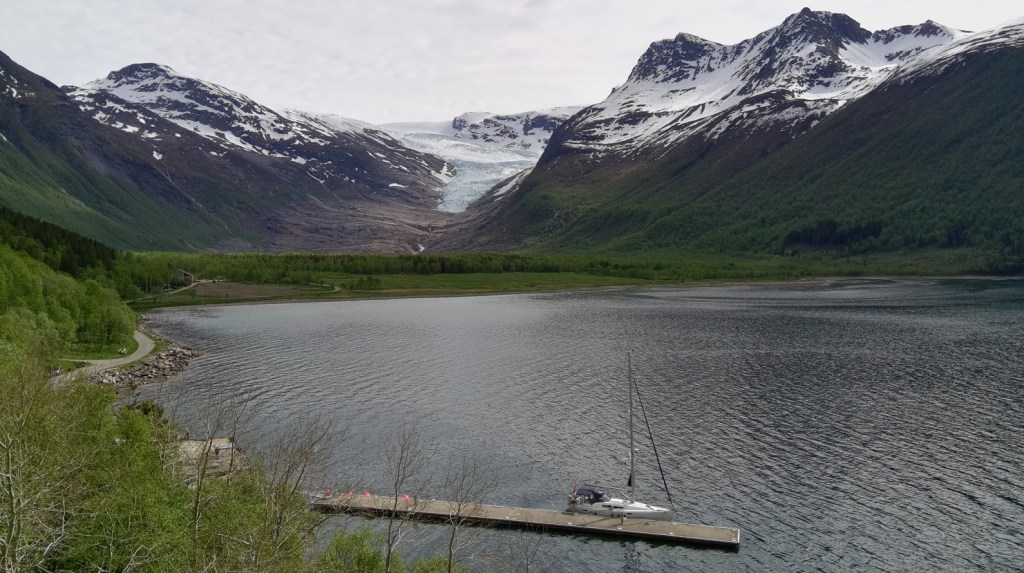
‘Svartisen’ means ‘black ice’ in Norwegian, so named because of its dark blue colour. It’s stunning. The main ice sheet covers the surrounding mountains, with a tongue of it cascading down the Engabreen valley towards the sea. Apparently it is the lowest glacier in Europe, due to the latitude we are at.
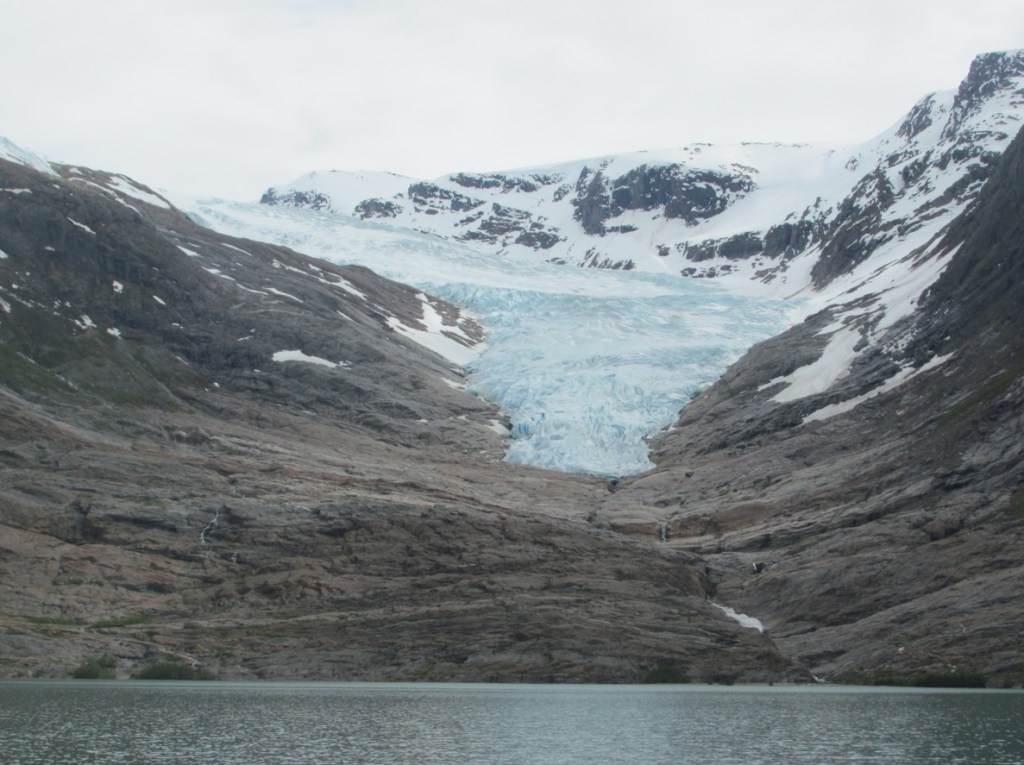
We start cycling along the small road leading towards the glacier. Occasional summer cottages appear in the trees along the way, all locked up now for the winter. The summer season doesn’t start until June, so we have the place to ourselves until then.
Then suddenly, a splash of orange ahead on the road for a brief moment before it disappears again. We are not alone, it seems. We continue pedalling, and catch up with a young woman in her early twenties carrying an enormous orange rucksack on her back.
“I’m heading up the side of the glacier”, she says, with the trace of an Antipodean accent. “There’s a DNT hut up there just next to the ice. I am planning to stay there for a couple of days just reading and walking.”
“What does DNT mean?”, we ask.

“It stands for Den Norske Turistforening”, she tells us. “The Norwegian Trekking Association in English. They maintain a network of trails and mountain huts throughout Norway. You pay a subscription, and it entitles you to use their huts wherever you want. Some are staffed and offer meals and accommodation, but the one I am going to is unstaffed, and I am taking my own food and sleeping bag.”
“Are you Australian?”, asks the First Mate. “You have a slight accent.”
“No, I am Norwegian, but I did spend a year working in Australia, so that is where the accent comes from”, she answers. “I loved Australia, and would like to go back there sometime.”
We wish her the best, and continue on with our cycle ride, impressed with her self-sufficiency and spirit of adventure. It’s not common for a young woman to spend time alone in a remote hut with only basic facilities in an Arctic wilderness, and we wonder what motivates her? So much for the critics of modern youth.
We reach the end of the road, and park the bikes. From now on it is following the walking track up the moraine of the glacier. Eventually, even the path peters out and we need to clamber over rocks, following blue painted markers. It’s tough going, leaping from one rock to the next, making sure that we don’t slip between the cracks and twist an ankle. Far off to the left, we can see the lone trekker making her way up the steep slope at the side of the moraine, her orange rucksack visible in the afternoon sun, until she too disappears from sight. We are alone again.
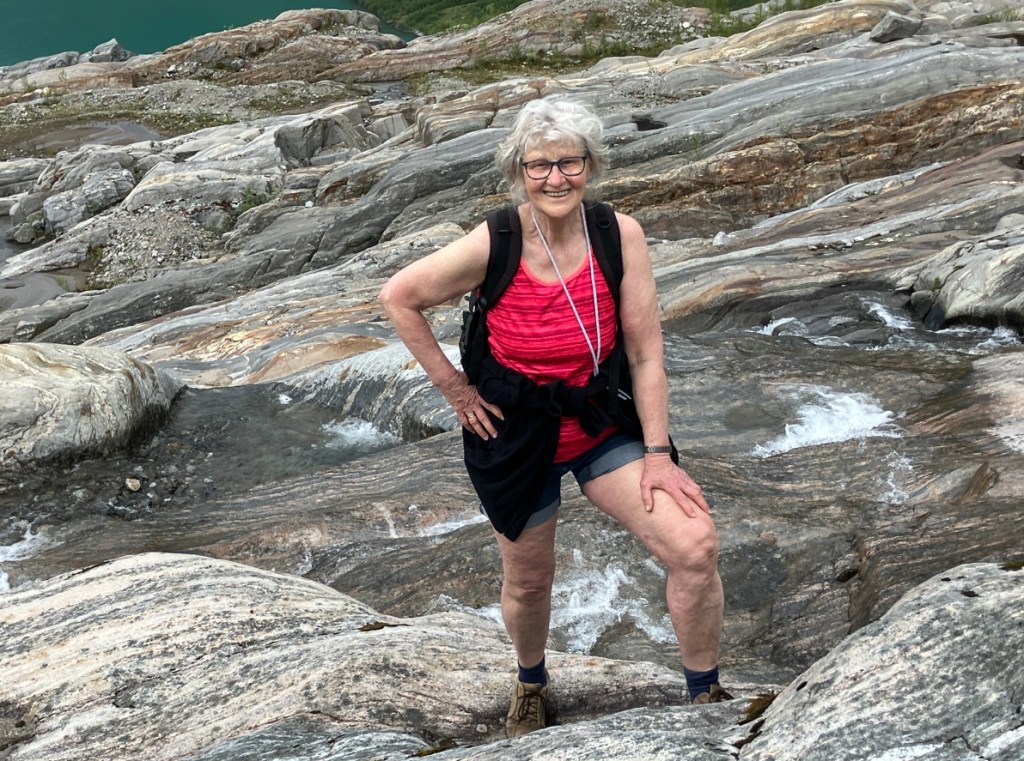
Eventually we reach the end of the markers. There is a sign warning us that getting too close to the glacier is dangerous for fear of chunks of ice calving. It doesn’t matter – we are a hundred meters or so from it anyway.
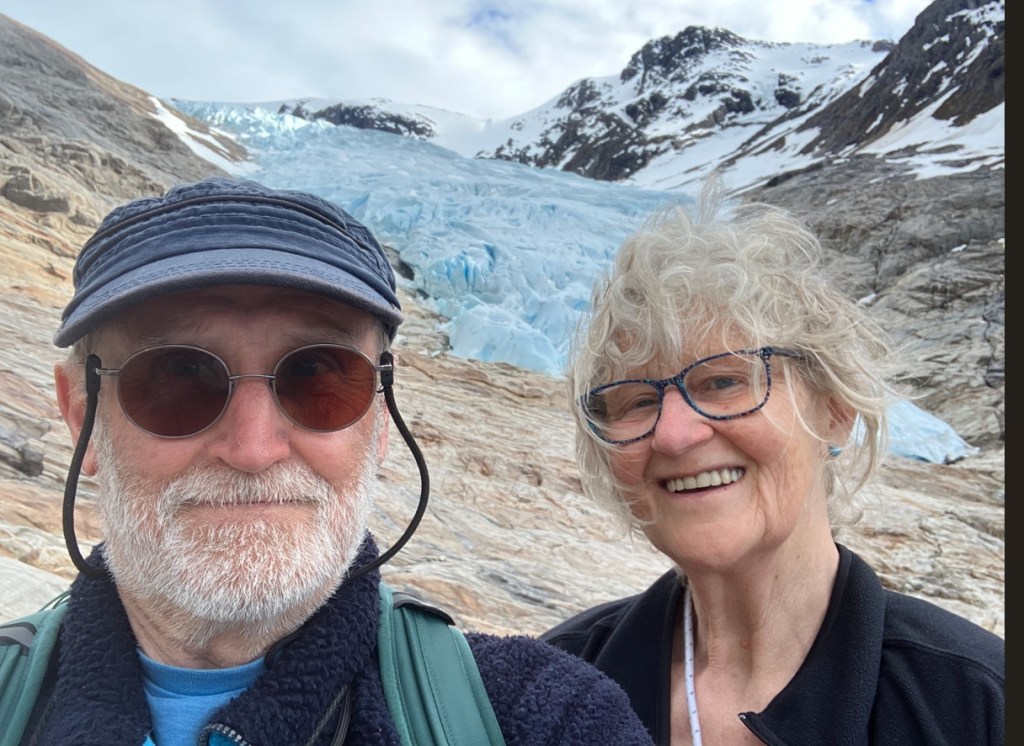
We sit on a rock and eat our snacks, awed by the massive river of ice flowing imperceptibly down the valley, but also realising that it is retreating, melting by the warming climate that humans have been responsible for through their activities. We had seen photos of the glacier ending much further down the valley, including the place that we were sitting on at the moment.
Later, when we are back, and we are sitting on the deck having our dinner, surrounded by nature’s grandeur on all sides, the First Mate expresses both of our thoughts.
“It’s such a shame that it is retreating so much”, she says. “Can you imagine what it will be like in a few more decades? It will hardly come down the valley at all.”

“The dynamics of this part of the glacier are actually quite complex”, says Spencer, butting in. “In the 1700s, it was nearly at the shore of the fjord. It retreated significantly in the late 1800s, then there was a brief advance in the early 1900s for ten years, but then it retreated about 2 km since then. From the 1990s, after a quick but short-lived advance, the edge of the glacier hasn’t changed all that much, but the ice has thinned and become structurally weaker due to more crevasses. There is no doubt that overall, climate change is driving these dynamics.”
“How can some of our leaders call all this a hoax?”, asks the First Mate. “They should all be brought here to see the evidence for themselves.”
“It’s because big money isn’t interested in nature”, I say. “All it is interested in is making even more money than it will ever need.”
Cynical, me?
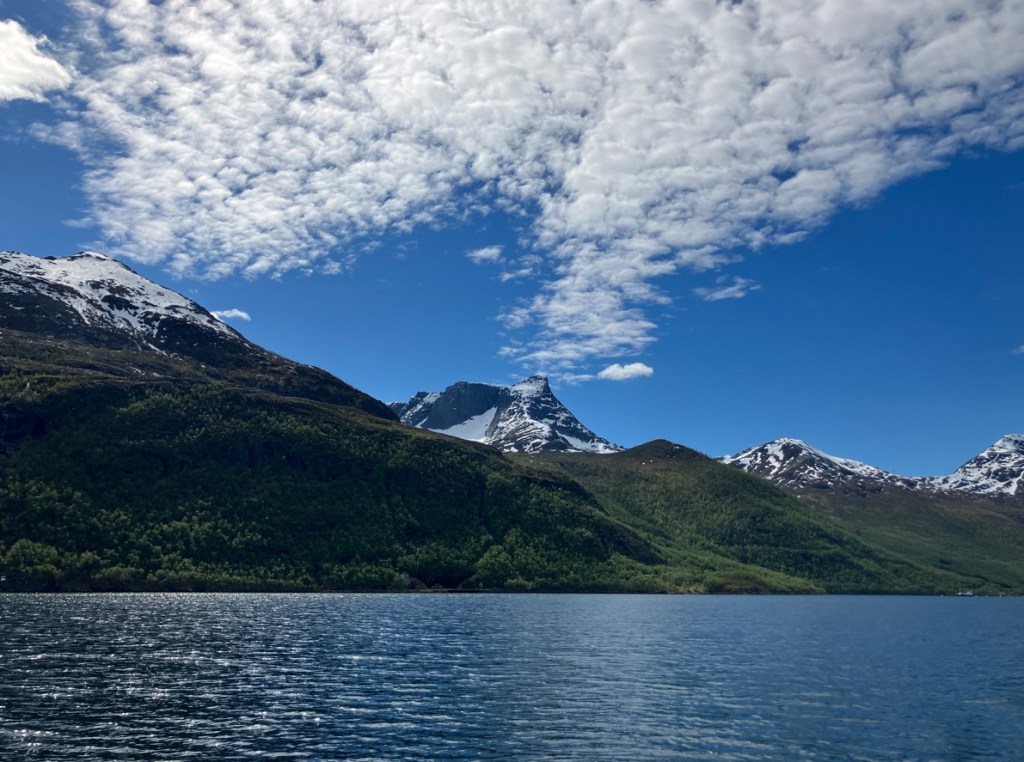
In the morning, we sail back down Holandsfjorden toward the coast, feeling privileged to have seen one of the world’s natural wonders close up and in its setting. We turn to starboard into Meløyfjorden and continue our voyage northwards.
In the early afternoon we arrive in Støtt, a picturesque fishing village and former trading post, and tie up to the quay next to the former warehouse. It’s quiet, no-one is around. A few other boats are there, but it doesn’t look like they have been used for a while. The small mini-market has a notice in the door saying it will open at 1500. We decide to have a cup of tea and come back then.
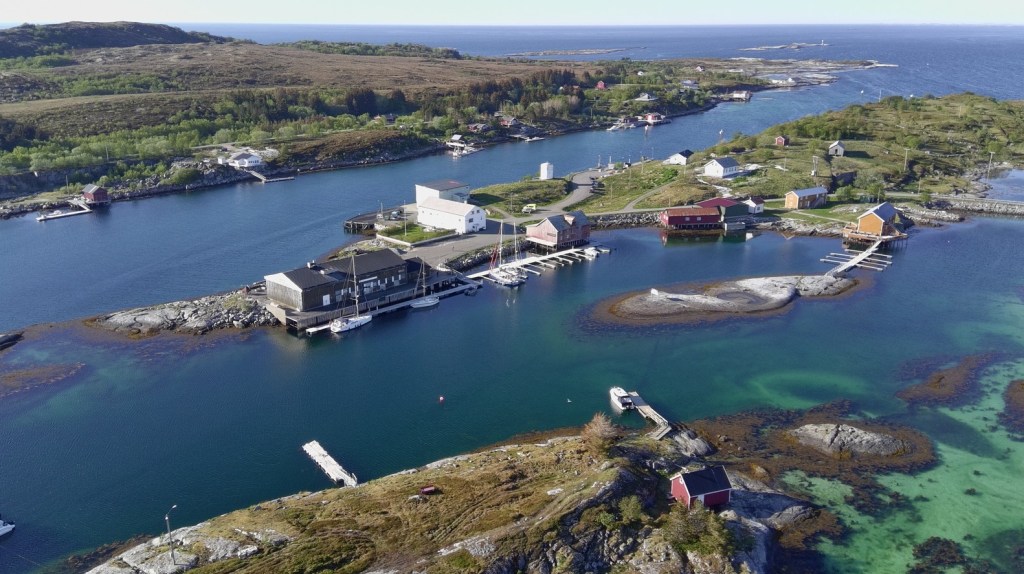
At 1500, it seems that the whole village has come to life. Mobility scooters are parked randomly outside the mini-market, with more on their way along the only road on the island. A number of islanders are sitting around the only table in the shop sipping their coffee.
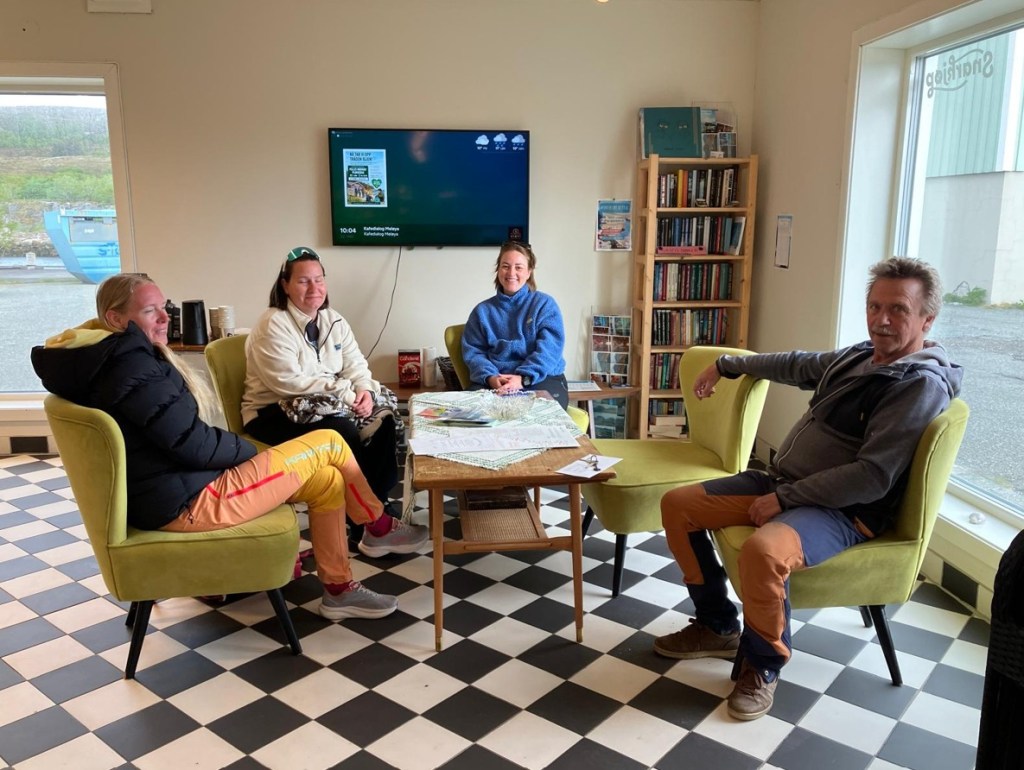
“The ferry comes in at three”, explains one. “There’s quite a bit of activity then, as new arrivals come to stay. We like to come here and see what’s happening. Otherwise it is very quiet on the island. Only 34 of us live here.”
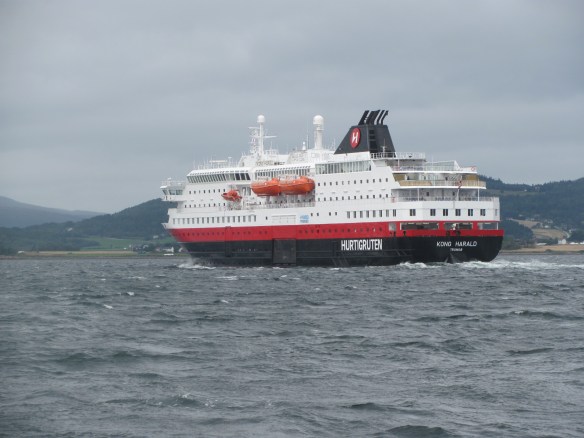
“It used to be a bustling trading post in the old days”, says another. “Fishermen used to live here during the season to be close to the fishing grounds, fish was shipped off to Bergen, and things like flour, tea and coffee were shipped northwards. But when the Hurtigruten started, there was less need for trading posts such as this one, and it fell into decline. Nowadays we survive from tourism.”
The Hurtigruten is Norway’s coastal shipping line.
The First Mate buys some fresh vegetables, and we walk down to the ferry quay, on the other side of small isthmus to where Ruby Tuesday is moored. A mobility scooter is waiting. A skeleton is sitting inside, with the words Jeg venter på ferger painted on the back – ‘I am waiting for the ferry’.

“The ferry must be late”, says the First Mate. “It looks like he has been waiting for a while. I am glad that we’ve got our own boat.”
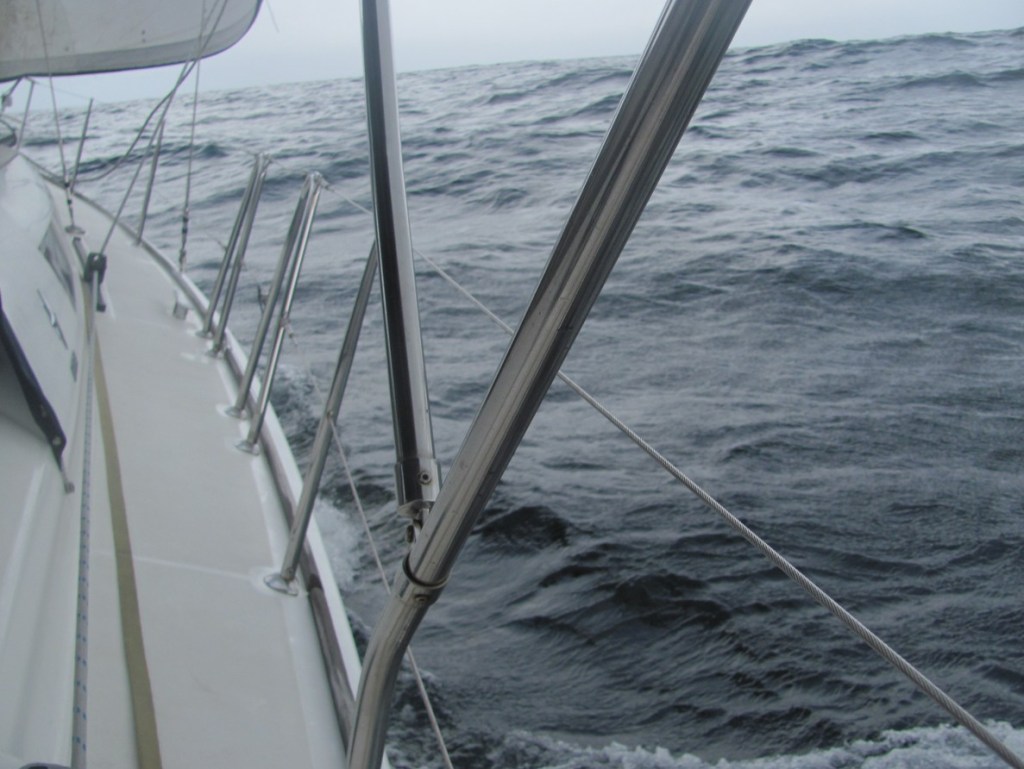
Strong winds arrive overnight, and we delay our departure the next morning until after lunch, when they are forecast to ease. But they don’t seem to. We decide to leave anyway, but the strong winds pin us against the dock, and it is difficult to manoeuvre ourselves away from it. Somehow we manage it, then just as we clear the island, the wind drops completely!
We put the sails up, and manage the stately speed of 2½ knots.
“You would hardly believe that it was so windy just half an hour ago”, I grumble.
“Never mind”, says the First Mate. “It is only a matter of time before it comes back again.”
She is right of course, but it is quite a long time. As we round the next island of Fugløya two hours later, the wind picks up, and we sail along on a pleasant beam reach.
“See, I told you”, says the First Mate. “You just need to be patient.”
We reach the town of Bodø. Andy, Anne and Rick in Amalia have arrived a couple of days earlier. Just as we tie up, the heavens open, and the rain pours down. We huddle in the cabin and cook dinner. Rivulets of water run down the windows. It’s like being in the monsoon again.
#/media/File:Bod%C3%B8-Panorama-04-2019-gje.jpg)
I pick up the guide book and read about Bodø. It was granted town status in 1816, and became a municipality in 1838. It is an important transport hub for northern Norway, being the northern rail terminus for the western railway line, which connects with many bus lines and ferry routes. It was even voted as one of the European Capitals of Culture in 2024. Its most well-known historical event seems to have been the ‘Bodø Affair’ in the early 1800s.
“Never heard of it”, says the First Mate. “Sounds like a spy scandal.”
“Not quite”, I say, reading on. “Although it was an international incident. Apparently there was a British company then that was trading illegally in Bodø. Norwegian officials seized a large amount of the illegal goods, but unfortunately for Norway, the country’s foreign affairs were handled by Sweden due to the dual monarchy system both countries were in. The Swedish Foreign Ministry decided to compensate the British company for the seized goods using Norwegian funds. This didn’t go down too well with the Norwegians, and sowed the seeds of distrust between the two countries until this day.”
“I don’t blame them”, sniffs the First Mate. “I would feel a bit miffed about it too.”
Eventually the rain stops. There is a knock on the side of Ruby Tuesday. It’s Andy, Anne and Rick. They’ve been to a concert in the Cultural Centre.
“It was absolutely brilliant”, says Andy. “It was ‘Beyond Haydn’ by the Arctic Philharmonic Orchestra. It’s a pity you hadn’t arrived earlier. I am sure that you would have enjoyed it.”
“You’ll need to get your shopping done tomorrow morning”, says Anne. “Everything is closed from mid-day onwards. It’s Pinse on Sunday, and the Monday is a holiday also. Nothing is open. Even the buses aren’t running.”
Pinse is called Whit Sunday in English, and is to celebrate the descent of the Holy Spirit to the Apostles. It is much less significant as a religious festival in Norway than it once was – instead, most Norwegians take it as a long weekend, and disappear off to their cottages in the mountains, boating, hiking, or visiting family.
We do our shopping the next morning. The rain returns, and we spend the afternoon catching up with things that have accumulated.
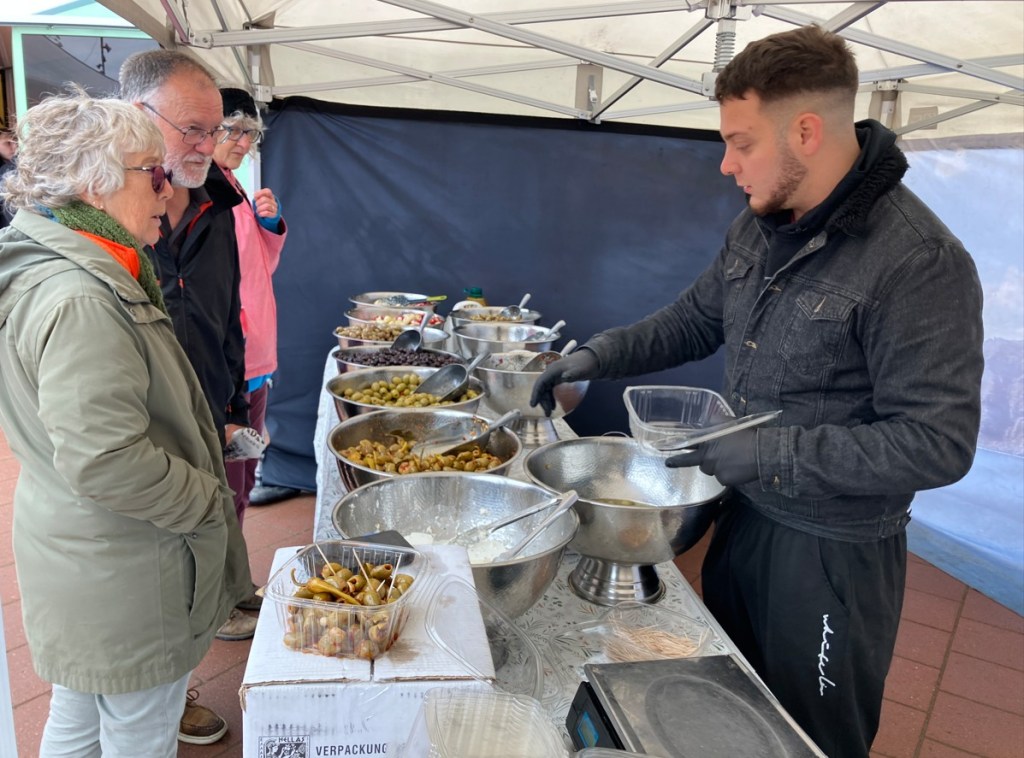
The next day, the rain eases. We decide to explore the town with Andy and Anne. Yellow flags are everywhere. Everything is closed except for a small food market doing a brisk business in one of the squares.
“I’ve got to get some of these garlic olives”, says the First Mate. “They just smell so good.”
“It’s this brown cheese for me”, says Andy. “Traditional Norwegian cheese. A little bit sweet, but very tasty though.”
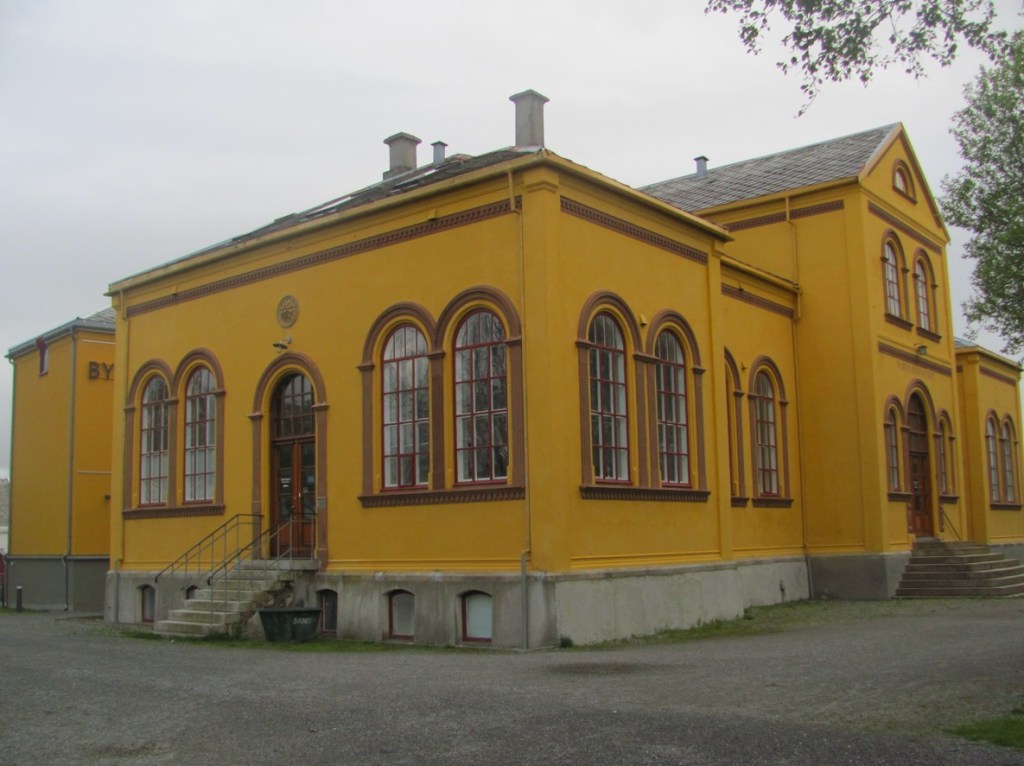
“Google says that the City Museum is open, even on Whit Sunday”, I say. “I have my doubts, but let’s go and see if it is.”
It’s not. We walk around the building to see if one of the doors might be open, but they are resolutely closed.
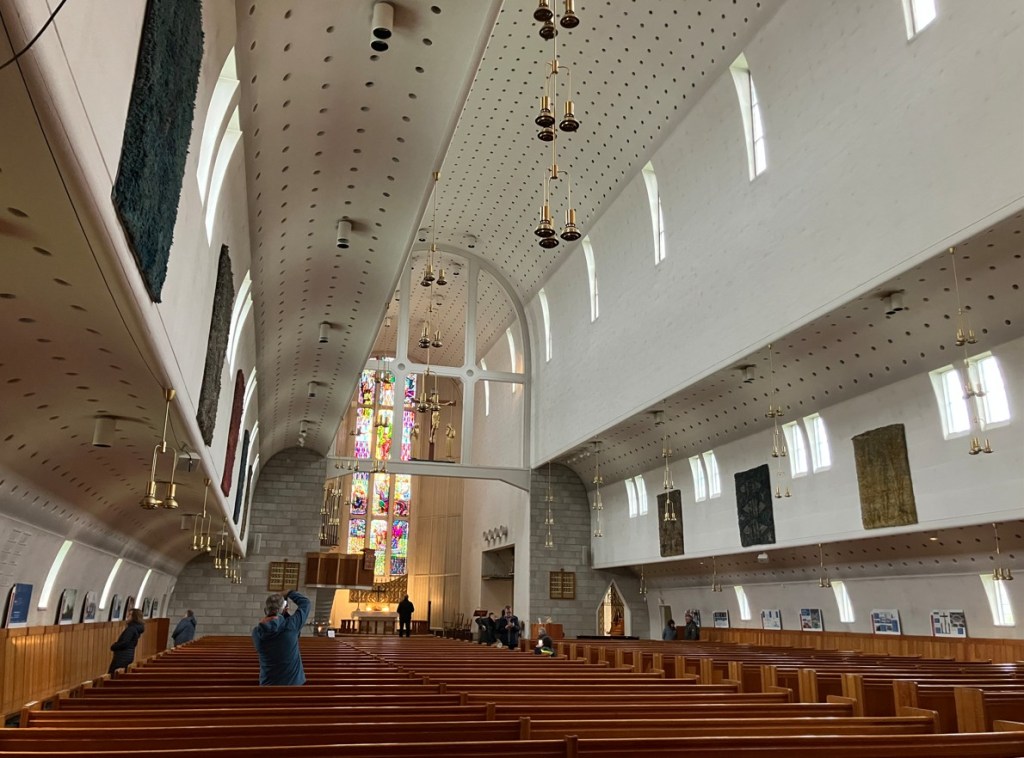
The town cathedral is not far though, and it is open.
“Yes, you can come in and have a look around”, says an earnest bearded young man. “But we are having a service soon, so we are closing in 15 minutes.”
It’s enough to have a quick look at the pictures around the walls detailing the history of the church. The original church was built in 1888, but was destroyed in 1940 by intensive bombing during WW2. The current one was built in 1956. There’s an impressive stained glass window at the end.
“Let’s go and have a coffee”, says the First Mate, after we are rounded up by the earnest young man. “I saw a nice café called Kaffee und Kunst just opposite. ‘Coffee and Art’. It sounds interesting.”
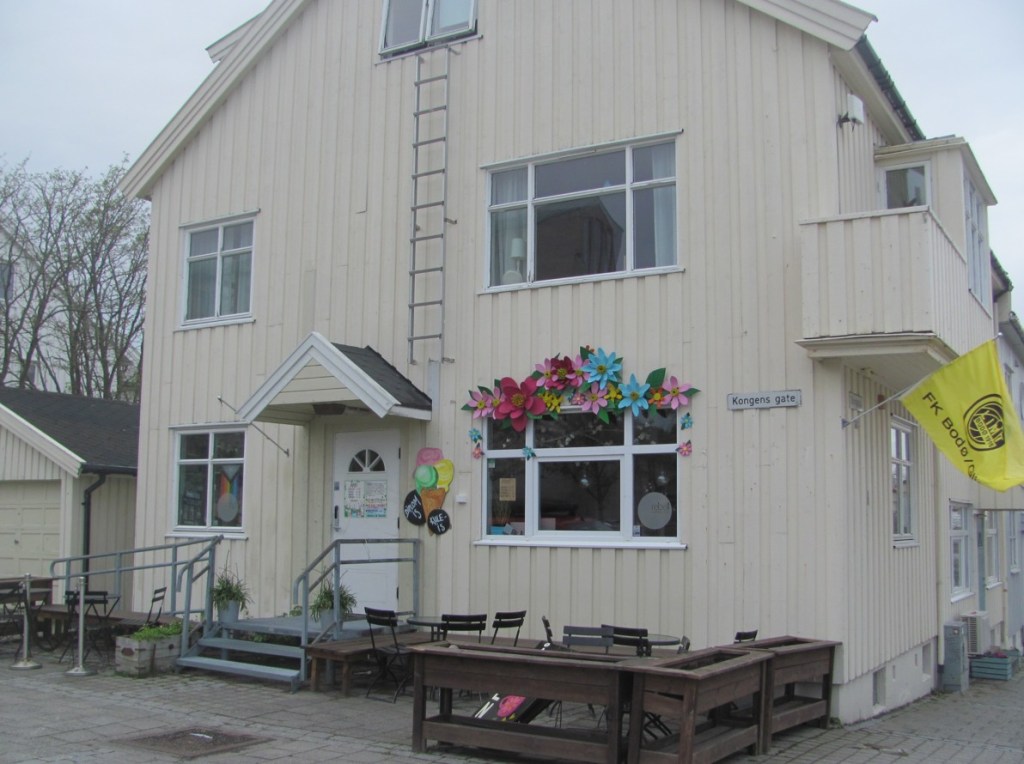
It’s warm and cosy inside, and the coffee and cakes are delicious. Paintings of various Bodø features adorn the walls. A group of young women are knitting furiously in one corner.
“We come here often and do our knitting and have a chat”, one of the women tells Anne. “It’s a way to catch up with all the news and we produce something at the end.”
We order another coffee each.
“I am awfully sorry”, says the woman serving us, apologetically. She is the owner. “It’s just that I have to close soon, as there is a football match on this afternoon. FK Bodø versus SK Brann. Most of the town are going. I support FK Bodø, and many of my customers do too, so I have to be there. You probably noticed the yellow FK Bodø flag flying outside the café. But you can certainly have a refill. Just drink it quickly!”
We learn later that FK Bodø won by 3-1 against SK Brann.

