Black ice, an old trading post, and an international incident

“There are some bicycles here that we can use”, says the First Mate. “They save walking in to the start of the path to the glacier.”

We have just arrived at the small Engen Brygge pontoon at the top of Holandsfjord, and are looking up at the Svartisen glacier. We are the only ones here, and could be the only people in the world.
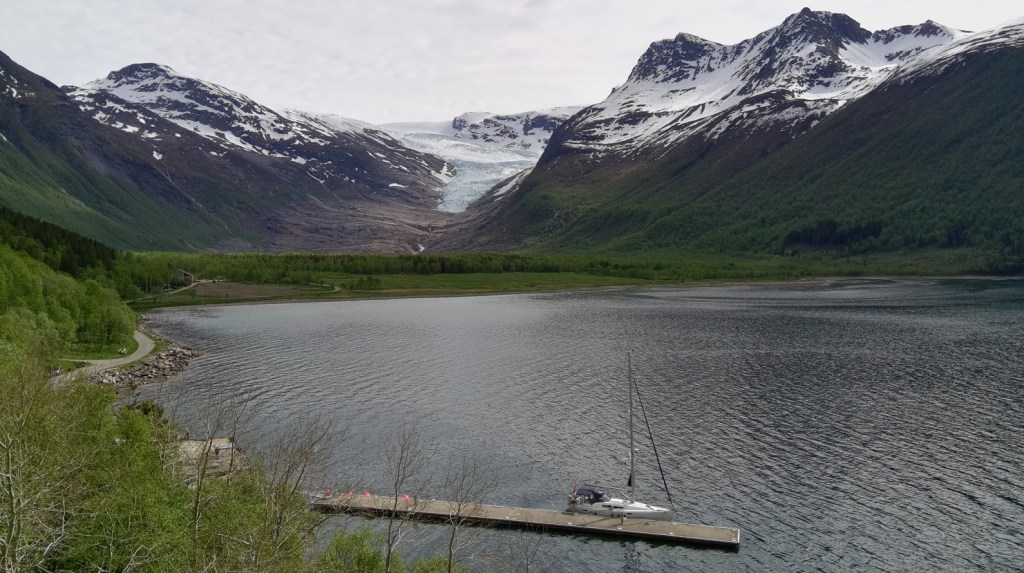
Tied up at the Engen Brygge pontoon near Svartisen glacier.

‘Svartisen’ means ‘black ice’ in Norwegian, so named because of its dark blue colour. It’s stunning. The main ice sheet covers the surrounding mountains, with a tongue of it cascading down the Engabreen valley towards the sea. Apparently it is the lowest glacier in Europe, due to the latitude we are at.
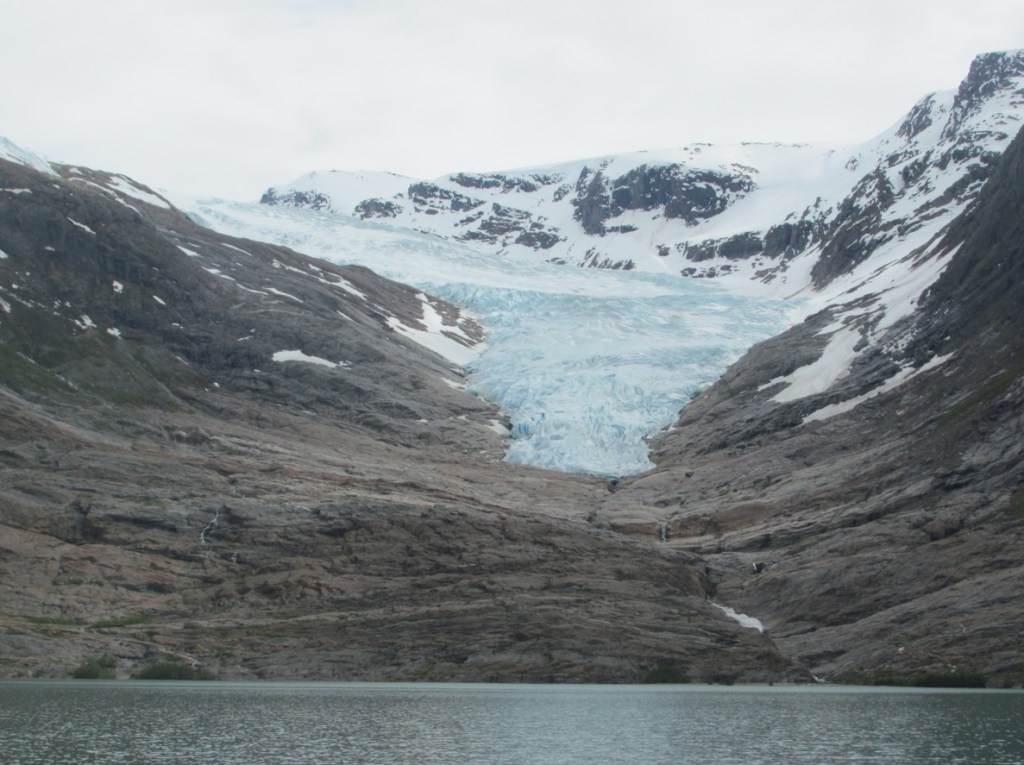
Svartisen glacier.

We start cycling along the small road leading towards the glacier. Occasional summer cottages appear in the trees along the way, all locked up now for the winter. The summer season doesn’t start until June, so we have the place to ourselves until then.

Then suddenly, a splash of orange ahead on the road for a brief moment before it disappears again. We are not alone, it seems. We continue pedalling, and catch up with a young woman in her early twenties carrying an enormous orange rucksack on her back.

“I’m heading up the side of the glacier”, she says, with the trace of an Antipodean accent. “There’s a DNT hut up there just next to the ice. I am planning to stay there for a couple of days just reading and walking.”

“What does DNT mean?”, we ask.

“It stands for Den Norske Turistforening”, she tells us. “The Norwegian Trekking Association in English. They maintain a network of trails and mountain huts throughout Norway. You pay a subscription, and it entitles you to use their huts wherever you want. Some are staffed and offer meals and accommodation, but the one I am going to is unstaffed, and I am taking my own food and sleeping bag.”

“Are you Australian?”, asks the First Mate. “You have a slight accent.”

“No, I am Norwegian, but I did spend a year working in Australia, so that is where the accent comes from”, she answers. “I loved Australia, and would like to go back there sometime.”

We wish her the best, and continue on with our cycle ride, impressed with her self-sufficiency and spirit of adventure. It’s not common for a young woman to spend time alone in a remote hut with only basic facilities in an Arctic wilderness, and we wonder what motivates her? So much for the critics of modern youth.

We reach the end of the road, and park the bikes. From now on it is following the walking track up the moraine of the glacier. Eventually, even the path peters out and we need to clamber over rocks, following blue painted markers. It’s tough going, leaping from one rock to the next, making sure that we don’t slip between the cracks and twist an ankle. Far off to the left, we can see the lone trekker making her way up the steep slope at the side of the moraine, her orange rucksack visible in the afternoon sun, until she too disappears from sight. We are alone again.
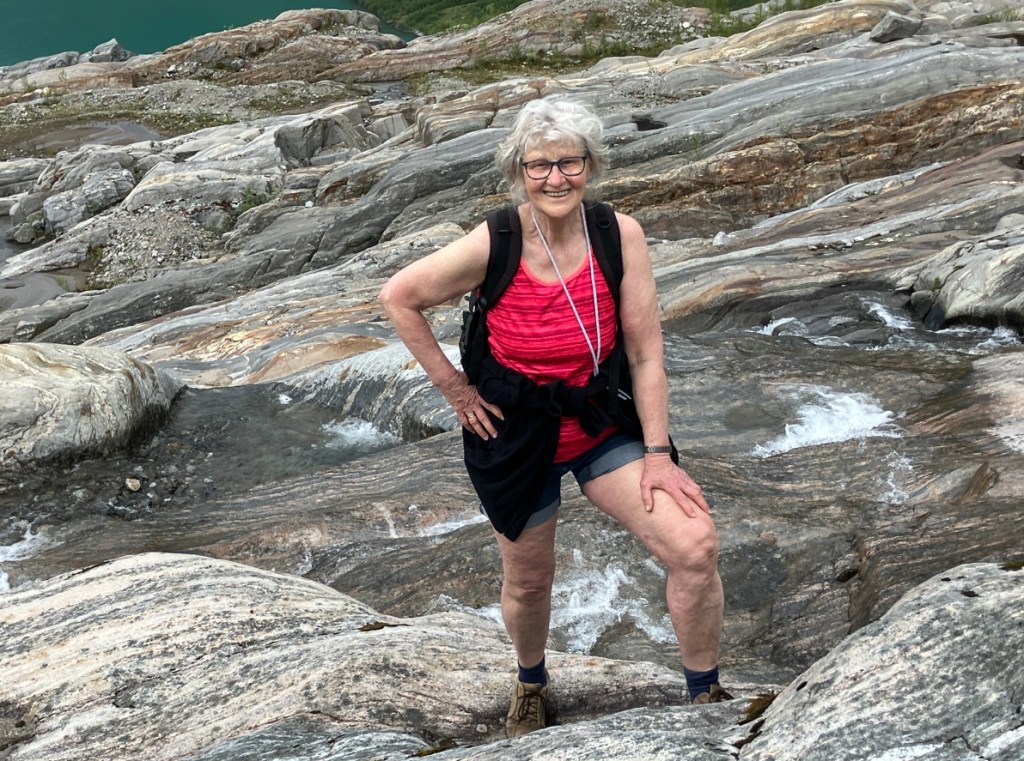
Climbing the Svartisen glacial moraine.

Eventually we reach the end of the markers. There is a sign warning us that getting too close to the glacier is dangerous for fear of chunks of ice calving. It doesn’t matter – we are a hundred meters or so from it anyway.
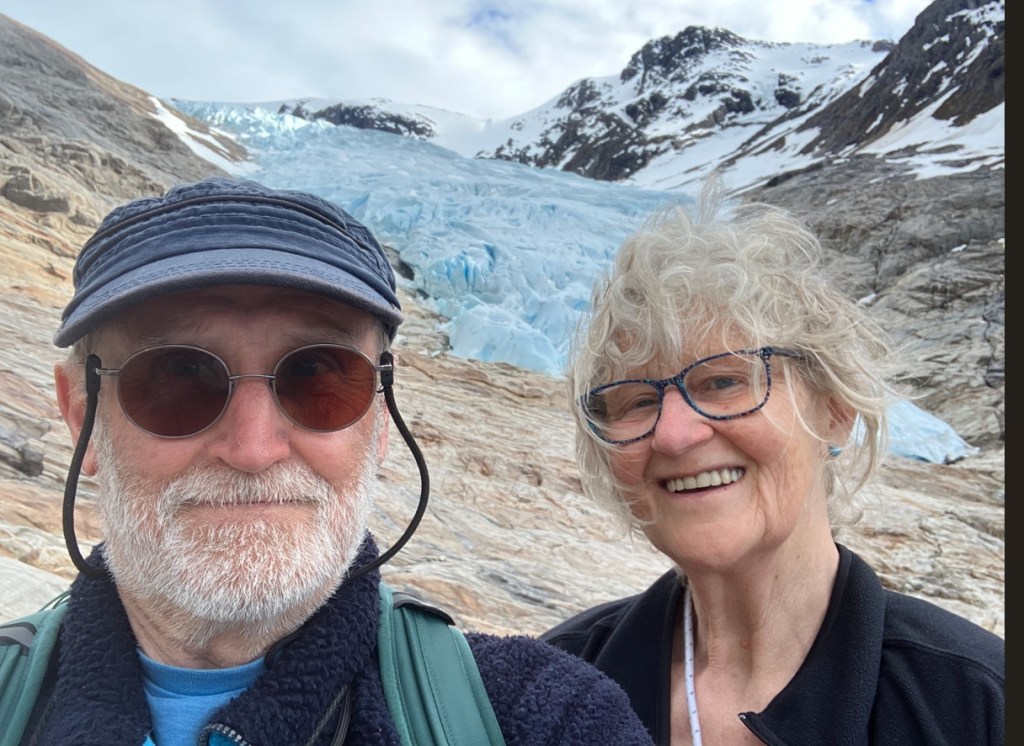
We make it!

We sit on a rock and eat our snacks, awed by the massive river of ice flowing imperceptibly down the valley, but also realising that it is retreating, melting by the warming climate that humans have been responsible for through their activities. We had seen photos of the glacier ending much further down the valley, including the place that we were sitting on at the moment.

Later, when we are back, and we are sitting on the deck having our dinner, surrounded by nature’s grandeur on all sides, the First Mate expresses both of our thoughts.

“It’s such a shame that it is retreating so much”, she says. “Can you imagine what it will be like in a few more decades? It will hardly come down the valley at all.”
“The dynamics of this part of the glacier are actually quite complex”, says Spencer, butting in. “In the 1700s, it was nearly at the shore of the fjord. It retreated significantly in the late 1800s, then there was a brief advance in the early 1900s for ten years, but then it retreated about 2 km since then. From the 1990s, after a quick but short-lived advance, the edge of the glacier hasn’t changed all that much, but the ice has thinned and become structurally weaker due to more crevasses. There is no doubt that overall, climate change is driving these dynamics.”

“How can some of our leaders call all this a hoax?”, asks the First Mate. “They should all be brought here to see the evidence for themselves.”

“It’s because big money isn’t interested in nature”, I say. “All it is interested in is making even more money than it will ever need.”

Cynical, me?
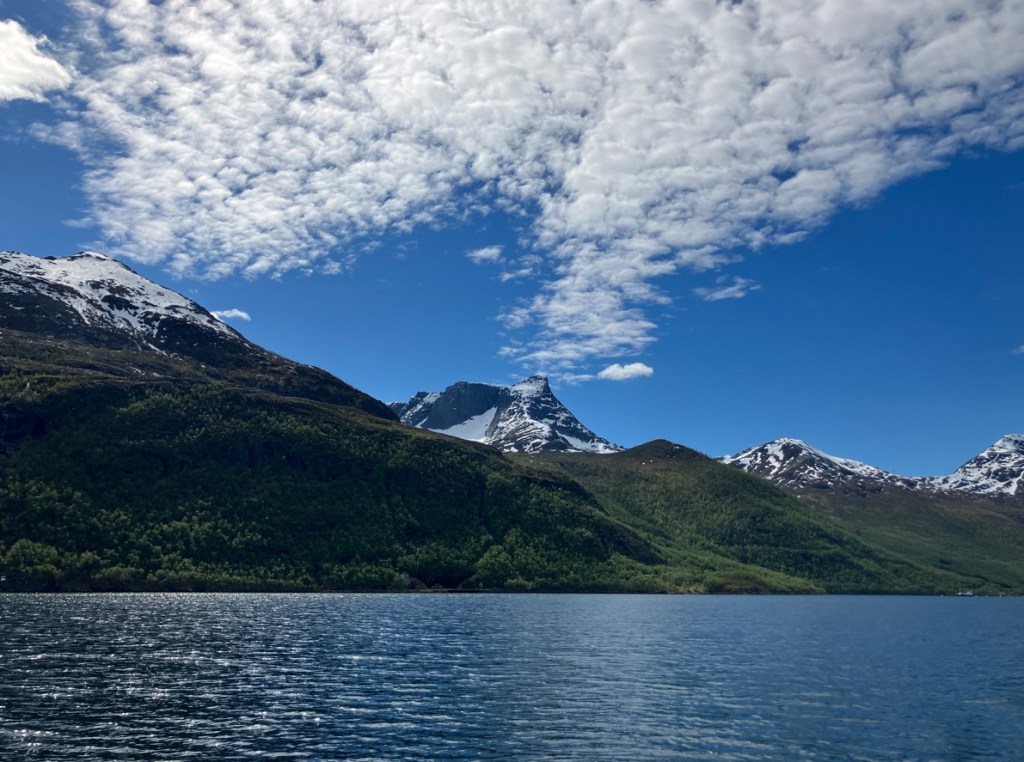
Holandsfjorden.

In the morning, we sail back down Holandsfjorden toward the coast, feeling privileged to have seen one of the world’s natural wonders close up and in its setting. We turn to starboard into Meløyfjorden and continue our voyage northwards.
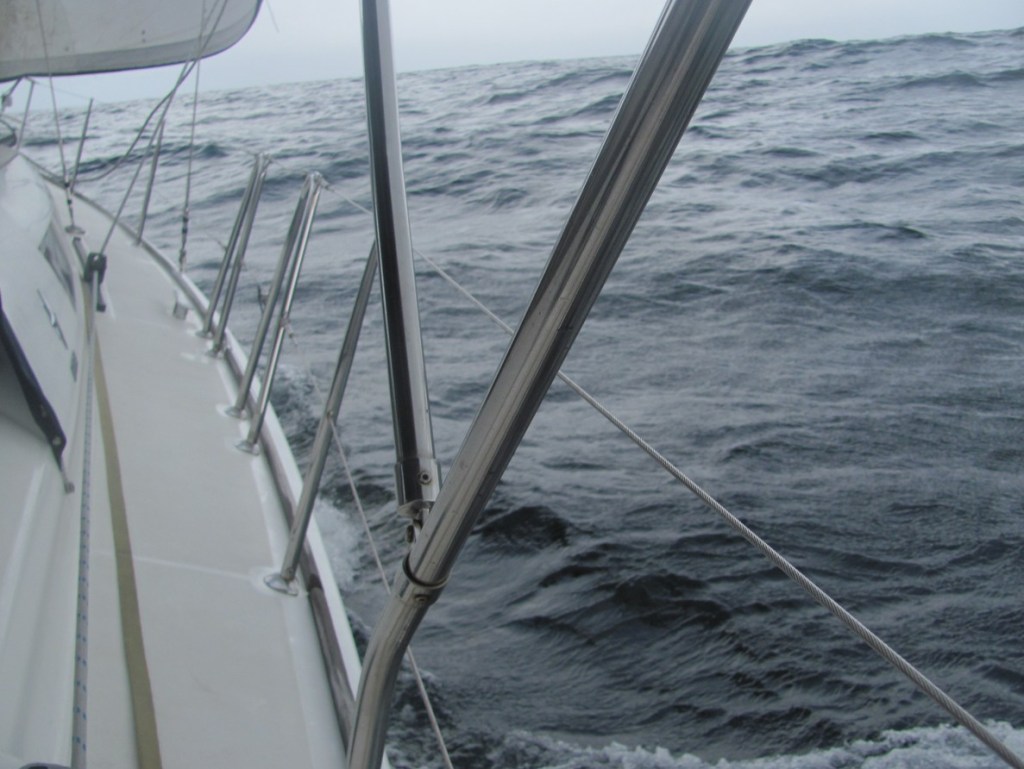
Heading north again.

In the early afternoon we arrive in Støtt, a picturesque fishing village and former trading post, and tie up to the quay next to the former warehouse. It’s quiet, no-one is around. A few other boats are there, but it doesn’t look like they have been used for a while. The small mini-market has a notice in the door saying it will open at 1500. We decide to have a cup of tea and come back then.
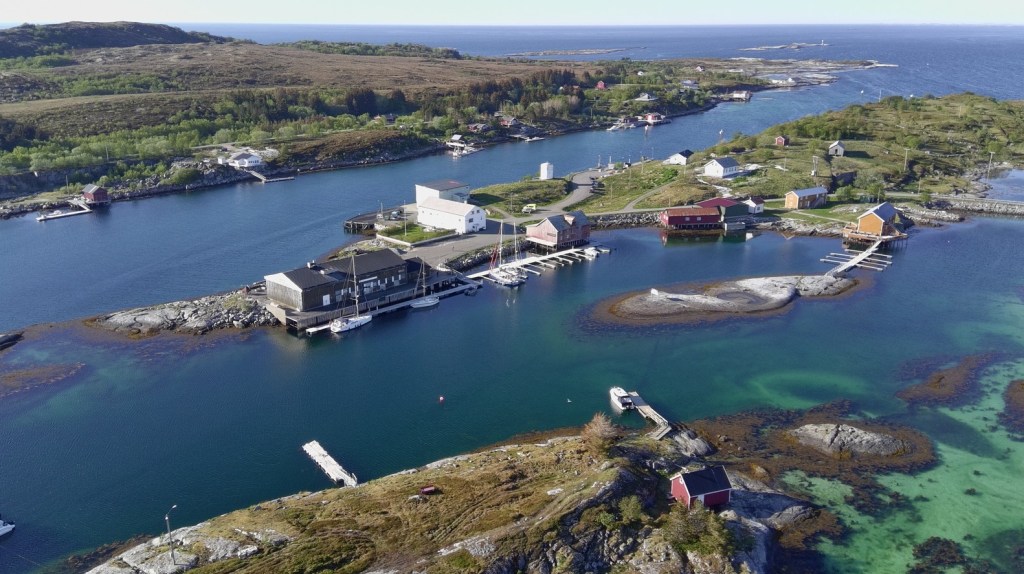
Tied up at Støtt harbour.

At 1500, it seems that the whole village has come to life. Mobility scooters are parked randomly outside the mini-market, with more on their way along the only road on the island. A number of islanders are sitting around the only table in the shop sipping their coffee.
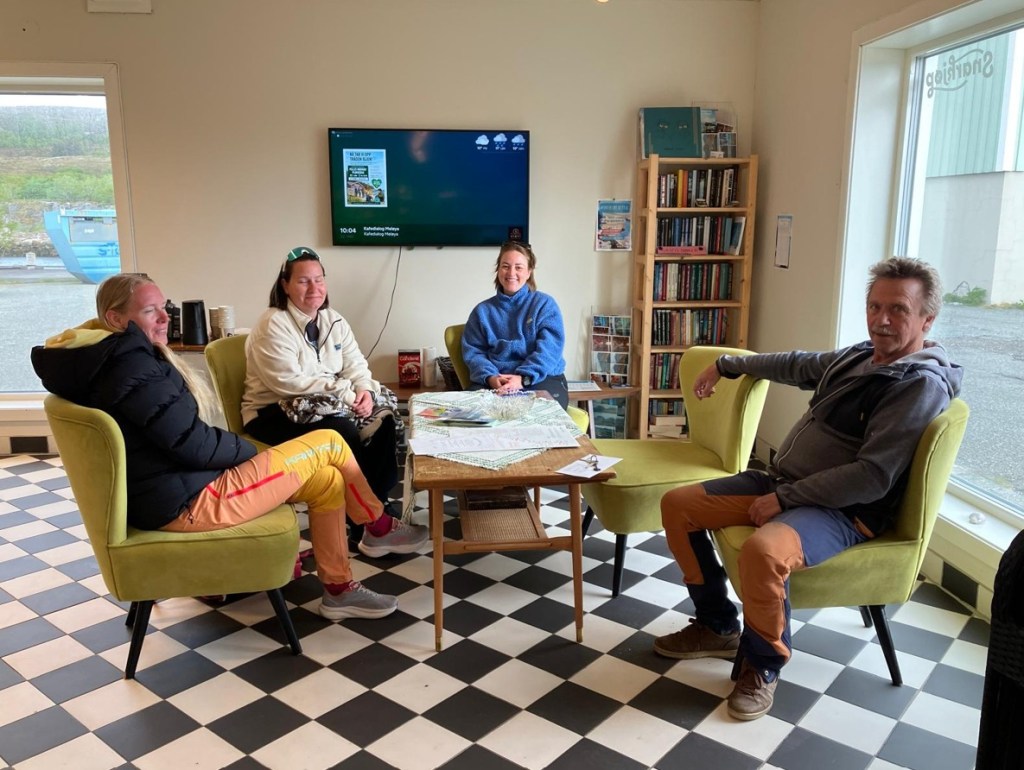
The social centre of the island.

“The ferry comes in at three”, explains one. “There’s quite a bit of activity then, as new arrivals come to stay. We like to come here and see what’s happening. Otherwise it is very quiet on the island. Only 34 of us live here.”

“It used to be a bustling trading post in the old days”, says another. “Fishermen used to live here during the season to be close to the fishing grounds, fish was shipped off to Bergen, and things like flour, tea and coffee were shipped northwards. But when the Hurtigruten started, there was less need for trading posts such as this one, and it fell into decline. Nowadays we survive from tourism.”

The Hurtigruten is Norway’s coastal shipping line.
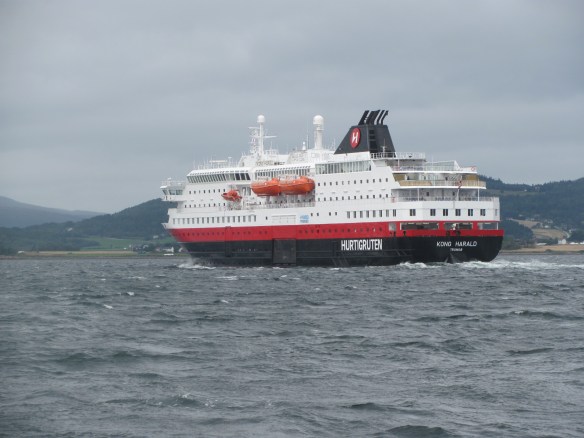
A Hurtigruten ship.

The First Mate buys some fresh vegetables, and we walk down to the ferry quay, on the other side of small isthmus to where Ruby Tuesday is moored. A mobility scooter is waiting. A skeleton is sitting inside, with the words Jeg venter på ferger painted on the back – ‘I am waiting for the ferry’.
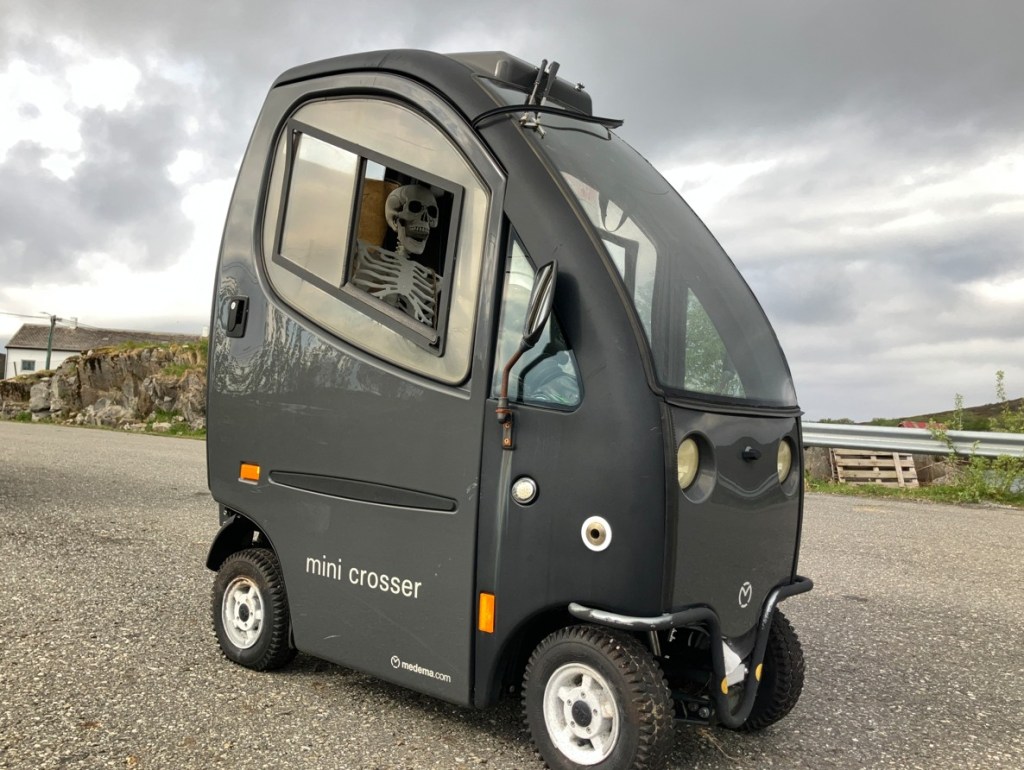
“Waiting for the ferry”.

“The ferry must be late”, says the First Mate. “It looks like he has been waiting for a while. I am glad that we’ve got our own boat.”

Strong winds arrive overnight, and we delay our departure the next morning until after lunch, when they are forecast to ease. But they don’t seem to. We decide to leave anyway, but the strong winds pin us against the dock, and it is difficult to manoeuvre ourselves away from it. Somehow we manage it, then just as we clear the island, the wind drops completely!

We put the sails up, and manage the stately speed of 2½ knots.

“You would hardly believe that it was so windy just half an hour ago”, I grumble.

“Never mind”, says the First Mate. “It is only a matter of time before it comes back again.”

She is right of course, but it is quite a long time. As we round the next island of Fugløya two hours later, the wind picks up, and we sail along on a pleasant beam reach.

“See, I told you”, says the First Mate. “You just need to be patient.”

We reach the town of Bodø. Andy, Anne and Rick in Amalia have arrived a couple of days earlier. Just as we tie up, the heavens open, and the rain pours down. We huddle in the cabin and cook dinner. Rivulets of water run down the windows. It’s like being in the monsoon again.

Bodø (from Wikipedia (Eichmann)).

I pick up the guide book and read about Bodø. It was granted town status in 1816, and became a municipality in 1838. It is an important transport hub for northern Norway, being the northern rail terminus for the western railway line, which connects with many bus lines and ferry routes. It was even voted as one of the European Capitals of Culture in 2024. Its most well-known historical event seems to have been the ‘Bodø Affair’ in the early 1800s.

“Never heard of it”, says the First Mate. “Sounds like a spy scandal.”

“Not quite”, I say, reading on. “Although it was an international incident. Apparently there was a British company then that was trading illegally in Bodø. Norwegian officials seized a large amount of the illegal goods, but unfortunately for Norway, the country’s foreign affairs were handled by Sweden due to the dual monarchy system both countries were in. The Swedish Foreign Ministry decided to compensate the British company for the seized goods using Norwegian funds. This didn’t go down too well with the Norwegians, and sowed the seeds of distrust between the two countries until this day.”

“I don’t blame them”, sniffs the First Mate. “I would feel a bit miffed about it too.”

Eventually the rain stops. There is a knock on the side of Ruby Tuesday. It’s Andy, Anne and Rick. They’ve been to a concert in the Cultural Centre.

“It was absolutely brilliant”, says Andy. “It was ‘Beyond Haydn’ by the Arctic Philharmonic Orchestra. It’s a pity you hadn’t arrived earlier. I am sure that you would have enjoyed it.”

“You’ll need to get your shopping done tomorrow morning”, says Anne. “Everything is closed from mid-day onwards. It’s Pinse on Sunday, and the Monday is a holiday also. Nothing is open. Even the buses aren’t running.”

Pinse is called Whit Sunday in English, and is to celebrate the descent of the Holy Spirit to the Apostles. It is much less significant as a religious festival in Norway than it once was – instead, most Norwegians take it as a long weekend, and disappear off to their cottages in the mountains, boating, hiking, or visiting family.

We do our shopping the next morning. The rain returns, and we spend the afternoon catching up with things that have accumulated.

The next day, the rain eases. We decide to explore the town with Andy and Anne. Yellow flags are everywhere. Everything is closed except for a small food market doing a brisk business in one of the squares.

“I’ve got to get some of these garlic olives”, says the First Mate. “They just smell so good.”

“It’s this brown cheese for me”, says Andy. “Traditional Norwegian cheese. A little bit sweet, but very tasty though.”
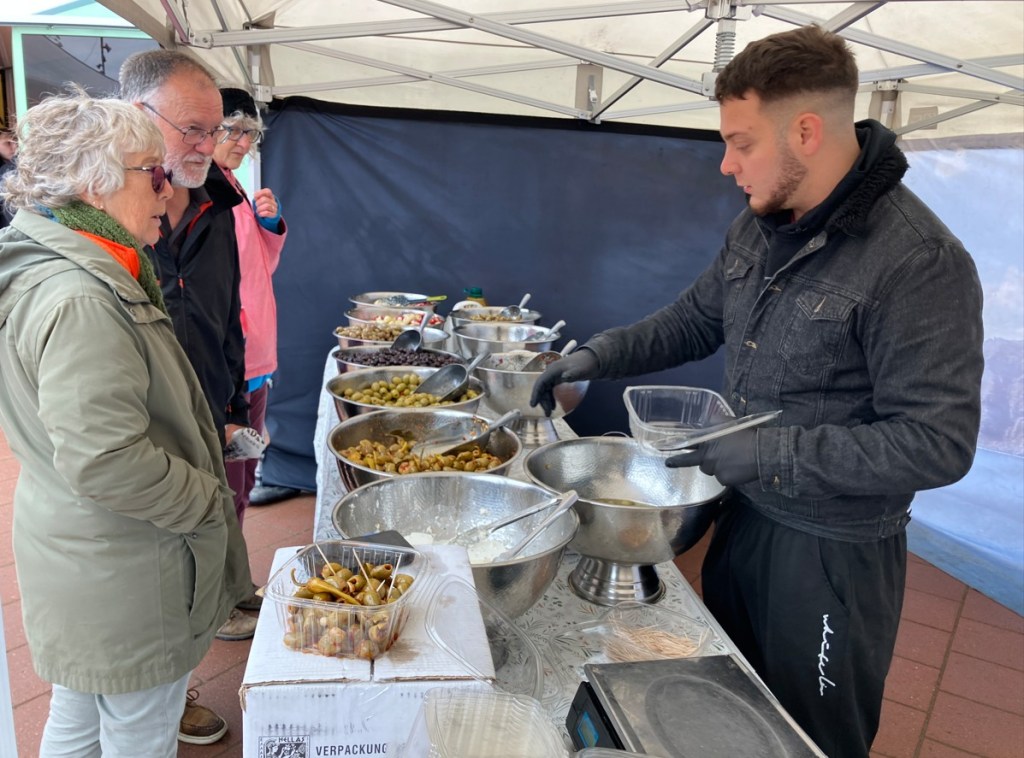
Trying the olives.

“Google says that the City Museum is open, even on Whit Sunday”, I say. “I have my doubts, but let’s go and see if it is.”

It’s not. We walk around the building to see if one of the doors might be open, but they are resolutely closed.
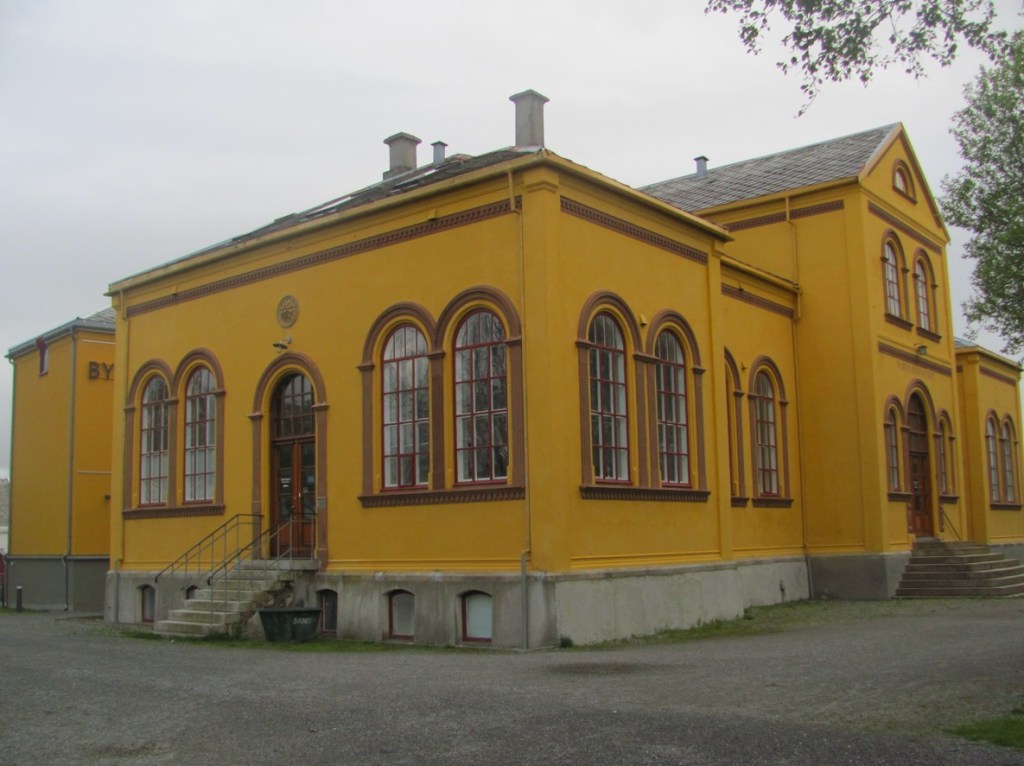
The City Museum looking very closed.

The town cathedral is not far though, and it is open.

“Yes, you can come in and have a look around”, says an earnest bearded young man. “But we are having a service soon, so we are closing in 15 minutes.”

It’s enough to have a quick look at the pictures around the walls detailing the history of the church. The original church was built in 1888, but was destroyed in 1940 by intensive bombing during WW2. The current one was built in 1956. There’s an impressive stained glass window at the end.
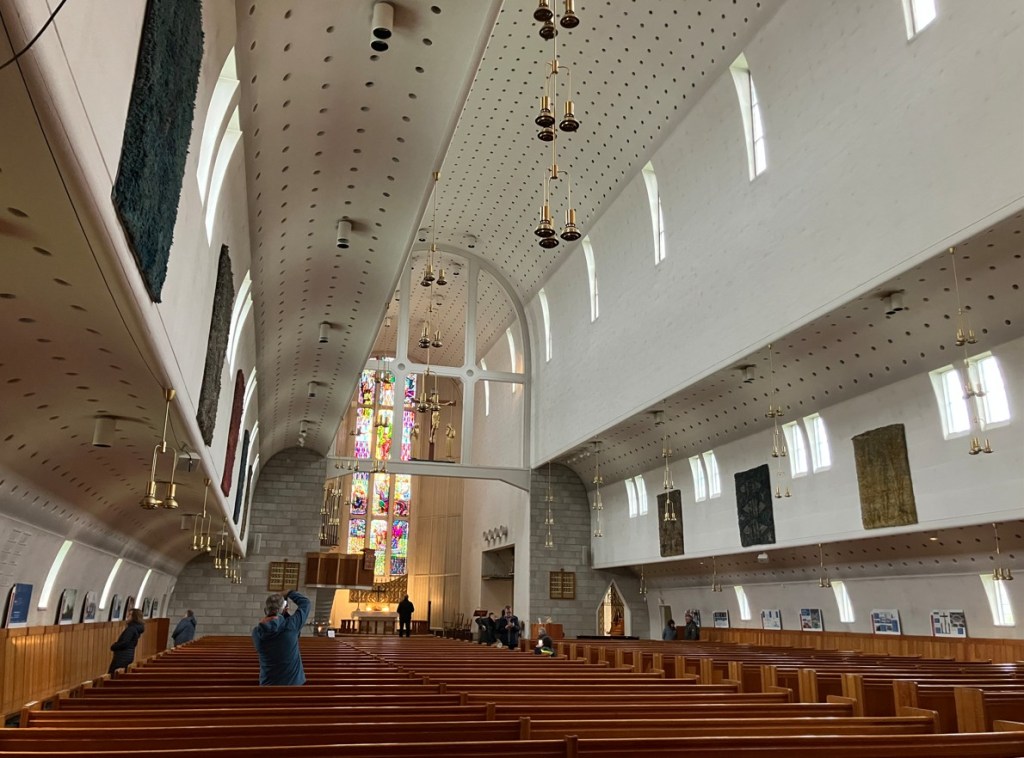
Bodø Cathedral.

“Let’s go and have a coffee”, says the First Mate, after we are rounded up by the earnest young man. “I saw a nice café called Kaffee und Kunst just opposite. ‘Coffee and Art’. It sounds interesting.”
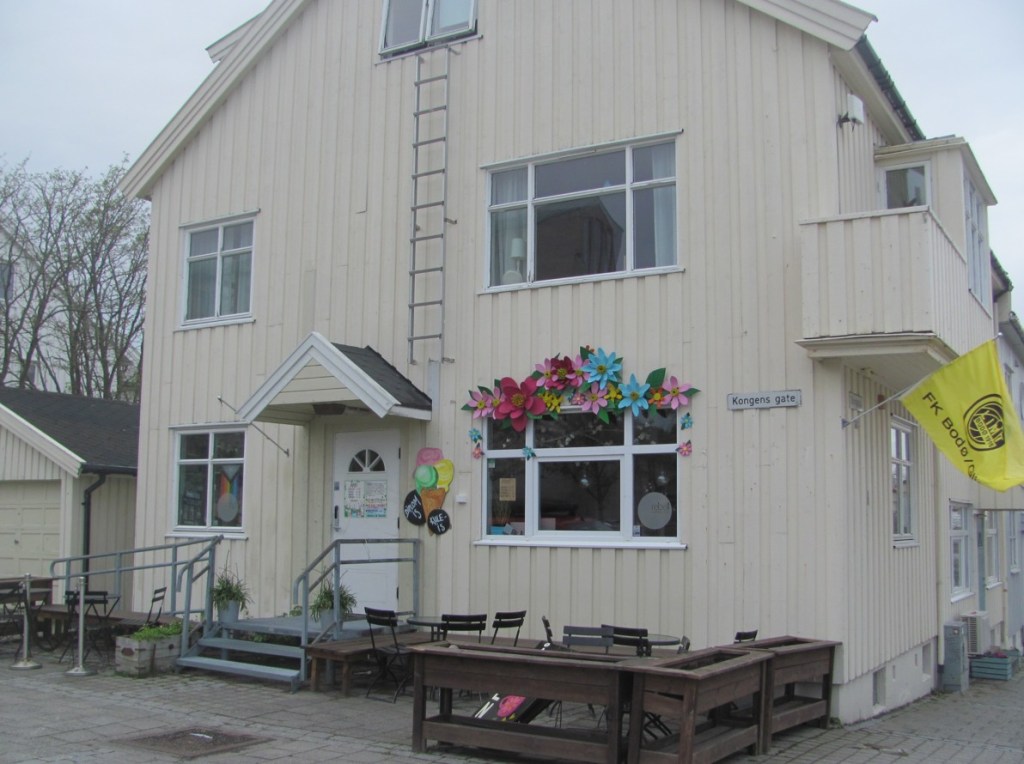
Kaffee und Kunst.

It’s warm and cosy inside, and the coffee and cakes are delicious. Paintings of various Bodø features adorn the walls. A group of young women are knitting furiously in one corner.

“We come here often and do our knitting and have a chat”, one of the women tells Anne. “It’s a way to catch up with all the news and we produce something at the end.”

We order another coffee each.

“I am awfully sorry”, says the woman serving us, apologetically. She is the owner. “It’s just that I have to close soon, as there is a football match on this afternoon. FK Bodø versus SK Brann. Most of the town are going. I support FK Bodø, and many of my customers do too, so I have to be there. You probably noticed the yellow FK Bodø flag flying outside the café. But you can certainly have a refill. Just drink it quickly!”

We learn later that FK Bodø won by 3-1 against SK Brann.
A long tunnel, a retreating glacier, and a preserved manor house

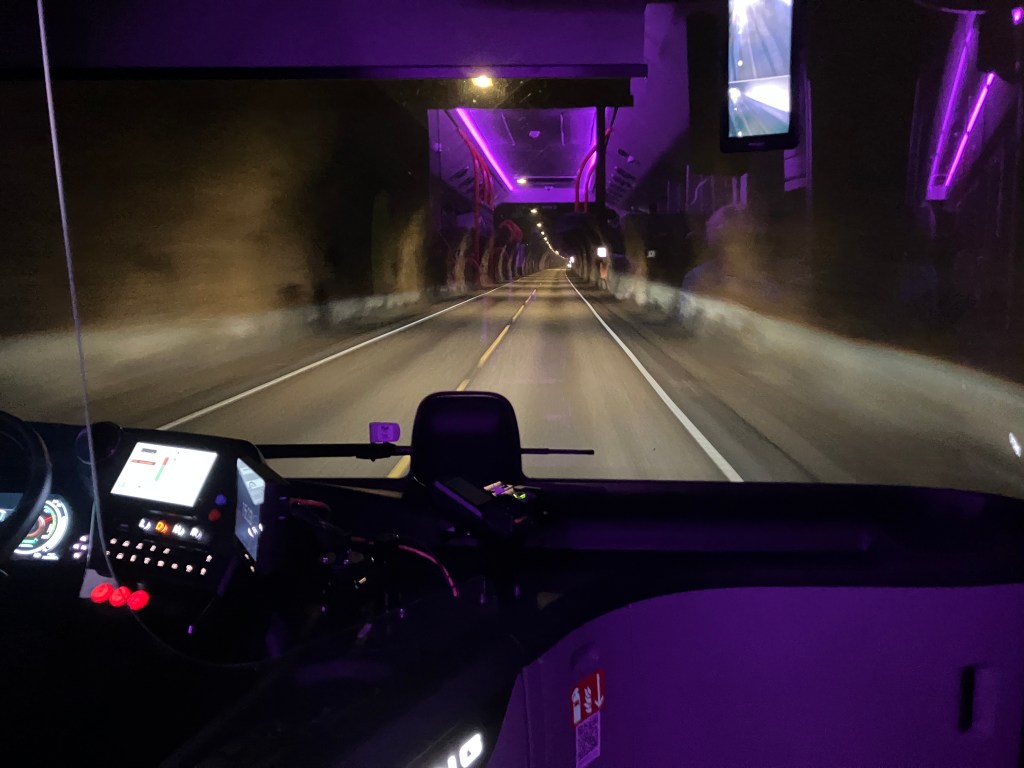
“It’s incredible the amount of work that must have been done to drill this tunnel through the mountain”, says the First Mate. “And to think that we are going right underneath a glacier.”

We are on the bus to the town of Odda at the head of Hardanger fjord. We had left Haugesund the day before, and had had a pleasant sail with favourable winds up the Hardanger fjord, arriving in the picturesque village of Rosendal in the evening. This morning we had caught the bus and snaked our way along the coastline until the mountain sides had become so steep that the road had had to take other measures to continue.

“Yes, the Folgefonna Tunnel”, I say. “It’s more than 11 km long. That’s a lot of rock to move.”

Driving through the Folgefonna Tunnel.

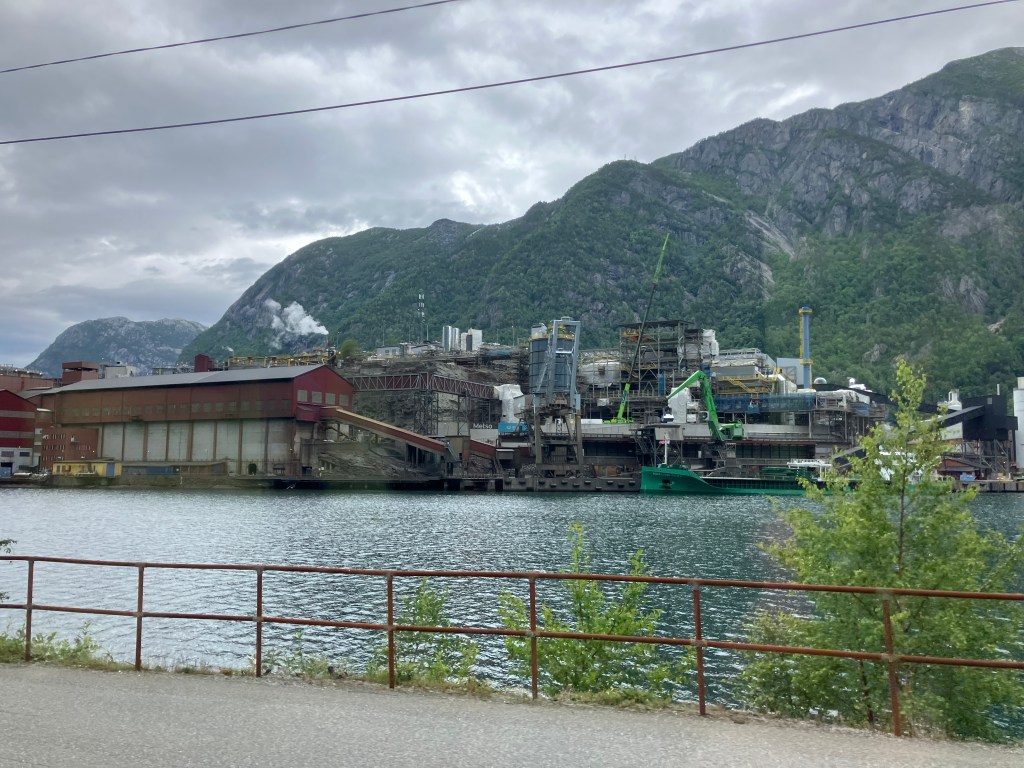
We eventually emerge from the tunnel, our eyes blinking as they adjust to the light. Initial impressions are not positive. The first thing we see is a huge industrial complex on a small island in the middle of the fjord. It turns out that it is a Boliden zinc smelter.

The Boliden zinc smelter at Odda.

“You might have thought that they could have sited it somewhere it can’t be seen”, sniffs the First Mate. “Such beautiful scenery, and to be spoilt by this eyesore.”

“I suppose they needed to have somewhere near the water so that things could be shipped in and out”, I say. “And for the hydro-electric power to drive the plant.”

The bus arrives in the town centre and we clamber out.

“It’s lunch time”, I say. “There’s a small café over there. What about that?”

—–

The elderly gentleman picks up his pen, dips it in the inkwell, and begins to write.

“My dear Meg”, he starts. “Here at Odda since yesterday afternoon …”

Poor Meg. His eldest daughter. The others had all flown the nest, but not her. It had always been a puzzle to him as to why she had never found a husband. Educated, attractive, one would have thought the young men would have been queuing up. He had even used his influence to obtain a place for her as a governess with a wealthy family in the south of Scotland. But she had remained resolutely single. No grandchildren from her. However, every cloud has a silver lining, he thinks – he enjoyed having her around the Manse, helping with parish matters. She was good at it. And it meant that he could have this break and get away to see another part of the world.

He had enjoyed the cruise so far. The sail down the Firth of Forth from Edinburgh had been calm and pleasant. Despite this, he had felt queasy when they had reached the open sea, and had retired early. The next day hadn’t been much better, so he had dosed himself up with whisky and water and had another early night. On the third day, he had almost recovered and had stood on deck admiring the entrance to the Hardangerfjord before breakfast. Since then, he had been feeling as good as ever. So much so, that when they had arrived in Odda at the top of the fjord that afternoon, he had taken a ride in a stolkjarre up to Lake Sandvinvatnet and had seen two waterfalls, the Vidfoss and the Hildalfoss, and, across the lake, the mighty Folgefonna Glacier.

—–

“Come on”, I say, picking up the bill and going to pay. “Let’s get moving. There’s a nice walk along the river that will take us up to the lake.”

“Ready when you are”, says the First Mate. “By the way, what is a stolkjarre?”

“It’s a small two-wheeled horse-drawn buggy just enough for two people with a driver sitting up behind”, I answer. “They were common in Norway before cars arrived.”

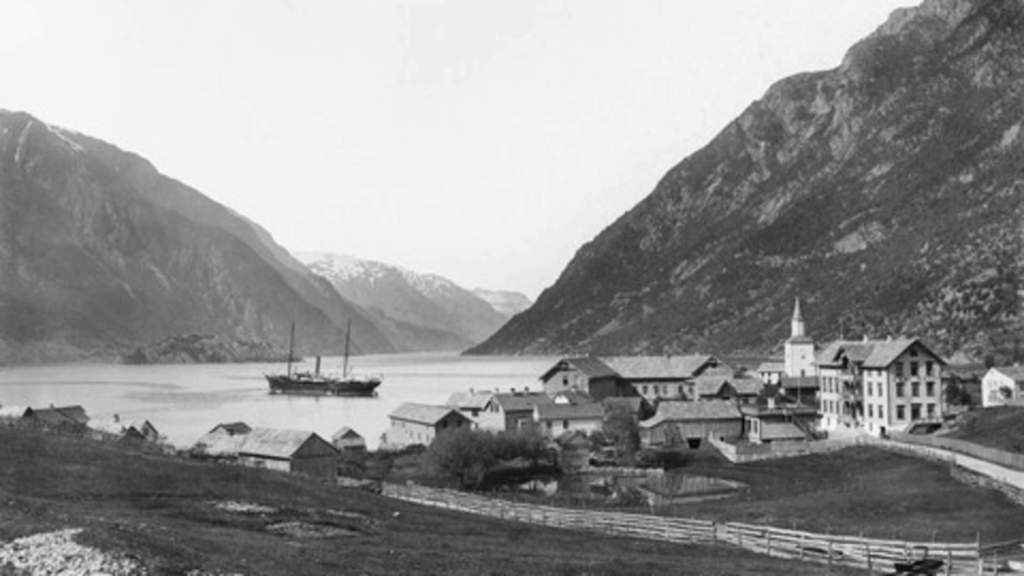
As we head towards the river, we notice an outdoor exhibition of Knut Knudsen, a renowned Norwegian photographer born in Odda. He had made his name in the last half of the 19th century taking photographs of local landscapes, his work making a major contribution to the growing sense of a Norwegian national consciousness.

“Look, there’s one of a steamship anchored in the bay just where we came in”, shouts the First Mate. “That could have been the one that your great-great-grandfather was on.”

Steamship anchored at Odda (by Kurt Knudsen, date unknown). No zinc smelter!

It had become fashionable in Britain in the late 19th century for those that could afford it to take advantage of the growing number of steamship companies to tour the fjords of Norway. My great-great-grandfather had taken one in 1889, and luckily had written letters back to his eldest daughter Meg describing his trip. Even more luckily, these letters had found their way down the generations to us. We had decided over the winter to follow as much of his trip as possible during our own voyage.

We follow the river crashing and tumbling over the rocks, and eventually reach Lake Sandvinvatnet. We stand in wonder looking at the same scene that my great-great-grandfather had seen 136 years previously. To the left are the two waterfalls he mentions. But no glacier!

Lake Sandvinvatnet, Odda.

“You need to walk around the western shore of the lake”, the woman in the Visitor Information had told us. “To a small hamlet called Jordal. The glacier doesn’t come down as far as it used to, but you can see it from there.”

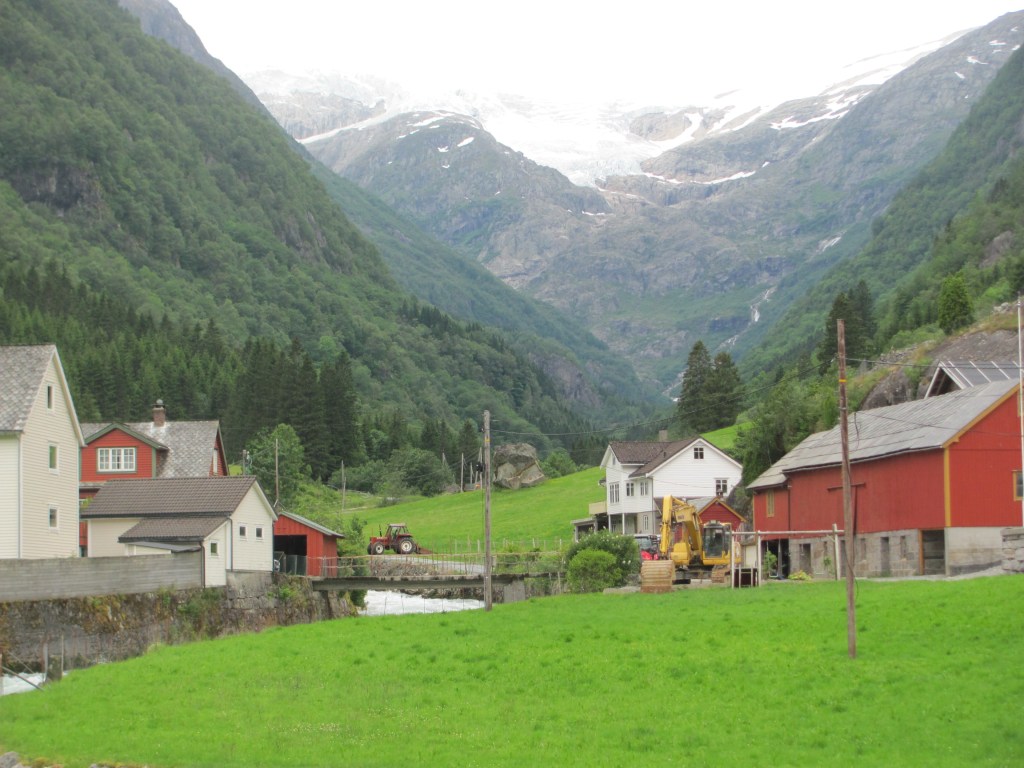
Sure enough, at the head of the valley, we see the mighty river of ice topping the rock like icing on a cake.

The Buarbreen arm of Folgefonna Glacier from Jordal.

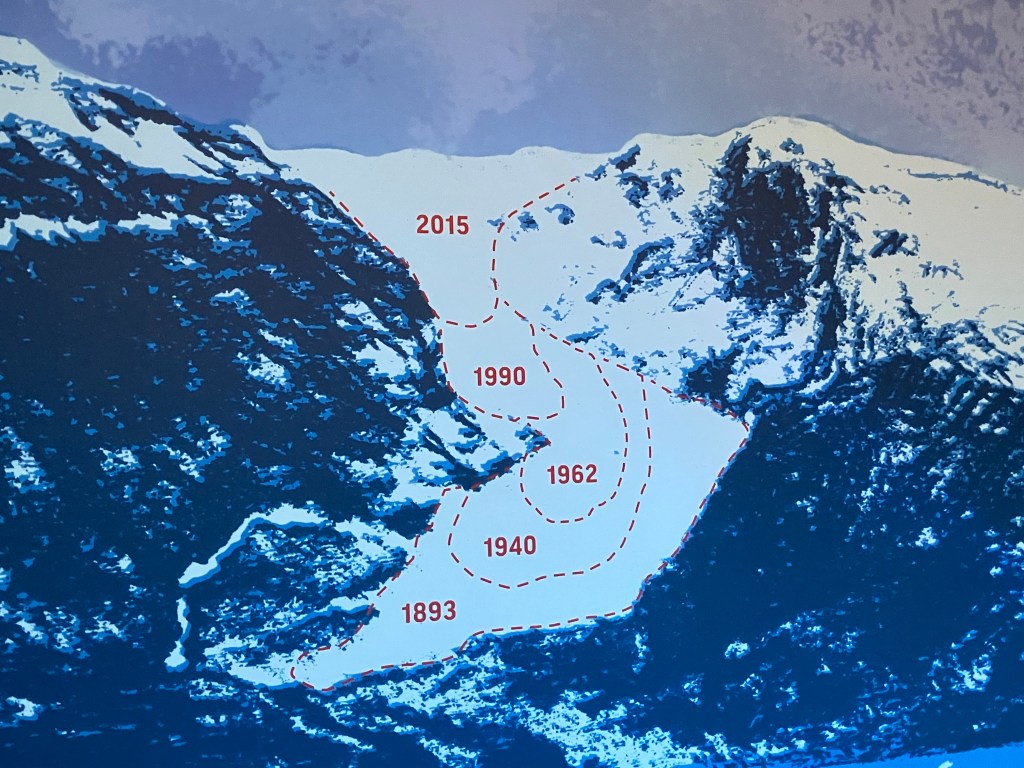
“It’s hard to believe that when my great-great-grandfather was here in 1889, that he would have seen much more of it than we are seeing it now”, I say, as we walk back to Odda. “Proof of climate change, if ever one was needed.”

Retreat of the Buarbreen glacier.

In the morning, we visit the museum in Rosendal. First up there is a film on how the Hardangerfjord was formed.

“Its geological history starts about 400 million years ago”, we learn. “Then, the three continental land masses of Laurentia, Baltica and Avalonia all collided with each other, resulting in the pushing up of mountains from the southern part of the United States right across to Scotland and Norway, with younger rocks being forced underneath the older rocks. In Norway, this created a huge fault along what is now the Hardanger fjord, with the oldest rocks generally on the south-east side and the younger rocks on the north-west side.”

“It’s pretty amazing, isn’t it?”, whispers the First Mate in my ear. “I am glad I wasn’t around when all these collisions were going on. Think of the insurance!”

“Over time, water eroded this fault line, weakening it”, the film continues. “When the Ice Ages came, glaciers formed in this huge fissure, grinding it and scouring it as they moved slowly down towards the sea. Eventually the ice started to melt, with meltwater running under the ice and further gouging out the fissure, resulting in fjords that were around 1000 m deep. Sediments from the erosion filled in some of this, so that the Hardangerfjord is now around 800 m deep for much of its length.”

It’s fascinating stuff. It’s difficult to imagine the power of the processes that can move massive amounts of rock around like sand in a sandpit, sculpting new landscapes as they go. Albeit very, very slowly.

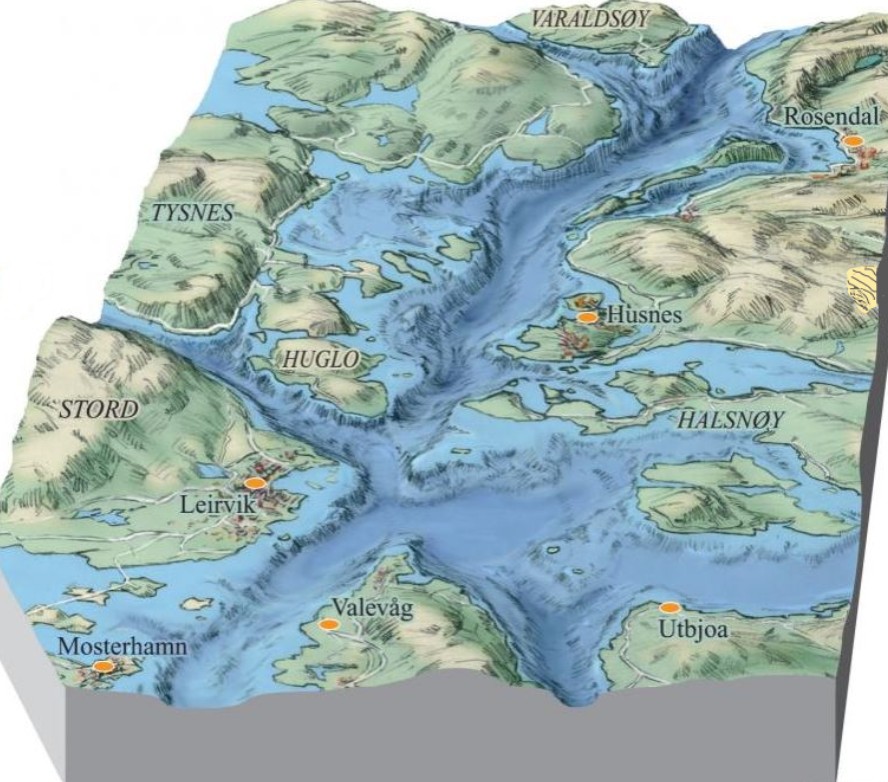
Undersea topography of the Hardangerfjord (from fjords.com)

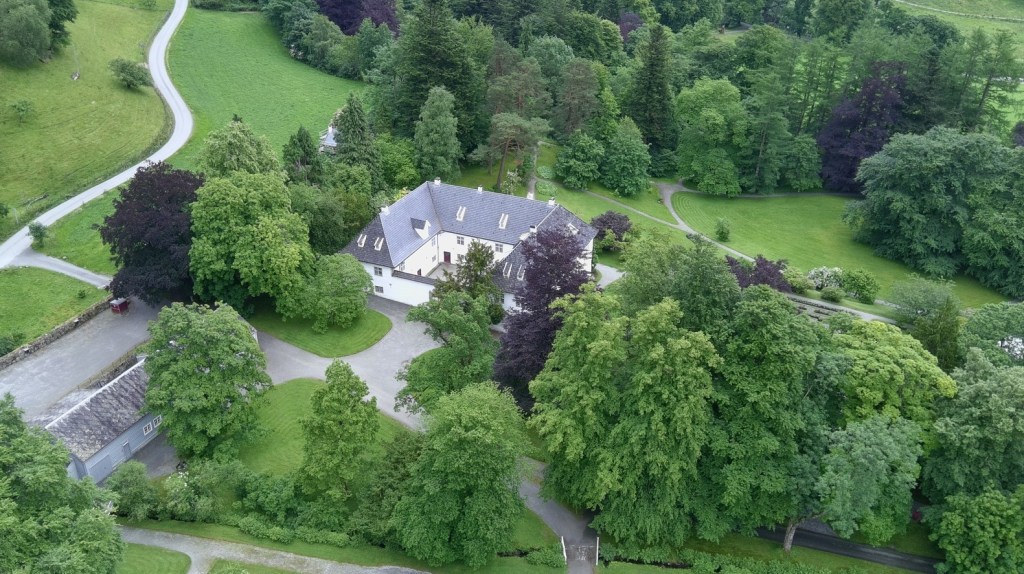
“I am glad you enjoyed it”, says the friendly lady at the Visitor Information Office. “Now, the other place you should visit while you are here is the Rosendal Baroneit, a 17th century manor house. It’s just a short walk from here. You can’t miss it.”

We walk up the road to the east of the village, and eventually find a tree-lined avenue.

Rosendal Baroneit.

“We do guided tours in both Norwegian and English”, says the young man at the ticket booth at the gate. “But unfortunately there is only one tour left today, and it is in Norwegian. But perhaps if you ask the guide nicely, and if the other people agree, he might do it in English.”

We’re in luck. No-one objects.

“We actually prefer English”, says one woman as an aside to the First Mate. “My parents are visiting us from Kazakhstan and they speak more English than Norwegian.”

“Back in the 1600s, there was once a  Danish nobleman by the name of Ludwig Rosenkrantz who married the richest heiress in Norway, Karen Mowat”, the guide tells us. “The couple were given the farm as a wedding present from her father, who had more than 500 farms in western Norway. They decided that they liked it so they built the manor house. It was finished in 1665. Shortly after Rosenkrantz was awarded a baronetcy by the King of Denmark, Christian V, the only one of its kind in Norway.”

He takes us through to the library. Ancient tomes line the walls.

“I wonder if anyone has read them all?”, whispers the First Mate. “Or do you think they are just there to impress people?”

“Titles were abolished in Norway in 1821”, the guide continues. “Title holders were allowed to keep and pass on their assets, and keep using their titles for their own lifetimes. But the title ceased when they died and no new ones were allowed to be created. The house remained in private ownership until the 1920s, when it was donated to the University of Oslo. Now it is preserved as a museum of an important part of Norway’s cultural history.”

We are taken through each room in turn – bedrooms, dining rooms, drawing rooms, ballrooms, ladies rooms, and the more mundane kitchens.

Rosendal Baroneit.

“Well, you certainly get an idea of how the other half lived”, says the First Mate. “It has a certain appeal. You know, one of my wishes when I was younger was to have a house with a turret.”

“Perhaps we can have one built”, I say. “Then I could lock you in it like Rapunzel.”

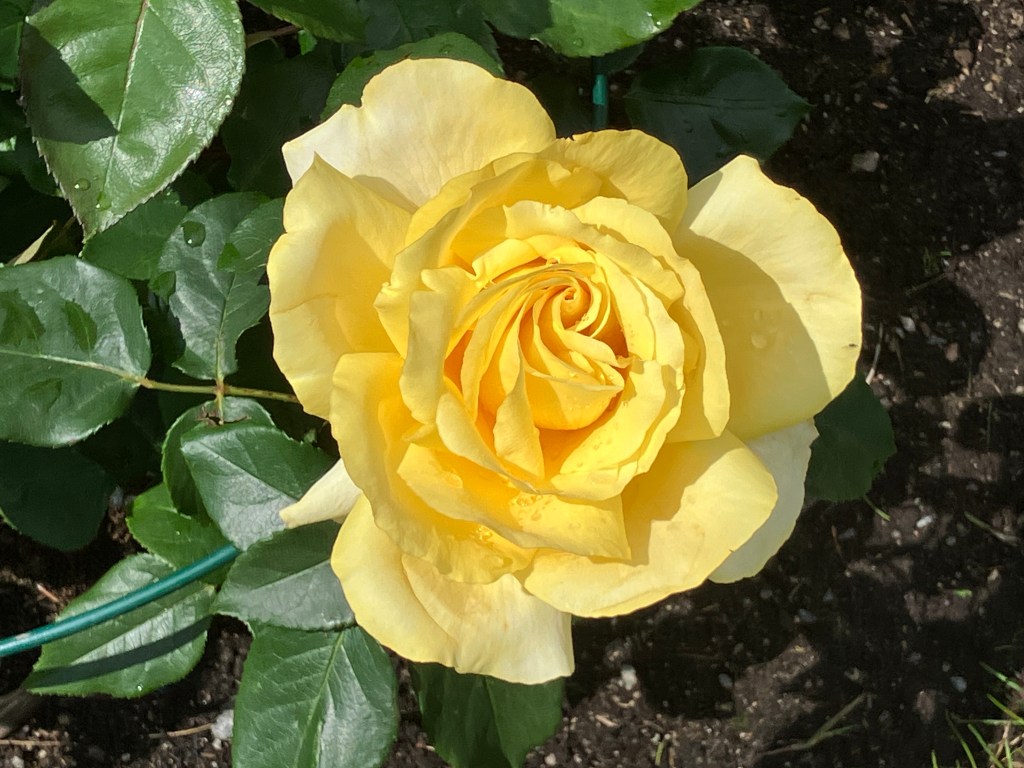
“Well, that is the end of the tour”, says the guide. “I hope that you enjoyed it. While you are here, I suggest that you see the gardens. They are supposed to be the finest Victorian gardens in Norway. The roses are especially beautiful.”

Roses at Rosendal Baroneit.

“You’ll never guess who I have just had a message from”, says the First Mate checking her phone as we walk home. “Simon and Louise. They have just arrived. They saw on their AIS that we were here, and thought that they would pop in too. I’ll invite them in for a café und kuchen.”

“There are strong winds and rain forecast for tomorrow”, explains Simon. “This looks like a good place to sit them out.”

The café und kuchen leads to dinner, where the conversation turns to the state of the world.

“You know, I can’t understand why we haven’t evolved beyond wars and strife by now”, says Simon. We all know that they are evil and unnecessary, yet we still seem to have them. Why?”

“Ah, you must subscribe to the Enlightenment idea of continual human progress”, I say. “Human affairs are always supposed to keep improving. The Stephen Pinker idea. I used to too, but after reading too much of John Gray and looking at what’s going on in the world, I am having second thoughts.”

“But you would think that any political system that was predisposed to wage war would ruin its economy so much that it couldn’t survive and would get weeded out”, he replies. “Just like unsuccessful reproductive strategies in biology.”

“It’s an interesting point”, I say. “But I am not sure that human affairs work like that. Look at the Roman Empire and most other empires in history. They were able to keep expanding because the countries that they conquered and bought under their control provided food and men for them to keep expanding. That was able to keep going for quite a long time, but eventually the costs of administering such a large empire outweighed the benefits and it collapsed. A bit the same with the British Empire.”

“But why haven’t we learnt from history that that is what happens in the end, and just not bother”, says the First Mate. “WW2 showed us that war and empire building was pointless, and that if we had a system of rules that applied to all countries big or small, then we would all benefit. So for the last 70 years or so, we have had peace in Europe and everyone has prospered.”

“Unfortunately, our current leaders seem to have lost sight of that”, says Louise. “There seems to be a move back to the authoritarianism that we saw in the 1930s.”

“It’s an interesting question”, says Spencer later over a nightcap. “Whether you humans should evolve towards greater cooperation rather than warfare, I mean. I think that It is all about raw power and prestige, and not really about devising better systems. Your leaders always want to leave a legacy that gives them prestige in the history books. If they believe they have the power to achieve that, then they will try and do it. Putin has visions of being a second Peter the Great in reunifying the old Soviet Empire, but it looks like he might have overestimated his power to do it. Trump seems to want an American Empire of the USA, Canada, Mexico and Greenland. It remains to be seen if either has the real power to achieve either of those aims.”

“The Law of the Jungle”, I say with a sigh. “Survival  of the Strongest.”