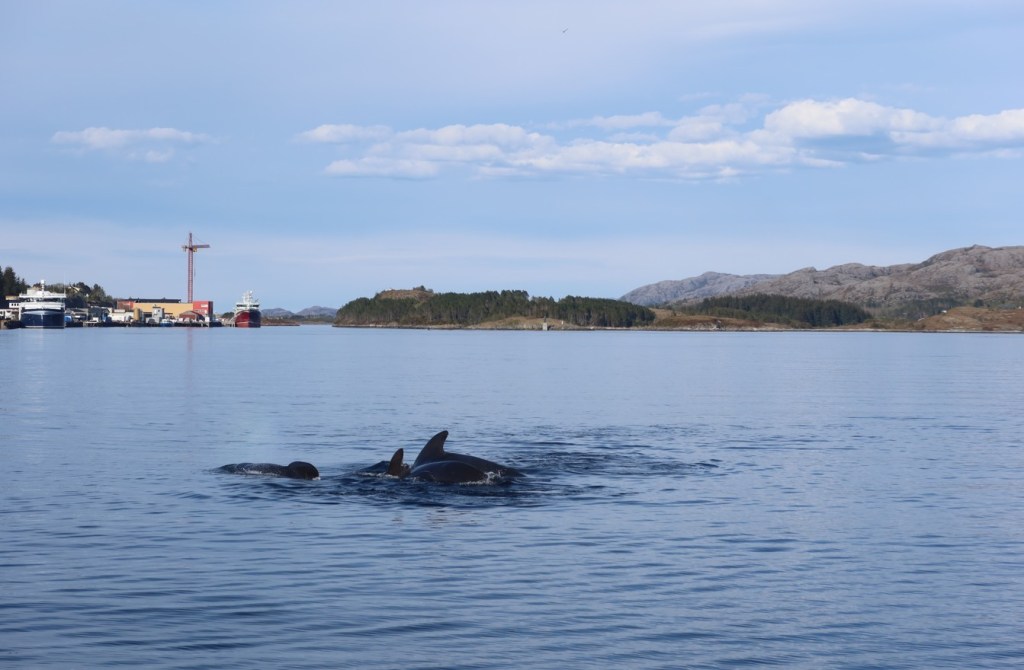
“What’s that in the water in front of us?”, shouts the First Mate from the bow, ropes in hand. “There’s something floating. Make sure you don’t hit it!”
We have just passed under the bridge approaching Rørvik, and are preparing to enter the harbour. She’s right. There is something in front of us. Then another, and another, and still more, their fins breaking the surface then disappearing back into the water.
“They are dolphins or porpoises, or something like that”, she calls excitedly.
But they look too big for normal dolphins or porpoises. And their fins are different. I slow down and turn the engine off and we drift slowly, so that we can watch them. The First Mate fetches the fish book from the cabin, and we flick through the pages.
“They could be pilot whales”, I say. “I vaguely remember the shape of their fins. Droopy. Very distinctive.”
The creatures seem to be totally unfazed by our presence. We sit and watch them for some time, taking photos. There are at least three subgroups with younger ones and older ones in each, all quietly feeding and playing. Occasionally they come quite close to the boat.
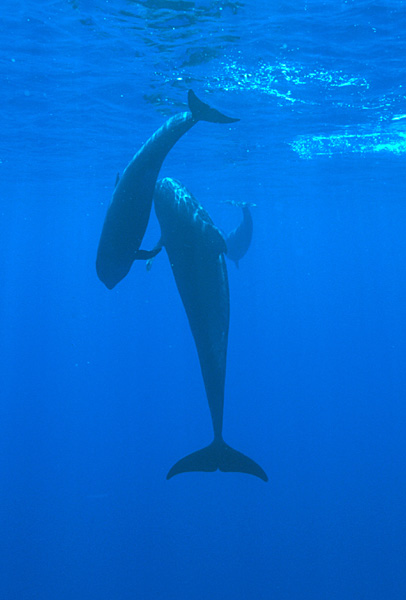
“Yes, they are long-finned pilot whales”, a neighbour on the pontoon tells us later. “They feed on squid and cod which are driven in here by the currents. They are actually members of the dolphin family, and are very sociable animals, usually staying with their family groups for their whole lives. You often hear of them getting stranded on beaches throughout the world, which is thought to be because of damage to their inner ears by noise pollution from ships and naval exercises. Then because of their strong social bonds, the others come to help and become stranded too.”
“They are certainly big”, says the First Mate.
“Yes, the males can get up to 7.5 metres long and weigh more than two tonnes”, he answers. “The females are usually a bit smaller.”
There’s something special about these interactions with large marine animals. Part of it is the size of them, but it is also intriguing to think about their social structures and to what extent they are like us in that respect. And do they have a consciousness similar to ours?
We tie up at the marina in Rørvik. The forecast is for rain and strong winds for the next two days, so we batten down the hatches and busy ourselves with boaty jobs. During a lull, I take time out to go and visit the Coastal Museum.
“You know that we close at two o’clock?”, says the lady at the desk. “That’s in half an hour.”
Google had told me that it was open until 1500.
“I can let you have half an hour for half price”, she says, seeing the look of disappointment on my face. “Would that be OK? I can recommend our exhibition on salmon. There’s a 20 minute film you can watch.”
I spend the next half an hour learning about the life cycle of salmon, important to Norway’s economy because of the many fish farms along the coast. It’s quite fascinating. Eggs are fertilised in a laboratory, they then hatch into alevin that develop into fry which are put into fresh water tanks and fed abundantly to grow into smolt. Then after about a year, they are transferred to seawater cages and raised for another 1-2 years before harvesting. All very industrial.
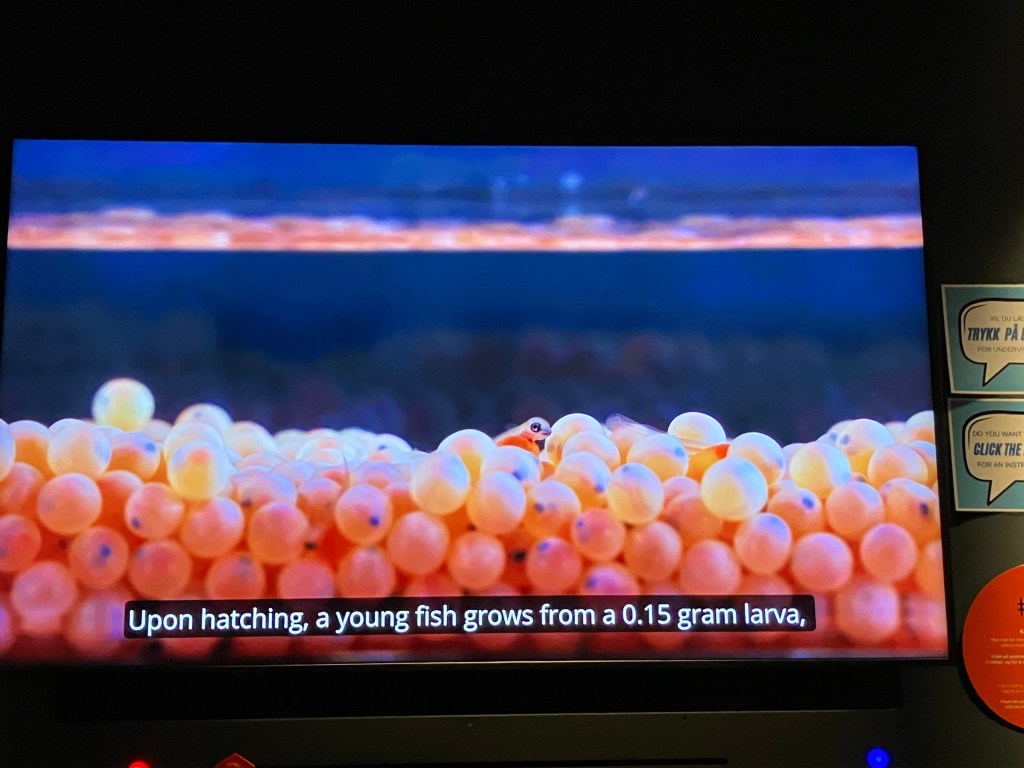
“We are very careful to feed them just enough food and no more so that there is no excess that can pollute the surrounding ecosystem”, the film assures me. “And we minimise escape of fish outside the cages to prevent their genetic material mixing with local wild populations of salmon.”
The next day, the winds have dropped and the rain has stopped, so we set off heading northwards. On the way, I decide to calibrate Ruby Tuesday’s electronic compass. We had been having problems with it for two seasons now, in that there was a deviation between it and the magnetic compass that couldn’t be explained by the magnetic deviation, the difference between the true and magnetic north poles. Over the winter, I had taken the compass sensor home and sent it off to the manufacturers for checking and service. It came back with a clean bill of health saying there was nothing wrong with it, but would need recalibrating once back in the boat. This is done by driving around in a circle so that the compass can align itself with the earth’s magnetic field.
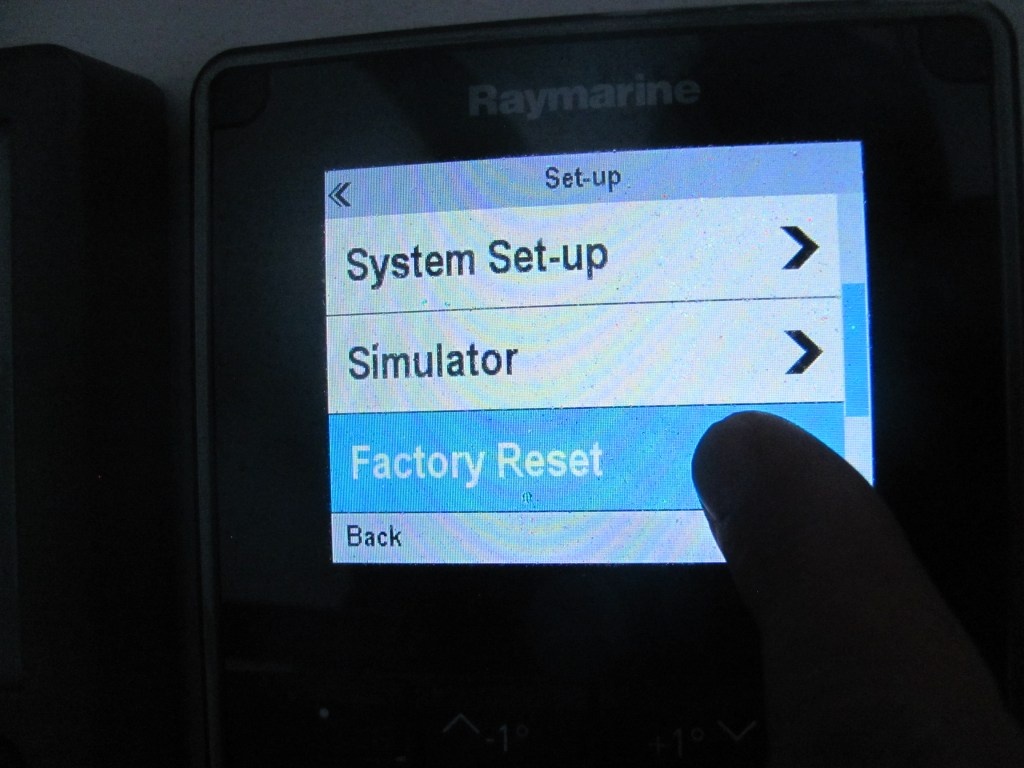
Somehow I manage to press the button for a ‘Factory Reset’ that erases all previous settings. Immediately the autopilot swings the wheel hard over. It has become mixed up between port and starboard and thinks that one is the other. I frantically try and reset it, but nothing works. And just at that moment we are hit by a sudden wind squall and it starts to rain.
I ring the manufacturer in the UK.
“I’ll email you the instructions for commissioning the autopilot”, the chap at the other end says. “If you follow that, you should be able to solve the problem.”
The incongruity of being in the sea somewhere off the west coast of Norway in a violent squall and being able to speak with someone in the UK and have him send some instrument instructions is not lost on me.
The instructions arrive almost immediately. The rain eases slightly. But I still can’t get it to work. There’s nothing to do except steer the boat manually, meaning that someone has to be a the wheel all the time, and try and work my way through it methodically when I get time in the evening.
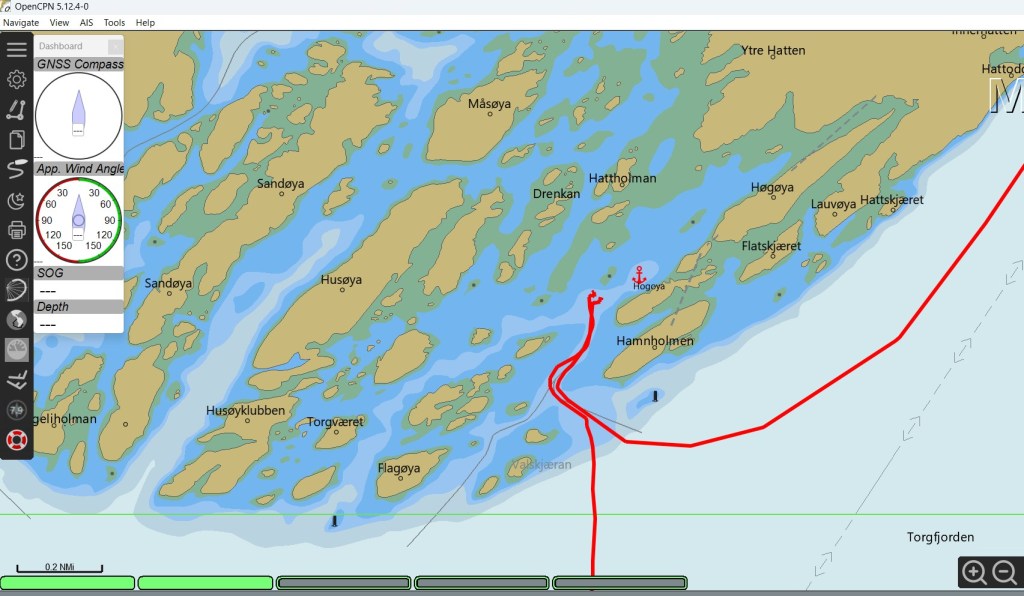
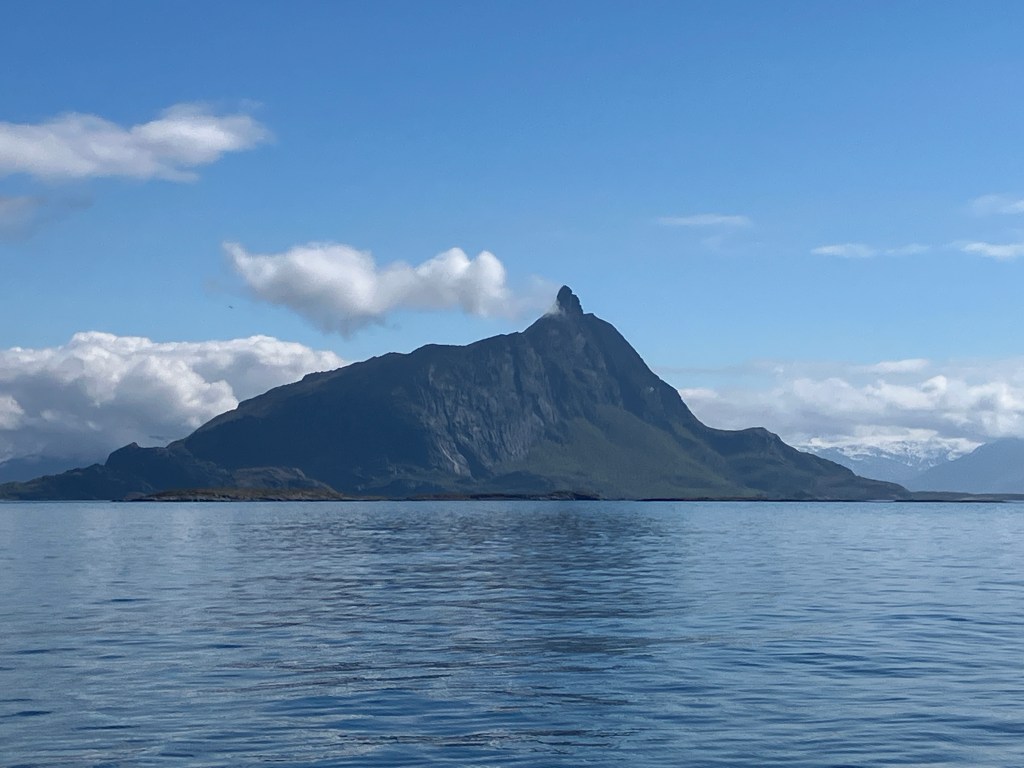
We are approaching Torghatten, an impressive cone of rock rising out of the sea, and decide to find an anchorage near there for the night. There is one marked to the south of it, but it doesn’t have an easy entrance, requiring some careful navigation through narrow channels with submerged rocks and drying areas on each sides. But by taking it slowly, and making maximal use of the charts and GPS, we make it to the inner pool without touching the bottom or scratching the sides. The First Mate drops the anchor.
“It’s beautiful”, she says. “Look at the light of the evening sun. And you can even see the hole through it.”
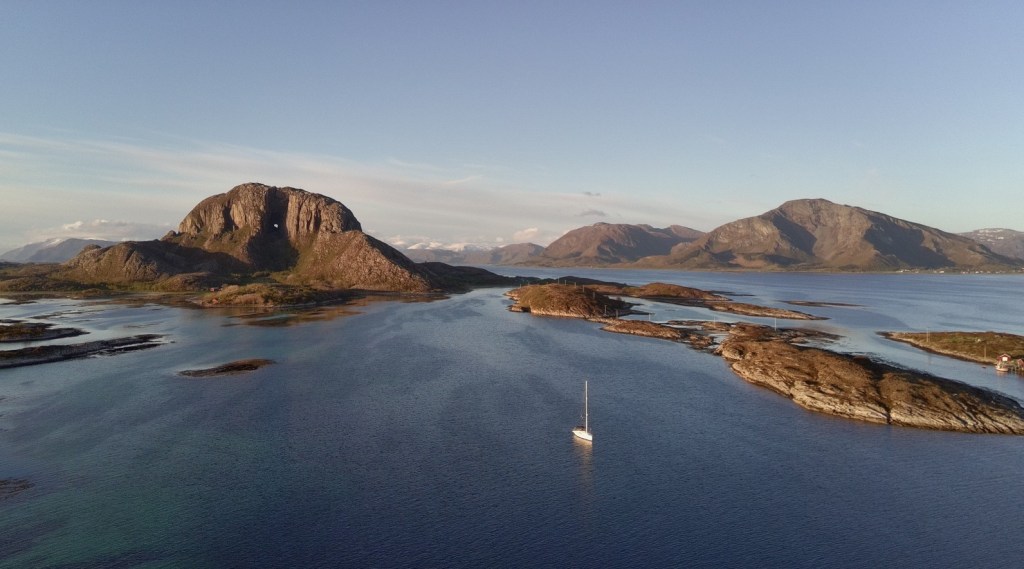
Torghatten’s pièce de résistance is a hole through its middle.
“I was reading of the legend about how it came to be there”, she continues. “A long time ago, these were the lands of the trolls. One of the troll kings had seven daughters which were a bit of a handful for him to manage, so he hired a maid called Leka to look after them for him. Leka was to keep the daughters entertained while he got on doing what troll kings do.”
“Which was what?”, I ask.
“I don’t know”, she answers. “Stopping people from crossing bridges, I suppose. That sort of thing. Anyway, one day, the girls were swimming in the sea, and Hestmannen, the son of another troll king, was riding past on his horse. He spotted them, and unfortunately took a fancy to Leka the maid rather than to the troll princesses. They fled, so he chased them all down the coast on his horse. The seven sisters then noticed that he was quite good-looking and stopped running, hoping that he might also stop. But he had his heart set on Leka and galloped past them.”
“Did he catch up with her?”, I ask.
“No, she was too fast for him”, she answers. “So he took his bow and arrow and shot at her, thinking that if he couldn’t have her, then nobody could. But just at that moment, a third troll king who had been watching the whole episode, threw his hat in the way of the speeding arrow, and saved the maid. The arrow left a hole in the hat.”
“There certainly seem to have been enough troll kings in those days”, I say. “That’s three in just one story.”
“Yes, but what they had all forgotten was that if trolls are struck by sunlight, they turn to stone”, she says. “They were all so excited by the goings on, that they didn’t notice the sun rising, and sure enough, they were all turned to stone. You can still see them all where it happened. Torghatten is the hat with the hole through it, Leka is an island we passed on the way up, the Seven Sisters are the mountain range just north from here, and Hestmannen is an island further north still.”
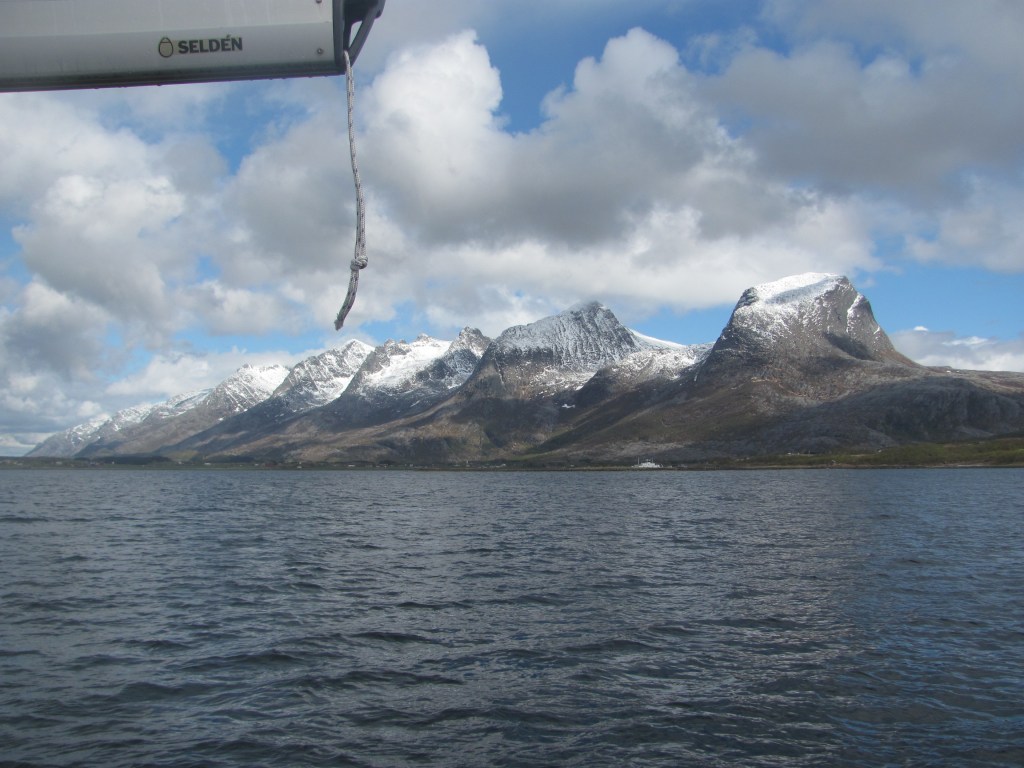
I think of the people who told these stories – huddling together around fires in their longhouses to keep warm against the long harsh Nordic winters – trying to make sense of the world with their gods, giants, trolls, elves, dwarfs and spirits. Were the stories for entertainment, or for an explanation of the cosmos, I wonder? Probably a bit of both.
“Nice story, but of course we know far much more now about the way things work”, sniffs Spencer, from his home in the canopy. “I’ve been reading about it on the Web.”
It’s the first time we have seen him this year. We were wondering if he had survived.
“Nice to see you again”, I say. “I am sure you’ll tell us.”
“The whole mountain is a granite intrusion formed deep in the earth’s mantle, which was then forced up into the rock layers above it. During the Ice Ages, there was a 1 km layer of ice all over the landscape, and when it began to melt, the meltwater created tunnels where there were weaknesses in the rock. Torghatten’s hole was one of these tunnels. At the same time, the softer rock surrounding the granite intrusion eroded faster than the dome, so that eventually it was all that remained.”
“I read somewhere that the hole was formed by wave action when the sea level was higher”, I say.
“Well, that’s what they thought for a long time”, he responds, “but recent research has shown that sea levels after the Ice Age were still 15 m below the hole, so it is unlikely that wave action would have had much influence.”
Either way, it is pretty amazing stuff, I think.
Later that evening, I clear the memory of the autopilot navigation system, and start again on the commissioning procedure. This time it works. It now knows that starboard is starboard and port is port and neither the twain shall meet.
“I am glad that you got that fixed”, says the First Mate. “It’s a bit tiring for someone to be at the wheel all the time. Not to mention the cold.”
The next day, the winds have veered more to the south and will be behind us. We would have liked to walk up to the Torghatten hole, but we decide to make the most of the winds and do it on the way back. We push on to Sandnessjoen, then on to Nesna, one of the places that we may decide to overwinter in at the end of the season. There the winds turn against us and strengthen, and we have to kick our heels for two days waiting for them to ease. But there could be worse places to be. The scenery is stunning and the marina is friendly.
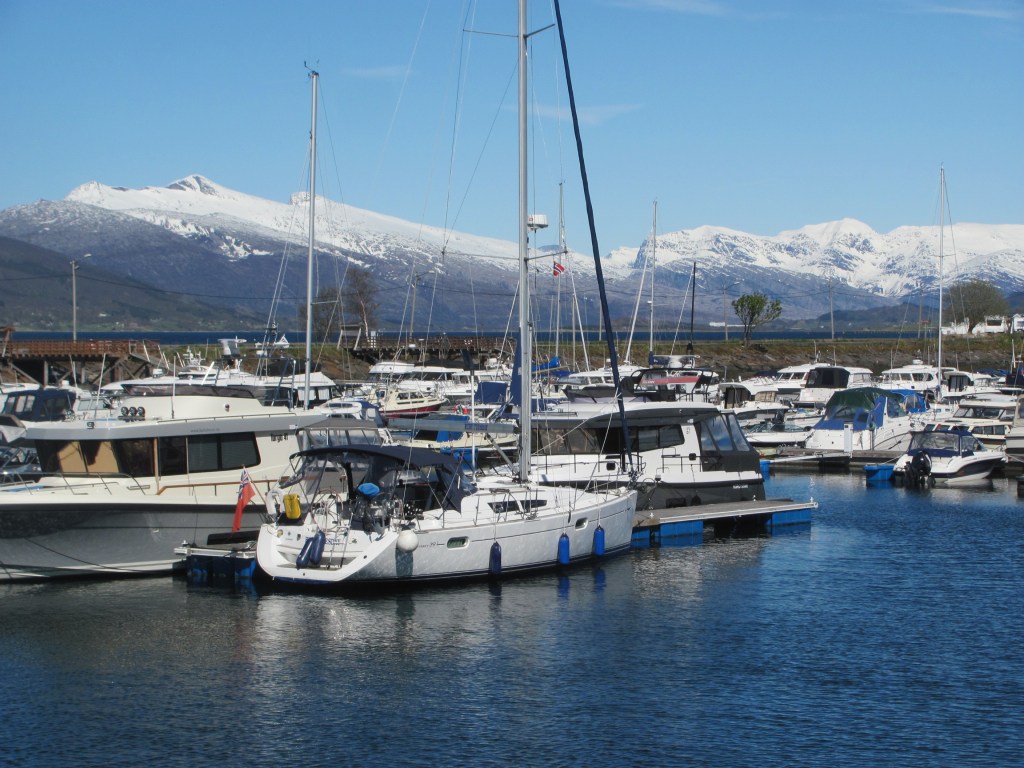
Eventually the winds change direction and ease slightly, so we make a break for Lovund, famous for its puffins. The wind is on the port quarter and gives us an exhilarating sail at nearly eight knots with just the genoa. We tie up at the new harbour to the north of the village. We are the only boat there. The season hasn’t started yet.
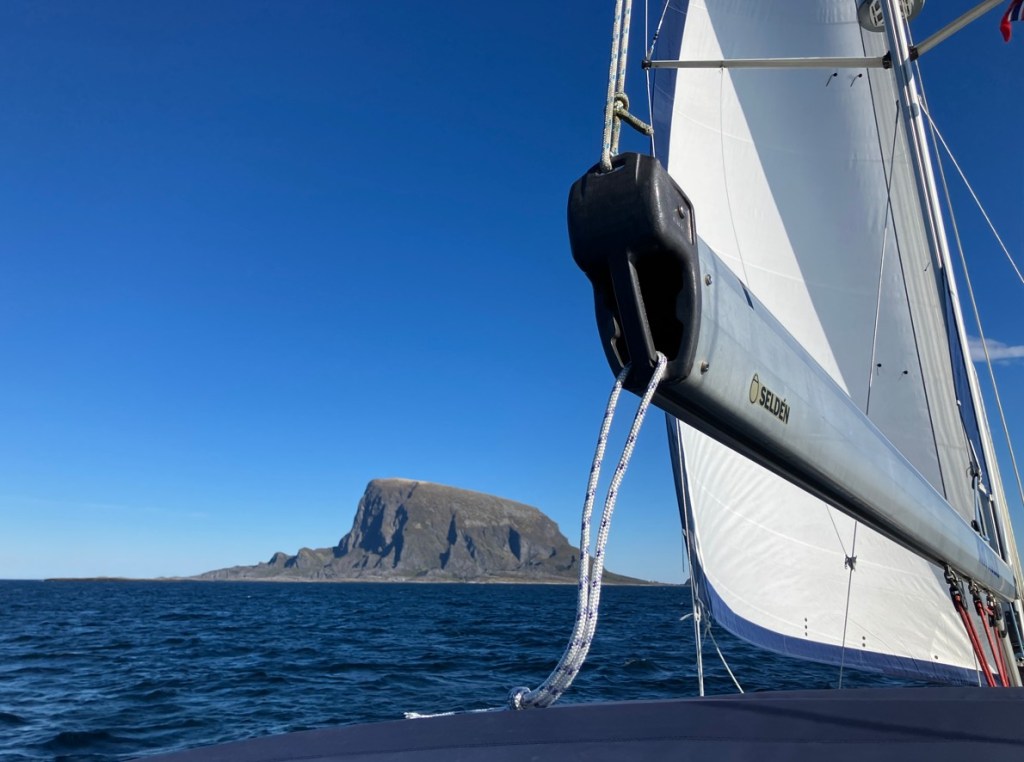
Andy & Anne arrive by ferry a couple of hours later, having left Amalia in a small harbour on the nearby island of Onøya. We have lunch and then decide to visit the puffin nesting grounds on a scree-covered slope. It’s a well-signposted walk to the north-west corner of the island.
We follow the rocky path as far as it will go. A sign tells us that it is forbidden to go further as the puffins are nesting. We look around expectantly, hoping to see some of the comical little birds bringing home sand-eels for their mates. None to be seen!
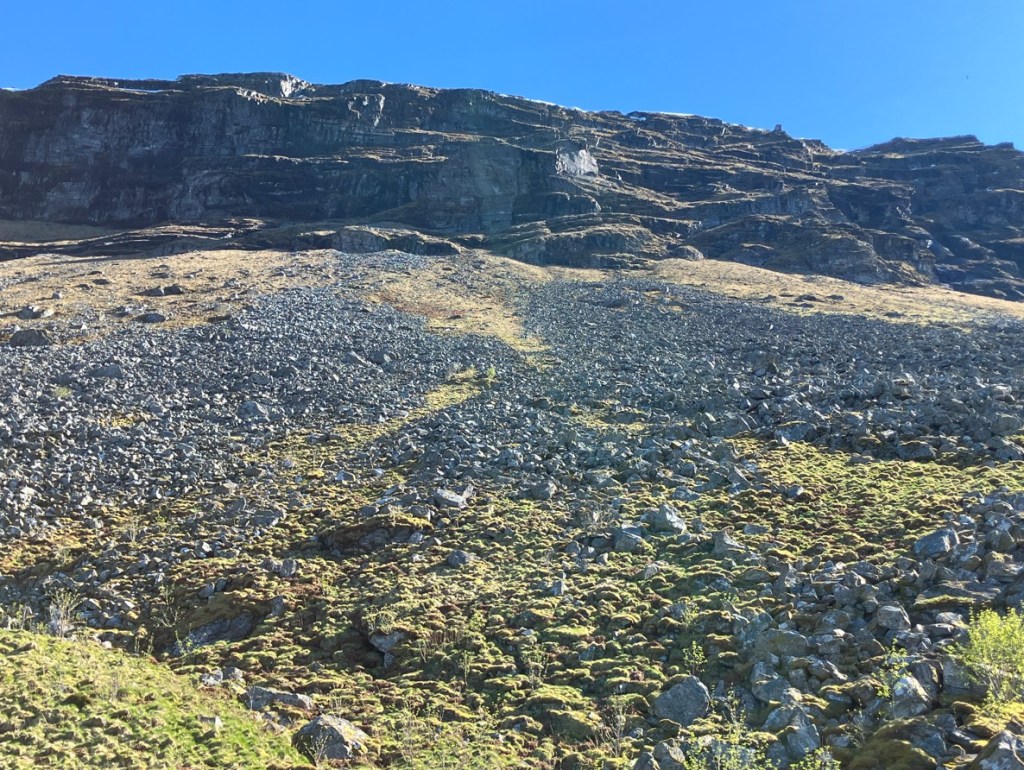
“You can really only see the ones flying around”, a woman tells us. “Not the ones that are nesting. Look here’s a big group coming in now.”
We strain our eyes and can just make out a flock of birds making their way in from the sea. They could be anything. We squint through the binoculars and can just about make out the red colour of their feet. I try and follow one as it lands, but it turns out to be a bit of dust on the lens.
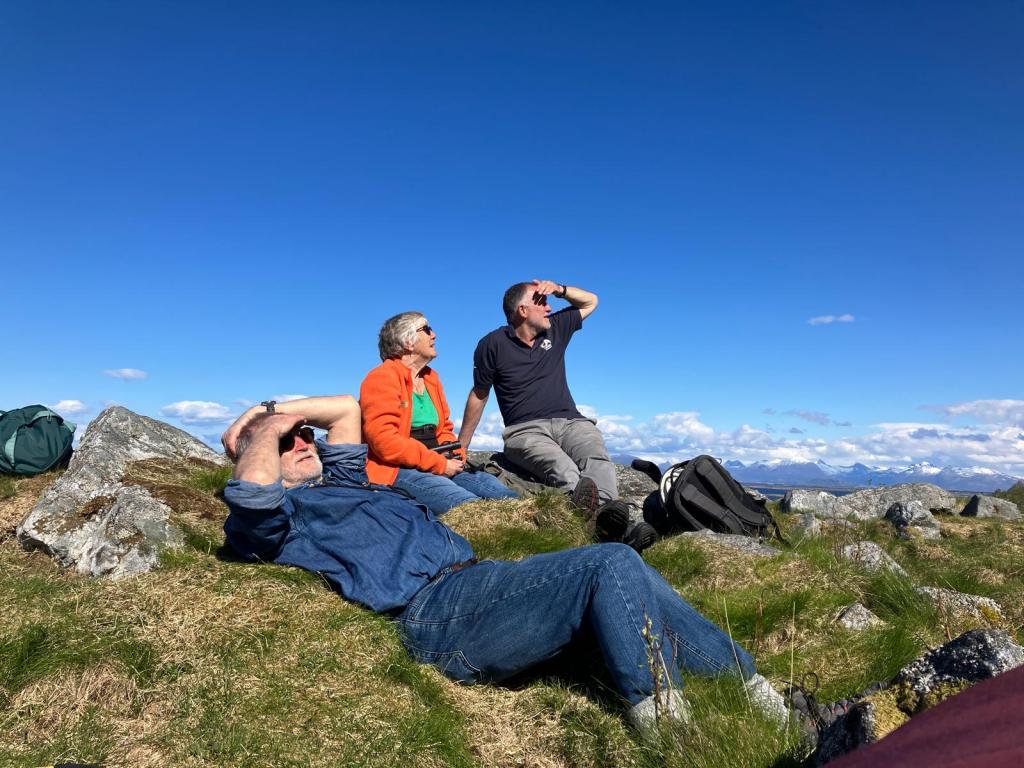
But it’s a glorious day. We lie in the sun soaking up the sun’s warmth, looking upwards at the tiny black specks circling. Down below is the colourful village of Lovund that we had just come from, a ferry just leaving for its next port of call. To the east, the snow-capped peaks of the Norwegian mainland. Out to sea, we can see the inselbergs of the Træna group of islands. It’s idyllic.
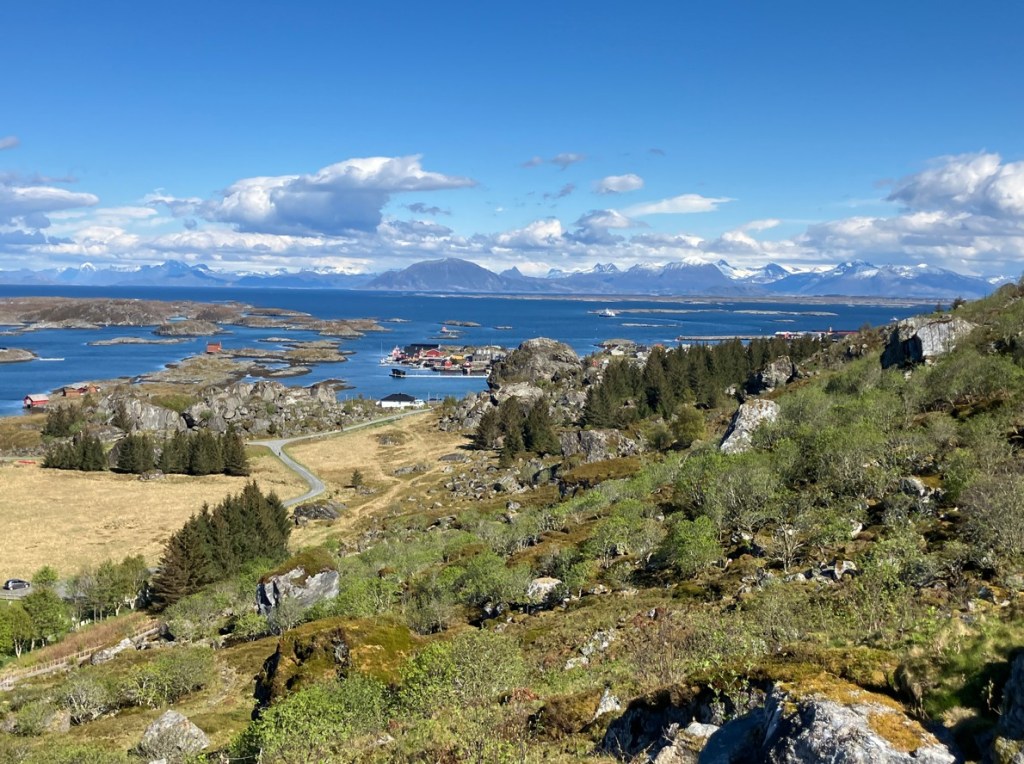
“Well, at least we have a good idea of why the puffins chose here to live and breed”, says Andy, always one to see the glass half full. “It’s beautiful here. And it’s not as though we haven’t seen puffins before.”
It brings to mind the time that we had sailed out to the Shiant Islands on the West Coast of Scotland. There had been so many puffins flying overhead and swimming in the water around us that we had been afraid that we would sail over the top of them.
“It’s a pity we didn’t see any close up”, says the First Mate. “But I am sure that you will find a nice puffin picture from Wikipedia or somewhere for the blog.”
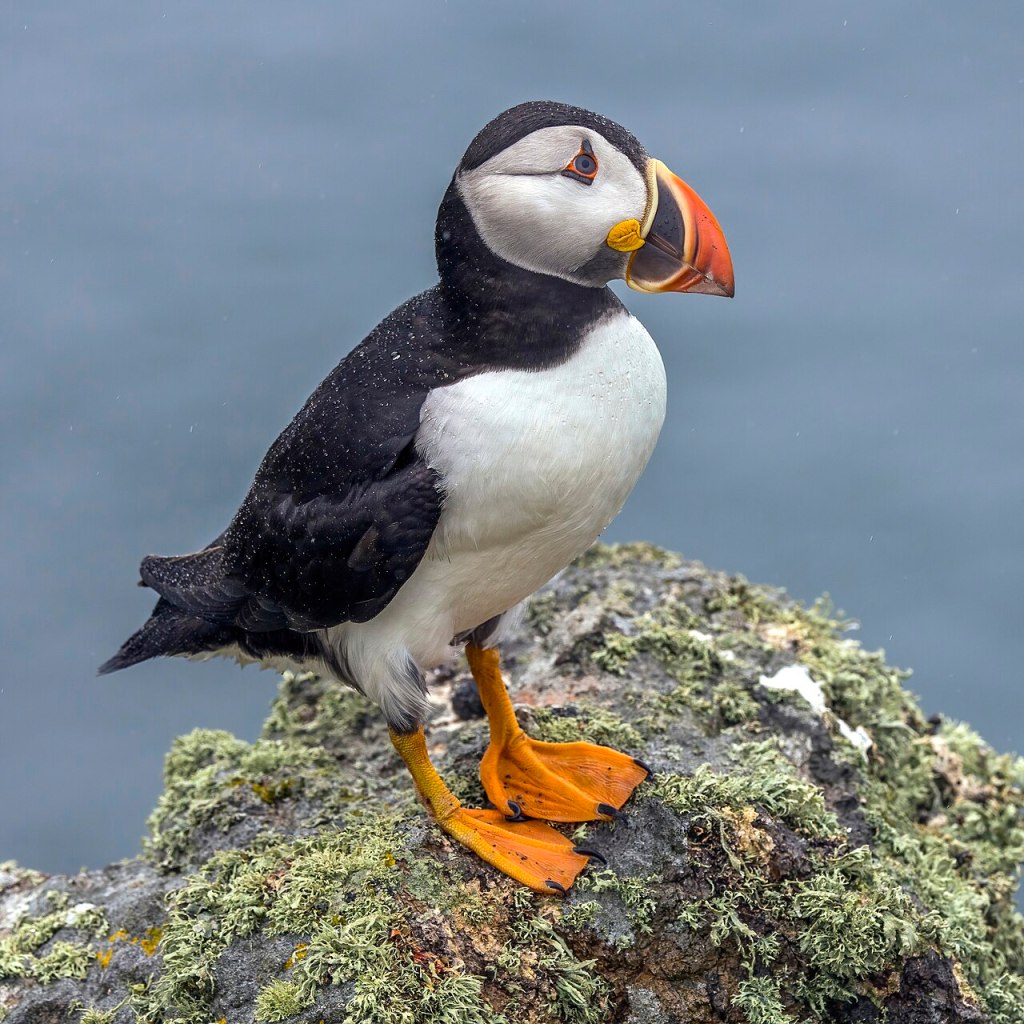


.jpg)
Back on the water again! Looking forward to hearing what happens next. Are you able to put up a bit of a map showing where you are and where you intend to go, please? Thanks
LikeLike
Hamish, yes, on our way again. We’re heading for the Lofoten Islands in the north of Norway, possibly further north than that too, but we will see how we get on. Exact route is difficult to predict as it depends on winds, weather and our own whims.
LikeLike