Escaping the storm, a Devonian wonder, and a clenched fist

“It’s right behind us”, I call out to the First Mate. “It looks like we are going to get wet.”

We are coming into the small harbour of Leirvik on the northern shore of the vast Sognefjord. A storm is chasing us from the south, and we are trying to get to shelter and tied up before it reaches us. About 200 m behind us we can see the ruffling of the water’s surface as the wind reaches it, our world reduced to a writhing mass of greys and blues. Raindrops begin to fall around us, spattering on the cockpit cover and the cabin roof.

For the last hour or so, we had seen the heavy dark clouds gather over the mountains to the south, and watched them with trepidation as they moved slowly across the fjord, wondering when it would be our turn to be engulfed. This looks like it might be it. But somehow it misses us. At the last moment it veers off towards the east, leaving only the perturbed water and the few raindrops in its wake.
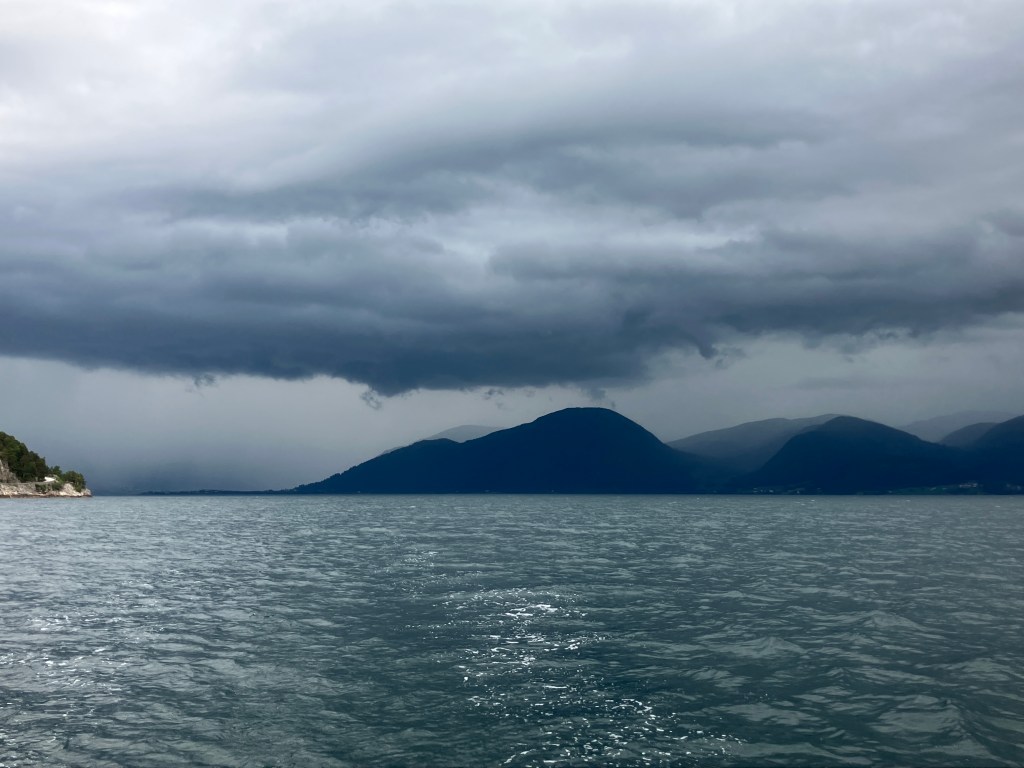
Storm clouds gathering.

“We’re not off the hook yet”, the First Mate shouts back, looking at the radar map on her phone. “There’s another one coming in. I’d say we have about ten minutes to get there.”

I push the throttle lever forward. We enter the small inlet, avoiding the salmon farms to starboard, and motor through the narrow marked channel leading to the harbour. Out of the corner of my eye, I can see the clouds appearing over the surrounding hills. Luckily there is a free space. We loop the lines around the cleats on the pontoon, quickly connect the power cable, pull down the sides of the cockpit tent, and retreat inside as the heavens open and the torrential rain starts.

“Phew, that was close”, I say. “I am glad that we didn’t get drenched. There’s something very nice about being warm and dry inside, listening to it pelting down outside.”

The rain stops in the early morning. We have a leisurely breakfast, top up with fuel, and set off northwards through Tollesundet. The wind is fitful, sometimes filling the sails and giving us a pleasant sail, other times dying to nothing so that once again we have to run the engine.
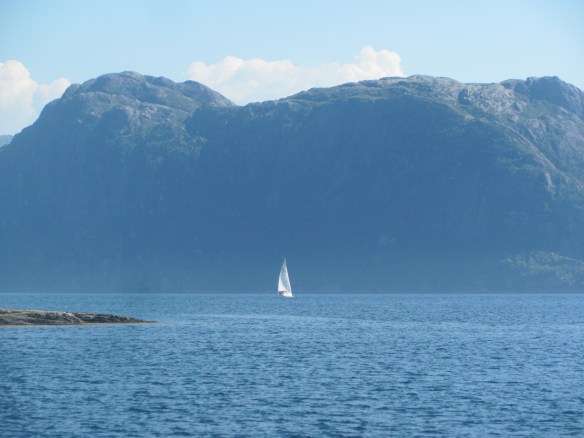
Catching the wind while you can.

“This topography plays havoc with the wind”, I grumble, as we take a line between the islands of Skorpa and Sula. “It always seems to be against you, whatever way you are going.”

“Just be thankful for the magnificent scenery”, says the First Mate. “And that we have the weather to be able to see it.”

In the late afternoon we reach the delightful little anchorage of Hatløy.

“Let’s stay here for the night”, says the First Mate. “It’s such a fantastic view. And there is no-one else – we have it all to ourselves.”

“Sounds a good idea”, I say. “It’s designated as a nature reserve and landing is prohibited from April to July for the nesting season, but we can stay on board.”

We drop anchor and chill out. A heron screeches from the reeds at the water’s edge, two ducks paddle by, looking expectantly for titbits. A cormorant flies overhead. There is a splash as a fish jumps and disappears again. It’s idyllic.
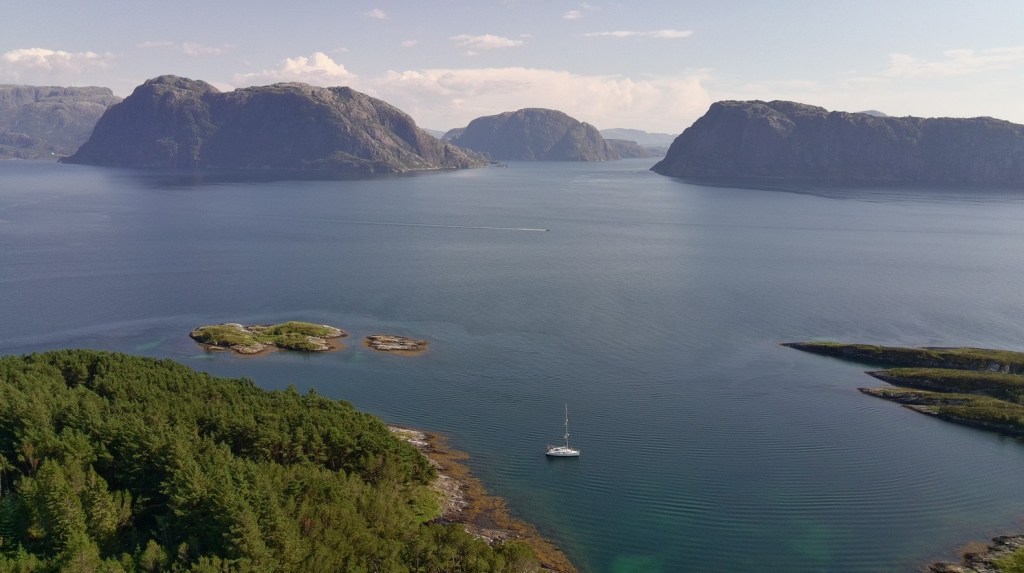
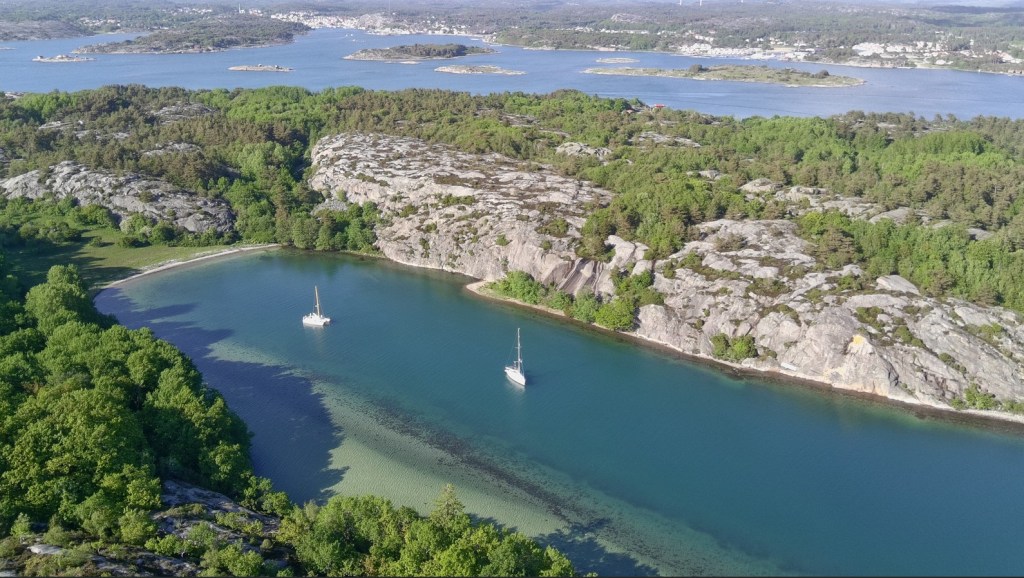
Anchored at Hatløy.

We carry on northwards the following day. The landscape widens, with more sea room and less feeling of being hemmed in by steep fjord sides. Nevertheless, it is still impressive. We pass the imposing bulk of Alden island with its Norskehesten mountain.
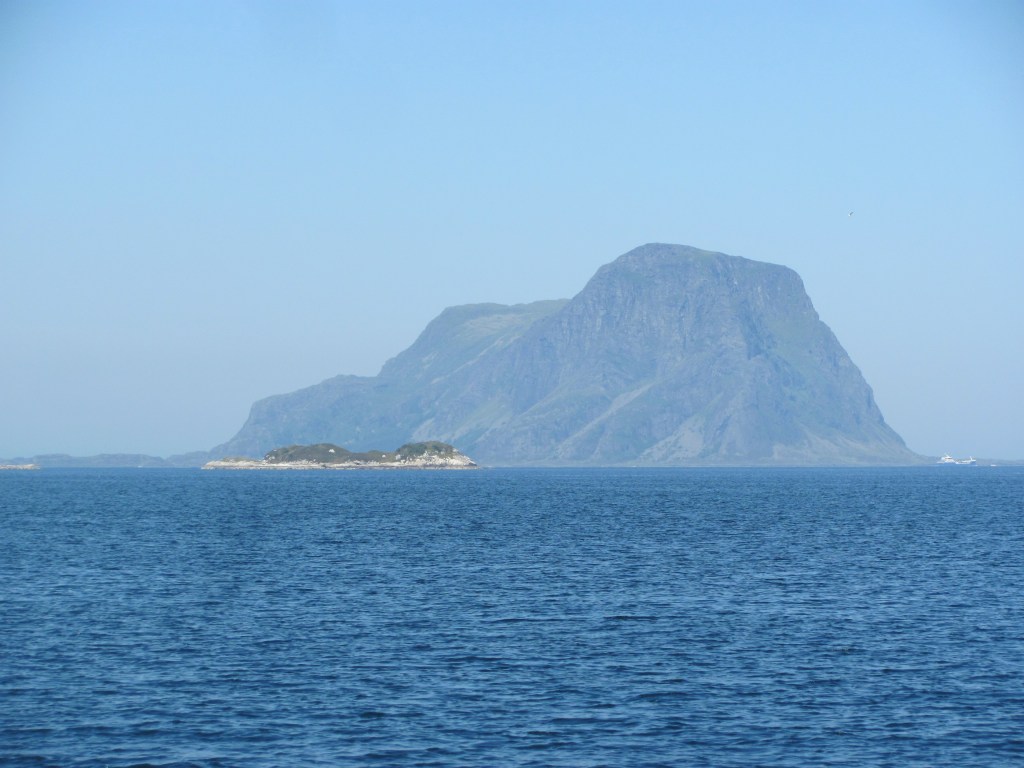
Alden island.

Norskehesten apparently means ‘Norwegian horse’”, says the First Mate. “But I can’t really see a horse in it. Perhaps from another angle. But it certainly is impressive. And look at the way the rock is twisted in this one we are just passing now. It looks a bit like a Swiss roll.”
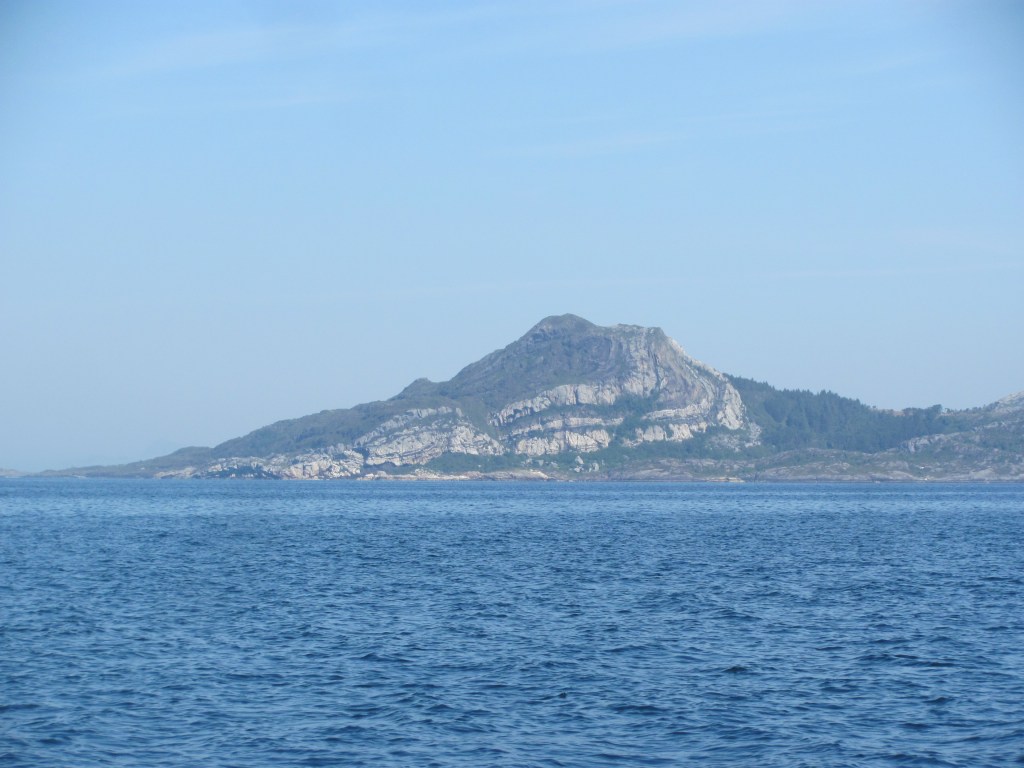
Swiss roll mountain?

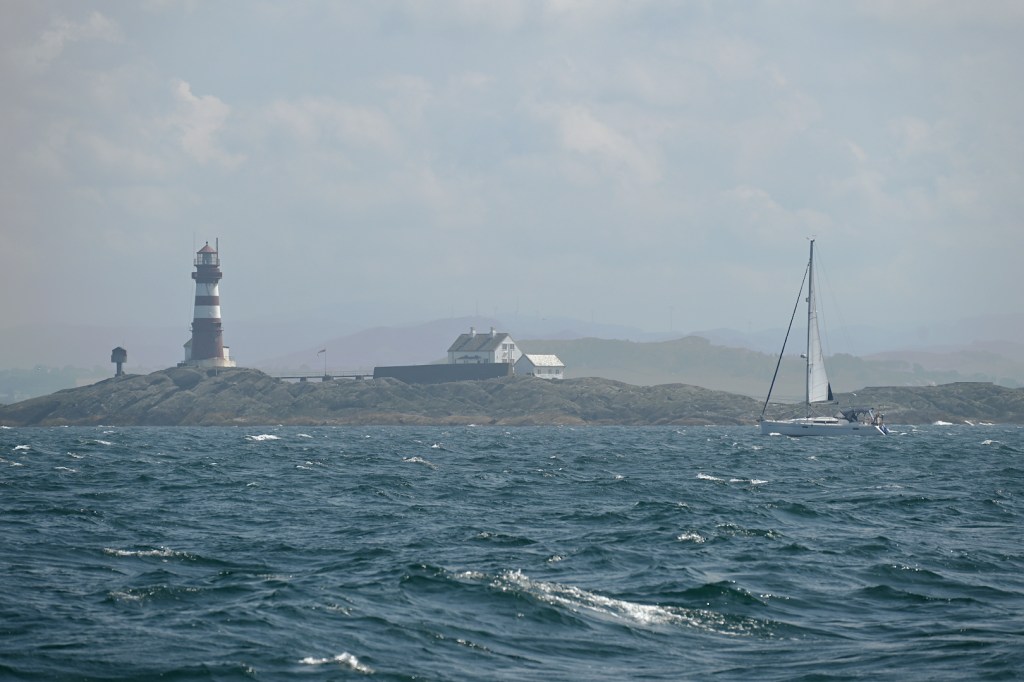
We eventually reach the bustling harbour of Florø. On the way in, we pass the iconic Stabben lighthouse.
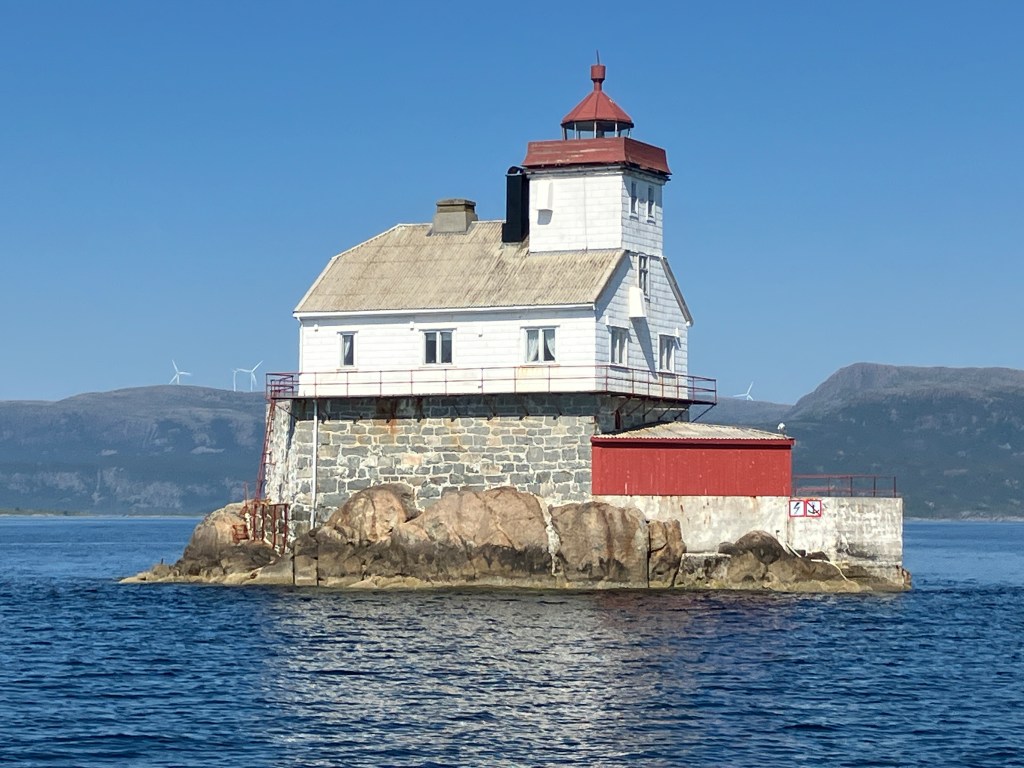
Stabben Lighthouse.

“We don’t need to stay too long in Florø”, says the First Mate. “I just have the washing to do and we can stock up on provisions. Then we should press on to Maløy while this good weather lasts.”

The Fisher Boy of Florø.

The next day we enter the Frøysjøen fjord. As usual, there isn’t much wind, and what there is is against us, so we have to motor until we turn eastwards where we are able to catch it on just enough angle to unfurl the sails. Even though we are only able to make three knots, we find it relaxing to sit back and enjoy the scenery without the noise of the engine.

“There looks to be a nice little anchorage coming up”, I say. “Hennøysund. Tucked in behind an island. We can stay there the night.”

“Sounds good to me”, says the First Mate.

It is good. Surrounded by high mountains on each side, it feels as though it is just us and nature. That’s if we ignore the occasional muffled throb in the main fjord on the other side of the island of ship engines carrying cargo or passengers from Florø to Maløy.

“Even in Norway with its small population, you never feel far from ‘civilisation’”, I muse.

Anchored in Hennoysund.

In the morning, just around the corner from our anchorage, we find we are dwarfed by a massive cliff rising straight out of the sea.
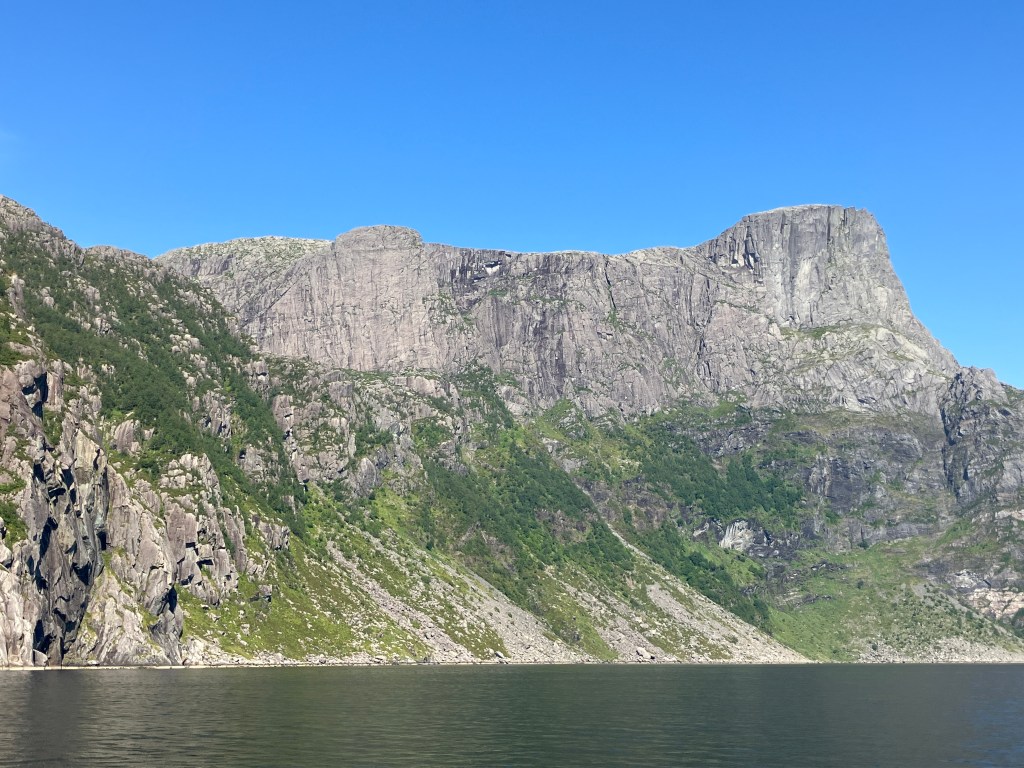
Hornelen Sea Cliff.

“It’s the Hornelen Sea Cliff”, says Mr Fairlie in awe. “Nearly 3000 feet high. The highest sea cliff in Europe, by all accounts. Devonian sandstone. At one stage it was a sedimentary river basin. Then when the Baltica plate collided with North America, it was forced upwards.”

“Ah, you and your natural processes trying to explain everything”, says the minister. “I’d forgotten that you had a passing interest in geology. You’ve been reading too much of James Hutton’s ramblings.”

“Well, I have to admit I am a strong admirer of the work of our countryman”, rejoins his companion. “Through observation of the country around him, he came to the conclusion that the components of the land were once formed by the tides and currents under the sea into a consolidated mass, and then raised up out of the deep by unimaginable forces. And if that is true in Scotland, then it must also be true in Norway.”

“But where is God’s hand in all this?”, chides the minister. “Isn’t he the Creator of all things?”

“Far be it from me to disagree with such a learned man as yourself”, answers Mr Fairlie. “But as with any craftsman, He makes use of the natural laws to produce what He wants. It is the calling of geologists such as Mr Hutton to determine what those laws are.”

“Well, whatever its cause, it makes one feel humble just to contemplate it”, says the minister, looking again at the cliff. “We don’t have anything so spectacular in Scotland. I suppose people must have climbed to the top?”

“Apparently, you can walk to the top”, says the First Mate. “There’s a marked path you can follow. There’s a little harbour around the corner you can start from. It takes about four hours to get to the summit.”

“Shall we tie up and have a go?”, I say, tongue in cheek.

“Ten years ago I would have said yes”, she replies. “But now my knees aren’t up to it.”

Mine are the same.

“If the steamship were to stop, I would do it”, says Mr Fairlie. “But I don’t think that there is any chance of that. We need to get to Maløy by tonight. But it was worth seeing. Perhaps I might come back sometime.”

“Rather you than me”, says the minister. “I’m too old for that sort of thing now.”

We eventually arrive in Maløy and find a place in the small marina. There is a huge cruise ship tied up across from us.

Cruise ship, Maløy.

“I suppose that is the modern equivalent of the cruise steamship that your great-great-grandfather was on”, says the First Mate. “But I have read that Norway is bringing in tough regulations in 2026 that will require cruise ships and tourist boats to be zero emissions, particularly in the UNESCO World Heritage fjords like Nærøyfjord and Geirangerfjord. I wouldn’t imagine that they would have worried about that in 1889 with their coal-fired ships belching smoke and other nasty gases.”

“That’s true”, I say. “And I read somewhere that they will even be using sniffer drones to check up on emissions from cruise ships in the fjords. But I wonder how it will affect sailing boats like ours? It’s not easy to use the sails only in the fjords, what with the fallvind and the like.”

“I guess we will have to replace diesel engines with electric ones eventually”, she says. “Some sailing boats are already doing that.”

“And a lot of the ferries that we see around us are already electric”, I say. “Or at least hybrid. They are taking it all very seriously. Good on them.”

The next day we sail for the island of Silda, to the north of Maløy.

“It’s hard to believe that this was the site of a battle between the British and the Norwegians in 1810 during the Napoleonic Wars”, I say, remembering something I had read in the travel guide. “Two British frigates engaged with some Norwegian gunboats based at the pilot station on Silda. The British captured two of the Norwegian boats, while a third was scuttled by its crew.”

“Hey, keep your eyes on where we are going!”, shouts the First Mate as we enter the tiny harbour. “You almost hit that boat!”

Strategically placed at the end of the breakwater is a shapely young woman who seems to have mislaid her clothes. She seems blissfully unaware of the effect of her presence on the psychology of sailors who have been too long at sea. Not that that applies to me, of course.

“I was just concerned that she might be feeling the cold”, I shout back.
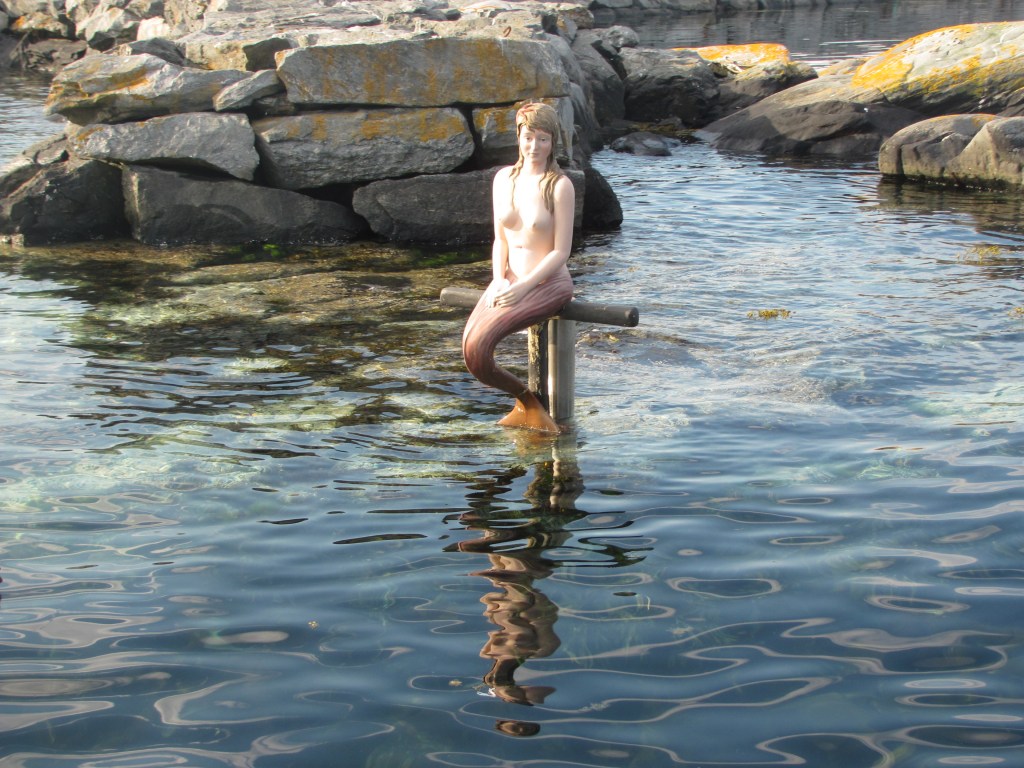
Feeling the cold?

Discussion over dinner that evening centres on the challenge tomorrow.

“I have to say that I am not really looking forward to rounding the Statt”, says the First Mate. “I’ve heard so many horror stories about it, it’s making me scared.”

The Statt is a peninsula that juts out into the Atlantic ‘like an angrily clenched fist’, as the Cruising Guide puts it. It is notorious for being dangerous in certain conditions, so much so that an escort service is provided for small boats wanting to round it. In fact, work has started on drilling a tunnel through the base of the peninsula large enough so that ships can sail through it and don’t have to go around it. With the Norwegian penchant for tunnel-building, I am surprised that it hasn’t already been built. Cost, I assume.

“We’ll be OK”, I say, not feeling as confident as I try to sound. “It’s just a question of picking your weather window. And with all this calm weather we have been having, there’s been nothing that could have made it rough.”

We study every weather app we can lay our hands on. One particular one gives the wave heights and wind speeds at the headland at three-hourly intervals. I painstakingly work these out for the week ahead trying to find a slot that has small waves and a southerly wind to blow us north around it as well as following the north-flowing current. Nothing is ideal, but there is a window that is relatively calm, albeit with a wind from the north.

“At least the wind is very low, so I think it should be OK”, I say. “We’ll just have to motor around it. Otherwise, we will have to wait a whole week before the wind changes to the south, and who know what the waves will be doing by then?”

“I hope you are right”, the First Mate says, not very enthusiastically. “How high does it say the waves will be?”

“It’s predicting a maximum wave height of 1.3 m”, I say. “That’s from the top of the wave to the bottom of the trough. And a 0.7 m significant wave height, which is the average of the top third of all waves. That’s not too bad. It’s a bit like the wash from a speed boat passing us. A bit bouncy, but tolerable.”

We set off in the morning. The sky is overcast, but at least there is not much wind. The sea is calm, but as we approach, the waves grow slowly in height, and Ruby Tuesday starts to plunge into each successive wave. The clouds thicken and seem to grow darker. A gust of wind rocks us from side to side. Or is it my imagination?

Eventually we reach Kjerringa, the peak at the outermost corner of the promontory. This is where two currents meet and the water is confused, with waves from one stream interacting with waves from the other. Ruby Tuesday pitches and rolls, not sure what is happening. Luckily it doesn’t last long, and we are soon back in more straightforward water.
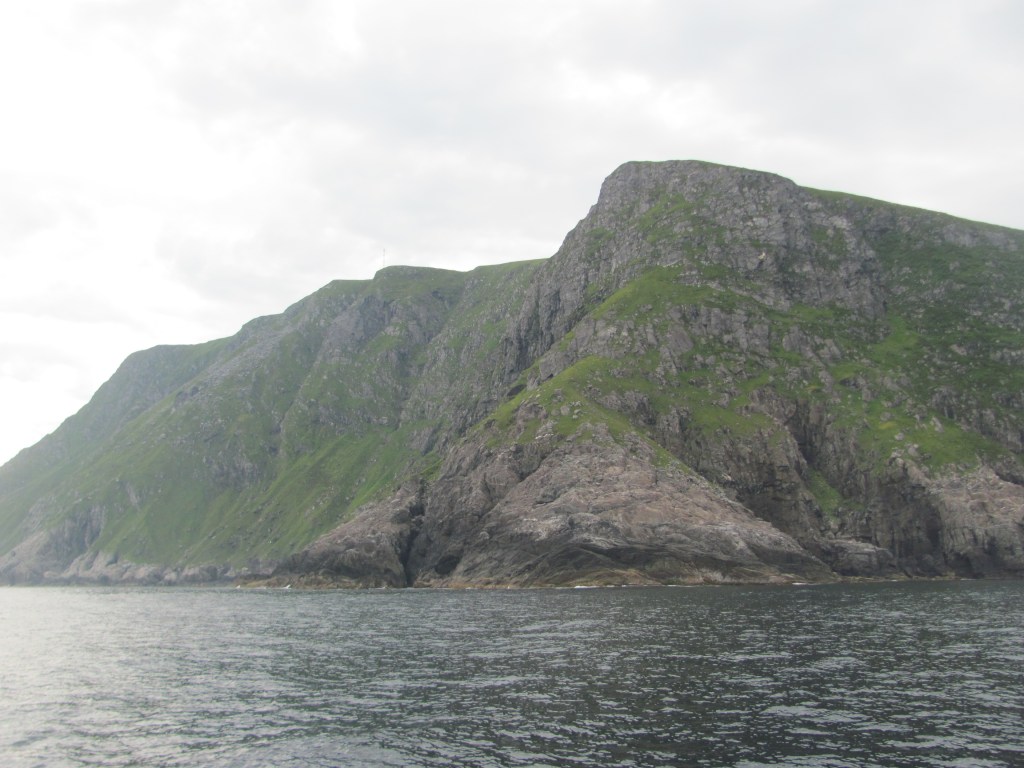
Kjerringa, on the end of the Stattland penensula.

“We’re over halfway now”, I say.

Slowly but surely the waves subside. Before long we are turning the corner eastwards again, and the water suddenly becomes smooth and the sun comes out.

“It really does generate its own microclimate out there”, says the First Mate. “I read that somewhere, but I didn’t really appreciate it.”

“Well, at least we made it”, I say. “We can relax now.”

“For the time being”, says the First Mate. “We still have two more designated ‘dangerous sea areas’ to go. Godø and the Hustadvika.”

Two royal statues, an iconic church, and a hotel with a view

“Look”, says the First Mate. “You can see the place where we anchored last night, and the bridge that we came under this morning. And I think I can just make out Ruby Tuesday down there.”
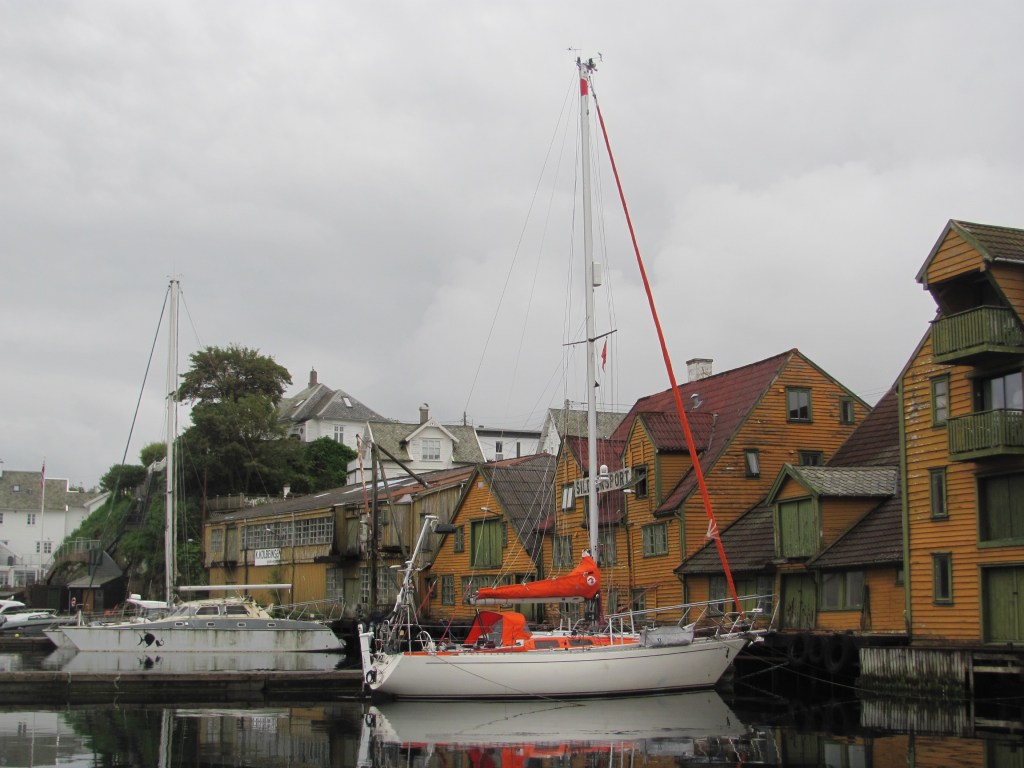
We had arrived that morning at the small village of Skjerjehamn, not far from the entrance to the vast Sognefjord. Previously it had been a bustling trading port, transportation hub, and administrative centre, when ships were the most important modes of transport on the west coast of Norway. That all changed with the arrival of cars and the building of roads and tunnels. All that remains now of the settlement is the small harbour and some of the warehouses, one of them having been converted into a restaurant.

Skjerjehamn

We had set off after lunch, and had walked the path from the harbour over moorland to the summit of Vesterfjellet, a local peak overlooking Ånnelandsund. It’s a hot day, so we had packed some biscuits, apples and bottles of water, which we are glad to have when we reach the top.

“This direction is just as spectacular”, I say, pointing to the north. “All those islands and fjords. That big one in the distance must be Sognefjord. That’s where we will be sailing tomorrow if all goes well.”
View from the summit of Vesterfjellet.

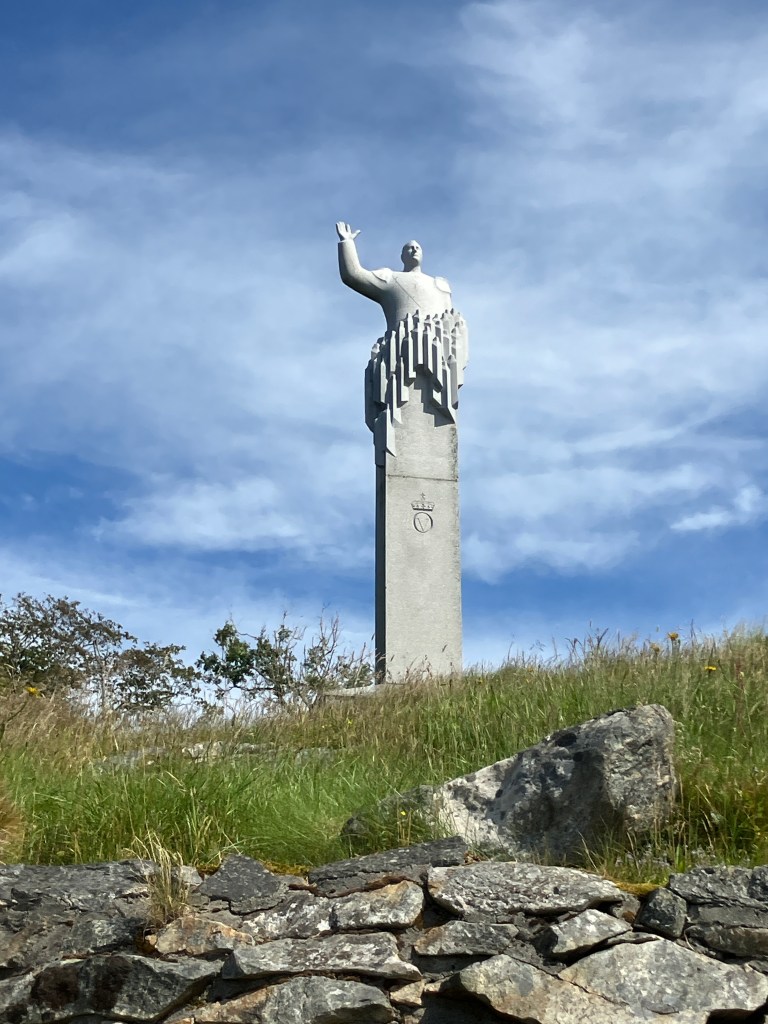
On the way back to the harbour, we pass the statue of Olaf V, King of Norway.

Statue of King Olaf V at Skjerjehamn.

“The City of Oslo commissioned a famous sculptor by the name of Knut Steen to create a statue of King Olav V”, a woman tells us. “However, when it was finished in 2006, they didn’t like it as the outstretched arm was too much like a Nazi salute, and they refused to display it. It was put up for auction, and the owner of the local aquaculture company decided that it would fit very well in Skjerjehamn. He put in a bid, it won, and the statue has been here ever since.”

“Olav V had been a popular king, especially as he had been a focus of Norwegian resistance against the Nazis, as well as being a symbol of Norwegian independence”, says her husband, joining us. “So having him give a Nazi salute wasn’t seen as being in the best taste.”

It doesn’t really look like a Nazi salute, I think. His arm is bent, not straight. He looks more like he is waving goodbye to someone. But far be it from me to get involved in national sensitivities.

The next afternoon, we push on towards Sognefjord, stopping at the small town of Eivendvik to stock up with provisions. We decide to anchor overnight in the bay at Rutledal.

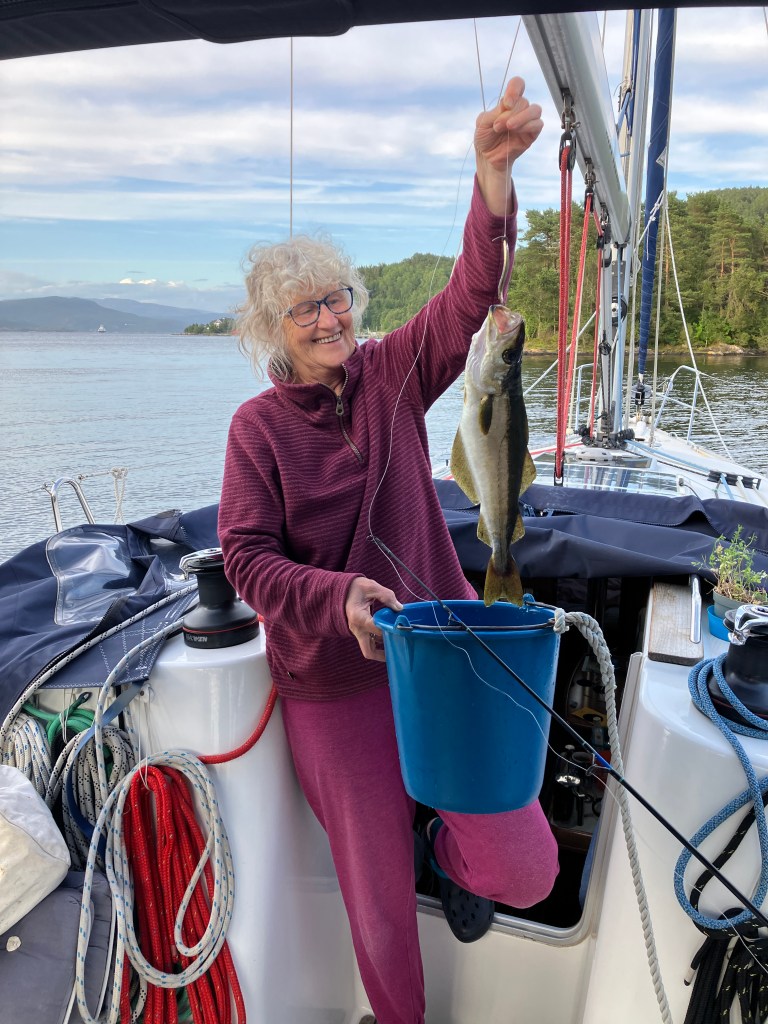
“This looks a good spot for fishing”, says the First Mate after dinner. “I think that I’ll have a go.”

With our fairly miserable record to date of catching fish, I am somewhat sceptical of any success. Still, if she wants to waste her time, that’s up to her.

She ties on a spinner, and begins casting.

“I think that I have caught something!”, she shouts after ten minutes. “Come and help me!”

I imagine it to be a piece of seaweed or an old tyre. Instead it turns out to be a fine specimen of a fish. A pollack, to be precise. We manage to land it without it getting away, which in itself is an achievement.

“We’ll have it for dinner tomorrow”, she says. “I’ve heard that pollack are best left for a day or so.”

The First Mate catches a fish!

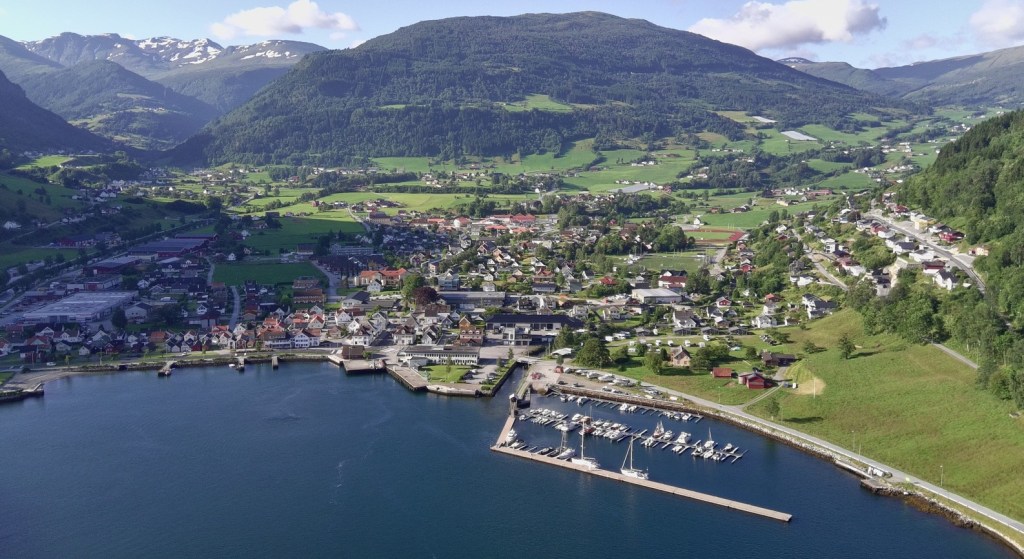
The next day, we reach Vikøyri, a town halfway up Sognefjord.

Vikøyri.

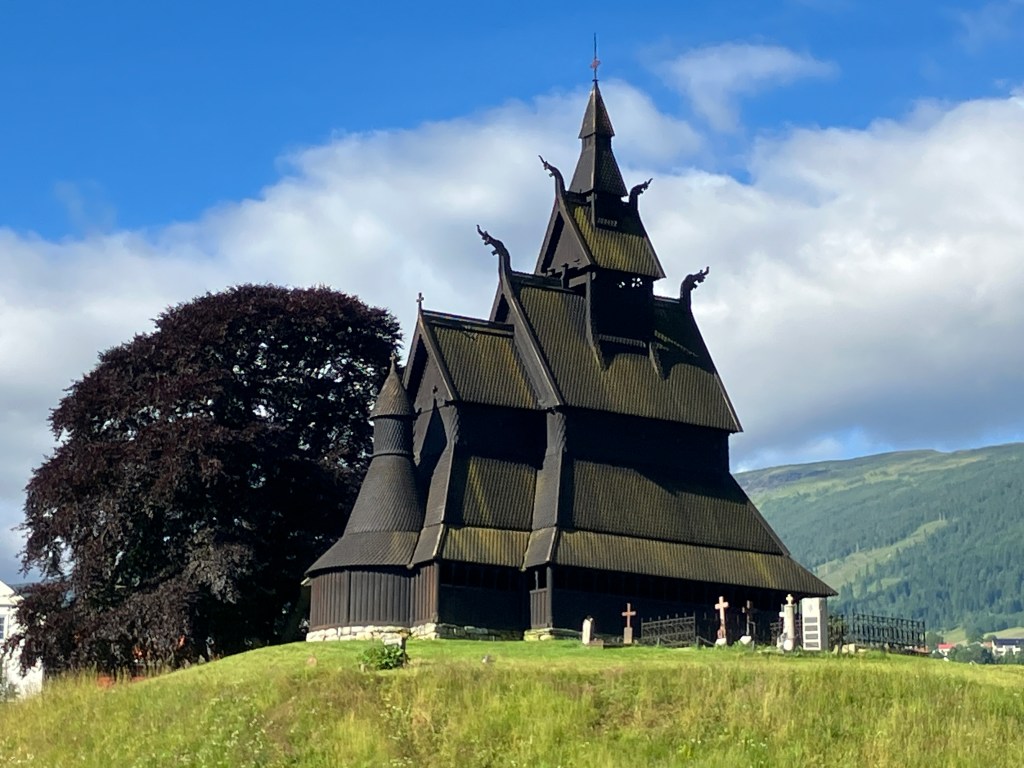
“The guide book says that there is a traditional stave church here”, says the First Mate. “We should try and see it.”

Following a map the Visitor Information lady has given us, we walk up to the Hopperstad stave church. Unfortunately, a bus load of tourists arrives at the same time.

“Never mind”, I say. “At least we can join their guided tour. It looks like a young history student is doing it again.”

“They always seem so enthusiastic”, says the First Mate.

“They still have all their dreams in front of them”, I reply. “No wonder.”

Hopperstad stave church.

“The church was built around AD 1130”, the guide tells us. “After the Viking Period. Many of these type were built throughout Europe, but for some reason only those in Norway have survived. Out of the estimated 1000 there used to be, only 28 are now left.”

“Do you remember that one we saw in Lillehammer when we were with Ståle and Gunvor?”, I whisper to the First Mate. “We have only 26 to go.”

“Shssssh”, she hisses. “I am trying to listen.”

“You’ll see that the basic structure consists of eight-metre high posts held together with rafters, with vertical planks filling the gaps between them”, the guide continues. “Note that it stands on a stone base, which has protected the wood from rotting. Even so, it fell into disrepair, but luckily it was faithfully restored in 1880s.”

“What do the carvings on the gables signify?”, someone asks.

“I am glad you asked that”, she says. “They are the heads of dragons or serpents. A hangover from Viking times. You are probably familiar with the carvings on the prows of their long-ships, which were supposed to ward off evil spirits, trolls, and even bad weather. When Christianity came along, there was an initial fusion of Christian and Old Norse beliefs, so these dragonheads were supposed to protect the church in the same way as they had done the long-ships. Now, let’s go and have a look inside.”

It’s dark in the church, and it takes a while for our eyes to adjust.

Inside the Hopperstad stave church.

“Miscarried foetuses and children who died before baptism weren’t allowed to be buried in the churchyard”, the guide continues. “So they buried them under these flagstones you are standing on, hoping they would go to heaven anyway. This practice carried on right up to the 19th century, when it was discontinued because of the smell.”

There is an uncomfortable shifting of feet.

“I am surprised it took them several hundred years to notice it”, whispers the First Mate. “I wonder if church attendance was falling off?”

“And over here, there are some runic-like inscriptions”, continues the guide. “They are generally pleas by people for God to reward them with a good harvest or success in business. They are not true Viking runes.”

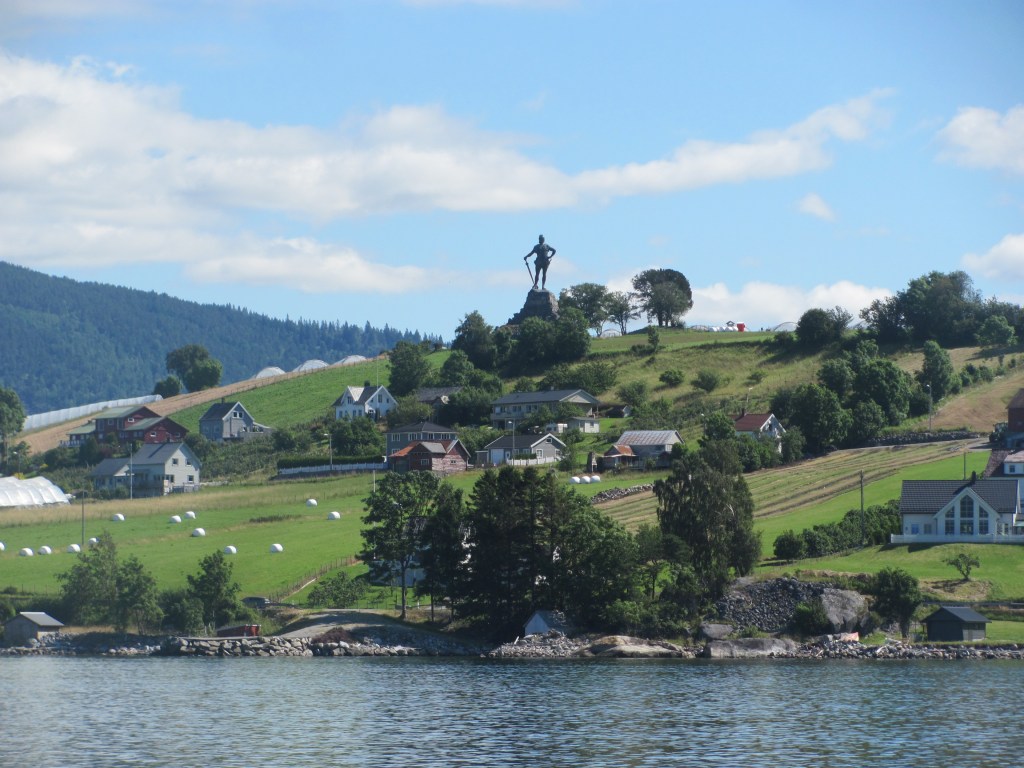
The next day we push on. We pass Vangnes with its giant statue of Fritjof the Bold, commissioned by Kaiser Wilhelm I of Germany in 1913.

“They certainly seem to like giant statues in these parts”, says the First Mate. “I wonder who Fritjof the Bold was?”

Statue of Fritjof the Bold at Vangnes.

It turns out that Fritjof was one of the legendary heroes written about in the Icelandic sagas, supposed to have lived in the AD 700s. The story is that he was the strongest, bravest and fairest in the kingdom of Sogn, the area we are in at the moment, and where the Sognefjord gets its name. On the other side of the fjord to Fritjof lived the king with his two sons, Helgi and Halfdan, and daughter, Ingeborg. The king and Fritjof’s father went off to war and were killed, so the four children were brought up by a foster family. Helgi and Halfdan eventually took over the kingdom, while Fritjof and Ingeborg fell in love. The two brothers were intensely jealous of Fritjof’s good looks and prowess, so they sent him off to Orkney, burnt his house down while he was away, and married off Ingeborg to an old king of a neighbouring kingdom, Ringerike. When Fritjof came back from Orkney, he befriended the old king, and just before the latter died, was appointed as the carer of Ingeborn and their child. After his death, Fritjof and Ingeborn marry, he becomes king of Ringerike, and declares war on his two brothers-in-law. He kills Helgi, subjugates Halfdan, and becomes king of both kingdoms.

“Sounds like a fairly typical functional family history for a Viking”, I think.

Kaiser Wilhelm I of Germany used to holiday in this area, and was so taken with Fritjof’s story that he decided to have the giant statue made and erected in a prominent place on the Vangnes spit where all passing sailors would be able to see it.

“Wilhelm had pretensions to being a great Emperor himself”, says the First Mate. “So I am not surprised he liked stories like this.”

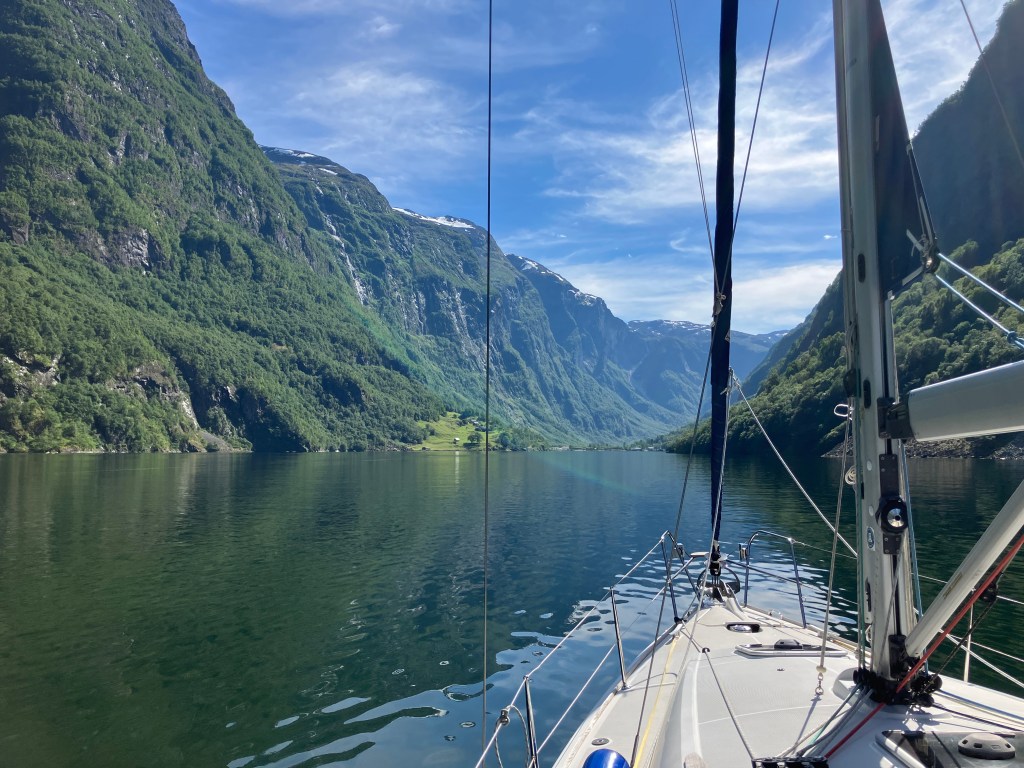
Towards the end of Sognefjord, we turn right into Nærøyfjorden, our destination. The fjord narrows, with almost perpendicular cliffs on both sides. Trees cling precariously to any nook or cranny they can find. The water is a deep green colour, and so clear that we could see the bottom if it wasn’t 300 m below us. The tallest mountains still have pockets of winter snow and ice nestling on their northern slopes. It’s stunning.

Nærøyfjorden, UNESCO World Heritage site.

“No wonder it’s a UNESCO World Heritage site”, says the First Mate.

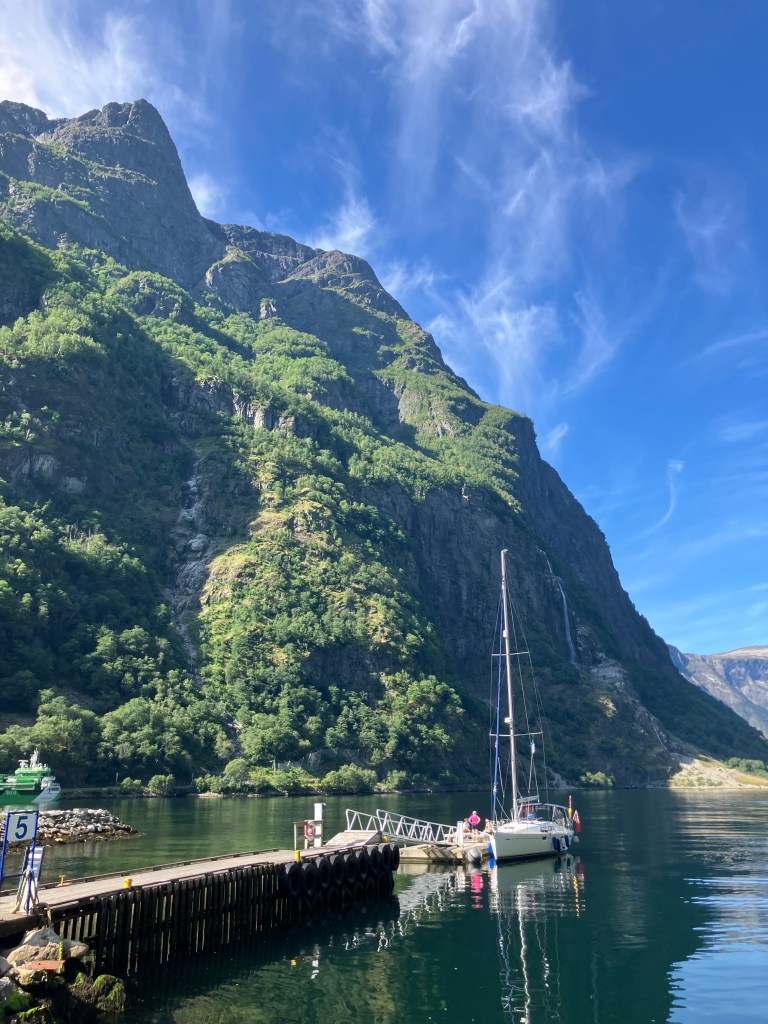
We reach Gudvangen, the small town at the top of the fjord. There is only one pontoon for guest boats. Luckily it is empty. We tie up.

“You can’t tie up there”, a girl teach kayaking skills to a group of people calls out. “One of the tourist boats comes in there. Sailing boats can only go on the other side.”

I had been going to tie up on that side originally anyway but it had looked a bit shallow for our keel, so I had chosen the other. In the event, there is 60 cm clearance – not a lot, but enough.

Tied up in Gudvangen.

The elderly gentleman asks the driver of the stolkjarre to stop at the hotel at the top of the pass for lunch. It had been a long morning – the two men had taken the train from Bergen to Voss, then a stolkjarre the rest of the way to Gudvangen.

“Stalheim Hotel”, says Mr Fairlie, his travelling companion. “It was only built four years ago. I’ve heard that you have the most exquisite views from here. Let’s see if we can have a table in the garden. It’s fine enough weather to sit outside.”

“I have never seen such natural beauty in my life before”, says the elderly gentleman, as they are shown a table near the edge of the precipice. “What a most wonderful valley! I am sure that nothing else in Europe can surpass it for grandeur.”

Stalheim Hotel at the head of Nærøyfjord.

“I think I will have the prawn sandwich, please”, says the First Mate to the waitress. “And a coffee.”

“Me too”, I say. “Except I’ll have tea. Earl Grey, please.”

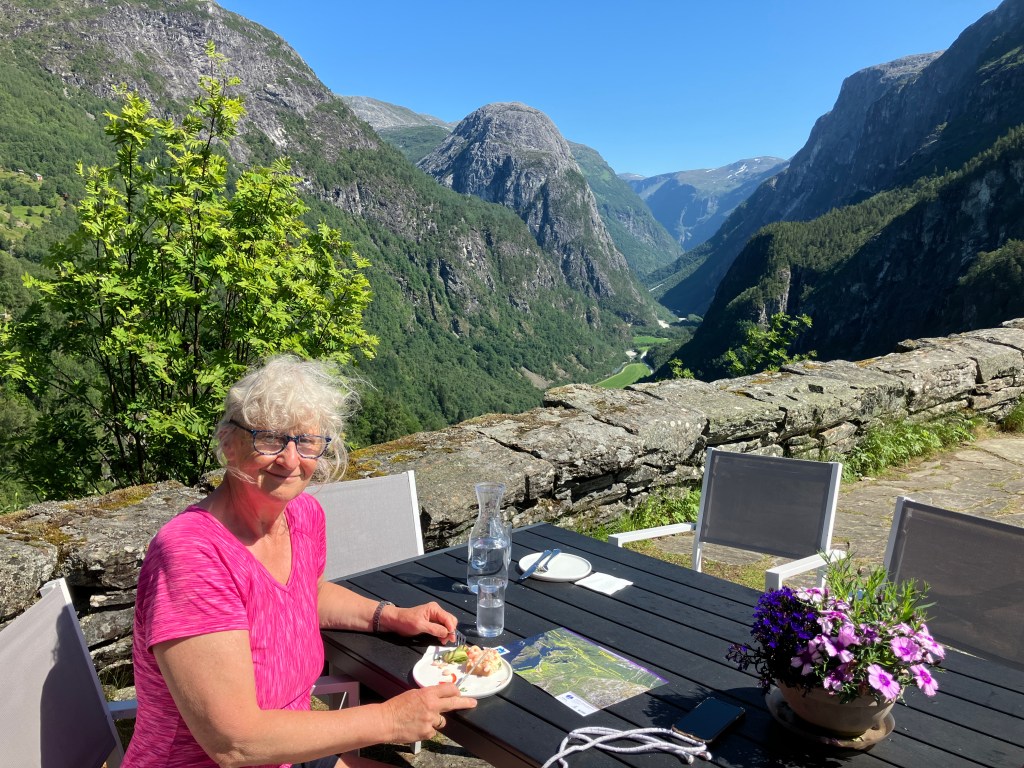
We are at the Stalheim Hotel at the top of Nærøyfjord. Earlier in the morning, we had left the boat in Gudrangen and had taken the No. 950 bus up the valley to the hotel for lunch.

“It’s amazing to think that my great-great-grandfather was here in this very place in 1889”, I say to the First Mate. “Admittedly, it’s not quite the same hotel, as it has burnt down no less than three times – in 1900, 1902 and 1959. This one dates from 1960. But the view will be the same.”

“Well, it certainly is stunning”, says the First Mate, as our lunch arrives. “But I am a bit surprised that he came on this cruise without his wife. I wonder why that was? Do you think that they had had a row?”

“It was quite acceptable for ministers and professional men to go on cruises without their wives”, ChatGPT tells us. “It was more to do with the cost than anything untoward going on. A cruise like this would have cost £10 in those days, plus a few pounds extra for side excursions. With a minister’s annual stipend for a rural parish being around £150, it would have been quite expensive.”

“Men always seem to get the privileges”, she sniffs. “I wonder what she thought about it?”

Lunch overlooking the Nærøyfjorden.

“Have you heard how your son Quinton is?”, asks Mr Fairlie, taking a sip of his tea. “Where was it that he went again? Canada, wasn’t it?”

“Well, it was Canada”, the elderly gentleman replies, the emphasis on the past tense. “At first. He managed to get farm work there for a while, but he had an accident in a threshing machine and lost some fingers on his right hand, so he wasn’t able to work for a while. Then the Americans brought in their Homesteading Act in which 160 acres of land were given free to those who moved there. It was the time the Northern Pacific Railroad was being put through, so the area was opening up. So he decided to move down to North Dakota, build a house, and make a living from farming. By all accounts he is doing quite well there.”

“It’s funny how both your boys ended up farming”, says Mr Fairlie. “What with you being a minister and all. None of them interested in being a man of the cloth, then?”

“They used to spend a lot of time on their uncle’s farm in Ayrshire when they were youngsters”, the elderly gentleman answers. “My wife’s brother Quinton. That’s probably where they got it from.”

“Well, you have to admire them for leaving the Home Country”, says Mr Fairlie. “More opportunities there than Scotland, at least. I am sure they will both do well. Anyway, if you are finished, we had better move on. We have to negotiate the Stalheimskleiva road down from here now before we get to Gudvangen. It’s very steep.”

The old Stalheimskleiva road.

“It certainly is steep”, says the First Mate. “It’s bad enough walking down. Imagine taking a horse and trap down here. Look at the hairpin bends.”

“I read that they often used to walk down steep parts themselves, to spare the horses”, I say. “But I agree. If the horse slipped or skidded everything would just go over the edge.”

Taking a break on the Stalheimskleiva road.

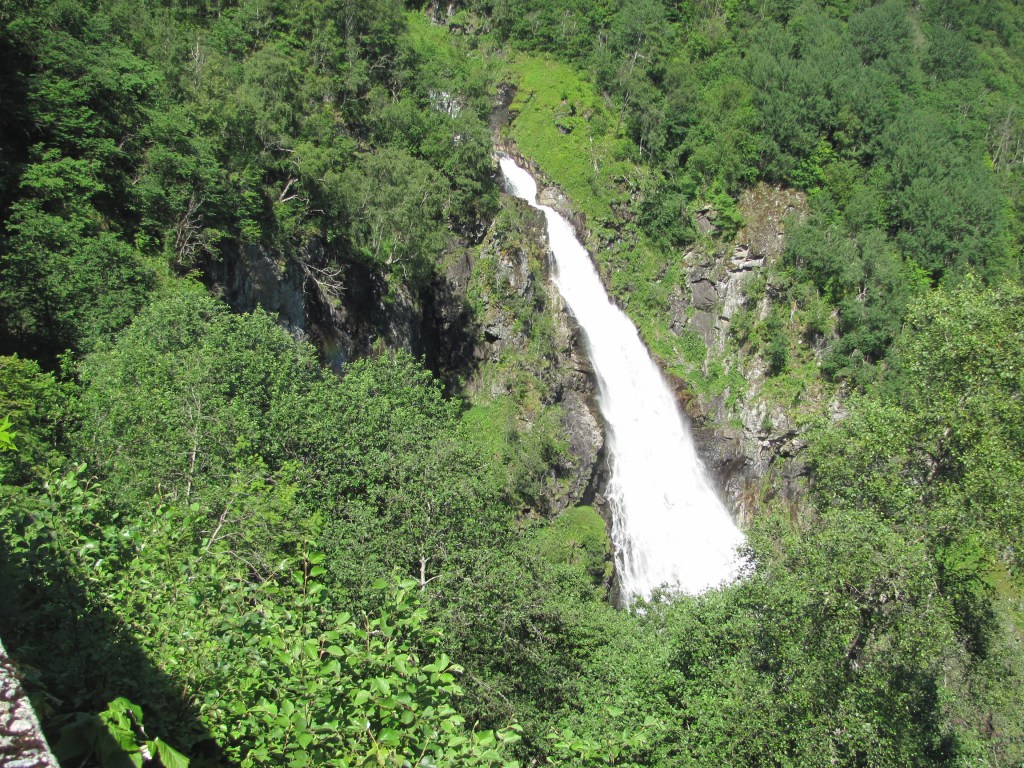
Halfway down we stop to look at the Sivlefossen waterfall.

The Sivlefossen waterfall.

Eventually we reach the bottom with everything more-or-less intact, apart from some protesting knees.

“Sometimes I feel I am getting too old for this sort of thing”, I say.

“Me too”, says the First Mate. “But don’t worry. Here comes the bus. We’ll be back in Gudvangen in no time. Just be thankful we are not on a stolkjarre.”

A long tunnel, a retreating glacier, and a preserved manor house

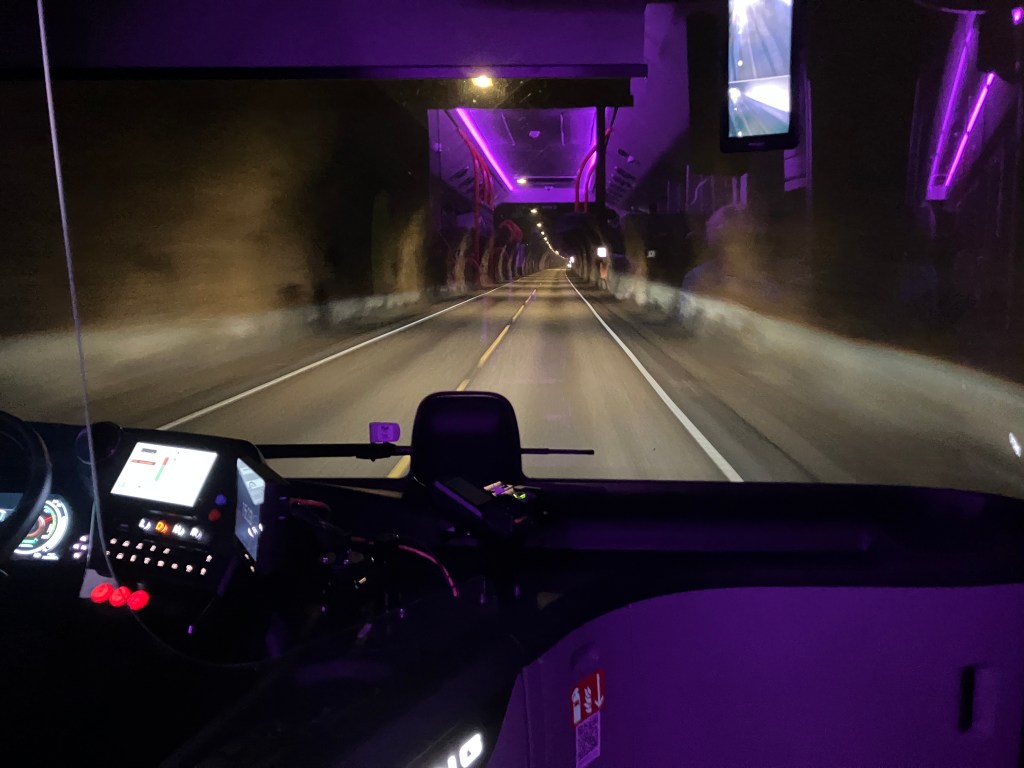
“It’s incredible the amount of work that must have been done to drill this tunnel through the mountain”, says the First Mate. “And to think that we are going right underneath a glacier.”

We are on the bus to the town of Odda at the head of Hardanger fjord. We had left Haugesund the day before, and had had a pleasant sail with favourable winds up the Hardanger fjord, arriving in the picturesque village of Rosendal in the evening. This morning we had caught the bus and snaked our way along the coastline until the mountain sides had become so steep that the road had had to take other measures to continue.

“Yes, the Folgefonna Tunnel”, I say. “It’s more than 11 km long. That’s a lot of rock to move.”

Driving through the Folgefonna Tunnel.

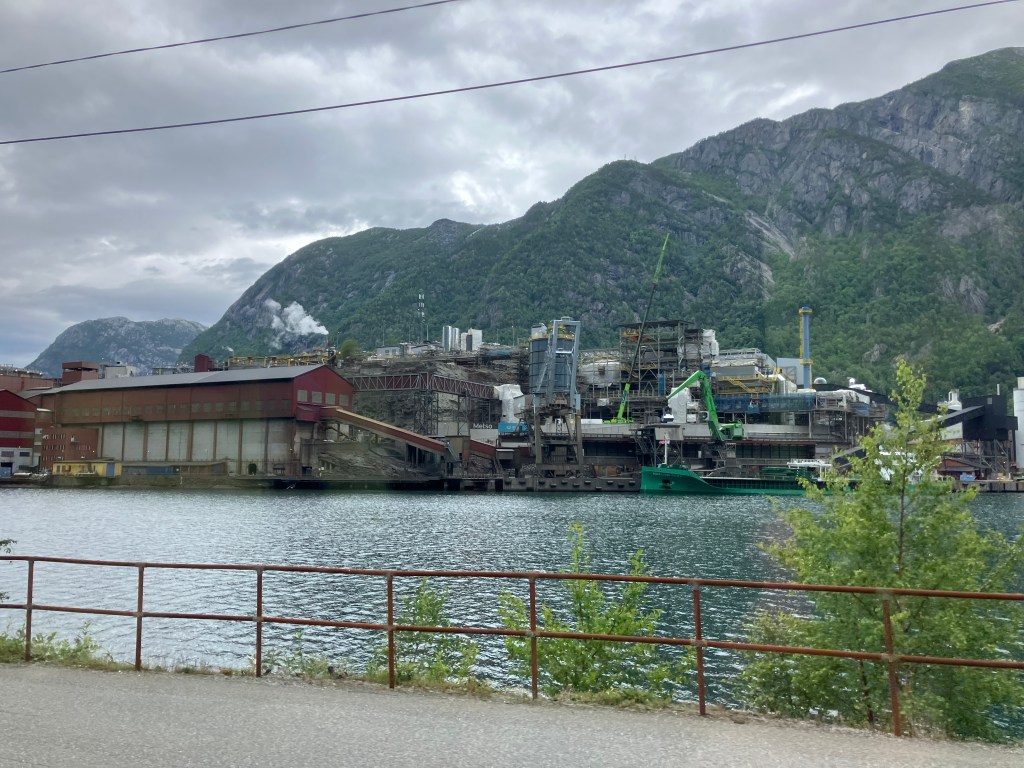
We eventually emerge from the tunnel, our eyes blinking as they adjust to the light. Initial impressions are not positive. The first thing we see is a huge industrial complex on a small island in the middle of the fjord. It turns out that it is a Boliden zinc smelter.

The Boliden zinc smelter at Odda.

“You might have thought that they could have sited it somewhere it can’t be seen”, sniffs the First Mate. “Such beautiful scenery, and to be spoilt by this eyesore.”

“I suppose they needed to have somewhere near the water so that things could be shipped in and out”, I say. “And for the hydro-electric power to drive the plant.”

The bus arrives in the town centre and we clamber out.

“It’s lunch time”, I say. “There’s a small café over there. What about that?”

—–

The elderly gentleman picks up his pen, dips it in the inkwell, and begins to write.

“My dear Meg”, he starts. “Here at Odda since yesterday afternoon …”

Poor Meg. His eldest daughter. The others had all flown the nest, but not her. It had always been a puzzle to him as to why she had never found a husband. Educated, attractive, one would have thought the young men would have been queuing up. He had even used his influence to obtain a place for her as a governess with a wealthy family in the south of Scotland. But she had remained resolutely single. No grandchildren from her. However, every cloud has a silver lining, he thinks – he enjoyed having her around the Manse, helping with parish matters. She was good at it. And it meant that he could have this break and get away to see another part of the world.

He had enjoyed the cruise so far. The sail down the Firth of Forth from Edinburgh had been calm and pleasant. Despite this, he had felt queasy when they had reached the open sea, and had retired early. The next day hadn’t been much better, so he had dosed himself up with whisky and water and had another early night. On the third day, he had almost recovered and had stood on deck admiring the entrance to the Hardangerfjord before breakfast. Since then, he had been feeling as good as ever. So much so, that when they had arrived in Odda at the top of the fjord that afternoon, he had taken a ride in a stolkjarre up to Lake Sandvinvatnet and had seen two waterfalls, the Vidfoss and the Hildalfoss, and, across the lake, the mighty Folgefonna Glacier.

—–

“Come on”, I say, picking up the bill and going to pay. “Let’s get moving. There’s a nice walk along the river that will take us up to the lake.”

“Ready when you are”, says the First Mate. “By the way, what is a stolkjarre?”

“It’s a small two-wheeled horse-drawn buggy just enough for two people with a driver sitting up behind”, I answer. “They were common in Norway before cars arrived.”

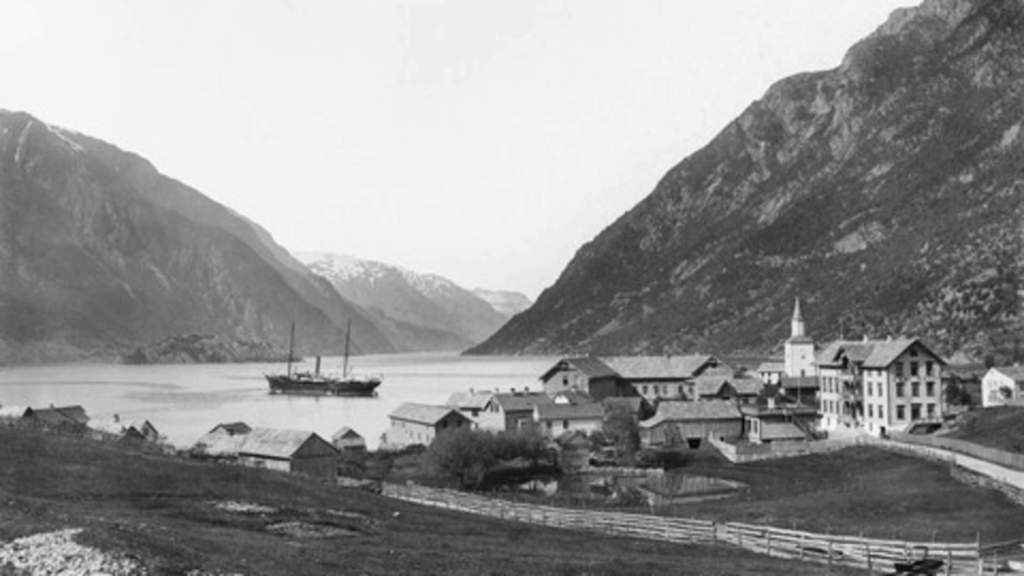
As we head towards the river, we notice an outdoor exhibition of Knut Knudsen, a renowned Norwegian photographer born in Odda. He had made his name in the last half of the 19th century taking photographs of local landscapes, his work making a major contribution to the growing sense of a Norwegian national consciousness.

“Look, there’s one of a steamship anchored in the bay just where we came in”, shouts the First Mate. “That could have been the one that your great-great-grandfather was on.”

Steamship anchored at Odda (by Kurt Knudsen, date unknown). No zinc smelter!

It had become fashionable in Britain in the late 19th century for those that could afford it to take advantage of the growing number of steamship companies to tour the fjords of Norway. My great-great-grandfather had taken one in 1889, and luckily had written letters back to his eldest daughter Meg describing his trip. Even more luckily, these letters had found their way down the generations to us. We had decided over the winter to follow as much of his trip as possible during our own voyage.

We follow the river crashing and tumbling over the rocks, and eventually reach Lake Sandvinvatnet. We stand in wonder looking at the same scene that my great-great-grandfather had seen 136 years previously. To the left are the two waterfalls he mentions. But no glacier!

Lake Sandvinvatnet, Odda.

“You need to walk around the western shore of the lake”, the woman in the Visitor Information had told us. “To a small hamlet called Jordal. The glacier doesn’t come down as far as it used to, but you can see it from there.”

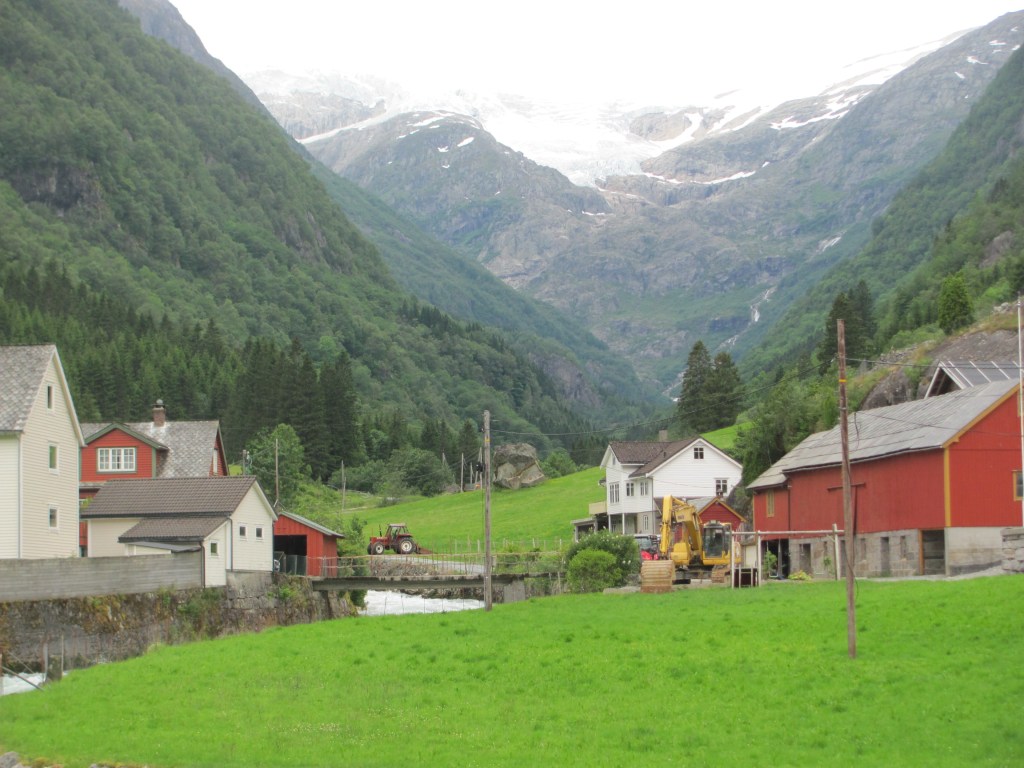
Sure enough, at the head of the valley, we see the mighty river of ice topping the rock like icing on a cake.

The Buarbreen arm of Folgefonna Glacier from Jordal.

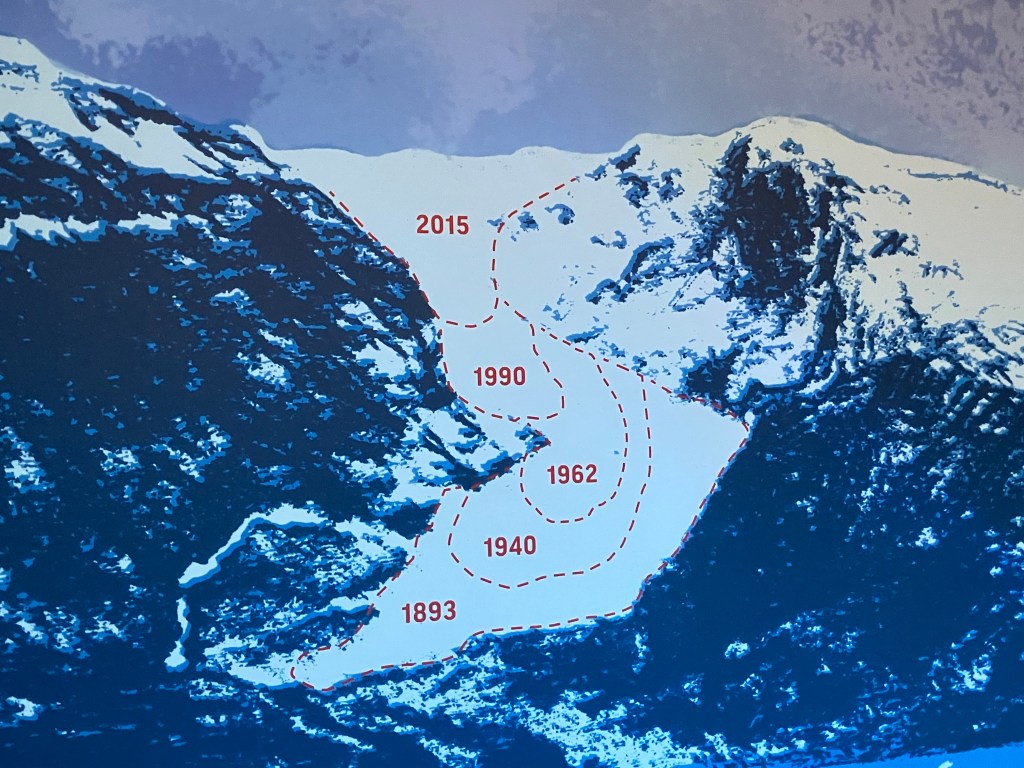
“It’s hard to believe that when my great-great-grandfather was here in 1889, that he would have seen much more of it than we are seeing it now”, I say, as we walk back to Odda. “Proof of climate change, if ever one was needed.”

Retreat of the Buarbreen glacier.

In the morning, we visit the museum in Rosendal. First up there is a film on how the Hardangerfjord was formed.

“Its geological history starts about 400 million years ago”, we learn. “Then, the three continental land masses of Laurentia, Baltica and Avalonia all collided with each other, resulting in the pushing up of mountains from the southern part of the United States right across to Scotland and Norway, with younger rocks being forced underneath the older rocks. In Norway, this created a huge fault along what is now the Hardanger fjord, with the oldest rocks generally on the south-east side and the younger rocks on the north-west side.”

“It’s pretty amazing, isn’t it?”, whispers the First Mate in my ear. “I am glad I wasn’t around when all these collisions were going on. Think of the insurance!”

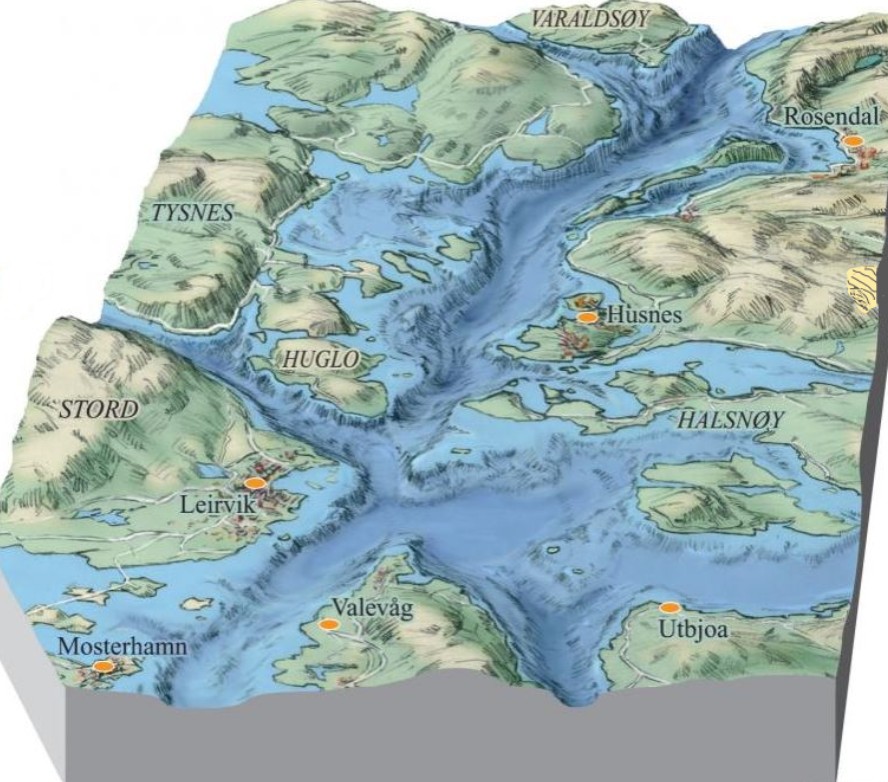
“Over time, water eroded this fault line, weakening it”, the film continues. “When the Ice Ages came, glaciers formed in this huge fissure, grinding it and scouring it as they moved slowly down towards the sea. Eventually the ice started to melt, with meltwater running under the ice and further gouging out the fissure, resulting in fjords that were around 1000 m deep. Sediments from the erosion filled in some of this, so that the Hardangerfjord is now around 800 m deep for much of its length.”

It’s fascinating stuff. It’s difficult to imagine the power of the processes that can move massive amounts of rock around like sand in a sandpit, sculpting new landscapes as they go. Albeit very, very slowly.

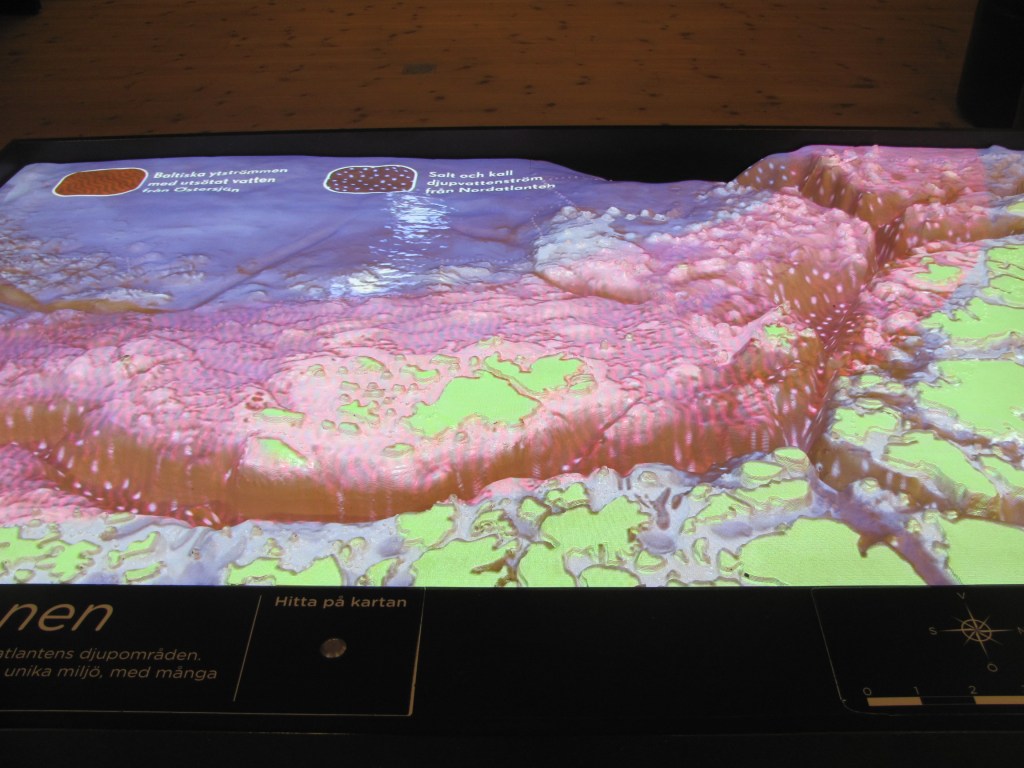
Undersea topography of the Hardangerfjord (from fjords.com)

“I am glad you enjoyed it”, says the friendly lady at the Visitor Information Office. “Now, the other place you should visit while you are here is the Rosendal Baroneit, a 17th century manor house. It’s just a short walk from here. You can’t miss it.”

We walk up the road to the east of the village, and eventually find a tree-lined avenue.

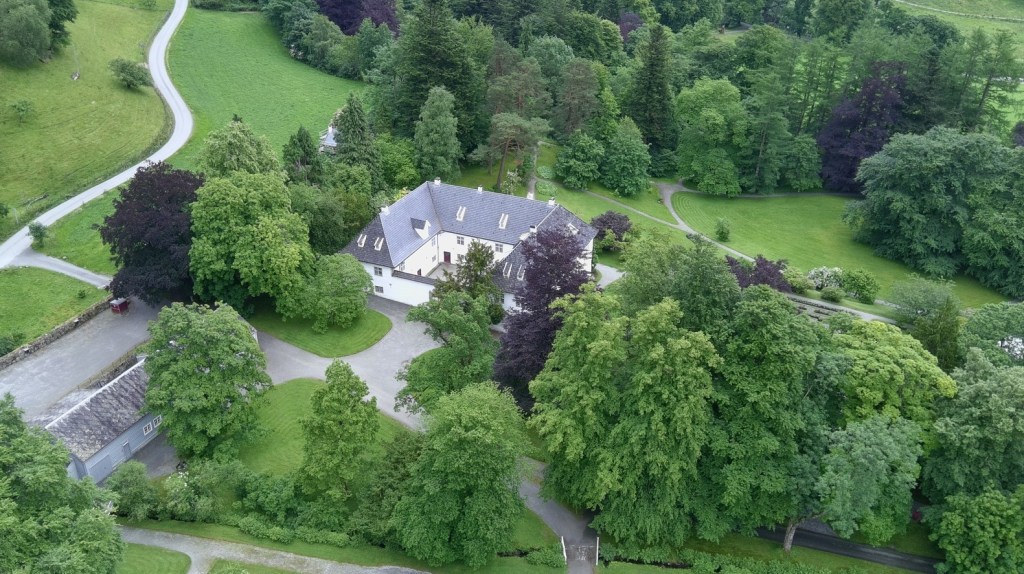
Rosendal Baroneit.

“We do guided tours in both Norwegian and English”, says the young man at the ticket booth at the gate. “But unfortunately there is only one tour left today, and it is in Norwegian. But perhaps if you ask the guide nicely, and if the other people agree, he might do it in English.”

We’re in luck. No-one objects.

“We actually prefer English”, says one woman as an aside to the First Mate. “My parents are visiting us from Kazakhstan and they speak more English than Norwegian.”

“Back in the 1600s, there was once a  Danish nobleman by the name of Ludwig Rosenkrantz who married the richest heiress in Norway, Karen Mowat”, the guide tells us. “The couple were given the farm as a wedding present from her father, who had more than 500 farms in western Norway. They decided that they liked it so they built the manor house. It was finished in 1665. Shortly after Rosenkrantz was awarded a baronetcy by the King of Denmark, Christian V, the only one of its kind in Norway.”

He takes us through to the library. Ancient tomes line the walls.

“I wonder if anyone has read them all?”, whispers the First Mate. “Or do you think they are just there to impress people?”

“Titles were abolished in Norway in 1821”, the guide continues. “Title holders were allowed to keep and pass on their assets, and keep using their titles for their own lifetimes. But the title ceased when they died and no new ones were allowed to be created. The house remained in private ownership until the 1920s, when it was donated to the University of Oslo. Now it is preserved as a museum of an important part of Norway’s cultural history.”

We are taken through each room in turn – bedrooms, dining rooms, drawing rooms, ballrooms, ladies rooms, and the more mundane kitchens.

Rosendal Baroneit.

“Well, you certainly get an idea of how the other half lived”, says the First Mate. “It has a certain appeal. You know, one of my wishes when I was younger was to have a house with a turret.”

“Perhaps we can have one built”, I say. “Then I could lock you in it like Rapunzel.”

“Well, that is the end of the tour”, says the guide. “I hope that you enjoyed it. While you are here, I suggest that you see the gardens. They are supposed to be the finest Victorian gardens in Norway. The roses are especially beautiful.”

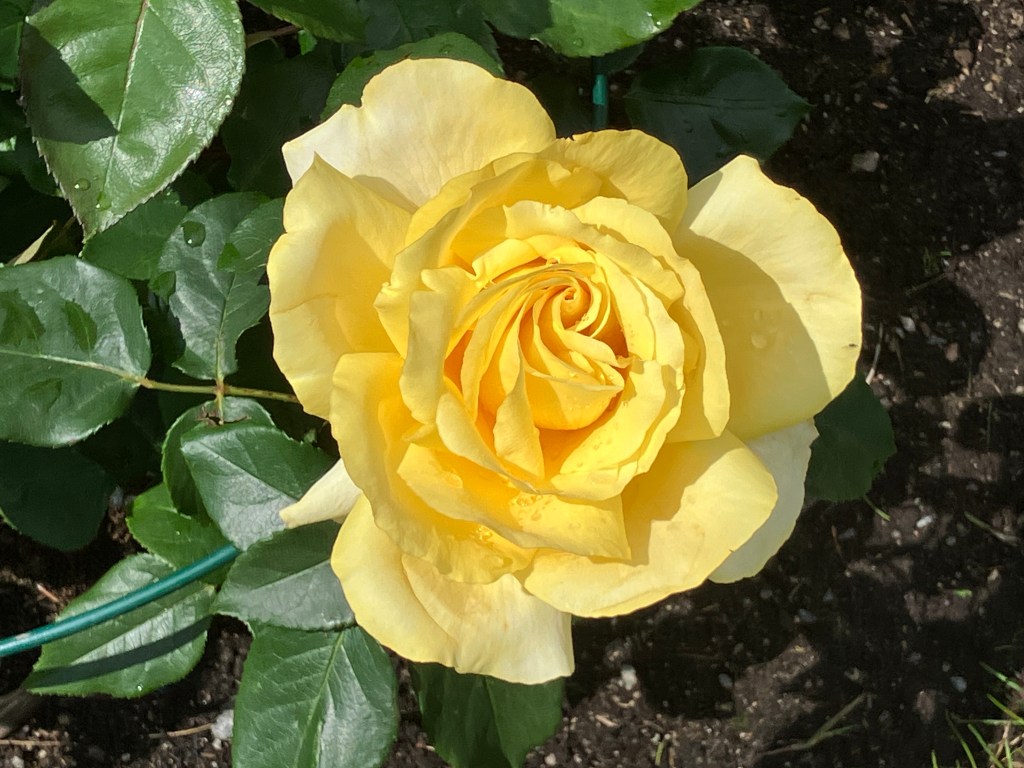
Roses at Rosendal Baroneit.

“You’ll never guess who I have just had a message from”, says the First Mate checking her phone as we walk home. “Simon and Louise. They have just arrived. They saw on their AIS that we were here, and thought that they would pop in too. I’ll invite them in for a café und kuchen.”

“There are strong winds and rain forecast for tomorrow”, explains Simon. “This looks like a good place to sit them out.”

The café und kuchen leads to dinner, where the conversation turns to the state of the world.

“You know, I can’t understand why we haven’t evolved beyond wars and strife by now”, says Simon. We all know that they are evil and unnecessary, yet we still seem to have them. Why?”

“Ah, you must subscribe to the Enlightenment idea of continual human progress”, I say. “Human affairs are always supposed to keep improving. The Stephen Pinker idea. I used to too, but after reading too much of John Gray and looking at what’s going on in the world, I am having second thoughts.”

“But you would think that any political system that was predisposed to wage war would ruin its economy so much that it couldn’t survive and would get weeded out”, he replies. “Just like unsuccessful reproductive strategies in biology.”

“It’s an interesting point”, I say. “But I am not sure that human affairs work like that. Look at the Roman Empire and most other empires in history. They were able to keep expanding because the countries that they conquered and bought under their control provided food and men for them to keep expanding. That was able to keep going for quite a long time, but eventually the costs of administering such a large empire outweighed the benefits and it collapsed. A bit the same with the British Empire.”

“But why haven’t we learnt from history that that is what happens in the end, and just not bother”, says the First Mate. “WW2 showed us that war and empire building was pointless, and that if we had a system of rules that applied to all countries big or small, then we would all benefit. So for the last 70 years or so, we have had peace in Europe and everyone has prospered.”

“Unfortunately, our current leaders seem to have lost sight of that”, says Louise. “There seems to be a move back to the authoritarianism that we saw in the 1930s.”

“It’s an interesting question”, says Spencer later over a nightcap. “Whether you humans should evolve towards greater cooperation rather than warfare, I mean. I think that It is all about raw power and prestige, and not really about devising better systems. Your leaders always want to leave a legacy that gives them prestige in the history books. If they believe they have the power to achieve that, then they will try and do it. Putin has visions of being a second Peter the Great in reunifying the old Soviet Empire, but it looks like he might have overestimated his power to do it. Trump seems to want an American Empire of the USA, Canada, Mexico and Greenland. It remains to be seen if either has the real power to achieve either of those aims.”

“The Law of the Jungle”, I say with a sigh. “Survival  of the Strongest.”

Our first fjord, midsummer revelries, and a national foundation story

“There’s another boat coming in”, calls the First Mate, as she ties us to the wooden quay. “I think it’s the one that was following us all the way up the fjord.”

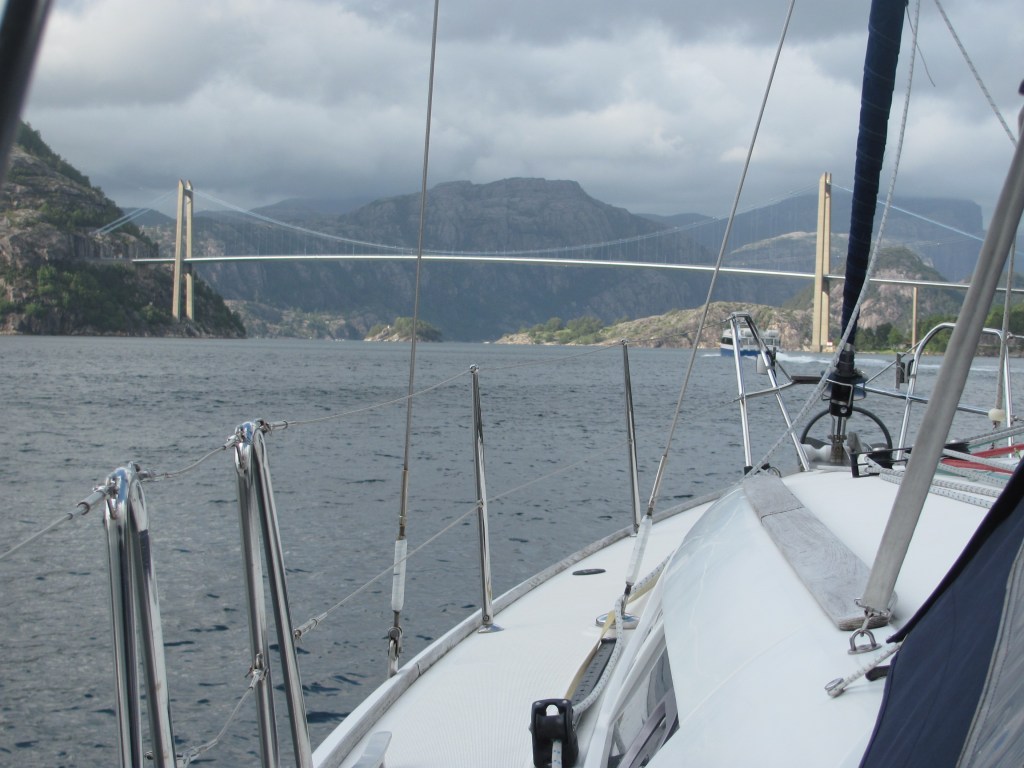
We are in the small hamlet of Flørli near the head of Lysefjord, the first of the five large fjords of Norway. Yesterday, we had set sail from Tananger and had anchored overnight in a small bay called Vikavagen just inside the fjord entrance, and carried on up this morning.

Entering Lysefjord.

We had spotted the incoming boat first on the AIS, and since then we had kept an eye on it with the binoculars. As it approaches the quay, we see that is flying a French flag and that there are four young lads on it.

“One of them has a console in his hands”, says the First Mate. “Is he really playing games while the others are tying up?”

“I think it is a drone”, I say. “He’s probably videoing themselves coming in to the quay.”

Sure enough, we soon hear the high-pitched sound of a drone overhead. It hovers behind the boats tied up.

“I am taking a photo of you”, the drone pilot calls out. ”I’ll give you a copy. Smile!”

Snapped from the sky.

“We are all students on our gap year”, Drone Pilot tells us later as he transfers the photos to my phone by AirDrop. “We decided to do something different, so as we all like sailing, we bought the boat in August, spent a bit of time kitting her out, and set sail in October. We sailed down to Madeira, then across to the Caribbean, then back again. Then we sailed up to the Baltic, saw a bit of Sweden, and now we are doing Norway. After we get to Bergen, we want to sail across to Scotland before heading home again.”

There is an irrepressible enthusiasm in his voice that I find myself envying. What would I give to be young again, I think. Fit and strong, no aches and pains, no worries, no responsibilities, doing something exciting, and the whole of life stretching out in front.

“Come on”, says the First Mate. “You’ve done pretty well for yourself in terms of excitement.”

After a cup of tea, we visit the small museum in the old power station at the end of the quay.

Flørli village with the power-station and penstock on the left.

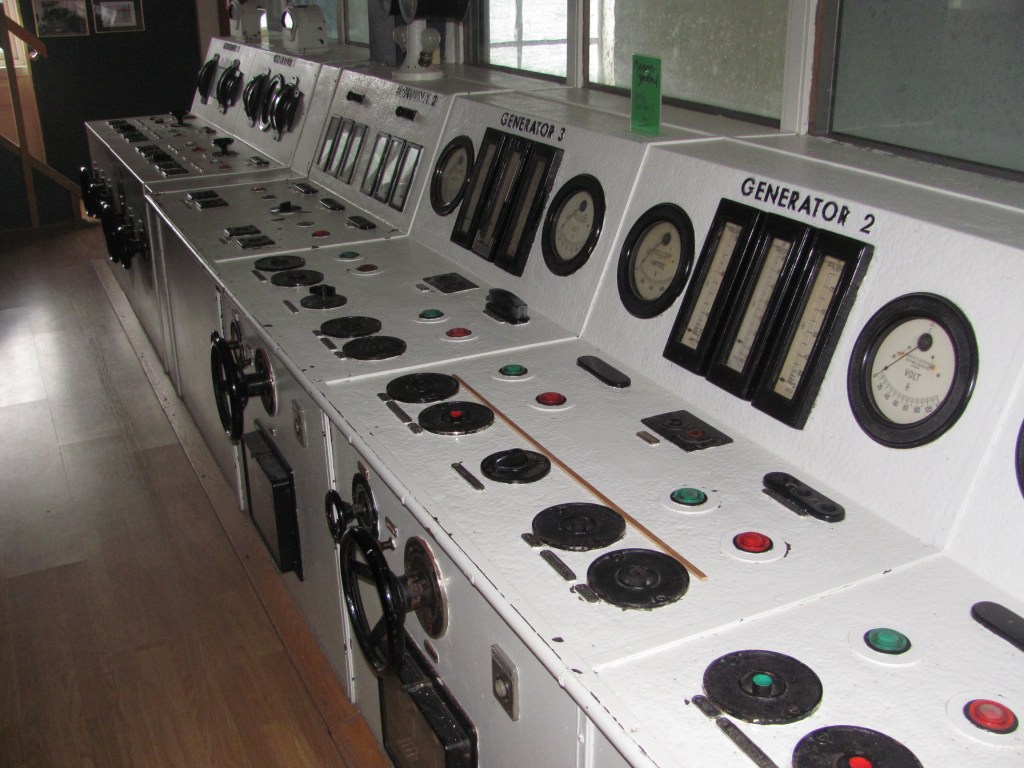
It was built in 1918, we learn, to bring water from the mountain lake Flørvatnet 740 m above sea-level through a penstock to the power station and its generators. At first, it was hoped that the power would be used by a steelworks, but the steel market collapsed globally and the steel company went bankrupt. Eventually the power station ended up supplying electricity to Stavanger city, until 1999 when a new power station was built inside the mountain. Now this one is derelict.

Control panel in the old power-station.

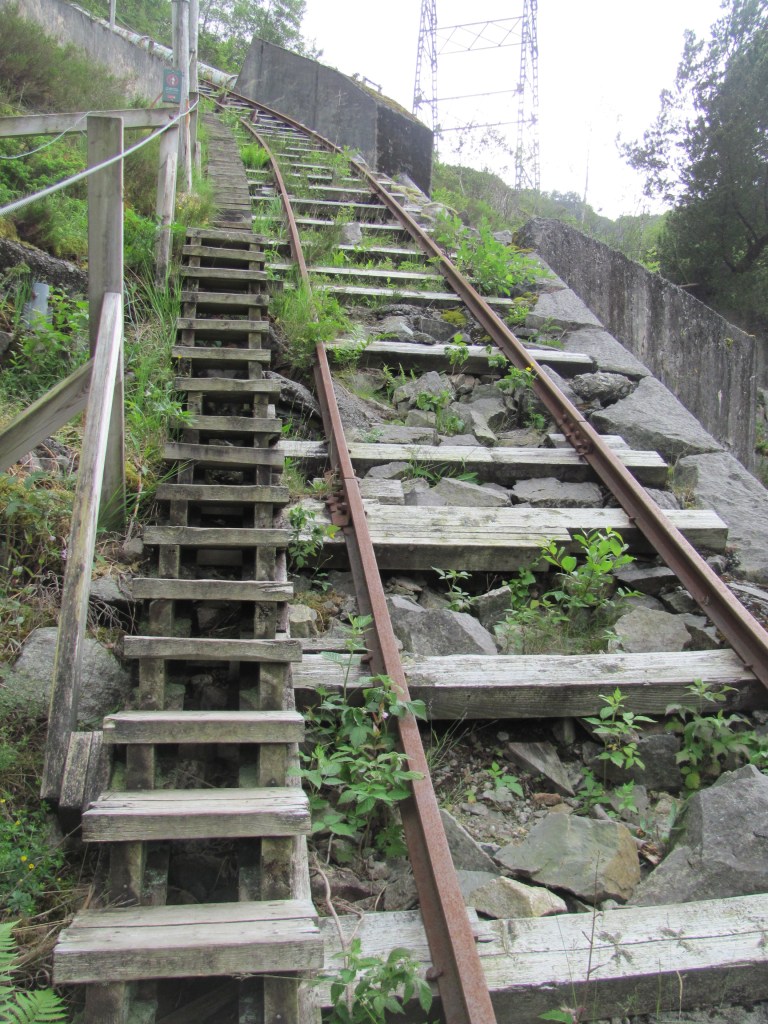
“Did you read about the small railway line they constructed when they were building it?”, asks the First Mate. “Apparently one of the trolleys got away on them and started careering down the mountain with nine people on board. Luckily they all managed to throw themselves off and the trolley kept on going and sank in the fjord.”

“They also built a set of wooden steps so that the workers could walk up”, I say. “Apparently one pair of brothers used to carry packs of up to 135 kg of materials on their backs up these steps. Quite a feat. Nowadays, the wooden stairway has been restored and you can climb to the top. There are 4,444 steps, the longest wooden staircase in the world. Shall we do it?”

“I don’t think my knee is up to it”, says the First Mate. “And it’s just been raining. The steps are too slippery.”

Flørli wooden steps and railway line.

When we get back to the boat, we discover that the wash from the high-speed passenger ferry has caused her to pitch up and down violently, and the anchor locker lid has been damaged by the anchor hitting the quay.

“It happens all the time”, says Tom, our German neighbour. “You need to make sure you are not tied too closely to the quay. You can use another rope to pull the boat closer when you want to get on and off.”

“Why can’t the ferry just slow down, so there is not so much wash?”, says the First Mate, irritated. “Now we’ll have to repair it.”

We set off the next morning back down the fjord. There’s no wind, but the sun is shining, and it looks stunning.

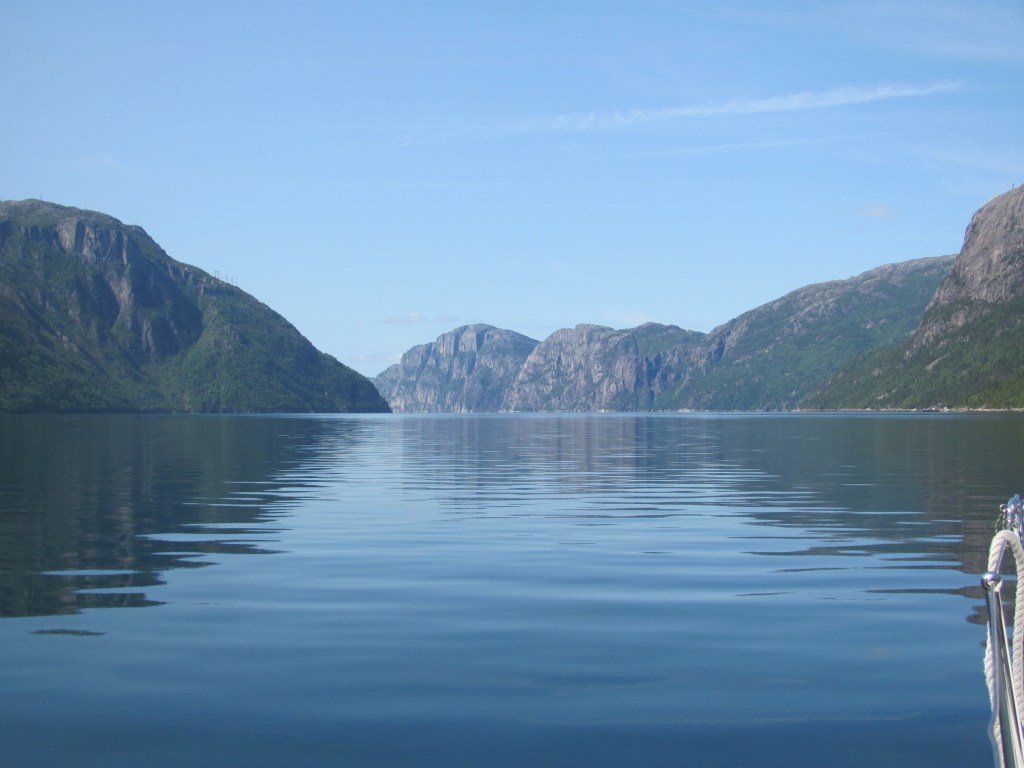
Lysefjord in the sun.

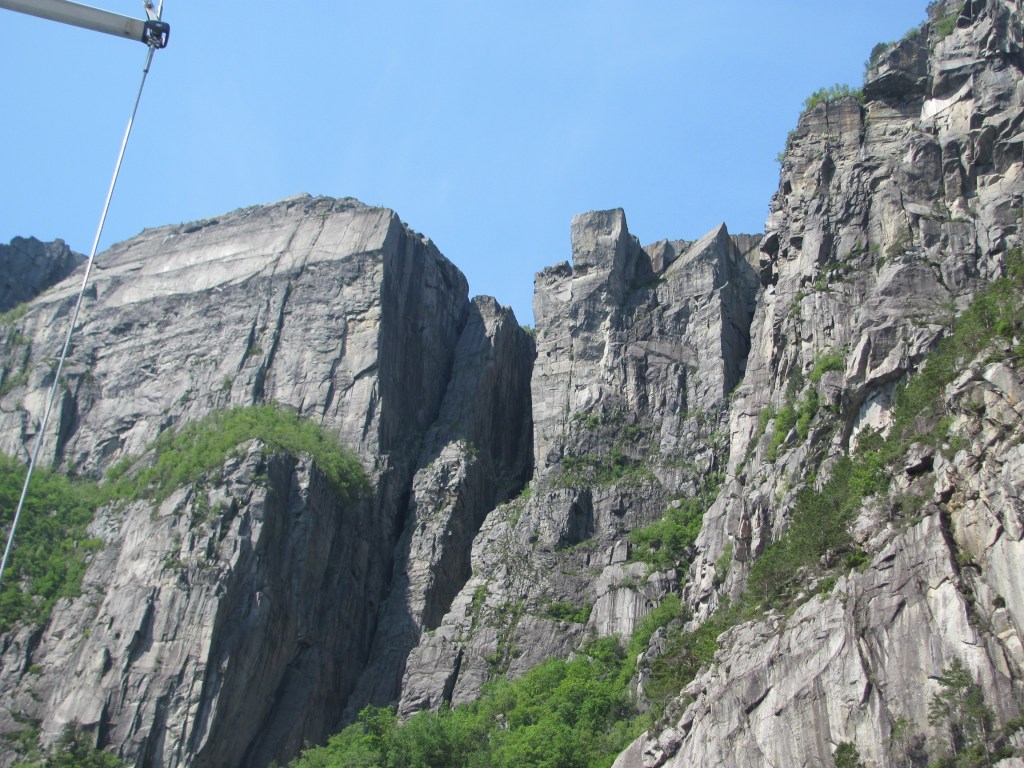
On the way, we pass the famous Preikestolen, a slab of rock shaped like a church pulpit jutting out from the cliff, 600 m up. Already we can see people on top having their photographs taken near the edge. We hadn’t been able to see it on the way up because of the low cloud and mist.

The Preikestolen from below.

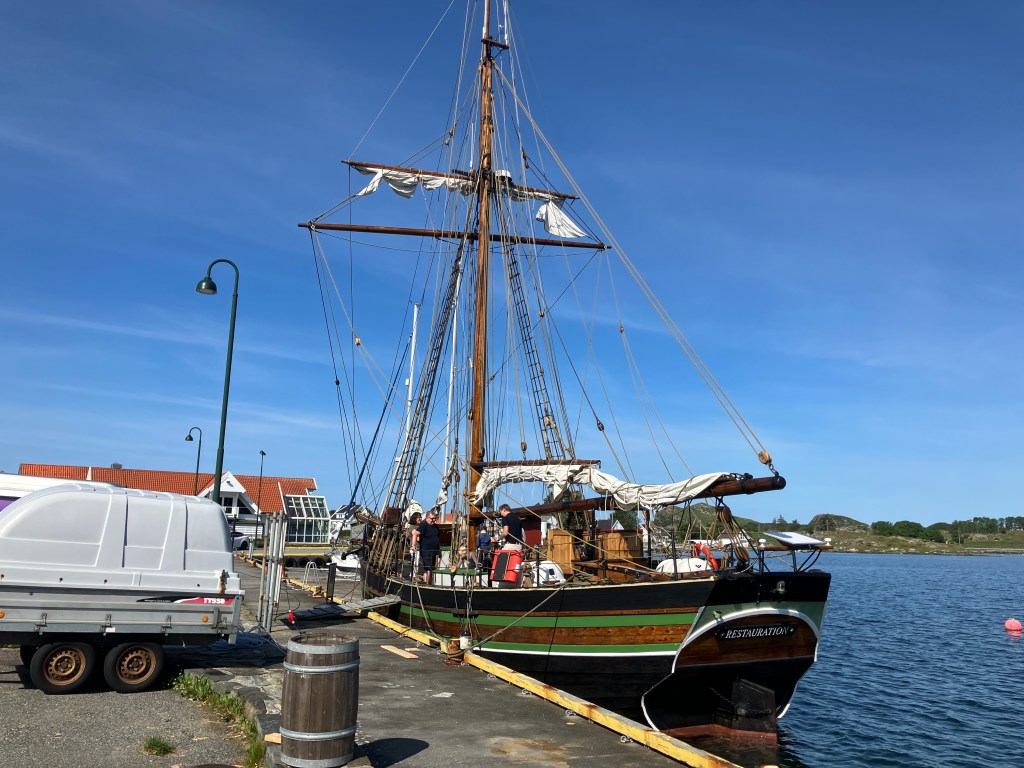
In the evening, we reach Finnesandbukta on the island of Mosterøy, and tie up next to a wooden ship. It has a plate with the name Restauration on its stern.

“It’s a replica of the ship that sailed from Stavanger to New York in 1825, two hundred years ago, carrying immigrants to America, mostly Quakers”, our neighbour tells us. “It has become sort of an icon of Norwegian immigrants to America. They are planning to repeat the voyage in two weeks’ time, leaving on July 4th. Of course, this one makes use of all the modern navigational equipment.”

The Restauration being prepared for its voyage to America.

“I hope that their visas and everything are in order”, I say. “You hear of people having all sorts of trouble at the US border these days.”

“Funny you should say that”, he answers, smiling. “The original ship contravened American law by having too many immigrants on board for its size, so the company was fined, the ship confiscated, and the captain arrested when they arrived. But when President John Quincy Adams heard about it, he rescinded all of these. The immigrants were allowed to settle and became known as ‘sloopers’.”

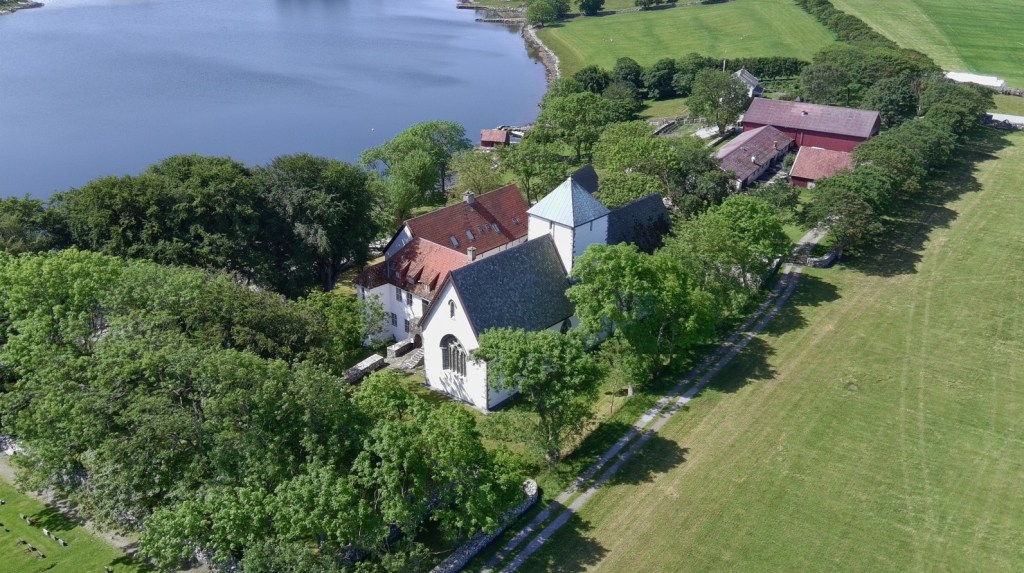
After lunch, we borrow some bicycles from the nearby hotel and cycle up to Utstein Kloster, a medieval monastery. Originally a royal estate during Viking times, the monastery was established in the 1200s. After the Reformation in 1537, it was turned into a bailiff’s residence, and is now a museum and concert venue. It is the only monastery that has been preserved in Norway.

I sit in the courtyard and pretend I am a monk. The bees are buzzing in the flower garden, the birds are singing in the trees nearby, there is the smell of soup and freshly baked bread coming from the refectory. I think that I would quite like it.

Utstein Kloster, Norway’s only preserved medieval monastery.

We set sail the next morning, heading for Haugesund. Soon we are in the Karmsund Strait, the official start of the ancient North Way trading route from which Norway derives its name. To our left is the island of Karmøy, and to the right the Norwegian mainland. The wind is just enough off head-on for us to sail close-hauled, albeit slowly. Just as we pass the rather industrial-looking town of Kopervik with its massive aluminium smelting works, there is a ping on the First Mate’s phone.

“We’re right behind you”, the message says.

We turn around. It is Simon and Louise, whom we hadn’t seen since the foraging session in Smögen.

“We had planned to stay the night in Kopevik”, they tell us later. “But we found it so depressing there that we decided to carry straight on to Haugesund. Then imagine our surprise when we saw Ruby Tuesday on our AIS just in front of us!”

They motor on slowly to Haugesund. We decide to continue by sail as we are enjoying the sunny weather and don’t feel we are in a hurry. They arrive a bit before us.

“The harbour is completely full because of the midsummer revelries”, Simon radios us. “There is half a place next to us, but it has an iron girder sticking up out of the water, so there is a risk that you might hit it, especially if there is a strong wind.”

It doesn’t sound very appealing. The First Mate does a quick scan on her phone of other possibilities to tie up. It seems that there is a community pontoon on the nearby island of Vibrandsøy. We motor slowly over to it. It is full with small motor boats. No room for us.

“Let’s tie up against these tyres, and review the situation”, I say. “I am sure no-one will mind.”

Two elderly gentlemen approach. We eye them warily, expecting them to tell us that we can’t tie up here. But we needn’t have worried.

“As far as we are concerned, it’s fine to stay there”, one says. “But there are strong winds forecast for tomorrow, and it is a bit exposed there. There is a better place against the white boatshed around the corner. If you like, we’ll meet you around there and help you tie up.”

We motor around the corner. It is right next to the community pontoon. The two men appear, grab our ropes, and attach them to rings embedded in the concrete at each end of the shed. But our euphoria at having a place to stay overnight turns to dismay when we realise that there is no way off the boat as the boathouse doors are blocking our exit.

The two men look perplexed.

“We’ll try and make room for you on the community pontoon”, one says.

They push and pull the motorboats around until there is enough space for Ruby Tuesday on one side. We tie up. This time we can step off easily.

Tied up at the community pontoon on Vibrandsøy. Haugesund in the background.

“You can stay here as long as you like”, they say. “By the way, we are having a small midsummer get-together which you are welcome to join if you like.”

It’s very kind of them. We have our dinner, and then clutching a bottle of wine, we amble over to the gathering of 30-40 people on the grassy area between the houses.

“We are a club dedicated to restoring and maintaining traditional wooden boats”, one of the men says. “By the way, my name is Svein. It’s a royal name from Viking times. I have been working on helping to restore that old ship over there. We are planning to sail it down to the Mediterranean when it is ready.”

He points to a wooden ship near the entrance to the harbour.

“You Norwegians have always been sea-adventurers”, I say. “From the Vikings themselves, to Nansen, and to Heyerdahl. Not to mention that boat being restored at Finnesandbukta. Apparently, they are sailing it to America in two weeks.”

“Ah, the Restauration”, says Svein. “Yes, I was helping with that as well. And there’s also a local lad who keeps on trying to get to Greenland from here, but he’s tried four times now and has had to turn back each time for various reasons.”

“You must mean Eric Anderaa”, I say in surprise. “I follow him from time to time on YouTube. He must be away on one of his voyages at the moment?”

“No, he is still here”, responds Svein. “His boat is over in the main harbour. I think he might have given up on Greenland. This year he is sailing to Edinburgh. I am not sure when.”

Eric Anderaa’s boat Tessie in Haugesund.

The next day, the midsummer celebrations are finished, and everyone has gone home. The main harbour is almost empty. We move Ruby Tuesday over to be closer to the city centre.

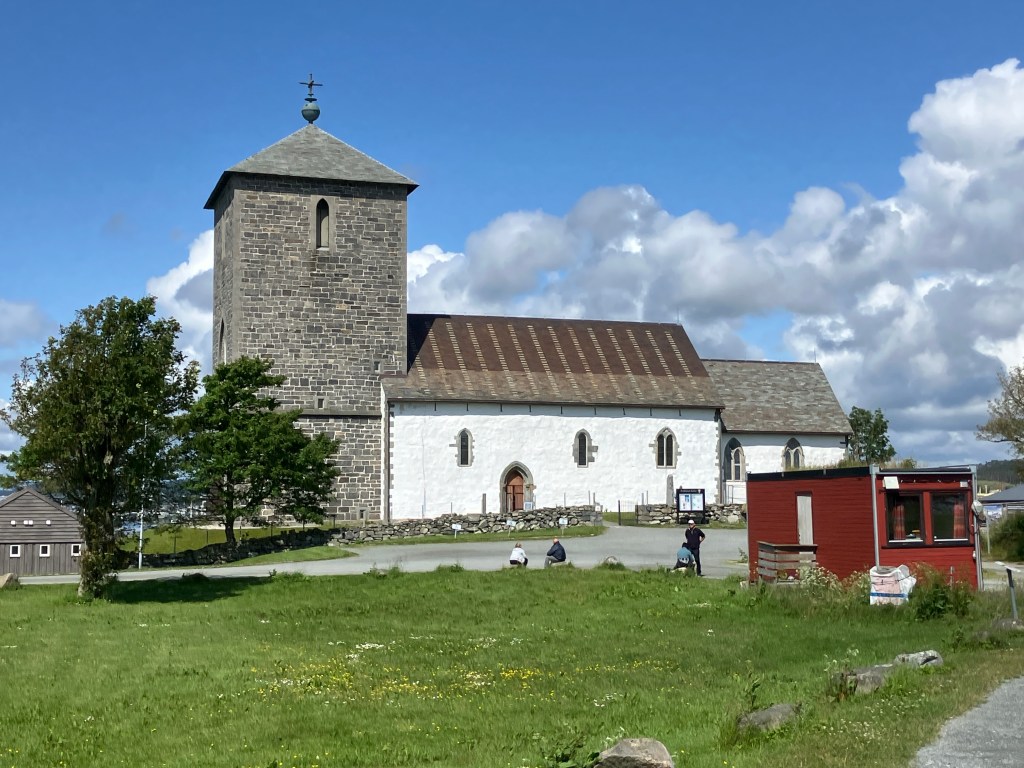
In the afternoon we take the 209 bus that takes us a few miles south from Haugesund to the small town of Avaldsnes, from where we walk the 1 km or so to the Norwegian Historical Centre and St Olav’s Church perched on a hill overlooking the Karmsund. We had seen the church from the boat as we had passed.

“You’re just in time”, says an enthusiastic girl dressed as a Viking. “The next tour starts soon. Quick, the introductory film is just about to start.”

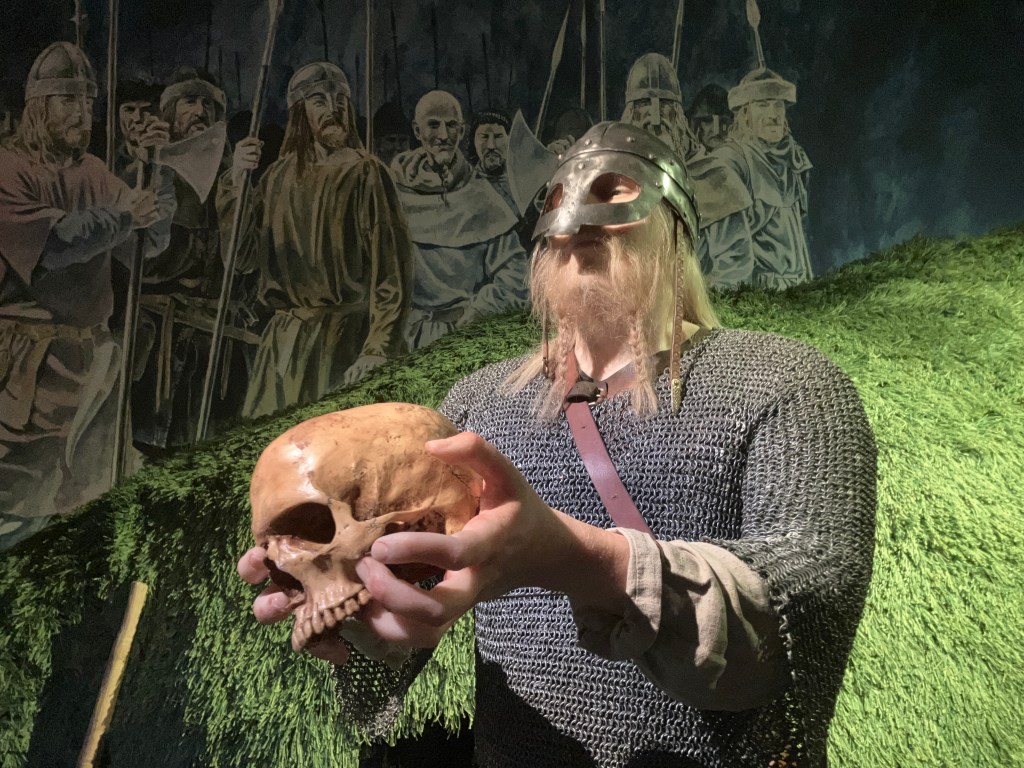
We take a seat in the front row. The film describes the rise of the sækonungr, the sea-kings, in the mid-700s – a coastal elite who did not own much land because of the inheritance system of the established manors and estates on the fertile inland areas passing only to the eldest sons. Instead, these sækonungr lived by using the infertile coastal islands to control maritime traffic, especially the trade in furs, down, walrus ivory, and whetstones from the Arctic. They gradually became wealthy in their own right, concentrating political power to themselves.

“Avaldsnes was named after one of these early sækonungr called Augvald”, the film tells us. “He had his seat of power here because the Karmsund narrows made it easy to control and tax ships passing through.”

“Later, another of these sækonungr was buried in the Great Mound here in AD 779. We don’t know for sure who it was, but it was possibly either Hjorleif the Woman-Lover or his son Half Hjorleifson. Not long after that the Viking raids on Western Europe began – the first raid on Lindisfarne monastery in the UK was in AD 793.”

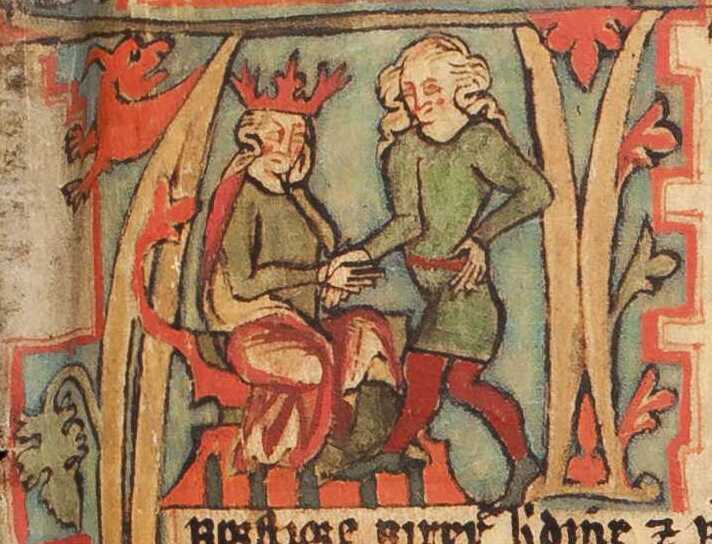
The film ends, and we explore the museum. We learn of Harald Fairhair who won the Battle of Hafrsfjord in AD 872 against his main adversaries and in so doing unified the whole of Norway under one ruler. He chose Avaldsnes as his seat of power.

Harald Fairhair (from Wikipedia)

“I read that Harald Fairhair is a big deal for Norwegians, as he gave them justification and a sense of identity when they became independent”, I say. “It’s their foundation story.”

Unfortunately, it seems that modern scholarship has cast doubt on whether he even existed. Most of what we think we know about him comes from the Icelandic Sagas, which are not known to be terribly accurate in the details.

“Look, it says on this panel that the church outside is generally thought to have been built by Olaf Tryggvason, who forcibly converted people to Christianity by the sword and became Olaf I of Norway”, says the First Mate. “Perhaps not surprisingly, he wasn’t well liked, and was eventually killed in a battle orchestrated by his third wife and King Svein Forkbeard of Denmark.”

St Olaf’s Church, Avaldsnes.

“Marvellous names”, I think. “But if you live by the sword, you die by the sword.”

We decide to have a coffee at the cafeteria, and go and sit on a grassy mound outside. A sign tells us that it is the Cellar Mound. It seems that Augvald, the original king that gave his name to Avaldsnes, worshipped a favourite cow that gave him good luck in battle, so the two were buried in adjacent mounds when they died. The story goes that when Olaf Tryggvason opened the mounds, sure enough he found human bones in one, and cow bones in the other.

Olaf Tryggvason finding the remains of Augvald in the mound.

“It certainly makes a good story”, says the First Mate.

Crossing the Skagerrak, a blind alley, and a dodgy radio aerial

“We need to get an early start tomorrow”, I say. “The wind is from the north-west from about midnight, which is good for us as it will be on a reach and it should carry us more southards. The problem is that it is forecast to go then around to the south-west at around noon, which will then blow us north. So we need to get as much of the north-west wind as we can. I suggest that we leave at 0300 just as it gets light.”

We are planning the crossing across the Skagerrak from Sweden to Norway, a notorious piece of water that is essentially open sea. Depending on where we make landfall on the Norwegian coast it could be a distance of 60 to 90 nautical miles. As we are then heading south along the Norwegian coast and around the bottom, we want to get as far south in our crossing as we can.

“Ugh, I don’t like these early starts”, says the First Mate. “But I guess we have to do it.”

“Once we get going, you can go back to sleep”, I say.

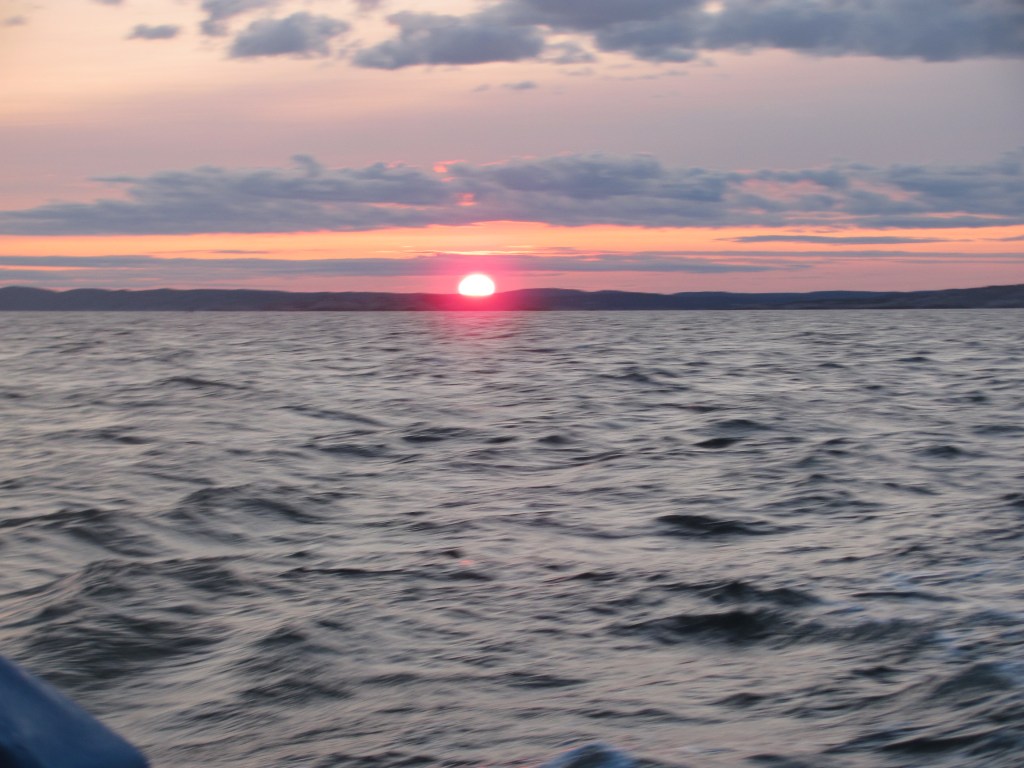
We edge our way out of the harbour in the half dark, and with little wind in the protected area of Strömstad, we motor clear of the rocks and skerries north of the Koster Islands before raising the sails. As forecast, the wind picks up and we sail on a fast beam reach. Looking back, we see the sun begin to peep above the horizon.

Sunrise over Strömstad.

“It’s times like this that I really love about sailing”, says the First Mate. “It’s so beautiful. Now, if you don’t mind, I am going to try and get a bit more sleep. Let me know if you need anything.”

“Just a cup of tea before you go”, I say.

The land disappears out of sight behind us, and Norway is yet too far to be seen. We are alone on the sea. The miles slip effortlessly under the keel, interrupted only by the passing of the ferry from Kiel to Oslo.

At mid-day, the wind drops to almost nothing. We consider starting the engine, but moments later, the wind starts again, this time from the south-west. Just as predicted.

“I’m always amazed how quickly these wind changes can occur”, says the First Mate, awake now. “You’d think that the change would be much more gradual than that, going around slowly. But it often happens all of a sudden.”

“I guess we must be at the boundary of two airstreams moving in different directions”, I say. “We would need to look at the wind map.”

As anticipated, the change in wind direction means that we will be pushed further north now. I do some quick calculations and work out that we should be able to make landfall at Risør, further north than I had hoped, but not too bad. By all accounts it is a pretty town.

Soon we are edging our way through the islands and skerries guarding the entrance to Risør harbour and tie up on the outside of the L-shaped pontoon.

Tied up in Risør harbour.

“You need to report your arrival to the police if you have just come from Sweden”, the couple on the American-flagged boat in front of us tell us. “As well as the Customs. They came down to inspect us earlier in the afternoon. Luckily we had declared everything and paid the duty on it.”

We had heard that the Norwegian Customs were tightening up on the entry of foreign boats into Norway, and that it was highly advisable to be proactive and up-front in registering your arrival and declaring what you are bringing into the country. We had just heard a story of a British boat which had been heavily fined in the previous week for not completing their formalities correctly.

We had already declared online the small amount of alcohol we had in addition to the meagre limit we were allowed. I spend the rest of the day trying to phone the police in Oslo, but no-one seems interested. Eventually I reach the local police for the area.

“That’s fine”, the young-sounding officer on the other end says. “I’ll make a note of your arrival, and send you an email to confirm that you have entered correctly. Let me just find out if Customs want to come and see you. They are just in the next room.”

“No, they don’t need to see you”, he says on his return. “You are free to sail in Norway now. But don’t forget that if you want to leave your boat here over the winter that you need to ask them formally for permission after six weeks from the date of entry.”

“Well, that was all very easy”, says the First Mate, with a sigh of relief. “I thought they would at least come and search us, after what the Americans told us. We could have been real smugglers for all they know.”

Risør is a picturesque little town with all of its houses painted white. It has a strong maritime history, with many wooden boats being kept and maintained here, and an international wooden boats festival every August.

Risør.

We climb up to the Risørflekken, a patch of bare rock painted white, overlooking the town. The story is that it was created by Dutch sailors in the 17th century as a navigational aid, and is still visible several miles out to sea. Its white colour has been maintained ever since then.

“Not quite”, says the First Mate. “I read somewhere that they painted it black during the Napoleonic Wars to stop the English boats from seeing it.”

In any case, it gives a good view over the town and the harbour. We sit for a while and watch the comings and goings of the small boats.

Risør harbour from the Risørflekken.

“Did you see that there is a pub here called ‘The Peterhead’?”, says the First Mate on the way back.

I had seen it. Peterhead is a major fishing port in north-east Scotland, where we live, and where we had kept Ruby Tuesday for a winter during the covid pandemic.

“I asked the landlord how it came to be called that”, she continues. “Apparently it was because of the strong timber trading links between Risør and Peterhead in the 18th and 19th centuries. A lot of Norwegian pine was taken from here to be used for shipbuilding and house construction in Scotland.”

The Peterhead Bar in Risør.

The next morning, we head southwards from Risør. The wind is now from the north-east, and the Norwegian current is also flowing southwards parallel to the coast, so we have an effortless run down on the genoa only, passing Arendal, Grimstad and Lillestad. Past that, we have decided to take the Blindleia route, the inner route through the islands off the coast.

“The name translates as the Blind Alley”, I say. “There are a lot of nice anchorages on the way. The only thing is that it is very narrow in places, with the occasional sharp turn, so we will need to take it carefully. There is also a bridge at the beginning that has only 19 m clearance, which is a bit risky for our 18 m, but luckily we can join it a few miles further down. Better safe than sorry.”

“There seems to be a nice looking anchorage just close to where we join it”, says the First Mate. “It’s called Mortensholm. We could anchor there, chill out, and stay there the night.”

Mortensholm turns out to be a beautiful sheltered little inlet surrounded by steep rock faces and forest. Three or four other boats are already in there, and there isn’t much room for us, particularly as there is a large shallow area in the middle we must avoid. We find a place between two other boats and drop anchor. But our swinging around the anchor brings us very close to one of them, and the occupant glares at us, his privacy disturbed and his boat in danger. A small Jack Russell bounds onto the deck and barks aggressively.

As a clever forestalling manoeuvre, the First Mate engages the man in conversation. She’s good at that. It turns out that he has worked in Africa, and knows Zambia well. We have an instant rapport, and the imminent collision is forgotten.

“I was working for a mining company there as an engineer”, he tells us. “Diamonds. We were looking for diamonds. I was in South Africa, Namibia and Zimbabwe too. Eight years in total, but in the end I decided to come back. There’s something about Norway that I like. I bought myself a boat and I spend the summers just exploring here and there. If I like a place I stay a bit longer; if I don’t, I just move on. Charlotte here keeps me company.”

Hearing her name, the Jack Russell wags her tail in agreement.

“It’s funny, isn’t it?”, says the First Mate to me later. “I haven’t thought about Zambia for years, but here we have been talking about it in the last two blogs.”

In the morning, we set off southwards along the Blindleia, passing through narrow gaps only a bit wider than the boat and only a few centimetres deeper than our draft.

Gently does it!

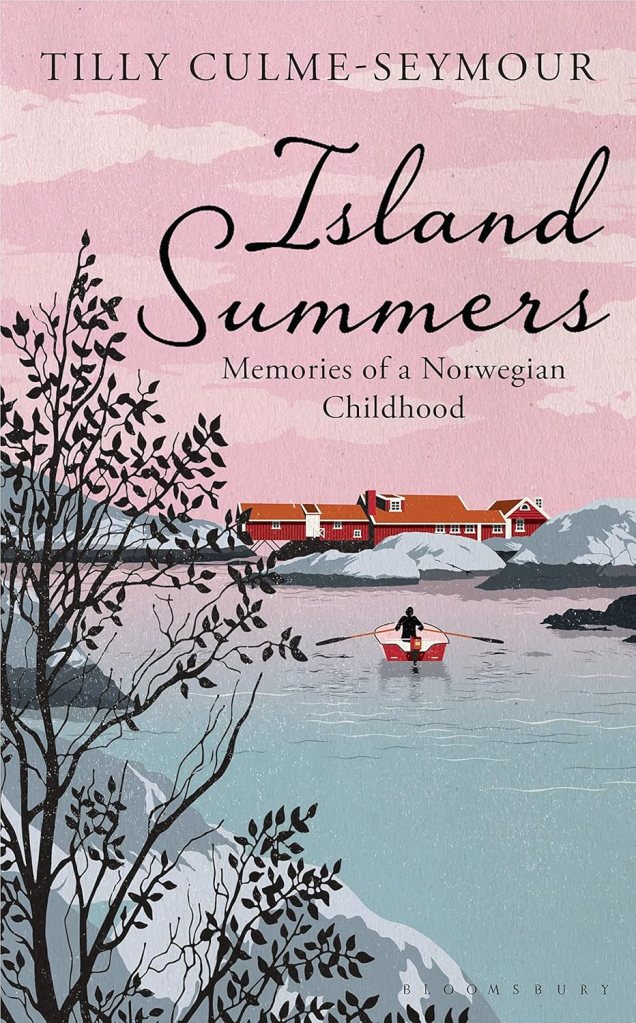
We pass the small island of Småhølmene, the focus of a book we had both read over the winter called Island Summers, by Tilly Culme-Seymour. In it the author describes how her grandmother, a descendent the Norwegian shipping family, Olsen, buys the island just after WW2 in exchange for a mink coat, and, in true Norwegian fashion, builds a wooden cabin on it for summer holidays. She and her family then come every summer to escape their hectic, albeit somewhat privileged, lifestyle in England and enjoy the peace and freedom that their Norwegian island offers, a tradition that continues for at least three generations. It’s a charming enough story, at least the first part, giving a glimpse of relaxed Norwegian summers enjoying nature, fishing, swimming, sunbathing, cooking and eating. However, it seems to lose its way towards the end when the author and her boyfriend decide to stay the winter in the cottage, but in reality are there only from March to May, hardly the winter, even in Norway.

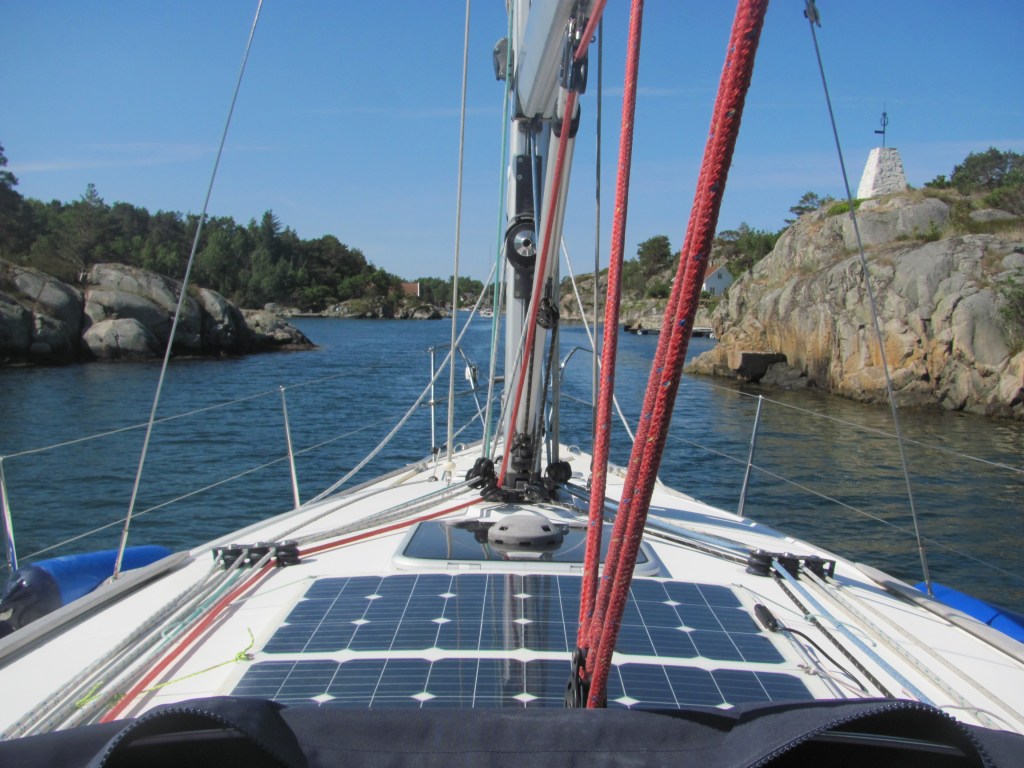
Making our way through the Blindleia.

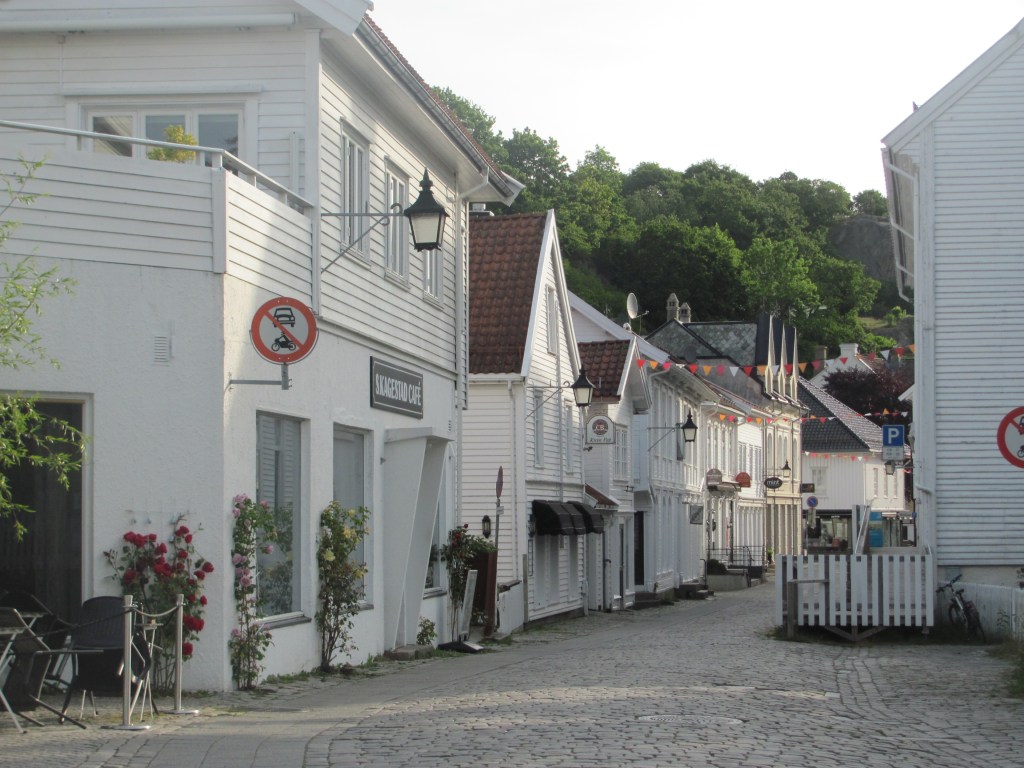
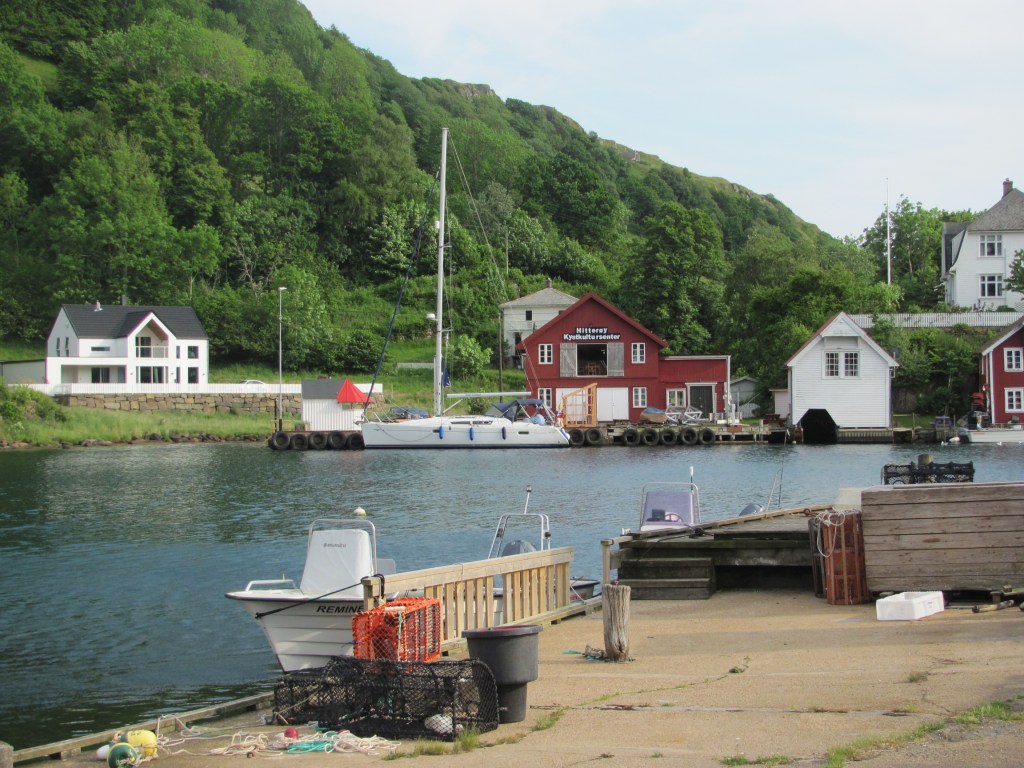
We continue to weave our way through the rocks and islands of the Blindleia, through tiny hamlets clinging to the banks on both sides, and eventually reach Mandal, the southern-most town in Norway, at the mouth of the Mandalselva River. Mandal built its wealth on the back of salmon fishing and timber trading in the 1700s, and still has a well-established, self-contented charm about it, with its white-painted wooden houses and beautiful golden-sanded beach.

Main Street in Mandal.
Mandal beach.

We still have the infamous Lindesnes and Lista capes to negotiate. These two rocky headlands where the waters of the Baltic and the North Sea meet have been designated ‘Dangerous Sea Areas’ by the Norwegian authorities, as ferocious winds and high waves can build up suddenly, particularly from the predominant south-west. They are not to be taken lightly.

Luckily for us, the winds have gone round to the east, and are forecast to stay that way for several days. We need to make the most of them to go around the capes and as far as we can up the west coast before they turn.

In the morning, we set off from Mandal and head westwards, using only the genoa again and not the mainsail, due to the risk of the latter gybing. We had just heard a story of a boat the previous week which had gybed accidentally going around the Lindesnes due to a sudden change in wind direction, which had damaged its mast. Even with only the genoa out, we still make 7 knots, so we don’t complain.

In the event, we pass the Lindesnes and then the Lista without incident. The seas are choppy, but not dangerous.

Rounding the Lindesnes.

“Well, that wasn’t too bad”, says the First Mate. “After all I read about them, I was a bit worried that it was going to be pretty rough. But that was tolerable.”

We stop for the night at the small island of Hitra, and its beautiful harbour of Kirkehamn, so named after its iconic white-painted church standing on a small promontory jutting out into the harbour. As luck would have it, there is a wedding in progress, and the small marina is full of the motorboats of the guests. We have no option but to tie up on the far side of the harbour against some old tyres with no facilities or power.

Tied up in Kirkehamn.

“It’s only for a night”, I say. “But we can walk around to the church and restaurant and have dinner there to make up for it.”

The iconic church in Kirkehamn.

In the morning, the easterly winds are still favourable but are forecast to change in a couple of days, so we decide to leave at 0300 to make the most of them and to sail all the way to Tananger, a distance of more than 60 NM.

“The last few days have been quite long sails”, says the First Mate. “I’ll be quite glad when we get to Tananger, so that we can chill out a bit. But it is great that we have finally managed to get to the west coast of Norway in good time.”

Ruby Tuesday approaching Tananger.

We make it to Tananger in late afternoon. The wind is strong and it makes tying up to the jetty difficult, but there are several helping hands and soon we are secure.

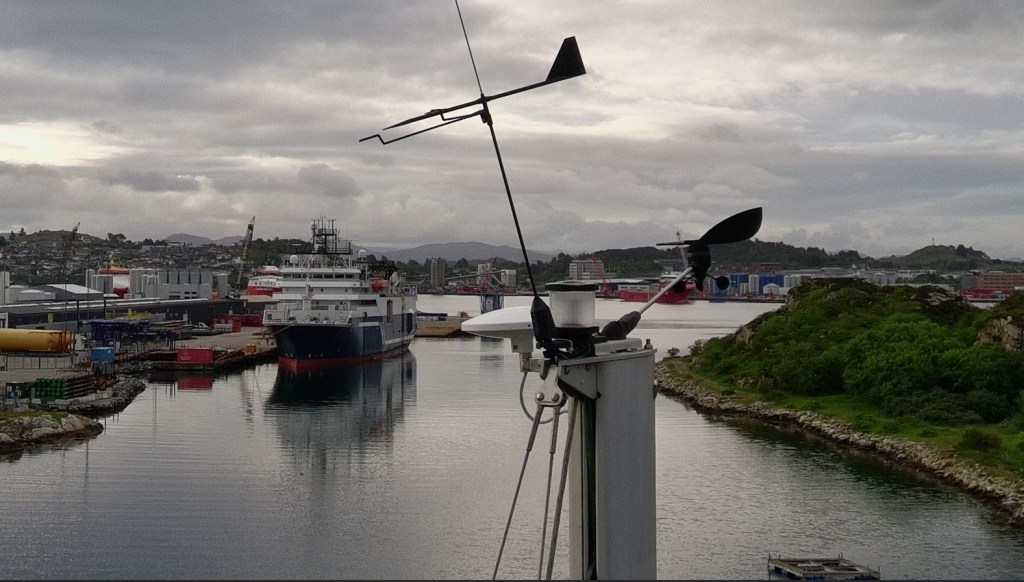
On the way in, I had noticed that the VHF aerial on top of the mast was swinging from side to side, even though it still seemed to be working. The next morning, I send the drone up to have a look and take some photos, but it is still not clear what exactly has happened.

A wobbly VHF aerial.

“My guess is that the retaining nut on the bottom has worked itself loose”, I tell the First Mate. “But it seems to be still attached at least. We’ll have to find someone who can go to the top and have a look at it. I’m too old for that sort of thing.”

I phone every boat repair company in Tananger, but none have free time to be able to do it as it is the start of the boating season in Norway. Eventually, I find someone north of Bergen who says that he can look at it.

“Bergen?”, says the First Mate. “But we won’t be there for at least two weeks. I hope that it stays on until then!”

So do I.

Existential despair, cottage country, and a Norwegian culinary treat

“I enjoyed the Munch museum yesterday”, says the First Mate, taking a bite from her sandwich. ”It was good to see The Scream at last. It gave me some inspiration for my own painting classes in the winter. I hope that I can remember it all.”

We are on the train to Gjørvik, two hours north of Oslo, to see our friends Ståle and Gunvor. Once clear of Oslo, we wend our way through deep valleys, lush forest, and fertile farms . It starts to rain heavily, the raindrops streaking the train windows. I reach for my coffee.

On our way to Gjørvik.

“Yes, he certainly taps into our deepest emotions of fear, anxiety and despair”, I say, recalling what I had read in the brochure we had been given. “All particularly relevant to today’s world. What I didn’t realise though was that he painted several versions of The Scream – I had imagined there was only one. And none of them are quite the same.”

“You certainly get the feeling that a lot of his work was based on his own personal experiences”, she says. “The early deaths of his mother and sister, and his own struggles with mental health, strongly influenced his depiction of illness, death and emotional turmoil. And the look of jealousy on the faces of the two women in Dance of Life. You could almost imagine that he, as the man, was enjoying it.”

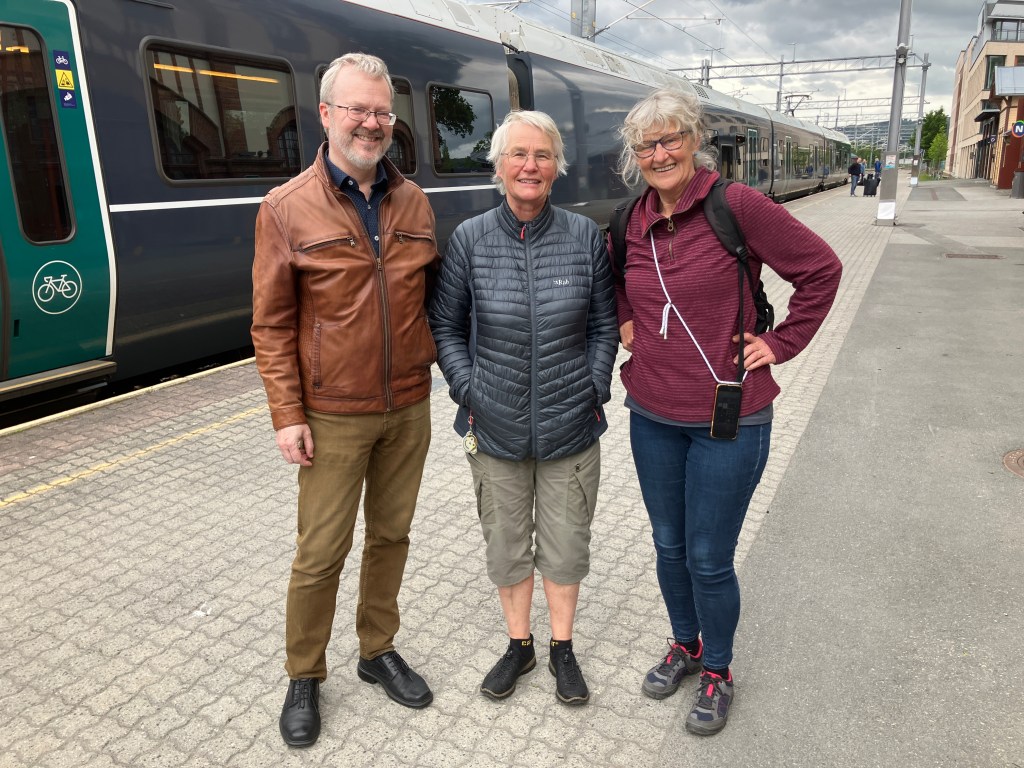
We reach the station at Gjørvik. Ståle and Gunvor are there to meet us. We had first met them in Zambia in the late 1980s, when we had all arrived at the same time to work on various development projects – building roads, teaching, administration, agricultural research – coincidentally all funded by the Norwegian Government. We had somehow lost touch with each other over the years, but now that we are retired and have the time, it is nice to catch up with old friends again.

Ståle and Gunvor meet us.

They look much the same as we remember them from 30 years ago.

“Well, apart from turning rather grey”, says Ståle. “And suffering the ignominy of new hair sprouting in senseless places!”

I know the feeling. Not to mention the teeth that have to be extracted, and the various aches and pains that seem to appear for no reason and take longer to disappear than they used to.

“Anyway, welcome to Norway”, he continues. “We have been preparing these last 1000 years for the retaliatory sea-raids out of Scotland after we did a little bit of looting and pillaging there. So we’ve been expecting you.”

Getting our own back?

Ståle is engaged in development and relief work as head of the Programme Department in an NGO in Gjørvik, while Gunvor processes building applications at the district municipality.

“We’ll pass my office on the way home”,Ståle says. “If you are interested, I can quickly show you around.”

We stop at a modern building not far from the centre of town. Inside, the walls are covered with posters of scenes in tropical countries and smiling happy people.

“It’s pretty much all funded by the Norwegian Government”, he says, as we tour the building. “Our work is on safeguarding children in developing countries, with particular focus on alcohol and substance abuse, mental health, children’s rights, and gender equality. We work through local partner organisations to support home-grown initiatives. A big part of what we do is to help with fund-raising for those initiatives.”

I ask him if he has any plans for retirement.

“There has been the odd hint that maybe I should start thinking about it”, he says. “But I haven’t risen to the bait yet. I love my job.”

We arrive at their house with a stunning view looking out over Lake Mjøsa, the largest lake in Norway.

Gjørvik and Lake Mjøsa.

“At 453 m depth, it is the fourth deepest lake in Europe”, Gunvor tells us. “In the winter, most of it can freeze over.”

“When I was young”, says Ståle, “I got my name in the local newspaper for ice-skating from one side to another. Unfortunately, I was seen as a reckless idiot rather than a hero. The thickness of the ice can vary considerably, and there is a real risk of falling through it. But I somehow survived to tell the tale.”

I shudder. The thought of being trapped under thick ice and not being able to find the entry hole before my breath runs out fills me with dread.

Over dinner, the conversation turns to economics.

Sorting out the problems of the world over the last 30 years …

“I’ve never really understood why everything is Norway is so expensive”, I say. “I suppose for Norwegians, though, you have the salaries to match, so things don’t seem so expensive to you? It’s only if you are coming from the outside that it does.”

“They were expensive because of the oil”, says Ståle. “We paid ourselves high salaries, even unskilled workers, because we could afford to. But actually now, salaries are levelling off so people are now starting to find things more expensive. It’s really only alcohol that is terribly expensive.”

“Yes, we are still trying to get to grips with the very strict rules that Norway has on the amount of alcohol you can bring in”, says the First Mate. “Do you think that it has any effect?”

“I know it is strange that we are so draconian now after the reputation the Vikings had for drinking”, says Ståle. “But I think that it’s helped to reduce a lot of family and social problems we used to have through alcohol abuse. Whenever they are asked, the public generally support the policy for that reason.”

We sleep that evening in a small cottage belonging to Gunvor’s niece, right by the shore of the lake. It’s idyllic. Particularly an early morning walk and watching the sun rise over the hills on the far side of the lake.

Lakeside retreat.

“I thought that we could drive to Lillehammer today”, says Ståle. “That’s where they hosted the Winter Olympics in 1994. There is an open-air museum there with a collection of houses from all over Norway and from different eras, which you might find interesting. Maihaugen, it is called. We can also have lunch there.”

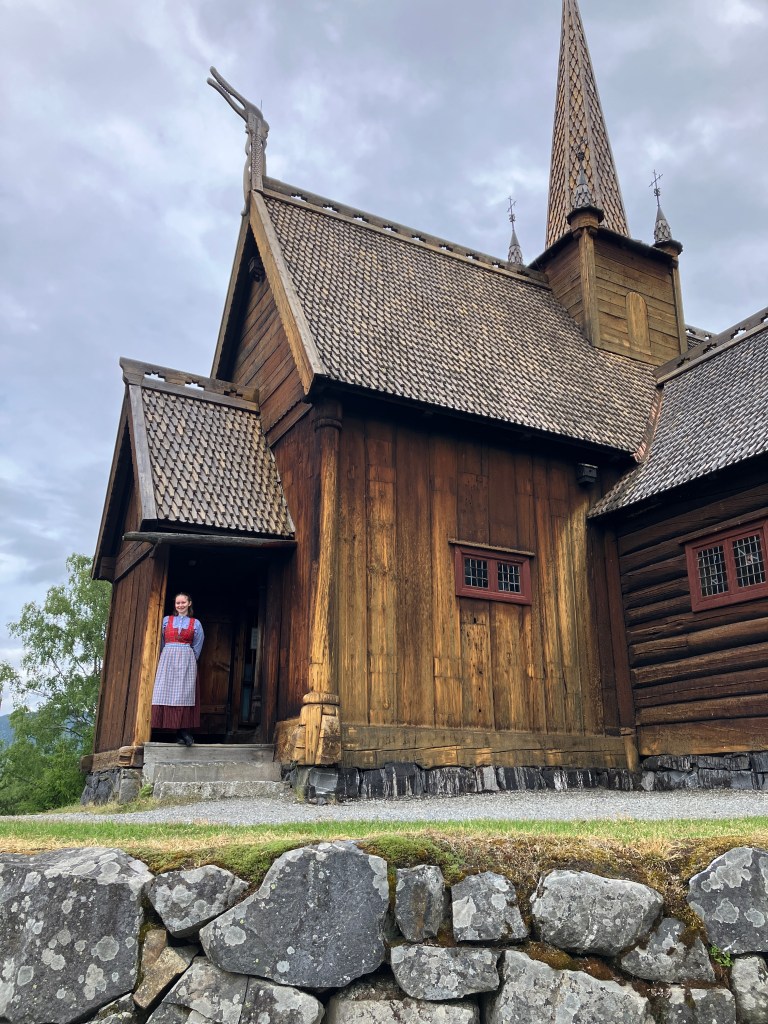
After lunch in the museum restaurant, we find ourselves in front of an impressive-looking wooden church.

The Garmo stave church.

“It’s called a stave church”, a museum guide dressed as some sort of friar explains. “Due to its method of construction. Strong wooden posts rise vertically to give the structure strength, with lighter boards filling in the gaps between. The original church was built in the early 1200s in Garmo. It was dismantled in 1880 and transported here in 1921. The altarpiece and pulpit are both from the original church.”

Further on, we watch a woman making soap the traditional way.

“It’s amazing how you can mix fat and wood ash to come up with something that cleans”, says the First Mate.

Making soap the traditional way.

“Did you see this house over here?”, calls Gunvor, pointing to a well-appointed, but distinctly suburban, house. “It’s Queen Sonya’s actual house. Don’t you remember that you met her in Zambia?”

There had been a royal visit by the then Crown Prince Harald and his wife Sonya to all the Norwegian-funded projects in Zambia. I had been asked to give a talk about the work that we were doing, and I distinctly remember standing in the middle of a field trying to explain to the royal entourage what agroforestry was all about. Later we had had lunch along with them, along with all the other Norwegians there. Sonya herself had been born a commoner, albeit a relatively well-to-do one, and the young couple were obviously very popular. More than a few tears were shed as they were taken to the small airport and their plane disappeared into the African skies towards Lusaka.

“The couple kept their courtship secret for nine years”, a panel in the house tells us. “In those days, royalty weren’t permitted to marry commoners. But Harald told his father that he wouldn’t marry anyone if he couldn’t marry her. Faced with the threat of his royal line dying out, his father agreed. Harald eventually ascended the throne in 1991 to become King Harald V of Norway, with Sonya becoming his queen.”

“She’s just repaying you for that interesting talk on agroforestry in Zambia you gave her in 1990 by inviting you into her childhood home”, jokes Ståle, taking a photo of me standing outside the house.

Outside Queen Sonya’s childhood home.

I am not so sure. I had always thought that I had bored them with my enthusiastic but technical talk of ecological farming. But who knows?

“I thought that we could drive over to our cottage west of here today”, says Gunvor the next morning. “Actually, my sister and myself inherited it when our father died, so we share it with them. They are there at the moment doing some tidying up work, so you’ll meet them.”

“We Norwegians love our cottages”, says Ståle. “They tend to stay in the family, passing from one generation to the next. Mostly they are quite basic with limited facilities, but offer a respite from the pressures of city life. I suppose it is all this getting back to nature thing. I actually have a cottage myself on the west coast on an island near Trondheim that I inherited from my father, although we hardly ever use it. We don’t even rent it out as it is more hassle than it is worth to find housekeepers and so on to look after it.”

It’s not all that different from the Cottage Country area in Ontario, Canada, where we had lived for a year, or, for that matter, the ‘bach’ culture in New Zealand, where I grew up. When we were children, my parents had had a small cottage at a local beach, which we visited from time to time in the summer. Happy memories of sunny days, playing in the sand on the beach, swimming in the small stream that flowed towards the sea, and, of course, eating ice-creams. Eventually we sold it, as us children grew up and moved away from home.

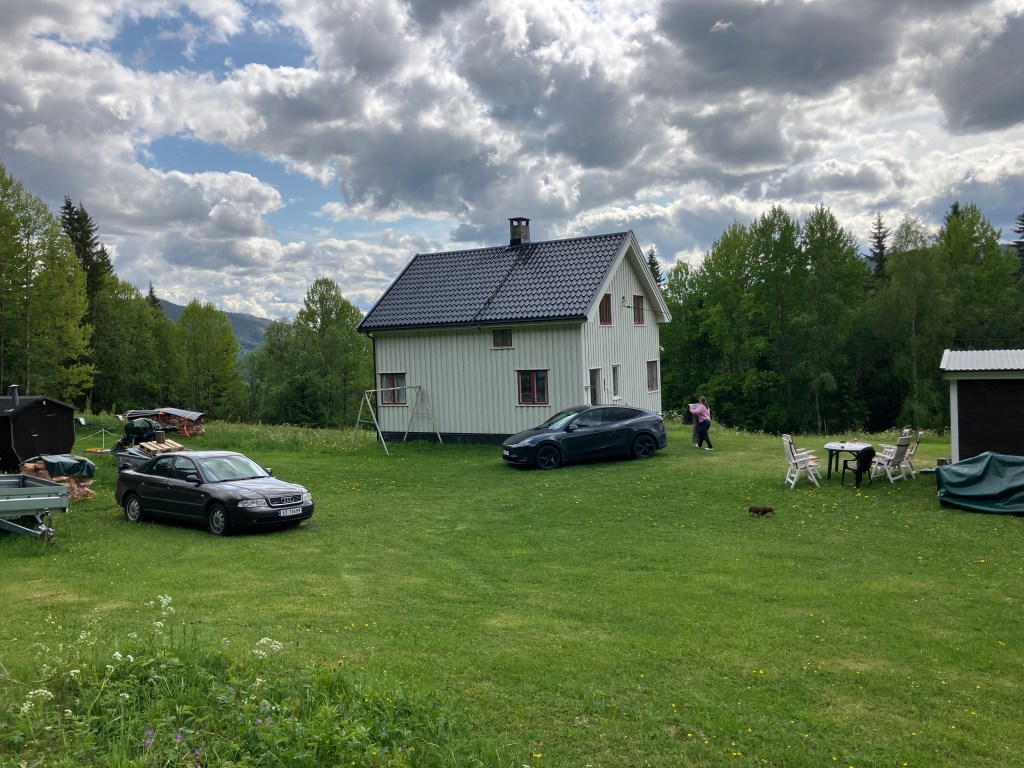
We drive up a winding, unsurfaced road, and arrive at a white-painted cottage in a large clearing in the forest. A ravine tumbles almost vertically from the mountain at the back, and an eclectic mix of agricultural implements lie next to a small shed.

The cottage in the mountains.

“They’re Gunvor’s toys”, says Ståle, following my gaze. “Being an engineer by training, she loves mechanical things that can do serious work.”

Gunvor’s sister Sigrid and her husband Ragnor, along with their small dachshund, are already there. They are also both engineers, working on military projects.

“We are sailors too”, Ragnor tells us over a lunch of waffles. “We used to have a boat and sailed it in the Skagerrak a lot, both in Sweden and Norway. In fact , I have always been fascinated by the idea of travelling by wind power. In my younger days, a group of us kite-skied from the south to the north of Greenland. It was an amazing experience.”

I am suitably impressed. It had never occurred to me that such a thing was even possible, let alone achieved.

“Try some of this Rømmegrøt”, says Gunvor. “It’s a traditional Norwegian dish made with sour cream, milk, wheat flour, butter, and salt mixed into a kind of porridge. You can drizzle it with butter, and sprinkle sugar, cinnamon and sultanas on top. You normally eat it to accompany salami or ham and a flatbread. It’s quite rich.”

Tucking into the Rømmegrøt.

‘Quite’ is an understatement.

“Phew, that was absolutely delicious”, I say, after a second helping. “But I don’t think I can squeeze any more in without bursting.”

“Me neither”, says the First Mate. “I am going to have to diet for the next month.”

“When I was growing up, it was my absolute favourite dish”, says Ståle. “I couldn’t get enough.”

On the way back to Gjørvik, the conversation turns to our Zambian days.

“Do you remember that trip to Zimbabwe?”, asks Gunvor. “The time there was no flour in the whole of Zambia because the parts for the mill at Kabwe hadn’t arrived. We drove down to Harare to buy flour, a journey that took two days just to get there.”

“I do remember getting to the border at Victoria Falls on the way back”, I say. “What we didn’t realise was that there was a 10 kg limit on flour that you could take out of Zimbabwe. Most of it was confiscated by the border guards. I was heartbroken looking in the rear-view mirror at our precious flour bags piled up in a heap by the border post. Our whole trip was wasted.”

“You can be sure where that ended up”, says the First Mate. “I bet the border guards enjoyed their bread that night.”

The next day, it’s time to go. We need to catch the 0735 train from Gjøvik to Oslo to get back to Ruby Tuesday. The winds to make the 70 nautical mile Skagerrak crossing from Strömstad in Sweden to Risør in Norway are in our favour tomorrow, and we have to make the most of them of them or wait another week.

“We’ve really enjoyed our stay with you”, says the First Mate. “It was wonderful to catch up with you both again after all these years.”

“It’s somehow quite special, isn’t it”, says Ståle. “I mean, that four young people could meet in a remote corner in the deep interior of Africa, that this led to two marriages that still are intact and thriving after 35 years, that we could meet and exchange memories half a life later in the deep interior of Norway, and that we are as comfortable in each other’s company now as we were back then.”

I couldn’t have put it better myself.

A deep ocean trench, an egg-shaped boat, and an anthropological adventurer

“Oh, no”, says the First Mate, peering through the binoculars. “”There’s someone else already there. I was hoping that we would have it all to ourselves.”

We had set sail from Smögen that morning. The other ‘foragers’ had already dispersed – Hekla had already left for Norway across the Skagerrak as they had to be in Bergen within a week to meet their daughter, Aloucia had decided to have a couple of days on Väderöarna (the Weather Islands) before doing the same, and Amalia was heading for Strömstad for a change of crew. We are meandering our way northwards so that we can visit our friends Ståle & Gunvor north of Oslo. On the way, we had seen a small bay that looked ideal for anchoring overnight.

“Never mind”, I say. “We can anchor a bit away from him and pretend he isn’t there. At least it isn’t packed with hordes of boats.”

We drop anchor in the middle of the small bay. It is idyllic. A steep cliff drops precipitously to the water on one side and lush green woodlands cover the gentler slopes on the other. Not a house, car, or even a telephone pole are to be seen. We could be the only people alive. Apart from the sole occupant of the other boat, of course.

Anchored in Otterön bay.

We cook dinner and bask in the warmth of the last sun of the day before turning in.

In the morning, I awake and lie watching the patterns of light dancing on the ceiling for a few moments. I make myself a cup of tea, and go out on deck. The other boat has already gone, and we are alone. A small gulp of cormorants fly overhead in formation, disappearing over the cliffs. Further down the bay, two swans come in to land, their feet swooshing across the surface before they settle down into the water, shaking their wings dry before folding them.

I pick up the book I am reading at the moment. It is the latest of John Gray’s, entitled The New Leviathans. Bleak but stimulating, he discusses the end of the liberal democracy era and its Enlightenment concepts of individualism, equality, universalism, and meliorism – the idea that things will always improve. Only 30 years ago, with the fall of the Soviet Union, the feeling in the West was that these ideas had triumphed over everything else, that liberal democracy was the pinnacle of human government, and that all that still needed to be done was to make every country believe that. Not so, says Gray – so many terrible things have happened since then, and the West and its freedoms are visibly crumbling with the rise of right-wing extremism, authoritarianism, and religious nationalism. The role of these new forms of government are more to protect citizens, or subgroups of citizens, rather than to protect basic freedoms. What’s more, he argues, all these -isms are just words with no substance; the reality is that it is just people going about making decisions for their daily lives. Such words, however, are dangerous as they make people do things in the name of ideologies.

“Breakfast time”, come the dulcet tones of the First Mate from down below. “I’ve put on the coffee. You can make the toast.”

I put down the book and go inside. Why am I reading this rather than enjoying the beautiful scenery around me, I ask myself. But I know I’ll continue reading it when the next chance comes.

After breakfast, we push on to the Koster Islands, about 12 miles west of Strömstad. We arrive at Ekenas, the main harbour. There is a strong current through the narrow channel in which the marina is located, and it is not easy to tie up. The neighbours help us, but somehow we still manage to nudge the pontoon and take a small chip out of Ruby Tuesday. I am not very happy.

“Come on”, says the First Mate, obviously seeing the look on my face. “Let’s go and get an ice-cream. That’ll cheer you up.”

Tied up at Ekenas on the Koster islands.

Near the ice-cream shop is a wooden building labelled the Naturum. It’s a kind of museum, and free. An enthusiastic woman greets us at the door.

“Welcome to the Naturum”, she says. “I’m your guide. I am studying ecology at university. You can learn all about the natural history of the Koster Islands here. Did you know they’re perched on the edge of the Norwegian Trench?”

We have to admit that we hadn’t heard of the Norwegian Trench.

“It’s a deep trench that curves all the way around the south of Norway, up to the Oslofjord, then a bit down the west coast of Sweden just past the Koster Islands”, the Enthusiastic Ecologist explains, leading us to a scale model lit with pulsating lights. “It’s up to 700 m deep in places, and up to 95 kilometres wide. A current flows along it bringing water from the Baltic to join the Norwegian Coastal Current along the west coast of Norway. These pulsating lights show you the currents.”

Model of the Norwegian Trench and its currents.

We tell her that we are planning to sail across to Strömstad, and from there across to Risør in Norway.

“Well, you’ll be sailing over it both times”, she says. “In fact, the deepest part of it is actually just off Risør. Keep an eye on your sonar – the edge of it comes up very suddenly like a cliff, so you can’t really miss it.”

It’s fascinating stuff. I read that evening that the Norwegian Trench is unusual for oceanic trenches in that it has been created entirely by erosion and glacial processes about 1 million years ago rather than by tectonic plates moving over each other as most other ocean trenches are.

In the morning, we unload the bikes, and set off to explore the islands. We come to the grocery store in the centre of South Koster, which judging by the amount of people, seems to be some sort of communal meeting place.

The supermarket on South Koster island.

“Let’s get lunch here”, says the First Mate. “I’m famished. I’ll go in and get something to eat and drink. You stay here and find a table and look after the bikes.”

She comes back out with some sandwiches and orange juice.

The bread in the sandwiches is dry and they taste old.

“The packet says they are best before June 30”, says the First Mate. “That’s a month away. They should be OK.”

I notice on the packet that they were made on May 2. Not only that, they were made in Italy!

“I can’t believe it”, she says. “Made in another country a month ago. No wonder they taste funny.”

“Don’t beat yourself up”, I say. “At least the orange juice tastes good.”

We eventually reach the village of Långegärde on the edge of the narrow channel that divides South Koster from North Koster. The electric ferry from the mainland has just arrived and is disgorging its passengers. We had seen it several times before when it stopped at Ekenas where we are tied up – with almost silent engines apart from a faint hum, it had seemed to creep up on us without warning and rock our boat violently with its wash. But all credit for being sustainable.

The electric ferry arrives at Långegärde.

There is a small chain ferry that goes from one side of the channel to the other. We join the queue.

“The last ferry goes at 1630”, a woman in the queue tells us. “If you miss it, you can get the main passenger ferry back again, but it doesn’t go until 1900. You’ll have a bit of a wait.”

The chain ferry from South Koster across to North Koster.

On the other side, we continue our cycle ride through beautiful green forests until we come to the small harbour of Vettnett. There isn’t a lot there apart from children fishing, but it is beautiful.

“We’d better get back”, says the First Mate. “I think we should try and catch the 1630 chain ferry. I don’t really want to wait around until 1900.”

We make it just in time, and are soon back on the South Koster side.

“You can actually work the chain ferry yourself”, the university student operating it tells us. “But you need to have been trained and to have a license. Lots of people who live on North Koster do just that and are not tied to timetables.”

On the way back to the boat, we stop and climb the path to the highest point on the Koster Islands, Valfjäll, rising to the awe-inspiring height of 50 m. But there is a good view of the archipelago from the top.

Valfjäll, the highest point on South Koster.

“I read that you can even see the Weather Islands from here”, says the First Mate, pointing southwards.

I strain my eyes, and just manage to see a slight smudge on the horizon. I clean my glasses to get a better view.

The Weather Islands seem to have disappeared.

In the morning, we sail over to Strömstad on the mainland. I keep an eye on the depth underneath us. Sure enough, as the Enthusiastic Ecologist said, it plummets suddenly from about 20 m near the harbour to more than 200 m as we cross the Norwegian Trench.

“I don’t like that very much”, says the First Mate. “All that water underneath me.”

“We learnt when we were kids that you can drown in a foot of water”, I say. “It hardly matters if it is 20 m or 200 m underneath us. Better instead to make sure that we don’t fall overboard.”

Arriving in Strömstad.

We have decided to leave Ruby Tuesday in Strömstad and take public transport to Oslo, have a couple of days there exploring the city, then carry on up to Gjørvik in the centre of the country where our friends, Ståle and Gunvor, live. We had considered sailing up the Oslofjord to Oslo, but had been advised by a number of people that while sailing up the fjord is not very difficult, sailing back again is, mainly because the predominant winds are from the south and we would be battling them all the way. As we still needed to make it to the west coast of Norway, a not inconsiderable distance, we decided this was good advice.

The First Mate finds an AirBnB in Oslo for a couple of nights, and books tickets on FlixBus.

“We need to get the local 111 bus out to the E6 motorway to catch the FlixBus”, she says. “There’s only 10 minutes between one and the other. Let’s hope the local bus is on time.”

It is, and soon we are whizzing along the E6 on our way to Oslo.

“The AirBnb is in Rosenhoff”, says the First Mate, when we arrive. “We need to catch a tram there. If we buy a 24 hour Oslo Pass, we can use it on all public transport to go exploring tomorrow as well. It also includes free entrance to museums and art galleries.”

In the morning, we take a ferry across to the Bygdøy peninsula where the Fram and Kon-Tiki museums are located.

The Fram was a purpose-built ship for polar exploration. Its hull was ingeniously designed in an eggshell shape so that the ice would force it upwards rather than crushing it, effectively ending up floating on the surface. The rudder and propeller could be retracted so that they wouldn’t be damaged by the ice. It was specially insulated and stocked so that the crew could live on it for up to five years.

The egg-shaped hull of the Fram.
The propeller and rudder could be retracted to avoid ice damage.

“The Fram was commissioned and used first by the Norwegian polar explorer Fridtjof Nansen in 1893”, a panel tells us. “It was used to test his theory that there was an east-west current across the north pole. By trapping the Fram in the ice around the Siberian islands, they found that it emerged into the North Atlantic Ocean after three years, partly proving the theory, although it didn’t cross the actual North Pole.”

The Fram locked into the ice.

“It was also amazing that the same boat was used by Roald Amundsen when he reached the South Pole in 1911”, says the First Mate over a coffee later. “He was originally planning to be the first to reach the North Pole, but was beaten there by the American explorer Robert Peary, so he secretly changed his mind to aim for the South Pole. He didn’t even tell his crew until the last minute of the change in plans.”

Roald Amundsen, 1872-1928.

“And in doing so, he beat Scott’s British expedition there by five weeks”, I say. “I remember learning about it at school, as Scott had stopped in New Zealand on his way to stock up. Unfortunately, they all died on the way back. It’s the stuff of a heroic British legend, even though they failed. Now, drink up, and let’s go and see the Kon-Tiki museum. It’s just across the way.”

The Kon-Tiki is a raft built of balsa wood that was used by the Norwegian explorer Thor Heyerdahl to test the theory that the inhabitants of the the Polynesian islands could have originated from people who travelled by boat from South America using the Humboldt Current to carry them. He built the Kon-Tiki in Peru in 1947, and by reaching the Polynesian islands of Tuomotu, showed that it was at least feasible.

The preserved Kon-Tiki made from balsa wood.

“It’s a great story”, says the First Mate, “but did you read that genetic and language information collected since have all but proved his theory to be false, and that Polynesians have their origins in South East Asia. Most reputable anthropologists nowadays dismiss his theories completely.”

“It didn’t seem to deter him, though”, I say. “Another of his theories was that the Ancient Egyptians could have sailed across the Atlantic to trade with the inhabitants of the Americas. So he built another raft called the Ra out of papyrus. After one failure, he rebuilt it and managed to sail from Morocco to the Caribbean in 1970, again proving that it was at least possible. I remember keeping a scrapbook on it when I was at high-school.”

Thor Heyerdahl’s Ra II made from papyrus.

“He certainly had an adventurous life”, says the First Mate. “It’s a pity after all that that none of his ideas turned out to be right.”

“That’s how science works”, I say. “People come up with different ideas, put them to the test, consider all the evidence, and either discard, modify or adopt them. Unfortunately, Heyerdahl’s mostly ended up in the dustbin. But you never know what will happen in the future.”