Polar adventurers, flaming tacos, and reindeer road rules

“Look at that white building over there”, says the First Mate, pointing to the right of the bridge that spans the sound. “It’s very impressive. I wonder what it is?”

We are sailing up Tromsøsundet and are approaching Tromsø.

“It’s got to be the Arctic Cathedral”, I say. “The Lonely Planet book mentioned it.”
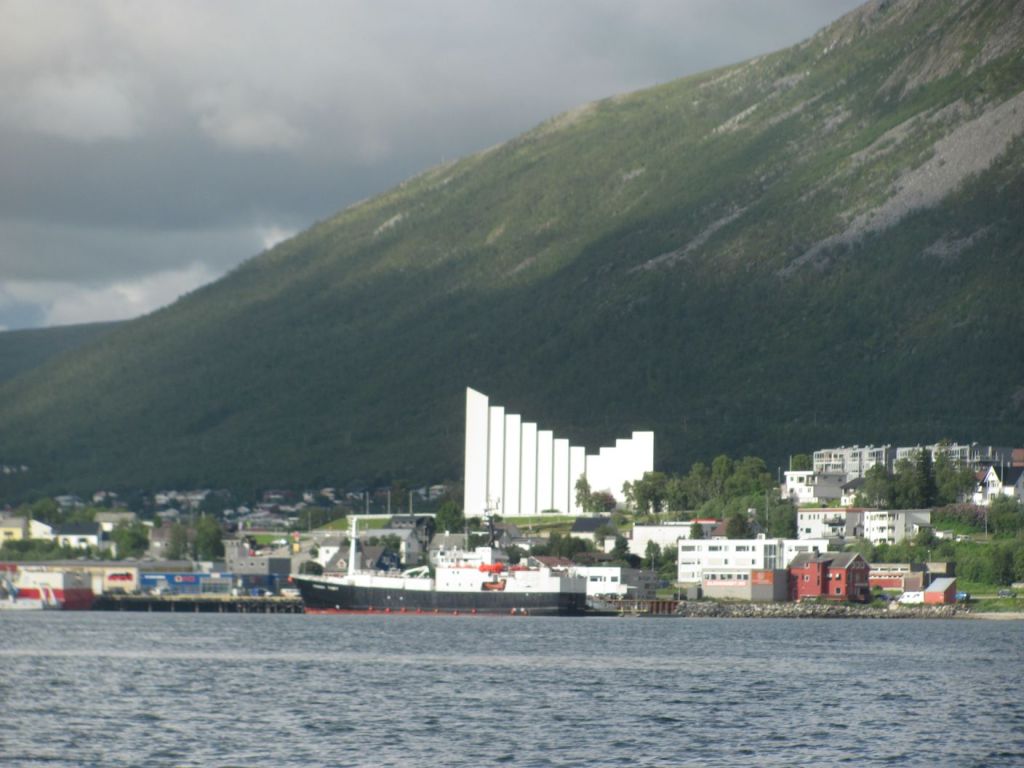
Tromsø’s Arctic Cathedral.

It is impressive. Built from eleven great white concrete panels stacked next to each other, it is visible for miles, contrasting starkly with the dark green hills rising up behind it. The eleven white panels are supposed to represent the eleven apostles who remained true to Jesus. Obviously not Judas.

Shortly we are docking in Tromsø marina, ably helped by a group of enthusiastic teenagers who are disembarking from a colourfully-painted wooden sailing boat.

“We’ve been sailing up to Svalbard”, they tell us, as they attach us to the pontoon cleats. “We’ve just got back. We are all pretty exhausted. But we had a great time. Now another group is going. They’ll be here soon.”

Svalbard is a large island that lies five days’ sail across open sea north of Norway. It belongs to Norway, but is subject to the Svalbard Treaty, which guarantees rights to 40 other countries who are signatories to the Treaty. Part of the Treaty says that it must not be used for military purposes.

Tied up in Tromsø marina.

“Let’s have a cup of tea”, says the First Mate. “Then we can go and have a look at the Cathedral. It’s just a short walk over the bridge there.”

The bridge is closed to motor traffic for repairs, but open to pedestrians and cyclists. There’s a great view from the top of its hump out over the sound and the city. It doesn’t take long to reach the Cathedral.

The First Mate reaches the Arctic Cathedral.

“The Cathedral was built in 1965”, the woman behind the counter tells us. “It is famous not only for its unique exterior design, but also for the stunning stained glass window within it. It depicts the Return of Christ showing God, Jesus, and a man and a woman. We also have concerts here during the summer. The acoustics are amazing.”

The stained glass window in the Arctic Cathedral (from Wikipedia Commons)

On the way back, we stop off at the Polar Museum on the harbour front. There are exhibitions on hunting and trapping in Svalbard, polar aircraft, and the famous Norwegian polar explorers, Nansen and Amundsen.

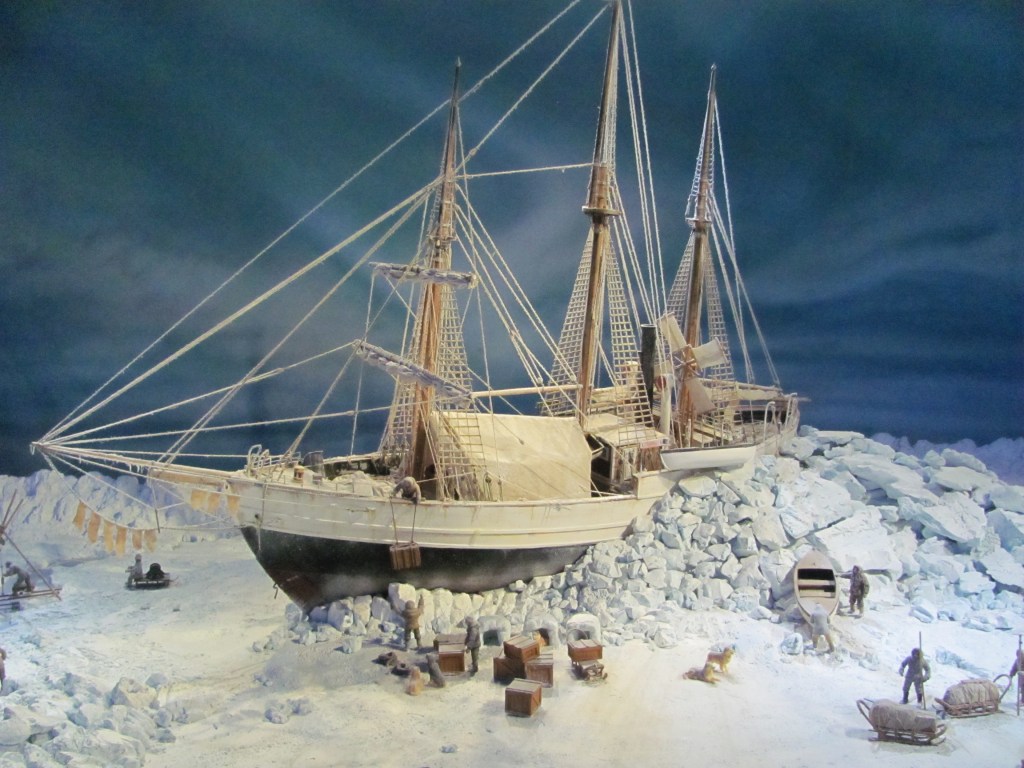
“Although there were overwinter trapping expeditions as early as 1795, it started in earnest in the 1890s”, the guide leaflet tells us. “Hunting then was mainly for walrus, and to a lesser extent, seals, reindeer, and Arctic foxes. Later, polar bears, musk oxen, and bow whales were hunted. Reindeer, in particular, almost became extinct. At first, most hunting and trapping was done in the summer season from April to September. Eventually, however, a number of trappers decided to overwinter.”

Overwintering in the Arctic.

“It must have been a tough life”, says the First Mate. “It says here that a lot of the early trappers died of scurvy because of the low levels of vitamin C in their diets. I wonder what made them want to go and do it? It seems that no-one became rich through hunting and trapping.”

“I guess that it just appeals to a certain type of person”, I say. “One who is happy with isolation and solitude, and battling against and surviving adverse conditions.”
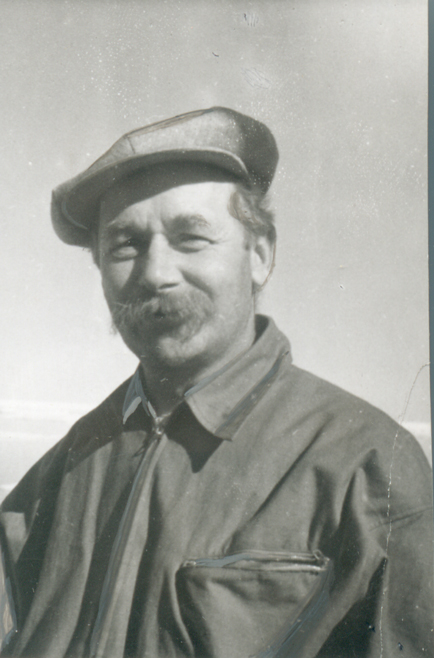
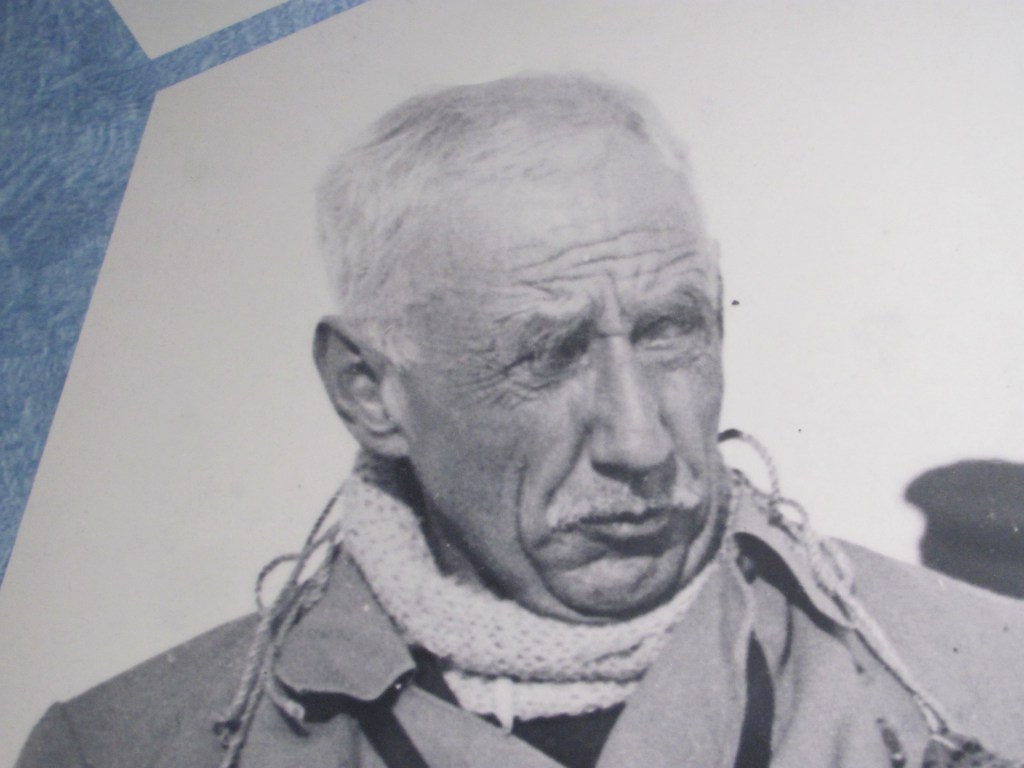
Henry Rudi (from the Norwegian Polar Institute)

One such trapper was Henri Rudi, the ‘King of the Polar Bear’, who became internationally famous. It was his boyhood dream to go to Svalbard, which he did when he was 19 and eventually spent 27 winters there. In total, he shot and trapped more than 700 polar bears before retiring back to Tromsø and receiving the King’s Medal of Merit. He also became famous around Tromsø for his lectures and story-telling of his experiences on Svalbard.

Interesting that we are worried now about climate change melting the ice and destroying polar bears’ habitat, and yet someone who shot 700 of the animals was honoured, I think to myself. How times change.

Wanny Woldstad (from the Norwegian Polar Institute)

Even some women were drawn to the lifestyle. Wanny Woldstad left her job in Tromsø as a taxi-driver, went to Svalbard in 1932 to learn how to hunt and trap, and liked it so much that she returned the following year with her two sons. She stayed several more winters there, during one of which she is supposed to have baked 900 loaves of bread. She became famous for thriving in what had been previously a male-dominated environment, and in 1956 published a book, “The First Woman Trapper in Svalbard”, in which she describes her life in Svalbard’s wild and beautiful landscape.

“I wouldn’t want to do that”, says the First Mate. “Too cold and too tough a life for me. I like my creature comforts.”

We move through to the rooms on Nansen and Amundsen. We had already seen the ship that both of these explorers used, the Fran, in the museum of the same name in Oslo last year, so we knew something about them. But there is more detail here about their adventures.
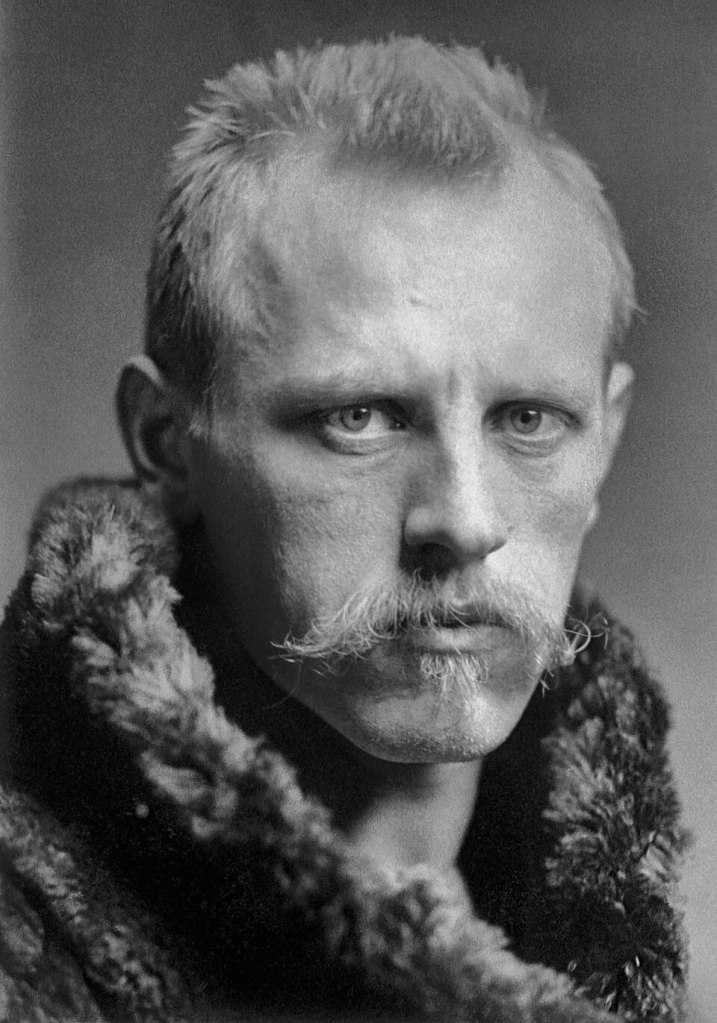
Fridtjof Nansen (Henry Van der Weyde, Public domain, via Wikimedia Commons)

I concentrate on Nansen. He had noticed that wreckage of a ship that had sunk in the New Siberian Islands had eventually ended up in Greenland some years later, and had surmised that the polar ice cap was not static, but was slowly moving. He organised an expedition to test this theory in which the Fran would be locked in the ice and they would see where it got to, hoping that it would pass over the North Pole. They started near the Siberian Islands in 1893, but after a year or so, it became clear that it wouldn’t reach the pole. So, in 1895, Nansen and one of his crew decided to leave the ship and ski there instead. Unfortunately, it took longer than they had thought, and they had to turn back because their supplies were running out. But even returning took longer than they had thought, and they were forced to overwinter alone in the Arctic. They lived off polar bear and walrus meat until the next spring, then set off again, and eventually in August of 1896 met another polar explorer who took them back to Norway in his ship.

“What happened to the Fran?”, asks the First Mate.

“It seemed that it broke free from the ice near Svalbard”, I say, “And arrived back in Norway just a little bit after Nansen got there.”

“So what was the point of it all?”, she asks. “It all sounds a bit like a Boys’ Own adventure to me.”

“Well, according to the exhibition, it did confirm his theory that the ice cap is moving”, I say. “As well as providing a lot of other valuable scientific information on the oceanography of the Arctic Ocean, and on the flora and fauna of the Siberian coast and Franz Joseph Land. So not only adventure.”
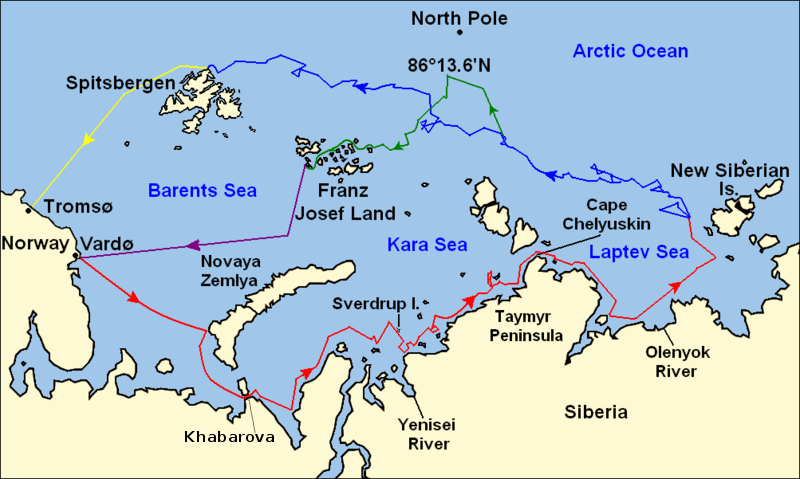
Nansen’s and Fran;s routes 1893-96.

We head back to the boat. Dinner time approaches.

“I think we can have tacos tonight”, says the First Mate. “We can heat up the shells in the toaster.”

I put the shells in the toaster, press down the lever, and go back to chopping the onions.

“Hey, there’s smoke coming out”, shouts the First Mate half a minute later. “And now flames.”

The smoke alarms in the boat go off with loud shrieks. Concerned people on the pontoon stop to look at the clouds of smoke now billowing out of the companionway. We open all the hatches to let more smoke out, and try and smother the toaster to stop the flames. It doesn’t work very well.

“Quick, put it under the tap”, I say, unplugging it.

We douse the toaster in water. Eventually the flames die down and the smoke stops. But not much is left of the toaster. Several of the plastic bits have melted, and the metal bits are warped and twisted.

“It must have been the oil on the taco shells”, I say. “As soon as it got to a certain temperature, it caught alight. I didn’t realise that a toaster could get so hot so quickly. When I am waiting for my toast in the morning, it seems to take forever and even then hardly browns the toast.

“At least it shows the smoke alarms work”, says the First Mate. “But we’ll have to buy a new toaster. That’s three appliances that have gone now.”

A few weeks earlier, she had put the base of the electric kettle onto the hot hotplate and melted it beyond repair. Not long after, our little fan heater had stopped working for reasons unknown.

“We’ll just have to buy some new ones tomorrow morning”, I say. “When the shops open.”

—-

After the shopping expedition the next day, we take the No. 40 bus to the Arctic University Museum of Norway, and spend a leisurely couple of hours absorbing information on the geology and natural history of the region, the northern lights, and Sami life, culture and politics.

We are astounded to learn that there are actually ten different Sámi languages, not just one. All are what are called Finno-Ugric languages, similar to Finnish and Hungarian, with a comparable structure and vocabulary, but are largely mutually unintelligible in the same way that Spanish and French are. North Sámi is the most widely spoken, but there are also South Sámi, Ume Sámi, Pite Sámi, Lule Sámi, Inari Sámi, Skolt Sámi, Kildin Sámi, Ter Sámi, and Akkala Sámi.
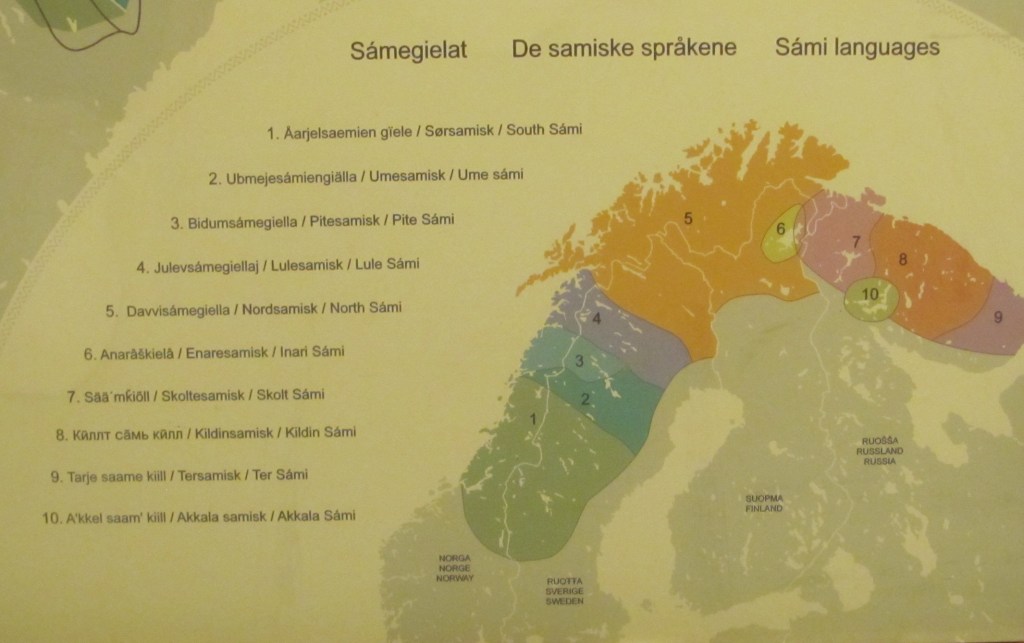
Sámi languages.

“Phew, it’s a lot of languages considering that there are only around 100,000 Sámi people”, says the First Mate. “It says that many of the languages only have 500 speakers or less. Ter Sámi only has two speakers.”

“At least there are efforts to try and revitalise some of the languages”, I say. “”After the disastrous policy of Norwegianization from the 1850s – 1960s where they tried to force the Sámi to become Norwegian. But it does make you think where to draw the line between actively trying to preserve a language and all the cost that that involves, and letting it take its natural course.”

“It’s easy to say that being a native English speaker”, she retorts. “But languages are part of people’s culture and identity, and reflect their different take on the way the world works. You would lose all that richness if we all spoke one language. And once you lose a language, it can’t be easily recreated. And besides, I read an article today that said that you slow your brain from ageing by learning more than one language.”

“I am not saying that we should all speak only one language”, I say. “I am all for learning a new language. I was just musing at what point you can’t do anything more to save a dying language. When the two Ter Sámi speakers die, for example, what are you going to do then?”

“I suppose the best way is to encourage people to be bilingual”, she says. “One global language like English, so that they can communicate wherever they go, and at least one local language to maintain the culture they come from. It’s largely what is happening already, particularly in Europe.”

We catch the bus back into the city centre and decide to have a coffee at the Backstube bakery.

“I found the bit about the young mammoth quite interesting”, says the First Mate, taking a slice of cheesecake.

She is referring to ‘Yuka’, a young male woolly mammoth who died 40,000 years ago and was discovered frozen in the ice in Siberia in 2012 by local hunters. The Museum has been involved in research extracting RNA from the remains, and has been able to deduce that he was under extreme stress at the time he died. This corresponds with scratch marks on his skin, suggesting he may have died from an encounter with cave lions.
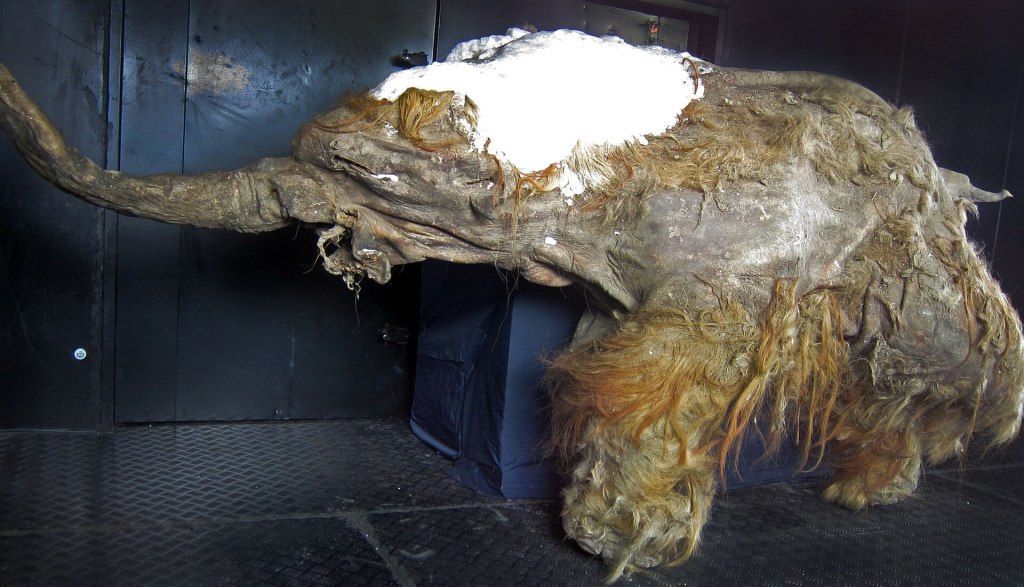
Yuka the mammoth from Siberia (from Wikipedia Commons).

“Yes, some of these new techniques are pretty amazing”, I say. “DNA shows what an organism is, but RNA can show what bodily processes were happening at the time it died.”

—-

We have been planning to hire a car and spend a week exploring Sápmi, the home of the Sámi people.

“You had better tell your readers that Sápmi is the traditional name for Lapland”, says the First Mate. “The name was changed because the people found the words Lapps and Lapland derogatory, as they had been imposed by outsiders and were sometimes used pejoratively.”

My phone pings. It’s a message from the car rental company saying that the car is ready and that we can collect it tonight, even though the rental period starts tomorrow.

“I’ll take the bus and go and collect it now”, I say. “That way we can set off earlier in the morning. We have quite a long journey in front of us.”

There is a bus leaving in five minutes which I manage to catch just in time. On the way, the bus stops. A herd of reindeer is crossing the road. One in particular is in no hurry, and cars are backed up behind it.
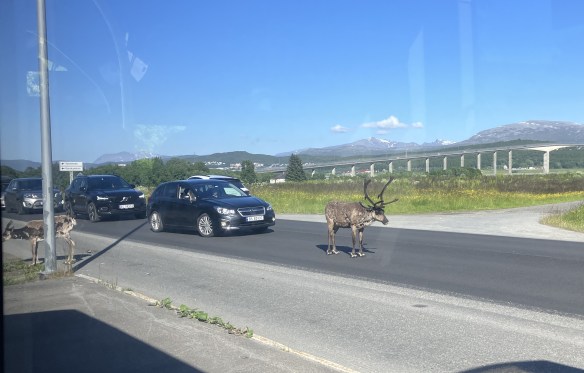
“Don’t hassle me, mate!”

“There’s a law here in Norway that says that reindeer must not be unnecessarily disturbed or frightened”, a woman sitting opposite explains. “In practice that means that if you encounter a reindeer on the road that you should stop and allow it to cross at its own pace. They can be a bit unpredictable if they are hassled.”

Like some people, I think to myself.
A deep ocean trench, an egg-shaped boat, and an anthropological adventurer

“Oh, no”, says the First Mate, peering through the binoculars. “”There’s someone else already there. I was hoping that we would have it all to ourselves.”

We had set sail from Smögen that morning. The other ‘foragers’ had already dispersed – Hekla had already left for Norway across the Skagerrak as they had to be in Bergen within a week to meet their daughter, Aloucia had decided to have a couple of days on Väderöarna (the Weather Islands) before doing the same, and Amalia was heading for Strömstad for a change of crew. We are meandering our way northwards so that we can visit our friends Ståle & Gunvor north of Oslo. On the way, we had seen a small bay that looked ideal for anchoring overnight.

“Never mind”, I say. “We can anchor a bit away from him and pretend he isn’t there. At least it isn’t packed with hordes of boats.”

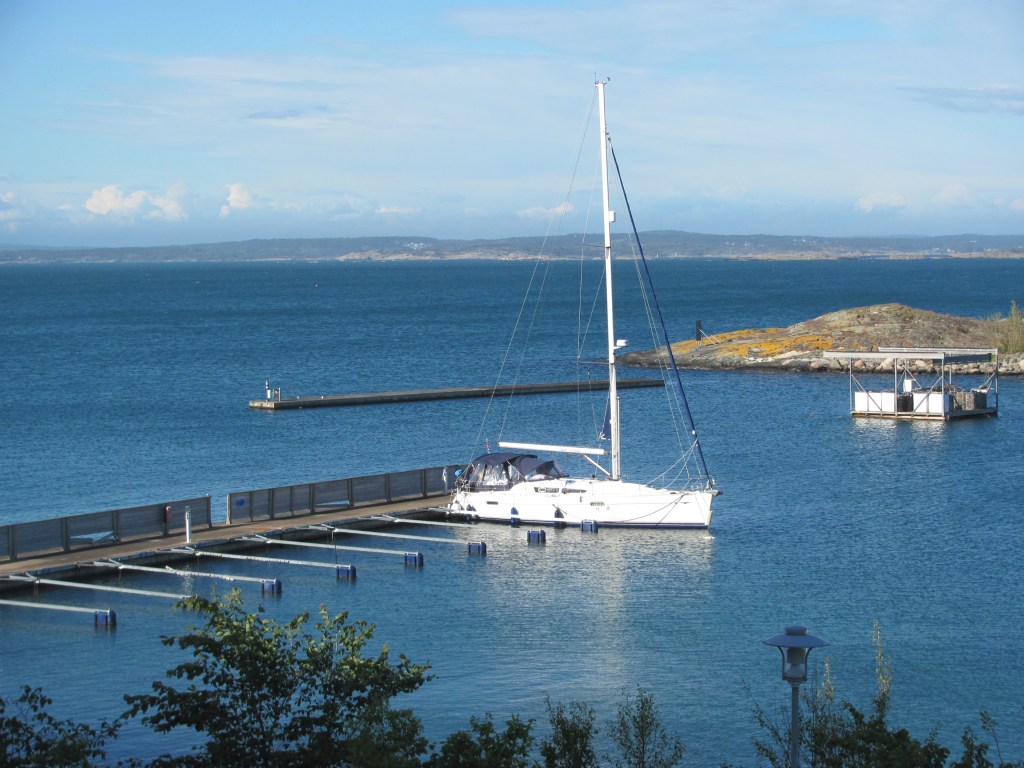
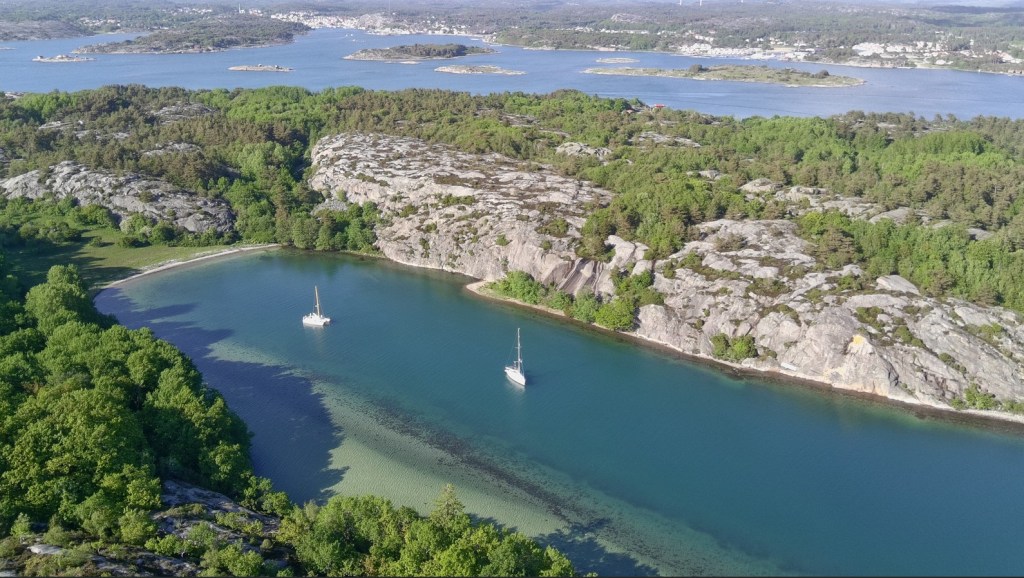
We drop anchor in the middle of the small bay. It is idyllic. A steep cliff drops precipitously to the water on one side and lush green woodlands cover the gentler slopes on the other. Not a house, car, or even a telephone pole are to be seen. We could be the only people alive. Apart from the sole occupant of the other boat, of course.

Anchored in Otterön bay.

We cook dinner and bask in the warmth of the last sun of the day before turning in.

In the morning, I awake and lie watching the patterns of light dancing on the ceiling for a few moments. I make myself a cup of tea, and go out on deck. The other boat has already gone, and we are alone. A small gulp of cormorants fly overhead in formation, disappearing over the cliffs. Further down the bay, two swans come in to land, their feet swooshing across the surface before they settle down into the water, shaking their wings dry before folding them.

I pick up the book I am reading at the moment. It is the latest of John Gray’s, entitled The New Leviathans. Bleak but stimulating, he discusses the end of the liberal democracy era and its Enlightenment concepts of individualism, equality, universalism, and meliorism – the idea that things will always improve. Only 30 years ago, with the fall of the Soviet Union, the feeling in the West was that these ideas had triumphed over everything else, that liberal democracy was the pinnacle of human government, and that all that still needed to be done was to make every country believe that. Not so, says Gray – so many terrible things have happened since then, and the West and its freedoms are visibly crumbling with the rise of right-wing extremism, authoritarianism, and religious nationalism. The role of these new forms of government are more to protect citizens, or subgroups of citizens, rather than to protect basic freedoms. What’s more, he argues, all these -isms are just words with no substance; the reality is that it is just people going about making decisions for their daily lives. Such words, however, are dangerous as they make people do things in the name of ideologies.

“Breakfast time”, come the dulcet tones of the First Mate from down below. “I’ve put on the coffee. You can make the toast.”

I put down the book and go inside. Why am I reading this rather than enjoying the beautiful scenery around me, I ask myself. But I know I’ll continue reading it when the next chance comes.

After breakfast, we push on to the Koster Islands, about 12 miles west of Strömstad. We arrive at Ekenas, the main harbour. There is a strong current through the narrow channel in which the marina is located, and it is not easy to tie up. The neighbours help us, but somehow we still manage to nudge the pontoon and take a small chip out of Ruby Tuesday. I am not very happy.

“Come on”, says the First Mate, obviously seeing the look on my face. “Let’s go and get an ice-cream. That’ll cheer you up.”

Tied up at Ekenas on the Koster islands.

Near the ice-cream shop is a wooden building labelled the Naturum. It’s a kind of museum, and free. An enthusiastic woman greets us at the door.

“Welcome to the Naturum”, she says. “I’m your guide. I am studying ecology at university. You can learn all about the natural history of the Koster Islands here. Did you know they’re perched on the edge of the Norwegian Trench?”

We have to admit that we hadn’t heard of the Norwegian Trench.

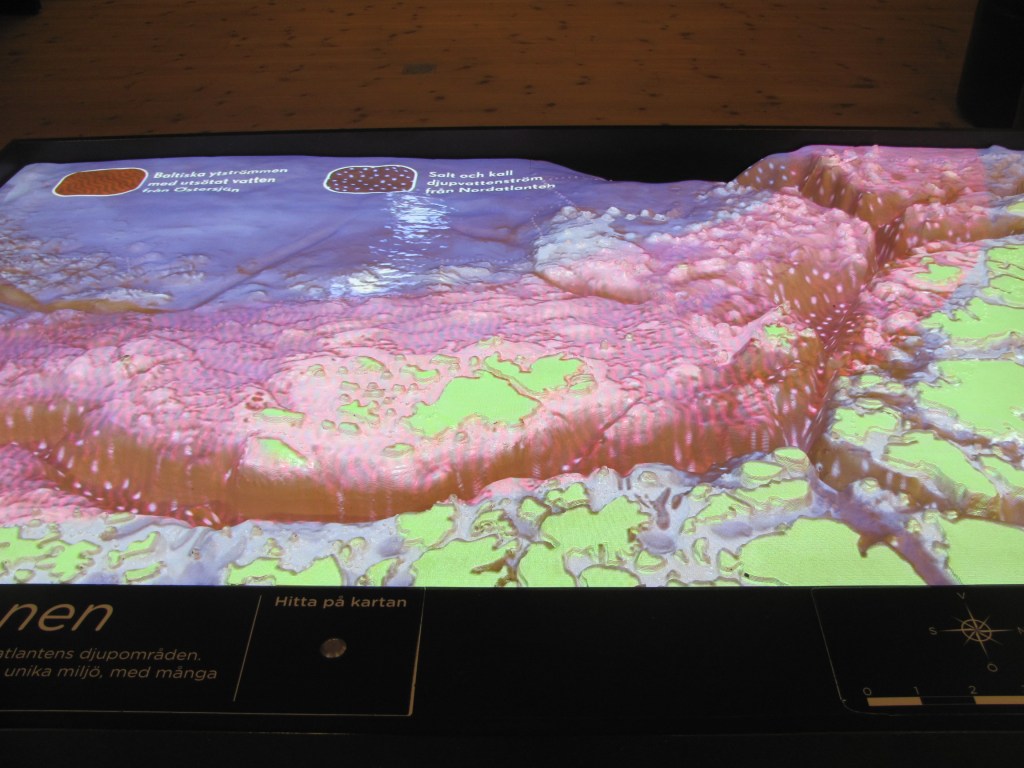
“It’s a deep trench that curves all the way around the south of Norway, up to the Oslofjord, then a bit down the west coast of Sweden just past the Koster Islands”, the Enthusiastic Ecologist explains, leading us to a scale model lit with pulsating lights. “It’s up to 700 m deep in places, and up to 95 kilometres wide. A current flows along it bringing water from the Baltic to join the Norwegian Coastal Current along the west coast of Norway. These pulsating lights show you the currents.”

Model of the Norwegian Trench and its currents.

We tell her that we are planning to sail across to Strömstad, and from there across to Risør in Norway.

“Well, you’ll be sailing over it both times”, she says. “In fact, the deepest part of it is actually just off Risør. Keep an eye on your sonar – the edge of it comes up very suddenly like a cliff, so you can’t really miss it.”

It’s fascinating stuff. I read that evening that the Norwegian Trench is unusual for oceanic trenches in that it has been created entirely by erosion and glacial processes about 1 million years ago rather than by tectonic plates moving over each other as most other ocean trenches are.

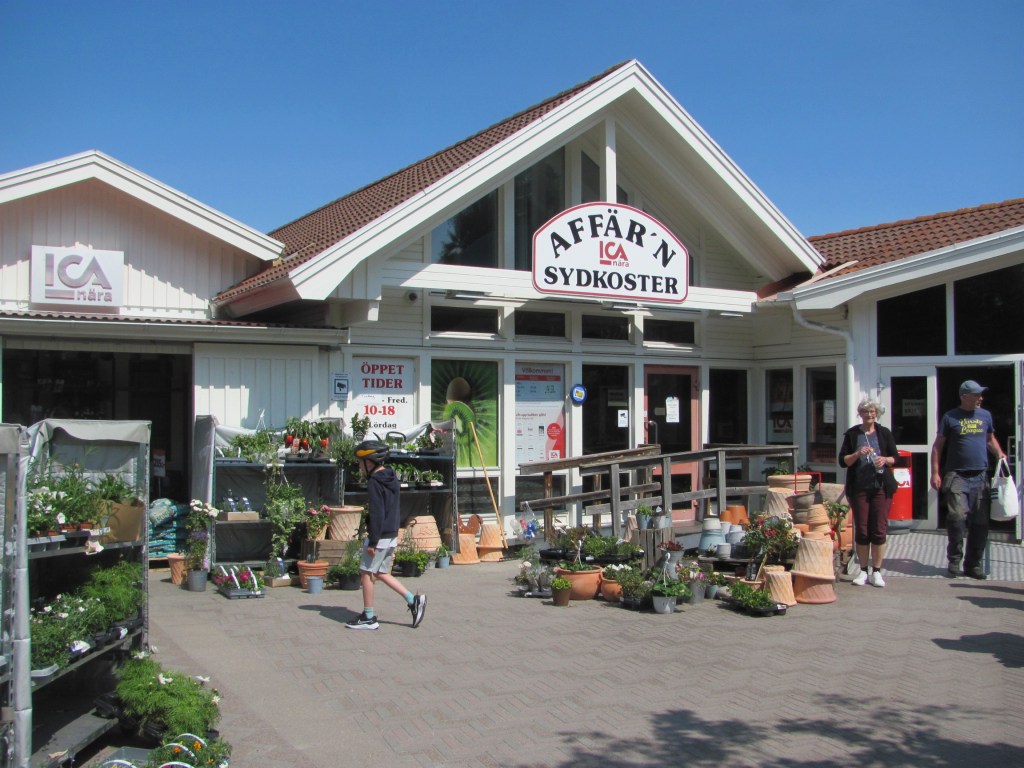
In the morning, we unload the bikes, and set off to explore the islands. We come to the grocery store in the centre of South Koster, which judging by the amount of people, seems to be some sort of communal meeting place.

The supermarket on South Koster island.

“Let’s get lunch here”, says the First Mate. “I’m famished. I’ll go in and get something to eat and drink. You stay here and find a table and look after the bikes.”

She comes back out with some sandwiches and orange juice.

The bread in the sandwiches is dry and they taste old.

“The packet says they are best before June 30”, says the First Mate. “That’s a month away. They should be OK.”

I notice on the packet that they were made on May 2. Not only that, they were made in Italy!

“I can’t believe it”, she says. “Made in another country a month ago. No wonder they taste funny.”

“Don’t beat yourself up”, I say. “At least the orange juice tastes good.”

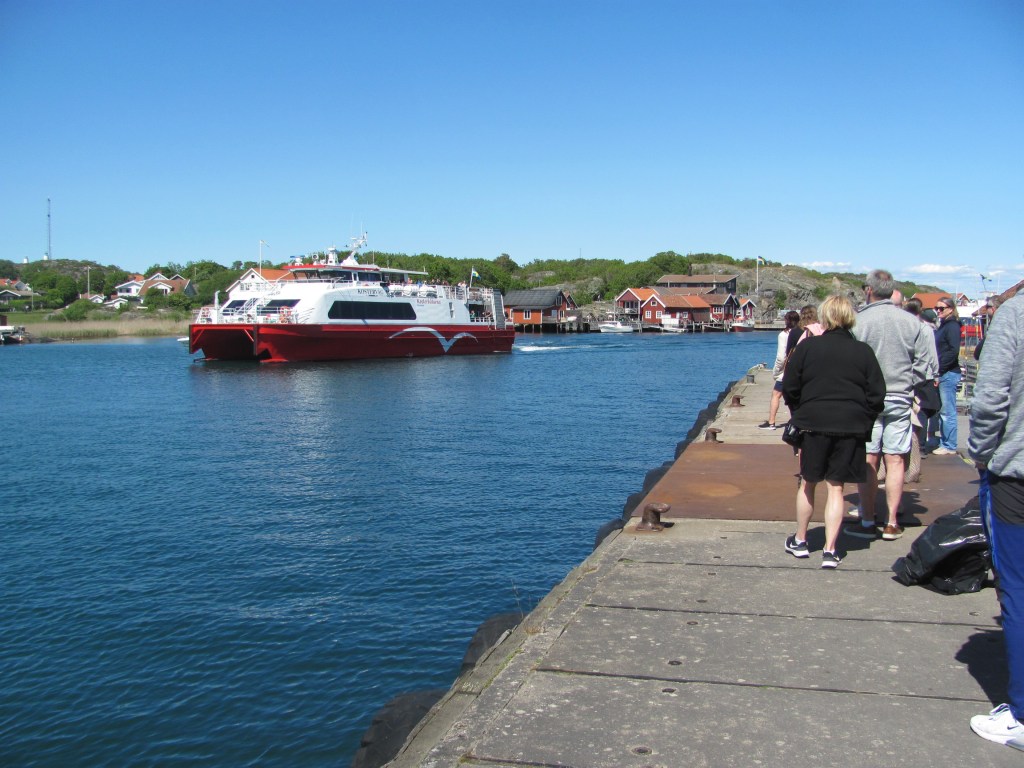
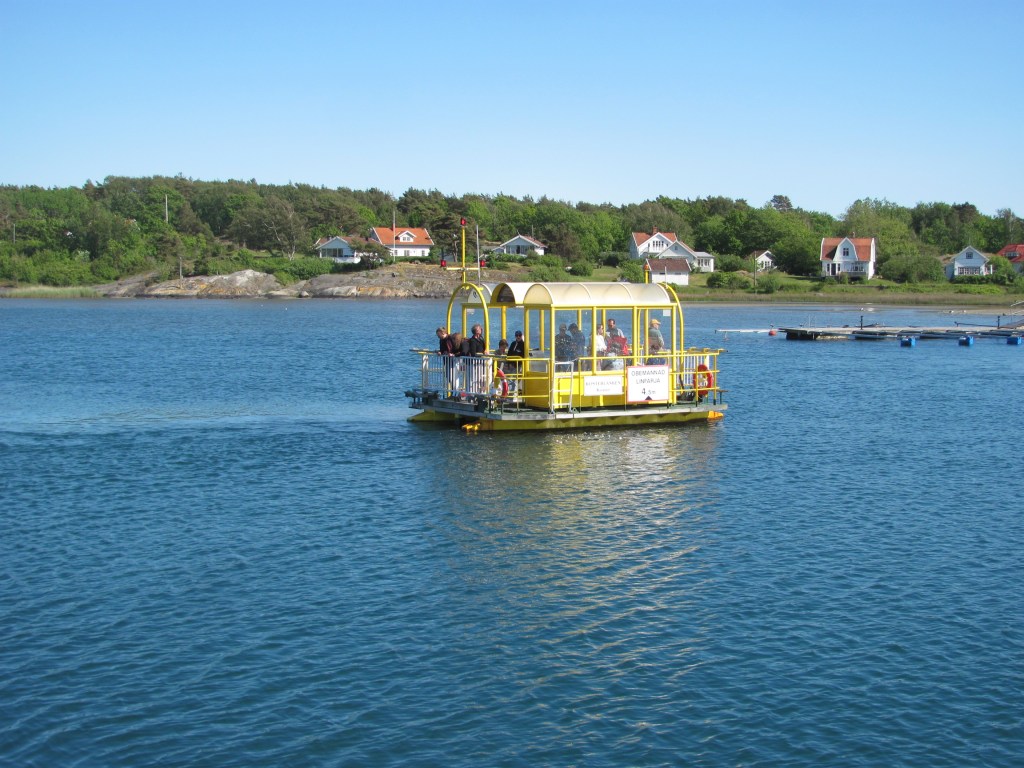
We eventually reach the village of Långegärde on the edge of the narrow channel that divides South Koster from North Koster. The electric ferry from the mainland has just arrived and is disgorging its passengers. We had seen it several times before when it stopped at Ekenas where we are tied up – with almost silent engines apart from a faint hum, it had seemed to creep up on us without warning and rock our boat violently with its wash. But all credit for being sustainable.

The electric ferry arrives at Långegärde.

There is a small chain ferry that goes from one side of the channel to the other. We join the queue.

“The last ferry goes at 1630”, a woman in the queue tells us. “If you miss it, you can get the main passenger ferry back again, but it doesn’t go until 1900. You’ll have a bit of a wait.”

The chain ferry from South Koster across to North Koster.

On the other side, we continue our cycle ride through beautiful green forests until we come to the small harbour of Vettnett. There isn’t a lot there apart from children fishing, but it is beautiful.

“We’d better get back”, says the First Mate. “I think we should try and catch the 1630 chain ferry. I don’t really want to wait around until 1900.”

We make it just in time, and are soon back on the South Koster side.

“You can actually work the chain ferry yourself”, the university student operating it tells us. “But you need to have been trained and to have a license. Lots of people who live on North Koster do just that and are not tied to timetables.”

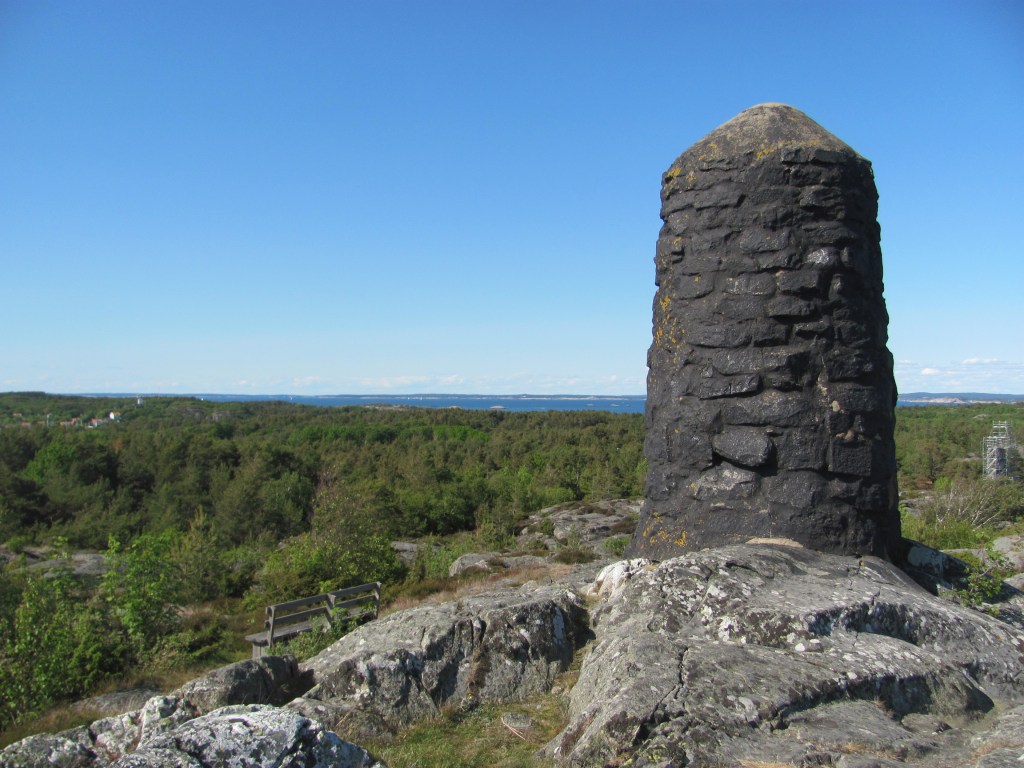
On the way back to the boat, we stop and climb the path to the highest point on the Koster Islands, Valfjäll, rising to the awe-inspiring height of 50 m. But there is a good view of the archipelago from the top.

Valfjäll, the highest point on South Koster.

“I read that you can even see the Weather Islands from here”, says the First Mate, pointing southwards.

I strain my eyes, and just manage to see a slight smudge on the horizon. I clean my glasses to get a better view.

The Weather Islands seem to have disappeared.

In the morning, we sail over to Strömstad on the mainland. I keep an eye on the depth underneath us. Sure enough, as the Enthusiastic Ecologist said, it plummets suddenly from about 20 m near the harbour to more than 200 m as we cross the Norwegian Trench.

“I don’t like that very much”, says the First Mate. “All that water underneath me.”

“We learnt when we were kids that you can drown in a foot of water”, I say. “It hardly matters if it is 20 m or 200 m underneath us. Better instead to make sure that we don’t fall overboard.”

Arriving in Strömstad.

We have decided to leave Ruby Tuesday in Strömstad and take public transport to Oslo, have a couple of days there exploring the city, then carry on up to Gjørvik in the centre of the country where our friends, Ståle and Gunvor, live. We had considered sailing up the Oslofjord to Oslo, but had been advised by a number of people that while sailing up the fjord is not very difficult, sailing back again is, mainly because the predominant winds are from the south and we would be battling them all the way. As we still needed to make it to the west coast of Norway, a not inconsiderable distance, we decided this was good advice.

The First Mate finds an AirBnB in Oslo for a couple of nights, and books tickets on FlixBus.

“We need to get the local 111 bus out to the E6 motorway to catch the FlixBus”, she says. “There’s only 10 minutes between one and the other. Let’s hope the local bus is on time.”

It is, and soon we are whizzing along the E6 on our way to Oslo.

“The AirBnb is in Rosenhoff”, says the First Mate, when we arrive. “We need to catch a tram there. If we buy a 24 hour Oslo Pass, we can use it on all public transport to go exploring tomorrow as well. It also includes free entrance to museums and art galleries.”

In the morning, we take a ferry across to the Bygdøy peninsula where the Fram and Kon-Tiki museums are located.

The Fram was a purpose-built ship for polar exploration. Its hull was ingeniously designed in an eggshell shape so that the ice would force it upwards rather than crushing it, effectively ending up floating on the surface. The rudder and propeller could be retracted so that they wouldn’t be damaged by the ice. It was specially insulated and stocked so that the crew could live on it for up to five years.

The egg-shaped hull of the Fram.
The propeller and rudder could be retracted to avoid ice damage.

“The Fram was commissioned and used first by the Norwegian polar explorer Fridtjof Nansen in 1893”, a panel tells us. “It was used to test his theory that there was an east-west current across the north pole. By trapping the Fram in the ice around the Siberian islands, they found that it emerged into the North Atlantic Ocean after three years, partly proving the theory, although it didn’t cross the actual North Pole.”

The Fram locked into the ice.

“It was also amazing that the same boat was used by Roald Amundsen when he reached the South Pole in 1911”, says the First Mate over a coffee later. “He was originally planning to be the first to reach the North Pole, but was beaten there by the American explorer Robert Peary, so he secretly changed his mind to aim for the South Pole. He didn’t even tell his crew until the last minute of the change in plans.”

Roald Amundsen, 1872-1928.

“And in doing so, he beat Scott’s British expedition there by five weeks”, I say. “I remember learning about it at school, as Scott had stopped in New Zealand on his way to stock up. Unfortunately, they all died on the way back. It’s the stuff of a heroic British legend, even though they failed. Now, drink up, and let’s go and see the Kon-Tiki museum. It’s just across the way.”

The Kon-Tiki is a raft built of balsa wood that was used by the Norwegian explorer Thor Heyerdahl to test the theory that the inhabitants of the the Polynesian islands could have originated from people who travelled by boat from South America using the Humboldt Current to carry them. He built the Kon-Tiki in Peru in 1947, and by reaching the Polynesian islands of Tuomotu, showed that it was at least feasible.

The preserved Kon-Tiki made from balsa wood.

“It’s a great story”, says the First Mate, “but did you read that genetic and language information collected since have all but proved his theory to be false, and that Polynesians have their origins in South East Asia. Most reputable anthropologists nowadays dismiss his theories completely.”

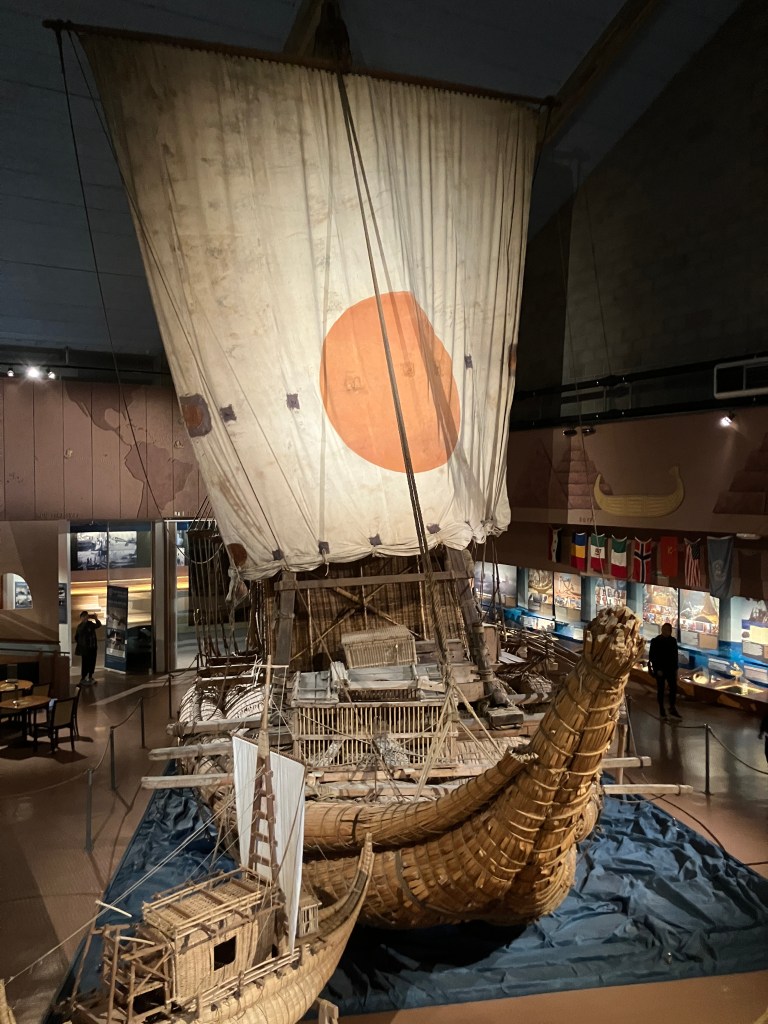
“It didn’t seem to deter him, though”, I say. “Another of his theories was that the Ancient Egyptians could have sailed across the Atlantic to trade with the inhabitants of the Americas. So he built another raft called the Ra out of papyrus. After one failure, he rebuilt it and managed to sail from Morocco to the Caribbean in 1970, again proving that it was at least possible. I remember keeping a scrapbook on it when I was at high-school.”

Thor Heyerdahl’s Ra II made from papyrus.

“He certainly had an adventurous life”, says the First Mate. “It’s a pity after all that that none of his ideas turned out to be right.”

“That’s how science works”, I say. “People come up with different ideas, put them to the test, consider all the evidence, and either discard, modify or adopt them. Unfortunately, Heyerdahl’s mostly ended up in the dustbin. But you never know what will happen in the future.”