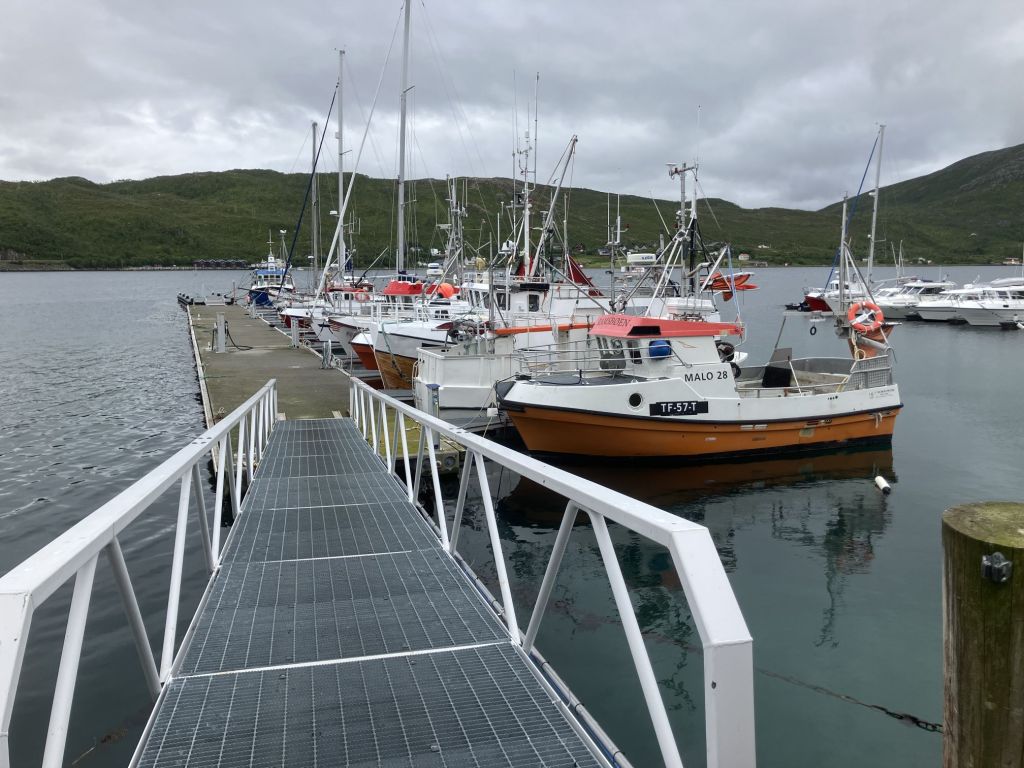
“There’s an empty berth in the middle of the pontoon”, calls the First Mate from the bow. “It’s one of those Y-berths that I hate, but at least it is on the sheltered side of the pontoon away from the wind. We can try it.”
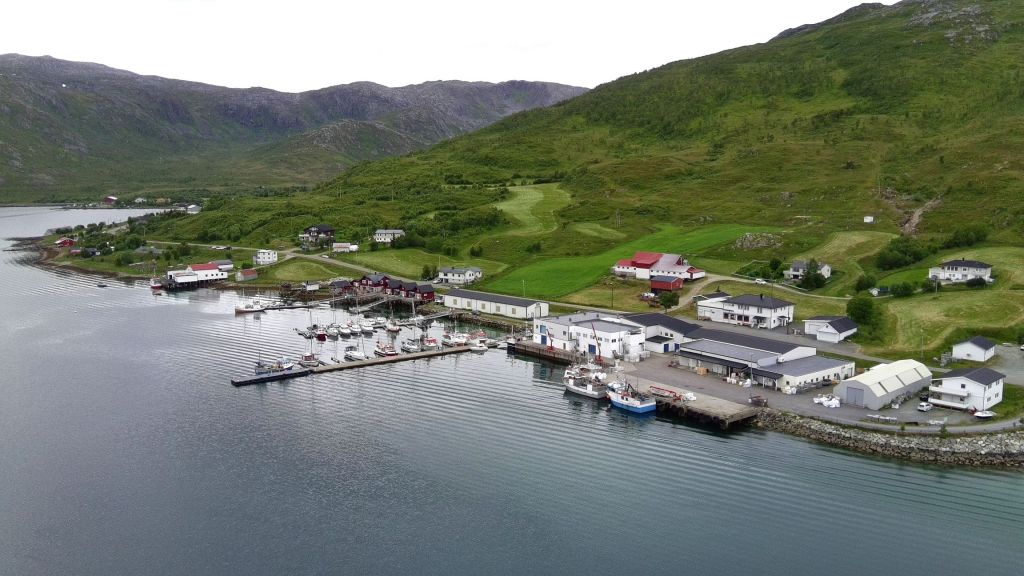
We have just arrived in the small harbour of Kvaløyavågen on the north coast of the island of Kvaløya. There are strong winds forecast from the north overnight and we need to be tucked away safely. One other yacht is there. Its occupants come out to help us tie up.
“We’re from Finland”, says the man, once we are secure. “My name is Rami and this is Enni. I am a photojournalist and Enni is a snowboarder. Our project is to explore northern Norway by boat for three years. We’ve been going for a year already. I am making a documentary film of our adventures. It’s great to be able to combine our passions with sailing.”
“I was brought up on a farm in northern Finland”, Enni says. “And started snowboarding when I was ten. I got into competitive snowboarding, and did quite well.”
“She has two Olympic medals, a World Champion title, and various other medals”, says Rami, butting in. “She’s too modest to tell you all that, so I have to.”
We are impressed.
In the evening, we explore the village. It is dominated by the fish processing plant, with several fishing boats tied up at the wharf. Apart from a small supermarket, there isn’t much else.
“They don’t seem to like tourists too much”, says the First Mate. “Look at that sign.”
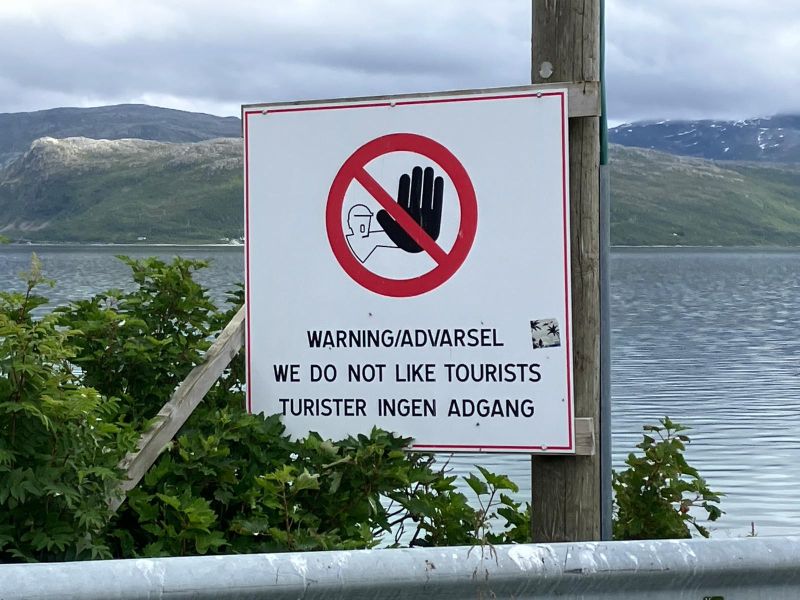
“It’s the fish processing plant”, explains the woman in the supermarket. “They get people with big motorhomes driving onto their wharves looking for a place to park for the night. They are constantly asking them to leave and find somewhere else. I can understand their point of view.”
“You’d think they might find a slightly better wording, though”, says the First Mate later. “It’s a bit aggressive.”
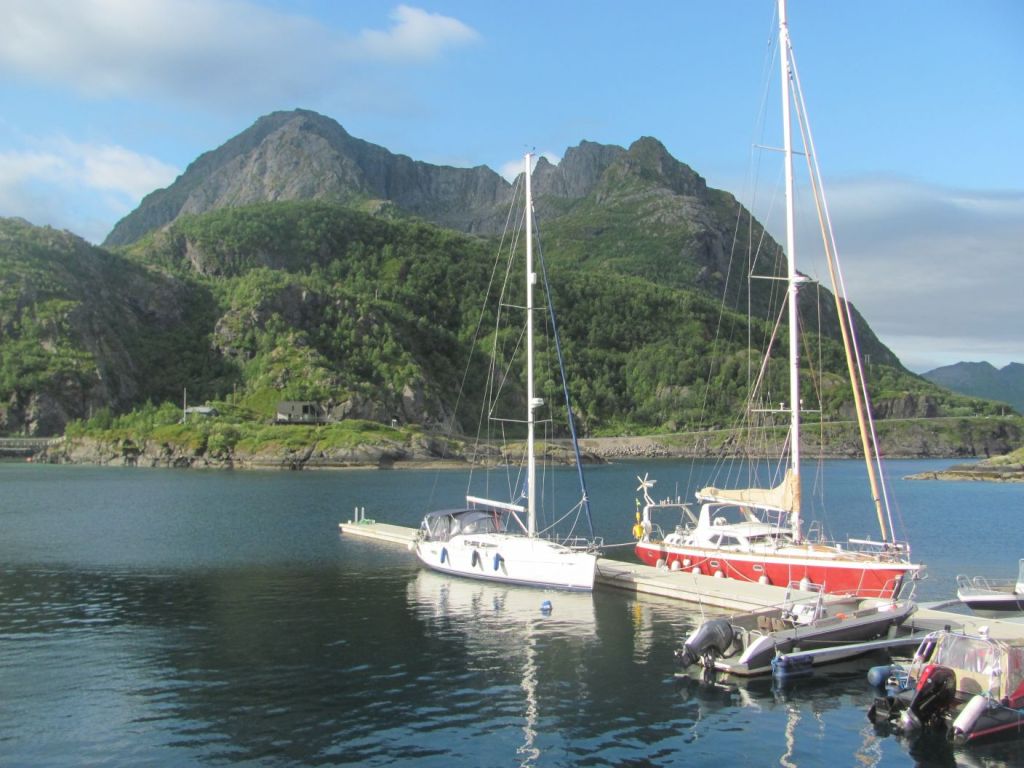
The next day, we sail around the top of Kvaløya island and enter Vengsøyfjorden. The scenery is stunning.
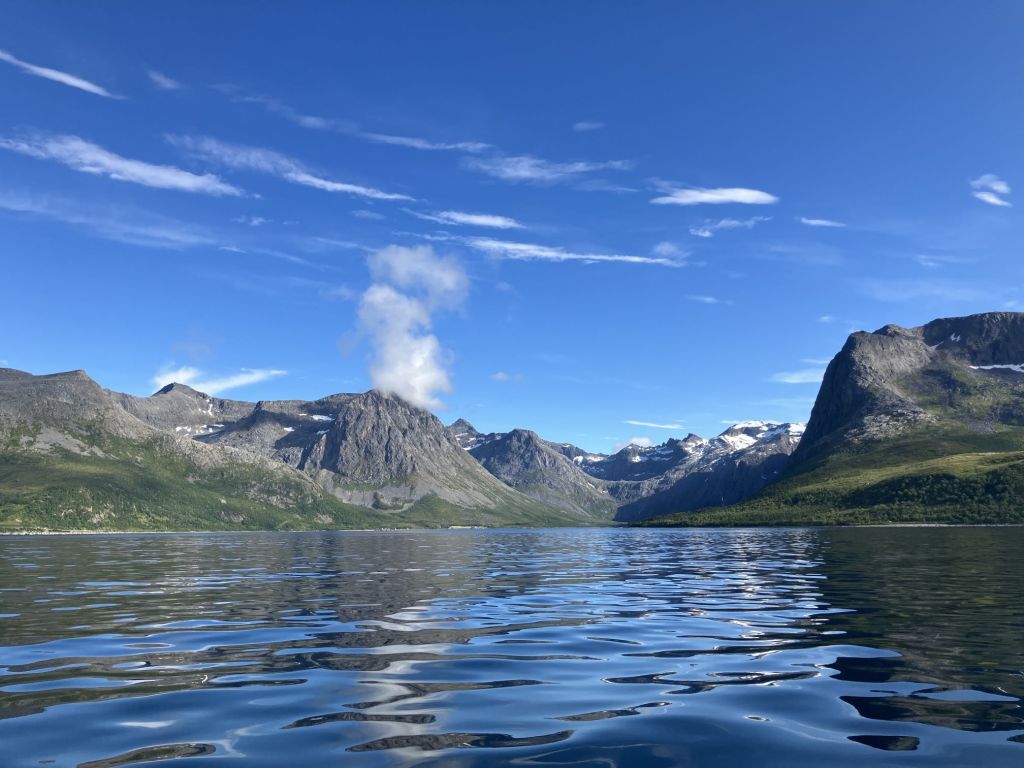
We arrive in Tromvik harbour, and tie up to the inner side of the breakwater pontoon. A pea-green sailboat is moored to the pontoon next to us. It has a Dutch flag.
“Yes, we are Dutch”, the young couple in it tell us. “The boat is our home. We have been living in it for five years here in Norway, just moving around. We are really into climbing, and our goal has been to climb every major peak in this area. It’s been great fun, but we have to get back to Holland by the end of this season, as we now have jobs there.”
“Mountain climbing is not the easiest of sports to practise in the Netherlands”, I say to the First Mate later. “I can understand them wanting to come to Norway.”
“But do you remember that Dutchman we met years ago?”, she says. “His name was Marco van den Berg – ‘Marco from the Mountain’. He used to tell us that his ancestors had lived near a small hill in the landscape, but that if you stood on top of your car, you could see over it to the other side!”
“The old ones are the best ones”, I think.
After dinner, we try our hand at fishing from the pontoon. Soon we are joined by three others. I manage to land a mackerel, but otherwise nothing.
“We normally fish for the Russian salmon”, one of them tells us. “We call them pukkellaks in Norwegian. Very tasty eating. But they have a two-year life cycle, and only come to spawn every other year. In Norway, they come in the odd years. They aren’t here this year.”

“Why are they called Russian salmon?”, I ask.
“Well, they actually originate from the north Pacific”, the second one says. “But the Russians decided back in the 1950s to release some around the Kola Peninsula with the idea of establishing a fishing industry there. But they did very well there, and have now started to spread westwards around the coasts of northern Norway”
“But a lot of people are not very happy about it”, says the third. “They are seen as a an ecological threat, as they compete with the local Atlantic salmon. They say that climate change has warmed the waters which is more favourable for them compared to the Atlantic salmon. The problem is that after they swim up the rivers and spawn, they die shortly afterwards, and there are so many that it degrades the water quality with all their rotting carcases. That affects the eggs of the Atlantic salmon.”
“Not only the Atlantic salmon”, says the first one. “But also other species such as the freshwater mussel, which are a sign of a healthy river.”
“But can anything be done about them?”, asks the First Mate.
“Well, the government has ‘declared war’ on them”, says the second one. “The idea is to try and stop them reaching their spawning grounds, so they have installed traps at the mouth of the streams and rivers. They have people there who go through all the salmon in the traps and sort out the Atlantic ones from the Russian ones. They let the Atlantic continue up the river, but kill the Russian ones and sell them for eating. But it is very labour-intensive and I can’t really see it working in the long term. I think that we will just have to get used to them.”
“Some people think that they are convenient scapegoats for the salmon farming industry”, says the third. “The escape of farmed salmon and the toxins from the fish farms may be a greater threat to the Atlantic salmon anyway, but it is good to have something else to blame.”
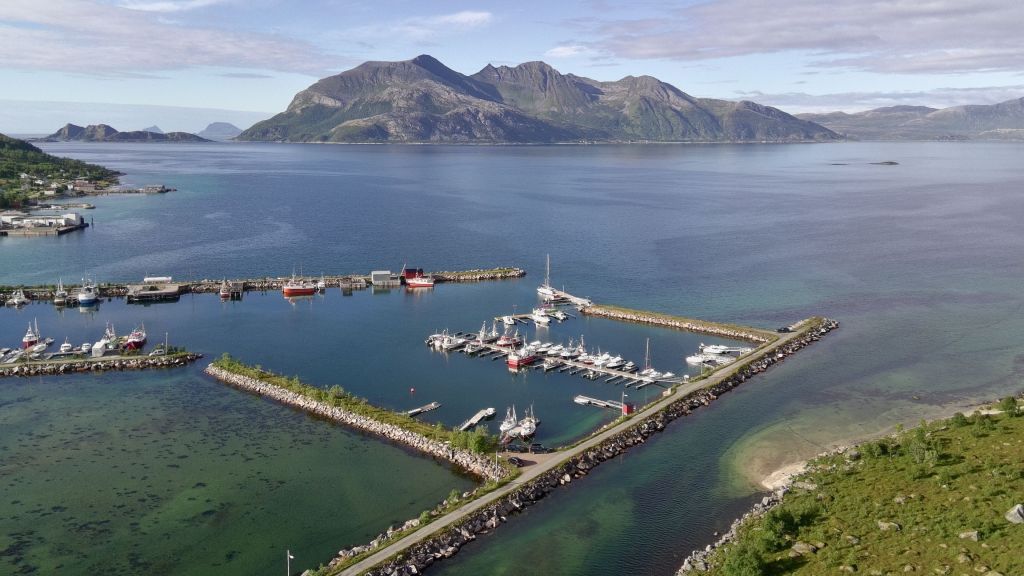
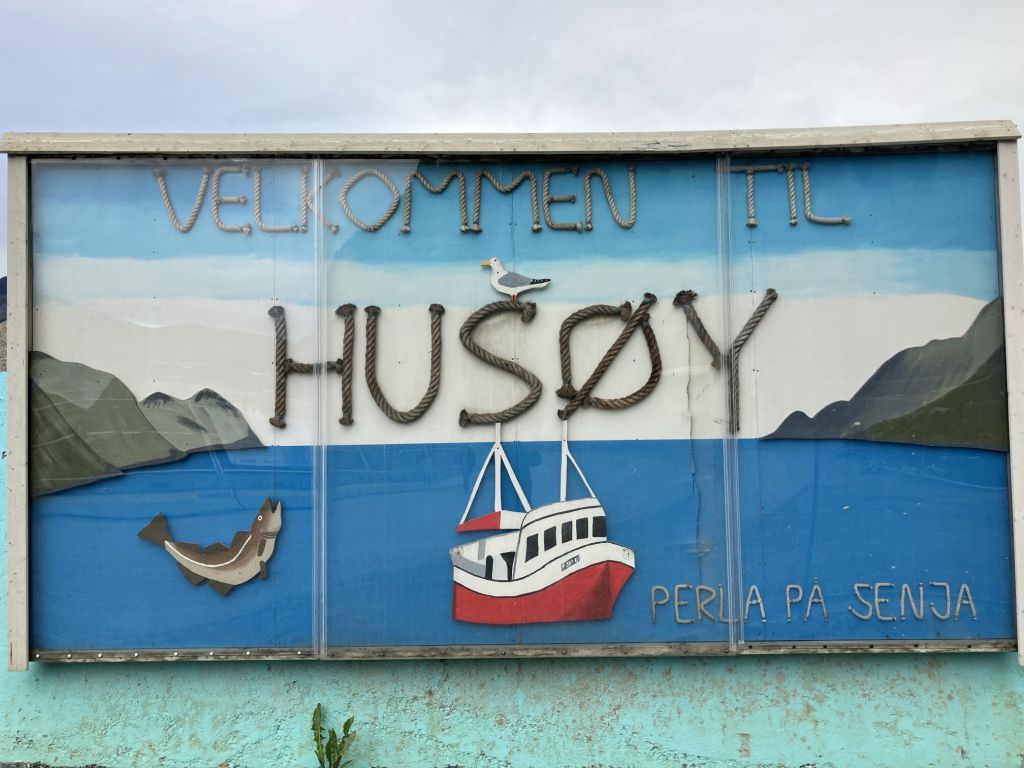
The next morning we head for Husøy. The small marina is full of fishing boats, but luckily there are two berths for guests, so we take one and tie up.
In one of the other berths, a man is painting his boat. Nearby a youngster is trying his hand at fishing with a rod and line.
“Do you know if there is a harbourmaster here?”, asks the First Mate.
“Yes, me”, he says. “You can pay by GoMarina, and there’s power on the pontoon. If you want water, let me know. The water supply leaks if it is left on, so I normally keep it off, and only turn it on when someone wants to fill their tanks. Excuse all the mess – the harbour is undergoing a major reconstruction and deepening, so things are not working as they should be.”
“Well, as long as it is sheltered in here, we don’t mind”, I say. “There are strong south-west winds forecast for the next few days, so we need somewhere to snuggle safely.”
“No worries there”, he says. “It’s very sheltered in here. The causeway stops anything from the north, and the mountains around shelter anything for the other directions. You’ll be safe here.”
“I caught a cod yesterday”, says the youngster in perfect English.
“He’s my grandson”, says the harbourmaster. “He’s only seven. They start English young these days. And of course, they watch a lot of English and American movies on TV and the internet.”
After a cup of tea, we decide to explore. Husøy is actually an island, joined by a man-made causeway to Senja, itself an island. Historically, it was a fishing village, and fish were the backbone of the community. Many families earned their living directly from the sea, and the harbour was full of working fishing boats. Nowadays, although fishing is still important, many people who live here travel to jobs elsewhere.
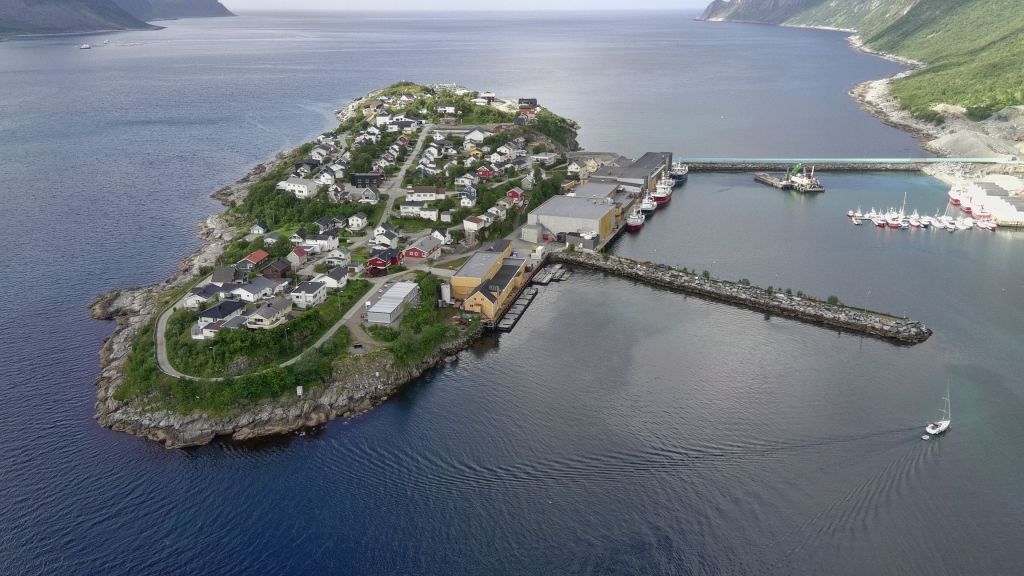
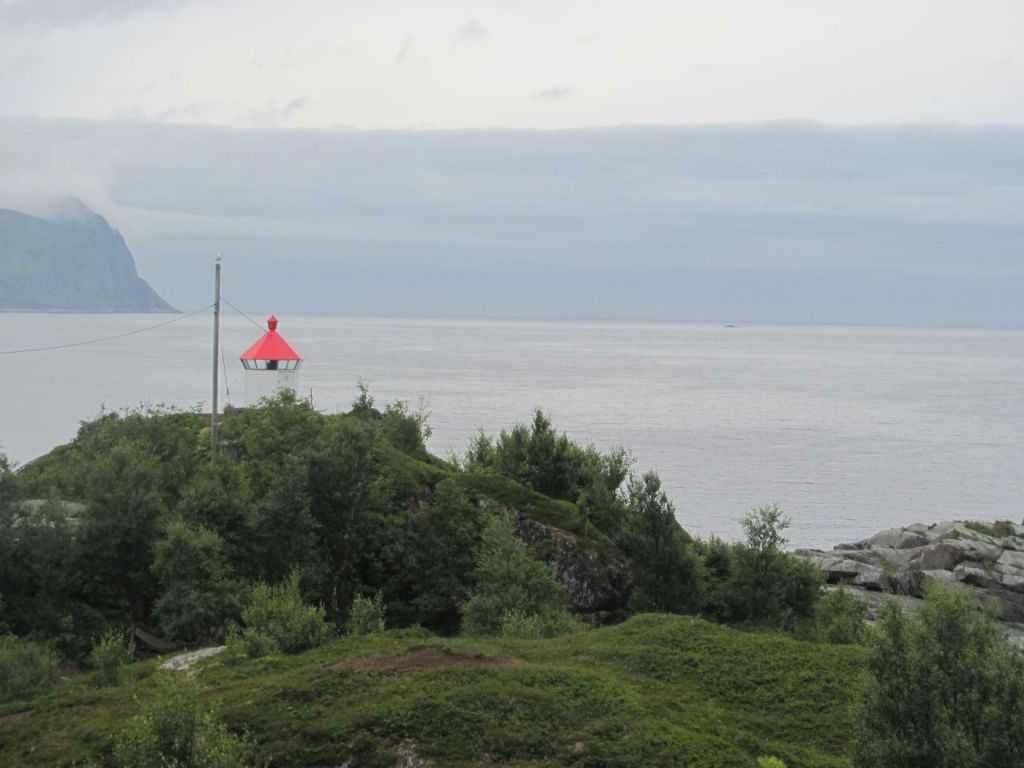
There’s clearly money there. Modern houses nestle side-by-side with older houses, but most seem to have a Mercedes or Tesla on the driveway. We find ourselves at the small lighthouse at the northern end of the island. “Please don’t use our island as your toilet”, says a sign. “Use the facilities on the mainland.”
“That reminds me”, says the First Mate. “Let’s go and have a coffee in that hotel we passed. We can use the toilets there.”
We sip our coffees in the lounge looking out over the fjord. Dark clouds are rolling in, beginning to obscure the peaks. The sea turns a turquoise colour. At the mouth of the fjord, squalls of rain beat down.
“It reminds me of Middle Earth”, I say. “I could just imagine a group of mountain trolls emerging from the forests.”
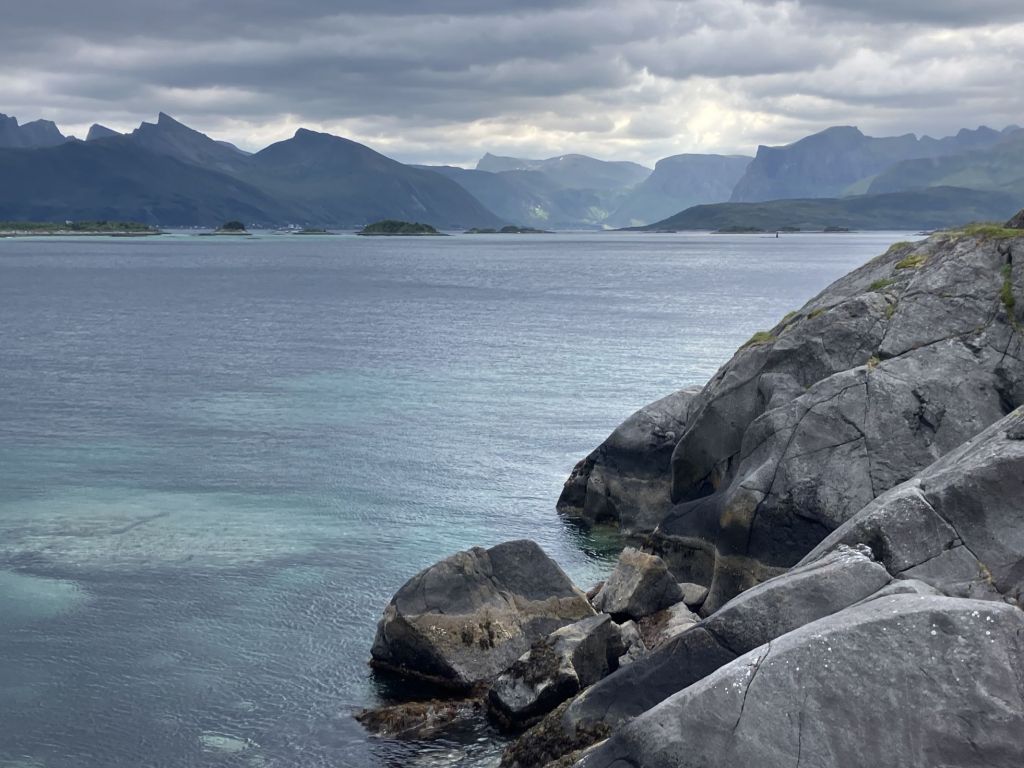
We spend the next two days hunkered down as the forces of nature lash the harbour and island. But at least we are sheltered from the worst of the wind, and are quite warm and cosy in our little cabin. We use the time to catch up on paperwork.
“I found out that there is a café just down the road”, says the First Mate on the second day. “They also have arts and crafts for sale there. Let’s go and see what it’s like.”
The café is empty except for one blond-haired girl in her late teens dancing to music. At first she doesn’t see us, but when she does, she stops.
“You dance very well”, I say. “Don’t stop.”
She beams. “I love dancing. It is just that nobody was here, so I took the opportunity. My Mum owns the café. I am just looking after it for her. She’ll be back soon. If you want coffee, you just help yourself over there. And cakes are here. We can settle up later.”
We help ourselves and sit down.
“I’m still at school”, she says, in response to our question. “In Tromsø. I have an apartment there. But I come back to Husøy for the summer and help out. I love it here – I was born here and have lived all my life here. I know everyone, and everyone knows me. It’s quite a contrast to Tromsø – here I know and talk to the parents of all my friends, but was just thinking the other day that I don’t know the parents of any of my friends there. That’s funny.”
For someone still at school, she has a self-confidence unusual for her age.
“Don’t you want to travel and see a bit of the world?”, the First Mate asks.
“Part of me would”, she answers. “I really envy what you guys are doing. But I think I will always come back to the island to settle and have a family. It’s a great place to bring up children here. There only problem is that the choice of partners is a bit limited. And I am not sure how easy it would be to get someone else to come here to live. Ah, here comes my Mum. I’ll need to go now. It was really nice talking to you.”
“She really doesn’t know what she wants to do, that one”, her mother tells us later. “She’s doing drama and dance at school, but I am not sure whether she will get a job using that. We’ll just have to wait and see. Her brother, on the other hand, is a fisherman born and bred. He’s only 22, and already he owns his own trawler. He’s based here, but at the moment he is way up around Hammerfest somewhere with it.”
“We noticed that all the boats in the harbour here are just sitting there at the moment, and not out fishing”, I say.
“Yes, most of the fishing happens here in the winter”, she says. “For cod. The fish factories take their summer holidays now, so there is nowhere to take fish even if it was caught. So the fishermen take their holidays too.”
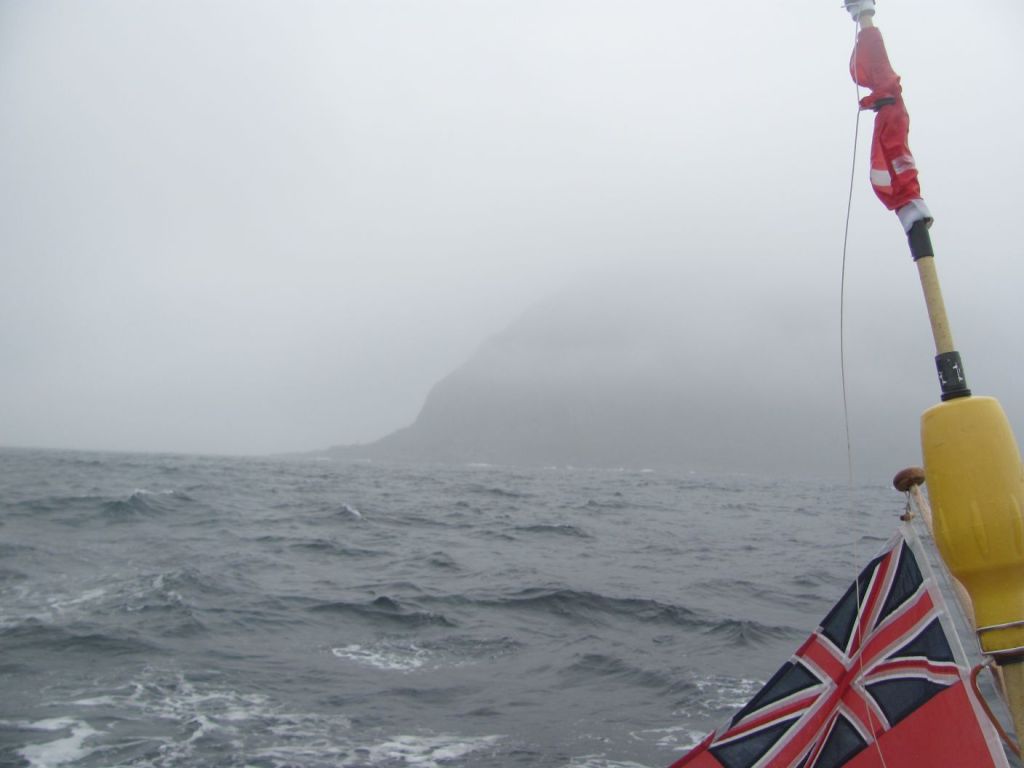
The winds abate the following day, and we venture to poke our nose out. It’s misty, wet, and choppy, but manageable. We sail around to the next small village, Hamn-i-Senja.
There is a hotel there with a pontoon. More strong south-west winds are forecast for the next day, so we decide to stay here.
“We seem to have hit a period of strong winds from the south-west”, I complain. “And that’s just the direction we want to go. We’ll have to take our chances when they come.”
“Never mind”, says the First Mate. “Bob and Fiona are making their way up towards here in Hekla. We can meet them, and they can give us our mail.”
Receiving mail from the UK is tricky as we are never sure where we are going to be. And somehow the postal service between the UK and Norway is subject to delays. Important letters took three weeks to reach us last year. This year, Bob & Fiona had to return home for a couple of weeks for family matters, so we had our mail sent to them, and they are bringing it out to us here.
They arrive the next day. It’s good to see them again. We haven’t seen them since we were in Trollfjorden together watching the Hurtigruten turn around. We give them lunch and catch up with our respective adventures since then.
“We’re heading north from here”, says Bob. “We need to be in Tromsø by the end of the month.”
“Well, at least you have favourable winds at the moment”, I say. “We have had two weeks of winds against us. And they don’t look like stopping soon.”
We part company again the next morning. After overnighting in the ferry port of Gryllefjord, we eventually reach the small harbour of Skrolsvik.
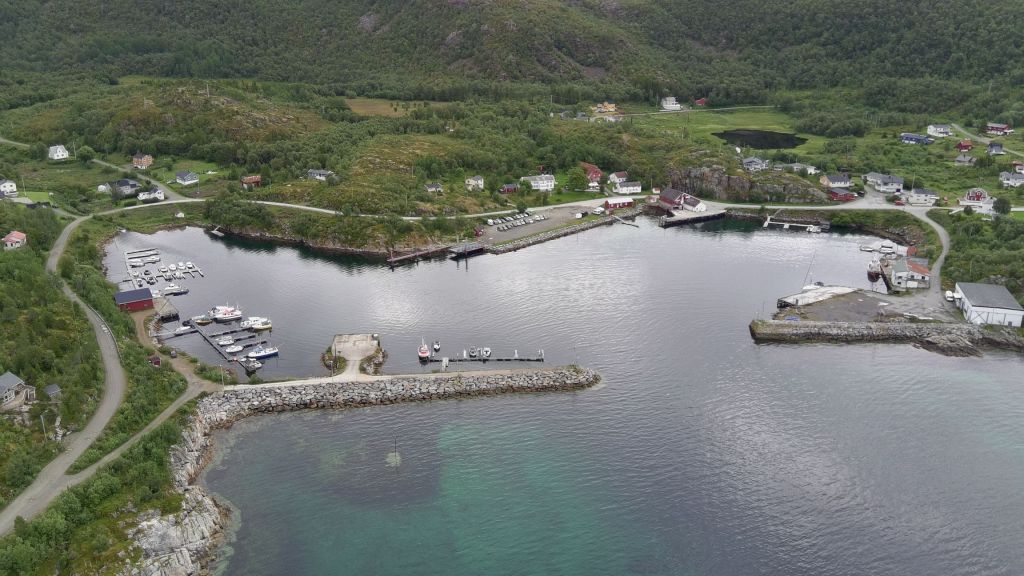
“We must go and see the Halibut museum”, I say as we tie up. “It closes at 1600, so there’s just time if we get up there now.”
The museum is an old fish processing factory that has been converted.
“Welcome”, says the girl behind the reception desk. “Since you are the only ones here, I can give you a personal tour of the museum if you like.”
“That sounds like a good idea”, says the First Mate. “Let’s do that.”
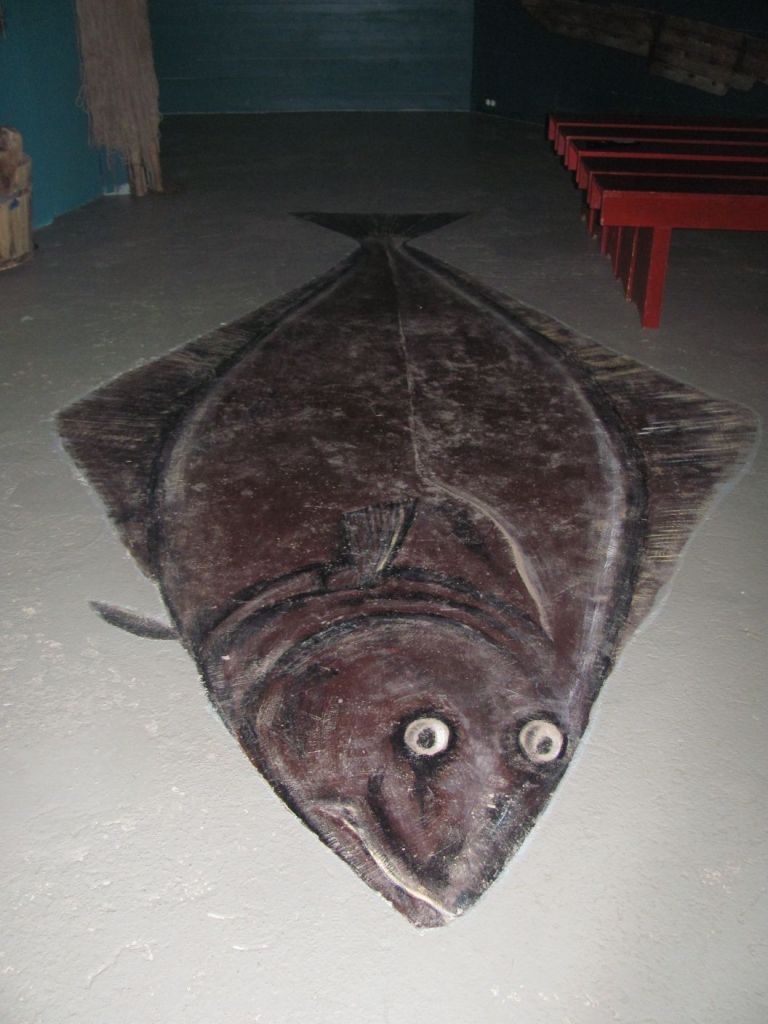
“Catching halibut has always been an important part of the local economy”, the girl tells us as she leads us into the first room. “So much so, it is known as ‘God’s fish’. It is traditional to eat it at Christmas time, and a fisherman would be looked down on if he couldn’t catch a halibut for that special time. They can grow to an incredible size – the largest catch recorded weighed 400 kg. This is a painting of it.”
She points to a painting on the floor of a rather bemused looking halibut. It’s a monster.
“You are supposed to throw any halibut over two metres in length back in again”, she continues. “Even if it is dead. Apparently they accumulate so many toxins in their tissues from all the pollution in the sea that they are a health hazard.”
Trying to manhandle a 400 kg halibut into a boat would also be a health hazard, I think to myself.
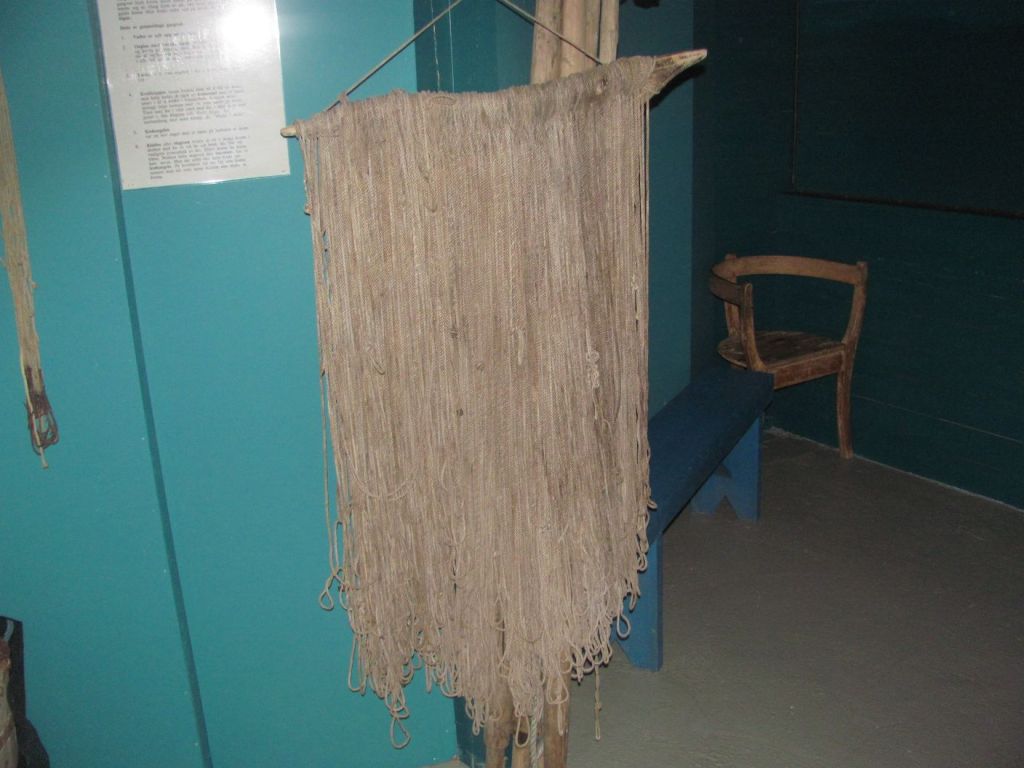
“Traditionally, long lines studded with hooks were used”, she continues. “Then, in 1936, nets were introduced. These were so efficient that most of the halibut stock was exhausted. Nets were then banned, and stocks have now recovered.”
“There are a lot of rituals associated with successful fishing of halibut. For example, fishermen weren’t allowed to say the word ‘halibut’ while at sea, as the belief was that the halibut would hear them and vanish. So they used codewords instead. Also, woman weren’t allowed anywhere near the fish for fear of bad luck. They weren’t allowed to go in the boats, they weren’t allowed to help with the unloading, and they weren’t to do any of the processing. All man’s work. But one of the things that was supposed to bring good luck was for the fishermen to have marital relations with their wives the night before they went out. Then they would be successful and return safely.”
“We’ve got enough fish for now”, the First Mate says later as we have coffee and waffles in the little Gamle Butikken shop behind the museum. “So don’t get any ideas.”
“We haven’t caught any halibut yet”, I say.