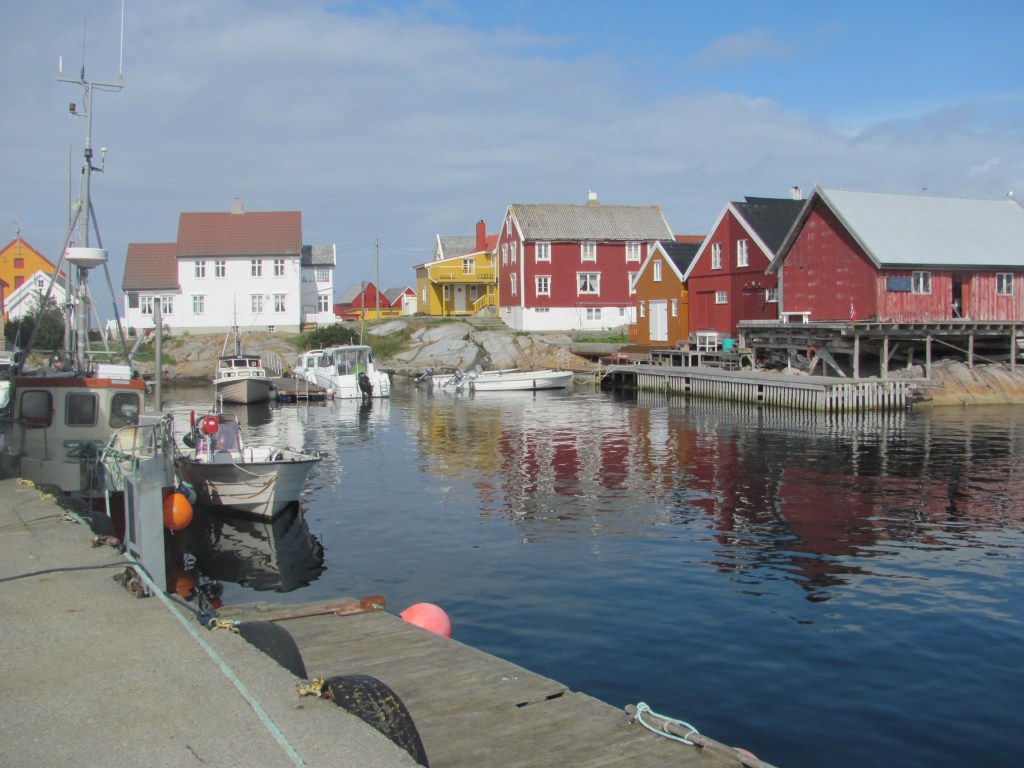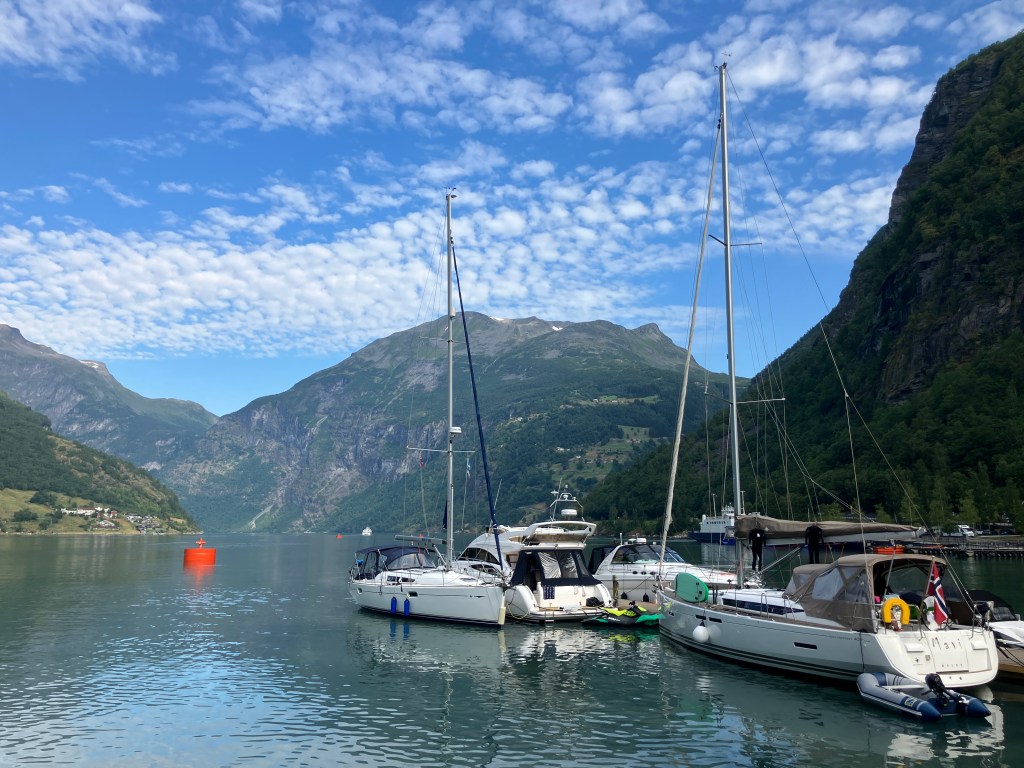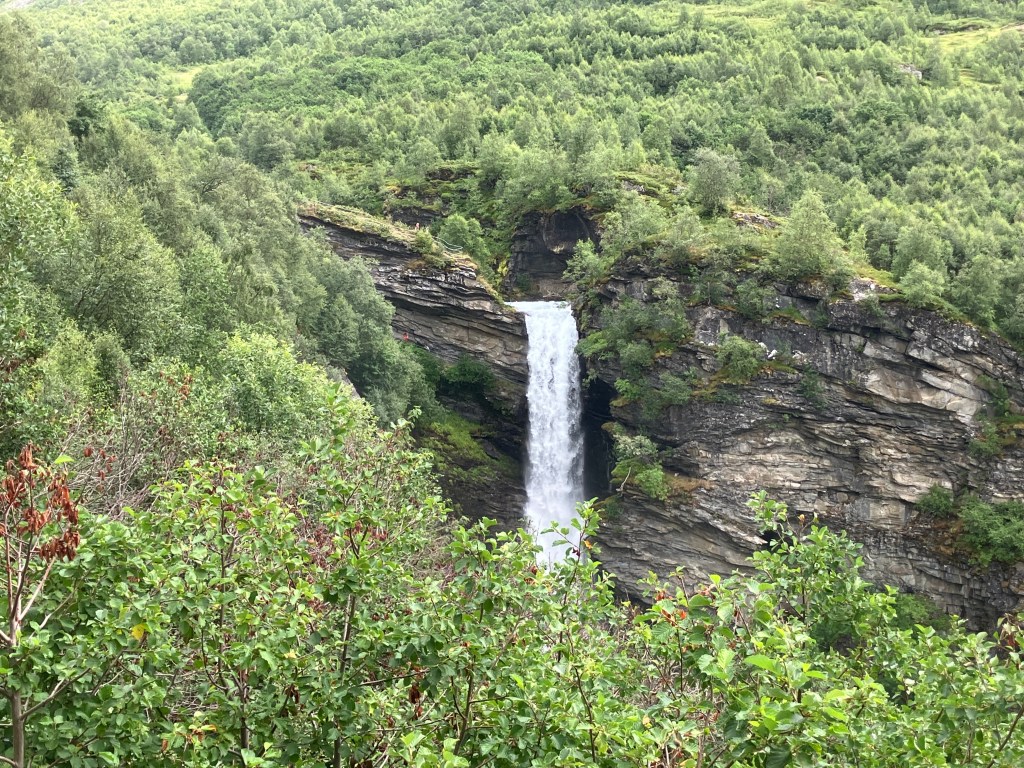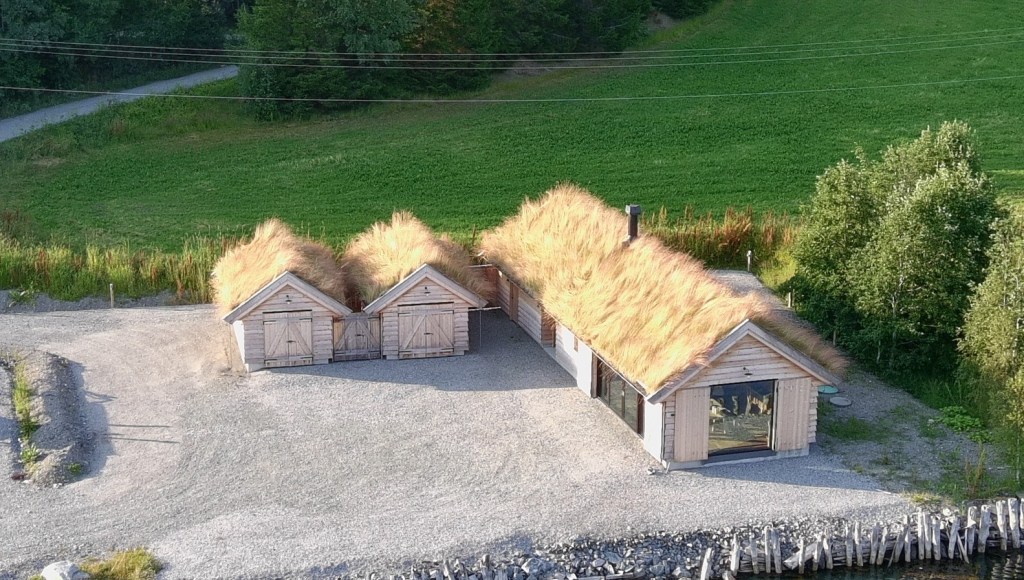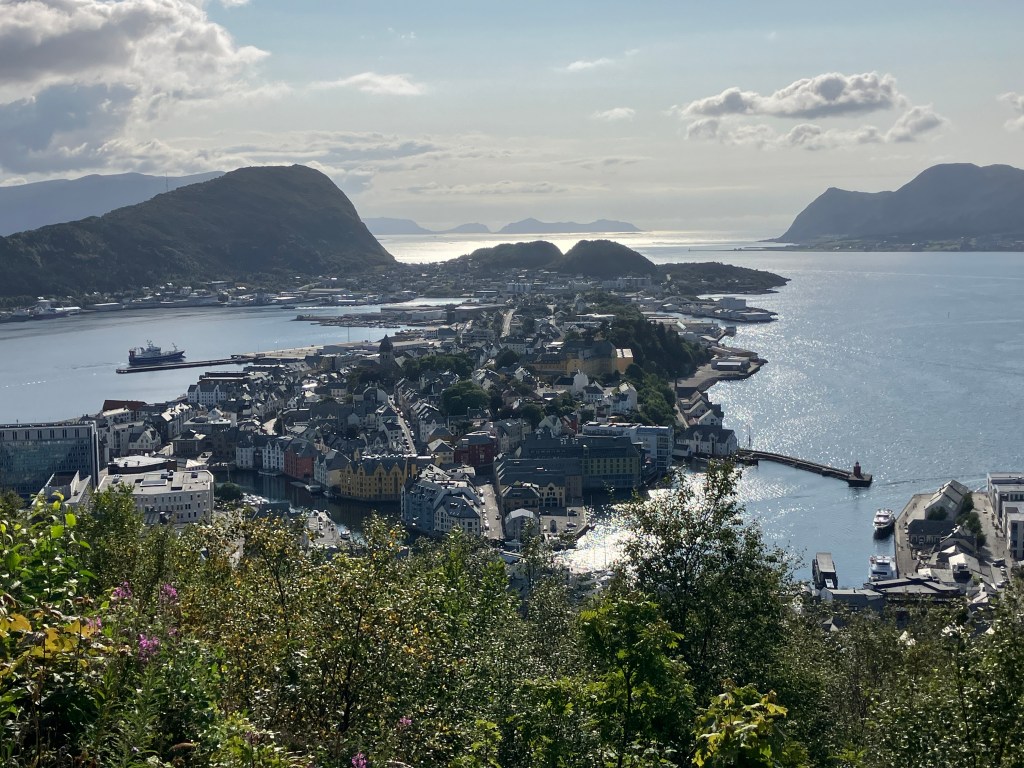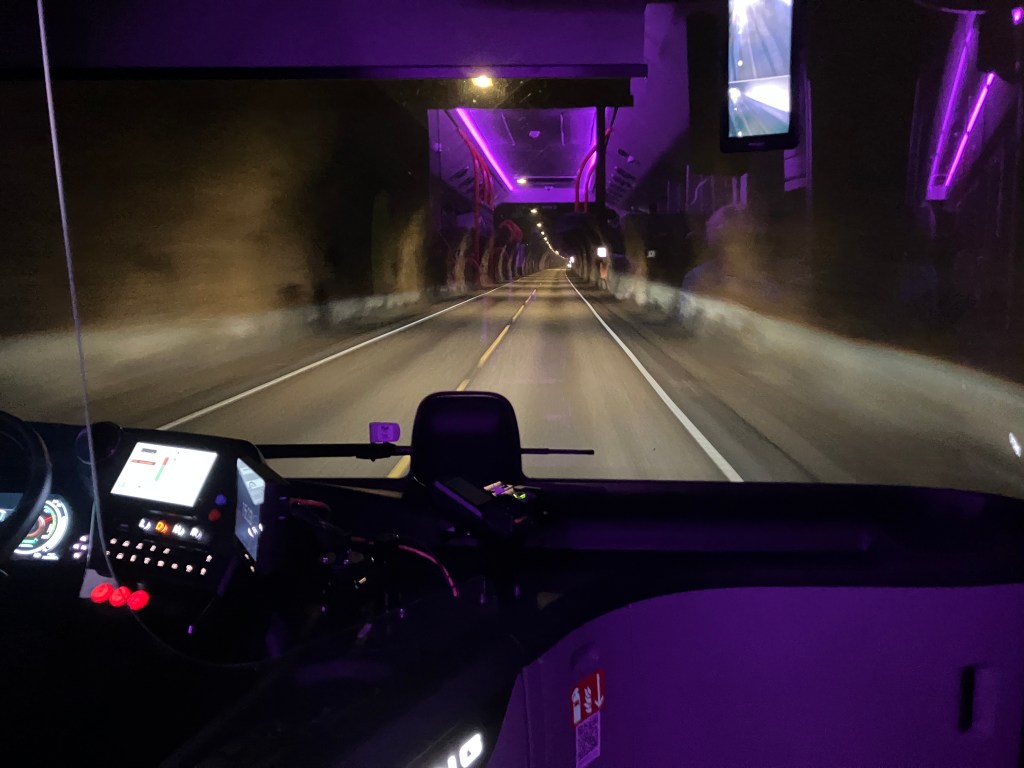
Fading batteries, a crowning cathedral, and a harnessed waterfall

“I’m getting a bit fed up with these storms”, says the First Mate. “It wasn’t that long ago since Storm Flores hit us.”

I feel the same. We are in the marina of Hellingsjøen sheltering from 50 knot winds from the west. We had known they were coming and had chosen Hellingsjøen as it had looked reasonably sheltered on the charts. And so it is, but the winds are still managing to come over the surrounding trees and across the small bay with considerable force.

“Just imagine what it must be like out in the open sea”, I say, by way of reassurance.

“Look, I think that the pontoon next to us is getting closer”, she responds, alarm in her voice. “The wind is blowing us towards it.”

It does seem to be. I clamber out, and, braving the gusts, gingerly make my way along our pontoon to the shore. Looking back, it is clear that the whole structure is being bent in a curve by the wind. If one of the retaining chains was to break, we would smash up against the boats on the neighbouring pontoon. Not a nice thought.

Will it break?

“Don’t worry”, says a passing fisherman. “We’ve had much bigger boats than yours tied up there. Nothing’s ever happened yet.”

Hardly reassuring. What if this blow is the one that breaks the camel’s back after being weakened previously? But there isn’t much we can do except keep a watchful eye on the situation and be ready for disaster if it happens.

Luckily it doesn’t. The wind keeps up for a day and a half, then dies down. We wake up to a bright and sunny day, a calm sea, the pontoon back where it should be, and a nagging irrational thought that perhaps we just dreamt it all.

We pack up, cast off, and continue on our way to Trondheim.

“The battery alarm is going again!”, calls the First Mate.

I’ve already heard it. Over the season we had noticed that there was a slow decline in the amount of time the batteries would last after a full charge. Even when sailing, we need them to power the autopilot, run the navigation instruments, charge the tablets, computers, and everything else that keeps us going. Previously they would last some days before we needed to plug into shore power and recharge them, but now it was down to a couple of hours.

We had charged them overnight at the small harbour of Hasselvika, but two hours later as we sail up Trondheimfjorden, they are almost flat again.
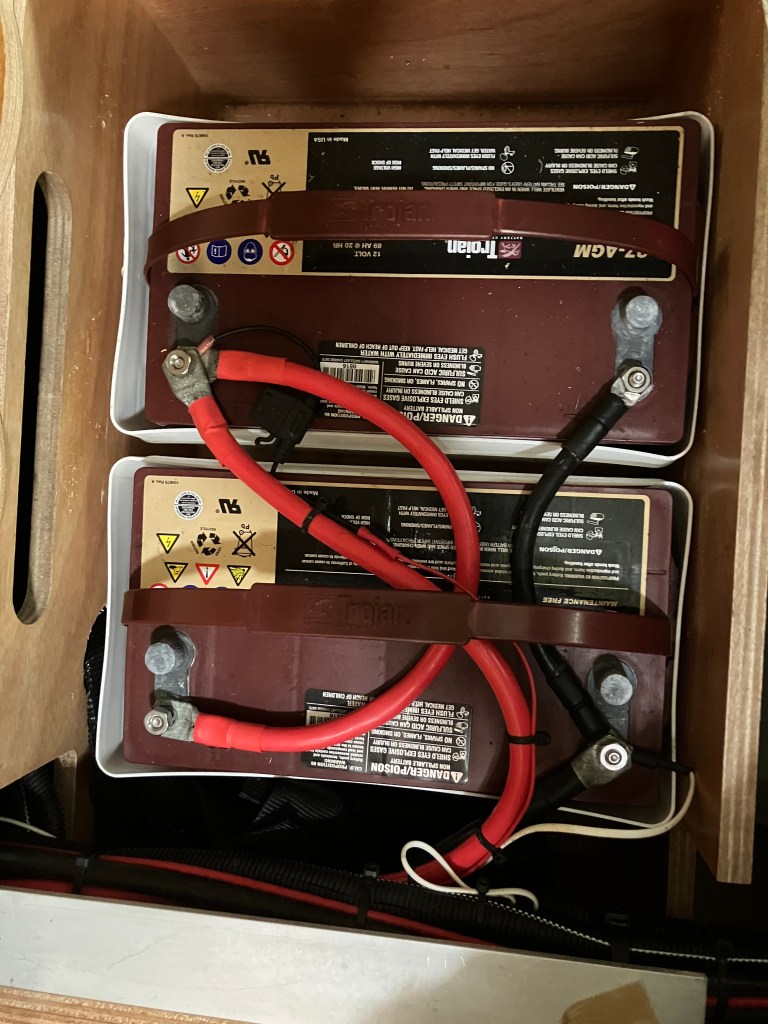
Fading fast.

I am not really surprised. They have reached the end of their design life of eight years, so they are likely to give up soon anyway. I am just a bit surprised it has happened so quickly.

“Turn everything off”, I shout back to the First Mate. “We can make it without using the autopilot, and I think there is enough power in the laptop and tablet to navigate. We can see if we can find a solution when we get to Trondheim.”

Luckily the wind is directly from behind, so we use the genoa only. We still manage to make seven knots.
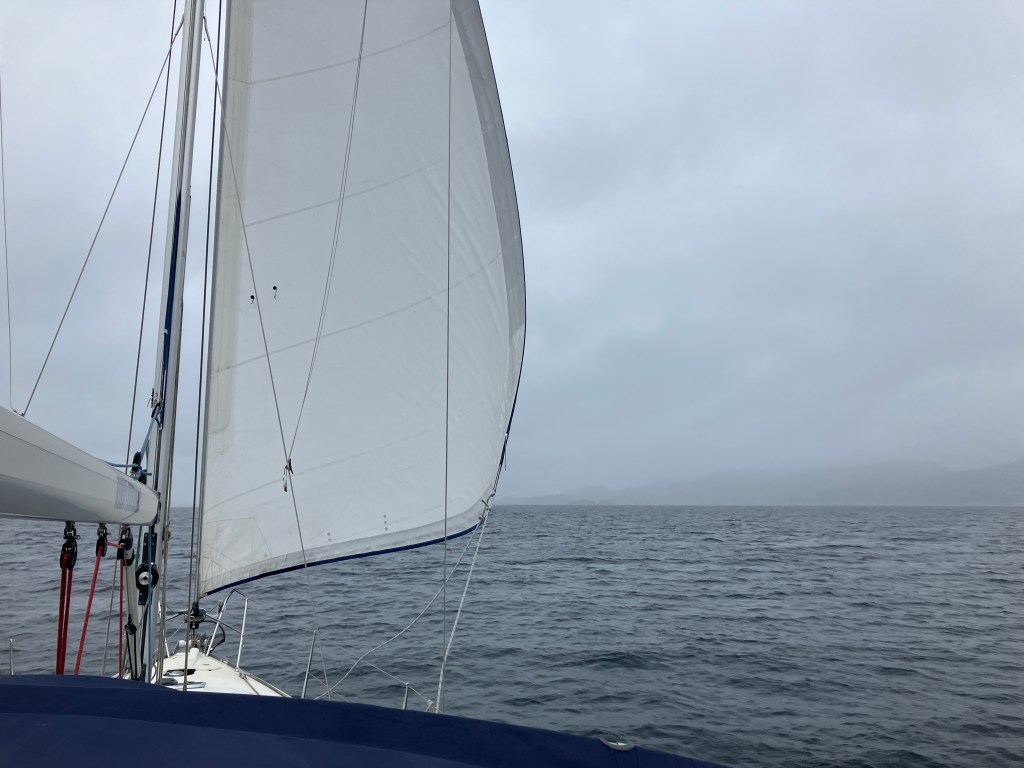
Approaching Trondheim.

We eventually arrive in Trondheim. The First Mate has called ahead and has been informed by the harbourmaster that the main Skansen marina is full because of a large conference on aquaculture for the next few days, with many attendees coming in their own boats. We are best to try the Brattøra marina further along, he advised us. Even there, several berths are reserved, but we might find a spot.

Luckily there is one place left. As we tie up the occupants from a neighbouring boat come and help.

“We’re from the UK as well”, they tell us, noticing our flag. “But we are flying back home in a couple of days. We’re leaving the boat at the Stjørdal marina along the coast a bit. We are sailing up there tonight, packing everything up tomorrow, then catching our flight the next morning. The good thing about Stjørdal is that it is close to the airport. We’re Chris and Terry, but the way.”

We invite them in for a cup of tea and cake.

“You’ll find Trondheim interesting”, says Chris, dropping cake crumbs on the floor. The First Mate looks aghast, but doesn’t say anything. “It was the capital of Norway during Viking times, and used to be called Nidaros after the River Nidelva which runs through it. Later it was called Trondheim after the Trønder people who lived in the area. The cathedral is still called Nidaros Cathedral.”

“The cathedral is definitely worth a visit”, Terry pipes in. “It’s where all the kings and queens of Norway were crowned.”

As we are speaking, a large bright green service boat is manoeuvring into the reserved space behind us, using its bow and stern thrusters to come in sideways like a crab. There isn’t a lot of distance between us and them.

Here for the aquaculture conference.

“We’ll be here for two days”, one of the crew tells us. “We’re one of the exhibits for the aquaculture conference. Now we have orders to get to and clean and paint everything.”

“Anyway, we need to get going”, says Chris. “We still have 20 miles to sail tonight, then we have a lot of packing to do in the morning. Perhaps we’ll see you here next year.”

We wish them the best for their homeward journey. Shortly afterwards we wave to them as they motor out of the harbour.

In the morning, we unload the bikes and cycle into town. We decide to attend to the boaty issues before we do the touristy bits, and stop off first of all at RiggMasters, a company specialising in rigging. We had been recommended them by the rigger who had repaired our VHF radio down near Bergen, and who had warned us that some of our mast shrouds were starting to fray and should be replaced soon. John, one of the bosses, promises to come and have a look at our boat in the morning. While we are there, we mention the batteries.

“I’ve actually got a couple of spare batteries you could borrow to finish your trip”, he says. “They’re second hand, but only a year old. You can bring them back afterwards if you don’t want to keep them, but you can have them for half-price if you want to keep them. I can bring them to the harbour if you like. But you will have to carry them down to your boat yourself. They’re pretty heavy, and my back is not up to it.”

I wonder if my back and knees are up to it too, but it’s an offer we can’t refuse.

“Let’s have lunch now, then go and see the Cathedral”, says the First Mate.

Nidaros Cathedral, the Crown Jewels, and the Armoury are all in the same complex. We buy tickets for all three. First up is the Cathedral.

Nidaros Cathedral.

“It’s absolutely stunning!”, exclaims the First Mate, once we are inside. “Think of the effort that has gone into building it all. No wonder the kings and queens of Norway like being crowned in here.”

Inside the Cathedral.

“The Cathedral is built over the remains of King Olaf II, who lived from 995-1030 AD”, I read in the pamphlet. “He was instrumental in bringing Norway together as a country, and was made a saint as he was credited with introducing Christianity to Norway. This was despite not actually having all that much to do with it, and what little he did do, did fairly violently in that people who refused to become Christians had their heads cut off. But apparently miracles started happening after he died, which resulted in the Cathedral becoming a major pilgrimage centre in medieval times. These days they are trying to resurrect some of the major pilgrim trails to Trondheim, both for those wanting the spiritual experience, but also for recreation.”

“Ah, yes”, says the First Mate. “I remember that German girl telling us all about it when we were in Kökar in the Åland Islands last year. Don’t you remember that one of the routes, St Olaf’s Waterway, ran past the marina?”
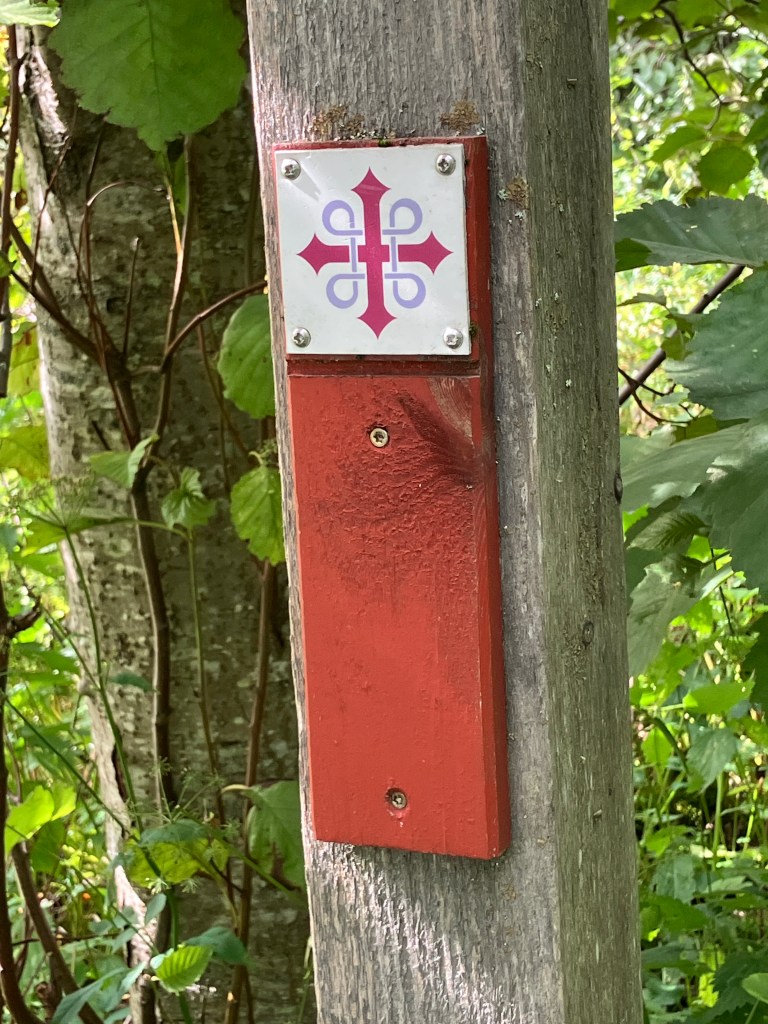
Signs marking pilgrim routes to Nidaros.

We find ourselves standing in front of a Norwegian flag and a British Royal Navy White Ensign hanging in one of the transepts. A young woman in religious attire comes over.

Navy ensigns in Nidaros Cathedral.

“Hello, I am an assistant priest here”, she says, a friendly smile on her face. “Can I help you? Are you puzzled about why the British flag is there? A lot of people are.”

“Well, it belonged to the British warship, the HMS McCoy”, she continues before I can answer. “It was the first Allied ship to enter Trondheim in 1945 after the war. The other one is the Norwegian Royal Ensign from the ship that brought King Haakon VII back from his exile in London a month later.”

Suddenly there is a burst of music from the massive pipe organ over the entrance. It’s the theme music of Chariots of Fire. Not quite what we had expected in a cathedral, but it is nevertheless stirring as the deep basses reverberate around the magnificent acoustics.
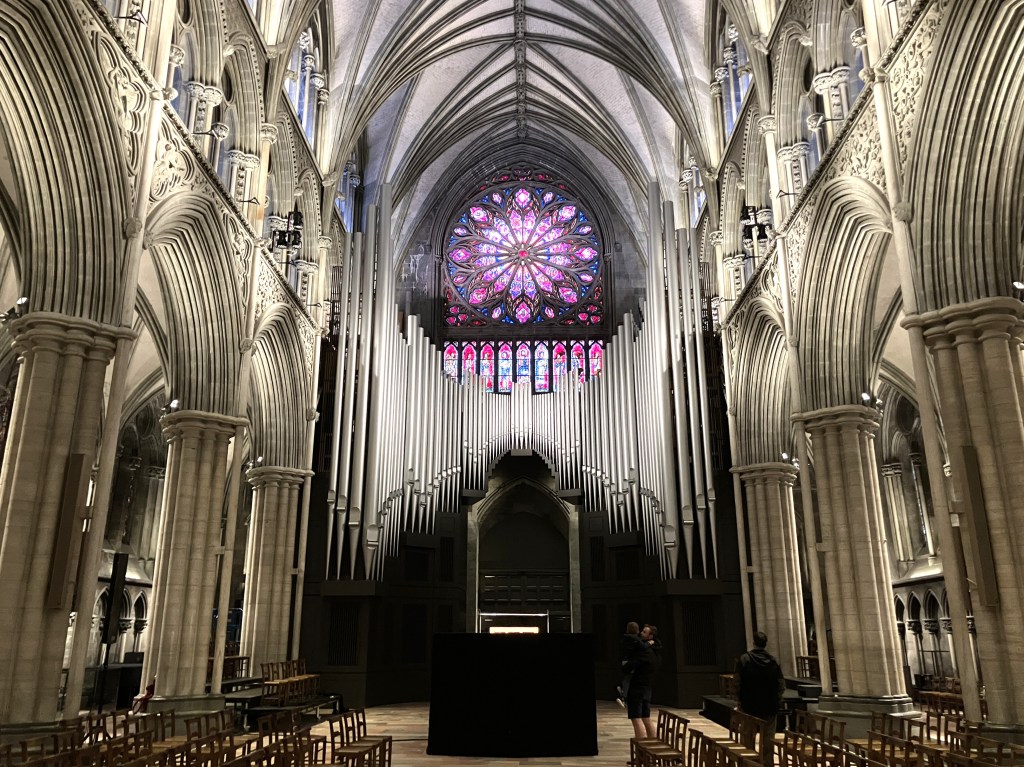
Pipe organ, Nidaros Cathedral.

We sit and listen to it, deep in our own thoughts.

“It’s amazing to think that my great-great-grandfather was here in 1889”, I say, when it is finished. “His letters say that it was being renovated at the time. Apparently it had fallen into disrepair, so they started major work on it in 1869, which wasn’t really finished until 2001. So we are quite lucky to see it in its finished state after 130 years of rebuilding. The original workmen in 1869 would never have seen the fruits of their efforts.”

We walk over to the building housing the Norwegian Crown Jewels. Unfortunately, we are not allowed to take photos.

“Never mind”, says the First Mate. “Here’s one of the coronation. You can take a photo of that to put in the blog. Now let’s have a quick look at the Armoury.”

Coronation of King Harald and Queen Sonja in 1991.

The Armoury is next door. We learn of the region’s military history from the Viking Age through to the Middle Ages, wars with Sweden, and, of course, the Nazi occupation during WW2. One thing I hadn’t really appreciated before was the leidangr system that started in Viking times and continued for some time afterwards. All free farmers of a local area had to assemble at periodic intervals and contribute to maintaining a ship and manning it to defend the country or participate in raids abroad. Men had to provide their own equipment and provisions.
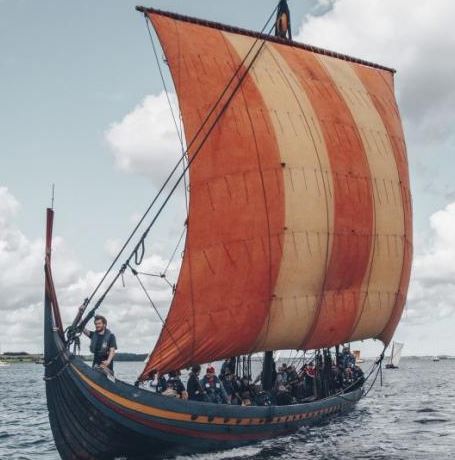
Contributing to the leidangr,

“Norway has certainly had a turbulent history”, says the First Mate as cycle back to the boat.

“Don’t forget that they dished it out as well”, I say. “Most of Europe was terrified of them at one stage.”

Display of swords in The Armoury.

“I’ve booked a stolkjarre for ten o’clock”, Mr Fairlie says at breakfast. “I was planning to go out to the Leirfossen. It’s a waterfall just on the outskirts of Trondheim. About half-an-hour’s drive. Apparently it’s quite spectacular. You are most welcome to join me if you want.”

“Thank you”, says the minister. “Very good of you. I should like that very much.”

The light, two-wheeled cart drawn by a single horse rattles slowly through the cobbled streets leading away from the quays. There is a smell of tar, fish, and salt in the air, causing the elderly man to draw his breath in sharply. Passing the timber warehouses of Bakklandet, they cross the old bridge with its carved wooden gates, then follow the rough country road along the Nidelva River. Beyond the town the road turns dusty and uneven, the packed earth and loose stones jolting the cart at every rut. Farms dot the slopes, their fields bright with ripening grain, and here and there the travellers glimpse women rinsing linen in the river and children driving cattle along the verge.

Nidelva River.

As the valley narrows, the low roar of water grows stronger, until at last the Leirfossen appears—a foaming white torrent pouring between dark rocks, its mist rising above the birches. The two men climb down from the stolkjarre and stand at the small viewpoint, absorbing the scene.
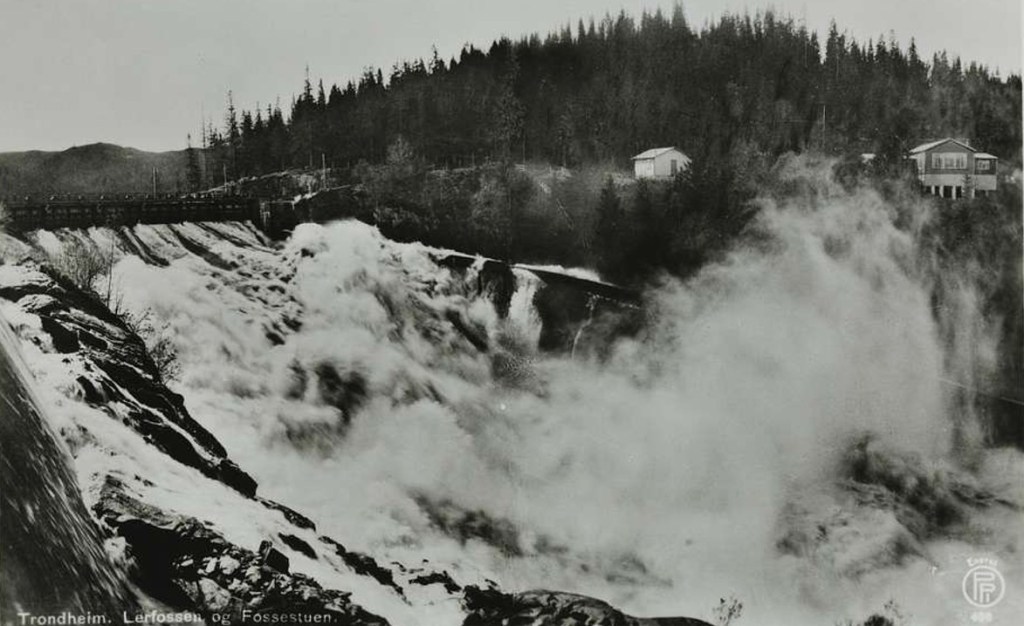
The Leirfossen, c.1890.

“There’s an enormous amount of power there”, says Mr Fairlie eventually. “You know, it’s a pity that it can’t be harnessed in some way and used to benefit mankind. A power station, for example. Think of it. Machines running without smoke or steam, lights in the streets after dark, electricity in every house in Trondheim. Maybe even powering the trams one day.”

“I like it the way it is”, says the minister. “Why does our modern society have this perpetual urgency to control nature? What’s wrong with the machines we’ve got? We don’t need trams without horses. The old ways have stood the test of time.”

“And yet it’s the new ways that will build the future, my old friend”, says his companion. “The river’s strength will eventually be harnessed to light the city, believe me. Wait! If I am not mistaken, I think I see the young Mr Hunter-Blair over there with his new bride. Fancy meeting our neighbours here so far from home. I suppose we should go and pay our respects.”
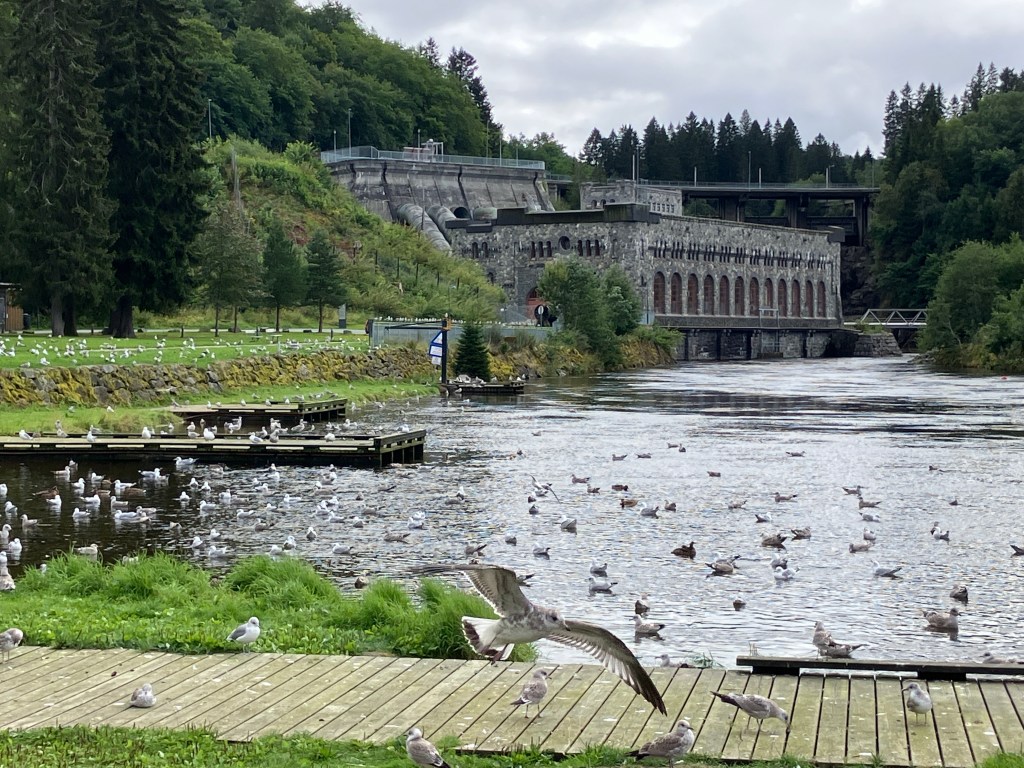
The Leirfossen in 2025.

“Did you see the waterfall?”, asks the First Mate, when I get back from my cycle ride.

“Well, sort of”, I say. “But it’s not a waterfall any more. It’s been converted into a power station. Mr Fairlie was right.”

“Remind me who Mr Fairlie is again?”, she asks.

“Just a friend of the family”, I answer. “And I stood in some seagull poo.”

Ancient Norwegians, the salted-cod city, and a deserted fishing village

“Yes, I am from Kristiansund”, says Lars. “Born and bred. It’s not the most exciting city, but it’s pleasant enough. Apparently it is where the first Norwegians are supposed to have lived, at least according to the archaeological evidence. It was first named Christiansund after the Danish-Norwegian King Christian VI in 1742, but the name was changed in 1877 to Kristianssund, then to its present spelling of Kristiansund in 1889. People often confuse it with Kristiansand in southern Norway, so we usually refer to it as Kristiansund N to indicate it is the northern one. We are heading back there now.”

Lars is the skipper of the boat tied up next to us at Håholmen. We are chatting to him as he gets ready to leave.

“We are still debating whether to get there by the outer route or to go round the island of Averøya”, I say.

“Both are fine”, he says. “But if you go around Averøya, you’ll go under the ‘Atlantic Road’, the road that connects many of the islands between Bud and Kristiansund. We are very proud of it. Some people think that it is a work of art – its sweeping arches and graceful curves are supposed to complement the natural landscape. It’s worth seeing.”

We leave a few hours after him, carefully following the perches marking the southern channel out of Håholmen. Soon we are at Storseisundet Bridge, the main bridge of the Atlantic Road. There is a strong current against us which buffets us from side to side, but we slowly make it through into Kornstadfjorden.

Approaching Storseisundet Bridge of the Atlantic Road.

There isn’t much wind, so we drift along at 2½ knots, Kornstadfjorden giving way to Kvernesfjorden, which in turn becomes Bremsnesfjorden. Soon the sun comes out, and we relax in its warmth.

Lars’ comment that the first Norwegians had lived around Kristiansund has intrigued me, and I think back to the book that I have just finished reading, Ancestral Journeys: The Peopling of Europe, by Jean Manco. In the case of Norway, the ice sheets had prevented anyone living there for thousands of years, but as the ice retreated around 12,000 years ago, two groups of hunter-gathering people had begun to move in – one group originating in south-east Asia and migrating along the northern extent of the ice across Russia, and the second migrating northwards from continental Europe through Denmark. Sure enough, they met in Norway roughly where Kristiansund is nowadays.

“I wonder if that means you can see a difference in their descendants in Kristiansund?”, asks the First Mate.

“It wasn’t really a clear cut border”, I say. “There was a lot of intermarriage, and of course people from both groups moved in both directions along the coast. But the ones in the north were the ancestors of the Saami people of today. In the south, it is more complicated, because the hunter-gatherers gave way to the Neolithic farmers around 3500 years ago bringing agriculture as they spread across Europe from the Near East, then later by the Indo-European peoples from Central Asia, who brought their language that became the basis of most of the European languages we hear today.”

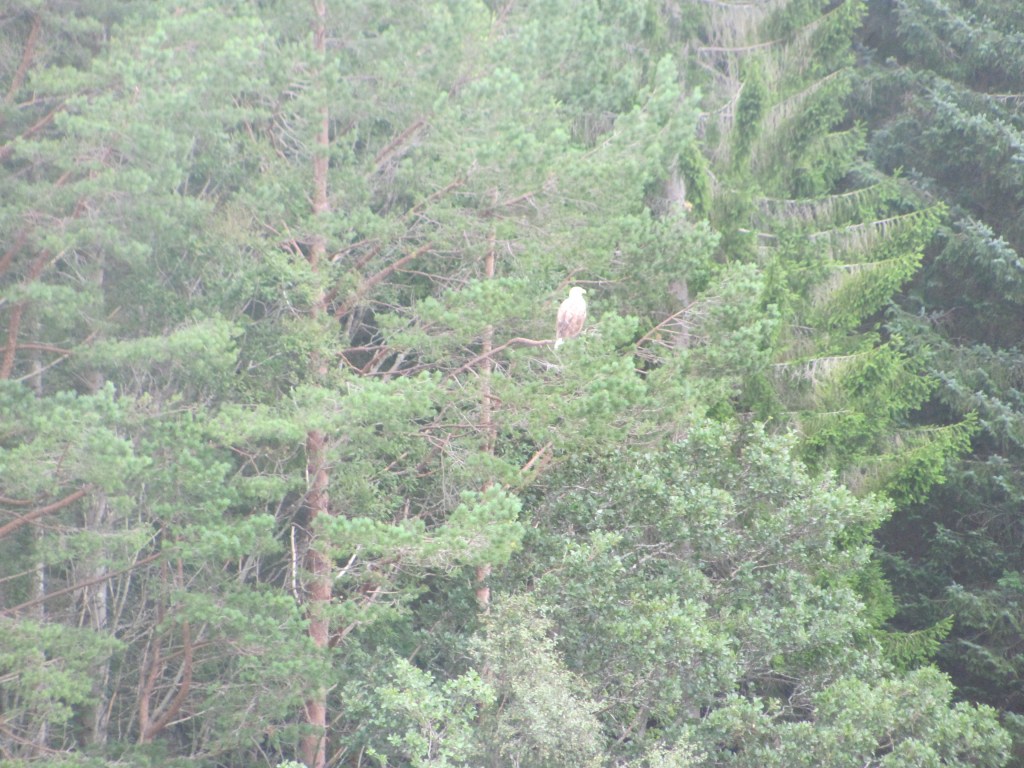
“Fascinating stuff”, says the First Mate. “So immigration has been going on for a long time, hasn’t it? Look, there’s a sea eagle in that tree.”

Wary sea-eagle.

The eagle lets us take a picture of her, then flaps off languidly.

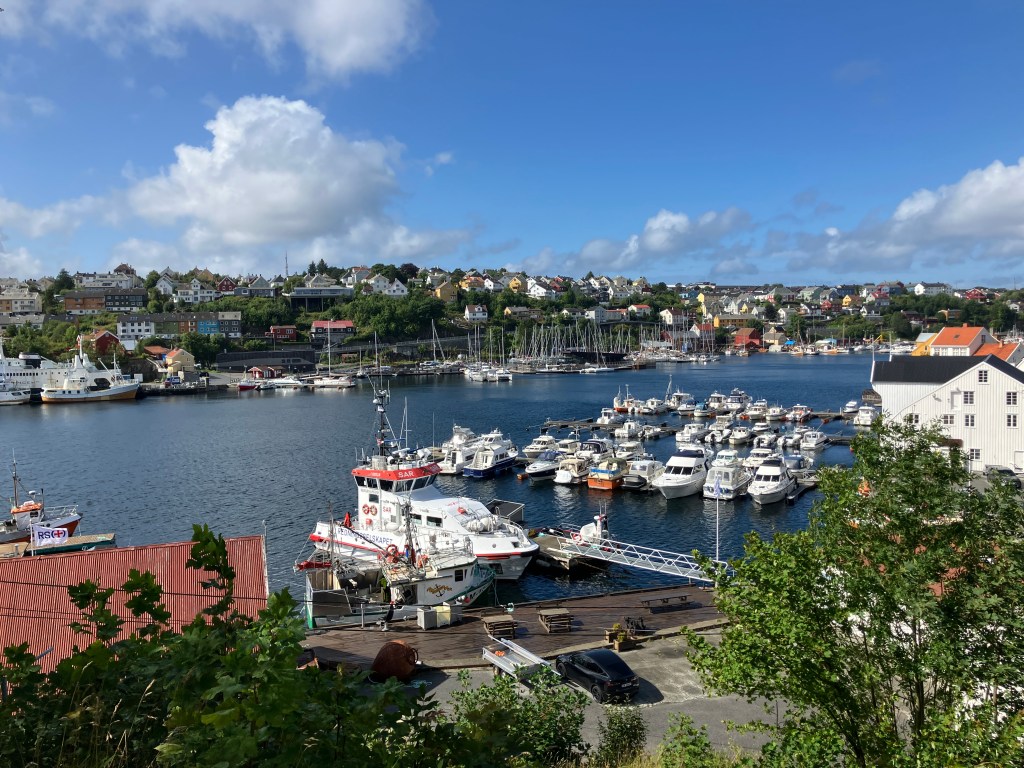
We eventually reach the Kranaskjæret Gjestehavn in Kristiansund. Lars is already there. He comes to give us a hand tying up.

“So you made it then”, he says. “Welcome to Kristiansund, the ‘salted-fish capital’ of Norway. It’s famous for its klippfish – you should visit the Klippfish Museum if you get a chance. It’s just over there, across the harbour.”

Kranaskjæret Gjestehavn, Kristiansund.

The next morning we walk around to the Klippfisk Museum.

“Hi”, says the young man behind the desk. “Welcome to the Klippfisk Museum. Would you like to have a guided tour? It’s included in the price, and you also get a free bowl of bacalao to try afterwards.”

“It sounds like a good idea”, says the First Mate. “I always think that you learn a lot from these guided tours. You can ask questions if you don’t understand things. Especially when things are in Norwegian. Where do we meet the guide?”

“I’m your guide”, the young man says. “I’ll do my best. It’s just you two. My name is Arne, by the way.”

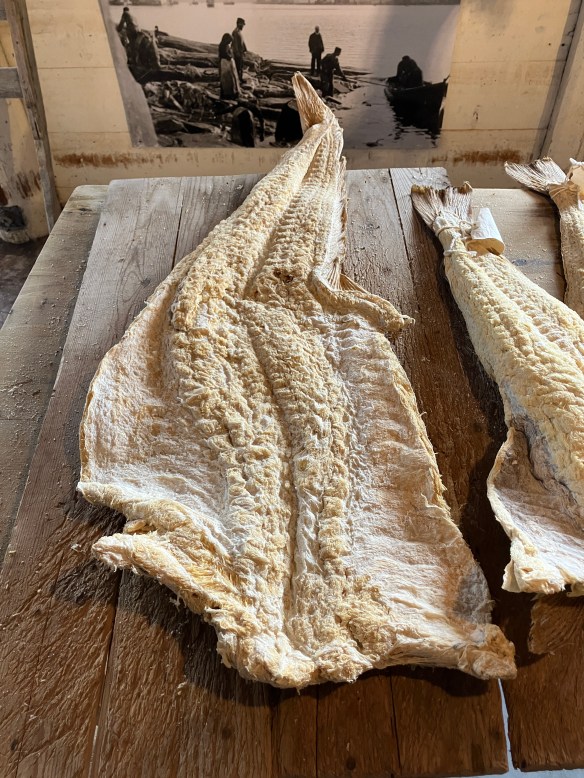
Klippfisk is basically any white fish that is salted and then dried in the sun”, he tells us. “Traditionally, they were laid out on rocks, hence the name klippfisk. Klipp translates as ‘cliff’ in Norwegian. Most of the time the fish used is cod, but it can also be pollack, saithe, or ling. Once it is dried, it will keep for several years.”

Klippfisk.

“The technique was developed in Spain, and was introduced to Norway in the late 1600s by Dutch merchants”, he continues. “Later the Scots also got in on the act – indeed, this very building we are standing in was built by a William Gordon from Cullen in 1749. He settled here and became fabulously wealthy buying and selling klippfisk. When he died, he left his wife and daughter £42 million, an absolute fortune in those days.”

“And not too bad these days either”, says the First Mate. “I think I need a new fishing rod. I’ve only caught one fish on this trip!”

“Good luck with that!”, laughs Arne. “But we shouldn’t forget the workers. Most of the hard work of salting and drying the fish was done by women – there is a statue honouring one of the Klippfiskkjerringa, or fish women, in the harbour. You should look out for it.”

A Klippfiskkjerringa, or fish woman (the one on the right).

“Was klippfisk all eaten here in Norway, or was it exported?”, I ask.

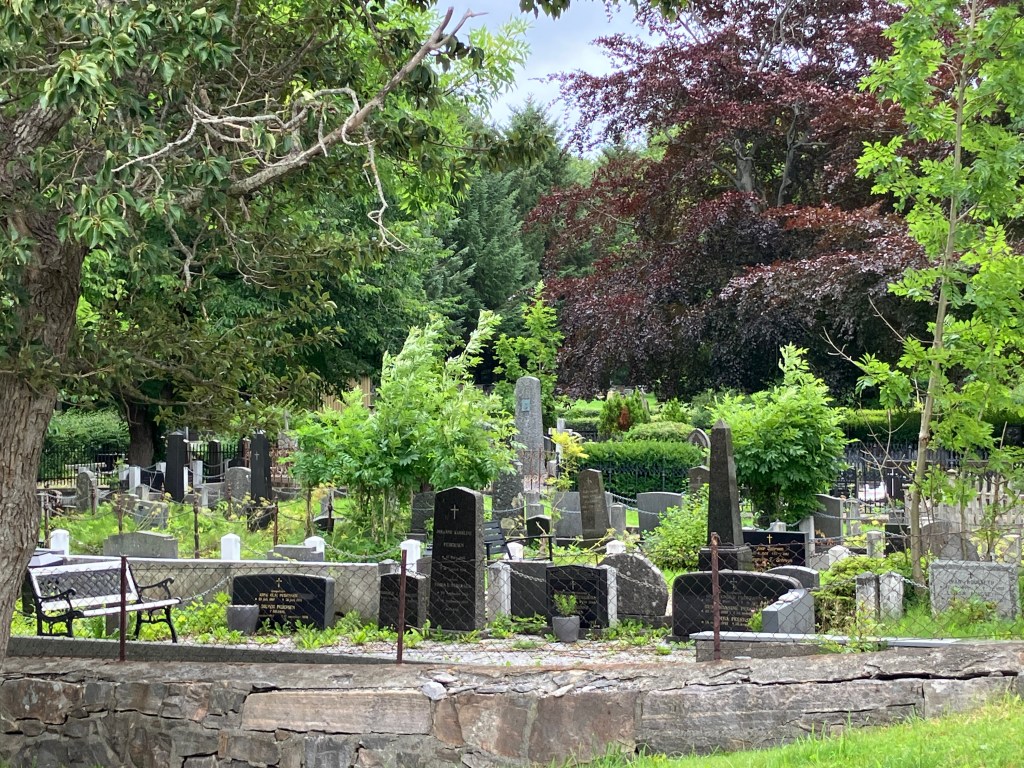
“It was exported all over the world, but the main markets were, and still are, Portugal, Spain, Brazil and Philippines. They are Catholic countries, and fish was an acceptable substitute for meat during Lent. Ships used to take the klippfisk to the Iberian Peninsula on the way out and fill their holds with soil for ballast on the way back. It was then emptied to make room for the next load. They say that most of the soil in the Kristiansund cemetery is Spanish soil.”

“A small part of Norway that will be forever Spain” (with apologies to Rupert Brooke).

“How do you cook it?”, asks the First Mate. “It looks too dry and hard to eat it as it is.”

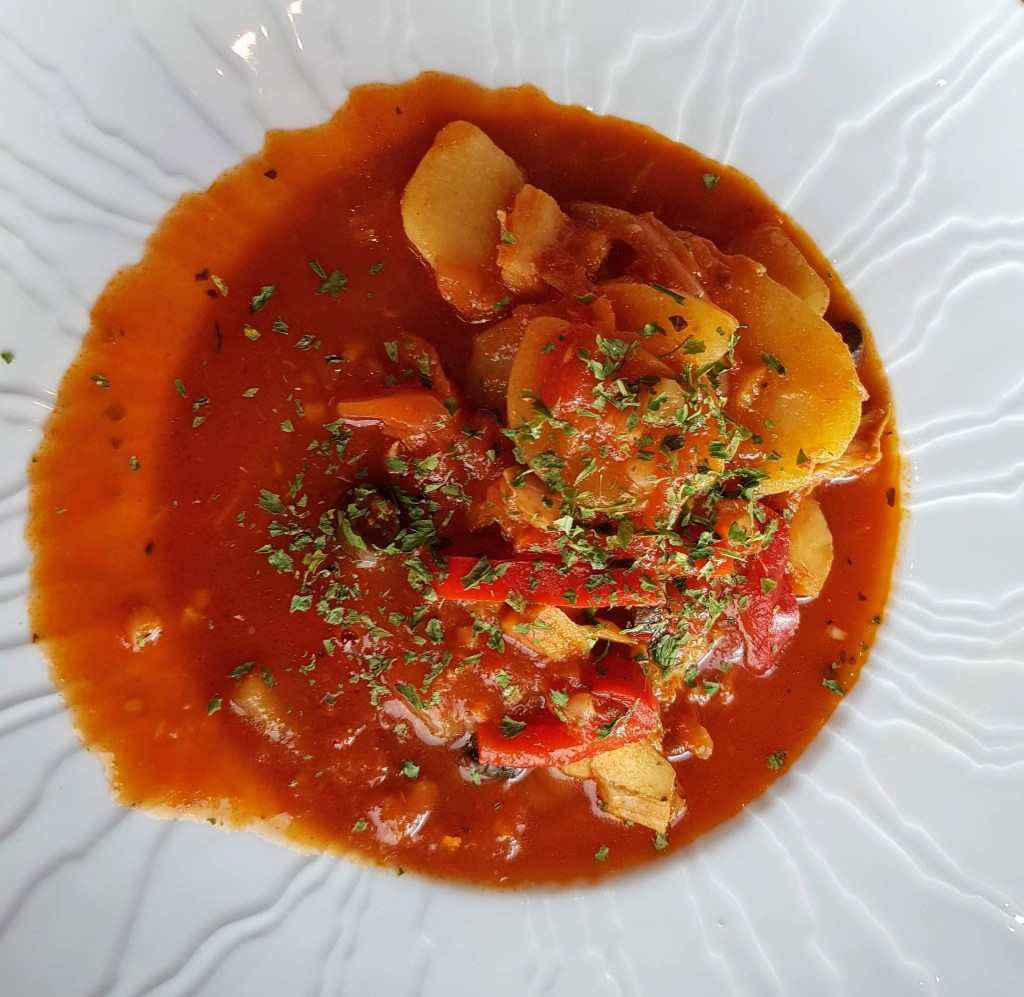
“Absolutely”, says Arne. “You need to rehydrate it by soaking it in water for a couple of days, replacing the water two to three times a day. That softens it and makes it much less salty. The classic Norwegian dish is boiled klippfisk with creamed peas and potatoes topped with a light cream sauce. However, another dish is bacalao, developed in Portugal, which is made by frying onions, garlic, and peppers in olive oil, adding tomatoes, sliced potatoes, olives, seasoning it with bay leaves, chilli and pepper, then pouring it over layers of the fish and simmering it until it is flaky and the potatoes are done. That’s also very popular here in Norway.”

Bacalao.

After the tour is over, we sit in the café and taste the small bowls of bacalao that he gives us.

“I read somewhere that the Portuguese have developed it much more since then”, says the First Mate in between spoonfuls. “By adding lots more ingredients, such as eggs, cream, or chickpeas, and either grilling, frying, or baking it, and using different spices, such as coriander or parsley. So much so that they are said to have 365 different varieties – one for every day of the year!”

In the afternoon, we decide to walk up to the Varden viewpoint overlooking the city. On the way, we pass a impressive looking modern building.

“It looks like a block of flats”, I say. “I wonder who lives there?”

Block of flats?

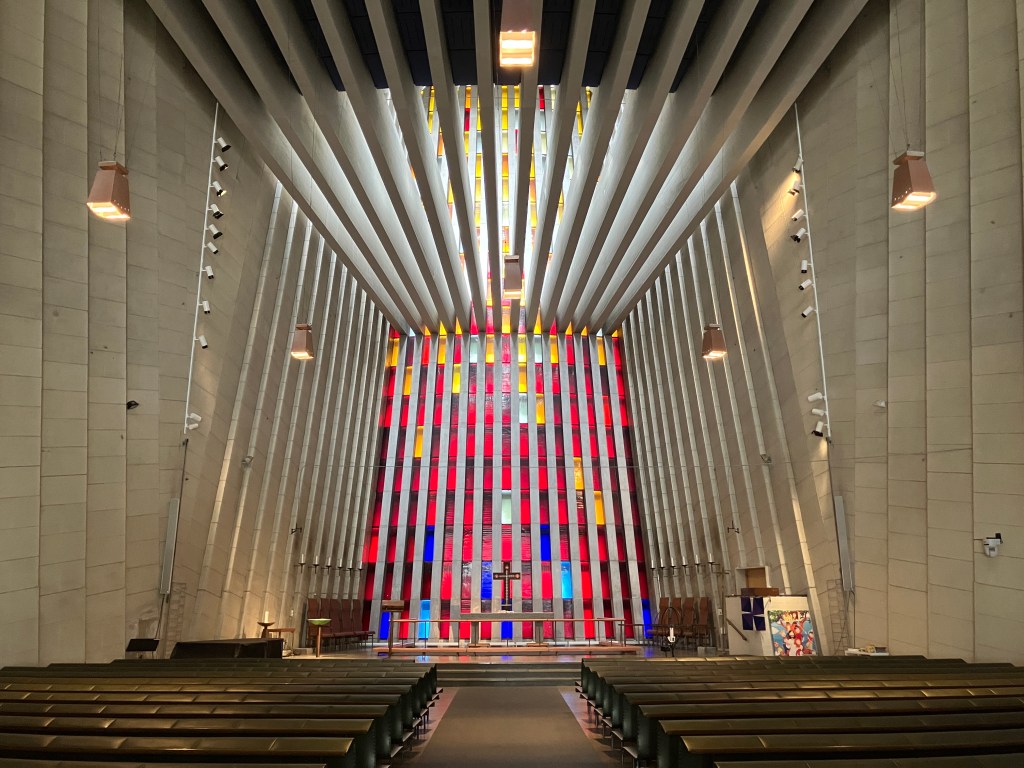
“It’s supposed to be a church”, says the First Mate, consulting the guide book. “Built in 1964 after its predecessor was destroyed by bombing in WW2. The most modern and daring one in the whole of Norway. Apparently it is worth having a look inside.”

Inside Kirkelandet Church.

“The theme is called ‘Rock Crystals in Roses’”, she whispers, once we are inside. “There are 320 coloured glass windows, and when the light strikes them, there is a burst of colours. The dark blue ones at the bottom represent man’s sinfulness, while the red, orange and white ones as you go up represent the process of enlightenment.”

Whether you believe the symbolism or not, it is certainly impressive. The ceiling beams and the side columns all contribute to the airiness and focusing of one’s attention on the chancel at the front.

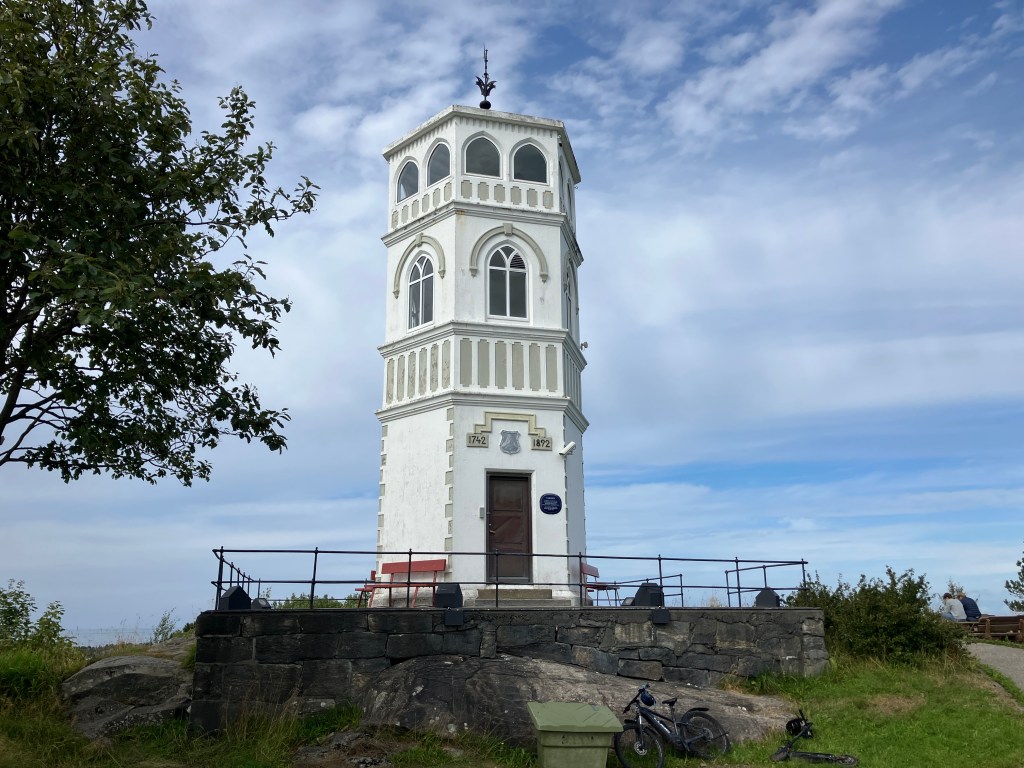
We eventually reach the lookout tower at the top of the hill. Entry is free. A woman opens the door at the bottom for us.

Varden watch tower.

“It was originally built as a watch tower to see ships coming to Kristiansund during the Napoleonic Wars”, she tells us. “Later it was the base station for an optical telegraph between Kristiansund and Trondheim. Be careful not to slip on the stairs. They are quite steep.”

The view from the top out over the city is magnificent. The walls between the arched windows are painted to give a panorama.

View over Kristiansund from the top of Varden watch tower.

In the morning, we walk down to the waterfront to catch the Gripruta, the ferry across to the island of Grip.

“It’s definitely worth seeing”, Andy had told us. “But there is no room in the tiny harbour for a sailing boat to tie up. You are best to take the ferry across.”

We had tried to book places on it yesterday, but the sea had been too rough and the ferry service had been cancelled. Today, however, it is running.

On our way to Grip island.

The trip takes about forty minutes each way. We are surprised by the number of people boarding, and surmise that some of them must be ones like ourselves who would have gone the day before but couldn’t. When we arrive at island, we are organised by a young woman who was on the ferry, whom we had thought was one of the passengers.

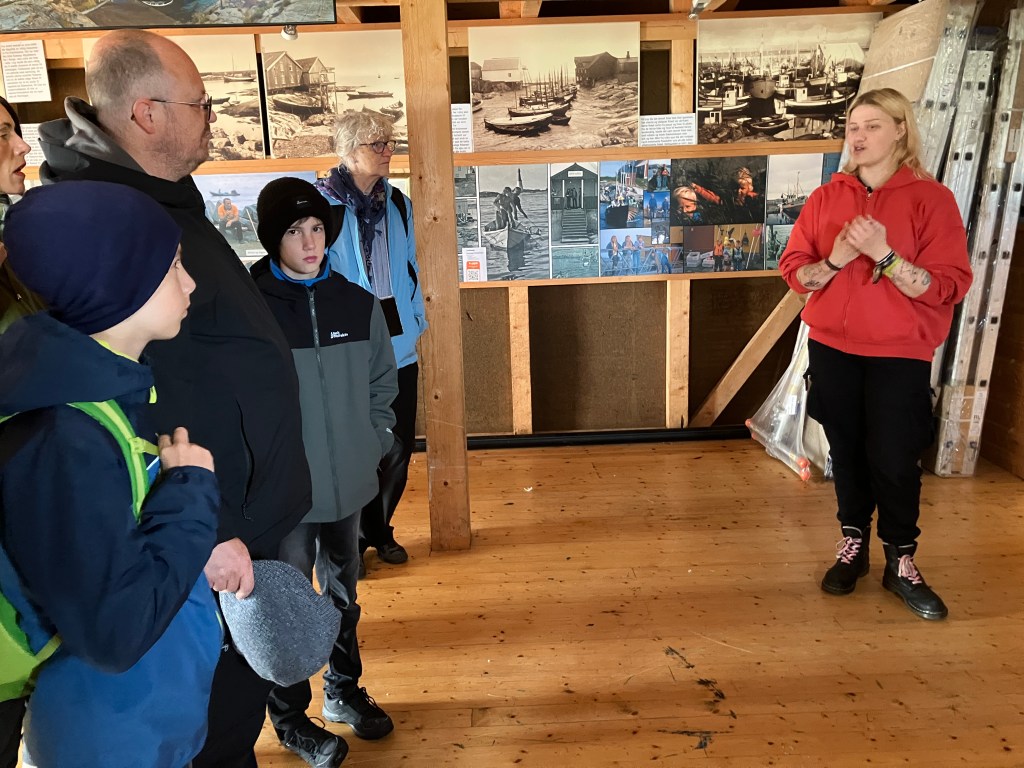
Hanna tells us about the history of Grip.

“My name is Hanna”, she tells us. “I am your guide today. My grandmother used to live on the island, and I can remember visiting her here when I was a child. So I have a personal connection with it. Nowadays it doesn’t have a permanent population, but most of the cottages are owned by former residents or their descendants.”

Cottages and harbour on Grip island.

“The island has been an important fishing community since around 900 AD. It became quite wealthy through exporting fish during Hanseatic times, and although the population did fluctuate due to the vagaries of fishing it probably always had a permanent population of around 200-300 people. But this could swell to 2000 people during the summer when fishermen would base themselves here rather that Kristiansund to be closer to where the fish were. However, the population eventually dwindled, and the last permanent residents left in 1974.”

Grip island.

“How did the island get its name?”, someone asks.

“Good question”, answers Hanna. “No-one really knows for sure, but one theory is that it came from the Old Norse word Gripar, meaning ‘to catch’, possibly referring to the fishing activities.”

“Does anyone own it?”, asks another person.

“Well, the first owner was the Archbishop of Norway”, she answers. “But in the 1500s, the King Christian III of Denmark seized it along with much other property of the Catholic church. It remained crown property until it was bought by a merchant called Hans Horneman in the early 1700s. Unfortunately this also gave him the fishing rights round about, and the fishermen had to sell him their catches at prices that he determined. They were more-or-less his vassals. These days it is owned and administered by the local municipality. Now if you just walk this way, we can see the church.”

Grip church on the highest point (10 m) of the island.

“The church was built around 1470 AD on the highest part of the island, an impressive 10 m above sea level”, she continues. “The idea was that any violent storm wouldn’t reach it. It seems to have worked – there have been some very severe storms over the years, often destroying several houses, but the church has remained standing.”

Paintings on the walls of the stave church.

The church is one of the stave churches that we had become familiar with by now, with the added distinction of being one of the youngest of such churches in Norway. At the front is the altar and a triptych.

The triptych in Grip church.

“The story is that the triptych was made in the Netherlands, but was given by a Princess Isabella of Austria”, Hanna tells us. “She was only 14, but was on her way to marry the King, accompanied by the Archbishop of Norway. The ship she was on encountered a severe storm and nearly sank. However, it did survive, which Isabella put down to the Archbishop being on board, so she gave the paintings to the Norwegian Church by way of thanks.”

We move on to the power station and fire station of the island.

“The island’s electricity comes from two diesel generators that run from 0700 in the morning to 2300 at night”, she tells us. “And the fire station has the world’s smallest fire engine.”

The fire station (left) and the power station (right).

“And over there is the Old Schoolhouse”, she continues. “Inside, you can still see the platform where the schoolteacher would stand. Nowadays, the building has been converted into a bar and café, and you can post letters there. Coffee, tea and snacks are also available.”

Old Schoolhouse on Grip (the one in blue).
Inside the Old Schoolhouse.

“It’s certainly all very picturesque”, says the First Mate as we carry our cups of coffee out and sit in the warm sunshine. “But I am not sure that I would like to have been brought up here. It’s a bit too cut off from the rest of the world.”

“If you had been brought up here, you wouldn’t have known anything else”, I say. “You’d probably be quite happy.”

Back to the bustle of modern life.

Alpine farming, behind a waterfall, and a renewed acquaintance

“According to the harbour guide, there’s supposed to be a hammerhead on the pontoon”. says the First Mate, peering through the binoculars. “But I can’t seem to see it. That would have given us plenty of room, but there seems to be just the pontoon. And it’s taken up with motor boats. We may have to raft up alongside.”

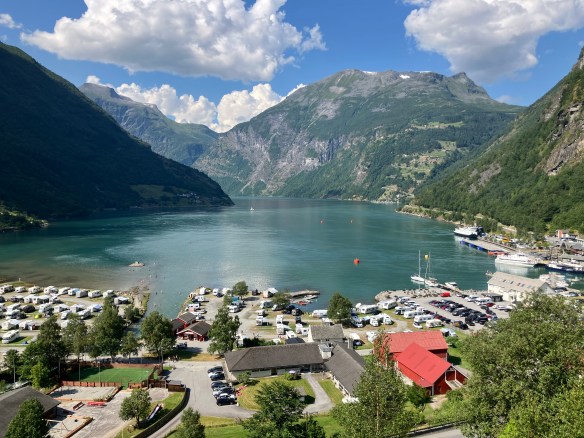
We are approaching the town of Geiranger at the top of Geirangerfjord, another UNESCO World Heritage site. We had set off in the morning from Sandshamn, and had had a pleasant sail up Storfjord then Sunnylvsfjorden, with the wind funnelling along the fjord behind us, before turning left into the short Geirangerfjord. In the distance, we see an army of campervans lining the waterfront, all with their skylights open in a vain effort to keep cool.

Approaching Geiranger.

“Yes, there was a hammerhead here last year”, says the owner of the motorboat we raft up to. “But it was destroyed by the ice over the winter and they haven’t got around to replacing it yet. But I am quite happy for you to tie up alongside. You can get to the pontoon over the swimming platform at the back here. By the way, there is a thunderstorm due shortly if you haven’t heard already.”

Rafted up in Geiranger.

We hadn’t heard. Nothing was mentioned about it in the weather reports we had received.

“They are very spontaneous”, he says. “It’s because of all the heat we’ve been having.”

Sure enough, fifteen minutes later, the wind starts to blow fiercely and the heavens open. As if choreographed, all the campervan skylights slam shut as one. We just make it into the cabin without getting wet, and watch and listen in trepidation as torrential rain falls and lightening cracks overhead. The windspeed indicator reads 33 knots.

Waiting out the thunderstorm.

“I hope our mast isn’t the tallest thing around”, says the First Mate.

“I think the buildings over there are taller than our mast”, I try and reassure her. “Hopefully, the lightening will go for them first.”

Thirty minutes later, it is all over. The sun comes out, and the skylights on the campervans open again in unison.

“Phew, that was pretty intense while it lasted”, says the First Mate.

Geiranger.

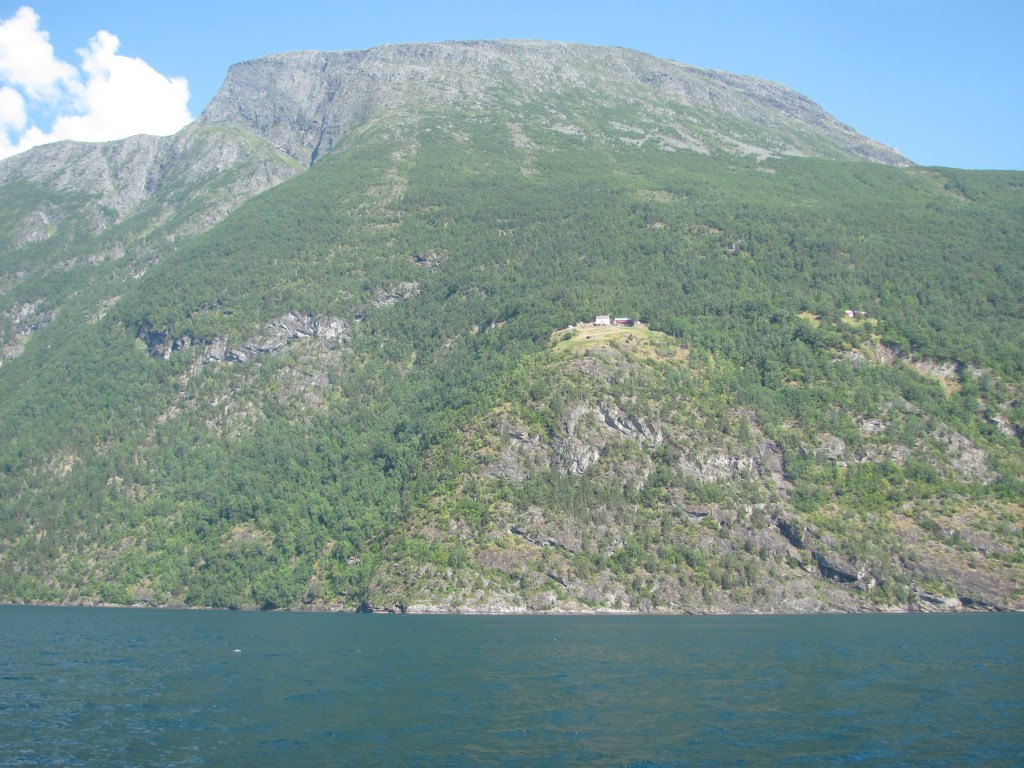
In the morning, we walk up to the Norsk Fjordsenter, where there is an exhibition on the mountain farms in the area. We had often seen these mountain farms clinging perilously to the steep cliffsides as we passed far below in the fjord, seemingly cut off from the rest of the world, with many not even visibly linked to the sea. As we had seen grass but rarely livestock, we had wondered what they actually farmed and how they transported their produce to the markets.

A mountain farm. How do they get there?

“Traditionally these mountain farms kept goats”, a panel in the exhibition tells us. “Pastures on the steep fjord sides provided grazing for them. The farmers produced brown and white goat cheeses and goat’s milk butter, all made according to traditional methods. Nowadays these farms may also keep sheep, cattle and Norwegian fjord horses.”

Mountain goats.

We taste some of the brown goat’s cheese.

“I can’t say I like it that much”, says the First Mate. “It’s a bit sweet for me.”

In one particular farm, the only route to it involved a short pitch of vertical rock that could only be passed with a ladder. The story goes that when the tax collector came to assess and collect the farm’s taxes, the farmer would pull the ladder up so that he couldn’t ascend any further, and he would have to go away empty-handed.

Tax avoidance, mountain farm style.

“I suppose the farmer thought he wasn’t getting much benefit from the state, so why should he contribute to its funding?”, says the First Mate. “There’s a certain logic to that.”

Life was precarious. Landslides and avalanches would sometimes sweep away entire farms, carrying the people with them. The worst of these was in the neighbouring Tafjord in 1934, when 2 million cubic metres of rock broke off and plunged down into the fjord below, causing a massive tsumani with waves up to 62 m in height and killing 40 people.

“Did you read that the next one they reckon will occur is at Åkerneset?”, says the First Mate. “Didn’t we pass that on the way in?”

We had indeed. A massive crack several hundred meters long and slowly widening each year threatens to collapse into Sunnylvsfjorden. Projections indicate that it could generate tsunami waves up to 70–80 meters high, drowning towns like Geiranger, Hellesylt, and Stranda within minutes. Luckily it is heavily instrumented to give warnings of its imminent collapse.

I shudder. “Perhaps we ought to get going”, I say. “I wouldn’t want to be underneath it when it goes.”

The next massive landslide?

“You can walk up to one of the former farms that overlooks Geiranger town”, the woman behind the desk tells us. “It’s more for tourists these days, and there’s a restaurant there, but it gives you a good idea of what life was like in these remote mountain farms. You can then also walk on further to the waterfall if you like. You can even go in behind the waterfall for a memorable experience.”

“There’s a plateau more than 1000 feet up the side of the mountain behind us”, says Mr Fairlie to his older companion over breakfast. “And there’s a new road up to it that they have just completed this year. If you wish, we could take a stolkejarre and driver up there and see how they farm. There’s also a good view of the fjord on the way up.”

“I should like that”, says the minister. “As much as I like sea air, I need to avail myself of fresh air from the land for a short time.”

“Well, there will be plenty of that up there”, says Mr Fairlie.

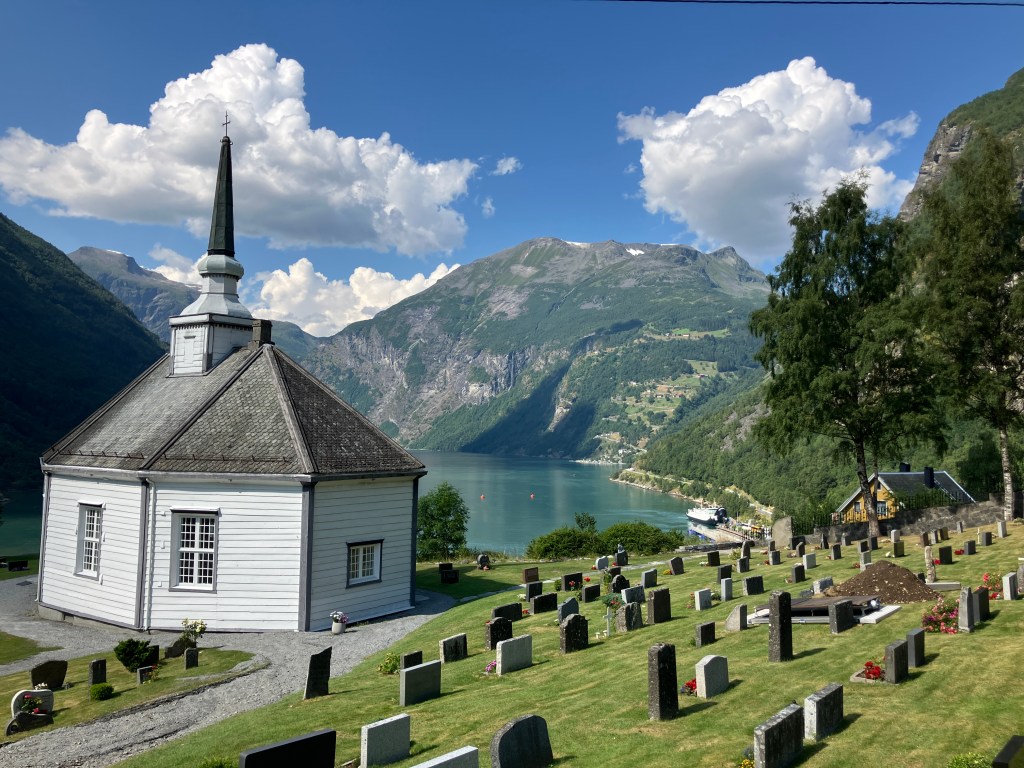
“There’s a funeral on at the church today”, the driver of the stolkejarre warns them. “We may be delayed somewhat as the mourners arrive. The road around it is narrow and there isn’t much room for vehicles to pass.”

Geiranger church.

We take the footpath up to the farm. The funeral traffic is completely blocking the road into the town, and there is a considerable tailback. We squeeze past the best we can and start climbing the stone steps up the hillside to the farm.

“Wow, that was steep”, pants the First Mate. “I am really looking forward to having an ice-cream at the restaurant.”

It’s closed. There is a sign saying that the funeral wake is being held there. The same cars that were blocking the road far below are now all crammed into the small restaurant car-park.

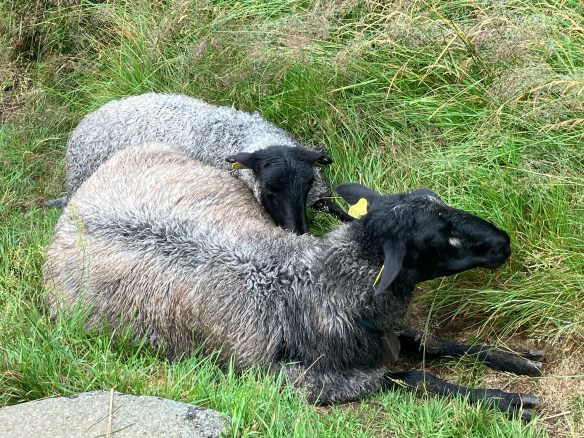
Luckily we have some sandwiches and water, so we find a shady spot under a tree and rest before carrying on. Behind us some mountain sheep are chewing the cud for their lunch.

Mountain sheep.

The elderly gentleman and his younger companion are already sitting there.

“We’re on a cruise around the fjords”, they tell us. “We have a day here in Geiranger, so we decided to take a side trip up here. It does one good to stretch one’s legs and to enjoy the views. It’s such a beautiful country. We are from Scotland.”

“Amazing”, I say. “That’s where we live. And we are also cruising around Norway. What a coincidence!”

We finish our lunch, say goodbye, and push on to the waterfall. It’s impressive.

The Storsæterfossen.

We clamber down the rocky path to the side and edge our way gingerly along it until we are under the waterfall. It is a surreal feeling as tons of water thunder past us every second.

Behind the Storsæterfossen.

“It’s lucky there is a guide rail to hold on to”, I say. “It’s a sheer drop down there. I wouldn’t want to fall over.”

Soon we are damp from the spray in the air.

“Come on”, says the First Mate. “Take your photos, and let’s go. I’m getting quite wet.”

There is no sign of the elderly gentleman and his companion as we retrace our footsteps back down the path.

“They have probably gone back to their ship”, I say. “The ones we had lunch with. By the way, did you notice that the elder one looked a bit like me?”

“What on earth are you talking about?”, asks the First Mate. “We had lunch with a young German couple who were touring Norway in their car. Are you losing it, or is this just your vivid imagination again?”

On the way back down again.

The next morning, we cast off and motor slowly back along the route we had followed up to Geiranger.

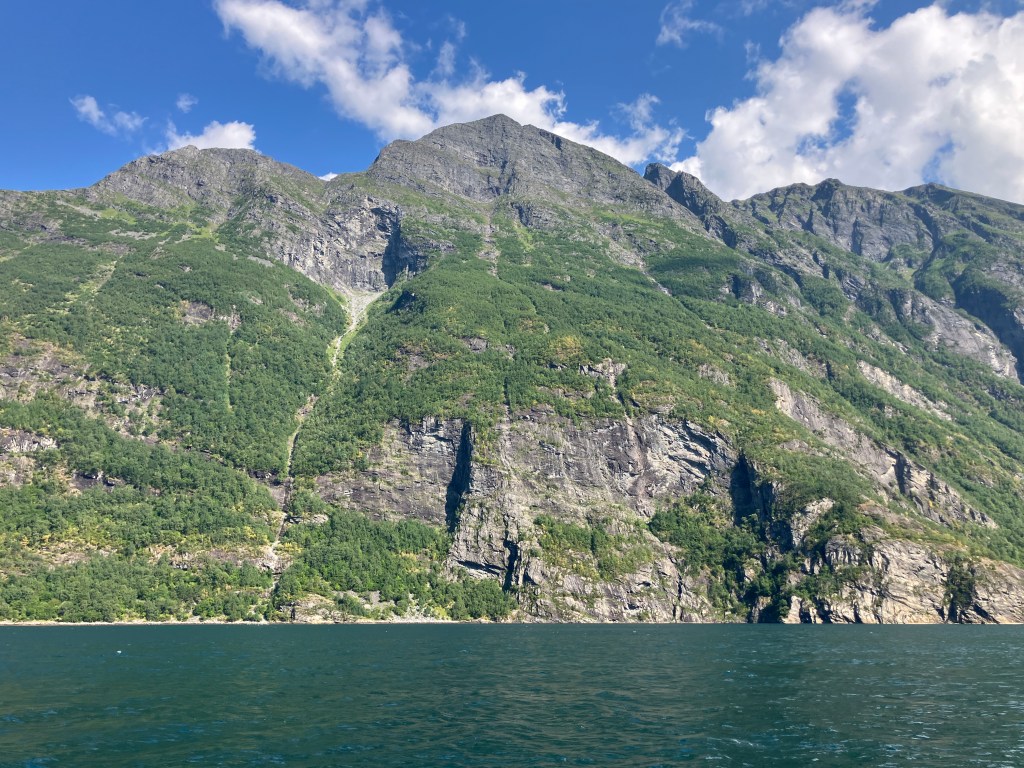
“Look”, shouts the First Mate from the bow as she tidies up the ropes. “There’s the Seven Sisters waterfall. But there only seem to be five at the moment. I read somewhere that the number of sisters depends on how much rain there has been.”

Seven Sisters waterfall, Geirangerfjord.

Unusually, the wind is favourable when we reach Sunnylvsfjorden, and we are able to enjoy a pleasant sail back down the fjord with the genoa only. Normally in the fjords, because of the funnelling effect, the wind always seems to be against us, no matter which direction we are heading and which wind direction has been forecast.

A boat is coming up fast in front of us.

“It’s the Hurtigruten”, I say, peering through the binoculars. “It’s going to pass us to port.”

The Hurtigruten is the iconic Norwegian coastal express service operating between Bergen and Kirkenes near the border with Russia in the far north. Not only does it act as a daily passenger and cargo service, it is also possible to take scenic cruises on it.

“You are pronouncing it wrong”, says the First Mate. “It’s ‘Hurtig-ruten’, not ‘Hurti-grutin’. It means ‘Fast Route’, just like in German.”

The Hurtigruten.

In the late afternoon, we break our journey at the delightful little anchorage of Honningdal.

“It’s such a lovely peaceful spot”, says the First Mate dreamily, as we sip our wine in the cockpit in the evening. “With stunning views of the mountains and the fjords. If only those geese over there would stop being so noisy with all their honking, we could enjoy the peace and solitude.”

“Well, I suppose they are part of nature as well”, I say.

Honningdal anchorage.

“Those sheds on the shore look like they have Boris Johnson haircuts”, I say, pointing to a cluster of boatsheds on the other side of the small inlet. “I think I might send the drone over there and get a shot of them.”

“Careful you don’t hit the power wires”, warns the First Mate.

Does Boris Johnson live here?

We eventually arrive in Ålesund. There aren’t any spare berths at the small marina, and we have to raft up to another sailing boat with a Swiss flag.

“You look familiar”, says its skipper. “I think that we have met somewhere before. And I recognise your boat’s name. Ruby Tuesday. Out boat is called Sol Vita.”

We rack our brains. He gets there first.

“It was in Hanko in Finland”, he says. “Last year. Don’t you remember there was an armed forces flag day? My name is Christoph and this is Solvita. The boat is named after her, by the way.”

My memory stirs. “And we were both visited by the coastguard people as we were the only two foreign boats there”, I say. “They checked our VAT status, being a UK-registered boat. Then they went over to you on the other side of the pontoon.”

“We followed your route around the Baltic States”, Christoph says. “We nearly caught up with you in Riga in Latvia – we were in another marina, but we came to your boat one day to see if you were in, but you weren’t unfortunately.”

“That was probably the time we left the boat and took the bus down to Vilnius in Lithuania”, says the First Mate. “What a pity we missed you.”

“We left the boat in Latvia over the winter”, says Solvita. “I am actually Latvian. This year we have sailed from there, around Sweden and Norway, right to the top of Nordkapp in the far north of Norway. Now we are on our way back again. ”

We’re suitably impressed. That’s about 3600 nautical miles as the crow flies, not counting all the little bays, inlets and fjords they must have gone into. We are lucky if we manage to do half that in a season.

“We do do a lot of long passages”, says Christoph, seeing the looks of astonishment on our faces.

In the afternoon, we take the path to the top of the Aksla hill overlooking Ålesund. There are supposed to be 418 steps. I’ll take their word for it. The view from the top is stunning.

Ålesund from the Aksla viewpoint.

Later we are invited to Sol Vita for drinks.

“I studied law and then medicine at university”, Solvita tells us. “But I couldn’t really settle to a job in those areas. I had always enjoyed sailing ever since I was a little girl, and since I met Christoph I moved to Switzerland to be with him. We have been sailing every summer since then. A couple of years ago I had a go at writing a book. All in Latvian, I am afraid. It’s called ‘Purva migla’, or ‘Bog Fog’ in English, and is about a girl with a dark past who is trying to find herself. She travels far and wide in her quest, but starts to realise that the answers to the question of her past lie back where she came from.”

“It sounds interesting”, says the First Mate. “I like those sorts of books. You should translate it into English sometime.”

A long tunnel, a retreating glacier, and a preserved manor house

“It’s incredible the amount of work that must have been done to drill this tunnel through the mountain”, says the First Mate. “And to think that we are going right underneath a glacier.”

We are on the bus to the town of Odda at the head of Hardanger fjord. We had left Haugesund the day before, and had had a pleasant sail with favourable winds up the Hardanger fjord, arriving in the picturesque village of Rosendal in the evening. This morning we had caught the bus and snaked our way along the coastline until the mountain sides had become so steep that the road had had to take other measures to continue.

“Yes, the Folgefonna Tunnel”, I say. “It’s more than 11 km long. That’s a lot of rock to move.”

Driving through the Folgefonna Tunnel.

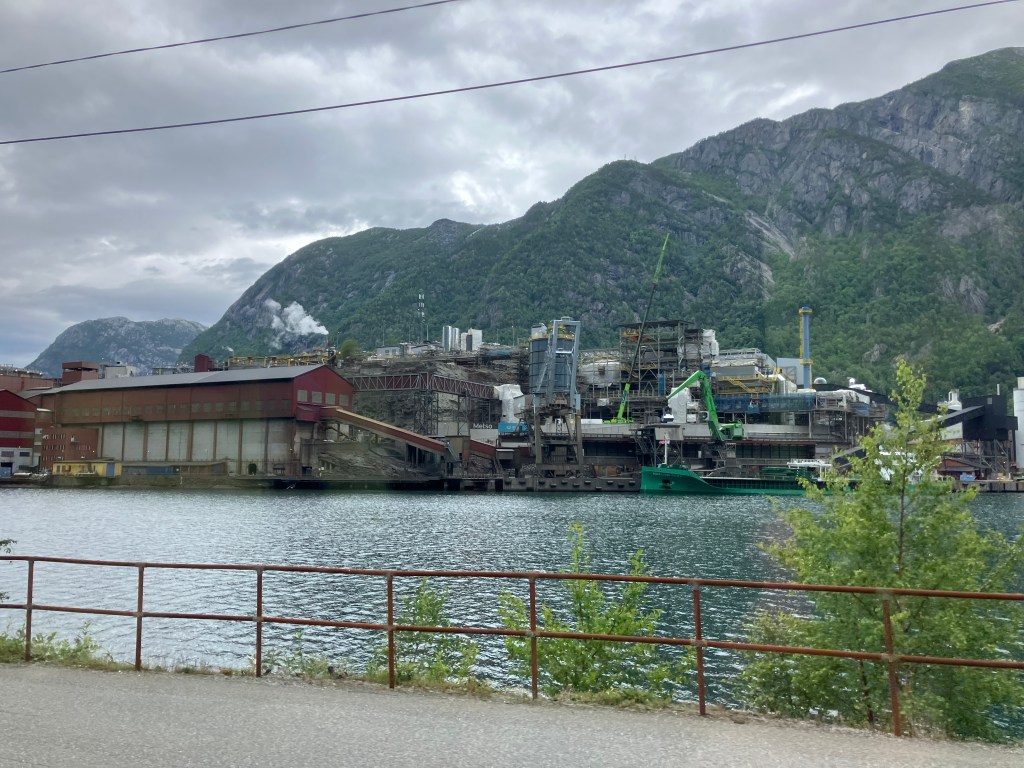
We eventually emerge from the tunnel, our eyes blinking as they adjust to the light. Initial impressions are not positive. The first thing we see is a huge industrial complex on a small island in the middle of the fjord. It turns out that it is a Boliden zinc smelter.

The Boliden zinc smelter at Odda.

“You might have thought that they could have sited it somewhere it can’t be seen”, sniffs the First Mate. “Such beautiful scenery, and to be spoilt by this eyesore.”

“I suppose they needed to have somewhere near the water so that things could be shipped in and out”, I say. “And for the hydro-electric power to drive the plant.”

The bus arrives in the town centre and we clamber out.

“It’s lunch time”, I say. “There’s a small café over there. What about that?”

—–

The elderly gentleman picks up his pen, dips it in the inkwell, and begins to write.

“My dear Meg”, he starts. “Here at Odda since yesterday afternoon …”

Poor Meg. His eldest daughter. The others had all flown the nest, but not her. It had always been a puzzle to him as to why she had never found a husband. Educated, attractive, one would have thought the young men would have been queuing up. He had even used his influence to obtain a place for her as a governess with a wealthy family in the south of Scotland. But she had remained resolutely single. No grandchildren from her. However, every cloud has a silver lining, he thinks – he enjoyed having her around the Manse, helping with parish matters. She was good at it. And it meant that he could have this break and get away to see another part of the world.

He had enjoyed the cruise so far. The sail down the Firth of Forth from Edinburgh had been calm and pleasant. Despite this, he had felt queasy when they had reached the open sea, and had retired early. The next day hadn’t been much better, so he had dosed himself up with whisky and water and had another early night. On the third day, he had almost recovered and had stood on deck admiring the entrance to the Hardangerfjord before breakfast. Since then, he had been feeling as good as ever. So much so, that when they had arrived in Odda at the top of the fjord that afternoon, he had taken a ride in a stolkjarre up to Lake Sandvinvatnet and had seen two waterfalls, the Vidfoss and the Hildalfoss, and, across the lake, the mighty Folgefonna Glacier.

—–

“Come on”, I say, picking up the bill and going to pay. “Let’s get moving. There’s a nice walk along the river that will take us up to the lake.”

“Ready when you are”, says the First Mate. “By the way, what is a stolkjarre?”

“It’s a small two-wheeled horse-drawn buggy just enough for two people with a driver sitting up behind”, I answer. “They were common in Norway before cars arrived.”

As we head towards the river, we notice an outdoor exhibition of Knut Knudsen, a renowned Norwegian photographer born in Odda. He had made his name in the last half of the 19th century taking photographs of local landscapes, his work making a major contribution to the growing sense of a Norwegian national consciousness.

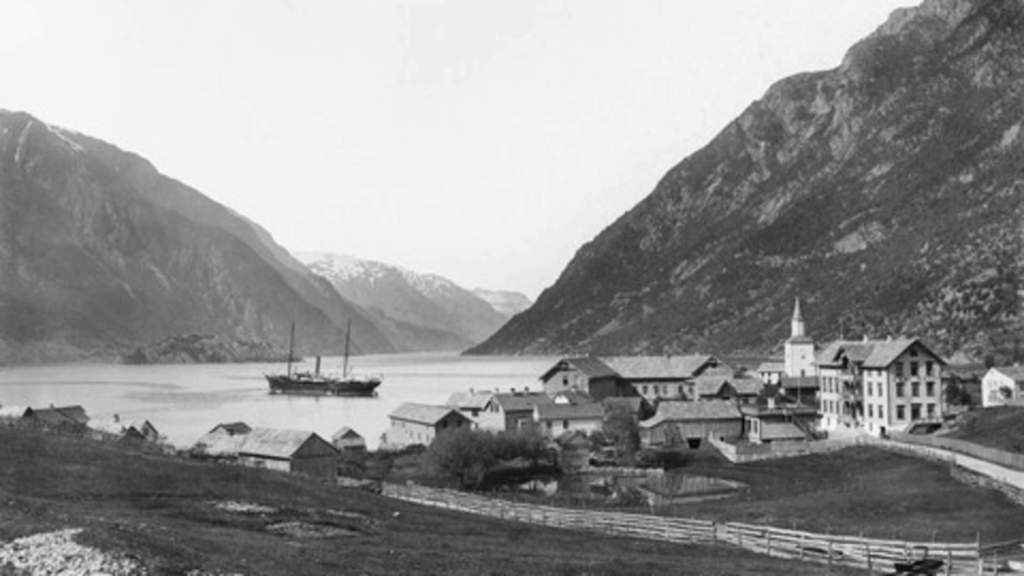
“Look, there’s one of a steamship anchored in the bay just where we came in”, shouts the First Mate. “That could have been the one that your great-great-grandfather was on.”

Steamship anchored at Odda (by Kurt Knudsen, date unknown). No zinc smelter!

It had become fashionable in Britain in the late 19th century for those that could afford it to take advantage of the growing number of steamship companies to tour the fjords of Norway. My great-great-grandfather had taken one in 1889, and luckily had written letters back to his eldest daughter Meg describing his trip. Even more luckily, these letters had found their way down the generations to us. We had decided over the winter to follow as much of his trip as possible during our own voyage.

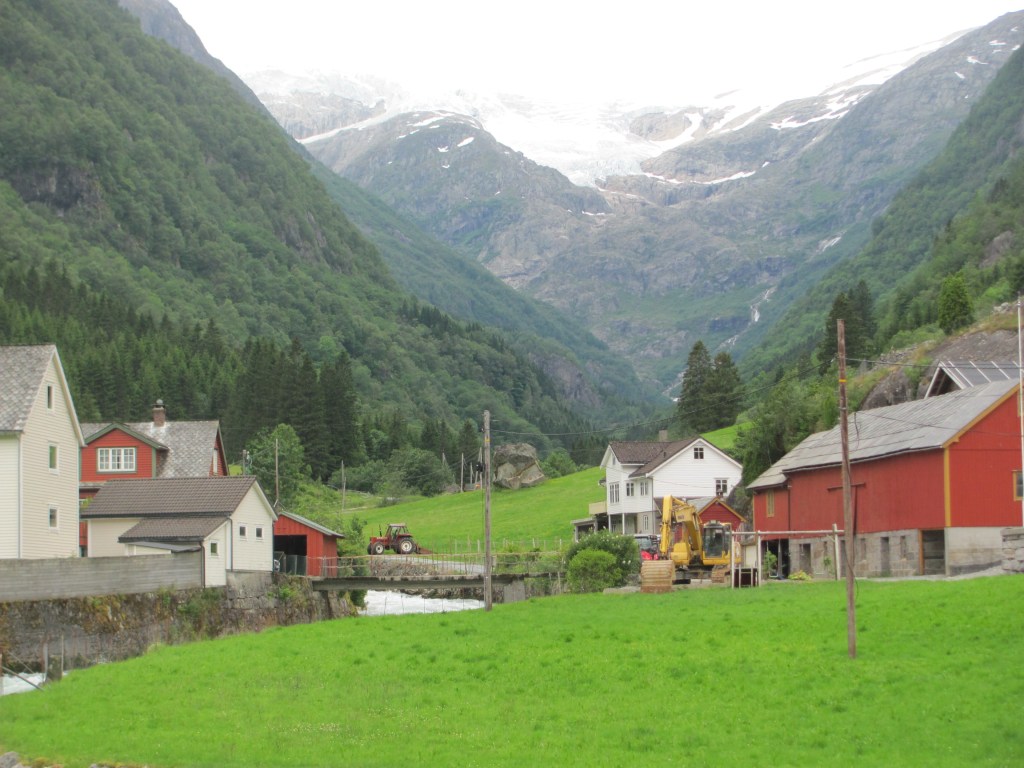
We follow the river crashing and tumbling over the rocks, and eventually reach Lake Sandvinvatnet. We stand in wonder looking at the same scene that my great-great-grandfather had seen 136 years previously. To the left are the two waterfalls he mentions. But no glacier!

Lake Sandvinvatnet, Odda.

“You need to walk around the western shore of the lake”, the woman in the Visitor Information had told us. “To a small hamlet called Jordal. The glacier doesn’t come down as far as it used to, but you can see it from there.”

Sure enough, at the head of the valley, we see the mighty river of ice topping the rock like icing on a cake.

The Buarbreen arm of Folgefonna Glacier from Jordal.

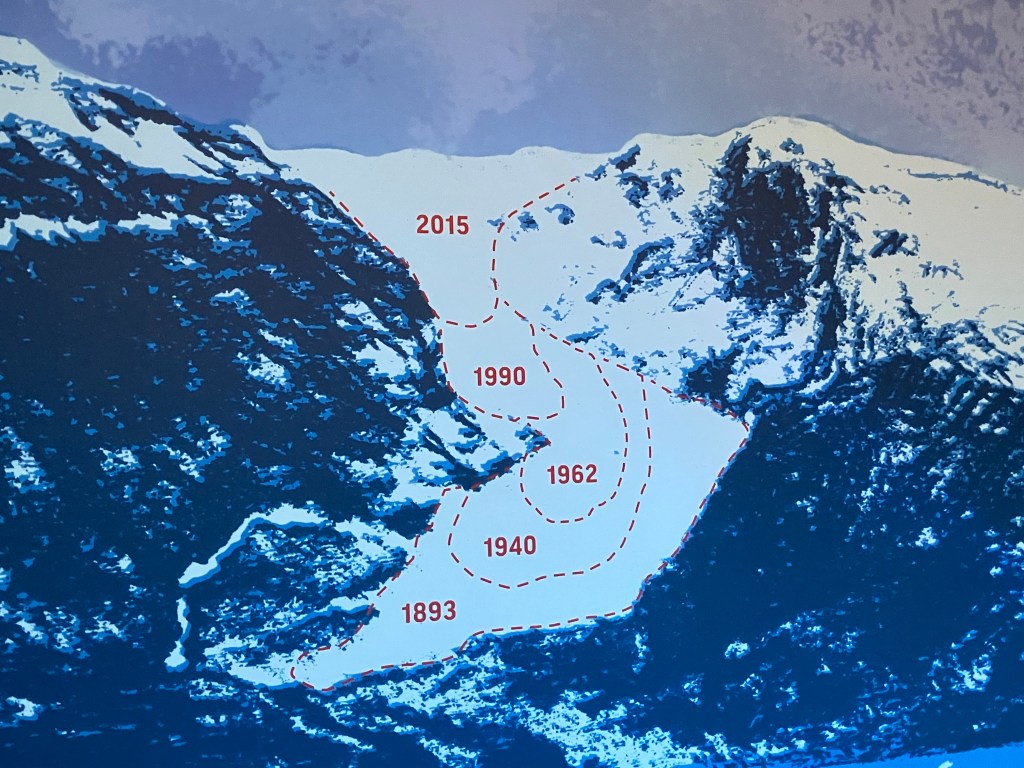
“It’s hard to believe that when my great-great-grandfather was here in 1889, that he would have seen much more of it than we are seeing it now”, I say, as we walk back to Odda. “Proof of climate change, if ever one was needed.”

Retreat of the Buarbreen glacier.

In the morning, we visit the museum in Rosendal. First up there is a film on how the Hardangerfjord was formed.

“Its geological history starts about 400 million years ago”, we learn. “Then, the three continental land masses of Laurentia, Baltica and Avalonia all collided with each other, resulting in the pushing up of mountains from the southern part of the United States right across to Scotland and Norway, with younger rocks being forced underneath the older rocks. In Norway, this created a huge fault along what is now the Hardanger fjord, with the oldest rocks generally on the south-east side and the younger rocks on the north-west side.”

“It’s pretty amazing, isn’t it?”, whispers the First Mate in my ear. “I am glad I wasn’t around when all these collisions were going on. Think of the insurance!”

“Over time, water eroded this fault line, weakening it”, the film continues. “When the Ice Ages came, glaciers formed in this huge fissure, grinding it and scouring it as they moved slowly down towards the sea. Eventually the ice started to melt, with meltwater running under the ice and further gouging out the fissure, resulting in fjords that were around 1000 m deep. Sediments from the erosion filled in some of this, so that the Hardangerfjord is now around 800 m deep for much of its length.”

It’s fascinating stuff. It’s difficult to imagine the power of the processes that can move massive amounts of rock around like sand in a sandpit, sculpting new landscapes as they go. Albeit very, very slowly.

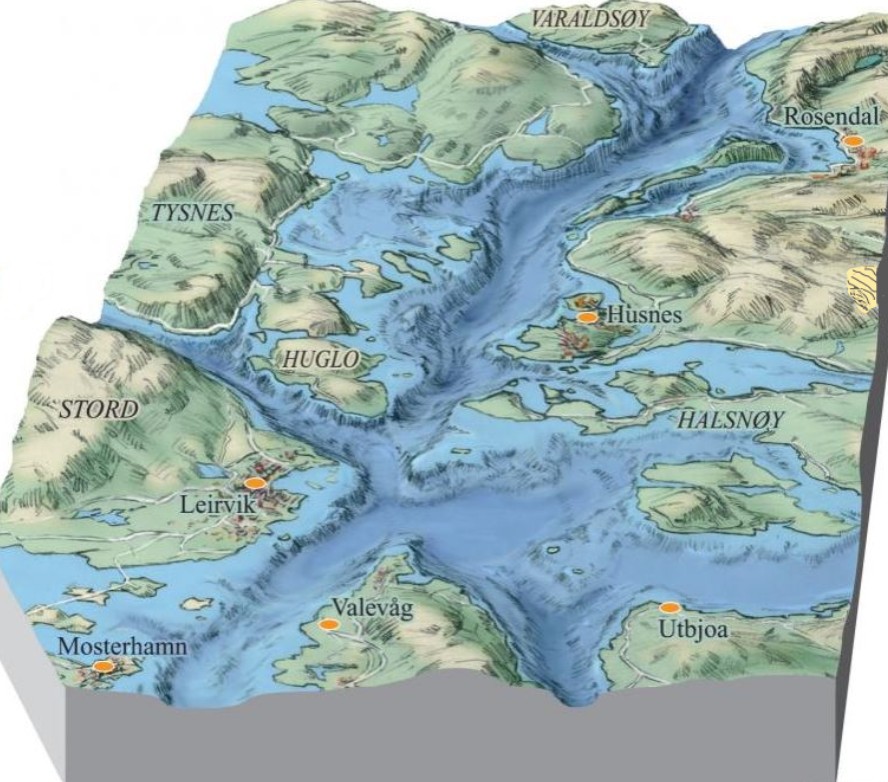
Undersea topography of the Hardangerfjord (from fjords.com)

“I am glad you enjoyed it”, says the friendly lady at the Visitor Information Office. “Now, the other place you should visit while you are here is the Rosendal Baroneit, a 17th century manor house. It’s just a short walk from here. You can’t miss it.”

We walk up the road to the east of the village, and eventually find a tree-lined avenue.

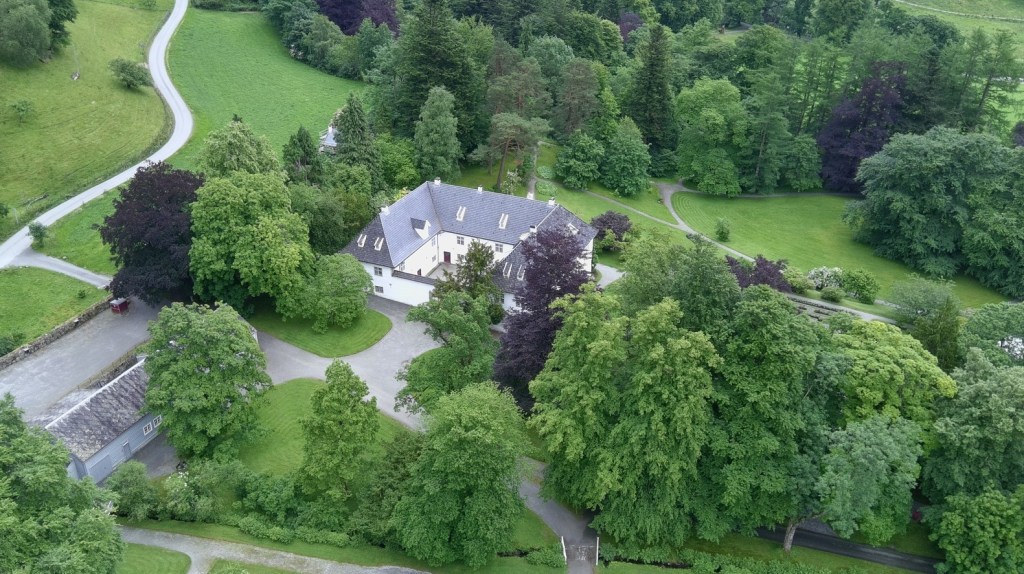
Rosendal Baroneit.

“We do guided tours in both Norwegian and English”, says the young man at the ticket booth at the gate. “But unfortunately there is only one tour left today, and it is in Norwegian. But perhaps if you ask the guide nicely, and if the other people agree, he might do it in English.”

We’re in luck. No-one objects.

“We actually prefer English”, says one woman as an aside to the First Mate. “My parents are visiting us from Kazakhstan and they speak more English than Norwegian.”

“Back in the 1600s, there was once a  Danish nobleman by the name of Ludwig Rosenkrantz who married the richest heiress in Norway, Karen Mowat”, the guide tells us. “The couple were given the farm as a wedding present from her father, who had more than 500 farms in western Norway. They decided that they liked it so they built the manor house. It was finished in 1665. Shortly after Rosenkrantz was awarded a baronetcy by the King of Denmark, Christian V, the only one of its kind in Norway.”

He takes us through to the library. Ancient tomes line the walls.

“I wonder if anyone has read them all?”, whispers the First Mate. “Or do you think they are just there to impress people?”

“Titles were abolished in Norway in 1821”, the guide continues. “Title holders were allowed to keep and pass on their assets, and keep using their titles for their own lifetimes. But the title ceased when they died and no new ones were allowed to be created. The house remained in private ownership until the 1920s, when it was donated to the University of Oslo. Now it is preserved as a museum of an important part of Norway’s cultural history.”

We are taken through each room in turn – bedrooms, dining rooms, drawing rooms, ballrooms, ladies rooms, and the more mundane kitchens.

Rosendal Baroneit.

“Well, you certainly get an idea of how the other half lived”, says the First Mate. “It has a certain appeal. You know, one of my wishes when I was younger was to have a house with a turret.”

“Perhaps we can have one built”, I say. “Then I could lock you in it like Rapunzel.”

“Well, that is the end of the tour”, says the guide. “I hope that you enjoyed it. While you are here, I suggest that you see the gardens. They are supposed to be the finest Victorian gardens in Norway. The roses are especially beautiful.”

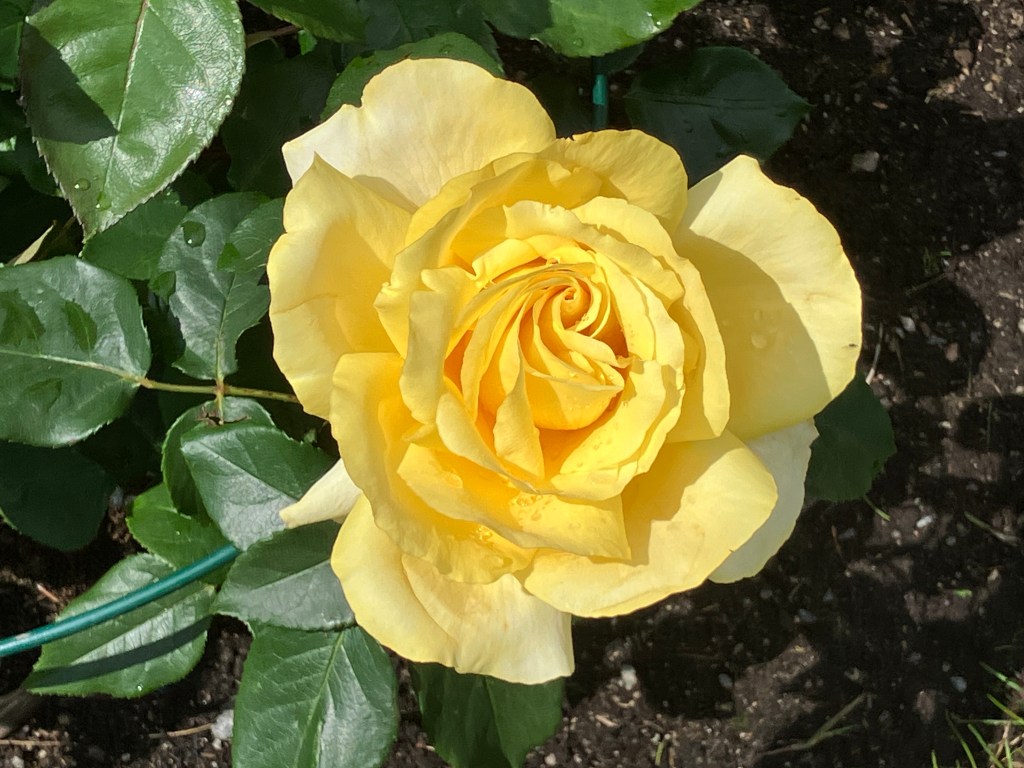
Roses at Rosendal Baroneit.

“You’ll never guess who I have just had a message from”, says the First Mate checking her phone as we walk home. “Simon and Louise. They have just arrived. They saw on their AIS that we were here, and thought that they would pop in too. I’ll invite them in for a café und kuchen.”

“There are strong winds and rain forecast for tomorrow”, explains Simon. “This looks like a good place to sit them out.”

The café und kuchen leads to dinner, where the conversation turns to the state of the world.

“You know, I can’t understand why we haven’t evolved beyond wars and strife by now”, says Simon. We all know that they are evil and unnecessary, yet we still seem to have them. Why?”

“Ah, you must subscribe to the Enlightenment idea of continual human progress”, I say. “Human affairs are always supposed to keep improving. The Stephen Pinker idea. I used to too, but after reading too much of John Gray and looking at what’s going on in the world, I am having second thoughts.”

“But you would think that any political system that was predisposed to wage war would ruin its economy so much that it couldn’t survive and would get weeded out”, he replies. “Just like unsuccessful reproductive strategies in biology.”

“It’s an interesting point”, I say. “But I am not sure that human affairs work like that. Look at the Roman Empire and most other empires in history. They were able to keep expanding because the countries that they conquered and bought under their control provided food and men for them to keep expanding. That was able to keep going for quite a long time, but eventually the costs of administering such a large empire outweighed the benefits and it collapsed. A bit the same with the British Empire.”

“But why haven’t we learnt from history that that is what happens in the end, and just not bother”, says the First Mate. “WW2 showed us that war and empire building was pointless, and that if we had a system of rules that applied to all countries big or small, then we would all benefit. So for the last 70 years or so, we have had peace in Europe and everyone has prospered.”

“Unfortunately, our current leaders seem to have lost sight of that”, says Louise. “There seems to be a move back to the authoritarianism that we saw in the 1930s.”

“It’s an interesting question”, says Spencer later over a nightcap. “Whether you humans should evolve towards greater cooperation rather than warfare, I mean. I think that It is all about raw power and prestige, and not really about devising better systems. Your leaders always want to leave a legacy that gives them prestige in the history books. If they believe they have the power to achieve that, then they will try and do it. Putin has visions of being a second Peter the Great in reunifying the old Soviet Empire, but it looks like he might have overestimated his power to do it. Trump seems to want an American Empire of the USA, Canada, Mexico and Greenland. It remains to be seen if either has the real power to achieve either of those aims.”

“The Law of the Jungle”, I say with a sigh. “Survival  of the Strongest.”

A near miss, a twisted torso, and different minds

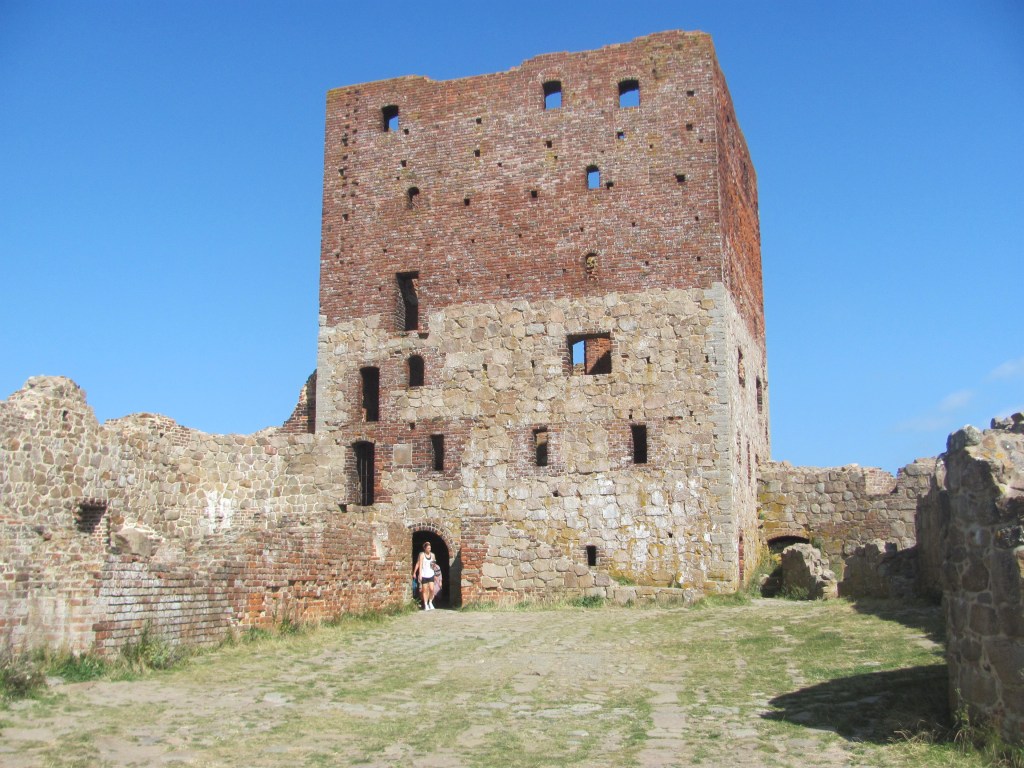
“Look!”, shouts the First Mate, pointing to a steep cliff to our port side. “You can see Hammershus castle up there. It’s hard to believe that we were up there yesterday. It looks quite impressive even from down here.”

We had left Allinge in the morning, edging our way carefully out of the small harbour with its dog-leg entrance, and are just rounding the northern point of Bornholm Island. The wind is from the north-east, giving us a comfortable beam reach as we head for Ystad, back on the Swedish mainland. Between here and there, however, we must cross a Traffic Separation Scheme (TSS) for the big ships, which the rules say that we need to do at right angles to minimise the amount of time crossing it.

“It reminds me of the time we crossed the English Channel”, I say. “It was like being in a pinball machine – no sooner had we dodged all the ships coming from one direction, we had to face a whole lot more coming from the opposite direction. Let’s see if we can get across here without altering our course.”

“Be careful”, says the First Mate. “We don’t want to have an accident at this stage.”

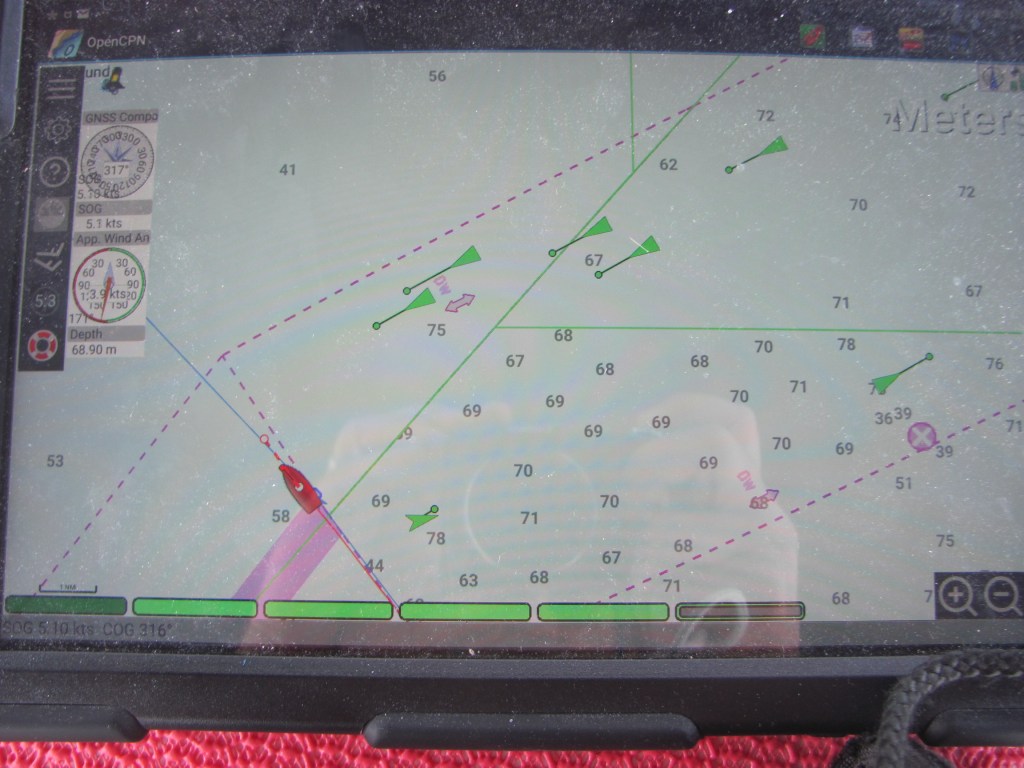
Running the gauntlet (we are the red one!).

We manage to make it through the north-bound lane without too much trouble. But traffic in the southbound lane is heavy, and there are five ships in a cluster that we need to avoid. The AIS tells me that we will pass behind the first three comfortably, but that we will pass in front of the fourth one with just 15 m as the Closest Point of Approach (CPA). That is a little bit too close for comfort! Hoping that the wind might strengthen and give us a bit more speed, or even drop so that we slow down, I keep an eagle eye on the AIS as we cross, but the CPA remains obstinately the same. As our paths converge closer and closer, I chicken out and decide to heave-to. As the ship passes about 100 m in front of us, we can see some of the crew leaning over the guard rails and smoking.

“Phew”, breathes the First Mate in relief. “That was pretty close.”

“Yes, I even noticed that it was Gauloises they were smoking”, I say.

Dodging the ships in the Traffic Separation Scheme.

Once clear of the TSS we alter our course to the east. As luck would have it, the wind shifts and drops, as does our speed.

“We aren’t in any hurry”, I say. “Let’s just take it easy and enjoy the sunshine.”

At a stately three knots, it takes most of the afternoon before we reach Ystad, our destination for the night.

“Better look out for that ferry over there”, calls the First Mate, pointing to something on the horizon. “It looks like it’s heading for Ystad too.”

“There’s plenty of time”, I say. “It’s miles away.”

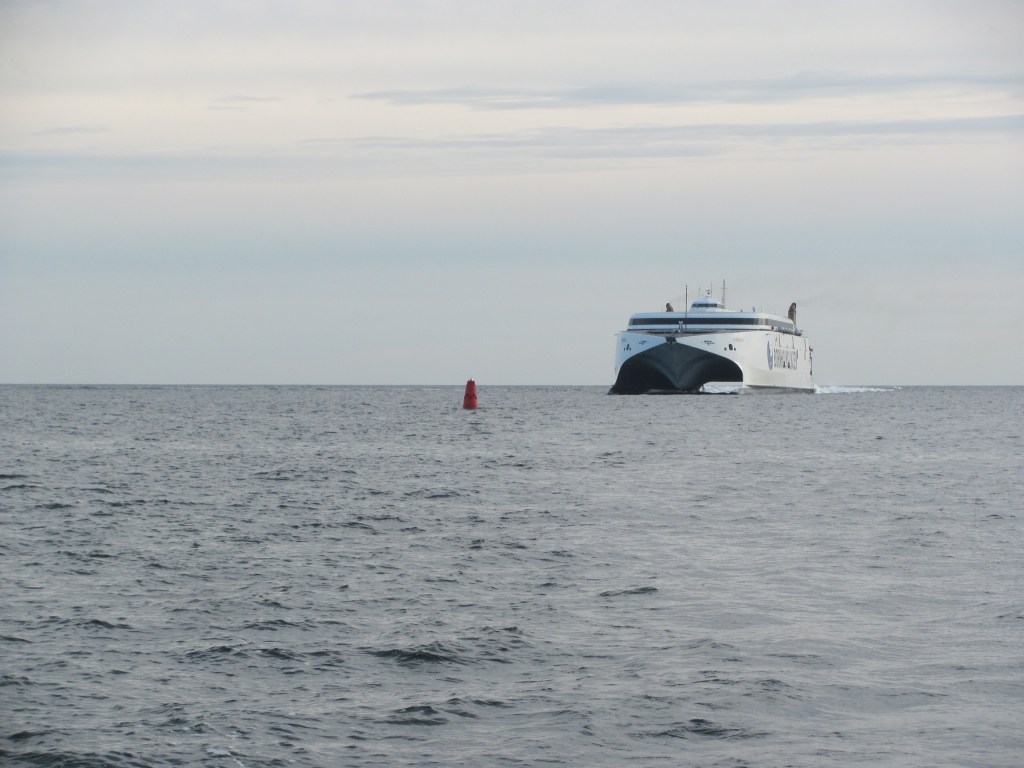
But it’s a catamaran and travelling fast. In a few minutes it is just behind us. It blows its horn to tell us to get out of the way. We motor as fast as we can to a red buoy, and take a line just outside it so that the buoyed channel is clear. The ferry slows down and cruises past us.

Getting out of the way of the ferry coming into Ystad.

Obsession is already there. We aim for the berth just behind her. Ingemar gives us a hand tying up.

“Ystad is a pretty enough place”, he says over a cup of tea. “It’s a former Hanseatic town, and the church and some of the old half-timbered houses are worth a look. It’s just a short walk into the centre of town from here. Ystad’s other claim to fame is that it is the place where the Wallander crime series is set.”

The First Mate has watched the Wallander series, but I haven’t. I make a mental note to try and see it on iPlayer over the winter.

In the morning, we walk into the town centre. We come across the Sankta Maria Kyrka, built in the 1200s in Brick Gothic.

Inside the Sankta Maria Kyrka.

“The guidebook says that the church still has a Tower Watchman”, says the First Mate. “His job is to climb the tower every night and keep an eye on the city. He blows a horn every 15 minutes from 2100h to 0100h to signal that everything is OK. If the horn doesn’t sound, it means that there is a problem, like a fire or something. It’s an old tradition from the 1700s that has been kept alive. Apparently, it has been the same family who have been doing it all that time.”

“I wonder what they do if he is sick or on holiday?”, I say.

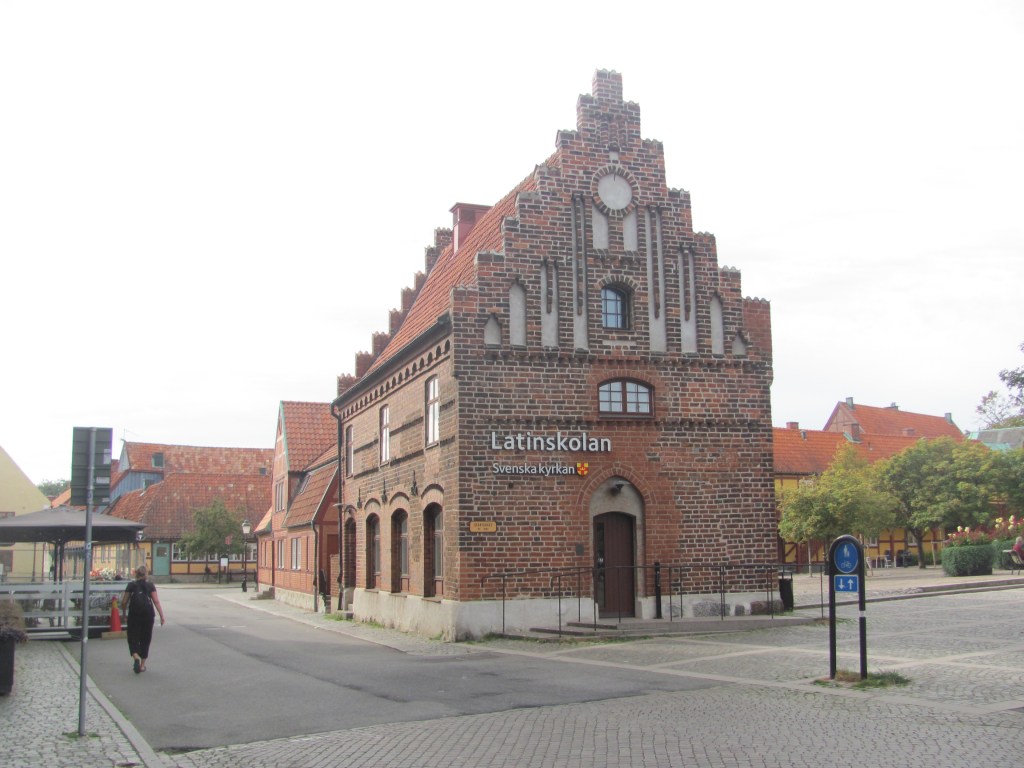
Next to the church is the Latinskolan, or Latin School, that was used in medieval times to teach Latin to the sons of clergymen and the local elite to prepare them to go to university.

The Latinskolan in Ystad.

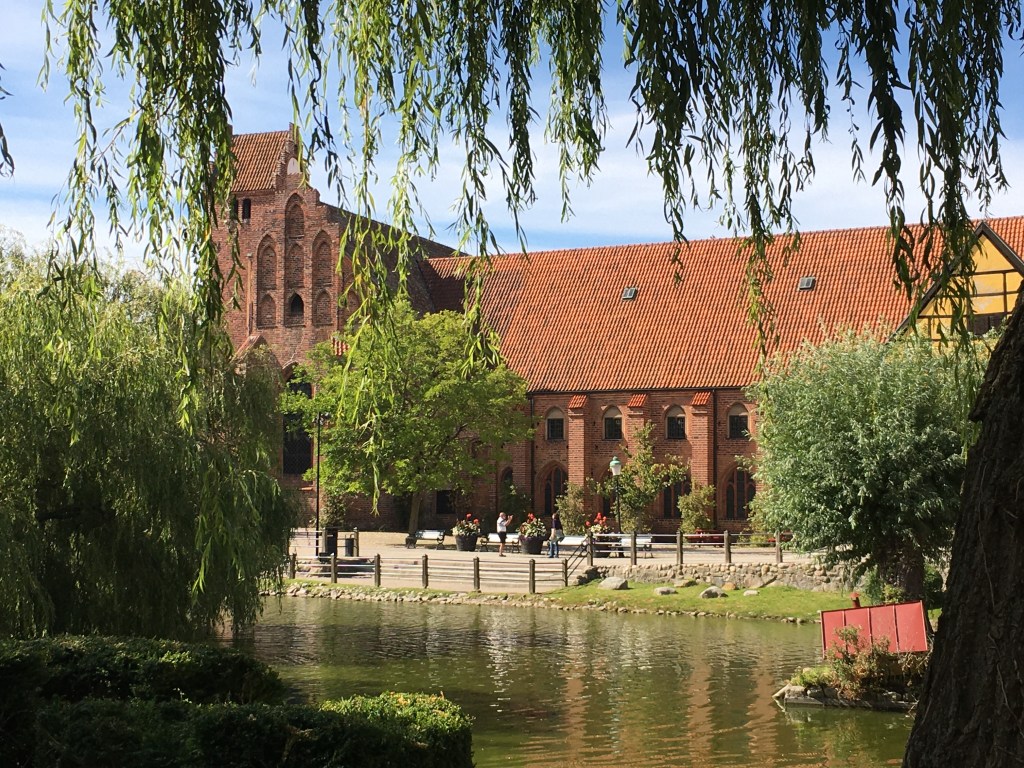
A little bit further on, we come to the Klostret I Ystad, or Greyfriars Abbey, originally a Franciscan monastery. There is a small museum attached to the side, but unfortunately it is Monday and it is closed.

The Klostret I Ystad.

“The book says that the Franciscan order wore grey habits”, says the First Mate. “Hence the Greyfriars name. They emphasised the simple life and travelled around the countryside preaching, caring for the poor and sick, and living off alms given to them by those who could afford it. The friary was a place they could come back to for meditation and contemplation.”

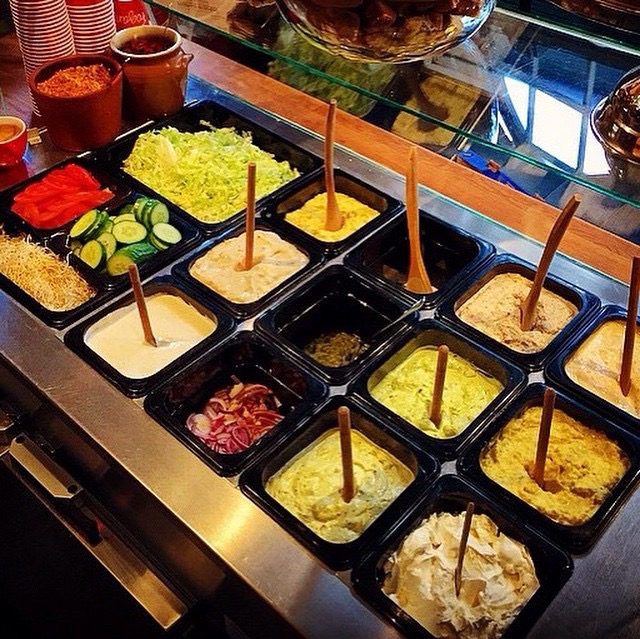
It’s lunchtime. We join the queue at a place called ‘Maltes Mackor’ that is famous for its tailor-made sandwiches, and eventually watch in mouth-watering anticipation as each of our sandwiches is ‘constructed’ with loving care.

Spoilt for choice (from Maltes Mackor).

“Well, it took a while”, says the First Mate, “but I have to say that it was worth it. They taste marvellous.”

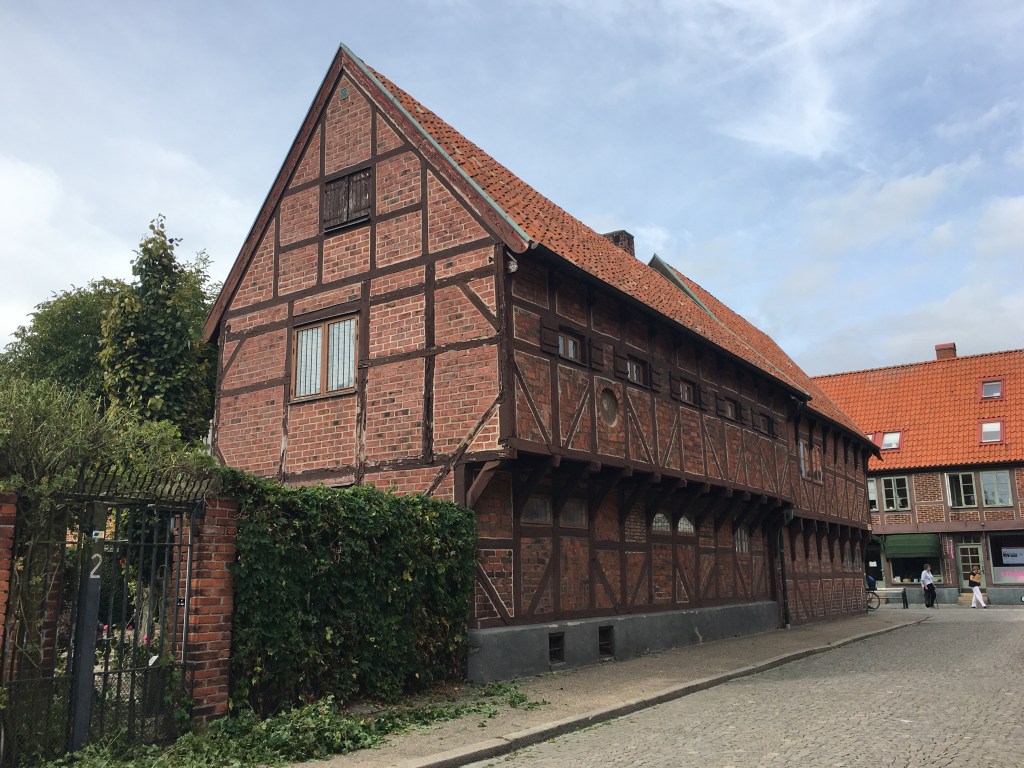
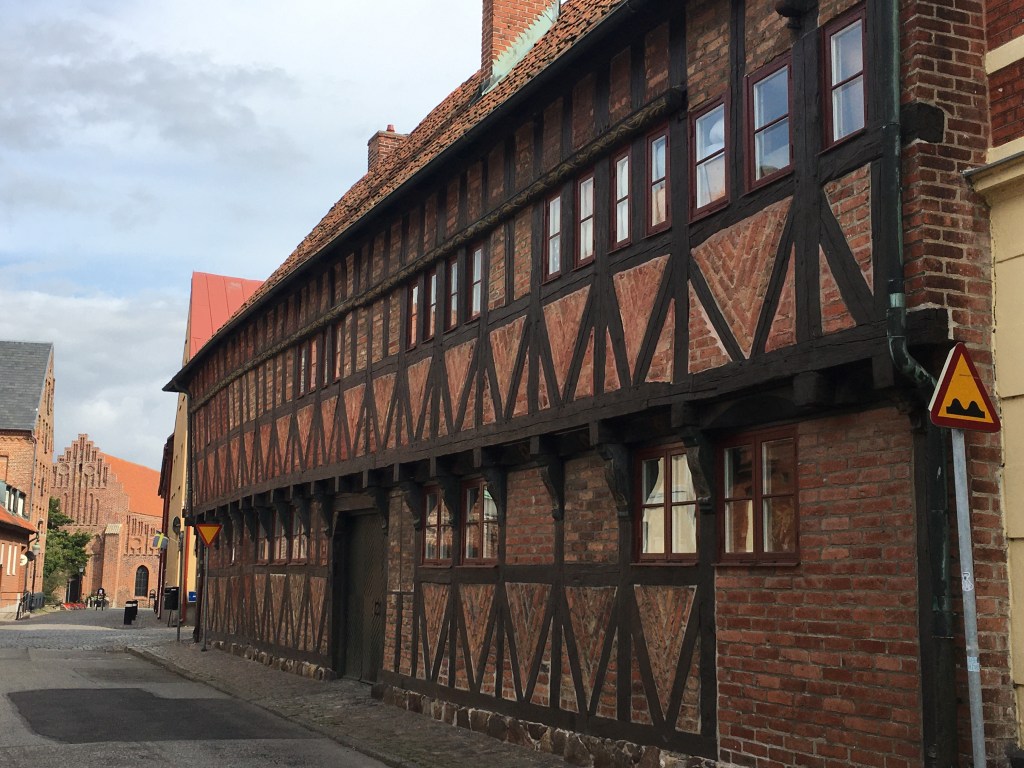
After lunch, we explore the narrow streets flanked with half-timbered houses. Per Helsas Gård was a farmhouse built just inside the city walls following their curvature. Nowadays, it houses a number of craftsmen, with an open air café in the old courtyard.

Per Helsas Gård.

Pilgrändshuset is a residential house joined to a warehouse dating from around 1500 AD.

The Änglahuset is another farmhouse, so called because of the decorative angel figures under the eaves.

Änglahuset.

In the evening, we ask Ingemar over for a drink.

“Did you hear that the Falsterbo Canal is closed for us?”, he asks, as he sips his Weizen beer. “They are repairing it. It’s open for south-bound traffic this week, but not northbound, then next week they are switching around. Unfortunately, we both need to go through this week.”

Falsterbo Canal was built during WW2 to allow Swedish vessels to continue sailing to and from the North Sea while avoiding the mines laid in the Öresund by the Germans. It is still maintained, but is now mainly used for recreational boats wishing to take a short cut to avoid the long way round through the Öresund.

“Yes, I read that somewhere”, I say. “We are planning to go round the outside and perhaps stop in Skanör for a night.”

Our route around Falsterbo peninsula avoiding the canal.

Obsession leaves at 0700 in the morning. We are a bit more leisurely, and don’t get going until around 1000. The wind is from the port quarter, but shifts to directly behind after a couple of hours. Sailing with the genoa only, we still make around six knots. As we reach the Öresund and turn northwards, the wind strengthens. I take out the mainsail, put in two reefs, and we still manage to make more than eight knots on a close reach. I glimpse Obsession on the AIS far ahead, already past Skanör, heading for Malmö.

Making good speed.

“8.2 knots!”, says the First Mate. “We don’t often do that speed. And with a double reef too. But it was heeling a bit too much for my liking.”

We stop for a night at Skanör, then set off in the morning for Malmö.

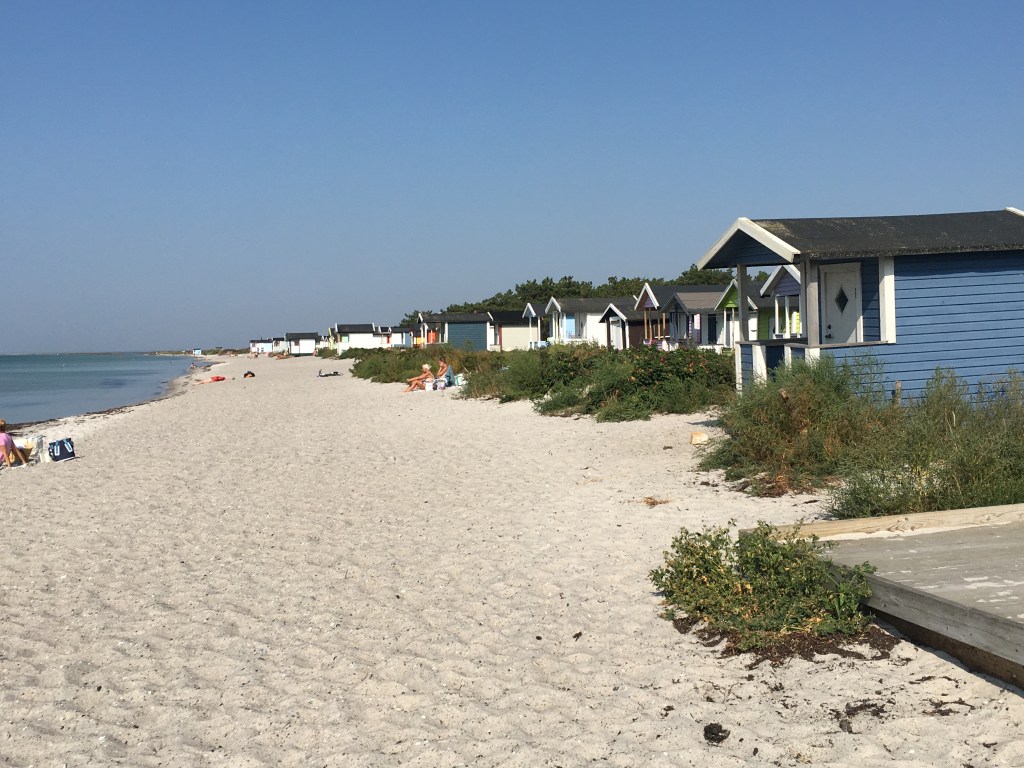
The beach at Skanör.

“This will probably be the last sail of the season”, I say. “I feel a bit sad that it’s all over for another season.”

“Me too”, says the First Mate. “Better make it a good one then.”

And it is. The wind is still an easterly, and blowing 24 knots, so we sail double reefed again. Before long we have passed the Lillgrund windfarm to our port, and are approaching the Öresund Bridge.

Approaching the Öresund Bridge.

“Keep an eye out for Saga Norén”, I call out to the First Mate at the bow. “They might be making another episode of The Bridge. And try to ignore the dead bodies, especially the ones sawn in half.”

With the wind blowing, she doesn’t hear me. Probably just as well.

We pass under the Bridge and arrive at the Limhamn marina in Malmö. The harbourmaster has asked us to tie up to the second pontoon. Ingemar sees us arriving and comes to catch our lines.

“I’ve just been servicing my heat exchanger this morning”, he says over lunch. “You need to do it every couple of years or so, or else the small pipes inside it will get blocked up with scale. I have rigged up a pump and some tubes that circulate phosphoric acid through the sea water side of the exchanger for an hour or so. That dissolves all the scale, leaving it nice and clean again.”

Rather than having a radiator like cars do, the heat exchanger takes in sea-water and uses it to cool the hot coolant circulating through the engine. That way sea water doesn’t come in contact with the engine to cause corrosion.

Ruby Tuesday’s heat exchanger.

“When was the last time we did that?”, asks the First Mate.

I have learnt that by ‘we’, she always means me.

“We haven’t done it since we have had the boat”, I say.

“It would probably be a good idea to do it”, says Ingemar. “Just to avoid problems.”

There is also a small leak in the cooling system that I have been meaning to do something about, and the mixing elbow that combines the warm sea-water with the exhaust gases also needs to be checked, so I decide to remove the whole assembly from the engine and take it home to do everything together. I spend the next couple of days getting it off. Like everything in boats, some nuts and bolts are almost inaccessible, and there is very little space for me to manoeuvre in the engine compartment.

“You need to lose a bit of weight”, sniffs the First Mate unsympathetically. “It’s all those peanuts you have been snacking on. I wouldn’t be surprised if you get stuck in there. Make sure you’ve got your mobile handy so you can call me.”

I finally manage to get the heat exchanger and the mixing elbow off. I change the oil and replace the oil and fuel filters. We pack away the sails, and take down the spray hood, cockpit tent, and the bimini. The new dinghy is deflated, rinsed in fresh water, and stowed. Clothes and other fabrics are stored in the vacuum packs and the air sucked out with the vacuum cleaner. Everything is ready for the winter.

Ruby Tuesday ready for the winter.

“You know, we should take the opportunity to explore Malmö”, I say one evening. “Now that most of the winter preparations are done.”

“I was thinking the same”, says the First Mate.

The next morning, we cycle into town to explore. Malmö was founded some time in the 1200s when southern Sweden was actually part of Denmark. One story is that the name comes about from a young woman being ground up in a mill, but this is almost certainly untrue. In the 1600s, the city became part of Sweden under the Treaty of Roskilde. Then, in the 1800s, it was the first city in Sweden to industrialise, with the main focus on shipbuilding and textiles, but it was slow to adapt to the post-industrial period after the 1970s. However, with the opening of the Öresund Bridge, it has taken off again and is rebranding itself as a hi-tech, educational and cultural centre. In 2020, it was the fastest-growing city in Sweden, with 40% of the population coming from a non-Swedish background.

We come to a bronze statue of a number of people sitting on the back of a giant fish, by the Swedish sculptor Carl Milles. Called “Emigranterna“, it represents the large numbers of Swedish people who left their homeland to emigrate to the New World in search of a better life. Emotions of determination, hope and apprehension line their faces as they head for an unknown future.

Emigranterna.

“It’s ironic that large numbers of Swedish people left from here to go abroad to make a better life”, says the First Mate, “and now Malmö is the place that many immigrants arrive from third world countries to make a better life here.”

“Even more ironic is that there were tensions between the Swedes and the earlier settlers in America”, I say. “Especially the English-speaking ones, who saw them as culturally different in terms of language and religion. The Germans and Dutch didn’t like them much either, as they competed for jobs. But now they are well integrated into American society. What goes around, comes around.”

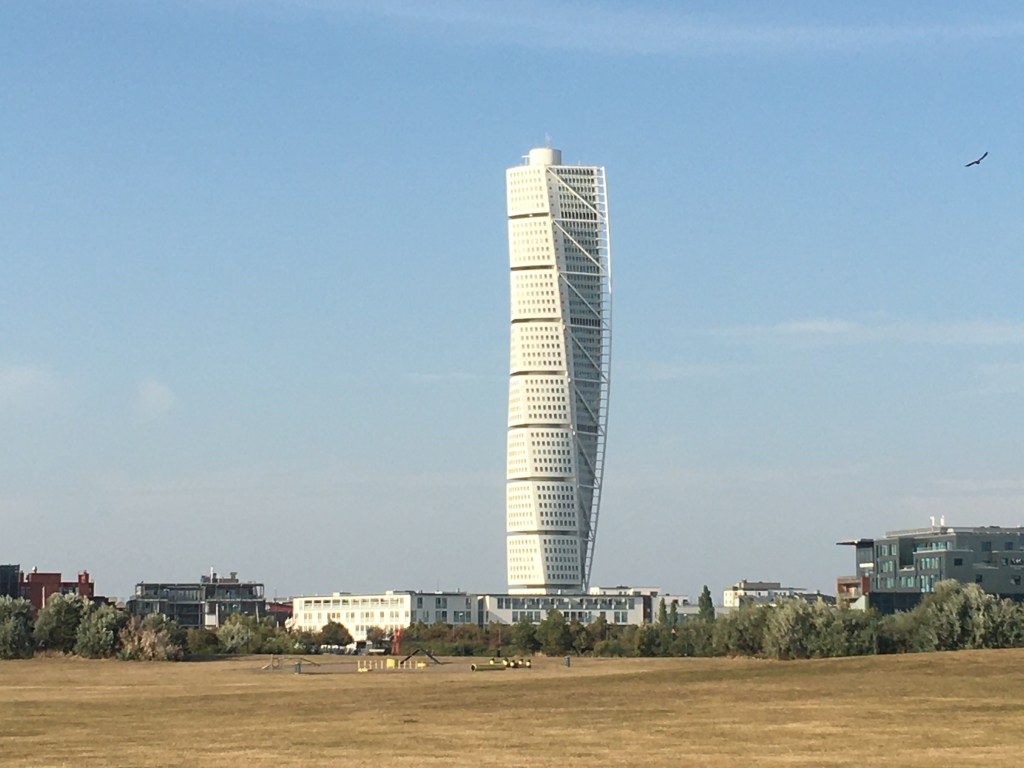
On the way back, we spot the ‘Turning Torso’, a 190 m high residential skyscraper built in 2005, and one of the tallest buildings in Scandinavia. It is the modern day icon of the city, replacing the shipyard crane that had previously been the Malmö icon, but since sold to South Korea.

“It’s certainly very eye-catching”, says the First Mate.

The ‘Turning Torso’.

—–

It’s the last day – the day that we are leaving to drive to Germany to see the First Mate’s family, and then back to the UK.

On the way back from the shower block, I see a quick movement of something black near the rocks of the breakwater. It’s a mink. It stops and regards me intensely. I stare back at it. For perhaps five minutes we regard each other with curiosity, neither of us moving. It doesn’t seem to be afraid, despite there being only two metres between us.

Our aquatic neighbour (from NatureScot).

What thoughts are going through its mind, I wonder? Do mink even have thoughts or a mind? Or emotions? Is it wondering what I am thinking? What would it be like to be a mink?

I think back to the essay written by Thomas Nagel “What is it like to be a bat?” that I had read during my student days. In it, he argues that consciousness has a subjective aspect that cannot be fully understood from an external, objective perspective. While we can study a bat’s brain physiology, we can’t fully grasp its subjective experience—what it is really like to perceive the world as a bat. We can imagine what it is like to be a bat, but that is still a human imagining what it might be like. Any attempt to reduce subjective experience to physical processes will always be incomplete.

And yet, there seems to be something shared in this brief encounter with the mink, even if it is just curiosity about the other. Is curiosity a shared experience? If so, there may be others. Or am I anthropomorphising?

“Come on”, calls the First Mate from the boat. “We need to pack the last things into the car and lock up. We’ve got a long journey in front of us.”

The mink scampers off to a gap in the rocks to re-join its world. I return to my world of other humans and their technology. The fleeting connection between very different minds is gone.

“See you next year”, I call after it.

A Royal Navy attack, Bob Dylan’s boat, and a detested fortress

“We’ll have to change the courtesy flag from Swedish to Danish at some point”, says the First Mate emerging from the cabin with a bowl of muesli. “Here’s your breakfast. I’ll make a cup of tea when you have finished it.”

We are on our way to Ertholmene, the ‘Pea Islands’. We had left Utklippan in the half light of dawn, even before the sun was up, carefully navigating our way out of the narrow exit to the guest harbour only a little bit wider than the width of the boat itself. All was quiet, as far as we could see we had been the first to leave. Even the intelligent rubbish bins had seemed to be asleep. A fresh wind was blowing from the south-east, so we had unfurled the sails almost straightaway. Silhouetted against the red light of dawn, the lighthouse seemed to be wishing us a safe journey, as it had no doubt done to many sailors before us.

Leaving Utklippan.

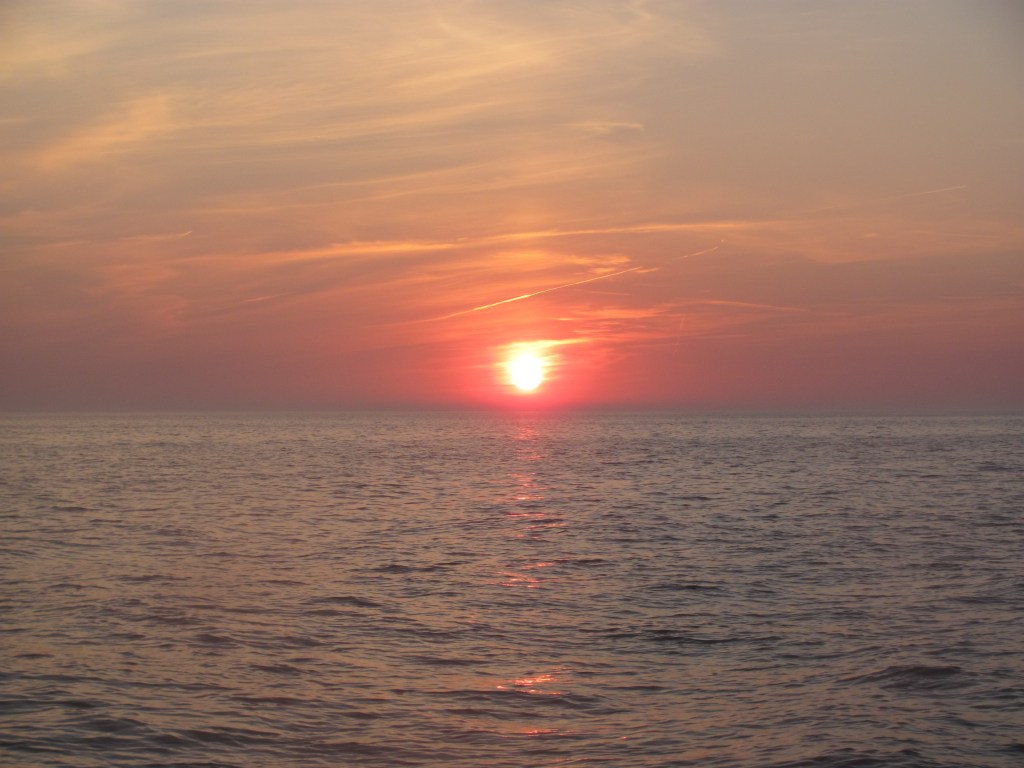
“That’s a beautiful sunrise”, says the First Mate, bringing out two mugs of tea and sitting down beside me. “You don’t see that often.”

“That’s because you are not often up at this time”, I joke. “It’s the best part of the day. Peaceful and quiet.”

She’s a night owl, I am an early riser. A perfect combination.

The sun rises over the Baltic.

We sail south-westwards on a comfortable close reach, the sea miles sliding smoothly under the keel. The hours pass.

“There’s a Swedish boat called Obsession following us”, I say, pointing to the chart-plotter. “I remember it being in Utklippan. It’s going faster than us, but I think that we have enough of a lead to get there first. We don’t want to lose our place at the ferry dock.”

We had called the harbourmaster at Christiansø earlier, to check that there would be enough space there for us. As it is only a tiny harbour, it can become very full at the height of the season.

“No problem”, he had reassured us. “The ferry goes at 1400h, so if you arrive just after then, you can tie up at the ferry dock. It’ll be free until 1000h the next morning.”

The wind strengthens, and moves round more to the east. We are now on a beam reach and doing 7½ knots. The sea also becomes choppier.

“Phew, this is a bit bouncy”, says the First Mate. “Can’t we go a bit slower? Look, there’s land ahead. It must be Christiansø.”

Christiansø is the largest of the islands of the Ertholmene archipelago, which belongs to Denmark. In fact, the whole archipelago is often referred to as Christiansø despite there being three other islands, two of which are designated as bird reserves and therefore out of bounds without a permit.

We round the south-eastern point of Christiansø, and the harbour suddenly appears, nestled in the narrow gap between two of the islands.

Approaching Christiansø harbour.

The ferry to the mainland is just leaving, and true to his word, the harbourmaster waves us to the place it has just left. About an hour later, Obsession arrives, and ties up behind us.

“I could see you on the AIS”, says the skipper. “I was trying to catch you up, but you had too much of a start on me. I’m Ingemar, by the way. I am on my way back to Malmö where I overwinter.”

I tell him that that is also where we have finally decided to keep Ruby Tuesday for the winter.

“It’s a good marina”, Ingemar says. “I grew up in Malmö. The harbourmaster is an old schoolfriend. He’ll look after your boat well.”

There doesn’t seem to be anyone else on his boat.

“I am sailing single handed”, he says, reading my thoughts. “I live in the south of France nowadays, and spend each summer sailing around the Baltic. I did the Stockholm archipelago this year.”

I am impressed. His boat is a 53-footer weighing 24 tonnes, dwarfing Ruby Tuesday. It can’t be easy to sail it by oneself.

Tied up in Christiansø harbour.

“Coffee’s ready”, calls the First Mate from the cockpit. “Drink it up quickly. I want to go and explore the place.”

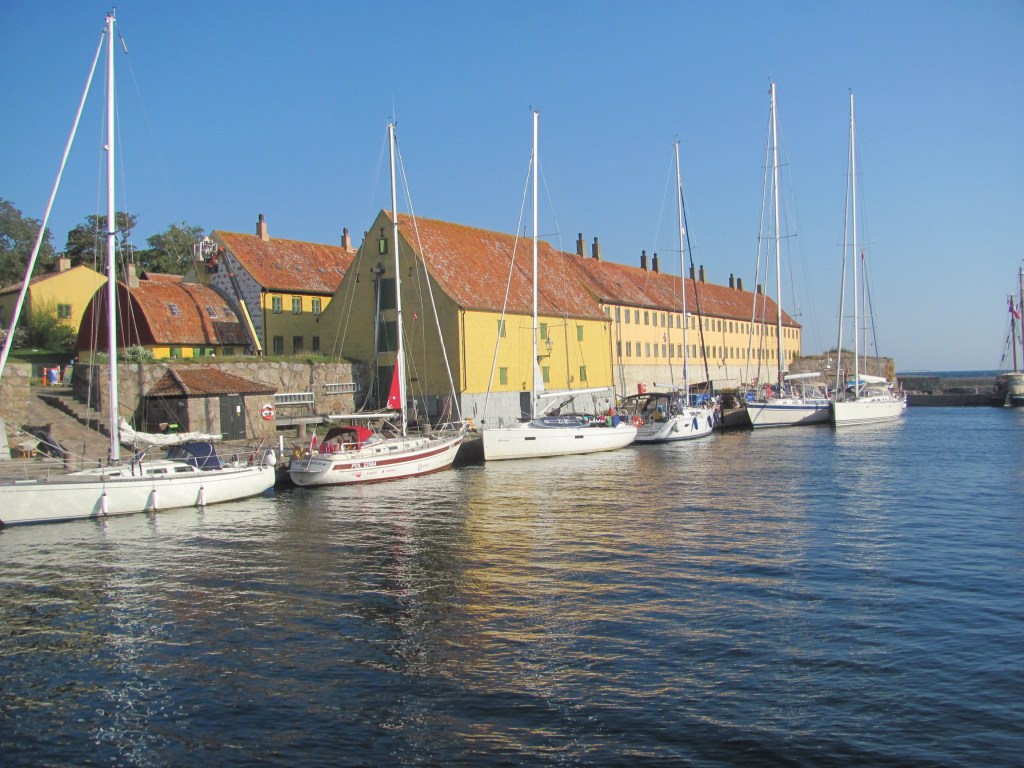
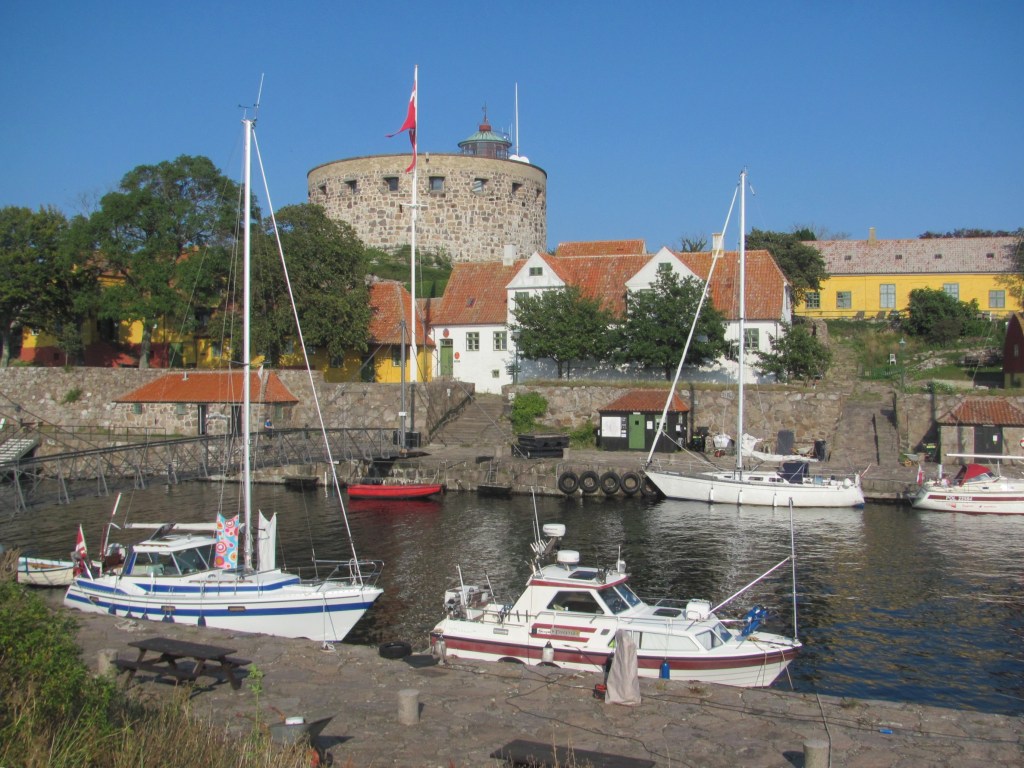
Christiansø was built by the Danish as a military fortification during the Swedish-Danish wars in the late 1600s. Part of the fortifications were two towers, both of which have been renovated and now contain museums.

Store Tårn (Great Tower), Christiansø.

“The English attacked the island in 1808 in what is known as the English Wars of 1801-1814”, one of the museum displays tells us. “They destroyed several of the fortifications and captured some of the Danish ships in the harbour, but were not able to capture the whole island, so they withdrew.”

The British bombardment of Christiansø in 1808 (by Arne Skotteborg-Frederiksen)

I am somewhat surprised, as I was not aware of war between Denmark and Britain. But Google tells me later that it was all part of the Napoleonic Wars, and that France and her allies were trying to prevent British trading vessels from entering the Baltic Sea. As Denmark was an ally of France at that time, Danish forts were considered legitimate targets. The Royal Navy had bombarded the city of Copenhagen the year before in an attempt to seize the Danish fleet to stop it from being used by the French. They had then moved on to Christiansø to prevent it being used as a base for state-supported privateers to attack British merchant shipping.

“Don’t worry”, says the harbourmaster with a grin. “It’s all history. We quite like seeing British boats here nowadays. As long as they don’t try and finish the job they started in 1808. But we don’t get many coming anyway since Brexit.”

We take a quick walk around the rest of the island. A foot bridge joins Christiansø with the neighbouring island of Frederiksø.

The foot bridge joining the two islands.

On Frederiksø is the Lille Tårn, or Small Tower, now a cultural museum.

Lille Tårn, Frederiksø.

In the morning, we need to leave before 1000h to make way for the ferry’s arrival. Obsession leaves first, easing away from the quay, and we follow her out of the narrow harbour entrance. Immediately, the wind picks up from the south-west, and we zip along on a comfortable beam reach, heading for the small harbour of Allinge-Sandvig on the island of Bornholm, 13 NM away. After a couple of hours or so, however, we enter the wind shadow in the lee of Bornholm, and the wind gradually dies to nothing. We drift for a while, but with the sails flapping listlessly, we are reduced to furling them away and motoring the last few miles into the harbour.

Allinge harbour, Bornholm.

“What about coming over for a drink later on?”, says Ingemar, as he helps us to tie up in front of Obsession.

“Sounds good”, I say.

Tied up in Allinge harbour, Bornholm.

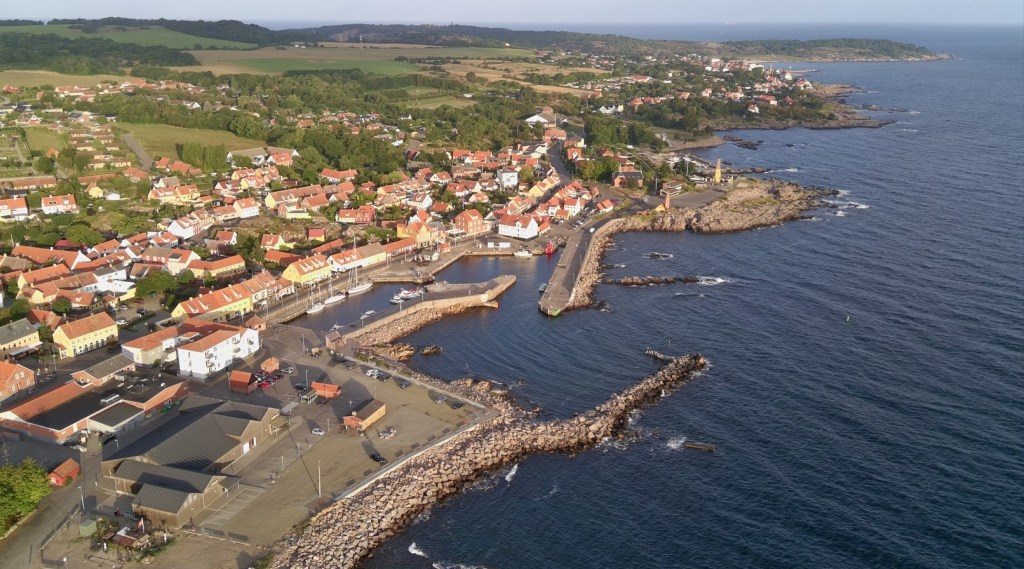
There’s just enough time before then to have a quick look around the town. Originally a small fishing settlement, Allinge prospered in the Middle Ages from the Hanseatic herring trade, with masses of Baltic herring being shipped to southern Europe for Catholics to eat on their ‘meatless’ days. In 1946, it officially joined with the neighbouring fishing village to become Allinge-Sandvig.

Nowadays, the colourful houses and streets exude charm in the typical Danish fashion that we had grown used to in southern Denmark three years ago.

The Allinge Technical School was built in 1895 with the aim of training craftsmen. Currently it is used as offices.

Former Allinge Technical School.

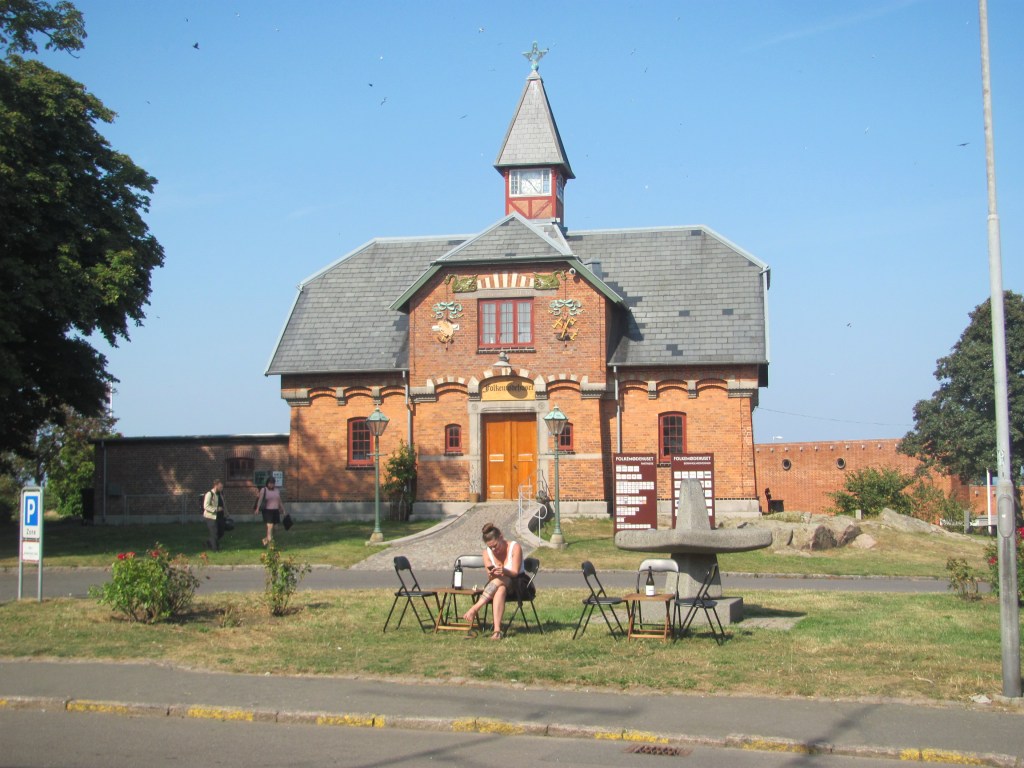
The Public Meeting Dome can be rented for various events.

The Allinge Public Meeting Dome.

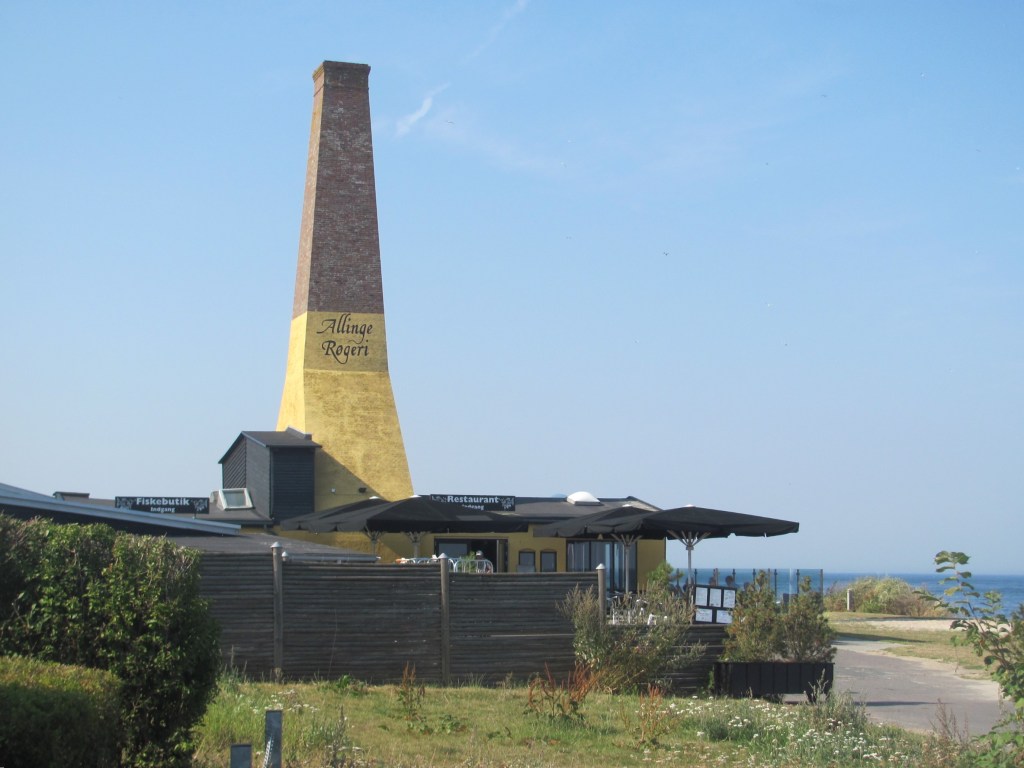
An the way back, we pass one of the two smokeries in the town.

Allinge Smokery.

“Welcome to Obsession”, Ingemar says, as we clamber aboard. “Yes, I am retired. But I have been sailing most of my life. I started off running charters in various places, including the Caribbean. Later I started a company making desalinisation equipment for the marine industry, removing the salt from seawater to make fresh water. The company did very well, and we ended up fitting our gear on a lot of the luxury yachts. One superyacht, for example, owned by a Russian oligarch, had two swimming pools – one for the adults and one for the kids, with the water for each coming from our desalinators. Anyway, I sold the company a few years ago, invested the money, and now spend the summers sailing.”

“I bet you could tell some great stories about the rich and famous?”, prompts the First Mate.

“I could, but I am not allowed to”, answers Ingemar with a smile. “Most of the jobs we did are covered by non-disclosure agreements.”

“Getting back to the Caribbean”, I say, “I read a fascinating book recently on a sailboat that was hand-built there. On the island of Bequia. A friend of mine who lives in Australia recommended it to me.”

“I know Bequia well”, says Ingemar. “It’s my favourite Caribbean island.”

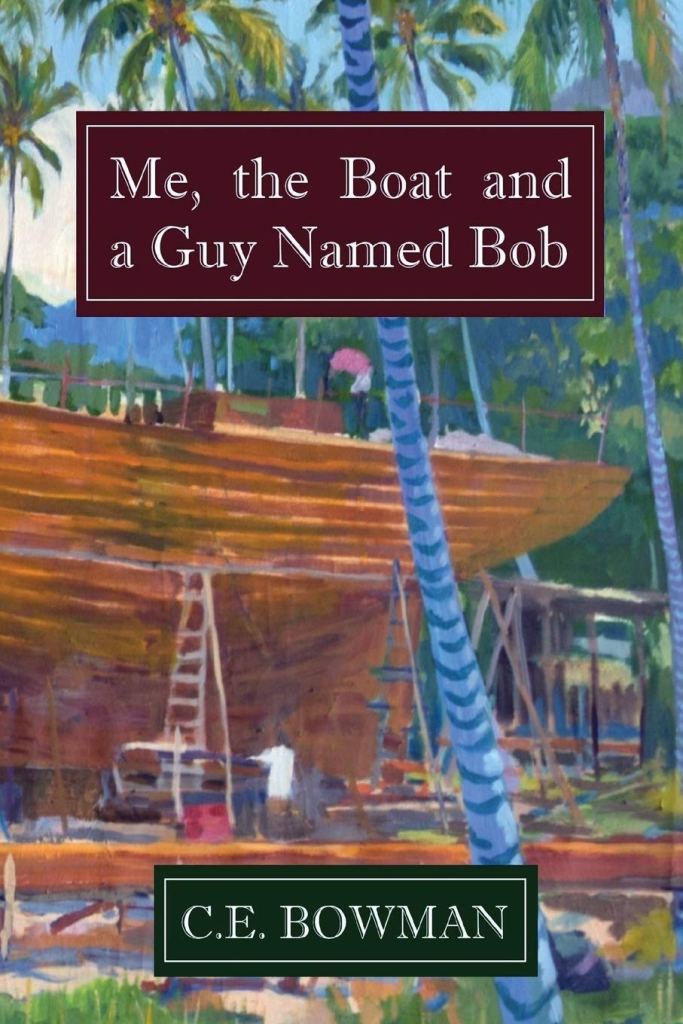
“The boat was built by a young Californian chap called Chris Bowman back in the 1970s”, I continue. “It was commissioned by Bob Dylan, but the agreement was that they would be joint owners of her. They named her Water Pearl. The book is called Me, the Boat and a Guy named Bob. It’s a good read.”

Ingemar’s brow furrows, as though he is trying to recall a memory from long ago.

“I knew Chris”, he says after a pause. “I was there on Bequia at the same time as him. I remember him building that boat. But didn’t she sink or something?”

“According to the book, she hit a reef at night at the entrance to the Panama Canal”, I say. “Despite their best efforts to rescue her, they couldn’t drag her off, and they had to leave her to break up. It was quite poignant really.”

”I wonder what Chris is doing now?”, asks Ingemar. “We didn’t keep in touch.”

“He lives in Western Australia”, I say. “My friend Tony met him at a book club meeting to which Chris was invited to come and talk about his new book. He married the girlfriend Vanessa of whom he talks about in the book, and they settled in Fremantle. She is Australian.”

“I remember her too”, says Ingemar. “It’s indeed a small world. I’ll have to buy the book.”

—-

The cold wind whips across the ramparts as the three figures furtively make their way through the dark shadows. Their years of imprisonment and the cruelty of their captor have sharpened their resolve, and now, with the fortress guard lulled by the monotonous night watch, the time for escape has come.

The woman unrolls the crude rope she had fashioned from bedsheets and drops it over the wall, trying to put the roaring of the sea below out of her mind. Weak from his illness, her husband ties it around his waist, and the woman and the servant slowly lower him over the side, the linen straining under the weight. Reaching the grassy mound at the base of the fortress wall, the man unties the rope and tugs it to signal that he is safe. The woman and servant follow, climbing down by themselves. The three pause for a minute to regain their breath, wrap themselves in the bedsheets for warmth, and with one last look at the ramparts to see if they have been discovered, disappear down the rocky path to the sea.

In his haste, the servant falls and twists his ankle, his cry echoing into the night. Lights and faces appear on the ramparts of the fortress, the alarm is raised. As the escapees pass a local inn, a dog begins to bark. The innkeeper, aroused from his sleep, is about to investigate, but, seeing the three white figures passing eerily by, believes he is seeing ghosts, and pulls the blankets tighter over his head.

The fugitives continue their escape, but they are hindered by the injured servant. Eventually, as dawn breaks, they reach the nearby harbour of Sandvig, but just as they are about to board a small boat that will take them to safety, the fortress guards appear. Their brief taste of liberty is over, and the couple are returned to the grim confines of Hammershus, their fate now darker than ever.

“It’s a good story, isn’t it?”, says the First Mate in my ear.

We are in the museum at Hammershus Fortress on the north-western tip of Bornholm, and I am reading a panel on the daring escape of one Leonara Christina Ulfeldt in 1660, a member of the Danish royalty who was imprisoned in the imposing fortress along with her husband, Corfitz, who had been accused of treason.

Hammershus Fortress ruins.

We had cycled over from Allinge harbour that morning, puffing our way to the top of the hill on which the Fortress was built in the 1200s. The largest in Scandinavia at the time, it was built when there were major struggles between the king and the church in Denmark, and served as a stronghold for the church. Over the years, various kings did manage to conquer it several times, but weren’t powerful enough to keep hold of it, and it was always surrendered back to the church. Until Frederik I, that is. In 1525, he decided that enough was enough, and chased the archbishops out of it for good.

“It’s amazing how powerful the church was at that time, isn’t it?”, says the First Mate. “They must have been terribly wealthy.”

Hammershus Fortress, Bornholm.

“Frederik I then gave it to Hanseatic merchants from Lübeck”, the next panel tells us. “However, despite their own wealth, the merchants taxed the local population heavily and coerced them to provide labour to extend the fortress. The people did rebel against them, but their uprising was brutally put down.”

Then in 1576, the King installed his own vassals there to use as an administration centre with courtroom, prison and gallows, with the proviso that they restore it, but they ended up taking the taxes from the local people to line their own pockets and letting the fortress fall even further into disrepair. It was during this time that Leonora and Corfitz Ulfeldt were imprisoned there.

The ‘Mantel’ Tower, where the Ulfeldt couple were imprisoned.

“Wow, you can sort of see why the local people on Bornholm had a deep loathing of the castle”, says the First Mate over a coffee at the end. “Everyone seemed to do all right out of it except them.”

“But I read that Bornholmians nowadays are quite proud of its dark history, and are helping to restore it again”, I say. “They think it is worth preserving.”

On the way back, we cycle past Sandvig harbour where the Ufeldt couple hadn’t escaped from.

“If the servant hadn’t twisted his ankle, they might have been able to get away”, says the First Mate. “As it was, she had to spend the next 22 years in solitary confinement.”

Sandvig harbour today.

We arrive back at the boat. Someone seems to be waiting for us.

“Wow, is that your boat?”, he says. “I was just admiring it. Have you come all the way from Britain? I saw your flag. I’m Jason, by the way, and this is Harold. He has been walking a lot today and is a bit tired.”

Jason & Harold.

Harold looks a bit dejected, but on hearing his name, manages a bark.

We tell them that we have sailed from Britain, but it has taken four years to do it. Our plan is to explore as much of Europe as possible by sea, but we are in no hurry. At the moment we are doing the Baltic.

Harold pricks up his ears.

“Wow, that is so cool”, says Jason. “I am a poor student from Copenhagen, but I have decided to take a year out and hitch-hike around Denmark first of all, then we’ll see how we get on after that. But I would love to do it by boat. You have inspired me to work hard and save up, and do something similar.”

Harold wags his tail.

“I think he’s spotted a mink over there”, says Jason. “There’s a few of them around.”

Peace between neighbours, Bronze Age spirits, and a lonely outpost

“It’s only weed”, calls out a man on one of the boats tied up to the quay. “You’ll be able to push through it no problem.”

We have just arrived in the small harbour of Kristianopel, and are negotiating the entrance. The depth sounder has just told me that the depth under the keel is zero, meaning we are grounded. But it doesn’t feel like it and we are still moving slowly.

I ease the throttle forward and sure enough we keep going. No graunching sound of cast iron against rock, or even squelching against mud for that matter. On either side, we see the stringy tendrils of aquatic plants rising to the surface. Suddenly we have 0.6 m water clearance. Plenty! We tie up alongside our helpful advisor.

“We thought the same when we came in”, he says as he takes our lines. “We were almost going to anchor outside the harbour, but someone told us it was just weed. It’s only at the entrance.”

The village of Kristianopel.

We boil the kettle and take stock. Kristianopel’s claim to fame is that it once was a fortress town on the border between Denmark and Sweden in the days when Denmark was a major power and included much of southern Sweden. The Swedes weren’t particularly happy about this arrangement and mounted a series of attacks across the border. The Danish king, Christian IV, became fed up with all this aggression, and in 1606 decided to build a fortress to defend against these attacks.

“He named it after his baby son, Kristian”, says the First Mate, reading the guide book. “But added a ‘-opel’ to the end to make it sound a bit more sophisticated, like Constantinople.”

The fortress didn’t help matters for the Danes all that much, as only a few years later in 1611, the Swedish captured it and burnt it to the ground and destroyed the church. The Danish retaliated and the fortress changed hands several times over the next few years, but eventually the Danes were so exhausted that they sued for peace.

We go ashore and explore the village.

Kristianopel harbour.

“What a pretty little place”, says the First Mate. “It reminds me of the cute villages that we saw when we explored southern Denmark a few years ago.”

The fortress walls still exist in most places, and we walk along them trying to imagine life behind them in those days rather than the caravan park that it is nowadays. The occasional cannon pointing northwards towards Sweden and an ancient brazier for showing ships the way into the harbour help a little.

Walking along the Kristianopel fortress walls.
Brazier for guiding ships into Kristianopel.

“I read that the peace treaty was signed just north of here”, I say. “At a place called Brömsebro in 1645. There’s a memorial stone there. We could cycle up there tomorrow and have a look at it. There’s a smokery where we could have lunch.”

“Look, there’s a dual flag combining the Swedish and Danish flags”, exclaims the First Mate, pointing to a flagpole outside one of the houses. “I suppose you could take it to mean that Sweden and Denmark are now friends with each other.”

Dual Swedish and Danish flag.

“Or that the owners still can’t make up their mind whether they are Swedish or Danish”, I say. “So they hedge their bets!”

In the morning, we unload the bikes and cycle up to Brömsebro. It takes a bit to find the Peace Stone, but eventually we do, nestled in a small grove by a brook that used to demarcate the border between Sweden and Denmark.

The Peace Stone to celebrate peace between Sweden and Denmark.

“It’s not a very impressive border”, sniffs the First Mate. “You would have thought that they had chosen a river or something that could have been more easily defended. Look, I can jump from one side to the other.”

The words on the stone say ‘In memory of the peace in Brömsebro. De la Thuliere – Axel Oxenstierna – Corfitz Ulfeldt. The stone was raised in 1915.’

“It says in the guide book that the treaty was mediated by France”, I say. “De la Thuliere was the French ambassador, Axel Oxenstierna was the Swedish representative, and Corfitz Ulfeldt was the Danish representative. It was a big deal for Sweden, as the terms of the treaty now exempted its ships and traders from paying tolls to the Danes if they were passing through Danish territory, and they also added Gotland and the island of Øsel in modern day Estonia to Swedish territory. It marked the decline of Denmark and the start of the rise of Sweden as a Great Power in the Baltic.”

“I am always intrigued how empires come and go”, says the First Mate. “They always seem to overreach themselves and then can’t hold on to their territory.”

In the evening, we sit in the cockpit sipping our wine, and watch the swans and their young ones swimming serenely near the rocks just outside the harbour entrance.

“Something seems to be disturbing them “, says the First Mate suddenly. “Look, I think that it must be that big bird that has just landed on the rocks.”

“It looks like a golden eagle”, I say, looking through the binoculars. “No wonder the swans are upset. Golden eagles will eat the cygnets. It’s probably just waiting for its chance to grab one.”

The swans swim agitatedly towards the safety of the harbour, the little ones following their anxious parents. The golden eagle remains nonchalantly on the rock eying a cormorant, then flaps lazily off.

Golden Eagle (by Jarkko Järvinen).

Strong winds are forecast for tomorrow afternoon. We decide to try and reach the next small harbour, Sandhamn, before they start.

“Look!”, says the First Mate as we arrive. “Klaus & Claudia are here. I can see their boat Saare. And there is a space behind them where we can tie up.”

“We’ve been here a couple of days”, Claudia tells us. “After we left you in Stora Rör, we went to Kalmar, hired a car for a day, and explored Öland. After that, we sailed down here.”

“It’s quite sheltered here from the west”, says Klaus. “And we are on the right side of the pontoon. We should be blown off it with no screeching of the fenders rubbing all night long.”

—-

The shaman chants an ancient prayer to the spirit of the forest and guides the boy’s forefinger around the horse shape carved into the rock.

“The spirits are pleased with you”, whispers the shaman. ”Don’t resist them. Breathe deeply and allow their power to take over your being. You will be a great horseman and will protect your people against the enemies that will come. Just like your father before you.”

The boy feels the power of the animal surge through him, filling him with awe and connecting him to the OtherWorld, the land of his ancestors.

Bronze Age rock carving of horses.

“Now, you must make your own picture”, says the shaman, giving him the metal tool he has been carrying. “For those who follow after you to gain strength from. As those that have gone before you have done. Let the spirits guide you to release the shape that is within the rock.”

The boy hesitates only for a moment, but he knows exactly what he will draw. As the wind sighs gently through the pines, he begins to slowly and deliberately scratch at the rock with the tool until a shallow groove appears. His face furrowed in concentration, he continues his work throughout the afternoon until the light begins to fail. His back aching from the unnatural position he had taken to carve his picture on the rock, he stands up.

“I’ve finished”, he says.

Together they take in his creation.

“It’s Sol”, says the boy. “The giver and sustainer of life to us. I want her to look favourably on our people, and ensure that our crops grow, that our animals flourish, and that the forest remains our provider.”

“You have drawn wisely”, says the shaman. “Thousands of years hence, people will look at these pictures and mourn the loss of the ties to the spirit world that we have.”

Rock carving of the sun.

“Did you see the carvings of the ships?”, says a familiar voice. The mists of time dissolve in a flash.

It’s the First Mate. We are visiting the Bronze Age petroglyphs at Hällristningar på Hästhallen, just to the north of Sandhamn. We had cycled out with Klaus & Claudia after lunch, turned off the main road and walked to the rock outcrop in a small clearing. We had spent the last half-an-hour or so marvelling at the 140 carvings of ships, horses and riders, deer, sun wheels, soles of feet, and cup marks. I am imagining how they might have come to be there.

Dated to around 1000 BC, the figures portray religious rituals and aspects of daily life in Bronze Age Scandinavia. When the rock carvings were made, the area was the coastline; but it is now 25 meters above sea level.

Bronze Age rock carvings of ships.

Back at Sandhamn harbour, I see that another boat has arrived and has tied up on the other side of the pier to us. What’s more, it is flying a New Zealand flag.

“You’ve come a long way”, I say to the couple sitting in the cockpit.

“Well, we have just come from Germany where we have bought the boat”, the man says. “So not too far. But we are going to sail it back to New Zealand in a couple of years’ time after we explore Europe. My name is Ian, by the way, and this is Colleen.”

When they hear that I am also from New Zealand, they invite us aboard for a drink. It turns out that Ian is the son of a university lecturer who taught me when I was at university. It’s a small world!

The winds die down over night, and the next morning we sail for Utklippan, a remote group of three tiny islands off the south-east corner of Sweden. Stunningly beautiful, these islands are the site of a lighthouse built in the 1800s. The lighthouse was deactivated in 2008, deemed not to be useful for modern day shipping. The islands are now a Nature 2000 reserve, famed for their wildlife. The rectangular guest harbour has been cut out of the rock of the northern-most island, and is a popular stopping-off place for sailors.

Utklippan from the north.

When we arrive, Klaus and Claudia are already there. They are the only ones.

“I’ve never seen it so quiet”, says Klaus. “It’s usually much busier than this. I have seen boats rafted up three or four deep sometimes.”

In the late afternoon, a black RIB arrives and ties up just in front of us. In it are two people in uniform.

“We are the coastguard”, one tells us. “We see that your boat is from the UK. Can you show us your passports, please?”

I disappear below and manage to locate our passports and other permits. They show little interest in the First Mate’s German passport, but study my NZ passport intently. We had arrived in Sweden in April, but my Swedish Visitor’s Permit allows me to stay for six months from then, longer than the Schengen visa waiver of three months. Satisfied, they glance around cursorily, jump back in the black RIB, and are gone.

“It’s interesting that the Finns seemed to be more interested in whether the boat had had VAT paid on it, whereas here in Sweden, they are more concerned about our passports”, says the First Mate.

In the evening, we decide to have a joint dinner with Klaus & Claudia. They bring a lamb curry and rice, while we do a vegetable curry.

Pre-prandial refreshments..

Over dinner, the conversation turns to the upcoming elections in Thuringia and Saxony in Germany.

“All the indications are that the far-right Alternative for Deutschland (AfD) party will do well”, says Klaus. “There is real concern in Germany that this could lead to a return to the Nazism of the 1930s if they receive too much support.”

“We grew up having Nie weider, never again, drummed into us”, explains the First Mate. “So it is a bit of a shock when so many people support a far-right party.”

“It’s interesting that the AfD wasn’t always far-right”, says Claudia. “It was actually started in 2013 by a group of economists protesting against the bailouts to the southern Europe countries during the Eurozone crisis. They wanted these countries to leave the EU. It was only later that the party evolved towards the far-right when its various leaders jumped on the immigration bandwagon in an effort to gain votes.”

“It has its strongest support in the former Communist East Germany”, says Klaus. “But what is worrying is that a large number of young people, whom we expected to be progressive, support it too.”

After Klaus & Claudia have gone, I sit in the cockpit musing over what we had been talking about. Surely Nazism won’t reappear?

“I overheard your conversation”, says Spencer from his home in the canopy. “It’s interesting, as I was just reading the other day that the AfD won’t gain power as it is just an East German thing. You see, West and East Germans are very different people, and the differences go much further back than the Communist era. Right back to our old friends, the Teutonic Knights, in fact. It was because of them, and those that followed them, that the Baltic Germans developed a colonial mindset where they dominated the indigenous Balts and Slavs. When Hitler recalled them just before WW2, most relocated to eastern Germany, bringing their conservative right-wing worldviews with them. These views largely remain today, despite 50 years of Communist rule. So the AfD has a lot of support in the east, but it won’t gain much ground in the more liberal west.”

“Well, I hope you are right”, I say doubtfully. “But my concern is that too much immigration touches a raw nerve in both east and west Germany, which the AfD plays on. We’ll just have to see how it pans out.”
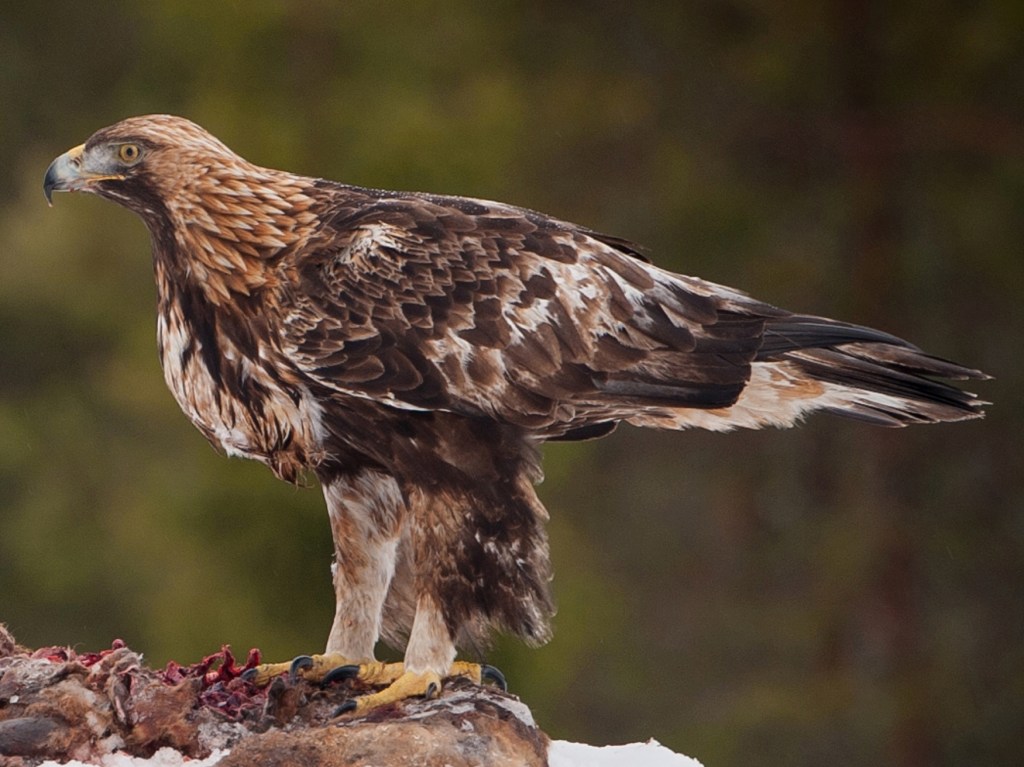
In the morning, as I drink my first tea of the day and do the crossword, there is a sound of voices outside. I poke my head out to see what is going on.

“We have come from the mainland to empty the rubbish bins”, says one of the voices. “I hope we didn’t wake you up?”

“How do you know when to come?”, I ask. “They might be empty and it would be a wasted journey.”

“Ah, but the bins are intelligent, you see”, he answers. “After someone has deposited something in there, it triggers a press and the rubbish inside is compressed. When the bin gets to around 80% full of compressed rubbish, it sends an email to our headquarters to tell us that it is nearly full. We then jump in a boat and come out to empty it. That way, the bins never overflow, and we don’t have any wasted trips. It’s all powered by this solar panel on top, see.”

Emptying the ‘intelligent’ rubbish bins on Utklippan.

After breakfast, we clamber into one of the small rowing boats provided on each island, and row over to the other island to explore the remains of the lighthouse station.

The Utklippan lighthouse.

Suddenly there is a massive series of thumps that reverberate throughout the island.

“What on earth was that?”, shouts the First Mate in alarm. “Did something fall down?”

“It sounds like heavy guns firing”, I say. “Perhaps the navy are practising.”

Sure enough, in the haze of the horizon we see a warship firing its guns, puffs of smoke being carried away by the wind.

Warships on the horizon.

“Crump … crump … crump”, go the guns. Then a few seconds later, another “Crump … crump … crump” in response, this time not quite so loud.

“There’s another ship that must be below the horizon”, I say. “We can’t see it.”

“I hope that they are only practising”, says the First Mate. “But what if the Russians have invaded Poland and this is the beginning of WW3? What would we do?”

“I suppose we could try defending the island with that cannon ever there”, I say doubtfully. “We might be able to hold them off for a minute or two, if we are lucky.”

Repelling the invaders.