The Isle of Man

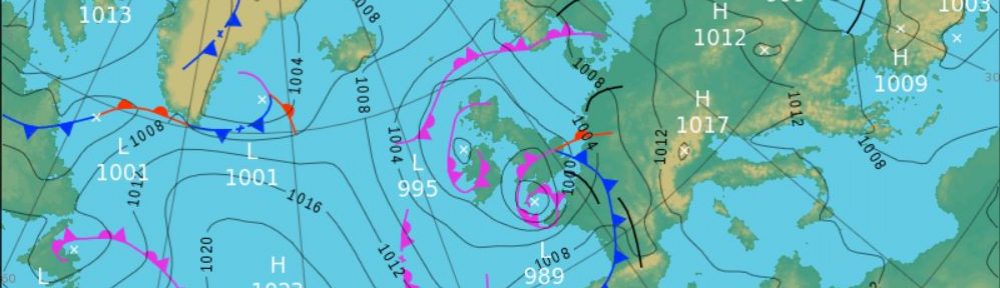
In the morning, the weather forecast tells us that a gale will arrive the next day. Holyhead harbour is a bit exposed (in fact the marina was destroyed by the Beast from the East storm in early 2018), so we reckon that we will be better off finding shelter in Douglas on the Isle of Man. The only thing is that we will need to leave pretty much straight away to get there in time.

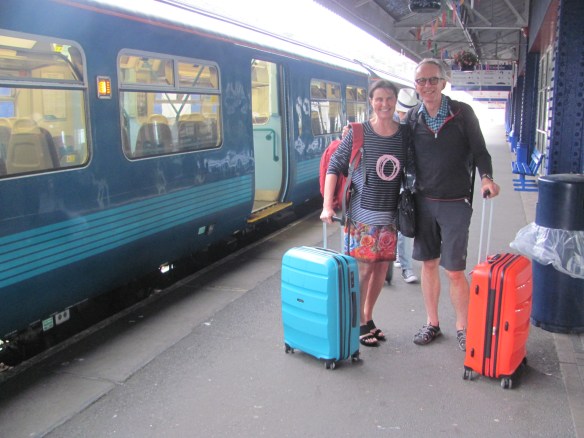
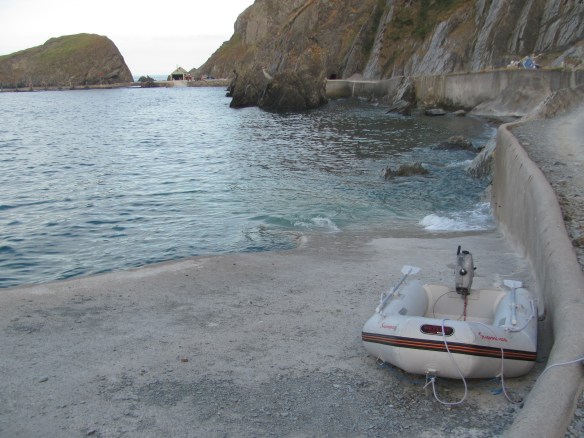
I take Peter and Joanne over to the shore in the little dinghy. No one is around, but the cleaning lady has promised to be there by 0800 to open the sailing club so they can retrieve their luggage. They have a taxi arranged to take them to the station for the train to London. We say our goodbyes and I head back to Ruby Tuesday. It seems strange to return to a boat with just the two of us. It has been good to see them.

We set off as soon as we have the dinghy loaded on the back. The wind has gone around to the south, so it is directly behind us. It is blowing at about 12 knots, so we goosewing and make a good speed.

On the way to the Isle of Man.

The First Mate brings out a cup of tea. I reflect on the last few months since we started our voyage, and how quickly the time has flown. I find my perception of that time has also changed – rather than a series of chunks ordered by the demands of a working day, it is more of a flow – hours glide by, and days merge into one another. Time has not disappeared, but it has settled into a pattern governed more by the earth’s great rhythms – day and night, the flood and ebb of tides, the seasons. In between, the everyday jobs of route planning, sailing, and keeping the boat tidy and in working order keep us occupied. The hourly filling out of the logbook when we are sailing, and the keeping of a diary do provide some structure, but it is easy to forget these, and I find myself amazed sometimes when several days have gone by since the last entry in the diary. We do seem to be less stressed and the sense of urgency is disappearing – if we don’t do something today, it can always be done tomorrow. And we feel better for it.

It makes me wonder if modern civilisation has gone too far in its perception of time and how it must be filled. When we were working, there was relentless pressure to make every moment count – to be doing something, producing something, deciding something, meeting someone. But what did it all achieve? There was so little time to ponder and reflect on the great mysteries of life and appreciate the world around us. Should we all take time out, just to go with the flow? Would we be happier, more fulfilled, more creative, and (dare I say it) more productive in the long run?

Suddenly, out of the haze, I see a large yacht passing in front of us. I check the radar and AIS (Automatic Identification System) and see that it is doing 11 knots. That’s fast, if it is correct! Then I see another one on the screen, then two more, some way behind. It is too hazy to see the actual boats at first, but they are there somewhere. Then the second one appears and passes a few hundred metres in front of us. The crew see us and wave frantically to us. It suddenly dawns on us that we have stumbled into the middle of a race, but this is no ordinary one – it is the Clipper Around the World Race that started in 2017 and these boats are now racing to the finishing line in Liverpool, perhaps an hour away. This is what our neighbour in Aberystwyth marina was heading to see.
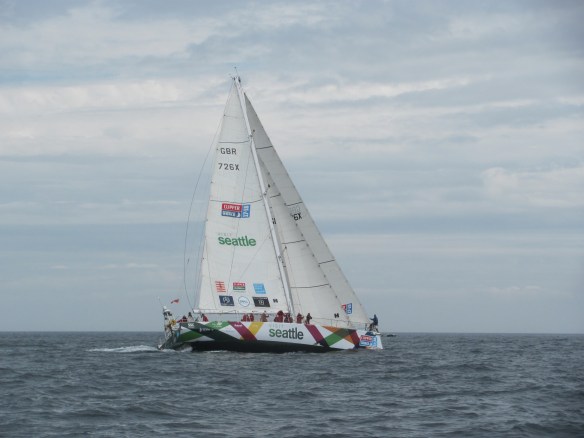
Seattle – one of the boats in the Clipper Round the World Race.

An hour or so later, we hear whoops of joy over Channel 16 on the VHF. The voice is unmistakably female and antipodean. We learn later that it is Wendy Tuck, an Australian, who has won the race. The boat we have seen, Seattle, is the second placed, skippered by a Nikki Henderson, a British woman. I tell the First Mate that there is hope for her yet. She ignores me.

We arrive in Douglas around 1800. Entry into the marina is via a lock gate that only opens two hours either side of high tide, and a road bridge also has to be raised. We are told by Harbour Control that the gates will open at 2215 and we can wait until then at the temporary pontoon in the outer harbour rafted up to one of the boats already there. The boat we tie up alongside is called Lady. We think there is a certain symmetry there – a Lady visiting the Isle of Man. Boom, boom!
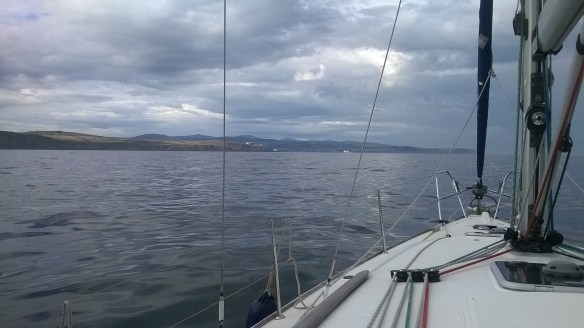
Approaching Douglas, Isle of Man.

We cook dinner and relax. Another boat draws up alongside and rafts up to us. It has a dog, a brown spaniel. The dog has been sick. The skipper explains that they have come from Conwy in Wales. It seems they rowed out in a small dinghy to their boat moored in the harbour to do some work on it, but couldn’t get back to shore because it was too rough, and decided on the spur of the moment to go to the Isle of Man instead, as one does. There are a lot of questions I feel need asking on this one, not least on why anyone would do that with an imminent gale warning, but I decide life is too short. The spaniel looks at me sorrowfully. “Don’t ask”, she seems to say.

At 2215, there is a burst of life. The gates have opened, and we form an orderly queue to proceed up to the marina. It is dark, and we follow the lights of the boat in front. We have been allocated a berth at the top of a side arm, which suits us fine. We can see street lights, shops and restaurants, and realise that we are close to the centre of town. We tie up the mooring lines and turn in.
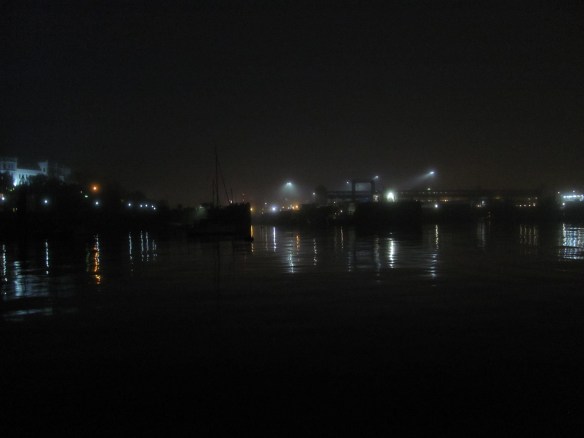
Douglas harbour at night.

The gale arrives in the early morning. There is an eerie calm beforehand, then the wind begins to blow. We are relatively sheltered in the marina, but the windspeed indicator at the top of the mast reads 50 knots at one point. Then the rain starts. We snuggle deeper into our beds. There is something immensely satisfying about being tucked up warmly and safely while the elements rage around us.

Tucked up safely and soundly in Douglas marina.


Holyhead

“Yes, we have a spare visitors’ mooring for you”, the lady from the sailing club says over the VHF in response to our request as we round Holy Island. “The launch will be out to show you where it is. You’ll know the launch from its colour. Pink. You can’t miss it.”

I try to imagine a pink boat, but give up. I think it is called cognitive dissonance, but in any case I have other things to think about. We are coming into Holyhead harbour, and I need to work out how to get out of the way of a massive ferry just off our port quarter. As we pass the breakwater protecting the harbour, sure enough there is the pink launch. It actually looks quite good.

The pink launch.

The pink launch draws alongside, and we are directed by the launch man to a yellow buoy next to a Moody 42. A woman on the Moody eyes us suspiciously.

Our crew manage to catch the yellow buoy with the boathook and haul up the thick rope. Usually mooring buoys have a lighter slip line to catch, but for some reason this one doesn’t seem to. They struggle to lift the heavy line, and eventually manage to slip the end loop over the forward cleat.

“You’d be better off putting it over the bow roller first”, says the pink launch man. I wonder to myself why he didn’t tell us that at the beginning. The crew unloop the thick rope again and try to thread it through the bow roller.

“You need to bring the boat a bit further forward to take the strain”, says pink launch man to me.

“You need to reverse a bit”, calls out the suspicious lady on the Moody.

“Can you go sideways a bit?”, says the First Mate.

I decide to do nothing. Eventually the rope is pushed through the bow roller and looped over the cleat. We relax. The suspicious lady on the Moody disappears down below. Pink launch man draws alongside and tells us how much we have to pay for the night. It’s reasonable, considering he will also act as a water taxi, taking us to and from the shore up until 10 pm for no extra charge.

Going ashore in the pink launch.

We eat that evening in the sailing club. Later, Peter and Joanne take their suitcases over from Ruby Tuesday on the pink launch to leave them in the club house, and they make arrangements to collect them in the morning. They are catching the train for London at 0900, but as the pink launch doesn’t start until 0900, I will have to take them across in our little dinghy in the morning. It makes it easier if their suitcases are already ashore.

The moon rises over the harbour while we sit on deck and have our last drink together. Tomorrow it is supposed to be a ‘blood moon’ with the earth eclipsing the light from the sun. We make a mental note to see it if we can.

Moon rising over Holyhead harbour.

Porth Dinllaen

We leave Pwllheli at 1230 so that we can arrive at Bardsey Sound at slack water at 1630 and take advantage of the north flowing tidal stream beyond that. A few other boats seem to have the same idea, and for a while we form an orderly procession as we proceed down St Tudwal’s Roads and sail between St Tudwal’s Islands. I read later that St Tudwal was a monk from Brittany who retired to one of these islands to become a hermit. The remains of his monastery are still on one of the islands.

Leaving Pwllheli on St Tudwal’s Roads.

We pass Porth Ceiriad and then the broad sweeping bay of Porth Neigwl, and Bardsey Island comes into view. Porth Neigwl translates as Hell’s Mouth, and we wonder what terrible events must have happened for it to earn such a name. All seems tranquil at the moment though, so much so that the wind dies right off and we have to motor to reach Bardsey Sound in time for slack water.

Approaching Bardsey Island.

We drift slowly through the Sound, carried by the current just on the turn. Two other boats follow us. On our port side, we pass Bardsey Island, or the Island of Currents, which has been an important religious site since St Cadfen built a monastery there around 500 A.D. There seems to be something about the islands off the Lleyn Peninsula that is conducive to religious contemplation more than some of the other islands we have seen on this voyage. In medieval times, pilgrims would come from far and wide to worship there, catching a boat at Aberdaron on the mainland and braving the often turbulent waters of Bardsey Sound to reach the island. Apparently three pilgrimages to Bardsey were the same value as one to Rome! Through the binoculars we see the Celtic cross commemorating the 20,000 saints that are reputed to be buried on the island. It is even claimed that King Arthur is buried there. It would have been interesting to stop, but we must press on.

Once around the point, the wind, such as it is, comes directly from behind us, so we rig the sails to goose-wing. There is so little force, however, that the sails barely fill and we are carried along at the majestic speed of one-and-a-half knots, mostly the effect of the tidal current. The only consolation is that the other two boats following us are doing the same speed. One, called Charisma, is also goose-winging.

Trying to catch the wind.

We fill the time reading, each in our own world. I find my favourite spot again in the sun on the foredeck.

I think of the many pilgrims that had made their way to Bardsey Island. What had made them do it? Were they just mindlessly following tradition in some massive groupthink, or did they find what they were seeking, or a bit of both? And was it the journey or the destination that provided the eventual fulfilment? I suspect for the pilgrims to Bardsey Island that it was the latter; it was where they were heading for that was more important than the getting there, although perhaps the rigours of the journey were an important part of the process in preparing them for the destination.

For ourselves, it is the journey that is more important than the destination, at least for the moment. We do have a physical destination in that we aim to be back in Scotland by the end of the summer, but within that we decide on the spur of the moment where and when we want to go, how long we want to stay in each place, and what we want to see and experience there. At the moment we see our fulfilment coming from not actually having a destination, but keeping ourselves open for seeing new places, meeting new people, and having new experiences and ideas. From that, fresh insights may gel and become the destination in themselves. I decide that until then we are travellers more than pilgrims. But not tourists, I hope wryly.

Out of the corner of my eye, I see another boat between us and the coast gradually overtaking us. It is Charisma. I wonder how she has suddenly managed to find a little bit more energy than us – perhaps the tidal stream is a fraction of a knot faster closer in to shore. No matter. I rejoin the others and put on the kettle for a cup of tea.

Drifting slowly in the tidal current along the Lleyn Peninsula.

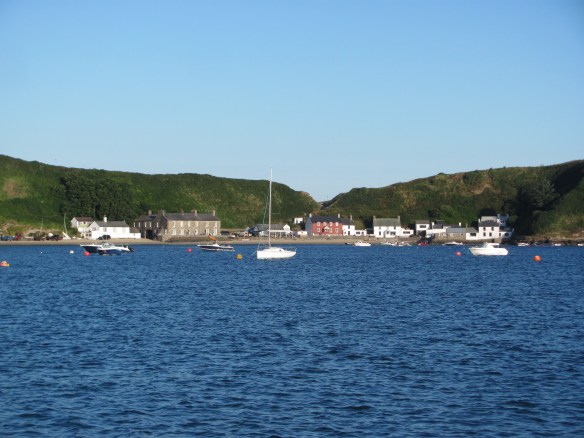
We arrive in Porth Dinllaen around 1930 and find a place to anchor opposite the small village of Morfa Nefyn. Charisma is already there. We cook dinner and sit and watch the last of the sun’s rays reflecting off the white-washed houses.

Porth Dinllaen.

Pwllheli

The next morning is wet and misty, with visibility poor. High water is at 0700, so to clear the bar we have to leave then. Seeing the green buoys through the drizzle and mist is a challenge as the mist completely disorients us, but by following the track of the GPS we had made the night before, we finally reach the red and white buoy marking the river entrance. Now safely out past the bar, we decide to anchor and have breakfast, hoping that the mist and rain might clear.

Our track in and out of Aberdyfi harbour. Note the shifting of the channel at the river mouth.

Sure enough, an hour later, the rain stops, the mist disappears, and the sun peeks out from between the clouds. Welsh weather is nothing if it doesn’t change at the blink of an eyelid. Living in Wales during my university days had taught me that. The wind is from the south, so we hoist the sails and head north, this time to the narrow channels that take us through Sarn-y-Bwch and Sarn Badrig (St Patrick’s Causeway), two more glacial moraines similar to Sarn Cynfelyn we had encountered just outside Aberystwyth. According to the legend, they were also causeways leading to the kingdom of Cantre’r Gwaelod.

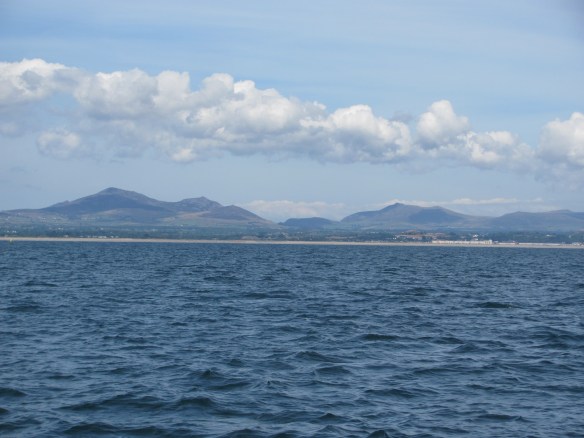
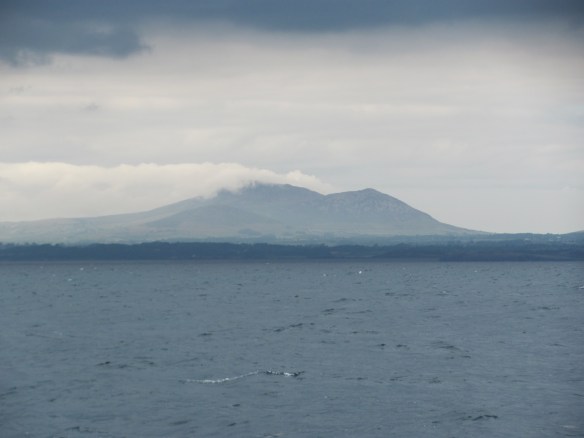
Once safely through them, we set a course for Pwllheli, our destination for the night. The wind is still from the south, on our beam, and we have some good sailing across Tremadog Bay with the mountains of Snowdonia in the background. Up until now, Peter has been a little bit disappointed that he has not yet seen more mountains in Wales, but this makes him happy. One of them even looks like a volcano with its covering of cloud.

The mountains of Snowdonia from Tremadog Bay.

An active volcano in Wales??

As we arrive at the marina, we pass a rower heading in the same direction. We ask her where she has come from to which she replies Shrewsbury. With Shrewsbury well inland, we think either we misheard or she is joking, but we find out later that she is indeed from there. Her name is Kelda Wood and she is planning to row single-handed across the Atlantic in her small boat Stormy Petrel to raise funding for her charity helping young people to regain their confidence after a life-changing injury. She herself suffered a leg injury while horse riding when young. It’s a big challenge to row that distance but we wish her all the best and hope she makes it. Brave woman!

Kelda Wood and her Stormy Petrel.

That evening, we take a walk around Pwllheli, but it is late and nothing is happening except for a fish jumping out of the footpath. It happens all the time, so we content ourselves instead with an ice-cream before heading back to Ruby Tuesday.

Fish trying to escape the concrete jungle.

Aberdyfi

We leave Aberystwyth just before high water the next day, and head out to sea to avoid the shallow parts of the underwater shingle spit Sarn Cynfelyn that stretches out several miles into Cardigan Bay. Legend has it that this was a causeway that led out to the kingdom of Cantre’r Gwaelod in the middle of Cardigan Bay, which was flooded when one of the princes of the kingdom during a drunken stupor accidentally forgot to close the sluice gates of one of the dykes protecting the kingdom. The remains of a submerged forest which was supposed to be part of the kingdom can still be seen on Borth beach just to the north of the spit. Apparently if you listen carefully on a stormy night, you can still hear the kingdom’s cathedral bells ringing, warning sailors to keep away. It’s a great story, with parallels with other Celtic flood myths, but geologists tell us that it is more likely to be moraines of the glaciers that once flowed down the associated valleys during the Ice Age.

Cardigan Bay showing the shingle spits and our route to Aberdyfi.

About three miles out to sea, there is a deeper gap through the spit called the Main Channel, which we take before turning northwards for Aberdyfi, where we have decided to stop for the night. With a fresh westerly breeze, we have a good sail along the coast up to the mouth of the Dyfi River marked by a large white and red buoy. We call the Aberdyfi harbourmaster, who tells us that the course of the river has changed, and that we should follow the green starboard marker buoys into the harbour where we can tie up to one of the visitors’ buoys. The only problem is that the positions of the green buoys bear no relationship to the charts we have, at least for the first bit.

At that moment, the wind strengthens and it starts to rain, so we decide to put our trust in the harbourmaster knowing what he is talking about and head for the first green buoy, keeping a watchful eye on the depth sounder. With the onshore breeze and the waves breaking on the bar, it won’t be an easy matter to turn around again if we have to, but luckily we manage to stay in the new channel even though we have only a metre of water below the keel in one or two places. The green buoys are quite far apart, so it is not always easy to spot the next one. However, eventually we rejoin the old channel, find the visitor’s buoy, and manage to tie up to it. And none too soon, as the heavens open fully at this point, forcing us to retire to the cabin to dry out and warm up. The salmon we have for dinner that night goes down a treat!

Cooking the dinner after mooring in Aberdyfi.

Aberystwyth

Three feet hit the white bar simultaneously in time-honoured tradition.

We are in Aberystwyth, my old university town. Back then it had been a ritual for anyone walking along the promenade to ‘kick the bar’ of the white railings when they reached the northern end near Constitution Hill. There are a number of theories about the origins of the tradition, but the one that I like best was that Edward VII had visited the town when he was the Prince of Wales, and while walking along the promenade had put his feet up on the bar to retie his shoelaces. The people of the town had continued the tradition as a mark of respect to their prince.

‘Kicking the bar’ on Aberystwyth’s promenade.

We had left Fishguard around lunchtime the day before and had caught the tidal current northwards. A light breeze had allowed us to hoist the sails to give Peter a chance to hone his sailing skills. Coming into Cardigan, we were amazed at the rock formations and the way that they had been rolled up into a near perfect circle. What forces had caused that, we wondered?

Interesting rock formations near Cardigan.

As we were in no specific hurry, we had decided to anchor in Cardigan and enjoy the sunset with a glass of wine before cooking dinner. An initial attempt on the northern side under a brightly-lit hotel had proved to be too exposed to the slight swell coming in from the south-west, so we had motored across to the south shore near the old lifeboat station and anchored there. Protected from the south, it had been much smoother. We had thought briefly about visiting Cardigan town, but the wide shallow bay had meant that we would have a long way to take the little dinghy before reaching shore, so we decided to stay on board, cook dinner, and retire early.

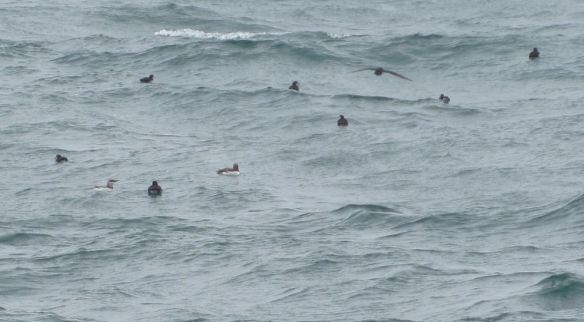
We had left at 0800 the next morning and continued northwards. The sun had come out, and the wind had dropped to a mere puff. The sea had been like a mirror, disturbed only by Ruby Tuesday’s wake. From time to time, we had encountered flocks of black guillemots on the water enjoying the peace and warmth and dispersing only as we neared them to settle a little further away. The light had been ethereal, bathing the sea and sky in a soft glow. Only the billowing clouds of the weak cold front on the horizon we had been warned about on the forecast had reminded us that it would not always be so peaceful.

The cold front on the horizon.

I lie on the foredeck in the sun and ponder the ideas in Peter Reason’s book on the relationship between ourselves and nature. At one level, it is not difficult to surmise why this division might have occurred in the first place – nature can be dangerous and life-threatening, and once humans developed an awareness that there is a distinction between life and death and that the latter could be caused by things in the natural world, then it became an enemy, first to be avoided, then to be controlled to meet human needs. I wonder if prehistoric humans conceived of themselves as being different. No one knows for sure, but the cave paintings they left behind would suggest that they worshipped some of the animals around the and therefore saw them as being higher and stronger than themselves. Later we realise that we are cleverer than most animals and we worship other natural objects that we think are stronger – the sun and the moon. The division between nature on earth and humans has begun.

A gannet flaps stiffly over the boat, turning its yellow head this way and that in search of an unsuspecting meal. It reminds me briefly of the annual harvest of guga, or young gannets, by the men of Ness in the Outer Hebrides, carrying on an age-old tradition. Modern civilisation has lost this direct link, and indeed condemns it, but Reason argues that to reconnect to nature, we need to start a new conversation with it. I think back flippantly to my light-hearted chat with my bird friends at Beaulieu River, and am relieved that at least I hadn’t thought of eating them. Perhaps there is hope yet. But I wonder if we can really reconnect again, or whether we are forever separated by our intellect and self-awareness? We can say the words, but does anything really change in our minds? Or is nature just a human construct, able to be changed over time like many more of our worldviews?

We are nearing Aberystwyth now. I awake from my reverie and calculate whether we can enter the harbour yet. There is a sand bar to avoid and we have been warned by the harbour master that the river is quite silted up, so we must enter two hours either side of high water and must carefully follow the transit marks of a west cardinal buoy and a yellow pole behind. It is still three hours to high water, and so we must wait another hour before there is enough depth for our draft. We anchor for lunch just outside the harbour and wait.

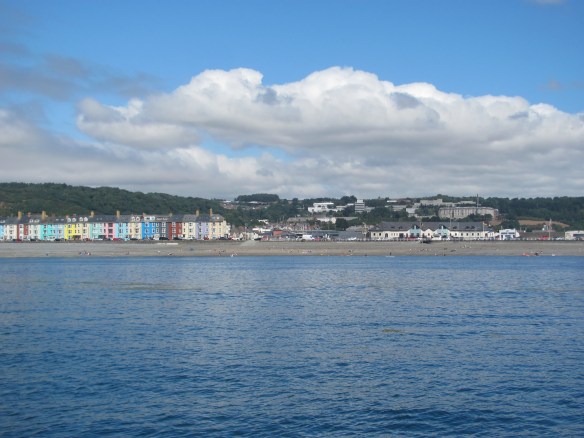
Aberystwyth.

Eventually we enter without any trouble and tie up to our pontoon alongside another couple who are heading north to watch the end of the Round the World Clipper race in Liverpool. He had been one of the crew on a previous leg.

We set off for the town to see the sights. I explain that before we do anything else, we have to complete the tradition of ‘kicking the bar’, so first up is the promenade. Duty done, we wander back to the pier and have an ice cream in the hot sun.

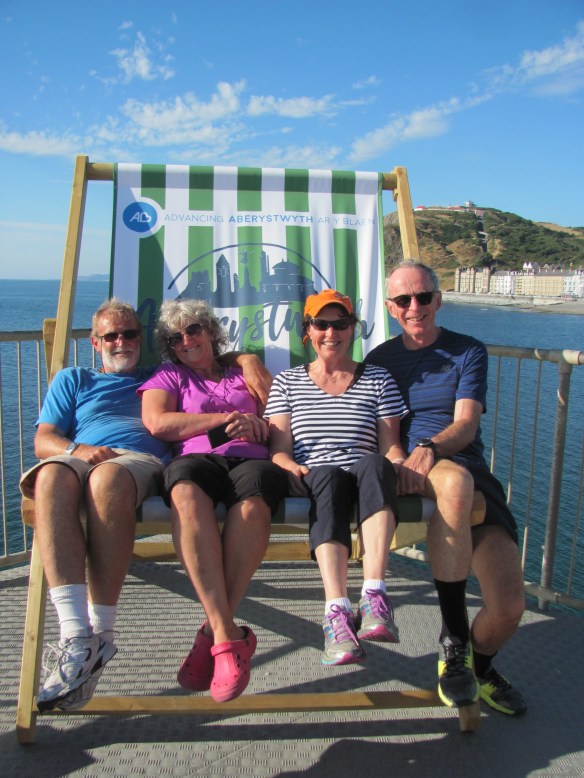
On the Aberystwyth Pier.

I point out the places I used to frequent, and talk about the people I used to know and the things we got up to. We even find one of the student houses I used to stay in –it is in a state of disrepair, but looks like it is being refurbished from the scaffolding around it.

One of the houses I used to live in.

Further on, we come across the chippie that sustained us when we couldn’t be bothered to cook. It had been an enjoyable stage of my life, an awakening of self, so it is a time of nostalgia for me now – 40 years is a long time ago, and a lot of water has flowed under the Rheidol bridge since then.

The Central Chippie.

Our sightseeing done, we traipse our way wearily back from the town and sit and have a drink watching the sun go down over Cardigan Bay.

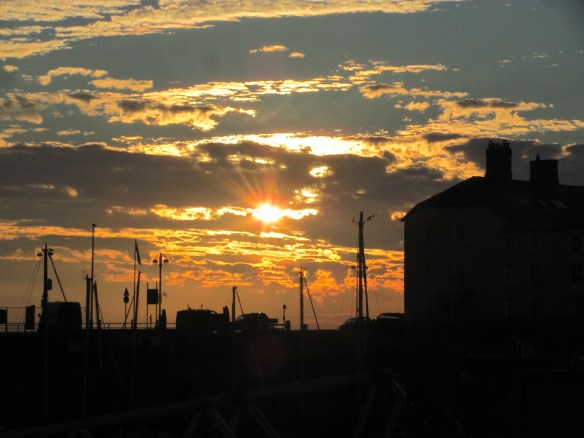
Sunset over Aberystwyth marina.

Fishguard

We fill up with fuel at the refuelling pontoon at the Milford marina entrance and cruise slowly out of the entrance lock. It is ‘free-flow’ time, meaning that the tidal level outside is the same as or more than the water level within the marina, so the lock gates can remain open. We head off down the way that we came in the previous day, following a giant tanker also on its way out. We pass Dale bay and make for Milford Harbour entrance. A huge cruise ship is coming in which we pass on our port side. It seems very close and we can see some of the passengers on deck.

Phew! We missed it!

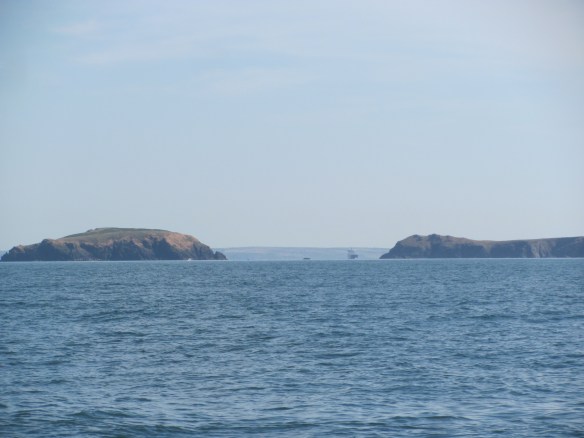
After many discussions and calculations, we have decided to take the outside passage around the outside of Skokholm, Skomer and Ramsey Islands. These are all islands with narrow channels between themselves and the mainland which funnel strong tidal currents through the gap, particularly during spring tides. Jack’s Sound, between Skomer and the mainland, is particularly notorious. Passages through these channels are fraught with dangers, with jagged rocks, steep cliffs and underwater reefs to avoid, all the while being whisked along at 7 knots or more. No wonder that many ships have come to grief there over the years. It seems they can be done if the timing in relation to slack water is spot on, and the correct transits are followed, but even then there is no margin for error. We had considered attempting them, but we had been advised against it with our deep keel possibly snagging the sloping edges of the channel.

Passing the western tip of Skokholm Island.

The three islands themselves are Sites of Special Scientific Interest (SSSIs). By coincidence, Moira had been there on a field trip the week before we had met her, and she had regaled us with stories of the puffins and shearwaters that live on the island. Apparently the latter are so dense that if you step off the marked pathways, there is a good chance you will step on a burrow and crush the bird inside. As we are swept past, we are sorry that we don’t have the time to stop and visit the island and see its wonderful inhabitants.

The notorious Jack’s Sound between Skomer Island and the mainland.

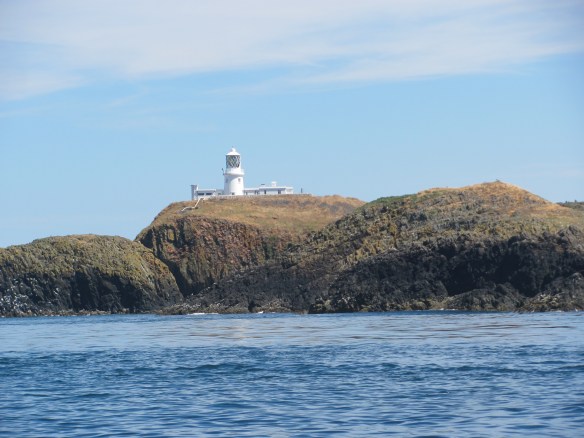
We are swept past St David’s Head at 10 knots, most of which is the tidal current. In the distance we can see the bright light of Strumble Head lighthouse, even though it is more than ten miles away and daylight. Beyond St David’s, there is a little wind, but the northward current is still strong, so we set the sails and the autopilot and spend the afternoon reading, fishing and sunbathing as Ruby Tuesday sails herself along the Welsh coast. This is idyllic – who could wish for more?

Idyllic.

I continue reading my book called “In Search of Grace: An Ecological Pilgrimage” by Peter Reason, in which he describes a voyage he makes in his yacht from the south of England, round the west coast of Ireland, then on to the far north of Scotland. He sees his trip as a pilgrimage, to reconnect with the natural world in some way. The technology of civilisation has separated us from this natural world by minimising the impact of natural forces on our lives, so much so that we are now influencing earth systems rather than being only influenced by them. This has resulted in climate change, loss of biodiversity, soil degradation, pollution of the air and seas, and all the other ecological problems we are causing. We need to rethink our place in the big scheme of things and see ourselves as part of nature rather than separate from it. We are already part of it of course; it’s just that we don’t see ourselves that way. He defines a pilgrimage as a journey of moral or spiritual significance taken to seek answers to deep questions by escaping from the everyday and, in this case, experiencing the Earth’s ecological processes in the raw. Many of his ideas resonate with my own, and, although I don’t like the word, I wonder if our own voyage is a pilgrimage of sorts. Certainly we have escaped the monotony of everyday work life of meetings, deadlines, and targets that we had, and are governed now much more by the winds, weather, currents and tides than we were. We do have a sense of seeking something more than ourselves, but the deep questions that we want to confront are only half-formed. Perhaps they will become clear during the rest of this voyage or on future ones …

The fishing line twitches, and we think we have caught a fish. We wind it in eagerly, but it is a piece of kelp that has become caught somehow. That pretty much sums up our luck at fishing so far. We throw it back.

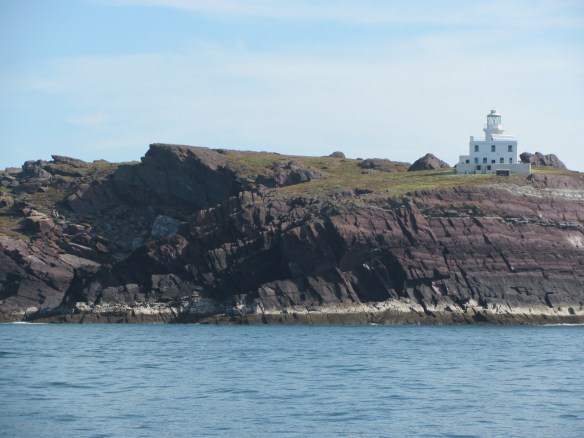
Passing Strumble Head lighthouse.

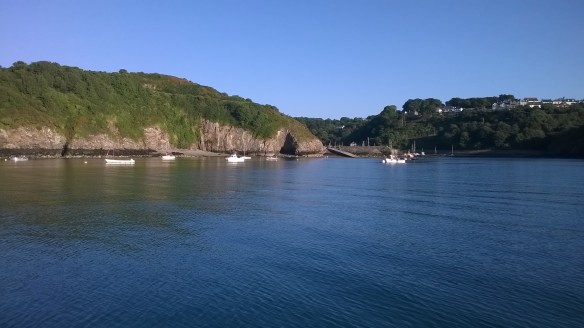
We arrive in Fishguard and anchor in the little bay on the south side of the harbour beneath a castle on a promontory. Appropriately, it is called Lower Bay. We pour ourselves glasses of wine and watch the sun go down. The light adds a soft glow to the greenery on shore and the stone buildings of the small village of Lower Town and we are mesmerised by their beauty.

Lower Bay, Fishguard.

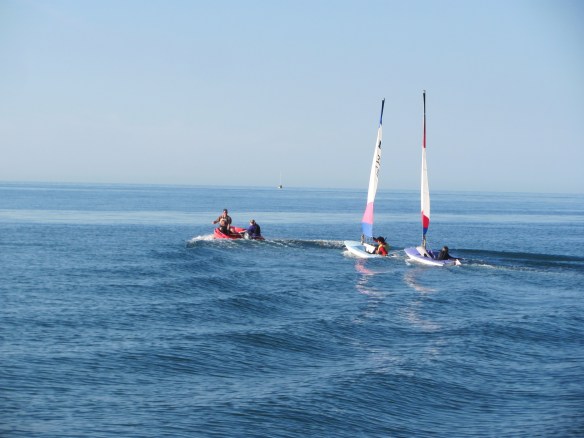
The local sailing club is out in force, and we watch youngsters in their sailing dinghies being put through their paces by their instructors. We think they are lucky to have such a beautiful place to learn their sailing in.

Learning to sail in Fishguard.

Later that evening, the train from London arrives with Joanne and Peter, my sister and brother-in-law, on it. They have just flown from New Zealand to Britain the day before to spend some time in Europe, and are still exhausted from the jet-lag. They are joining us for a week’s sailing before heading off to Mallorca, Morocco and Spain. We find a taxi to take their luggage from the station to the pier in Lower Bay, then load it into the dinghy and ferry them across one-by-one to Ruby Tuesday. We are well accustomed to sailing with each other, having done trips in Greece and New Zealand in previous years, so we are looking forward to having them with us.

Joanne and Peter arrive in Fishguard on the train.

Transferring to Ruby Tuesday.

They have worked out that they need to be back to Gatwick for their flight to Mallorca by early afternoon on the following Friday, and have found a train leaving from Holyhead at 0900 that would get them there on time. We carefully plan our week’s sailing to make sure that we arrive in Holyhead the evening before.

Milford Haven

“Unidentified yacht off the Firing Range Patrol vessel’s bow, please identify yourself and your destination”.

For the second time on the trip, we are intercepted by a Ministry Of Defence vessel. It seems that we have strayed a bit close to the Castlemartin Firing Range to the east of Milford Haven. We are not quite sure why we are unidentified, as the words Ruby Tuesday are blazoned in huge letters along the boom for all to see, but we think they might be too young to remember the Rolling Stones.

“Yacht Ruby Tuesday, heading for Milford Haven”, we say.

“No problem, but could you keep out of the firing area as it is active today, and we wouldn’t want any accidents, would we?”, they respond, friendly but firm. “Keep on a new course of 275° until you receive further instructions from us – that should be OK.”

They zoom off in the opposite direction. Feeling a bit like Jim Phelps in Mission Impossible, we comply with the instruction. One hour later, we are still on the same course, so we call the patrol boat on the VHF.

“Sorry, we forgot about you”, they reply. “Please alter your course to 330° and wait for us to call you again.”

Another hour passes, and we seem to be passing the entrance to Milford Haven. Thinking they might have forgotten us a second time, we call them again. This time there is no answer. We decide to head directly into Milford Haven. We are not arrested, so we assume they have all gone home. We hope they are not quite so forgetful when they are on active duty.

Intercepted by the Firing Range Patrol vessel.

We had left Lundy early that morning, and had caught the tide that helped us on our way northwards. In the lee of the island it was calm to start with, but once we passed the headland the wind strengthened to 18 knots and the sea became quite rough. We reefed to reduce the sail area and wallowed our way through the waves coming on our beam. It was cold, so the First Mate went below decks while I put on my jacket and sat in the cockpit.

Alone on the sea.

I am struck by the solitude. Lundy fades from view and we cannot yet see the south Wales coast. No other boat is in sight – we are alone and might be the only people in the world. Only a flock of black guillemots bobbing on the waves passes us. It is us and nature. It is tempting to think that we are at one, and yet we wouldn’t be here if it wasn’t for our civilisation – Ruby Tuesday herself is the product of centuries of accumulated human knowledge and modern materials, and we are aided by the wonders of the electronic age. We are semi-sustainable in that we can last for several days on the provisions, water and energy we have on board, and can travel using the natural forces of wind and tides, but eventually we must return to our comfort zone to restock and repair if necessary.

Can mankind ever be truly sustainable? In a sense we have to – this planet is all we have, and if we can’t it may dispose of us. The evolutionary record shows that many species have disappeared because they have not been able to adapt to changing circumstances. And yet, other species have changed their environment irrevocably and created conditions for new species to evolve. We ourselves would not be here if various bacteria had not learnt how to produce oxygen as a waste product. We are now in the Anthropocene, a geological age in which the activities of humans have a marked influence on earth processes. A bobbing lobsterpot buoy off our starboard bow reminds me that even the seas we are sailing over have unseen particles of plastic detritus from our waste. What will be the outcome of our presence – new opportunities for evolution to thrive, or massive extinctions? We just don’t know.

Are we destroying their environment?

We enter Milford Haven, and turn left into Dale Bay. An old friend from university days has a mooring buoy there and has offered it to us to tie up to as his own boat is having repairs done to it. We have its number and GPS coordinates and have no problems in locating it right under Dale Fort, a field studies centre. It is near the shore. We are a little concerned that it might be too shallow for our draft, but we calculate that we will have about 30 cm below the keel at low water, just enough in these calm conditions. We relax and enjoy the evening by cooking dinner and catching up on our reading.

Dale Fort, Milford Haven.

In the morning, we cruise slowly up to Milford Marina, which has a lock gate that opens at 0900. On the way we pass giant oil tankers anchored near the petroleum storage terminal on the southern shore of the harbour. Once an oil refinery, the terminal, with its huge chimneys reaching into the sky, reminds us of a mosque and its minarets, a shrine to the excesses of the age of fossil fuel.

Milford Haven oil storage depot: a temple to the age of fossil fuels?

We have arranged to refuel and also meet an old friend at Milford Marina. Moira, another friend from university days, is an avid retired geologist and accompanied us on a sailing trip around Mull in 2016. It is good to see her again and we have lots of catching up to do. Over lunch on Ruby Tuesday, we talk about our offspring and mutual friends from long ago, and what they are all up to now. She is heavily involved in leading and supporting local geology groups around Malvern Wells, where she lives, and in fact has to be back the following day to meet the president of a nearby Geopark to help organise an outing for its members. We had thought that she might stay the night with us and perhaps sail around to Fishguard, but it isn’t possible. She’s a busy lady.

Moira.
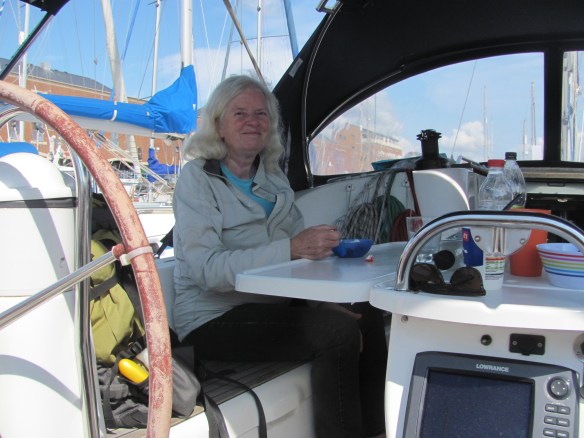
In the evening we do a big shop at the Tesco’s next to the marina and stock up for my sister and brother-in-law who are joining us in Fishguard for a week’s sailing.

Lundy

The barman strokes his chin pensively before he answers. “Well, there was a yacht that was here a year or two back, and they anchored in that self-same place, it started to blow an easterly, and, well, you can see what’s left of it down on those rocks at the end of the bay.”

We are in the Marisco Tavern on Lundy Island. While buying drinks, I had asked the barman casually if the holding was good in Landing Bay, hoping that he would allay my fears about Ruby Tuesday drifting off. We hadn’t seen the yacht he mentions, but it does nothing to allay my fears in any case.

Approaching Lundy Island.

We had arrived in Lundy around lunchtime from Padstow. Another glorious day, but very little wind, and we had only managed to sail for part of the way before starting the engine. We had been met by a school of dolphins a few miles off the island, who had accompanied us for some time before breaking off suddenly and disappearing into the depths. They were probably bottle-nose dolphins, but seemed smaller than the ones that we see in Scotland.

Dolphins escorting us to Lundy.

We had anchored in the appropriately named Landing Bay on the south-east coast of the island, had lunch on board, then taken the dinghy across to the concrete slipway. We had calculated the tidal range to be a massive 7 m, so we were careful to lug it over the rocks and well beyond the high water mark, a not insignificant effort.

Anchored in Landing Bay, Lundy.

From there, we had walked up the gravel track, zig-zagging its way to the top of the cliffs, until we had reached the cluster of farm buildings that essentially constitute the ‘capital’ of the island, consisting of a pub, general stores, a museum and basic accommodation for the many visitors that come to the island.

General store, Lundy Island.

Near the museum was a camp site with two solitary tents pitched at opposite ends of the field. Being a Sunday, the store had been closed, but we had a browse of the museum before setting off along the path to the north.

Looking out to the north of Lundy Island, with overfalls visible.

Some of the inhabitants of Lundy.

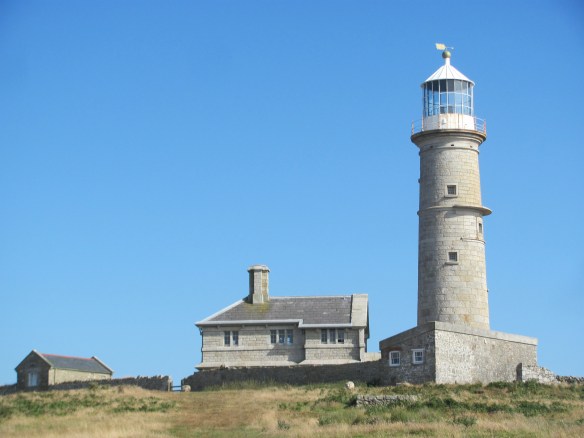
We had looped back along the western coast until we had reached the Old Lighthouse, which was built around 1819 but which turned out to be too high and above the cloud cover so that ships weren’t able to see the light. Quite a design flaw, in my mind! From there, we had returned to the capital to have dinner in the Marisco Tavern, where we are now.

The Old Lighthouse, Lundy Island.

We order dinner. While waiting for the food to arrive, I find a book and begin reading of the history of the island. It seems that in the 13th century, a certain William de Marisco found himself on the wrong side of Henry III by somehow being involved in the murder of one of his messengers. Not only that, a few years later there was an attempt on Henry’s life itself, and again, William de Marisco was involved. To escape the king’s wrath, William decided to head to Lundy and barricade himself there. Henry tolerated this state of affairs for a few years, but eventually invaded the island, with his men scaling the cliffs of the islands and capturing William and his supporters. He built a castle there to maintain law and order, which was successful for a while, but the island gradually reverted to being a haven for pirates and other ne’er-do-wells, including descendants of William de Marisco, who would raid ships heading up the Bristol Channel with valuable cargo.

In the Marisco Tavern, Lundy.

The food arrives. I had gone for the Lundy sausages and the First Mate had ordered a sweet potato bake. Both slipped down a treat. Afterwards, as I finish my beer, I continue to read more of the history of the island. For some reason, it seems to have given its various owners a sense of grandeur, several seeing it as their kingdom and themselves as kings. Even as recently as 1924, a Martin Coles Harman bought the island and proclaimed himself king, and going so far as to issue coins with puffins on them. It wasn’t the first time that Lundy coins had been issued, but this was the 20th century after all, and he was prosecuted and fined. So much for self-proclaimed kings!

On the way back to the boat, we pass the island’s church. This had been built by the improbably-named Reverend Hudson Grosset Heaven in 1896, another owner whose lifelong ambition had been to build a church, even more so than a new harbour which the island desperately needed. He was the son of one William Hudson Heaven who had bought the island in 1834 for grouse shooting and treated it as his own little fiefdom, which became known as the Kingdom of Heaven. It might have been better to put Mammon before God in this case, as the finances of the island deteriorated with no harbour, along with the fortunes of the Heavens who ultimately had to sell it.

St Helen’s Church, Lundy.

Inside St Helen’s Church, Lundy.

We eventually reach Landing Bay again, and find that the tide has risen almost up to where we tied the dinghy. All in a few hours. We launch it into the surf that is now breaking onto the slipway and clamber aboard and make it back to Ruby Tuesday.

High tide at Landing Bay. We were glad we had tied the dinghy high up!

Restored vision

“Look into my eyes”, says the beautiful young girl with long eyelashes and shoulder-length hair seductively. For a moment, I think that I am 20 again and that it is my lucky day. Then I remember that I am in the Specsavers opticians in Newquay, Cornwall. I am having my new glasses fitted and she just wants to make sure that they are working as they should be. She wouldn’t be interested in an aging stick-insect like me anyway, I think. She makes a few adjustments and they are perfect. I can see again! Strangely, for some reason the girl with long eyelashes and shoulder-length hair has turned into a middle-aged woman.

I did go to Specsavers!

I had lost my glasses over the side of Ruby Tuesday in Fowey while trying to attach the dinghy. Later that day I had booked an eye test at Specsavers in Falmouth, and had gone and had it done when we had arrived there. Explaining that we were travelling around the UK by boat, they had promised to make up some new glasses and when they were ready they would post them on whichever of their branches was closest to us for collection. I had received a text from them just as we were coming into Padstow, had rung them, found out that Newquay was their nearest branch, and had arranged for them to send it first class post to there. We had taken a bus down from Padstow to Newquay to collect them.

We have coffee and cakes to celebrate, but suddenly realise that the last bus from Newquay to Padstow leaves in 10 minutes from the Great Western Hotel, about 10 minutes’ walk away. Grabbing our belongings, we rush madly down the street to the bus stop, and make it with mere minutes to spare. We don’t dare think of how we would have got back to Padstow if we had missed the bus. Taxi, I suppose?

Recovering after a mad dash for the bus back to Padstow.

When we get back, David, the Mikes and Patrick tell us they have decided to go the next day, and we need to change our boat positions around so that they are on the outside of the raft for an early start. We work out a sequence of rope manoeuvres that allow their boat to slip out backwards unimpeded, Ruby Tuesday to be pulled over where they were, then for them to take the place where we were. It is more complicated than I imagine at first, but it is all beautifully choreographed by David and goes according to plan. We are invited to their boat for a gin-and-tonic in recognition for not letting the side down.