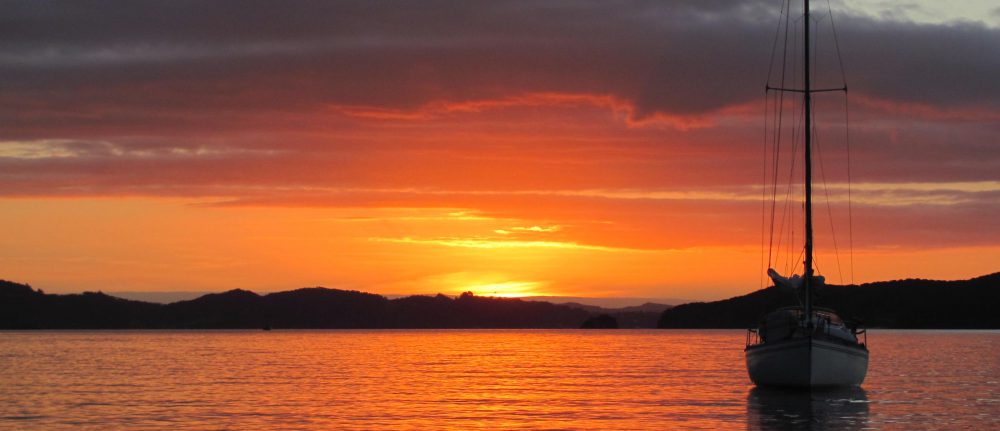
Isles of Scilly to Padstow

We leave the Scillies early the next morning, just as the sun is rising. We are aiming for Padstow, the nearest place with a deep enough harbour on the southwest coast, but it is nearly 70 NM away, and we also need to be there in time before the harbour lock gates close before low tide. We have done all our calculations carefully and think we can just about make it if we leave at 0500 in the morning. Our mooring neighbours, Noggin and Serin y Mohr, who are travelling together, have the same idea. We motor out of the Sound, past Cromwell’s Castle, and set a course for the northeast towards the sunrise.

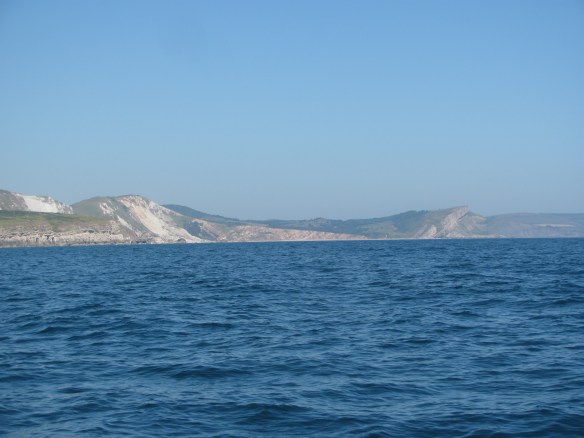
Leaving the Isles of Scilly for Padstow.

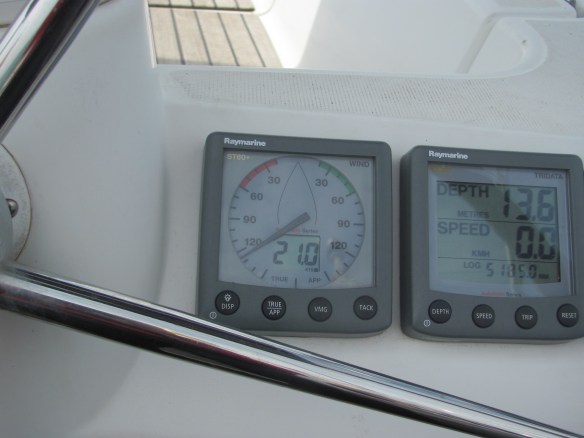
The wind has gone round to the northeast, the same direction we are heading, but it is just enough off our nose to catch some of its energy without tacking. Close hauled, we speed along at a merry rate, even reefing from time to time as the wind reaches 20 knots.

En route to Padstow.

The Isles of Scilly fade from view. The First Mate goes below to have a nap, and I sit alone in the cockpit. Just me and the sea. Now and then the radar and AIS pick up a vessel somewhere in the distance, usually well before I can see it visually. The wind is cold and I put on one of the jackets we bought in Portsmouth. There is lots of time to think.

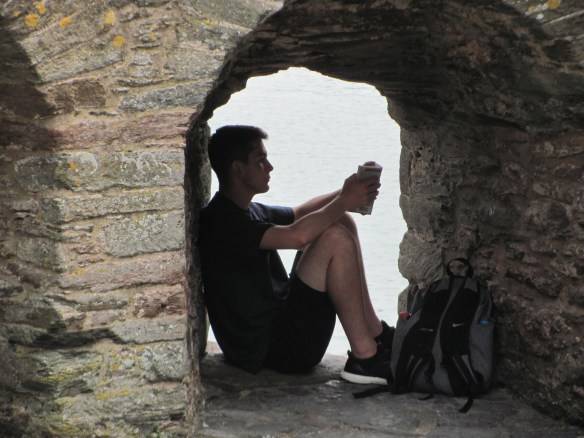
The small boy wakes up early and rushes into the lounge where the Christmas presents lie under the tree. His parents are already up. Eagerly, he opens the ones labelled for him; one is a book by Robert Louis Stevenson called “Treasure Island”. He curls up on the sofa and begins reading, and is immediately taken into a swashbuckling world of pirates, schooners, shoulder parrots, tropical islands and treasure chests. He envies Jim Hawkins and the adventures he has looking for the treasure left by Captain Flint – he would love to do something similar, to sail in a boat and discover new islands, fight evil buccaneers, and find buried treasure to make his fortune. Perhaps one day he would. He parents call him for breakfast …

We eventually near Padstow where the River Camel reaches the sea. The town and harbour are a little way up the river and we must cross the ominously named Doom Bar and navigate our way up a narrow channel to reach them. As calculated, it is near high water and we have enough depth to cross the bar without mishap. Luckily the channel has red and green buoys making its extent, but even so, we take a wrong turning, and end up in The Pool, a patch of deeper water where a number of small boats are moored. A weary-sounding voice comes on to the VHF and warns us that we are heading in the wrong direction, and please go back to the last red buoy and turn left. It is the Padstow harbourmaster, who had been watching us come in. It seems as if it must be a common mistake that visiting yachtspeople make.

We make it to the harbour gate eventually, and are given instructions to turn to starboard immediately after entering the harbour and raft up to two other boats as space is limited. We find the boats, edge alongside, lines are thrown across, and we are safely tied up for another night. The only thing is that we have to cross two other boats to get to shore. But we do have power and water at least. The harbour gate shuts behind us.

The harbour lock gate closes behind us.

Our new neighbours turn out to be four retired friends, David, Mike, Mike and Patrick, on their annual sailing expedition. The boat is based in Falmouth, and this year they have been exploring the Bristol Channel and had made it all the way to Gloucester up the River Severn. Now they are on their way back. Apparently the Severn is navigable to Gloucester, where there is a port, but they say that it wasn’t easy and that they had grounded several times where the depth was less than that shown on the chart. Nevertheless, they had enjoyed it immensely, and recommend that we try it. Unfortunately, we don’t really have the time, but we mark it down as a potential future expedition.
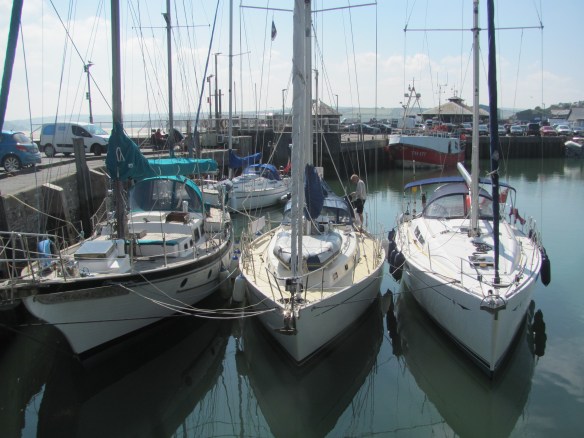
Rafted up in Padstow harbour.

We explore Padstow. It is an old fishing harbour, and is still used as such – tied up opposite us are two large trawlers. However, its main reason d’etre now seems to be for the summer tourists. It has a chocolate box charm, but most shops are selling only arts, crafts and fast food. One woman we talk to tells us wryly that there is nothing for local people any more, and that they have to travel to Wadebridge for their supplies. We try and imagine what it must be like in the winter, once all the crowds and good weather have gone.
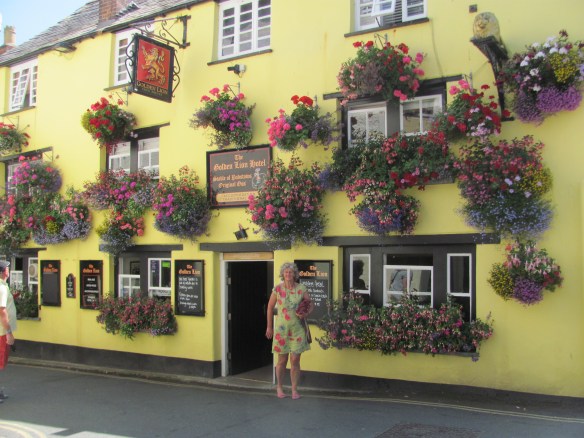
The Golden Lion Hotel, Padstow.

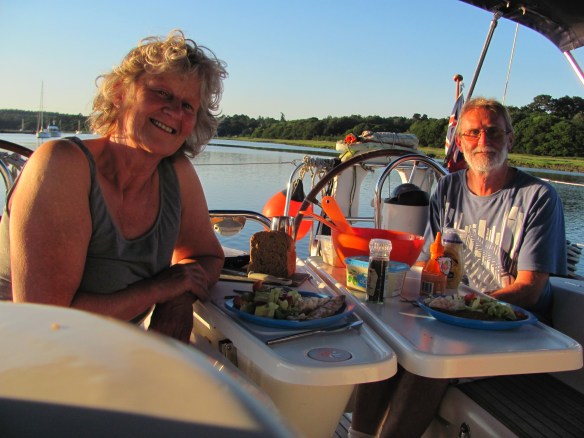
We eat our dinner that night on deck in the warm balmy evening, feeling part of the nightlife. On the other side of the harbour, guitar chords come from the Custom House pub, the crowds of tourists drink, laugh and sing, and the other sailors sip their wine slowly, also on deck. There is a vibrancy in the air, the sky is blue, the water is smooth as a mirror, and we feel something special about sitting on Ruby Tuesday and being in the middle of it all. Everything is alright with the world, tonight at least.
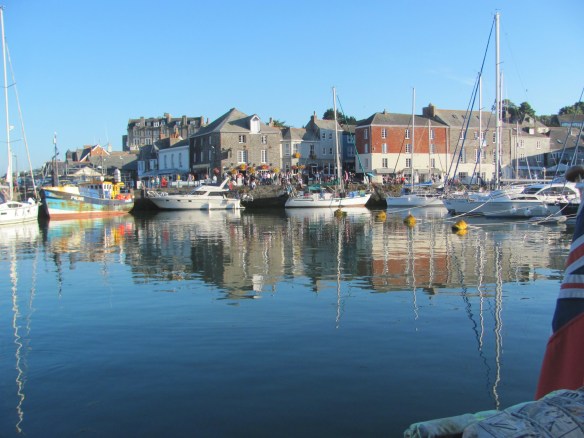
Enjoying the balmy evening in Padstow.
The Isles Of Scilly

The little girl wipes away a tear from her eye, as she watches the members of her village wend their way slowly to the top of the hill near where she is sitting. They are carrying grandfather on a pyre of wood that her father and uncles have been making over the last few days, ever since he had kept on sleeping and not moving. The procession reaches the burial chamber at the top of the village, the pyre is laid carefully in front of it, and the chanting begins. Her grandfather had told her that the chamber had been built by the Ancient Ones and that it was the entrance into the Otherworld of spirits where all people would go in time. Now it is his turn, she thinks. She shudders, the chamber frightens her; she remembers her cousin telling her that he had crept in one night and found piles of blackened bones in there. She watches the Druid advancing and lighting the brushwood underneath the pyre. The flames gradually take hold and crackle and roar into the sky. All of a sudden she feels very lonely.

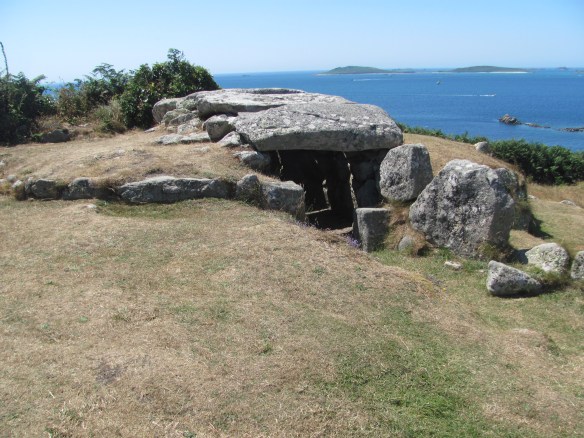
We are sitting on a small hillock overlooking the Halangy Down Ancient Village on St Mary’s Island in the Isles of Scilly. Beyond are the blue waters of Saint Mary’s Roads shimmering in the sunlight and the wide sweeping sand flats of the other Scilly islands, St Martins, Tresco and Bryher. A yacht picks its way through the shallow waters of Crow Bar, parts of which dry at low tide. It is idyllic, more like some tropical paradise than a far flung outpost of the United Kingdom.

Bant’s Carn burial chamber, St Mary’s, Scillies.

I am trying to imagine what sort of people might have lived here and what their lives might have been like. The village was occupied from about 300 B.C. through to about 700 A.D., but there is evidence of an older village further down the slope closer to the sea which was abandoned, perhaps due to advancing sand dunes. The burial chamber is much older than this even, dating from the Bronze Age around 4000 years ago, but seems to have been preserved by later people, perhaps because they respected it.

We had left Falmouth the day before after saying goodbye to Adrian and Helen. Once past the Lizard, the wind had picked up from the north and we scooted along on a beam reach. The sea had become choppier, plunging Ruby Tuesday up and down like a yoyo.

Passing the Lizard.

The mainland coast had receded into the distance, and for a short time we were out of sight of land alone on the sea before the dim shape of the Isles of Scilly appeared in the haze. We had anchored in Porth Cressa on the south side of St Mary’s, where it was relatively sheltered from the northerlies, and had taken the dinghy ashore to explore Hugh Town and the rest of the island.

Anchored in Porth Cressa, St Mary’s, Scillies.

Hugh Town is situated on a narrow isthmus of land and surrounded by beautiful white sandy beaches to the north and south. Boats of all shapes and sizes fill up the bays, and tourists throng the streets. Despite the houses being built of solid stone reminiscent of houses in Scotland, it had an air of a tropical paradise, at least on the days that we were there, with hot brilliant sunshine the whole time. We were not so naïve, though, to believe that the frequent sea mists and storms rolling in off the Atlantic would not give it a different character. We had had lunch in a small café on the Porth Cressa beach and then set off on a walk around the island, eventually reaching the Halangy Down Ancient Village where we are sitting.

Hugh Town, St Mary’s, Scillies.

We continue on our way, spurred on by the thought of coffee and German apfel-strudel cake at a small café in the centre of the island recommended to us by several people. On each side of the road are fields of freshly made hay, reminding us that there is more to the economy than just tourism. From time to time, people on bicycles pass us, and we wish that we had brought our little folding bicycles from the boat. We pass the giant telecommunications tower, and in the distance see a small twin-engined aeroplane taking off from the tiny airport on the south of the island, both providing links between the islands and the outside world. It is hot and we are glad when we find the café and some shade. The cake is delicious and we are reluctant to leave, but as it is nearly closing time we pack up and trudge on in the heat.

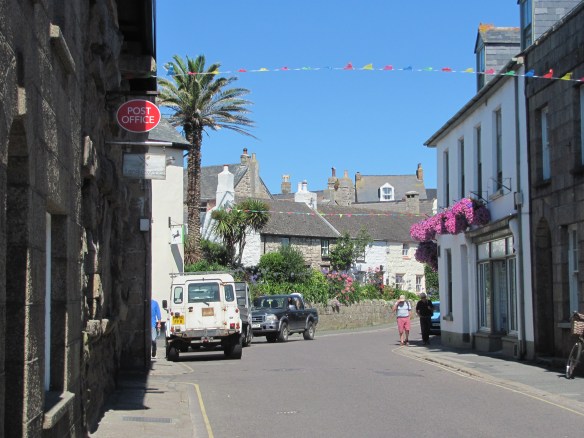
In the morning, we decide to move on to the neighbouring island of St Agnes. We anchor in The Cove, and once ashore explore the island. There isn’t an awful lot to it despite there being a Higher Town, Middle Town and Lower Town, and one single-lane concrete road running lengthways across the island connecting the three. Nevertheless, it has a charm of its own, and we shortly leave the road to explore the many small paths around the coast. We discover several small bays and coves that look enticing to anchor in, and indeed, a few already have a yacht or two in them enjoying their own piece of paradise.

The main road on St Agnes, Scillies.

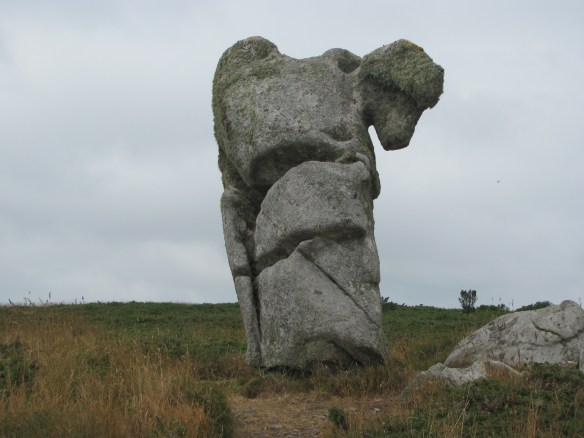
We pass some odd rock formations, one of which I think resembles a sheep, and are surprised to overhear another woman remarking to her companion how much it resembles an angel. Each to their own interpretation, I suppose, but it makes me wonder how many times we project our own backgrounds, experiences, hopes and fears on to inanimate objects, trying to create some meaning out of the patterns. I struggle to see the angel despite walking around the rock a couple of times, and decide that it is better as a sheep, for me at least.

Interesting rock formation, St Agnes, Scillies. A sheep, an angel or both?

We eventually reach the only pub on the island, the Turk’s Head, and decide to have dinner there. As we eat, we chat with the couple sitting at the next table, and discover that he is a writer for the BBC and she is a university lecturer in climate change. He is in the process of buying a gîte in France and she is moving to Sweden for two years. They are currently camping on the island and have been coming here for several years. Their dream is to buy a boat and sail around the UK, and are excited when we tell them that is what we are doing, albeit half of it this year. We end the evening discussing the collapse of civilisation as we know it and whether we can sail away to escape Trumpism, Brexitism and all the other –isms that we seem to be afflicted with. That Cornish Ale is good!

The Turk’s Head, St Agnes, Scillies.

In the morning, we decide to move on to two of the other islands, Tresco and Bryher. We cruise slowly through Smith Sound, then up into the Tresco Flats, a vast area of drying sand at low tide, thinking that we might be able to make it across into New Grimsby Sound between the two islands. Alas, it is too long after high tide and therefore too shallow, so we have to turn around and head north around Bryher the long way round, and into New Grimsby Sound that way. There are a number of boats already anchored there, but we find a spot with enough swinging room.

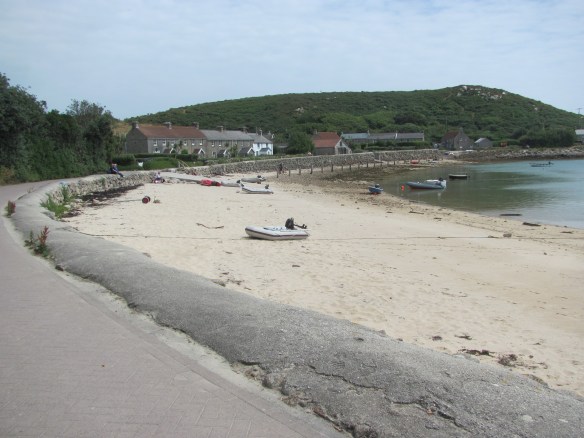
Going ashore at New Grimsby, Tresco, Scillies.

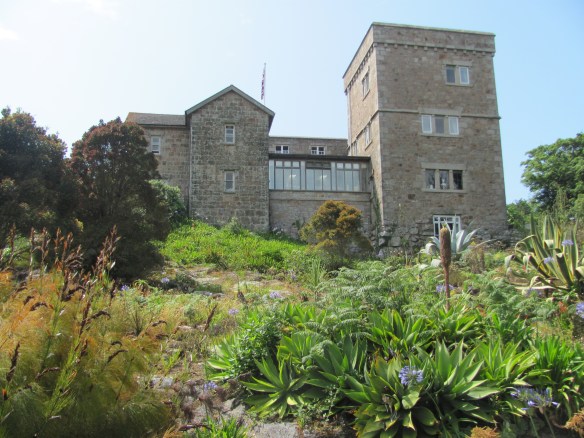
We take the dinghy across to the New Grimsby beach on Tresco and explore the island. The island’s claim to fame are the Abbey Gardens created by Augustus Smith, who owned the island in the nineteenth century, and amassed a collection of plants from his various travels. Later this was expanded by the Lord Proprietor of the Isles of Scilly, one Arthur Algernon Dorrien-Smith, to include plants from all over the world.

Abbey Gardens, Tresco, Scillies.

We return to New Grimsby and have a drink at the New Inn. Preparations are underway for the England-Croatia semi-final in the World Cup. We decide not to stay, but to have dinner on the boat and watch the match there. We decide it is probably the best decision given the result!

Returning to the boat from New Grimsby, Tresco.

Fowey

As we tie the dinghy to the pontoon, we notice a camera team filming. Surprised that they had found us as we had tried to keep our arrival in Fowey indiscreet, it slowly dawns on us that it is not us they are filming, but someone else. The two subjects are instantly recognisable – broadcasters Michael Buerk and John Sergeant. We learn from talking to one of the camera team that they are filming a new Channel 5 travel programme on sailing around Britain in a beautifully restored wooden cutter called Bonaventura, also tied up to the same pontoon. They too are heading up to Scotland, so we might see them again. It seems that the programme will be shown later this year; we make a mental note to watch it if we can.

A TV programme in the making.

We had arrived the day before late in the evening and had had to raft up as there were no visitor buoys left nor places on the mid-river pontoons. We had found another boat around the same size as us, Smudgley, and had tied up to her, trying not to disturb her occupants who were in the middle of their dinner. We had then pumped up the inflatable dinghy for the first time in the trip so that we could get ashore.

Rafted up in Fowey harbour.

We edge past the camera crew, and walk up to the town. Fowey (pronounced ‘Foy’) is a picturesque little place, a little like Dartmouth in that there is a matching town across the other side of the river, Polruan in this case. First stop is the Fowey Gallants Yacht Club for showers, which we learn later is named after a group of privateers who were given licenses to attack French ships during the Hundred Years War in the 1300s, and later defended the town against the Dutch. Swashbuckling times! Unfortunately we discover that two of the showers have been recently vandalised. We find it difficult to believe that this can happen in such a beautiful spot – who would do such a thing? We hope that it wasn’t fellow visiting yachtspersons.

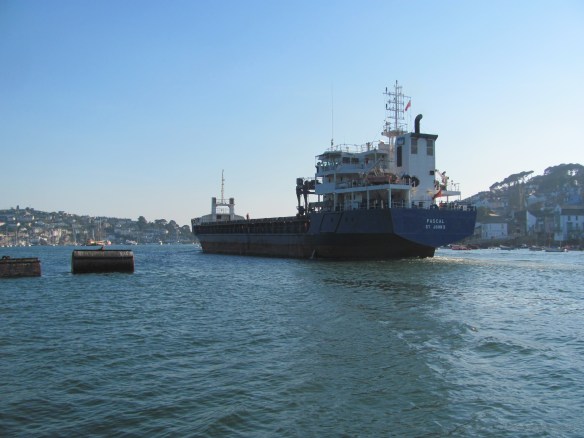
The town is also a deep water port important for shipping out china clay from Cornwall, and we are astounded (and somewhat nervous) to see huge ships wending their way through the hordes of little boats and yachts in the small harbour. Sometimes they even use the harbour area to turn around before being towed backwards up the river to the wharves where they load the clay. We are amazed that there are no accidents, but it all seems to work as it should.

Large ship passing through Fowey harbour.

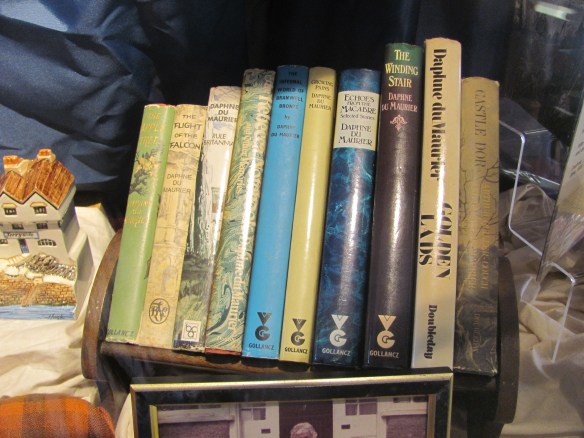
We visit the small museum in the middle of the town. Much of it is dedicated to two famous writers from the area – Sir Arthur Quiller-Couch and Daphne du Maurier. Neither of these have I read, and later I buy Rebecca from a second-hand bookshop to fill the gap.

Books to read.

Adrian and Helen arrive on the last bus in the evening. The plan is that they sail with us down to Falmouth and catch the train back from there to Exmouth where they live. After dinner, we lift and tie the dinghy on to the back of Ruby Tuesday so that we are not pulling it through the water, and in doing so, I lose my glasses over the side. I have no spares. As they sink slowly into the depths, I consider diving in after them, but there are too many things in the way and I decide that further injury is not desirable. It is 10 m deep here, and we wonder if they might be found with a mask and snorkel, but as the water is pretty murky, we reluctantly abandon them to their fate. I will have to manage without them somehow. Such are the risks of boat life!
Newly glassless!

That evening, I turn on the radar instead of the fridge. I should have gone to Specsavers. At least we can see where our neighbours are, even if we can’t offer then a cold drink.

Dartmouth

The wind howls and the waves plunge Ruby Tuesday up and down like a cork. We are just off Start Point in Devon, heading for Plymouth. The forecast was for Force 4 or 5, but the wind speed has risen to 21 knots, almost Force 6. We are reefed already, but I decide to take in more sail area. We point the boat into the wind, but just then the in-mast furling mechanism jams and the endless loop works its way off the pulley. This is not a good time for that to happen. I crawl forward to the mast clutching a winch handle with one hand and holding on for my life with the other, and manage to wind the mainsail in manually, then feed the endless loop back through the pulley mechanism. It seems OK for now.

Strong winds around Start Point.
We had left Dartmouth that morning after a pleasant couple of days there. Dartmouth is a naval town, dominated by the imposing Naval Academy building on top of the hill. We had tied up to a mid-river pontoon with no water, electricity or land access, as all the good ones had been taken by the time we had arrived. At least our pontoons were cheaper, and we could run the engine for a while in the evening to keep the batteries topped up and to run the fridge enough to keep things cool. We needed to, as Dartmouth was also enjoying the sweltering weather the rest of the UK seemed to be having.

Collecting our mooring fees in Dartmouth.

We had met Helen and Adrian, some friends from Bedford days, but who are now living in Exmouth. It was great to see them again, and we had found a seafood restaurant to have lunch before exploring the town. This is Agatha Christie country, and not having read much of her work when I was young, I had been pleased to find a little second hand bookshop and buy a couple of her books for later reading. Nearby, someone else had seemed to have the same idea!

A quiet moment.

We had then caught one of the little water taxies run by the Harbour Authority that buzz about the harbour taking folk from one place to another for £1, and had headed to Ruby Tuesday on the other side of the river for coffee and cake. They are keen to do some sailing with us, so we agree to meet them again next weekend for them to do a leg with us.

Catching up.

We are out of the rough water around Start Point now, and the wind lessens. It is from the north and we head for Plymouth on a close reach.

Portland Bill

We are eating breakfast feeling a bit like the damned. Neither of us has slept very well, thinking about whether we will survive Portland Bill this morning, the point of land that sticks out and interrupts the tidal flows, funnelling them into overfalls and a race that is dangerous to man and beast, exceeding 7 knots at spring tides. Cunliffe, in his book The Channel Pilot, describes it as the most dangerous extended area of broken water in the English Channel. We have read all the guides and talked to several of the locals who have told us stories of doom and destruction to the extent we have worked ourselves up into a bit of a state, especially as we are doing it right on spring tides. However, we have no choice but to tackle it if we are ever going to get back to Scotland.

There are in fact two routes around the point – the Outer and Inner routes. The Outer route involves avoiding it all together by taking a wide berth but this adds several miles to an already long passage to Dartmouth where we are heading. The Inner route is a narrow channel of relatively smooth water about 200 metres off the point itself, but navigation needs to spot on or else there is the danger of being swept into the race. To make it even more of a challenge, the Inner route is also a favourite place for lobster fishermen to drop their pots and leave the buoys for hapless sailors to avoid.

Leaving Weymouth.

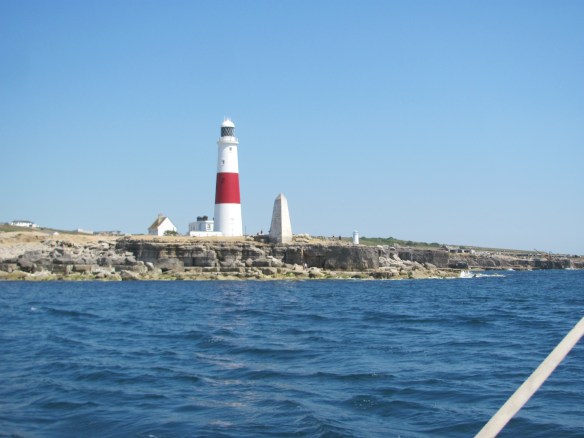
We have done all the calculations and aim to be at the Bill at around slack water when it is not so rough. We leave Weymouth in plenty of time and join the south flowing current just out of the harbour, which adds another know to our speed. Before long we see the lighthouse on the point and realise that we are now committed to the Inner route whether we like it or not. We continue to be swept along slowly but surely, and before we know it are passing the Bill and are in Lyme Bay, wondering what all the fuss was about. We have survived Portland Bill, but hardly know we have done it! We know the conditions are very benign today and try to imagine what it would be like normally.

Passing Portland Bill on the inner route.

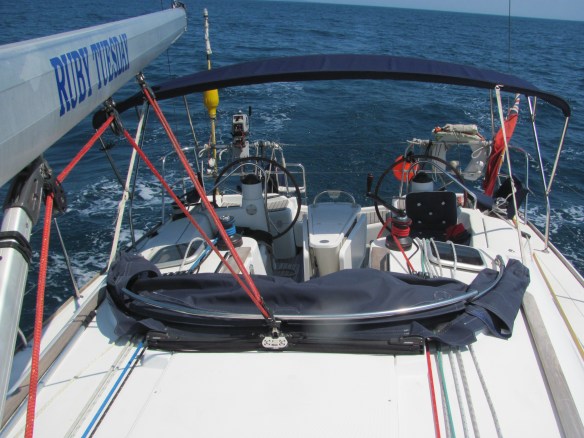
We set a course across the broad sweep of Lyme Bay for Dartmouth 45 miles away. The wind goes around to the north and picks up. We set the sails and the autopilot and spend the day reading while Ruby Tuesday sails herself. This is the life!

Ruby Tuesday sailing herself across Lyme Bay.

I lie on the foredeck in the sun and look up to the top of the mast. It is mesmerising to see the sails stretched smooth by the flow of wind over them, pulling the boat forward. It all seems a world away from the troubled times we seem to be in, from Brexit to the return of authoritarian politics. Why are we doing this?, I ask myself.

Forces of nature.

The small boy pushes the old tin bath tub into the murky waters of the pond and clambers in, trying not to get wet. The plug he had jammed into the plughole seems to be keeping the water out. The bath had been left behind the shed of the new house his parents had just moved into, and it seemed to be too good not to have a use. The pond, a widening of the stream running through a field at the side of the house, is waiting to be explored, and the two seem to be made for each other, the unused and the unknown. He picks up the piece of wood in the bathtub he has fashioned into a paddle and pushes against the willow tree growing on the bank. Unbalanced, the makeshift boat tips to one side and begins to fill with water. The small boy begins to cry …

Murder most foul

The man holds his head high and looks his accusers in the eyes. His stomach churns with fear, but he is determined that it doesn’t show. The eldest of the two men facing him demands again his confession to having stolen some of the contraband that had arrived by boat the night before. Once again he denies all knowledge of it, but he knows in his heart that they won’t believe him. He knows who the real culprit is, but he will not betray his own brother. The other men around him move closer, cutting off any way of escape. Behind him, the heat of the fire in the blackened stone fireplace reminds him that there is no way out that way either. The younger of his two accusers brings a long thin whip out from under his cloak and unfurls it. The blows rain down on the accused man, who falls to the floor still protesting his innocence, his arms up vainly trying to protect himself. Blood from his wounds spills onto the hearth of the fireplace. The men around him urge his attacker on. The whip wraps itself around his throat, stopping him from breathing. The world goes dark and the pain ceases.

‘What do you want to drink?’ a woman’s voice says. It is the First Mate. We are sitting in the Black Dog pub in Weymouth, supposedly the oldest one in the town. My mind had drifted after reading some of the pub’s history on the menu instead of choosing my food. It seems that the fireplace which we are sitting in front of was the scene of a grisly murder between smuggling gangs in 1758, but in this case an innocent man was killed.

The Black Dog pub, Weymouth.

We order soup. The menu tells me that the name of the pub comes from the Black Labrador dog owned by a previous landlord, which he had bought in Newfoundland and brought back to Weymouth. People would come from miles around to marvel at the colour of the dog, and the landlord became rich from charging them to see it. It’s a good story, but we are a bit sceptical of people paying to see a black dog, even in those times. But the soup and sourdough bread is good.

We finish our lunch and amble down to the seafront. It is hot, and we toy with the idea of sunning ourselves for half-an-hour in two of the many deckchairs on the promenade, until we realise that they need to be hired for the day. Besides, it seems obligatory to wear a panama hat, which I don’t have, so we content ourselves with an ice-cream surrounded by shouting children and crying babies. At least it is in the shade.

A hat enjoying the sun, Weymouth sea front.

Further on we find a Punch and Judy show, but unfortunately it is closed and the next performance is tomorrow. We feel we have missed out on an essential piece of British beach culture. In the distance we can see the chalk cliffs and the entrance to Lulworth Cove where we were the day before.

Waiting for the show to start.

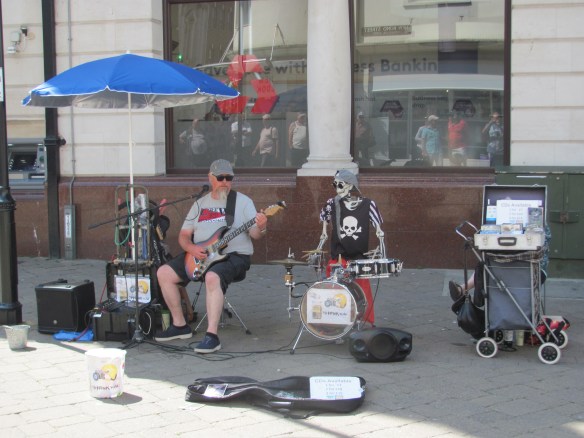
On the way back to the boat, we watch an old rocker playing on his guitar. He is good, but we are concerned about his partner who doesn’t seem to have been fed for several months!

Street entertainer in Weymouth.

We help the army

There is a bump. I wake up and look out of the boat, half expecting another boat to have collided with us. Nothing, although there is a new boat has appeared during the night and anchored not far away from us. We had heard stories of people smugglers using Lulworth Cove as a secluded spot to deposit their cargo after a fast trip from France in the early morning, but this boat doesn’t look like one of those.

It has been a rough night. The wind had gone around to the north at some point and had strengthened. Rather than being sheltered from northerly winds in Lulworth Cove as one might expect, it seems to act as a funnel instead. I had checked our position a couple of times during the night and we had seemed fine, but when I check the chart-plotter now I see that we have definitely moved from where we had anchored the night before. It seems the anchor has dragged, and we are closer to the rocks at the entrance to the Cove now. We decide to leave now rather than trying to re-anchor.

The anchor had dragged in the night somehow.

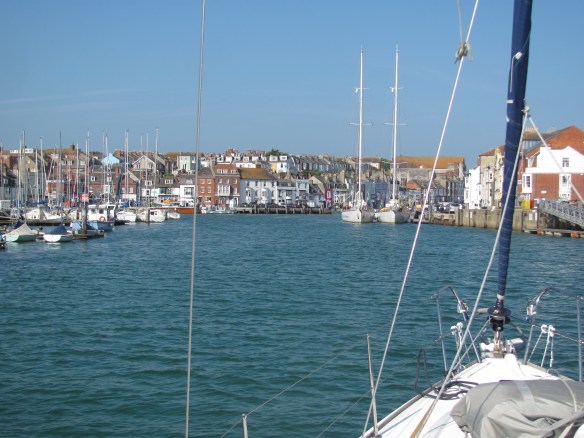
By the time we reach Weymouth, the sun comes out, and the town looks welcoming and cheerful. Even the harbour master  on the VHF sounds friendly when we call him to tell him of our arrival. The sun always seems to have that effect for me. To reach the marina, we must pass under a traffic bridge that lifts up every two hours. We are instructed to tie up temporarily to a holding pontoon and await the next time of lifting, which just happens to be in a half-an-hour or so.

Coming into Weymouth harbour.

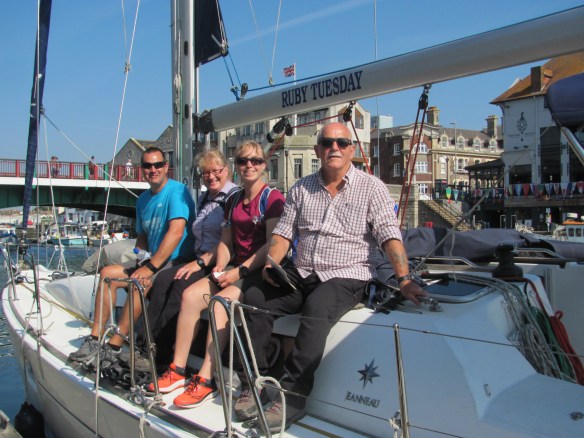
Just as we moor, we are accosted by a group of fit looking individuals who tell us that they are army cadets taking part in a competition and one of the challenges they have been told to do is to find a yacht and pose for a photograph with the owners. Would we mind? And we mustn’t allow any of the other teams to do the same. Momentarily thinking it might be a hoax and looking around for the hidden cameras, we don’t have the heart to refuse, and let them clamber on to Ruby Tuesday for their photo. Then just as they thank us and leave, a second team arrives with the same request. The word has clearly got around, and another and then another team arrives. Five teams in all. By this stage we are wondering if there is anyone left in the British Army that is defending the country, but it is all a bit of fun and we agree. At least we have done our bit for the morale of the troops.

The army have their photos taken on a yacht.

Eventually, a bell rings and the imminent lifting of the bridge is announced, so we need to focus our attention elsewhere. The traffic stops, the bridge lifts, boats coming out sail through, then it is our turn. We have arrived in the marina.

Lulworth Cove

We watch the patrol boat approaching with some trepidation. Have we made a mistake with our calculations of where we are? We are on the edge of the Lulworth Firing range and we know from the maritime safety information broadcast that it is active today. From time to time we have heard the rattle of gunfire from the land, and although we half wondered if we might see the splash of large shells hitting the water, we had thought that we were outside the exclusion zone. I had even called the Duty Officer earlier to confirm the route we should take,

The Range Firing Officer at Lulworth pays us a visit.

We needn’t worry. The patrol boat comes in close, and there are friendly smiles from the two occupants. They enquire if we are OK and where we are heading for, and reassure us that we are fine if we stick to the latitude of 50° 33’N that we are on at the moment, and that we should turn north at 02° 16W to get to Lulworth Cove. They wish us all the best and head off to intercept another boat that is approaching a mile or so away. We hear more shots in the distance.

Trying to avoid the Firing Range and looking for Lulworth Cove at the same time.

We approach Lulworth Cove under power as the wind has dropped. The entrance is not easy to see from the sea, but we have the waypoint coordinates and steer towards it. Suddenly the entrance opens out and we see several other boats anchored in there. We cruise in slowly and are momentarily taken aback to see that the beach and water are thronging with people. For some reason, we had naively assumed that we would have it all to ourselves. The relative solitude of being at sea has made us forget that there are many other people in the world too.

Anchored in Lulworth Cove.

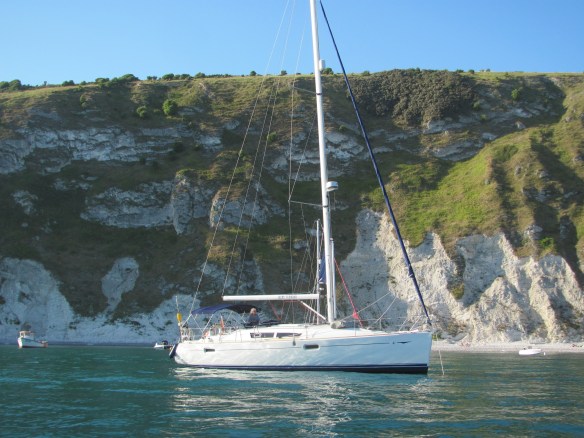
We find a spare place and drop the anchor, paying out lots of chain. It seems to hold. We sit and have a coffee in the sunshine, taking stock of the situation. This is Jurassic Coast country. The entrance to the cove is a narrow cut where the sea has broken through the limestone and allowed the waves to erode the softer clay and sands behind into a bulbous shape, while at the back of the cove are the steep chalk cliffs that have resisted erosion. We can see why geologists like coming here, and indeed we see a geology student with her hammer examining rocks in the eastern corner.

Interesting geological formations in Lulworth Cove.

A catamaran arrives and tries to anchor next to us. We think it is too close, especially when there is plenty of room in the rest of the Cove. Its skipper is alone and is trying to wrestle with the anchor winch at the front with no one to help him on the helm. The winch operates with a lever arm and seems to be jammed. I stand on our bow ready to fend him off if he drifts towards us. The skipper looks across the narrow gap between us and grins sheepishly.

“I am a little bit close to you, I think?”, he says, probably interpreting the look of alarm on my face. The accent is unmistakably German.

“A little”, I say, trying not to appear too concerned. The catamaran edges closer. There is perhaps five meters between us now.

“This winch is giving me problems and I am by myself”, says the Kapitan. “I have just bought the boat and haven’t anchored before.”

“If I could get across to you I could give you a hand”, I say, thinking that I need to protect Ruby Tuesday somehow. “But our tender isn’t inflated.”

“That’s no problem, I have a dinghy, and will blow it up and come and fetch you”, says the Kapitan. That saves us the job of pumping up our own dinghy then.

“Perhaps you could just move your boat a little further away from us before that?”, I say.

Soon we hear the puffing sounds of an inflatable pump. The Kapitan rows across and I clamber into the dinghy. We row back to the catamaran. I am not sure what I can really help with anyway, but I direct the Kapitan to a spot a bit further away and drop the anchor. It seems to hold. The Kapitan offers to show me around the boat. It is nearly 40 years old, but has been looked after well. He tells me how he has modified it by converting half of the living area into a sleeping area.

Helping to reanchor the catamaran.

The Kapitan drops me back to Ruby Tuesday. We invite him in for a beer. He is from Munich, but has worked in the Caribbean and elsewhere. He has always wanted a boat, and bought his catamaran in Walton-on-the-Naze in the Thames estuary. He is now wanting to sail the world with it. His immediate plan is to get to Dartmouth, but he is thinking of Spain after that, then an Atlantic crossing. We think he is terribly brave to be doing all this single-handed. The Kapitan shrugs. It’s not all the time – a friend joined him last week, and his girlfriend is joining him next week. She hasn’t sailed before, so we wants her to enjoy it. There is something about his attitude that we like. “Catch your dreams before they fly away”, I think. We sit and try and solve the world’s problems until the moon starts to rise over the cove entrance.

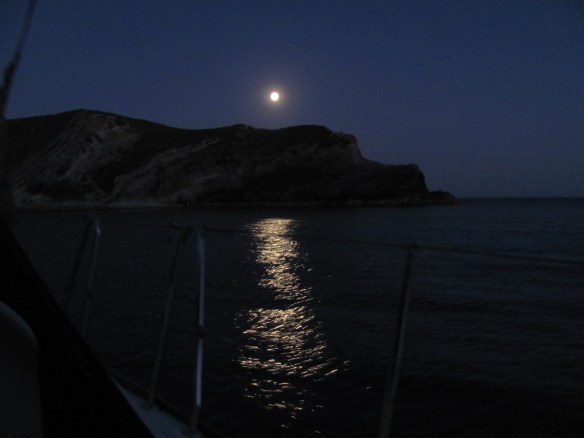
Moonrise over Lulworth Cove.

Poole

I awake with a start. The loud lapping of the waves against the side of the boat can only mean one thing. They are coming from the beam rather than the bow as they would if we were swinging freely. I quickly dress and go on deck. The wind is coming from the east, and all the other boats next to us are aligned east west except us, aligned north south. I switch on the depth sounder. It reads zero. We are grounded.

Grounded off Green Island in Poole harbour.

We are in Poole Harbour. Rather than stay in a marina, we had decided on peace and solitude and had taken the left turn after entering the harbour and followed the narrow South Deep channel around the south of Brownsea Island, and had found a nice place to anchor with a few other boats  just on the edge of the channel near Green Island. I had done my tidal calculations and had estimated that we would have 40 cm under the keel at low tide at 0430 in the morning. Not a lot, but enough. I had gambled on the wind staying in the east as was forecast, which would have kept us aligned at the edge of the channel, but at some time during the night either the wind or the current had changed and we had swung round to where it was shallower. Then at low tide, the keel had settled gently into the mud. No matter, it is a rising tide. I make a cup of tea and sit down to wait.

We had arrived in Poole the night before. We had left our paradise on the Beaulieu River in the morning, and had caught the start of the west flowing current down towards the Needles. Before long we were passing Yarmouth to our left, then Keyhaven to our right, each with their respective fortifications guarding the entrance to the Solent, Fort Albert and Hurst Castle. At some point we had noticed a tall ship following us and hoped that she would catch us up so we could get a good view of her.

Tall ship passing us near the Needles.

We had passed the Needles, chalk stacks extending out from the western end of the Isle of Wight. To our right had been the dangerous pebble reef called the Shingles, so we had steered a route between two buoys that took us safely through the two hazards.

Passing the Needles off the Isle of Wight.

From there, we had set a course directly west to Poole. The wind had strengthened to 10-12 knots and we had whizzed along, helped by a favourable current which had taken us in a looping arch northwards then southwards across Christchurch Bay and Poole Bay. A couple of hours later, we were approaching Old Harry Rocks at the bottom end of Studland Bay, more chalk stacks that are the same stratum as the Needles. The sails in, we had had a brief stop for a cuppa in Studland Bay, then had pushed on up the dredged channel into Poole harbour, then to our anchoring spot.

Old Harry Rocks, Studland Bay, near Poole.

There is a slight tremor and Ruby Tuesday detaches herself from the mud below and begins to swing freely, out in the deeper water and aligning herself with the other boats. The depth sounder suddenly reads 2 metres. We are free again!

Beaulieu River

It is another glorious day, sunny, warm and cloudless. The Canada geese graze quietly on the grassy banks, occasionally emitting contented hoots at each other. From time to time a mother leads her goslings, now nearly adult size, across the river to join the ones on the other side. Two oystercatchers shriek piercingly as they probe the muddy shore with their beaks, while a black-headed gull stands a respectful distance. A kestrel circles overhead looking for prey, and a fish jumps from the water to catch an unsuspecting insect. A gentle breeze springs up, causing the river to glisten like thousands of tiny diamonds dancing on its surface. It is idyllic.

Canada geese, Beaulieu River.

We are on the Beaulieu River, just across from Cowes. After a leisurely breakfast , we had motored across from Shepard’s Marina in windless conditions, having caught the west-flowing tidal stream, making 7 knots despite the engine just ticking over. Entering the river mouth requires a bit of care – there is a sand bar that is only 0.8 m deep at low water, but with careful tide calculations and lining up the transit marks of Lepe House and one of the red markers in front, it can be done. Once past the bar, there is plenty of depth, even at low water, all the way up to Bucklers’ Hard, a landing place and marina on a bend in the river. We decided to forego the pleasures of Bucklers’ Hard and find an unused buoy on a quiet part of the river and chill out.

Finding an unused buoy on the Beaulieu River to tie up to.

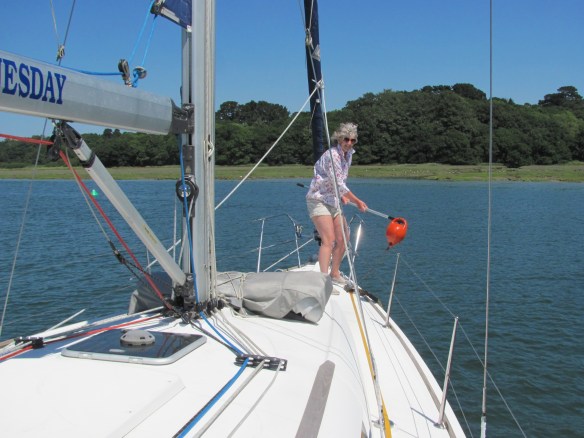
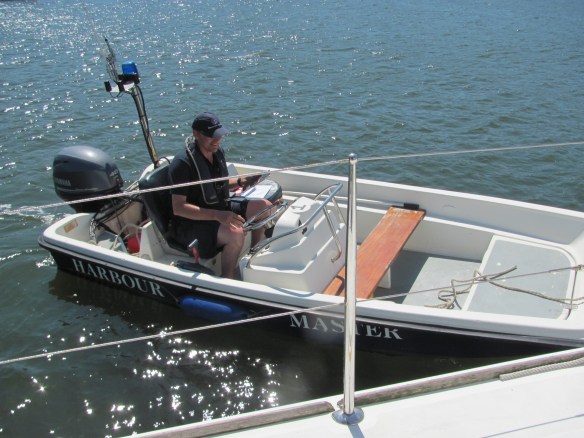
Later in the afternoon, the harbourmaster comes past in his little dory and we are asked to pay for the use of the mooring. He even has a card terminal for credit cards! We don’t mind paying something, but we think the prices asked are a little steep for just a mooring and no amenities or shore access. Still, it is a beautiful place to stay the night so we cough up. We guess the Duke of Beaulieu has to meet his expenses somehow.

The harbourmaster comes to collect his dues, Beaulieu River.

In the evening, we sit and have our dinner outside in the cockpit watching the sun go down. The water is like a mirror, and the only noise we hear is the occasional splash as a fish jumps out and the shriek of oystercatchers. In the mud flats opposite, the geese and black headed gulls have been replaced by two white egrets, a curlew, and two ducks. The geese have decided to have some evening exercise after a day of gorging, and are swimming in a line between the moored boats. Beneath the boat, we see jellyfish wafting past. Between the trees in the distance, we see two horses grazing, and wonder if they are New Forest ponies.

Dinner on the Beaulieu River.

In the morning I awake at 0500, and sit with my cup of tea on deck absorbing the peacefulness of the river. Wisps of mist rise from the smooth surface as the early morning sun begins to warm it. The curlew is on the other bank now.

‘Ba-week, ba-week, ba-weeek’, says the oystercatcher on the mudflats next to us. My Birdese is a little rusty, but I know enough to work out that she is saying what a nice morning it is. ‘Yes, it is’, I agree. She returns to probing the mud for her breakfast.

‘Skee-skee-skee’, says the black-headed gull perched on the red buoy just behind us, not wanting to be left out of the conversation. ‘Skee-skee?’. ‘We’ll probably be leaving around mid-morning’, I answer. It doesn’t seem appropriate to be more precise than that.

Black-headed gull wanting to know when we leave.

‘Cheeki-cheeki-cheeki’, contributes the egret picking his way through the rocks on the bank. ‘Thanks,’ I say. ‘I hope you have a good day too, whatever you are planning’.

It’s good to talk, BT used to tell us. I think they had a point.