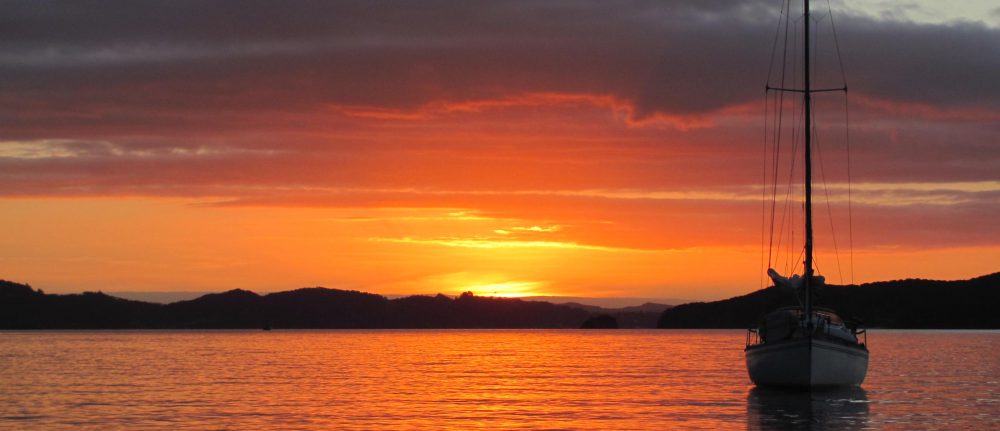
A defeat, a quiet anchorage, and some ecowarriors

We leave Flensburg in the morning after topping up with fuel. The tank is still half full, and it is the first top up since we started. Most of it is because we were required to motor through the Kiel Canal, so we haven’t been doing too badly. So far this season, there has been a lot of wind, and we have been making the most of it.

We arrive at the Sønderborg marina on the south side of the town and tie up. It’s a box berth, but we are getting fairly experienced in box berths now, and we glide in gracefully and don’t even miss lassoing the poles on the way in or bump the bow against the pontoon.

“We’ll have to get used to calling everything a ‘-borg’ now that we are in Denmark, rather than a ‘-burg’ as we do in Germany, or a ‘-burgh’ as we do in Scotland”, says the First Mate.

“Not only that, I’ll have to look out how to do all these ‘ø’s, ‘å’s, ‘ö’s and ‘ä’s on my keyboard”, I respond. “Why can’t you Europeans just keep it simple? Twenty-six letters without all this fancy stuff on top are quite enough.”

We cycle into town and check out the shops. The prices are eye-watering.

“I’m glad that we did the ‘big shop’ in Flensburg”, says the First Mate. “At least we have enough to keep us going for the meantime.”

I shudder. My shoulders still haven’t resumed their normal shape.

Checking the prices!

“Look at all these umbrellas hanging up in the street”, says the First Mate. “I wonder what they signify?”

“Shoes in Flensburg, umbrellas in Sønderborg”, I say. “Do you notice a pattern here? It’ll be underpants in the next town.”

“Don’t be silly”, she says.

Mary Poppins town.

The next day, the water has risen again due to a wind change. We can hardly climb back into the boat from the pontoon which is fixed and not floating.

“I know”, says the First Mate. “We can use those little folding steps that we bought in Hoorn. I knew they would come in useful some time.”

They work brilliantly.

The next step.

The night air chills our bones, and we wrap our cloaks tighter around us and try to snatch what sleep we can. All the way down the hillside are fires, the orange flames leaping skywards as the soldiers throw on more logs. On the hill opposite are the fires of the enemy. I recall playing as a child on the ground that is now under their control. But it won’t be for long. Tomorrow we will show them, and drive them from the land that is rightfully ours, all the way back to the Danevirke.

“We should never have withdrawn from the Danevirke”, says my friend Johan, his face lit by the flickering flames. “It is the border of our country and a symbol of our nation. Abandoning it seems like a dereliction of duty.”

“The swamps at each end of it had frozen”, I say. “The enemy could have ignored the fortifications and just marched around the ends of it. We would have been outflanked. Now try and get some sleep.”
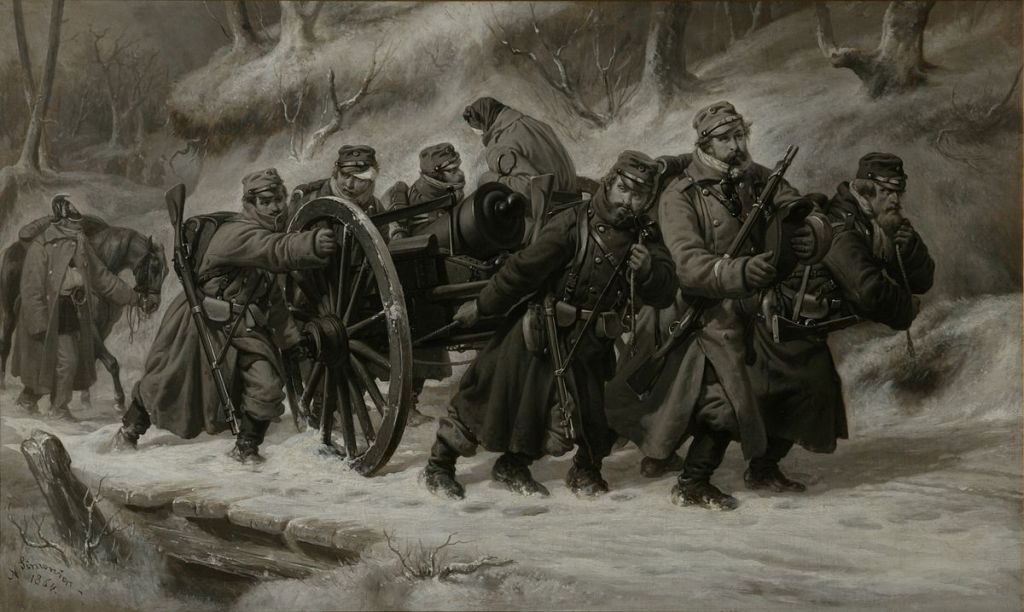
The Retreat from the Danevirke (from Wikimedia Commons).

We are awoken in the middle of the night by the dull thunder of the enemy cannon. Seconds later, the balls strike the wooden palisades of our redoubts, destroying them in showers of splinters. Grenades fly through the air behind our lines and explode in deafening claps. The enemy have launched their attack. We leap to our feet, out bodies still cold, tired and exhausted. The gun-smoke irritates our eyes, making it difficult for us to see what is happening. Behind us, the Dybbol Mill is hit and bursts into flames, lighting up the sky like a portent of doom.

In the morning, the Prussians charge our positions. Our men put up a stubborn fight and manage to beat them off. Heroes, every one of them. Our warship, the Rolf Krake, bombards the enemy positions from the bay. The Prussians have no warships and can do nothing about her. Things seem to be going well after all.

But slowly the tide turns. The enemy outnumber us and have modern rifles that they can reload lying down, while we need to stand up and are easy targets. They mount charge after charge, and eventually break through and capture one of our redoubts. And another. And another. Our men lie dead and dying around us. I look for Johan, but he is nowhere to be seen.
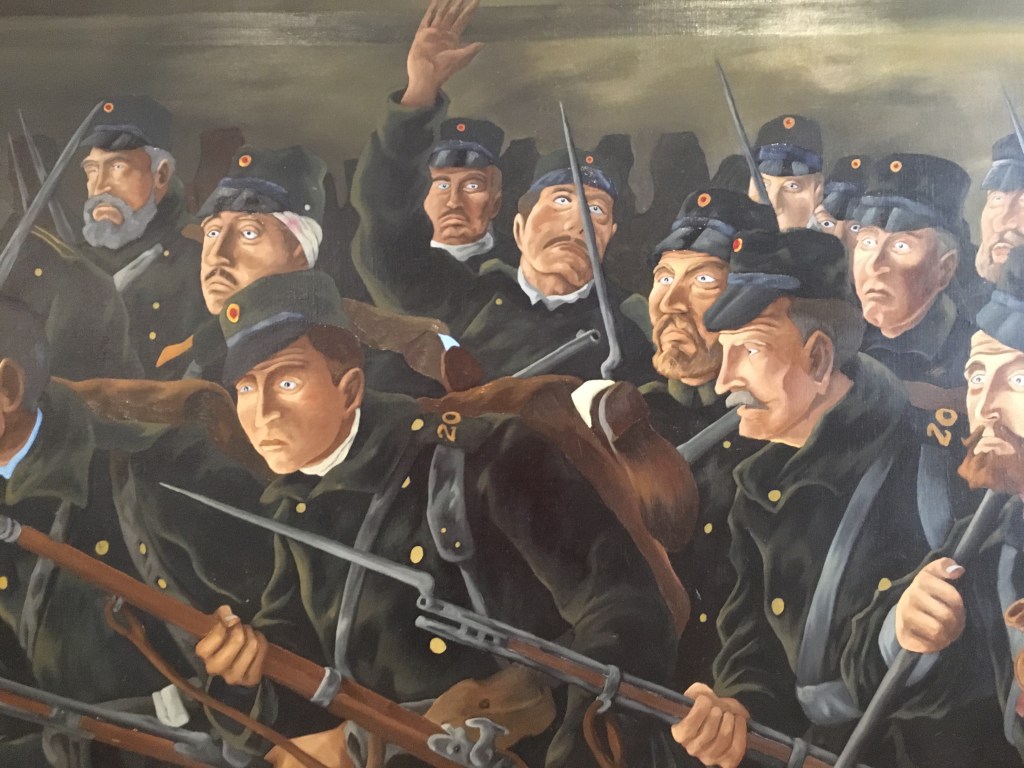
“National Retreat”, Martin Bigum, 1996.

We fall back to cross the bridge over the Alsund to Sönderborg. Defeat is written in the faces of the exhausted and dirty soldiers and the civilians that trudge along the road through the mud and snow. We have lost the battle and the war. What will happen now?

One of the stragglers, a young girl, is struggling with a baby in one arm and a bag of her possessions. I put my arm around her to stop her from falling …

“Hey, what do you think you are doing?”, a familiar voice says. “We’re in public, you know!”

It’s the First Mate, of course.

“I was just giving you a hygge”, I say.

We are at the Dybbol Mill on the hill overlooking Sønderborg, the site of the last battle of the Second Schleswig War in 1864, in which the Danes were defeated by the Prussian Army. I am imagining what it might have been like for a Danish soldier during the battle. It has particular resonance with the Danish psyche as it was the battle that lost them the southern part of Jutland to the Germans for more than 50 years. To make matters worse, the Danevirke, a line of fortifications built in AD 650 as a defence against the Saxons and later the Franks, and nowadays the symbol of their national pride, had been within that lost territory, a situation that continues to this day even though the northern part of Schleswig has been returned to them.
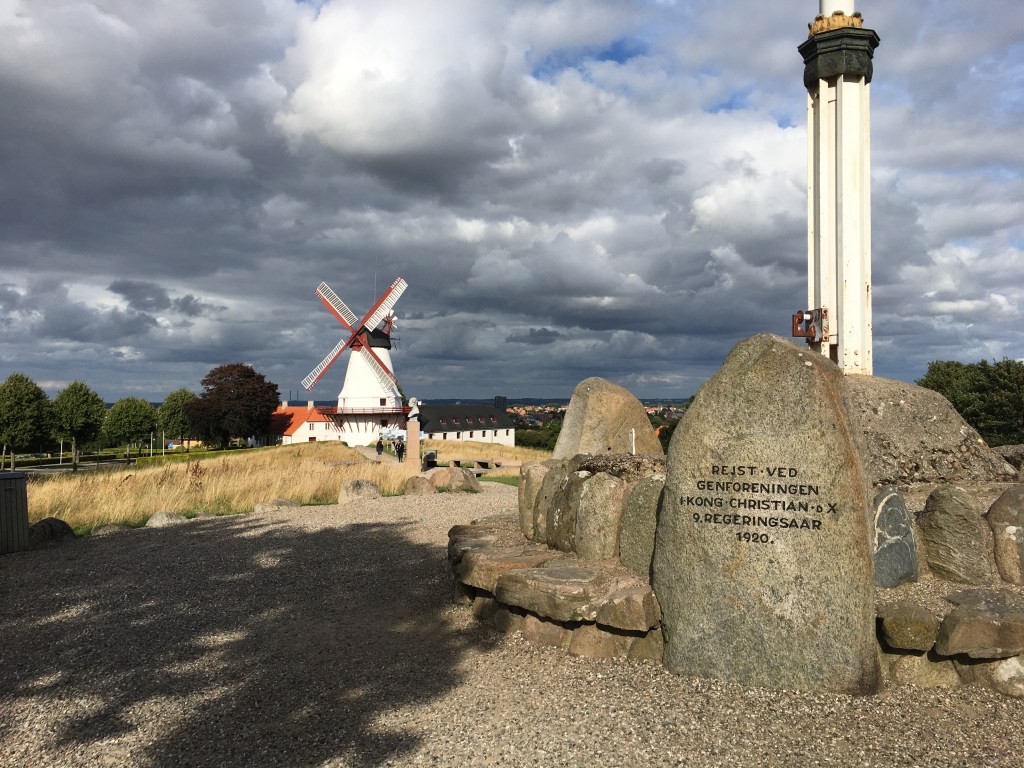
Dybbol Mill and memorial to the 1864 battle.

We cycle back into town to the museum at Sønderborg Castle. The castle was built around 1200 as a royal palace, but was later taken over by the dukes who ruled Southern Jutland (Sønderjylland) stretching from the River Kongea in the north to the River Eider in the south.
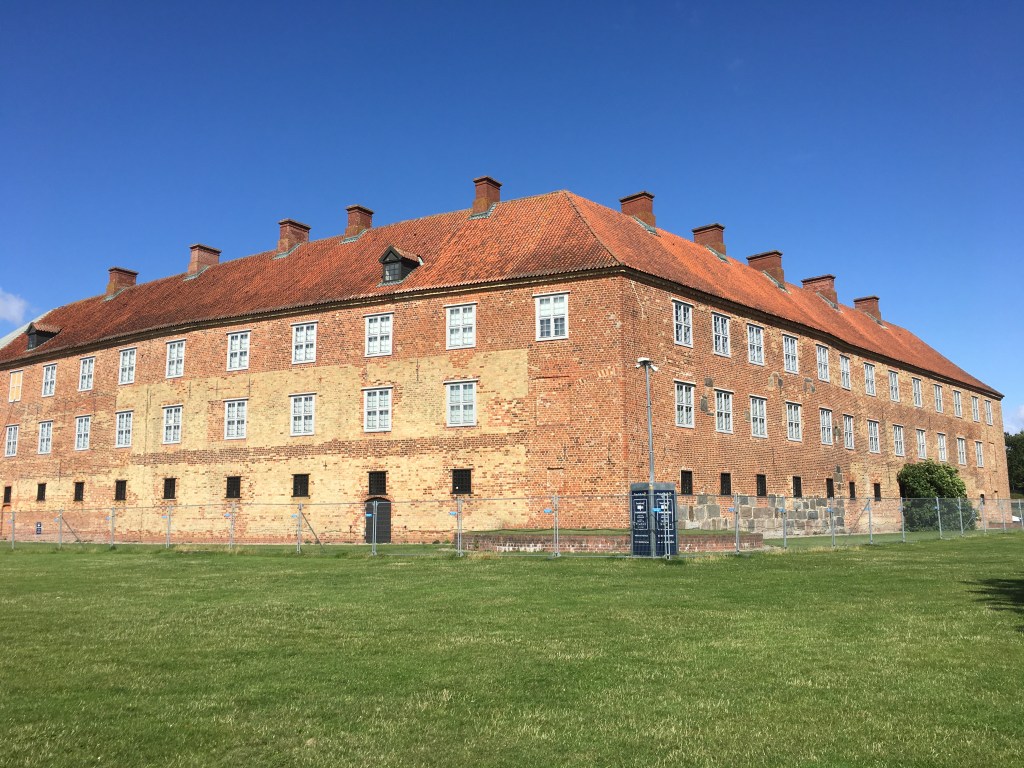
Sønderborg Castle and museum.

The focus of the museum is on the archaeology and history of the region, particularly the tussles between Germany and Denmark over its sovereignty. Woodrow Wilson’s principle of a ‘people’s right to self-determination’ and the resulting referenda at the end of WW1 to settle the question are described in detail. While it was probably the fairest solution, it has still left national minorities on both sides of the modern day border.

The point is made several times that archaeology is more than just a science – it is also a tool to establish ownership of territory as part of a nation. In the 19th century, many of the finds were examined minutely to see if they were more ‘Danish’ or more ‘German’. Nowadays, helped by membership of the EU, there seems to be more cooperation between the two sides, and archaeologists focus on working together to further the science rather than ownership of a particular piece of land.
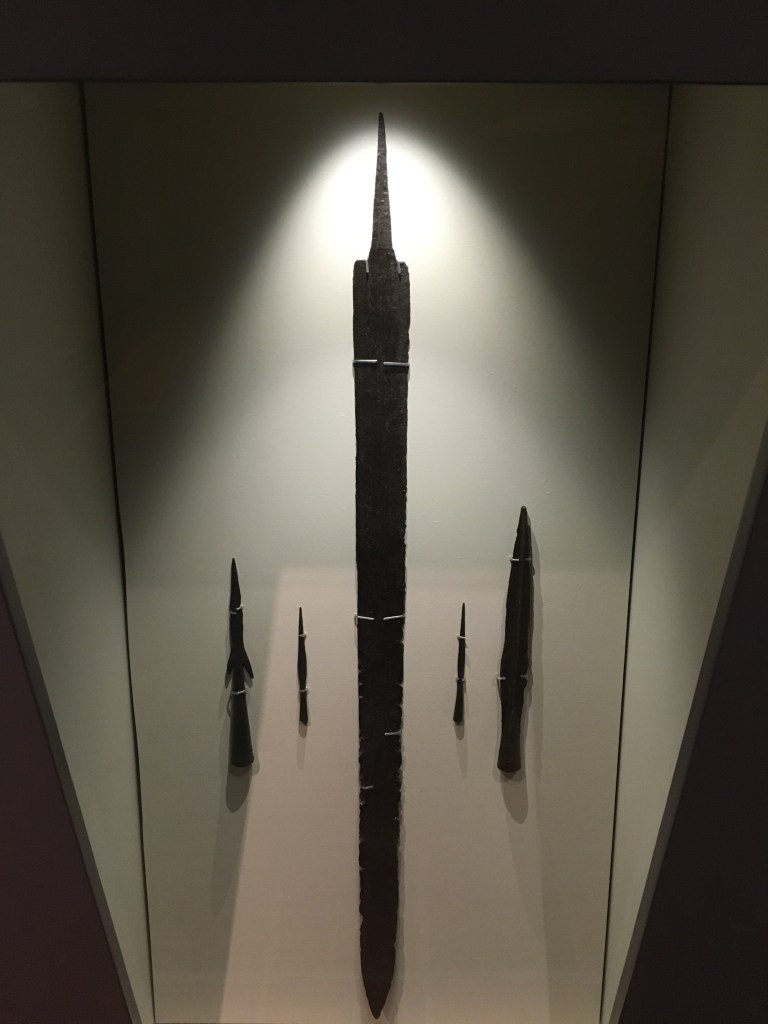
Spearheads and sword blades in Sønderborg museum. Danish or German?

We leave the marina at 0900 the next morning and join the queue waiting for the Christian X bridge to open at 0938.

“I wonder why they chose 38 minutes past the hour to open the bridge”, muses the First Mate. “Couldn’t they have made it a round 40 minutes?”

Whatever the reason, the bridge opens punctually at 0938 and we follow the flotilla of other boats through to the Alsund, the stretch of water between South Jutland and the island of Als. The wind is from the north-west, and is a gentle breeze, just enough to allow us to sail majestically along the sound.
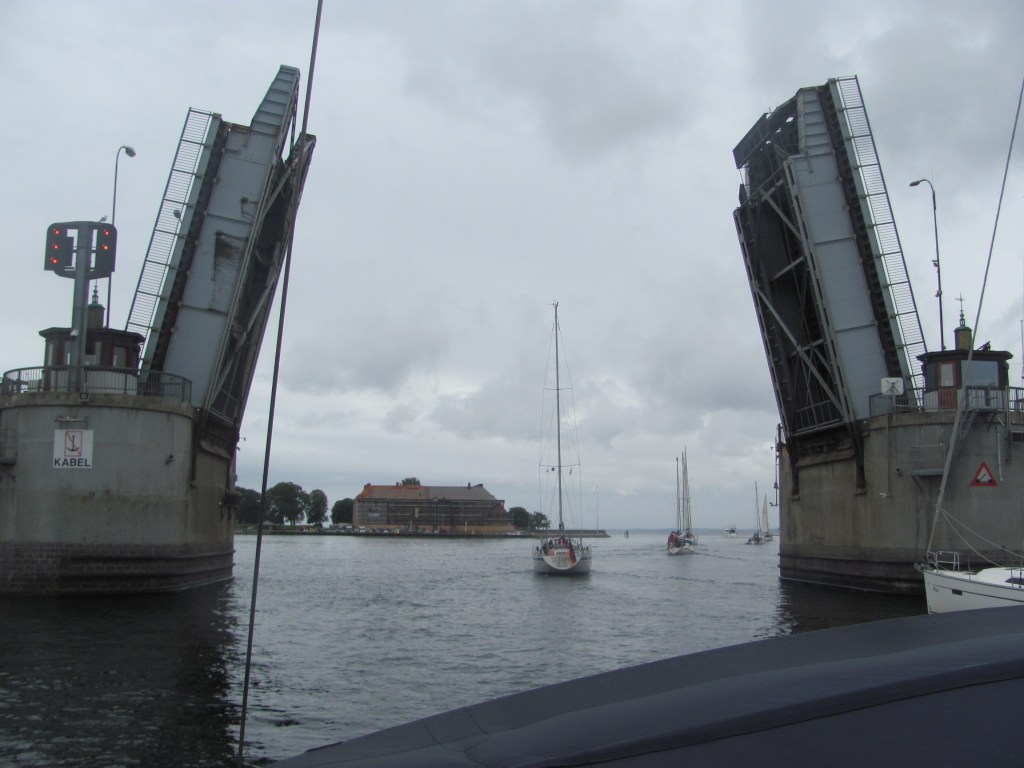
The bridge opens and we join the procession.

We arrive in Dyvig, a small inlet where we have decided to stay the night. Entrance into the small bay at the end is through a narrow buoyed channel about 15 m wide, which we need to negotiate carefully. We drop anchor in 5 m of water on the northern side of the bay where a few other boats are also anchored, and spend the rest of the day relaxing in the warm sunshine.

The next morning I awake to the sight of dappled light playing on the cabin roof reflected through the small side window. I make a cup of tea for myself and go and sit on deck. It is warm and sunny. The water is like a mirror, only the occasional zephyr of wind rippling it momentarily before it returns to its stillness. The other boats drift lazily at anchor, trees lean out over the water, the reflections of both almost perfect images of the real thing. All is quiet.

Except that it is not. As I relax I start to hear sounds that I am not normally aware of, sounds that my brain normally filters out because they are of no use to me in my daily life. Small birds chirrup. Wood pigeons coo in the trees along the water’s edge. A lone seagull mews as it flies overhead. Swans honk on the shingle spit protruding out into the water. A crow calls raucously, then flaps off into the distance. A fish breaks the surface, spreading ever-widening ripples. A cormorant takes to the air, its wing tips beating a rhythmic sound on the surface as it struggles to gain height. A heron stalks primly next to the bank of rushes, from time to time plunging its bill into the water like a stiletto and withdrawing it with a wriggling fish.

I focus still further, and begin to hear a gentle thrum of sound deeper down – the hum of bees, the chirp of insect legs, the rustling of leaves – almost like virtual particles winking in and out of existence, so low that I wonder if I am imagining it. But it is there.

A quiet anchorage.

I close my eyes and allow my mind to drift where it wants. Time stops. I am floating, detached from, and yet part of, the natural world around me.

There is a loud splash. Someone from one of the other boats has dived into the water. The world of humans once again asserts its dominance, and my reverie is shattered. It’s time for breakfast.

We weigh anchor at 1000 and set off for Faaborg. There is absolutely no wind, and we need to motor for the first couple of hours. The First Mate goes down below for a nap.

“You know”, says a familiar voice. “I overheard you talking last night about your visits to Dybbol Mill and the museum, and what makes a nation. So I thought I would do a bit of reading on the web.”

It’s Spencer. If you remember from last year, he found a way of linking his web into the Worldwide Wide Web and has become very knowledgeable on a lot of things.

“But I really wonder if the nation state will continue much longer”, he continues. “Its’s only a relatively new concept in the history of human affairs, and already there are a lot of things wrong with it.”

“Like what?”, I ask.

“Well, a nation is supposed to be a grouping of ethnically similar people with a common language, culture, history and territory”, he says. “Most modern nations are anything but that. Take many countries in Africa as examples – most were created on a map by Europeans with no regard for tribal differences and shared languages, and borders often just represented arrangements made between the European colonisers on their areas of influence. Most of the war in the last 100 years or so have been over territory and resources and who owns them. Even here in Denmark, the way that Schleswig was divided between ethnic Germans and Danes still causes unease.”

“I know the nation state concept is not perfect”, I say defensively. “But it is the best we have, and it works. Sort of.”

“Possibly”, says Spencer. “But the forces of the 21st century are causing it to creak at the seams. Globalisation and the internet, for example, are making a mockery of national borders. Some big companies have budgets greater than many countries and others already do things that governments used to do, such as surveillance and mapping. The wealthy are able to escape national restrictions, and governments have lost control over the flows of money that may be generated in their own countries. Where is the nation state in all of this? What we really need is a supranational form of government that national governments are subject to.”

“I am not sure that a world government would gain much traction”, I say.

A tall ship is approaching us, and I break off the conversation to alter course slightly to avoid a collision.

A tall ship passes us.

“Look at the disaster unfolding in Afghanistan”, Spencer continues after it has passed. “Twenty years the western countries have tried to build a nation there, and it collapses within weeks after they withdraw. Not exactly a success story. Many in the Muslim world have lost faith in the western concept of a nation state as a form of governance, and want to restore the glories of their past empires, based on their religion. Empires, after all, were the main form of governance for much of human history.”

“But they all fell in the end”, I say. “Most sowed the seeds of their own destruction by overreaching themselves so that they couldn’t afford the costs of maintaining them. Look at the Roman and British Empires, for example.”

“True, but some did achieve a lot while they lasted”, he says. “The Ottoman Empire lasted 700 years and generated amazing prosperity and cultural achievement before it finally declined. Look, I am not saying that more empires are the solution – just that we need different forms of government than the nation state to solve the problems of climate change, globalisation, big data, and all the rest of it. They need to operate at the level of global economic flows so they can be controlled, not underneath it.”

We are approaching Faaborg, and I need to concentrate on entering the harbour. We find a place on the inner pier and tie up. I look for Spencer to continue the conversation, but there is no sign of him.
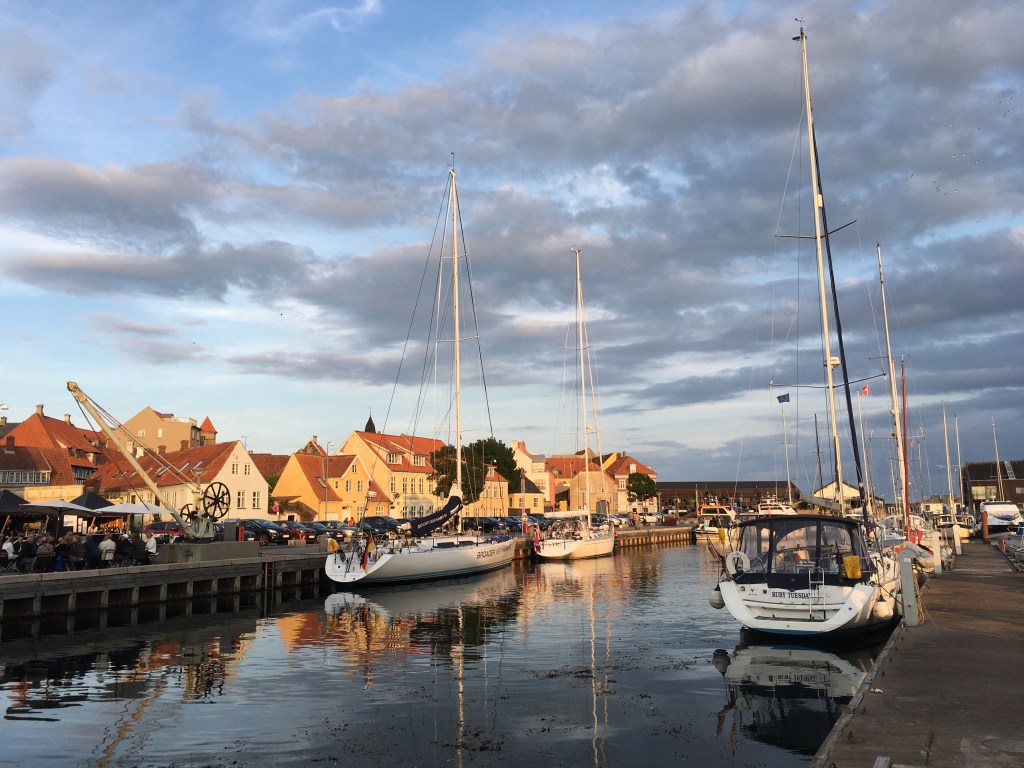
Tied up in Faaborg harbour.

We have lunch and go to explore the town. Faaborg is an old port, dating to before the 1200s. It became prosperous as a trading centre, trading as far afield as England and the Mediterranean. Nowadays its quaint houses and streets make it a popular tourist attraction.

Faaborg clock tower.
House in Faaborg.
If you can work out what’s going on here, drop us a line.

Just as we are thinking of retiring for the night we hear shouts outside, the sound of an engine, and some bumping of wood against wood.

“I think that we have some new neighbours”, says the First Mate.

I go out to see what is going on. Sure enough, a boat has arrived, and is trying to manoeuvre itself alongside the pier behind us. The darkness is making it difficult. I go and help.

“We are sailing around the archipelago and stopping at different harbours to raise awareness about pollution of our seas”, says the woman, as she throws a rope to me. “It is still legal to dump construction rubble in the seas, and many companies are doing it. Some of it contains toxic material, which is permitted below a certain level, but no-one checks, and many companies are dumping material that is above the limit. It’s killing off sea life. By the way, my name is Vibeke.”

In the morning, I chat to the skipper of the boat.

“Vibeke is a politician”, he says. “She is really concerned about the environment. We are old friends, and I am retired, and this year we thought it might be a good idea to sail to different places to protest about the pollution. There is a harbour fete here today, and we are distributing pamphlets.”

Vibeke appears from the boat to make a video of their plans for the day. Shortly afterwards it appears on her Facebook page. Later in the day, we see her handing out leaflets at the harbour fete.

New neighbours tie up behind us.

“It’s good to see some genuine concern for the environment from a politician”, says the First Mate.

A thunderstorm, an English homeland, and a Big Shop

“When I said that we had a whole new set of adventures in front of us, this wasn’t exactly what I meant”, says the First Mate.

We are sailing between Kiel and the entrance to the Schlei fjord. When we left Kiel, there had hardly been a breath of wind, and we had had to motor almost to the mouth of the Kiel Förde. There the wind had picked up considerably, and, coupled with a long swell from the east on our beam, had made the sailing somewhat uncomfortable, to say the least.

“It’s OK, we don’t have that far to go”, I try and reassure her. “Once we are in the Schlei, it should be calmer.”

I am wrong, at least for the first part. It is quite a long way, and if anything, the wind intensifies and the swell grows. Soon we are heeling at an alarming angle. I take a reef in, and we stabilise a little, but it is still rough. It dawns on me that we are the only boat in sight. Do they all know something we don’t?

We have no option but to push on. We eventually see one other boat, which reassures us that we are not the only crazy ones in the world. After what seems ages, we see the lighthouse marking the entrance to the Schlei fjord in the distance.

“I’ll be glad when we get there”, says the First Mate. “This has been the roughest we have sailed since, since… Well, since the last rough time.”

We surf in on one of the swells, past the lighthouse, and into the calmer water inside the breakwater.

“See”, I say. “At least I was right about that. It is calmer here.”

Approaching the entrance to the Schlei fjord.

We reach Kappeln, a small town on the north shore of the Schlei. Ominous dark clouds are gathering over the orange roof tops catching the sun momentarily. It feels like they are warning us away.

“The forecast said there were going to be thunderstorms this evening”, I say. “Those clouds must be them.”

The town has three marinas along the waterfront, all more-or-less next to each other. We do a quick looksee around the first one, but there are no vacant berths. We motor down to the next marina, a few hundred metres further on. The same there. And the third. What shall we do? The First Mate calls one of them on the phone and asks if there is somewhere we can berth.

“If you don’t mind tying up on the edge of one of the entrance ways, you can have there”, he says. “It’s kind of like half a box-berth – only one stern pole.”

It’s not ideal, but beggars can’t be choosers.

We edge in, but the First Mate misses the pole with her lasso. The wind is catching the bow and blowing the stern around, close to another boat. I reverse out and try again. This time she manages to get the line around the pole and hands it back to me. We motor forward gingerly, and manage to get the bow lines attached. I tighten the stern line to position the boat as parallel with the other boats as possible. At least it will do for the meantime.

Twenty minutes later, the thunderstorm starts. We sit cowering in the cockpit enclosure watching it raging around us. Sometimes the lightning cracks directly overhead and we pray that we are not the tallest mast in the marina. The rain is torrential and reminds me of the monsoon in India.

Waiting out the thunderstorm.

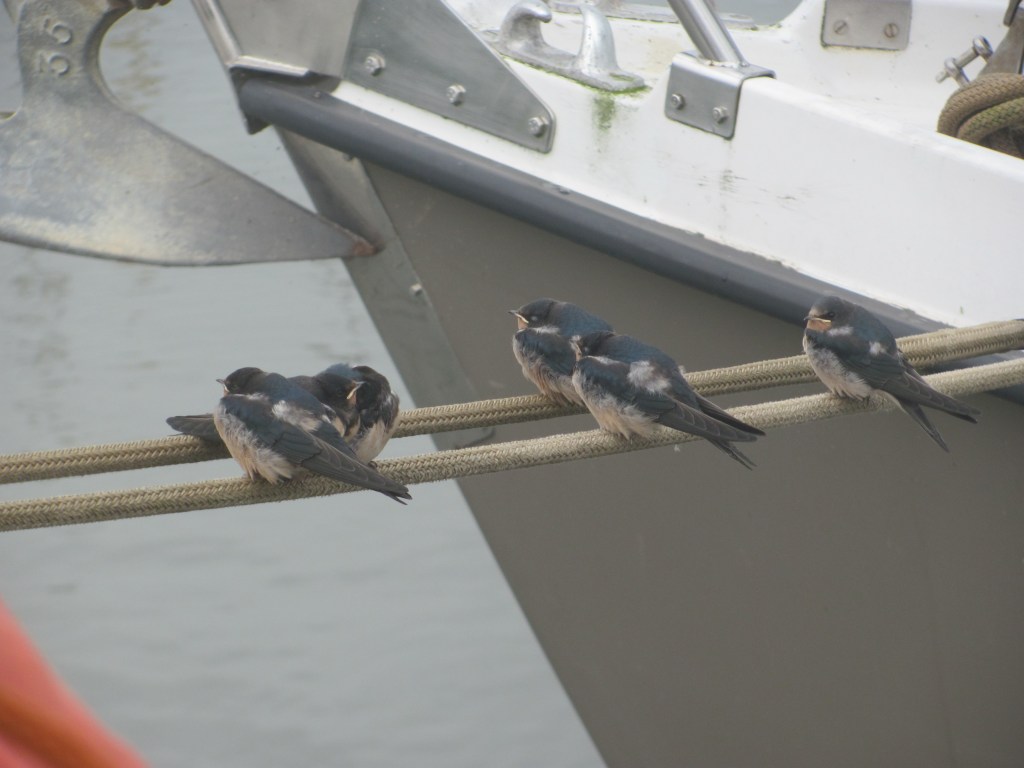
Bedraggled birds cling to the mooring ropes waiting for it to pass. At least they are sheltered in between the boats.

Hunkering down against the storm.

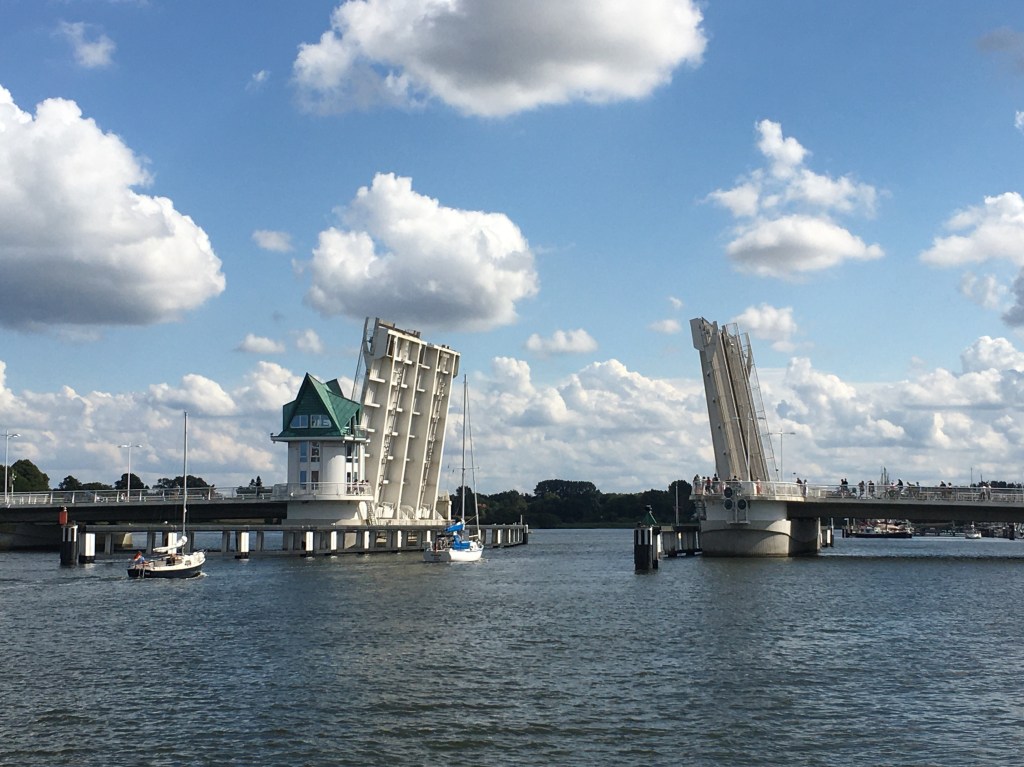
The storm abates during the night, and the next day dawns bright and sunny. We decide to cycle into Kappeln town about a kilometre from the marina and explore. A key feature of the town is its bridge, which lifts in the middle to allow boats to pass through.

The lifting bridge in Kappeln.

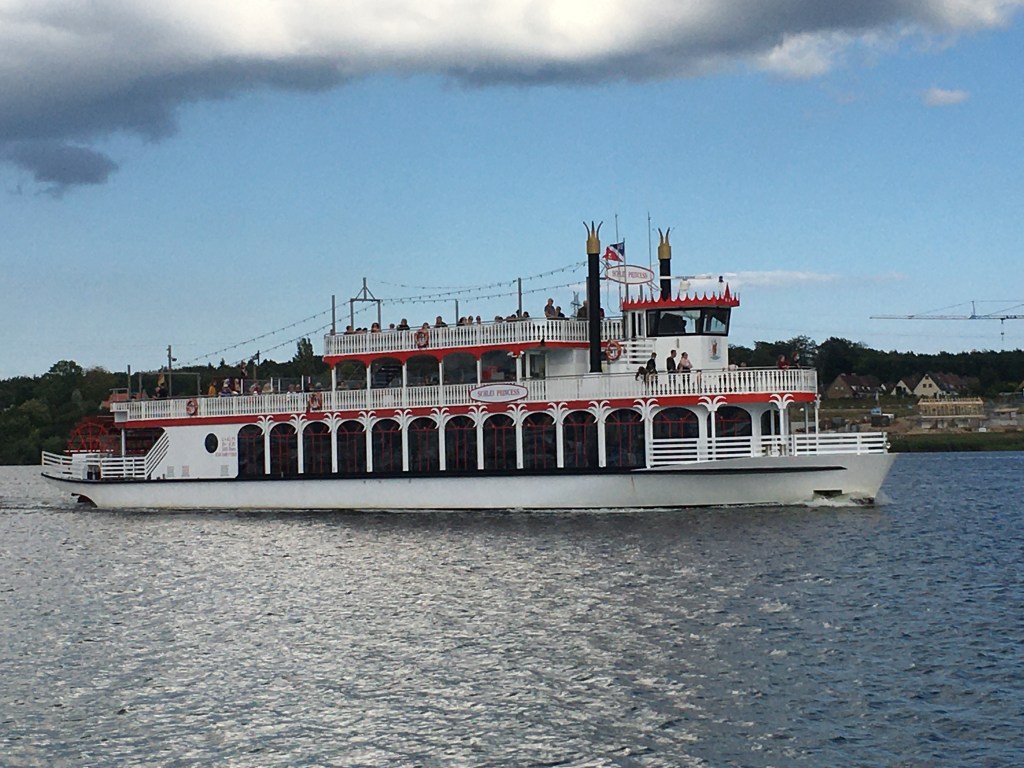
The Schlei Princess leaves the dock, taking day trippers out to the lighthouse at the mouth of the Schei that we passed as we came in.

The Schlei Princess.

A musician sings Let it Be. The old ones are the best ones. The songs, that is.

“When I find myself in times of trouble …”.

On the hill, where it can catch the wind, is the town windmill.

Kappeln windmill.

A mural highlights the importance that fishing plays in the prosperity of the town.

Fishing for compliments.

The next day we take the bus from Kappeln to the town of Schleswig at the top of the Schlei fjord. We had considered sailing there, but there is another lifting bridge about halfway along, and we had heard stories that it is notoriously unreliable, sometimes remaining down for days.

For a while, we are the only ones on the bus, and the bus driver chats to us about the things to see in Schleswig. She drops us off near the magnificent baroque Gottorf Castle which now contains the Landesmuseen Schleswig-Holstein.

“Well worth a visit if you are interested in the archaeology of the region”, she says.

Gottorf Castle, Schleswig.

The cold north wind blows over the moor, chilling the small group of people waiting on the hillock. Mist rises from the pools of fetid water lying between the mounds of higher ground, as the spirits of the dead writhe in their eternal punishment. The clouds part momentarily, allowing the full moon to illuminate the two men holding the young girl. The women in the group begin to wail, their voices rising against the noise of the wind, and bringing tears to the eyes of the watchers. There is fear in the girl’s eyes, as she suddenly realises the nature of her punishment for betraying Nerthus, Mother Earth.

I shiver, and draw the hastily borrowed cloak around me. We had been born on the same day and had grown up together. We had played in the fields surrounding the village, and had watched and then taken part in the same annual rituals of sowing, reaping and harvest. She had been selected to be one of Nerthus’ servants, but we had remained friends. Then this year following the cleansing rites of Nerthus’ cart, robes and body, she had given birth to a male child. The rumour was that the father was from a neighbouring tribe, the Sachsens. The priests had decreed that she must be punished for this transgression of impurity against Mother Earth, but that her son would be spared. It had been foretold that he would become the progenitor of a mighty tribe of people who would eventually conquer many nations and spread their language to every corner of the world.

She struggles, but her captors are too strong. They hold her under the water until she is still, and the priests place the large stone over her body to keep it from rising to the surface again. Nerthus has been appeased.

I start running, running back to the village, anywhere to escape that terrible place and the bodies of the damned. My task now is to nurture and raise Angel, her son, to fulfil his destiny.

“Why are you walking so fast?”, says a familiar voice. You have that faraway look in your eyes again. Is it another one of your daydreams?”

It is the First Mate. In an instant, I am back in the present.

“I just had an idea that the café was about to close”, I say, thinking quickly. “I thought we had better get there soon if we want to have lunch.”

I had been looking at the prime exhibits of the museum – five bodies that had been found in the peat bogs of Schleswig-Holstein, known as the Moorleichen, and had been trying to imagine the circumstances of the death of one of the bodies, that of a young girl in her mid-teens.

Remains of young girl found in peat bog.
Reconstruction of the face of the young girl buried in a peat bog.

Except that it turns out from recent DNA analysis that ‘she’ was probably a young boy who may have died after a protracted illness. So much for daydreams.

We have lunch and explore Schleswig. The old part of town, Holm, is quite charming, originally the quarter where fishermen and their families lived, now highly desirable and expensive.

Holm, the fishermen’s quarter of Schlesvig.

We leave Kappeln the next morning for Flensburg. The winds are fair, and once out of the mouth of the Schlei we sail northwards on a pleasant beam reach. Soon however, we must turn west and directly into the wind, and we need to motor.

“You know, it’s quite interesting”, says a familiar voice. “I was reading on the web this morning that this area used to be inhabited by a tribe called the Angles.”

It is Spencer.

“Yes, I know”, I say. “In fact, on the bus yesterday to Schleswig, we passed a sign pointing the way to a place called Angeln.”

“That would be named after them”, he says. “But did you know that this particular tribe migrated to Britain after the Romans left in A.D. 410? The part of Britain where they lived became known as Angle-Land, or England as we know it today.”

“Well, yes, I was vaguely aware of that”, I say, casting back to my history lessons at school. Spencer could be a bit of a know-all at times. “But I thought that the Saxons were also involved?”

“That’s true”, he says. “They lived a bit further south from here – where you went to visit the First Mate’s sister, in fact. Together they became known as the Anglo-Saxons.”

“Of course”, I gasp. “The descendants of the girl in the peat bog we saw in the museum. It all makes sense now.”

“The Jutes and the Frisians were also lumped in with them”, Spencer continues. “There’s still a bit of a debate about how they all came to Britain. You see, it used to be thought that they invaded and chased the existing people, the Romano-Britons, over to the western side of the British Isles, to where Wales and Cornwall are today. But genetic research has shown that that didn’t really happen, and the Romano-Britons pretty much stayed put. So the latest thinking is that it may have been a kind of Anglo-Saxon warrior elite that settled here and dominated the local population, but didn’t chase them off. Because they were the rulers, their language, known today as Old English, was prestigious and spread through Britain.”

“It’s amazing that a couple of small tribes originally from the swamps and forests in northern Germany eventually spread themselves and their language throughout the whole world”, I say. “I wonder what the girl in the peat bog would think if she knew that would happen?”

“I have no idea”, says Spencer. “But what I do find puzzling is the anti-German feeling that still exists in many parts of England today, which Brexit exposed. Why should they still feel hard done by by the Germans, when they are German themselves?”

“It’s a difficult one to explain rationally”, I say. “But I am sure that everyone has their own theory.”

“You could say the same thing about immigration in general”, he continues. “You are all immigrants if you go back far enough. I wonder what the Romano-British people thought about those hordes of Anglo-Saxons descending on them from the Continent?”

“Well, there’s no record of them having a referendum about it, at least”, I say. “Perhaps they liked the idea of having some fresh blood?”

We arrive in Flensburg and tie up to end of a pontoon in the City Marina, ten minutes’ walk from the town centre. There is something very appealing about being able to sail to a city centre with your own home and use it as a base to explore.

Arriving in Flensburg.

We spend the rest of the afternoon doing just that. Flensburg is an old city, founded around AD 1200, and is a pleasant mix of German and Danish culture. Although now in Germany, there is a Danish library and several Danish restaurants.

A mixture of Danish and German culture.

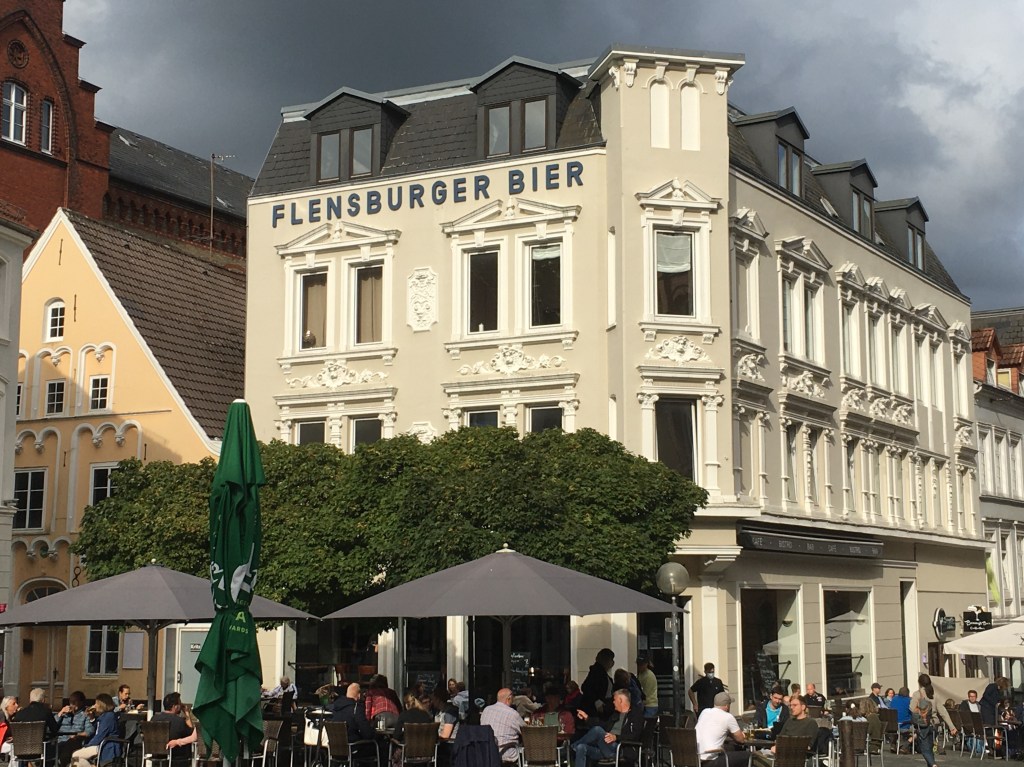
Although it wasn’t part of the Hanseactic League, many of the old buildings reflect its past importance as a major trading centre. One such is the West Indian Warehouse, now converted into prestigious apartments.

The West-Indian Warehouse, Flensburg.

We are particularly intrigued by the lines of shoes hanging above some of the streets. No one seems to know what they signify, although there are various theories.

“It used to signify that drug dealers were active here”, says one person we asked.

“No, that’s not right”, says another. “There have never been drugs here. Someone dropped their shoes there from a top floor apartment by accident one day, and other people just thought it a good idea, and started throwing their old shoes there too.”

Take your pick.

Hanging shoe puzzle.

Flensburg beer is well-known throughout Germany.

A popular beer.

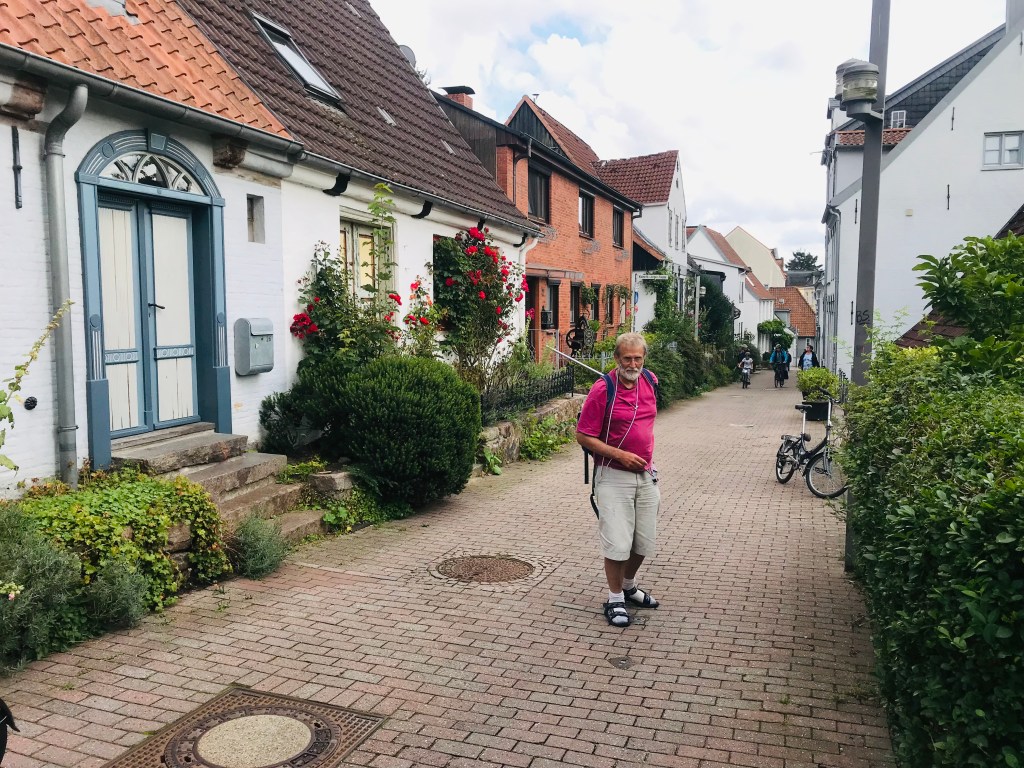
We find the Captains’ Quarter quaint and peaceful. Previously it was where the sea trading captains lived.

Exploring the Captain’s Quarter of Flensburg.

“Have you noticed that there seem to be sirens going all the time?”, I say to the First Mate. “Every time I hear one in future, I’ll think of Flensburg.”

“It’s because the hospital and police station are right in the city centre”, she says.

City of sirens.

When we get back, there is a big catamaran tied up behind us. The name on it is Anakiwa.

“That’s a very Polynesian name that you have for your boat”, I say to the skipper.

“It’s named after a place in New Zealand where there is an Outward Bound school”, he explains. “I worked there for a while to gain experience, then I came back to Germany and now I run my own Outward Bound courses, mainly on sailing. It’s all about pushing yourself to the limit so that you know what you are capable of. One cohort has just left, and I am expecting another one tomorrow. They love it, and many come back again. My name’s Ben, by the way.”

Memory stirs. I had been to Anakiwa once before, when our parents had taken us on a family holiday near there in the Marlborough Sounds when I was about 10. Ben is astonished that I have heard of it, let alone been there.

“I guess you are getting used to there being little tide here in the Baltic?”, he says, noticing our flag. “But actually, we have what are called ‘wind-tides’ where strong winds from a particular direction for a period of time can push the water to the other side of the Baltic, raising the water level there and lowering it on the other.

“It has been blowing from the west for several days now”, he says. “You can see here on the pier how much the water level has dropped – probably nearly a metre. The wind has pushed all the water over to the eastern side of the Baltic – they’ll be getting higher water in Lithuania, Latvia and the like.”

‘Wind tides’ in the Baltic.

“I think that we should do a Big Shop before we go”, says the First Mate over breakfast the next morning. “It’s so expensive in Denmark that we should buy as much here as we can to last us.”

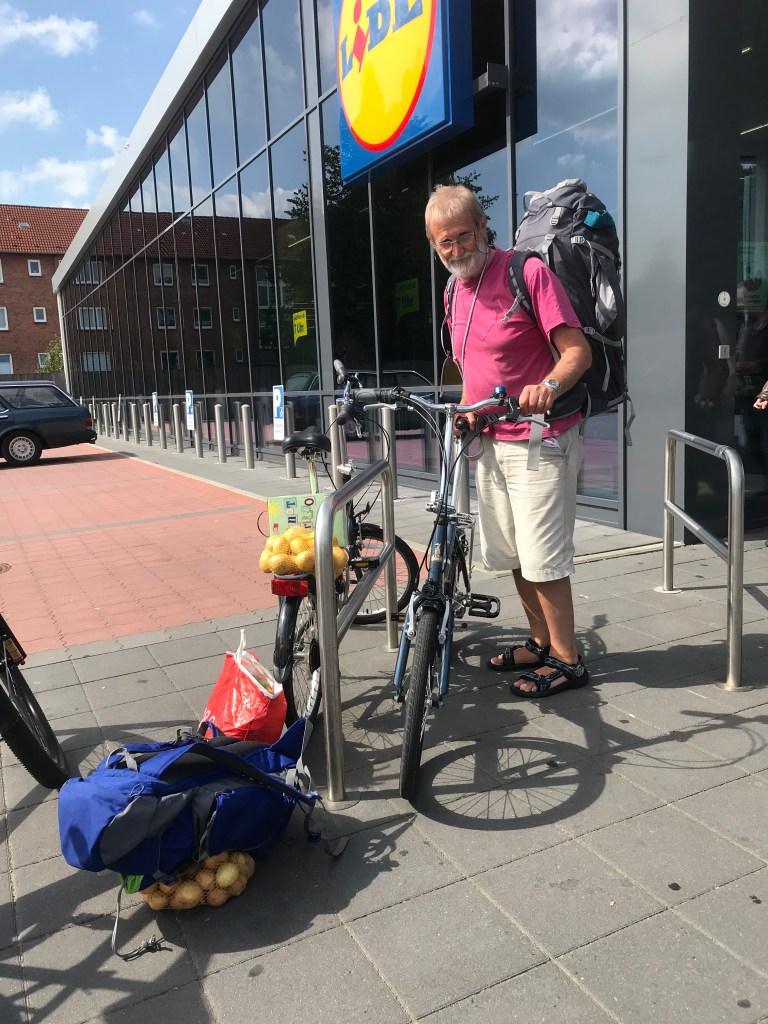
We dig out our big rucksacks from the recesses of the boat where they have been stored, and cycle to the nearest Lidl store. ‘Nearest’ is relative in this case – it turns out to be 4 km from the marina. Not only that, it is uphill almost all the way.

We reach the Lidl store. Soon we have a nearly full trolley.

Filling the trolley.

“I think we have overdone it”, I say. “We’ll never get all this back on our small bicycles. I’ll go and put some back.”

“Don’t worry”, says the First Mate. “We’ll manage somehow.”

I groan. I have learnt over the years that the ‘we’ in this case is a peculiar variant of the ‘Royal We’. Diametrically opposite, in fact. What she means is that ‘you’ll manage somehow’.

We load up the rucksacks. Mine is 60 litres in volume, I remember from the blurb when I bought it. Plus the pockets on the side. Fifteen litres each.

“You can carry all the wine and soft drinks”, says the First Mate. “They’ll never fit in mine.”

We somehow manage to get all the liquids into my rucksack. And the potatoes. And the leeks. And the meat.

“What have you got in yours?”, I say.

“Bread”, says the First Mate. “Cakes. And a few other bits and pieces. By the way, it doesn’t look like you have put anything in your side pockets. Here, you can put the onions in there.”

As I put on the rucksack, I notice other shoppers coming out staring at me disbelievingly. I smile at them as though I do this two or three times a day for a living. No-one is fooled. I climb on to the bicycle. The front wheel lifts off the ground.

“You’ll have to lean forward to keep the wheel down”, says the First Mate.

Getting the ‘big shop’ back to the boat.

Luckily it is more-or-less downhill all the way back to the boat. My concern is that the brakes won’t stop me once I gather speed down the hill. But somehow they do, and we make it back. My shoulders feel as if they have a permanent bend in them. The wrong way.

“I’ll never do that again”, I say. “I almost had a heart attack.”

“I was thinking we could have got another carton of wine in”, says the First Mate. “We didn’t have anything on the bike carriers.”

I start unpacking my rucksack.

“Hey, I thought you said you had the bread in yours”, I say.

“Did I?”, says the First Mate absent-mindedly, already answering her texts.

Through the Kiel Canal – we reach the Baltic at last!

“It’s a bit of a race for the marina when the lock gates open”, says the skipper of the boat in front of us. “It can get quite full, and if you want a place for the night you need to make a dash for it.”

We are in the lock at the entrance to the Kiel Canal in Brunsbüttal waiting for the gates to open. We had left Cuxhaven around lunchtime to catch the incoming tide, and had had a good sail up the Elbe assisted by the current and a westerly wind behind us, making eight knots at times with just the genoa.

So much so, we had even overshot the entrance to the Canal slightly and had had to struggle to get back against both current and wind. But we had made it, and the skipper of the boat in front had helped us tie up to the floating pontoons inside the lock.

Sailing up the Elbe with just the genoa.

“But we are lucky”, he continues. “Both of us are at the front of the lock, so we have a head start on the others.”

“Come on”, says the First Mate to me. “We don’t want to miss out. Get the engine started.”

Already the other boats have their engines running and are keenly looking for when the gates open. When they do, they all surge forward like greyhounds released from their starting positions. That is if 10 tonne boats with a maximum speed of 6 knots can be likened to greyhounds. But we are not slow off the mark either, and leave the lock in second position behind our friendly skipper. There is some jockeying for position, but we keep our place and enter the tiny marina to the side of the lock before the others. Sure enough there are not a lot of spaces left, but we find one rafting up to another boat with a Swedish flag. Helping hands reach for our lines and we are soon secured. We are safe for the night.

Safely ensconced for the night at Brunsbüttal.

Not that we have a quiet night. As we are so close to the canal, large ships pass by mere meters away from us as they enter the lock, their engines rumbling and their propellers churning the water as they go. In the end, however, it becomes strangely rhythmic and we manage to sleep well until the morning. We just hope that their positioning systems are precise – an error of a couple of meters could spell disaster!

Big ships passing through the Brunsbüttal lock.

The Kiel Canal was built in 1895 by Kaiser Wilhelm II to provide a way for the German navy and merchant shipping to avoid going around the top of Denmark, as the two countries weren’t particularly friendly at that  time. It is nearly 100 km long, and an average of 90 ships pass through it every day. At the moment, as a concession to the coronavirus, it is totally free to use. Sailing is not allowed, so we have to motor the whole way.

We leave at around 1000 the next morning. It is squally weather – one moment a torrential downpour, the next brilliant sunshine. From time to time huge container ships pass us, dwarfing us with their size. We stick well to the starboard side of the Canal to give them as much room as possible, but are surprised how little wake they produce – they slip past, hardly rocking us.

The First Mate holding her nerve as a large container ship passes.

We approach a ferry crossing. Usually these consist of two ferries that cross alternatively from one side to the other, so that there are two to look out for. Not only that, they have right of way, at least for yachts. The problem is that they can set off at any time, so you need to keep an eye on when they are likely to leave by being fully loaded by cars. It is probably just my overactive imagination, but on more than one occasion, I could have sworn that they lie in wait for an unsuspecting yacht and time their departure just as the yacht is approaching to force them to stop!

A ferry crosses in front of us.

We eventually reach Rendsburg and pass under the railway bridge spanning high above the Canal.

The Rendsburg railway bridge.

“The guidebook says that it was built in 1913 to take the railway over the Kiel Canal”, says the First Mate. “It’s supposed to be the longest railway bridge in Europe at 2,500 metres in length and 41 metres in height.”
It’s certainly an impressive structure. Suspended underneath is the transporter unit that can also take cars across from one side to the other like an aerial ferry. We find out later that it is not working, and is taking some time to repair.

We turn left and enter the Eider River branch to the marina near the city centre. We see an empty box berth and go for it. There is a strong cross-wind blowing, and it is difficult to tie up. Luckily we are helped by a friendly couple a few berths along who see our predicament. Before long we are secure. We’ll need to practice these box berths, particularly when they are long ones and the wind is blowing.

Safely tied up for the night in Rendsburg.

In the morning, we explore the town. It is old, and over the years has flip-flopped between being part of Denmark and part of Germany. Since 1864, it has remained the latter. Although it is connected to the sea by the Eider River, it really gained in importance when the Kiel Canal was built, and is now a proper seaport despite being well inland.

The Marienkirche is one of the oldest in the area, having been built in 1286.

The Marienkirche, Rendsburg.

The Old Town Hall dates from the 16th century.

The Old Town Hall.

There is still a market once a week in the town’s Market Square.

The Market Square, Rendsburg.

“I just want to have a browse in that shop over there”, says the First Mate. “Why don’t you wait here for a minute? I won’t be long.”
I inwardly groan. The First Mate’s sense of ‘long’ is quite different from my own. Nevertheless, I do as I am told and wait in the recessed doorway of a department store. At least I can stay out of the rain.

The door of the shop opens. I move to one side to make way for the person coming out. There is nobody. It takes me a few seconds to realise that it is an automatic door and that it is me who has opened it by standing too close to it. I move a little bit further away and continue my wait.

I’m bored. I bend my leg backwards. The door opens and closes. I wait for a minute and move my arm slowly. The door opens and closes. I lift the other leg. The door opens and closes. I put my rucksack down. The door opens and closes. I pick up my rucksack. The door opens and closes. It’s fun, in an eight-year-old’s kind of way.

I notice one of the shop assistants at the perfume counter is glaring at me. With a flourish, I lift my leg one more time, and move out into the street. The door opens and closes.

“Sorry”, says the First Mate, returning. “That took a little bit longer than I thought. I hope you weren’t too bored waiting?”

“Not at all”, I say. “I had plenty to do.”

In the afternoon, we walk to the Fussweg unter dem Canal, a tunnel under the Kiel Canal for pedestrians and cyclists to cross from one side to the other. There is a steep escalator that goes down deep enough to get below the water depth, then a long wide tunnel like those on the London Underground, and another escalator at the other end.

The escalator down to the tunnel.

“It’s amazing to think of the tunnel supporting all those heavy ships passing by in both directions above us”, says the First Mate. “I hope they have done their calculations right. I wouldn’t like being in the tunnel if it collapsed.”

I rack my brains for my fifth-form physics lessons with Mr Butcher. I seem to remember him telling us that a ship displaces the same weight of water that it weighs itself. So there would be no extra weight involved as the ships pass over, as they would have just pushed water with the same weight out of the way. As we pass the halfway mark of the tunnel, I just hope that he knew what he was talking about and that my memory is still good.

The pedestrian tunnel under the Kiel Canal.

The next day Volkmar arrives. Volkmar is an old friend of the First Mate, and now lives in Kiel. He used to sail in his younger days. We have arranged for him to join us in Rendsburg and accompany us along the Canal back to Kiel.

Volkmar joins us in Rendsburg.

“We are passing through the region of Schleswig-Holstein”, he tells us, as we sail past rolling fields and woods. “It’s had a fascinating history. For a long time the Schleswig part of it was under Danish influence, and Holstein was part of the Holy Roman Empire. But in reality, they were ruled by a common Duke, and it all seemed to work pretty well. But in the nineteenth century, things came to a head, and Denmark decided to annex it. The Prussians weren’t too happy about that, so they invaded it, but were beaten back. A few years later, in 1864, they had another go, and this time they won. So Schleswig-Holstein was absorbed into the Prussian Empire.”

“Lunchtime!”, calls out the First Mate, bringing out sandwiches on a plate. “We can eat while Volkmar tells us about the history.”

“After WW1, there was a lot of debate about where to draw the borders of Germany”, he continues. “In this area, they decided that the best thing to do was to put it to the vote and ask the people whether they wanted to be part of Germany or part of Denmark. It turned out that in the southern part of Schleswig the majority wanted to be German, and in the northern part, the majority wanted to be Danish, so they worked out a border that reflected these results. They tried to follow natural features like streams, but this often ended up with farmers with fields in both countries. In the end, they found a way that took most people’s wishes into account, but in one case, the border even went through a house so that one side of it was in Germany and the other in Denmark!”

Did they have to use their passports to go to the bathroom, I wonder?

“I bet they did all their shopping at least on the German side where it is cheaper. Tea or coffee?”, says the First Mate, putting on the kettle.

“Coffee, please”, says Volkmar, pausing.

“Nowadays, there are minorities on each side of the border – Danish in Germany, German in Denmark – but they live happily enough together”, he continues. “The rights of each minority are guaranteed and respected. In the German town of Flensburg, for example, there is a Danish library, Danish restaurants, and so on, while in the Danish town of Sönderborg, there is a German museum.”

“It sounds like a good way to solve territorial disputes”, I say. “It’s a pity that they don’t do that more often in other parts of the world, rather than resorting to war.”

We are approaching the lock at the Kiel-Holtenau end of the Canal. There are a few other sailboats already waiting, so we join the group and wait to be instructed to enter the old lock used for pleasure craft. Something is said in German on the VHF, but none of us catches it. Not that it matters much, as all of the other boats start moving into the new lock used for the big commercial ships. We decide to follow suit. The lock is vast. There are wooden pontoons floating at water level that we are supposed to tie up to.

We tie up in the lock for commercial ships at Keil-Holtenau.

“Careful not to touch the pontoons”, calls out the First Mate. “The fenders are not much use as they are floating on the surface and are not protecting the boat.”

We find out later that savvy sailors tie weights onto the end of the fenders to hold them perpendicular in the water to work properly. I make a mental note to do that next time.

We edge in gently and manage not to damage the hull. There are rings on the pontoons that we attach temporary lines to.

The enormous gates at the far end of the lock eventually open and we motor forward. We have reached the Baltic Sea!

We enter the Baltic Sea!

“There’s quite a nice marina on the other side of the Kieler Förder”, says Volkmar. “You could tie up there the night and I can get the ferry back home again. There are a few things I need to do there. Then we can meet again in the morning for a bike ride. There are some nice routes on that side.”

“I’d really like to get my bike fixed before we get to Denmark”, says the First Mate over breakfast the next morning. “We can ask Volkmar if he knows any bike shops nearby.”

The mudguard had come off her front wheel some time ago. I had tried to fix it, but we needed a small part and we didn’t have anything on the boat that would do the trick. In addition, both of our bikes have developed annoying clacking sounds from the pedals which I suspect are loose crank bearings.

“Yes, there is a bike shop just up the road from the marina”, says Volkmar. “Five minutes’ from here. I’ll take you.”

Sure enough, the bike mechanic says he can fix it. He makes the small part and ten minutes later, the mudguard is firmly attached. Out comes the special tool for tightening pedal cranks, and that problem is also soon dealt with. The bikes are as good as new. We are glad, as the little folding bikes have proved invaluable, giving us much-needed mobility away from the boat.

Getting the bikes fixed.

Volkmar suggests lunch at a restaurant further up the coast from our marina, so we cycle along the coastal cycleway, though leafy forests and sandy beaches, until we get to Laboe.

“The pizzas are great here”, says Volkmar. “And there’s a nice place just a bit further on that we can have kaffee und kuchen afterwards. It’s one of my favourites.”

Tucking into our pizzas.

From there, we continue northwards. We pass a U-boat display – it looks interesting, but the queue to enter is too long.

U-235.

On the way back, we hear some lilting violin music.

“Look there”, says the First Mate. “There’s an artist trying to attract people to buy her paintings. That’s novel.”

Serenade.

In the evening, we sit on deck and watch the sun go down over the Kielder Förde.

“Well, we have finally made it to the Baltic”, I say. “It took a while, but we did it.”

“Yes”, says the First Mate. “It feels like the start of another chapter, doesn’t it? We have a whole new set of adventures awaiting us.”

Sunset over Kielder Förde.

A Scottish king, lost soap, and visiting relatives

“I think I’ll go and have a nap”, says the First Mate. “These early starts don’t bring out the best in me.”
We had left Norderney marina at 0630, following our usual pattern of catching the last of the outgoing tide to carry us out through the gat into the North Sea then taking advantage of the beginning of the flood tide to carry us eastwards into the German Bight towards Cuxhaven. The sea is smooth, and the wind is on our beam, and we make a good speed.

Somewhere between Norderney and Cuxhaven.

“So how are you?”, says a familiar voice.

It is Spencer the spider. I haven’t seen him since the first day we arrived. I had wondered where he had got to.

Spencer looking for a chat.

“I’ve been pretty busy”, he explains. “That’s why I haven’t had any time so far to chat like last year. It’s all the paperwork I have had to do to travel within the EU. No longer just free-and-easy travel to anywhere – I can stay in each Schengen country for up to 90 days in every 180 days, but I have to get my passport stamped to prove where I was and when.”

“It sounds complicated”, I say. “I can sympathise.”

“Anyway, there is something I have been meaning to ask you”, he says. “When you arrived back on the boat, you mentioned there was something you wanted to tell me. What was it?”

“Oh, nothing that important”, I say. “You remember the night passage that we did from the Humber down to Lowestoft last year?”, I say. “The one where we talked about one of your ancestors being with a chap in a cave who destroyed his web with a sword?”

“Of course, I do”, says Spencer. “But what of it?”

“Well”, I say. “I got back into doing some family history research over the winter, and by strange coincidence I discovered that I am actually a descendent of that chap. His name was Robert the Bruce, the King of the Scots in the 1300s. It turns out he is my (great-)x22 grandfather.”

“Am I supposed to be impressed?”, he says. “You know, there is one thing that I don’t understand about you humans, and that is why you attach so much importance to history. With us spiders, we just are. Living in the present. We just about remember who our parents are.”

“But your mother told you that story of your ancestor”, I say. “That’s spider history.”

“I suppose it is”, he says, thinking it over. “ But I thought of it more as a good story to illustrate a point, not really history.”

“That’s maybe how it started in humans too”, I say. “When we learned to talk, we’d sit around a campfire and tell stories. The ones that illustrated a point, or information about prey, or places to live, or gave some meaning to our existence, would probably be remembered better than ones that didn’t. Over the years the good stories would be passed from one generation to the next, probably with small modifications each time. Then when writing came along, they were written down, there was less room for modification, and some of them came to be seen as universal truths. Now humans can’t get by without some kind of story to give meaning to their existence. Family history is just one of those kinds of story. Religion is another. Even writing a blog like this is constructing a narrative to give some meaning to our trip.”

We are passing through an anchoring area for container ships and I need to concentrate on not hitting any. Even so, there is a loud hoot from the ship’s horn of one as we pass close to the bow. There is no sign of activity anywhere, and I wonder where the crew are, and who saw us. We manage to pass by without getting tangled in the anchor chain.

Passing anchored container ships.

 “I can see where you are coming from”, says Spencer. “But if it is all just a nice story, then what’s the point? Looking for meaning in stories that you have constructed yourself is like looking for patterns in clouds – you’ll see whatever you want to see. It’s all just an illusion.”

“That’s as may be”, I respond. “But somehow us humans need such stories. It’s part of being human. They allow us to create a sense of direction and purpose for our species. And then we can see where we as individuals fit in and what role we will play.”

“All this Robert the Bruce stuff, for example”, he says. “You have constructed a nice narrative that you are descended from a Scottish king, but the reality is that he is only one of your ancestors and that you are descended from thousands of people, and he is just one of them. Why don’t you talk about the murderer that you are bound to have as an ancestor?”

“Well, I suppose I might do”, I counter, ”but so far I haven’t come across one. But I think part of it is the sense of belonging. I kind of feel an added depth that I am part of Scotland where I live. More so than I did before. I know that it is only a narrative, and that people who have just come from somewhere else are as much a part of Scotland as I am, but they probably also feel something similar for their own homelands as well.”

“Has he been on about Robert the Bruce again?”, says the First Mate, coming out of the cabin with cups of tea. “I bet he didn’t tell you that if you work out the number of people descending from Robert the Bruce over 23 generations assuming just two children per generation, that it comes to nearly 4 million, which is only a bit less than the population of present day Scotland? You could say that most of Scotland are descended from him. It’s no big deal.”

“Interesting”, says Spencer. “But you mentioned progress. Do you think human nature has progressed much since your Robert-the-Bruce? I don’t mean technical progress, as that is clearly developed in leaps and bounds since then, but progress in the sort of people we are.”

“You sound a bit like John Gray, the philosopher, if you don’t mind me saying so”, I say. “All things evolve and change, some things faster than others. Slow variables and fast variables, to use Panarchy-speak. A lot hasn’t changed much  – we still need the basics of life – food, shelter, mates, and we will go to extraordinary lengths to obtain them. We still like power and prestige, so if all these things are what you mean by human nature, then I suppose we are much the same. Those are slow variables. But morals have changed a lot since then – we probably value human life more, we respect each other more, we are much more tolerant towards others that are different from us, we probably have greater empathy for people in other countries. So if values, respect, tolerance and empathy are human nature, then yes, we have made progress. Those are fast variables.”

“You sound a bit like Stephen Pinker, the psychologist, if you don’t mind me saying so”, says Spencer.

A police boat passes us. It has a gun mounted on the back, and seems to be looking at us suspiciously.

Police boat on the look out.

“Are you sure you paid the marina bill before we left?”, I ask the First Mate anxiously. “Perhaps they’ve told the police and they have come to collect it.”

“Well, I was a Euro short, but the harbour-master said not to worry about it”, she says. “I hope he didn’t change his mind. And I did forget to wear my mask when I went to the toilet block just before we left. It could be that.”

The police boat ignores us, and continues on past. I feel a little bit hurt that we are so unimportant.

I turn to continue the conversation with Spencer, but he has disappeared. Was it him the police were looking for, I wonder?

Just as we reach the Elbe and the approaches to Cuxhaven, the wind dies, and we are forced to motor. We follow the green buoys in. Lots of massive container ships pass us.

Massive container ships dwarf us.

The First Mate has phoned ahead and arranged a berth for us at the Cuxhaven Yacht Club. We find it without too much trouble and tie up. Some sleepy seals are on the pontoon next to us.

Sleepy seals welcome us to Cuxhaven Yacht Club marina.

In the morning, I walk over to the washing block to take a shower. The system is that you put €1 in a slot meter to get four minutes of hot water for your shower.

I select my cubicle, undress, and put the €1 in the meter. Immediately it starts counting down. What they don’t tell you beforehand is that the timer is not related to the amount of hot water you get. I feel the water coming out. It is freezing. Gradually it warms up, but by this time 45 seconds has gone past.

I jump under the warm water and shampoo my hair and start to soap myself all over. Unfortunately, I drop the soap and it skithers under the dividing wall between the next cubicle and mine. I kneel down to see if I can see it. It’s on the far side of the cubicle and I can’t reach it.

There doesn’t seem to be anyone else in the shower block at the moment, so I decide to take a risk and retrieve it. I open my door and peer out. It is all clear. Just as I reach the cubicle where the soap is, I hear the main door open and voices. I peer out and see a father and son. Hopefully they will go into their own shower cubicles. I wait for a few moments, but they have come to brush their teeth in the basins. I decide I have to get back to my original cubicle, and try to saunter nonchalantly back. I feel like John Cleese in a Fish Called Wanda, but I ignore the astonished looks and disappear back into my cubicle.

Just as I do, the shower timer beeps and runs out.

Back in the boat, the First Mate looks at me in surprise.

“You’ve still got shampoo in your hair”, she says. “Didn’t you rinse it?”

“There was a problem with the slot timer”, I say. “It ran out of time.”

“We should try and get the money back”, she says.

In the afternoon, we get the bikes out and cycle into the city centre to explore. On the way, we pass the Alte Liebe, the remains of an old pier that today is used as a viewing platform to watch the ships pass by on the way up the Elbe to Hamburg. Details of each ship is announced by loudspeaker to any watchers who happen to be there. We wonder if Ruby Tuesday’s details will be announced when we come to sail past, but suspect we are only minnows and to small to be of any importance.

The Alte Liebe in Cuxhaven.

“Apparently, the name of the Alte Liebe, which means Old Love in English, comes from the name of one of the ships that was deliberately sunk on this spot to create the original pier”, the First Mate translates from the display board at the bottom of the steps leading to it.

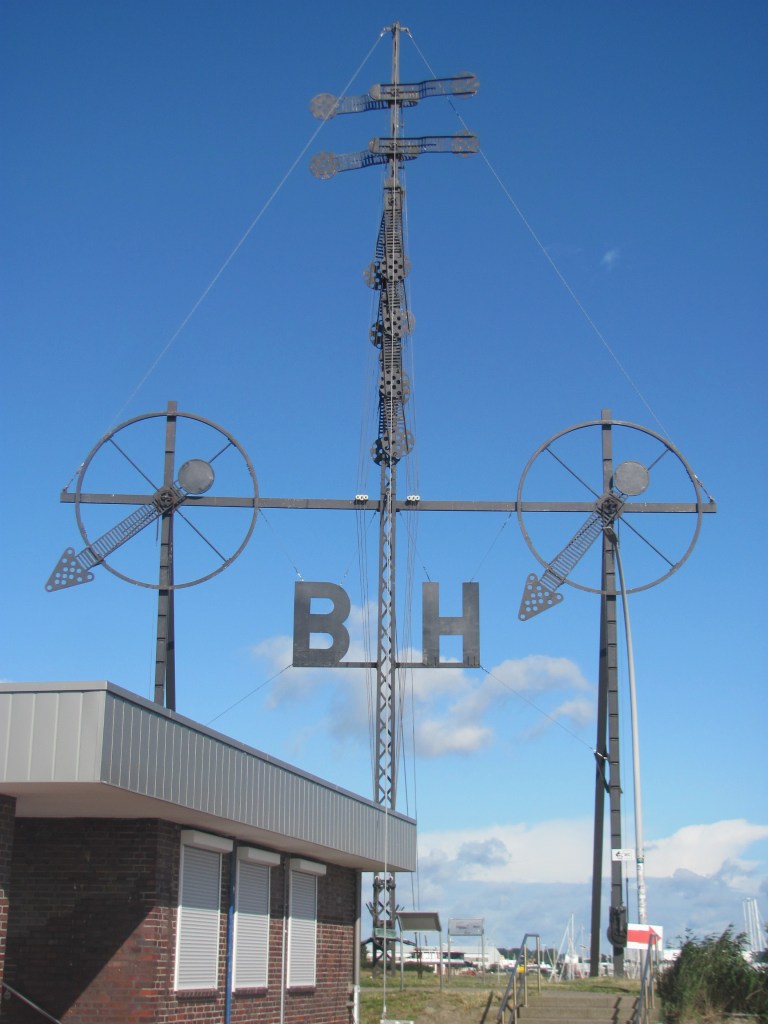
Nearby is the Semaphore, a complicated mechanical contraption of levers, pulleys and wire cables that was used to signal to passing ships the weather conditions on the islands of Borkum and Heligoland so that the skippers could decide whether it was a good idea to go there or not. It was only used for a short time before radio communications were developed, and is kept nowadays as a curiosity of a bygone age in marine communications.

The Semaphore indicating wind conditions in Borkum and Heligoland.

“It’s amazing that it needs all those levers just to tell the windspeed and direction”, says the First Mate.
Further on, we pass a tower covered in plastic sheeting in a small park.

Christo work of art?

“It looks a bit like one of those Christo efforts”, I say. “You know, the ones where he covers iconic landmarks in fabric. Maybe he is around somewhere.”

I have a quick glance around, but there isn’t any sign of him on any of the paths or in any of the surrounding trees and bushes.

“I think it is just being renovated”, says the First Mate. “And in any case, I think he died a year or two ago, so it is unlikely to be him.”

No wonder I didn’t spot him.

We eventually reach the Schloss Ritzebuettal. This was built originally by feudal lords of Saxony-Lauenburg, and later taken over and used by officials of the city of Hamburg to control the entrance and exit of shipping on the Elbe. Nowadays it is used as a restaurant and for exhibitions and weddings.

Schloss Ritzebuettal.

The next day the First Mate’s sister Petra and her husband Juergen come to visit us.

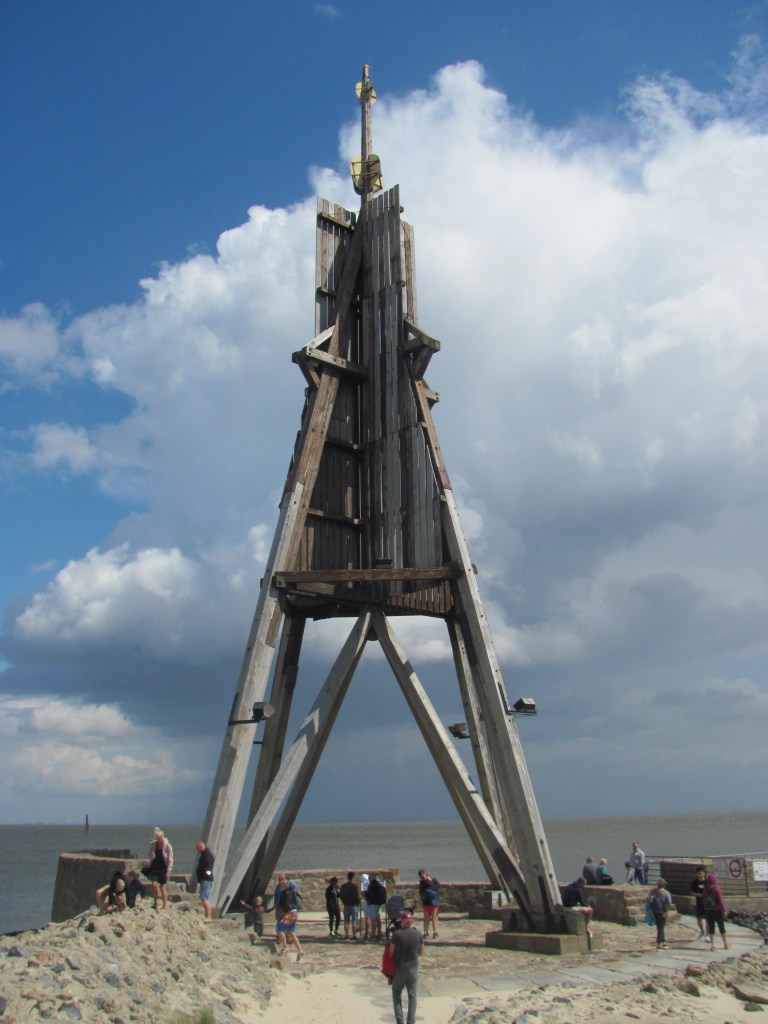
We walk out to the Kugelbake, or Ball Beacon, the wooden beacon first built in the early 1700s that marks the somewhat arbitrary boundary between the North Sea and the River Elbe, and with its light was also an important navigational aid. Being of wood, it is rebuilt from time to time due to deterioration from the elements. These days it is used more as the city’s symbol.

The Kugelbake (Ball Beacon), Cuxhaven.

After coffee and cakes, we drive back to Petra and Juergen’s place. They live not far away near Wilhelmshaven.

Juergen is into motorbikes. He has a BMW 1200cc and is setting off for a week’s tour to Italy with friends the day after we leave.

“Do you fancy a ride?”, he says.

It’s a long time since I have been on a motorbike, in fact hardly since I had an accident on one when I was young and damaged my knee ligaments. But I say yes. I am kitted up in all the gear, and feel like a spaceman when the helmet goes on.

“Bye”, I say to the First Mate. “Give me a last hug. As First Mates go, you have been a pretty good one. I am glad that we got the Will done.”

“Don’t be silly”, she says. “You’ll be back. Just don’t fall off, that’s all. And in any case, you have to help with peeling the prawns that Petra has bought. You can’t get out of it that easily.”

Setting off on a motorbike ride.

I sit on the back and Juergen takes me for a spin around the town. I hold on for dear life. I don’t want to miss the prawn peeling.

“How did you like that?”, says the First Mate when we return.

“It’s certainly a bit faster than sailing”, I say.

“Well, you can get back to your normal pace of life by peeling these”, she says handing me a bowl of krabben, or miniature prawns.

They are fiddly and not much flesh on each one, but there are lots of them. After a couple of hours we have finished them.

“We’ll have them for breakfast”, says Petra. “They’re delicious with brötchen.”

Peeling the krabben.

In the evening, we go to a local restaurant for dinner. Their speciality is meat roasted over an open fire in the dining room. A ring suspended by chains from inside the chimney is rotated in alternate directions by the waiters each time they go past it to ensure even cooking. There is a delicious aroma of barbecued beef.

Dinner cooking on the open fire.

My 200 g portion of beef arrives. I have heard of slabs of meat like doorsteps and had always thought it was just a figure of speech. It isn’t.

“Where’s your salad?”, sys the First Mate. “You are supposed to eat it as a side dish with the meat.”
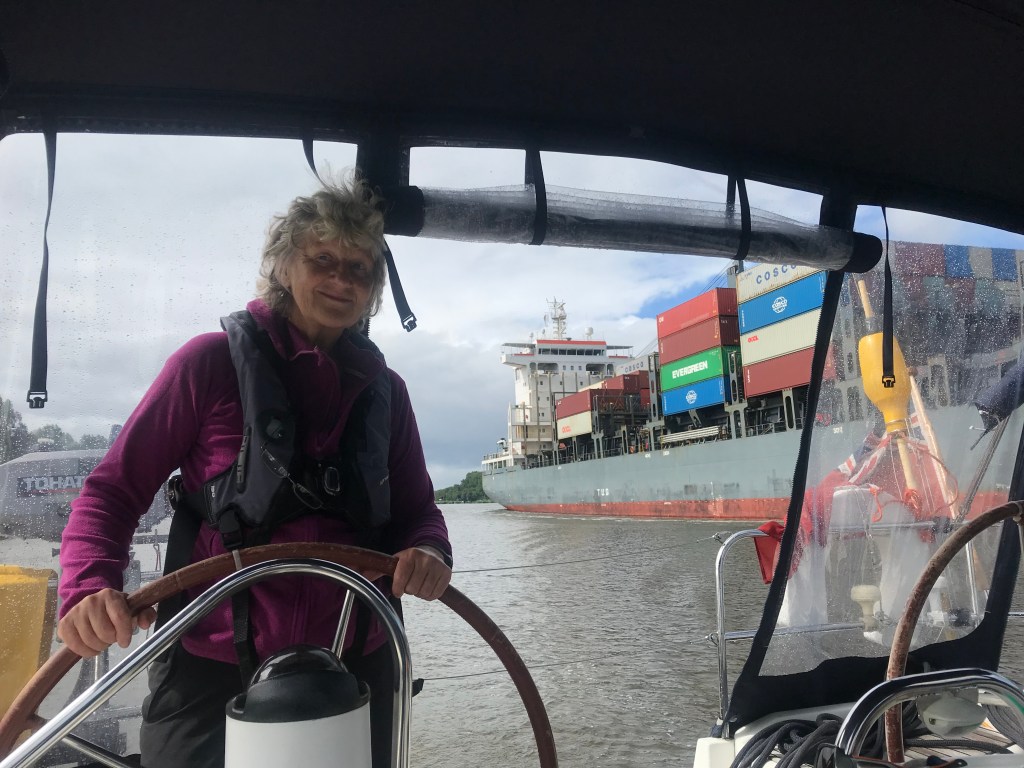
“I have eaten it already”, I say. “I was so hungry and I thought it was starters.”

“Dummer junge”, she says.

Exploring two islands and meeting some Frisians

We leave Terschelling at 0600 on the dot, and catch the last hour of the outgoing tide that sweeps us out into the North Sea before it changes direction and begins to carry us eastwards. We have a 75 mile sail in front of us, and need all the help we can get to minimise the time. The wind is from the north and on our beam, but with the long period of northerly winds we have had over the last week, there is a significant swell from the side, and we wallow through each successive wave. It is not comfortable, and we both start feeling queasy.

Leaving Terschelling harbour at sunrise.

Before long, Terschelling is fading into the distance. Other Frisian islands with the weird and wonderful names of Ameland, Shiermonnikoog, Rottumerplaat, Zuideruintjes and Rottumerroog appear and disappear in the haze. We would love to visit them, but all are too shallow for us to enter their gats and harbours.

Fair winds for Borkum.

After a hard day of sailing, we eventually arrive in Borkum harbour. There is only one pier for visiting yachts, and we need to raft up again. There is a strong cross-wind, and manoeuvring Ruby Tuesday isn’t easy. We select another boat of similar size and edge close in to it, but a sudden gust of wind pushes the bow round more than our stern. I frantically try and use the bow-thrusters to avoid our anchor from scoring their side, but the gust is too strong. A disaster looms. Luckily the owner of the boat has seen the danger and is waiting to fend us off. The anchor misses by centimetres and we glide alongside, fenders absorbing the shock and protecting each boat from damage. Ropes are thrown across from bow and stern, are threaded through cleats, and then returned – we are secure. Our new neighbours are from Norway, they have been to the Caribbean, and are now waiting for southerly or westerly winds to take them home again.

Arriving in Borkum harbour.

As we are now in Germany and not Holland, I put up the plain yellow Q-flag to indicate that we still need to clear customs and immigration formalities. I am not sure it is needed, but technically we are in a new country, and with the UK no longer in the EU, I reason that it is better to be safe than sorry. The Germans like their rules.

“The flag looks like it’s upside down”, jokes the First Mate.

“How can a plain yellow flag be upside down?”, I say.

But she is right. I have tied the little loop at the bottom and the long tail at the top without thinking. It’s soon fixed.

Upside down Q-flag?

The next day we cycle into Borkum town and head for the beach.

“Oh, look”, says the First Mate. “There are some strandkorbs. I have always liked them. They are great for sitting on the beach when it is windy.”

Strandkorbs are basically two-seater park benches, but have evolved into quite elaborate structures that can be tilted backwards and forwards, rotated to face away from the wind, have a canopy that can be pulled down against the sun, folding foot-rests, folding shelves for drinks, and storage drawers underneath.

“The most expensive with all the extras can cost nearly €3000 new”, she continues. “Made of teak, with porthole windows, cushions, you name it. Germans think it is the pinnacle of sophistication to own one. But you can also rent them by the day or by the week. See, these ones cost €12 a day.”

Enjoying the beach whatever the weather.

I had always been amused by them. I had seen photos of old couples sitting in them completely wrapped up on cold, windy and overcast days, stoically determined to have a day at the beach in spite of the weather. I can see the point of them, but why not just wait for a good day?

“Often you can have sunny warm weather here, but there might be a strong wind lifting sand from the beach”, says the First Mate, a little defensively. “Strandkorbs allow you to enjoy the sunshine while protected from the wind.”

“I can’t imagine a family with parents and kids all cramming into them”, I say.

“Ah, but they do”, she retorts.

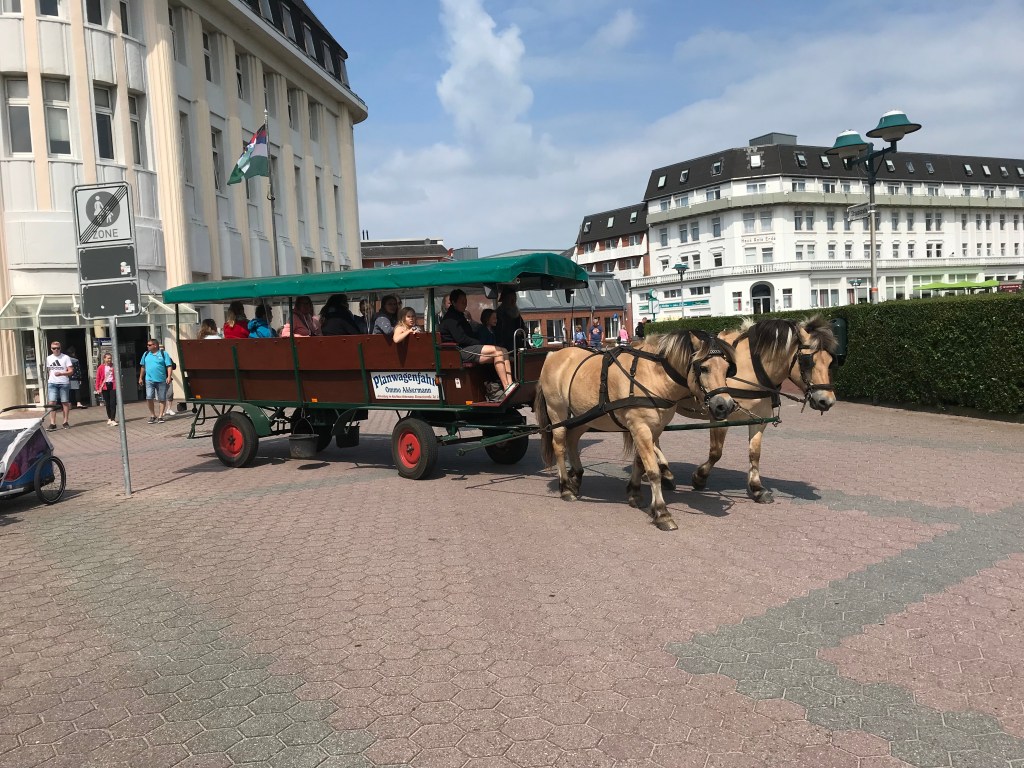
We buy some filled rolls and sit in the small park opposite the train station to eat them. A little girl is fighting with her brother for a scooter. Their exasperated mother grabs the scooter and tells them both to behave. A man with bags of cat litter stacked up on the carrier of his bike parks it and comes and sits on the next seat. Opposite, a woman sits with a laptop on her knees and talks animatedly into her mobile phone. There is a toot, and the small train from the harbour arrives, disgorging its passengers. Two horses wearily plod past pulling a wagon-load full of tourists.

“Life in Borkum, eh?”, says the First Mate.

The small train arrives from the harbour.
Horses for courses.

“Come on”, I say, swallowing the last of my roll. “Let’s get going. We haven’t got all day.”

We find a cycle path leading from the town beach, following the sand line around the northern coast of the island.

The cycle path along the northern beaches, Borkum.

Eventually it leads away from the beach and though a lush green woodland.

The First Mate enjoying a woodland cycle.

At one point, we see a sign pointing to the FKK beach. There is even a bus stop called FKK Beach.

“Shall we go there?”, I say. “Perhaps we can have a swim?”

“I didn’t bring my swimming costume”, says the First Mate.

It’s as good an excuse as any. We cycle on.

The path circles round to the south and we find ourselves cycling back along the southern dyke just as we did in Terschelling. On the landward side are fertile polders, and on the seaward side marshlands growing rushes which give way to the mudflats. There is a strange beauty.

Cycling along the southern dyke.

In the morning, we set off for Norderney. As with Terschelling, we catch the last of the ebb tide to take us out to the North Sea, and then the flood tide to take us eastwards. This time it is only 35 miles, but the swell has persisted, and the wind is strong. We have a good sail, but there is a fierce chop and it is not smooth.

We approach Norderney. There are two channels into the harbour. One, the Schlucter, is from the west, and therefore is the natural one that we would take. The other, the Dovetief, is from the east. Both are relatively shallow, marked on the charts as 2.6 m at low water. The four slight problems are that our keel is 2 m deep, that we are approaching just after low water, in choppy conditions, and the Schlucter is very narrow with drying sandbars on each side. Get it slightly wrong, and we could end up grounded. The Dovetief is wider, with more margin for error, but would entail a long detour eastwards to enter it, then back again.

“Why don’t you call the harbourmaster at Norderney and ask him about the depth in the Schlucter?”, says the First Mate, anxiously. “He might be able to advise us.”

I manage to get through to him.

“It could be touch and go for you, especially in choppy conditions”, he says. “I would wait an hour for the tide to rise a bit more, if I were you, then you should have enough to get through. Follow the red buoys, keeping them to your port side. However, remember that the S6 buoy has moved and you need to keep it on your starboard and not your port.”

We reach the outermost buoy, the S2, and decide to anchor there for an hour. The bottom is sand and the anchor sets well, but with a choppy sea with long swells rolling in from the North Sea, it is not comfortable. Ruby Tuesday pitches up and down, and we both feel queasy. The information about the S6 buoy being in the wrong place also does not add to our confidence.

Eventually the hour is up, and we motor gingerly in, counting the red buoys, S4, S6, S8. As advised, we are careful to go on the wrong side of S6. At one stage, the depth reads 0.8 m below the keel. We breathe in, and slowly it increases again: 1 m, 1.1 m, 1.2 m. We are past the worst. Later I calculate that the extra depth that we gained by waiting an hour is 30 cm. We probably could have made it with only 50 cm under the keel in calm conditions, but with the pitching and tossing of the waves, we could have easily hit the bottom. Better to be safe than sorry.

Threading our way through the Schlucter channel into Norderney (red line).

In the evening, we sit in the cockpit and enjoy the soft golden glow of the setting sun. Suddenly the peace and calm is shattered by the piecing shrieks of a flock of oyster-catchers on the opposite bank. Something has upset them. We watch in fascination as they set upon a solitary black-headed gull in their midst. On one of the posts in the water, a single oyster-catcher seems to be directing operations. Again and again, the attackers dive bomb the gull, who runs this way and that trying to escape. Eventually it gives up and flies away. The shrieking dies down and peace returns.

“Internecine warfare in the bird world”, I say.

“I think it is over territory”, says the First Mate. “The oyster-catchers must think they own that piece of land over there, and try and keep any other bird species away from it.”

I am not so sure. We didn’t see any oyster-catchers there earlier in the day, and after they had proved their point with the gull, they all left. The next day we see a huge flock on another promontory. They don’t seem to be wedded to a specific territory.

Oyster-catcher territory?

In the morning, we unload the bikes and cycle into the town centre. We find the Tourist Information in a stunning building called the ConversationHaus and obtain a map of cycle tracks over the island. Outside there is a band playing “Time after Time”. We sit and listen, but it is their last song, and they pack up.

The ConversationHaus, Norderney.

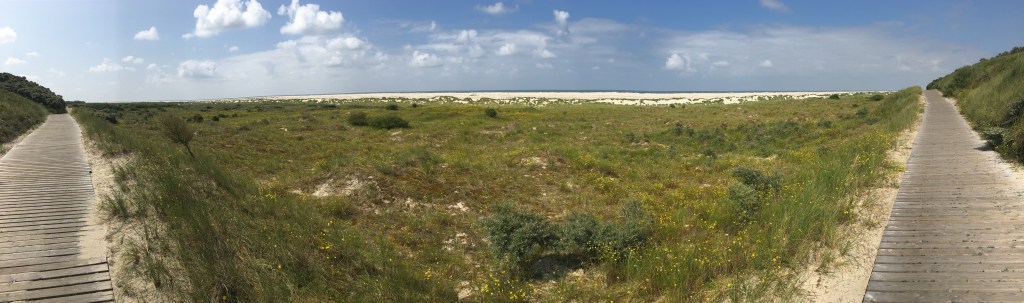
We cycle out of the town and find a cycle track that takes us around the island. From one of the dunes we have a fantastic view over the rugged interior. It looks wild, but there are cycle tracks criss-crossing it.

Mature dunes in the centre of Norderney island.

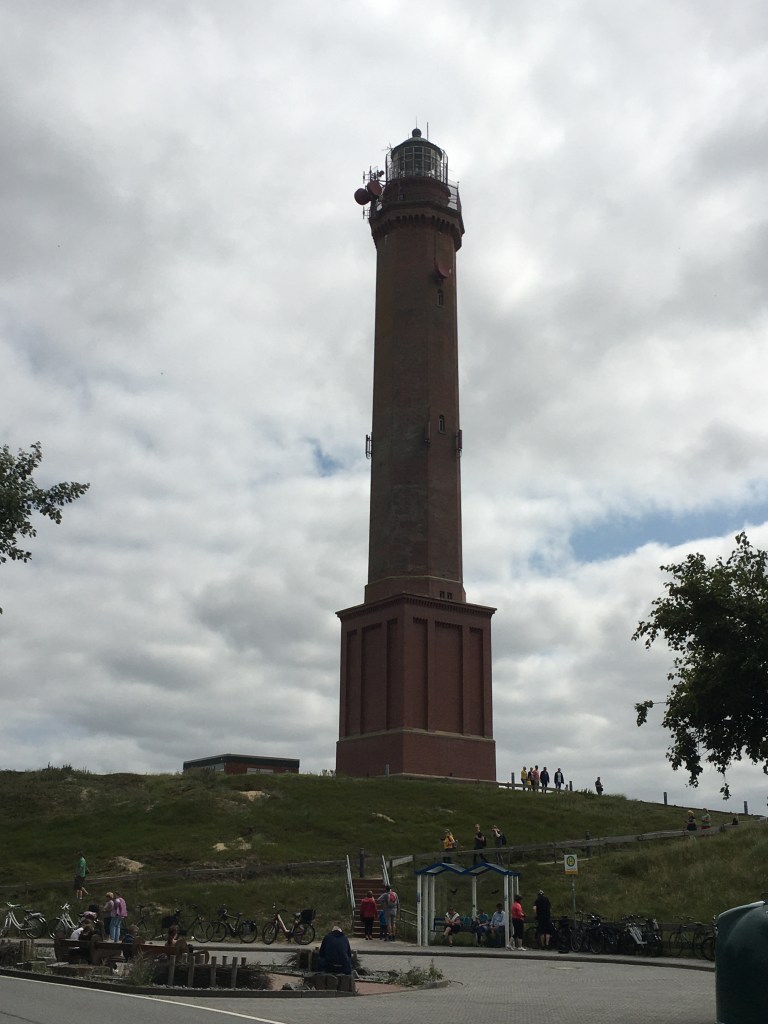
We eventually reach the lighthouse in the middle of the island and stop at the restaurant there for lunch.

The lighthouse in the centre of Norderney.

The track eventually comes to the southern dyke and takes us all the way back to the marina. I am conscious that Erskine Childers’ spy novel Riddle of the Sands was set here, and try and imagine Arthur Davies wending his way in his Dulcibella through the narrow channels and fog to Memmert island and the waiting Captain Dollmann in his yacht plotting to invade Britain in WW1.

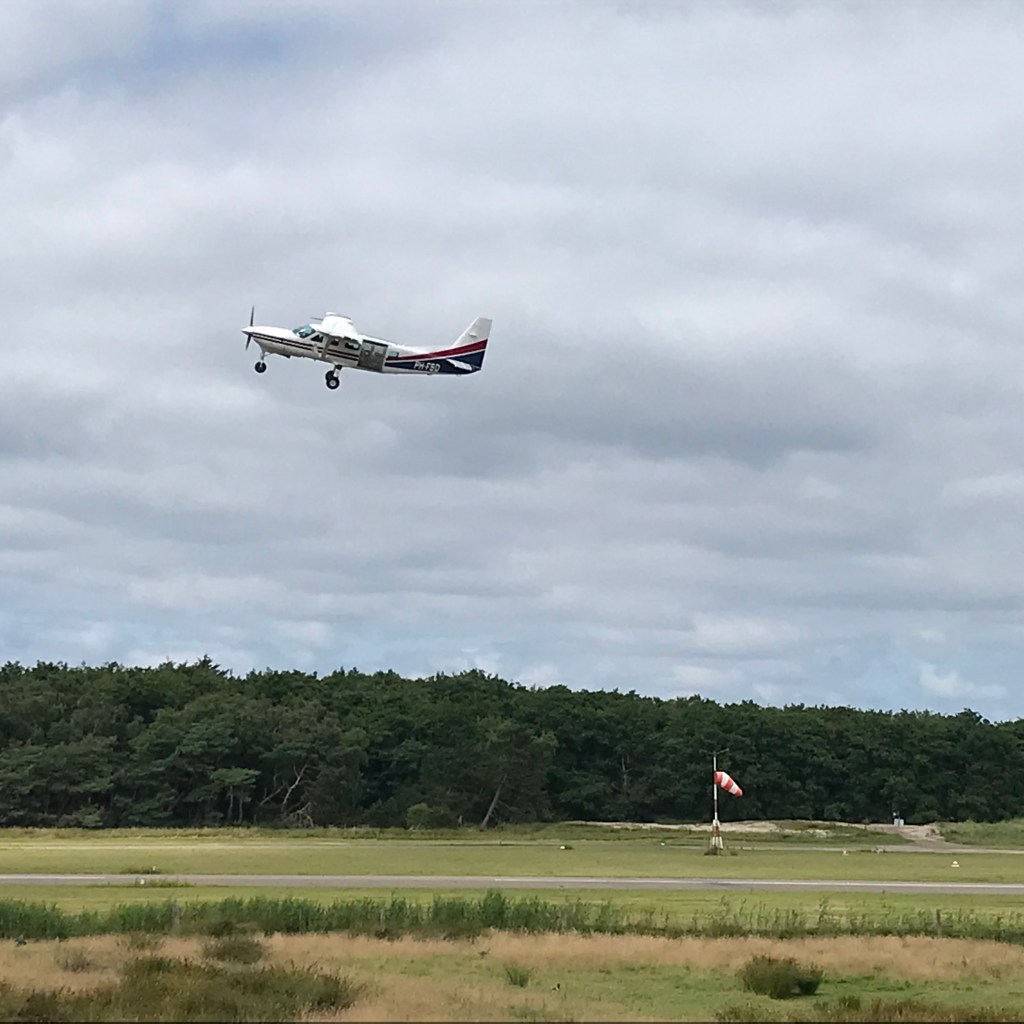
“Look!”, says the First Mate suddenly. “There’s a plane taking off.”

A small aircraft is taxiing along the runway of the tiny airport in the centre of the island. We watch it climbing until it disappears into the clouds.

A small plane takes off from Norderney airport.

“It’s probably heading back to the mainland”, says the First Mate. “They have regular flights back and forwards.”
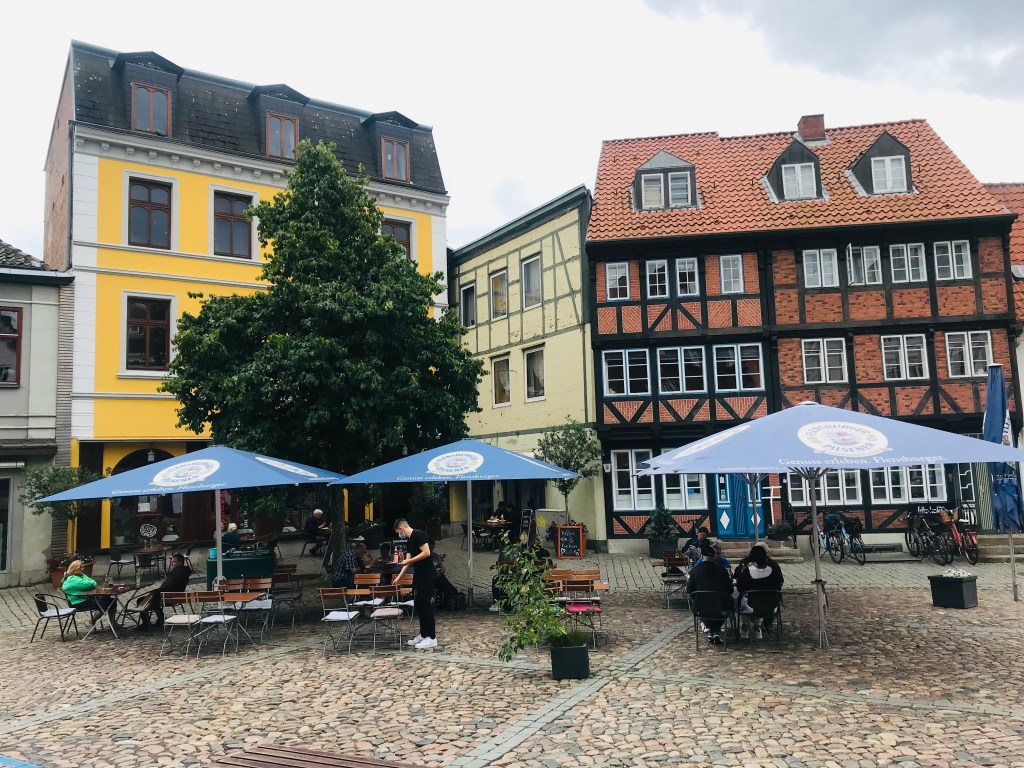
Suddenly there is a swishing sound above us and we see half-a-dozen parachutists descending rapidly in our direction, their colourful parachutes contrasting with the white of the clouds. The same small plane is coming back to land again.

Parachutists coming in to land.

“They are probably British paratroopers come to attack Dollmann’s Medusa”, I say. “Carruthers must have ordered it.”

She looks at me strangely.

“You have a weird imagination sometimes”, she says.

I notice that a pattern seems to be emerging for us on these islands. We tie up in the harbour, explore the town on the western side of the island, then cycle eastwards to see beautiful sandy beaches, small villages, and woodland until we reach the nature reserves on the eastern end of the island, then return along dykes with polders on one side and the muddy flats of the Wadden Sea on the other.

“I told you that once you have seen one of the Frisian Islands, you have seen them all”, says the First Mate.

And yet, somehow, each one does have its own character. Terschelling is the summer playground of the Dutch, Borkum is the same for the Germans, and Norderney is supposed to be the new Sylt, the island playground of the international jet set in the North Frisian Islands.

“I haven’t seen any rich and famous yet”, I say.

“No, nor have I”, says the First Mate. “They are probably all hiding in their beautiful houses overlooking the beaches, trying to avoid the peering eyes of the riff-raff like us. And all those small planes we saw parked at the airport probably belong to them.”

Planes of the rich and famous?

In the evening, we meet Jost and Marina for drinks. We had first met them in Borkum when they tied up behind us, and then again here in Norderney when they had rafted up next to us temporarily before being allocated a proper berth. Josh is born and bred in Friesland in Holland and is financial controller at a large school, while Marina is from Amsterdam and is a university lecturer.

They proudly tell us something of the history of Frisia.

“The area was first settled in Roman times, when the people lived on man-made hills on the Wadden Sea mudflats to stop being swept away by each tide”, says Jost. “The Romans considered them a bit primitive as they hadn’t developed any agriculture and lived on a subsistence diet.”

“It’s interesting that the area eventually developed the Frisian cow, the highest milk production cow in the world, and yet were so primitive in those times”, I say.

“Yes, but the cows did exist even back then, but were kept by a different Frisian tribe further inland”, says Marina. “It’s thought that people from Hesse came to Frisia with their black cows and crossed them with the white cows that were in Frisia at the time, which eventually become the modern-day Frisian.”

“My sister lives in Friesland In Germany”, says the First Mate. “It’s interesting how Frisia seems to be split between both the Netherlands and Germany nowadays.”

“Yes, the Frisians were always more interested in their farming than in warfare”, continues Jost. “They never really existed as a separate country as such, but were invaded by various other peoples, including the Vikings, the Franks, the Saxons, you name it. In the Middle Ages, they became part of the Hapsburg Empire, but they didn’t like that too much, so they did revolt, and joined the Dutch republic when it was formed in 1577.”

 “What about the Frisian language?”, I ask.

“There are actually three main Frisian languages”, says Marina. “West Frisian, Saterland Frisian and North Frisian. But there are also a lot of dialects, many of which are not mutually intelligible. It’s pretty complicated. Frisian is also the closest Germanic language to English, with a lot of similarities particularly with the English spoken in Norfolk. Probably due to the trade links they had back then. Some Frisians even joke that London is a suburb of Frisia!”

“In Frisian, we say tsiis for cheese and tsjerke for church, for example”, says Jost. “Old English and Old Frisian were very similar, but English and Frisian are two separate languages nowadays, mainly because of the influence of other languages – English by the Norman French, West Frisian by Dutch, and North Frisian by German.”

I shiver. It is getting late, and we are the last customers left in the bar. The moon has risen and casts a streak of light across the water. We drink up, put on our jackets and stumble back to our respective boats. It has been a fascinating insight into a small part of Europe that I knew little about. Frisia is not just about cows.

Frisia – not just about cows!

A sea battle, a sandy island, and washing the clothes

The Dutch East Indiaman changes tack and cuts in astern of us trying to position herself to fire off a broadside at us from the cannon protruding from her gun-ports. Sailors line the decks, shouting and brandishing their weapons. We are faster and more agile than her, but a cannonball amidships or through Ruby Tuesday’s mast could cripple us and make us ripe for the picking.

I turn stern on to her to minimise our cross-section and pray that her gunners will have trouble aiming in the gently rolling swell. There is a puff of smoke from one of her gun-ports, followed by a deafening boom rolling across the water. There is a swish as the ball flies harmlessly to our port side. I shiver; another shot to get our range, and they will have us in their sights. I tack quickly to gain speed to distance Ruby Tuesday from them, then turn suddenly broadside on, and give the order for our cannon to be fired. I smell the stench of burning gunpowder as ball after ball rips into the Indiaman’s gunwales and rigging, turning her sails into tatters and holing her at the waterline. She won’t be able to follow us now, I think.

“Watch out for that sailing ship behind us”, shouts the First Mate in alarm. “It’s going faster than us, and it’s getting very close. I’d almost say it is going to hit us.”

Hostile intentions?

My mind snaps back to reality. I was daydreaming of the First Anglo-Dutch War in the 1600s, when the English and Dutch were at each other’s’ throats to gain dominance in the lucrative maritime trade. The English had won the first war, but had come second in the following three.

“It’s OK”, I say. “I have it under control.”

We are on the way to Terschelling, one of the Dutch Frisian islands. I had done the calculations the previous evening, and we had left South Harbour in Harlingen just before high water to catch the outgoing tidal flow along the channel. A lot of other boats have had the same idea and we are just one of a long procession. The wind is favourable, coming from the north, giving us a nice beam reach for the first part of the voyage, and we make eight knots. The Dutch East Indiaman recedes into the distance.

In the procession to Terschelling island.

We eventually reach the Schuitengat, the narrow buoyed channel that leads to West Terschelling harbour, and turn into it, leaving the main channel. The tide is now against us as it flows out to sea, and we need to start the engine to make any progress.

We arrive at the marina, and are met by a member of staff in a small RIB who directs us to the space allocated for boats of our length. All the pontoon berths are already taken, but there is enough space to raft up alongside another one.

“We normally have a maximum of three boats rafted together”, explains the staff member. “You can chose where you want to go.”

We decide to raft up to a large catamaran as it counts as two boats, but it also means that we only have one other boat to clamber over. At least we have a place for the night.

Rafted up in West Terschelling marina.

“You can take your glasses into town to see if they can be fixed”, says the First Mate at breakfast the next morning, cutting another slice of cheese.

I idly think the cheese looks like the shape of Terschelling island. Mind you, anything could look like the shape of Terschelling when one of the legs on your glasses has become wobbly and they don’t sit straight on your face.

We unload the bikes and cycle into West Terschelling, the main town of the island. It seems there is an optician there.

“Don’t stand so close to me”, says the optician as I hand him the glasses. “You are supposed to be 1.5 metres away.”

It’s an interesting customer relations approach. I am wearing my mask, and he had asked to see the glasses. I am not sure how I am supposed to give him the glasses unless it is on the end of a fishing line. And in any case, I am not much less than 1.5 m from him anyway.

“I am afraid I can’t fix these”, he says curtly. “They are a special SpecSavers make. You’ll have to take them back to the place you got them.”

I explain that this is a bit difficult, as we are travelling for some months.

“Sorry, there is nothing I can do”, he says. “You could try and fix them yourself, I suppose.”

Fixing glasses is not something I am good at. At least not without the risk of breaking them. And anyway, what are opticians for? Luckily, I have a spare pair back on the boat. They will have to do.

“He was a bit grumpy”, says the First Mate, as we leave. “I wonder what side of the bed he got out of this morning? Anyway, forget about him. I just want to have a quick look around the shops. Why don’t you find somewhere to have a coffee, and I’ll catch up with you shortly.”

While I am waiting, I scan through a small brochure on the natural history of the island that I had picked up at the marina. It seems that the whole of the Wadden Sea that we had crossed yesterday used to be dry land and the islands didn’t exist until fairly recently, geologically speaking. When the ice melted after the Ice Ages, the sea level rose by 60 m and by 7000 years ago it was all flooded. Then wave action from the North Sea started building up sand banks until some of them grew enough not to be covered by the tide each time. Vegetation became established which allowed them to grow further as sand was trapped from being blown away by the grasses and shrubs. The constant supply of sand from the seaward side created beautiful sandy beaches and behind them, dunes. The younger dunes are white from the fresh sand, but as they begin to accumulate organic material from the vegetation, they become darker. In between the dunes, fresh water collects to create marshes.

The First Mate returns from her shopping expedition.

“I read last night that the islands are actually migrating eastwards”, she says. “With the predominant wind from the west, the sand gets blown from the western side and is deposited on the eastern side. All the towns now are on the western end of each island, but they used to be in the middle.”

“We had better not stay here too long, or else we might find ourselves back in the sea”, I joke.

We jump on the bikes and head eastwards, following the well-signposted cycle tracks criss-crossing the island. There is a strong wind from the north, and it is tough going in places. We pass through some delightful forest tracks and eventually reach the beach on the north coast. Unfortunately the wind is so strong that the sand is being lifted from the beach and stings our faces like tiny needles. I now know how Ruby Tuesday feels having her hull sand-blasted to remove marine growth. We beat a track to the café at the start of the dunes and have a cold drink behind the glass windscreens to recover.

Sheltering behind the windscreen from the sand.

We eventually reach the end of the bike path. Beyond is the Boschplaat, an extensive nature reserve of nothing but rolling dunes interspersed with marshes. It’s a wilderness.

Looking over the Boschplaat.

We consider a walk, but rain is forecast. Already a few drops are falling, so we decide to head back home along the southern dyke that separates the Wadden Sea from the polders. These are areas that used to be part of the Wadden Sea mudflats, but which have been drained and are now used for agriculture. A farmer mows the lush grass growing on the rich soil of the former sea bed.

Mowing the grass on the polders, Terschelling.

With the wind from the north, we have a nice beam reach as we cycle along the top of the dyke (did you see what I did there?). Bird life on both sides is abundant. We see geese, lots of oystercatchers, cormorants, terns, and black-headed gulls, to name but a few.

A cormorant dries its wings.

We are particularly taken with the little stone-turners hunkering down between the cracks in the rocks making up the side of the dyke.

“They would have a job turning those stones”, says the First Mate.

Wadden Sea stone-turners.

Back near the town we spy a boat resting on the sand, her keel withdrawn. The local boats are built to have wide flat hulls which can sit quite happily on the exposed sandbars at low tide. Apparently it is a highlight of tourist boat trips to the Wadden Sea islands for the skipper to ground the boat and allow the tourists to walk around the sandbar before the tide returns and they have to get back in the boat. It’s not a party trick that Ruby Tuesday can do with her fixed deep keel, unfortunately.
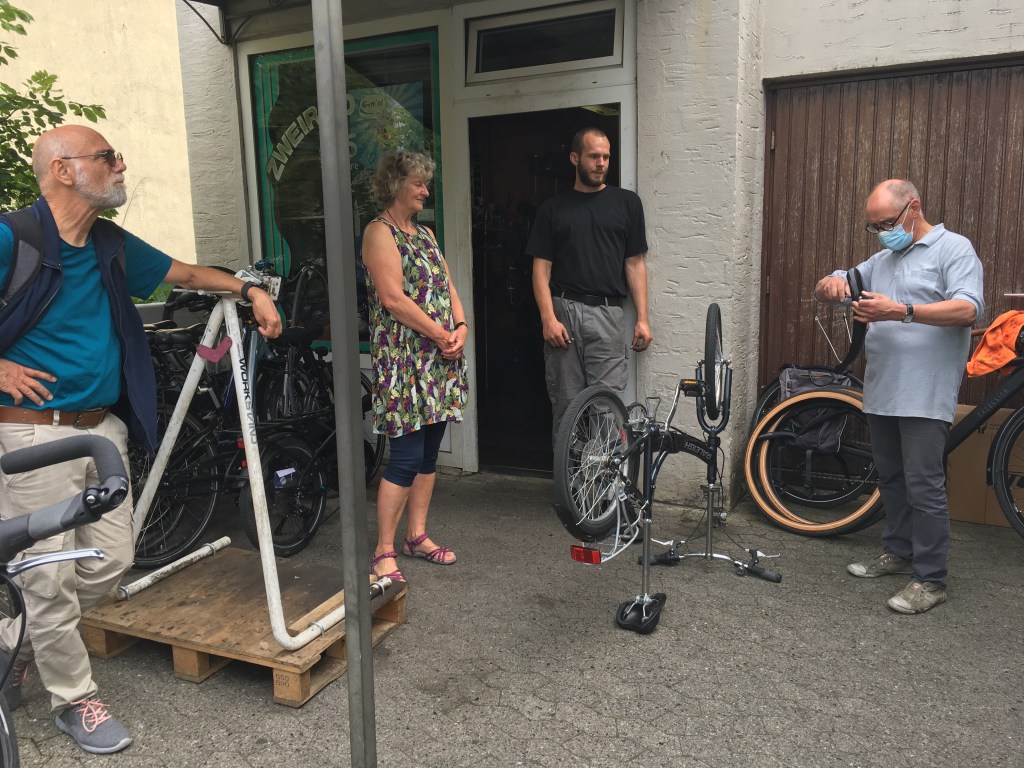
Boat resting on the Wadden seabed.

We arrive back in West Terschelling. Luckily, the rain has held off, so we decide to have coffee and cakes.

“Apparently cranberries are a speciality of Terschelling”, says the First Mate. “I think I might try a cranberry pancake with cranberry liqueur. You can have some of it.”

The First Mate treats herself to a cranberry pancake.

When we get back to the boat, we have new neighbours. They are a young couple from Amsterdam who have rafted up next to us. They are three deep, and have to clamber over us and the catamaran.

“I hope you don’t mind”, they say shyly. “There was no other place left.”

“Not at all”, we say. “That’s the way it is done here.”

“You know, I don’t think that we have seen another British boat since we started off”, they say.

We had noticed the same thing. There had been a lot of Dutch boats obviously, and German ones were increasing in number the further north we went, even a smattering of Norwegian and Swedish craft. We had even seen one with a Swiss flag, despite that country not being well known for its extensive coastline. But no UK ones so far apart from ourselves.

“I guess it’s a combination of COVID and Brexit”, I say. “Now that the UK is out of the EU, we are treated as a third country as far as things like pandemics are concerned, and are given no slack when entering the EU. And now that COVID numbers are rising exponentially again, we are really persona non grata here. They just don’t want us bringing nasty variants into mainland Europe. And who can blame them?”

Not only that. Now that we are out of the Customs Union, boats are also treated as foreign goods, and need to be temporarily imported into the EU for a maximum of 18 months at a time without paying VAT. And to complicate things even further, UK-registered boats must pay VAT a second time if they are out of Britain for more than three years, even if it was paid at the time of purchase. Many boat-owners are heading back to the UK to avoid this tax before the deadline in June 2022.

“It’s a pity”, says the First Mate. “When I first came to Britain, it was well-known for its pragmatism and openness to people from other countries. Now it has changed, and foreigners don’t feel welcome there anymore. It is well on its way to cutting itself off entirely from Europe.”

It’s true. Brexit was sold as an opportunity to become more global in its outlook. So far there has been little evidence of that. The reality is that a generation of Britons will be more inward-looking because of the country’s self-imposed isolation from their nearest neighbours. The absence of the Union Jack in European waters may be a permanent feature of the future.

A declining presence in European waters?

“I have just discovered that the washing machines here are free”, says the First Mate in the evening. “Not only that, the washing powder is added automatically. We should get all our washing done while we have the chance. The only problem is that they are in tremendous demand, but I have heard that if you get in when they open the building in the morning you have a chance.”

“So, I have been thinking”, she continues. “You are usually up at that time. You can take the washing over.”

“But it’s my birthday”, I protest. “I was thinking of having a lie-in.”

The real reason is that washing machines and I just don’t get on. I just get confused with all the options –  temperatures, soaps, conditioners, fabric types, and colours – that are important in washing clothes these days. After 20 years, I have learnt the buttons to press on the one at home, but every new machine I encounter seems to have a different set of dials, displays and buttons to negotiate. I am usually happy to leave it to the First Mate. Not only that, in this case all the instructions are in Dutch.

In the morning I find myself trudging to the washing block carrying two huge bags of smelly clothes. The washing machine room is empty, so at least I am spared the ignominy of having to be shown how to operate the machine. Ten minutes later I have worked it out. I press the button and it starts to rotate. So far, so good. The machine completes its cycle, and I transfer the clothes to the drier.

An hour later, I return. There is one other person in the room – a man with bulging biceps, an earring, shaven head, tattoos, and a tight-fitting vest with Nebraska University written on it in Varsity Font. He is a lot bigger than me. My drier has completed its cycle, but not all of the clothes are dry yet. I pick out the ones that are dry, and push the button to start the machine for another cycle. Nebraska Man glares at me. I realise he also wants to use the drier. I decide to brazen it out and wait for my cycle to complete. Nebraska Man moves closer and clears his throat.

I crack.

“Are you waiting for the drier?”, I ask, knowing the answer.

Nebraska Man grunts. I take it as a yes, and press the stop button.

“Ah, that’s better”, I say, reaching inside and feeling the clothes. “They are dry now.”

It’s been only two minutes and they are not dry. But at least I leave with my teeth intact. I put it down as a win-win situation.

“These clothes are not really dry”, says the First Mate, when I get back to the boat.

“I know”, I say. “There was something wrong with the machine.”

Not worth losing teeth over.

An un-forecast wind, meeting friends, and a decision

“Bye, bye, Enkhuisen”, says the First Mate. “We’ve enjoyed being here, but it’s time to move on.”

“Enjoyed it, yes, but not happy to have lost my keys”, I say grumpily.

“Never mind”, she retorts. “It’s not the end of the world. I am sure we can get some replacements at some stage.”

Leaving Enkhuisen.

We are motoring out of Enkhuisen harbour on the way to Makkum, across on the other side of the IJsselmeer. It is not the ideal day for sailing as there is almost no wind, so we continue on motoring, following the line of buoys almost directly north. According to the forecast, there is supposed to be a slight breeze later in the afternoon, so we are hoping we will catch that. At least it is warm and sunny, so we relax and bask in the sunshine.

A flappy sail is not a happy sail.

But not for long. Catching us by surprise, a strong wind suddenly springs up, and within a few moments it is blowing at 16 knots.

“Is this the slight breeze that you reckon was forecast?”, shouts the First Mate, grabbing her towel from the foredeck. “I think you need to study those forecasts a bit more carefully next time. This isn’t a breeze, it’s a Force 4.”

None of the three forecasting websites we use had predicted this, all saying a breeze of around 6-7 knots. Momentarily, I feel a little bit aggrieved that I am getting the blame for nature not obeying human weather forecasts, but there isn’t time to dwell on it, as we haul out the sails and cut the engine. The sails fill and Ruby Tuesday leaps forward. It is a welcome relief on the senses to hear only the swishing of water as it flows under the hull and emerges in a gurgle of bubbles at the stern, rather than the throb of the engine. Sailing boats are built for, well, sailing, aren’t they?

Ah, that’s more like it! Full sails in the IJsselmeer.

Buoy after buoy slips past us, LC8, LC6, LC4, LC2, VF-B, VF-A. Each has its own name and number, making it a doddle to find where exactly in the IJsselmeer we are. A lot of boats seem to be outside the buoyed channels, but we tell ourselves that they have local knowledge, and with our deep keel of 2 m, we need to play it safe and keep to the lanes.

Keeping us on the straight and narrow.

We arrive in Makkum Marina and are allocated a box berth. It seems the owner is away, but will be back in two days. If we want to stay longer, we will have to move to another one. The berth is the tightest we have ever fitted into, but somehow, we manage to squeeze in with centimetres to spare on each side, without even touching the neighbouring boats.

“Breathe in …”. Not much to spare either side on this one!

“Phew, I really didn’t think we were going to make that”, says the First Mate.
“All in a day’s work”, I say nonchalently.

The next day we borrow some bikes from the marina and cycle into town for lunch.

“Oooh, look here’s a place that does uitsmijter and flammkuchen”, says the First Mate. “They are my favourite. You can order one, and I’ll order the other, and we can share.”

I am usually not all that keen on these sharing arrangements with the First Mate, as I invariably end up with the smaller ‘half’. In this case, however, it seems like a good idea. Uitsmijter is not for the faint-hearted – it is a kind of sandwich with bacon and cheese finished off with a fried egg or two on top. Flammkuchen is a kind of pizza. Both not really what you might describe as a fat-free light lunch.

Uitsmijter and flammkuchen – eyes bigger than our stomachs!

I see the First Mate struggling.

“I thought they were your favourite”, I say. “You don’t seem to be making much progress with that.”

“I feel full”, she says, halfway through her share of the uitsmijter. “I had forgotten how much it is. Can you finish mine?”

I am also feeling pretty bloated and am starting to feel drowsy. Heavy lunches always do that to me.

“Afraid not”, I say.

“Put them in this bag and we can finish them tonight for dinner”, she says, pulling out a paper bag. She always seem to have such items concealed about her person somewhere.

After lunch, we watch the lock-keeper opening and closing the lock for boats passing up and down the canal. He collects his payment by dangling a blue-painted wooden clog attached to the end of a fishing rod down to the boat, into which the skipper puts his money. Any change is returned the same way.

“They can’t get away without paying”, says the First Mate. “He won’t open the lock-gate until they do!”

“I wonder if he accepts credit cards if you have no cash?”, I muse.

The lock-keeper lowers a clog on the end of a fishing line to collect the fee.

Later in the afternoon, our friends, Harry & Beate, come to visit us. They keep their boat in Workum, just down the coast from Makkum, and have decided to sail up to see us. We had thought about calling in at Workum to see them on our way up, but we are not able to enter the marina there with Ruby Tuesday, as her draft of 2 m is too deep for it. They are a little late as the lock at the entrance to their marina had been closed for the lock-keeper to have his lunch. First things first!

Harry and Beate come to see us.

It’s good to see them, and we settle down on their boat to a relaxed afternoon and evening of beer, wine, snacks and dinner. They have just flown back from Austria where they went all the way to participate in a dragon boat race against other dragon boats from all over Europe.

“How did you get on?” I ask.

“We came second in our race”, says Harry.

I’m impressed, and am about to say so.

“But there were only two boats in it”, continues Beate. “A lot of competitors didn’t come because of COVID restrictions.”

We decide that coming second sounds much better than coming last out of two, especially having gone all the way to Austria. We congratulate them wholeheartedly.

They bought their sailing boat a couple of years ago and are in the process of refurbishing it. The previous owner lived on it for 14 years with his wife and son, but decided that was long enough and bought a camper-van instead. Consequently the boat is well fitted out.

“We call her Dabeh”, explains Harry. “It’s a combination of the first letters of our daughter’s name and our names. We thought it sounded kind of exotic.”

I have to agree. Perhaps a hint of Arabian? Scimitar-wielding princes and dusky princesses come to mind.

“Our plan is to take her home near Dusseldorf at the end of the summer”, he continues. “It’s great over here in Workum for sailing on the IJsselmeer, but not very convenient for doing work on her over the winter. The idea is to take the mast and sails off and leave them in Workum, and motor back home along the Rhine. Then we will bring her back next summer.”

I can sympathise with him. It’s all very well overwintering the boat abroad, but if it isn’t possible to get to her because of COVID19 or other reasons, jobs get squeezed into the week or so at the beginning of any sailing, or left un-done for some other time.

The next morning, they head back to Workum and we set sail for Harlingen, an ancient fishing town further up the coast. First, we must pass through the Afsluitdijk dam via the Kornwerderzand locks. We follow a couple of other boats into the holding area. Suddenly a loudspeaker booms across the water.

“Willen de boten in het wachtgebied naar de juiste lijn gaan?”, or something to that effect.

My Dutch is almost non-existent, but it doesn’t take much to guess that we are in the wrong lane, and that the lock for yachts is the next one. There is even a sign with an arrow pointing the way for sports boats, which we had somehow missed. We turn around swiftly and manage to be the first one into the correct lock. I pretend that we have been there all along, but I don’t think anyone is fooled.

Waiting in the Kornwerderzand lock.

“We need to take more care reading the signs next time”, says the First Mate.

She’s not wrong.

We pass through uneventfully to find ourselves in the Wadden Sea, a vast area of sand and mud flats that flood and drain with the tides. The area is criss-crossed with numerous channels through which boats with deeper drafts can sail if they know where to go. When the tide is in, it looks just like one giant sheet of water. The route to Harlingen is marked with red and green buoys along the sides of the channel, with dangerous patches of green marked on the charts outside them. The green areas dry as the tide recedes and are probably only a few centimetres deep. Woe betide any sailor with a deep keel that strays beyond the safety of the channels.

Our route from Makkum to Harlingen along the Boentjes channel.

“Why do you think that this channel is called the Boentjes channel?”, asks the First Mate. “Boentjes means ‘beans’ in Dutch. It’s a strange name for a channel.”

“I have no idea”, I say. “Probably some reason that is lost in the mists of time. Perhaps someone lost a can of beans overboard in the old days?”

A random thought flits into my mind as to whether the Dutch have the equivalent of ‘Heinz means beans’. Almost as quickly, it flits out again.

We follow the channel around, and eventually see Harlingen in the distance. At one point in the channel we have only 50 cm of water under the keel, but we scrape though. The water deepens again as we approach the harbour entrance. I call the Harbour Control on the VHF and ask for a berth for a boat with 2 m draft. We are told to go into the North Harbour in the centre of town.

A few minutes later, he calls back.

“Ruby Tuesday, Ruby Tuesday. Change of plan. Can you go to South Harbour instead? Right at the end just where the church is.”

South Harbour is further from the town centre, but is deeper. I had wondered if it might be too shallow in the North Harbour. A bridge lifts for us, and we cruise slowly along the narrow confines of South Harbour. Traditional boats line the quays on each side. Teenagers sun themselves on the decks of some of the old boats. A dog looks over the gunwales of one and barks at us as we pass. A kayaker speeds by, his paddles almost scraping our sides. Eventually we find a set of pontoons at the end.

Entering South Harbour, Harlingen.

“Look, there’s an empty berth”, says the First Mate. “It’s free as it has a green nameplate on it.”

The system in some places is that a berth owner can indicate with a green nameplate that his boat is away from the berth and that someone else can use it, for the normal fee of course. It means at least that berths are not lying empty while others are looking for one, and the berth-owner can offset his own fees. A red nameplate indicates that he is only out for a short time and wants it to be free when he comes back.

We go to find the Harbour Office in the centre of town to pay our mooring fees. We are still semi-debating whether to take the Staand MastRoute to Delfzijl rather than the outer route around the Frisian Islands. Harlingen is the last chance we would have to enter the canal system. The problem has always been that it is supposed to be very shallow in certain sections, mostly around Dokkum, too shallow for our draft of 2 m, but can vary with rainfall. But it depends on who you talk to. We had spoken to a few people who had said that we shouldn’t have any problem, but usually these are sailors who have shallow drafts and have passed through unscathed, with no idea of how little or how much water was under their keel. In Enkhuisen, we had met a couple who had just come through from north to south with a 1.9 m draft, and they said that it had been ‘scary’ in places where they had touched the bottom. That had more or less decided us against it, but we decide to check one more time with the harbourmaster here. After all, if a harbourmaster doesn’t know about canal depths, who does?

“I think you might have problems”, he tells us. “It’s only about 1.8 m deep around Dokkum, and I think you would struggle for a few kilometres coming through there. The rest of the route would be perfectly fine.”

That more or less settles it. We decide to take the Outside Route around the Frisian Islands.

“And besides, sailing via the islands is much more interesting, unless you like cows and locks”, he continues.

I have nothing against cows or locks in the grand scheme of things, but with all due apologies to dairy farmers, once you have seen a few cows you have more or less seen them all, and we did do a lot of locks last year in the southern Staande MastRoute.

We find a café and order coffees. The First Mate treats herself to a cake as well.

“You know, one thing that I like about Holland in the towns that we have seen so far is that there is a feeling of affluence”, she says. “In the UK, many of the places looked a bit dilapidated with several of the shops closed or boarded-up.”

Feeling of affluence?

I hadn’t really noticed it. But now that she mentions it, I realise that she has a point. People in the Netherlands have the ‘feel’ of being better off on the whole than those in the UK. Of course, we might have been seeing a biased sample – places along the canal side may be the most prosperous, while we just never see the run-down areas of Holland. Someone needs to study it.

That evening, we hear on the news that the Dutch Prime-Minister has apologised to the nation for allowing the COVID virus to get out of control in the Netherlands, and re-imposed restrictions on bars, restaurants and nightclubs and cancelled all events involving large crowds.

Sorry seems to be the hardest word.

“I don’t think that it will affect us very much”, says the First Mate. “But I wonder if the British Prime Minister would ever admit to the nation that he has made a mistake?”

The numbers of new cases per day in the Netherlands is now not far off the UK on a pro rata basis – 488 vs. 509 per million per day. When we had arrived just over three weeks earlier it was ‘only’ 51 per million per day. It feels like we are out of the frying pan into the fire.

“Somehow, I doubt it”, I sigh.

A storm, lost keys, and a bygone era

“The forecast is for strong winds tonight and tomorrow”, I say. “We might need to put some extra warps on, and batten down the hatches”.

“That all sounds very nautical”, says the First Mate. “Splice the mainbrace, me hearties, and all that. Have you been reading the Manual of Sailing again?”

I suspect she isn’t taking me seriously enough. We have some sailing friends who are in the Isles of Scilly at the moment, and they have emailed us to tell us that they are making a run for it back to mainland Britain as they don’t want to weather the storm in the limited shelter there. The winds forecast for Enkhuisen are the tail-end of their storm.

Depression centred over the Isles of Scilly.

The wind is already starting to rise, and there is a steady stream of boats coming in off the Markermeer for shelter in the harbour. There isn’t a lot of space, so all the newcomers have rafted up to others already there. We are in a relatively sheltered part of the harbour, so I think we should be alright. I put on a couple of extra lines just to be safe and make sure the hatches are closed. I don’t want the harbour master thinking we are blasé about it.

The wind increases and the trees start to sway, their leaves shaking loose and blowing around the harbour. Ruby Tuesday strains against her moorings, the mast moving slowly from one side to the other. We sit in the cockpit and watch the seagulls struggling against the wind to try and get home, and then giving up and flying where it takes them. The sun breaks through the gathering storm clouds for a moment and catches the lighthouse at the entrance to the harbour, and lights it and the sheltering yachts up against the darkening storm clouds.

The calm before the storm.

Then the rain starts. Small drops at first, then becoming heavier and heavier until we can’t hear ourselves talk. We sit in silence. There is something comforting sitting in the cockpit enclosure, protected against the elements, as the forces of nature rage around us.

Warm and dry inside.

The next day dawns bright and clear. We decide to cycle out to the Zuiderzee Museum for the afternoon.

“Have you see my keys?”, I say. “They don’t seem to be in any of my pockets.”

“Perhaps the jackdaws stole them?”, says the First Mate. “They like bright shiny things. Where did you last have them?”

I try and think. I had locked the bike the day before when I went to the harbour office to pay our mooring fees. I hadn’t used them since – the First Mate had locked the two bikes together overnight. We ransack the boat looking for them, I check at the harbour office, and try and retrace my movements after that, but to no avail. Luckily there are only two keys which are missing, one to the boat itself, and one for the bike lock. Oh, and my COVID facemask. All are important, but at least we have a spare of each.

“No problem”, I say. “We can see if there is a keysmith in town, and we can call in with the spare keys on the way to the museum and get him to make copies. We can pick them up again in the evening.”

Mr Google tells us that there is a keysmith not far from where we are tied up.

“It shouldn’t be a problem”, he says when we get there. “Call back after your museum visit and I’ll have them ready.”

Relieved, we cycle out to the museum on the north-east of the town. There are two parts – an indoor part, and an outdoor part, about two minutes’ walk from each other. As the sun has come out, we decide to do the outdoor section first. Who knows what the weather might do later?

The Zuiderzee was a former large body of shallow seawater that extended inland from the North Sea. During storms, it had the effect of funnelling water in from the North Sea and flooding the surrounding land, drowning people and destroying villages on a periodic basis. The Dutch eventually became fed up with this, and in 1932 decided to build a huge dam across the mouth of the Zuiderzee to stop these storms causing so much havoc. The dam was called the Afsluitdijk, and it created a new lake behind it, which was named the Ijsselmeer. Parts of this lake were also drained and made into ‘polders’ or farmland, and even a new province called Flevoland where town and villages were built. A second dam completed in 1975 called the Houtribdijk further divided the Ijsselmeer to create the Markermeer. This was the dam that we had passed through on entering Enkhuisen.

Flooding in the Zuiderzee.

Although the dams stopped the flooding, it did have the effect of destroying much of the fishing culture that had previously existed around the shores of the Zuiderzee, and the museum is an attempt to preserve some of that culture. The indoor part contains many of the different types of boats used in and around the Zuiderzee, while the outdoor part consists of an artificial village constructed from houses from different parts of the region.

Model Dutch village at the Zuiderzee museum.

We stop at one of the houses. Inside is a women dressed in traditional Dutch costume. She introduces herself as a traditional storyteller.

“Can you tell us a story in English?”, I ask. We are the only other people in the house at that moment.

“Of course”, she replies. “Let me tell you the story of the mermaid who lives in the Zuiderzee.”

“Once upon a time there was a young boy named Sijmen who lived in one of the villages around the Zuiderzee”, she starts. “As fate would have it, he fell in love with a girl called Geeske, the daughter of one of the skippers of the village. Eventually, they decide to get married, but first Sijmen has to ask Geeske’s father for her hand in marriage.

“No, you can’t marry my daughter”, is the response. “You are much too poor. Only if you can give me one thousand guilders can you have her.”

Sijmen is a bit downcast at this, as 1000 guilders is an impossible sum for a poor fisherman’s son. So, as one might do in these circumstances, he jumps in his boat and goes fishing.

“Why are you looking so sad?”, says a voice suddenly.

He looks around. Who is talking to him our here in the middle of the sea? Then he spots a beautiful mermaid poking her head up out of the water. He tells her his story.

“Perhaps you made a mistake in counting how much money you have?”, she says.

“No chance”, he says. “I only have 200 guilders. I know, because I count it every night.”

“I still think you might have made a mistake”, says the beautiful mermaid. “Go and count it again.”

So Sijmen goes and counts his money again, and discovers that indeed he has 1000 guilders. Overjoyed he goes back to Geeske’s father and gives him the money and the couple get married. And from that time on, every time that Simjen goes out fishing, he looks for the mermaid to thank her. But he never sees her again.

The Zuiderzee mermaid (from Wikimedia Commons).

The storyteller looks at us and sips a glass of water. Did I just imagine a small tear in her eye?

“Rumour has it that she is still out there”, she says. “Many a fisherman since has seen her. But others say it is just the waves. Make of it what you will.”

We thank her for the story, and continue on. We pass kilns used to extract lime from seashells. Here and there, old fishermen chat to each other in the sunshine while mending their nets, a woman hangs out the washing.

Mending the nets.
Hanging out the washing.

The houses are tiny, yet this was where whole families lived together, and often worked together as well.

Living room in Zuiderzee house.

Real cows and sheep graze peacefully in the lush grass near the canal. A post office has scales for weighing letters and parcels, the carpenter uses his chisels to shape timbers for a boat, and wooden clogs are lined up neatly outside the school classroom.

Carpenter in Zuiderzee museum.
Clogs in the school cloakroom.

The church stands at the centre of the community as a place for people to come together. All relics of a bygone and simpler age.

We stop at the café for a coffee and cake.

“That was one of the best museums I have been in a while”, says the First Mate. “Life was certainly tougher then. But more sustainable. It’s a bit like my parents lived when they were young. I think what impressed me was the community spirit they all would have had – everyone helping each other. I wonder if it will ever revert to that kind of lifestyle again, or has it gone for good?”

A jackdaw alights on a chair nearby and eyes our piece of cake.

“It could come again”, I say. “We only have a high-powered lifestyle now because of cheap fossil fuels. Once they run out and we haven’t found any alternative energy sources, then we might have to accept a different way of living than we do now.”

Over the winter, I had read 2052: A Global Forecast for the Next Forty Years by Jorgen Randers, one of the authors of the original Limits to Growth book back in the 1970s. I had read Limits to Growth back in my university days, and it had been a major influence ever since. In this 40-year update, Randers uses a mixture of real data, models and projections to hazard a guess at what life will be like over the next 40 years. Global population will keep increasing, but will slow down and peak at around 2040. We won’t run out of fossil fuels, but they will become increasingly expensive to extract, meaning that a greater proportion of our effort will have to be spent on doing that. Use of renewable energy will increase, but again, the cost of this will increase. But the biggest challenge will be climate change and its impacts – more and more effort will have to be spent on dealing with the damage it causes – rising sea levels, flood defences, lower food production and the like. Even though we know now about these impacts, we will be sluggish in doing anything about them, as the consultation and participation of our democratic political systems are just too slow to make the rapid, and sometimes unpopular, decisions necessary. For that reason, China will be the next world superpower and not the USA. The bottom line is that the global economy will change drastically – less money will be spent on consuming things we don’t really need as more and more will be spent on just keeping the world safe for us to live in.

“I am not sure if I would like that too much”, says the First Mate, trying to shoo the jackdaw away. “I am quite glad that we are living when we do. It worries me what our grandchildren will have to face.”

Jackdaw contemplating the future of the world.

It does all sound doom and gloom, but it might not be such a bad thing. Randers argues that consumer culture will be replaced by other things that give us longer term satisfaction and meaning in life, and that the focus on individual rights will give way to more cooperative behaviour where the common good is more important than personal pleasure. And the environment will benefit as a result. It’s a more upbeat perspective than Limits to Growth, emphasising societal change rather than collapse. But is it a change that we will choose, or is it one that will be forced on us?

We finish our cake and get up to leave. The jackdaw flies off with a disgusted look on its face. I am fairly sure it is because he didn’t get any cake, and not because of the topic of conversation. But I might be wrong.

On the way back to the boat, we call in at the keysmith.

“Here they are”, he says. “The bike lock key was easy, the boat one other more difficult, as there is no number or make on it. But I managed to find a blank that is close enough, so I think it should be OK. Give it a go.”

Getting new keys cut.

We cycle home. I decide to try the keys. The bike lock one works perfectly. The boat door key doesn’t fit at all. It’s too late to go back to the keysmith as he is closed, so we decide to do it first thing in the morning before we set off for Makkum.

In the morning, I jump on the bike and pedal around to the keysmith.

“I don’t think I’ll be able to do it”, he says. “It’s a really unusual key. You’ll probably need to get some blanks from the boat manufacturer, and get someone to cut out the pattern from the spares. It’s consumer culture. Sorry. Here’s your money back.”

Up until now, I had had no idea of the intricacies of key science. They had all looked the same to me.

Just before we leave, an email arrives to tell us that our sailing friends have made it safely back to Cornwall, but that other sailors they had met out there and who had decided to ride out the storm have had a terrible night of it, with several boats dragging their anchors, and one being dashed on the rocks. Enkhuisen seems benign in comparison.

Enkhuisen the morning after the storm.

Visiting family, and setting off at last

“I’m glad we went”, says the First Mate. “It was good to see them all again, after all the travel restrictions last year. And I am glad we found a solution to the gas problem.”

We are driving back from a few days in Germany to visit the First Mate’s family, particularly her mother, who has almost reached the impressive age of 88. We had hired a car in Hoorn and driven the two-and-half hours to her home town. We had decided to call the car Strawberry Custard because of its colour scheme. Choosing a car to advertise the rental company had been the latest in the First Mate’s efficiency measures.

Strawberry Custard, our rental car.

We had arrived just after lunch. The barbecue planned by the First Mate’s brother for the evening had unfortunately had to be cancelled as thunderstorms and heavy rain had been forecast. It didn’t really matter, as the time had been spent visiting various members of the family and other friends, making the most of the good weather in the following days by enjoying coffees, teas and ice-creams in the street cafes, catching up on the gossip, and, of course, shopping.

In particular, we were keen to solve our problem of a gas supply for the boat. We had discovered that despite the best efforts of the EU to standardise gas bottles and fittings, every country still had its own system, most of them incompatible with any of the others. The existing bottles on the boat were butane Calor Gas ones from the UK, and could not be filled for love or money on the Continent, mainly because it is illegal. We had found propane bottles in Germany, but of course the dimensions of the bottle were different, and foolishly I hadn’t measured the dimensions of the gas locker on the boat. We weren’t desperate yet as we still had one more bottle of Calor Gas left, so we decided that the best thing to do was to check the dimensions of the German bottle and our locker, and if compatible, to buy one later, along with the fittings, when we were in the German part of the Baltic. Assuming our current Calor Gas bottle lasts until then, of course.

Not easy to find a replacement.

We arrive back in Hoorn, unload all of our luggage, load one of the bikes into the boot, and take Strawberry Custard back to the rental company.

The next day we cycle into the town centre.

“I don’t think you are allowed to ride your bicycle down there”, says the First Mate, as I enter a narrow lane. “It’s only for pedestrians.”

I am not so sure. The sign says Fietsen toegelland buiten winkeltijd. I get out my phone and ask Mr Google to translate. He tells me it means “Cycling allowed outside shopping hours”.

To cycle or not to cycle, that is the question.

It’s a Sunday. Many of the shops are closed, but some are open. Is it ‘shopping hours’ or not? I hate uncertainty, but I do as I am told, and push the bike rather than riding it. I’ve found that it’s easier that way. To do as I am told, that is.

We sit down at a café to have lunch. We can see the statue of Jan Pieterzoon Coen, one of the Dutch Governors-General of the Dutch East Indies, in the Roode Steen square. We had learnt a bit about him when we had visited the Friesland Museum in October, but over the winter we had both read Nathaniel’s Nutmeg by Giles Milton on the history of the spice trade in the East Indies. Different times, different morals, of course, but by most measures Jan Coen was a nasty piece of work. A Calvinist with no sense of humour, he hated the English with a vengeance because they had killed a close friend of his, and was determined to gain control of the spice trade by conquering islands, subjugating the natives, and establishing Dutch colonies. Any Englishmen that he captured were whipped, had salt and vinegar rubbed into their wounds, and were put into cages and paraded around ports to show Dutch superiority. The Bandanese islanders fared even worse – their leaders were hung drawn and quartered, and the people dropped over cliffs into the sea, or shipped off to Jakarta and sold into slavery.

Jan Pieterzoon Coen – putting others in the shade?

“It’s unbelievable”, says the First Mate. “How could people be so cruel? And I thought they were supposed to be Christians. How do you think they reconciled their beliefs with what they were doing?”
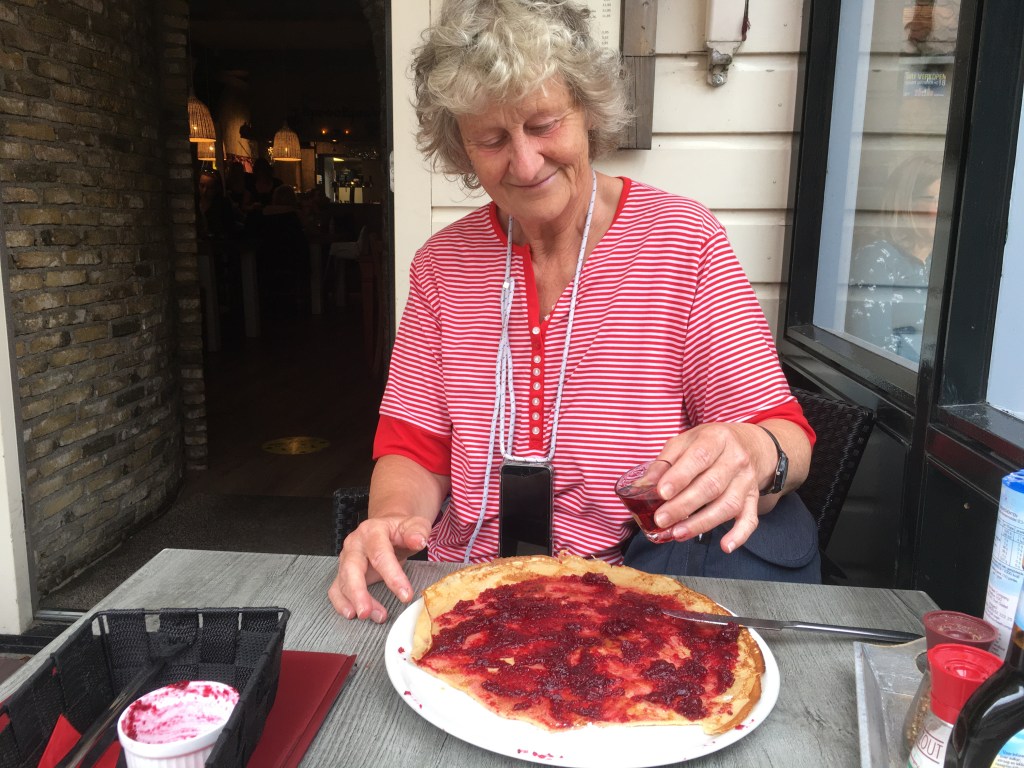
“They probably just thought of them as a different category of human”, I philosophise. “Don’t you remember in the book that Coen said the Bandanese were an indolent people of whom little good can be expected. That probably justified in his mind the way that he treated them. Love one another, but only if they are the same as you – that kind of thing.”

“Not very ‘woke’”, says the First Mate. “It’s interesting that his statue is still standing – in the UK, there is pressure to remove the statues of people associated with the worst aspects of the British Empire. I wonder if it is the same here?”
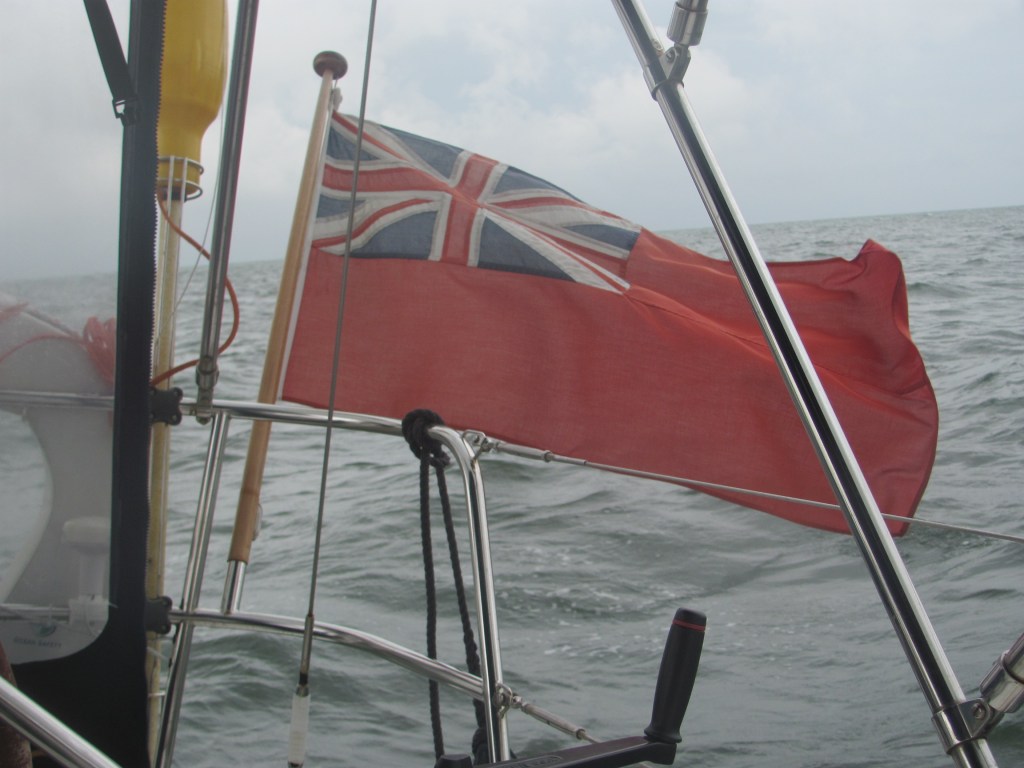
She has a point – the statues of Edward Colston associated with the slave trade and Cecil Rhodes associated with subjugation of Africans are currently proving contentious in the UK. We read later that, in fact, there had been a large demonstration against the Jan Pieterzoon Coen statue in June 2020, but that the authorities had refused to remove it. Apparently many of the Dutch regard him as a national hero.

Another couple come and sit at the table next to us. The First Mate strikes up a conversation with them. They live in Hoorn, and are enjoying the fine weather by having lunch in the town before heading back to watch the Austrian F1 Grand Prix. The Dutchman Max Verstappen is a favourite to win.

“After the Netherlands was knocked out of the Euros by the Czech Republic, we need something else to cheer for”, says the man.

“We were just wondering if you are allowed to cycle in those little streets in that area over there”, says the First Mate, pointing to where we had just come from.

“No, definitely not”, the woman says. “Pedestrians only.”

“But what counts as ‘shopping hours’?”, I ask. “It’s Sunday today, and some of the shops are open even though most are not. How many shops have to be open in a street to count as ‘shopping hours’?”

“That’s a good question”, says our neighbour. “Do you know, I don’t really know. The owners can choose to open on Sunday or not. Shopping hours are definitely before 1800h during weekdays, but I must admit I don’t know what they would be on Sunday.”

I decide to play safe and push the bike through the narrow streets. I don’t really want to cause an international incident over cycling rights. It’s not such a big deal anyway. Either way is good exercise.

With Ruby Tuesday now ready to go, we decide to leave Hoorn around 0900h the next morning. It’s about 13 NM up the coast to Enkhuisen, just a nice distance to get us back into the way of sailing after about eight months. It’s a bit overcast, but the wind is good. I look back as we motor out of the harbour entrance, and feel a tinge of sadness to be going. We had both enjoyed Hoorn, and had got to know it well – its narrow streets, picturesque houses, beautiful harbour, and friendly and helpful marina staff – in the weeks that we had been there. Not quite like home, but somewhere familiar nevertheless.

Leaving Hoorn.

We cut the engine and hoist the sails. Ruby Tuesday surges forward like a bird who has just regained its freedom after being imprisoned for a period and wants to test its wings again. The First Mate takes the helm. She is keen to get more practice on helming and getting the feel of the sails and the wind.

The First Mate in control.

The first hour the wind is from the SW and we are on a beam reach, giving us an effortless stretch. I am always a bit nervous on the first sail of the season – have we forgotten to do something, is something seized up after a long period of inactivity? Weed around the propeller or rudder? Growth blocking up the log paddle wheel? But everything seems to be working fine. I begin to breathe easier.

We reach Kraaienburg, and turn to the NE. This is not so easy – with the wind more-or-less directly behind us now, we need to take care that we don’t gybe. We decide to furl the mainsail and use the genoa only to avoid this. There is still enough power in the wind to push us along at 5 knots, and we are not in a hurry.

Making good progress with the genoa only.

Eventually we reach the Krabbergat Naviduct on the Houtribdijk, the 27-kilometre dam that divides the Markermeer and the Ijsselmeer. Here the road goes under a canal constructed for boats moving between the two bodies of water. Apparently this used to be a real bottleneck for both road traffic and shipping when there used to be a only a single lifting bridge as only one or the other could pass at any one time. Now the traffic can flow through unimpeded underneath while the boats sail through overhead.

Traffic passing underneath the Krabbergat Naviduct.

“That’s clever”, says the First Mate. “It reminds me of that viaduct we crossed on the Forth and Clyde Canal in our little boat with the motorway going underneath.”

She’s right. We had taken our small boat from the centre of Edinburgh to the centre of Glasgow along the Forth and Clyde Canal a few years ago, at the same time as the infamous EU Referendum in 2016. We had crossed the Edinburgh City Bypass on the Scott Russell Aquaduct and looked through at the traffic zooming past underneath.

We arrive in Enkhuizen around 1300h, and enter the town harbour. We had heard that it gets busy here, and that sometimes 20 boats have been rafted up next to each other. We are not all that keen on that as it means clambering over other boats to get to shore, and also probably means that we won’t have power. By chance another boat is leaving from the small number of box berths at the end of the harbour, so we quickly nab that one. It’s perfect – no one else can raft up to it, it has its own power supply, and it is a five minute walk to the town centre. What more could one wish for?

We find a good berth in Enkhuisen harbour.

The owner of the boat in the next box-berth gives us a hand tying up.

“Have you been here for a while?”, says the First Mate, noticing the two folding bikes next to the boat.

“Most of the summer”, he tells her. “We live in Amsterdam, but my wife is working in Enkhuizen at the moment, so we decided to come up here with the boat and stay here. I am working remotely.”

It’s not the first time we have heard something similar. We had met a couple in Hoorn marina who lived in a small poky flat in Amsterdam, and were glad to get out if it in the summer and come somewhere nice in their boat. I can’t say that I blame them.

He shows us how the electric power system operates. We need to purchase a card with credit on it, then place it against a reader, and push a button next to our socket. The First Mate presses the button.

The First Mate getting to grips with the power supply.

“Ah, it’s nice to have power again”, she says.

The power goes off about an hour later.

“Perhaps we have a dud socket”, I say.

We plug into a different socket and press its button. This time it lasts a couple of hours before stopping.

It eventually dawns on us that each button push gives us 1 kWh of electricity, and that we need to push the button a few times to get enough for the day. I calculate that we are using about 4 kWh per day. At home we use about 20 kWh per day. I push the button four times.

We are feeling peckish and find a place serving food overlooking the harbour. As we munch our kibbelings (fried chunks of fish) dipped in garlic sauce, we watch the boats coming in after us, circling around the harbour looking for free spots, and eventually rafting up to another boat of similar size. We feel slightly smug that we managed to bag the last of the box berths, and that we have power and water and no pesky neighbours. It’s the same feeling you get when you have got up early and put your towel on the best sun-lounger on the beach. Not that I do that, of course. In the distance, the sun catches the green onion-shaped spire of the church, and its glockenspiel starts to play a cheerful tune announcing the top of the hour. All is good with the world.

“Look out for those dohlen” says the First Mate suddenly. “They are pretty cheeky, and will steal anything shiny when you are not looking.”

She is referring to the flock of jackdaws have descended on our eatery and are perched on empty chairs, eyeing our food like vultures. The people at the next table pay and leave, and the jackdaws converge on their table, pecking at any food that is left. In nature, little goes to waste.

Jackdaw waiting for the leftovers.

That evening, we hear on the news that Johnson is dispensing of all COVID regulations in the UK on July 16th, despite the number of infections by the Delta variant still shooting up meteorically. The idea is that the country just has to learn to live with the virus. It this wise, we wonder? Will it translate through into more and more admissions into hospital, intensive care, and eventually deaths? Perhaps the vaccine roll out will stop this happening, who knows? But we feel glad that we are in Europe, and are onlookers in this massive public health experiment rather than part of it.

Gambling with people’s lives?

Tests, tests and more tests!

“Well, that wasn’t too bad”, the First Mate says, helping herself to some more salad. “Getting all those tests was a bit of a palaver, but at least it paid off once we arrived in Holland. Now it feels like we are back home again.”

We are sitting in the cockpit of Ruby Tuesday having dinner watching the sun go down behind the trees. With all the snacking we had during the day, it’s more of a light meal than dinner. I help myself to another slice of bread and some cheese. Two crested grebes and their young ones are swimming at the back of the boat, hoping for some titbits. The First Mate throws them a couple of small chunks of bread and we watch them fight over them excitedly.

Crested grebes coming to see us.

She is right – it hadn’t gone too badly. We had left home in the morning for the airport armed with our vaccination certificates certifying that we had had our two vaccinations, the certificate of the PCR test we had had the day before, the quarantine declaration form, and the health declaration form. I was starting to think that we would need a separate suitcase just to hold the paperwork necessary for travelling in a covid19 world. And we still had to have the Rapid Antigen test an hour or so before boarding and get the certificate for that too.

Just about to have our Rapid Antigen test.

Luckily, that too had turned out negative. Eventually we had boarded the plane and managed to get seats together, a change from the last time travelling in the opposite direction. The flight itself was uneventful, and the effects of the early start we had had caught up with me.

I am lying in the dentist’s chair staring up at the TV screen mounted on the roof. An old rerun of Neighbours is on. I am not really interested in it, but it does divert me from the pulling and pushing and twisting that is going on in my mouth.

“It’s looking really good”, says the dentist, looking down at me though his full face mask. “The implant screw has taken, and the bone and gum is looking really healthy. All I have to do now is take this little pin out and we are done for the day. Then next time you come, I’ll put in the implant itself.”

He takes a pair of tweezers and what I assume is the dental equivalent of a screwdriver, and twists it.

“Ah, there it is”, he says. “Ooops …..”.

I feel something drop on to the back of my tongue, and try to block it by pressing my tongue against the back of my throat, but it is too late. I can feel it slithering down, and cough vigorously, but it’s gone.

“I am so sorry”, says the dentist. “The little pin popped out of the tweezers, and I think it’s gone down your throat.”

“It has definitely gone down”, I say. “What does that mean?”

“It shouldn’t do any harm”, he says. “It’s made of titanium. In 99% of the cases, it will go straight through.”

“What about the other 1%?”, I ask.

“There is a small chance that it could go down in your lungs and cause inflammation and lots of mucus. So it’s probably best to get a chest x-ray just in case, and to be sure one way or another.”

I think that he is more worried than he is letting on. I hadn’t really expected this as part of my tooth implant treatment, but accidents happen, I suppose. I arrange a chest x-ray a few days later. It shows nothing in my lungs.

“It must have gone right through you”, says the First Mate. The thought makes me feel queasy, and I try not to think about it.

The dentist looks relieved the next time I see him. “That’s good news. It must have gone right through you”, he says.

“That’s what the First Mate said”, I say. He looks at me quizzically, then knowingly. I have already told him about our sailing project.

A sharp jab in the ribs from the First Mate’s elbow awakes from my reverie.

“You dozed off. What were you dreaming about?”, she says. “You had a smile on your face.”

“I was just remembering the experience over the winter with the dentist and the little pin”, I respond.

“I hope it’s not still in you”, she says. “It might set off the x-ray scanners, and they won’t let us in.”

There is an announcement by the air hostess telling the crew to take their seats and prepare for landing. We fold our tray tables away and put the rucksacks under the seats in front of us.

This was the first time that we had entered Europe since the UK had left the EU. Having heard all sorts of stories about ham sandwiches and the like being confiscated by Dutch customs, we had made sure we had were carrying no food or other contentious items. We needn’t have worried – we were waved through immigration after presentation of our test results, collected our luggage, breezed through customs, and entered Europe! Nothing seemed to have changed, and yet everything had changed – we were no longer EU citizens with the right to roam anywhere within its borders. We were foreigners now. Well, I was anyway – the First Mate still has her German passport.

And we are lucky that she does. Because of the coronavirus, entry to the Netherlands and many other European countries is still banned to non-EU and non-EEA citizens, which now includes all Brits, particularly now that the Delta variant of covid19 is spreading like wildfire through the UK. However, exemptions are made for EU citizens and their spouses, hence us being allowed to enter.

We catch the next train directly to Hoorn. On the way, we can’t help overhearing a telephone conversation of the man on the other side of the aisle. He is speaking with an English accent.

“Yes, I just arrived at Schiphol about an hour ago”, he says. “No, I didn’t have much trouble at immigration and customs – just waved me through. Yes, they did ask to see the PCR and lateral flow test results. No, they didn’t search my bags.”

His experience is similar to ours. When he has finished, I lean over and ask him where is going.

“I have a boat in Greece”, he says. “I am visiting friends in Hoorn for a few days, then heading off out there. But this whole Brexit thing has just made it so much more difficult. It must go down in history as the biggest own goal a country could score. And all for what? I ask you, what good has come out of it so far, or ever will? A couple of piffling trade deals with Norway and Australia that has our fishermen and farmers up in arms? British influence diminished, delusions of grandeur with new royal yachts being built – we are the laughing stock of the world. Pah!”

He sniffs derisively. I try to work out whether he would have voted for Leave or Remain in the referendum. It’s a tricky one.

Arriving in Hoorn.

We reach the marina, and there is dear old Ruby Tuesday just as we left her. Our home once again for the next few months. She is in good shape, a bit grubby from the winter elements, but nothing a good scrub won’t clean up. And then! We are greeted by Rameses and Nefertiti, the two Egyptian geese we had met last year. Except there weren’t two of them, there were three, a new addition to the family since we had seen them last. They seem to have forgotten about the mat episode, or, if they haven’t, are too polite to mention it.

Our Egyptian Geese, Rameses, Nefertiti and offspring – pining for the Pyramids?

And on the boat itself, who should be waiting but Spencer himself! I was secretly hoping he would be still there, as I had enjoyed our conversations last year, but wasn’t sure if he would have survived the winter or not.

“It’s good to see you again”, I say. “And I have got something to tell you. But not now. When there is more time.”

Spencer comes out to welcome us back.

We spend the next five days in quarantine. The rules are that we must quarantine for ten days, but that we can have another PCR test after five days, and if negative, we can finish our quarantine there and then. I ring up the Public Health Service (the Gemeentelijke Gezondheidsdienst, or GGD) and book a slot for us both. The COVID Testing Centre is about 20 minutes cycle ride from where we are.

On day 2, the Ministry of Health ring us to check that we are quarantining. They have received our details from the airline. We tell them that we are on a boat and will stay there until the five-day test. They are happy with that, and run through the quarantine rules with us. All very friendly.

Time flies by. We have enough food on the boat from last year – tins and dried food – to last us. The rest of the time is spent on all the boaty jobs that require doing to de-winterise. First, up goes the bimini and canopy, so that we have something to shelter in when it rains, and to sit under when the sun is too strong. Next the water tanks – flushing them though, then filling with fresh water for us to drink and wash. Then the sails – the genoa and the mainsail. Next is servicing the winches – ensuring the cogs are greased and the pawls oiled. They turn with a satisfying metallic click-click-click. That should keep them going for another year. Finally the engine – a new water impeller, checking and topping up the oil, and tightening the water pump belt.

Servicing the winches – will they ever work again?

On day 5, we jump on the bicycles and head off to the covid testing centre. It looks like an aircraft hangar plonked in the middle of a field.

The covid19 testing centre in Hoorn.

Inside the shed are little tents set up with chairs outside each one. We are told to take the bikes with us and prop them up next to the tent. I am selected to go first, and sit down in one of the chairs. A nurse takes a swab and pushes it to the back of my nose, so far that I am surprised the First Mate doesn’t notice it coming out the back of my head. My eyes water. I am glad when the nurse pulls it out again. I go to get up.

“Good”, she says. “Now the other nostril.”

She either misses, or chooses to ignore, the look of terror on my face.

“That was more uncomfortable than the one back in the UK”, the First Mate says on the cycle back. “I hope it is worth it.”

We have to wait up to 48 hours for the results, so we continue with the boaty jobs.

The next day I hear a call from the First Mate. She is standing next to the bikes propped up against a tree, with an embarrassed look on her face.

“Can you come and help me? I seem to have lost my glasses. I think they fell down a hole near the tree.”

It is about five metres from where she dropped the mat into the water last year. A thought briefly crosses my mind that perhaps there is some kind of gravitational anomaly in the vicinity that targets women of a certain age and makes them drop things.

Where are those glasses?

I peer down the hole next to the tree, using the torch on my phone to provide light. It is some kind of corrugated tubing that presumably is used to water the tree, making sure that the water reaches the soil layers where the roots are growing. At the bottom of the hole, a small beetle stares back at me transfixed as though he has been caught doing something he shouldn’t have been.

“Sorry, buddy”, I say. “I don’t mean to disturb you, but I am looking for a pair of glasses that might have dropped down here. I don’t suppose you have seen them?”

The beetle looks trance-like around the bottom of the hole and back to me again.

“No”, I say. “Nor can I. I suppose they must be somewhere else. Have a good day.”

“Are you sure you dropped them here?”, I ask the First Mate.

“Not really”, she says. “It might have been back there along that path that I was walking along. Or even in town. I am not sure.”

We walk along the path for a bit, but there is no sign of the glasses.

“Never mind”, says the First Mate. “I have another pair on the boat. I can wear those.”

“Here, let me guide you. Old ladies can easily bump into things without their glasses”, I say.

“Get away with you”, she says, crossly. “I am not that old yet. I’ll let you know when I need guiding.”

In the evening, we sit at one of the bars along the inner harbour quay enjoying the warmth of the evening sun, and admiring the sailing boats tied up next to us. The one in front of us has a German flag, and a woman lounging in the cockpit with a drink, speaking into her mobile phone. I get the impression that she is enjoying the admiring glances coming from the bar patrons, whether they be for her or the boat.

Enjoying the evening sun in Hoorn Inner Harbour.

“Well, that’s good news”, says the First Mate, picking at the snacks.

We had received a telephone call in the afternoon from the Public Health Service informing us that the PCR tests that we had had the day before are both negative. That means that we are allowed to end our quarantine and can move freely around the Netherlands as any other European. The drinks we have ordered are a kind of celebration.

“Yes, it is”, I agree, sipping my Weizen beer. “But we still have to follow the rules of social distancing, washing hands, wearing masks, and all the other rules that we have been following for the last year. But at least we are not confined to the boat anymore.”

We sit in silence and soak in the beauty of the surroundings – the old ships in the harbour, the old merchant’s houses beyond, the old harbour office at the entrance. I try to imagine what it would have been like in the days of the Dutch East India Company.

Eventually, the sun goes down and it starts to get cold. We pay the bill and walk home.

“Oooh, look”, says the First Mate. “There are my glasses, hanging on the spokes of your bike. I knew I had dropped them somewhere around here.”

Finding the First Mate’s glasses.
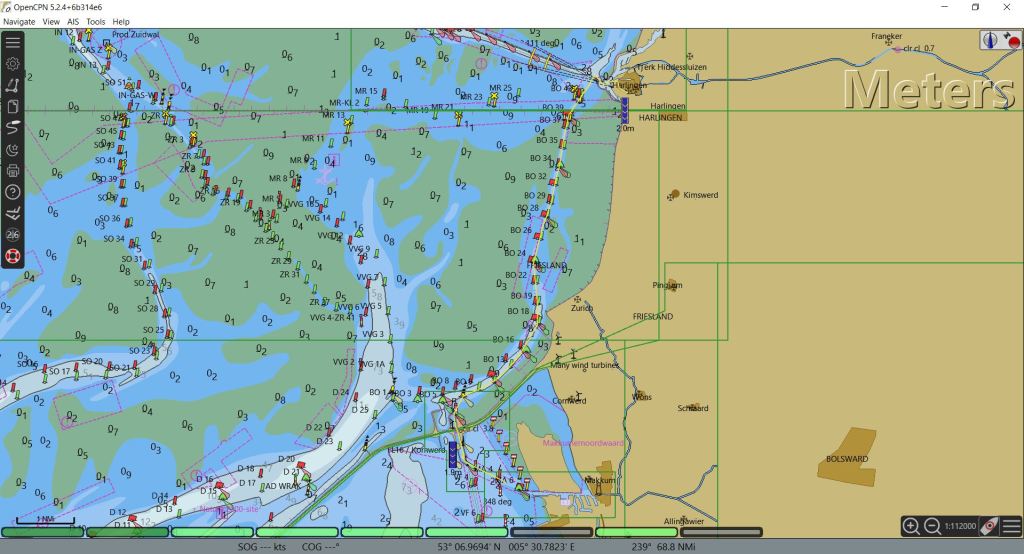
A fitting end to the day. I wonder momentarily if the beetle in the hole has got over his traumatic experience yet.