“Are you from England?”, the woman on the seat opposite us asks us.
“No, Scotland”, the Skipper answers. “We are sailors, and are sailing around Norway at the moment. We left our boat near Trondheim over the winter.”
We are on the Dovre Line, a scenic train trip from Oslo to Trondheim. We had arrived in Oslo the previous day, having flown there from Scotland. We had decided to take the train to see some of the stunning scenery in the hinterland of Norway.
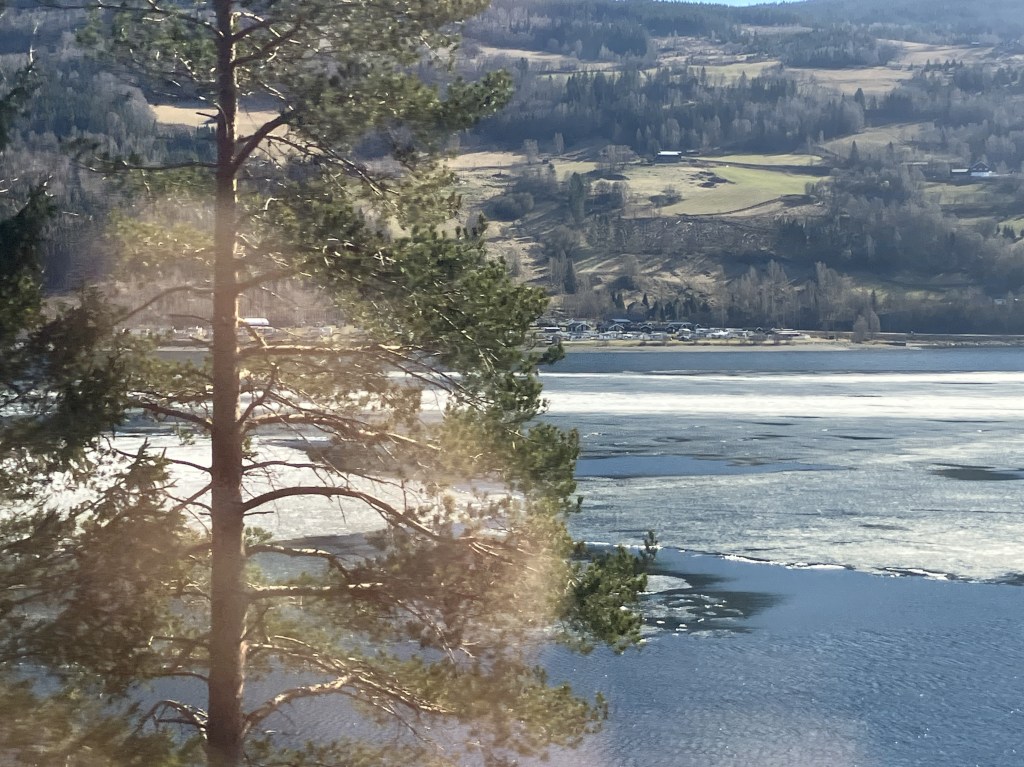
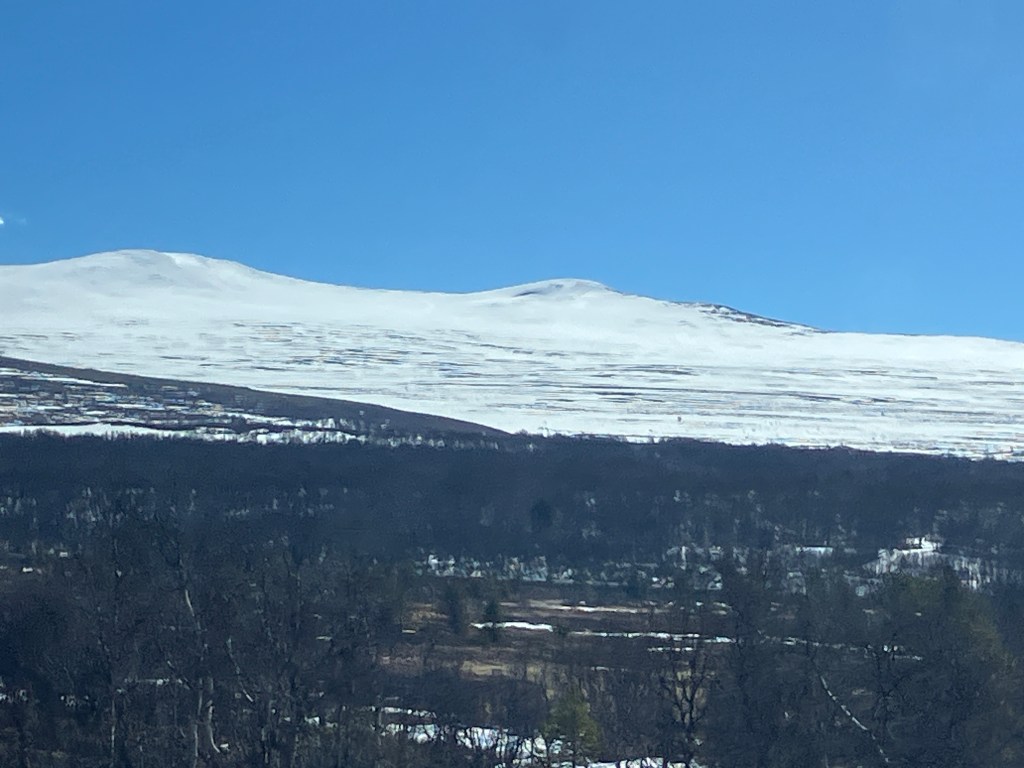
The train winds its way through the spectacular Dovre valley, climbing gradually through the snow capped peaks and sheer walls of rock. Lakes, their low water levels waiting for the ice melt to replenish them, sparkle like diamonds in the dark gloom of the forests. Spring has not yet arrived, the grassy meadows still a dull beige from the winter. We learn later that there has not been so much snow this year, and that the lakes might not fill to their capacity. But there still seems to be some snow, at least.
“We have a cottage on Trondheimsfjord”, the woman continues. “We spent Easter in it. It has become a bit of a tradition in Norway to retreat to your cottage over Easter, and binge-read crime novels that you have accumulated over the previous year. It’s called Påskekrim, or Easter crime. New crime novels are released by the publishers just before Easter for people to buy. There’s even a big crime fiction festival in Oslo just before Easter. They say that it is Norway’s moody landscapes and the long winter nights that inspire our love for crime.”
“It’s strange that Norway is one of the safest places in the world, and yet you like reading about crime so much”, I say.
“And Scandi-Noir is famous the world over”, says the Skipper. “Despite the Scandinavian countries always ranking high in the happiness index.”
“Perhaps that is the reason”, the woman says. “We have so little real life crime, so we make up for it by reading and making films about it!”
We reach Trondheim station and find a trolley to wheel our luggage to the hotel nearby.
The next morning, we visit the Police Station to register ourselves to stay longer than the ninety days permitted by the Schengen Agreement. I have the right to stay longer by dint of my German nationality, and the Skipper because he is married to me, an EU citizen. The policewoman is efficient, collects all our documents, and immediately issues a permit to me to stay up to five years. For the Skipper it is a little bit more complicated – his documents need to go off to the Department of Immigration, and it will be a few weeks before he gets his residency card. But she assures us there is unlikely to be a problem.
“Well, that was relatively easy”, says the Skipper. “Let’s get some lunch, then we can go and pickup the car that we have booked.”
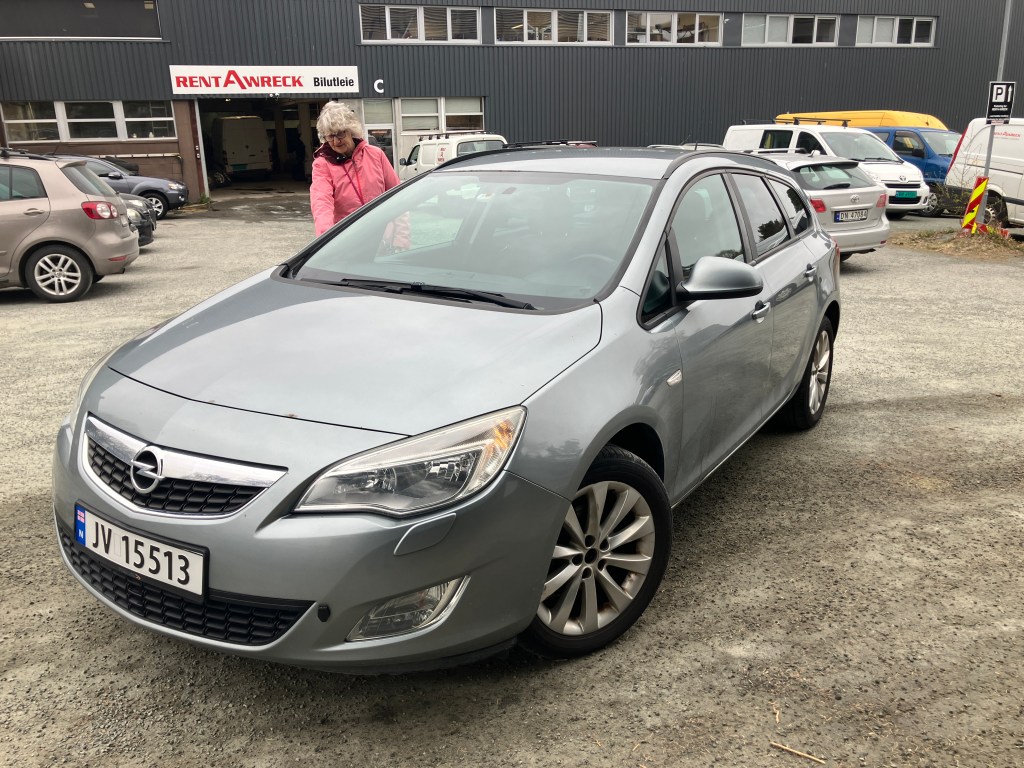
We have reserved a car from Rent-A-Wreck, specialising in senior, but reliable, cars at prices not quite so eye-watering as those of newer cars. We had used the same company to drive around Gotland a couple of years earlier, and had had a good experience with them. No frills, no nonsense.
We drive to Røros, a small mining town two and a half hours south east from Trondheim, and designated as a UNESCO World Heritage site. We find the museum and meet Oliver, his dark flowing locks giving him the appearance of a Viking. He is to be our guide for the day through the museum, village, and one of the mines.
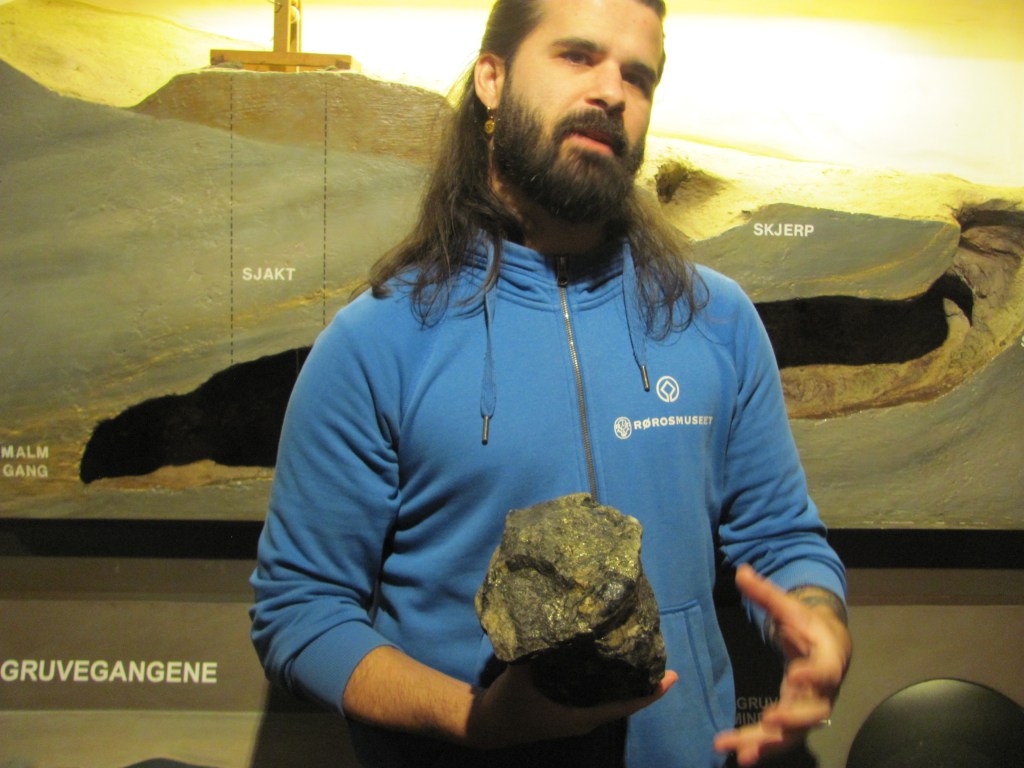
“Mining started here in the mid-1600s, and was very profitable when the price of copper was high”, he tells us by way of introduction. “When the copper price plummeted in the 1900s, the town went into a slow decline to the point where it became uneconomic, with the mines closing for good in 1977. However, the town remained, and it now attracts tens of thousands of visitors every year, not only to see the mines, but also for the winter markets and summer music festivals.”
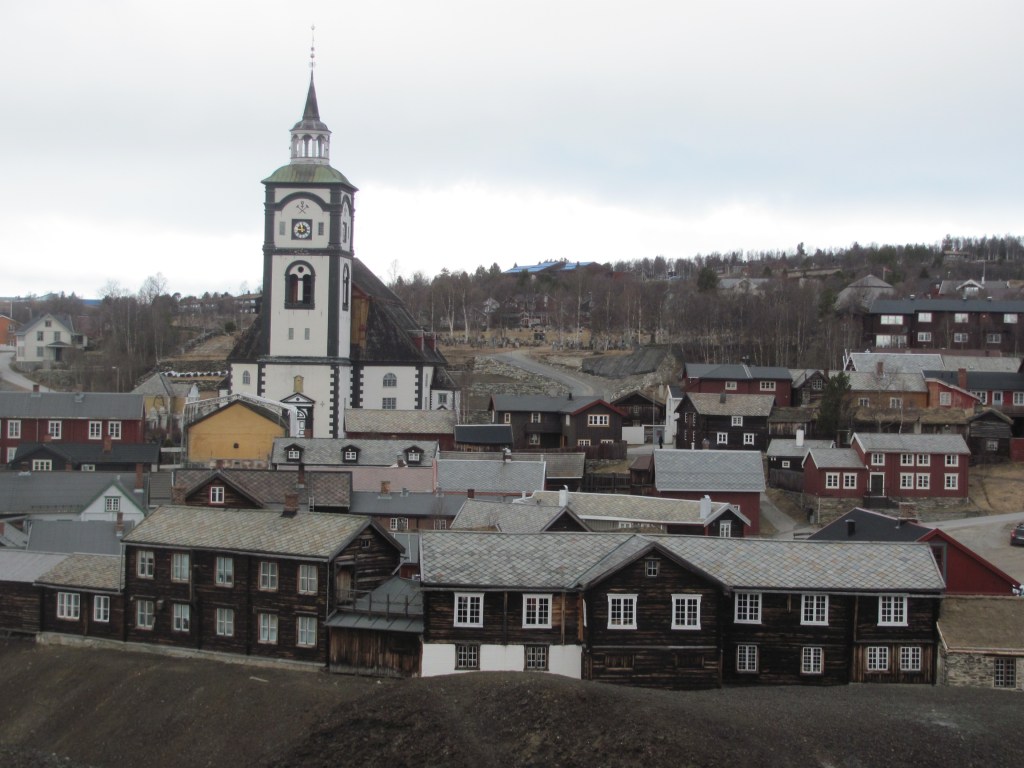
“The Swedish captured Røros in the early 1700s and took possession of all the copper that had been mined”, he continues. “They didn’t stay long though, as when the main Swedish army were beaten in battle In Trondheim, the remnants retreated here, and then eastwards back to Sweden across the mountains. Unfortunately, many of the soldiers perished on the route due to not being prepared for the extreme cold. Even now, one of the annual music festivals commemorates the Swedish troops who died.”
“I myself am of Swedish extraction”, he continues. “It may be that we are descended from one of those soldiers who were stationed here in 1718. But whether I am or not, Røros is my home – I was born here, and even though I had a high-paying job in Oslo for a few years, I missed the place here so much that I decided to return, buy a small farm, and do this tour guiding as a side line. I have always been interested in history.”
We take a break for lunch, then rejoin Oliver in the Olavsgruva, one of the copper mines not far from Røros. Donning hard hats, we descend into the depths of the mine.
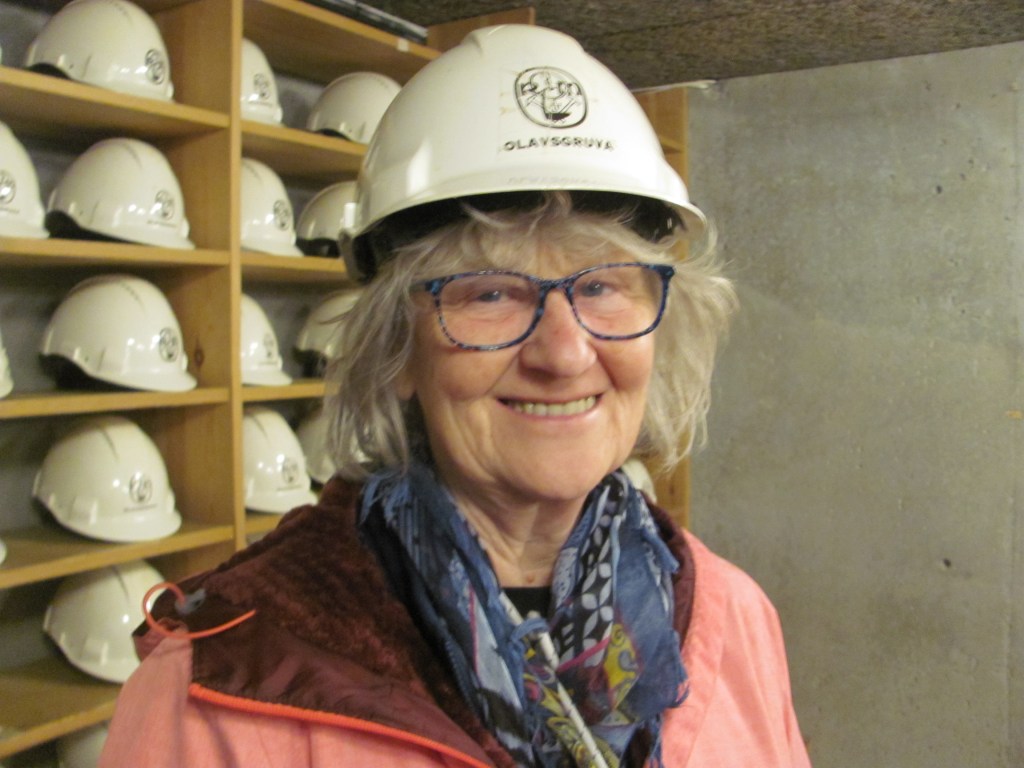
“It’s a bit scary to think of all that rock above us”, I say, scanning the roof of a rough-hewn cave. “I hope that it doesn’t decide to collapse in on top of us!”
“It’s pretty safe”, says Oliver, his locks now tied in a ponytail. “The rock is very stable here. They even hold concerts down here, because the acoustics are so good. But the path can be slippery due to the water dripping on it. Just mind your step.”
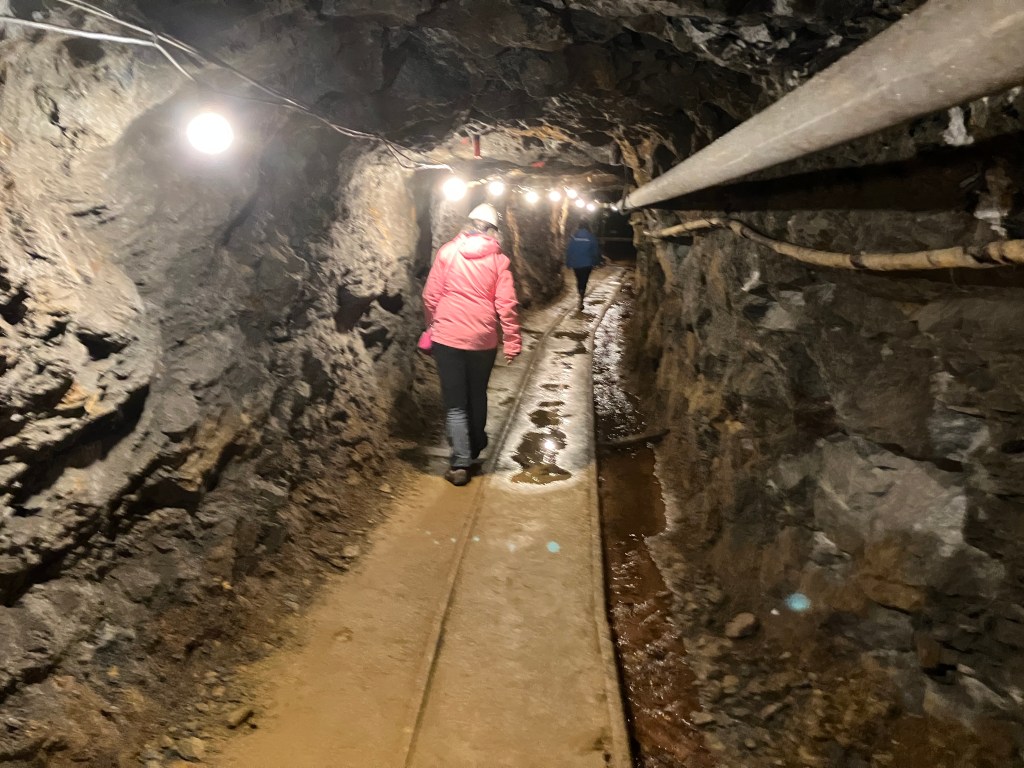
“While it was operating, 1,131 million tons of rock were mined”, he continues. “With an average copper content of 1.39%, this yielded 15,720 tons of copper. The copper ore was taken by an overhead bucket and cable system to Nedre Storwartz, where it was processed into copper concentrate. From there it went to the smelter in the town of Røros.”
“An interesting day”, says the Skipper on the way home. “But I can sympathise with the Swedish soldiers. It was bitingly cold while Oliver was showing us around the town. And that was with my fleece, anorak, scarf and gloves. Imagine not having any of those!”
At the weekend, we make it to the island of Hitra, where Ruby Tuesday and the other boats have stayed for the winter. She is in good shape, despite having withstood fierce winds, icy temperatures, and a covering of snow. Well, almost in good shape, as the Windex at the top of the mast, which indicates the best wind directions for sailing, have come off, and are lying on the deck.
“It was caused by birds sitting on them”, the Boatyard Manager tells us. “They like to sit on them to get a good view. Unfortunately, some of them are too heavy and they snap the arms of the Windex off.”
We discover that the same thing has happened to two of the other boats in the same yard.
“I’ve never heard of birds breaking the Windex arms off before”, says the Skipper with a sniff. “Perhaps it was a sea eagle? They’re big enough. We saw a couple of them around here last year.”
“I reckon that you have been training the birds around here to do that”, I say to the Boatyard Manager as a joke. “Just so that you can get the job of fixing them.”
“Well, we did get someone to order a new one for you”, says the Boatyard Manager, “but unfortunately when he came to fit it, he put it on one of the other boats. As it turned out, it didn’t actually need one. But it wouldn’t have fitted yours anyway. We won’t charge you.”
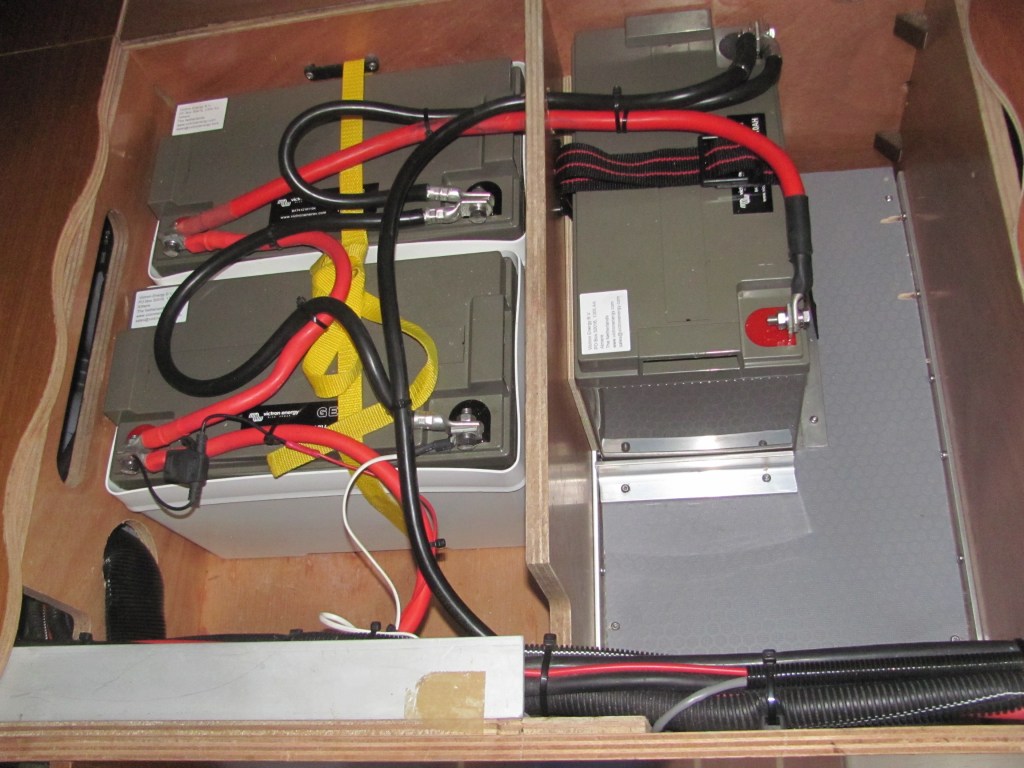
We are a little bit disappointed that our new batteries haven’t been installed. The old ones had reached the end of their lifespan last year, and would only hold a charge for half-an-hour despite being fully charged overnight. We had left instructions for new batteries to be installed over the winter. In fact, the new batteries had only been ordered a couple of weeks before our arrival, they still hadn’t even been delivered. And it’s only a few days until our scheduled relaunch date.
“It seems that the supplier sent them two weeks ago”, says the Boatyard Manager. “They seem to have been sitting in some depot in Trondheim, and we weren’t told that they were there. They should be here tomorrow.”
They do turn up in the first delivery of the day, and are immediately lifted into Ruby Tuesday. It is no trivial task, as each one weighs more than 30 kg. The Skipper tries to lift one, and nearly puts his back out again. I try, and fail miserably. However, they are soon connected up, tested, and we have a working electrical system again. They are needed to power our fridge, lighting, communications, electronics, and navigational system.
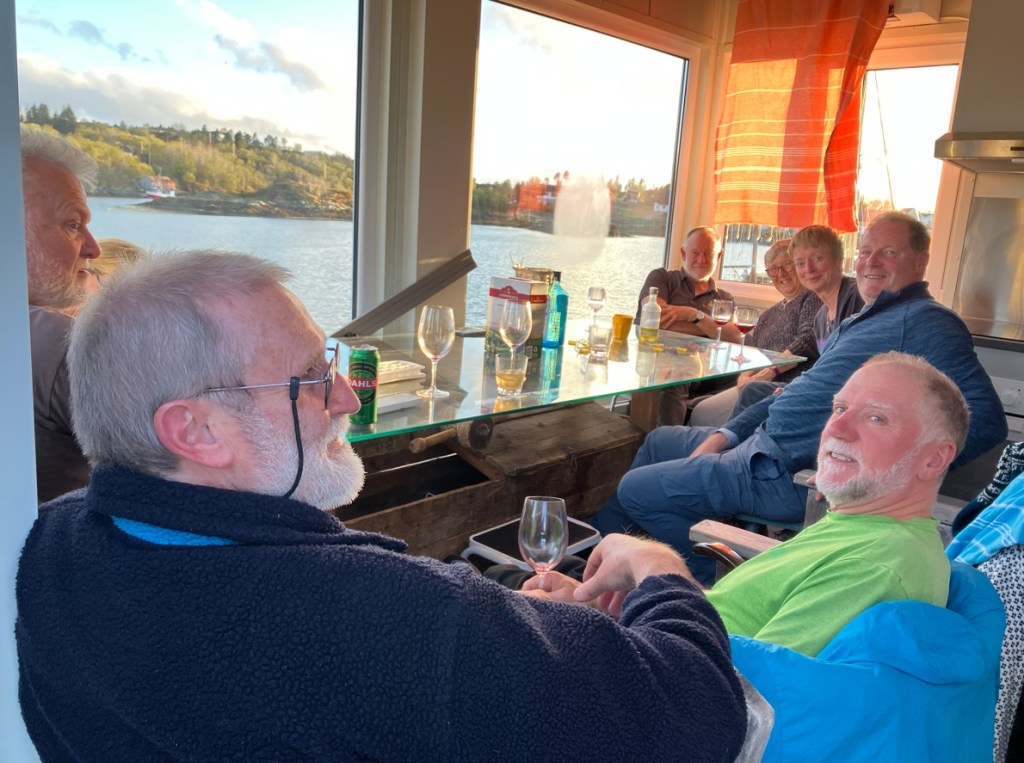
Andy, Anne and Rick arrive a few days later. They have driven all the way from Britain to Hitra in their new electric car. They assure us that they didn’t have any worries about running out of battery power. Especially in Norway, which has made a concerted effort to switch over to electric transport, so charging points are almost everywhere. We are suitably impressed, and wonder if we should have gone for a full electric car rather than the hybrid we bought last year.
One by one, the others arrive – Simon and Louise in Aloucia, and Bob and Fiona in Hekla of Banff. The whole team is now assembled to explore the barren arctic wastes. Our plan this year, carefully researched over the winter, is to sail north from Trondheim and explore the stunning scenery of the Lofoten Archipelago, and possibly further north if time and weather permit.
The next few days are frantic. Painting the hulls in anti-foul to prevent algal growth. New anodes to stop the underwater metal parts from corroding. The polishing of propellers. Evenings spent in the small communal kitchen cooking, eating, and planning.
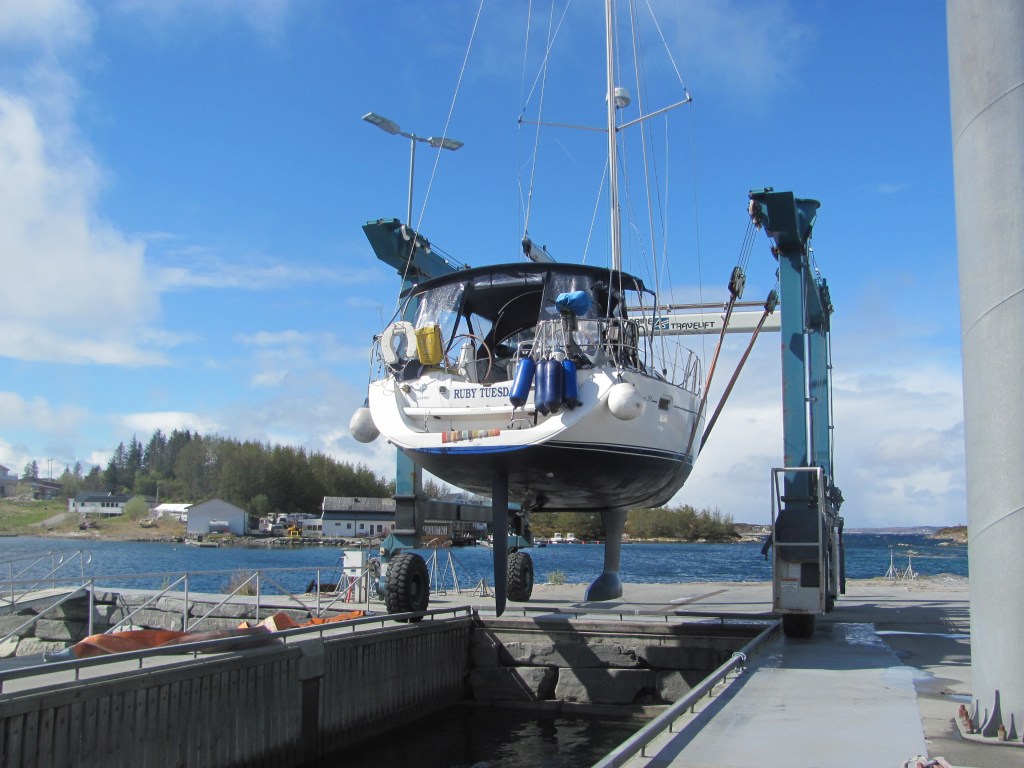
Splash Day arrives. One by one, the boats are lowered into the water, Ruby Tuesday first. Hasty last minute checks to make sure that there are no unplanned leaks, that the engines start, that the bilge pumps pump. Everything seems to be working.
More work now the boats are on the water – sails on, provisions stowed, solar panels attached, anchor windlass checked, navigational software updated.
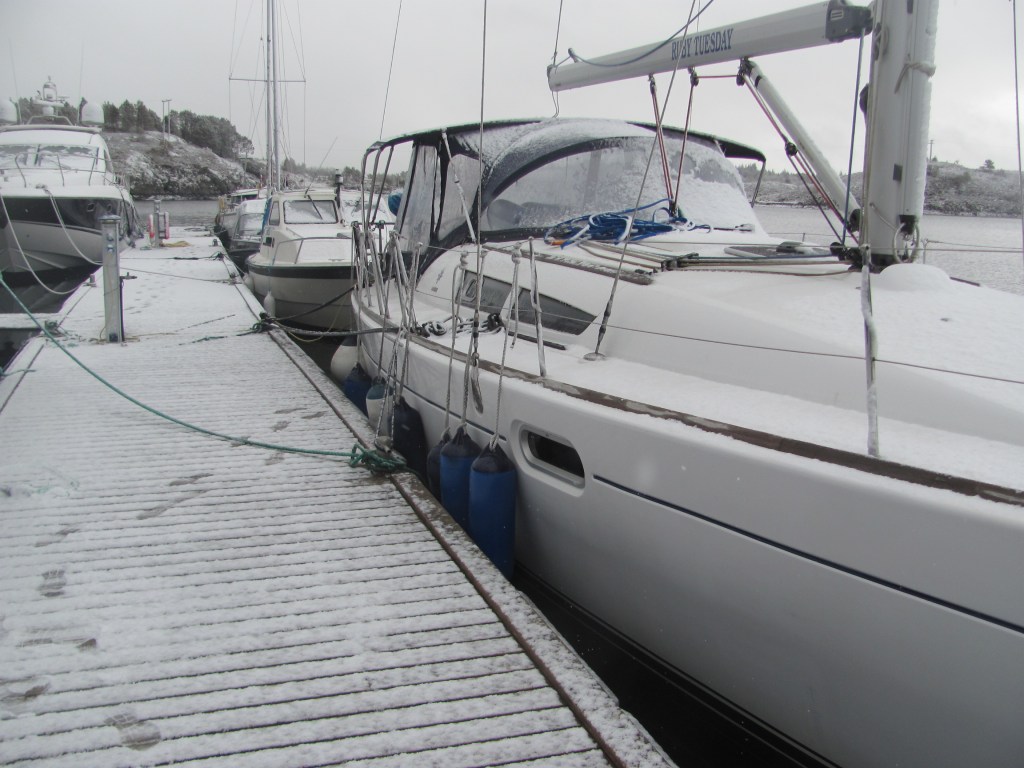
Overnight, it decides to snow.
“Someone told me that the sailing season in Norway starts at the end of April”, grumbles the Skipper, trying to do a Roald Amundsen polar explorer impression. “I wasn’t expecting snow. But I suppose we are not far from the Arctic, so it’s hardly surprising. I hope that it warms up soon though.”
Finally we are off! At least, Ruby Tuesday and Amalia are. The other two boats are still waiting for parts which should arrive in the next day or so. They’ll follow as soon as they can.
Ruby Tuesday spreads her wings and slowly starts to fly, her muscles stiff after her long winter sleep. But soon she is skimming along, better than ever before. The Skipper even looks happy!
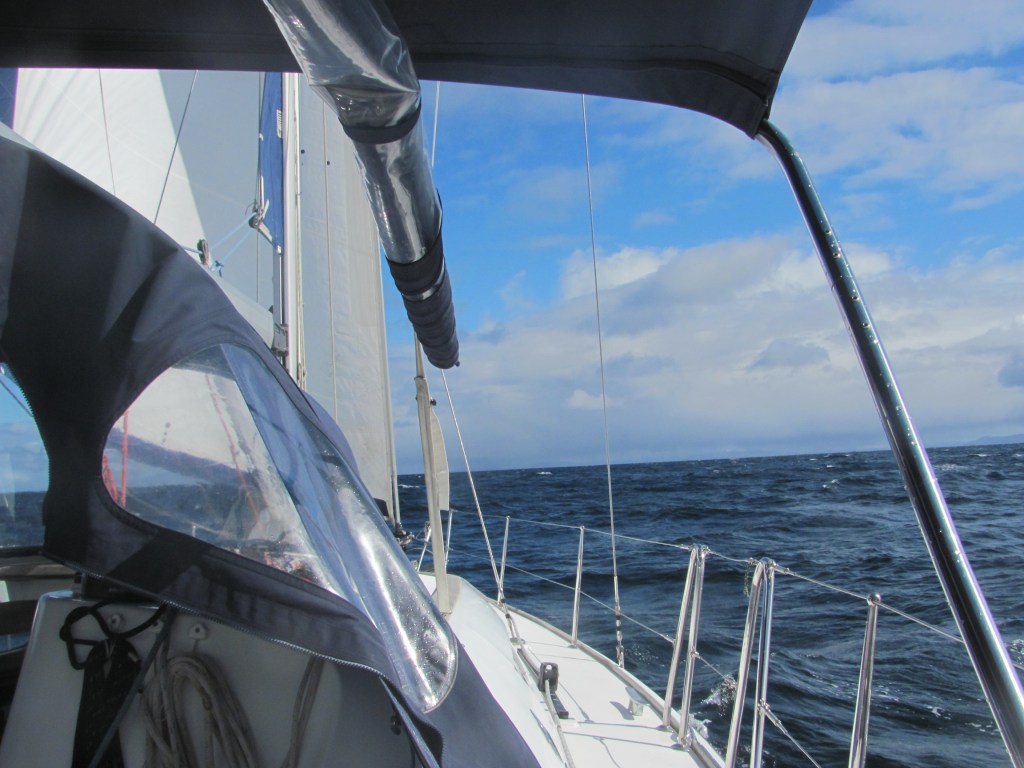
“Having the rigging checked and adjusted last year has really made a difference”, says the Skipper with a smile on his face. “She feels much tighter and more responsive, and doesn’t heel so much.”
Forty nautical miles later, we reach the small harbour of Kuringvågen. A cold wind is blowing, but at least the sun is shining. We tie up and Amalia’s crew come over for a cuppa.
“I can’t understand how you got in front of us”, says Anne. “We started off about half-an-hour before you, then we lost you on the AIS, and then suddenly you appeared out of nowhere in front of us.”
“We couldn’t see you on our AIS either”, says the Skipper. “We took the seaward route around that group of islands, and there was more wind out there. We had an exhilarating sail with a consistent wind. The islands probably got in the way of the AIS signals.”
“Yes, you are probably right”, says Andy. “We took the inner route, and the wind was quite variable, broken up by the islands. We were constantly trimming the sails.”
Later we go for a walk. I spot some klippfish drying on the side of the wall.
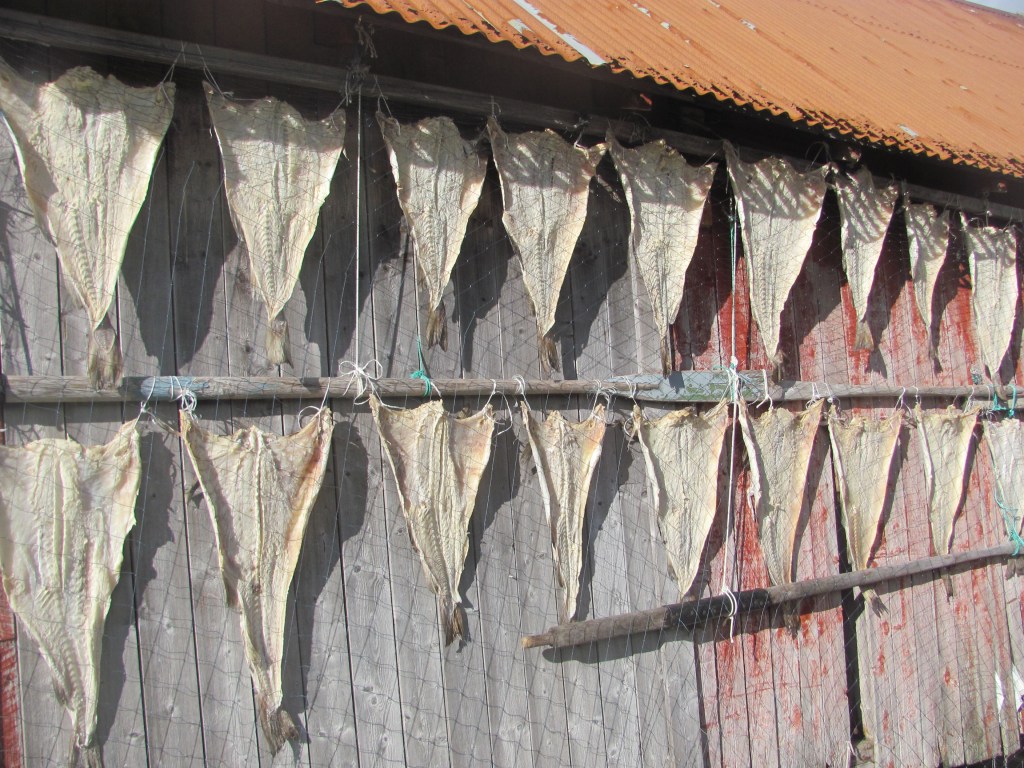
“Just like the ones we saw in Kristiansund last year”, says the Skipper. “At the Klippfish Museum.”
We explore the club house of the local sailing club, open to fellow sailors.
“Look, a British boat passed through here two days ago”, says the Skipper, looking at the visitors’ book. “Morwenna. They must have set off in all that bad weather we had.”
“I am sure that we will meet them somewhere along the line”, I say. “Sailors have a habit of staying at the same places.”
 Ruby Tuesday