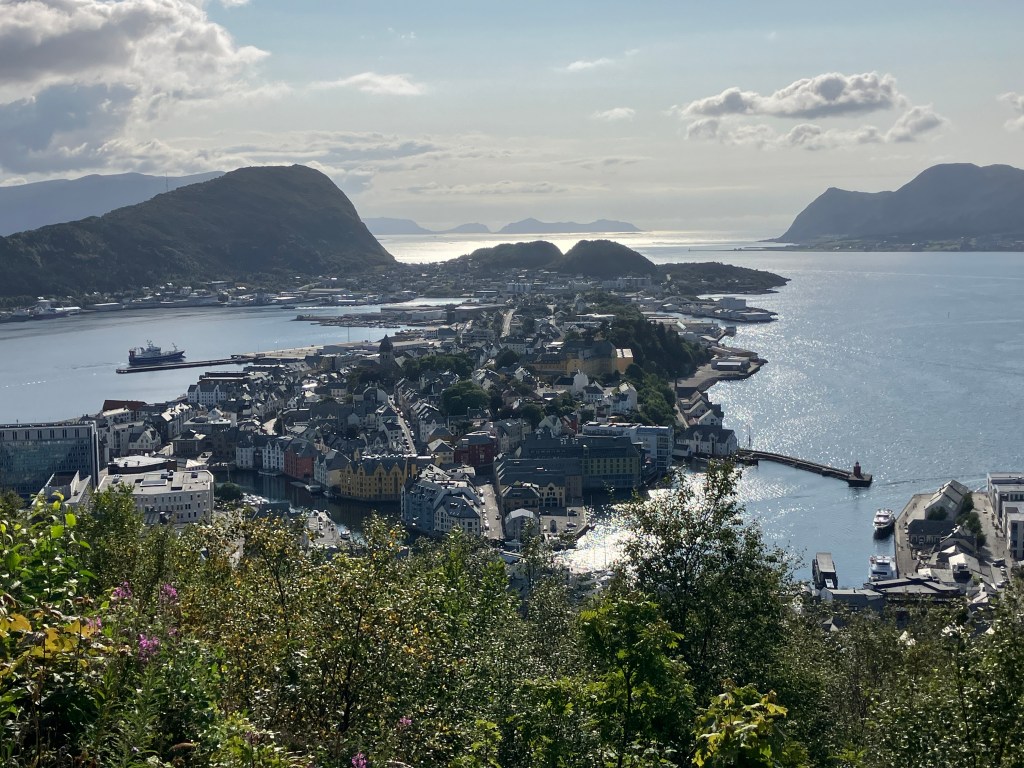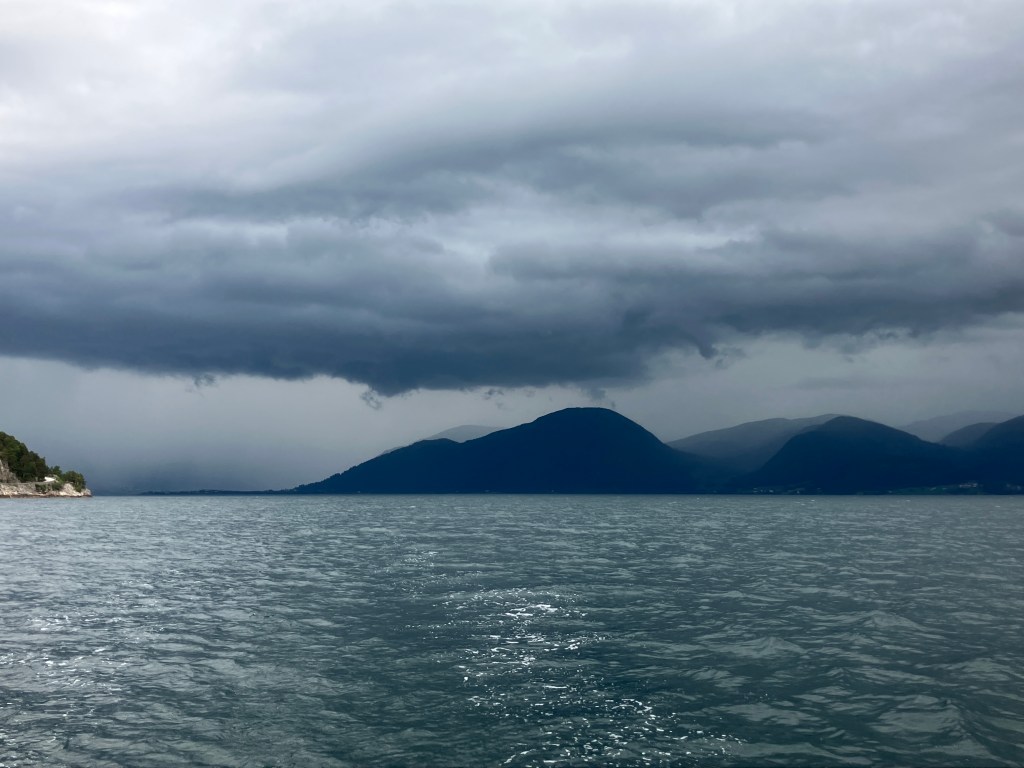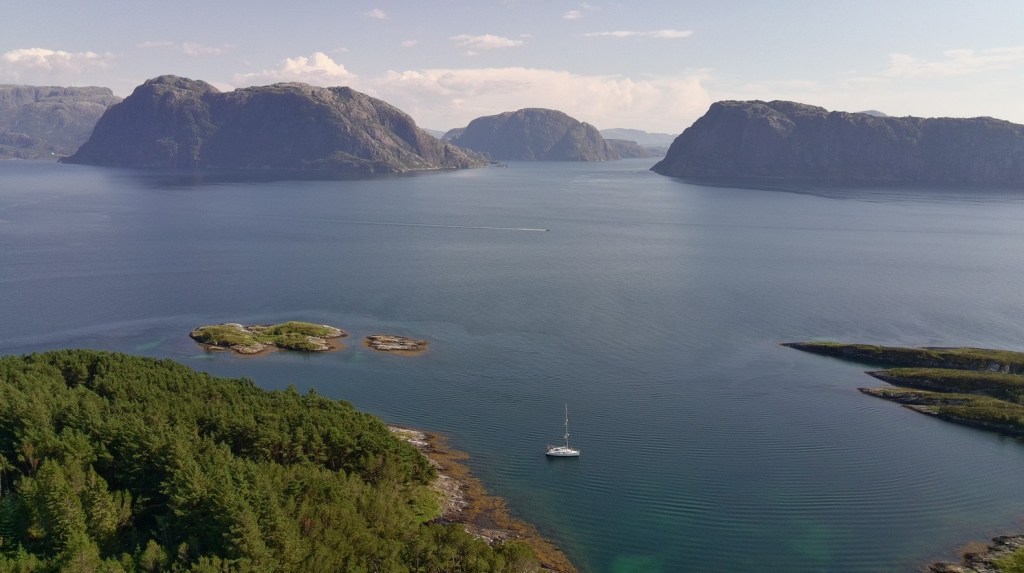
Fading batteries, a crowning cathedral, and a harnessed waterfall

“I’m getting a bit fed up with these storms”, says the First Mate. “It wasn’t that long ago since Storm Flores hit us.”

I feel the same. We are in the marina of Hellingsjøen sheltering from 50 knot winds from the west. We had known they were coming and had chosen Hellingsjøen as it had looked reasonably sheltered on the charts. And so it is, but the winds are still managing to come over the surrounding trees and across the small bay with considerable force.

“Just imagine what it must be like out in the open sea”, I say, by way of reassurance.

“Look, I think that the pontoon next to us is getting closer”, she responds, alarm in her voice. “The wind is blowing us towards it.”

It does seem to be. I clamber out, and, braving the gusts, gingerly make my way along our pontoon to the shore. Looking back, it is clear that the whole structure is being bent in a curve by the wind. If one of the retaining chains was to break, we would smash up against the boats on the neighbouring pontoon. Not a nice thought.

Will it break?

“Don’t worry”, says a passing fisherman. “We’ve had much bigger boats than yours tied up there. Nothing’s ever happened yet.”

Hardly reassuring. What if this blow is the one that breaks the camel’s back after being weakened previously? But there isn’t much we can do except keep a watchful eye on the situation and be ready for disaster if it happens.

Luckily it doesn’t. The wind keeps up for a day and a half, then dies down. We wake up to a bright and sunny day, a calm sea, the pontoon back where it should be, and a nagging irrational thought that perhaps we just dreamt it all.

We pack up, cast off, and continue on our way to Trondheim.

“The battery alarm is going again!”, calls the First Mate.

I’ve already heard it. Over the season we had noticed that there was a slow decline in the amount of time the batteries would last after a full charge. Even when sailing, we need them to power the autopilot, run the navigation instruments, charge the tablets, computers, and everything else that keeps us going. Previously they would last some days before we needed to plug into shore power and recharge them, but now it was down to a couple of hours.

We had charged them overnight at the small harbour of Hasselvika, but two hours later as we sail up Trondheimfjorden, they are almost flat again.
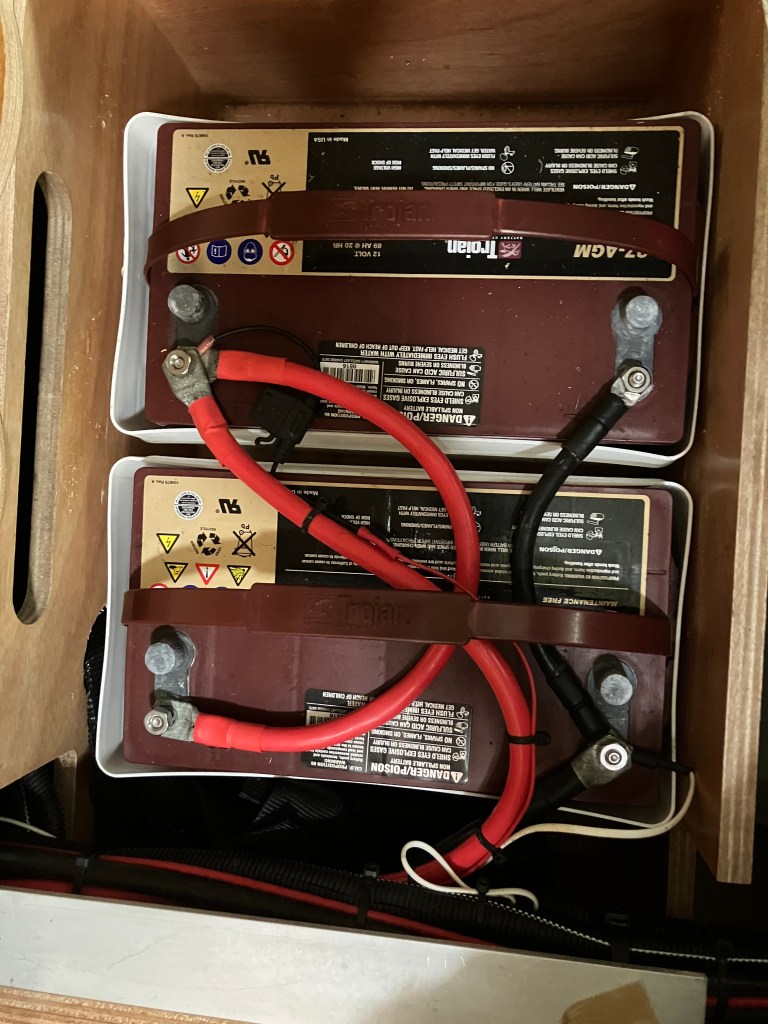
Fading fast.

I am not really surprised. They have reached the end of their design life of eight years, so they are likely to give up soon anyway. I am just a bit surprised it has happened so quickly.

“Turn everything off”, I shout back to the First Mate. “We can make it without using the autopilot, and I think there is enough power in the laptop and tablet to navigate. We can see if we can find a solution when we get to Trondheim.”

Luckily the wind is directly from behind, so we use the genoa only. We still manage to make seven knots.
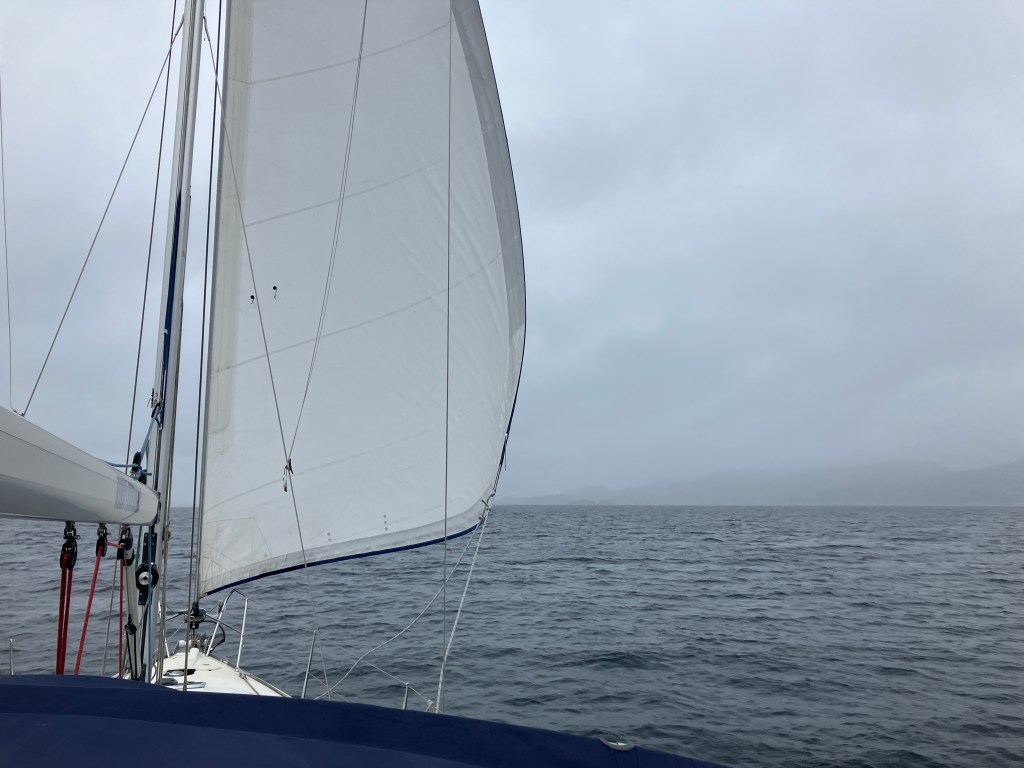
Approaching Trondheim.

We eventually arrive in Trondheim. The First Mate has called ahead and has been informed by the harbourmaster that the main Skansen marina is full because of a large conference on aquaculture for the next few days, with many attendees coming in their own boats. We are best to try the Brattøra marina further along, he advised us. Even there, several berths are reserved, but we might find a spot.

Luckily there is one place left. As we tie up the occupants from a neighbouring boat come and help.

“We’re from the UK as well”, they tell us, noticing our flag. “But we are flying back home in a couple of days. We’re leaving the boat at the Stjørdal marina along the coast a bit. We are sailing up there tonight, packing everything up tomorrow, then catching our flight the next morning. The good thing about Stjørdal is that it is close to the airport. We’re Chris and Terry, but the way.”

We invite them in for a cup of tea and cake.

“You’ll find Trondheim interesting”, says Chris, dropping cake crumbs on the floor. The First Mate looks aghast, but doesn’t say anything. “It was the capital of Norway during Viking times, and used to be called Nidaros after the River Nidelva which runs through it. Later it was called Trondheim after the Trønder people who lived in the area. The cathedral is still called Nidaros Cathedral.”

“The cathedral is definitely worth a visit”, Terry pipes in. “It’s where all the kings and queens of Norway were crowned.”

As we are speaking, a large bright green service boat is manoeuvring into the reserved space behind us, using its bow and stern thrusters to come in sideways like a crab. There isn’t a lot of distance between us and them.

Here for the aquaculture conference.

“We’ll be here for two days”, one of the crew tells us. “We’re one of the exhibits for the aquaculture conference. Now we have orders to get to and clean and paint everything.”

“Anyway, we need to get going”, says Chris. “We still have 20 miles to sail tonight, then we have a lot of packing to do in the morning. Perhaps we’ll see you here next year.”

We wish them the best for their homeward journey. Shortly afterwards we wave to them as they motor out of the harbour.

In the morning, we unload the bikes and cycle into town. We decide to attend to the boaty issues before we do the touristy bits, and stop off first of all at RiggMasters, a company specialising in rigging. We had been recommended them by the rigger who had repaired our VHF radio down near Bergen, and who had warned us that some of our mast shrouds were starting to fray and should be replaced soon. John, one of the bosses, promises to come and have a look at our boat in the morning. While we are there, we mention the batteries.

“I’ve actually got a couple of spare batteries you could borrow to finish your trip”, he says. “They’re second hand, but only a year old. You can bring them back afterwards if you don’t want to keep them, but you can have them for half-price if you want to keep them. I can bring them to the harbour if you like. But you will have to carry them down to your boat yourself. They’re pretty heavy, and my back is not up to it.”

I wonder if my back and knees are up to it too, but it’s an offer we can’t refuse.

“Let’s have lunch now, then go and see the Cathedral”, says the First Mate.

Nidaros Cathedral, the Crown Jewels, and the Armoury are all in the same complex. We buy tickets for all three. First up is the Cathedral.

Nidaros Cathedral.

“It’s absolutely stunning!”, exclaims the First Mate, once we are inside. “Think of the effort that has gone into building it all. No wonder the kings and queens of Norway like being crowned in here.”

Inside the Cathedral.

“The Cathedral is built over the remains of King Olaf II, who lived from 995-1030 AD”, I read in the pamphlet. “He was instrumental in bringing Norway together as a country, and was made a saint as he was credited with introducing Christianity to Norway. This was despite not actually having all that much to do with it, and what little he did do, did fairly violently in that people who refused to become Christians had their heads cut off. But apparently miracles started happening after he died, which resulted in the Cathedral becoming a major pilgrimage centre in medieval times. These days they are trying to resurrect some of the major pilgrim trails to Trondheim, both for those wanting the spiritual experience, but also for recreation.”

“Ah, yes”, says the First Mate. “I remember that German girl telling us all about it when we were in Kökar in the Åland Islands last year. Don’t you remember that one of the routes, St Olaf’s Waterway, ran past the marina?”
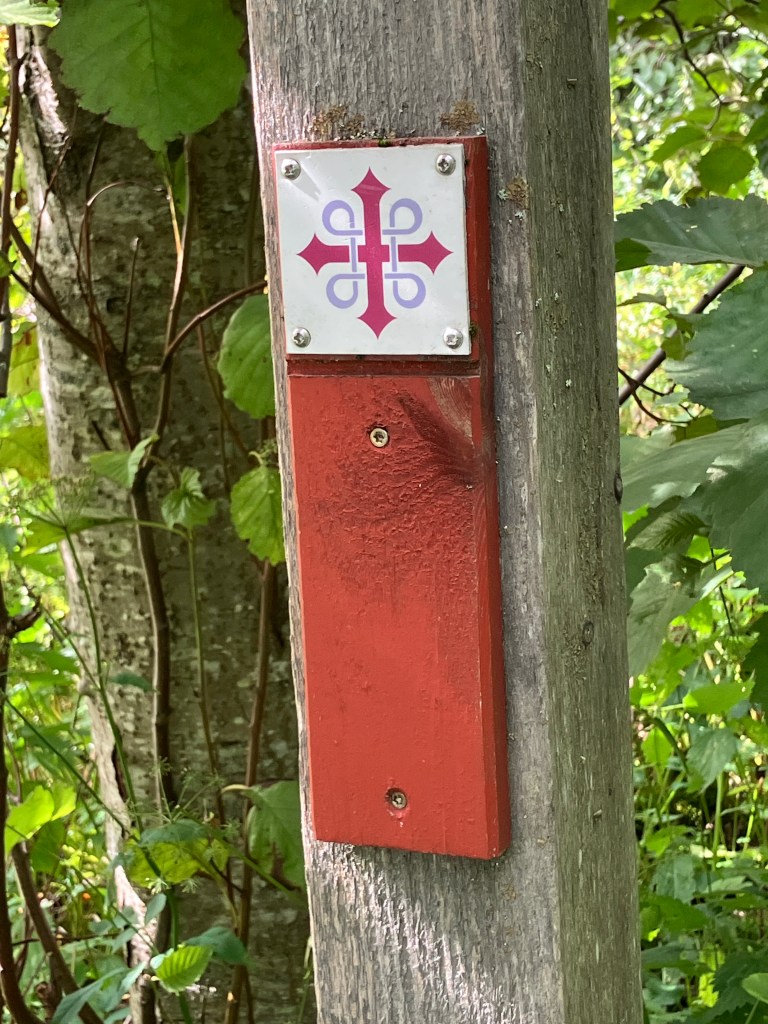
Signs marking pilgrim routes to Nidaros.

We find ourselves standing in front of a Norwegian flag and a British Royal Navy White Ensign hanging in one of the transepts. A young woman in religious attire comes over.

Navy ensigns in Nidaros Cathedral.

“Hello, I am an assistant priest here”, she says, a friendly smile on her face. “Can I help you? Are you puzzled about why the British flag is there? A lot of people are.”

“Well, it belonged to the British warship, the HMS McCoy”, she continues before I can answer. “It was the first Allied ship to enter Trondheim in 1945 after the war. The other one is the Norwegian Royal Ensign from the ship that brought King Haakon VII back from his exile in London a month later.”

Suddenly there is a burst of music from the massive pipe organ over the entrance. It’s the theme music of Chariots of Fire. Not quite what we had expected in a cathedral, but it is nevertheless stirring as the deep basses reverberate around the magnificent acoustics.
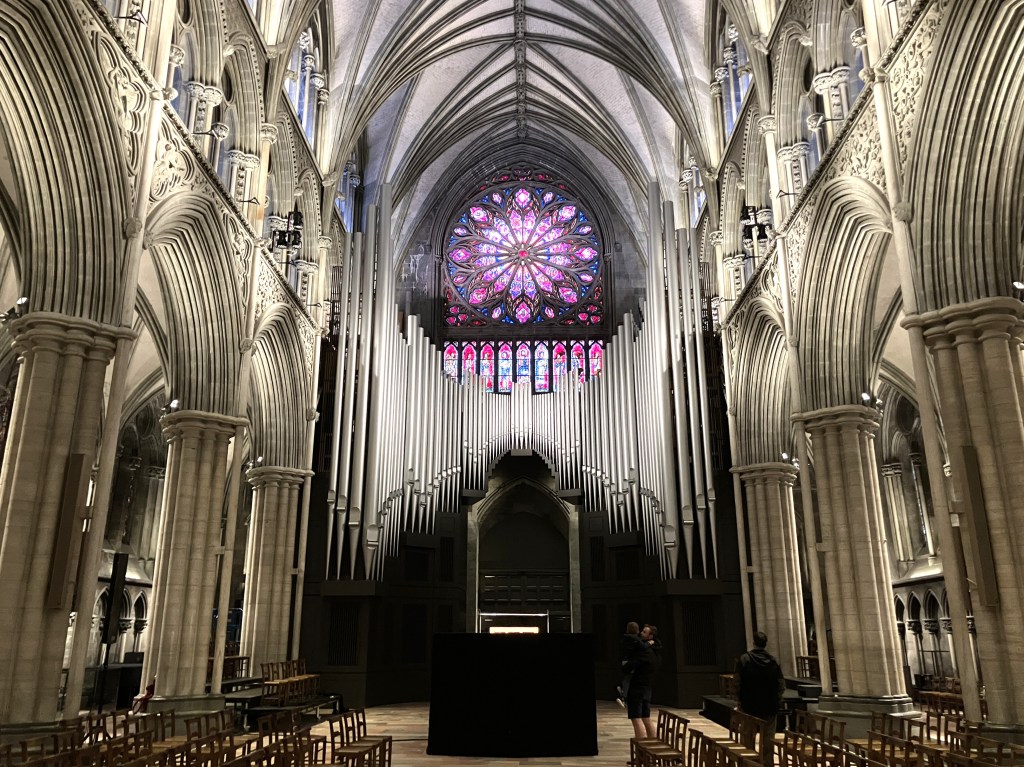
Pipe organ, Nidaros Cathedral.

We sit and listen to it, deep in our own thoughts.

“It’s amazing to think that my great-great-grandfather was here in 1889”, I say, when it is finished. “His letters say that it was being renovated at the time. Apparently it had fallen into disrepair, so they started major work on it in 1869, which wasn’t really finished until 2001. So we are quite lucky to see it in its finished state after 130 years of rebuilding. The original workmen in 1869 would never have seen the fruits of their efforts.”

We walk over to the building housing the Norwegian Crown Jewels. Unfortunately, we are not allowed to take photos.

“Never mind”, says the First Mate. “Here’s one of the coronation. You can take a photo of that to put in the blog. Now let’s have a quick look at the Armoury.”

Coronation of King Harald and Queen Sonja in 1991.

The Armoury is next door. We learn of the region’s military history from the Viking Age through to the Middle Ages, wars with Sweden, and, of course, the Nazi occupation during WW2. One thing I hadn’t really appreciated before was the leidangr system that started in Viking times and continued for some time afterwards. All free farmers of a local area had to assemble at periodic intervals and contribute to maintaining a ship and manning it to defend the country or participate in raids abroad. Men had to provide their own equipment and provisions.
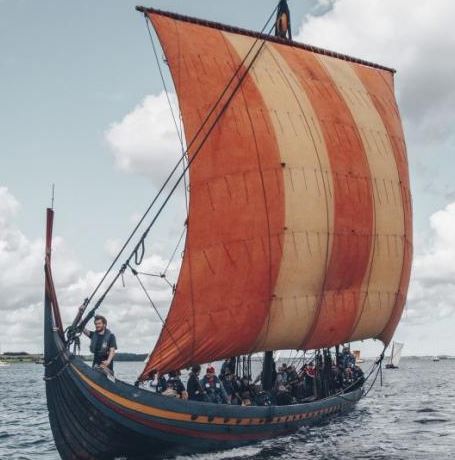
Contributing to the leidangr,

“Norway has certainly had a turbulent history”, says the First Mate as cycle back to the boat.

“Don’t forget that they dished it out as well”, I say. “Most of Europe was terrified of them at one stage.”

Display of swords in The Armoury.

“I’ve booked a stolkjarre for ten o’clock”, Mr Fairlie says at breakfast. “I was planning to go out to the Leirfossen. It’s a waterfall just on the outskirts of Trondheim. About half-an-hour’s drive. Apparently it’s quite spectacular. You are most welcome to join me if you want.”

“Thank you”, says the minister. “Very good of you. I should like that very much.”

The light, two-wheeled cart drawn by a single horse rattles slowly through the cobbled streets leading away from the quays. There is a smell of tar, fish, and salt in the air, causing the elderly man to draw his breath in sharply. Passing the timber warehouses of Bakklandet, they cross the old bridge with its carved wooden gates, then follow the rough country road along the Nidelva River. Beyond the town the road turns dusty and uneven, the packed earth and loose stones jolting the cart at every rut. Farms dot the slopes, their fields bright with ripening grain, and here and there the travellers glimpse women rinsing linen in the river and children driving cattle along the verge.

Nidelva River.

As the valley narrows, the low roar of water grows stronger, until at last the Leirfossen appears—a foaming white torrent pouring between dark rocks, its mist rising above the birches. The two men climb down from the stolkjarre and stand at the small viewpoint, absorbing the scene.
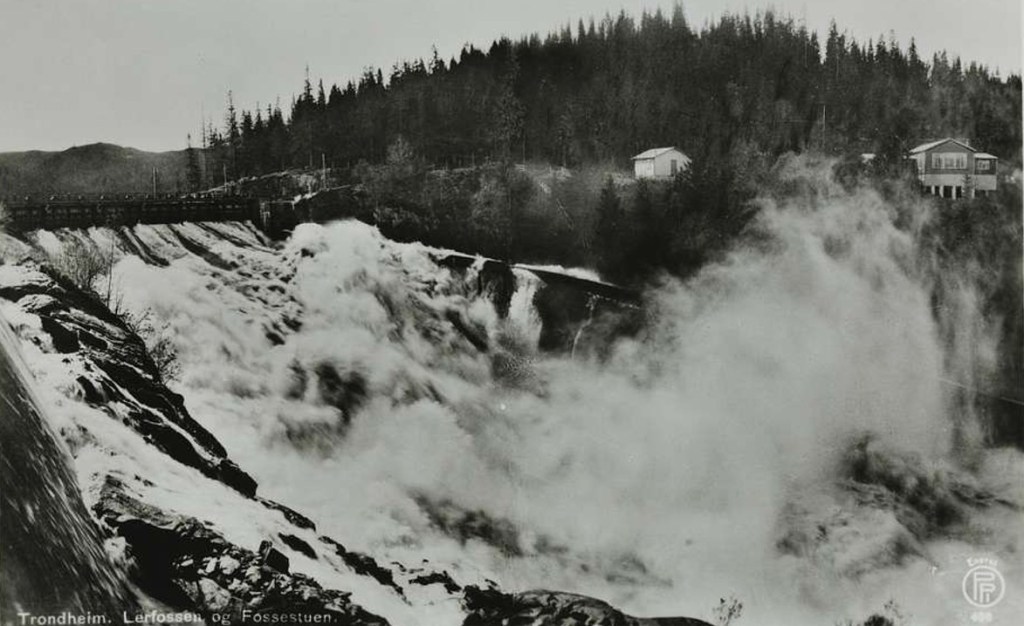
The Leirfossen, c.1890.

“There’s an enormous amount of power there”, says Mr Fairlie eventually. “You know, it’s a pity that it can’t be harnessed in some way and used to benefit mankind. A power station, for example. Think of it. Machines running without smoke or steam, lights in the streets after dark, electricity in every house in Trondheim. Maybe even powering the trams one day.”

“I like it the way it is”, says the minister. “Why does our modern society have this perpetual urgency to control nature? What’s wrong with the machines we’ve got? We don’t need trams without horses. The old ways have stood the test of time.”

“And yet it’s the new ways that will build the future, my old friend”, says his companion. “The river’s strength will eventually be harnessed to light the city, believe me. Wait! If I am not mistaken, I think I see the young Mr Hunter-Blair over there with his new bride. Fancy meeting our neighbours here so far from home. I suppose we should go and pay our respects.”
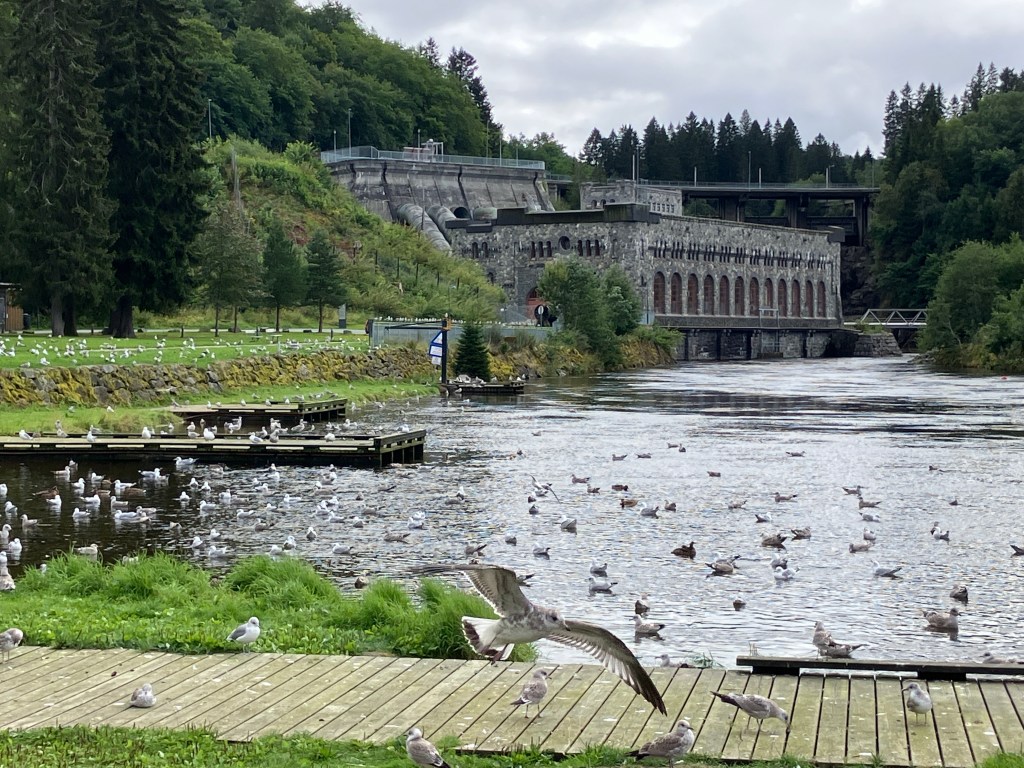
The Leirfossen in 2025.

“Did you see the waterfall?”, asks the First Mate, when I get back from my cycle ride.

“Well, sort of”, I say. “But it’s not a waterfall any more. It’s been converted into a power station. Mr Fairlie was right.”

“Remind me who Mr Fairlie is again?”, she asks.

“Just a friend of the family”, I answer. “And I stood in some seagull poo.”

Alpine farming, behind a waterfall, and a renewed acquaintance

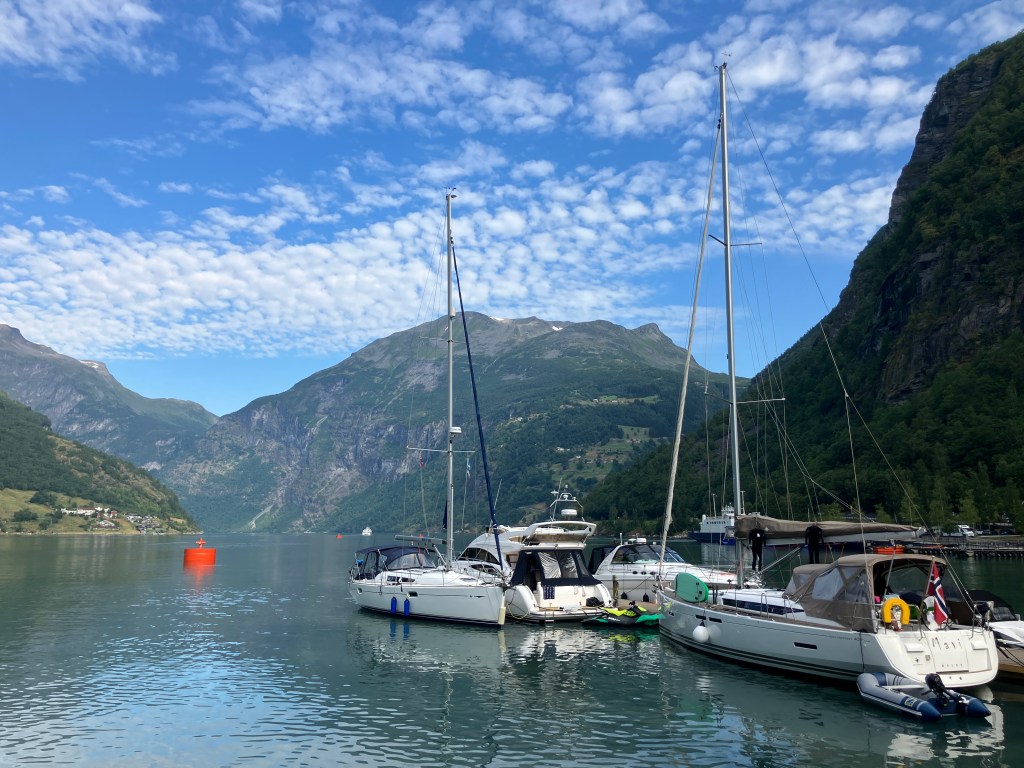
“According to the harbour guide, there’s supposed to be a hammerhead on the pontoon”. says the First Mate, peering through the binoculars. “But I can’t seem to see it. That would have given us plenty of room, but there seems to be just the pontoon. And it’s taken up with motor boats. We may have to raft up alongside.”

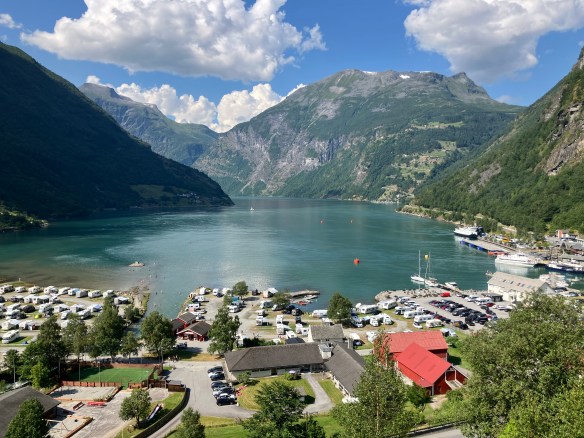
We are approaching the town of Geiranger at the top of Geirangerfjord, another UNESCO World Heritage site. We had set off in the morning from Sandshamn, and had had a pleasant sail up Storfjord then Sunnylvsfjorden, with the wind funnelling along the fjord behind us, before turning left into the short Geirangerfjord. In the distance, we see an army of campervans lining the waterfront, all with their skylights open in a vain effort to keep cool.

Approaching Geiranger.

“Yes, there was a hammerhead here last year”, says the owner of the motorboat we raft up to. “But it was destroyed by the ice over the winter and they haven’t got around to replacing it yet. But I am quite happy for you to tie up alongside. You can get to the pontoon over the swimming platform at the back here. By the way, there is a thunderstorm due shortly if you haven’t heard already.”

Rafted up in Geiranger.

We hadn’t heard. Nothing was mentioned about it in the weather reports we had received.

“They are very spontaneous”, he says. “It’s because of all the heat we’ve been having.”

Sure enough, fifteen minutes later, the wind starts to blow fiercely and the heavens open. As if choreographed, all the campervan skylights slam shut as one. We just make it into the cabin without getting wet, and watch and listen in trepidation as torrential rain falls and lightening cracks overhead. The windspeed indicator reads 33 knots.

Waiting out the thunderstorm.

“I hope our mast isn’t the tallest thing around”, says the First Mate.

“I think the buildings over there are taller than our mast”, I try and reassure her. “Hopefully, the lightening will go for them first.”

Thirty minutes later, it is all over. The sun comes out, and the skylights on the campervans open again in unison.

“Phew, that was pretty intense while it lasted”, says the First Mate.

Geiranger.

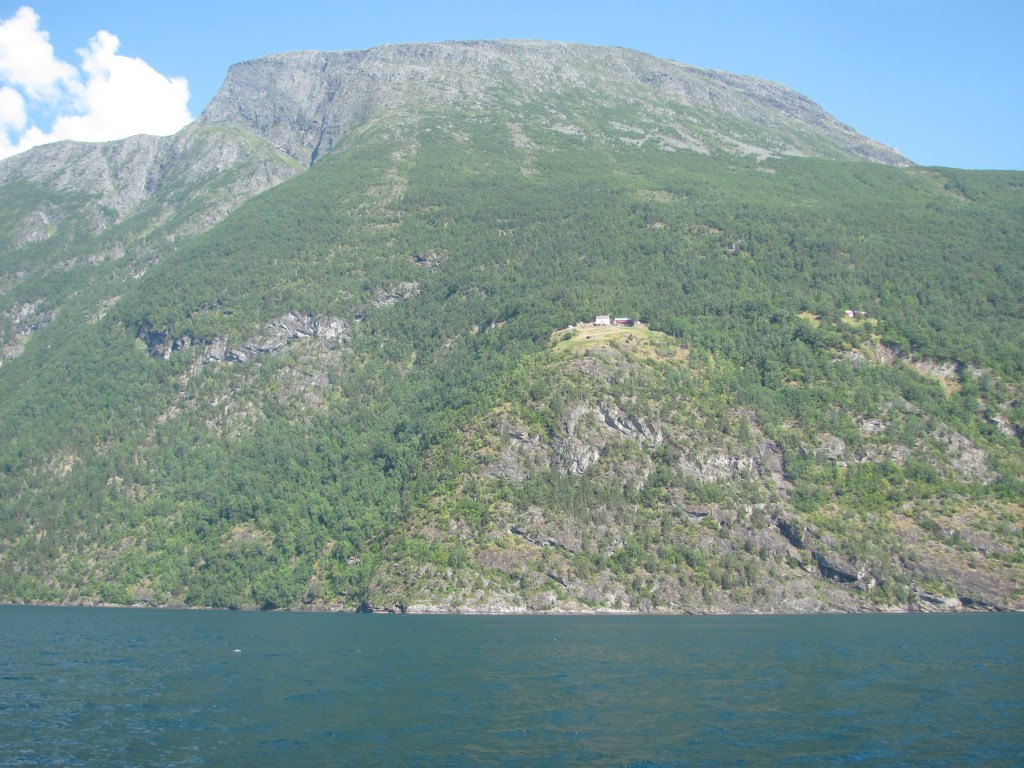
In the morning, we walk up to the Norsk Fjordsenter, where there is an exhibition on the mountain farms in the area. We had often seen these mountain farms clinging perilously to the steep cliffsides as we passed far below in the fjord, seemingly cut off from the rest of the world, with many not even visibly linked to the sea. As we had seen grass but rarely livestock, we had wondered what they actually farmed and how they transported their produce to the markets.

A mountain farm. How do they get there?

“Traditionally these mountain farms kept goats”, a panel in the exhibition tells us. “Pastures on the steep fjord sides provided grazing for them. The farmers produced brown and white goat cheeses and goat’s milk butter, all made according to traditional methods. Nowadays these farms may also keep sheep, cattle and Norwegian fjord horses.”

Mountain goats.

We taste some of the brown goat’s cheese.

“I can’t say I like it that much”, says the First Mate. “It’s a bit sweet for me.”

In one particular farm, the only route to it involved a short pitch of vertical rock that could only be passed with a ladder. The story goes that when the tax collector came to assess and collect the farm’s taxes, the farmer would pull the ladder up so that he couldn’t ascend any further, and he would have to go away empty-handed.

Tax avoidance, mountain farm style.

“I suppose the farmer thought he wasn’t getting much benefit from the state, so why should he contribute to its funding?”, says the First Mate. “There’s a certain logic to that.”

Life was precarious. Landslides and avalanches would sometimes sweep away entire farms, carrying the people with them. The worst of these was in the neighbouring Tafjord in 1934, when 2 million cubic metres of rock broke off and plunged down into the fjord below, causing a massive tsumani with waves up to 62 m in height and killing 40 people.

“Did you read that the next one they reckon will occur is at Åkerneset?”, says the First Mate. “Didn’t we pass that on the way in?”

We had indeed. A massive crack several hundred meters long and slowly widening each year threatens to collapse into Sunnylvsfjorden. Projections indicate that it could generate tsunami waves up to 70–80 meters high, drowning towns like Geiranger, Hellesylt, and Stranda within minutes. Luckily it is heavily instrumented to give warnings of its imminent collapse.

I shudder. “Perhaps we ought to get going”, I say. “I wouldn’t want to be underneath it when it goes.”

The next massive landslide?

“You can walk up to one of the former farms that overlooks Geiranger town”, the woman behind the desk tells us. “It’s more for tourists these days, and there’s a restaurant there, but it gives you a good idea of what life was like in these remote mountain farms. You can then also walk on further to the waterfall if you like. You can even go in behind the waterfall for a memorable experience.”

“There’s a plateau more than 1000 feet up the side of the mountain behind us”, says Mr Fairlie to his older companion over breakfast. “And there’s a new road up to it that they have just completed this year. If you wish, we could take a stolkejarre and driver up there and see how they farm. There’s also a good view of the fjord on the way up.”

“I should like that”, says the minister. “As much as I like sea air, I need to avail myself of fresh air from the land for a short time.”

“Well, there will be plenty of that up there”, says Mr Fairlie.

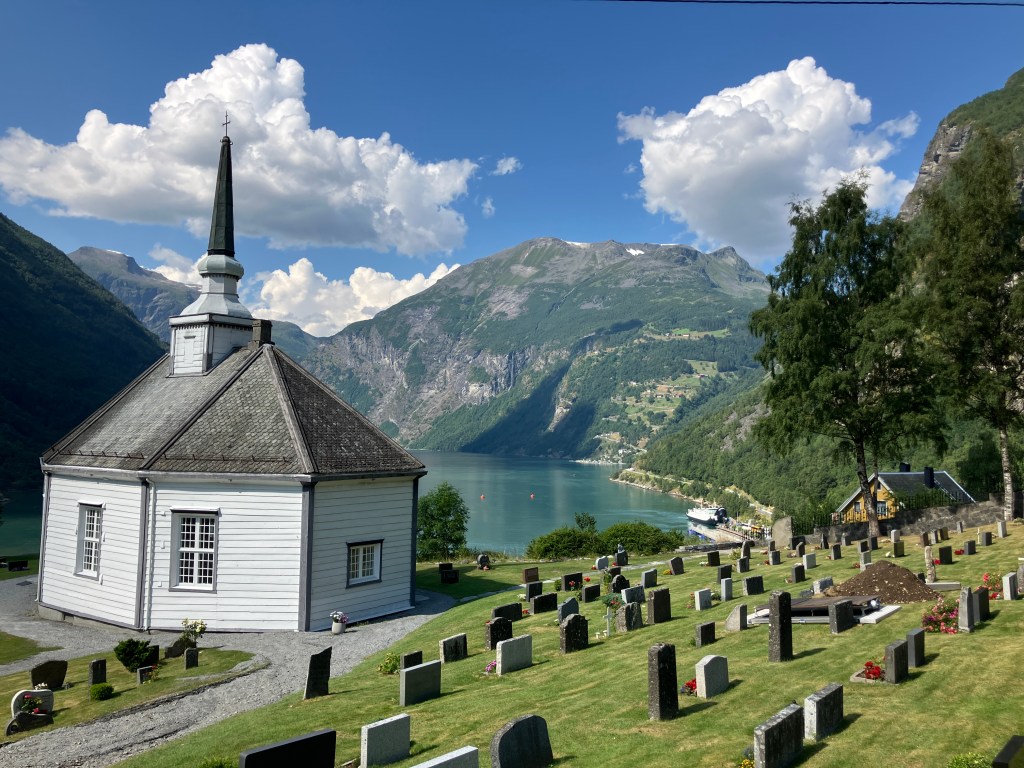
“There’s a funeral on at the church today”, the driver of the stolkejarre warns them. “We may be delayed somewhat as the mourners arrive. The road around it is narrow and there isn’t much room for vehicles to pass.”

Geiranger church.

We take the footpath up to the farm. The funeral traffic is completely blocking the road into the town, and there is a considerable tailback. We squeeze past the best we can and start climbing the stone steps up the hillside to the farm.

“Wow, that was steep”, pants the First Mate. “I am really looking forward to having an ice-cream at the restaurant.”

It’s closed. There is a sign saying that the funeral wake is being held there. The same cars that were blocking the road far below are now all crammed into the small restaurant car-park.

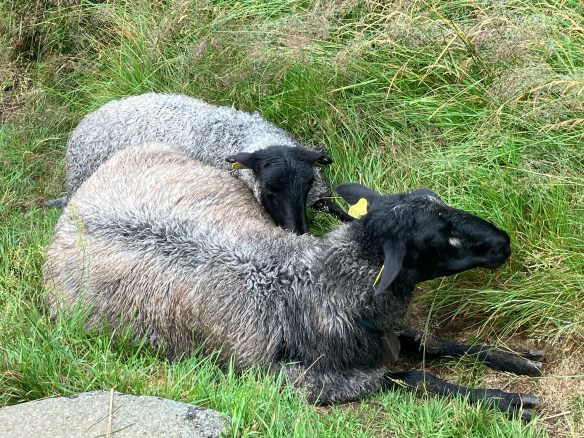
Luckily we have some sandwiches and water, so we find a shady spot under a tree and rest before carrying on. Behind us some mountain sheep are chewing the cud for their lunch.

Mountain sheep.

The elderly gentleman and his younger companion are already sitting there.

“We’re on a cruise around the fjords”, they tell us. “We have a day here in Geiranger, so we decided to take a side trip up here. It does one good to stretch one’s legs and to enjoy the views. It’s such a beautiful country. We are from Scotland.”

“Amazing”, I say. “That’s where we live. And we are also cruising around Norway. What a coincidence!”

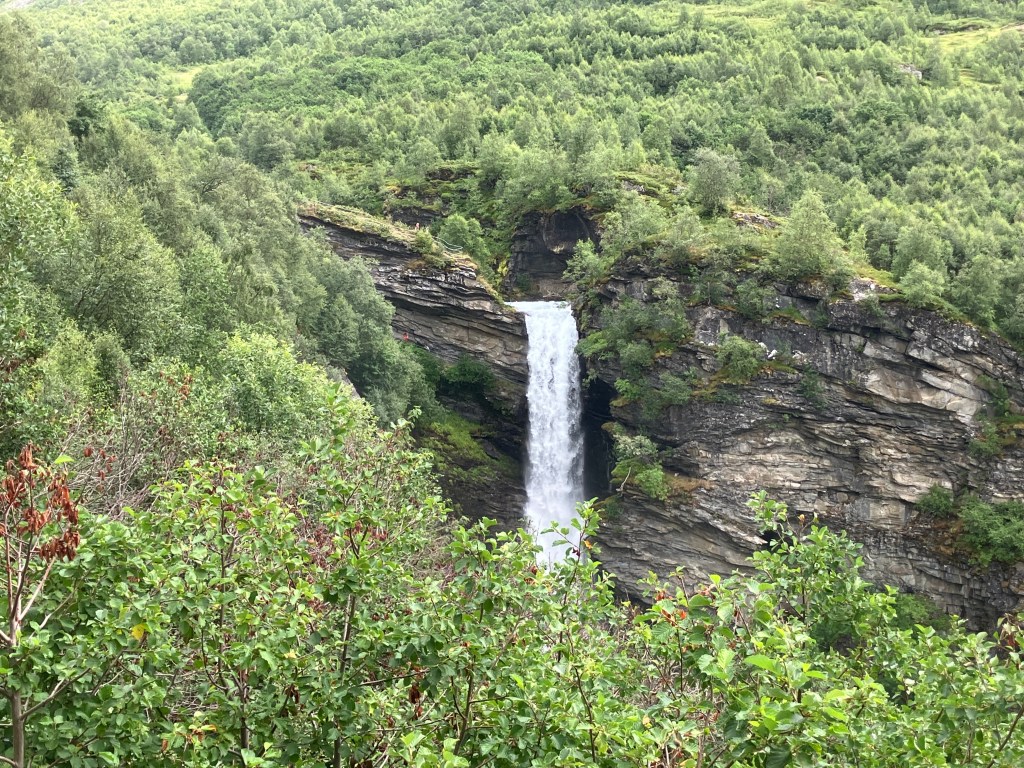
We finish our lunch, say goodbye, and push on to the waterfall. It’s impressive.

The Storsæterfossen.

We clamber down the rocky path to the side and edge our way gingerly along it until we are under the waterfall. It is a surreal feeling as tons of water thunder past us every second.

Behind the Storsæterfossen.

“It’s lucky there is a guide rail to hold on to”, I say. “It’s a sheer drop down there. I wouldn’t want to fall over.”

Soon we are damp from the spray in the air.

“Come on”, says the First Mate. “Take your photos, and let’s go. I’m getting quite wet.”

There is no sign of the elderly gentleman and his companion as we retrace our footsteps back down the path.

“They have probably gone back to their ship”, I say. “The ones we had lunch with. By the way, did you notice that the elder one looked a bit like me?”

“What on earth are you talking about?”, asks the First Mate. “We had lunch with a young German couple who were touring Norway in their car. Are you losing it, or is this just your vivid imagination again?”

On the way back down again.

The next morning, we cast off and motor slowly back along the route we had followed up to Geiranger.

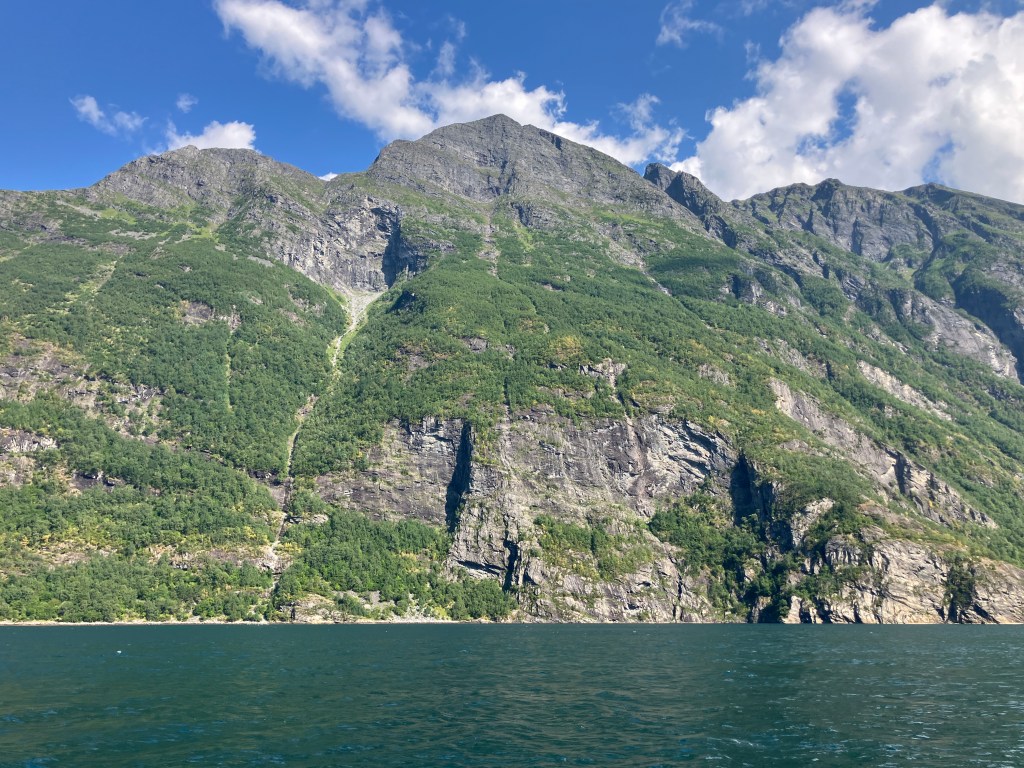
“Look”, shouts the First Mate from the bow as she tidies up the ropes. “There’s the Seven Sisters waterfall. But there only seem to be five at the moment. I read somewhere that the number of sisters depends on how much rain there has been.”

Seven Sisters waterfall, Geirangerfjord.

Unusually, the wind is favourable when we reach Sunnylvsfjorden, and we are able to enjoy a pleasant sail back down the fjord with the genoa only. Normally in the fjords, because of the funnelling effect, the wind always seems to be against us, no matter which direction we are heading and which wind direction has been forecast.

A boat is coming up fast in front of us.

“It’s the Hurtigruten”, I say, peering through the binoculars. “It’s going to pass us to port.”

The Hurtigruten is the iconic Norwegian coastal express service operating between Bergen and Kirkenes near the border with Russia in the far north. Not only does it act as a daily passenger and cargo service, it is also possible to take scenic cruises on it.

“You are pronouncing it wrong”, says the First Mate. “It’s ‘Hurtig-ruten’, not ‘Hurti-grutin’. It means ‘Fast Route’, just like in German.”

The Hurtigruten.

In the late afternoon, we break our journey at the delightful little anchorage of Honningdal.

“It’s such a lovely peaceful spot”, says the First Mate dreamily, as we sip our wine in the cockpit in the evening. “With stunning views of the mountains and the fjords. If only those geese over there would stop being so noisy with all their honking, we could enjoy the peace and solitude.”

“Well, I suppose they are part of nature as well”, I say.

Honningdal anchorage.

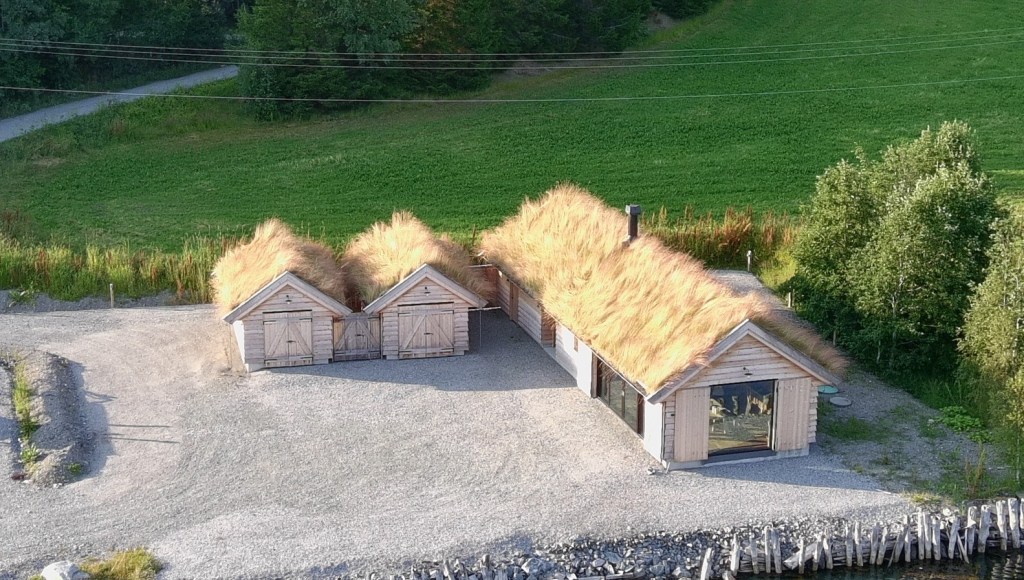
“Those sheds on the shore look like they have Boris Johnson haircuts”, I say, pointing to a cluster of boatsheds on the other side of the small inlet. “I think I might send the drone over there and get a shot of them.”

“Careful you don’t hit the power wires”, warns the First Mate.

Does Boris Johnson live here?

We eventually arrive in Ålesund. There aren’t any spare berths at the small marina, and we have to raft up to another sailing boat with a Swiss flag.

“You look familiar”, says its skipper. “I think that we have met somewhere before. And I recognise your boat’s name. Ruby Tuesday. Out boat is called Sol Vita.”

We rack our brains. He gets there first.

“It was in Hanko in Finland”, he says. “Last year. Don’t you remember there was an armed forces flag day? My name is Christoph and this is Solvita. The boat is named after her, by the way.”

My memory stirs. “And we were both visited by the coastguard people as we were the only two foreign boats there”, I say. “They checked our VAT status, being a UK-registered boat. Then they went over to you on the other side of the pontoon.”

“We followed your route around the Baltic States”, Christoph says. “We nearly caught up with you in Riga in Latvia – we were in another marina, but we came to your boat one day to see if you were in, but you weren’t unfortunately.”

“That was probably the time we left the boat and took the bus down to Vilnius in Lithuania”, says the First Mate. “What a pity we missed you.”

“We left the boat in Latvia over the winter”, says Solvita. “I am actually Latvian. This year we have sailed from there, around Sweden and Norway, right to the top of Nordkapp in the far north of Norway. Now we are on our way back again. ”

We’re suitably impressed. That’s about 3600 nautical miles as the crow flies, not counting all the little bays, inlets and fjords they must have gone into. We are lucky if we manage to do half that in a season.

“We do do a lot of long passages”, says Christoph, seeing the looks of astonishment on our faces.

In the afternoon, we take the path to the top of the Aksla hill overlooking Ålesund. There are supposed to be 418 steps. I’ll take their word for it. The view from the top is stunning.

Ålesund from the Aksla viewpoint.

Later we are invited to Sol Vita for drinks.

“I studied law and then medicine at university”, Solvita tells us. “But I couldn’t really settle to a job in those areas. I had always enjoyed sailing ever since I was a little girl, and since I met Christoph I moved to Switzerland to be with him. We have been sailing every summer since then. A couple of years ago I had a go at writing a book. All in Latvian, I am afraid. It’s called ‘Purva migla’, or ‘Bog Fog’ in English, and is about a girl with a dark past who is trying to find herself. She travels far and wide in her quest, but starts to realise that the answers to the question of her past lie back where she came from.”

“It sounds interesting”, says the First Mate. “I like those sorts of books. You should translate it into English sometime.”

Escaping the storm, a Devonian wonder, and a clenched fist

“It’s right behind us”, I call out to the First Mate. “It looks like we are going to get wet.”

We are coming into the small harbour of Leirvik on the northern shore of the vast Sognefjord. A storm is chasing us from the south, and we are trying to get to shelter and tied up before it reaches us. About 200 m behind us we can see the ruffling of the water’s surface as the wind reaches it, our world reduced to a writhing mass of greys and blues. Raindrops begin to fall around us, spattering on the cockpit cover and the cabin roof.

For the last hour or so, we had seen the heavy dark clouds gather over the mountains to the south, and watched them with trepidation as they moved slowly across the fjord, wondering when it would be our turn to be engulfed. This looks like it might be it. But somehow it misses us. At the last moment it veers off towards the east, leaving only the perturbed water and the few raindrops in its wake.

Storm clouds gathering.

“We’re not off the hook yet”, the First Mate shouts back, looking at the radar map on her phone. “There’s another one coming in. I’d say we have about ten minutes to get there.”

I push the throttle lever forward. We enter the small inlet, avoiding the salmon farms to starboard, and motor through the narrow marked channel leading to the harbour. Out of the corner of my eye, I can see the clouds appearing over the surrounding hills. Luckily there is a free space. We loop the lines around the cleats on the pontoon, quickly connect the power cable, pull down the sides of the cockpit tent, and retreat inside as the heavens open and the torrential rain starts.

“Phew, that was close”, I say. “I am glad that we didn’t get drenched. There’s something very nice about being warm and dry inside, listening to it pelting down outside.”

The rain stops in the early morning. We have a leisurely breakfast, top up with fuel, and set off northwards through Tollesundet. The wind is fitful, sometimes filling the sails and giving us a pleasant sail, other times dying to nothing so that once again we have to run the engine.

Catching the wind while you can.

“This topography plays havoc with the wind”, I grumble, as we take a line between the islands of Skorpa and Sula. “It always seems to be against you, whatever way you are going.”

“Just be thankful for the magnificent scenery”, says the First Mate. “And that we have the weather to be able to see it.”

In the late afternoon we reach the delightful little anchorage of Hatløy.

“Let’s stay here for the night”, says the First Mate. “It’s such a fantastic view. And there is no-one else – we have it all to ourselves.”

“Sounds a good idea”, I say. “It’s designated as a nature reserve and landing is prohibited from April to July for the nesting season, but we can stay on board.”

We drop anchor and chill out. A heron screeches from the reeds at the water’s edge, two ducks paddle by, looking expectantly for titbits. A cormorant flies overhead. There is a splash as a fish jumps and disappears again. It’s idyllic.

Anchored at Hatløy.

We carry on northwards the following day. The landscape widens, with more sea room and less feeling of being hemmed in by steep fjord sides. Nevertheless, it is still impressive. We pass the imposing bulk of Alden island with its Norskehesten mountain.

Alden island.

Norskehesten apparently means ‘Norwegian horse’”, says the First Mate. “But I can’t really see a horse in it. Perhaps from another angle. But it certainly is impressive. And look at the way the rock is twisted in this one we are just passing now. It looks a bit like a Swiss roll.”

Swiss roll mountain?

We eventually reach the bustling harbour of Florø. On the way in, we pass the iconic Stabben lighthouse.

Stabben Lighthouse.

“We don’t need to stay too long in Florø”, says the First Mate. “I just have the washing to do and we can stock up on provisions. Then we should press on to Maløy while this good weather lasts.”

The Fisher Boy of Florø.

The next day we enter the Frøysjøen fjord. As usual, there isn’t much wind, and what there is is against us, so we have to motor until we turn eastwards where we are able to catch it on just enough angle to unfurl the sails. Even though we are only able to make three knots, we find it relaxing to sit back and enjoy the scenery without the noise of the engine.

“There looks to be a nice little anchorage coming up”, I say. “Hennøysund. Tucked in behind an island. We can stay there the night.”

“Sounds good to me”, says the First Mate.

It is good. Surrounded by high mountains on each side, it feels as though it is just us and nature. That’s if we ignore the occasional muffled throb in the main fjord on the other side of the island of ship engines carrying cargo or passengers from Florø to Maløy.

“Even in Norway with its small population, you never feel far from ‘civilisation’”, I muse.

Anchored in Hennoysund.

In the morning, just around the corner from our anchorage, we find we are dwarfed by a massive cliff rising straight out of the sea.

Hornelen Sea Cliff.

“It’s the Hornelen Sea Cliff”, says Mr Fairlie in awe. “Nearly 3000 feet high. The highest sea cliff in Europe, by all accounts. Devonian sandstone. At one stage it was a sedimentary river basin. Then when the Baltica plate collided with North America, it was forced upwards.”

“Ah, you and your natural processes trying to explain everything”, says the minister. “I’d forgotten that you had a passing interest in geology. You’ve been reading too much of James Hutton’s ramblings.”

“Well, I have to admit I am a strong admirer of the work of our countryman”, rejoins his companion. “Through observation of the country around him, he came to the conclusion that the components of the land were once formed by the tides and currents under the sea into a consolidated mass, and then raised up out of the deep by unimaginable forces. And if that is true in Scotland, then it must also be true in Norway.”

“But where is God’s hand in all this?”, chides the minister. “Isn’t he the Creator of all things?”

“Far be it from me to disagree with such a learned man as yourself”, answers Mr Fairlie. “But as with any craftsman, He makes use of the natural laws to produce what He wants. It is the calling of geologists such as Mr Hutton to determine what those laws are.”

“Well, whatever its cause, it makes one feel humble just to contemplate it”, says the minister, looking again at the cliff. “We don’t have anything so spectacular in Scotland. I suppose people must have climbed to the top?”

“Apparently, you can walk to the top”, says the First Mate. “There’s a marked path you can follow. There’s a little harbour around the corner you can start from. It takes about four hours to get to the summit.”

“Shall we tie up and have a go?”, I say, tongue in cheek.

“Ten years ago I would have said yes”, she replies. “But now my knees aren’t up to it.”

Mine are the same.

“If the steamship were to stop, I would do it”, says Mr Fairlie. “But I don’t think that there is any chance of that. We need to get to Maløy by tonight. But it was worth seeing. Perhaps I might come back sometime.”

“Rather you than me”, says the minister. “I’m too old for that sort of thing now.”

We eventually arrive in Maløy and find a place in the small marina. There is a huge cruise ship tied up across from us.

Cruise ship, Maløy.

“I suppose that is the modern equivalent of the cruise steamship that your great-great-grandfather was on”, says the First Mate. “But I have read that Norway is bringing in tough regulations in 2026 that will require cruise ships and tourist boats to be zero emissions, particularly in the UNESCO World Heritage fjords like Nærøyfjord and Geirangerfjord. I wouldn’t imagine that they would have worried about that in 1889 with their coal-fired ships belching smoke and other nasty gases.”

“That’s true”, I say. “And I read somewhere that they will even be using sniffer drones to check up on emissions from cruise ships in the fjords. But I wonder how it will affect sailing boats like ours? It’s not easy to use the sails only in the fjords, what with the fallvind and the like.”

“I guess we will have to replace diesel engines with electric ones eventually”, she says. “Some sailing boats are already doing that.”

“And a lot of the ferries that we see around us are already electric”, I say. “Or at least hybrid. They are taking it all very seriously. Good on them.”

The next day we sail for the island of Silda, to the north of Maløy.

“It’s hard to believe that this was the site of a battle between the British and the Norwegians in 1810 during the Napoleonic Wars”, I say, remembering something I had read in the travel guide. “Two British frigates engaged with some Norwegian gunboats based at the pilot station on Silda. The British captured two of the Norwegian boats, while a third was scuttled by its crew.”

“Hey, keep your eyes on where we are going!”, shouts the First Mate as we enter the tiny harbour. “You almost hit that boat!”

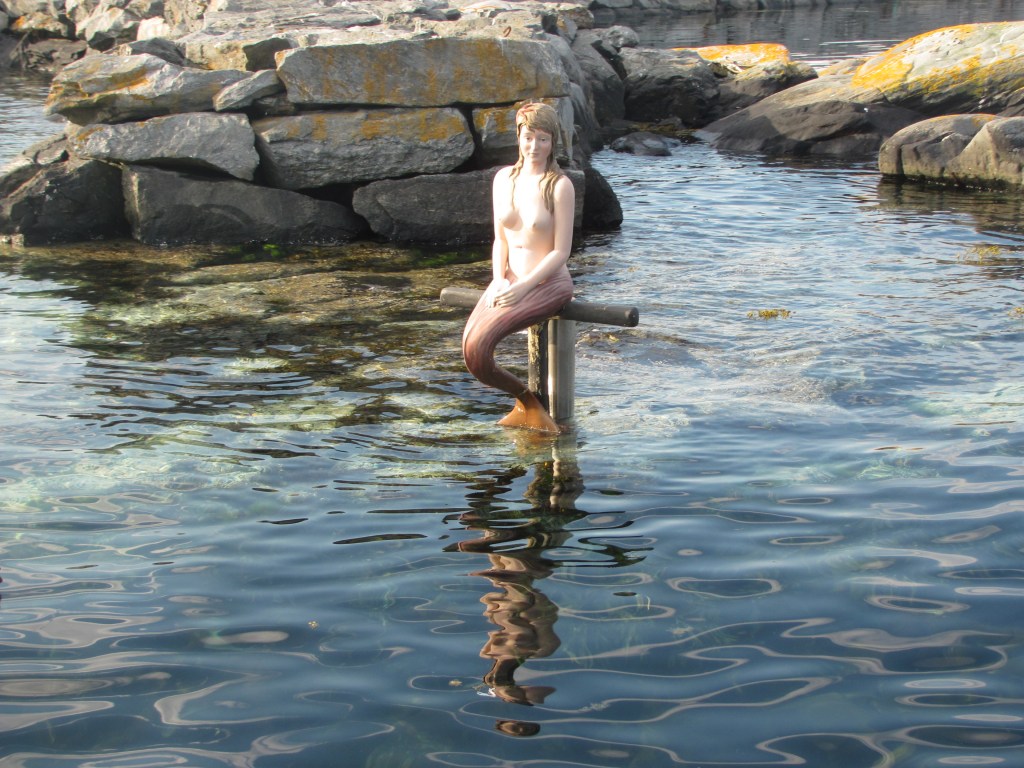
Strategically placed at the end of the breakwater is a shapely young woman who seems to have mislaid her clothes. She seems blissfully unaware of the effect of her presence on the psychology of sailors who have been too long at sea. Not that that applies to me, of course.

“I was just concerned that she might be feeling the cold”, I shout back.

Feeling the cold?

Discussion over dinner that evening centres on the challenge tomorrow.

“I have to say that I am not really looking forward to rounding the Statt”, says the First Mate. “I’ve heard so many horror stories about it, it’s making me scared.”

The Statt is a peninsula that juts out into the Atlantic ‘like an angrily clenched fist’, as the Cruising Guide puts it. It is notorious for being dangerous in certain conditions, so much so that an escort service is provided for small boats wanting to round it. In fact, work has started on drilling a tunnel through the base of the peninsula large enough so that ships can sail through it and don’t have to go around it. With the Norwegian penchant for tunnel-building, I am surprised that it hasn’t already been built. Cost, I assume.

“We’ll be OK”, I say, not feeling as confident as I try to sound. “It’s just a question of picking your weather window. And with all this calm weather we have been having, there’s been nothing that could have made it rough.”

We study every weather app we can lay our hands on. One particular one gives the wave heights and wind speeds at the headland at three-hourly intervals. I painstakingly work these out for the week ahead trying to find a slot that has small waves and a southerly wind to blow us north around it as well as following the north-flowing current. Nothing is ideal, but there is a window that is relatively calm, albeit with a wind from the north.

“At least the wind is very low, so I think it should be OK”, I say. “We’ll just have to motor around it. Otherwise, we will have to wait a whole week before the wind changes to the south, and who know what the waves will be doing by then?”

“I hope you are right”, the First Mate says, not very enthusiastically. “How high does it say the waves will be?”

“It’s predicting a maximum wave height of 1.3 m”, I say. “That’s from the top of the wave to the bottom of the trough. And a 0.7 m significant wave height, which is the average of the top third of all waves. That’s not too bad. It’s a bit like the wash from a speed boat passing us. A bit bouncy, but tolerable.”

We set off in the morning. The sky is overcast, but at least there is not much wind. The sea is calm, but as we approach, the waves grow slowly in height, and Ruby Tuesday starts to plunge into each successive wave. The clouds thicken and seem to grow darker. A gust of wind rocks us from side to side. Or is it my imagination?

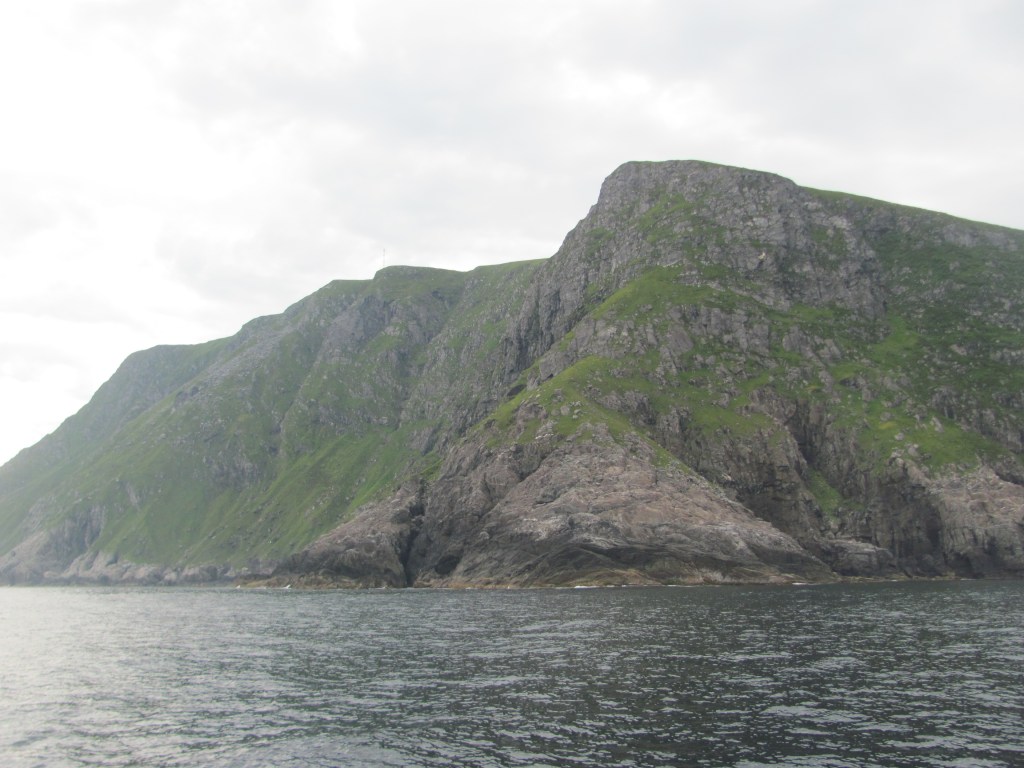
Eventually we reach Kjerringa, the peak at the outermost corner of the promontory. This is where two currents meet and the water is confused, with waves from one stream interacting with waves from the other. Ruby Tuesday pitches and rolls, not sure what is happening. Luckily it doesn’t last long, and we are soon back in more straightforward water.

Kjerringa, on the end of the Stattland penensula.

“We’re over halfway now”, I say.

Slowly but surely the waves subside. Before long we are turning the corner eastwards again, and the water suddenly becomes smooth and the sun comes out.

“It really does generate its own microclimate out there”, says the First Mate. “I read that somewhere, but I didn’t really appreciate it.”

“Well, at least we made it”, I say. “We can relax now.”

“For the time being”, says the First Mate. “We still have two more designated ‘dangerous sea areas’ to go. Godø and the Hustadvika.”