We help the army

There is a bump. I wake up and look out of the boat, half expecting another boat to have collided with us. Nothing, although there is a new boat has appeared during the night and anchored not far away from us. We had heard stories of people smugglers using Lulworth Cove as a secluded spot to deposit their cargo after a fast trip from France in the early morning, but this boat doesn’t look like one of those.

It has been a rough night. The wind had gone around to the north at some point and had strengthened. Rather than being sheltered from northerly winds in Lulworth Cove as one might expect, it seems to act as a funnel instead. I had checked our position a couple of times during the night and we had seemed fine, but when I check the chart-plotter now I see that we have definitely moved from where we had anchored the night before. It seems the anchor has dragged, and we are closer to the rocks at the entrance to the Cove now. We decide to leave now rather than trying to re-anchor.

The anchor had dragged in the night somehow.

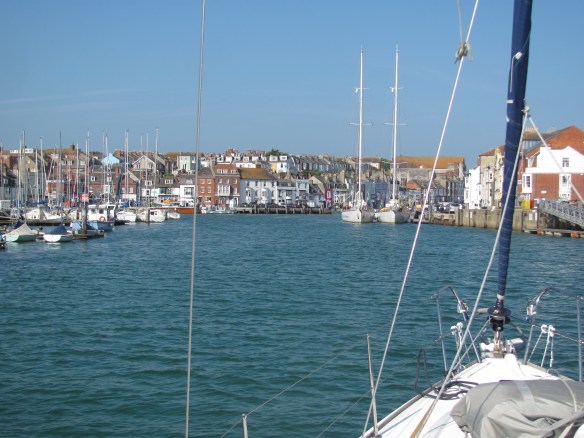
By the time we reach Weymouth, the sun comes out, and the town looks welcoming and cheerful. Even the harbour master  on the VHF sounds friendly when we call him to tell him of our arrival. The sun always seems to have that effect for me. To reach the marina, we must pass under a traffic bridge that lifts up every two hours. We are instructed to tie up temporarily to a holding pontoon and await the next time of lifting, which just happens to be in a half-an-hour or so.

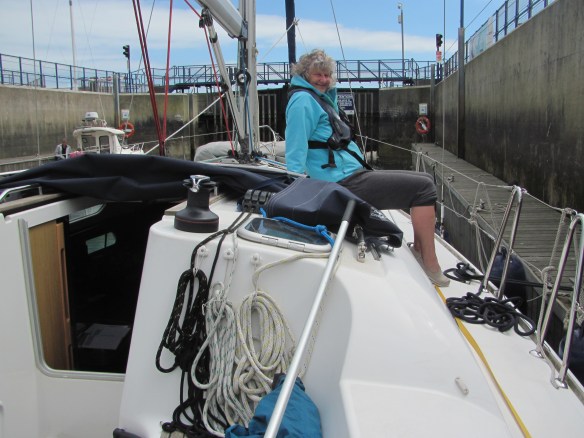
Coming into Weymouth harbour.

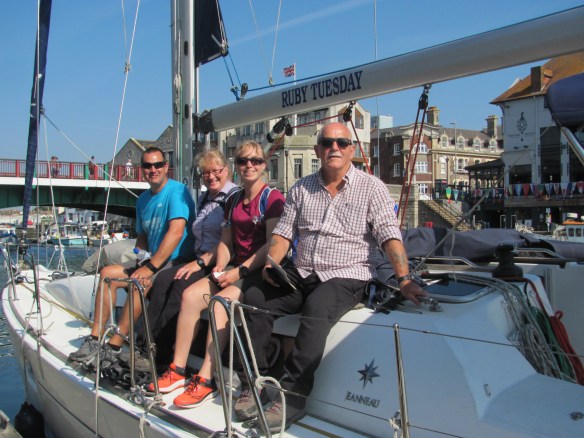
Just as we moor, we are accosted by a group of fit looking individuals who tell us that they are army cadets taking part in a competition and one of the challenges they have been told to do is to find a yacht and pose for a photograph with the owners. Would we mind? And we mustn’t allow any of the other teams to do the same. Momentarily thinking it might be a hoax and looking around for the hidden cameras, we don’t have the heart to refuse, and let them clamber on to Ruby Tuesday for their photo. Then just as they thank us and leave, a second team arrives with the same request. The word has clearly got around, and another and then another team arrives. Five teams in all. By this stage we are wondering if there is anyone left in the British Army that is defending the country, but it is all a bit of fun and we agree. At least we have done our bit for the morale of the troops.

The army have their photos taken on a yacht.

Eventually, a bell rings and the imminent lifting of the bridge is announced, so we need to focus our attention elsewhere. The traffic stops, the bridge lifts, boats coming out sail through, then it is our turn. We have arrived in the marina.

Lulworth Cove

We watch the patrol boat approaching with some trepidation. Have we made a mistake with our calculations of where we are? We are on the edge of the Lulworth Firing range and we know from the maritime safety information broadcast that it is active today. From time to time we have heard the rattle of gunfire from the land, and although we half wondered if we might see the splash of large shells hitting the water, we had thought that we were outside the exclusion zone. I had even called the Duty Officer earlier to confirm the route we should take,

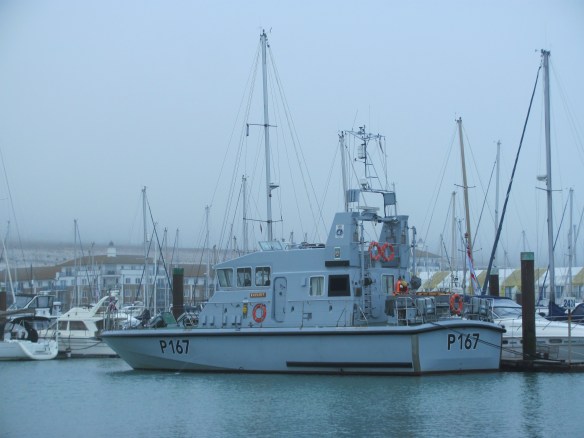
The Range Firing Officer at Lulworth pays us a visit.

We needn’t worry. The patrol boat comes in close, and there are friendly smiles from the two occupants. They enquire if we are OK and where we are heading for, and reassure us that we are fine if we stick to the latitude of 50° 33’N that we are on at the moment, and that we should turn north at 02° 16W to get to Lulworth Cove. They wish us all the best and head off to intercept another boat that is approaching a mile or so away. We hear more shots in the distance.

Trying to avoid the Firing Range and looking for Lulworth Cove at the same time.

We approach Lulworth Cove under power as the wind has dropped. The entrance is not easy to see from the sea, but we have the waypoint coordinates and steer towards it. Suddenly the entrance opens out and we see several other boats anchored in there. We cruise in slowly and are momentarily taken aback to see that the beach and water are thronging with people. For some reason, we had naively assumed that we would have it all to ourselves. The relative solitude of being at sea has made us forget that there are many other people in the world too.

Anchored in Lulworth Cove.

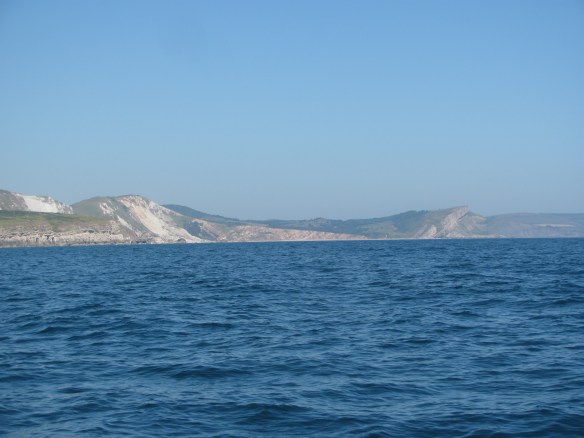
We find a spare place and drop the anchor, paying out lots of chain. It seems to hold. We sit and have a coffee in the sunshine, taking stock of the situation. This is Jurassic Coast country. The entrance to the cove is a narrow cut where the sea has broken through the limestone and allowed the waves to erode the softer clay and sands behind into a bulbous shape, while at the back of the cove are the steep chalk cliffs that have resisted erosion. We can see why geologists like coming here, and indeed we see a geology student with her hammer examining rocks in the eastern corner.

Interesting geological formations in Lulworth Cove.

A catamaran arrives and tries to anchor next to us. We think it is too close, especially when there is plenty of room in the rest of the Cove. Its skipper is alone and is trying to wrestle with the anchor winch at the front with no one to help him on the helm. The winch operates with a lever arm and seems to be jammed. I stand on our bow ready to fend him off if he drifts towards us. The skipper looks across the narrow gap between us and grins sheepishly.

“I am a little bit close to you, I think?”, he says, probably interpreting the look of alarm on my face. The accent is unmistakably German.

“A little”, I say, trying not to appear too concerned. The catamaran edges closer. There is perhaps five meters between us now.

“This winch is giving me problems and I am by myself”, says the Kapitan. “I have just bought the boat and haven’t anchored before.”

“If I could get across to you I could give you a hand”, I say, thinking that I need to protect Ruby Tuesday somehow. “But our tender isn’t inflated.”

“That’s no problem, I have a dinghy, and will blow it up and come and fetch you”, says the Kapitan. That saves us the job of pumping up our own dinghy then.

“Perhaps you could just move your boat a little further away from us before that?”, I say.

Soon we hear the puffing sounds of an inflatable pump. The Kapitan rows across and I clamber into the dinghy. We row back to the catamaran. I am not sure what I can really help with anyway, but I direct the Kapitan to a spot a bit further away and drop the anchor. It seems to hold. The Kapitan offers to show me around the boat. It is nearly 40 years old, but has been looked after well. He tells me how he has modified it by converting half of the living area into a sleeping area.

Helping to reanchor the catamaran.

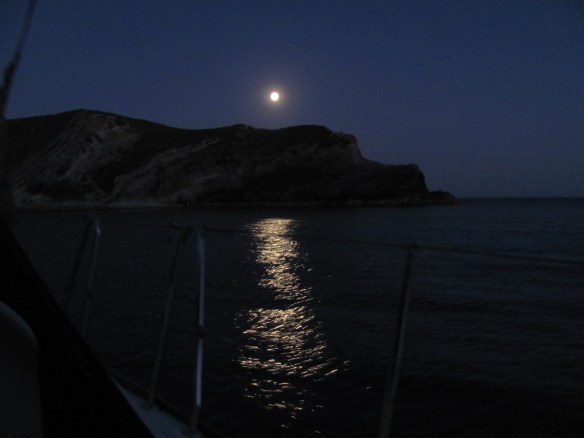
The Kapitan drops me back to Ruby Tuesday. We invite him in for a beer. He is from Munich, but has worked in the Caribbean and elsewhere. He has always wanted a boat, and bought his catamaran in Walton-on-the-Naze in the Thames estuary. He is now wanting to sail the world with it. His immediate plan is to get to Dartmouth, but he is thinking of Spain after that, then an Atlantic crossing. We think he is terribly brave to be doing all this single-handed. The Kapitan shrugs. It’s not all the time – a friend joined him last week, and his girlfriend is joining him next week. She hasn’t sailed before, so we wants her to enjoy it. There is something about his attitude that we like. “Catch your dreams before they fly away”, I think. We sit and try and solve the world’s problems until the moon starts to rise over the cove entrance.

Moonrise over Lulworth Cove.

Poole

I awake with a start. The loud lapping of the waves against the side of the boat can only mean one thing. They are coming from the beam rather than the bow as they would if we were swinging freely. I quickly dress and go on deck. The wind is coming from the east, and all the other boats next to us are aligned east west except us, aligned north south. I switch on the depth sounder. It reads zero. We are grounded.

Grounded off Green Island in Poole harbour.

We are in Poole Harbour. Rather than stay in a marina, we had decided on peace and solitude and had taken the left turn after entering the harbour and followed the narrow South Deep channel around the south of Brownsea Island, and had found a nice place to anchor with a few other boats  just on the edge of the channel near Green Island. I had done my tidal calculations and had estimated that we would have 40 cm under the keel at low tide at 0430 in the morning. Not a lot, but enough. I had gambled on the wind staying in the east as was forecast, which would have kept us aligned at the edge of the channel, but at some time during the night either the wind or the current had changed and we had swung round to where it was shallower. Then at low tide, the keel had settled gently into the mud. No matter, it is a rising tide. I make a cup of tea and sit down to wait.

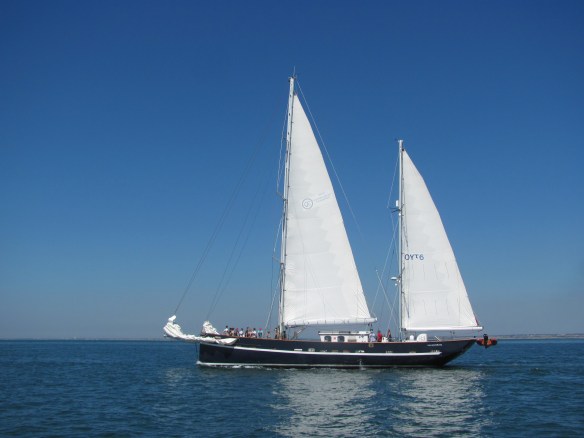
We had arrived in Poole the night before. We had left our paradise on the Beaulieu River in the morning, and had caught the start of the west flowing current down towards the Needles. Before long we were passing Yarmouth to our left, then Keyhaven to our right, each with their respective fortifications guarding the entrance to the Solent, Fort Albert and Hurst Castle. At some point we had noticed a tall ship following us and hoped that she would catch us up so we could get a good view of her.

Tall ship passing us near the Needles.

We had passed the Needles, chalk stacks extending out from the western end of the Isle of Wight. To our right had been the dangerous pebble reef called the Shingles, so we had steered a route between two buoys that took us safely through the two hazards.

Passing the Needles off the Isle of Wight.

From there, we had set a course directly west to Poole. The wind had strengthened to 10-12 knots and we had whizzed along, helped by a favourable current which had taken us in a looping arch northwards then southwards across Christchurch Bay and Poole Bay. A couple of hours later, we were approaching Old Harry Rocks at the bottom end of Studland Bay, more chalk stacks that are the same stratum as the Needles. The sails in, we had had a brief stop for a cuppa in Studland Bay, then had pushed on up the dredged channel into Poole harbour, then to our anchoring spot.

Old Harry Rocks, Studland Bay, near Poole.

There is a slight tremor and Ruby Tuesday detaches herself from the mud below and begins to swing freely, out in the deeper water and aligning herself with the other boats. The depth sounder suddenly reads 2 metres. We are free again!

Beaulieu River

It is another glorious day, sunny, warm and cloudless. The Canada geese graze quietly on the grassy banks, occasionally emitting contented hoots at each other. From time to time a mother leads her goslings, now nearly adult size, across the river to join the ones on the other side. Two oystercatchers shriek piercingly as they probe the muddy shore with their beaks, while a black-headed gull stands a respectful distance. A kestrel circles overhead looking for prey, and a fish jumps from the water to catch an unsuspecting insect. A gentle breeze springs up, causing the river to glisten like thousands of tiny diamonds dancing on its surface. It is idyllic.

Canada geese, Beaulieu River.

We are on the Beaulieu River, just across from Cowes. After a leisurely breakfast , we had motored across from Shepard’s Marina in windless conditions, having caught the west-flowing tidal stream, making 7 knots despite the engine just ticking over. Entering the river mouth requires a bit of care – there is a sand bar that is only 0.8 m deep at low water, but with careful tide calculations and lining up the transit marks of Lepe House and one of the red markers in front, it can be done. Once past the bar, there is plenty of depth, even at low water, all the way up to Bucklers’ Hard, a landing place and marina on a bend in the river. We decided to forego the pleasures of Bucklers’ Hard and find an unused buoy on a quiet part of the river and chill out.

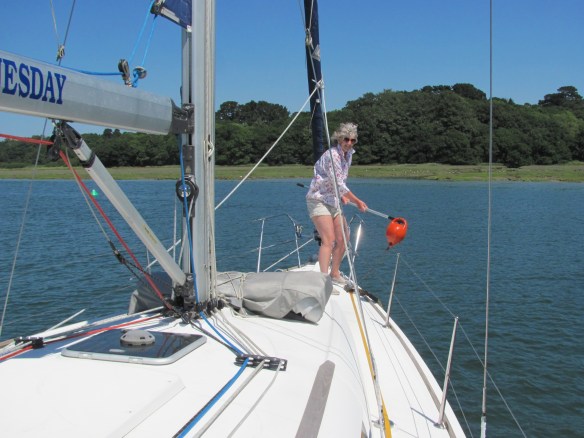
Finding an unused buoy on the Beaulieu River to tie up to.

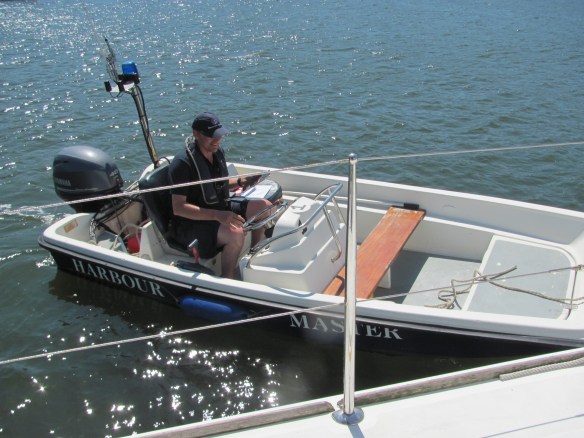
Later in the afternoon, the harbourmaster comes past in his little dory and we are asked to pay for the use of the mooring. He even has a card terminal for credit cards! We don’t mind paying something, but we think the prices asked are a little steep for just a mooring and no amenities or shore access. Still, it is a beautiful place to stay the night so we cough up. We guess the Duke of Beaulieu has to meet his expenses somehow.

The harbourmaster comes to collect his dues, Beaulieu River.

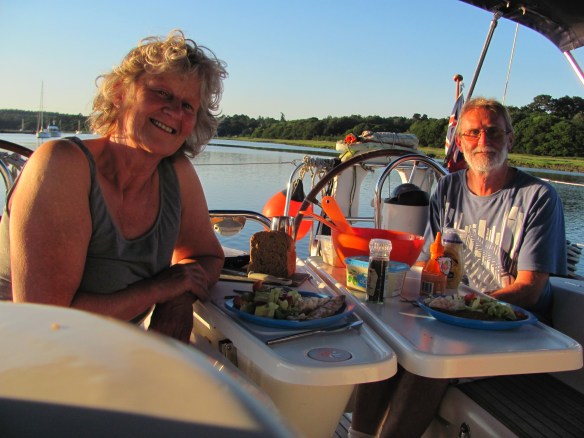
In the evening, we sit and have our dinner outside in the cockpit watching the sun go down. The water is like a mirror, and the only noise we hear is the occasional splash as a fish jumps out and the shriek of oystercatchers. In the mud flats opposite, the geese and black headed gulls have been replaced by two white egrets, a curlew, and two ducks. The geese have decided to have some evening exercise after a day of gorging, and are swimming in a line between the moored boats. Beneath the boat, we see jellyfish wafting past. Between the trees in the distance, we see two horses grazing, and wonder if they are New Forest ponies.

Dinner on the Beaulieu River.

In the morning I awake at 0500, and sit with my cup of tea on deck absorbing the peacefulness of the river. Wisps of mist rise from the smooth surface as the early morning sun begins to warm it. The curlew is on the other bank now.

‘Ba-week, ba-week, ba-weeek’, says the oystercatcher on the mudflats next to us. My Birdese is a little rusty, but I know enough to work out that she is saying what a nice morning it is. ‘Yes, it is’, I agree. She returns to probing the mud for her breakfast.

‘Skee-skee-skee’, says the black-headed gull perched on the red buoy just behind us, not wanting to be left out of the conversation. ‘Skee-skee?’. ‘We’ll probably be leaving around mid-morning’, I answer. It doesn’t seem appropriate to be more precise than that.

Black-headed gull wanting to know when we leave.

‘Cheeki-cheeki-cheeki’, contributes the egret picking his way through the rocks on the bank. ‘Thanks,’ I say. ‘I hope you have a good day too, whatever you are planning’.

It’s good to talk, BT used to tell us. I think they had a point.

Cowes

It is hot. We are sitting in a bar called ‘That 60s Place’ on the High Street in Cowes having a drink. The central feature is a split screen Volkswagen camper that apparently has come all the way from Brazil. Part of the body has been cut away to make the counter for the bar. It is original, at least. Various bits of 1960s memorabilia adorn the walls – psychedelic pictures of Beatles songs, photographs of John Lennon and Paul McCartney, an Abbey Road street name plate, a panel of vinyl 45 records. On the large flatscreen TV on the back wall, the Japan-Senegal match in the World Cup is on. Senegal are leading 2-1.

‘That 60s Place’, Cowes.

We had left Port Solent Marina in the morning, retracing our route out through Portsmouth Harbour that we had taken on the way in a few days earlier. Entering the Solent, we had raised the sails but there had been little wind to speak of. The tidal flow had been in our favour, so we had drifted along languidly, the sails giving the odd flap now and then. Relaxing, but we hadn’t been going anywhere fast.

Where’s that wind gone?

We had eventually arrived in Cowes, across the water on the Isle of Wight, and had found an alongside berth in the North Basin of Shepards Wharf marina. Over lunch, we had sat and watched the hustle and bustle of the harbour. Negotiating it is not for the faint-hearted, with boats of all shapes and sizes jostling for space. Huge ferries come and go, disgorging their passengers before taking on more. Noisy powerboats pass, their engines just ticking over to stay within the speed limit. Yachts glide past, their sails down and motors running. Strings of sailing dinghies being towed one after the other by RIBs like a mother duck and her ducklings wend their way through the melee. It’s a wonder that there are not more accidents, but somehow it seems to work. Cowes lives and breathes boating – if you have a boat, it seems you have to see and be seen here at some stage in your life.

A salad lunch, watching the world go by in Cowes.

Later we had explored the town, just two minutes’ walk from the marina. We had been a little bit disappointed, as being a Sunday most shops were closed. We contented ourselves by walking along the Parade and having an ice-cream, eventually ending up at the Royal Yacht Squadron, probably the most exclusive yacht club in the world with Queen Elizabeth as the patron. While I inspected the row of brass cannons guarding the entrance to Cowes harbour to make sure there were no specks of dust on them, the First Mate enquired of the man on the gate about membership. Surely they would have someone who had made it all the way down from Ipswich? The man on the gate had skilfully avoided the question and started on the history of the club.

Brass cannons at the Royal Yacht Squadron, Cowes.

A cheer goes up. Keisuki Honda has equalised for Japan. The music in ‘That 60s Place’ is playing the Beatles’ Let it Be. We think about asking them to play Ruby Tuesday, but decide to head back to the boat for something to eat while watching the sunset.

The sun goes down over Cowes.

Job satisfaction

I sit back and survey my own handiwork with satisfaction. The autopilot is now working again, and is turning the rudder and wheels as it should do. My cup of tea tastes better than normal.

We had discovered that the autopilot helm control unit wasn’t working while testing everything at Shotley Marina just before we set off, which puzzled us as it had been working during the sea trial we had had in April. Something had made it give up the ghost in the intervening period. We had called Raymarine, the manufacturers, who had agreed to try and repair it, and if they couldn’t, then to replace it with a new unit. This seemed very reasonable to us, with the only downside being that it would take two to three weeks before we received the replacement. It had meant that we would have to start the journey with no autopilot to steer the boat on long passages, a significant inconvenience but at least not a show stopper.

No autopilot means someone has to be on the helm the whole time. It’s limiting!

At that stage, we’d had no idea where we would be, but they had agreed to email us when it was ready, take the payment, and post it to wherever we wished. It so happened they are based in Portsmouth, so now in the area, we had called them to find that they were just in the process of packing a new unit to courier to us. The only problem was that we wouldn’t receive it until next week, but realising they were only eight miles away from where we were berthed, in a flash of inspiration, we had decided to cycle there to collect it.

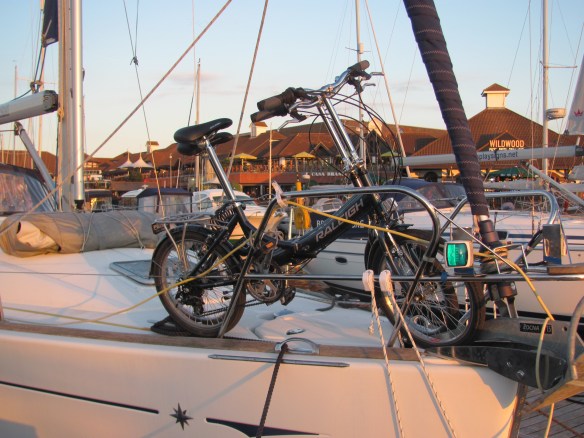
Bikes pressed into service from their temporary home.

We had cycled to Portchester, had lunch there, and had continued on to Fareham, circling around different arms of Portsmouth Harbour. Raymarine were just a bit further past there. Sure enough, the autopilot unit was ready to collect, so that we could fit it back in without delay.

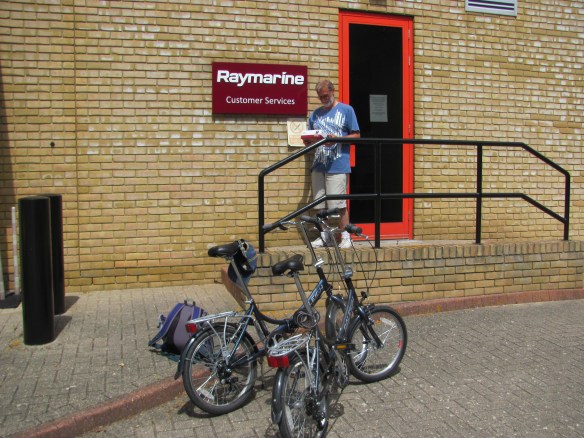
Collecting the autopilot from Raymarine.

The system works through a network connection to a central control computer located in one of the cabins below, which also provides power to the unit. The computer takes data from a fluxgate compass and combines this with the course settings from the helm unit to control actuators for the rudder. It’s all very clever, and only needs one cable to connect all the various components together. All I have to do is to plug the existing cable into the back of the replacement unit, remount it on the console next to the other instruments, and away we go. No need to even recalibrate it, as all the settings are held in the central computer. Result!

The new autopilot helm unit.

That evening, we cook a curry, and settle down to watch The Handmaid’s Tale. Ruby Tuesday has a mast head aerial, and although we usually have to retune the stations each place we go to, the reception is unexpectedly good. It’s no good travelling without one’s creature comforts!

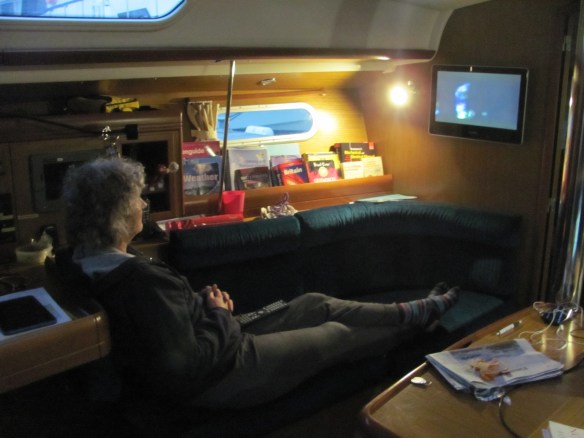
Catching up on our viewing.


Brighton to Portsmouth

The forecast for the next day had promised northerly winds, which would be offshore and on our beam, so the sailing should be good for us. The almanac has told us that the westwards tidal flow will begin at high water, which happens to be at 0600. We awake early, and slip our lines. There is plenty of water this time and we have no fears of grounding in the soft mud. Several other boats obviously have had the same idea as us and are leaving at the same time, so we join an orderly queue that reminds us of a mother duck and its ducklings until we are clear of the harbour entrance.

Then it is everyone for themselves. As the forecast had promised, there is a good stiff breeze coming from the north, so we hoist both sails, switch off the engine, and give Ruby Tuesday her head on a course towards Selsey Bill, the promontory protruding out into the sea from Sussex. Before long we are skimming along at 8 knots, helped along by the favourable tidal stream. The day is perfect, bright and sunny, only a few clouds in the sky. What more could one wish for?

Heading for Selsey Bill with fair winds.

Off to our right, the shore seems to be one continuous conurbation – Southwick, Shoreham-by-Sea, Worthing, Littlehampton, Bognor Regis – all places that I had probably driven through a long time ago, but couldn’t really remember – but today all pass by without us noticing. All that matters at that moment is the wind, the sea and the boat. It is an exhilarating feeling, that of being at one with nature, working together to move nearly 8 tonnes of mass to its destination. The wind strengthens with gusts reaching 18 knots, and we slow to reef the sails. Ruby Tuesday has a large sail area, and we are learning that it is best to reef early to avoid problems. It doesn’t make much difference to her speed, but she does heel less, which makes it more comfortable.

Just over four hours later we are passing Selsey Bill. The Bill is notorious for many a shipwreck in the past, mainly due to its treacherous reefs that dry at low water, the Mixon Rock and the Inner and Outer Owers. Between these is a channel, the Looe, which provides a safe passage from one side to the other in good conditions. We had worked out waymarks which take us through it safely, but we are still relieved to reach the intriguingly-named Boulder and Street buoys that mark the Solent end of the Looe. We have made it!

But we relax too soon – between the two buoys is another much smaller buoy marking a lobster pot below, a long yellow rope snaking just below the surface before it plunges into the depths. It is too late to avoid it, and we just pray that it won’t snag the keel, the propeller or rudder. I have visions of having to dive overboard to free it, but somehow we miss it, even though we can see it as it passes under the boat. We thank our lucky stars and breath again. Lobster pot buoys are the bane of sailors – a line wrapped around the propeller can immobilise a boat. I have mixed feelings about them – of course, they provide a livelihood for fishermen, which no one would begrudge, but the sea has many users, and the pots need to be placed where they won’t cause a danger to others. This one in particular has been placed thoughtlessly right in the middle of a busy and potentially dangerous seaway. A farmer on land after all wouldn’t graze his animals on a busy motorway.

We are starting to enter the Solent now, the acknowledged mecca for yachtspeople. There is certainly more commercial traffic, but not as many yachts as we thought there might have been. Perhaps it is because it isn’t the weekend yet. We can see an enormous containership bearing down on us, looking as if it is coming straight for us at one point, but it veers off to pass us on our port side as it follows the deep water channel for large boats.

Being overtaken by a giant container ship in the Solent.

Soon we are passing Horse Sand Fort, one of four forts constructed in the Solent in the 19th century to protect Portsmouth Harbour against a perceived threat of a French invasion. The others are No Man’s Land Fort, Spitsands Fort, and St Helens Fort. They are impressive structures, but never used for the original purpose they were intended for. Nowadays, three of them are owned by a luxury hotel chain. There is still a submarine barrier used in WW2 made of huge concrete blocks leading out from the mainland to Horse Sands Fort which we were advised well to avoid. Better safe than sorry!

Spitsands Fort, one of the four Solent Forts.

By now, there are boats of all shapes and sizes everywhere, so we put away the sails and start the engine. It seems that there is a lane for yachts just to the left of the main shipping channel, so we join the line of other boats following this. Safety in numbers, we think. At one point, particularly large bow waves from a cargo ship threaten to overturn us, but we follow the example of the boat in front of us, and turn into the waves. Even so, two or three times the bow rises right out of the water before slamming down again and sending water cascading over the foredeck. Before long, we are passing the spectacular Emirates Spinnaker Tower marking the entrance to Portsmouth Harbour, keeping a watchful eye on the numerous ferries coming and going in all directions. The hustle and bustle here contrasts strongly with the peace and quietness we have enjoyed earlier in the day.
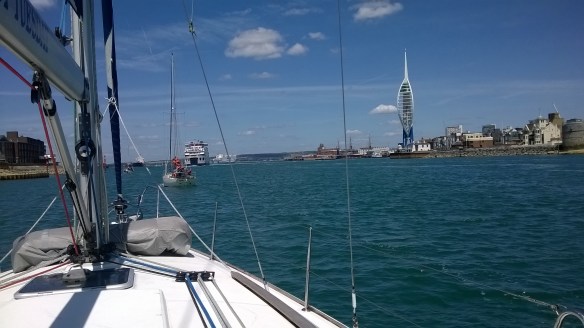
Entering Portsmouth harbour. The Emirates Spinnaker Tower is on the right.

We cruise slowly up Portsmouth Harbour heading for Port Solent Marina at the top end, passing navy aircraft carriers and Portchester Castle on the way, underlining once again the role that defence has had on the history of the area. As it was close to low water, we have to pick our way carefully through the poles marking the dredged channel, keeping the red ones to our port side and the green ones to starboard. Before long we reach the entry lock and are through into the marina. We have chosen this marina as we have been here before when looking for boats to buy and had liked it. It also happens to be close to a shop where we want to buy some sailing jackets.

Portchester Castle, near Portsmouth.

We have accumulated a large bag of washing since we have been afloat, so we take the opportunity to use the laundry facilities at Port Solent. The brilliant sunshine and gusty wind dry the clothes in no time at all, and once again we have a choice of what to wear.
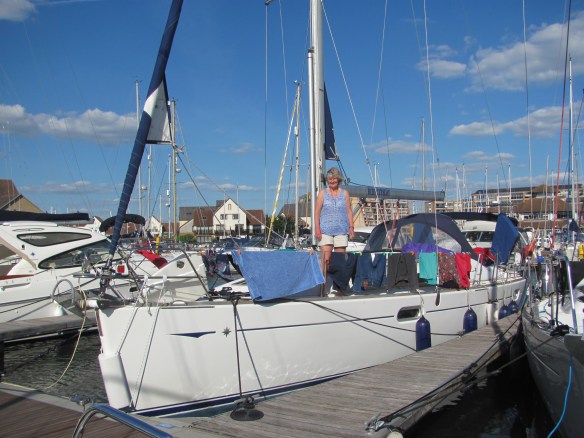
Laundry day!
Brighton rocks

‘Clip, clop, clip, clop’. The black horse comes down the track, flaring its nostrils and throwing its head from side to side. The small boy stands rooted in terror as it comes closer. He tries to run, but his feet are glued to the ground and his legs won’t move.

I wake up in a sweat from the recurring dream I have had since childhood. I lie for a few moments and realise that the sound of the hooves hasn’t stopped, but it is not the dream. Someone is tapping at the window. I struggle out of bed and into some clothes, and poke my head out of the companionway. One of the marina staff is there and asks us if we could please shift as the navy are coming and they need that berth. We are slightly miffed as we had made quite an effort to edge carefully into the narrow space the night before, and feel that we have earned our place there. Moreover, we like it – it is conveniently close to the washing facilities and marina office. However, we can’t stand in the way of matters of the Defence of the Realm, so we untie our lines and reverse away from the pontoon. At least the boat that was behind has already gone, so we have more space to manoeuvre.

The navy arrives and we have to move.

The only problem is that, in the haste no one, not us, nor the marina staff, have remembered that it is just on low water, and just as we try and enter the alley for our new berth, we come to a firm stop, the keel embedded in the mud at the bottom. We give it considerable reverse throttle and manage to extricate ourselves into deeper water again amid the muddy cloud we have stirred up. We look around in embarrassment, but no one seems to have noticed except a marina staff member, who asks us to tie up temporarily to the end of a pontoon, but again we find ourselves unable to get there. In the end, we decide to raft up to another boat already tied to the end of a pontoon in deeper water. At least we are now stationary and aren’t drifting around the marina causing all sorts of damage. I notice that the name of the boat we are tied to is called Rolling Stone, so it seems very appropriate that Ruby Tuesday is alongside her. Who doesn’t believe in fate? We find out later that she did in fact originally belong to a roadie with the real Rolling Stones and is also made of ferro-cement, hence the stone connection.

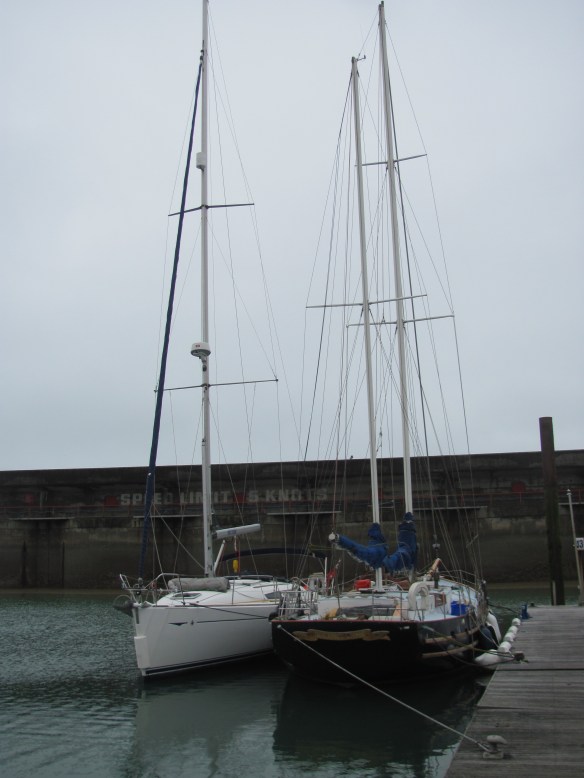
Ruby Tuesday and Rolling Stone rafted up together.

The navy now catered for, we decide to explore Brighton for the rest of the day. The No 7 bus takes us into the city centre where we join the multitude of school parties visiting the Royal Pavilion. This extravagance was commissioned by George IV while he was the Prince of Wales as somewhere to hold parties for his mates, and was built in stages between 1787 and 1822. Constructed in the style of an Indian Rajah’s palace, it is interesting to see what can be produced with a rampant imagination and where money is no object. With that and his dissolute lifestyle, he soon found himself with massive debts, which fortunately (for him) were underwritten by Parliament. All this at a time when they were scratching around to pay for the Napoleonic Wars. Different times and different worlds – I wonder what the reaction would be to our current Prince of Wales building extravagant palaces during times of austerity, then having taxpayers pay for it? At least it is now publicly owned and the rest of us can enjoy it.

The Royal Pavilion, Brighton.

We find ourselves on the Palace Pier. Iconic, yet a monument somehow to the human desire for entertainment to distract us from the realities of our lives. We amble to the end, past the various amusements along the way. A party of French students chatter noisily as they eat their chips, or pommes frites. Below on the pebbly beach, some hardy bathers splash in the surf. In the distance we see a lone head bobbing up and down in the waves, a more adventurous swimmer heading for one of the buoys; we hope he makes it (why do we assume it is a ‘he’?). I think of Graham Greene’s Brighton Rock, a book we read at high school, and try to imagine Pinkie Brown and Rose on this self-same pier – Pinkie, the amoral Catholic sociopath, plotting the death of Fred Hale and Rose’s suicide, finally killing Hale here, and eventually dying himself at the end of the book. The superficial entertainment around us seems discordant with, and yet somehow complements, this darker side of human nature.

The Palace Pier, Brighton.

We retrace our steps and come across the Lanes, an area of narrow pedestrianised streets full of quirky shops reminiscent of those we saw in Hastings, although here they seem to be less touristy and catering more for the alternative lifestylers that make their homes here in Brighton. We find shops for ‘vegetarian shoes’, native American bric-a-brac, and second-hand clothes. A cloth-capped artist stands on a street corner with his easel painting a street scene. We like it – it contrasts with the opulence and cheesiness of the Pavilion and Pier that we have just seen.

Two Feathers shop in the Lanes, Brighton.

Street artist, the Lanes, Brighton.

On the way back to the boat, we meet another couple, Dominic and Birgitta, who, it turns out are also sailing westwards and up to Scotland over a similar time period. We have a coffee with them, swap stories, and agree to keep in touch with each other on our voyages.

Eastbourne to Brighton

We feel as if we have ‘done’ Eastbourne and its environs now, and are just waiting for the winds to die down so that we can push on. The north-easterlies that we had for much of May and early June due to the large anticyclone over the UK have well gone, and we have had day after day of strong south-westerlies brought about by Atlantic depressions passing to the north of the country, which admittedly are the predominant winds for this time of year, so we shouldn’t really be surprised. We know all about them just cycling into Eastbourne along the seafront from the marina.

At last however, although the direction doesn’t change, they do die down a little, and we decide to have a go at making it to Brighton. We clear the lock out of the marina at around 1100, and try and set off into the wind. It’s difficult. The tidal stream is still against us and will be for another couple of hours, so we try tacking this way and that battling our way down to Beachy Head, but progress is slow.

Exiting Sovereign Marina, Eastbourne.

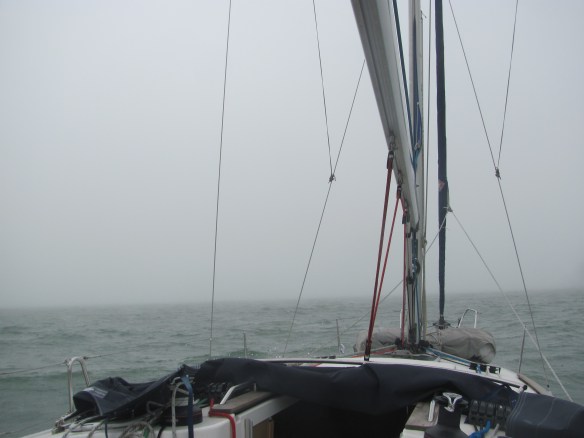
We do eventually make it to the precipitous cliffs of the Head, but just at that moment the fog comes down, and we lose sight of everything. Only our GPS and radar instruments tell us the direction we are heading, which is just as well as my natural inclination would have been to head directly onto the shore. Fog is really disorienting with nothing to see as a reference. Ethereal in one sense, dangerous in another.

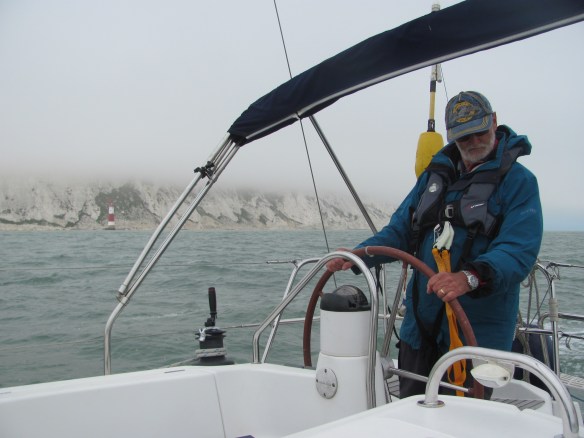
Passing Beachy Head just as the fog comes down.

We decide that discretion is the better part of valour and to motor, at least until we are out of the fog. We plough on, the visibility down to 100 m or so at times, with the waves catching us on the beam and making Ruby Tuesday pitch and wallow. From time to time on the radar we can see the shapes of other boats passing in front and to the sides of us, but we can’t see them in reality. We just hope we can trust the instruments or that none of those fast ferries sneak up on us from behind and run us down. A seagull follows us for some time, but eventually disappears. The hours pass, it’s lonely and cold, and we keep ourselves warm with cups of tea and coffee.

The fog closes in.

Then suddenly the fog thins and we see the hazy shape of the wall around Brighton marina looming in the distance. The fog thickens again, and it disappears, but we know that we are on the right track and that we are nearly there. A few minutes later, the fog lifts completely and we can see clearly the marina and Brighton town behind. We have made it!
Brighton appearing out of the fog.

We slow down to tie on the fenders and ready the mooring lines, and then negotiate the shallow entrance to the harbour. The whole harbour is constantly being silted up, and it is a constant battle against nature to dredge it to provide enough depth for keel boats to come and go. As it is, we have been told not to try and enter it between two hours before and two hours after low water.

Another boat suddenly appears out of the fog and follows us in. We call the marina office and are allocated a berth in the visitors’ section. It is a linear berth between two boats already there, and there is not much space between the one behind and the one in front, but with luck more than good management, we somehow manage to wedge ourselves in with a few inches to spare at each end. It’s beer time!

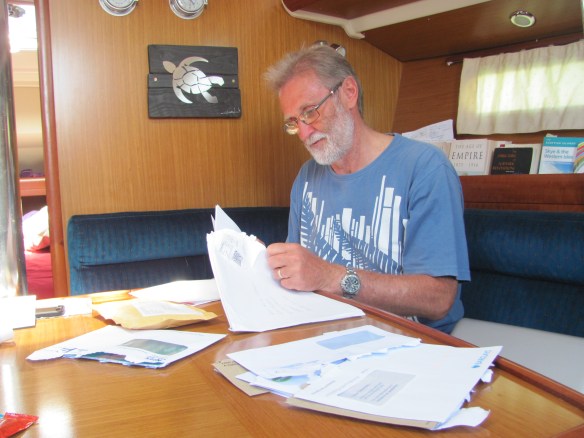
We have arranged to have our mail forwarded to the marina, and after a few palpitations due to them saying they have not received anything for Ruby Tuesday, a bulky envelope is found under the desk, and we spend the rest of the evening reading what we have been sent. We are learning to appreciate simple pleasures.

Reading our mail.