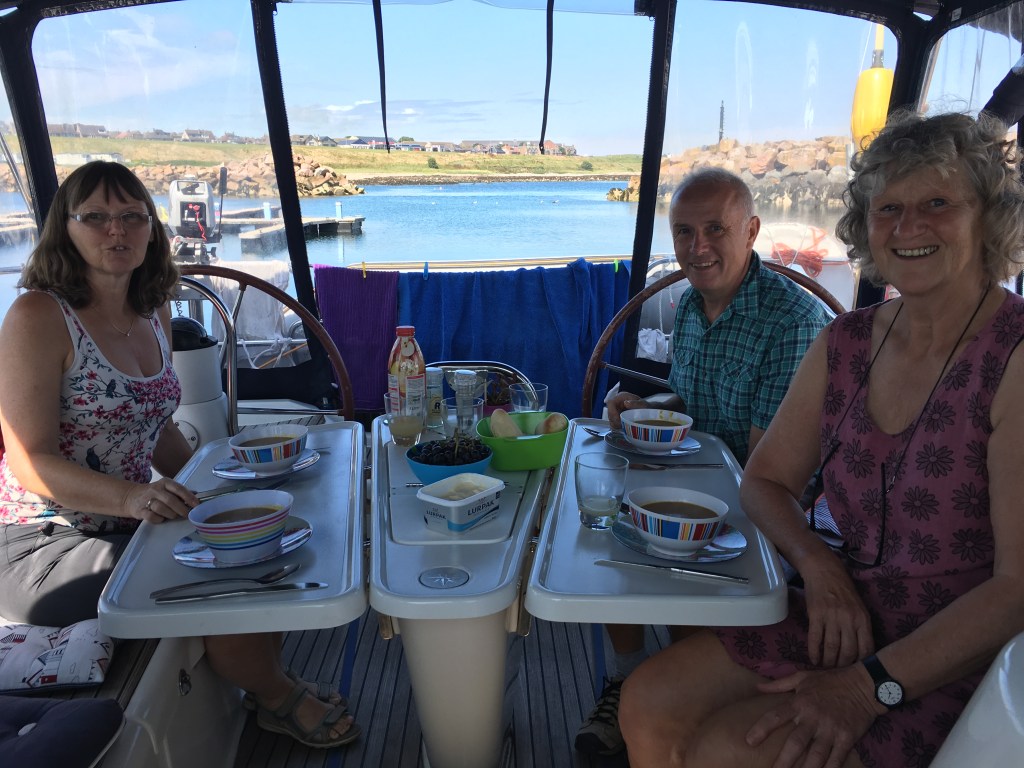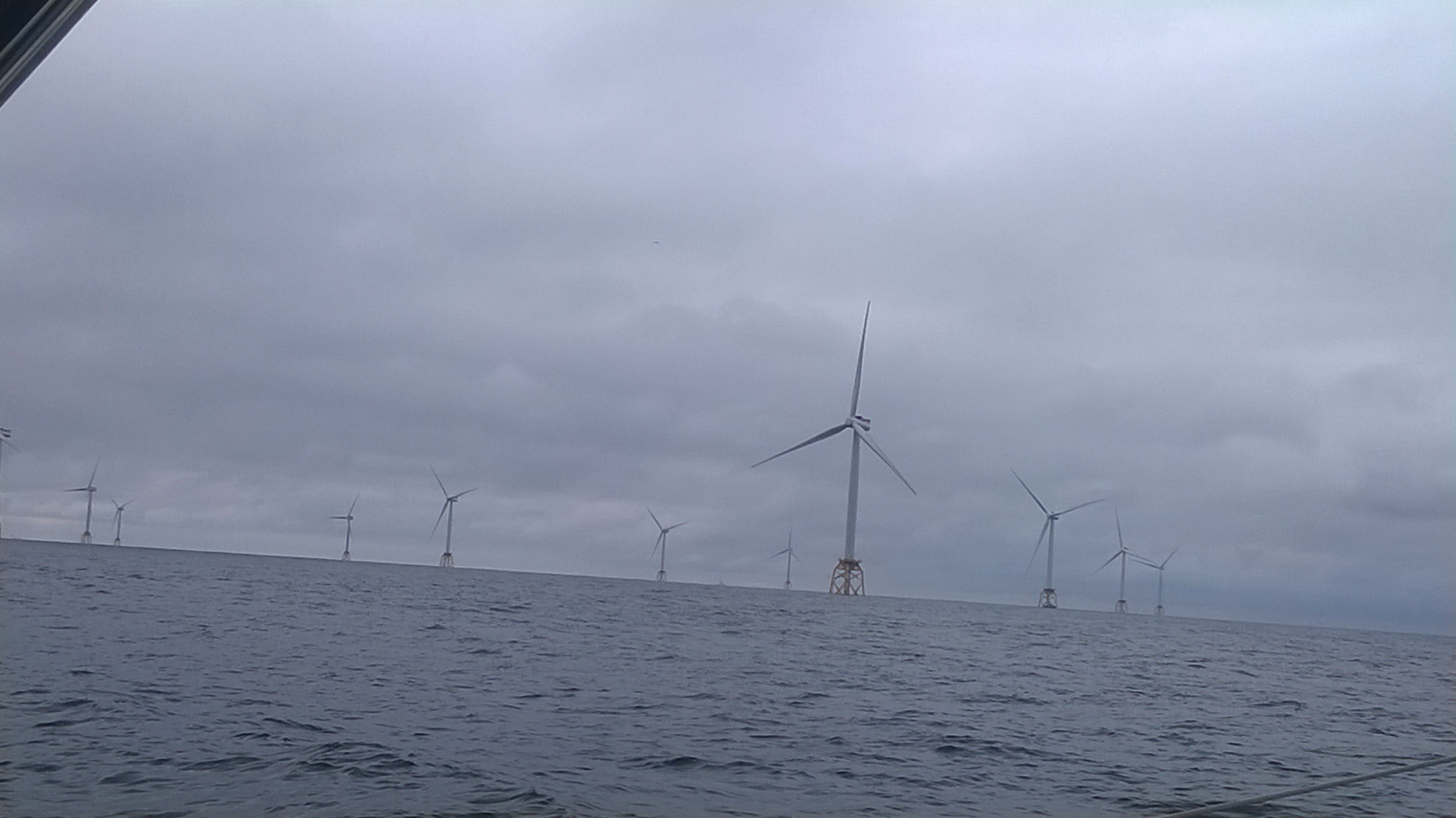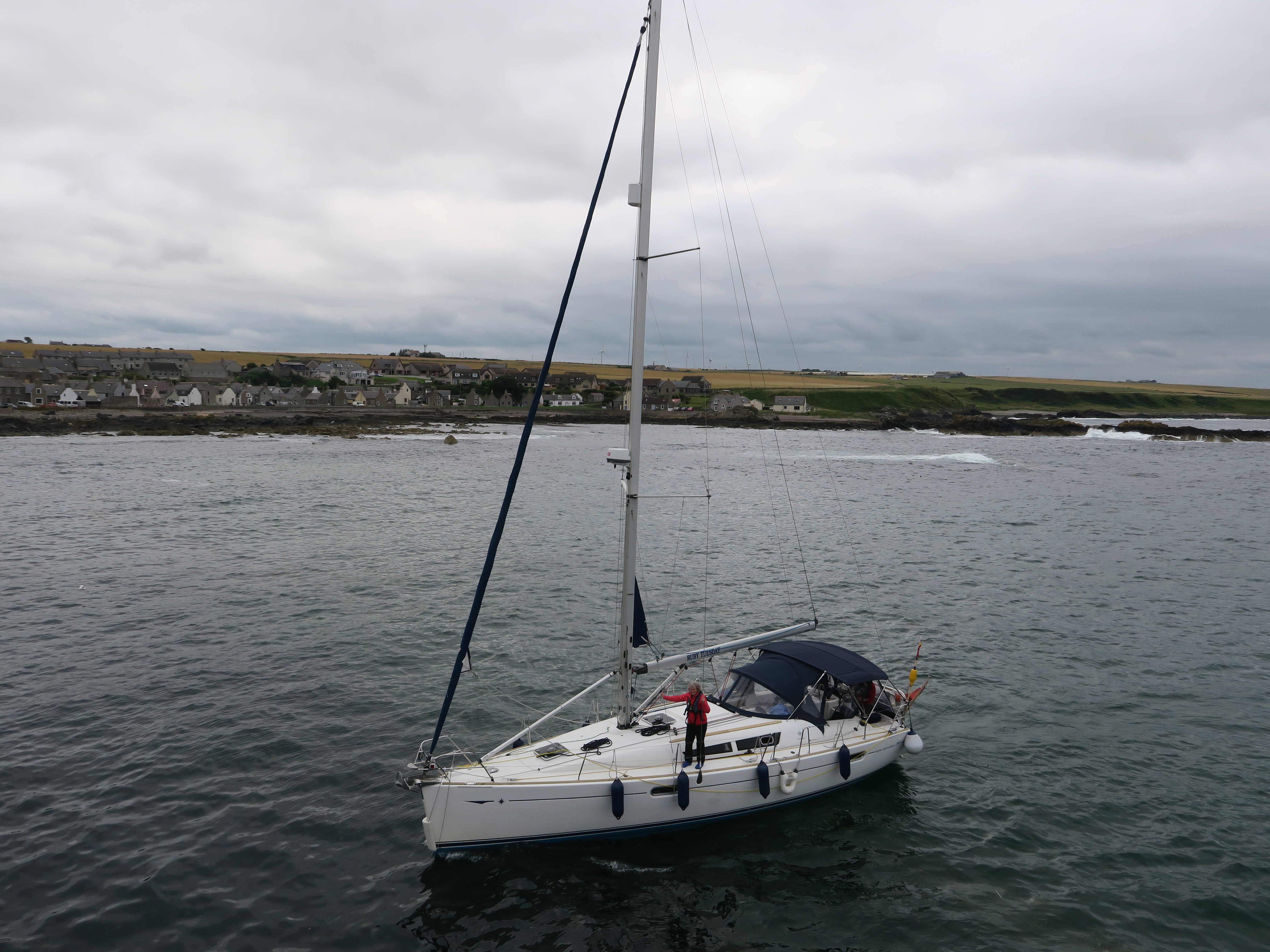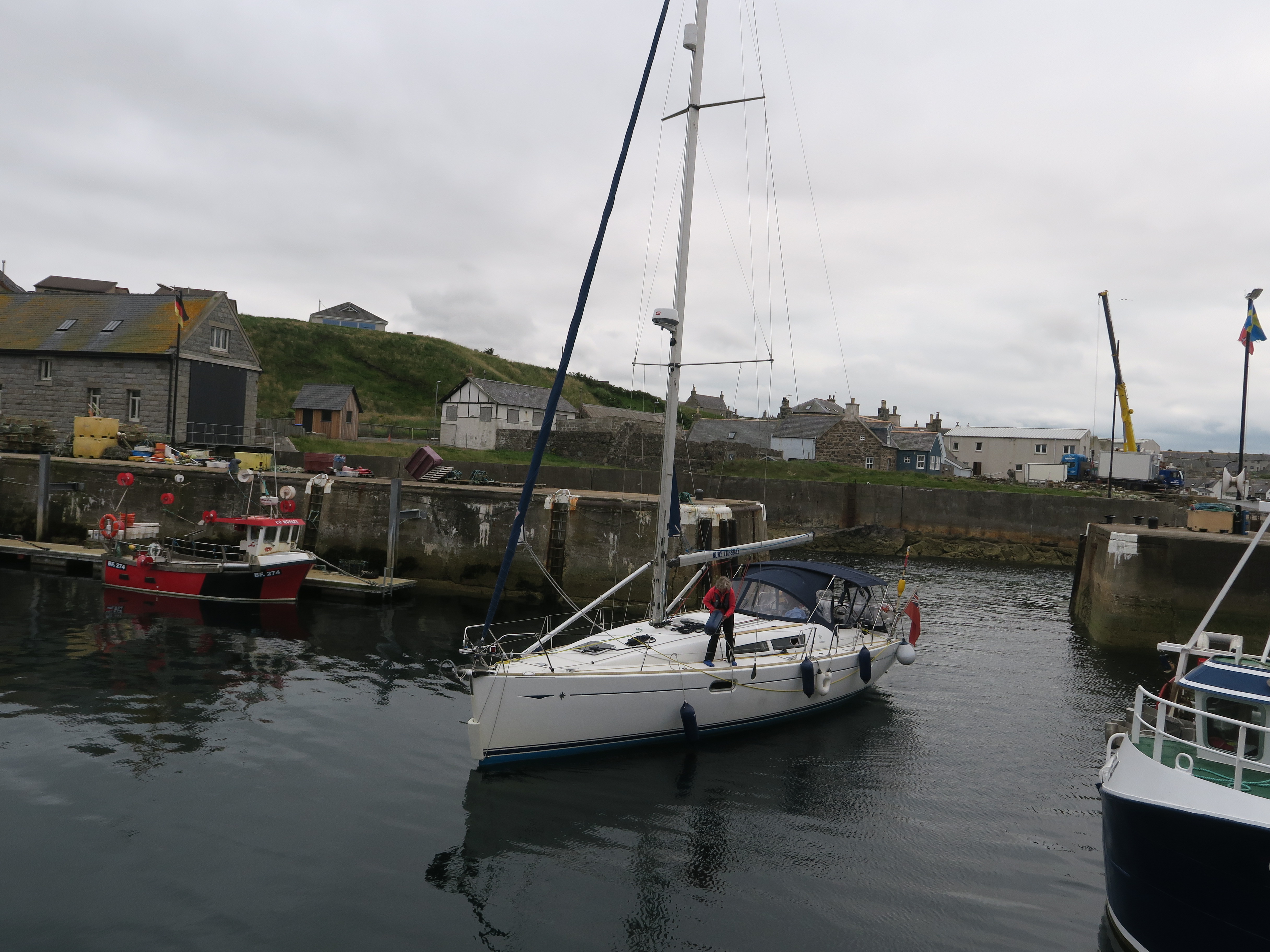
Lowestoft

The north wind blows strongly for most of the night, and neither of us sleep very well with the noise of the rigging, the lap of the waves, and the pitching and rolling. But at least the anchor holds and the alarm doesn’t go off.

Now we have to decide on what to do for the next leg of the trip. We had been keen to stay at Wells-next-the-Sea in Norfolk, as it is a convenient break in the 100 miles or so between the Humber and Lowestoft, and it is a picturesque town in its own right. A few days ago I had rung the harbourmaster at Wells-next-the-Sea.

“We were wondering about staying a couple of nights in Wells on the way sailing from the Humber to Lowestoft”, I say. “Early next week sometime. Would that be possible?”

“Of course”, she says brightly. “Visiting yachts are always welcome. What is the length and draft of your boat?”

I tell her. There is a slight pause at the other end of the line.

“Ah”, she says. “We normally only recommend boats of that draft to come in at spring tides. The entrance is too shallow at neap tides. Unfortunately it is neaps next week. Is there any chance that you could come the week after? It will be springs then, and you should have no trouble getting in then.”

It seems a little strange that a harbour can only be entered every other week, but that is how it is on the east coast – shallow, sandy harbours, often with a bar to complicate things further. It looks like we are in for a long passage to Lowestoft.

“I’ll talk about it with my First Mate”, I say. “We’ll get back to you.”

Can we get to Wells-next-the-Sea?

We discuss it over breakfast. The thought of hanging around the Humber to kill time for a week doesn’t really appeal to either of us. No disrespect to the Humber; it is just that we want to press on and complete our circumnavigation. But the First Mate is also not keen on an overnighter. However, with 100 miles to go, the logic is that we really have no choice if we want to get to Lowestoft.

“Ok, let’s do it then”, she says, resignedly. “I haven’t got any other suggestions.”

“OK, I say. “We need to leave at 1445 to get the most out of the tidal flow southwards before it turns.”

We weigh anchor at 1445 on the dot and head out from the anchorage to the buoy marking the edge of the deep water channel for the big ships. I call VTS Humber to request permission to cross the channel, which we need to do at right angles to minimise the time spent in the channel and avoid collisions.
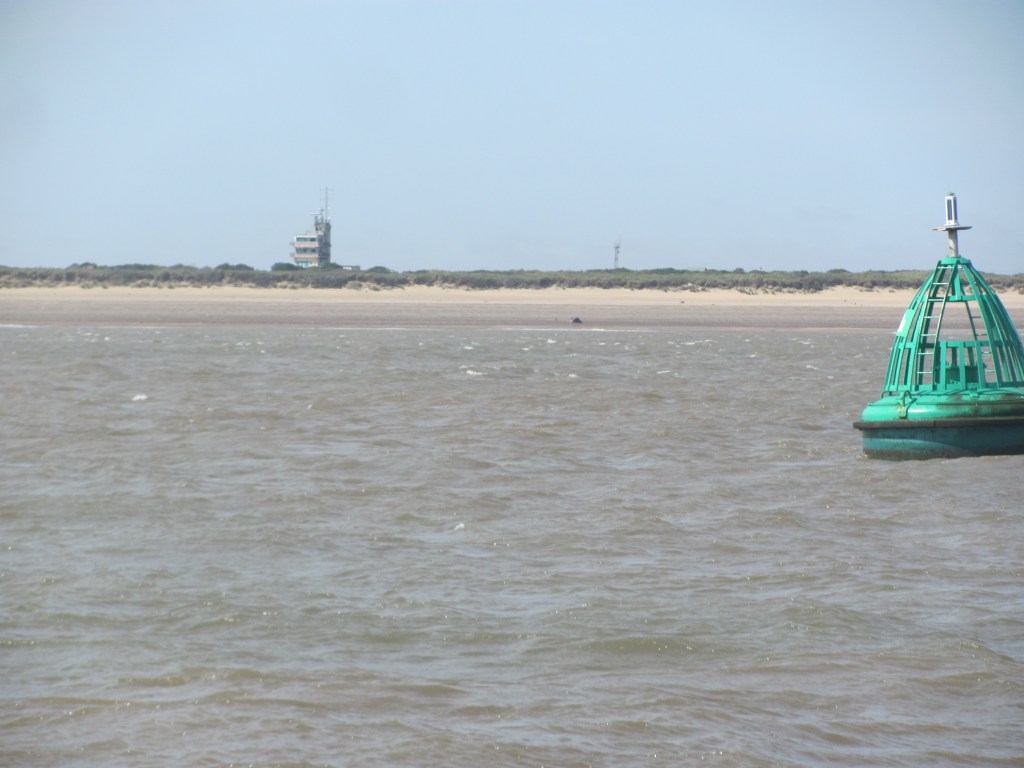
Leaving Spurn Head anchorage.

Before long, we are being swept down river by the ebb current and out into the open sea again. We follow the red port hand side buoys for a time, then set a course of 120°T for Cromer on the Norfolk coast. This will be our course for the next 10 hours.

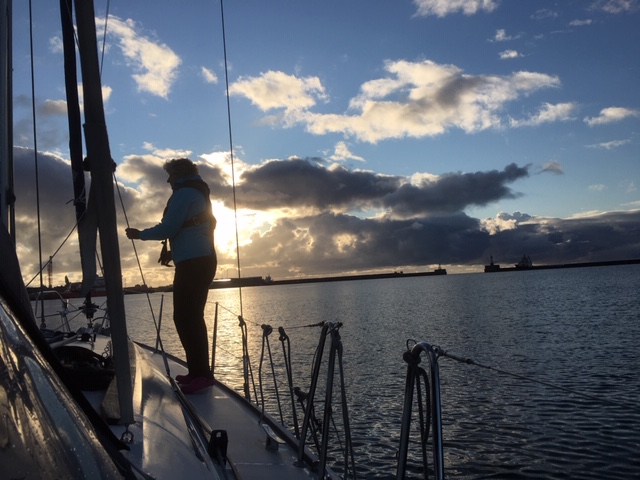
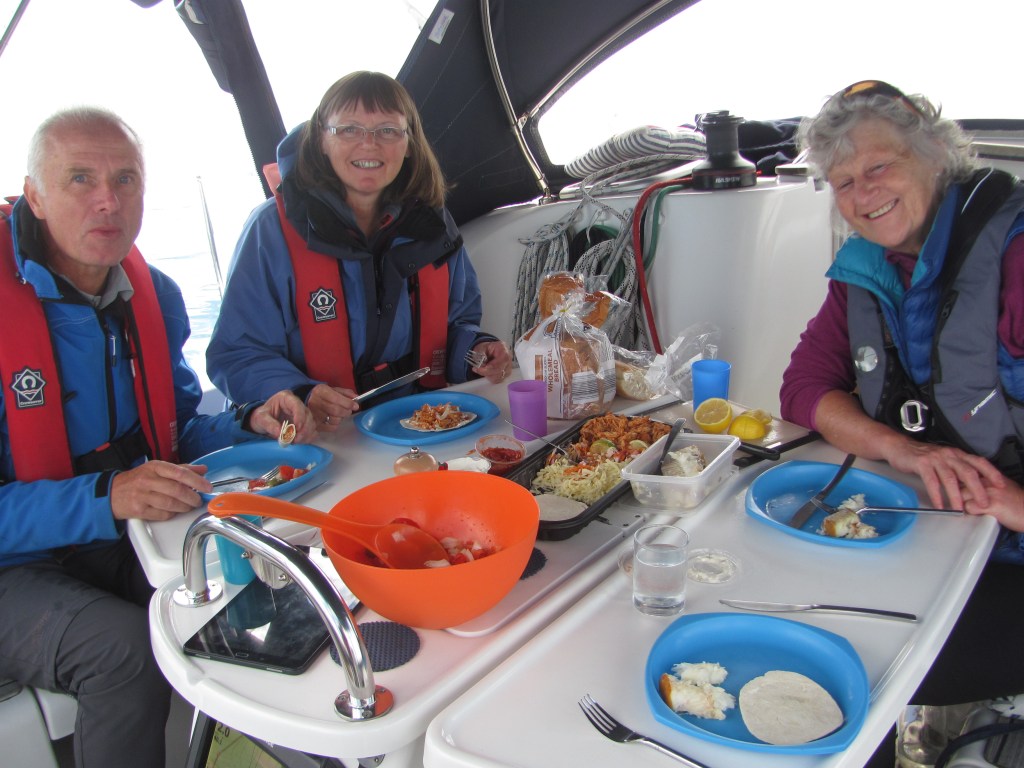
The wind is coming from the northeast on our beam and for the first six hours the tidal current is with us, taking us along at a healthy 7-8 knots. Soon we are out of sight of land. The First Mate had prepared some dinner in the morning, and all it requires now is heating up. We both sit in the cockpit watching the sun go down behind us. We are the only ones in the world. It’s beautiful.

A romantic view for dinner.

At 2100 it starts to get dark. The First Mate is feeling a bit queasy and goes downstairs to sleep. I am left alone in the cockpit and prepare for a long night. Having not slept well the previous evening, and already feeling tired, I start to wonder if I can do it. Nine whole hours to go.

Settling down for the long night.

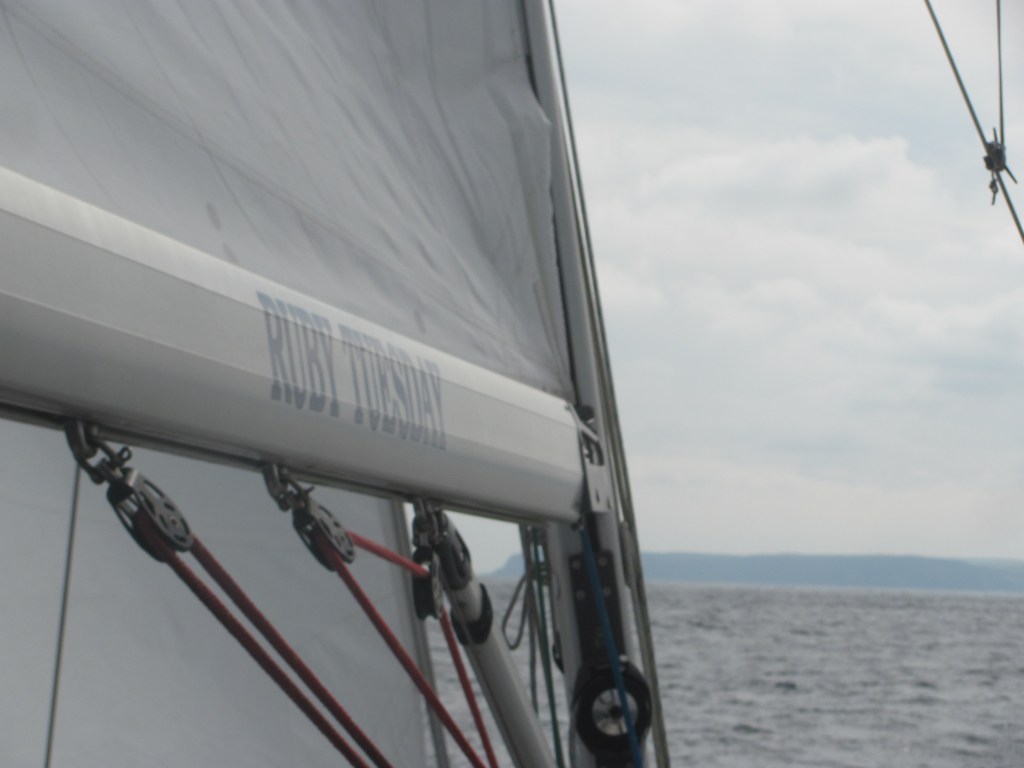
Soon it is pitch black. Ruby Tuesday continues on, plunging through the waves, her sails full. Only the faint glow from the instruments illuminates my little world. I feel a strange mixture of fear, comfort and elation – fear of the unknown of what is out there in the darkness, comfort that Ruby Tuesday will look after us no matter what, and elation that we are going to make it.

At first, I keep myself busy with making minor adjustments to the sails, filling out the logbook every hour, watching our progress on the chart-plotter, drinking cups of tea from the flask that I had prepared earlier. By the light of the torch, I even get a few pages of Dracula read. But then the tiredness comes.

Keeping an eye on our route through the darkness.

Suddenly, I hear a voice. I look up and see Spencer the Spider scowling at me from the cockpit frame. I haven’t seen him for a couple of days. There are three flies now in his web; at least he is keeping his side of the bargain.

“Are you still here?”, I say, trying to keep the grumpiness out of my voice.

“Of course. Where did you think I would be?”, he replies, equally tetchy. It seems he is suffering from lack of sleep too. “Would you rather I wasn’t?” There is an edge to his voice.

“No, no, nothing like that. I am just surprised to see you, that’s all”, I respond. “Anyway, why did you come aboard in the first place? Life must be a bit easier for you on land.”

“Easier in one way”, he says, crunching a leg of one of the flies. “But I got fed up with my fellow spiders all wanting to do the same thing day in day out – just wanting to go around and round on those merry-go-rounds at Scarborough Fair, not trying to do anything different. With all the rubbish around, flies were aplenty and easy to catch, no challenge at all. Spiderdom is in danger of becoming decadent, of losing its soul. I want to get away from all that – do something different and develop my potential. And when I saw your boat down in the harbour, I thought that this was my opportunity. At night I smuggled myself aboard.”

“I have to say that I almost gave up last night”, he continues. “It was so windy and rough, and I threw up a couple of times before my stomach settled down.”

I push the thought of spider vomit somewhere on our new cockpit tent to the back of my mind.

“But I am not going to give up”, he says. “When we were growing up, our mother always told us the story of one of our ancestors who was in a cave somewhere. The walls of the cave were slimy and the web just wouldn’t catch hold, but she just wouldn’t give up. She just kept on getting up each time and having another go. Eventually she found a good spot and the web held. And you know what happened then? Just as she finished, some geezer wearing a crown got his sword out and smashed her web to pieces.”

I remember hearing a similar story when I was growing up, but the ending seemed slightly different.

“Are you sure that is how it finishes?”, I ask. “I seem to remember a story a bit like that where the geezer in the crown took your ancestor’s efforts as an inspiration to keep on trying until you win.”

“Ah, that’s what his spin’ doctor wanted you to believe”, Spencer replies. “The real moral of the story is that if you keep on trying too much, the bastards will grind you down anyway.”

I was about to say that it all sounded a bit nihilistic and that we need positive narratives, when I hear a familiar name.

Ruby Tuesday, Ruby Tuesday”.

It takes a few seconds to filter through my state of semi-consciousness. Did I really hear that, or did I dream it? Or was it Spencer?

Ruby Tuesday, Roby Tuesday, this is ….”, says the VHF, the last words drowned out by the swish of the waves from the bow and the wind in the sails. I sit bolt upright. Someone is calling us.

I rub my eyes and look at my watch. It is 1200 midnight. Everything is dark around us. I grab the VHF mike and mumble in to it.

“Station calling Ruby Tuesday, I say. “This is Ruby Tuesday receiving. Go ahead.”

There is silence. Did I imagine it after all?

Ruby Tuesday, this is Pride of Hull”, a voice says out of the darkness. “The Hull to Rotterdam ferry. I am coming up fast behind you, and just thought I would warn you so you don’t get a shock when I pass you. We are about five miles from you at the moment, and will pass you in twelve minutes.”

Pride of Hull, can you see us?”, I say, realising as I say it that they must be able to as they wouldn’t have called otherwise.

Ruby Tuesday, yes I can see you on the AIS, on the radar, and your stern light has just come into view. You are very visible”, he says. “I’ll be passing you on your starboard side.”

Pride of Hull, thanks for letting us know”, I say, marvelling at the wonders of modern technology, and glad that I had installed an AIS transceiver over the winter to replace the receiver only that had been there previously. It is reassuring to know that big boats can see us at night. I strain my eyes through the darkness and in the distance see a glow of lights that look like a palace. It has to be the Pride of Hull. I check the chart-plotter screen and note that it is doing 25 knots. That’s fast. I wouldn’t like to be hit by that from behind in the darkness.

Ruby Tuesday, you’re welcome. Good watch. Out.”

Sure enough, in twelve minutes, the Pride of Hull passes us on our starboard about 200 m away. She is huge. I recall that we ourselves had been on the same ferry last time we had driven to Holland.
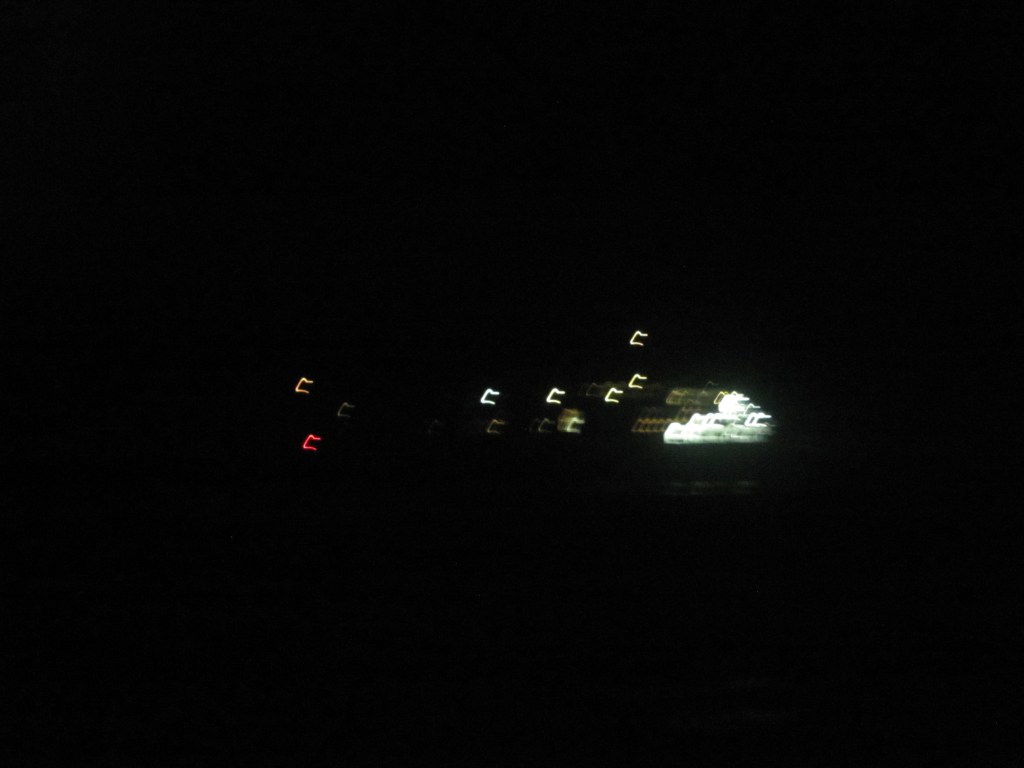
Pride of Hull ferry passing us at 25 knots around midnight.

I settle back. There is no sign of Spencer. Had I dozed off and dreamt the whole thing?

At around four in the morning, the wind suddenly dies to nothing. It is still dark, and I see from the chart-plotter that we are just passing Cromer. In several ways, it couldn’t occur at a worse time. The tide has turned about an hour earlier, and we are now being pushed back northwestwards in the direction that we have just come. Up until now the wind has been strong enough to overcome it. Normally, we would switch to engine and carry on, but my concern now is that we are rounding a rocky part of the coastline and there may be numerous lobster pot buoys, the ‘mines’ of the sea. Running over one of them and getting the line tangled up in the propeller would be a major disaster with no sail power and no engine power.
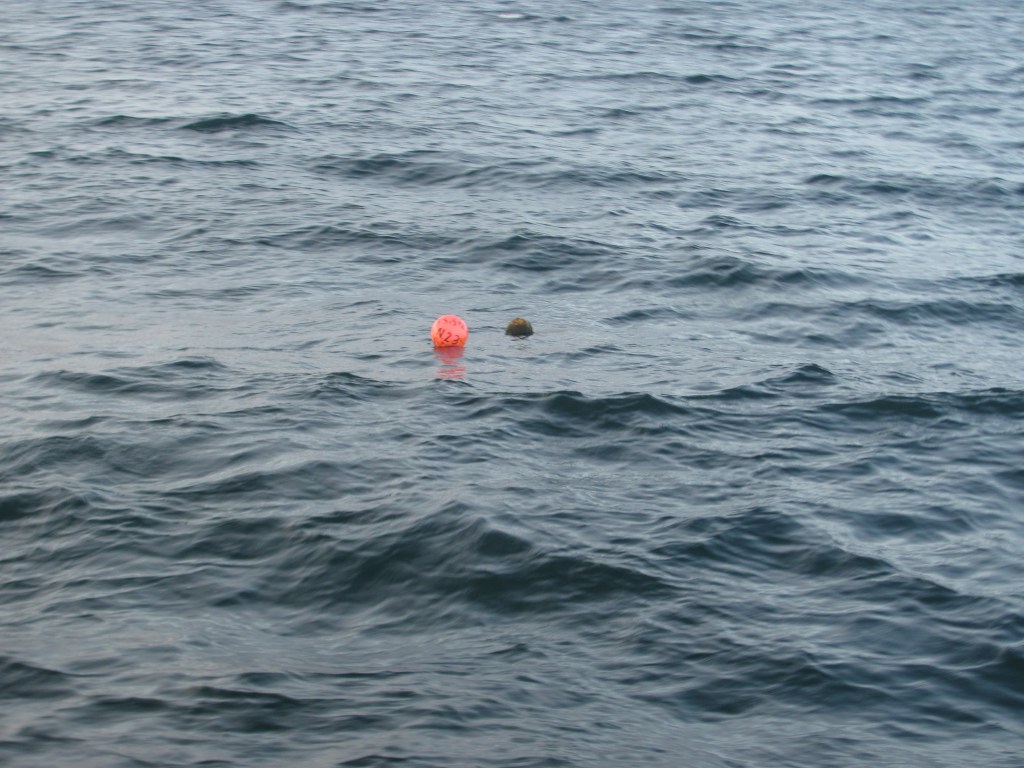
Lobster pot buoys – almost impossible to see at night.

What to do? For the moment, to gain some breathing space, I decide to furl the sails and allow the current to take us further out to sea where there may be less likelihood of buoys. It works to some extent, although we are going parallel with the coast more than out. But with no driving power, the autopilot can’t steer, and goes into a frenzy trying to turn the rudder this way and that way but to no avail. I turn it off to save power. Then to add to our woes, a ship that we had passed the night before now appears on the AIS behind us and heading directly for us. I call him to check whether he has seen us. He responds quickly to reassure us that he has. One less thing to worry about at least.

I estimate that it might start getting light in about half an hour, so if we can hang on until then, it will be possible to see any lurking buoys. Sure enough at 0445 it starts to lighten slowly as the new day breaks, so I start the engine and motor gingerly ahead keeping my eyes peeled for any buoys. I don’t see any, but I am not sure if that is because there are none there, or because I am missing them. Woken by the sound of the engine, the First Mate joins me, and together we look out.

Eventually we turn south and for some reason the wind starts blowing again. We make reasonable progress down the Norfolk coast, passing the quaintly named little villages of Overstrand, Mundesley, Bacton, Happisburgh, Eccles. We hear later that just the previous evening at Happisburgh a woman had drowned trying to save her children from being swept away. A tragedy.

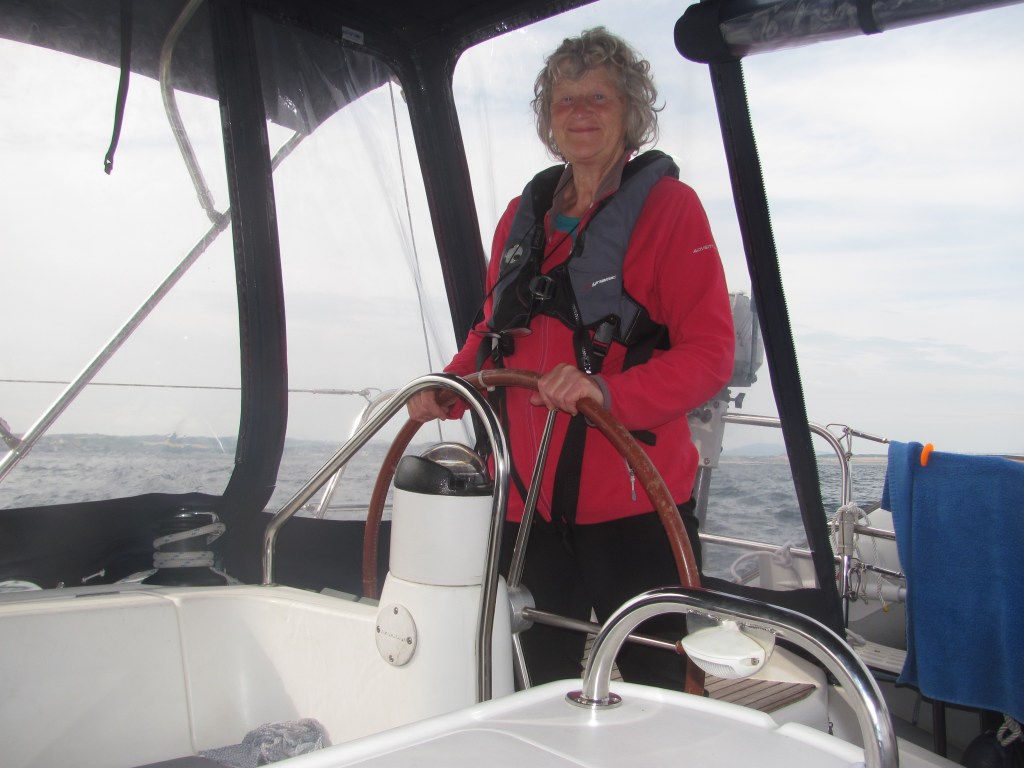
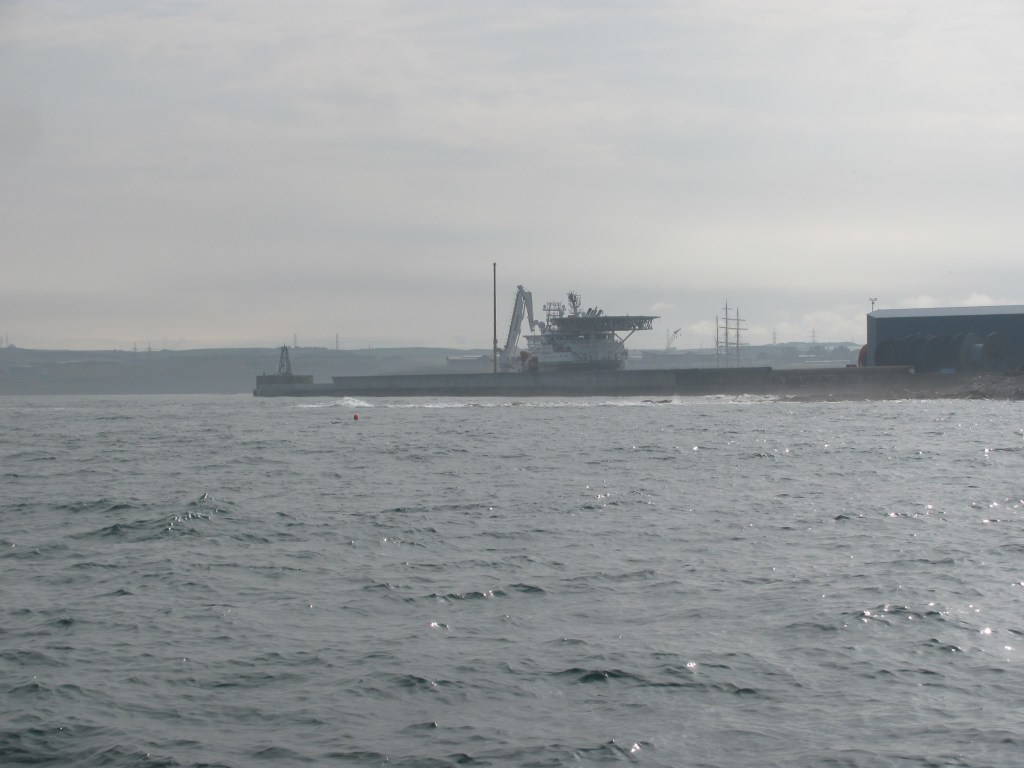
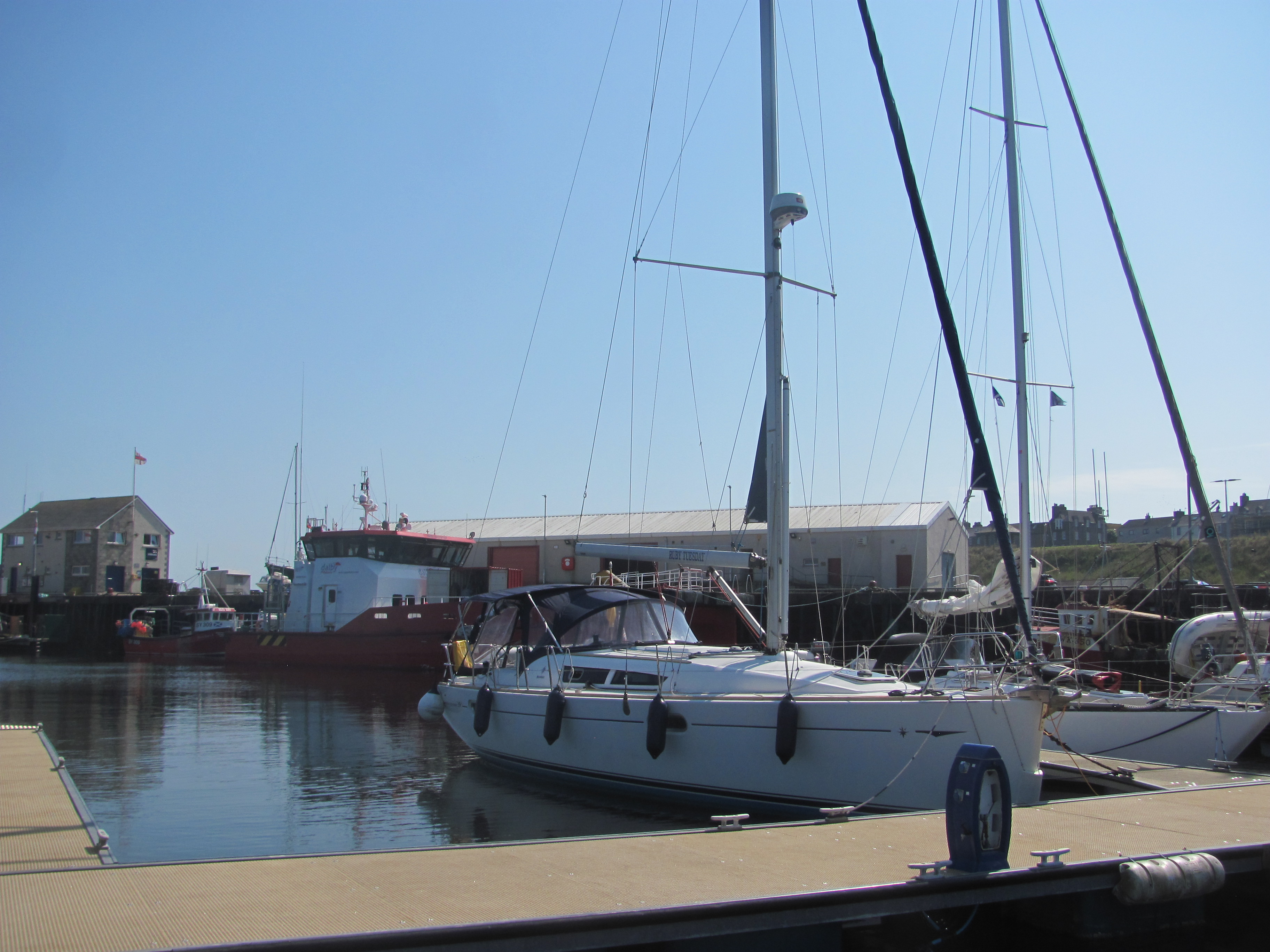
On a comfortable beam reach, we pass Great Yarmouth and arrive in Lowestoft at lunchtime. We motor slowly in through the harbour entrance and turn left into the Royal Norfolk and Suffolk Yacht Club with its iconic clubhouse.

Arriving at the Royal Norfolk and Suffolk Yacht Club (RNSYC).

With nearly two nights now without sleep, I am exhausted and crash out for a nap while the First Mate gets to grips with where we are. Ever one for a bargain, she books us in for dinner at the clubhouse, which just happens to be participating in the ‘Eat Out and Help Out’ scheme. We’ll get £10 each off our dinner, paid for by the government to get the hospitality industry going again after the lockdown.

From behind her mask, the waitress tells us that the Yacht Club was established in 1859 to support boating both on the Norfolk Broads and along the coast. The clubhouse was eventually built in Lowestoft in 1886, 27 years later, but was immediately found to be too small, and replaced by the current one in 1898. One wonders why a bit more foresight wasn’t given. Then in 1998, the marina was built with lottery grant money.

We order, and the food is brought to a table in the middle of the dining room to avoid the staff getting to close to the diners. We fetch it from there ourselves.
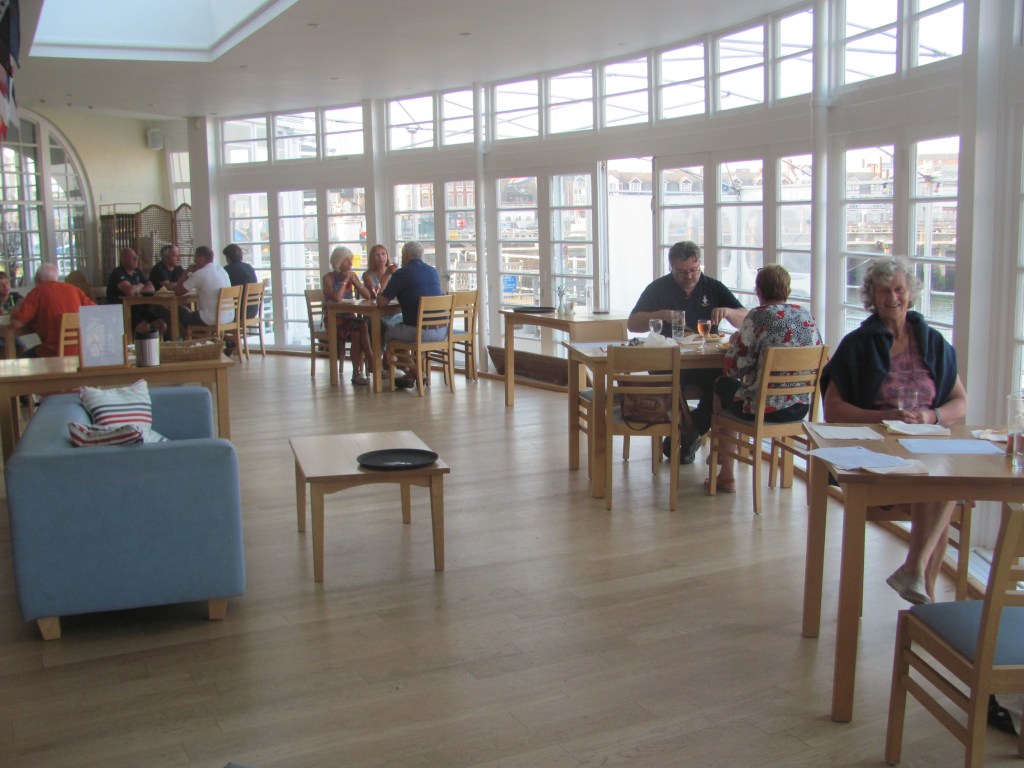
Waiting for dinner in the RNSYC.

“I have to say that I am a bit disappointed”, says the First Mate.

“Why is that?”, I ask. “The food looks pretty good to me.”

“No, I mean the Club. It is called the Royal Norfolk and Suffolk Yacht Club and I kind of expected that there might be some royalty here. But the marina is little better than a working harbour with all those survey vessels tied up here.”

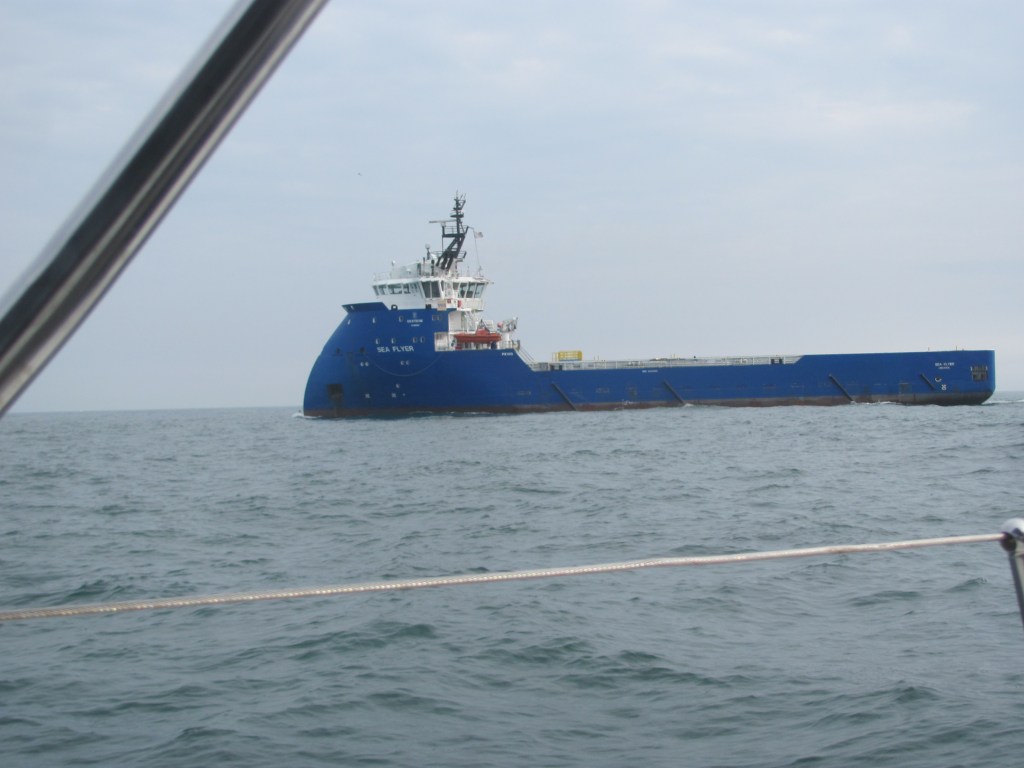
She has a point. There are a lot of survey vessels there.

“Perhaps they are just visiting to do a particular job, and will leave it to the royals again after they have finished”, I say unconvincingly. We gaze out of the window. The First Mate spies a jet skier down below.

“He’s got something about him”, she says dreamily. “I wonder if he is a prince?”

In the morning, I walk to the chandlers to get some new shackles to mend the outhaul. It is a long way from the harbour, it is hot, and I wish that we had taken the little bikes out and used them. It seems at first to be bad planning that a chandler should be such a distance from his prime customers at the marina, but all becomes clear when I arrive. They are at Oulton Broad, the take-off point for sailing and boating on the Norfolk Broads, and there are probably more boats there than at the marina. At least they have just what I need, so I buy some extra ones as spares. After lunch, I fix the outhaul mechanism. It is not particularly complicated, and seems to work perfectly, but the proof of the pudding will be in the eating.
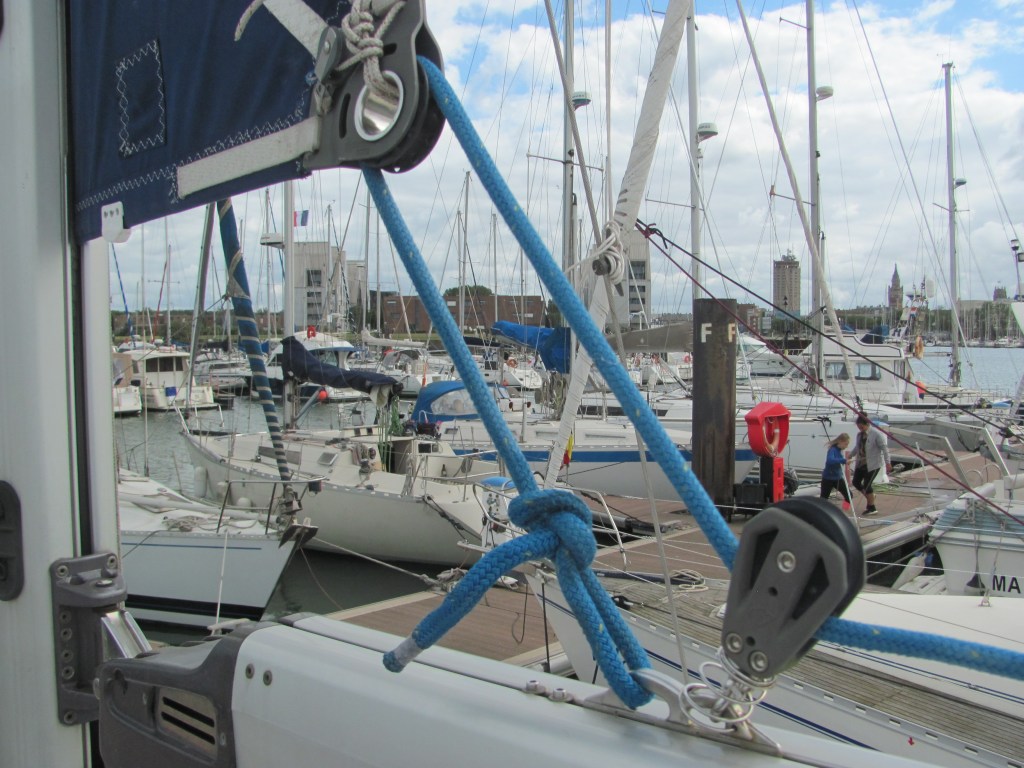
The repaired outhaul system.

Just as I finish, another boat draws up alongside and the occupants ask if they can raft up to us while they sort out a berth with the marina management. The First Mate asks them over for a drink when they are settled. The conversation inevitably drifts towards Brexit and the implications for sailing. We discover they are committed Brexiteers and take the opportunity to find out why.

“It’s the East Europeans coming over here that did it for us”, they say. “It seems that if the parents have come here to work they are allowed to register all their children for social security in the UK whether they are living here or not. So what many were doing was registering their extended family children as well and claiming for them. The authorities in Britain weren’t checking to see if they were their real children, so they were getting hundreds of pounds more in benefits. Even the East Europeans were saying they couldn’t understand why the UK government allows it. That can’t be right, can it?”
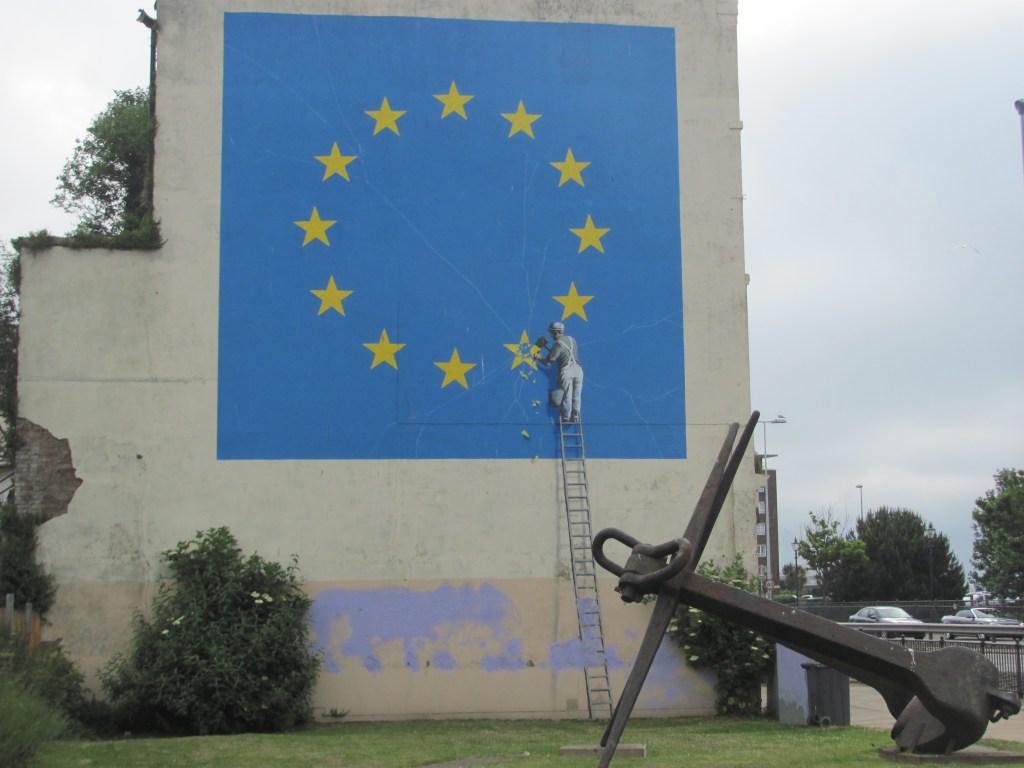
Mural in Dover.

We ask why laxity on the part of the UK government means that Britain has to leave the world’s largest trading bloc and go it alone rather than just plugging that particular loophole, but there is a reluctance to discuss anything in detail further, and we turn to the more neutral subject of the advantages and disadvantages of deep versus shallow keels. But it has given us a small insight into some of the concerns that the majority in the country have.

Scarborough and the Humber

At the best of times, I rarely sleep well when I know that I have to get up early in the morning. Today we have planned to leave at dawn when the swing bridge opens at 0530, and the cacophony of the seagulls that has gone on most of the night has added to my sleeplessness. As I lie awake, I recall a programme on the radio a few days ago about how seagulls are in serious decline, but at the moment I feel the sooner the better. Apparently our poor management of the seas and copious rubbish on land is attracting them more and more to urban areas where there is food for them. They find places to live and breed on top of buildings, get going in the day around three or four in the morning, and generally make a nuisance of themselves, at least as far as humans are concerned. Apparently it was quite difficult for them during the coronavirus lockdown as people weren’t out and about leaving their rubbish for them to feed on. Poor things, I think grumpily.

A mother seagull and her offspring in Whitby.

The alarm goes off at 0500, I get up and wake the sleeping First Mate, and make cups of tea and coffee for us both. We rig the slip lines, warm up the engine, disconnect the shore power cable, turn on all the instruments, set the GPS to record, call the Bridge Control to let them know our intentions, and do all the other little things that need to be done before we get going. I fleetingly contemplate what Captain Cook would have made of all this.

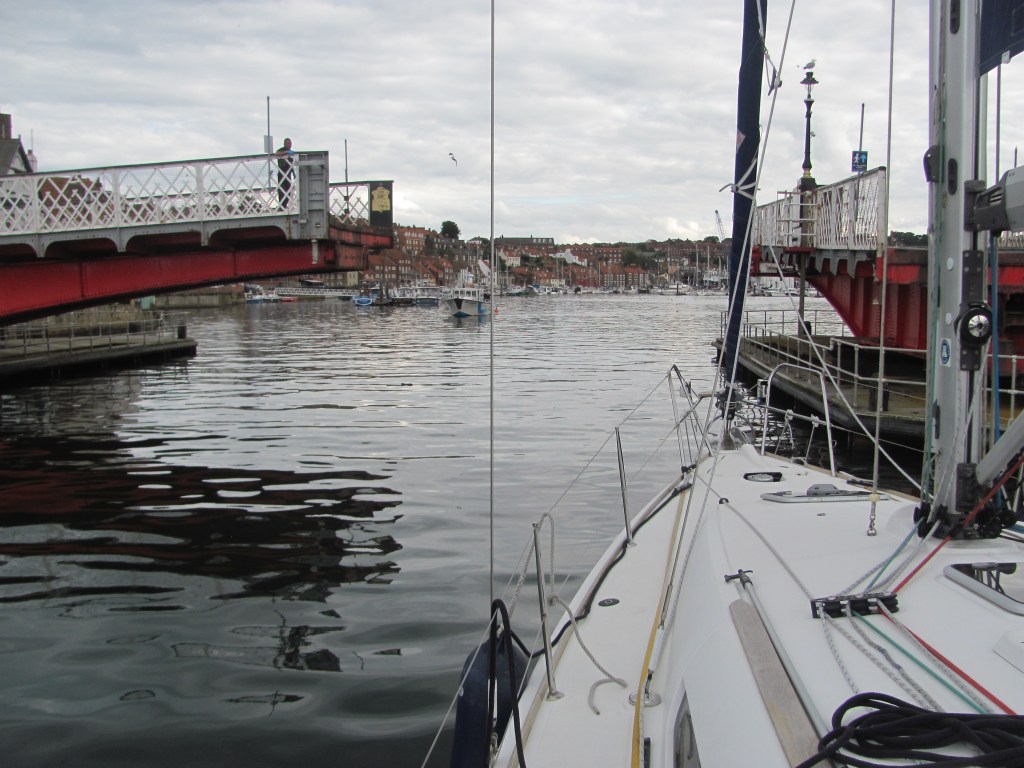
We slip the lines just before 0530 and wait in the fairway for the bridge to swing open. The First Mate takes the wheel and we glide through. As we look back at the town, the sun just rising above the horizon catches the houses and bathes their red bricks in a golden glow, the odd window catching the light full on and reflecting it with a bright flash. Somehow we liked Whitby, with its curious mix of brash modern tourism – entertainments, thronging crowds, harbour tour boats, a replica of Cook’s Endeavour, trips around the bay in tacky pirate ships – and a quieter, more reflective side – its history of the abbey, Cook and Dracula, its shipbuilding, and its quaint little lanes, nooks and crannies.

Slipping quietly out of Whitby at dawn.

We pass out through the harbour entrance and set a course south for Scarborough. The wind is variable – rising at times to a credible 10-12 knots, then dying away to almost nothing. The engine goes off and on again with monotonous regularity. “Are you going to Scarborough Fair?”, we sing raucously and out-of-tune in between. It is just as well we are out to sea and out of earshot.

Passing through the harbour entrance at Whitby.

By 1030, we are nearing Scarborough. We have been in contact with the harbourmaster by VHF and have been promised a berth in the small marina. It is a working harbour, and leisure craft such as ours jostle with fishing boats, tour boats, pirate craft and kayaks. Like Whitby, the promenade is a riot of entertainment – game arcades, funfair (it had to be here), the ubiquitous fish and chip shops, and masses of people casting social distancing to the winds.

Arriving in Scarborough harbour. Now, where is the Fair?

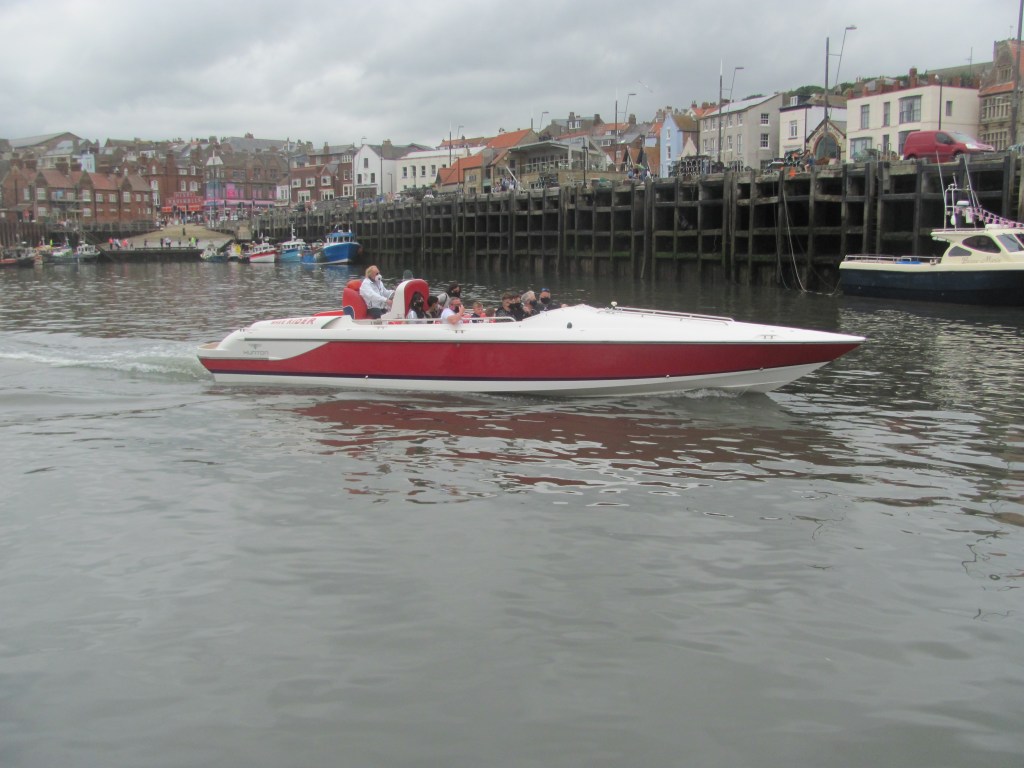
And then we see them. At least, we hear them first of all. Just as we are settling down for a nice relaxing cuppa, there is a tremendous roar outside. We rush out and spy two large speedboats with unsilenced V8 engines tying up to the slipway a few metres away from us. People are starting to line up on the slipway. It dawns on us that these two monsters are getting ready to take them on trips around the bay. With generous blips on the throttles to keep the engines from stalling, the first of the drivers loads in his passengers and sets off out of the harbour. Once past the entrance, he opens it up wide, gets up on the plane, and sets off around the bay. The air vibrates, any peace is completely destroyed, and we look at each other with disbelief. Five minutes later the procedure is repeated by the second boat. Each trip lasts nine minutes, with one minute back for change over of passengers. We are not to know it at the time, but this will carry on all day without respite until 1930 in the evening!

Rowdy speed boats taking people on bay rides.

For a few days, we have been having problems with water leaking into the bilge. The first test was to check if it was salty – if so the problem is serious as it means that seawater is somehow coming through the hull – not good news! Luckily it is not salty, so we can discount a breech of the hull, which is a relief. But where it is coming from has proved to be a puzzle. I had checked all the freshwater hoses to and from the galley sink unit, the bathroom basin and shower, the hot water cylinder, and all had seemed fine – no sign of a leak. There was too much water for condensation from the fridge, so that was also unlikely.

Water leaking into the bilge.

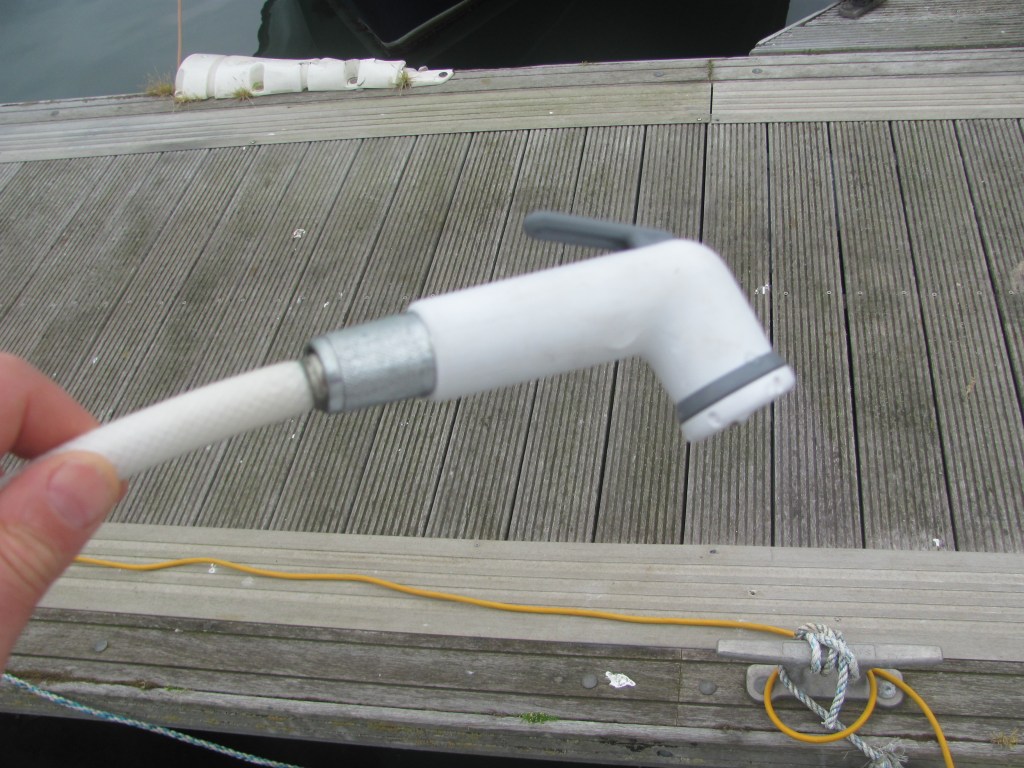
Then in the night the answer had occurred to me. The only hoses I hadn’t checked were those to the cockpit shower on the transom – in fact, I had forgotten we had one as we rarely use it. In the morning, I prise open the little hatch at the back of the rear cabin, and sure enough, there is a steady drip-drip-drip from one of the hoses. Spot on! Further tracking shows that the source of the problem is the little tap that turns the shower on and off – somehow it must have been joggled, leaving it partly on, with water reaching the shower head. In its stowed position, the water has little option but to leak into the boat rather than the sea, and eventually finds its way down into the bilge. Tap position back to off, problem solved! How easy things are when you know what is causing them.

The offending shower nozzle.

By all accounts, it is not an uncommon problem – later in the day, I tell the story to the folk on one of the neighbouring boats; they look at each other and laugh.

“We had exactly the same problem last year – it took us several days to find what was causing it. Now, whenever we find water in the bilge, that is the first thing we check”, they say.

I make a mental note to do the same. I suppose it is some kind of rite of passage for a boat owner.

“What do you think these little birds are?”, says the First Mate, changing the topic.

She is looking at a group of small chicken-sized birds with orange, black and white markings loitering on the pontoons. We had seen a similar bird on one of the pontoons in Whitby, and I had meant to look it up. Although reluctant to let us get too close, they seemed relaxed to be amongst and around humans.

A cute little turnstone.

“Terns”, say our neighbours. “That’s what we have always called them, at least.”

I am not a bird expert at all, but for some reason terns doesn’t ring quite true. The terns that I have seen previously all had forked tails and seemed to be at sea. These ones don’t and aren’t. Later I look them up in our bird book, to discover they are most likely turnstones, so named because they like to turn stones on the beach over to look for food. Our neighbours have the first syllable right at least.

We had planned to stay a couple of days in Scarborough, but can’t bring ourselves to face another day of the raucous speedboats coming and going every five minutes. Our neighbours tell us of a nice peaceful bay a little further down the coast where we can anchor and relax, so in the morning we sail down to Filey Bay and anchor there. The sandy beach in front of the town is massive, and already full of a lot of people. The day turns out to be beautiful and sunny, so we decide to stay the whole day there reading and catching up. I settle down to read my Dracula book which I had bought at a bookshop in Whitby. The First Mate starts on answering her accumulated emails.

It is then that I meet Spencer. Spencer is a spider of unknown provenance, who is in the process of weaving a web across two of the struts holding up the canopy tent. At first I am a little affronted that he has the audacity to litter up the boat with his cobwebs, but then I remember that we have had a large number of flies coming and going, both in Whitby and Scarborough, which we had assumed was due to the heat and not us or our dirty washing. So I decide that he can stay provided he earns his keep by catching flies.

Spencer seems to understand the deal, as no sooner has he finished his web across the triangle of the struts, than there is a fly struggling to escape. Spencer moves quickly across and immobilises the fly with a numbing Dracula bite to the neck, and looks at me for approval. I give him the thumbs up.

“What are you doing?”, says the First Mate, looking up from her computer.

“Just encouraging Spencer the spider to do his stuff”, I say. “Hopefully he will keep the number of flies down on the boat. Let’s leave him there for a few days. Make sure you don’t clean his web away.”

Spencer the spider looks up from his fly as if to say “Fine, you keep to your side of the bargain and I’ll keep to mine. In a day’s time you’ll notice a lot less flies, believe you me.”

In the morning, the wind has gone around to the north, now coming from behind us on our port quarter. Not only that, we are just in time to catch the south-flowing flood tide. We set the sails and have a good run down past Flamborough Head where the current strengthens further and carries us along at a cracking 8 knots.

Passing Flamborough Head.

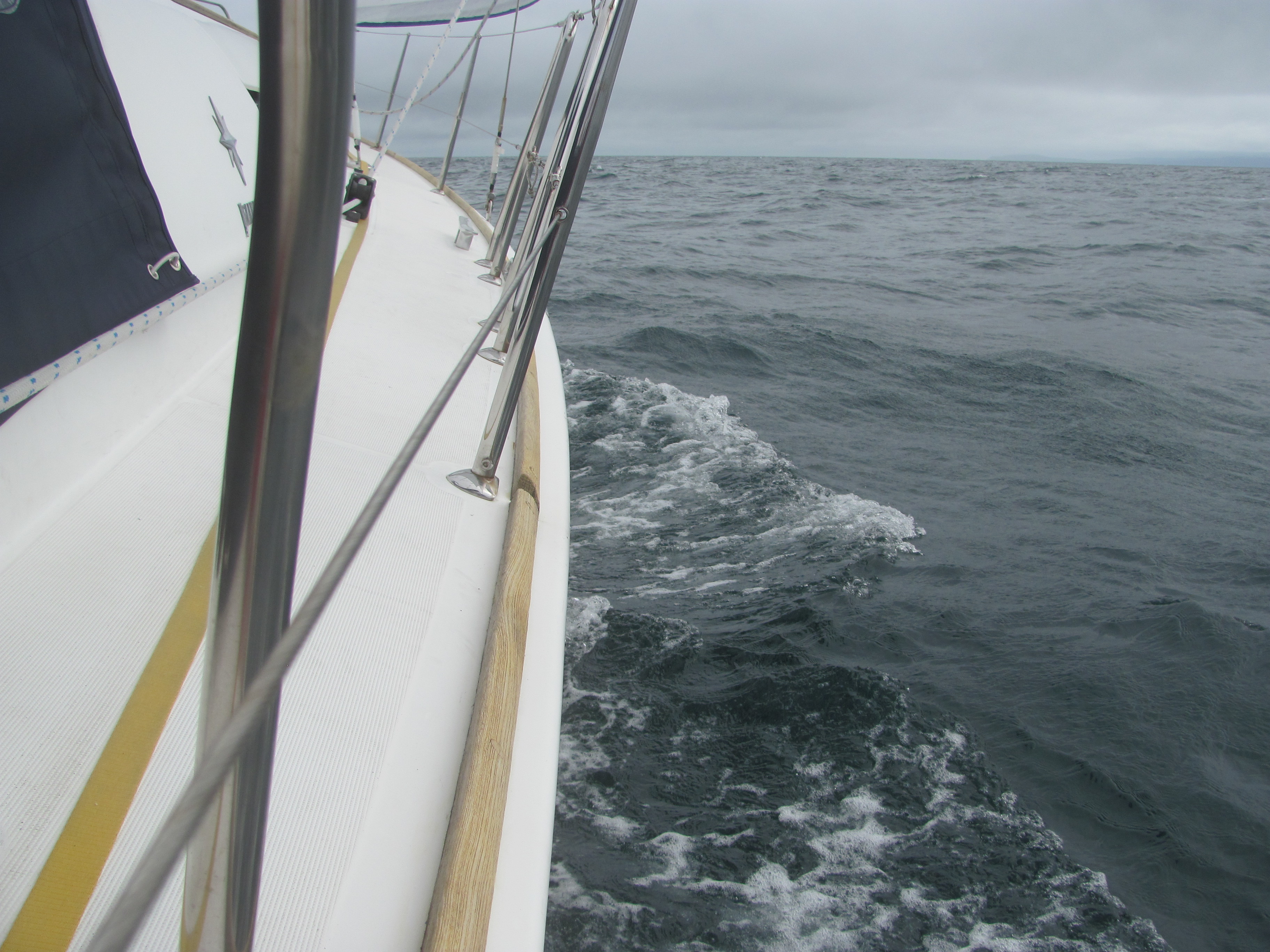
In the afternoon, the tidal current changes to the other direction so that the wind and tide are now in opposition. Such ‘wind-over-tide’ conditions usually result in quite choppy waves, and this time is no exception. As our speed slows and the going becomes much more difficult, Ruby Tuesday rears and dives into each successive wave as it comes. With the wind directly behind where we want to get to, we also have to take several long tacks to avoid any accidental gybes where the boom is blown violently from one side to the other. It’s slow going.

The tide starts to turn against the wind!

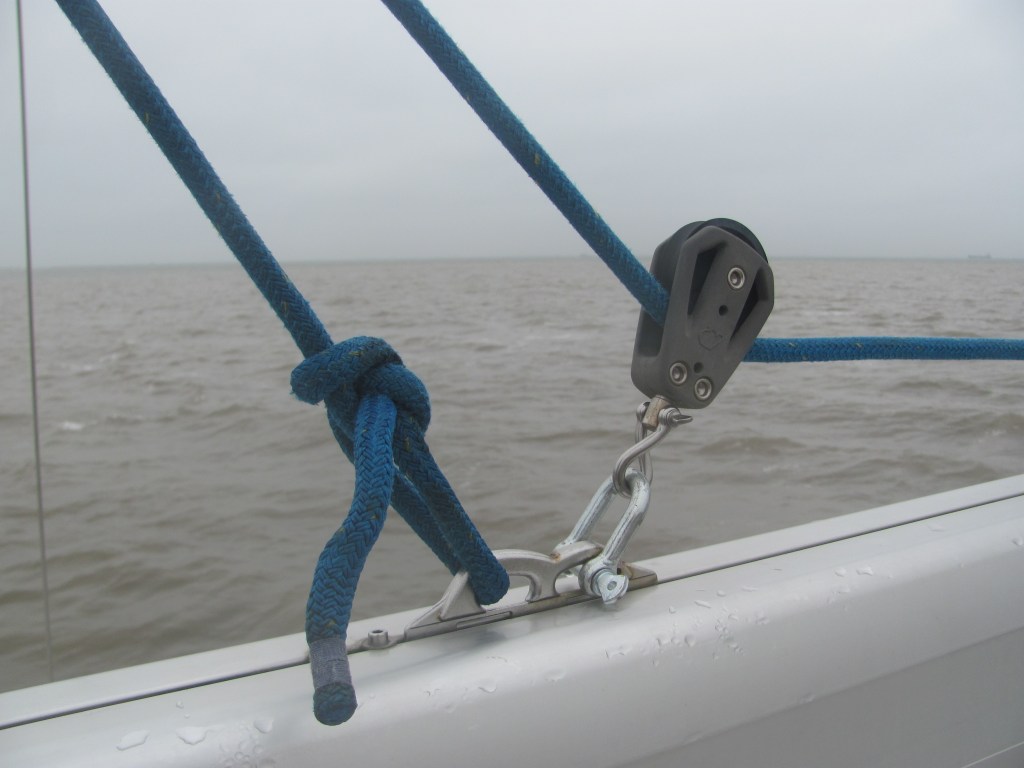
And then disaster of sorts. There is a crack and the mainsail goes slack and starts flapping in the wind. Then there is a clanging of something against the metallic boom. This is not a good time for problems. I peer over the cockpit tent to the boom and see that the outhaul block system that pulls the sail out from the mast seems to have disintegrated. One of the shackles has broken. The block itself is making the clanging sound against the boom. Luckily the outhaul line is still attached to the clew of the sail preventing it from flapping around too much. We pull the mainsail in and decide to motor the last few miles with the genoa remaining out to give some extra push against the tidal flow. The broken block system will have to wait until the evening when we have somewhere calmer to fix it.

The outhaul shackle bends and breaks.

There is mobile reception, so I phone the Humber VTS Control to ask the best route into the Humber. The voice sounds friendly, so I decide to ask him also about the anchorage on the western side of Spurn Head.

“It’s a great little anchorage”, he says. “The wind is from the north at the moment, so it should be quite sheltered. You’ll be fine.”

That all sounds reassuring, so we decide to spend the night there rather than going into Grimsby proper. It is about seven miles in and seven miles out, which will add quite a bit of time to our next passage, so anchoring at the mouth of the Humber seems like a good idea.

As we round Spurn Point, the wind seems to increase, and we see whitecaps on the waves and one yacht beating a hasty retreat. The omens are not good. And the shelter is almost non-existent – Spurn Head is a sandy spit at the mouth of the Humber, perhaps only a few metres above sea level, and we can see the north wind whistling over the scrubby vegetation and whipping the waves in the supposed anchorage into a froth.

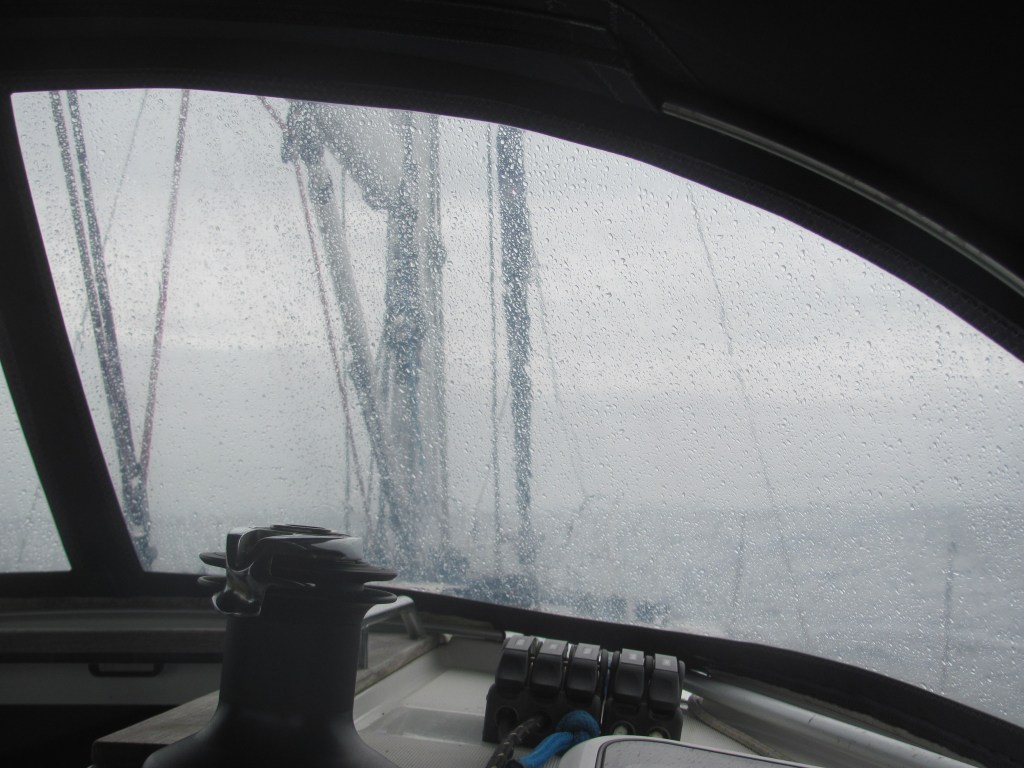
As we approach, we spy two other boats there – another yacht and the lifeboat, both heaving up and down at anchor – so decide to give it a go. At least it will be a chance to test the anchor alarm on the new AIS. We find a spot a little way from the other boats and drop the anchor and set the alarm. It seems to hold, although the boat is pitching up and down like a yo-yo. Then the mist comes down and it starts to rain. We decide we will just have to stay here and make the most of it.

Anchored behind Spurn Point with the Humber lifeboat.

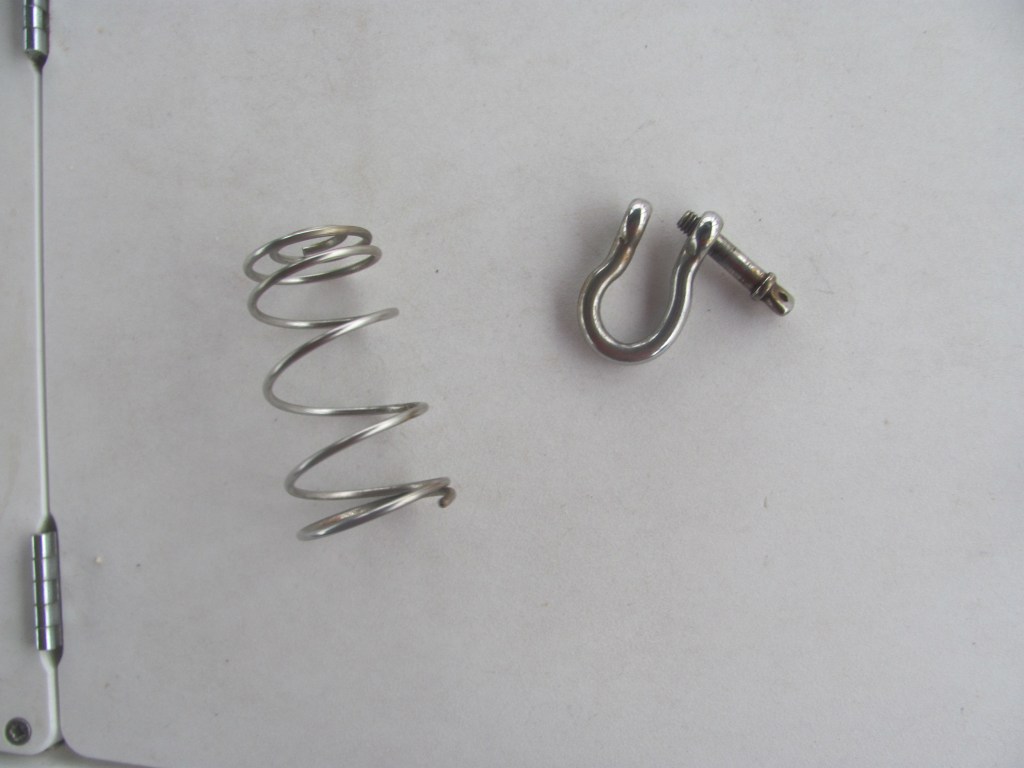
In the evening, I find a couple of spare shackles that I use to fix the outhaul block system. One is a twisted shackle used on the genoa, so I have to use another straight shackle to counteract the twist. It is not ideal as it makes the whole assembly longer than it should be, but it will have to do the trick in the meantime. I’ll buy the correct shackles at the next chandlers we come across.

A temporary fix for the outhaul block.

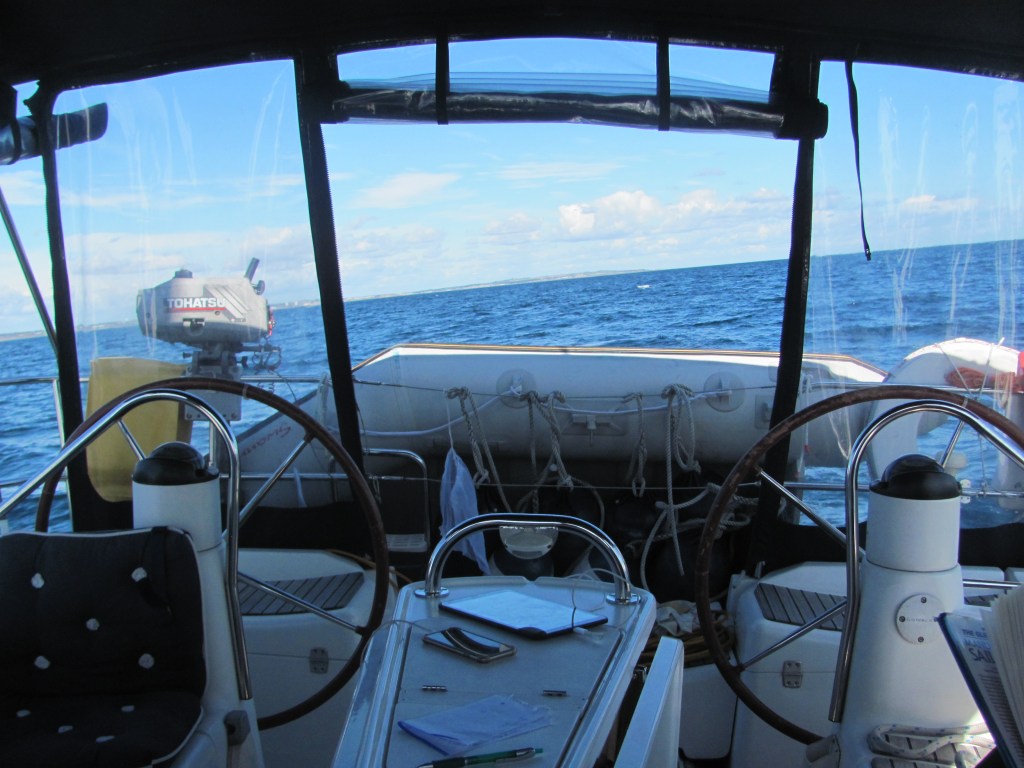
The wind is howling and the boat is pitching as I go on deck to reattach the outhaul line, so I clip myself in just in case I fall overboard. The First Mate keeps a watchful eye on me through the saloon hatch. I make it back.

Whitby

We leave Amble at around midday to catch high water. Getting out is certainly easier than getting in – there is little wind to speak of, so Ruby Tuesday goes where we point her this time. We take a north route around Coquet Island to avoid the shallows between it and the mainland, and set a course southwards.

On our way south again.

The First Mate takes the opportunity to do some exercises.

The First Mate stretching her muscles.

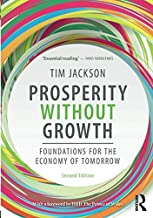
The conversations with David, the ponytailed sailor in Eyemouth, have got me thinking. The current system is not sustainable, it can’t carry on the way it is. But what to replace it with? My mind goes back to a book I was reading over the winter – Prosperity without Growth, by Tim Jackson.

Jackson makes the point that we are all familiar with, that the present western lifestyle is not sustainable, that we are consuming more and more than the finite earth can provide in the long run. We are only able to do this at the moment because of the availability of cheap energy from fossil fuels. Encouraged by advertising and fuelled by cheap debt funded by the emerging economies such as China, we convince ourselves that we need to purchase more material goods than our basic needs in order to lead fulfilled lives. We use our material goods as a way of communicating our worth in society, and are conditioned to have a constant fear of being left behind and missing out in comparison to others. The problem is that satisfaction does not increase linearly with possession of material goods – beyond a certain point it levels off. It all sounds a bit like a lose-lose situation – we consume more material goods to try and make ourselves happy, which they don’t, but by consuming so much we not only deplete the world’s resources but also pollute the natural environment.

The problem is that it is difficult for the current system to throttle back and remain static – it can either grow or collapse. Growth occurs because new ideas make the production of things more efficient, which puts people out of jobs. But new ideas lead to new products, which hopefully employs those people. It all keeps growing because people are conditioned into buying cheaper and newer products. Trying to reduce consumption would lead to less demand, less production, more unemployment, which in turn would lead to less demand, less production, more unemployment, in an ever-increasing and unstable downward spiral.

All this is hardly new, but as the solution, Jackson proposes that we shift the economy from less one of production and consumption of material goods to more one of production and consumption of care, craft and cultural services. To some extent this is what is happens to economies anyway – a gradual move from agriculture to heavy manufacturing to services. We need some material goods for prosperity, he says, but something more is needed – a sense of purpose, and a sense of belonging and trust by the community.

We are passing Hartlepool, where a lot of gas tankers are anchored in the shallow water outside the harbour, all bringing fossil fuel to feed our demand. The irony is not lost. I shelve my musings until another time as we need to concentrate on avoiding the ships coming out of the harbour. The AIS has gone into overdrive in calculating potential collisions with us even though most of the protagonists are safely behind the harbour wall – it has no way of knowing there is an obstacle in between us. We don’t mind it making a few ‘false positive’ errors -it’s the ‘false-negatives’ that keep us awake at night!

We eventually reach Whitby and enter the outer harbour. On the pier above us anglers are casting their lines. Although there is a sign saying that fishing is only permitted on the seaward side, there are several lines dropping into the water on the harbour side. We hope that none get caught on our propeller. Suddenly there is a shout and one of the fishing lines goes taut. We are caught! I wrench the gear lever into neutral, but Ruby Tuesday continues on under her own momentum. The line disappears and we don’t see it again – I suspect that it has snagged on the keel but has slipped off. At least the propeller is still working, and we see no fisherman dragged off the pier!

The entrance to Whitby harbour.

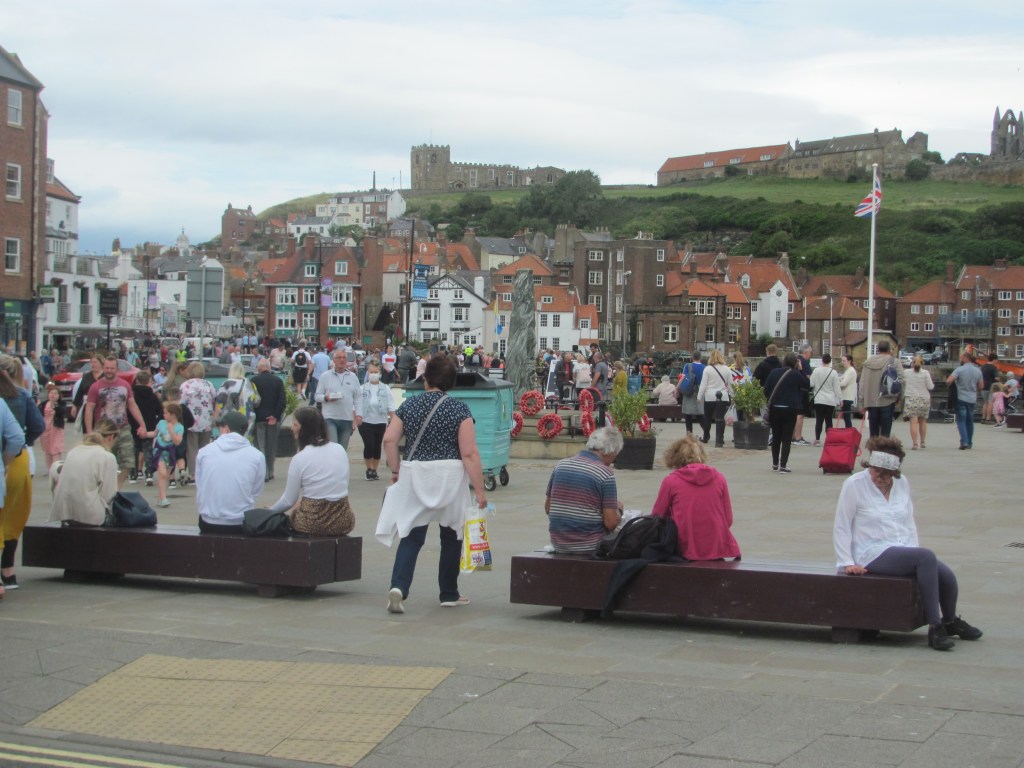
We continue up the river and come to the swing bridge which we need to pass through to get to the marina. We call the bridge control to let them know that we are there, and are told to wait for a few minutes. The street above us seems to be the main centre of activity in the town – a garish mix of game arcades, neon lights, and fish and chip shops. Crowds of people throng it – social distancing seems to be an unheard of concept. It all seems rather tawdry after a day at sea when the only noise is the swish of water as the boat cuts through the waves, or the cry of seagulls as they fly overhead.

Crowds throng in Whitby.

We hear a buzzer, traffic lights go red, the cars and pedestrians stop. One half of the bridge swings open, and we are given the go-ahead. We inch our way through the gap, only a few centimetres on each side to spare, conscious that we are the centre of attention of the waiting crowd. We had better not mess up!

Squeezing through the swing bridge at Whitby – not much room to spare!

We make it, and are directed to a berth on the end of a pontoon. It is perfect – we are in the centre of town, and yet can sit in the cockpit, enjoy the peace and quiet, and watch the world go by from a discrete distance. Who could wish for more?

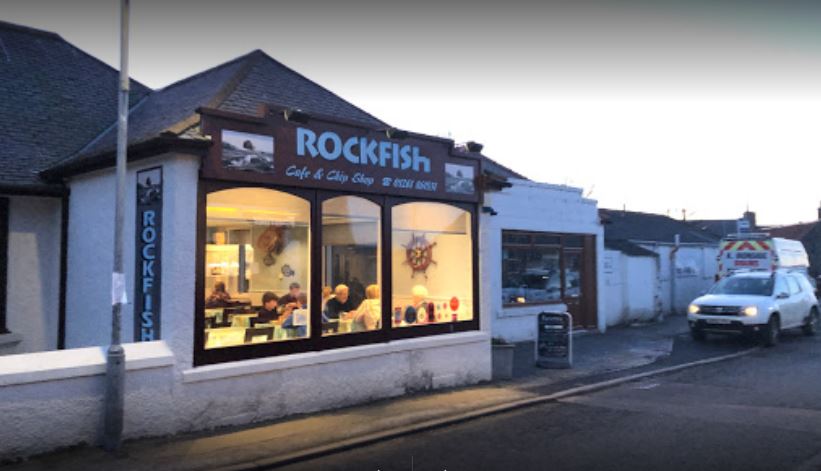
Later we stroll into town, stopping for fish-and-chips on the way. If you can’t beat ’em, join ’em, I think. We have to queue outside a window of the shop with the only means of communication through a microphone and speaker system. When the order is ready, we collect it from another small shutter window that can be opened by the girl to leave the bag and closed when we pick it up. No one bats an eyelid, but I think how bizarre it is that this new normal has been accepted so quickly. Will we ever go back to the old normal?

It turns out that our fish-and-chip shop is one of many – I don’t think I have ever seen so many per square mile. How do they all stay in business?

One of the many fish-and-chip shops in Whitby.

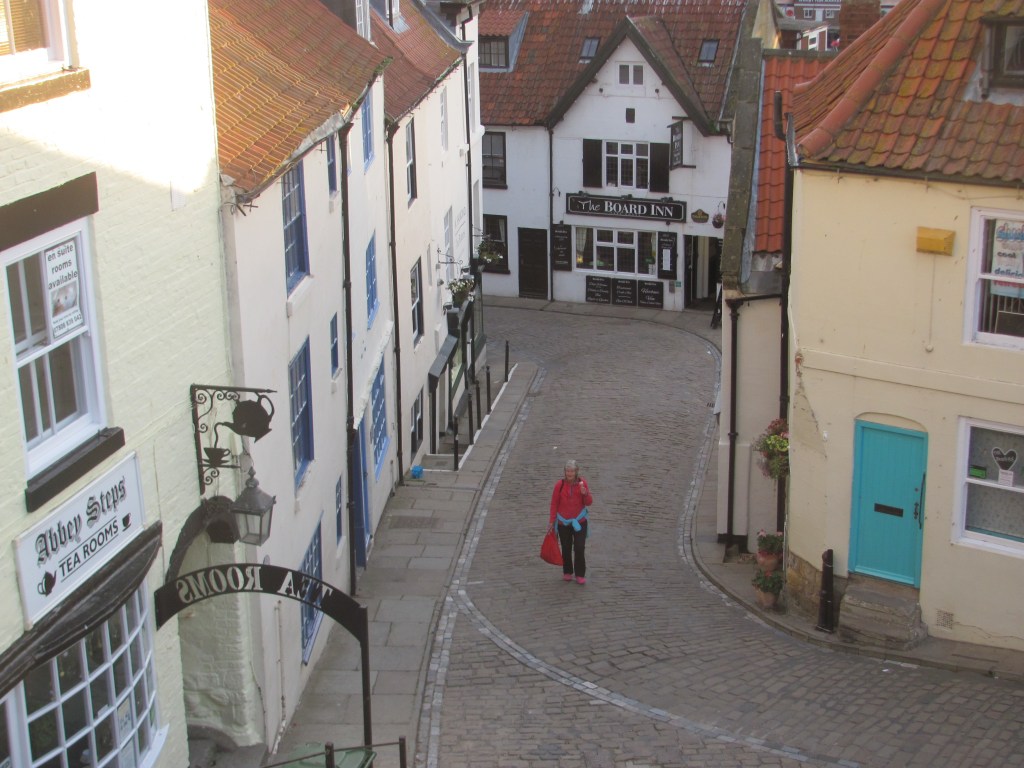
Our appetites sated, we wander through the quaint little streets of Whitby. Away from the brash flashing neon lights of the entertainment area, there is a certain old-world charm to the place, albeit catering mainly for tourists.

Street in Whitby.

We end up at the bottom of a long flight of stairs up to the abbey ruins on the hill to the south of the town. It is a steep climb, but we manage it, and are rewarded by a spectacular sunset over the bay.

Sunset over Whitby Bay.

Behind us, the abbey ruins are bathed in the warm golden glow of the setting sun. It’s magical. Bram Stoker was supposed to have sat somewhere around here and got the inspiration for Dracula, but with this beautiful coast in front of us, it is difficult to see why he was inspired to write of blood-sucking vampires from Transylvania, and not some nice romance. Perhaps it was all the gravestones in front of the abbey. This is the second place we have encountered the grisly Count on this trip – the first in Slains Castle in Aberdeenshire – is it turning into a theme?

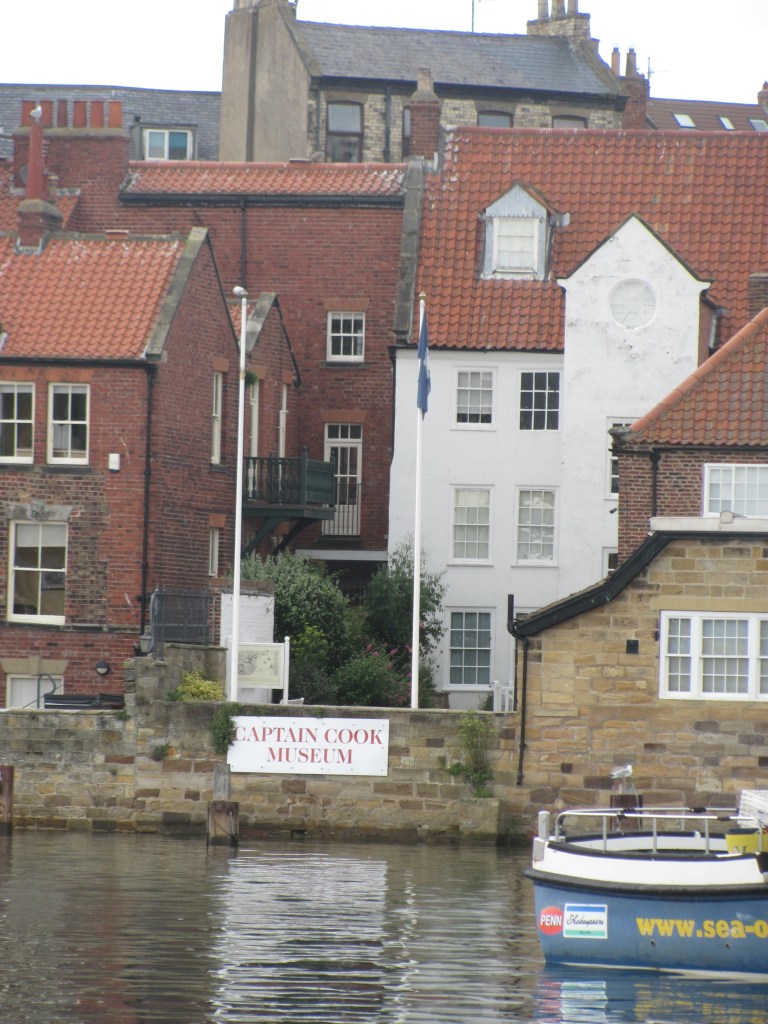
The next day, I decide to go and visit the Captain Cook Memorial Museum while the First Mate has a look around Whitby. Because of the social distancing rules, I have to book online for an hour slot starting every 15 minutes. The idea is that there are four floors to the museum and you are allowed 15 minutes on each one before moving to the next one. A fresh intake of visitors come in at the bottom 15 minutes later while the ones on the top floor leave.

The Captain Cook Memorial Museum.

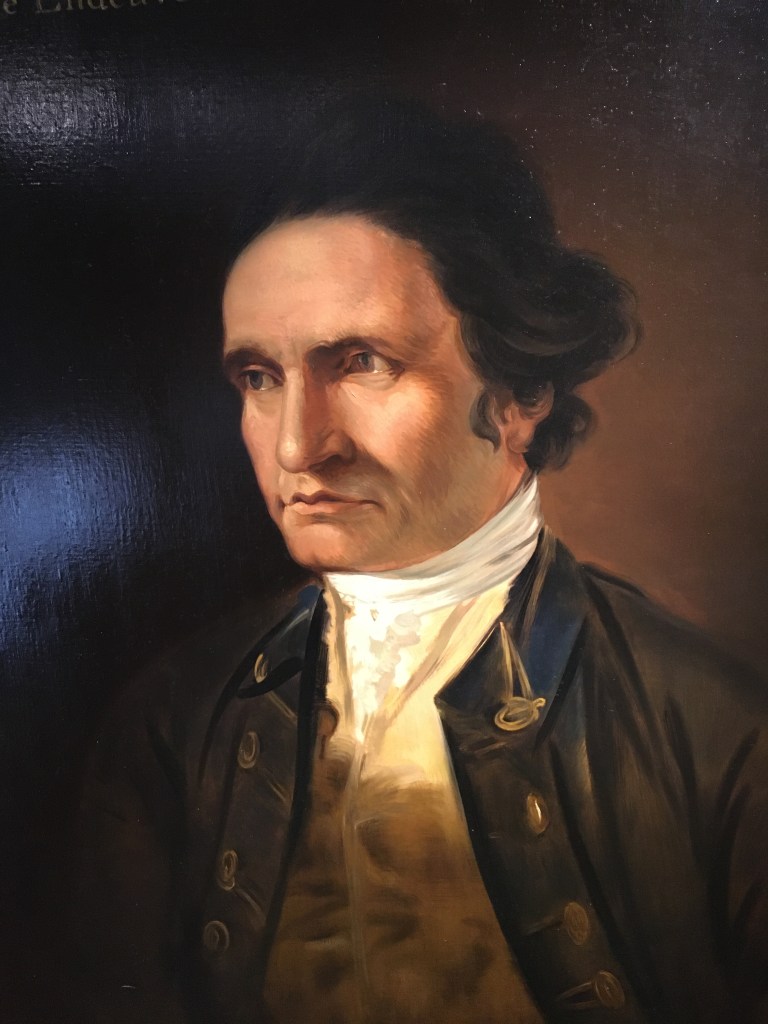
I have a particular interest in Captain Cook as he circumnavigated New Zealand, my country of birth, in the 1800s, leading to its colonisation by people from Britain, some of whom were my forebears. And here are we now, nearly finished a circumnavigation of the land of his birth! Cook was born in one of the villages near Whitby, and served his apprenticeship with the shipowner who had once owned the house where the museum is now located. Although he moved away from Whitby when he joined the Royal Navy, the ships that he had sailed in, Endeavour, Adventure, Discovery and Resolution, were all built in Whitby.

Captain James Cook.

As I explore the museum, my admiration for sailors of that era is renewed. Not only did they have no electronic technology to help with navigation and warn of dangers or engines to push them along, but their ships also could hardly sail into the wind, meaning that they had to spend much more time waiting for favourable winds than we do now. And yet they somehow managed to explore and map much of the globe, often with intricate detail.

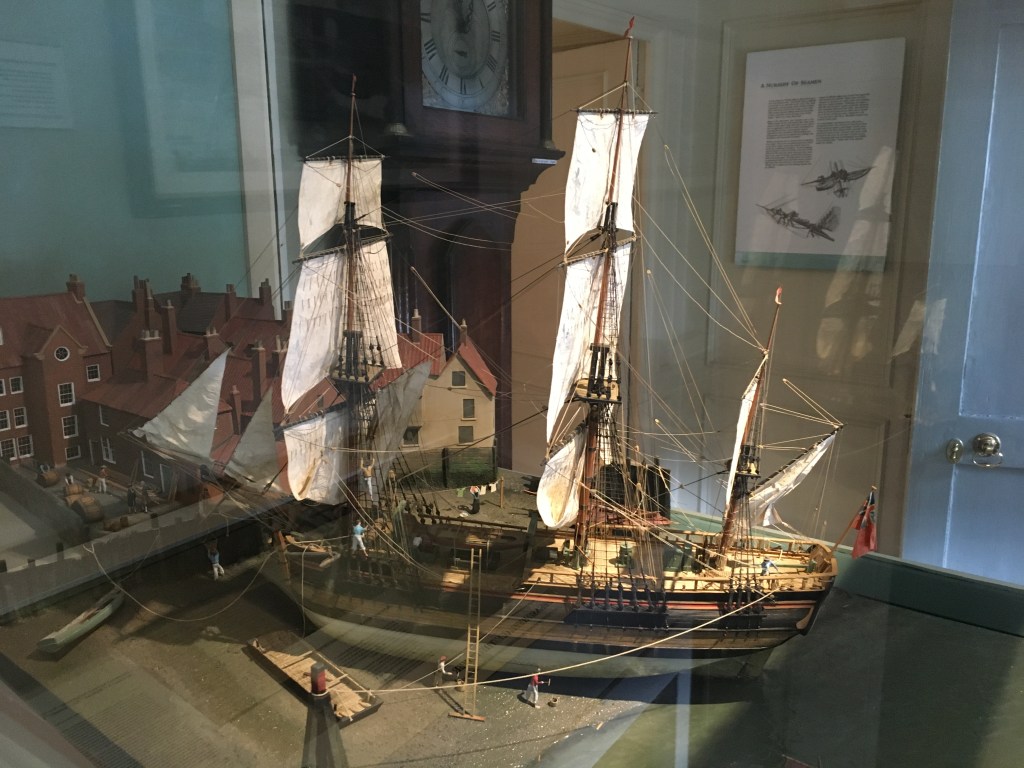
Model of Cook’s ship Endeavour.

On the top floor, I am welcomed by a white-haired attendant. After exchanging pleasantries, he asks me where we are staying. Probably to surprise him a little, I point out of the window to the marina below.

“We’re staying in the marina”, I say. “Look there – that’s our boat on the end there”, pointing to Ruby Tuesday below.

An instant bond is formed. He is also a sailor, and has three boats – a yacht, a motor cruiser, and a racing dinghy. He keeps his yacht further up the coast at Sunderland, not Whitby, as it is too expensive here. Most of his sailing he has done on the east and south coasts, and he now teaches sailing to the boy scouts. He is impressed at our project to circumnavigate Britain.

“It’s something I have always wanted to do”, he says. “I have sailed as far as Falmouth, but never had the opportunity to go further. But your accent – do you mind asking what it is? Australian, New Zealand, South African?”

“New Zealand”, I say. “But I have lived in the UK for most of my life.”

“Ah, New Zealand”, he says wistfully. “Beautiful country. My daughter lives out there. We visited her a couple of years ago.”

Realising I have only fifteen minutes on this floor before the bell rings, I politely try to draw the conversation to a close and absorb myself in the display on Joseph Banks’ botanical expedition with Cook. When I was growing up, we used to look out every day to Banks’ Peninsula near Christchurch, which is named after Joseph Banks. But the white-haired attendant has the bit between his teeth.

“We hired a camper van and did both islands …”, he starts. The bell rings, and I have to move on. The exploits of Joseph Banks and the camper van will have to wait for another day. I bid him farewell and wish him the best with his sailing.

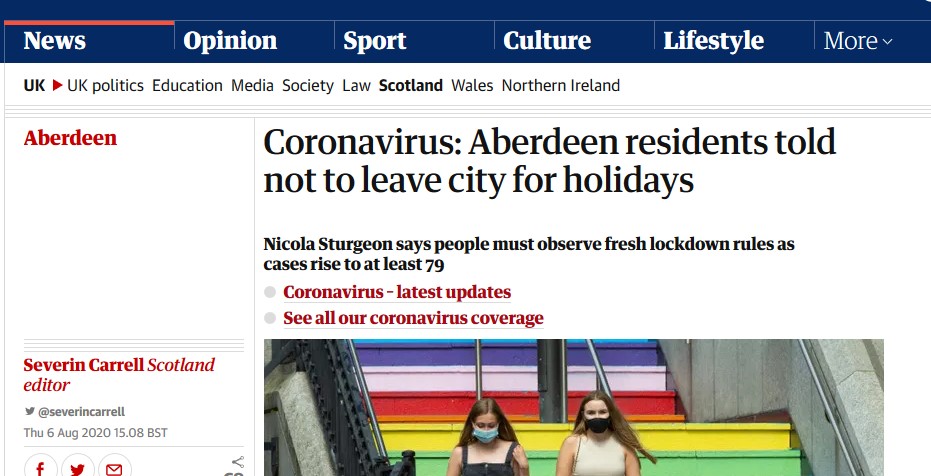
We hear on the news that night that Aberdeen is in lockdown again – there has been a cluster of cases centred on specific pubs. It seems that we escaped just in time.

Amble

The dark silhouettes of the silent houses glide by above us as we motor slowly out of Eyemouth harbour. It is 0430, and we are the only ones about as the town continues to sleep. We pass the looming bulk of the dredger tied up in the small dock to the side of the main channel, and enter the Canyon, the eerie red and green glow from the navigation lights on our bow reflecting off its steep walls. For a moment it reminds me of a deserted alley in a horror movie.

Leaving Eyemouth in the early hours.

We need to leave at this ungodly hour two hours before low water at 0630 to make sure that we don’t ground ourselves on the rocky bottom on the way out. We could also have left two hours after low water at 0830, but that wouldn’t have given us enough time to get to our next port of call, Amble, where we can only enter at high water at around 1230. All this planning around tides makes it tricky when sailing on the east coast, and often guarantees leaving or arriving at unsociable hours.

As we leave the harbour, I follow the track of the GPS that we made on the way in to make sure that we don’t  hit the Hurkar Rocks that caused the horrific loss of life in 1883. Another ship wreck at this time of the morning wouldn’t look good. When we reach the cardinal buoy marking the presence of the rocks from the sea, we turn southwards and set a course for the Farne Islands. The sails fill with a slap, we pick up speed, and soon the street lights of Eyemouth are receding into the distance.

The First Mate makes us hot cups of tea, and together we huddle in the shelter of the cockpit watching the grey horizon give way to the brilliant reds and yellows of the sunrise as a new day dawns. It is moments like this that make us feel that the early starts all worthwhile and that life is worth living.

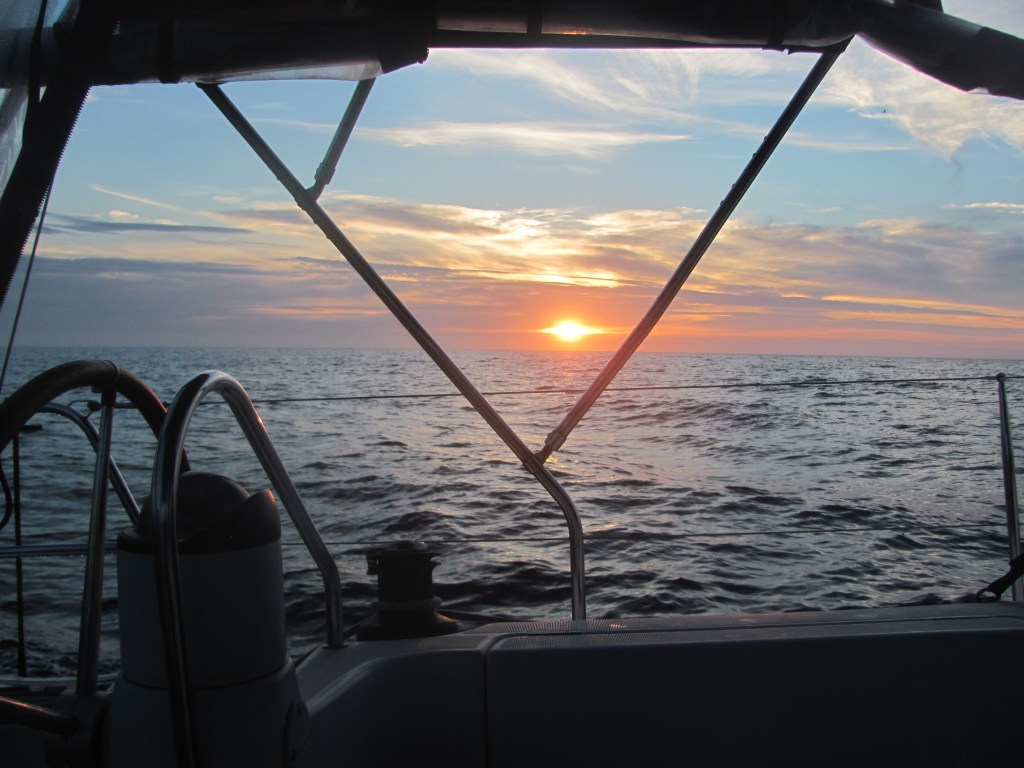
Watching the sunrise.

The young shepherd awakes sweating, and pulls his cloak closer around him to keep warm. He had taken shelter in the cowshed the night before and fallen asleep almost straightaway, exhausted from driving his sheep down from the north. He had slept soundly for most of the night, but had been woken by a vivid dream in which Bishop Aidan of Lindisfarne, the head of the church he worshipped under, had died and had been carried off to heaven by angels dressed in white. One of the angels had turned around and pointed to himself, saying ‘you will follow’. He shivers and tries to go back to sleep, but the otherworldliness of his dream stops him. He lies awake, his mind in a whirl, listening to the movements and breathing of the cows around him, their thick, earthy smell almost suffocating him. Why should he, a humble uneducated shepherd, have had such a dream of someone so far above him, so respected, someone he had never even met? And what did he mean by saying that he would follow? Was he going to die too? Nothing made sense.

Dawn comes, and the young shepherd decides that he can only find the meaning of his dream by travelling across to the Holy Island of Lindisfarne. It was a long way, but he is sure he can do it in a day if he doesn’t stop. He leaves his sheep with the owner of the cowshed, saying he could keep them in place of payment for his sleeping place, and sets off. By late evening he is nearly there, and falls in with a friendly monk on the road just outside the village.

“You won’t be able to go across to the monastery today, you know”, the monk says when the young shepherd tells him where is heading. “Bishop Aidan, the founder of the monastery, died this morning, and the monks are preparing for his funeral. In fact, that is where I am going myself, to give a hand, like.”

The monk’s words hit the young shepherd like a thunderbolt. His dream was real! But how could that be?

“The castle looks beautiful. Do you remember when we were there, quite a long time ago now?”.

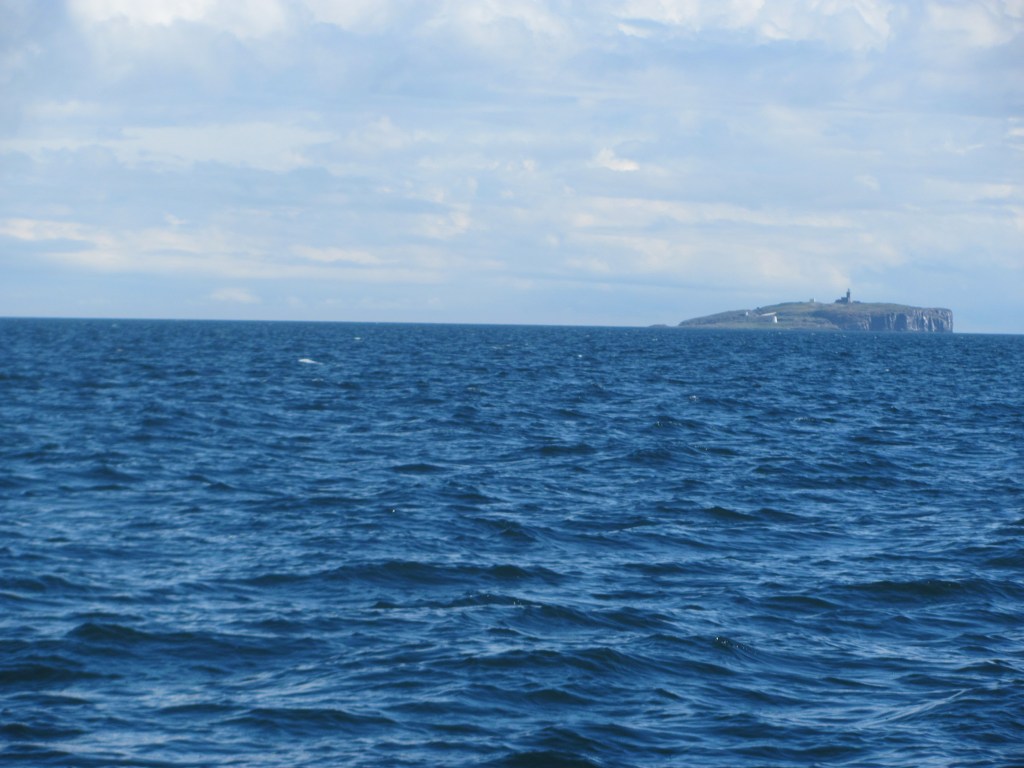
I am woken from my reverie by the First Mate, bringing out some fresh mugs of hot tea. We are just passing the Holy Island of Lindisfarne with its castle rising out of a rocky promontory of the otherwise flat island almost as if had been fashioned naturally rather than built by humans.

Passing the Holy Isle of Lindisfarne.
St Cuthbert.

I had been recalling the story of St Cuthbert, which I had read when growing up. From humble origins as an uneducated shepherd, but with the convincing power of a vision that had come true, he had decided to become a monk, and had worked his way up the orders until he eventually become the Bishop of Lindisfarne. After his death, the Lindisfarne Gospels, a beautiful illuminated illustrated version of the four gospels, were made to celebrate his life.

“We rented a cottage in Northumberland one Christmas, and visited Holy Island. Don’t you remember we walked across the sand at low tide?”, continues the First Mate.

She is right – we had been on the island before, and I can remember sampling the mead made there, and rushing back along the causeway across the sand flats to the mainland before the tide came in again. Our son had only been six then, and we had tobogganed together down the snow-covered slopes outside our cottage.

The monastery on Lindisfarne had been established in 634 AD by Aidan, who had come across from the Holy Island of Iona on the west coast of Scotland, which we had seen during last year’s voyage in Ruby Tuesday. Aidan had brought with him the Celtic brand of Christianity that St Patrick had introduced from Ireland. For a while it had been the centre of Christianity in the north of England, but eventually lost influence to the Roman brand of Christianity in Canterbury further south. One of the differences between the two brands was the style of haircuts the monks had, and many bitter arguments ensued. Apparently God finds these things quite important when he is not running the universe.

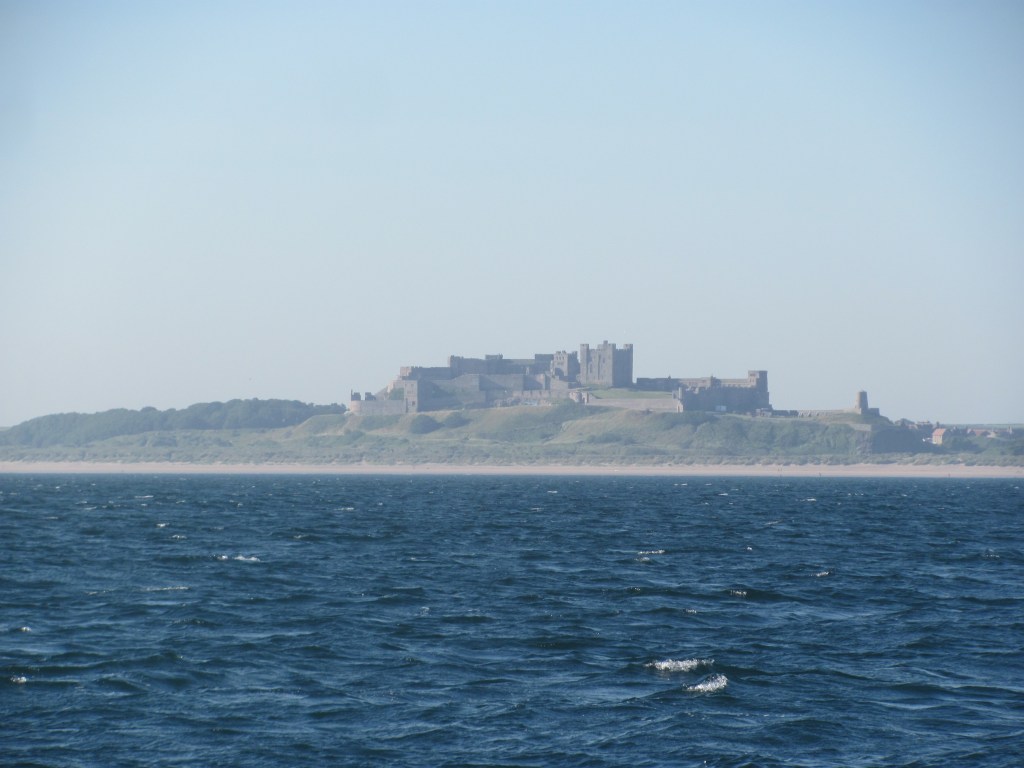
A little bit further on, we pass the imposing Bamburgh Castle. The Northumbrians certainly loved building castles – in addition to the one on Holy Island that we had just passed and Bamburgh Castle, there is another on a little bit further on, Dunstanburgh Castle. Turbulent times need secure defences, no doubt.

Bamburgh Castle.

We pass through the narrow stretch of water between Bamburgh Castle and the Farne Islands stretching like a chain of beads out to sea. Many years ago, I had dived off the Knifestone Rocks, the last in the chain, amongst the seal colony there. I still think it was one of the best dives I ever did, watching the seals underwater pirouetting and jumping as they showed off their skills to us.

Passing the Farne Islands.

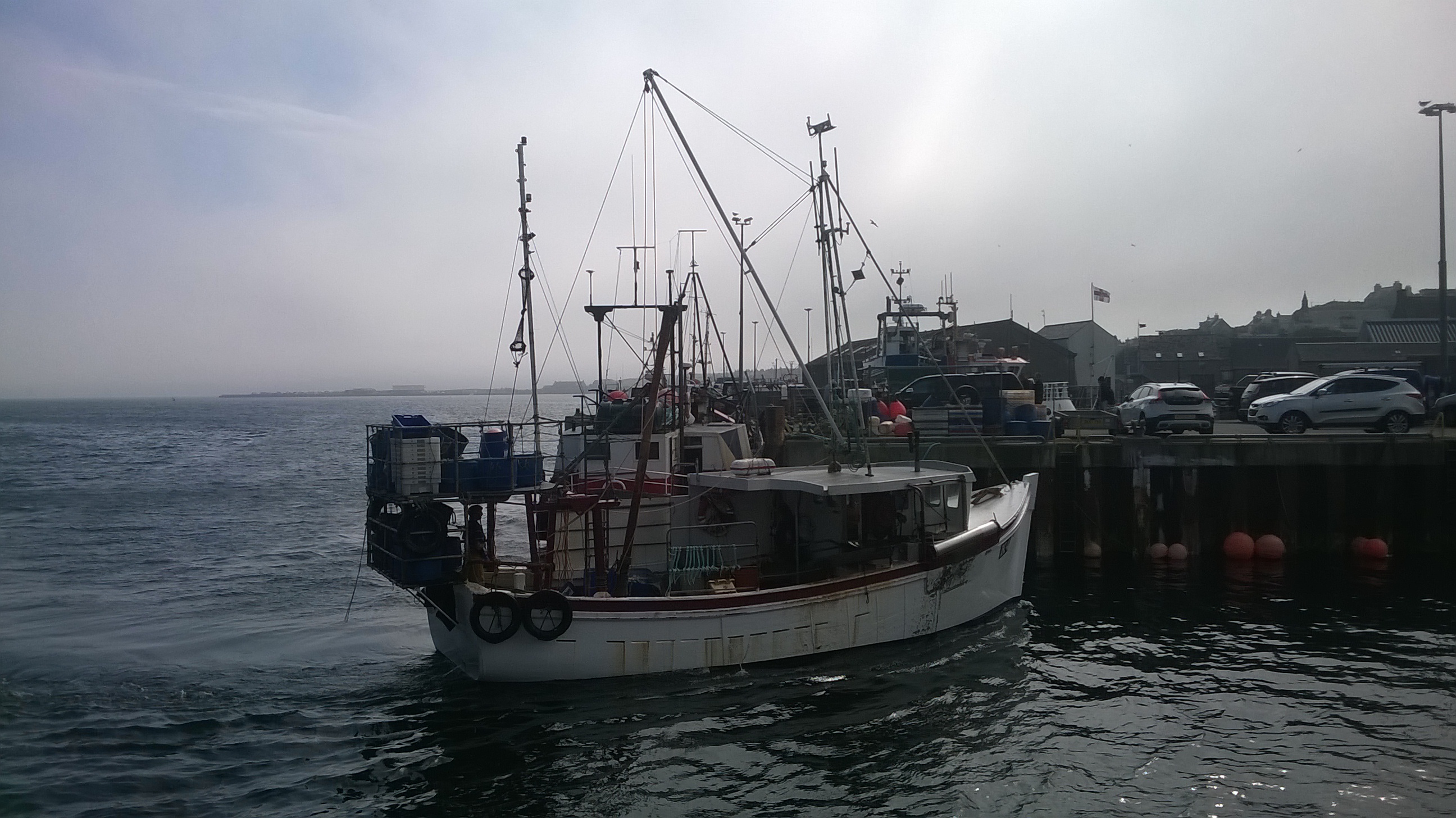
We arrive in Amble just after midday, just on high water. The marina is up the River Coquet about a mile, and we have been told to follow the course of the river around, sticking closely to the southern wall, as that is where the deep water is. On the north side, although covered at the moment by water only about a metre deep, are extensive mud flats that will be dry in an hour or so. It is easier said than done to hug the wall, as the southern bank is also where all the fishing trawlers tie up, and we have to swing in very close to them to stay in the narrow deep water channel.

Amble harbour on the River Coquet.

We finally reach the marina, and see in front of us a man in shorts on one of the pontoons waving energetically at us. Thinking that he is one of the marina staff wanting to direct us, we pull in as best as we can to the pontoon, not the easiest thing to do in the strong crosswind blowing us off. Eventually we are tied up securely.

“Phew, that wasn’t easy”, I say. “So, which is our berth for tonight?”.

“I have no idea”, the man replies. “I am just another berth-holder. You need to talk to one of the marina staff.”

“But we saw you waving us in”, I say. “We thought you had come down to show us where to go.”

“No, I just saw your wife waving to me, and I waved back”, he says.

It transpires that we have inadvertently tied up to the fuel berth. Luckily a real marina man arrives. I decide that we need to top up our fuel tank anyway. It has the advantage that (a) we can pretend that was our plan all along, and (b) that it will save a job later, and (c) we can leave when the tides are right rather than when the marina is open.

We eventually find the berth that has been allocated to us, tie up, and have lunch. I settle down in the cockpit for a snooze, and am soon dreaming of executing the perfect tack, or some such thing. A sudden shout from the First Mate wakes me abruptly.

“Watch out, watch out”, she shouts. “The idiot. He doesn’t know what he is doing.”

It was probably only a few seconds before I realised that it wasn’t me she was referring to, conditioned as I am. I leap up and see a small motorboat in the middle of the narrow fairway between the pontoon where we are tied and the neighbouring one. The driver is trying to get into the small gap between two other boats. To be fair, the wind is very strong and it is not easy to position the boat with any accuracy, as we ourselves had found when we came into the marina. The motor boat makes two to three attempts without any success, on all occasions being blown past his slot. Then, whether in frustration, panic or confusion we’ll never know, the driver rams the throttle forward and careers wildly around in the fairway between the two pontoons, heading for the side of Ruby Tuesday. The First Mate and I both see a potential accident developing and grab the boathooks to try and fend him off. Too late! His boat hits ours and scrapes its way along the side in a sickening graunch. My boathook catches in the front of the little boat somehow and pitchpoles in a graceful arc like a javelin, and disappears into the water in the fairway. The little boat continues it course of mayhem, careering from side to side of the fairway, narrowly missing two other boats and grazing the end of the last finger pontoon, ending up on the main fairway from the marina entrance facing the way it had come. For a moment I wonder if the driver is just regrouping for another attack to finish off the boats he missed first time around, but a look at his face shows that he is more shocked than we are. I even feel a bit sorry for him.

Scratches down the side of Ruby Tuesday.

We exchange insurance details and metaphorically shake hands to avoid transmitting any viral particles. These things happen, there are no hard feelings on our part. Later on, a neighbouring boatie brings us our boathook which he finds floating near his boat. At least all is not lost. Later I clamber into our little dinghy and take photos of the damage. Luckily it is not a deep scratch and can probably be fixed with a little filler and sanding. It could be worse.

Later in the afternoon, we explore the town.

“We can’t come here without going for an amble around Amble”, I say, feeling rather pleased with myself. I had been waiting for the opportunity to use that one. The First Mate looks at me witheringly.

Going for an amble in Amble.

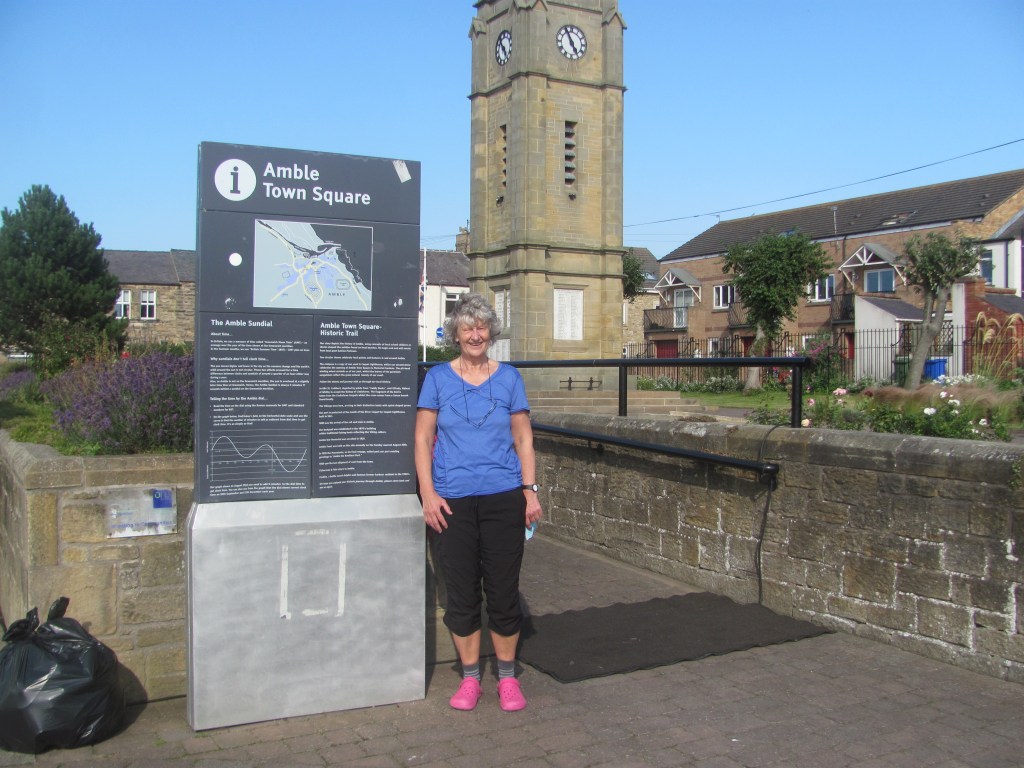
Amble was once a port for the coal industry in Northumberland, but has since declined in that respect, and now relies on its small fishing industry and tourism. It is pleasant enough, not spectacular, but has seen some redevelopment work around the town square and the riverside harbour.

We come to the Northumberland Seafood Centre that sells the freshly caught fish coming directly from the boats. It also has a lobster hatchery, but unfortunately it is closed to the public because of the coronavirus.

Northumberland Seafood Centre, Amble.

We talk to the owner who is standing outside the Centre.

“We sell a lot of our fish to Europe”, he says. “Brexit is going to be a disaster for that. I am not sure how we are going to survive.”

“But the north-east here voted en masse to leave”, I say. “And the fishing industry in particular want to get back control of our waters. I don’t understand.”

“People were just manipulated by the politicians to believe that no-one was going to tell Britain what to do. It’s a north-eastern thing”, he says morosely. “But no good will come of it, you see.”

We end up at a café on the river front where we decide to have a drink. The First Mate looks at the menu and decides to order squid rings to go with her drink. The drinks arrive, but no squid rings. After half-an-hour, we ask the waitress what has happened to them.

Waiting for our squid snacks.

“They are just coming”, she says. “The kitchen has been really busy.”

Twenty minutes later, they have still not arrived. We are getting cold. We ask her again.

“They’ll be here in a couple of minutes”, she says.

Ten minutes later we ask again. “I am so sorry”, she says. “For some reason, the order didn’t go through. It’s my fault. Give them five minutes.”

This time they do arrive. There are only three squid rings. The First Mate gobbles them up. We ask for the bill. It arrives, and we are charged £16.40 for two snacks instead of one. I complain to the waitress.

“Not only did our snacks take more than an hour to arrive, we only get three squid rings for £8.20, and then to top it all, you charge us for two snacks instead of one”, I say.

“I am so sorry”, says the waitress. “Tell you what, you can have the drinks free.”

It’s been quite a day.

Eyemouth

At the stroke of eight bells, the First Mate slips the lines and we motor slowly out of Port Edgar marina, under the two eastern-most bridges, then set the autopilot on a course of 70°T. The wind is from the west, behind us, and before long, we have the sails out and are making a good speed heading along the southern shore of the Firth of Forth. At least the wind is in our favour today.

Leaving behind the new Forth road bridge.

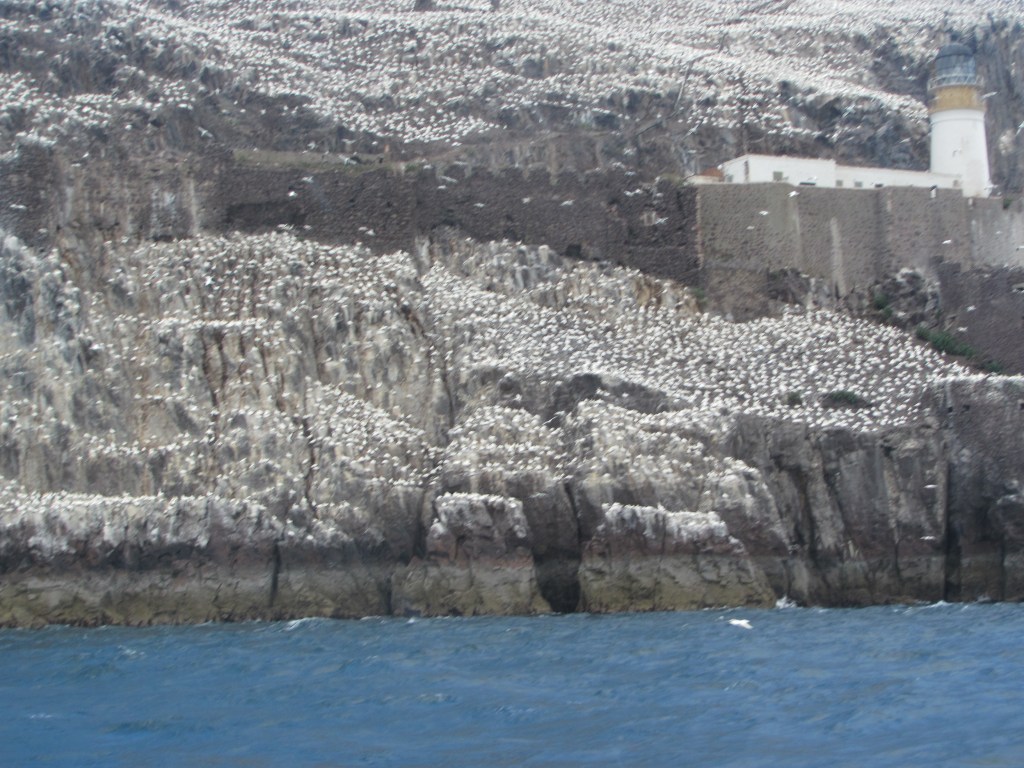
We eventually pass the town of North Berwick, its church spires and house roofs catching the early morning sun. Further on looms the imposing bulk of Bass Rock. From where we are, it looks as if it is covered in white flowers, but as we get closer, we begin to pick out the individual spots of white and see that they are gannets, tens of thousands of them. The rock is a volcanic plug dating from Carboniferous times around 300 million years ago, and today is famous for its giant gannet colony with around 150,000 of the birds taking up every conceivable space.

Approaching Bass Rock.

We decide to take a loop out of our planned route to get a closer look. As we get closer, the sea suddenly becomes choppier and the wind rises to a fierce prolonged gust of 25 knots, almost as though it is warning us off. Ruby Tuesday heels violently, and we quickly take in the sails and start the motor instead. And if the gust is not enough, a sudden intense rain squall engulfs us and drenches us before we are able to get the side panels of the cockpit tent down. Then, as we begin to turn away, everything equally as suddenly stops and the sun begins to peak out again. If I was a superstitious type, I might think we have angered the gods by approaching too close to a sacred sanctuary.

Gannet colony on Bass Rock.

I recall a great story I had read at some stage about Bass Rock. Back in the late 1600s, four captured Jacobite officers were imprisoned in the castle on the Rock when it was used as a jail. One day when a supply ship arrived, all of the garrison of the castle had to go down to the landing to help unload a difficult cargo. With no-one in the castle, the prisoners took it over, and wouldn’t let any of the jailers back in, who had to leave with the supply boat to go back to the mainland, leaving the Jacobite officers in total control of the Rock. Their sympathisers on the mainland and in France heard what had happened, and kept them secretly supplied with food, water and arms for several years, and because of the Rock’s natural defences, they were able to beat off any attacks. The whole thing became a bit of an embarrassment to the government, who, with all the to-ings and fro-ings, had no idea of how many people were on the Rock. In the end, the Jacobites negotiated very favourable terms of surrender, escaped to France, and became local heroes.

We sail on. The wind is very variable, sometimes a good strong beam reach pushing us along at 7-8 knots, other times down to a couple of knots only so we have to start the engine to make any progress. We still have quite a way to go to Eyemouth and need to get there before the tide gets too low for our 2 m draft to enter the harbour.

Eventually we reach the cardinal buoy marking a group of submerged rocks just outside Eyemouth harbour and furl the sails. As instructed when I had called in the morning, I call the harbour-master on Channel 11 of the VHF to let him know that we would like to enter the harbour. There is no answer. We wait for five minutes and call again. Silence. When we had called him earlier, he had told us that they are dredging the harbour in the evenings and that we should contact them on the radio once we had arrived when we would be given further instructions on how and when to enter the harbour. But with no-one answering, what should we do? Just push on in and hope for the best?

Then suddenly there is a voice.

Ruby Tuesday, this is Neville the dredger operator”, it says. “The harbourmaster has probably gone home for the night now. We have started dredging, but just come straight in. You should be able to squeeze past us somehow.”

It seems a bit tricky, but we decide to give it a go. We find the two leading lines that guide us past the treacherous Hurkar rocks at the harbour entrance to the start of a narrow high-walled channel which we learn later is aptly named the Canyon. Once through there, we see the dredger in front of us, almost blocking the way. Luckily, the channel widens slightly at that point, and we are able to squeeze gingerly around it and into the upper part of the harbour where we see the pontoons at which visiting boats are able to tie up.

About to enter ‘The Canyon’, Eyemouth Harbour.

The bad news is that there don’t appear to be any spare berths for us. Two yachts that we had seen entering the harbour about half an hour before us are safely tied up, taking up all of the pontoon that we could have had if we had been a little bit earlier. The only option that we have is to raft up – that is, to tie up alongside a boat that is already there, which means clambering across it if we want to go ashore. But where?

A youthful sailor with a ponytail emerges from one of the boats and offers to check if we can raft up next to one of the other boats tied up at the pontoon. In the meantime, we execute the delicate manoeuvre  of turning around in mid-river without hitting anything on either side. We somehow manage more by luck than good management, and drift downstream again to where the boats are moored.

“None of the other boats want you to raft up alongside them”, says the Ponytailed Sailor, with an American accent. “ They say they are heading off early in the morning, but I am not sure I believe them. Anyway, you can tie up alongside me if you like, even if it is three deep. I am not going anywhere in the next couple of days, and the other boat isn’t either – the owner died a couple of months ago. Here, give me your lines.”

He grabs our line from the bow and makes it fast to a cleat on his own boat, then rushes back and grabs our stern line that I am holding. The two boats roll alongside one another momentarily, but there are enough fenders on both to prevent any damage. We also tie the two boats together amidships and string a further couple of lines from our bow and stern directly to cleats on the pontoon. With all that, Ruby Tuesday isn’t going anywhere.

We sit on the foredecks of our respective boats and chat in the last warmth of the fading sun. The Ponytailed Sailor’s name is David and his boat is his home. He did once have a house, but he sold it and bought the boat. He has two cats for company – one young and ginger, the other old and black. He has just spent the winter in it in Eyemouth because of the lockdown and is getting itchy to move on northwards now that it has lifted.

David and his feline companions.

“I was once a production engineer, you know”, he tells us. “I worked for a company making electronic widgets, but I just couldn’t stand manipulating people to make more money for the company.”

“What do you mean?”, I ask.

“My job was to go around and look for ways to increase the productivity of staff. I was good at my job, introduced lots of changes, and was rewarded by the company well as their profits increased. And do you know the oddest thing – the employees themselves liked the changes I made because it often made their jobs more enjoyable even though they were more productive.”

“Sounds like a win-win situation though”, I say. “But what did you do then?”

“Well, I left shortly after”, he says. “Watching people age prematurely due to the changes that I made, knowing that mothers, fathers, sons, and daughters would have less time together because of me – is truly a burden I wish I didn’t have – and to this day it weighs heavily upon on my soul.”

“I decided then that the whole of society stinks, that it is all based around manipulating people to make more money for other people that already have enough. Who wants to live in a society like that? So I sold my house, bought the boat, and travel around where I wish, staying where I like for as long as I like. I live sustainably, and opt out of the rat race as much as I can – my two cats keep me company. I love it.”

David’s home.

I am reminded of Captain Nemo in Jules Verne’s Twenty Thousand Leagues under the Sea, but I have to admit I have a lot sympathy with him. There does seem to something wrong with the way the world works at the moment. And although we haven’t sold our house, his lifestyle is not all that different from our own during the summer months.

“But how would you change society to make it better?” I ask.

“Well, stop having people making things that other people don’t really need, for a start”, says David. “And educate people to stop buying rubbish.”

“But who decides what people need and don’t need, and what is rubbish and not rubbish?”, I say. “Even with your lifestyle, you will still need things from time to time – when your sails wear out, you will need new ones; if your engine gives trouble, you will need spare parts; you need pet food to feed your cats. And what would all those newly unemployed people that used to make things people didn’t need do for a living instead?”

“I know, I know. All good questions”, he says. “I have to admit that I don’t really know. All I know is that things can’t go on as they are.”

I always enjoy these sorts of conversations, but I have had similar before. We all know that things have to change, but no-one knows quite what system should replace it. We all like our mod-cons, our boats, our cars, our entertainment, our electronic gadgets, our warm and comfortable homes, our healthy and diverse food, our freedom to choose, whatever. We ourselves are no different. But all these require a system behind them to produce them. And not all of us have the resources to opt out completely. The ultimate dilemma.

In the morning, the two boats we saw coming in the day before us have gone, and we move Ruby Tuesday to their space on the pontoon. At least now we don’t have to clamber across two boats to get ashore.

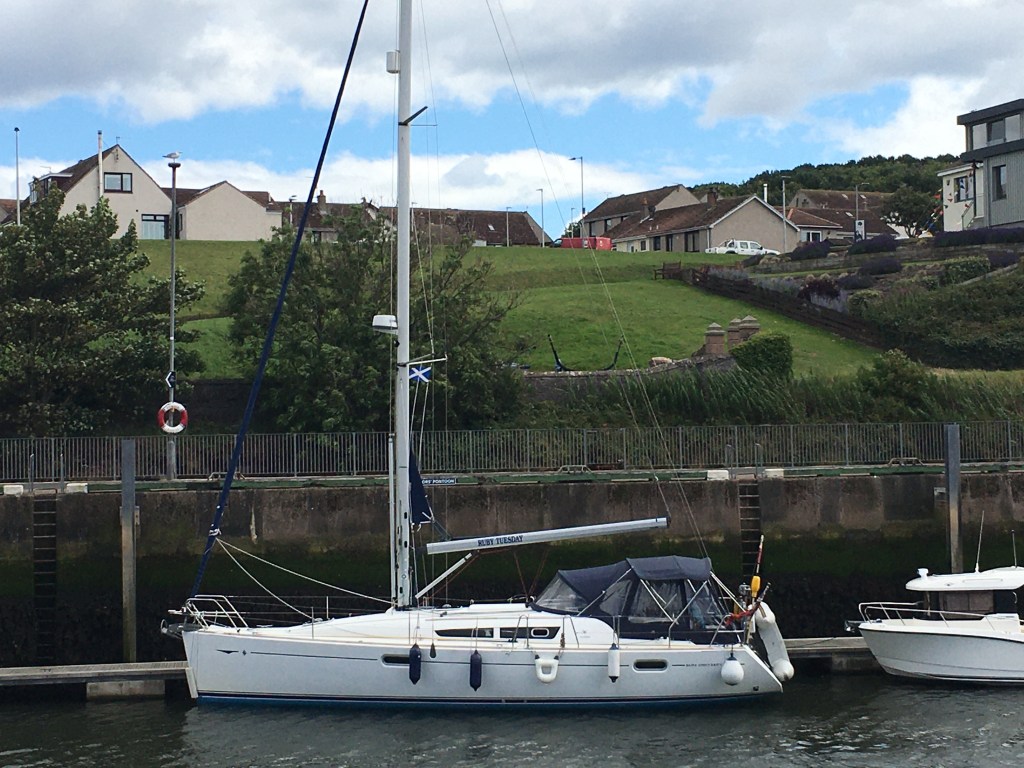
Ruby Tuesday tied up to the visitor’s pontoons in Eyemouth harbour.

Later the First Mate catches the bus back home as she has a dentist appointment, so I am left to my own devices for a couple of days. She takes plenty of masks with her, and is under strict instructions from me to make sure she sits next to no-one in the bus.

On the way to the bus stop, we come across a bronze statue of one Willie Spears. It seems that back in the nineteenth century, the fishermen used to have to pay a tithe of 10% of their catch to the local Church of Scotland. Naturally, they resented this as they wanted to spend the money instead on upgrading the harbour to make it safer. The local minister, however, was having none of this. The dispute rumbled on for several years, until one day one of the fishermen, Willie Spears, had had enough. He organised a peaceful demonstration of 4000 folk in one of the neighbouring villages, with the upshot that the minister backed down and agreed to the tithe being bought out for a total of £2000. Tragically it was too late to improve the harbour, as a few years later in 1881 there was a fierce storm when most of the fisherman were out fishing, and 129 trying to get back in died in front of their distraught families when their boats hit the Hurkar rocks at the entrance to the harbour, the same ones we had passed on the way in. Only the few that stayed out at sea survived. A poignant reminder of its dangers.

Statue of Willie Spears.

Later that day, I walk up to the Harbour Office to pay our mooring fees. The harbourmaster tells me he is new and still finding his way. He needs to go and check the fee rules to see if we are eligible for any discounts, and lo-and-behold, we are – 25% off the third day. Somehow we get into a conversation about Brexit. He is all for it.

“We need to stimulate British agriculture and stop buying all our food from overseas”, he says. “Things have got out of control in the last few years.”

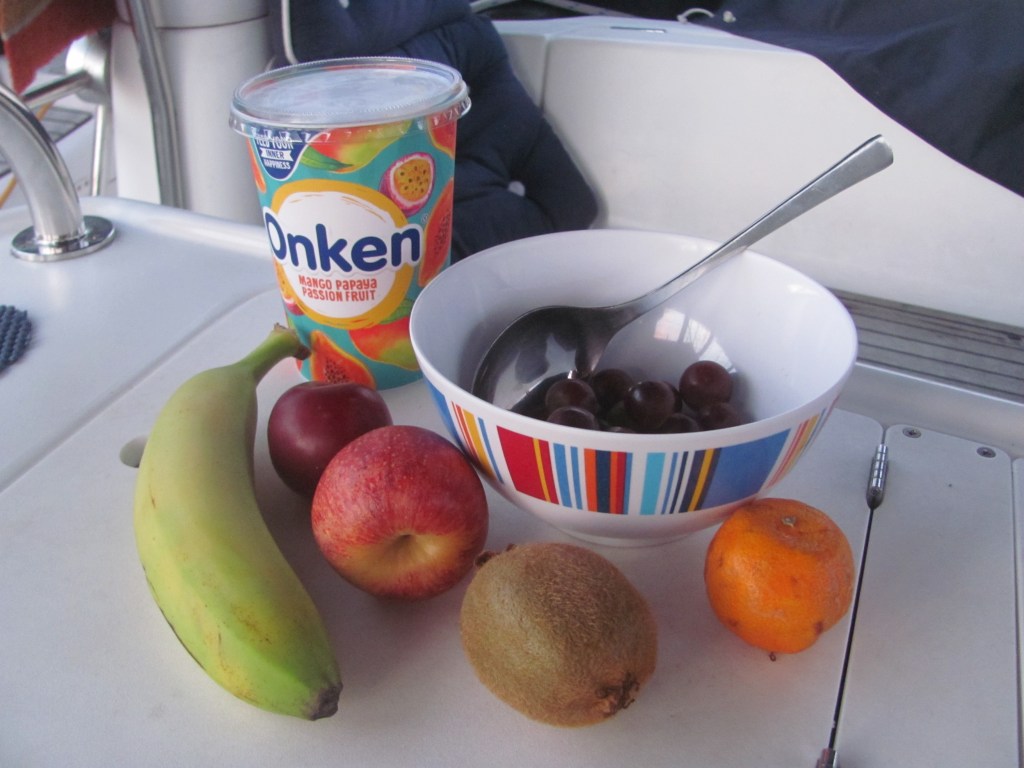
He has a point, but we only produce around half of what we eat at the moment. I think of the fruit salad I had for breakfast this morning, and wonder whether the banana, kiwi fruit, and orange would grow in the UK. I suppose the grapes, plums and apple do already. But the mango and papaya in the yoghurt I liberally dolloped on top wouldn’t. I suspect our diet might not be as diverse if we were to rely entirely on domestic agriculture, but perhaps that is the price to pay for the free, independent and self-sufficient Britain that the country wants.

Will I still be able to have my breakfast in future Britain?

Port Edgar, Edinburgh

I awake at 0500 in the morning and lie for several minutes slowly waking up. There is a slight lapping of waves against the side of the boat next to my head, and momentarily I recall that I am actually lying below the water line. Overhead, I can hear the mewing of seagulls, and even the murmur of voices. I stumble out of bed and through the window see that there are already a couple of fishermen with their rods and gear on the outer sea wall. They must be keen, I think, as I boil the water for the first cup of tea for the day.

We cast off at 0600 on the dot with the First Mate at the helm, and head out past Downie Point with its large lump of rock almost separated from the mainland, and turn southwards. It is a damp and misty morning, with the cloud cover down low, and after a while we are not able to see the shoreline. I make sure that the radar and AIS are on so that we can see any other boats around us. No point in sailing blind.

Leaving Stonehaven in the mist, fog and drizzle.

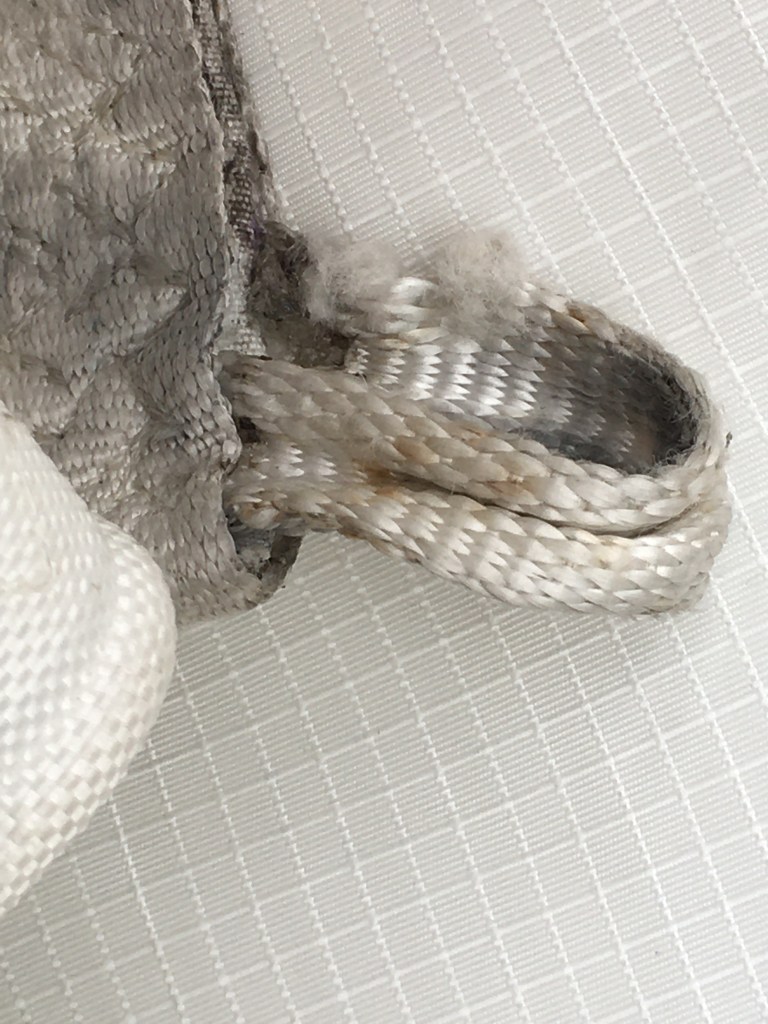
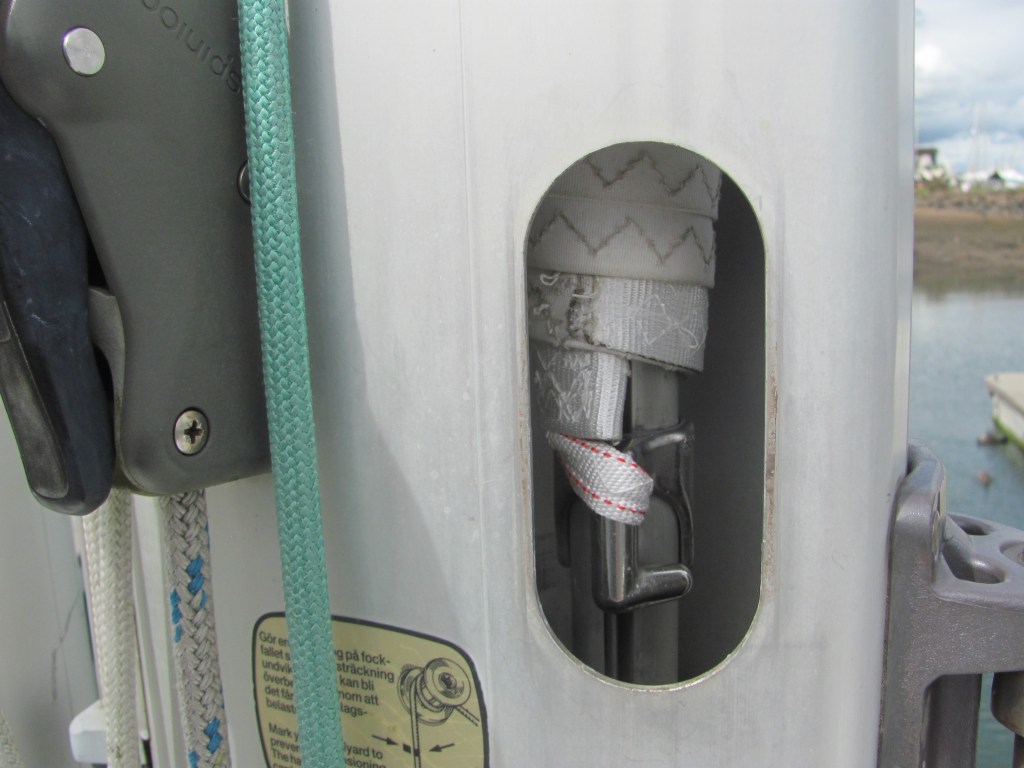
The winds are dead on our nose and we are forced to motor. We had considered leaving the next day, a Friday, but we needed to be in Edinburgh by Thursday night to catch the sail-maker there the next day to replace the small tack loop at the bottom of our main sail before he closed for the weekend. The First Mate had noticed a small fray in the loop when we were putting the sail up, and although it was still safe enough to use for a while, we didn’t want to take the risk of it fraying further and causing a disaster. The loop attaches to a hook inside the mast to provide tension to the front, or luff, of the sail, and a sudden snapping might cause the sail to shoot upwards, making it difficult to retrieve. Better to be safe than sorry.

We plod on. Even the tidal current is against us at this point, so the going is heavy. Eventually the cloud clears and the sun appears. At least that cheers us up. Then, opposite Montrose, just off our bow we see a disturbance of the surface of the water and a group of gannets clearly occupied by something. Suddenly the unmistakable fin and bulk below it of a minke whale breaks the surface in a gentle curve and disappears again. We surmise that there is a school of sand eels or mackerel underneath and it is feeding. We strain our eyes to see if this awe-inspiring citizen of the depths surfaces again, but there is on sign. But even that short glimpse is uplifting.

The First Mate goes below where it is warmer and to listen to the radio. The coastline slips by on our starboard side. I am struck how normal it appears, so similar on the surface to previous coastlines we have sailed along, with the exception this year that the land is being ravaged by a deadly viral disease. People are dying, the country has been under lockdown, the economy has been brought to a standstill, but who would guess all this from looking at the land from the sea?

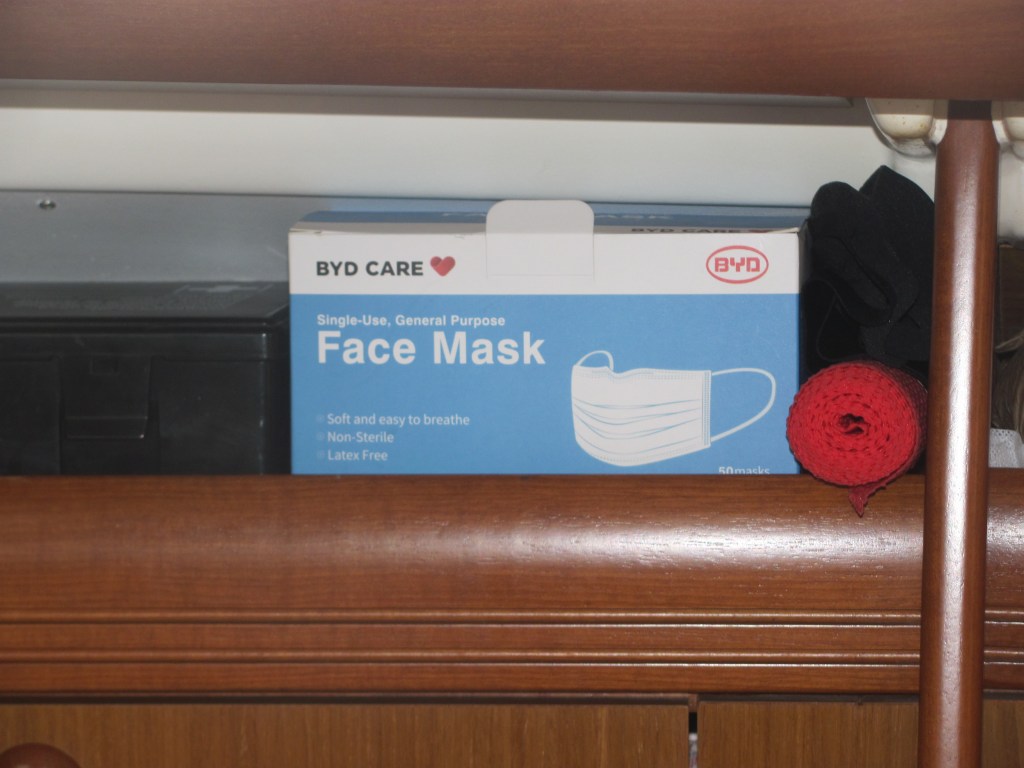
We feel safer out here, away from human contact and the potential to catch the virus from wayward sneezes and coughs. Yet I am reminded by the fate of some of the giant cruise ships at the start of the pandemic – once the virus had taken hold, there was more risk of catching it from others in their floating prisons with little chance of escape. In our case, we can stay away from it while out at sea, unless one of us has it already – although this is unlikely, as neither of us had shown symptoms during the three months of lockdown, and had taken every precaution since. However, we will always have to come in at some stage for water, food and fuel, and then the risk increases. But at least we have our masks and social distancing etiquette!

Our box of face-masks.

We pass Bell Rock Lighthouse off to our port side with the Tay Estuary on our starboard. The lighthouse is another of Robert Stephenson’s, of which we had seen several on our voyages around Scotland. When it was inhabited, communication with the land was by signals sent to and from a shore station in Arbroath, just north of the Tay Estuary. Nowadays, of course, the lighthouse is totally automated. Because of the difficulties involved in its construction – the workmen lived first in a ship anchored close to the rock and subsequently on a hut on stilts on the rock itself – it was included as one of the Seven Wonders of the Industrial World. The number of ships it has saved is huge – before it was built, according to the records around six ships per year hit the almost submerged rock, whereas in the 200 years since it was built, only two ships have sunk.

Bell Rock Lighthouse.

Eventually we sail in close to the promontory of Fife Ness and enter the massive Firth of Forth. At its mouth it is so wide that the opposite shore is just a hazy blur on the horizon, and it will take another three hours before we reach Port Edgar Marina where we will berth for the night. Directly in front of us is the Island of May, formerly the site of a monastery, but now a nature reserve owned by Scottish Natural Heritage. Beyond that is Bass Rock, home to a gannet colony, which we make a mental note of seeing on our way south.

The Isle of May.

As we progress along the Fife coast, we pass small villages spilling down to the sea – quaint names such as Crail, Anstruther, Pittenweem, Earlsferry, Largo, Kinghorn, Burntisland that suggest a rich history that I must look up some time. Many are small fishing villages with their own harbours.

Passing Crail, Fife coast.

At last the three Forth bridges come into view. On our port side, we pass the island of Inchkeith, used in the past as a quarantine station for various diseases and also as a fortress to protect entry further up into the Forth as many of these Forth islands have been in their past. And the site of a lighthouse, built by – yes, you guessed it – Robert Stephenson. Then on the starboard side, a little bit further on is Inchcolm, Columba’s Island, with its impressive looking abbey.

Remains of Inchcolm Abbey.

As we approach the bridges, I suddenly have misgivings as to whether the mast will pass under them. From where we stand it seems that the top of the 20 m mast with its VHF aerial on top is going to collide. The situation is complicated further by a large cargo ship coming downstream and passing just under the bridge as we do, forcing us to steer to starboard where the bridge arch is lower than directly under the middle.

Competition for bridge space.

We slow down and are ready to throw the propeller into reverse if it looks like we can’t make it, while the First Mate stands at the bow to try and gauge the clearance, if any. We needn’t have worried, as we slide under with metres to spare. All a question of perspective. I guess we should have known that a marina wouldn’t have located itself on the far side of bridges that didn’t let sailing boats through!

We squeeze through with space to spare.

Just beyond the bridges we reach Port Edgar, find our allocated berth on the last pontoon, tie up, and finally relax. It’s been a long day.

Tied up in Port Edgar.

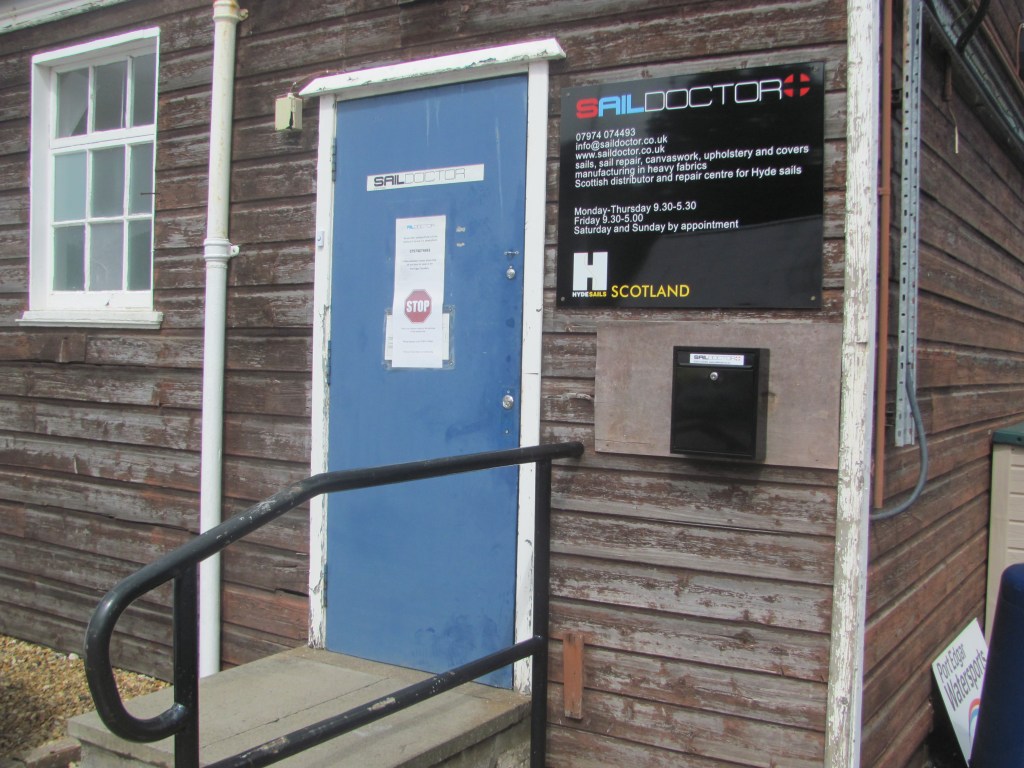
In the morning, I take the mainsail down, fold it up and load it into a trolley, and trundle it along the pontoons and up the steep ramp at the end. In the group of buildings at the end of the pier is an unprepossessing door with a sign next to it announcing the whereabouts of the Sail Doctor. On the door is notice saying that entry is prohibited due to covid-19 and to ring the bell and someone will come. This I duly do, and after a short wait, the door edges open and Chic the Sail Doctor appears.

The Sail Doctor’s clinic at Port Edgar.

I am always surprised how the picture one builds up in one’s mind through talking to people on the phone seldom matches the reality, for me at least. I had imagined Chic to be an older man, tall and somewhat rotund, with thick greying hair. I got the tall bit right, but the rest was completely wrong – Chic was young, thin, and no hair at all.

We discuss the frayed loop, and Chic agrees that it is better to get it fixed now before it causes any trouble. He says that he can have it replaced by lunchtime, so I leave it with him and return to the boat.

The tack loop starting to fray.

“Why don’t we go and get lunch somewhere?”, says the First Mate when I get back.

“Sounds a good idea”, I say. “There’s a place up near the chandler’s that would be handy. What about that?”

“I was thinking of somewhere in South Queensferry”, she replies. “I was recommended one there by the chap who grabbed our lines when we came in. It’s called Bottoms Up, or something like that. I always think that locals know the best places to go.”

We trudge into South Queensferry from the marina. Actually, it isn’t far, but we are peckish and it is hot, and we start to feel sticky. We walk the length of the small village, but there is no sign of anywhere called Bottoms Up, not even a public conveniences. Keeping a two metres distance, we stop and ask a woman on the street.

“No, I don’t know anywhere of that name here”, she says. “But there is quite a good place to eat called Down the Hatch at the marina that I can recommend.

Down the Hatch”, exclaims the First Mate. “That’s its name. I knew it was something to do with drinking. Oh no, we have just come from there.”

“May be that’s the one I suggested”, I say.

“I doubt it”, says the First Mate. “There are several there.”

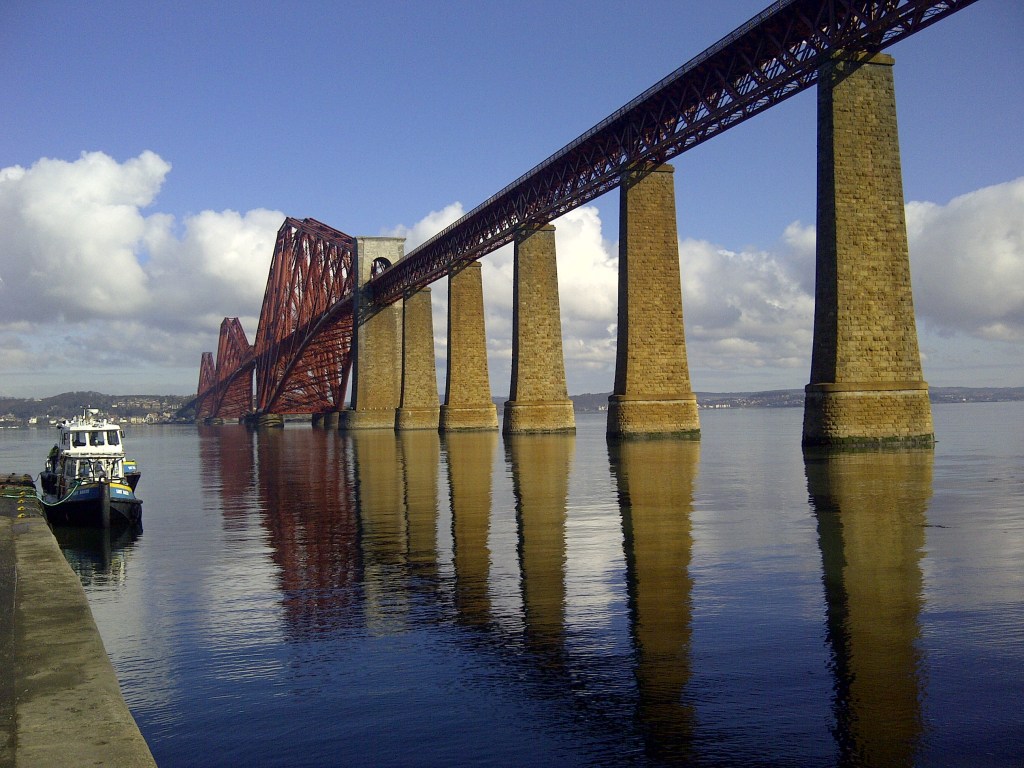
We find a bakery we passed back along the street, buy a prawn baguette to share, and sit down on a seat overlooking the Firth of Forth and the iconic railway bridge. A train rattles over it, dwarfed by the giant girders glowing ochre in the sun. I idly wonder if any of my ex-colleagues are on it. Below us a group of cyclists in day-glo jackets wheel their bikes out to the end of a stone jetty and take in the view. It is stunning.

The Forth Railway Bridge.

Strangely, the seat we have chosen to sit on seems to be in the middle of the footpath rather than at the side. People pass by in front of us, but they are not able to maintain their 2 m social distance. I glower fiercely at each one as a potential source of the virus, but they just look away. Some seem to misinterpret my glower as a smile and smile back. I make a note to practice my glowering in front of the mirror tonight to make it fiercer, and instead stretch out my legs in front of me to make them go around the back of the seat. They just step over them. So much for social distancing.

Once back in the marina, we pass the restaurant that I had suggested. Sure enough, its name is Down the Hatch.

“It looks quite nice”, says the First Mate. “Let’s have lunch there tomorrow.” I keep quiet.

At least the sail is fixed. We trundle it back in the trolley and refit the sail. Everything seems to work perfectly.

The new tack loop attached to its hook inside the mast.

The next day, we arrive at Down the Hatch in time for lunch.

“Have you booked?”, says the girl at the entrance.

“No”, we say. “We thought that we could just turn up.”

“You need to download our app and use that to book”, she says in a way that suggests she can’t believe we don’t know that already. “It will tell you when we have spaces free.”

“What about food to take away?”, we say. “Your sign says you do that too.”

“You need to order your take-away through our app also”, says the girl. “It’s really easy.”

For some reason, neither of us has bought our phones with us, and we are not keen to walk all the way back to the boat to get them. We decide that Down the Hatch is one of the pleasures we are destined to forgo in this life. Perhaps in the next one.

Leaving Peterhead for Stonehaven

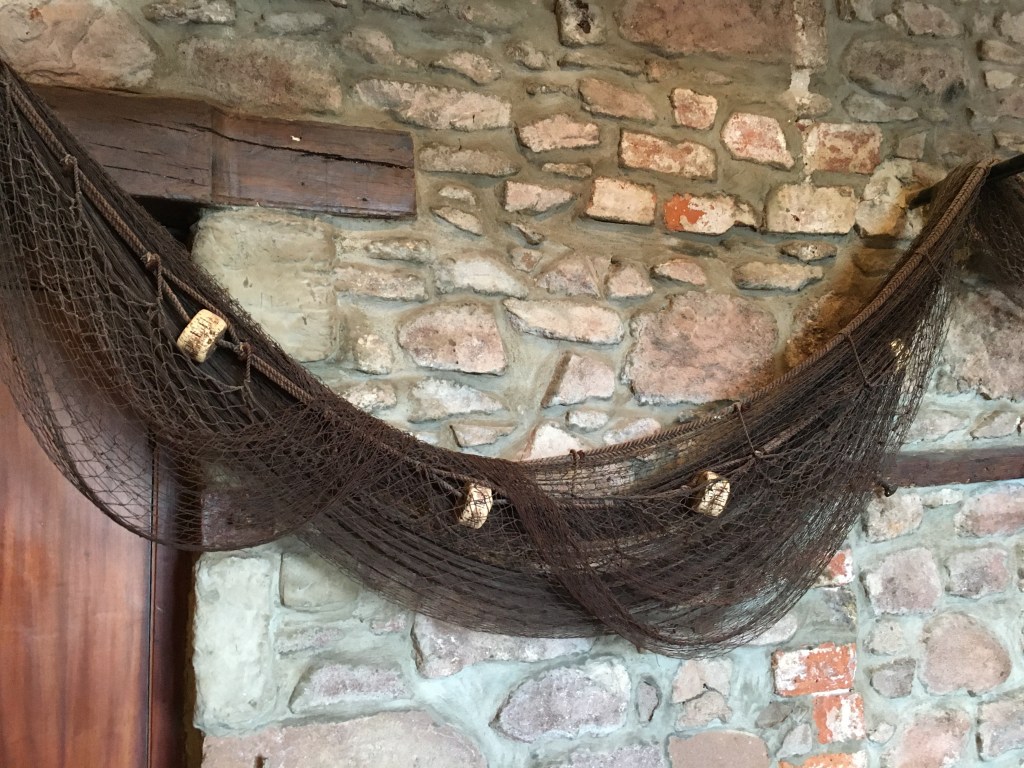
The fishing nets precariously attached somehow to the wall behind us as a decorative effect look as if they might fall down at any moment on top of us. I try to imagine ourselves struggling to free ourselves from the fine mesh and think that might be how a seal or dolphin feels if it gets trapped in fishermen’s nets.

Will we be caught?

We are in the Marine Hotel in Stonehaven for our evening meal. We have just sailed down from Peterhead with our friends Uli and Ian, and are relaxing in a pleasant post-sail lethargy discussing the day’s events. Much delayed, we had set sail on our summer voyage at long last, and they were keen to try their hand at a bit of sailing in the stretch from Peterhead to Stonehaven. They had joined us the night before, staying on board to sample the sailing experience to the full.

Planning the next day’s passage late into the evening.

We had set off at early in the morning at 0600, both to catch the high tide to avoid any depth problems with exiting the marina, and to catch the south-flowing tidal current that started later in the morning and which would carry us all the way down to Stonehaven, adding an extra knot or two to our speed.

Leaving Peterhead harbour.

And then something spooky.

“Peterhead Harbour Control, this is sailing vessel Ruby Tuesday. Request clearance to leave the marina and harbour”, I radio to the Harbour Control people. Peterhead is a busy commercial harbour serving the fishing and offshore industries, and there is a need for coordination of the many boats entering and leaving the harbour.

Ruby Tuesday, this is Harbour Control. When you get within a mile of the harbour, call us again, and we will direct you in”, they respond.

“Harbour Control, sorry, I wasn’t clear”, I say. “We are in the marina and are requesting permission to leave, not come in.”

There is a short delay. I think I can hear the scratching of heads.

Ruby Tuesday, apologies. There is another yacht Ruby Tuesday just north of here and we thought it was her calling. You have clearance to leave the harbour”.

Sure enough, we spot the second Ruby Tuesday on the AIS about five miles north of Peterhead. How much of a coincidence is that? We are aware of only two other Ruby Tuesdays in the whole of the UK beside ourselves, both in England, and one of them has to be passing Peterhead just as we are leaving it. Half-an-hour earlier or half-an-hour later and we probably would not have been aware of her.

Coincidences notwithstanding, it turned out to be a gorgeous day, bright and sunny, with a steady wind from the west and a smooth sea. At 0800 we were passing Slain’s Castle, the inspiration for Brad Stoker’s Dracula, where we decided it was time for breakfast. Over our toast and jam, fruit and yoghurt, and mugs of tea and coffee, we mused over the castle’s history. Apparently, Brad Stoker used to travel from Ireland to visit the Slains area and was there when he started to write Dracula. The story has it that an eight-sided hall in the castle inspired the octagonal Great Hall in the novel. Though set in Eastern Europe, I could see how the ruins of a castle on the bleak Aberdeenshire coastline could give rise to stories of vampires sucking their victims’ blood to gain strength. Momentarily I wondered if I could finish my yoghurt, but the feeling passed.

Slains Castle on the Aberdeenshire coastline (taken on a previous walk).

Further on, we reached the Balmedie windfarm array. Commissioned only in 2018, we had seen this several times from the land as we had driven up to Peterhead to prepare the boat, so it was interesting to see it from the sea and sail amongst the giant turbines dwarfing us. The array is particularly significant as Donald Trump opposed its construction as it interfered with his view of the North Sea from his golf club, but lost the appeal against the local authority. Good on them – at least it shows that the rich and powerful can’t have it all their own way all of the time. Scotland can benefit more from nearly 100 MW of renewable energy being generated than a few elites hitting a ball around the dunes. By all accounts the course is making a loss anyway.

Sailing through the Balmedie windfarm.

Just past Aberdeen, we decided to stop and drift in the current to have our lunch and enjoy the sun. just as we were making ourselves comfortable, the VHF comes to life.

Ruby Tuesday, Ruby Tuesday, this is A-Comms. We see you have slowed your speed and are within range of one of our ships engaged in underwater activities. Would you mind moving on to give it a 500 m berth?

We had seen the ship in question on the AIS, although we had had no idea what it was up to. We were probably already more than that distance away, but we didn’t argue and agreed to move further away for somewhere to have our lunch. We learned later that the ship was laying a cable out to one of the off-shore wind arrays further out to bring renewable energy back to the mainland.

A leisurely lunch drifting in the tidal current south of Aberdeen after being moved on.

Ian had brought his fishing rod with him, and decided to give it a go. It probably took him longer to tie his hooks and sinker on than it did to catch his first fish – within seconds of dropping the line overboard, five silvery mackerel were struggling on the end of it, three small ones and two larger ones. The smaller ones were freed and returned to the depths, while the largest were dispatched and filleted for a future dinner. Over went the line for a second time, and again within a minute or so, another five were hooked. Clearly we were above a school of the creatures, as is often the case in July of each year as they begin their migration northwards.

Trying for dinner.

We had arrived in Stonehaven just on high tide, and had no problems entering the harbour with our 2 m draft and tying up to the outside wall, leaving plenty of slack in the lines to allow for the 4 m tidal range. We didn’t fancy coming back from dinner at low tide to find Ruby Tuesday hanging halfway up the wall, or more likely, all the lines snapped with her floating around in the middle of the harbour!

Ruby Tuesday tied up in Stonehaven harbour.

The fishing nets on the wall behind us in the Marine Hotel have stayed put for the duration of our dinner, and we live for another day. Just as well, as I didn’t fancy the job of extricating ourselves if they had fallen down. We say our goodbyes to Ian and Uli, and they return home while we amble back to the boat.

Later that evening, the First Mate and I sit in the cockpit with a glass of wine and muse over the events of last several months. They had certainly not been the usual run-of-the-mill, to say the least.

First up was my toe operation. For a few years, I had been suffering from a painful toe joint, which had made if very difficult, if well-nigh impossible, to walk long distances. Luckily it could be fixed with a small operation to fuse the joint, although unfortunately it required six weeks on crutches to heal, and another six weeks to build up the muscles again. I was lucky to be able to have the operation scheduled for October with the recovery period from November to January, so that it didn’t impinge on our summer sailing plans. All went well, and I have to say that I quite enjoyed my enforced convalescence as I was able to catch up on reading and writing that I had been meaning to do for years. To match all that, the First Mate started on the process of having new teeth implants. Should we really be sailing in our state, I wondered?

Recovering from the toe operation.

The General Election was next. The slender hopes we had entertained of Brexit being cancelled were dashed as Johnson swept to power with an 80 seat majority. At a stroke our plans of sailing around Europe in Ruby Tuesday were just made significantly more difficult as the UK would now be classified as a third country and British citizens would be subject to the 90/180 rule – only permitted to stay in the EU for 90 days in any 180-day period. Even the boat would only be allowed to stay in Europe for 18 months without attracting VAT again which has been already paid in the UK when it was first purchased. A First World problem, I know, but what are the benefits that will outweigh these steps backward?

Still lots of uncertainty.

To cheer ourselves up, we had booked flights to the Canaries to soak up some sun and to use up Air Miles that would be lost otherwise. The First Mate had been keen to revisit La Gomera where she had spent some time in her younger days when it was the in place to be for German alternative life-stylers. So we had booked an apartment there, had hired a car, had met another couple who had similar interests, and had spent three weeks exploring the island, walking various paths within the rainforest national park covering the central part of the island and enjoying the sandy beaches tucked away at the base of precipitous cliffs. We even managed to squeeze in a day on the way back at the Santa Cruz Carnival, supposedly the largest outside Brazil.

Hiking in the wilds of La Gomera, Canary Islands.

Then came the coronavirus. In many ways, we were lucky, as we had a garden we could potter around in and sunbathe when the weather was good, and lots of paths near the house that we could go for long walks along, perfecting our social-distancing techniques by sidling along one side of the track when anyone approached from the opposite direction. We can now do passable imitations of crab walks. We did a few Zoom quizzes, kept in touch with family and friends by Skype, and did some cycle rides. The only limitation was not being able to get to Ruby Tuesday to do all the little jobs that needed doing on her.

Then the lifting of the restrictions began. Eventually we were allowed to travel to our choice of sports; in our case, sailing, although it was a few weeks before staying on board overnight was permitted. When that eventually happened in Scotland, most of the ports and harbours down the east coast of the UK were already open and receiving visitors, so we were finally able to plan our trip for real. We had decided to abandon going to Shetland and across to Norway and Sweden as had been our plan at one stage, and instead complete our circumnavigation of the UK then cross to France and work our way northwards towards the Baltic that way. But with coronavirus, quarantines, lockdowns and Brexit, who knows what might lie ahead?

Our wine glasses are now empty, and it has been a long day. We stumble downstairs and to sleep.

No wine left!

Peterhead

“We don’t seem to have made much progress”, says the First Mate, emerging from the cabin. “I remember seeing that headland half-an-hour ago and it hasn’t got any closer.”

She is right – it is slow going. I feel somehow that she thinks it is my fault. We need to head almost due east to get to Rattray Point, but with the wind coming from the ESE that just isn’t possible, and we are sailing close-hauled with the wind about 30° off our nose. As a result we are gradually being pushed away from the Scottish coast in the direction of Norway and will have to tack soon towards Fraserburgh if we are to get back on course.

Why is it taking so long to reach that headland?

We had left Whitehills Marina that morning at 0530 to give us enough depth of water to get out before the low spring at 0900 when we would have been grounded again. The plan was to anchor in deeper water just outside the entrance to the harbour for a few hours, have breakfast, then catch the east-flowing tidal flow. The main ebb tide flows down past Wick, heading roughly for Cullen, before splitting into two, with one stream heading westwards in towards Inverness, and the other stream eastwards towards Fraserburgh and around Rattray Head. It was the latter stream that we had wanted to try and catch when it started flowing eastwards at around 1000. All had gone according to plan, except for the wind, which had had a little bit more east in it than had been forecast. We could still sail – it just meant that we would have to tack more often and the going would be slower than we might have liked.

The wind strengthens, driving a band of cloud in from the east, and the temperature drops as Scottish weather reasserts itself. The First Mate goes back down into the cabin.

I think back of the trip behind us. We have been on the boat now for more than three months. The time has passed quickly. I muse on why I see the trip ‘behind us’. I recall a book that I had finished a couple of weeks ago – “How the World Thinks: A Global History of Philosophy”, by Julian Baggini. In it, he questions the Western concept of time – we see it as linear with the past behind us and the future in front of us. It just seems the natural way that things are, but there is no reason why it should be that way. Many other societies see time as circular, with no beginning and no end, which neatly gets around the problem with linear time of what there was before time started. In societies where life was dominated by the cycle of the seasons and there wasn’t a huge number of changes between one generation and the next, I can see this kind of worldview makes a lot of sense.

And still other societies may still see time as linear, but completely the other way around to us – the past is in front of us and the future is behind. My mind goes back to the time I spent working in Zambia where the First Mate and I met. The local people in the north of the country, the Bemba, had this worldview, and I recall several discussions we had trying to understand it. They see the past as definite as it has already happened, and therefore it is better to face it to focus on it and keep memories alive. On the other hand, the future is unknown with no one knowing how it will develop, so it is pointless facing it as it could go in any direction. I thought at the time that this seemed so alien to my own way of thinking, but again there is some sort of logic to it.

We are now opposite Fraserburgh. We tack and head directly for the town, the wind now on our port side. Fraserburgh harbour is very commercial and not particularly welcoming to sailboats, so we give up any idea of stopping there for a break. We approach to within a kilometre from Kinnaird Head with its lighthouse, and then decide to motor directly into the wind, aiming to get around Rattray Head. The tidal current becomes stronger at this point, and we are swept along at 8½ knots by it as much as by the engine. The seas too become quite choppy, churned up by the currents around this extremity of the British Isles.

Passing Fraserburgh.

Eventually we round Rattray Head and turn south. As if to welcome us, the sea becomes smooth again, the clouds clear, and the sun comes out. The wind is now on our port beam and we skim along comfortably on a beam reach, so much more pleasant than the tough beating into the wind that we had been doing for most of the day until now. Ruby Tuesday sails herself, her sails fully out, so we relax for the first time and have our lunch and enjoy the sun. Ham and tomato sandwiches have never tasted so good! I lie down in the warm sun and close my eyes while the First Mate takes over the helm.

The First Mate in control.

But are these different ways of looking at time of any use in the modern world? It seems so obvious that there is a direction of travel and that we are not just going around in circles. There is an unrelenting pressure towards more complexity and innovation – who would argue that there hasn’t been any progress over the last century, or millennium or epoch for that matter? Whether it is all for the better is another question, but certainly there has been rapid change over that time.

And if we dismiss the future as something behind us, and not worthy of focus, how can we plan and achieve things? When we sail from A to B, we need to have a picture in our minds of the route, the conditions along the way, and the final destination in order to plan. All of that is in the future of where we are in the here and now and we are journeying towards it. I suppose we could just focus on where we have come from, and see where the future takes us, but it seems to be a bit of a risky strategy, with sailing at least.

Time is a slippery concept, and it is interesting that all cultures seem to use spatial metaphors to think about it, even though the metaphors may be different. But in reality time doesn’t exist like any of them – those metaphors are just inside our heads. I eventually decide that I still prefer the linear approach to time with the future in front and the past behind, not only because I am most familiar with it, but it also seems to be the most useful. Nevertheless, it is always good to examine one’s own assumptions and think of other ways of seeing things. I make a mental note to give it some more thought when I get a moment.

“What about a cup of tea before we arrive in Peterhead?”, says the First Mate, waking me from my reverie. “We’ll be there in half an hour or so.”

We arrive at Peterhead Harbour at 1730. As advised by the Sailing Directions, we call up the Harbour Authority about a mile away and tell them that we are heading for the marina. Peterhead Harbour is a busy fishing port and also home for many of the supply ships for the oil rigs in the North Sea, so there is a lot of activity.

Arriving at Peterhead harbour.

“Peterhead Harbour Authority, Peterhead Harbour Authority, Peterhead Harbour Authority, this is sailing vessel Ruby Tuesday, Ruby Tuesday, Ruby Tuesday. Over.”

There is a gap of a few seconds, and I wonder if they have heard us. Then a broad Doric accent answers. It sounds friendly.

Ruby Tuesday, Ruby Tuesday, Ruby Tuesday, this is Peterhead Harbour Authority. Good afternoon.”

“Peterhead Harbour Authority, this is Ruby Tuesday, and we are heading for the marina. Request permission to enter the harbour”, I say.

Ruby Tuesday, this is Harbour Authority. Where are you coming from, what is your speed and estimated time of arrival?”

I look down at the instruments and do a quick calculation.

“Harbour Authority, this is Ruby Tuesday. We are coming from the north, we are doing about six knots, and should be there in about 20 minutes”, I respond.

Ruby Tuesday, this is Harbour Authority. Thanks for letting us know. Proceed until you are just north outside the harbour entrance, and then call us again.”

Fifteen minutes later, we are there. We furl the sails and start the engine, letting it idle in neutral. I call the Harbour Authority again to let them know we have arrived, although I am sure they know already.

Ruby Tuesday, this is Harbour Authority. Can you just wait for ten minutes or so? There is a ship just about to leave, and then you can enter”, says the Doric accent.

Not wanting to come off second best with one of the massive supply ships, I put the engine in gear and let it tick over so that we can circle around on the same spot. Before long, we see the supply ship coming out through the entrance to the harbour. It towers over us as it passes, and Ruby Tuesday wallows in its wake like a cork.

Oil rig supply ship leaving Peterhead harbour.

Ruby Tuesday, this is Harbour Authority. You are free to enter now. Come in through the entrance, keep to your left, and head for the green can on the south side of the harbour. The marina is just past that. You will see the entrance to it when you get to the can”, says the Doric accent.

We motor slowly across the harbour, past a magnificent tall sailing ship called Sea Cloud II with a Maltese flag, reach the green can, and turn to the left into the marina. The marina manager, Keith, is waiting for us, and grabs our ropes. We leap off and help him to tie us up to the outermost pontoon where the water is the deepest. This is to be Ruby Tuesday’s home for the winter. We spend the rest of the day cleaning up, sorting out what we need to take home, and treat ourselves to a filling pub meal in one of the hostelries in Peterhead.

The Sea Cloud II, a temporary neighbour in Peterhead harbour.

The next day, our friends Uli and Ian arrive and come down from the car-park to the pontoons where we are tied up. They live not too far away from Peterhead, and have kindly offered to come and collect us and take us back home, saving us a complicated bus ride. It is great to see them again. The First Mate makes a soup and cuts the bread into slices. I clear the table.

Soup and sandwiches in Peterhead marina.

As we eat our soup and sandwiches, we spot the Border patrol vessel motoring out of the marina. It has been tied up at one of the fingers at the other end of the pontoons from us. We joke that perhaps Brexit has happened while we have been away, and that it is off to make sure that we have taken back control of our borders properly. Either that, or it is just practising for when it does happen.

The Border Force off to take back control of our borders.

That evening, we are home again. Everything looks much the same. It’s nice to be back, but we feel a little deflated – our summer voyage from Scotland’s West Coast to its East Coast is now starting to seem like a dream as we try to adjust once more to the normality of everyday life. But we have our memories – Neolithic temples and villages, holy islands, Viking churches and settlements, picturesque canals, magnificent rugged scenery and awe-inspiring wildlife, remote islands, challenging but exhilarating tidal races, and perhaps best of all, we have met old friends and made new ones.

And once again, Ruby Tuesday has looked after us and kept us safe, and taken us to places that we might not have seen otherwise. There is lots of maintenance to do on her that will keep us busy over the winter, as we plan and prepare for the voyage across to Scandinavia when the season starts in 2020. New adventures beckon!

Whitehills

We leave Wick marina at 0630 the next morning to catch the southward tidal flow down to Whitehills. Several of the supply ships are leaving the same time, so we have to call the harbour control on Channel 14 to let them know we are planning to leave too. We edge our way out of the narrow dogleg behind the breakwater and motor out of Wick Bay before hoisting the sails and turning southeast. A fishing boat follows us, and soon passes us.

The narrow entrance to Wick harbour.

After a couple of hours, the Beatrice Offshore Windfarm Ltd (nicely abbreviated as BOWL) starts to show up on the radar. It is the one that we saw Prince Charles opening in Wick. We slow down, debating whether we should go through it or deviate around the side. On the radar the turbines look close together, but in fact each one is 0.9 km from the next one, and I had also read somewhere that the lowest point reached by the rotors is 22 m above the level of the sea. With our air draft of around 20 m, there is plenty of room to go through, although we decide to motor rather than sail just to have more control. Who knows what wind turbulence there might be between the turbines?

The Beatrice windfarm starting to show up on the radar.

I start to read the brochure on Beatrice I had picked up in Wick. At the moment, it is Scotland’s largest offshore wind farm, and is designed for a lifetime of 25 years. Offshore construction began in April 2017, with the first turbine being installed in July 2018 and the last one May 2019. Over its lifetime it is expected to generate more than £2 billion of value for the UK economy, with about half going to Scotland. I muse on what might happen to these figures if Scotland becomes independent after Brexit.

Sailing through the Beatrice windfarm.

There are little platforms at the base of each turbine. On one, we see two workers on the platform at the base and wave to them. They wave back.

Base of one of the turbines.

Once we are through the windfarm we let out the sails again and continue straight to Whitehills. The wind blows steadily and we scoot along on a close reach.

I start to read my New Scientist magazine which has just arrived on my phone that morning. There is an article by Donald Hoffman on the nature of reality. HIs argument is that what we experience with our senses and what is really out there are not necessarily the same things – that evolution has conditioned us to sense things to ensure our survival and not necessarily the ‘truth’. Our perceptions, therefore, may obscure the reality behind things. It’s an interesting article, but hardly a new idea – Plato way back in Ancient Greece suggested that our perception of reality was like living in a cave with a fire burning in it, with people walking around it casting shadows on the wall. If we can only see the shadows, we can imagine all sorts of wonderful shapes and explanations of what they are, but it doesn’t give us any idea of the reality of the people causing the shadows.

But the argument in the article seems flawed. I can accept that our senses have developed through evolution to select for ‘payoffs’ that ensure our survival. However, Hoffman’s next claim that this prevents us seeing reality as it is, I think doesn’t follow. The only evidence he provides are some computer simulations that show that basing selection on ‘payoffs’ rather than ‘truth’ win out every time. I wouldn’t dispute this, but it doesn’t seem to me to prove that the two are mutually exclusive – or that this prevents us from seeing reality. For sure, we know that our perceptions can sometimes deceive us, but usually this is to be safe rather than sorry – the rustle in the bushes might only be the wind most of the time, but in some cases it could also be a lion, so it is better to have the wrong perception often and run to stay alive, than to have the wrong perception just once and stay and be eaten. However, this doesn’t imply that we can never see reality – we could refine our perception by using another sense, such as sight or smell, and arrive at a conclusion a bit closer to reality.

A survey ship crosses in front of us. Is it real, or is it just my perception? I check the AIS and radar screen – it shows up on there too. I conclude that my perception and reality are in fairly close alignment, and alter course slightly to make sure we avoid it. Which makes a point itself – that we have greatly extended our range of perception beyond our five senses through the instruments that we have developed.

Survey ship crossing in front of us. But is it real?

It starts me thinking about what reality is and whether it even exists. It seems that there are two definitions – reality is what is left after you take humans and their artefacts out of the picture, or it is what the basic building blocks are that make up everything. The first of these doesn’t feel very satisfying to me – humans are real, as are the things they make, so why should these be excluded? The second feels more intuitively right, but even with that it seems there are problems. Quantum physics say that things only become real if there is an observer. So if you take a conscious observer’s brain, you can study its constituent parts all the way down to sub-atomic particles. But at that level these are only probabilistic wave functions until they are observed by something, when the wave function then collapses into a particle. So it’s all a bit circular – matter needs consciousness to exist, but consciousness needs matter to exist. Is there any reality independent of our observations? And if there is, how would we know? Perhaps panpsychism has the answer – the two basic building blocks of the universe are both matter and consciousness? Did Descartes have a point after all with his dualism? I make a note to read up more about it when I get a chance.

Fascinating stuff, but it isn’t getting the sails trimmed. The wind has gone around to the north a little, so I let the mainsheet out a smidgen. Ruby Tuesday surges ahead.

We reach Whitehills marina around 1600. I call ahead to the harbourmaster to check where we should tie up. He tells us that it will be to the pontoon in the outer harbour and that he will meet us. Getting in is quite a challenge – there is a narrow channel between harbour wall on the port side and two markers on the starboard side beyond which there is a rocky reef. Once past those, there is a narrow entrance in the harbour wall itself into which we have turn at a sharp right angle, then we are in the small outer harbour.

Whitehills harbour and marina (from their website).

As we gently negotiate all of this, we spy someone on the corner of the wall taking photos, which we surmise is the harbourmaster himself. He later gives us an SD card with the photos for us to transfer to the computer. Apparently he does this to all arrivals. A nice touch, and we finally get some photos of Ruby Tuesday with us both on it!

Ruby Tuesday entering Whitehills marina.

He introduces himself to us as Bertie. He decides to put us in the part of the harbour where it is the deepest, but to do this we have to turn around in the narrow confines, not as easy as it sounds as the width of the clear space is only a little more than the length of Ruby Tuesday. We tie a line to a rear cleat and the pontoon, then motor forward against it with the rudder hard over. She pivots around the line, just clear of the fishing boat tied up on the other side. We then reverse slowly into our spot on the pontoon. Luckily no drama!

Coming through the narrow entrance.

“Right”, says Bertie, a welcoming smile all over his face. “Let me answer your questions before you ask them. Is there a pub? Yes, just 10 minutes’ walk from here. Is there a restaurant? Yes, that building just up there in front of my office. Is there a fish and chips shop? Yes, just before you get to the pub. Is there a grocery shop? Yes, just opposite the fish and chips shop. You can stay as long as you like. Now, if there are no more questions, we can just do the paperwork.”

The formalities over, we sit and have a cup of tea. I calculate the height of the tides in the harbour by taking the current depth reading, then using the maximum and minimum depths in the tide tables for that day to calculate the range, then to work out how much lower the water will drop to at low tide. Unfortunately, it is right on spring tides and my calculations show that we will have about 5 cm under the keel at low water tonight, but at low water in the morning, Ruby Tuesday will be resting on her keel, 25 cm out of the water! We hum-and-ha about this, but in the end decide that she spent all winter resting on her keel while ashore, so a short time here shouldn’t do any harm. Bertie assures us that the bottom is silt and mud, no rocks, so the keel may well sink into it a bit. In any case, she will still be in some remaining water which should take most of the weight.

Ruby Tuesday sitting on her keel. The line of weeds indicate the normal waterline.

That evening, we have a drink in the Seafield Arms, then eat in the Rockfish fish and chip shop that Bertie recommended. We haven’t eaten much all day so we are ravenous. Luckily the portions are generous and we feel full.

RockFish fish and chip shop (from their website).

As we waddle our way back to the boat we pass some open garage doors on the side of the road. Inside are two shiny beautifully restored cars – a Morris Minor and a BMW Series 6. The owner is standing outside having a cigarette.

“Lovely cars”, I say.

“Thanks”, he replies. “They’ve cost a bit of time and money over the years. But it’s my hobby, so what does it matter?”

“My first car was a Morris Minor”, I say. “Good cars, even though it was a bit underpowered. Drove it until it fell apart. Not surprising, the way it was treated, I suppose!”

We discuss old cars for a bit. The First Mate becomes bored and continues back to the boat.

“I used to drive wedding cars and coaches for a living, you know”, says the garage owner. “I have taken coach parties all over the UK, I have. Always had full coaches too. The most we did on one week once was from here to Thurso and back, then from here to Cornwall a couple of days later.”
The conversation turns to Brexit. Which one doesn’t these days?

“I can’t wait to get out”, he says.

“Why’s that?”, I ask.

“Most of my mates here are fishermen. We have to stop those European boats coming over here and taking all our fish somehow”, he explains. “They are just ruining the industry here, you know. Our boats have to go further and further out, just to catch the same amount.”

I mention that this doesn’t seem to have stopped some fishermen becoming extremely well off.

“Aye, that’s true”, he says. “Some of them have done pretty well for themselves. There’s one chap I know – just retired and has build a house for £4 million, not far from here. Good luck to him. There’s a lot of money where all the fishing is, in places like Peterhead.”

What will happen to fishing after Brexit?

“But what about markets?”, I ask. “Most of the boats we have seen on our voyages all sell their catch  in Europe. It’s almost impossible for us to buy fish off boats directly these days – all the catch is under contract to the Spanish and the like. If we cut off those links, who will they sell to?”

He looks for a moment as though he hasn’t considered that angle before. “Aye, well there is that”, he says. “We’ll be looking to our politicians to develop new markets for us.”

I wonder if this whole thing has been thought through properly. Putting your trust in the current crop of politicians doesn’t sound the wisest business strategy. It can take years to develop new markets. And what happens in the meantime? And all for what purpose anyway?

Later I realise that he is only the third person that we have met on our trip both last year and this year who admits to being in favour of Brexit.

“Of course, yachties are probably a bit better off than average, and have travelled more, so are more likely to want to Remain”, I hear you say. But I remember seeing a pre-referendum poll in 2016 amongst the yachting fraternity in which the split was 48% to 52% Leave to Remain, not that far off the national result.

Poll in YBW forum in June 2016.

In any case, many of the people we have talked to haven’t been yachties. Why are we not meeting any Leavers anywhere? It’s weird.

Wick

“Urrrrgggh”, says the First Mate. “I don’t feel very well. Urrrrrrrgggghhhh!”

“Shall we have a bite of breakfast?”, I say hopefully.

“Urrrrrggggghhh”, she says again. “Don’t mention food to me at the moment. Can you bring me one of the buckets?”.

The First Mate feeling a bit sorry for herself.

We had left East Weddel Sound at 0500 that morning to catch the south-flowing tide to take us almost all the way to Wick before it turned northward again. In the Sound it had been sheltered and the water relatively calm, but once we had gone beyond the point of Burray Ness, the full force of the swell that had been building for the last four or five days from the easterly winds had caught us on the beam. Even though the wind had now gone around more to the north-east and wasn’t particularly strong, the swell had persisted and Ruby Tuesday had wallowed each time one of the long waves went underneath us. Even I started feeling a bit queasy.

Wallowing through the swells.

I bring one of the buckets to the ailing First Mate. “Urrrrrrggghhhh”, she says into it. I look the other way.

My hunger eventually gets the better of me, so I put the wheel onto autopilot and go downstairs to get a bowl of muesli, fruit and yoghurt. I bring it back to the cockpit and tuck in. I feel a bit less queasy, at least.

“Are you sure you don’t want any?”, I say. “I can make you some. It may help you. I feel better already.”

“Urrrrgggghhh”, says the First Mate. I take that as a no. Poor old thing – it isn’t much fun being seasick, but there isn’t much I can do.

The wind freshens and we skim along nicely on a broad reach doing about 7 or 8 knots. In the distance we can see the Pentland Skerries and give them a wide berth to avoid the overfalls and eddies that the CCC Sailing Directions warns about. After some time, we alter course to the south west to head directly for Wick.

Our track from Orkney to Wick.

The problem now is that the wind is directly from behind and the genoa flaps uselessly in the shadow of the mainsail. I decide to goosewing, and pole out the genoa to one side and the mainsail to the other to present as much sail area to the wind as possible. I clamber on to the foredeck to rig a preventer line to stop the boom from gybing – swinging uncontrollably from one side of the boat to the other very quickly – when a gust of wind catches the sail and the very thing that I am trying to stop happens – the boom whizzes across, and although it misses me, the mainsheet catches the side of my face and whips my glasses off and grazes the skin, drawing blood.

“Be careful!”, calls the First Mate from her sickbed.

It’s good advice, but looking at her with blurred vision and blood dripping down one side of my face, I wonder if its timing could be improved on. Luckily my glasses are hanging from my neck, albeit sad and bent. Since losing my previous pair of glasses overboard in Foley harbour last year, I have taken to wearing one of those little neck cords attached to my glasses to stop the same thing happening again. At least it has worked this time.

I clamber back into the cockpit as best I can. With the wind now behind us, the wallowing is less, but the pitching from bow to stern is more. We carry on at a reasonable pace until the coastline of mainland Britain comes into view. We are through the infamous Pentland Firth!

Goosewinging our way to Wick.

Then the wind stops altogether. Not a breath. I hope that it might just be a temporary lull, but unfortunately that seems to be it for the foreseeable future. We switch on the engine and motor the last few miles to Wick. As we approach, I realise that the First Mate is still in no state to help and I am going to have to tie up at the marina by myself. Getting in to the marina should be no problem, but docking is much easier with two people – one to keep the boat under control and the other to handle the ropes and tying up. I may have to do both. I radio ahead on the VHF to the pontoon manager to see if there is someone who can assist. In the meantime, I get the fenders tied on and the mooring lines ready.

There is no answer from the pontoon despite my calling several times. Then suddenly there is a voice.

Ruby Tuesday”, the voice says. “This is supply ship Rix Lynx. The marina manager is usually not here on a Sunday. Perhaps I can help?”

I ask him if there are places left for visitors at the pontoon.

“We are actually in the harbour itself, but looking across to the marina I can see some spare spaces”, says Rix Lynx.

“Will there be anyone there to help me dock?”, I ask. “I have a sick person on board and am essentially single-handed.”

“There seem to be some people around. I am sure they would be happy to give you a hand”, says Rix Lynx.

I decide to go for it. The water is much calmer inside the breakwater, and we take it slowly as we turn a sharp right angle into the outer harbour and then a left into the marina. On the way, we pass Rix Lynx, and wave to her. I am not sure if anyone sees us. There is a space next to a boat with a Norwegian flag. More Vikings, I think. But they hear us arriving and come out to help, and soon we are tied up. Back on dry land, the First Mate shows a speedy recovery and is soon in conversation with the Norwegians. They are very friendly, and I wonder if Vikings just have a bad press. It’s been a long day, so we decide to relax in the cockpit in the sunshine and have a glass of wine.

Tied up in Wick marina.

I hope ya don’t mind, I hope ya don’t mind ….”, sings a crewman on the offshore supply ship opposite us, sponging its windows. I briefly wonder what he did with the money that his mum gave him for singing lessons, as it is not clear if even Elton John would recognise the song, but I decide it is the mood behind it that is the most important. He sounds happy. Even the local cormorant seems to like it.

The local cormorant enjoying Elton John.

There are several supply ships tied up around the harbour. It seems that Wick is reinventing itself as the centre for the offshore renewables industry after the catastrophic decline in the fishing industry over the last century or so. Everywhere we look there are gleaming hi-tech ships bristling with all the latest gadgetry to take people and material out to the windfarms. There are still some small fishing boats dotted here and there, but the harbour really belongs to the supply ships and leisure craft such as ourselves. A sign of the times.

High speed supply ship for taking people out to the wind turbines.

That ah put down in words/How wonderful life is while you are in the world”, finishes the crewman sponging the windows, tidying up his buckets and brushes. A foghorn suddenly seems quite tuneful.

Beautiful clean windows.

I walk into town the next morning to the opticians to see if they can straighten my glasses. On the way into town, I see a familiar face. It is Prince Charles. It seems that he has turned up to open the new Beatrice wind turbine array in the sea out to the east of Wick.

Prince Charles.

After shaking the hands of the dignitaries lined up at the door of the Beatrice building, he comes over to have a chinwag with the commoners.

When he gets close, his face lights up with recognition. “Well, well, well. If it’s not the Skipper!”, he says. “I wondered if I might see you here. How’s Ruby Tuesday? I read your blog avidly, you know.”

“We are fine, thanks”, I say. “The First Mate was a bit peaky yesterday when we were crossing the Pentland Firth. But she’s OK now. Off doing some shopping at the moment, I think. She’ll be sorry she missed you.”

“Pentland Firth, eh?” says the Prince, stroking his chin thoughtfully. “I have heard that it is pretty challenging, isn’t it? Anne’s always going on about doing it in her boat one day, but I don’t think that she has yet. Not my cup of tea, really. Speaking of tea, what about if I come down later to Ruby Tuesday for a cuppa after all this snipping of ribbons, and you can show me around and tell me all about it. I particularly enjoyed the bit where you were talking to the sheep on Scalpay, although I did wonder if you had taken leave of your senses there for a moment. But, well, I often talk to my plants to keep me sane, so I suppose it’s not really all that different, is it?”

“It’ll be a pleasure”, I say. “But we only have Earl Grey. The Darjeeling ran out last week, and the First Mate wasn’t able to find any in Asda yesterday. By the way, I hope Earl won’t be below your rank?”

“Well, yes, it is actually, but don’t worry, I will overlook it this time”, he says with a guffaw. “See you later.”

Prince Charles having a chat.

I am jolted from my Mitty-dream back into the real world by a rather large lady jostling my elbow somewhat intimately. “Well, that was lovely, wasn’t it?”, she says.

I assume she means seeing Charles and not the jostling, so I nod in agreement. “But I’ll have to wash the mugs now”, I say. She looks at me as if I have escaped from somewhere and hurries away. Probably to find some men in white coats.

I find the opticians and they straighten my glasses.

“You look like you have been in the wars”, says the lady. “Ah yes, just those pesky Vikings again”, I joke. She doesn’t know whether to take me seriously or not.

I should have gone to ….

In the afternoon, we explore the town. In fact, Wick is actually two towns – the original town of Wick and the newer Pulteneytown. Wick has been around for a while – since the Iron Age at least – and gets its name from the Norse word for bay, vik, as does the word Viking itself. It became a Royal Burgh in the 16th century. Pulteneytown was built in the 19th century by the British Fisheries Society to house crofters fleeing from the Clearances looking to capitalise on the herring boom.

The Heritage Museum gives a good history of it all – its Johnson Collection is a fascinating archive of photographs taken by three generations of the local photographic business from 1863 to 1975. Like many towns we had visited, the story goes (and the pictures show) that there were so many fishing boats at one stage, it would have been possible to walk across them from one side to the other without getting your feet wet.

Wick in its heyday.

Unfortunately, the herring boom collapsed after WW1, partly due to overfishing, change in tastes, loss of markets during the war, and dereliction of the fishing fleet while the men were away fighting. The industry never really recovered and since then the town has gone into decline. There is a sadness as we explore the streets – many shops and houses and boarded up or unoccupied, the streets are uncrowded, so different from what it would have been like in its heyday.

Main street in Wick.

There are efforts at revival – the harbour is a focus for the wind-farm industry and leisure sailing fraternity, and the town centre has been renovated. However, we read in the paper that one of the main pubs, Weatherspoon’s Alexander Bain, is up for sale, which will be a major blow. Alexander Bain was a local lad and the inventor of the electric clock. Hopefully, the new owners will keep it going, as its good value food and drink provides a much-needed social focus for the town.

Further on, we see one of the residents trying to keep the old traditions alive by catching fish from the bridge over the river. The First Mate tries to advise him that his line is on the wrong side of the parapet. For some reason he is not very responsive.

The Wick style of fishing.

“Perhaps he is embarrassed by being told how to fish by a visitor?”, I say.

Further on, we come across a set of steps leading up to Pulteneytown. The First Mate points out a plaque on the wall saying that these were the steps that provided the inspiration to L.S. Lowry, the well-known painter of industrial landscapes, for one of his paintings. It seems that this particular one was painted in 1937 and had remained hidden for 20 years, but was rediscovered in 2013 in Edinburgh. It sold for nearly £900,000 at auction at the time. Not a bad little earner!

Black Steps in Wick, by L.S. Lowry.
And the real thing!

“Apparently not all of Lowry’s work is known, and there may be several of his paintings still out there”, says the First Mate.

“I’ll make a note to check in our attic when we get home”, I say.