Dover to Eastbourne

The sails fill and Ruby Tuesday surges forward. We are on our way again.

Leaving Dover at last.

The furler swivel had arrived the day before and Sean the rigger and his ‘little helper’ Dave had come during the afternoon to fit it to the masthead. As someone with not too much of a head for heights, I have to say that I have the utmost admiration for anyone that can climb to the top of a mast swaying from side to side in the wind. The forestay had also been replaced due to damage to it from the seized swivel. The only thing remaining was for us to rehoist and refurl the genoa the next morning as it had been too windy to do so straightaway.
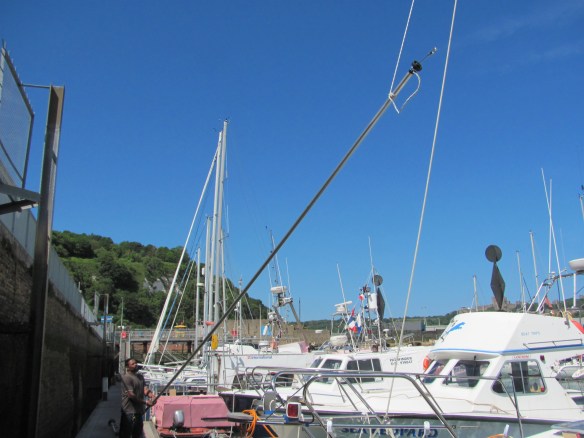
Raising the forestay and furler back to the top of the mast.

Dave was chatty. He lived in the Philippines on the side of Mount Pinatubo overlooking Subic Bay, the American military base, but he was back in the UK to sell his boat so he could buy a new one out there. While he waited for the many offers for his boat to flood in, he was giving his old friend Sean a hand winching him up and down masts. His partner was a Filipina and owned the house that he lived in. He himself had been in the merchant navy, but had done a lot of other things since then, and was now retired. He had a son from a previous marriage, now at the University of Cambridge. We had something in common, as we had also lived in the Philippines for two years, at Los Baños, south of Manila, where our own son had been born. We had once visited Subic Bay on the way back from the Banawe rice terraces, although then it was just after the 1991 eruption and much was still covered in ash. Now everything is green again, Dave tells us.

Dave and Sean, our riggers.

Strong winds from the southwest had been forecast for the following day, so we decided to take advantage of the last of the easterlies that we had enjoyed for the last month, and had left Dover in the morning. It wasn’t ideal from the point of view of the tidal flow, but we wanted to make it to Eastbourne in the daylight rather than arriving in the near dark. As a result, the first two hours had been motoring against a strong northward current, before the tide turned again to carry us southwards towards our destination, allowing us to cut the engine and hoist the sails.
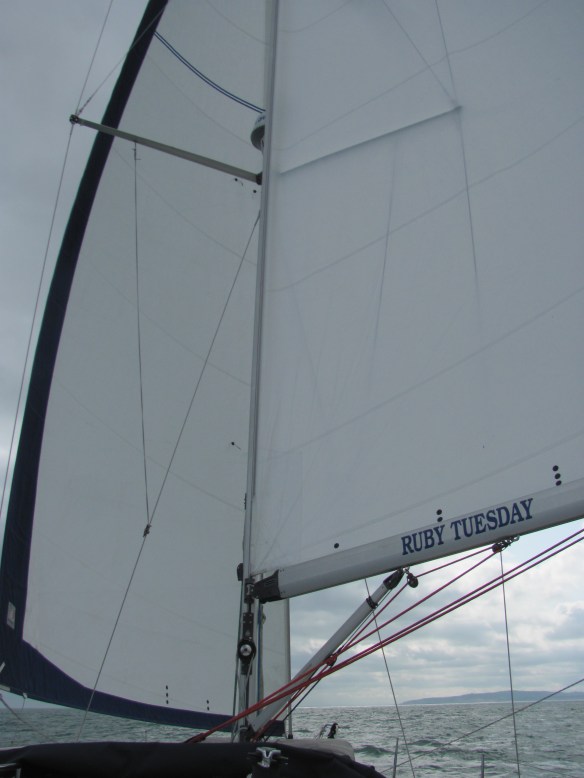
Running before the wind down to Eastbourne.

The wind is now directly behind us. We rig a preventer to the boom to stop any accidental gybes, and goosewing for the rest of the journey to Eastbourne. Before long, we are passing Dungeness Point with its two nuclear power stations. The stony beach in front has several fishermen trying their luck casting into the surf for cod. Some have put up little tents to provide shelter from the wind. We take care to clear the cardinal buoy warning us to keep south of the shoal that extends out from the beach.
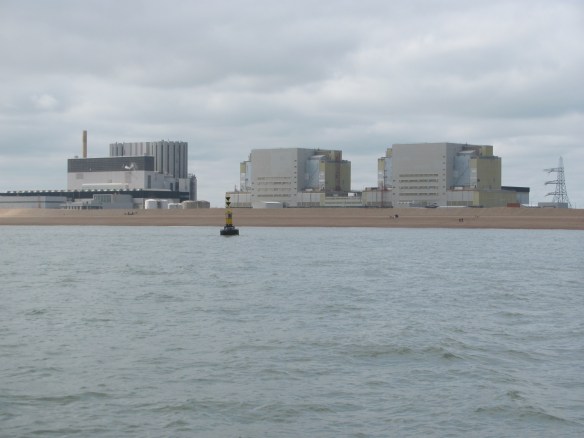
Passing Dungeness Point.

Further on, we pass Rye, Hastings and Bexhill, while off to our port is the distinct shape of the Royal Sovereign Lighthouse. Otherwise, we are alone on the sea. I had thought that there might be more boats around, particularly in comparison to Scottish waters, but we see very few other yachts, and only the odd motor boat and fishing vessel passes us. Still, I suppose there is time enough; we are not in the Solent yet.

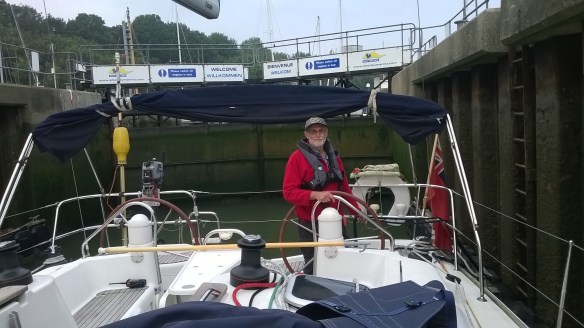
We arrive at the Sovereign Marina at Eastbourne at around 2000. At the red and white buoy we call the marina on the VHF and are guided in to a holding area in front of the two locks into the marina. Soon it is our turn, and we enter the lock along with another fishing boat that has appeared from somewhere behind us. A smiley lady comes to welcome us and take our details and tells us where to find our berth. It’s been a long day, but good sailing.

In the lock entering Sovereign Marina, Eastbourne.

 

A Busman’s Holiday and a Sandwich Deal in Kent

“This junction is really dangerous in the winter”, the man sitting in the next seat says to us.

“How do you know?”, asks the First Mate.

“I am a bus driver, and do this route often”, he explains. “One time I was coming down here, and the road was all iced up. I braked and nothing happened – the bus just carried on across the junction and up the road on the other side.”

“It’s lucky this is just a country lane and there is not much traffic”, I say.

Our off-duty bus driver agrees.

We are in a bus on a round trip from Dover to Deal, Sandwich, Canterbury, and back to Dover. We had decided to explore a bit of Kent while we wait for the boat to be fixed and so had bought a cheap Rover ticket that entitles us to visit all three places. It reminds me a bit like a lunch you might buy at Tescos.

Exploring Kent by bus.

We had just done Deal – walked along the beach, seen the Time Ball tower, and explored the shopping area. I had been interested to see the place, as part of the Stonor Eagles written by William Horwood on the sea eagles of Scotland that I had read on our boat trip around Skye had been set there. In the book, it seems to be a lonely bleak place, and I can see how it could be that in the winter, but at the moment there is life there as the town awakes on a Sunday morning.

The old Regent Cinema in Deal.

We had then caught the next bus to Sandwich where ‘Le Weekend’, the annual French market day, was on. The off-duty bus-driver is also going, along with his wife sitting on the other side of him. They go every year. He begins to tell us of things they had seen in previous years.

The bus tries to turn a tight corner in small village, but a car with a trailer blocks the way, and the driver is unwilling to reverse.

“He will have to go back, you know”, says our off-duty bus driver. “It’s against the regulations for buses to reverse.”

Looking at the face of the car driver opposite, I am not so sure, but the off-duty bus driver is right. The car driver backs up his trailer quite a way along the single lane round until he finds a passing place. The bus squeezes past with literally inches to spare. We all breathe out again. Further on, the branches of a low hanging tree scrape along the roof of the bus.

“The roofs have to be repainted every year, you know”, says our off-duty bus driver.

I am beginning to see that there is a lot more going on in the bus driving world than I had imagined.

We arrive in Sandwich. A lot of French flags are flying, and accordion music is coming from one of the market stalls. Many people are speaking French, from which we deduce they actually are from France, not Sandwich. It’s not far from here after all. We explore some of the market stalls and admire the many different types of sausages, meats, cheeses and preserves on display. Further on a stand has been erected in the square on which a single musician plays an accordian. It is certainly all very French. William the Conqueror would have been proud.

Jam for sale.

After lunch, we catch the bus to Canterbury. We try and visit the Cathedral, but it is closed to viewing due to renovations, and we have to content ourselves with seeing it from the outside through all the scaffolding. We wander back through the city and visit the Beaney House of Art and Knowledge with its eclectic but interesting collection of artwork, objects and memorabilia from around the Canterbury area. A gentle stroll around the city walls brings us back to the bus station, where we board a bus back to Dover. There are no off-duty bus drivers on this one, unfortunately, so we make our own commentary.

Facial sculpture, Canterbury.

A boat from the Bronze Age

We peer through the glass case at the boat from the Bronze Age, around 3500 years old. We are in the Dover Museum, where the Bronze Age boat has a whole floor devoted to it. Discovered in 1992 six metres below the streets of Dover while a road was being built, it is remarkably well preserved. Almost 10 m long, its planks, black from the silt in which it laid for so long, are of oak lashed together with yew branches tightened with wedges. However, it may well have been significantly longer than this as not all of the boat could be excavated without making some existing houses unsafe. We are awed to think that this boat could have been longer than Ruby Tuesday and capable of going to sea. It was about this time that tin had been discovered in Cornwall and was being exported all over Bronze Age Europe, so perhaps it had been involved in that? Are we sailing the same routes that it had?

The Bronze Age boat in Dover Museum.

We read that the boat might have been purposely laid to rest in a small tributary in the River Dour, which still exists although today is no more than a small creek. What sort of people had used the boat, we wonder? What was their world like, what did they think about, what did they worship, and did they believe in an afterlife? Why had they laid the boat to rest? It must have had some special significance for them to have done so. Perhaps it was an appeasement to some long-forgotten river-god? Or had the owner of the boat, the chief perhaps, died, and it was thought appropriate to bury his boat at the same time, a little bit like the boat burial at Sutton Hoo that we had seen earlier?

A Roman Painted House, Channel Swimmers and White Cliffs

The Roman centurion swallows hard and orders his men to begin demolishing the wall of the inn house. He had stayed in it many times and had many good memories, and it is sad to think that it would soon be no more. The walls, in particular, the plaster murals of Bacchus and his mates, which had provided a backdrop for many a good drinking session, he feels bad about. However, he has been given orders to build the new fort here, and orders are orders, especially if they help to keep those pesky Saxons away. An idea occurs to him – perhaps he can just take down enough of the inn to build the wall of the fort through its middle, and leave the two halves intact on either side of the fort wall. That way, someone, in fact possibly two families, could still enjoy living in it. He tells his men to take away just the stones that are necessary …

My mind snaps back to the present. I am in the Roman Painted House in Dover, and am trying to imagine what might have happened to produce this remarkable ruin. Looking down from the modern balcony built around it, the five rooms of the house, the remnants of the painted Bacchanalian scenes on their walls, can be clearly seen, as can the underfloor heating ducts, and bizarrely, the wall and buttress of a fort that seem to have been pushed right through the middle of the house later on. Ironically, it seems that it was the building of this fort as part of the ‘Saxon Shore’ around 270 A.D. that might have helped preserve it – much of it was covered in rubble from the wall and protected from the ravages of time.

Part of the Roman Painted House, Dover.

Emerging, we walk up to the White Horse pub, and over a drink read some of the hundreds of inscriptions on the walls of people who have swum the English Channel. We find that of David Walliams, the comedian, and that of an unknown Australian woman who swam it not once, not twice, but three times, with only a 10 minute break in between each one! A fascinating record of many personal triumphs.

The White Horse Inn, Dover, with Channel swimmer inscriptions.

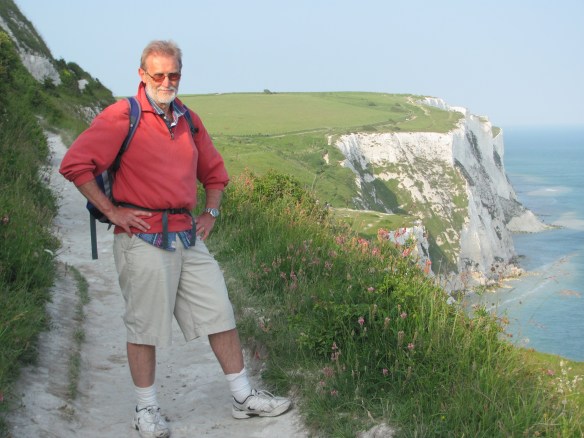
From there, we follow the walking route along the dual carriageway, then through narrow little streets, passing the ‘Last Pub in the Civilised World’, eventually arriving the top of the White Cliffs. We sit for a moment to gain our breaths at the National Trust café, which is closed now, and watch the stream of ferries coming and going into the harbour below, the same harbour we came through on our first day. A small yacht seems to be sailing around in circles in a quiet part of the harbour, presumably practising. Everything seems to run like clockwork, but we wonder what it will be like following Brexit. We continue on past the café and reach the viewpoint overlooking Langdon Bay. An Australian family there take our photos, and we reciprocate. They are travelling around Britain by car, and so far are enjoying every minute of it, but are finding it a bit cold. We tell them jokingly that this is as good as it gets.

White Cliffs of Dover, overlooking Langton Bay.

Ramsgate to Dover

We had planned to catch the tide the next day for the long run down past Dungeness Point to Eastbourne, a distance of about 70 NM, leaving around 0800. However, once again, the fog intervened, and at the planned time of departure we found ourselves hardly able to see the boat next to us. We had a leisurely breakfast wondering whether it would lift, and sure enough around midday it did. It was too late to reach Eastbourne in reasonable time by this stage, so we decided to go for Dover, and do Eastbourne the next day, so that at least we would shorten the leg by about 20 NM.

Off we went, and we managed to catch the southward tidal flow so that we were helped on our way by a 2 knot current. Unfortunately, we found that we still couldn’t unfurl the genoa, so clearly something was stuck at the top. We would have to have it looked at when we arrived in Dover. We tried sailing with the mainsail only, and made reasonably progress, particularly with the following wind and favourable tide, before eventually switching to the engine.

Sailing from Ramsgate to Dover.

Before long we were passing the White Cliffs of Dover, and called Dover Port Control on the VHF to tell them of our impending arrival. We were instructed to wait in a holding area just outside the eastern entrance to the harbour until there was a gap in the many ferries arriving and leaving. Eventually it was our turn, and we were given a route to follow through the ferry area until the Prince of Wales dock, then into the Granville Marina which, although we didn’t know at the time, was to be our home for the next few days.

Passing the White Cliffs of Dover.

After completing the formalities, we found the local rigger, and told him of our problem with the foresail. A hour later, he was at the top of the mast to investigate. The news wasn’t good – the swivel had seized – they only have a life of ten years, and ours was already eleven years old, so it perhaps wasn’t surprising, particularly as the boat hadn’t been used very much in the last few years. The part would have to be ordered, and he would then have to fit it. It could be three or four days before we could get going again. Disappointing as it was, there wasn’t much we could do but plan what we wanted to see in Dover.

Checking the foresail furler.

The Smack Boys of Ramsgate

We are sitting in Peter’s Fish Factory on Harbour Parade in Ramsgate eating our fish and chips with our new friends Graham and Alison. The walls of the shop are covered in posters identifying almost every fish that exists, not only in English, but German and French as well, so that we are well informed on what we might be eating. Graham and Alison are our temporary neighbours on the pontoon in the marina, and have just returned from France in their tiny 18-foot boat that they have had for forty years. They live in Gillingham but keep the boat here in Ramsgate. We think they are terribly brave to cross the Channel in something so small, but they tell us that they do it every year. Nevertheless, Alison confides that she was a bit nervous this time because of the fog and the number of ferries that follow the same route to Calais and Boulogne. They are going to stay one more night on the boat and go home in the morning.

Clock House, housing the Ramsgate Maritime Museum.

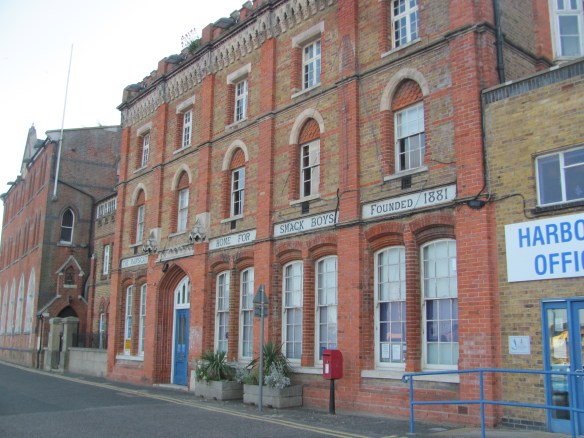
We walk back to our boats past the impressive Clock House housing the Ramsgate Maritime Museum, along Harbour Parade, passing the many bars that are now starting to fill up with young folk dressed in their evening finery. It is Saturday night after all. One group sings raucously at the top of their voices to celebrate one of their friend’s birthday. Further along, someone drops a wineglass that shatters into pieces on the footpath. Briefly, people look disapprovingly, then resume their conversations. There is a brashness about this part of Ramsgate, and we are not sorry to eventually reach the quieter Military Road running alongside the marina, old fuddy-duddies that we are. On the other side of the road we notice a brick building with the intriguing name of “The Ramsgate Home for Smack Boys, Founded 1881”. Is it some sort of corrective institution for heroin addicts?, we joke. Later Mr Google tells us that it was built to house the young apprentices of the fishing smacks that were based in Ramsgate. Many of the boys were from the workhouse and some were as young as ten. We tried to imagine what life must have been like for children forced to work in a tough industry at such a tender age through no fault of their own. The past is not always a golden age, as some current politicians would like to think.

The Ramsgate Home for Smack Boys.

The next morning, the marina is a hive of activity. The weather forecast is good and racing is planned. Many of the boats deserted the night before now have their crews on board, each wearing the coloured t-shirts specific to their team. We have a leisurely breakfast in the cockpit in the sun and watch the goings on. Then the wind drops right off and there is a hiatus while the teams consider what to do. We talk to one of the ones next to us, and they offer to help with our foresail problem. The genoa halyard is too tight, they tell us, meaning that the rotary mechanism at the top isn’t turning properly, instead dragging the halyard around with it, then jamming. We loosen it off, let the halyard unwind, then rewind the genoa, and retension the halyard. It seems to be fixed, and we thank them gratefully. Shortly, the wind comes again, and they are off, jostling with the other boats to leave the marina. We hope they win their race, but don’t see them again.

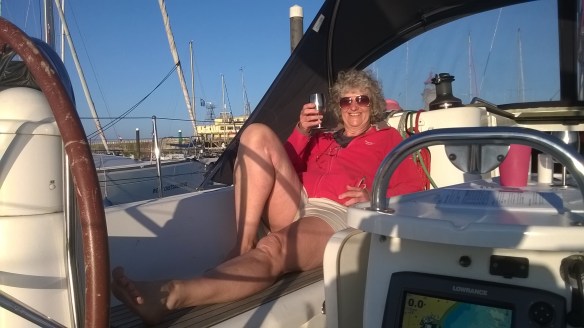
Relaxing in the sun in Ramsgate Harbour.

On our way at last

The first leg of our planned voyage was from Shotley Marina to Ramsgate, a distance of around 50 NM. We had no idea of the average speed of Ruby Tuesday, but guessed it might be about five knots. That would mean a passage time of 10-11 hours, the better part of a day. We also had to take into account the tidal race around North Foreland near Margate and try and catch the flow as it turned southward to avoid a battle against the current. The further complicate matters, we couldn’t exit from the sea-lock at Shotley Marina within an hour each side of low water.

Doing all the calculations meant that we had to leave around 0530 in the morning. Not able to sleep much that night due to the excitement of our impending trip, we rose early, only to discover that we were surrounded by thick fog rolling in off the Channel. Worse still, according to the forecast, it would stay around for most of the morning. Even though Ruby Tuesday had radar we were not too keen on taking a boat new to us though heavy shipping lanes in the fog, so our passage plan now in ruins, we decided to wait until the next day and try again.

Leaving Shotley Marina sea lock.

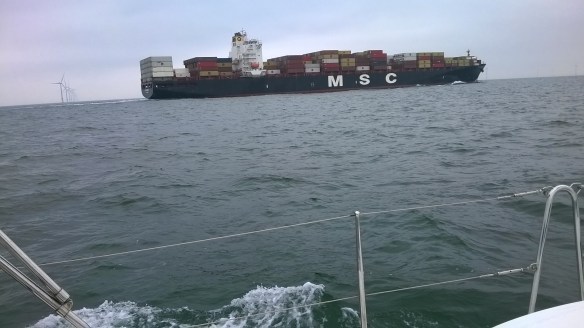
The fog went in the afternoon but returned overnight, and continued this pattern for the next three days. By this time we had explored most of Shotley and Ipswich, and were becoming more and more frustrated. Luckily, Saturday morning arrived with no fog to speak of, so we decided to set off. It turned out a beautiful day, warm and bright, with a good steady breeze from the west, and we really whizzed along at 8 knots, trying to find the right route through all the sandbanks of the Thames estuary, following quaintly named channels such as Black Deep, Fisherman’s Gat and Knock Deep. The biggest worry was keeping an eye on the massive container ships that would zoom past us at 20 knots, and getting out of their way if they were heading towards us, as they can hardly manoeuvre.

Container ship passing us rather rapidly in the Black Deep channel.

Then, as we were nearly into Ramsgate, we had a problem with the foresail furling mechanism which seemed to have jammed, preventing the genoa from rolling away. Try as we might, we couldn’t get it working, so had to roll the sail away by hand, and limped into Ramsgate under power. At least we had made our planned destination, and within the estimated time period as well! Hopefully we would also be able sort the furling problem out there.

Harwich

There was a small ferry that did the rounds between Shotley, Harwich and Felixstowe, which we had been meaning to take over to Harwich more-or-less since we had arrived, but with all of the activity in getting Ruby Tuesday ready had not yet got around to it. There were a few other passengers going with us – the woman we sat next to was taking her little girl to the beach at Felixstowe for the afternoon. Although she had been born in Cornwall, she had lived in Shotley almost all of her life, and loved this little part of Suffolk, referring to it as ‘Britain’s secret’.

Leaving Shotley on the ferry across to Harwich.

The town of Harwich was much smaller than we imagined, as we had naively assumed that the hustle and bustle of being a major ferry terminal to Europe would have meant that it too would have been a hive of activity. Instead, the actual ferry terminals were to the west of the town, and the town itself is now a quiet backwater clinging to its previous importance as a naval dockyard, base for the defence of the realm, and stepping off point for Europe. Much was also made of the fact that the Mayflower carrying the Pilgrim Fathers to America had been launched here, and that its Captain Christopher Jones had lived here.

Wandering around the town, we had a welcome tea and biscuits pressed on us at the Redoubt that had been built to repel any Napoleonic invasion, and spent the next hour or so looking around the museum there at its detention cells for Conscientious Objectors and the amazing collection of WW2 memorabilia, all maintained by volunteers.

The Harwich Redoubt.

Two lighthouses built here to provide leading lights for ships to enter the harbour eventually were retired from service when the sand channels changed and the became known as the ‘misleading lights’!

One of the ‘misleading lights’ in Harwich (in the background!).


Arthur Ransome country

We are sitting outside the Butt and Oyster at Pin Mill on the banks of the River Orwell, made famous by the children’s books of Arthur Ransome. This is quintessential sailing country, and Ransome’s books, such as Swallows and Amazons and We Didn’t Mean to Go to Sea, have been responsible for introducing many a young reader to the romance and adventure of sailing that carried on throughout their life.

Out on the river, a Thames barge sails majestically past, only its topsail out but somehow managing to catch the almost imperceptible breeze. A fish breaks the surface of the water in front of us as it snaps at an insect. To our left a dilapidated pier stretches out into the river – two houseboats are tied up to it, whether they are inhabited, it is difficult to say. Beyond the pier is the boatyard where Ransome apparently had his own boats built. It all seems like a piece of time preserved from a previous age. Back in the present, the waitress brings our asparagus soups and corn bread. They are delicious.

The Butt and Oyster at Pin Mill.

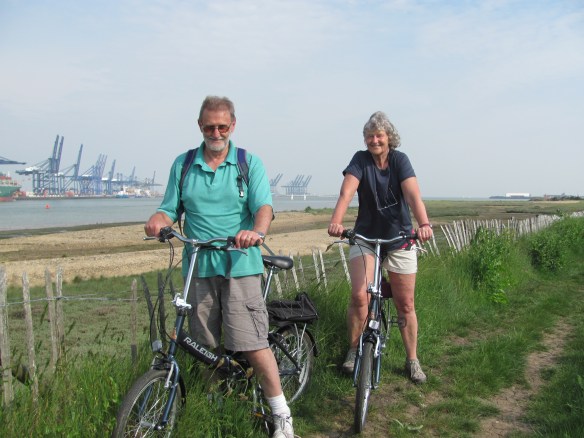
We had bought two folding bicycles to have with us on Ruby Tuesday so that we could explore the surrounding countryside of the places that we stopped at on our voyages. It was a glorious sunny afternoon, so we had decided to give them a shakedown test by cycling from Shotley Marina along the path by the Orwell. Across on the other side, the skyline was dominated by the giant cranes and container ships at Felixstowe, the largest container port in the UK, with occasional metallic clangs drifting across the water as containers are dropped on to their ships, a striking contrast to the more bucolic landscape of the south bank where we were.

Cycling along the River Orwell. Felixstowe container port in the background.

Returning, we explore the small village of Shotley Gate next to the marina. Dominated by a Martello Tower, one of many that were built as defences all along the coast during Napoleonic times, the village is also home to the now dilapidated HMS Ganges, a former training centre for naval cadets. We stop at the Bristol Arms to have a drink, sitting outside in the warm sun looking across the River Stour this time to Harwich on the other side. Tomorrow we plan to take the short ferry ride across the river to there and see what it has to offer.

Mast at now defunct naval training station, HMS Ganges.

Surveys

We are now the proud owners of a sailing boat! Our offer was accepted, and all that remained was the survey and sea trial. This meant more trips down from Aberdeen to Ipswich to meet and talk with the surveyor, arrange the lift out to look at her bottom, and try her out for real in the sea. The indignity of looking at the bottom of a lady of the seas wasn’t lost on us! Nevertheless, she suffered all this in silence and passed our probing investigations with flying colours, with only a temporary concern due to relatively high moisture readings in the hull. However, this turned out to be just transient moisture due her being in the water over the winter, and she rapidly returned to near normal values once she had had a chance to dry out on land for a week.

She had a few little jobs to be done as part of the purchase agreement, primarily work on the rudder, but eventually all was ready, and she was ready for handover.

Ruby Tuesday having her bottom looked at during the survey.

The big challenge now she was ours was to get her back to the west coast of Scotland somehow. Our cunning plan was to spend most of the summer doing this, sailing clockwise around Britain – along the south coast of England, and up the Irish Sea to Scotland. We had thought of going up the east coast and round through the Caledonian Canal, which surprisingly was about the same distance, but we thought that the western route would be more scenic despite heading into predominantly south-westerly winds along the south coast.