A cement town, a wartime evacuation, and unexpected winds

“You can leave your car with a friend of mine”, says Ingemar, over a beer. “He has a big barn, so it will be under cover.”

We had met Ingemar on the Danish island of Christiansø last year, and had sailed along with him to Limhamn marina on the outskirts of Malmö, where he was also storing his boat over the winter. Limhamn was where he had been born and grown up, so despite now living in the south of France, he knew the place and its people well.

“It’s better than leaving it at the marina, where it is likely to get covered in salt spray from the wind”, he continues. “I always leave my motorhome with him.”

He has a large motorhome that he uses to travel around in when he is not sailing. We had been most impressed with it – it is fitted with state-of-the-art gear, and even has a small garage in the back of it in which he keeps his SmartCar for travelling around locally in when he reaches his destination.

A home away from home? (Similar to, but NOT Ingemar’s mobile home.)

The next day, I follow him to his friend’s place and park our car in the barn. His motorhome is already there. Several other cars are also in the barn, some classic, some covered in dustsheets. Our car will have others to talk to.

“Your car will be fine here”, says Ingemar’s friend. “I won’t move it from its place. Remember to disconnect your battery so that it doesn’t go flat.”

On the way back to the marina in his SmartCar, Ingemar talks about the local history of the area.

“Limhamn actually means Lime Harbour. There was a huge quarry, the Limhamns Kalkbrott, from which they used to extract limestone and take it by train to the harbour where it was converted into cement. I can remember as a young boy being woken every morning by the huge explosions as they blasted out the limestone. Our whole house shook. The cement was shipped all over the world – the ‘Christ the Redeemer’ statue in Rio de Janeiro was actually made using Limhamn cement.”

“Do they still make it here?”, I ask.

“Not any more”, he says. “Nowadays, most of Sweden’s cement is made on Gotland. They have turned the quarry here into a nature reserve with a lake in the middle which attracts wildfowl and other animals. Apparently the nature reserve has one of the very few populations of the European green toad left in Sweden. Look, the observation point is just off here. I’ll take you to see it.”

We stand on the edge of a giant crater and look down at the small lake and regenerating vegetation. On three of the sides of the rim are new-build housing areas, and on the fourth is the motorway to the Øresund Bridge.

Limhamns Kalkbrott.

All that material removed from the earth and used to make the cement to construct the hallmarks of modern civilisation, I think.

“Ironically, they have to keep pumping water out of it so that the whole area doesn’t become a lake”, says Ingemar. “It makes you wonder how sustainable it will be in the long run.”

—-

We set sail the next morning. We are a little nervous, not only because this is our first sail of the season, but also because it is the first proper test of everything on the boat after the winter repairs – particularly the engine which had had the heat exchanger removed. Will it all function, or did I forget to reassemble some vital bolt or screw, I wonder.

But everything works as it should, and we are soon sailing merrily northwards along the Øresund. It is just as well, as we had arranged to meet three other boats by a specific date in the small village of Smögen some 200 miles away well up the west coast of Sweden, and we already don’t have much time to get there. But at least we are finally on our way.

“Look, there’s Kronborg Castle over there”, says the First Mate, pointing to an impressive looking structure on the Danish side. “The town nearby is Helsingør, where we used to catch the ferry across to Sweden the times we drove to Stockholm.”
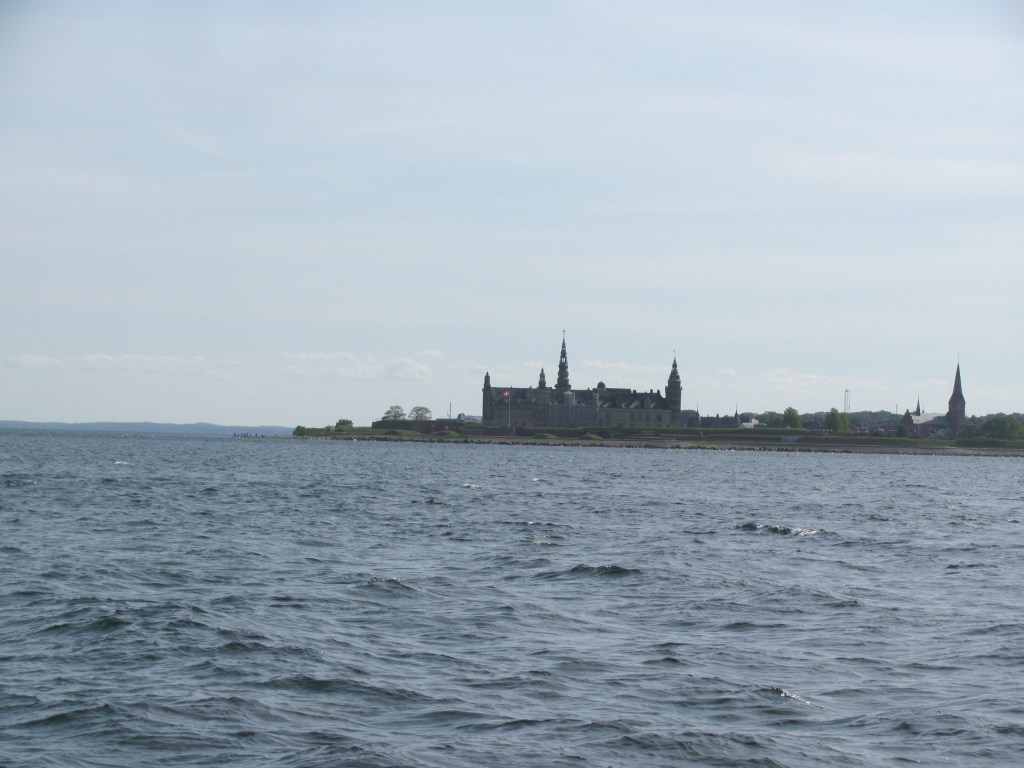
Kronborg Castle, Helsingør.

We cross the shipping lane at right angles to reach the Danish coast. Now the wind is on the nose, and we have to furl the sails and start the engine. Eventually we reach our destination for the night, the small town of Gilleleje on the north coast of the island of Sjælland.

“It looks like we’ll be here for a few days”, I say, perusing the weather charts and forecasts in the evening. “Strong north winds and lumpy seas are forecast for the next three days at least. We can’t sail into those.”

“Well, I am sure we can find enough things to do here for a few days”, says the First Mate. “It seems a nice little place. I read that there’s a good fish shop here with fresh fish from the fishing boats.”
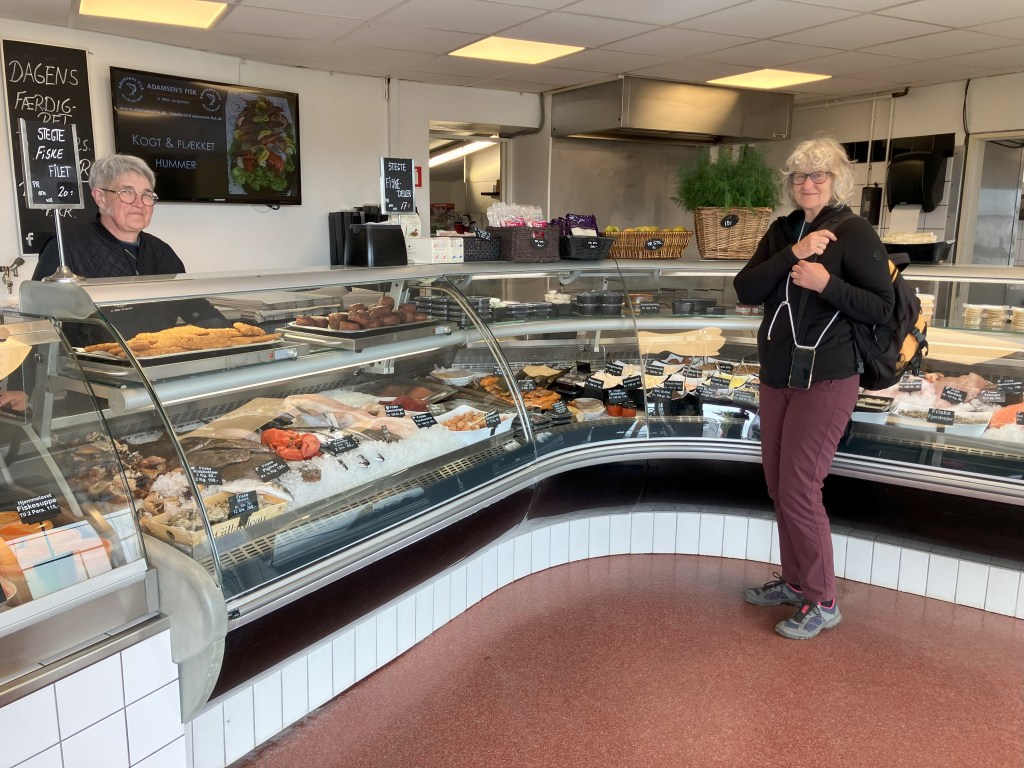
Looking for fresh fish in the Gilleleje fish shop.

In the morning, I walk over to the shower block for my customary shower, taking with me the card we were given to access and pay for the toilets and showers.

“I am not sure how much money is left on the card”, the First Mate says. “I had rather a long shower last night, and I may have used quite a bit of it. But there is definitely some left.”

Outside a group of people are busy doing aerobics, led by an athletic hunk in his twenties.

“Legs up and twist”, he chants. “Arms straight in front, and bend. One, two, three four.”

Inside, I undress and wave the card in front of the reader. The shower starts. I stand underneath it and soap myself up. After one minute there is a click, and the water stops. I wave the card again in front of the reader. Nothing. There is a beep and a message appears on the reader display.

“Insufficient funds on this card to continue.”

Consternation! Dripping soapsuds and shampoo, I have no way of rinsing them off. The machine for topping up the card is at the yacht club, 100 metres away. And I can’t put my clothes on top of wet suds anyway.

The brilliant idea occurs to me that the only way is to rinse myself off at one of the basins in the common washroom. But what if someone comes in? I have to take the risk.

Starkers, I stand on my towel and slosh myself with water from the sink. The aerobics chanting outside ends, and there is the sound of the outer door opening. I just manage to wrap my towel around myself before the washroom door opens.

I avert my eyes from the curious gazes of the Athletic Hunk and several other sweating faces.

“Shower not working”, I mumble, pretending to be a foreigner not used to Danish bathroom technology. No one looks convinced.

The Athletic Hunk waves his card in front of the reader. The shower spurts out water perfectly. I pretend not to notice, dress, and beat a hasty retreat.

“I have a bone to pick with you”, I say to the First Mate when I get back to the boat.

“I told you there might not be much on it”, she says unsympathetically. “You should have topped it up before you went in.”

In the afternoon, we visit the Gilleleje museum, the central focus of which is the evacuation of Danish Jews to Sweden in October 1943. Two of the museum staff are sitting outside the café in the sunshine drinking coffee.

“The Jews in Denmark were left relatively alone for the first part of the war”, one of them tells us. “Mainly because Denmark had an official policy of cooperation with the Germans. But in October 1943, this arrangement broke down, and the Germans began arresting Danish Jews.”

“Suddenly, Jews from all over Denmark started coming to Gillerleje”, the second one tells us. “It’s the closest point to neutral Sweden, and they were trying to flee to there. Many came by train to the station here. You can find out more about it in the exhibition over there.”

“Local people hid the fleeing Jews in their lofts”, one of the panels tells us. “Then when a boat became available, they would be taken down to the harbour in the dark of night and put aboard the boat. Children were even sedated and carried down in cardboard boxes so they wouldn’t cry out and arouse the suspicions of any chance German patrols. The boat would then take them across to Sweden.”

Some of the refugees weren’t so lucky. Someone informed the Germans that there were Jews hidden in the loft of the church – a patrol was dispatched there, the Jews were arrested and taken to the nearby Horserød prison camp, and from there to Theresienstadt concentration camp in present-day Czechia, where many of them died.

The Gilleleje church where several fleeing Jews hid in October 1943.

“Look, here’s one of the boats that transported people across”, says the First Mate, pointing to a dinghy in the middle of the exhibition. “It’s so small. I wouldn’t have liked to be on the sea in one of those in the middle of the night.”

“You probably wouldn’t mind if the alternative was being taken to a concentration camp”, I say.

One of the boats used to evacuate Jews from Gilleleje to Sweden.

Later, we walk out to the outskirts of the town to see the memorial of the Jewish evacuation and of those who died.

Teka Basofar Gadol, it says in Hebrew. “Let the Great Ram’s Horn proclaim our liberation.”

The Teka Basofar Gadol memorial to Jews evacuated from Denmark to Sweden.

—-

“Well, I have to say, this is the type of sailing I like best”, says the First Mate, stretching out languidly in the warm sunlight bathing the cockpit. “A nice light breeze to keep us moving, no heeling, and no waves to make us roll from side to side. Bliss.”

We are on our way from Læsø to Marstrand in Sweden. The winds had changed, and we had been able to sail from Gilleleje to the island of Anholt and from there to the island of Læsø. We had originally planned to explore both islands in detail, but a quick scan of the weather forecast had convinced us that if we were ever to get to Smögen to meet the others, we had to press on. The next three days were to be strong winds from the north again, which would confine us to port. We weren’t too keen to do that. Today was to be light winds and smooth seas all the way to Marstand, so much so, I was expecting that we would probably have to motor some or most of the way. We promised ourselves that we would visit Anholt and Læsø on the way back and do them justice.

The First Mate is right though – it is pleasant. Except is doesn’t last long. After about half an hour, as I had expected, the wind drops to three knots and the sails flap listlessly. Shortly we are drifting along as less than two knots. At this rate, we might be lucky to get to Marstand by the morning. But at least the sun is shining.

I go downstairs to make a cup of tea. While I am down there, the boat suddenly lurches and begins to heel. Out of nowhere, the wind has picked up. I glance at the instruments – 18 knots! Where has that come from? I try to carry my cup of tea up the companion way without spilling it; by the time I get there, the wind is touching 25 knots and we are speeding along at 7½ knots.

“I thought it was supposed to be calm all the way”, shouts the First Mate. “We need to reef. We’re heeling far too much.”

We put in two reefs just to be on the safe side. The boat stabilises, but she is still hurtling along at almost undiminished speed.

A sudden wind takes us by surprise.

Driven by the wind, the waves slowly begin to grow. Unfortunately, they are an our beam, coming from the side, and Ruby Tuesday rolls as each one travels underneath us.

“I’m feeling a bit squeezy”, says the First Mate, starting to look green. “I think I’ll go below.”

“Queasy”, I say. “You mean queasy.”

“Whatever”, she says, disappearing.

Ruby Tuesday settles into an uneasy rhythm – rolling precipitously with each successive wave, but somehow managing a consistent seven knots. Clouds roll in and the sun disappears, adding to the melancholy. From time to time, the bow plunges into a wave, sending green water cascading over the foredeck and windows of the spray hood.

Crossing the Kattegat in high winds and strong seas.

A ship appears out of the haze. We are crossing a shipping lane and I have been keeping a watchful eye out for ships to avoid. The AIS tells me that our closest point of approach to this one is 75 m. That’s a bit too close. I adjust the autopilot two degrees to the south.

Ruby Tuesday, Ruby Tuesday”, suddenly crackles an Indian voice on the VHF. “Your course is very close to ours. We’re closing fast.”

“Ship calling Ruby Tuesday”, I respond. “I am aiming to go behind you.”

I adjust the autopilot a further two degrees to the south just to be on the safe side. A few minutes later we pass behind the giant cargo ship, and I am watching its stern disappear slowly into the haze again. The AIS tells me she is bound for Baltimore.

The hours pass. There is no let up in the windspeed and the waves are as high as ever. But we are making progress, uncomfortable as it is, and gradually Sweden comes into view. Eventually we reach the entrance to the fjord where Marstrand, our destination, is located. Like the flick of a switch, the wind suddenly drops and the waves calm down, and we sail sedately up the fjord with only the genoa up as we pass the imposing Carlsten Fortress on the hill guarding the entrance to the town.
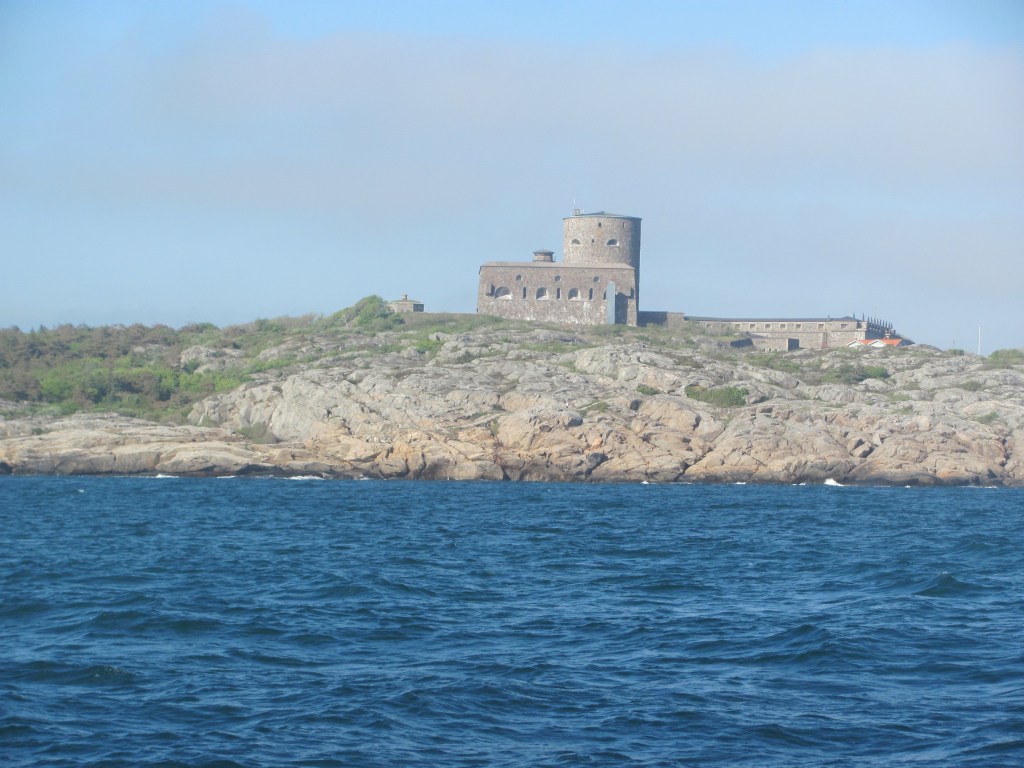
Carlsten Fortress, Marstrand.

“Well, I am glad that is over”, says the First Mate. “I didn’t enjoy that at all. It was odd wasn’t it? When we set out it was calm, and here it is calm. Did we just imagine all those strong winds and waves in between?”

A good question.

Celestial mechanics, a Viking with bad teeth, and meaningful motorcycling

“Well, we have decided to head for Tunisia in the boat”, says Harry as he grinds the coffee beans with his traditional manual grinder. “We want to get there in time to see the solar eclipse in August 2027.”

We are at Harry and Beate’s place in Germany. Beate previously shared a flat with the First Mate when they were both single, and we have kept in touch with them since then. We share a mutual interest in sailing, and, indeed, had previously visited them on their boat in Makkum in Holland.

Harry & Beate with their boat in Makkum, Netherlands.

“The plan is to start off this year from Holland and enter the French canal system”, says Beate. “We’ll see how far we will get in the canals, leave her somewhere over the winter, then carry on in 2026 down to the Mediterranean.”

“Then in 2027 we’ll sail across the Mediterranean to Tunisia”, continues Harry. “I have just finished rewiring the whole boat, so she is in pretty good shape now. Everything works the way I want it to.”

Harry is used to doing such things. When we first met, he was in the process of converting a double-decker bus into a mobile home, with the kitchen and living room downstairs, and the bedroom upstairs.

“I’ve even been taking celestial navigation classes”, he continues. “Look here’s the sextant I have just bought.”

We go out on the balcony and I measure the angle between a block of flats and the power station cooling towers. It’s 87°. It could be useful.

“It all sounds very exciting”, says the First Mate. “Although don’t forget that it gets terribly hot in the Mediterranean in August. We were there a few years ago, and it was almost unbearable. I couldn’t sleep at night. But good luck anyway.”

We spend the next few days in the First Mate’s home town, visiting her family and friends. Her mother is now 91 and in a care home. The plan is that I then drive up to Ruby Tuesday in Malmö and start preparing her for the new season. The First Mate will then come up by train a week later and we will set off.

On the way up, I stop for the night with our friends Hans and Gisela in Denmark. Their son Arne and his girlfriend Evie are also there for a few days, back from Holland where they live.

“Perfect timing”, says Gisela, as I arrive. “Dinner’s almost ready. We’re having garfish that Arne caught today in the sea.”

I have never eaten garfish before, but I remember that they have a long nose.

“And the bones are green”, says Arne. “They contain some stuff related to haemoglobin called biliverdin that is bright green in colour. I hope it doesn’t put you off. Green bones look rather weird.”

Garfish (from the Daily Scandanavian)

Continuing the colour theme over dinner, the subject of Greenland comes up.

“What do the Danes think about America’s plan to annex it?”, I ask.

“Most people think that it is ludicrous”, says Hans, almost choking on a green fish bone. “America is supposed to be one of our allies, and here they are talking about taking Greenland by force just to extract minerals. The most ridiculous thing is that as an ally, they could have want they wanted through joint ventures anyway. No need to annex the place.”

“And it is also not true to say that Denmark has not done anything for Greenland”, says Gisela. “Of course, mistakes have been made in the past, but in recent years the Danes have spent a lot of money improving services in Greenland. And it is completely untrue to say that Greenland is not defended against the Russians. Greenland is part of Denmark, and Denmark is a member of NATO, so Greenland is well defended by NATO.”

“People are also trying to work out what it means for NATO”, says Hans. “Article 5 states that if one NATO country is attacked then the others would all help to defend it. The US is a member of NATO, so does that mean the US would help to defend Denmark against itself?”

Welcome to the new world order, I think.

The next morning, after breakfast, we decide to visit the Trelleborg Ring Fortress not far from Slagelse.

Trelleborg Ring Fortress (from Leibrandt via Wikimedia Commons)

“The fortress was built by Harald Bluetooth in the mid-980s”, one of the museum guides dressed as a Viking tells us. “Harald is credited with introducing Christianity to the Viking world, and with consolidating Denmark into one kingdom. For a short time he also ruled parts of Norway. He built his capital at Jelling, and constructed a series of ring fortresses to demonstrate his power to the German Emperor to the south. But he didn’t live long to enjoy it all – in 987 he was killed in a civil uprising led by his own son Svein, who was the one that invaded Britain.”

We wander out of the museum and head towards the Ring Fortress. On the way is a reconstructed longhouse.

Reconstructed Viking longhouse at Trelleborg Ring Fortress.

“Apparently there were quite a few of these inside the fortress itself”, says Hans. “Families must have been living here, but there never was a town associated with it. Presumably they were the soldiers’ families.”

Back at the small café, we sit in the sun and eat our ice creams.

“We haven’t been here for a while”, says Gisela. “It’s interesting to see the progress they are making in developing the museum.”

In the evening, I arrive at Ruby Tuesday. Spencer is there to greet me. Both he and the boat appear to have weathered the winter well. There is no mould inside and the air smells fresh. I check the data loggers that I had left running and find that the temperatures inside her had not dropped below zero over the winter. Our worries about snow and ice seem to have been unfounded.

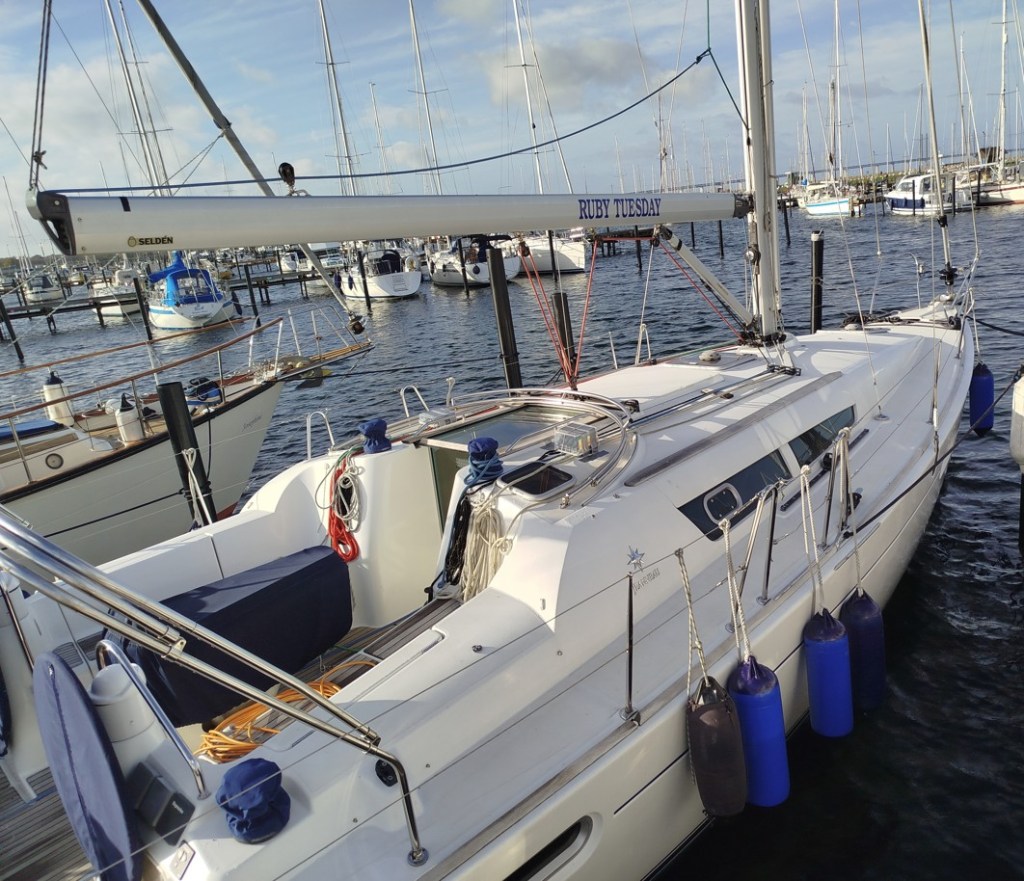
Ruby Tuesday in her winter berth, Malmö.

I spend the next few days preparing for the voyage. I had taken the heat exchanger home to clean and service it – just as well, as I had found that nearly half of the small cooling tubes had been blocked by scale. Soaking the unit in vinegar had helped to dissolve that and left it coppery clean. The job of the heat exchanger is for saltwater from the sea to absorb the heat from the coolant running through the engine, so it is essential that it functions properly to prevent overheating.

Servicing the heat exchanger – nearly half of the small tubes have been blocked by scale.

I also decide to check the anode inside the hot-water heater. We have never done that since we had bought the boat, so it is high time. Extracting the heater from under one of the seats isn’t too difficult, but undoing the nut on top of the cylinder is. It is corroded in position, and none of the tools I have are up to the job of freeing it. In the end, I have to borrow some larger ones from the harbourmaster. With a combination of these and brute force, it slowly comes undone. There is no anode left! No wonder it has corroded. I am sure that no-one has looked inside the cylinder since it was made. I decide to replace not only the anode, but also the heating element, thermostat and pressure relief valve while I am at it.

Servicing the hot water cylinder.

The First Mate arrives in due course. I collect her from the train station.

“I hope that you have got everything clean and tidy for me?”, she says, as I load her bags into the car. “I don’t want to start cleaning as soon as I arrive.”

Luckily it is dark when we arrive back at the boat.

The next evening, we drive over for dinner to some friends, Martin and Mia, who live just north of Malmö. We had first met them on the Swedish island of Borgholm when Martin had kindly given us a hand tying up, as well as a list of must-see places on the east coast of Sweden, which we had now seen most of. He had offered to kept an eye on Ruby Tuesday over the winter, visiting her from time to time to check that everything was OK and that the batteries were kept charged.

“That’s his second wife”, says Mia with a wink as we walk past the Porsche in the garage as we arrive.

“Well, a man has to have a few pleasures in life”, says Martin, grinning.

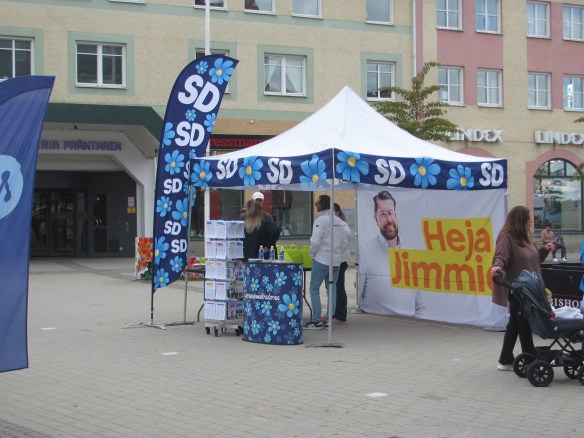
Over dinner, the conversation turns to Swedish politics. When we were sailing near Stockholm two years previously, it had been the time of the national elections, and the far-right Sweden Democrats had won a sizeable share of the votes, giving them a strong influence in government. I am curious as to how they have performed since then.

The Sweden Democrats campaigning in 2022.

“Well they have lost some popularity since then”, Martin says, as he serves the salmon. “Last year, for example, they were found to be using social media to spread disinformation and attack political opponents online. People were put off by that. Then, this year, the government proposed stricter gun control after the country’s worst mass shooting in Örebro, but the Sweden Democrats opposed that, saying that they had concerns for hunters and farmers. That further eroded a lot of people’s confidence in them.”

“People also think they focus too much on immigration and crime”, says Mia. “Sure, it was a concern two years ago when they were elected, but overall it is less so now. But the Sweden Democrats don’t seem to be able to move on from then.”

“The next national elections are next year”, says Martin. “It will be interesting to see whether they still have the same amount of support then.”

We have booked a slot to have Ruby Tuesday lifted out of the water to have her bottom seen to.

Lifting out Ruby Tuesday for a bottom inspection.

The next few days are spent washing, scraping, sanding and painting, and replacing the anodes. I am astounded at the state of the propeller anode – I fitted a new one only a year ago, and it has almost completed eroded away.

Aluminium anode almost completely eroded after one year.

“Sometimes if you are tied up next to a steel boat, that can happen”, explains Peder, the harbourmaster. “But at least it is doing its job.”

Soon Ruby Tuesday is back in the water to complete the preparations. In the afternoon, we receive a WhatsApp message from Simon and Louise, whom we had met on the Cruising Association Rally in 2023, and with whom we had explored Gotland together in 2024.

“Are you still in Malmö?”, they ask. “We have a rip in our sail, and need to have it fixed. Is there a sailmaker there? We’ll be there in the afternoon tomorrow.”

They arrive in time for coffee and cakes.

“I am not quite sure how it happened”, explains Louise. “I was sailing, and I wanted to tack, and I think the sail must have got stuck on something sharp on the self-tacking mechanism.”

We give them a hand in taking down the sail, packing it in a bag, and putting it in our car to take it to the sailmaker in the morning. The tear is quite small, but unless repaired such rips have a habit of getting much bigger quickly. It’s always better to get them fixed as soon as you can.

In the evening, we have dinner on their boat.

“As soon as we get back from this trip in October, I’m setting off for a motorcycle trip in Nepal”, Simon tells us. “It’s a sort of spiritual motorcycle ride with a group of other like-minded bikers. I came across this chap who organises trips combining motorbiking and discussions on spirituality. It sounded interesting, so I thought I would give it a go. I even had to be interviewed by him to see if I would fit into the group.”

“It sounds like something you could write a book on”, I say. “Did you ever read Zen and the Art of Motorbike Maintenance? In it, the author, Robert Pirsig, writes about a motorcycle trip he made from Minnesota to California in the 1960s with his son. The trip is interspersed with philosophical discussions on the pursuit of truth. He developed his theory of the Metaphysics of Quality in which quality is the driving force of the universe.”

“I like these philosophical discussions”, Louise says. “I am not religious now, but I was brought up as a Quaker. Both of my parents were members. We were taught that God doesn’t exist as a supreme being, but that something of what you might call God exists in everyone and emerges when people interact. Just meeting and having an interesting conversation like we are now is being part of God. Quakers believe that you find spiritual truth through your own inner experience of every-day life and human relationships, and for that reason we don’t have any need for ritual, ceremony or even clergy. They just get in the way of the relationship between yourself and God.”

“It all sounds very logical”, I say. “But I always thought that Quakers were a sect of Christianity. This sounds more like Humanism, I think.”

“Yes, they do follow many Christian traditions”, says Louise. “But a lot of Quakers wouldn’t describe themselves as Christians, more as members of a universal religion. And they don’t believe that the Bible, or any other book for that matter, is the ‘Word of God’, although they do think that it provides inspiration along with many others. So yes, a lot of their concepts are similar to humanist ideas, and in fact, a branch of the Quakers are actually affiliated to the Humanist Association.

“Wasn’t there a lot of resistance to them at one stage?”, asks the First Mate.

“Yes”, answers Simon. “George Fox, who was one of the founders, taught that all people have equal value. This didn’t go down too well with the rich landed gentry at the time, who saw it as a challenge to the established social order, and he was brought before the magistrates several times for blasphemy. His followers were officially persecuted for a time.”

“Well, that was interesting”, says the First Mate as we walk back to Ruby Tuesday. “I didn’t know much about the Quakers. You don’t hear much about them these days.”

“That’s true”, I say. “But their ideas certainly contributed a lot to the Enlightenment and to the way we think nowadays. Their condemnation of slavery, their campaigns for social justice, and focus on individual conscience and spiritual experience all align with the Enlightenment values of human rights, social reform, and reason. Quite an impact.”

Simon & Louise and us.