“It’s the best job in the world”, says the woman, as she climbs out of the small single-seater, electrically-powered vehicle with glass doors. “I used to have a higher paying job, but I have been doing this for about five years now, and couldn’t wish for anything better. I know everyone on the island, and they all know me, and I feel as if I am doing something useful. And this little thing here protects me from the elements and means that I don’t have to walk everywhere.”
We are in the town of Marstrand on the west coast of Sweden, and are talking to the postwoman of the island.

“These are the letters I have to deliver”, she continues, pointing to rows of envelopes arranged in a rack on one side of the cabin. “And the big parcels are in the back here.”
“Do you know where we can get some lunch?”, the First Mate asks her. “Everything seems to be closed today.”
“Yes, places close here when the weather isn’t so good, as not many tourists come over”, the postwoman says. “But I think that the bakery along the waterfront is open. You could try there.”
She climbs in her post-van, presses a button, and whizzes away over the cobblestones.
We find the bakery and order sandwiches and coffee. A brochure on the town is lying on the table.
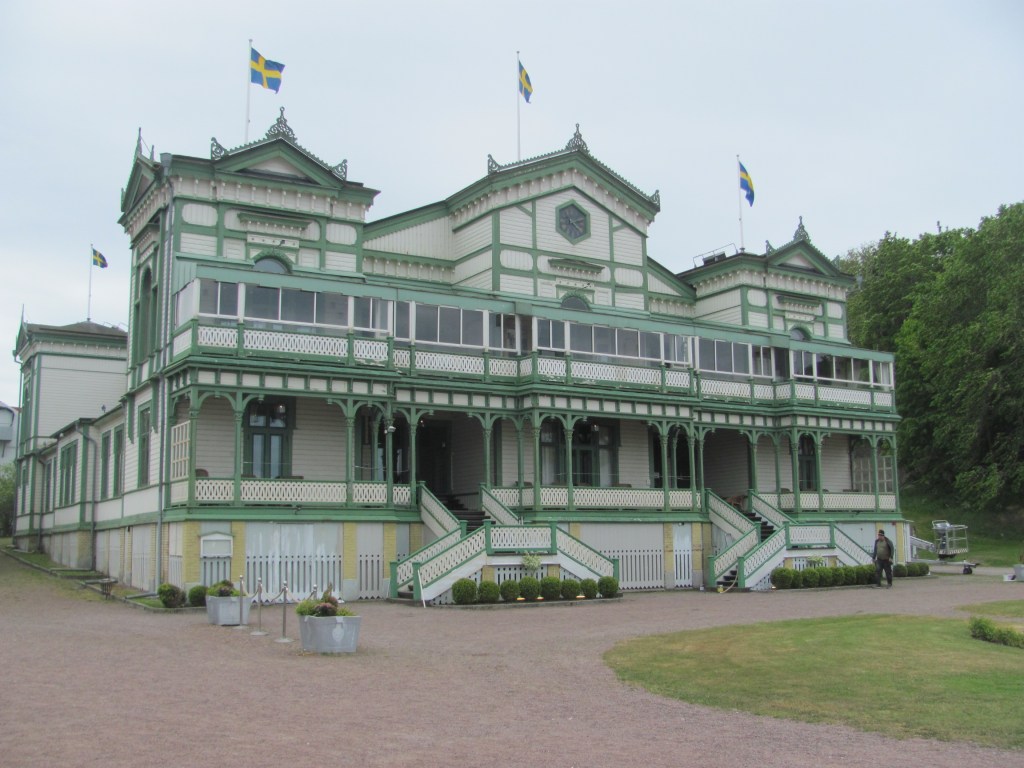
“Marstrand was founded in the 13th century by the Norwegian king Håkon Håkonsson because of its strategic location, being ice-free, and its good shelter from all wind directions”, it tells me. “It developed as a fishing town, and made its wealth from herring, becoming known as the herring capital of Europe. At one time, the street lamps in Paris were all lit with herring oil from Marstrand. It became part of Sweden in 1648, which is when the fortress was built. The herring declined in the late 19th century, however, so Marstrand rebranded itself as a holiday resort attracting the rich and famous. Nowadays it is well-known for its water sports, particularly sailing, hosting many events.”
The First Mate strikes up a conversation with some German tourists at the table next to us.
“There’s a nice walk around the island”, they say. “It starts just at the north end of the harbour. Here, you can use our map. We are finished with it. And don’t forget to see the Eye of the Needle.”
It’s not much of a day – grey and overcast, and a chilly wind is blowing, but we do want to see some of the island, so we set off.
“Look, here’s the Eye of the Needle they were talking about”, says the First Mate. “The Nålsögat. Apparently smugglers used to use it as a hiding place. I’m glad I didn’t have that extra bit of toast for breakfast this morning. I wouldn’t have fitted through. I don’t know how you are going to manage though.”
We have come to a place on the route where the path narrows to a tight gap between several large boulders. With a public path running right through it, I am not sure that it makes a good hiding place, I think to myself. Perhaps there wasn’t a trail there then.

Further on, we reach Skallens Lighthouse at the western most tip of the island, and sit on the rocks watching the crashing waves where the Kattegat and the Skagerak seas meet. The grey skies and the cold wind only add to the wild and elemental atmosphere of the place.
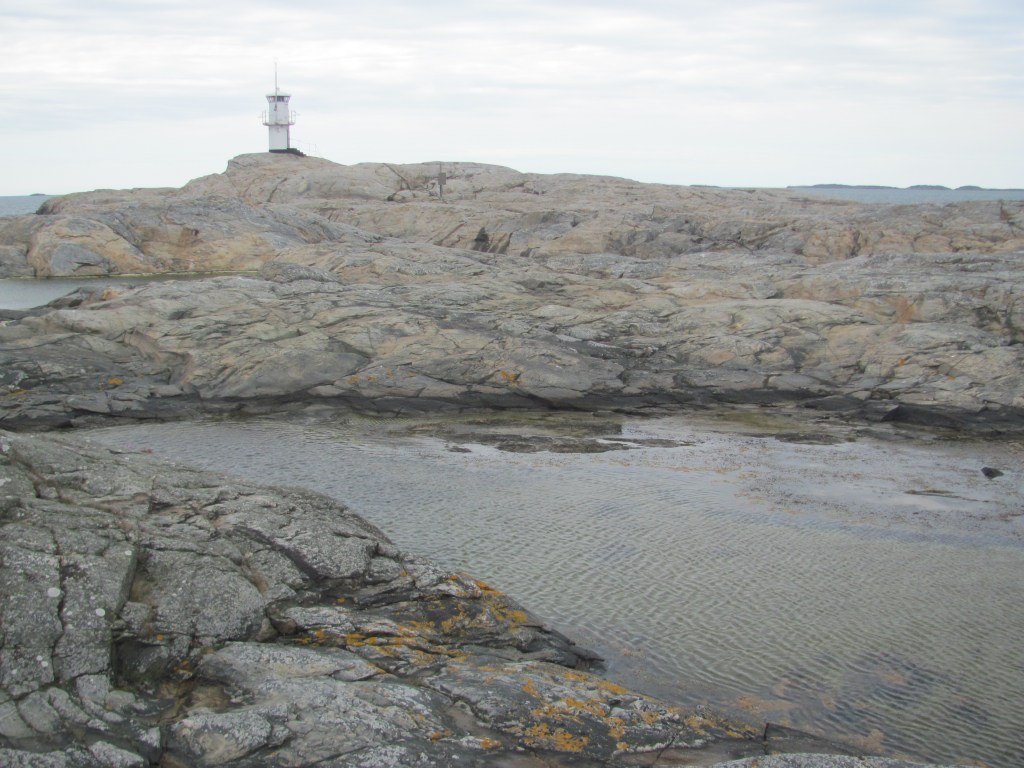
Patterns on the rocks in front of us make me think of the vast depth of time since they were created, certainly well before humans appeared on the scene. Was it a day like this that a marine creature hauled itself out of the sea to give rise to the diversity of land animals we see today?

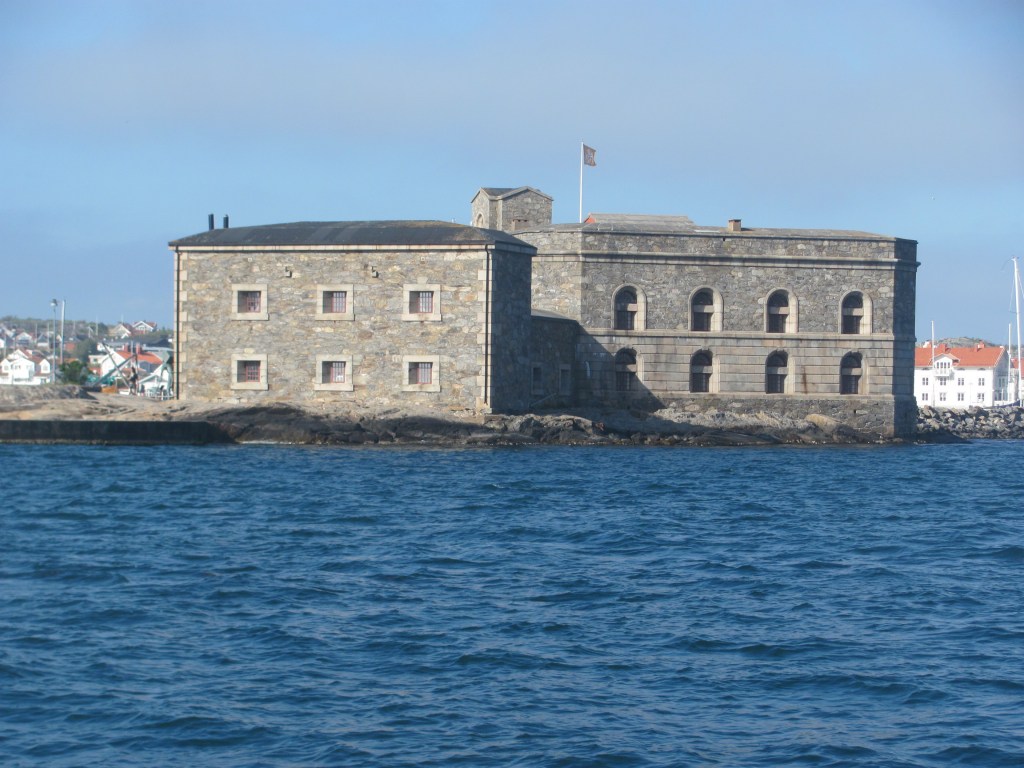
On the way back from Skallens Lighthouse, we pass Carlsten Fortress on top of the hill. Unfortunately, it is closed until the following weekend, when summer officially starts. However, we are able to get a glimpse of it from the path running around the walls.

“After the Treaty of Roskilde in 1658 between Sweden and Denmark, Marstrand became Swedish”, a panel informs us. “Because Marstrand was becoming an important trade hub, King Karl X Gustav of Sweden had the fortress built to protect the town. However, this wasn’t entirely successful, as it was captured again by the Danish a couple of times after that. When it once again returned to Swedish hands, it was expanded several times and used for the last time in WW2. In 1993, it was declared to be no longer part of Sweden’s defence installations, but it has been maintained and is a tourist attraction nowadays.
Arriving back at the boat, we pass the Strandverket Art Museum, formerly an old fort. Unfortunately it is also closed until next weekend.
“The girls around here are certainly pretty tall”, says the First Mate, standing next to a figure just outside the entrance. “It must be all the fish and sea air they get.”

“The guide book says that the fort once housed a notorious Swedish master-thief called Lass-Maja”, I read. “He specialised in dressing up as a woman to fool his victims and to make it easier to escape. Sometimes he dressed as a lady’s maid, or a housekeeper, or a prostitute, even flirting with some of the men he was planning to rob. Eventually he grew to be so comfortable wearing women’s clothes, he carried on doing so in his spare time. However, one day his luck ran out when he stole some church silver, and he was tried and imprisoned here in Marstrand. His memoirs became very popular with the reading public in the 19th century, so much so that he was eventually pardoned by the king and released.”
“Who says that crime doesn’t pay?”, sniffs the First Mate.
“The geology of Sweden is quite fascinating”, says Spencer that evening, as we sip our wine. “It is part of the vast continent of Baltica, which formed around two billion years ago through the collision of three older tectonic plates which are now part of Russia, Ukraine and Scandinavia. Around 700 million years ago, the combined landmass was in the southern hemisphere, but it moved north about 450 million years ago to collide with the Scotland and Greenland plates, and later with the Siberian plate in the east to form the Ural Mountains. So Baltica has been around a bit. The rocks you were looking at this afternoon were probably formed around a billion years ago.”
“You know so much for a spider”, I sigh. “Especially as it all happened so long before your or my species even existed.”
“That’s the advantage of having my web connected to the World-Wide-Web”, he smiles.
With favourable winds the next morning, we set off northwards for Smögen. On the way we pass the picturesque fishing village of Mollösund with its white houses stacked neatly above the narrow channel between it and the neighbouring island.

We stay a night on the car-free island of Käringön with its eponymous landmark statue of an ‘Old Woman’, supposedly giving its name to the island.

Eventually we reach Smögen. Andy & Anne and his family and friends are already there with their new boat Amalia, and give us a hand tying up. Bob & Fiona in Hekla of Banff, and Simon & Louise in Aloucia arrive not long after us, completing the quartet of boats. We had all met on the Cruising Association Rally in the Åland Islands in 2023, and had found that we have similar cruising routes planned in the following years. We had already seen Aloucia this year when she called in at Malmö to have her sails repaired.
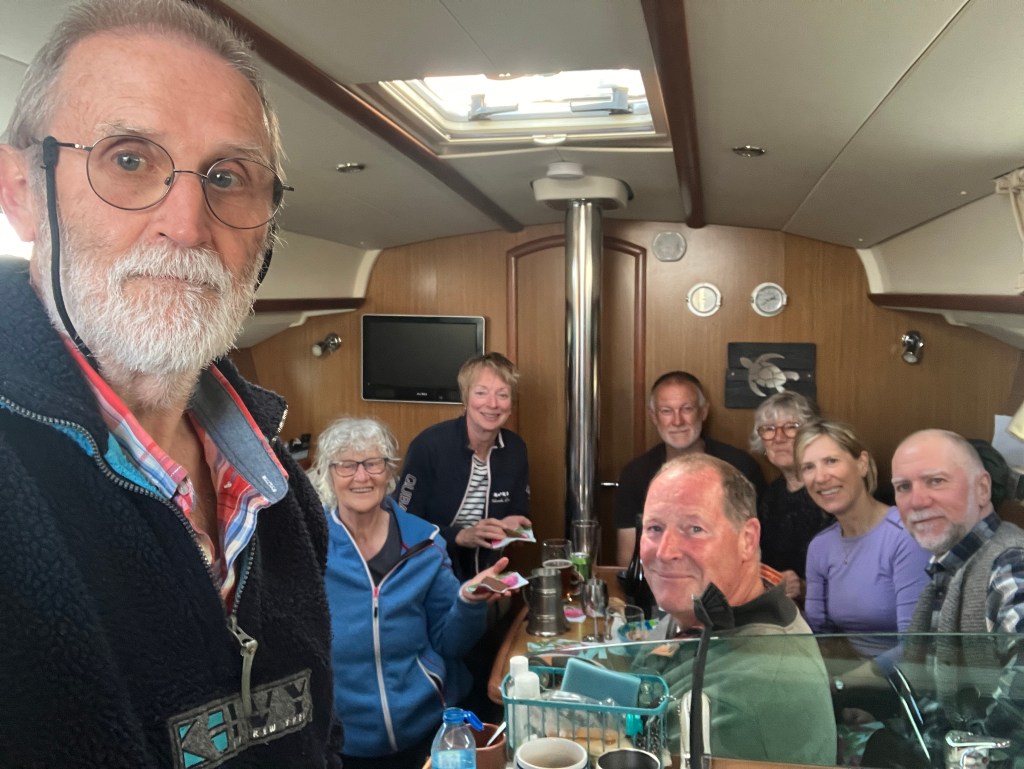
Louise has arranged for us all to attend a course in Smögen on sea-foraging.
“We did a sea-foraging session while we were in South Africa over the winter”, she explains. “We learnt a lot about what you can and can’t cook, including kelp pasta. It was great fun, and they put us in touch with a Swedish woman in Smögen who runs sessions snorkelling for seaweed with outdoor cooking of whatever we find afterwards.”
We have arranged to meet the organiser, Linnea, at a carpark near the top of the harbour, just past the iconic fishermen’s huts.

Louise leads the way, the rest of us following with our wetsuits, mask, fins and snorkels crammed into our rucksacks. Linnea is already waiting, busy unloading an eclectic mix of pots, pans, primus stoves, plastic boxes with tasty-looking food inside, and an assortment of neoprene boots, wetsuits, hoods, and gloves for those that don’t have their own.
“It isn’t much of a day”, she says, “But the place we are going is fairly sheltered from the winds, so it should be OK. It’s only about ten minutes’ walk from here.”
“I’ve been doing this now for several years”, she tells us on the way down. “I’ve also written a book and seaweed foraging. The sea is a tremendous resource, and we don’t really make enough use if it in a sustainable way. I’ll show you which species are good to eat, what they contain, how they are harvested sustainably and cooked. Most of them contain lots of nutrients – sea lettuce, for example, has fatty acids, magnesium, sodium, potassium, calcium, phosphorus, iron, iodine, and vitamins A, B, C, D and E. We’ll only pick what we will eat. Afterwards, you can help prepare lunch with me. And, of course, help me eat it!”
“There are also plants along the shore that you can eat”, she continues. “Look, these are violets – the flowers and leaves are quite sweet and make a good addition or a garnish to a salad. But you can’t eat the roots as they are toxic. And these are beach asters – the leaves are edible and can be added to salads, stir-fries, or used as a side dish. And here’s some sea beet – you can boil this like ordinary spinach. But now let’s get changed and we can see what we can find in the sea.”

We find places behind the rocks to struggle into our wetsuits that don’t seem to have changed in the same way that our bodies have since they were last worn, several years ago in my case.
“You can borrow these boots, gloves and hoods”, says Linnea. “It’ll be quite cold, so I think you will need them.”
I am starting to wonder if it was a good idea to sign up to the session. I don’t really do cold these days. But the others are all looking very enthusiastic, so I pretend to limber up as though I am raring to go.
Somehow we manage to squeeze ourselves into our wetsuits, carefully squashing all the bulgy bits in through judicious inhalations. My only worry is that getting out of it might be harder than getting in. We’ll cross that bridge when we come to it, though.
“Are you going to be able to walk down to the beach in that?”, says Andy cheekily.

I clamber down the small ladder, and gasp as I jump into the water. It’s freezing. I almost jump back out again, as I feel it finding its way into the thin layer between the wetsuit and my skin. But I have done enough diving to know that it will only be a few seconds before my body heat warms it and it will become another insulating layer.
“This is sea lettuce”, says Linnea, clutching a mass of green foliage looking remarkably like the lettuce that outlasted Liz Truss. At least that’s what I think she is saying, as she is wearing her mask and snorkel, and speaks with a Swedish accent.

We spend the next hour or so swimming along a rock wall picking sugar kelp, oarweed, gutweed, bladder wrack, knotted wrack, saw wrack, bootlaces, Irish moss, and lavar, and putting them into little net collecting bags. Soon Linnea signals to us that it’s time to get out. None too soon, as I am starting to feel a little bit cold, especially from the small stream of water finding its way through the gap between my hood and wetsuit, down my spine, and out through one of my legs.

Soon we are back in our warm clothes. Fortuitously the sun has appeared, and we bask on the rocks to get our circulations working again. Linnea, meanwhile, has the primus roaring, and is unpacking the food she prepared beforehand. We are each given jobs of cutting, slicing, frying, boiling, and spreading. My job is to cut the bladder wrack into strips and boil it.

Soon we are loading our plates with chunks of cod and cheese fried with sea lettuce, gutweed and tomato salad, kelp pasta, boiled bladder wrack seasoned with lemon and pepper, lashings of lavar, and numerous other tasty bits and pieces.

“This is absolutely delicious”, says the First Mate. “I am going for my third helping.”
“Be careful you don’t turn into a nervous wrack”, I say.
 Ruby Tuesday