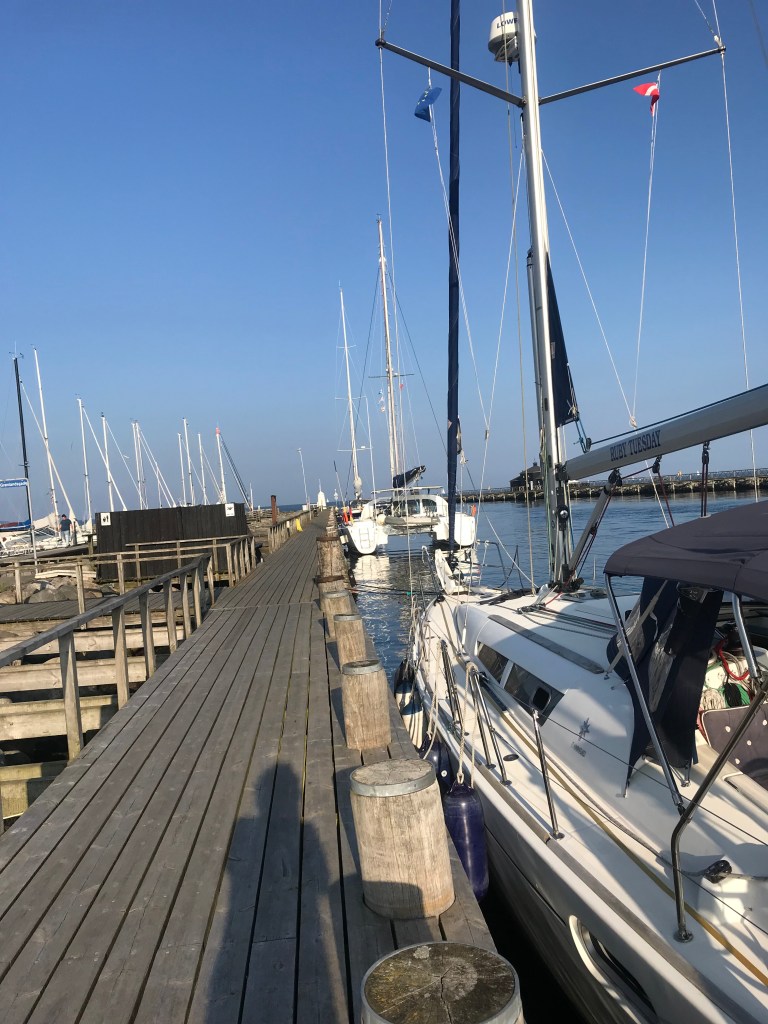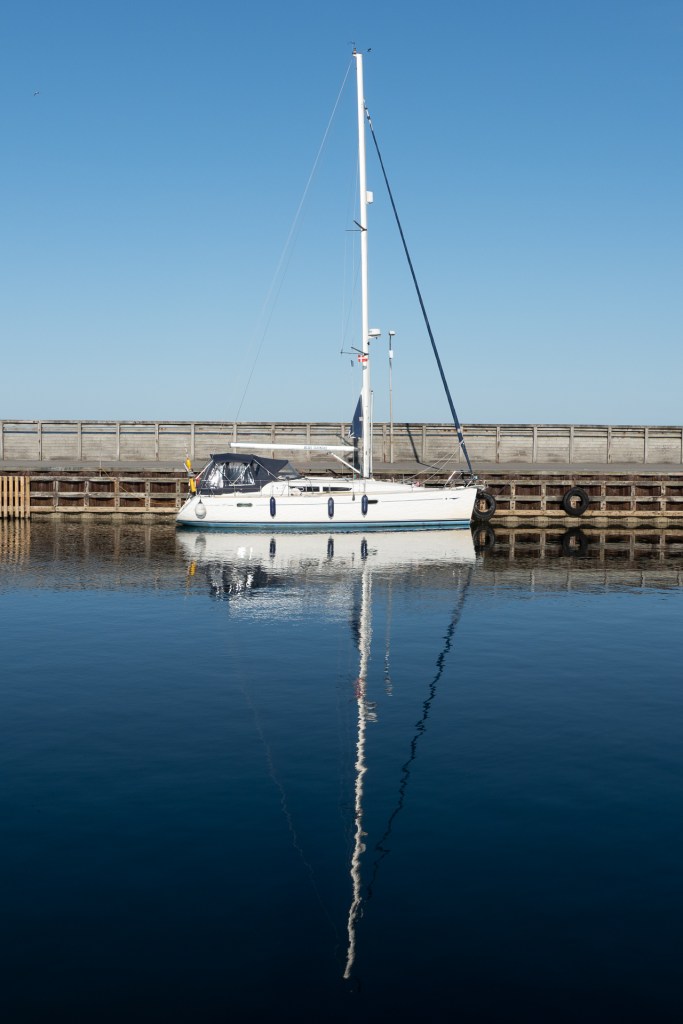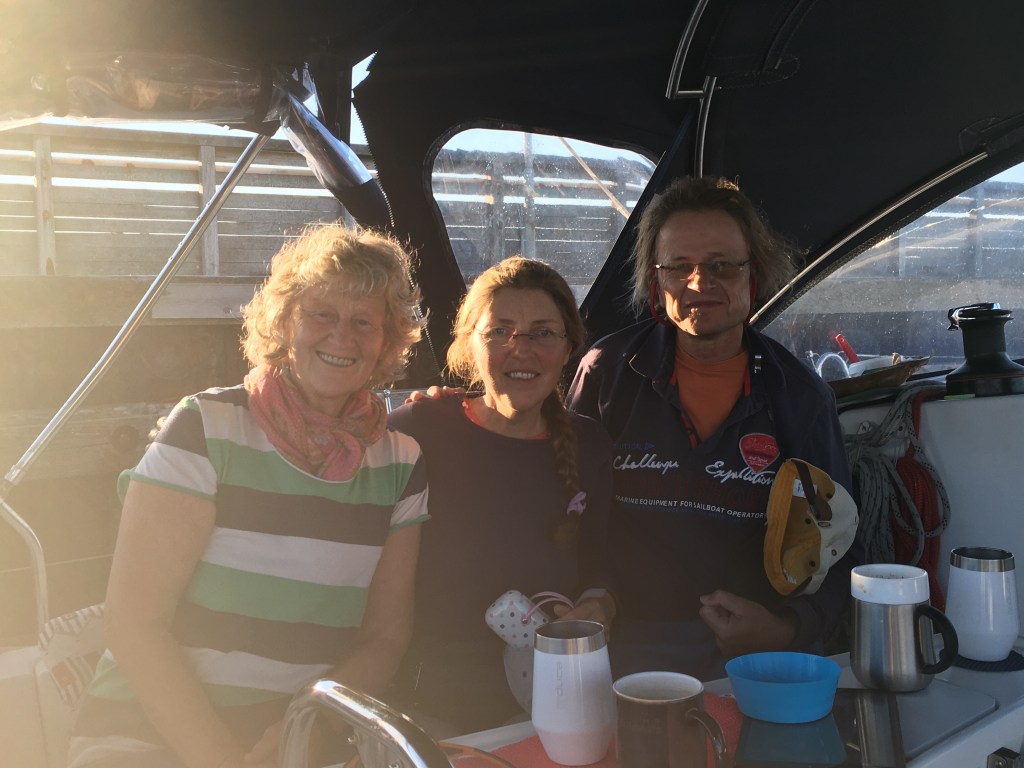
A leaky boat, a troubled painter, and a medieval clock

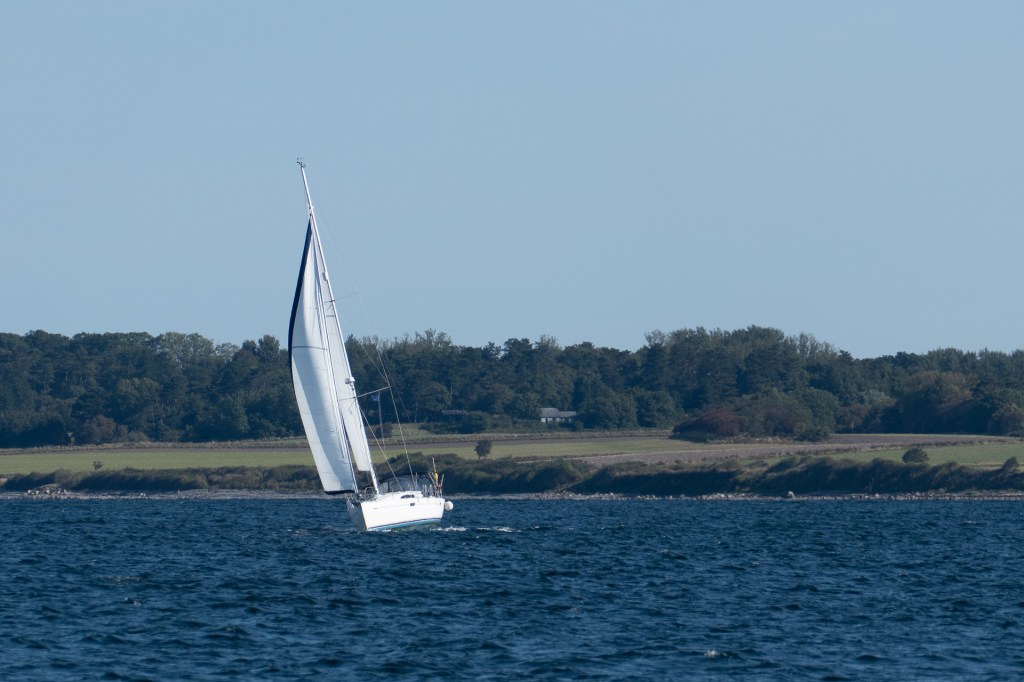
We leave Timmendorf at 0800. The wind is from the south-west, but it is only a few knots, and we move slowly. We follow the buoyed channel through the shallows to the north of Poel Island, and eventually emerge into deeper water.
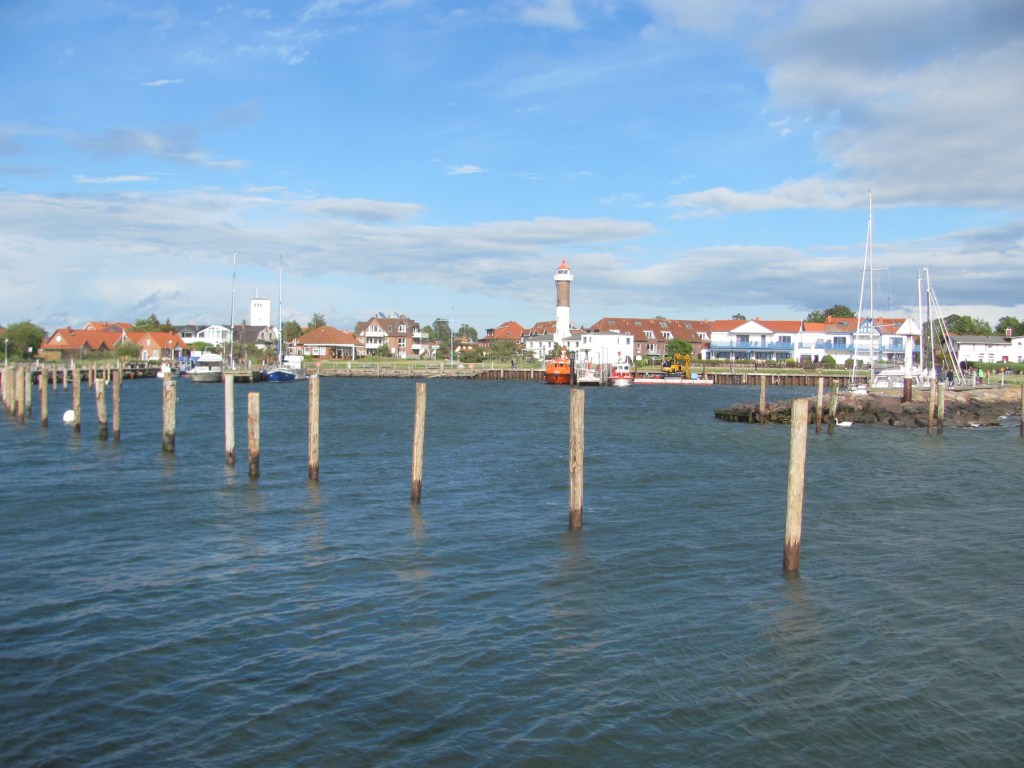
Leaving Timmendorf.

The wind is now directly behind us, so we ‘goose-wing’ with the genoa poled out to one side and the mainsail rigged with a preventer to guard against an accidental gybe. We round the Trollegrund Spit, and with the wind now more on our starboard, we have a nice broad reach sail along the coast.

“This is my type of sailing”, says the First Mate, going down to make tea. “At least we don’t have to worry about things flying around everywhere.”

Goose-winging our way to Warnemünde.

My mind turns to the book I am reading at the moment, Can Democracy Work? A Short History of a Radical Idea from Ancient Athens to Our World, by James Miller. In it he describes the development of democracy, from its first airing in ancient Athens, then much later the French Revolution espousing freedom and equality, the American Revolution, the Russian Revolution, through to modern liberal democracy. For a long stretch of history, democracy was thought to be an inferior form of government, and a monarch and aristocratic hierarchy much better with every one knowing their place.

“All very interesting”, says Spencer, from the coaming behind me. “But the big drawback with democracy is that most people don’t have time to practice it directly – they are far too busy making a living, raising a family, developing careers, saving for their retirement, and so on. Therefore, they elect representatives to do their democracy for them.”
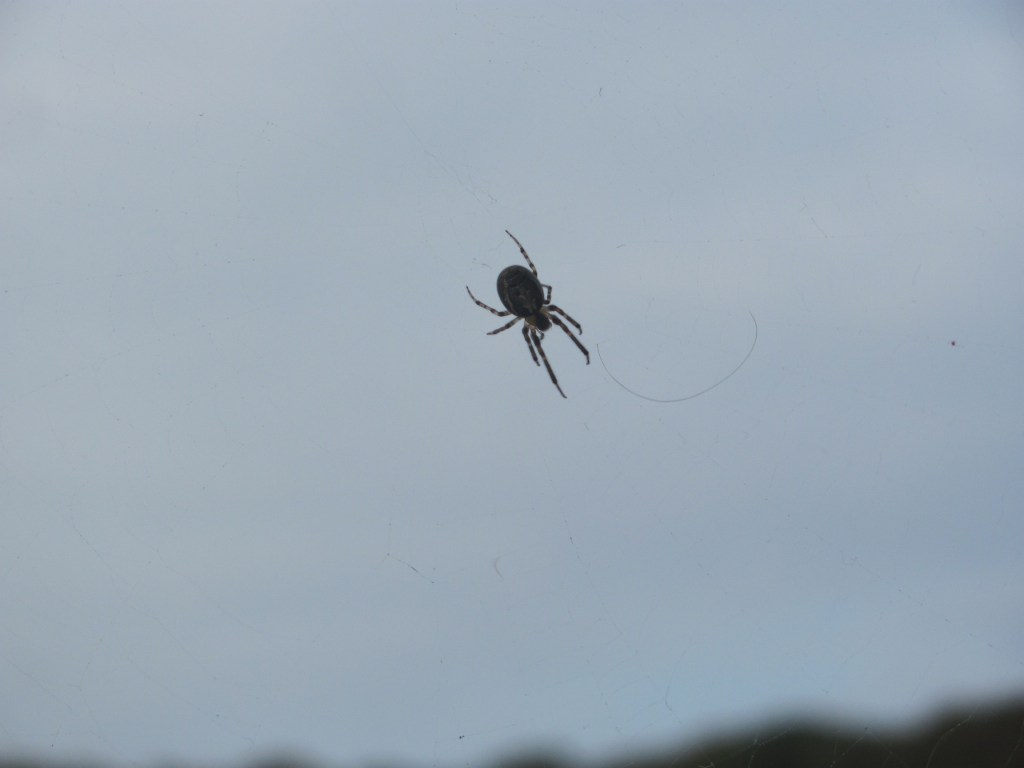
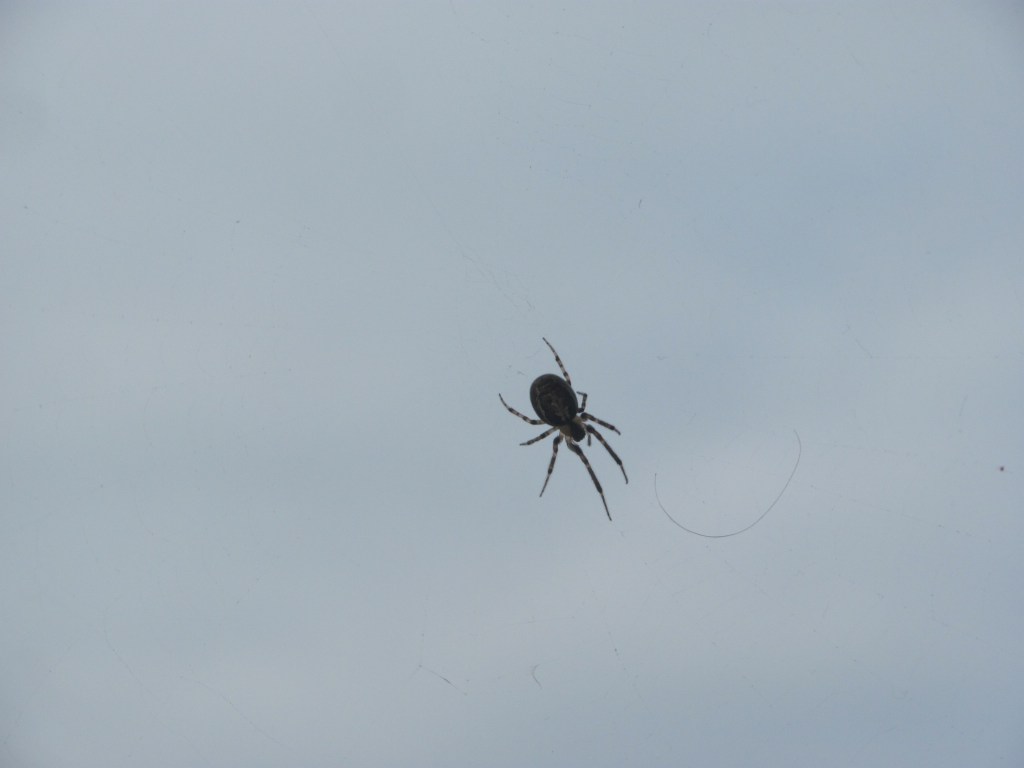
Arachnid pontifications.

“Well, well, well”, I say. “Nice to see you. How was the winter?”

“Great”, he responds. “It was nice and warm in the anchor locker, but I thought I needed to get out and stretch my legs now.”

He stretches each one in turn. It takes quite a while.

“Anyway, as I was saying”, he continues, “The danger is that these representatives become a new elite – they do what they want for the duration of their terms, make lots of money from themselves and their friends, control the media to influence the way people think about them, and get themselves re-elected. And so it goes on. Over time, these representatives get richer and more powerful, make laws for the small people but not themselves, and before you know it you have a new elite. Then the small people may get fed up and decide to have a revolution to make people more equal, and the whole cycle starts again. Democracy is an inherently unstable system that contains the seeds of its own destruction.”

“That all sounds a bit nihilistic”, I say. “Here was me thinking that the human race progresses, rather than going round and round in circles. I remember reading a book called The End of History and the Last Man, by Francis Fukuyama, in which he argues that modern liberal democracies are the pinnacle of human political organisation.”

“Complete cobblers!”, says Spencer. “I’ve read it too. He comes up with this idea that the human psyche is composed of three parts – basic animal desires for food and shelter, intellectual reason, and the desire to be recognised as a human being of some worth. He then manages to deduce somehow that only liberal democracies provide satisfaction of all three desires, particularly the third one. Once a society gets to be a liberal democracy, there is no driving force left for it to develop any further politically as all its citizens are free to develop to their potential and be someone of worth.”

“It sounds like there could be something in it”, I say.

“No, it is all about power”, he responds. “Trying to gain it, then trying to keep it. Nothing else explains the flow of human history. The political systems that you come up with are just expendible structures that you build for certain elements of your societies to maintain power. Look at what is happening in America at the moment with the storming of Capitol Hill, preventing peaceful transition of power, voter suppression, gerrymandering and so on. And the UK is not much better, with its prorogation of Parliament, Downing Street parties and the like. The elite don’t give a hoot about democracy as such, it’s all about maintaining their power.”

We are approaching Warnemünde, and I need to concentrate. We break off the conversation. The First Mate appears.

“Look at that weird ship”, she shouts, as we approach the entrance to the harbour. “It looks like it has a huge funnel on it. I wonder what that is for?”
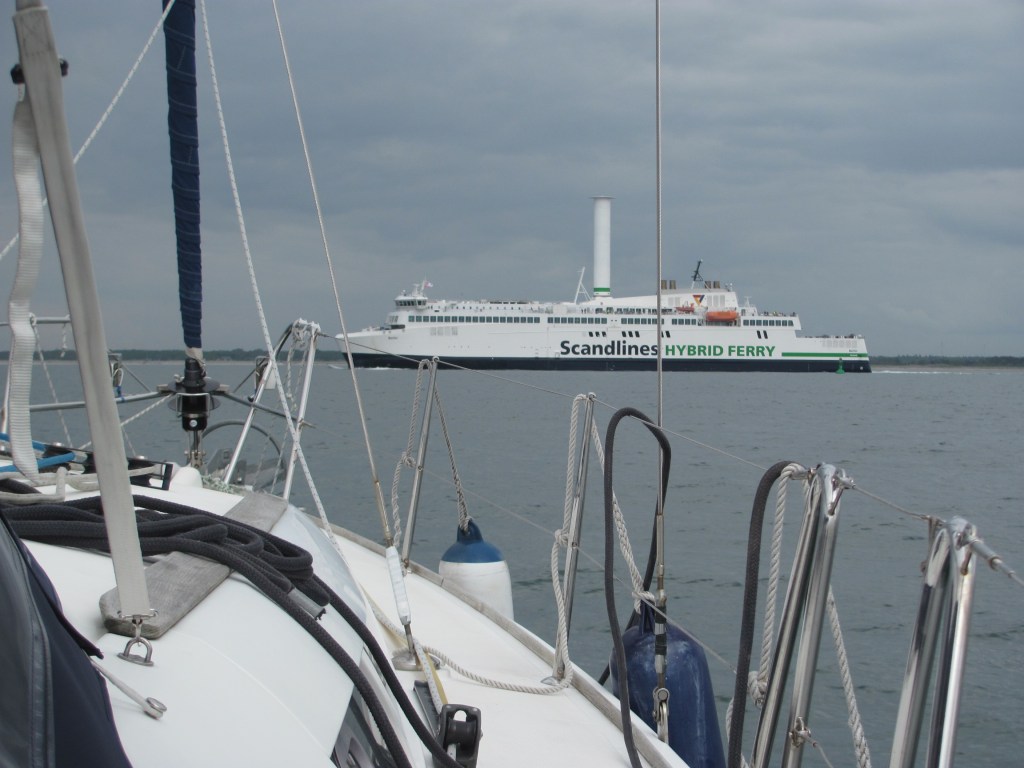
A Hybrid Ferry crosses in front of us.

“Ah, I was reading about that last night in those brochures you got”, I say. “It’s a rotor sail. It works by rotating and creating lower pressure on the front side of it and higher pressure on the stern side, a bit like a sail. The difference in pressure helps to pull the ship along and reduce fuel consumption. It’s made by a company called NorsePower and has been fitted to some of the ferries between Germany and Denmark.”

“That’s very clever”, says the First Mate. “I wonder why more ships don’t have it?”

“It’s a help”, I say. “But the problem is that it really only works when the wind is blowing at right angles to the direction of travel. It works well here in the Baltic as many ferry journeys are north-south and the predominant wind direction is west-east. They claim it reduces fuel consumption by between 5 and 20%.”

“That’s worth having”, says the First Mate. “But why don’t they just put giant sails on the ferries and be done with it? They could have them computer-controlled to adjust them to the right angle.”

It’s a good question.

We furl our own sails and motor the last little bit into Warnemünde. We have decided to stay in the Alter Strom, the old harbour near the town centre, if there is space, rather than in the brand new spanking marina on the eastern bank. There is something attractive about being near a city centre and being able to watch life going by rather than in a parking lot for boats that most marinas seem to be. The only thing is that we have to tie up against piles where fenders don’t work properly, so we need to use our boards.
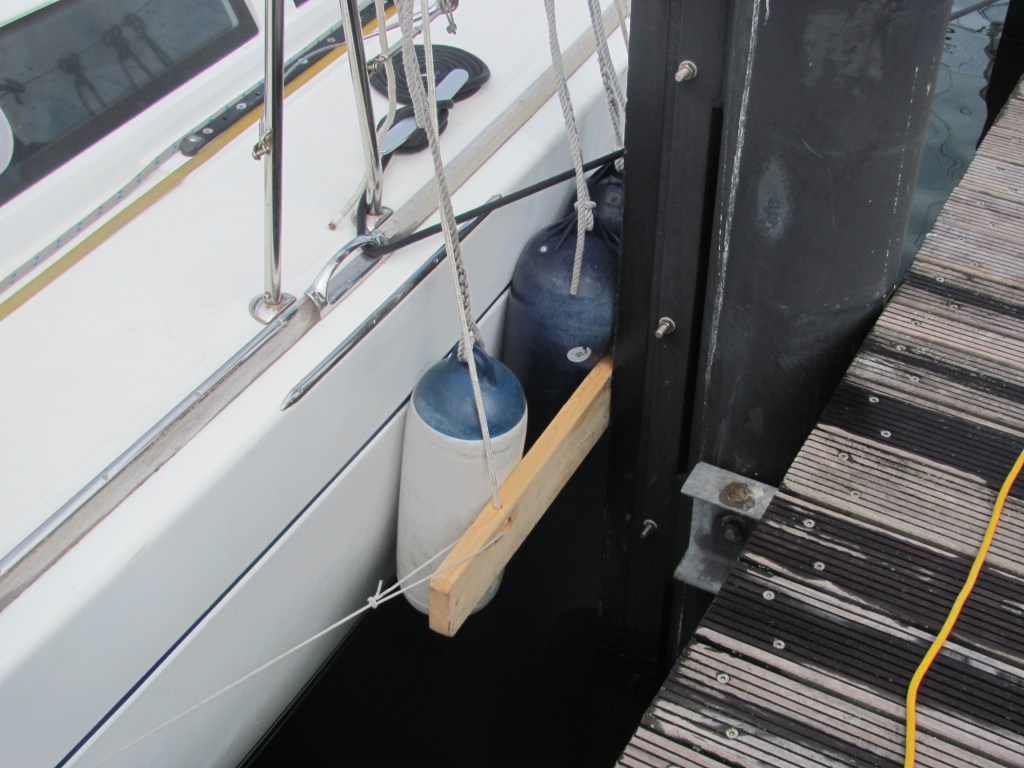
Tied up to the piles with our mooring boards.

As we arrive, out of the corner of my eye I spot a British flag on one of the boats already tied up. Later, we are invited for a cup of tea with the owners, Jim and Marjorie. It turns out they are also from Scotland, from Inverness, not all that far from us.

Jim & Marjorie and their boat.

“We saw your Scottish flag, and wondered if you were from there”, says Marjorie. “You don’t see many boats from the UK these days, let alone from Scotland.”

When they retired, they bought an old wooden motor boat, did her up, and now they are exploring the waterways of Europe. They have a relatively shallow draft, so are able to tackle most of the rivers and canals. They had overwintered their boat on Fehmarn, and were heading into the canal system at Rostock.

“The problem we have at the moment is that she dried out over the winter”, says Jim. “She was in a shed, but was near the corrugated iron wall, and when the sun shone, it would heat the air inside quite a bit. The wood has contracted, and even though we have been back in the water for about a month now, it still hasn’t expanded back again completely and is still leaking a lot.”

“And that’s not all”, says Marjorie. “The bilge pump is playing up too. The float switch gets stuck and sometimes won’t turn either on or off again. But if we give it a tap with a stick, it seems to free it up. In fact, if you will excuse me, it’s time to tap it again. I’ll be back in a minute.”

She disappears down below. We hear some tapping, and a pump motor starts somewhere. I look around for the lifejackets, and drink my tea a bit faster.

“Don’t worry”, says Jim. “She’ll be OK in a couple of weeks once the wood has expanded again. The boat, that is.”

I am not sure I want to stretch my tea out that long, but I have to say that I admire their sang froid. To be travelling around Europe in a leaky boat with a dodgy bilge pump is not everyone’s cup of tea, so to speak.

As we leave, I notice a steady stream of water coming out of one of the outlets on the side of the boat. The pump is doing its job at the moment, I think.

In the morning, we explore Warnemünde. The town was originally a fishing village, but developed as the seaside resort town of Rostock in the 19th century, and nowadays is an important harbour for the cruise industry. Expensive shops and restaurants line the other side of the Alter Strom from where we are tied up, while floating fast-food cafes offer quick snacks of fischbrötchen, fisch and schipps, and filled rolls. A paddle steamer splashes past.

Shops on Alter Strom.
Floating restaurants.
Paddle steamer.

We eventually arrive at the lighthouse. Built in 1897, it is still in use, and for €2 even allows tourists to climb the narrow stone stairs 37 m to the platform near the top. The view from the top over the Baltic Sea to the north and the town to the south is superb.

View of the entrance to Warnemünde harbour from the lighthouse.

At its base is the so-called Teepott restaurant, rebuilt from an earlier building destroyed by fire in the 1960s in GDR days.

The Teepott restaurant.

“Why do you think they called it the Teepott?”, I ask. “It doesn’t look much like a teapot. I can’t see either a spout or a handle.”

“There is a passing resemblance to one of those tea cosies that you use to keep the teapot warm”, says the First Mate. “Perhaps that’s the reason. The curved roof is supposed to be a good example of East German architecture, by the way.”

West of the lighthouse and the Teepott stretches the long sandy beach and its ubiquitous strandkörbe that makes the town attractive as a resort.

View from the top of the lighthouse.

In another street, we come across the Edvard Munch house, a former fisherman’s cottage. Seeking peace and quiet, the Norwegian painter of The Scream had come to Warnemünde in 1907 to escape his demons, and had painted and sketched many scenes in the area. However, despite being well-liked by the inhabitants, he abruptly left without reason only 18 months later, never to return.
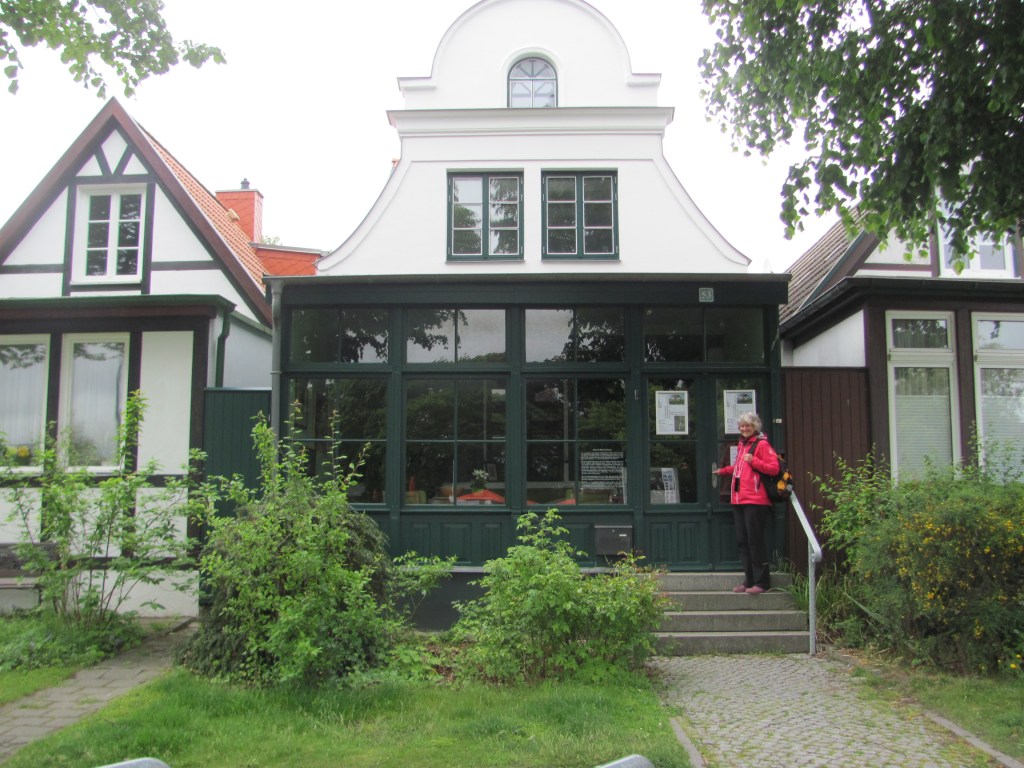
The house in Warnemünde where Edvard Munch lived for 18 months.

“We have to go and see Rostock while we are here”, says the First Mate over breakfast the next morning. “Apparently you can get the train down there for a day. It’s only about five minutes’ walk to the station from here.”

We catch the S-Bahn to Holbein Platz on the outskirts of Rostok and change to the Straßenbahn to reach the city centre. We get off at the Kröpeliner Tor, the westernmost gate of the old centre.
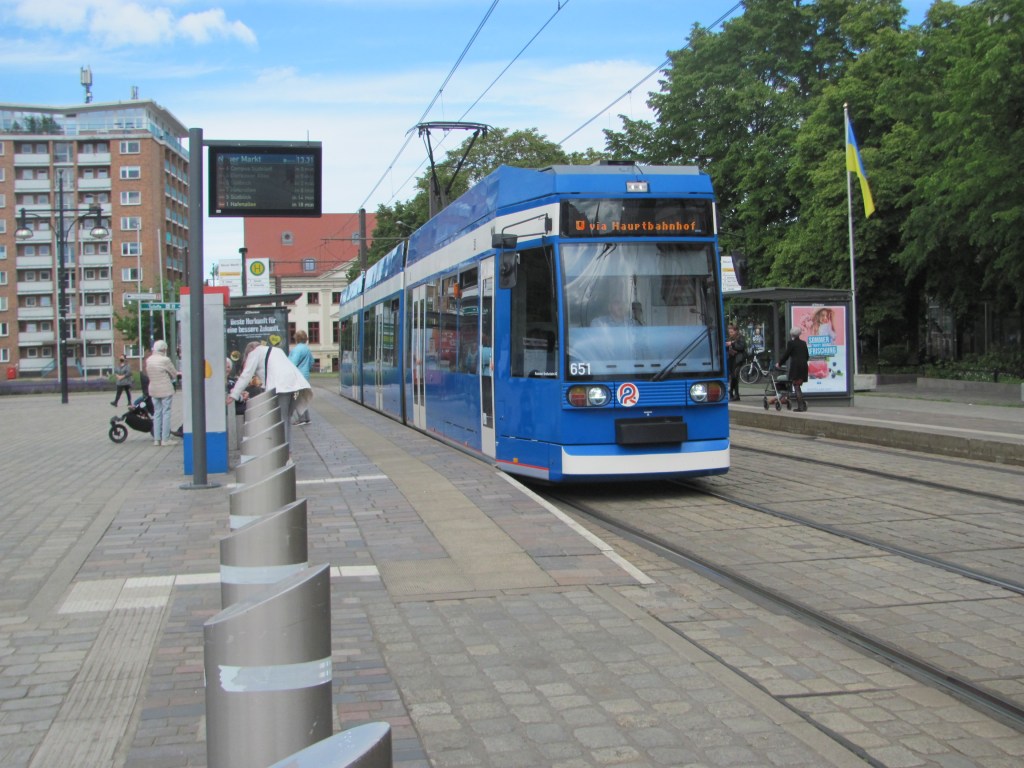
The Straßenbahn takes us to the city centre.

From there, we wander along the old city walls, passing the Kloster St Katharinen, a former Franciscan monastery. Now it is the Academy of Music and Theatre in Rostock.

Kloster St Katharine.

“It’s certainly very peaceful in here”, says the First Mate as we wait for a group of school pupils to take photos of each other against the buildings. “I think I wouldn’t have minded being a monk in those days.”

We eventually reach the Universitätsplatz in front of the imposing University main buildings.

Main University building, Rostock.

“Very impressive”, says the First Mate.

“What on earth do you think is going on here?”, I ask further on. “I am not sure my delicate constitution can cope with this.”

We are standing in front of a series of nude sculptures clustered around a fountain in the centre of the square.
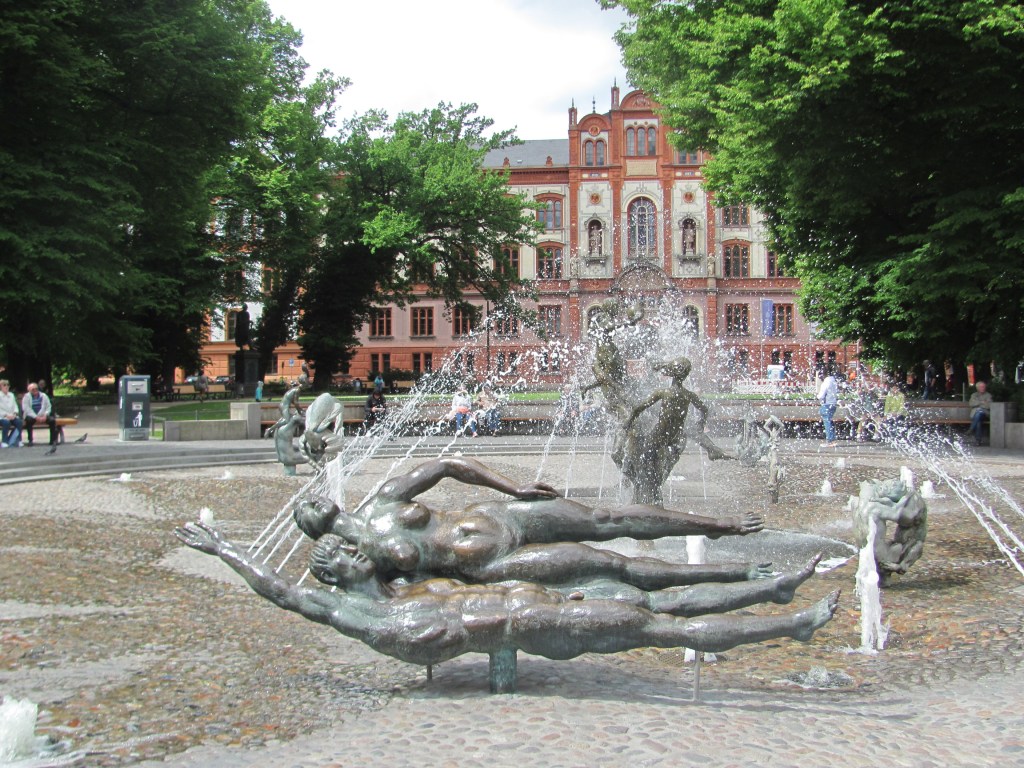
Brunnen der Lebensfreude, Rostock.

“It says it is called Brunnen der Lebensfreude”, says the First Mate. “The Fountain of the Zest for Life. But apparently the locals call it Pornobrunnen. I am not sure why.”

“I think I can guess”, I say, as I try and work out which limb belongs to whom in a writhing couple. The two dogs expressing their love for each other ignore me.

We wander down Kröpelinerstrasse until we come to the Neuer Marktplatz in front of the Rathaus, the Town Hall. In the centre is the Möwenbrunnen, a sculpture of a seagull surrounded by Poseidon, Triton, Nereus, and Proteus, four Greek gods of the sea. A market is in progress, so we have a little browse.

The Rathaus in Neuer Marktplatz, with the Möwenbrunnen in front.

On the other side of the square are picturesque houses of wealthy Hanseatic merchants.

Hanseatic merchants’ houses in Neuer Marktplatz, Rostock.

Just off the Neuer Marktplatz is the Marienkirche, a massive structure in North German Gothic brick style.

The Marienkirche from Neuer Marktplatz.

“We’d better go and see this one”, says the First Mate. “There is supposed to be an astronomical clock in it. Apparently it still works. You’ll probably want to see that.”

“Did you know that senior citizens can have a 30% reduction?”, says the lady at the ticket desk.

I don’t know whether to be pleased to have the reduction, or to be annoyed at being identified as a senior citizen. I decide on the former. The latter is reality I suppose.

We find the astronomical clock at the rear of the church. Apparently it still has all its original clockwork and has not stopped working since it was built in 1472, being wound every day and greased regularly down through the ages.
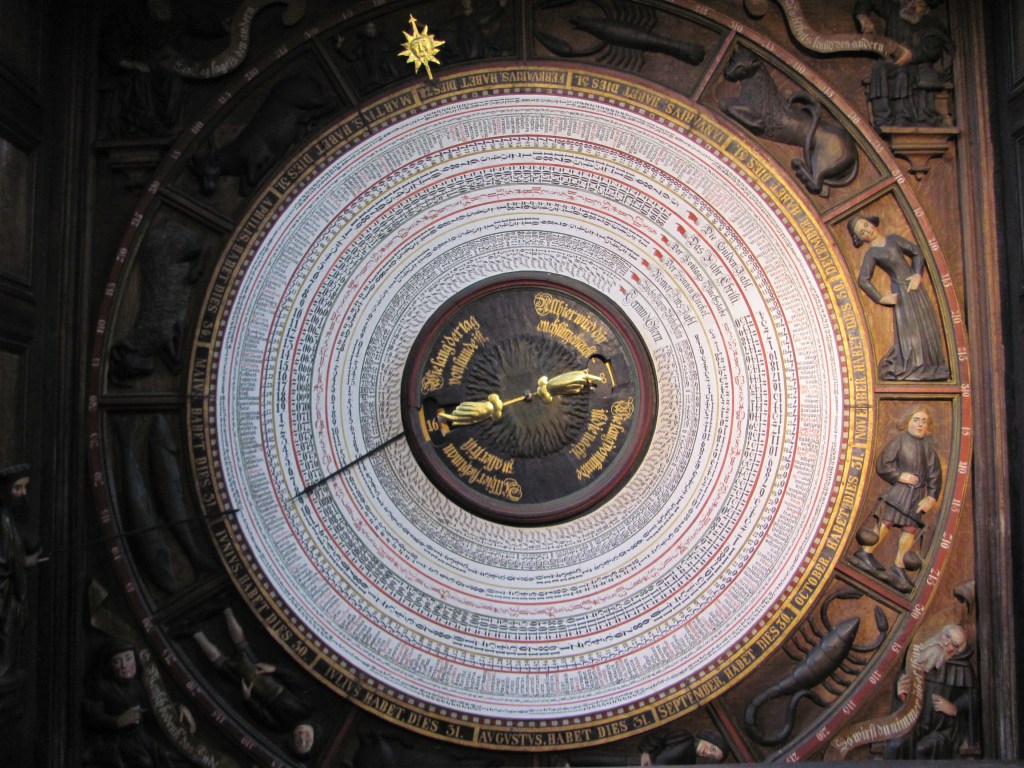
The astronomical clock in Marienkirche, Rostock.

It’s a thing of beauty. I stand for a time in front of it, taking in its intricacies and the peculiar mix of religion and science in its construction. Not only does it give the time, but also the phases of the moon and the solar year. Apparently at noon each day the twelve apostles rotate around to obtain God’s blessing in turn – I glance at my watch, but unfortunately we have missed that.

It is fascinating to think that it was built around the beginning of the modern scientific revolution, just as people were starting to realise that the world wasn’t just a series of random occurrences caused by the whim of some capricious god or gods, but instead ran according to well-defined rules that could be used to predict the future. The dawn of the modern mind.

Detail of the astronomical clock.

“It’s pretty amazing, isn’t it?”, says the lady at the ticket desk on the way out. “When it was built, Christopher Columbus hadn’t even discovered America. Where are you from?”

We tell her.

“Ah, my brother is over in Scotland at the moment”, she says. “He’s sailing as well. He’s trying to retrace some of the voyages of St Brendan the Navigator on the west coast of Scotland. Sort of a pilgrimage. Just last week he was on Eileach nan Naoimh.”

“The Island of the Saint”, I say. “Where Brendan set up a monastery. Reputed to be the mysterious Hinba, where Columba came from his monastery on Iona to contemplate. We’ve been there too.”

We had anchored in the small bay of Eileach nan Naoimh, the southernmost of the Garvellachs in the Inner Hebrides, a few years ago when we had been exploring the west coast. Although we had not gone ashore, we could see the small beehive huts and the other monastic buildings that the monks had constructed on the lonely, windswept island.

Monastic buildings on Eileach nan Naoimh, Inner Hebrides.

We chat for a few minutes on St Brendan, sailing, and how we come to be in Rostock.

“Amazing”, says the First Mate, as we leave. “Fancy coming across a connection with an island in Scotland while in a medieval church in Germany.”

That evening, we huddle inside Ruby Tuesday as a thunderstorm rages around us.

“Wow, that one was close”, says the First Mate. “It must have been just overhead. I just hope that we are not the tallest mast here.”

Sheltering from the thunderstorm.

A former border, a bike repair, and war refugees

The light winks three times from the direction of the dark shoreline. I relax– the ‘goods’ are ready. All is quiet. All we have to do now is wait, our own lights off so that the patrol vessels won’t detect us. Our boat is wooden so that it won’t show up on the coastal surveillance radar. The night is moonless, carefully chosen.

The ‘goods’ will be with us in about an hour. I adjust the fishing lines paid out over the stern to make it look like we are just innocent fishermen trying our luck for night fish in the event we are detected. I open the flask and drink the tea in it while we wait, the hot liquid burning its way down my throat. What a world we live in, I think. A country that does everything it can to prevent its citizens from leaving, even to the extent that it will shoot to kill any of them found crossing the border. Perhaps if they had a better system, people might be flocking to live there, rather than trying to escape its repression. The ‘goods’ in this case is a high-ranking official who has had enough, and wants to defect to the West.

Before long, we hear the creak of oars in their rowlocks, the dip of blades in the water. In the darkness, a torch flashes on and off for a second. The small rowing boat we are expecting is nearly here. We get ready to help its passenger to board our boat.

Suddenly there is a throb of engines. A search light flashes on, illuminating a patrol boat a few hundred metres away from us, its machine gun on the foredeck trained on the small boat nearing us. It must have been patiently waiting there all the time, invisible in the darkness. Have we been betrayed?

The machine gun stutters as the bullets trace a line of splashes towards the small boat …

GDR Border Police patrol boat (from Bundesarchiv, Bild 183-35031-0001 / CC-BY-SA 3.0)

“You look a bit shocked”, says the First Mate, coming up from the cabin. “Did I surprise you? Here, let me take that cup of tea. I’ll make some more. It’s lunchtime.”

“I was just trying to imagine what it must have been like to have been involved in smuggling people out of the old German Democratic Republic to the West”, I say. “I was about to receive a fugitive from the East when the border police intercepted us. It didn’t end well.”

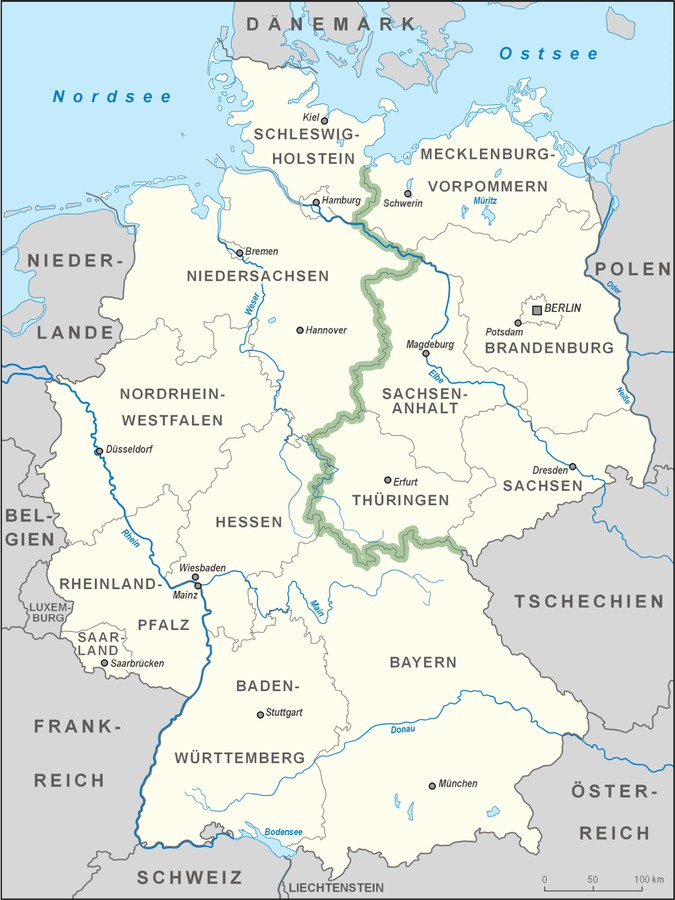
We are have just crossed the former border between West and East Germany in the Lübecker Bucht and are now in the former GDR. Not that long ago we would have been illegally in no-go land.

The border between the former West and East Germanies.

“Ah, the GDR”, says the First Mate. “Do you remember that time we were in Weimar? We had just arrived late at night and were tired and hungry. We found a pension to stay in, but they didn’t do food in the evening, so we had to go hunting around town to find somewhere that served dinner.”

“I can remember seeing lots of theatre-goers walking the streets all dressed up to the nines”, I continue, “But every restaurant that we found had shut at 6pm. In the end the only place that we could find that was open was the restaurant in the railway station. Even then, we were given a table to share with a young couple who were embarrassed and really didn’t want to talk with us either in German or English, and left shortly afterwards, not finishing their meal. I always felt guilty after that for spoiling their evening.”

Old memories! The First Mate and I had only met a few months earlier, and I was still recovering from an operation on my knee to repair the cruciate ligament. The Wall had just come down a month earlier, and once I could walk again we had decided to drive over to eastern Germany to see what it was like.

“And what about that time we were in that café in Eisenach, and we were listening to these young guys talking about the new cars that they had bought?”, she says. “The problem was that they were all so used to driving Trabbies and the like that they had no idea how to handle the power of a BMW or Audi, and were ending up crashing them on the motorway, or worse still, killing themselves.”

“Interesting times”, I say, philosophically.

We arrive at the small harbour at Timmendorf on the island of Poel. On the way in, we touch the bottom as we stray a little off the narrow entrance channel. Luckily it is only sand.

We tie up next to a motor boat. The occupants are a retired couple from Hamburg. “You speak good English”, I say, as they help us moor.

“I was a ship’s captain for much of my life”, he says. “I travelled all over the world.”

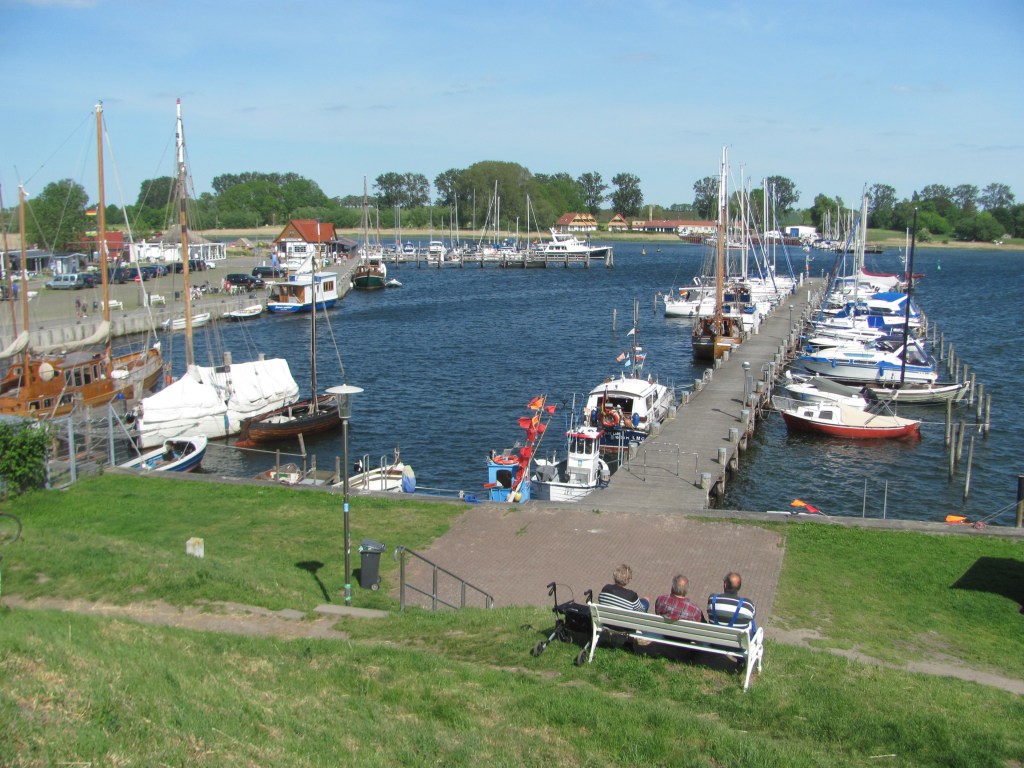
Tied up in Timmendorf harbour, Island of Poel.

There is a lot of activity on the green area in front of the harbour. “It’s a craft fair”, says the retired sea captain’s wife. “It finishes at five.”

“We have an hour”, says the First Mate. “Come on, let’s go and have a look. I always like a good fair.”

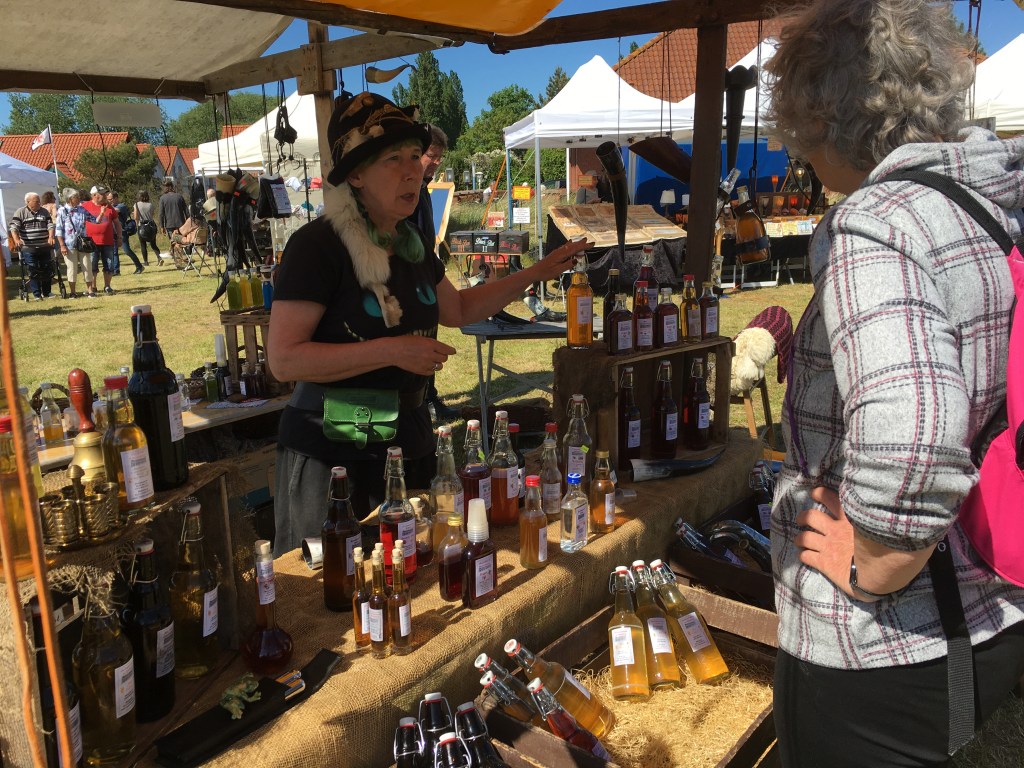
We find ourselves at a stall selling home-made spirits and liqueurs, and try a whisky flavoured with vanilla. It’s tasty and we buy a bottle.

Home-made spirits and liqueurs at the craft fair.

Afterwards, we sit on deck eating our dinner and watching the market traders pack up their stalls. Behind, last of the sun catches the lighthouse tower and reflects off the glass to reradiate a soft glow.

“I wonder if they go home happy with what they have made today, or do you think that it is a fairly hand to mouth existence?”, I muse.

“They must have a few overheads to worry about”, says the First Mate. “Their vans, the gazebo things for their stalls, all their merchandise, the fees for the stand.”

“Well, they can’t be doing too bad for themselves – those vans must cost a bit. They all seem pretty new.”

The wind drops, and the water in the harbour becomes like a mirror. One by one the market vans are packed up and disappear. Eventually the green is clear. Two or three couples walk their dogs along the small promenade. A noisy motor bike appears, disturbing the peace momentarily, but roars off again. Small swallows dart and dive around the boats, alighting on the mooring lines and defying their swaying motion. All is at peace with the world.

“I love these little harbours”, says the First Mate. “They are so full of character.”

Peace and quiet reigns supreme.

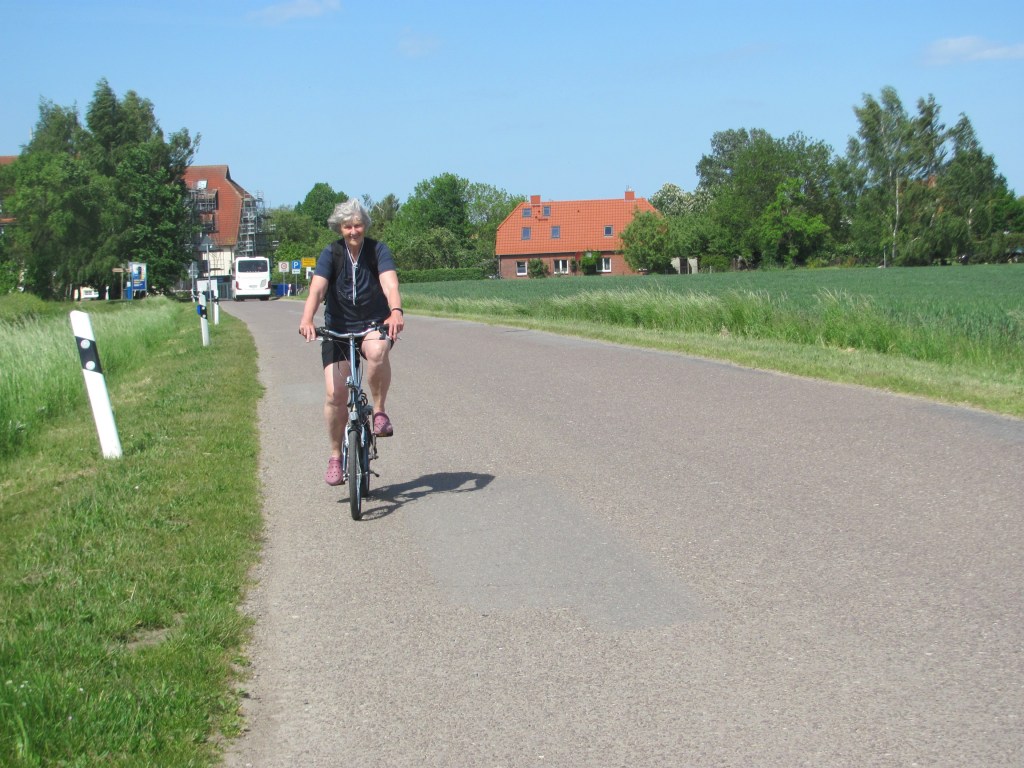
The next morning, we decide to do a cycle ride around the island. It’s only about 10 km in diameter. We unload the bikes and follow the route on a map the First Mate was given by the harbourmaster. We leave the main road and take a narrow track across fields of barley blowing gently in the wind until we pick up the coast again.

Through fields of barley.

My bike starts to rattle.

“Oh no”, I say. “My front mudguard has come off. Look, the screws that held it on have come undone. Perhaps we can find somewhere to fix it.”

We stop in a village called Am Schwartz Busch for lunch. The view out over the beach is great, but the service is slow and when our lunch does arrive, the portions are small.

“I still feel hungry”, I say, when we have finished.

“Me too”, says the First Mate. “I don’t think that I would recommend this place.”

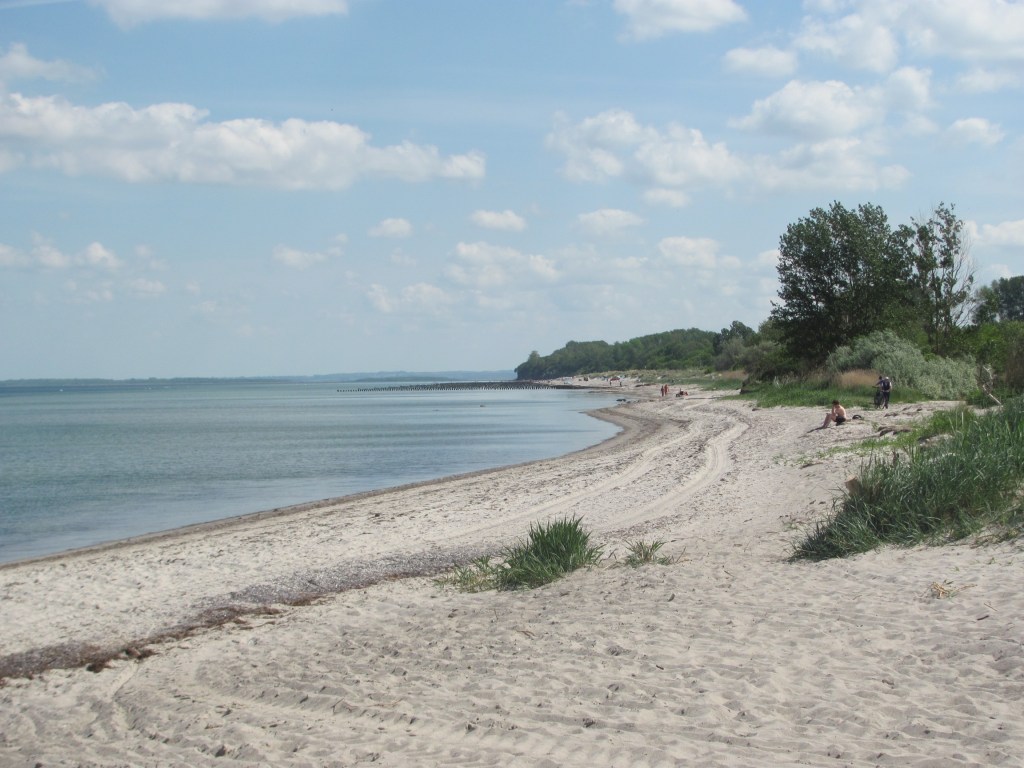
Beach near Am Schwartz Busch, Poel Island.

As we leave the village, I suddenly stop.

“Why are you stopping here?”, says the First Mate. “I thought we wanted to press on?”

“I saw a sign for a bike rental shop”, I say. “Perhaps they have some screws that I could use to fix the mudguard.”

The man in the bike rental shop looks at the bike and then the mudguard.

Ich denke wir können das reparieren”, he says.

He brings out a huge box of assorted screws he has accumulated over the years.

“Where do you come from?”, asks the First Mate as he searches through it, looking for a screw that will do the trick. “Your accent sounds a bit like it might be from Hamburg?”

“Born and raised on the island”, he responds. “Lived here all my life. Seen it all – communism, wiedervereinigung, capitalism, you name it.””

“Is it still an issue between East and West?”, asks the First Mate.

“Not now”, he says. “It was at first though. We in the East felt that the West dominated everything – any thing from there was just better without question, anything from the East was inferior. We would have liked to have had more time to sit down and discuss how to select the best of each system and merge them together into something unique. But that didn’t happen.”

“But over all, it was good that wiedervereinigung happened”, he continues. “It’s right that we are one country again, and our standard of living has improved. I have a much better pension than I would have had otherwise. The only thing is that we don’t like that the government is bringing in too many foreigners. Tourists like yourselves are OK, but all these refugees, there are just too many of them.”

“What, do you mean the Ukrainians?”, asks the First Mate.

“No, the Ukrainians are all right”, he responds. “It’s not their fault they were attacked. No, it’s all the others I mean.”

The First Mate presses him to explain, but realising that he might have already said more than he wanted to, he refuses to be drawn.

“There you go”, he says, tightening up the screw. “That mudguard should be fine now. Have a good trip.”

Back on the road.

We press on. On the north coast the paved cycle path gives way to a smooth track through the woods. Through the gaps in the trees, we can see the sea.

Through the woods.
View of the Baltic Sea from the woods.

“It’s absolutely beautiful”, says the First Mate. “I wouldn’t mind living here.”
“You say that about every nice place that we go to”, I say.

We cycle back round in a loop that takes us to Kirchdorf, the village in the centre of the island, and have an ice-cream overlooking the bay and the harbour.

“We could have brought Ruby Tuesday in here”, I say. “But it is quite a bit longer and a very narrow channel up the bay.”

“I think I like it better where we are”, says the First Mate. “There’s something about these small harbours.”

Harbour at Kirchdorf, Poel Island.

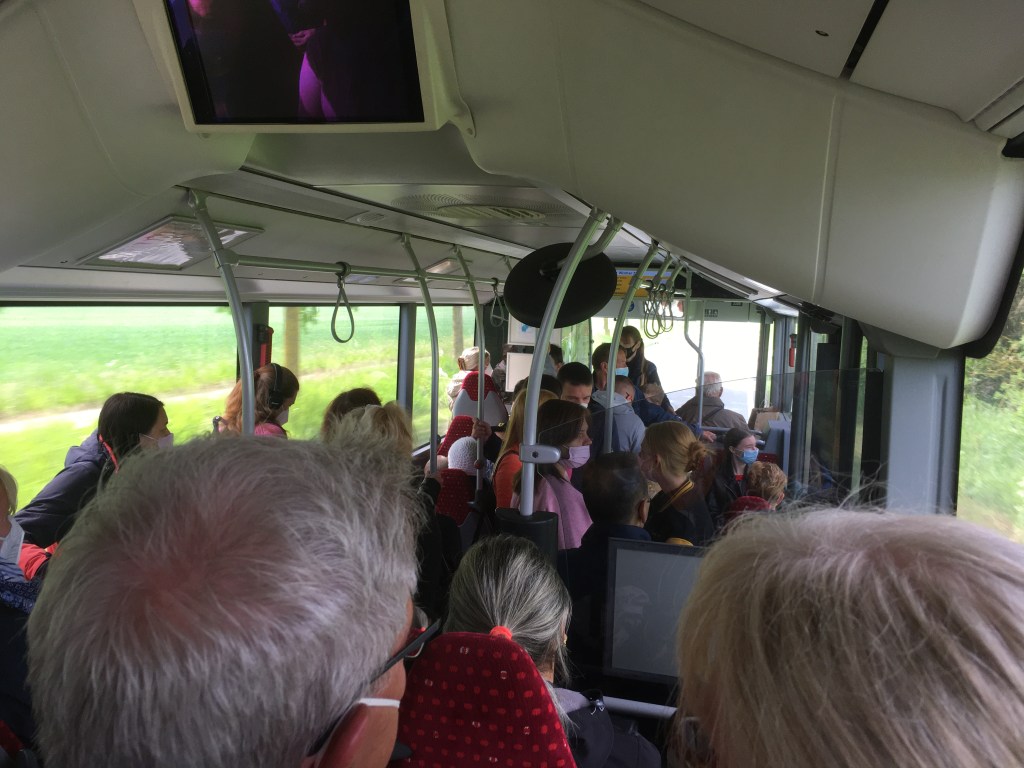
The next day we decide to take the bus to Wismar. It takes about 50 minutes. At one stop on the way, a large group of people are gathered, mostly women and children. The bus stops and they clamber in.

“Probably some sort of group tour”, says the First Mate.

Each one is carrying a shiny new blue passport.

“I think they might be Ukrainian refugees”, I whisper. I catch a glimpse of one of the passports. Sure enough, it says Republic of Ukraine. It looks like it has been newly issued.

Ukrainian refugees board the bus.

“It’s so sad”, says the First Mate. “When you see the pictures on the news of the horrendous destruction that the Russians are doing to their cities – apartment blocks and houses completely wrecked. They could be the homes of some of these people. And their husbands and fathers might have been killed.”

“It’s all so senseless”, I agree. “What sort of strategy is it to unify similar people by bombing their cities to pieces and forcing them all to flee to neighbouring countries? That’s one of the justifications for the war, after all. Weird logic.”

The group of Ukrainians gets off at the Lindengarten stop.

“Perhaps they are going to a language course somewhere”, says the First Mate. “You know, to learn German.”

We get off at the bus station, and walk towards the city centre. We end up in the Market Square in front of the Rathaus, where there is a market on. In one corner of the square is the Wasserkunst, an ornate structure that was built in the 1600s to dispense water to the citizens. Behind it is the Alte Schwede, supposedly the oldest house in Wismar, originally built around 1380, but later lived in by a wealthy Swedish merchant when Wismar was ruled by Sweden from 1648 to 1903. Nowadays it is a restaurant.

The Wasserkunst in the foreground, the brown Alte Schwede behind.

“Oh, look”, says the First Mate. “Here is a market stall selling Thüringia sausage. That was always one of my favourites growing up. Let’s get some for lunch.”

“How was it?”, I ask afterwards.

“Disappointing”, she responds. “Not as good as I remember it.”

The First Mate trying to relive her youth.

We come to the St Georgen Church. Like many of the churches we have seen in these northern German cities, it is massive, soaring 80 m into the sky. But on this one, you can take a lift to the top and get a great view out over Wismar.

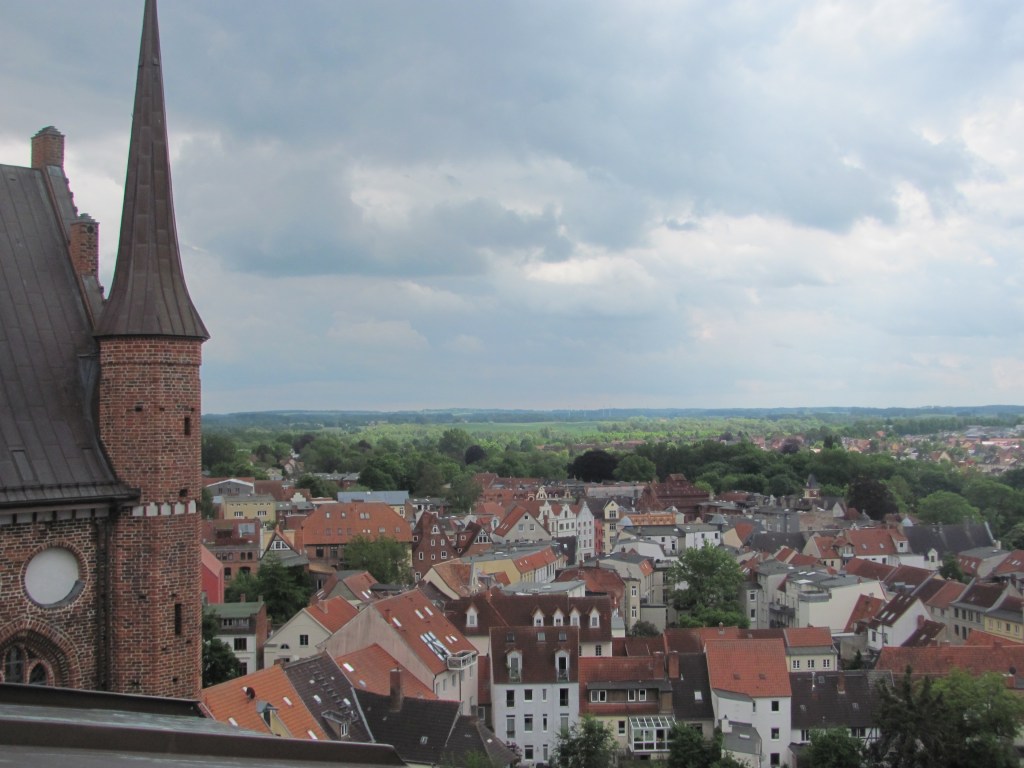
View from the top of St Georgen church, Wismar.

The view certainly is stunning. But looking down on the church below, I am filled with awe at its forgotten builders. With no cranes as there are nowadays, it takes a certain type of person who is comfortable climbing to such heights and willing to do a day’s work putting bricks in place when there. I am not sure if I could have done it.

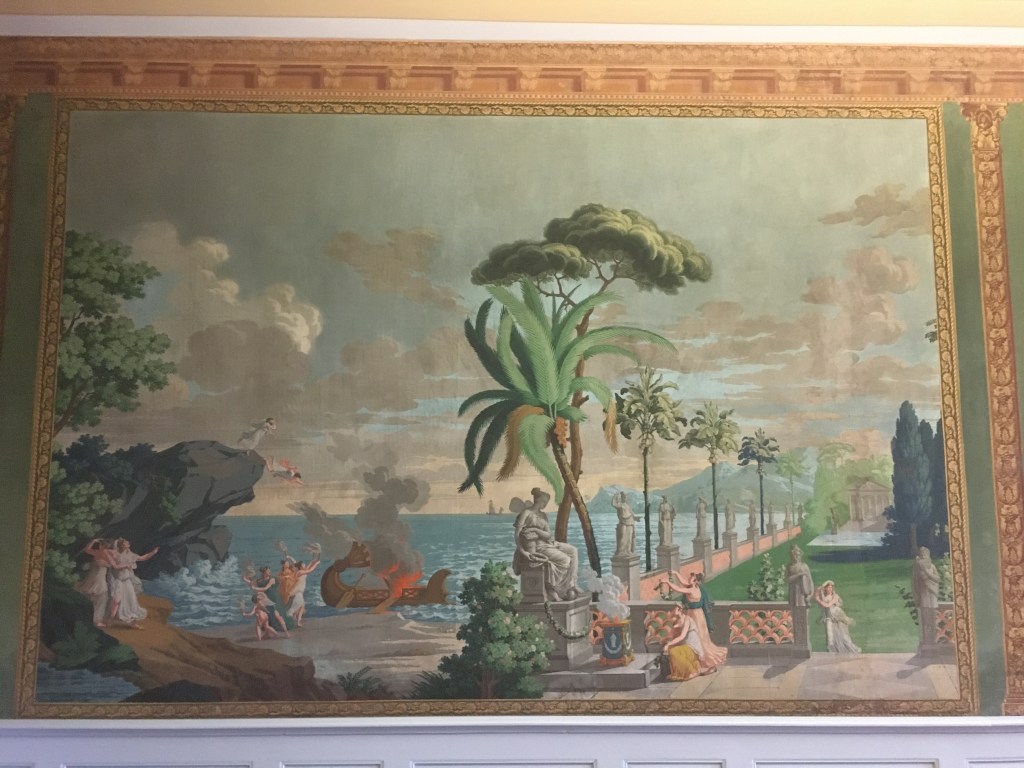
Not far from the church is the UNESCO World Heritage House of Wismar, originally built by a wealthy Hanseatic merchant. Houses built in the Hansa cities at that time had to follow common building regulations – all had to be built with bricks and have a firewall between neighbouring houses, for example. Refurbishment started in the 1970s under the GDR government and has continued until the present day. Of particular interest is the restored wallpaper depicting the Greek mythological tale, Travels of Telemachus on Calypso’s Island. Wallpaper was a relatively modern invention when this was first put up in the 1820s.

Part of the restored wallpaper in the World Heritage House, Wismar.

On the way out, I sign the Visitors’ Book and read some of the comments.

“It’s so great to see the spirit of preservation and reconstruction”, says one. “So different to the destruction that is going on in Ukraine at the moment.”

The next day is very windy, too strong for pleasant sailing. We decide to stay on Poel another day.

“I think I might take the bus into Kirchdorf while you work on the blog”, says the First Mate. “We need to do some shopping. Is there anything you want?”

“Not much”, I say. “Perhaps some fruit. We are running a bit low.”

“I’ll be back later in the afternoon”, she says. “I’ll call you when the bus gets back, and you can come and help me carry things.”

Catching the bus to Kirchdorf.

She arrives back at the boat around an hour later.

“That was quick”, I say, putting the finishing touches to the blog. “Did you manage to get everything?”

“No, she says irritably. “The whole place was closed because of the Himmelfarht holiday, and not all the buses are running. I had to get the next bus back again or else I would have had to wait four hours with absolutely nothing to do. I completely forgot about Himmelfarht.”

“So it was a fruitless journey?”, I say.

If looks could kill …

An amber beach, a broken tooth, and prosperous traders

“Look, there they are!”, says the First Mate pointing over to the left as we leave the marina. “It’s the Heiks – Heiko and Heike, and their Flying Fish. They’re just getting ready to leave too.”

Sure enough, we get a cheery wave from the couple on one of the boats tied up at the marina next to ours. We had met them while our two boats were on the land, and had got to know each other as we prepared our respective boats for our voyages. They are planning to spend the summer sailing up the west coast of Norway, while we are heading for Sweden, but are spending the first few weeks exploring the German Baltic coast while we wait for my long-term Swedish Visitor’s Permit to come through. We had agreed to keep in touch.

Approaching Schleimünde and the Baltic Sea.

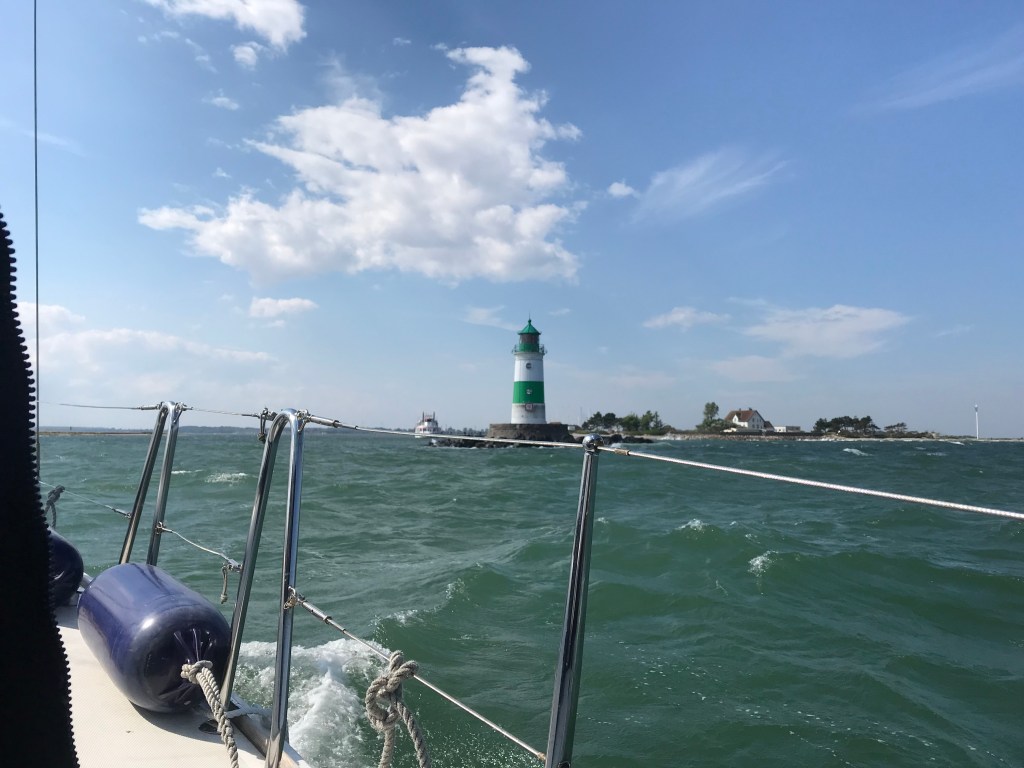
We motor out of the Schlei fjord and enter the Baltic Sea proper. The rays from the early morning sun dance on the surface, seemingly beaconing us to further adventures. There is a stiff westerly breeze blowing directly on to our stern, so we decide to use the genoa alone, and before long we are making six knots, heading south eastwards en route for Heiligenhafen, our destination for the day. The lighthouse at Schliemünde fades into the distance and eventually disappears.

The day becomes warm and sunny, so we lie on the foredeck sunning ourselves while Ruby Tuesday steers herself.

“It’s somehow nice being back on the water, isn’t it?”, says the First Mate. “So relaxing. I’m looking forward to our trip.”

On our way at last.

The peace is disturbed by the VHF suddenly coming to life.

“All ships, all ships. For an update on the maritime situation due to the construction of the Fehmarnbelt-Querung tunnel, please switch to channel 68.“

Out of curiosity we do so, even though it is not where we are heading. There follow details of where shipping must and must not go due to the construction of a road and rail tunnel under the sea from the German island of Fehmarn to the Danish island of Lolland, a distance of 18 km. I had read that the scheme to connect Scandinavia with the rest of Europe had long been talked about and was originally conceived of as a bridge, but in 2010, the Danish decided that a tunnel would be the best option. Even so, it still took another decade to plan it and obtain all the necessary approvals, but work eventually started in January 2021, and is scheduled to be completed in 2028.

“It’s quite an ambitious project”, I say after the transmission ends. “I wonder if we will even have the opportunity to drive along it?”

“I wouldn’t like to be driving along it if it suddenly sprang a leak”, says the First Mate. “What do you think they would do? Seal off the affected section with giant doors with the unlucky cars trapped in there?”

We reach the end of the spit protecting Heiligenhafen harbour and turn back on ourselves, taking in the genoa and motoring the last mile or so, and tie up in the Sailing Club marina to our left. The harbourmaster appears and helps us to make fast our bow lines.

“How long are you thinking of staying?”, he asks.

“A couple of days at least”, responds the First Mate. “But it depends on what there is to do in Heiligenhafen.”

“Ah, there’s lots to do”, says the harbourmaster. ”There’s Graswarder Reserve across there, for a start, the new holiday resort area, and the ‘zig-zag’ bridge. They have recently modernised the old town, but kept the same character. You can take the bus over to Fehmarn Island, or to the train station to get the train down to Travemünde and Lübeck.”

In the morning, we take his advice and walk out to Graswarder Nature Reserve, the spit of land protecting the harbour area. It consists of small curved lagoons of brackish water left behind as the spit extended eastwards, which now provide habitats for a wide range of birds. From the watchtower, we spot oystercatchers, tufted ducks, eider ducks, geese, and swans. There are even supposed to be white-tailed eagles, but despite keeping our eyes peeled, we don’t see any.

View out over the Graswarder Nature Reserve, Heiligenhafen.

“Apparently here is a good place to find amber washed up by the waves”, says the First Mate as we walk back along the beach.

We fervently scan the sand in front of us as we walk, but apart from finding lots of shells, some odd-shaped stones, and some interesting bits of driftwood, it seems that it is not an amber day for us.

The First Mate searching for amber.

“I am not really surprised”, I say. “I would have thought that what with the Vikings and the Hanseatic League trading the stuff, that most amber would have been found by now. The Amber Way was the route from the Baltic to Italy that it used to be transported to be worked. It’s now a long distance cycle-way.”

“Nevertheless, I read that if you are lucky you can still find bits of it washed up here”, responds the First Mate, as we re-enter the town. “But it seems that the only amber we will see today is that traffic light over there”.

“Or we could have a glass of amber nectar at this bar here”, I say.

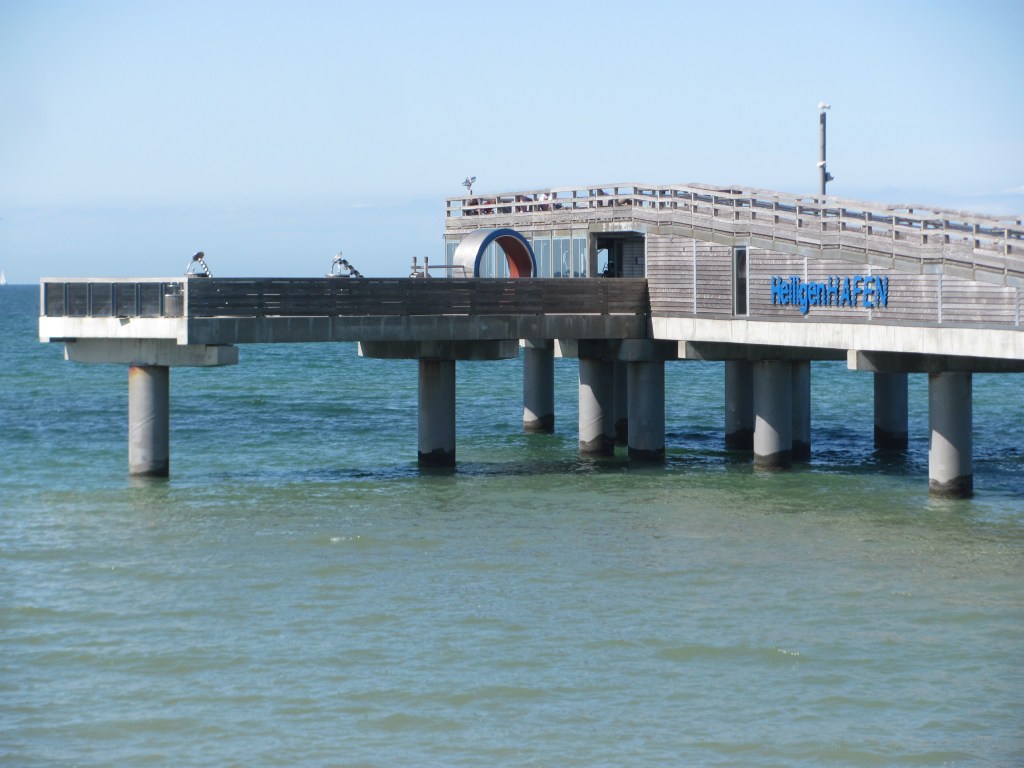
Witticisms out of the way, we arrive at the so-called ‘zig-zag’ bridge, in reality a multi-angular pier that juts out into the sea and affords a good view back of the beach and town.

The ‘zig-zag’ bridge, Heiligenhafen.

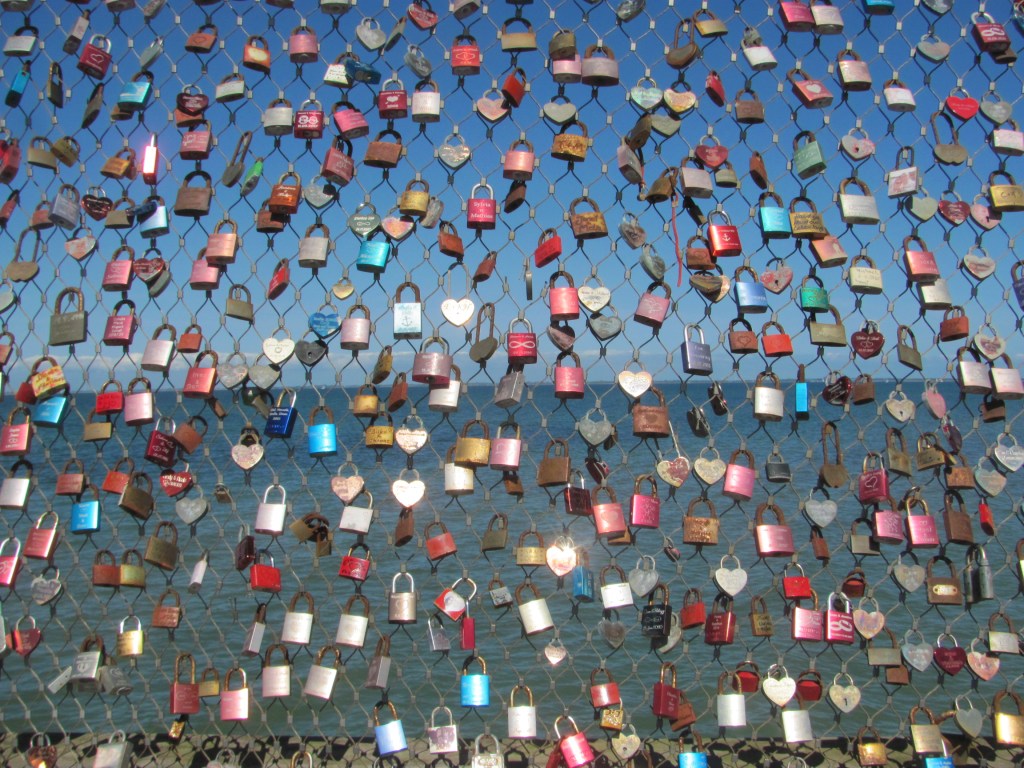
“Look at all these locks”, says the First Mate. “They are called Love-locks. Couples put their names on them, and lock them to the fence. It’s supposed to symbolise their everlasting love.”

“I wonder if they come back and remove them if they split up or divorce?”, I ask.

It is nice to leave the brashness of the new resort and explore the picturesque old city centre. It is quiet as it is Sunday and none of the shops are open.

The Market Square, Heiligenhafen.
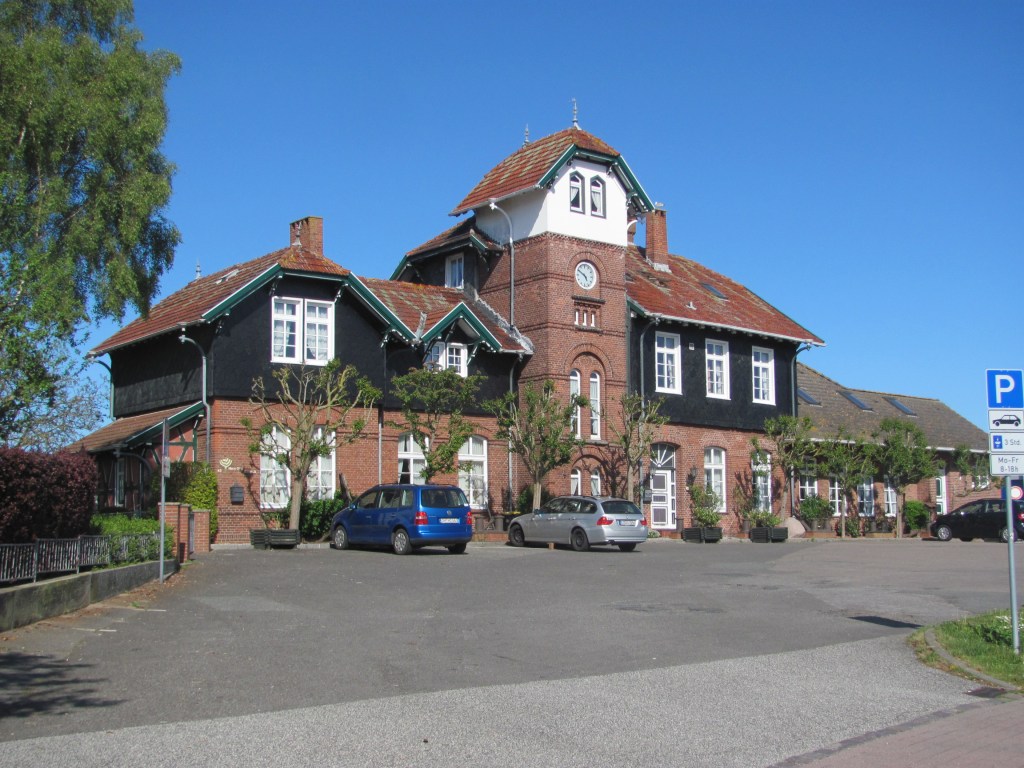
The Old Railway Station, Heiligenhafen.
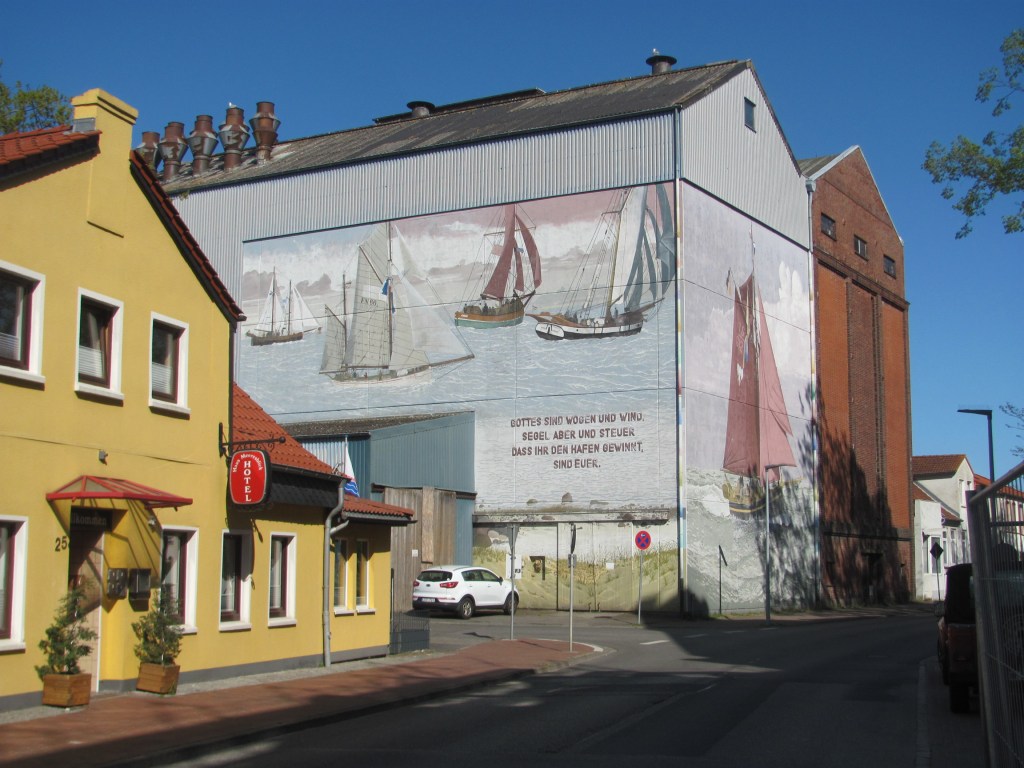
Mural art, Heiligenhafen.

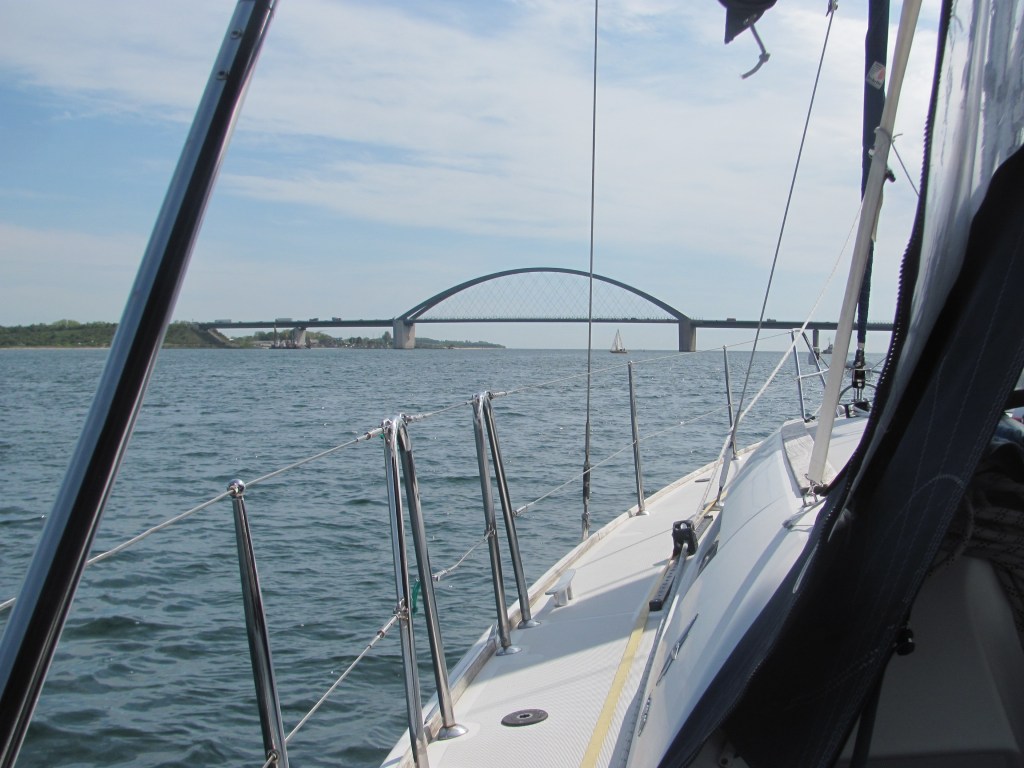
In the morning, we leave Heiligenhafen and sail for Travemünde. Once through the bridge to Fehmarn, the wind picks up and we have an exhilarating sail on a beam reach down into the Lübecker Bucht.

Approaching the Fehmarn Brdge.

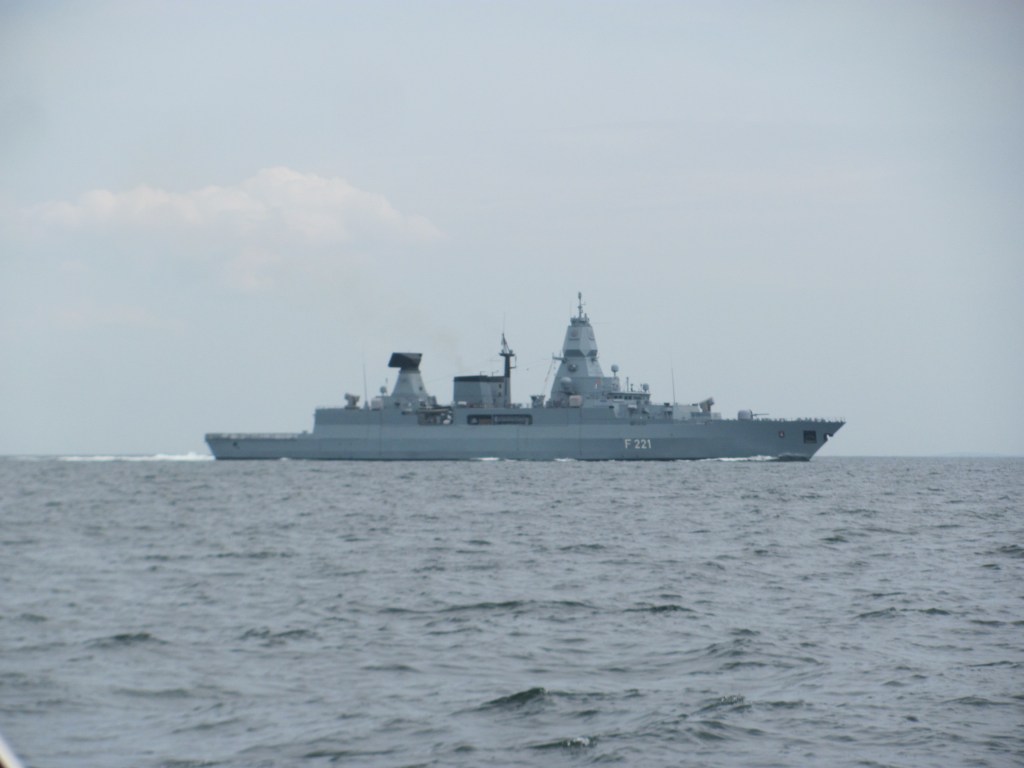
But as we approach Travemünde the wind dies as quickly as it arose, and we are left with our sails flapping. We furl them, and for a while we drift in the slight current. A warship passes us.

“I wonder if it is something to do with the Russian war in Ukraine?”, says the First Mate.

Checking us out?

“Come on”, says the First Mate at last. ”I’m getting hungry. We need to get to Travemünde and find somewhere to tie up for the night. I suggest we head for Böb’s Werft marina. The reviews in the Harbour Guide all say that it is very popular.”

“Take the first left, then immediate right, then the second left”, the hafenmeisterin at Böb’s Werft tells the First Mate over the VHF. “Then berth number 73 is on your left.”

New marinas always make me apprehensive, this one particularly so. The fairways are narrow, there are a lot of expensive-looking boats on each side, and there is quite a strong cross-wind. We find berth number 73, a box berth. We are getting used to box berths now, and normally rig slip lines to each of the four corners to make it easier on the way out. We inch into the berth, and I slip the looped lines over the two rear posts when they are level. The First Mate waits at the bow with the bow lines. But this berth is longer than most, and our stern lines are not long enough for the double line needed for a slip. Before I realise, their free ends run out and drop into the water.

“Hurry up”, shouts the First Mate. “The wind is starting to blow the bow around. The anchor is getting pretty close to the boat on our left. We don’t want to take a gouge out of it.”

“I have to go back”, I call out frantically. “I’ve lost the stern lines. We have to start again, and use single lines, not double.“

Faces appear on neighbouring boats, drawn by our shouting. We reverse slowly until I am level with the stern posts, the poor First Mate trying to keep the bow straight. I lasso each stern post in turn, then pay out the single lines as we edge forward once again. We have more than enough for the stern lines now.

“That’s it”, calls the First Mate. “Stop!!”

I use the stern lines to stop the boat and tie them off. The First Mate does the same at the front.

“Phew, that was a bit of a palaver”, I say. “I think that is the longest box berth we’ve been in.”

We finally get those stern lines attached!

“It’s not over yet”, says the First Mate. “The next problem is getting off. The pontoon is lower than normal. It’s too far from the anchor to the ground for me.”

For me too.

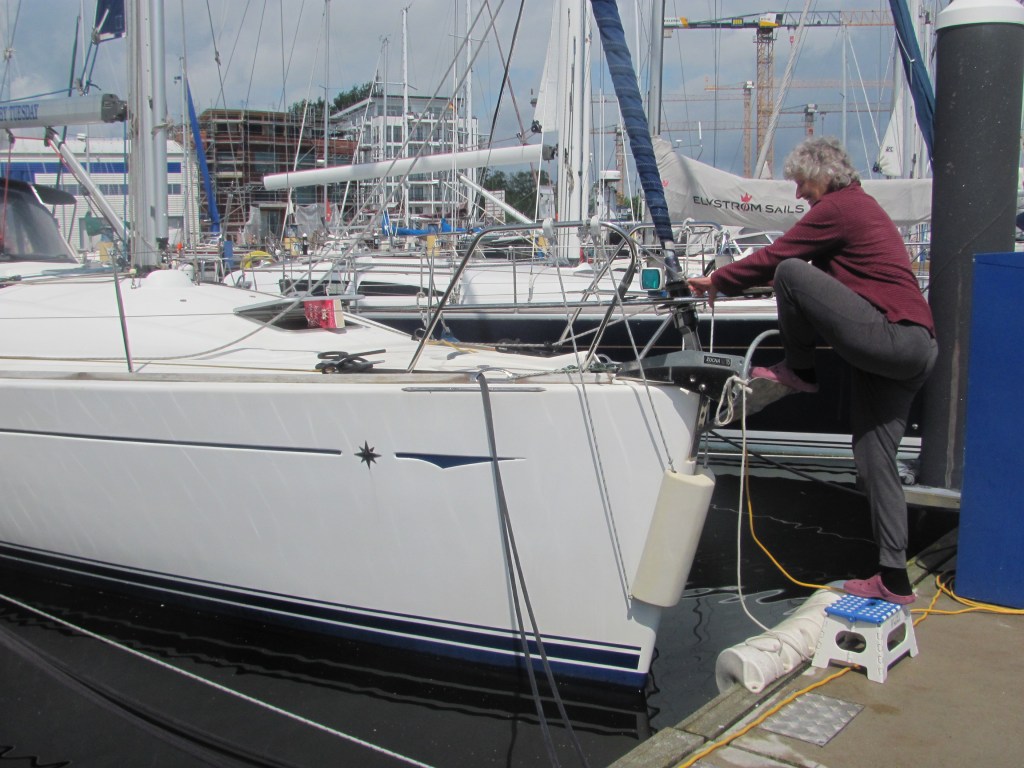
“Perhaps we should try another marina”, I say. “Why is this one so popular?”

“We’ve got the little steps that we bought last year in Denmark”, says the First Mate, ignoring me. “We can use those.”

But they don’t help much.

A giant leap for womenkind?

One set of small steps, but still one giant step for womankind, I think. As Neil Armstrong might have said, but didn’t.

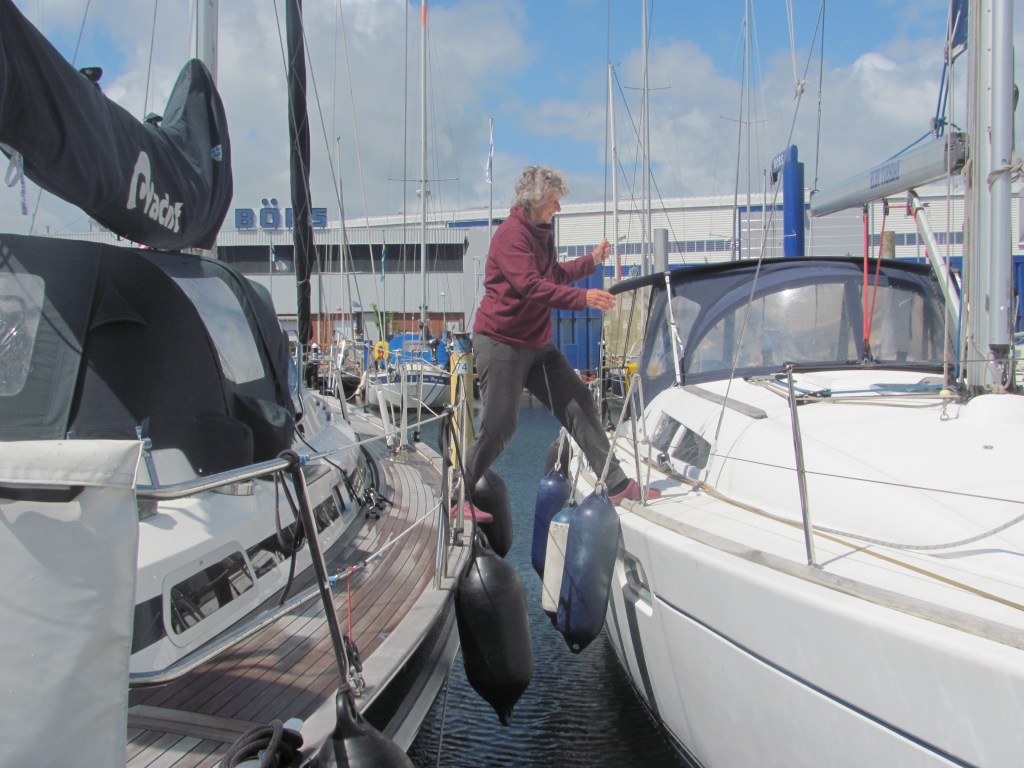
“I know”, I call. “We can climb over the neighbouring boat. Luckily it is reversed in, so we can get on it easily, then clamber across to ours. It looks like no-one is there at the moment, so we won’t be disturbing anyone.”

“Great idea”, says the First Mate.

It works. We use that method of getting on and off for the whole time we are there.

“Why don’t we try reversing into these box berths like they have done?”, asks the First Mate.

Why not indeed?

We finally make it on board.

We prepare dinner.

“I have put some croutons into the salad”, says the First Mate. “Hopefully they’ll be OK for your teeth. But take care.”

In the last couple of years, I have been having trouble with several teeth as they begin to wear out, and have been trying not to eat anything too hard that might tempt trouble.

“I’m sure they will be fine”, I say. “Anyway, I like croutons.”

Halfway through dinner I feel a crack.

“I think I might have broken a tooth”, I say, somewhat pathetically.

“I told you to be careful”, says the First Mate unsympathetically.

Sure enough, I retrieve a piece of tooth trying to hide in the rocket. My tongue finds the gap instantaneously, and, despite my best efforts, spends the rest of the evening exploring it.

“You’ll have to try and find a dentist in the morning”, says the First Mate.

The hafenmeisterin has the phone number of a dentist not far away.

“Can you come straightaway?”, says the receptionist when I call in the morning.

Naturlich”, I reply. “Sofort.”

I find the dental clinic nestled in between two supermarkets. The door looks from the outside like it might lead to a storeroom of some kind, but opens out like the Tardis into a spotlessly clean and bright dental clinic.

I tell the receptionist that we are travelling around Europe in a boat when she asks me my address.

Warten Sie hier für ein paar minuten, bitte”, she says, indicating the dental chair.

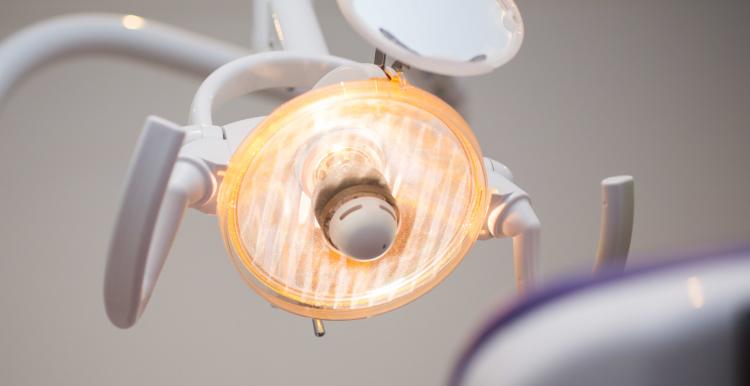
Waiting for the dentist to arrive.

The dentist arrives. He tells me to open wide and scratches my tooth with a pointy thing.

“What sort of boat do you have?”, he asks me in faultless English.

“Irrrrsssshy oooota”, I respond. Why do dentists ask you questions when they must know you can’t answer, I wonder. Don’t they realise?

“I am quite a keen sailor myself”, he continues. “But I don’t have my own boat. I usually go out with friends. I think they only have me along as the muscle to work the winches.”

“Thhhhassss iessss”, I say.

He stops poking my tooth.

“Well, the tooth is broken alright”, he says. “But it is very healthy – no cavities or signs of decay. It’ll be fine. I’ll just smooth off the rough edges to stop your tongue damaging itself. At some stage you could get a crown fitted, but there’s no immediate hurry for that. Just when you get home again.”

We chat about boats and cruising for a few minutes.

“He was really friendly”, I tell the First Mate when I get back to the boat. “And I think I got off pretty lightly with my tooth. It’s fine.”

“That’s good”, she says. “But all the same, no more croutons for you on this trip.”

The Russian trader narrows his eyes and strokes his beard. “Nein, das is nicht genug”, he says in halting German. “Furs are scarce this year. The winter has been hard, and the hunters have not been able to travel as far. Wheat yields have been lower. And the snow has made it more difficult to bring the timber to here. You have to give me better prices.”

I know that he is bluffing. I look past him to the gloomy forests behind the small trading kontor. My sources have told me that the winter has been more lenient than usual and there have been more wolves and bears trapped, and wheat is plentiful. But of course, we have to go through the motions of bargaining each other down. It all comes down to how much he wants my fine wines, clothes and other items manufactured in Europe for selling on to his wealthy buyers in the Russian hinterland. My guess is that it is a lot. Not that I don’t want his timber, wax, resins and wheat, but there is no point in paying more for these things than is necessary.

Nimm es oder lass es”, I say. “Take it or leave it.”

“Sie sind ein harter Mann”, he says. “OK, a man has to live. I accept.”

Easier than I thought. We shake hands.

Hanseatic Museum: Bust of a Russian trader.

“Have you got the jitters?”, says the First Mate, behind me. “I know you are probably in one of your daydreams again, but why are you shaking your hand up and down?”

“I was just imagining I was a Hanseatic trader doing a deal with a Russian”, I say. “It’s just amazing how much trade went on between Russia and Germany in those days. But then it is not much different nowadays judging from the amount of oil and gas that Germany imports from them.”

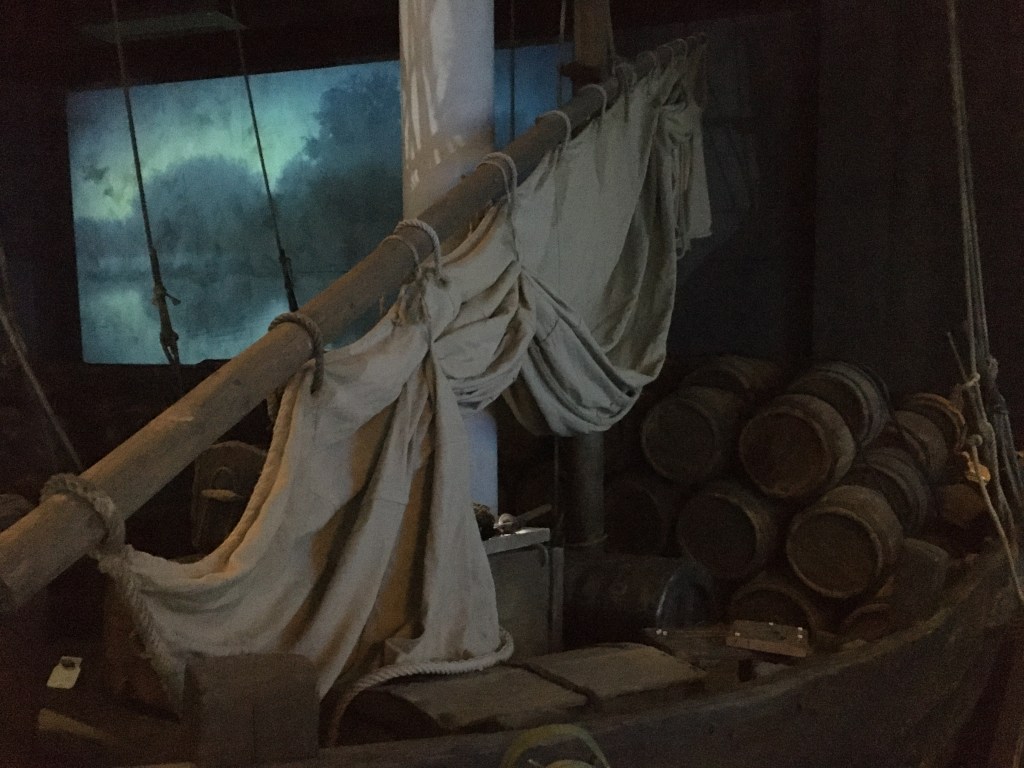
Hanseatic Museum: Reconstructon of a ship at a Russian trading post.

We are in the European Hansemuseum in Lübeck looking at a display of a boat full of goods at a remote Russian trading post. We had left Ruby Tuesday in Travemünde and taken the bus down to Lübeck for the day, the main city of the medieval Hanseatic League of Baltic trade. We had alighted at the Holstentor, the westernmost gate of the city, and had worked our way around the old city, exploring the grand churches, the picturesque houses, and the narrow alleys (gassen) between the houses leading to the inner courtyards.

Holstentor, Lübeck.
Inside one of the gassen, Lübeck
Town Hall and Market Square, Lübeck.

We had ended up in the museum, and are learning how the Hanseatic League formed in the late 1100s to become the most influential trading bloc of its time.

“Yes, it says here that the Hanseatic League was a kind of prototype of the European Union”, reads the First Mate. “It was a loose association of city states, with an agreed set of rules and procedures that included not just trade and tariffs, but also the way that houses should be built, legal procedures, weights and measures, and so on. Membership was optional, and believe it or not, the cities of London and Edinburgh were also part of it, as was Novgorod in Russia.”

Part of a Hanseatic trading agreement.

“This one says that it declined in the 1500s due to changing economic circumstances”, I read on the next board. “The development of overland routes in Europe meant that sea trade was of less importance. Also, the Dutch and English were rising as sea trading powers, and although they were part of the Hanseatic League, their focus shifted globally.”

“Funny how history seems to repeat itself”, says the First Mate on the way home. “The EU, Brexit, Global Britain, and all that.”

“We’ll see”, I say. “But the world is a very different place today to what it was in the 16th century. I am not sure that the Brexiteers appreciate that.”

A sea temple, a Frisian king, and back in the water

The tide has turned and the waves begin their race up the beach, reaching further and further each time. Bearing the remains of the Wise One, the small procession wends it way along the sandy path from the village, smoke rising lazily from the huts nestled in the trees behind. Keening wails rise from the women at the rear of the procession, calling the spirits of the land and sea to receive the Wise One into their world. I stand, my arms upraised, while the body is laid gently into the cradle formed by the roots of the upturned oak tree in the centre of the sacred ring of trunks, newly cut for the purpose. Their bark has been left on specifically to symbolise the connection with the land. Once the flesh has been picked from the body by the birds of the air, the remains will be transferred to the second ring of tree trunks further along the beach, their bark removed to signify the brightness of the sea and sky. Our Wise One is on her way to join her ancestors through these portals to the OtherWorld.

The waves begin to lap at my feet as the procession of mourners deposit their gifts of grain, newly born lambs and calves at the base of the trunks. They will provide the Wise One with the food she needs on her journey to the next world. The chanting begins and I renew my calls to the spirits. A breeze springs up, signifying their arrival. A seagull, the messenger of the spirits, alights on one of the trunks, eying the body.

“Excuse me”, says a woman gently touching my arm. “Are you feeling OK? It’s quite stuffy in here.”

It takes me a few seconds to remember that I am not the holy man of the tribe in Bronze Age Norfolk, but in the British Museum at the World of Stonehenge exhibition. I am standing in front of Seahenge, the remarkable ancient monument found on the beach near Holme in Norfolk in 1999, and loaned to the Museum specifically for the exhibition. These are the real tree trunks cut down in the spring of 2049 BCE that I am gazing at, not some modern reconstruction. They are 4071 years old, almost to the day!

The Seahenge display at the World of Stonehenge exhibition, British Museum.

The woman has the intense look of a retired history teacher at an expensive school. I put my arms down and move on. Her eyes follow me, wondering whether to call the museum staff or a doctor.

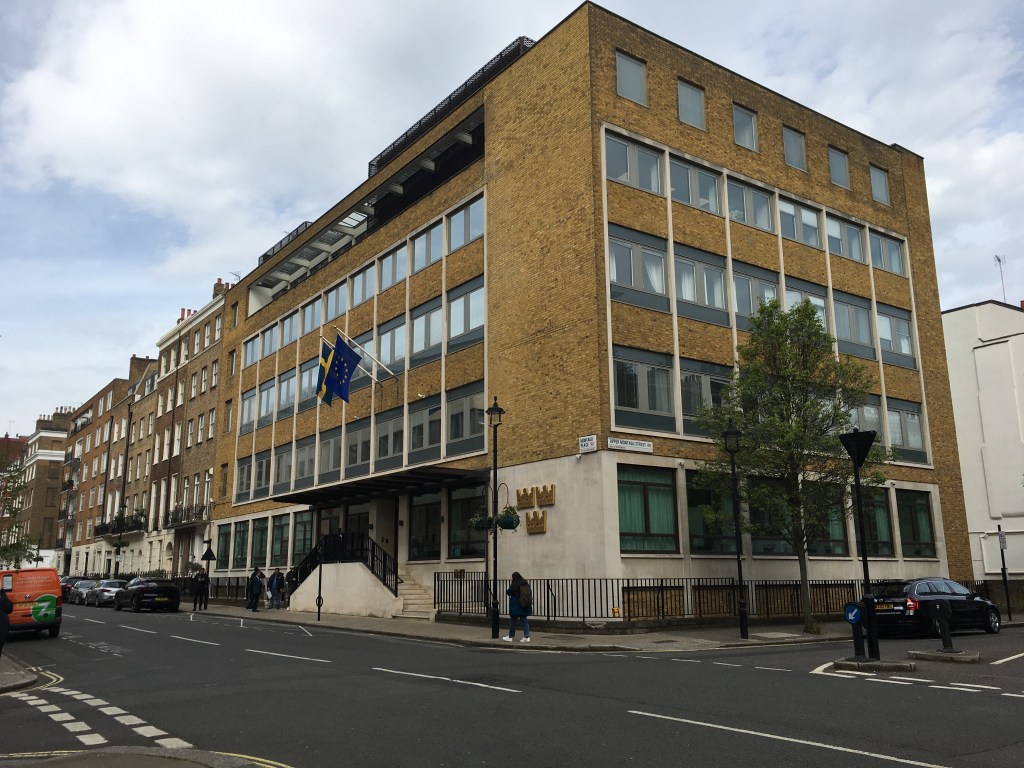
We had driven down the day before from Scotland, staying with friends in Bedford, and I had taken the train from there down to London to attend an interview at the Swedish Embassy for a long-term Visitor’s Permit which enables me to stay up to a year there and also visit other Schengen countries. Since the UK had left the EU in January 2021, life has become more difficult for cruising sailors, as the maximum time permitted in whole Schengen area is now 90 days total in any 180-day period. However, a few countries offer longer-term visas, Sweden being one. For that, though, I have to attend an interview in person at the Swedish embassy in London. It had gone well, so in the afternoon, I had decided to treat myself to the Stonehenge exhibition.

Swedish Embassy, London.

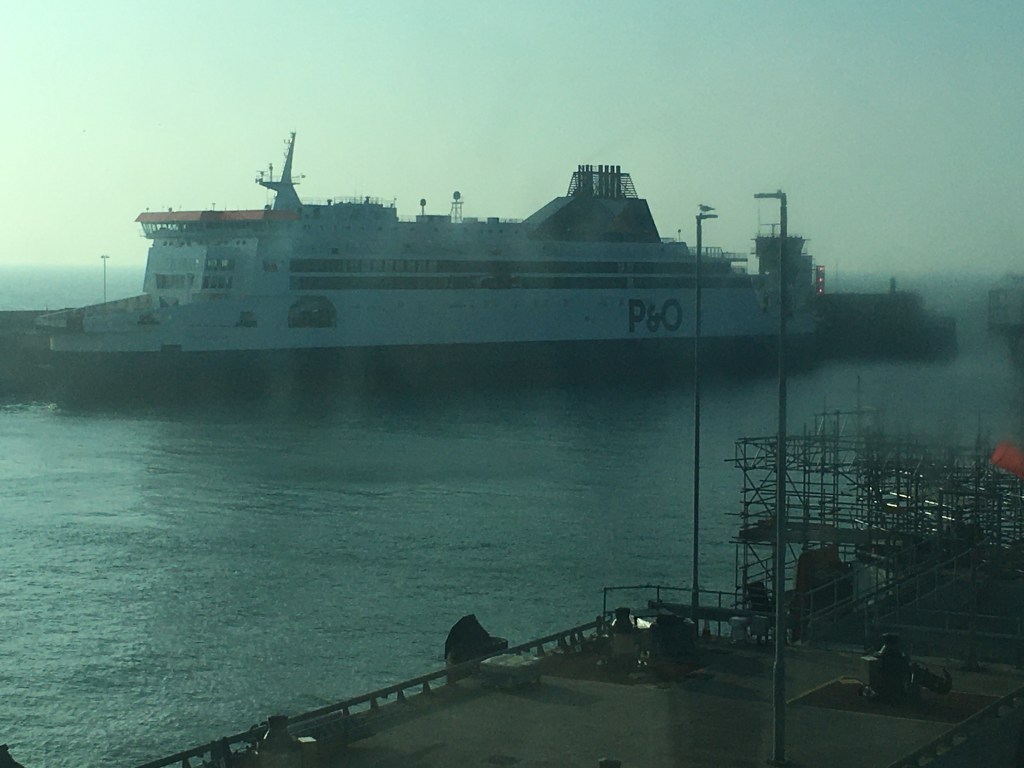
The next day, we continue our journey down to Dover. The news on the radio the day before hadn’t sounded good. Apparently, there is chaos at the port and huge queues tailing back up the M20, not only because of Brexit but also because of the laying up of the P&O ferries as a result of their sacking their staff and replacing them with new cheaper people. Luckily we are booked to travel on DFDS, but it is apparently still chaotic due to P&O passengers trying to find alternative ways to get to France for their holidays.

“It doesn’t look too bad”, says the First Mate, as the satnav indicates only five miles to Dover. “We haven’t seen any queues yet. I fully expect to see the start of one around this corner.”

But there isn’t. We arrive in Dover, and everything seems normal. We find our lodgings for the night and I drive down to the local filling station to top up with fuel before we cross the next morning. There have been rumours of fuel shortages throughout Europe due to the Russian-Ukrainian war.

Every pump has a ‘Not in Use’ sign on it.

“You won’t be able to buy fuel in the whole of the south-east”, says the filling station attendant, with an air of weary resignation. “We have been expecting a load for a week now, but nobody knows when it will come. Another week, perhaps. Maybe two. The war, and Brexit, you know.”

It’s the same at the next garage. And the next. Luckily our tank is about three-quarters full, so we don’t have an immediate problem. Perhaps France will be different.

“I hope you are right”, says the First Mate when I get back. “I don’t fancy running out of fuel in Belgium somewhere.”
Our crossing the next morning is at 0800, but we need to check in an hour beforehand. We decide to get up early to avoid the reported queues. Bleary-eyed, we drive down to the ferry terminal through the slowly waking town. Temporarily, a rubbish truck blocks our way and we fret and fume helplessly while it swallows its breakfast, but we are soon on our way again.

And still there are no queues. We pass through passport control and customs and before we know it we are waiting to board the ferry, third in the line.

“Perhaps the queues were just the trucks”, says the First Mate. “Although we didn’t see them either.”

“And I am puzzled as to where all the P&O passengers have got to”, I say. “I had expected it to be heaving. But it is all very relaxed.”

P&O ferry suspended from duty for bad behaviour.

As we drive off the ferry into France, we notice that the car deck is only half full. If the P&O passengers are here, there are not many of them. Plenty of space for more.

“Did you get your passport stamped?”, asks the First Mate as we leave the port area in Dunkirk.

Panic! She’s right. Now with Brexit, we are considered a third country by the EU, and we have to have our passports stamped to prove when we entered the Schengen Area.

“I didn’t see anywhere to have it done”, I say. “I can’t understand how we missed it. We have to go back and find it. Otherwise I will have no proof of entry and could get fined.”

We drive back to the port area. I am still adjusting to driving on the right, and nearly go around a roundabout the wrong way.

“Look out!”, shouts the First Mate. “That truck nearly hit us. I know we have medical insurance, but I don’t want to end up in hospital so soon into the trip.”

We find the passport control booths for car passengers leaving France. One is empty and I knock at the window. The official slides it open. A car pulls up behind me. Then another. And another.

Vous auriez dû le faire tamponner au Royaume-Uni avant de monter à bord du ferry”, says the official.

I manage to work out he is saying I should have had it stamped in the UK before we left.

I tell him in Franglais that they must have forgotten to stamp it in Dover and that I need to get it stamped here. I am not sure he understands me, but with a Gallic shrug he takes my passport and stamps it. With his pen, he changes the sign in the bottom corner from an arrow pointing out to one pointing in. Pragmatism at its best. At least I am officially in Europe now, I think. Or should that be ‘I hope’?

Merci, merci”, I say profusely.

He waves me away impatiently. The cars behind me move forward.

We find a filling station and top up. No shortages here. We fill the jerry cans just to be sure. If we don’t use them for the car, we will be able to on the boat. That’s what they are for anyway.

In the evening, we approach Kappeln. It’s been a long day.

“I hope we can get across the bridge”, says the First Mate. “I’ve heard that it was closed due to repairs.”

“I think that was just the lifting part for boats”, I say. “I am hoping that it will be OK for cars driving across. Mr Google hasn’t said otherwise. At least we overwintered Ruby Tuesday on the right side of it.”

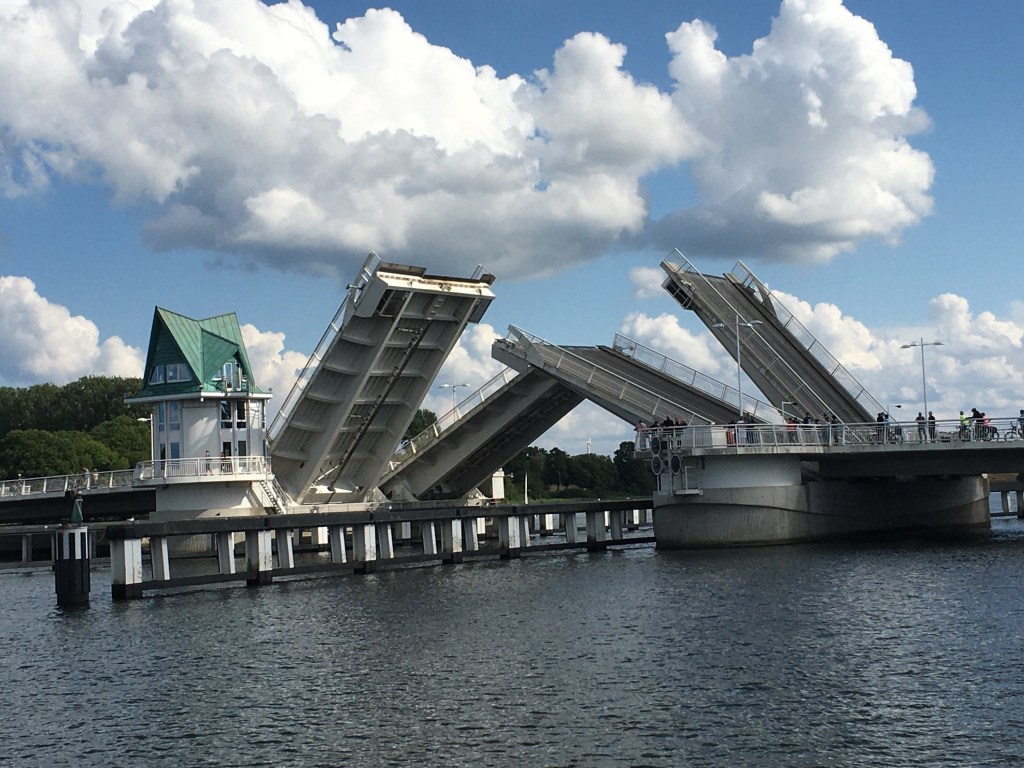
The lifting mechanism of the bridge across the Schlei fjord in Kappeln had broken over the winter and was being repaired. Another bridge further up the fjord at Lindaunis also wasn’t working. Boats that had overwintered in marinas between the two bridges were trapped between the two, not able to put to sea or even explore the upper reaches of the fjord. A rush of schadenfreude comes over me. Normally that would be us, but by pure luck we had made the right decision for once.

Broken over the winter.

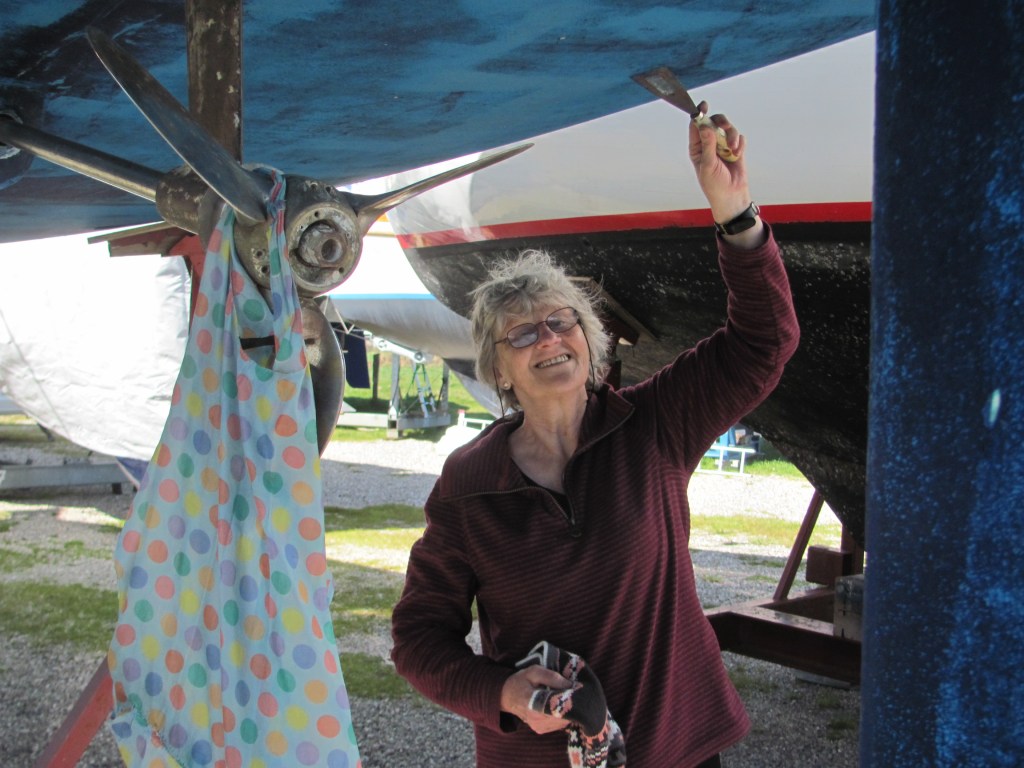
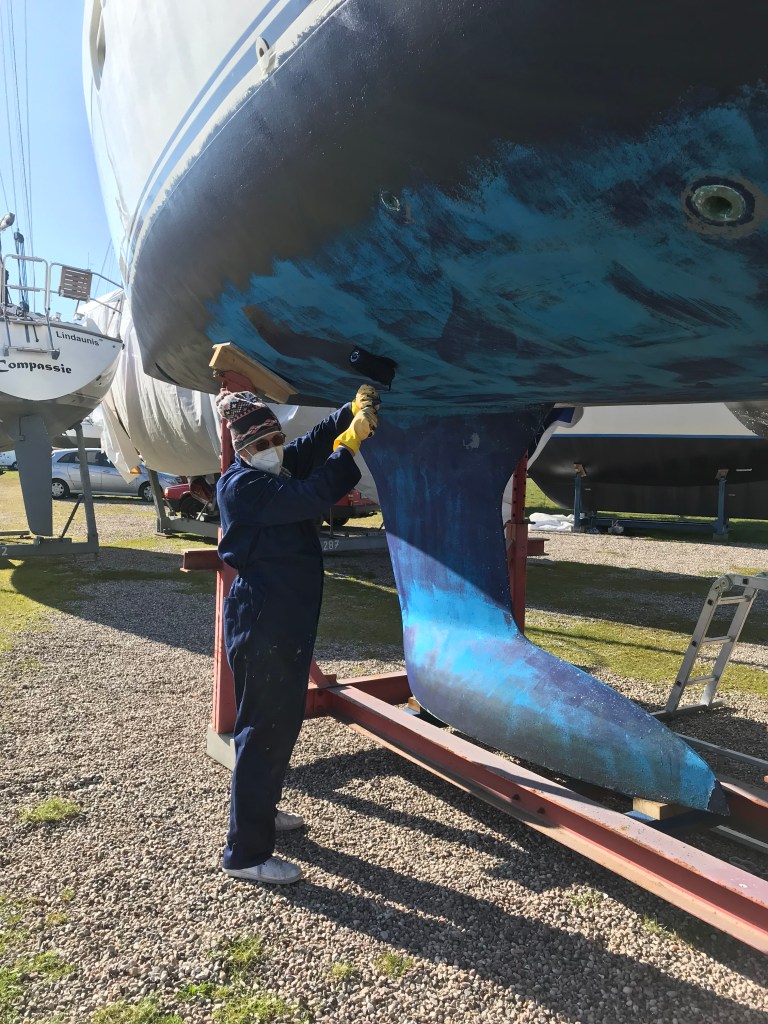
We spend the next week preparing Ruby Tuesday for launching. With her out of the water, it makes sense to take the opportunity to antifoul her. The last application had been done at Ardrossan on the west coast of Scotland three years previously, and it had lasted well given that it is supposed to be done every year or so. The next couple of days we spent underneath the hull scaping off any loose material and painting on the new dark blue layer with a roller brush. The latter is messy work and I need to cover up.

Scaping off the old flaking anti-foul.
Painting on the new anti-foul. Yes, it is me!

“You’ve got blue blotches everywhere on your trainers”, says the First Mate, “And little blue speckles all over your glasses.”

“I was wondering why you were looking bluer than normal”, I respond. “I thought you were feeling the effects of the cold evenings again.”

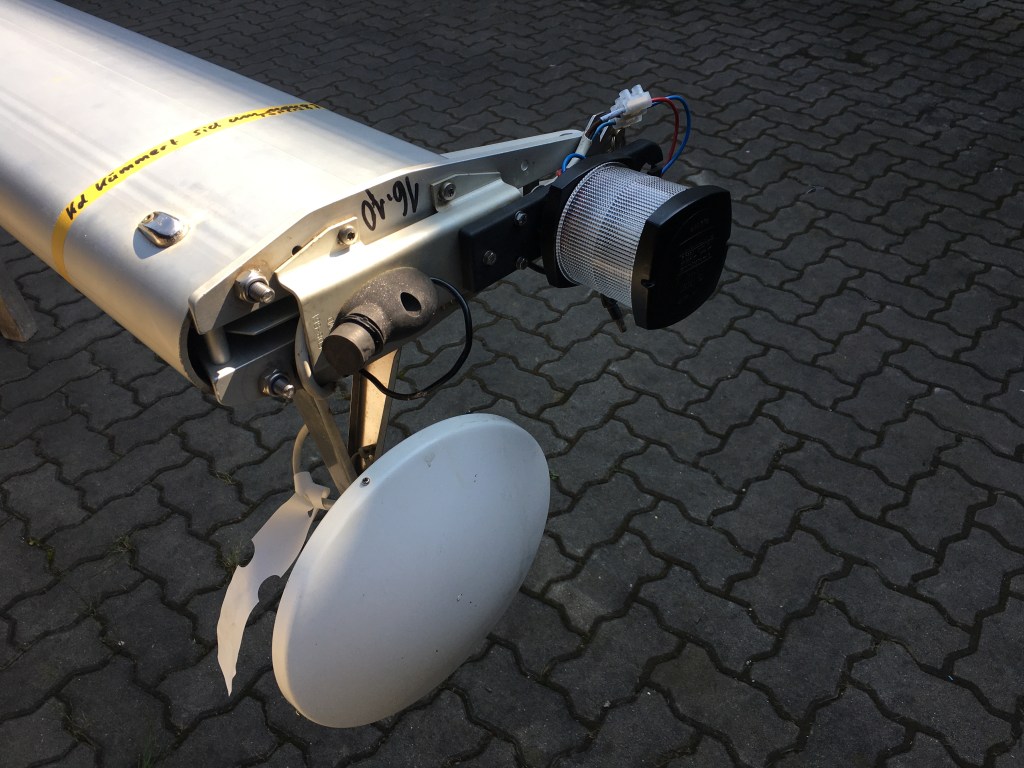
We work our way through the to-do list as the scheduled date of launching looms. Many of the jobs can be done once she is in the water, so we focus on making sure everything is completed below the water line and on the mast. We fit a new anchor light on the latter.

A new anchor light gets fitted to the top of the mast.

The day of launching arrives. The trailer arrives exactly on the dot of the scheduled time. German efficiency at its best. Vorschprung durch Technik, or words to that effect. The giant crane lifts her off the trailer, and I take the opportunity to paint antifoul on the small squares on her hull that were missed where the cradle supports had been. I manage to spill some on the ground.

Vorsicht, vorsicht!”, shouts the crane operator angrily. “Jemand könnte da reintreten.

I feel like I am back in kindergarten the day I made a mess with my paints.

Ooops! Naughty me!

The crane swings Ruby Tuesday around, and lowers her gently into the water. A smaller crane lifts the mast back on, and it is secured with the shrouds. She starts to look like a yacht again.

In she goes!

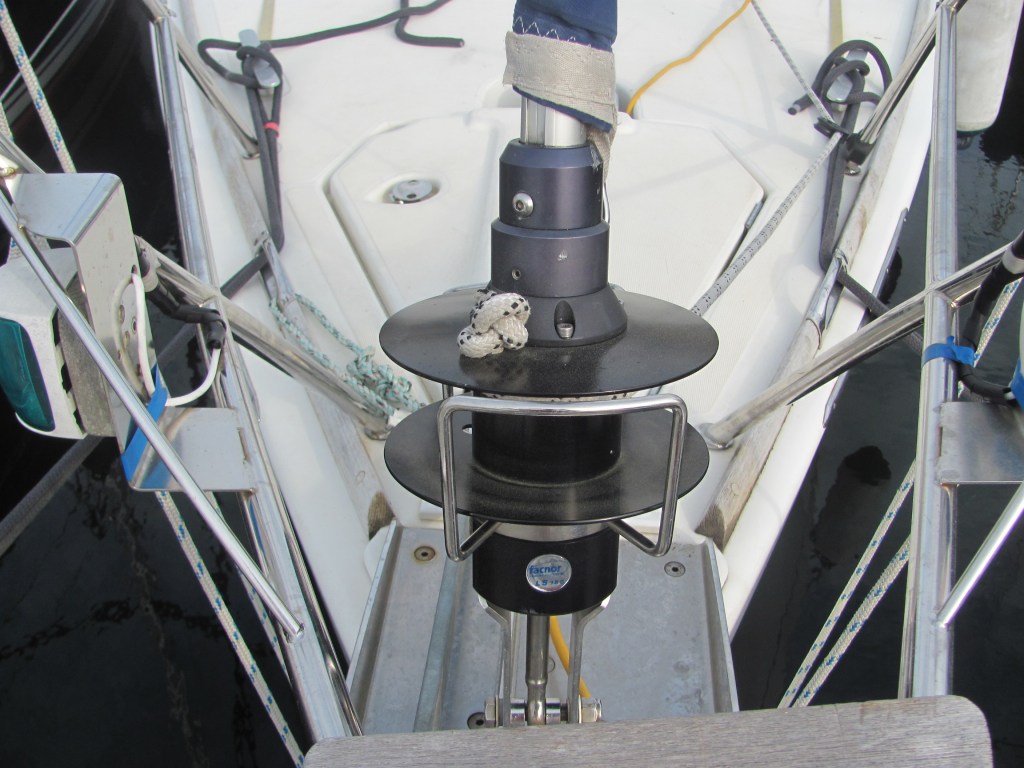
Back in our berth, we re-attach the boom and the kicker and hoist up the mainsail. Everything seems to be running smoothly. Then a glitch. I try to turn the furling drum of the foresail, but it sticks tight. After some twisting and turning, I manage to get it to move, but it is so stiff as to be unusable. Liberal doses of WD40 don’t seem to make much difference. We speak to the rigging expert.

“It’s probably corroded inside”, he says. “It’s a known problem with the early versions of this type of drum. The circlips that hold the bearings in place are made from mild steel and not stainless steel, and sea water gets in and rusts them. Why anyone thought of using mild steel in a marine environment is beyond me. You can try dismantling the drum and seeing if the circlips can be replaced with new ones, otherwise you will have to replace the whole thing, I am afraid.”

Jammed furler drum.

We try and undo the bolts that hold it together. It’s as if they are welded and won’t budge.

“The only thing I can suggest now is that we take the drum off and try and dismantle it in the workshop”, the rigger says. “We can probably get the bolts undone by applying heat. But we will have to use the crane to take the whole furler off. We can then let you know if you can repair it yourself or whether you need to replace it.”

It is starting to sound expensive. But we don’t have a lot of options, as we have planned to drive down to stay with the First Mate’s folks in Nord-Rhine-Westfalen for a few days, so we leave it in the rigger’s capable hands while we are away.

The journey down is supposed to take five hours but takes nine due to staus, or traffic jams, around Hamburg. We arrive tired and grumpy. Over the next few days, we do a few cycle rides in the surrounding countryside to restore our spirits.

“You know”, says the First Mate, propping her bike on its stand. “In all the years that I was growing up here, I never came to this bit. I can’t understand why we never did. It’s a great view.”

We are standing on top of a huge mound of tailings, the remains of the Radbod coal mines that were an important part of the local economy of Hamm in the first part of the 20th century. It has been rewilded and there is a lookout tower on the mound giving a good view out over the city. Behind us, we can see the two giant headframes that were used to lift the coal up the shafts. Immediately in front of us is the Lippe River and the canal that was constructed both to control its flow and provide a harbour to load the coal on for transport. To the east is the Radbodsee area that is now a large lake for watersports.

Headframe at the Radbod coal mine, Hamm, Germany.

“We were always told as kids that Radbod was a 12th century king of the Frisians”, she continues. “But I was reading the other day that when they built the mine here, they initially named it after St Radbod, a local archbishop. When they tried to recruit Protestant miners, however, they found that they weren’t too keen on working in a mine named after a Catholic priest, so they changed the story to it being named after Radbod, the King of the Frisians, to give it more universal appeal even though he didn’t really have much to do with the area. It seemed to work, as lots of Protestant miners were recruited.”

“There’s advertising for you”, I say.

Cycling along the Lippe Canal, Hamm, Germany.

Below us, we see a police car driving furiously along the road beside the canal, its siren blaring raucously.

“Dooo-daaah, dooo-daaah”, it goes.

“Flens-burg, Flens-burg”, I sing in harmony.

“Why are you saying that?”, asks the First Mate. “We are in Hamm.”

“Every time I hear a police siren in Germany, I am reminded of the time we were in Flensburg when there seemed to be a siren every ten minutes”, I answer. “Even throughout the night.”

“That was because we were tied up just next to the police station”, says the First Mate.

In the evening, we get an email from the marina to say that they have taken the furler drum off and that it is completely corroded inside and beyond repair by normal on-board tools. They recommend that the drum is replaced with a new one, and can do it before we get back. Not wanting to waste time, we give the go-ahead.

Corrosion in the old furler drum.

Two days later, we take the train back to Schleswig and catch the bus to Kappeln. I take special care to remember my fleece after my mini-adventure in Holland last year. When we arrive it is pouring with rain. A taxi takes us to the marina.

On the way back to Kappeln by train.

The new furler drum has been installed and turns easily with one hand. At least we can finally get going now. I try not to think of the bill.

Crossing the border, lifting out, and a lost jacket

“There looks like a long stretch of bad weather coming in a couple of days’ time”, I say over breakfast. “Much as I would like to stay on Ærø longer, I wonder if we should make a move tomorrow to get back to Kappeln for the winter, or else we might be stuck here for a week or more with high winds.”

We have decided to overwinter Ruby Tuesday in Kappeln. We want to leave her in Germany, as with potential travel restrictions due to COVID, it is easier to get into that country due to the First Mate’s nationality. Kappeln is also reasonably easy to get to with public transport – a regular bus to the small town of Süderbrarup 5 km away, then mainline trains from there to Kiel and beyond. It had also been very difficult to find storage places anywhere else in Germany with any space left, even outside or in the water, and a marina at Kappeln was one of the few that did have room. Apparently the shortage was because many German sailors had brought their boats back to Germany for the same reason of access during times of restricted travel. This year, many who had kept their boats in Denmark had not been able to get to their boats until late in the season. We didn’t really want to be stuck in the same situation next year.

“I think that sounds a good idea”, answers the First Mate. “I am not too keen on rough crossings. And we have quite a bit to do to prepare Ruby Tuesday for the winter. The sooner we get started, the better.”

We cast off the next morning at 0730, motor out of the marina, and turn southwards to clear the south-eastern tip of Ærø. Once we are out of the shelter of the island, the wind picks up to 22 knots. Unfortunately it is from the south-west, meaning that we will probably be beating most of the way.

Close-hauled in a stiff breeze.

The wind is even more on the nose than was forecast. We sail as close-hauled as we can, 30° off the wind, but is soon becomes apparent that we have no chance of reaching Kappeln on that angle and are more likely to end up in Kiel instead. I decide that there is nothing to do but take a long series of five-mile tacks. At least we have all day.

The sun comes out, warming us up. We look back as the coast of Ærø fades into the haze.

The Danish coastline recedes into the distance.

“It’s kind of sad to think this is our last sail, isn’t it?”, says the First Mate. “I’ve got used to boat life in the last four months.”

“Yes, it’s been great”, I say. “We were pretty lucky to have been able to get over here and stay healthy all that time, what with Brexit and COVID. I have to say that I have really enjoyed Denmark. I didn’t know much about the history of the place before we came, but it has been fascinating how this area here has flip-flopped between Denmark and Germany.”

“I was surprised how beautiful it all was”, the First Mate replies. “All the little villages and houses are so quaint and colourful, and those doors! They have somehow managed to maintain a lot of their old buildings rather than ripping them down and replacing them with modern monstrosities.”

“Where do you think we should go next year?”, I ask.

“I would quite like to work our way along the south coast of the Baltic”, she replies. Germany, Poland, then perhaps up to the Baltic States – Estonia, Lithuania and Latvia. I saw a documentary on them, and it looked beautiful there. But I heard that they haven’t been doing too well with COVID.”

“I wondered about heading up to Sweden and doing the east coast there”, I say. “The Swedish archipelago is supposed to be very nice. We need to think about it over the winter.”

We sit in silence for a time, lost in our own thoughts.

Reminiscing over our voyage.

“I wonder what sort of country we will be getting back to?”, I say. “Shortages of drivers, food shortages in the shops with empty shelves, disputes with the EU over Northern Ireland, arguments with the French over fishing rights, and so on. It just never seems to stop.”

“I heard from one of our neighbours that it isn’t too bad for shortages around where we are”, says the First Mate. “Maybe the odd thing isn’t available, but it’s nothing like empty shelves or anything like that. At least not yet. But it does seem that prices of things have gone up.”

“Wah-hay!”, I interrupt, looking up from the chart. “I’ve just noticed that we have crossed the border from Denmark into Germany.”

Crossing the border.

“It doesn’t feel any different”, says the First Mate. “But I’ll put the kroner away and get the euros out, if you like.”

“Fine”, I say. “I’ll change the courtesy flags.”

Approaching the entrance to the Schlei fjord.

We approach the entrance to the Schlei Fjord. On our port side, I notice a small wooden yacht with two people on board. It is heeled right over, looking like they are racing us to the narrow entrance. Lacking the inclination and the ability to do anything about it, we watch them with bemusement. They reach the entrance well before us, still heeled significantly, and continue up the fjord. There is a buoyed channel, perhaps 20 m wide, for yachts to follow – outside the buoys where it is shallow, one ventures at one’s own risk. I forget about them momentarily as we enter the entrance ourselves, then see them again in front of us tacking furiously from side to side as they go.

“That little yacht is going well outside the buoys”, says the First Mate. “Should they be there?”

I shrug. “They are probably local and know the water here like the back of their hands. You wouldn’t get me doing it with our draft, but I am sure they are alright.”

They’re not. As I speak, the little yacht comes to a shuddering halt and starts to lean alarmingly to one side.

“I think they have gone aground”, says the First Mate. I check the depth on the chart where it is. 30 cm!

“Sure looks like it”, I say, “That’ll teach them to show off.”

I try not to let the schadenfreude in my voice show. We are in Germany after all.

“Should we go and help them?”, says the First Mate.

“There’s no way we are going over there”, I say. “They are not in any immediate danger. Anyway, here comes someone to pull them off, look!”

Sure enough, a small motorboat is making its way slowly towards them.

We round a bend in the fjord and lose sight of them. Later we hear on the VHF that a yacht went aground, but has now been rescued.

“I am glad they are all right, at least”, says the First Mate. “It’s a pity we didn’t get a picture of them.”

We spend the next few days preparing Ruby Tuesday for the winter on land. We take down the sails, the cockpit canopy, and spray hood, and stow them. I change the engine oil and replace the oil and fuel filters.

Changing the engine oil.

We take the boom off and store it on the foredeck tied to the railings. We wash, dry and stow all the running rigging. This year we are taking the mast off for the first time to check that everything is OK on it. Better to find out now if there are any issues rather than somewhere in high winds on a lee shore with the tides against us. I disconnect all the electrics running up the mast and prepare the standing rigging for removal. The First Mate stores all the clothes and textile things in the vacuum packs and sucks the air out of them with the vacuum cleaner. And cleaning, cleaning cleaning.

Preparing the mast for removal.

“I am always amazed how much cleaning needs to be done”, says the First Mate. “Even though it is quite a small area and we clean it regularly en route. Here, can you empty the rubbish bin again?”

“Humans are just messy creatures”, I say, sweeping out the cockpit and trying to sound profound at the same time. It doesn’t work.

It’s the day of the lift out. We arise bright and early. At least it is not raining. We eat our breakfasts in silence, planning in our minds the last little jobs that we have to do. We cast off and reverse out of the berth into the fjord, and motor up to the lifting crane.

“Watch out!”, shouts the First Mate. “There’s a fishing boat coming up on the inside. It looks like it will cut us off. Don’t hit it.”

There is a strong current in the fjord taking us out to sea and I am not keen to try and remain stationary to wait for the boat to pass. I wave to him to indicate that we are going into shore to the crane, but he continues on his course. We are already getting swept down, so I decide to head for the lifting area and hope he will pass around us. He keeps coming. At the last moment, he veers to port and misses us.

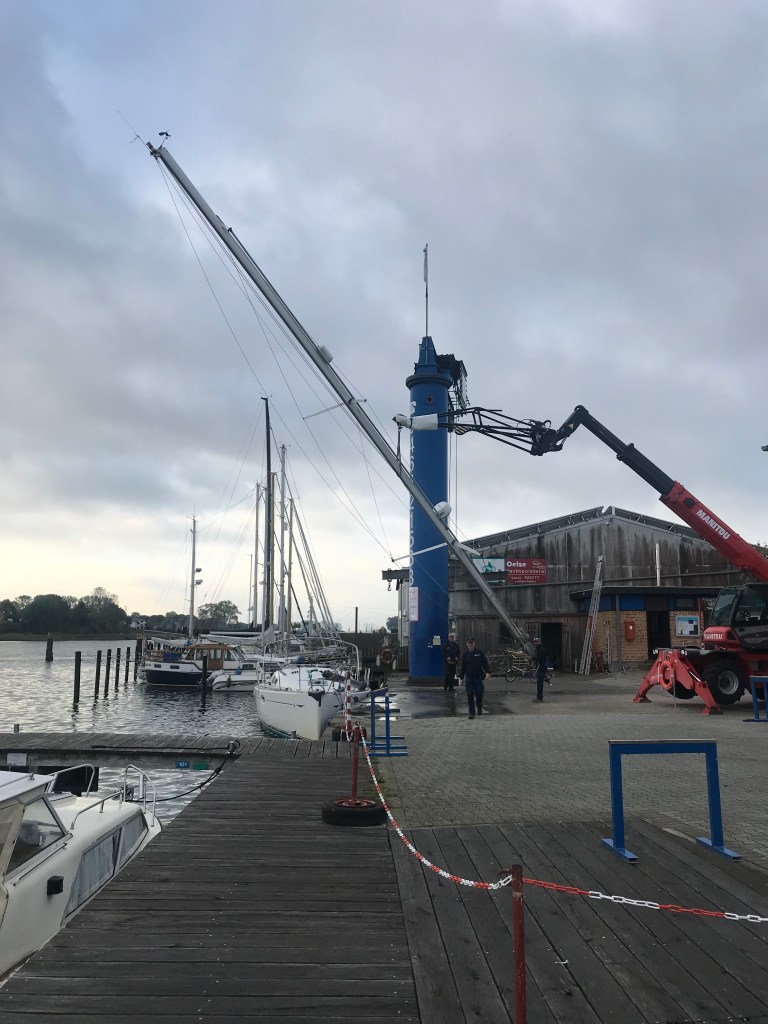
We tie up, and the marina staff swarm over Ruby Tuesday, attaching the crane to her mast, removing the shrouds and furler. A whine of winches and the mast is lifted off and laid on trestles.

Off comes the mast.

Two large straps are pulled underneath the hull and attached to the crane. We hold our breaths. Another whine of winches and before we know it Ruby Tuesday is sitting happily in the cradle that will support her for the winter. We needn’t have worried – the staff know their jobs.

Out she comes.

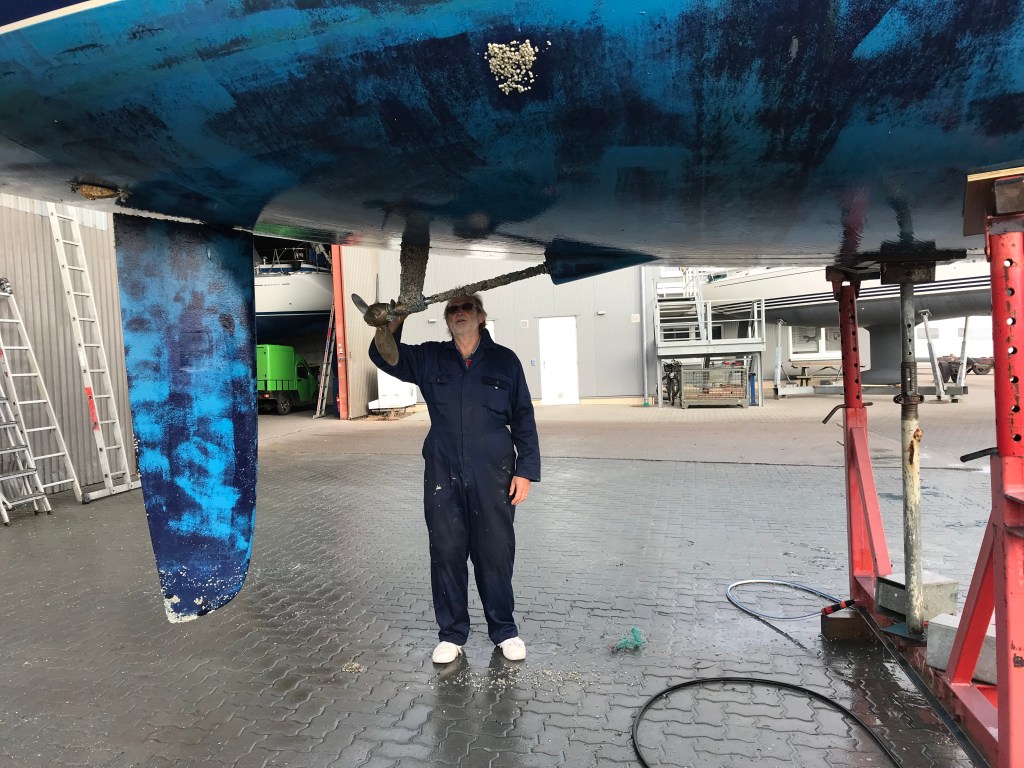
There is surprisingly little growth on the hull – just a cluster of barnacles around the driveshaft and propeller where we didn’t antifoul her last time, and a few along the waterline. Not bad for not having been lifted out for three years!

The staff clean the hull with a high pressure hose to remove the small amount of slime here and there. The First Mate and I then get to work scraping the barnacles off. It is strangely satisfying work, and soon the drive shaft and propeller are shiny again.

Cleaning off the barnacles.

Soll ich den Rumpf reinigen?”, says a voice next to us. “Es ist einfacher es jetzt zu machen als nächste Jahr. Ich verwende ein spezielles Waschmittel.

One of the staff is standing next to us with a high pressure hose attached to a brush and a container of detergent. He’s asking if we want the top part of the hull to be washed.

Ja bitte”, says the First Mate. “Glauben Sie, Sie können diese Rostflecken auch entfernen??

Wahrscheinlich. Ich werde es probieren”, he says.

Whatever he uses works a treat. Soon Ruby Tuesday is gleaming all over.

“She looks like she is smiling”, says the First Mate. “I’m glad that we got that done.”

She is towed over to her winter storage location in the back paddock. Ruby Tuesday, that is, not the First Mate. The latter needs to be towed back to Britain for her winter storage.

Ruby Tuesday in her place for the winter.

We put anti-freeze in the sea-water cooling circuit to minimise damaging from freezing, disconnect the batteries, and drain the freshwater from the tanks and the hot water cylinder. One last clean and we lock the door, climb down, and wave goodbye to her. We are staying in a hotel in the town centre not far the bus-station for the night.

“I hope she will be alright”, says the First Mate.

“I am sure she will be”, I answer. “She has the cows to talk to.”

“What about Spencer?”, she says. “Where’s he?”

“I put him in the anchor locker”, I answer. “It will be warm and dry in there. He’ll be fine there for the winter.”

Spencer examines his home for the winter.

The next morning, we catch the bus that takes us to Süderbrarup train station, 12 km away. Five minutes after we get there the train to Kiel arrives.

“Quick, get on”, I say. “This is our one.”

“No, it isn’t”, says the First Mate. “I booked the later one to make sure that we didn’t miss it if the bus was late. We have to wait another hour.”

It eventually comes. We climb aboard and settle into our seats. We are finally on our way home.

Homeward bound!

The effort of the last few days catches up with me and I doze off. I start dreaming of snow, mountains, long walks, and lockdowns. Someone shakes my arm.

“Quick, quick!”, I hear the First Mate saying. “Wake up! There has just been an announcement that we can transfer here to go directly to Schiphol.”

“I thought that we had to go to Amsterdam Centraal first, then change”, I say grumpily.

“Yes, I know, but they just said that we can get out here, and there’ll be a train for Schiphol along in a few minutes”, she says. “It’ll save us about 20 minutes.”

Still rubbing the sleep from my eyes, I grab the rucksacks and struggle to the door. It opens and we step out on to the platform. The First Mate tumbles out after me clutching her luggage.

“Brrrrr, it’s a bit chilly”, I say. “I am going to put on my fleece ….. My fleece! My fleece and gloves! They’re still on the train!”

I rush back to the train door. It closes in front of me. The train starts moving.

“Oh no!”, I shout. “They’re gone. My favourite fleece and gloves have gone!”

Other people standing on the platform stare at me pityingly. I wave at the accelerating train, pretending that I am upset that my favourite aunt is leaving us. They don’t look convinced.

“You need a new one anyway”, says the First Mate, unsympathetically. ”You have had that one for thirty years. It doesn’t owe you anything.”

A fairy-tale town, a 12th century fortress, and ships galore

The forecast is for heavy showers, but we decide to take a chance and head in a south-easterly direction from Lyø towards Ærøskøbing on the island of Ærø. Once we are out of the shelter of Lyø, the wind picks up to 13 knots from the south-west and gives us a comfortable beam reach all the way. The islands of Avernakø, and then Drejø, pass by to our port side. In the distance, we can see squalls, and we keep our fingers crossed that we are to be spared. It is pleasant sailing, but we feel that it is only a matter of time before the rain comes our way.

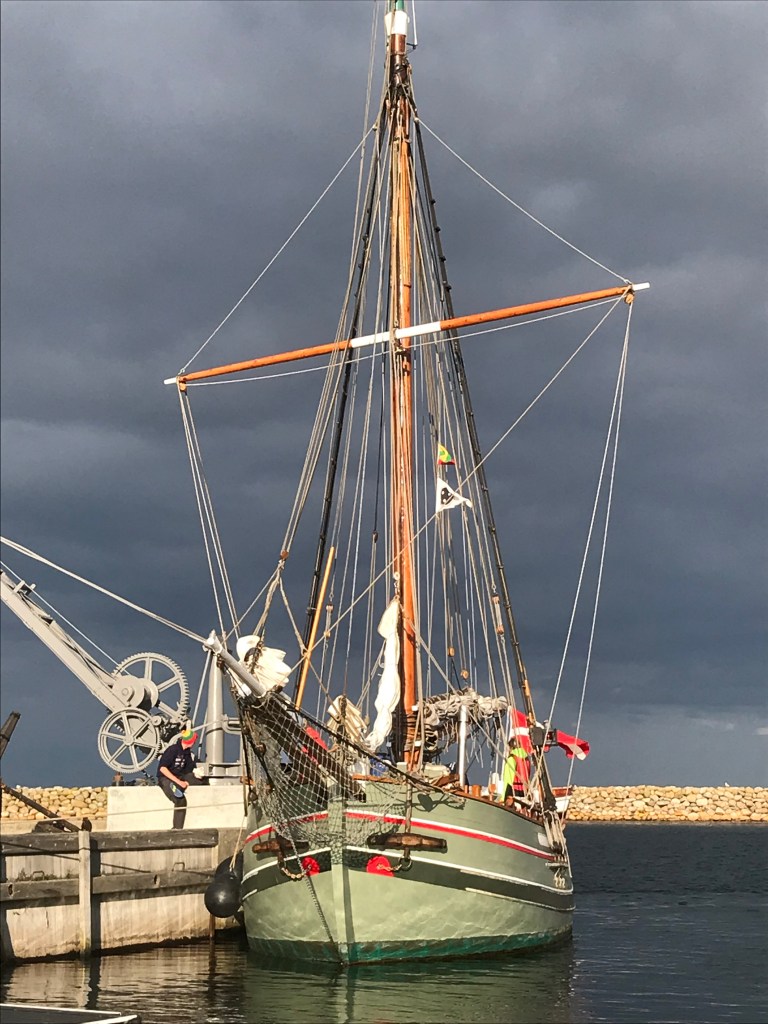
And so it does. Just as we pass Drejø, down it comes by the bucket load. We drop the sides of the cockpit canopy and huddle inside, eyeing the AIS and trying to peer through the sprayhood window to make sure nothing is coming. Out of the gloom a tall ship appears, but it is travelling parallel to us in the opposite direction, so it is not a danger. A few minutes later, it disappears back into the murk again.

A tall ship looms out of the mist and rain.

As we approach Ærøskøbing, the rain eases. We follow the marker buoys into the marina on the right. The wind is still strong, so we opt to tie up alongside the outer pontoon rather than a box berth, and let the wind blow us onto it.

“Perfect”, says the First Mate. “I must say, I like alongside berthing better than the box berths. And I don’t have to clamber over the anchor all the time. But have you noticed the marina is only about half-full?”

Tied up in Ærøskøbing marina.

“Yes, it has quite an ‘end-of-season’ feel now”, I say. “It’s nice that it isn’t so busy, but sad to think that that’s almost it for another year. But at least we have a bit of time left. Let’s go and explore Ærøskøbing in the meantime.”

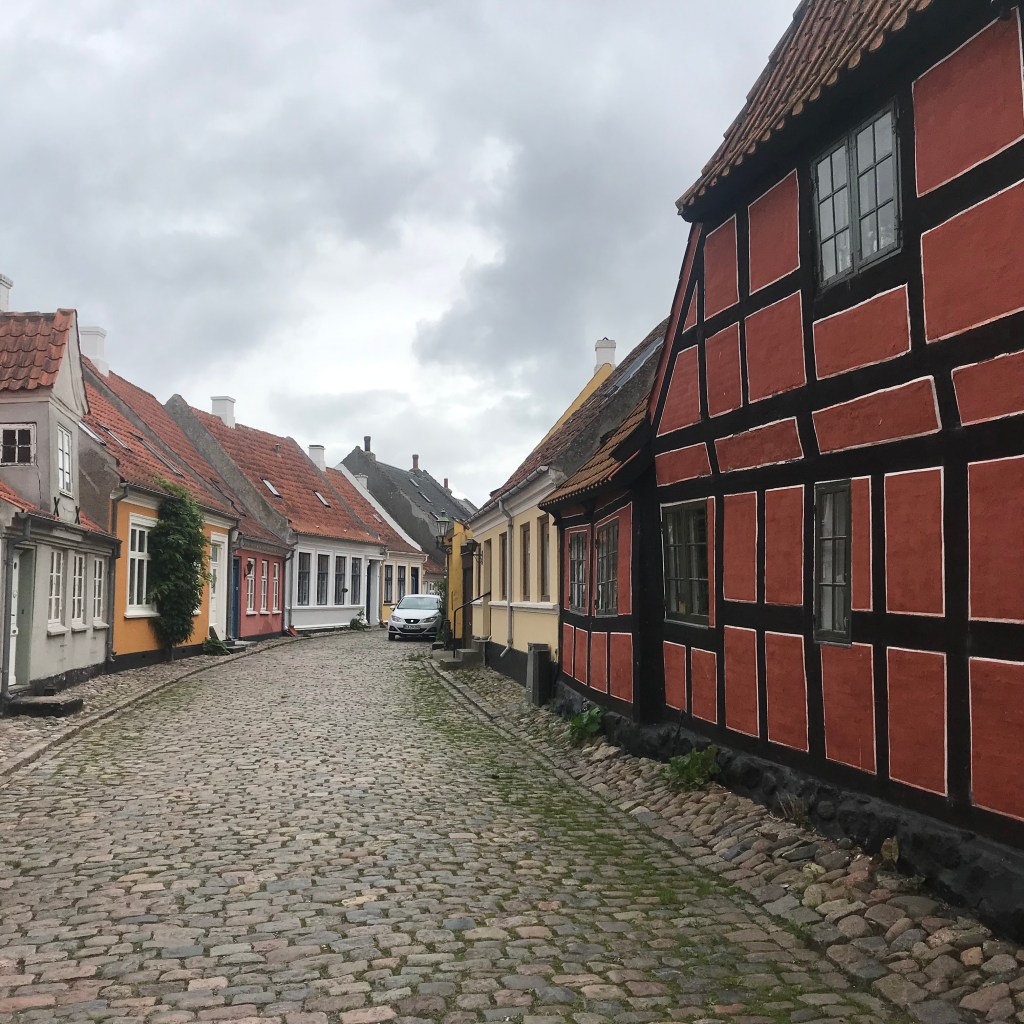
We wander through the quaint little former market town with its colourful houses and cobbled streets lined with hollyhocks.

Street in Ærøskøbing.
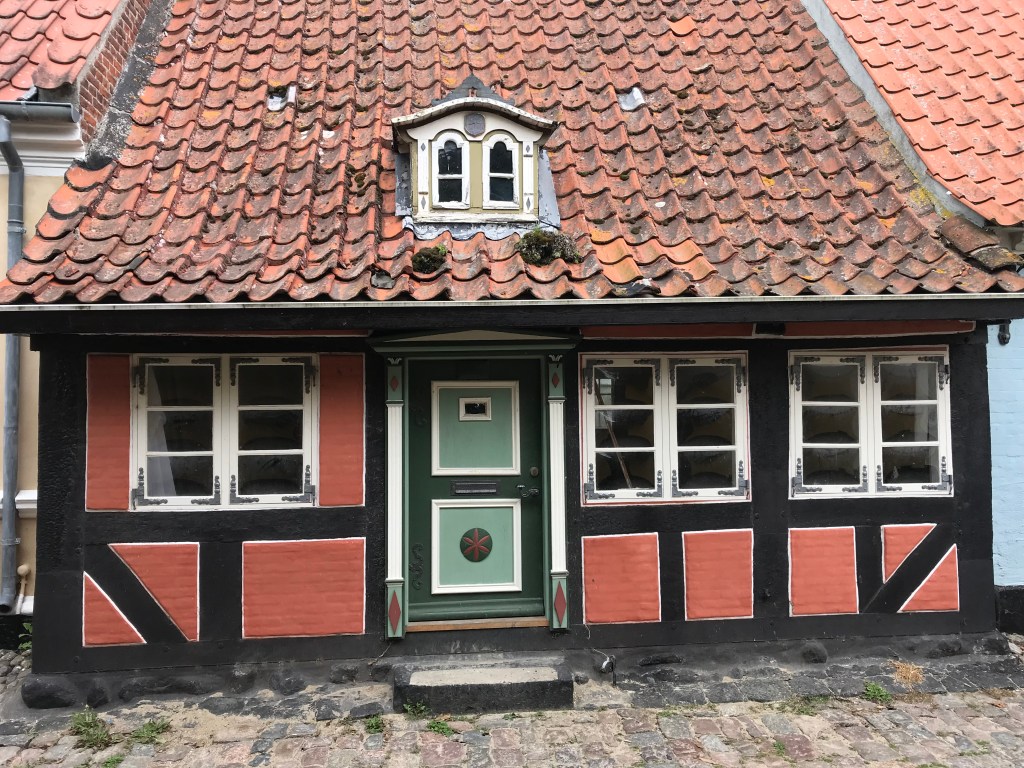
House in Ærøskøbing.

“I read that it is Denmark’s best-preserved settlement from medieval times”, says the First Mate. “It certainly is very picturesque. It reminds me of something out of a fairy-tale.”

Fairy-tale town?

In the morning the winds are still strong, but have moved around to the north.

“I think I’ll go and get some photos of those doors today”, says the First Mate. “They’re just so beautiful.”

“Fine”, I respond. “I was thinking of seeing the museum. We can meet afterwards and compare notes.”

I climb the steps of what was a former bailiff’s house, now the recently refurbished Ærø Museum, and am immediately immersed into a world of the island’s history and culture, replete with creaking floors.

Like many of the coastal towns in Denmark we had visited, Ærøskøbing was founded in the 1200s. The ‘-købing’ suffix means that it was given the status of a commercial and maritime trading town in the Middle Ages. The town was destroyed by fire in the 1600s, but was rebuilt – it has been from those times that the character of the town today derives. To maintain this character, master craftsmen have been encouraged to settle there, particularly bricklayers, carpenters, and blacksmiths. One display celebrates the role that these craftsmen have played in the development of the town, some of which, such as wheelwrights, coopers, and millwrights, have long gone.

Carpenters’ planes in Ærø Museum.

A poignant little tale is that of Bende Bendsen, a poet, teacher, linguist, and, yes, a hypnotist. Although born a West Frisian, he settled and lived most of his life in Ærøskøbing. Despite his several talents and obvious intellect, including writing a grammar of the West Frisian language, he struggled most of his life near the poverty line, and when he couldn’t work any more due to old age, he died in the poorhouse. After his death it was found that he had written several scientific articles and had communicated with numerous academics throughout the world.

With no bridge to the mainland like most of the other Danish major islands, much of the focus in the museum is on the modern challenges of maintaining a viable island population on Ærø. Many of the younger people are leaving the island to be educated and to find jobs elsewhere, so that the population is both declining and aging. Nevertheless, the people are fighting back, and when the Maritime School in Marstal was threatened with closure in 2000, a third of the population travelled to Copenhagen to protest. The government backed down.

With its picturesque building and streets, the town is a popular tourist destination, and has also promoted itself as a wedding venue, simplifying many of the complex rules surrounding international marriages.

Ærøskøbing – a popular tourist destination.

I eventually find myself in a small enclosed garden at the back of the museum, which is supposed to be a reconstruction of an 18th century urban garden. It s quiet and peaceful, and I sit down on one of the seats for a few minutes.

I think of the challenges of trying to maintain a viable island community in today’s world. We had encountered similar issues on some of the islands on the west coast of Scotland we had visited – Canna had only a tiny population of 19 permanent residents, Gometra only three. Attracting people with the right skills who want to live on such small island communities is difficult. At least Ærø has 6000 people; and they seem to be quite dynamic – one aspiration is to be self-sufficient in renewable energy – already solar, wind and biomass power are providing 55% of the island’s needs, and a fully-electric ferry was commissioned in 2019. The island of Eigg, in the Inner Hebrides, had similar aspirations.

Urban garden at the rear of the museum.

A group of people enter the garden, talking noisily. I decide it’s time to leave and have a coffee with the First Mate. As I walk back, I see a wedding taking place. Just as it said in the museum.

Wedding in Ærøskøbing.

“How did you get on?”, I ask the First Mate, over our cappuccinos.

“Great”, she says. “I took more photos of doors than I know what to do with. Each one is different, and I can’t chose which one I like best.”

Colourful door in Ærøskøbing.
And another one …

“They certainly seem to like their doors”, I say. “But what’s this one? The prison?”

And a third …

The next day, the wind is still blowing hard, so we take the bus up to Søby in the north of the island.

“I read the guide book”, says the First Mate. “There seems to be a bit going on there.”
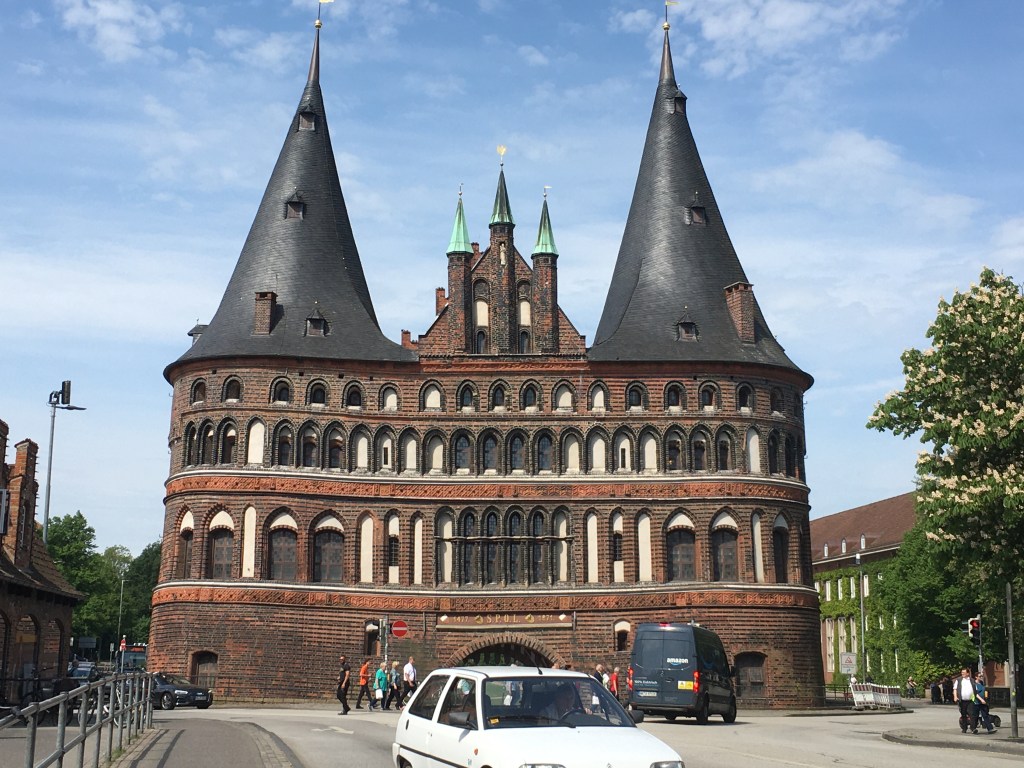
When we get there, there isn’t. It is a Sunday, and everything is closed except for Finn’s Bakery. We do the harbour and the surrounding area in ten minutes. It’s two hours until the next bus back to Ærøskøbing, so we decide to have a coffee and some cake at the café. I pick up a brochure at the table.

The only place open in Søby on a Sunday.

“Søby translates as lake-village, and dates back to the 1100s”, I read. “The area surrounding it is mostly farming, but there are fortifications north of it that were used in the Gunboat War between Denmark and Britain in the early 19th century. Nowadays it is a fishing and industrial port. There is also a shipyard and a marina with 200 spaces. The stone pier was built in 1865, and eventually regular ferry services were established with Faaborg.”

“All very interesting”, the First Mate says. “I didn’t realise that Britain and Denmark had been at war with each other.”

“Neither did I”, I say. “Remind me to look it up when we get back to the boat.”

“Anyway, what about walking back to that stately home place that we passed on the way up?”, she says. “I think it was a couple of kilometres, so it shouldn’t take long. Then we can catch the bus back from there.”

“Sounds like a good idea”, I say. “The brochure says that it is called Søbygaard. There are also the ruins of a fortification there we could have a look at. Let’s go.”
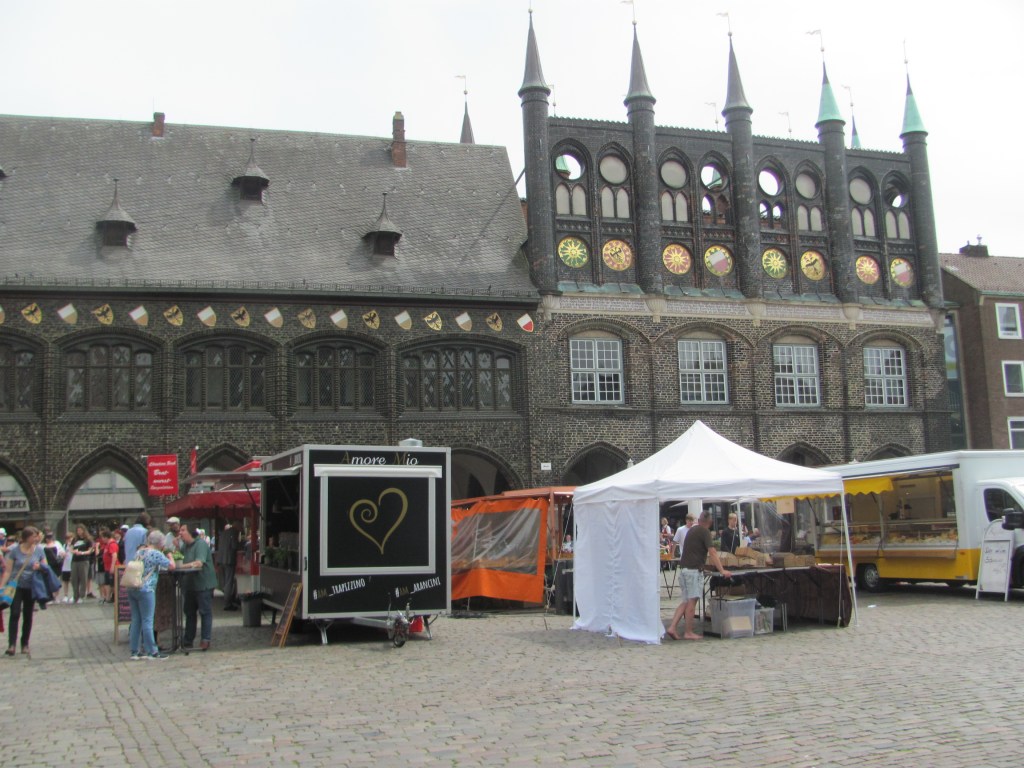
It’s a sunny day, and we arrive at our destination hot and sweaty. They are some quite impressive ramparts called Søby Volde built by a King Niels in the early 12th century as fortification against foreign incursions, mainly from the Germans and people called the Wends, a confederation of different Slavic tribes living along the southern coast of the Baltic Sea.

Søby Volde, fortification from the 12th century.

“It says on this panel here that the ramparts were only used for about 150 years, then it fell into disrepair”, says the First Mate. “Apparently the sea used to come almost up to here also before it was drained. They’ve found the remains of buildings, which was likely to have been a trading port.”

“You can just see where it would have come”, I say, once we get to the top of the ramparts. “There’s a marshy piece of ground called Vitsø Nor over there. Amazing to think that ships used to dock here.”
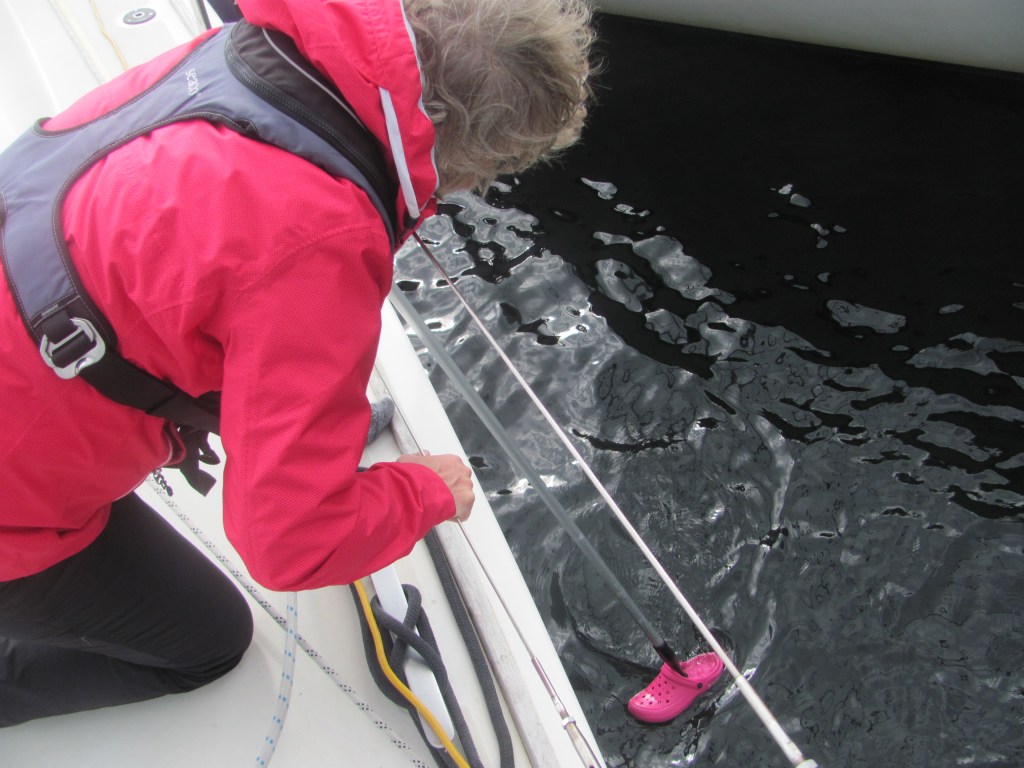
I try and imagine the castle as it once was – apparently wooden palisades were embedded on the ramparts, so it would have been much higher. Traces of fire and crossbow bolts have been found, suggesting it might have been attacked at some stage.

On top of the ramparts trying to work out what’s what.

We walk down again and up the small road opposite the ramparts to Søbygaard, a medieval manor house and farm buildings. There is a moat around the house.

Søbygaard manor house.

“It was built by Hans the Younger around 1580”, the woman in the ticket office tells us. “He quite liked building manor houses on Ærø – he already had one at Gråsten, this one was the second, and later he built another one at Gudsgave in the south of the island.”

“I bet he didn’t have to do the cleaning of them himself!”, says the First Mate.

The ticket woman smiles.

“That’s for sure”, she says. “Then in the last few decades a lot of effort has been put into restoring the house and its surroundings, and now it is used for concerts and exhibitions.”

The bus is almost due, so we walk back to the road. Some llamas are also waiting at the bus-stop.

“Are you going back to Ærøskøbing too?”, I enquire politely.

“Don’t be silly”, says the First Mate. “They don’t understand English. You’ll have to ask them in Danish. Or Spanish. And mind they don’t spit at you.”

Llama waiting at the bus-stop for Ærøskøbing.

We arrive back in Ærøskøbing without the llamas.

“I think I’ll just walk over and get some photos of the beach huts over there”, says the First Mate. “I’ve been wanting to do that since we arrived.”

From the boat, we can see the huts on Vesterstrand, the beach that stretches northwards from the marina. Apparently they are a bit of a thing on Ærø – the plots that they are built on are rented indefinitely, and there are strict regulations about what can and can’t be done to the huts themselves. No extensions, no electricity or water, and only minor maintenance. But they are quite a status symbol to own or stay in, and some have remained in the same family for four generations or more.

Colourful beach huts on Vesterstrand.

While the First Mate is away, I look up the British-Danish War of the early 1800s.

“It occurred during the Napoleonic Wars”, I read. “Denmark and Norway were neutral and tried to keep the seaway between Denmark and Norway free for trade. The British were having none of that as they wanted to blockade trade to France, so they attacked and destroyed a lot of the Danish and Norwegian navies. The Danish and Norwegians retaliated by fitting guns on small fast boats which were quite successful at attacking the larger British ships. They were helped by shore batteries, one of which was near Søby. In the end though they lost, and Denmark had to cede Heligoland to Britain, and Norway was annexed by Sweden.”

“Sounds a bit traumatic, given their sensitivity to territory”, says the First Mate when she returns. “They seem to have forgotten all about it now, though.”

The next day, the wind has dropped, so we decide to push off to Marstal, in the south of the island. Even though it is only about five miles from Ærøskøbing to Marstal as the crow flies, the journey by sea is about two-and-a-half times that, as it is too shallow to sail directly. Instead, we must make a huge loop by heading north-eastwards, then taking the narrow Mørkedyb Channel southwards, and then turning south-westwards again. Luckily the route is buoyed most of the way.

Our route from Ærøskøbing to Marstal through the Mørkedyb Channel.

The entrance to the marina at Marstal is narrow and quite shallow, but we manage to find a berth. The owner of the boat next to us grabs our lines and helps us to tie up.

“Yes, this is our home port”, he tells us. “We have finished sailing for the season, but we decided to have a couple of weeks just relaxing on the boat before we go home again.”

“You will know Marstal well then”, says the First Mate. “What should we see here?”.

“Well, Marstal is the largest town on Ærø, and also the main shopping centre”, he says. “It became world-renowned in the 17th and 18th centuries for building wooden ships, and that sets the atmosphere of the town. It has a Maritime School that trains navigators for the Danish merchant fleet, and there is a Maritime Museum that’s worth a visit. The streets and houses are also quite quaint, although, I have to say, not as picturesque as Ærøskøbing.”

We set off to explore the town.

“It’s interesting”, I say. “Have you noticed that there is no real town centre like other places? There’s no church that is in the centre either. I read somewhere that the town developed around the streets that radiated out from the shipyards, then they just put in ring roads every so often to link them.”

Cottages in Marstal.

“Yes, but there are not so many nice doors as in Ærøskøbing”, says the First Mate. “Our neighbour was right.”

We walk back to the harbour. There are ships of all shapes and sizes.

Traditional ship in Marstal harbour.
Boats in Marstal harbour.

We eventually come to the Maritime Museum. We spend the next couple of hours going through it. It’s an impressive collection of all things nautical.

Ship in a bottle – Maritime Museum, Marstal.
Storm at sea – Maritime Museum, Marstal.

“Phew”, says the First Mate as we come out. “They must have paintings or models of almost every ship they built here. I don’t think that I have seen so many pictures of ships in one place before. And some of those storm paintings also made me shiver. Here, get a photo of me with this chap. I’ll send it to people and tell them I have run off with a pirate.”

Tall dark stranger?

“They probably think that already”, I say.

Back at the boat, we clamber back in over the anchor. Suddenly there is a cry from the First Mate.

“Help, help! My shoe has fallen in. It’s drifting off.”

Luckily, there is a boathook close to hand.

“They need a good wash anyway”, I say, as she hooks it back in. “Why don’t you chuck the other one in too?”

Man shoe overboard!

Rebel farmers, portals to the cosmos, and a prisoner king

We leave Årø harbour at around 0930 and head south-eastwards for the island of Lyø. The wind is from the west, so we enjoy a pleasant broad reach, with the First Mate helming most of the way. At the appropriately named Sønderhjørne promontory (Southern Corner in Danish) of Fyn we turn due east. With the wind now directly behind us, we roll the mainsail away and use the genoa alone. Our speed drops, but we still make about 4 knots or so.

Leaving Årø for Lyø.

We approach Lyø and enter the narrow entrance to the marina, its width only about twice our beam. I always feel apprehensive entering unknown harbours, but we make it through and into a box berth on the far side.

In the evening, we hear a knock on the bow. It is the harbour master come to collect the fees. The First Mate goes to pay.

“I’ve found out a lot of useful information from him”, she says on her return. “It seems we can hire bikes here. You just put 20 kroner per bike per day in the honesty box just up there next to the ferry terminal. It’ll save us from getting our own bikes out.”

She has a point. Getting our bikes in and out from the storage cabin is always a bit of a hassle with the risk of damaging the woodwork. It’s easier to use bikes that are already on land. The disadvantage is that you are never quite sure what you are getting.

In the morning, we select a couple of bikes that look reasonable. Mine needs the saddle putting up. I loosen the clamp and raise it to the right height, and tighten the clamp again. I sit on it to test it. The saddle goes down to its lowest point again. I select another bike and try it. This time the saddle is OK, but it won’t change gears. The island is a bit hilly not to have gears.

“Perhaps we should get our own bikes out anyway”, I say.

“Mine’s OK”, says the First Mate. “Here, try this one. It looks in reasonable condition.”

The saddle is fine, and the three gears seem to work. But the brakes don’t.

“You don’t really need brakes”, says the First Mate. “Mine don’t work very well either.”

We put the money into the honesty box, and set off. It’s about a kilometre to the main village of Lyø By. We make it on one piece, mainly because it is slightly uphill and we don’t need to use the brakes.

The village is clustered around a few small ponds. The story goes that it was established in the 1540s when 24 families who had been involved in a failed uprising against their landowner on the mainland were told that they could choose between execution or exile. They fled to Lyø, where the previous population had died out from an epidemic, built the village more-or-less in the centre of the island, and divided up the land into farms running radially out from the village, a bit like spokes on a bicycle wheel. Most of the current islanders are descended from those 24 families, and the houses and land arrangement has remained pretty much the same ever since. The ponds were apparently constructed to provide water for the fire service.

Map of Lyø showing Lyø By village in the centre.

We come to a rock in the middle of the village. The inscription translates as 6 May 1223. A night of sorrow over the land for 1864-1920, however, for our cause God advises and leads everything to the best. Travelled 6 May 1923. Another reminder of the time that this part of modern Denmark was under the rule of Germany for more than half a century. It’s not only the rock that it is etched into, but also deep into the Danish psyche.

Reunification memorial stone, Lyø.

“I wonder what happened on the 6th May 1223?”, says the First Mate.

“I have no idea”, I say. “Remind me to try and find out.”

“Look, here’s the village shop”, she says. “The harbourmaster said last night that his wife runs it. Let’s have a look at what they have got.”

It is a typical island village store that stocks pretty much everything.

Lyø village shop (photo used under VisitFyn Terms and Conditions)

“You can order bread for the morning here”, the harbourmaster’s wife tells us. “I bake it myself, so it’s as fresh as you can get. I can particularly recommend the oat bread.”

“Why don’t you get yourself some for your breakfast?”, asks the First Mate. “I have plenty of rye bread, so don’t worry about me.”

I order and pay.

“My husband delivers it to the communal room down at the harbour in the morning”, says the woman. “You can pick it up there at 0830. It’ll have your boat’s name on it.”

We return to the bikes and explore the village.

“It’s just so picture postcard”, says the First Mate. “I could almost photograph every house in the village, they are so beautiful.”

“I think you have already”, I say. “I am surprised you have any space left on your camera.”

Traditional house in Lyø.
Another traditional house in Lyø, this time around the village pond.
And yet another one.

A little bit further on is the church. It is immaculate with its orange-tiles roof, stepped gables, whitewashed walls, and circular graveyard. A man is trimming the little hedges around each grave with a hedge-trimmer while another sucks up the pieces with a garden vacuum cleaner.

Church in Lyø.

We take the small road Vestensvej to the west of the island. On the outskirts is the old mill standing on the highest point of the island. Although there had been mills there for centuries, this particular one was built in 1876 based on a Dutch design. It is now a private residence.

Mill on Lyø.

“You go on”, says the First Mate. “I’ll catch you up. I want to take a few photos of the windmill.”

I continue to the end of the road where it gives way to an unpaved track, and come eventually to the dolmen nestled in a small grove of trees. It is old – built around 5,500 years ago during Neolithic times, not long after the introduction of farming to this part of the world. Although originally it would have been covered by a mound of soil, that has long been eroded by the wind and rain, or removed by local inhabitants for other uses, and all that remains now are these four standing stones and their massive, horizontal capstone, pockmarked by cup-shaped hollows made much later during the Bronze Age.

Klokkestenen dolmen on Lyø.

I lie on one of the seats, staring at the scudding clouds, and try and get my head around how old it is – 1000 years before the Egyptian pyramids, 3000 years or so before the Greeks and Romans. Who were its mysterious builders? What sort of people were they? How did they see the world around them? Why did they build it?

I feel drowsy and close my eyes. I am back in the Neolithic. I look around me. The island’s woods have been largely cleared to grow crops and to domesticate animals. Nevertheless, there is still game in the remaining woods and fishing around the coasts is good, so many of the farmers continue to hunt and fish. Brushing away a tear, I refocus on the burial chamber in front of me. The soil is still fresh from where it has been laid to cover the stones containing what remained of his body and his few possessions – his bow and arrow, his favourite drinking vessel, his flint blades, and battle axe. A farmer, hunter and warrior, my father had been respected by all, and had done much to nurture and protect the small settlement on the island against the marauding neighbours. But now he is gone, journeying through this portal and on to the Otherworld, to the third tier of the cosmos, to take his place with the other ancestors. I will not see him again until I myself also travelled that way. It is as it always had been and always would be.

Until then, it is my duty to continue what he started and to care for my people, ensuring they continue to prosper in this benevolent landscape. The Earth Mother will give me the strength and means, and the spirits of the ancestors the guidance to achieve this. I had chosen the site of my father’s burial mound for that very reason – in view of the fields and woods behind, the beach and the sea in front, the fishing spit to the north – the source of all our wealth. It will always be a sacred place – for our storytellers to hear the Earth Mother as they sleep and refresh their tales of our past and our place in the cosmos.

“It’s not a bad view, is it?”, says the First Mate, getting off her bike. “I can see all the way across the Lillebælt, across to Horne Land on Fyn, and down there to Lyø Trille spit.”

“That’s probably why they chose this spot for the dolmen”, I respond, emerging from my reverie. “They would have seen it as a significant point on the landscape, connecting the world of the living and the world of the dead.”

“Did you read the information panel?”, she says. “It says that there were once 52 barrows and dolmens on Lyø, but now only five remain, including this one. Apparently it’s called the Klokkestenen, or Bell Stone, as it makes a sound like a bell if hit with a stone in the right way. If it rings, you can make a wish which will come true.”

“I’m not sure if we should do that”, I say. “If everyone who had seen it over the last 5000 years had bashed it with a rock, then there would be nothing left of it.”

“I guess you are right”, she says. “It’s bad enough that the other 47 have been destroyed. Better to leave it for future generations to ponder over. Anyway, let’s go. I’d like to see the other end of the island.”

We head back to the village in the middle of the island. From there, we take the road Østensvej eastwards along a tunnel valley formed during the Ice Ages. It is a gentle slope all the way down to the coast and the bikes gather speed. With the brakes hardly working, we whizz along, the trees and bushes on each side of the road just a blur. Luckily there is a small knoll at the end which slows the bikes to a standstill. We rest for a while looking across to the island of Avernakø and further south to the lighthouse on Ærø.

Looking across to the island of Avernakø.

“It’s so peaceful”, says the First Mate. “Denmark really is a beautiful place.”

We carry on along a rough track around the eastern coast of the island through fields of barley and grazing cows, until we come to a farmhouse and buildings. There the track seems to peter out.

“Here it is”, I say, spotting a small arrow pointing to the west. “There’s a road here called Smedegyden. According to the map it should get us back to the village.”

Working out where we are.

Sure enough it does.

When we get back to the harbour, we see a tall ship tied up to the edge of the ferry wharf near the entrance to the marina. Day trippers line the gunwales as the boat prepares to leave.

“That doesn’t look right”, says the First Mate. “Wouldn’t he be better to reverse straight out?”

She’s right. For some reason, the skipper has decided to turn around in the narrow entrance and has become stuck, only able to move forward and backward about a metre at each end. The entrance is completely blocked and no one can enter or leave. There is a sound of splintering wood as the small tender on davits at the stern smashes into the wharf guard rail. The passengers who realise what is happening look bemused, while others continue tapping their phones, oblivious. Eventually the skipper manages to swing the bow around to clear the piles at the entrance, and is free.

“Phew”, says the First Mate. “They made a bit of a mess of that, didn’t they?”

Chaos at the harbour entrance.

In the morning, I wander over to the harbour communal block for my shower. Sure enough, along with several others, the oat bread is lying on the table as promised, still warm from the oven. I take the one marked Ruby Tuesday back to the boat, and we toast it for breakfast. It’s delicious with marmalade.

“Mmmm, this is good”, says the First Mate. “You can’t beat freshly baked bread.”

“Hey, I thought you were supposed to be eating your rye-bread!”, I say.

“I just wanted to try this to see what it tastes like”, she says.

Freshly-baked oat bread.

In the afternoon we get some new neighbours. They are Jan and Marien, a retired Dutch couple who are heading northwards towards Copenhagen. They have sailed this area many times and know it well.

“Yes, Lyø has to be one of our favourites”, they tell us as we watch the sunset in the evening. “There’s a lot of history here. Did you hear the story about Valdemar the Victorious?”

“No”, we say. “We can’t say we have. Tell us.”

Learning about Valdemar the Victorious.

“Well, Valdemar the Victorious was the king of Denmark back in the 1200s”, says Jan. “He started as the Duke of Jutland, and by beating off various challengers for the throne, he was proclaimed Valdemar II, King of Denmark, in 1202.”

“We saw a castle called Valdemar’s Slot in Svendborg”, says the First Mate. “I wonder of that was the same Valdemar?”

“No”, says Marien. “That was a different one. He was about three or four hundred years later.”

“Anyway, Valdemar II invaded and conquered quite a bit of northern Germany and eventually controlled all the land along the south coast of the Baltic from the Elbe to Danzig”, Jan continues. “He even conquered Estonia to the east of the Baltic.”

Lands under Danish control in Valdemar’s reign (from Wikimedia Commons).

“Then, to cut a long story short”, says Marien, “Valdemar was here on Lyø on the 12th of May 1223 hunting with his son Valdemar the Young. They had had a successful day hunting, and had had a large feast in the evening. Then after they had crashed out for the night, he was captured by one of his German nobles, Count Henry of Schwerin, who took him, probably through this very harbour here, back to Schwerin near Hamburg, and imprisoned him. Henry demanded that Valdamar give up all of the land along the south coast of the Baltic and that he became a vassal of the Holy Roman Empire.”

“Of course, the Danish weren’t very keen on that idea, so they declared war”, Jan says. “But they were soundly defeated, and lost all of their German territories. Valdemar even had to pay 44,000 marks to secure his release. He spent the rest of his days back in Denmark developing a code of laws and introducing feudalism to the country, which was good for the nobility but not for the peasants, as they lost all the freeman rights they had had since Viking times.”

“Ah-ha! The 6th of May 1223 explains the date on the memorial stone we saw in the centre of the village yesterday”, I say. “I wondered what the significance of that was.”

“Yes”, says Marien. “The Danish see it as the day marking the unravelling of their ‘Baltic Empire’. They have been a bit sensitive about what is in and what is out of Denmark ever since. It’s not helped by having a large neighbour like Germany right next door.”

In the morning, I set the table for breakfast.

“Do you know where the oat bread got to?”, I say. “I can’t find it anywhere.”
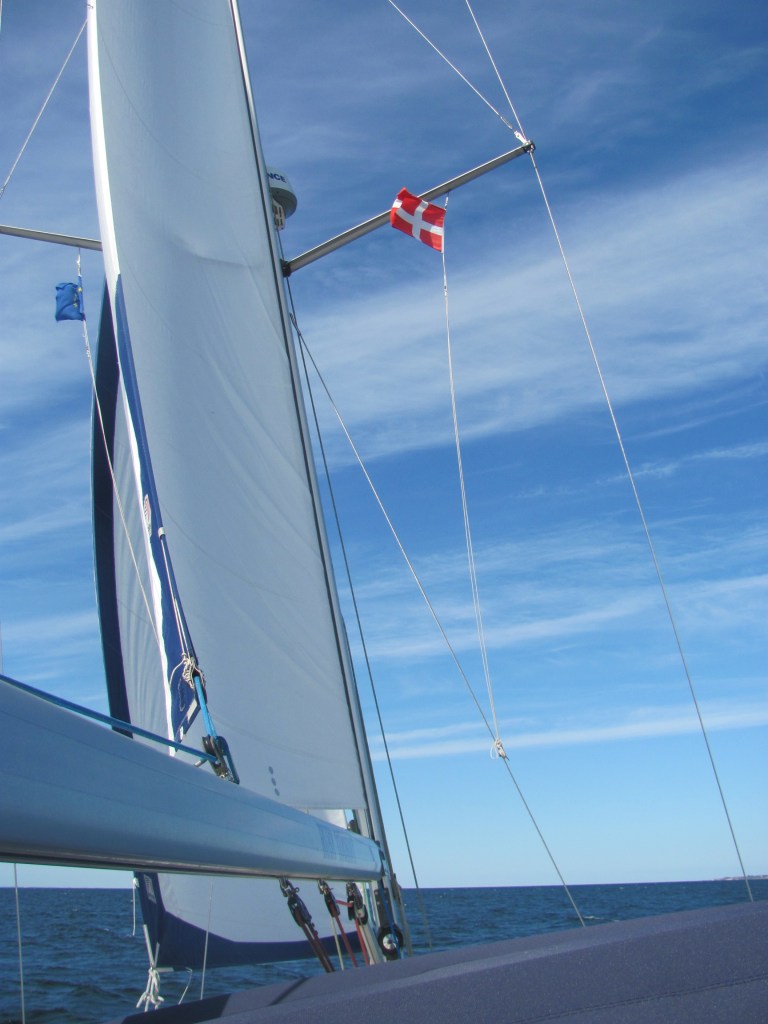
“Ah, I meant to tell you”, says the First Mate. “It was so nice that I had another slice yesterday, then another, and before I knew it, the loaf was gone. I am really sorry.”

The day doesn’t get better. On the way out of our berth, I catch the stern flagpole on one of the rear posts, snapping it off at the base. As it falls towards the water, I manage to grab it before it disappears. I feel a bit like one of those soldiers you read about who risks his life to protect his country’s standard and honour.

“I think I’ll write to the Queen”, I say to the First Mate. “I might even get a medal.”

A stunning sunrise, an island walk, and an international bird reserve

I wake up suddenly. Yellow light pours through the cabin window, casting a golden glow on the roof. My first reaction is that there is a forest fire on the island. I jump to my feet and poke my head out of the companionway. It’s just the sunrise, but what a sunrise! The sun hangs heavy in the sky like the Eye of Sauron. The water lies still, glowing like lava. A solitary ketch lies at anchor, its reflection dancing gently in the ripples from the slight breeze. It’s primordial.

Sunrise near Lænkevig.

I make a cup of tea, and sit out on the deck. The boat next to us swings gently at anchor, the occasional wave lapping against her hull. There is an autumn tinge to the air and I draw my fleece tighter around my shoulders.

“You know what they say, don’t you?”, says a familiar voice. “Red sky at night, sailors’ delight, red sky in the morning, sailors’ warning. The red colour is due to all the moisture in the air. It bends the light into the red part of the spectrum. There’ll likely be rain today. I’d be prepared for it if I was you.”

It’s Spencer the know-all. Who else?

“You know”, he continues. “I overheard your conversation last night about energy, and it reminded me of quite an interesting book I read over the winter called ‘The Upside of Down’, by a chap called Thomas Homer-Dixon.”

“I am sure you are going to tell me about it?”, I say.

“Well”, he responds. “His argument is that as societies get more complex, they consume more and more energy, but that this also makes them rigid to change. The Roman Empire, for example, maintained a large army and constructed magnificent buildings designed to project power, but these required huge amounts of energy to build and sustain. Complex social organisation was required to generate and channel this energy. Not all that dissimilar to your modern-day civilisation in many ways. But in the end, the Roman Empire just couldn’t generate enough energy to sustain itself, so it went into decline.”

“You would think people might have seen what was happening, and tried to do something about it”, I say.

“Well, this is the thing”, responds Spencer. “Often you humans can see the warning signs and know all about the risks and their causal factors, but you just tend to ignore them, thinking the world will carry on just as it has always has. These days these signs include climate flips, energy price jumps, pandemics, and global financial crises, but you find it difficult to give up your cherished worldview that the Earth was created for your benefit, so you try to contort difficult facts to fit that view, particularly when those facts are ‘slow-creep’ ones. Then stresses slowly build up in your societies to breaking point and suddenly breakdown and collapse occur. That’s when social revolutions happen. You have probably noticed that you have already had two of the four warning signs since the book was written in 2006.”

“It all sounds a bit dire”, I say. “Does Homer-Dixon think anything can be done to stop it?”

“Well, he argues that there will have to be a massive shift in the trajectory of modern civilisation”, says Spencer. “People will have to adopt new mental tools through which they see, understand and deal with problems. It will be a bit like the so-called Axial Age from about 900 to 200 BCE when there was a similar change in thinking – people then started using reason and reflection to understand their world, they realised that societies are not static but develop and change over time, they learnt that individuals had the capacity to determine their own fate, and they began to see that their physical and spiritual worlds were separate. You still think more-or-less along those lines today.”

“Yes, I know about the Axial Age”, I say. “But what sort of things does he think will need to change these days?”.

“Well, it’s like you said last night”, says Spencer. “You need to move to a steady-state economy rather than one based on growth. But the question is what such a steady-state economy would look like. What economic and ethical values might it be based on? Would it be compatible with political and personal liberty? How would political and social conflicts be dealt with if there is no growth?”

“Big questions indeed”, I say. “But don’t you think that some of that change might start to happen after COVID? The global economy slowed down last year because of all the lockdowns, and people changed their lifestyles by working from home and travelling and consuming less. They realised that there were other values besides just constant work and making lots of money. Now that the vaccines have checked the impact of the virus, will life just go back to pre-COVID patterns or will people maintain those changed lifestyles and newly-acquired values?”

“My guess is that things won’t change that much”, replies Spencer. “The problem is that a lot of people saved their money by not travelling and consuming, so what will happen to all that pent-up spending power when it is released? It might even be worse than before. Industrial production may increase to meet its demand, and along with it, energy consumption. What do you think will happen with prices of fossil fuels?”.

“Probably increase? They always do. But I suppose we will just have to wait and see”, I say, somewhat glumly.

“You might not have long to wait”, says Spencer. “Now, if you don’t mind, I have to dash. There’s a nice fly over there waiting to join me for breakfast.”

It begins to cloud over. The sun disappears and the brilliant red and oranges are replaced by a dull grey. The breeze stops, as though nature is holding its breath in anticipation. I hear the First Mate moving about down below. The aromas of toast and fresh coffee waft out from the cabin. It’s time for breakfast.

“I think that there is going to be rain today”, I say to the First Mate. “We should get going as soon as possible.”

“Just finish your toast then, and we can be off”, she says. “We can wash up later. If you don’t mind, I would like to get a bit of helming practice in this morning.”

We weigh anchor and set off towards the next destination, the island of Årø. The cloud morphs into a dense mist so that we can barely make out the land. There is almost no wind, and the little that there is is directly on our nose. We motor until we are clear of Fænø and enter the Lille Bælt, then try to sail by tacking into the wind. We move, but progress is slow. Porpoises appear and disappear periodically.

“Come on”, I imagine them saying. “Surely you can go a bit faster than that? Look at us!”

Porpoise in the Lillebælt.

It starts to rain. There’s truth in these old sayings. Fed up, we decide to resume motoring.

“That’s more like it”, say the porpoises. “It won’t take long now. Have a good trip. Bye!”

We arrive in Årø in the early afternoon. The ferry to Årøsund is leaving, so we slow down to give it time to leave the tiny harbour. Most of the box berths for our width are already full, but there is one left. There is a fresh cross wind blowing, but after a couple of attempts we manage to squeeze into it.

The harbour consists of the ferry terminal, a small café, and a self-help Tourist Information Office. ‘Cupboard’ would probably be a better description, as only two people can squeeze into it at any one time. Another couple are already in there.

“Never mind”, says the First Mate. “Here’s a seat we can sit on while we are waiting. I wonder what this word means?”

The First Mate waits outside the Tourist Information Office.

Her sidder de, de der altid sidder her” I say, consulting Mr Google. “It means ‘Here they sit, those who always sit always here’. Very profound. We could be in for a long wait.”

Luckily, the other couple leave after a couple of minutes, clutching a collection of guides and maps.

“They must have heard you”, says the First Mate. “Anyway, it’s our turn now.”

We collect a guidebook and a few maps, and sit down in the café for a coffee and cake.

“The guidebook says there are 150 people who live on the island”, says the First Mate, tucking into her cake. “Most of them live in the small village of Årø, which is about half a kilometre from here. It has a church and there is a farm there called Brummer’s Gård. Gård means ‘farm’ in Danish. The farmhouse is a protected building. There’s another small settlement on the southern part of the island. The whole island is less than 6 km2.”

“All very useful”, I say. “Let’s go and explore.”

We set off towards the lighthouse we can see from the harbour.

Årø lighthouse overlooking Årøsund.

From there, the path takes us onto a stony beach that extends across most of the south coast of the island.

South Beach, Årø.

Eventually, we join the road leading to the east of the island.

“Look”, says the First Mate. “There are loads and loads of rose-hips along here. I’ll pick some and make some jam out of them.”

Rose-hips for the picking.

The road eventually gives way to a rough track leading to the Årø Kalv bird reserve on the east side of the Årø. The guidebook tells us that the area was formed about 6000 years ago out of eroded material swept around from the south part of the island, and consists of shingle and sand ridges interspersed with shallow marsh areas. It is a Ramsar site, with access prohibited in the breeding season from April to July.

“What’s a Ramsar site?” asks the First Mate.

“It’s an international treaty to do with protection and conservation of wetlands throughout the world”, I say. “But I forget the details. I’ll have a look at Google.”

“The treaty was signed in 1971 in the city of Ramsar in Iran”, I read. “The Convention maintains a list of more than 2,300 sites of international importance covering more than two million square kilometres, with the UK having the greatest number of sites and Bolivia having the greatest area of sites. The committee meets every three years to review their objectives and update their policies – the next meeting was to be held in November of this year in China, but because of COVID they are having an online meeting at the end of October instead. It’s actually the whole of the Lillebælt which we have just come through that is the Ramsar site, so Årø Kalv reserve is part of that.”

“Interesting”, says the First Mate. “It’s good they are doing something about preserving these wild places.”

We pass a cycling couple, each with a dog trailer attached to the back of their bikes. The dogs peer morosely out of the mesh on the sides of the trailers.

“I suppose it is one way to take your dog for a walk”, I say. “Although I don’t think the dogs do much walking.”

“They’d probably chase the birds anyway”, says the First Mate. “Better that they are under control.”

We turn left and take the path along the top of a dyke separating the bird reserve from farmland. The path is rough, and eventually we find ourselves alone, the cyclists left far behind. Waders, ducks and gulls of various kinds swim in the shallow lakes. Overhead a raptor of some kind suddenly swoops and snatches something from the stony shore of one of the lakes and flaps off into the distance. It is too far to see what it has caught.

View of Årø Kalv bird reserve from the top of the eastern dyke.

The sun comes out. We find a place sheltered from the wind and sun ourselves. In the distance we can see the two islands in the reserve, Småholme and Bastholm. Beyond them, the orange-tiled roofs of the town of Assens on the island of Funen glow in the sunlight. I lie back and close my eyes, switching from seeing to hearing. Behind us, the trees rustle in the slight breeze. A pigeon takes to the air, its wings flapping wildly as it tries to gain height. Cows in the field beyond low sporadically. A rooster crows in the farmyard in the distance. It is a rural idyll, broken only by the staccato shrieks of oystercatchers piercing the air above us.

Cows grazing.

We continue on along the dyke. In front of us, we see a large bird feeding on something. It is the same raptor that we had spotted earlier. Seeing us, it flaps off lazily, leaving its prey behind. As we get closer, we see that it is a water rat, its black fur still wet and glistening.

We eventually come to the observation tower overlooking the Lillebælt. In front of us is a small beach with a few boats tied up. The cyclists with their dog-trailers are already there, having come by the road from where we saw them last. We nod in recognition. The dogs bark back. “Let us out of these ridiculous trailers”, they seem to say.

View out over the Lillebælt from the bird observation tower.

Eventually we find ourselves back in Årø village. We stop at the Christmas Church, so-called because the first service was held on Christmas Eve in 1906. The story goes that the land for the church and cemetery was provided by one of the local farm-owners on the condition that he was buried on one side of the entrance and his best friend on the other.

The ‘Christmas Church’, Årø.

“Look, here’s a memorial plaque for soldiers who were killed in the First World War”, says the First Mate. “Believe it or not, Årø was part of North Schleswig in Germany at that time, so they fought for the German Army. After the war, the island became part of Denmark again, which it has been ever since.”

“It must be weird for the inhabitants here being shunted backwards and forwards between two countries”, I say. “Especially in times of war. Imagine having to fight against a country you used to be part of for a country that once was your enemy.”

The houses in the village are cute, with traditional thatched roofs.

House in Årø.

Further on we come to the Fire Station. It must be one of the smallest in the world – just a garage on the edge of a field.

“It can’t be a very big fire engine that fits in there!”, says the First Mate.

“Probably just a couple of bicycles and a job lot of expired fire extinguishers”, I say.

The smallest fire-station in the world?

“I love these islands”, says the First Mate.

A navy patrol boat, the Middle Way, and we get lost

I stare abstractedly at the bubbles streaming in our wake, marking momentarily our passage before disappearing. For a while longer a path of smoother water remains, before merging once again with the rest. Like our own existence, in a way. I think of the thousands of other seafarers that have travelled the same way before us. How many Stone Age people thought the same as they paddled these routes in their hollowed-out tree-trunks, how many Vikings in their long-ships, how many medieval traders in their skutes, how many modern day sailors like ourselves? Each must have left similar trails, each has now gone.

Fleeting trails.

The mists of time swirl. My mind takes me back to when the Baltic Sea is starting to form. A large depression in the rock of the ancient continent of Baltica starts to fill with sediment from erosion of the surrounding land. Much later, a river, the Eridanos, flows through the basin, deepening it and carrying much of the sediment out to the North Sea. Millions of years later, the ancient continent of Laurentia collides with Baltica and compresses the Baltic Sea into the elongated shape it is today. In the last two million years or so, glaciers cover the depression, leaving behind a vast freshwater lake called Ancylus when they eventually begin to melt. Eventually the North Sea breaks through the shallow Danish Straits where we are now and the Baltic Sea becomes the brackish water body that it is today. The islands of the Danish archipelago and the surrounding shallow straits are all that remains now of the barrier that once separated the lake from the sea.

“You look as if you are daydreaming again”, says the First Mate. “Look, why don’t you go and make us a cup of tea? That’ll wake you up.”

We are on our way from Bogense to Middlefart. The wind is gusting from the north-west, and we are sailing close-hauled. The First Mate is helming to get some practice handling sudden gusts. I dutifully do as I am told, and bring out two steaming mugs.

“You know”, she says. “I could get used to this.”

“Used to what?”, I ask. “Helming, or me doing as I am told?”

She doesn’t hear me.

We are approaching Middelfart. In the distance, we see the New Lillebælt Bridge spanning the narrow Snævringen channel between Jutland and Fyn. From this distance, the cars and trucks crossing it look like tiny Matchbox toys. We need to go underneath it.

The New Lillebælt Bridge, Middelfart.

“I have been thinking”, says the First Mate. “You can’t write Middelfart in the blog. It’s too rude. The automated censors will pick it up and delete it. Can’t you think of some other name?”

“Yes, you are quite right”, I say. “I think I will call it Bottomfart. That sounds much better.”

“Well, at least the blog will have something for everyone”, says the First Mate. “Even six-year-olds. Look there’s a navy ship following us. They’ll keep you in line.”

Sure enough, there is a patrol vessel not far behind us. The AIS shows that it is doing eight knots, so it will soon catch us.

Followed by a navy patrol vessel.

“They probably think we are smugglers”, I say to the First Mate. “I hope you hid those bottles of whisky.”

“They are more likely to think you are an illegal immigrant from the UK now that it’s a third country”, says the First Mate.

“Whatever”, I say. “Let’s see if we can outrun them.”

I push the throttle forward. Our speed increases from 6 knots to 6.2 knots.

“Well, that didn’t make a lot of difference”, says the First Mate. “We’d better hope they run out of fuel or something.”

The patrol vessel continues to gain on us. As we pass under the New Lillebælt Bridge, it slows and loops around and heads back in the direction it came from. Either they have decided that we are not carrying anything worth making a fuss about, or we weren’t the target in the first place. Probably both.

We follow the Snævringen channel around to the right and then to the left. Two porpoises surface close by, as though to welcome us. In the distance we spy the forest of masts of Middelfart Marina and head for there. Before long, we are tied up on the end of one of the finger pontoons.

“Let’s get the bikes off and go for a ride into town”, says the First Mate. ”I read that it is about a kilometre or so. We can have a look around and then have a coffee.”

Apparently the name of Middelfart derives from the Old Danish for ‘Middle Way’. It was originally used for the Snævringen channel between Jutland and Fyn that we had just come through, but later was applied to the town that grew up around it. In the Middle Ages, the town had specialised in catching harbour porpoises.

“The guidebook says that only selected families were allowed to hunt the porpoises, a privilege given to them by the king”, says the First Mate. “They used to line their boats up across the narrowest part of the channel and beat the water with their oars to frighten the poor things into the shallow areas where they were killed. Their blubber was used to extract oil for lamps. When electricity came along, there was no need for much oil any more, and hunting for porpoises stopped. Now it is illegal.”

“Perhaps that was what the patrol vessel was doing”, I say. “Making sure that foreign boats don’t do anything to the porpoises. As if we would.”

We sit and have an ice cream opposite the church.

St Nicholas’ Church, Middelfart.

“The Danish certainly have managed to preserve a lot of their medieval buildings”, says the First Mate. “Look, there’s one over there that was built in 1584. I might have a look around for some more interesting doors.”

Holm’s restaurant, dating from 1584.
Medieval house in Middelfart.
Door in Middelfart.

We end up at the small harbour on the north side of the town. Several traditional boats are tied up there.

Middelfart harbour.

The next day it is bright and sunny.

“I take your point about our tyre marks from Kolby Kås”, I say at breakfast. “They just don’t seem have started a trend. I think I am going to clean them off this morning.”

I fetch the hose from the pontoon and start scrubbing. It’s tough work but eventually the black marks are gone.

“Here, let me get a photo of you”, says the First Mate. “It’s not often I see you working so hard. I need a record for posterity.”

The shutter clicks.

“Oh no”, she says, looking at the small screen. “It’s made you look like the Mannikin Pis statue we saw in Bogense. We can’t put that in the blog.”

“Well, at least the six-year-olds will find it funny”, I say.

Cleaning the tyre marks off Ruby Tuesday. Yes, really!

We decide to have lunch at the small restaurant near the marina office.

“I was talking to one of the people along the pontoon this morning”, says the First Mate. “Apparently there is a very nice path from here out around the promontory and back into Middelfart. Why don’t we go for a cycle along it after lunch? I have a map, so we won’t get lost.”

“That sounds like a good idea”, I say. “It’s a nice sunny day for it.”

After lunch, we set off. The path leads along the shoreline, past a small yacht harbour, then into some woodland. There are beautiful views out over Fænø Sund towards Lænkevig, and we sit for a short time on a bench taking it in.

Looking out over Fænø Sund towards Lænkevig.

“That looks like a nice place over on the other side”, I say. Perhaps we can anchor over there tonight. It’ll be nice and peaceful and we will also save on marina fees.”

“That’s a good idea”, says the First Mate. “Let’s do that.”

We push on. The track becomes narrower and rougher.

“Are you sure this is a cycleway?”, I ask.

“I am sure it will get better just up around this corner”, says the First Mate.

We reach the corner. The track gives way to a small sandy beach. Two woman are there, enjoying the sun. They look surprised to see bikes on the beach. I smile at them, pretending that we are beach inspectors come to check the quality of the sand. I scuff the sand with my foot. They don’t look convinced.

Checking the sand quality.

“Over there”, says the First Mate, pointing. “I can see the track leading up the hill at the other end.”

It does. But it isn’t a cycle track any more. Even calling it a walking track is being generous. We lug the bikes to the top of the bluff overlooking the beach. Another path leads in the general direction we want to go. The gnarled tree roots criss-crossing it make it unrideable, on our small bikes at least.

The path gets rougher and rougher.

After ten minutes, we reach a huge gully blocking the way. The path leads down then up again on the other side.

“Let’s have a look at that map”, I say.

We are on a brown line snaking its way around the promontory. The key says that it is a walking track with a classification of three ‘boots’. Another key explains that three ‘boots’ mean that it is a strenuous hiking route and strong footwear is advised.

“I don’t think that this is a cycle route”, I say. “Did the chap you talked to really say it was? He must be into mountain biking.”

“No, he just said it was a nice route”, says the First Mate. “I just assumed that we could cycle along it.”

I stop myself from gnashing my teeth. I am not sure if our travel insurance covers self-inflicted dental damage, especially in Denmark.

We backtrack along the bluff and come across a camping site. At least there is a road leading out of it. We follow that and come to a small café.

“Let’s stop here and have something to drink”, says the First Mate. “I am getting tired and thirsty.”

Just as we are locking our bikes, the local Hell’s Angels chapter arrives.

“I’ll find us a table outside”, I say, remembering my encounter with Nebraska Man in the laundry on Terschelling. “You go and order. I’ll have a cup of tea. Earl Grey, please.”

“How did you get on with the bikers?”, I ask the First Mate when she returns. “Did they push in in front of you or beat anyone up?”

“Not at all”, she says. “They were very courteous. One even picked up my money for me when I dropped it.”

Courteous bikers.

In the evening, we sail across to the other side of Fænø Sund to Lænkevig and drop anchor. A few other boats are already there, but there’s enough space. We sit in the cockpit drinking wine and watching the sun go down behind the trees. There is an ethereal quality to the light.

Anchored in Lænkevig in Fænø Sund.

I pick up the book I am reading at the moment, Life after Growth, by Tim Morgan. In it, he talks about the era of growth that we have become accustomed to being over. It’s all due to the availability of energy – there is no shortage of energy as such, but what is important is the amount of energy that is extracted per unit of energy expended, or Energy Return on Energy Input, EROEI for short. At the beginning of the Age of Oil, the average EROEI was around 100:1, meaning that each unit of energy input would yield 100 units of energy output, so that there were 99 units of net energy available. Since then the EROEI has declined drastically, so that now the global average value is around 15:1. North Sea oil is even as low as 5:1. Obviously, when the EROEI gets to 1:1 the energy extracted is the same as the energy input, so there is no net gain. Apparently when the average EROEI gets to between 8:1 and 4:1, economies cease to be viable, as so much energy needs to be expended obtaining energy that there is not enough surplus energy for all the other things in the economy. Agriculture, for example, needs a lot of energy and natural gas to produce fertilisers and pesticides. Without those, we can’t grow crops, and won’t be able to feed the global population.

What to do? Renewable sources of energy will help but may not be enough. Wind-farms have EROEIs around 17:1 and solar panels between 7:1 and 9:1. Biofuels are around 2:1, and also need more land than world’s current cropland. Nuclear power may be an option, but the problems are public opposition and scaling up – 15 times the current number of stations would be needed. In the short term, we need to become much less wasteful of energy – more use of public transport, living closer together to improve energy efficiency, less consumption. But in the long run, we will need to develop a new economic model not based on growth. It will be a profoundly different era to what we are used to.

“What’s the book about?”, asks the First Mate, topping up the wine glasses.

I tell her.

“Can’t you find something more cheerful to read?”, she says. “Especially in such a beautiful place as this?”

“It is what it is”, I say. “Maybe we should just stay on the boat and live the simple life.”

Fellow mariners, a picturesque trade town, and a reflection

The forecast in the morning is for light winds from the north-east. We leave Kerteminde at 1000, needing to motor out of the fjord directly into the wind. Once we reach Alervet point, however, we turn northwest and catch the wind on our beam. We have arranged to meet Axel and Claudia at either Korshavn, a tiny harbour at the very north-east tip of Fyn island, or else Kolby Kås on the western side of Samsø island, further north. We’ll decide en route which to choose, depending on how things go. Starting from Korsor on the other side of the Store Bælt, I estimate they are probably around a couple of hours behind us.

Leaving Kerteminde.

We have about an hour of light wind and make reasonable progress past the island of Romsø on our starboard. Then the wind dies to almost nothing, and we sit with the sails flapping.

“We are not going very fast”, says the First Mate.

“No, we aren’t”, I say. “It would be nice to have a bit more wind than this. But there’s not a lot we can do about it.”

We brew the kettle and have a cup of tea drifting along in the current. On the AIS, we see that Axel and Claudia are still making seven knots. They still seem to have some wind, while we languish in the doldrums. They’ll be catching up with us soon.

Suddenly, the wind picks up.

“Ah, that’s better”, I say. “Someone must have heard me.”

“It’s a bit too strong now”, says the First Mate. “Couldn’t you have asked for something in between?”

Within the space of ten minutes or so, the windspeed has gone from around four knots to 16 knots. We are heeling significantly, so I take the sails in a reef. It helps, but we are still at quite an angle. We get a text from Claudia.

“Has the wind also stopped where you are?”, she asks. “There’s nothing here.”
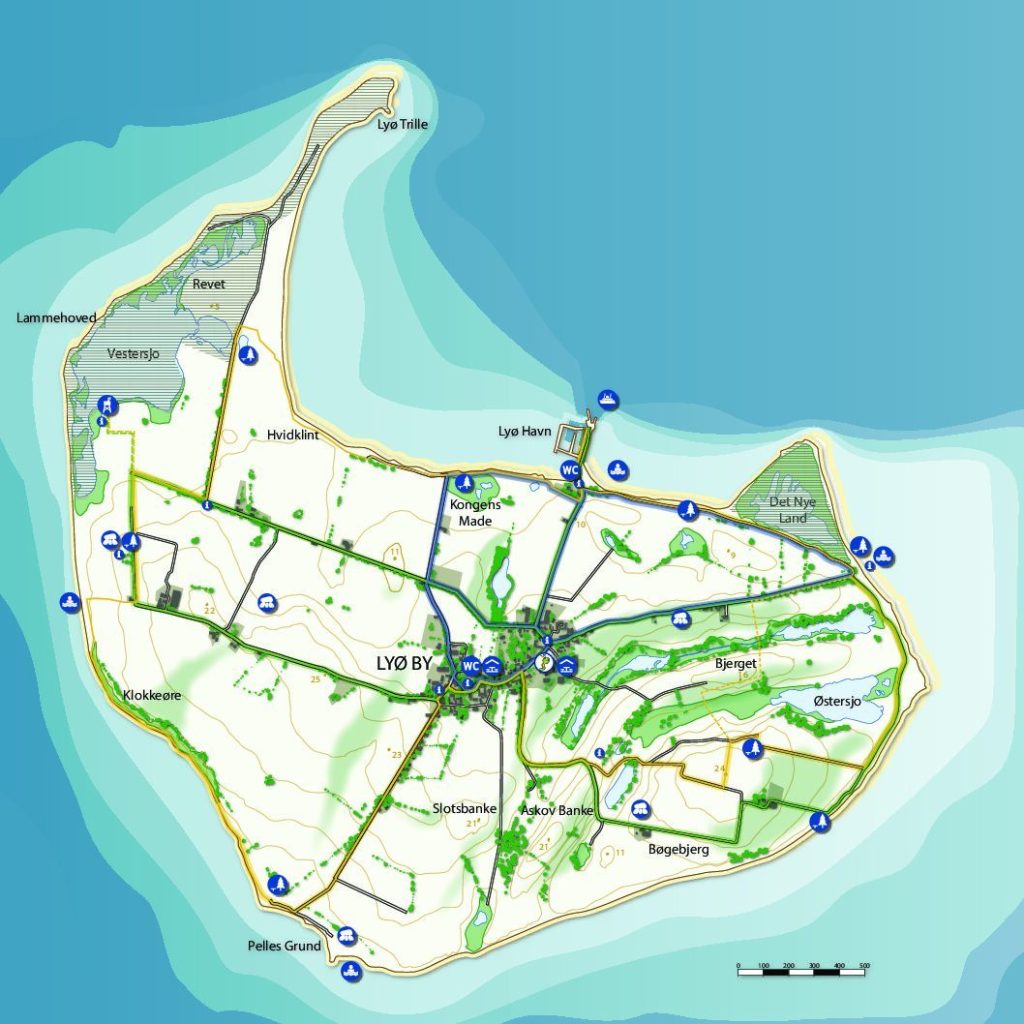
“We were like that”, we text back. “But now it has picked up again.”

We whizz along at a good speed. Before long, there is another text from Claudia.

“We have it too now”, it says. “Shall we meet at Kolby Kås on Samsø? We have heard that it is not easy to anchor at Korshavn because of all the seagrass there.”

“See you at Kolby Kås”, we text back.

We are now entering the Samsø Bælt, the stretch of water between Fyn and Samsø islands. It becomes quite choppy, and the windspeed slowly increases even further. Before long it is around 22 knots. I take in another reef. We are still sailing at around eight knots. Ruby Tuesday alternately plunges through the troughs and rears her head again for the next wave like a thoroughbred. From time to time, particularly big waves wash over the foredeck and back down again on the leeward side. Exhilarating!

Sailing between Kerteminde and Samsø island.

We continue on like this for a couple of hours. Eventually we reach the lee of Samsø island and the wind eases off and the sea becomes quieter.

“Phew”, says the First Mate. “That was a bit rough. I hope we don’t get too many of those. Particularly as winds that strong weren’t predicted.”

We enter the tiny harbour of Kolby Kås and tie up against the pier. Some old tyres cushion us.

“Are you sure it’s a good idea to tie up against tyres?”, says the First Mate. “I know they will act like fenders, but they might make black marks on our hull.”

I jump ashore and peer down at the side of our hull. A perfect imprint of one of the tyres is near the bow. There’s another midships, not quite so perfect. And another near the stern, a smudgy mess.

“We can pretend that it’s the latest in abstract art for sailing boats”, I say. “It might start a trend.”

Moored up against the tyres.

Axel and Claudia arrive later in the afternoon in their boat Astarte.

“Why did you moor up against those tyres?”, Axel calls out. “I think we will go over here.”
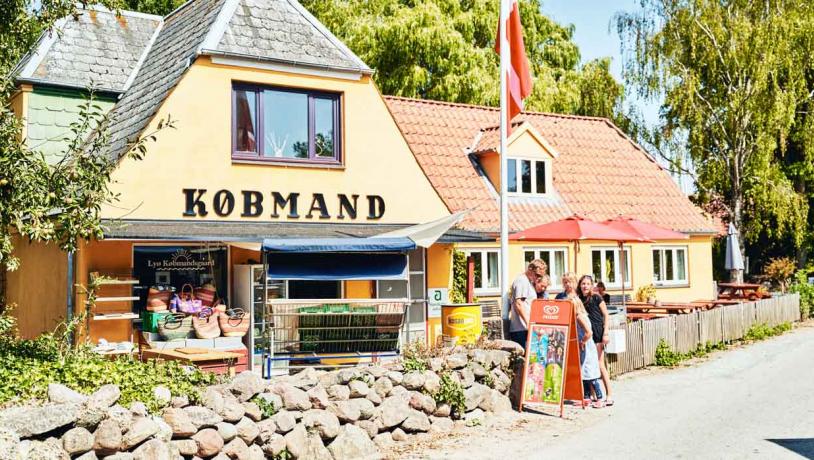
“See”, says the First Mate. “It’s not much of a trend so far.”

“Give it time”, I say.

We invite Axel and Claudia over for coffee.

“I have to say it was a bit of a surprise to hear from you”, I say. “We thought you were still over in Griefenwald.”
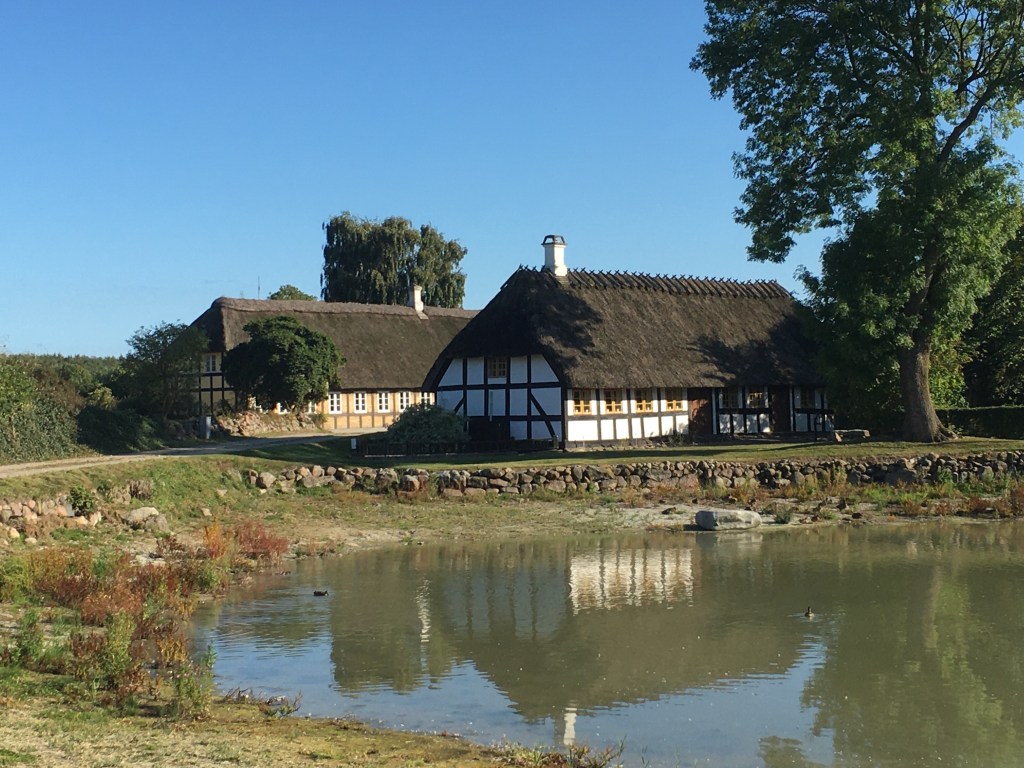
“Well, we were”, says Claudia. “But we have to be back at the end of the month for a family birthday, so we need to get Astarte down to Rendsburg and all tucked away for the winter before then. We have to go back into the Kiel Canal to get there, and have quite a lot of work to do on her to prepare her.”

Axel & Claudia join us for coffee.

“We’ve had a frustrating summer”, says Axel. “We had a serious problem with Astarte just as we were leaving Gustow. We started taking on water, and couldn’t work out where it was coming from. We managed to limp in to Griefswald with the bilge pump working overtime, and got her lifted out by one of the yards there. It turned out that it was coming in through the stern tube.”

“A sailor’s worst nightmare”, I say. “You were lucky you were so close to land.”

“Then trying to get it fixed was a real hassle too”, says Claudia. “The company that said they would be able to do it, then changed their mind and said they couldn’t. But at least they felt guilty about it and said that we could use their yard and one of their staff if we were going to fix it ourselves.”

“Getting the old shaft out was also a problem”, says Axel. “It was jammed, so we had to heat it to loosen it and had to be ready with buckets of water inside in case it caught fire. We also had to cut the skeg off to get it out. And it also took a while to source a new one. At first the company sent us the wrong one.”

“It all sounds horrible”, says the First Mate.

“Yes, it was”, says Claudia. “But in the end we managed to find the right shaft, and thanks to everyone working night and day, we manged to get it fitted. Finally we got her back in the water.”

“Well, I hope that you have trouble-free sailing from now on”, I say.

In the evening, we all go for a walk along a farm track, following the coast of the island and watch the sunset. We walk back along the track in the darkness. It is surreal.

Sunset from Samsø island.

Back in the harbour, a few more boats have arrived. None have tied up against the tyres. Some trends are slow to start.

We both leave at 1000 the next morning heading for Bogense on the north coast of Fyn island. The wind is from the southeast and the sea is calmer than the day before, giving us a comfortable beam reach. Axel and Claudia’s boat is a half a knot or so faster than ours, as being a ketch it has more sail area, and they pull slowly away. When we arrive in Bogense, they are already tied up.

Ruby Tuesday leaving Kolby Kås .

“You got here just in time”, they say. “There are only a couple of berths left. Look, here’s one here.”

It’s a tight turn, and there is a fresh cross-wind blowing. We make a bit of a hash of it getting in, narrowly missing the boat on our right and coming to rest against the boat on our left. Luckily there are plenty of fenders on both boats. Sensing disaster, people appear from the blue to help with the bow-lines. I fling the stern ropes over the poles. Amazingly they go over first time. That doesn’t happen often. We pull them tight and we are secure.

Tied up nicely in Bogense marina.

In the evening, we have drinks on Astarte. The conversation turns to Brexit.

“It’s sad that the UK didn’t want to stay in the EU”, says Axel. “We really can’t understand the logic behind it. What benefits has it brought?”

“We are probably not the right people to talk to”, I say. “We don’t really see any benefits either. The one example most often given is the speed with which Britain could roll out the vaccine last year compared to the delay due to all the red tape in the EU.”

“It’s true that the UK had a head start”, says Claudia. “But most EU countries have caught up now, and many even have greater vaccination rates than the UK. So you can’t really say that is a benefit.”

“And what about the Northern Ireland Protocol?”, says Axel. “What sort of person makes an international agreement, telling everyone that it is ‘oven-ready’ and the best deal ever, and then a few months later wants to unilaterally break it because it isn’t suitable?”

We stare at the floor and shuffle our feet. There’s not a lot we can say.

“And now there’s talk of empty shelves and Christmas being cancelled because of a shortage of lorry drivers with all the East Europeans going back to their countries”, says Claudia.

“I think the Brexiteers were just lucky that COVID came along when it did”, says the First Mate. “They are able to blame all the Brexit problems on the pandemic and lockdowns. There may have been some effect, but there is no doubt in my mind that the real reason is Brexit and all the disruption it has caused to supply chains.”

“It’s amazing that a modern country would do that to itself”, says Axel. “Especially Britain, who we in Germany always saw as being so sensible and pragmatic. You were always very influential in Europe, but now you have lost all that.”

“The interesting thing will be what role we find for ourselves now that we have left the EU”, I say. “All this talk of ‘Global Britain’ by the government, but no one really knows what it means. The debacle in Afghanistan last month is hardly a good omen. The USA hardly even consulted on the troop withdrawal there. My worry is that we will become a ‘vassal state’ of America, hanging on to their coat-tails.”

“Yes, and all that sending of an aircraft carrier to the Pacific Ocean a few months ago to frighten the Chinese”, says Claudia. “Surely they are not serious abut trying to influence anything there?”

“Who knows?”, I say. “The present people in charge are capable of anything, no matter how crazy it seems. The world is becoming a dangerous place.”

Axel and Claudia leave the next morning. It’s been good to see them, but they have to get home now.

Farewells.

We decide to walk into Bogense to explore. The town began its existence as a trading post in the 12th century and eventually became a market town, but was destroyed by fire in the 16th century. It was rebuilt, but never really recovered. These days it is still involved in trade, but tourism is becoming more important, especially from sailing. The marina is supposed to be the largest on the island of Fyn.

Medieval houses, Bogense.

“Let’s start at the church”, says the First Mate. “It’s pretty much in the centre. It’s called the Sankt Nikolaj Kirke.The guidebook says that it was built in the 15th century on the remains of an earlier 12th century church. The baptismal font is from the 13th century, the altar was built in the 16th century, and the pulpit from the 17th century. Its spire is even used as a navigational landmark for boats.”

Sankt Nikolaj Kirke, Bogense.

“It has certainly had some history”, I say.

Not far from the church is the Town Hall, an impressive building in white.

Bogense Radhus.

“The old houses are all so cute”, says the First Mate. “But there are only so many pictures you can take of them. I think I am going to specialise in doors. There are so many different types.”

Door in Bogense.
No. 19, Bogense.

“Come and have a look at this statue”, I say. “It’s a bit rude, but with your strong constitution you should be able to cope.”

I am standing in front of a statue of a small boy having a pee.

The Manneken Pis, Bogense.

“Ah yes”, she says. “The guidebook says that it is called the Manneken Pis. Apparently it is modelled after a similar statue in Brussels. The story behind this one is that back in the 1800s sometime, they found a baby boy on one of the ferries coming to the town. No-one claimed him, so the city butcher and his wife adopted him. The baby eventually grew up to become a consul in the Foreign Office, responsible for passports and visas and the like. To show his appreciation to his adopted city, he commissioned this statue.”

“He must have had a sense of humour, at least”, I say. “I am not sure that I would like to be remembered for peeing in the main street of a town.”

“Speaking of which, I wouldn’t mind a coffee”, says the First Mate. “But have you noticed that many of the places seem to be closed?”

“I read somewhere that many smaller shops are only open for the summer tourists”, I say. “As soon as they disappear at the end of August, the shops close until the next summer. It happens in Britain too, but I am surprised how early it happens here, particularly when the weather is nice like today, and the older set without children are now on holiday. Like us.”

“This place looks like it should be open”, says the First Mate, sitting down outside a restaurant.

Any service today?

I peer through the window. A man is tidying up behind the counter at the back of the shop.

“There’s someone in here at least”, I say. “Perhaps he’ll give us a cup of coffee and a cake.”

I wave to him to come over. He waves back. We wait a few minutes, but he doesn’t come.

“Pretty poor service”, I say. “It’s not as though they are busy or anything.”

I peer through the windows again and mouth the word ‘coffee’. The man says something, but I can’t understand it. I scratch my head in puzzlement. The man scratches his head too. I stick out my left arm. The man sticks out his right arm.

It slowly dawns on me that he is me. There’s a mirror behind the counter.

“Is he coming?”, says the First Mate.

“No”, I say. “He said that they have just closed for the day. We’ll just have to make our own coffee on the boat.”