“Well, that was quite a coincidence”, says the First Mate, as we drive off the ferry at IJmuiden in Holland. “Fancy meeting your old colleagues like that.”
We have just arrived in Holland. The day before, we had driven down to Newcastle to catch the ferry across to IJmuiden on the long journey back to Stockholm to re-join Ruby Tuesday. Just as we had emerged from the car deck clutching our overnight bags, we had bumped into three of my former colleagues who were on their way to northern Germany to do some fieldwork. We had arranged to meet in the bar after dinner. Much reminiscing over several beers ensued.
“Yes, it was great to catch up on everything that had happened since I saw them last”, I say. “It seems that nothing has changed, yet everything has changed. They are having another round of redundancies at the moment. I don’t regret retiring when I did. It seems that funding is as hard as ever to get. Brexit didn’t make it any easier to work with the rest of Europe.”
We stop for a few days with the First Mate’s family in Germany. Her mother had just gone into a care home a few months previously, and we spend time visiting her each day. She is happy to see us.
“You look so thin”, she tells me. “Aren’t you eating properly? Here, have a piece of this cake someone brought me.”
I politely decline. But I feel secretly pleased that my efforts to lose the winter flab over the last few weeks are recognised. Worth the pain.
We eventually set off northwards, the car laden with cheap food and drink from Germany, heading for expensive Scandinavia.
On the way, we stop off for lunch with Gabi and John, fellow sailors whom we had met in the Åland islands last year. They live in Ostfriesland in Germany.
“Come and have a look at this map”, says Gabi, showing me one of those old medieval maps hanging on the wall. “Frisia is all this bit along the Wadden Sea, stretching from the Netherlands to Germany. There are three parts to it – West Frisia in the north of Holland, East Frisia, in Germany where we are now, and North Frisia, which is up in Schleswig-Holstein in the north of Germany. Each has offshore islands associated with them as well.”
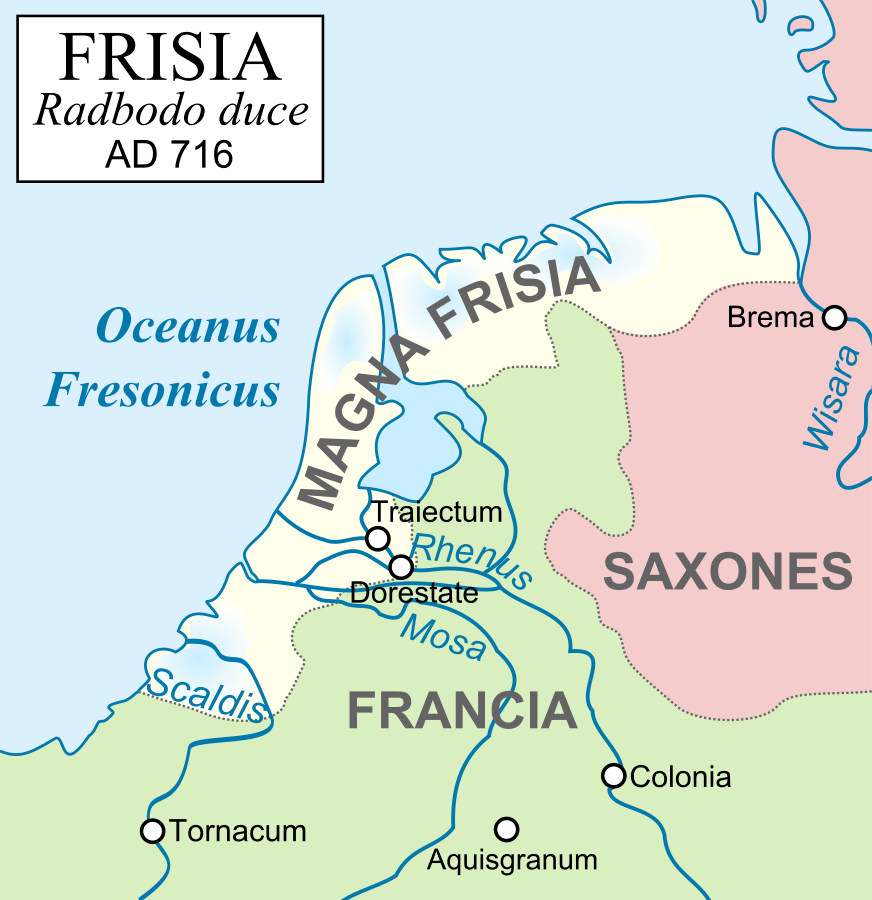
“Ah yes, we visited a few of the Frisian Islands as we sailed that way in 2021”, says the First Mate.
“The modern Frisians are not actually descendants of the original inhabitants, but of the Angles and Saxons who emigrated here from further east after the Romans left”, continues Gabi. “Here’s Saxony here. We all know where else the Angles and Saxons emigrated to.”
“We were in the Angle homelands the year that we overwintered in Kappeln”, I say. “There are still a lot of place names that refer to them.”
“Although West Frisia and North Frisia still have their own languages, here in East Frisia they speak Plattdeutsch, which is a German language, not a Frisian one”, says John.
Finishing our excellent lunch, we bid our farewells and continue our journey. We have arranged to meet with some more sailing friends, Axel and Claudia, who are preparing their boat for the season in a marina on the Kiel Canal near Rendsburg. We had first met them in Dover many years ago on our circumnavigation around Britain, and had kept in touch since then. The last we had seen of them had been in Kalmar in Sweden two years ago.
Google seems to think they are further along the canal than they really are, and takes us along a muddy track following the canal side for two to three kilometres. Eventually we come to a bridge leading across the water to a small island where their marina is located. We spot Astarte, their boat.
“Great to see you”, says Axel. “We thought that you had got lost, but what with Google Maps, that’s almost impossible these days.”
“You’d be surprised”, I say.
They are leaving the next day to sail along the German Baltic coast, so we have caught them just in time. It’s good to see them again.

Over kaffee und kuchen I tell them about my project for the next four years to update the IMRAY Cruising Guide to Germany and Denmark, one of the guides used by cruising sailors. I had been asked over the winter by the publishers if it was something I would be interested in doing, and I had accepted. One of the things they want me to do is to take more drone photos of various harbours to illustrate their layout. We have just bought a drone, so we are complete novices, but Axel & Claudia are seasoned drone fliers.
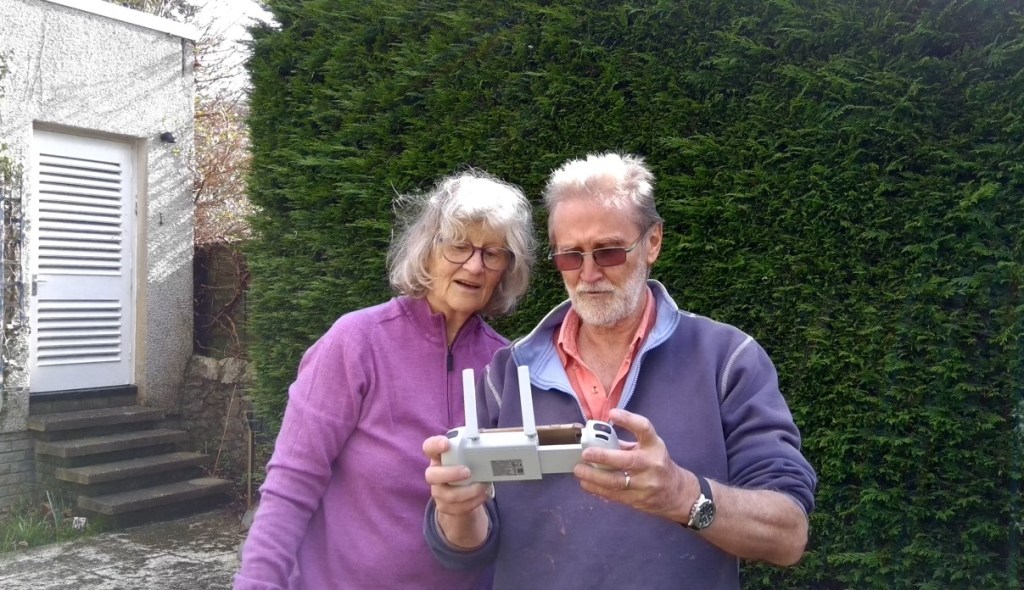
“You need to be careful taking drone photos in Germany”, says Claudia. “Especially if they are published. I don’t know about the other countries, but there are so many rules and regulations here.”
“You can get sued if you take pictures of private property and use them for commercial gain without written permission from the owner”, says Axel. “The same goes for identifiable people in the photo. It makes it almost impossible to take aerial photos of harbours as there is always bound to be private property and people in them, and you can’t go around them all to get their written permission.”
I begin to wonder if I am taking on an impossible task. That evening, I write to the publishers to see what their take is.
We have arranged to stay the night in Kiel with Volkmar, one of the First Mate’s old friends. In fact, Volkmar has already sailed with us in 2021 along the Kiel Canal from Rendsburg to Kiel. Over breakfast the next morning, he asks us where we are planning to explore this year. We tell him.
“Ah, the Baltic States”, says Volkmar, buttering his brötchen. “An interesting part of the world. There was quite a German influence there, you know. Back in the 13th century, the German Teutonic Knights invaded the area to convert the pagan Balts to Christianity in what are known as the Prussian and Livonian Crusades. However, their activities there were less to spread Christianity than to acquire large estates, and many of them settled there, marrying into the local population and becoming the de facto rulers.”
“I guess there must have been other Germans that followed them?”, I say, reaching for the mettwurst.
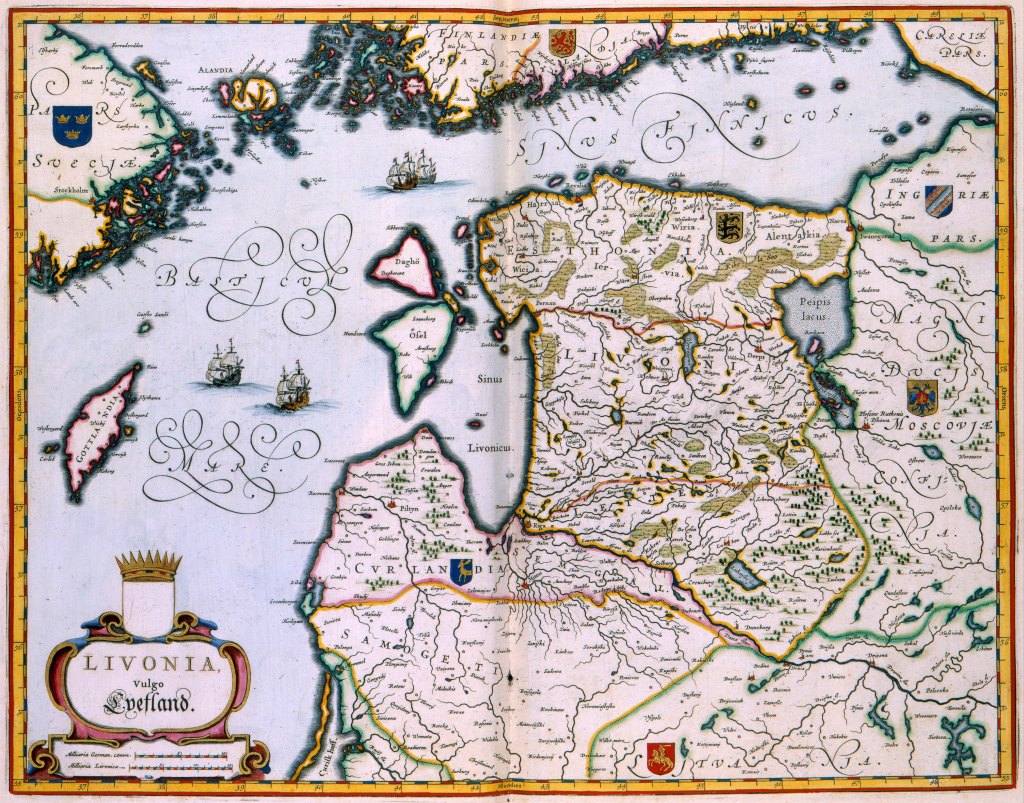
“Yes, lots of German merchants and clergy followed in the wake of the Knights”, he says. “Eventually they formed the medieval country of Livonia. Over the centuries they retained their German-speaking identity despite being part of various empires, such as the Swedish and Russian, that came and went. Then just before the start of WW2, most of these Baltic Germans were coerced by Hitler into resettling in Nazi Germany and present day Poland. Many more were expelled after WW2 ended. Nowadays there are not many of them left in the area.”
“It’s fascinating stuff”, says the First Mate, pushing the plunger down on the coffee. “My mother’s side of the family came from Ostpreussen, or East Prussia in English. I have always wondered how they came to be there. Perhaps they were some of the settlers that followed the conquests of the Teutonic Knights. They were farmers.”
“Could be”, says Volkmar. “A Balt tribe called the Old Prussians originally lived in that area, with their own Indo-European language. However, when the Teutonic Knights conquered them, they were either killed if they resisted Christianisation, or assimilated if they accepted it. Their language died out in the 1700s, although there are some similarities to present-day Lithuanian. Nowadays the area is in Poland. It would be interesting to find out more about why your mother’s ancestors ended up there.”
It’s time to press on. We bid farewell to Volkmar and hit the road.
“We’ve done pretty well so far on this trip in learning about movements of people around Europe”, says the First Mate. “First the Frisians, now the Baltic Germans. I wonder who will be next?”
We push on up through Denmark, catch the ferry across the Øresund to Sweden, and continue on the long drive up north. Trees. And more trees. And still more trees. Late in the evening we arrive in Stockholm and find our AirBnB near the marina where Ruby Tuesday has been for the winter having repairs done.
In the morning after breakfast we drive down to the marina, not quite knowing what to expect. We needn’t have worried. The work done to repair the bow and the keel and hull is finished, as is the polishing. The keel had been removed and the hull strengthened.
“It’s all much stronger now than when it left the factory”, says John, who did the work.
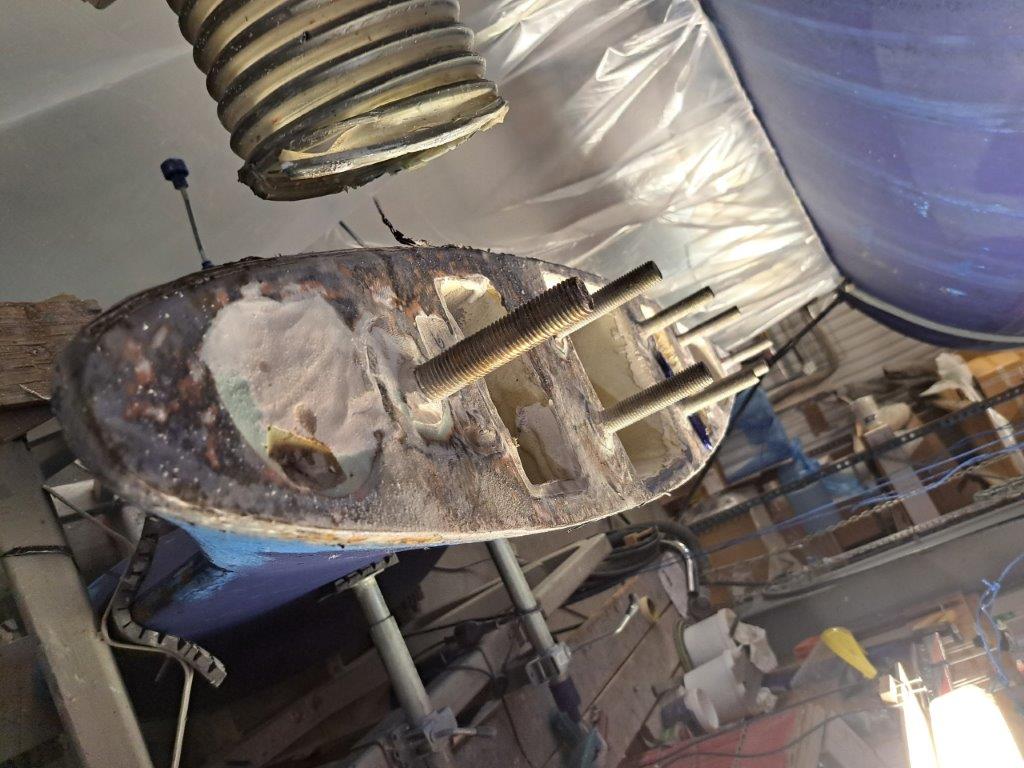


“They’ve done a really good job”, says the First Mate after a close inspection only she can do. “She looks like she can’t wait to get back into the water and continue her adventures.”
A familiar face appears over the stern. It’s Spencer, overjoyed to see us.

“Boy, am I glad to see you two”, he shouts in excitement. “It’s been a terrible winter for me. Down to –20°C! I almost didn’t make it. And then the dust! Some guy came on board and started sawing into poor old Ruby Tuesday with a machine. I did my best to stop him, but of course he didn’t take any notice.”
“I thought that we told you that she was having some work done on her”, I say sympathetically. “You must have forgotten. But thanks anyway for keeping an eye on her over the winter.”
We spend the next few days preparing Ruby Tuesday for the season. Back on with the anchor, which had been removed and stowed on board. The propeller had been serviced by the manufacturers in the UK, so it is reinstalled too.

This year we have decided to replace the zinc anodes with aluminium ones, as they are supposed to work better in both freshwater and saltwater, more suitable for the brackish water of the Baltic. We’ll see how they work out.

My phone pings. It’s a text from Andy, the leader of the Cruising Association Rally around the Åland Islands last year. We had kept in touch over the winter, and in fact we had met up in Perth in Australia. He has overwintered his boat just south of Stockholm, and has just had it put back in the water. He has his brother, son, his son’s partner, and another friend with him. He invites us for a drink that evening to catch up.
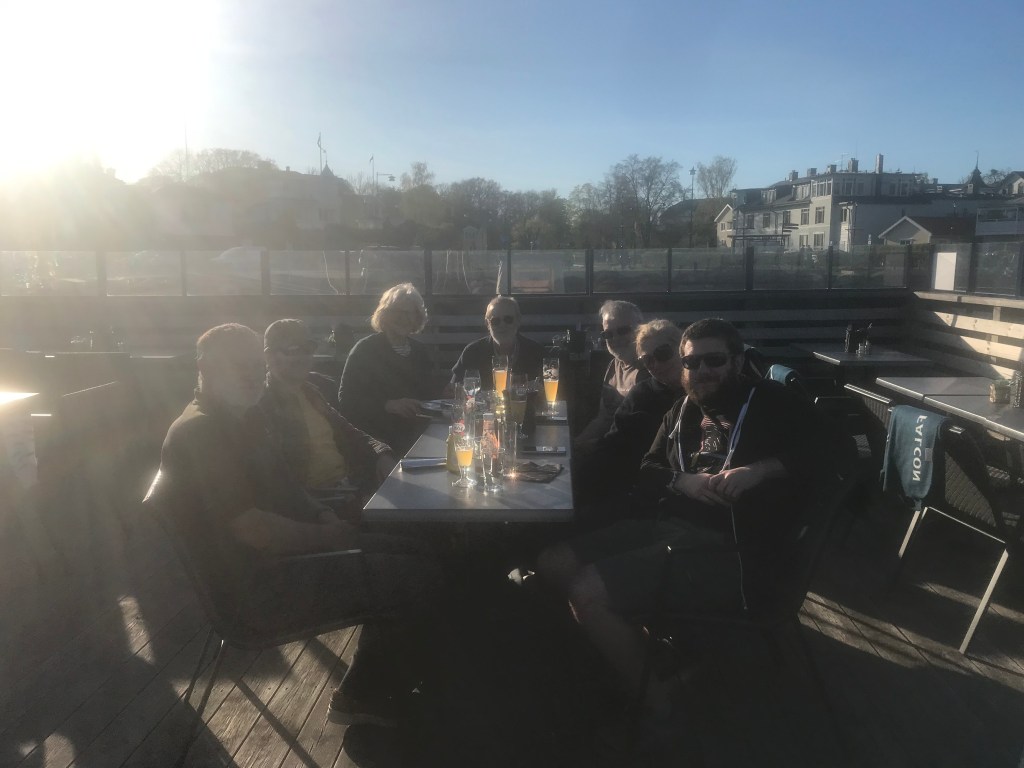
The waiter takes a photo of us all.
“It’s terrible”, says the First Mate later. “You can’t put that in the blog.”
“I know”, I say. “But at least it gives a flavour. Readers can use their imagination as to who’s who.”
“We did the Baltic States a few years ago”, Andy says. “I think you will enjoy them. Lots of history, lots of culture, and the people are very friendly. In fact, I think I still have the charts and harbour guides somewhere you could borrow. Let me go and have a rummage.”
He disappears downstairs. There are sounds of things being moved around. He emerges, beaming.
“Here they are”, he says. “Charts and harbour guides for southern Finland, Estonia and Latvia. You’ll find them useful. Especially with the Russians interfering with the GPS. You can use traditional navigation like we used to before the age of electronics.”
We had been discussing reports that the Russians had been transmitting signals to override the real GPS supposedly with the aim to disrupt aircraft and shipping. One of the most intense areas or interference is the Gulf of Finland, right where we are headed.
“That puts my mind at rest”, says the First Mate. “I have been worried sick about us taking the wrong course, ending up in St Petersburg, and imprisoned as spies.”
She isn’t joking.
The day arrives for the relaunch. The transporter arrives and Ruby Tuesday is lifted on. Before we know it, she is back in the water. John comes over to check for any leaks in his handiwork. There are none.

Then over to the crane to have the mast lifted on again.

“She’s starting to look like a real sailboat again”, says the First Mate.
We finish the unloading of items from the car to the boat. We have bought a new rubber dinghy to replace the old one which was deteriorating rapidly. It has done good service, lasting for 17 years, but the wooden transom is now rotten and letting in water. We fold and pack the bikes and stow them on board. We are pretty much ready to go.

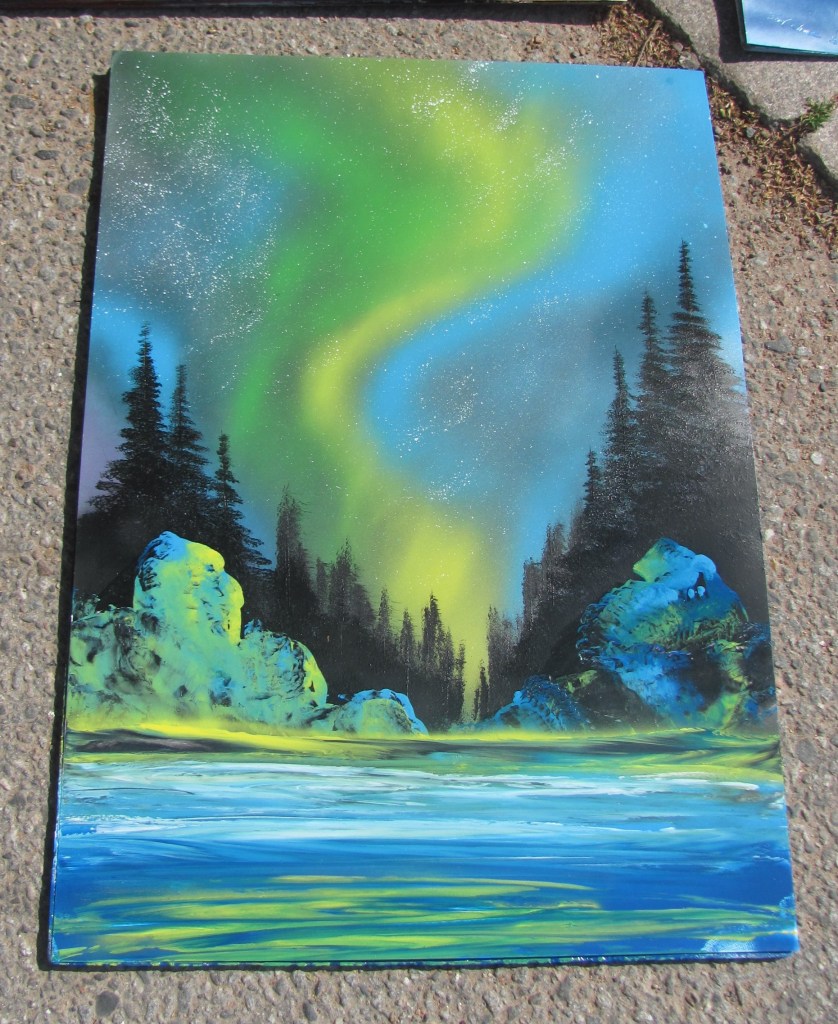
In the evening, we sit outside on the cockpit seats eating our taco kits that the First Mate had bought earlier in the day, waiting for the much-feted Aurora borealis to appear.
“Well, that was a bit of a disappointment”, says the First Mate as we prepare to go to bed. “I was really hoping to see the Northern Lights. Especially in Sweden. We are pretty far north.”
“At least it was a beautiful sunset”, I say trying to see the bright side, although I too would have liked to see them. “I am sure that there will be lots of photos in the newspapers tomorrow. We can see what they were like then.”
“It’s not the same as seeing them yourself”, the First Mate complains, as she disappears downstairs. “It’ll be just our luck if they appear later tonight when we are sleeping.”

My mind drifts back to memories of my youth. I am driving along the Summit Road of the Port Hills near Christchurch one night, and round a bend in the road looking down into the vast volcanic crater where the port of Lyttleton nestles. There, in front high above me are the eerie green and purple lights of the Aurora australis as the charged particles streaming from a solar storm reach the earth’s atmosphere. I stop the car and watch spellbound as they writhe this way and that like giant glowing curtains.
No wonder ancient peoples had imbued them with meaning from their own lives, I think – the smoke of fires for the Australian aborigines, the souls of the dead for the Sámi people in Lapland, a fire-fox dashing across the sky for the Finnish, and bringers of good luck in fishing for Swedish fishermen. I cross my fingers that their non-appearance doesn’t mean any bad luck for our upcoming voyage in Ruby Tuesday. Superstitious, moi?
 Ruby Tuesday

