More repairs, winter preparations, and au revoir

What on earth is that noise?”, says the First Mate.

I look at the clock. It’s 0800.

“I think that they have started on the bow”, I say. “I’ll go and have a look.”

We are back at Svinninge Marina where we are booked in for the repairs to the bow. Hans & Gisela have left to continue their journey home to Denmark.

I fall out of bed, rub the sleep from my eyes, pull my clothes on, and peer around the splash hood. A cheery face with a great bushy beard looks back at me from the bow.

“Hi”, the Beard says. “Sorry if I woke you up. I have just started to sand your bow back. But I am struggling to get a good angle on it. I think that we’ll have to lift her out so that I can get to it underneath. It’s just too awkward here. I’m worried that I might fall into the water.”

Sanding starts on the bow.

Images of a bedraggled, seaweed-entwined beard floating in the water appear briefly in my mind’s eye, but I quickly dismiss them.

“OK”, I say. “But is there enough time for us to have breakfast first?”

“Of course there is”, says the Beard. “I still have to go and book the crane.”

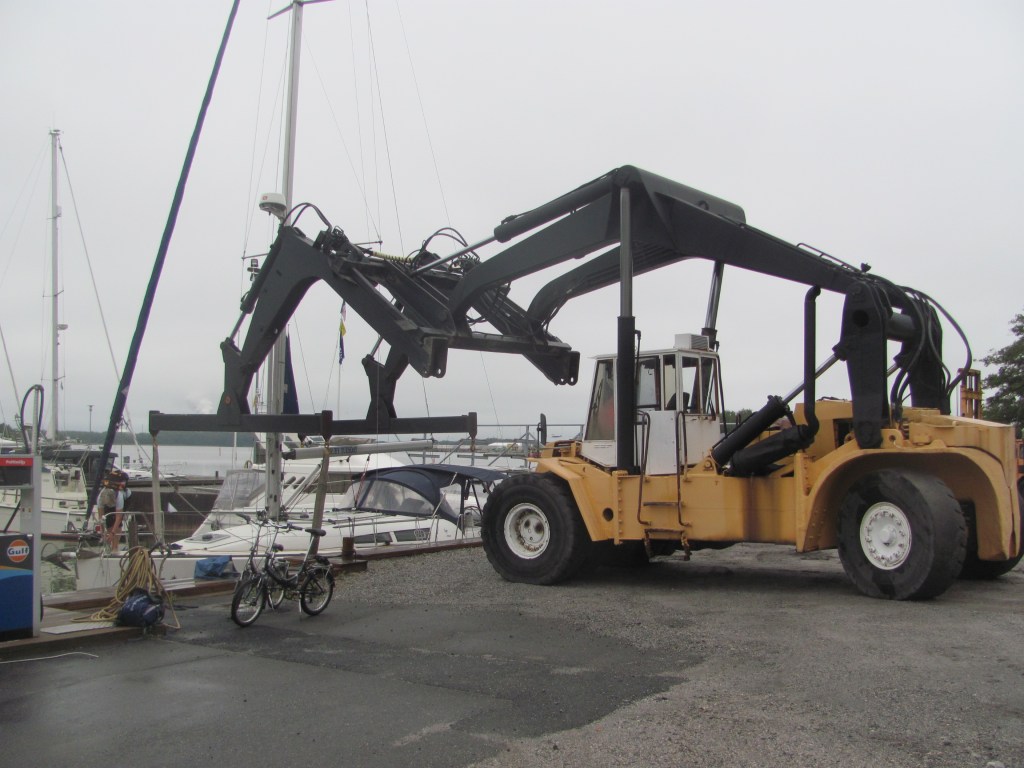
Later in the morning, Ruby Tuesday is lifted out and deposited on to a cradle. We find a ladder to get on and off her while she is there. We are just having lunch when there is a knock on the hull.

Ruby Tuesday is lifted out.

“I think that you had better come and have a look at this”, says Nicolas. Nicolas is the Beard’s boss.

It sounds a bit ominous. I clamber down.

“Did you hit a rock at some point?”, he asks.

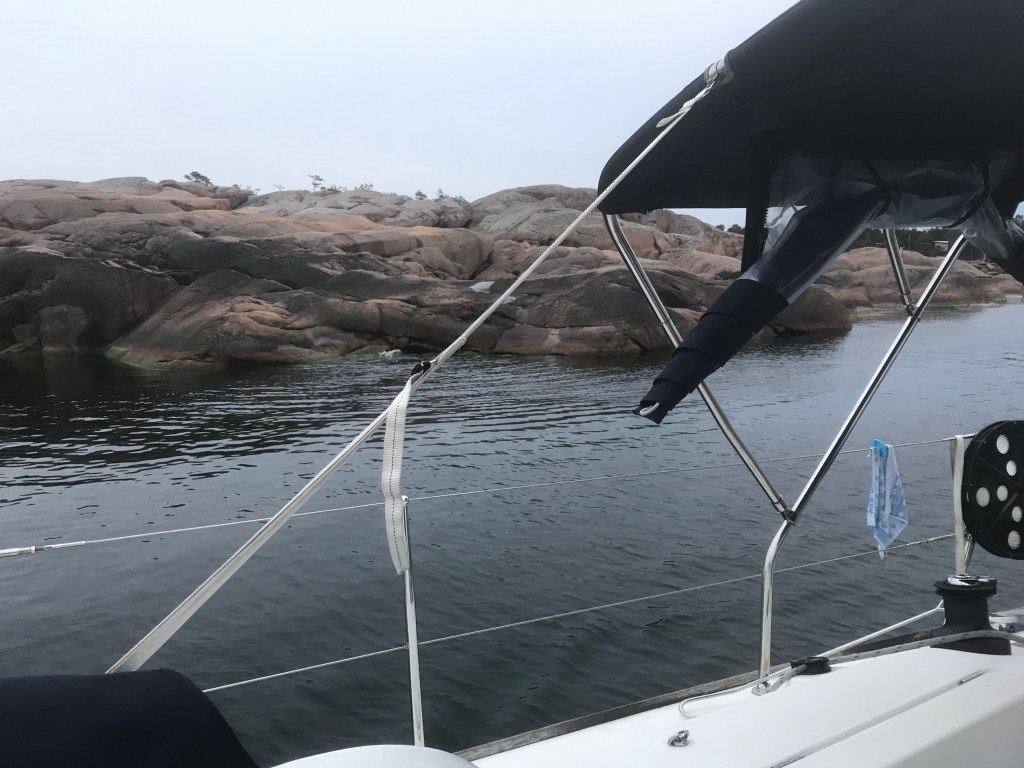
We had glanced off an uncharted rock previously, but there hadn’t been any leaks and I had dived under to check the keel and found nothing, so we had assumed that there had been no damage.

“You can see that small gap between the hull and the front of the keel”, says Nicolas. “ And there is a depression in the hull at the back of the keel. That’s a sure sign of an impact with a rock. It doesn’t look as bad as some that I have seen, but you really need to get it fixed. The boat is still able to be sailed OK, but if you were ever to hit another rock you never know what might happen.”
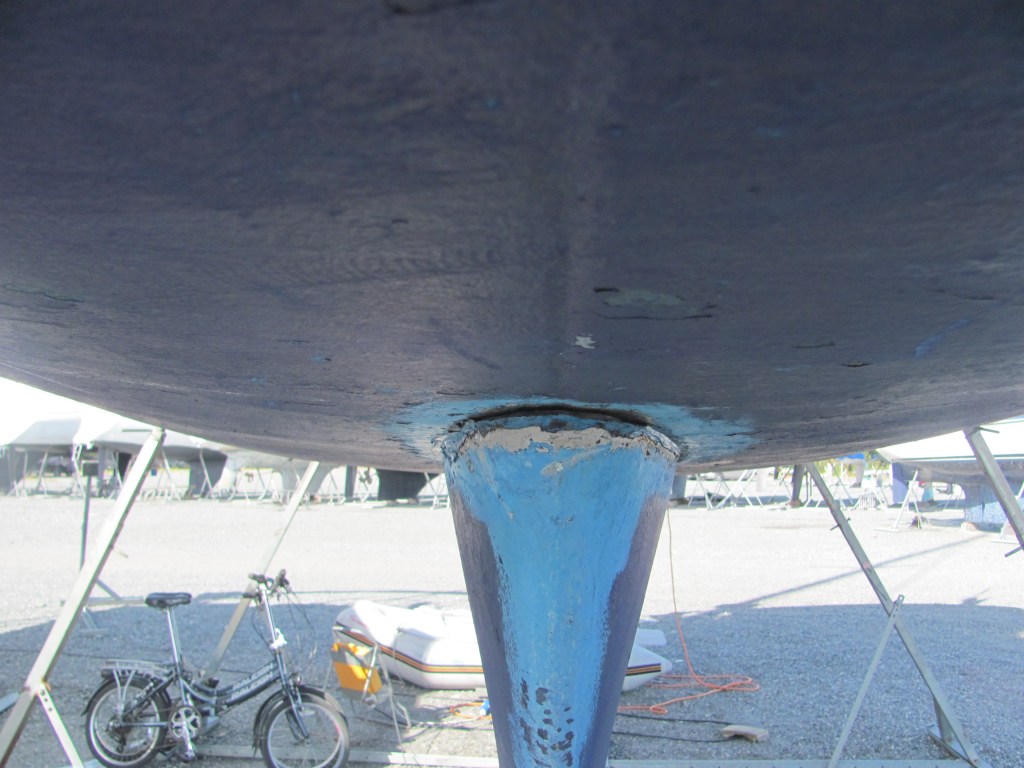
Gap between keel and hull.

The First Mate and I have a confab.

“There’s no question that we have to have it fixed”, I say. “I’ll ask them if they could do it over the winter.”

“Yes, of course”, says Nicolas in response. “But you will have to join the queue. We have several others lined up for similar repairs. Most people hit rocks at some stage or another. In fact, we have a saying that there are three types of sailor in Sweden, those that have hit a rock, those that are just about to hit a rock, and those that have hit a rock but don’t own up to it. It’s just one of risks of sailing in Sweden. But the good thing is that after we have repaired her, you’ll have a much stronger boat even than when she came out of the factory.”

We decide to leave her with them over the winter. It isn’t the marina we had planned to stay at, but that is of little consequence. Having her repaired before sailing her again is of prime importance. In any case, we find out later from several people that the company has the reputation of being the best in the Baltic for such repairs. People bring their boats from all over to have them seen to. That is some reassurance.

A good reputation.

We take the bus and train down to the other marina where we have left the car, then spend the next few days preparing Ruby Tuesday for winter. All the normal jobs of taking down and stowing the sails, the cockpit tent and the splash-hood, and servicing the engine, are eventually completed. The First Mate starts cleaning and packing things inside.
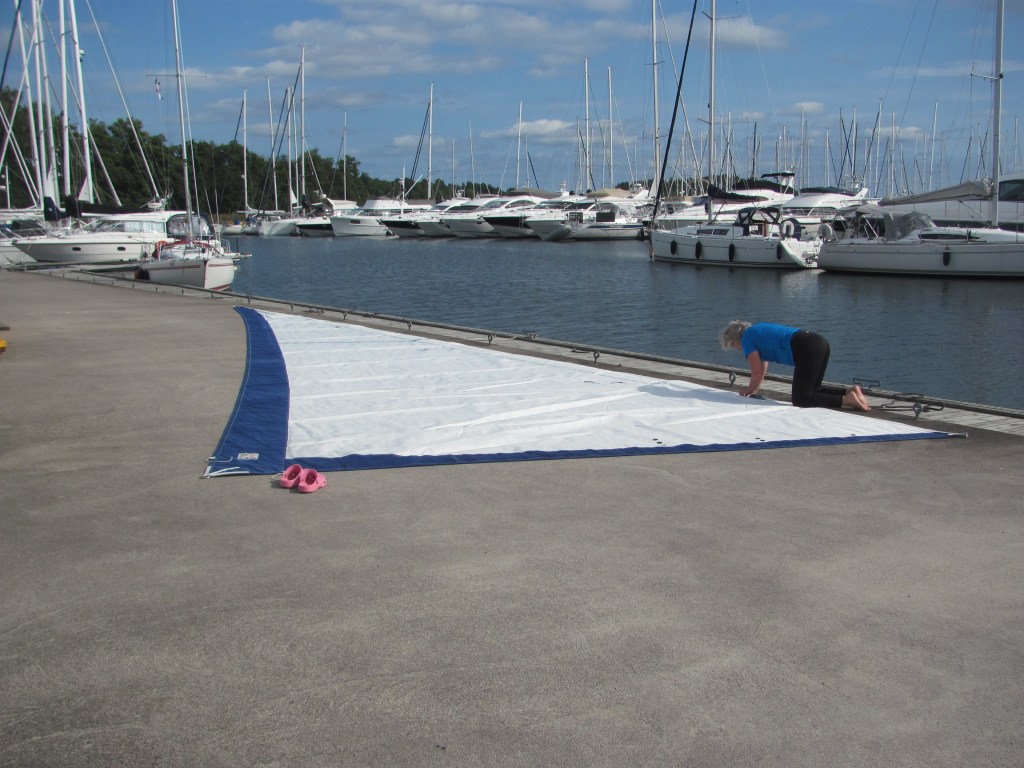
Cleaning and folding up the sails.
Changing the oil.

“You’ll also need to cover her against snow”, Magnus advises us. “It needs to be quite steep so that it slides off. You can build a frame to support it out of this old wood here. Use what you like. When you are ready to put the ridge pole on, I’ll get some of the lads to lift it up. It’s too heavy for one person to do.”

Magnus is one of the employees of the repair company. It would be difficult to find someone more friendly and helpful.

I spend the next two days building the frame. Three A’s are soon constructed with their feet fastened securely to the side cleats. Magnus and his lads bring over the ridge pole and soon that too is fastened securely on top of the A’s. For good measure, I use screws and bolts to make sure that it is solid.

Constructing the frame.

Then the covers from last year go on and are tied underneath the hull.

The covers go on.

“That looks pretty good”, says Magnus. “I am glad that you didn’t tie the covers to the cradles anywhere. Some people do that, but occasionally the wind can be so strong it catches the cover like a sail and pulls the cradle away, and the boat falls over. You don’t want that to happen.”
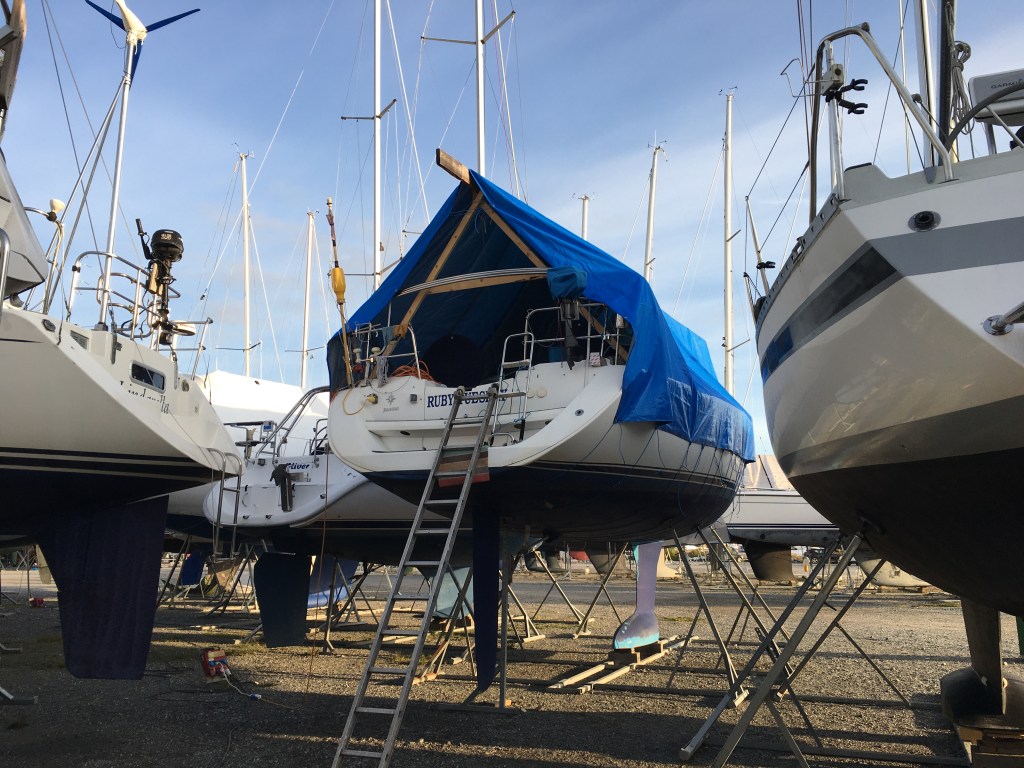
Bring on the snow!

“We still need to get the gas cylinders filled”, says the First Mate. “Let’s drive over this afternoon and do that.”

Filling gas bottles is a perennial problem. Despite being standardised in most other things, the one thing the EU has not yet managed to do is to standardise fittings on top of gas cylinders. Each country has its own system and many outlets will only fill bottles from their own country. We have cylinders we bought in Germany, but luckily have found an outlet that will fill those. The only thing is that it is on the other side of Stockholm.

“Sure, no problem”, says the man when we get there. “We can fill them. Bring them over to this shed.”

Filling the gas bottle.

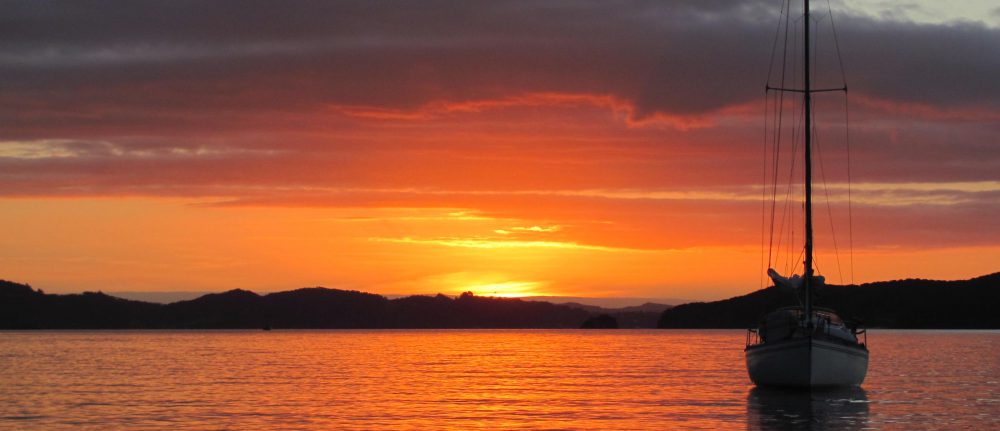
It’s time to leave. In the morning, I go for one last walk along the shore near the marina. The sun glows like a fireball, and the early-morning mist rises off the water’s surface. Islands hunker to either side, hiding their secrets. The masts in the marina sway gently from side to side, silhouetted against the scudding clouds of the sky beyond.
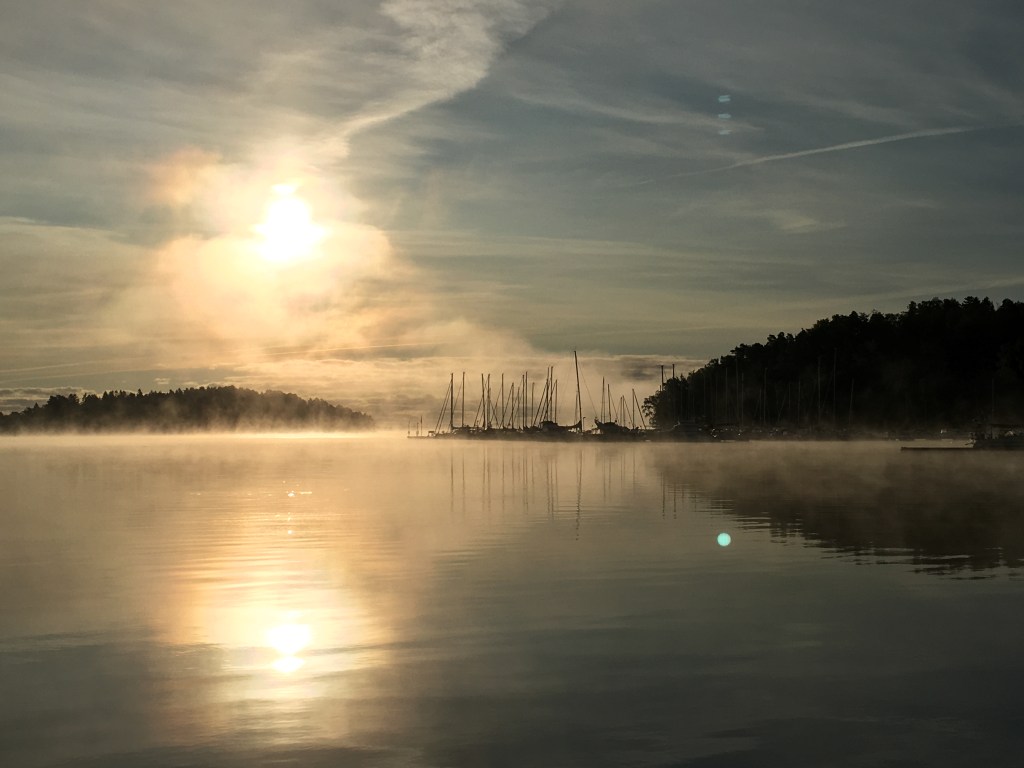
Early morning at Svinninge.

This is the Baltic, I think – sun, water, trees, islands and boats. I start to reminisce back over our voyage. Sailing to Åland, meeting our son, the rally and getting to know a new set of friends, the journey up to the Högekusten, the High Coast, and the many picturesque little harbours we stopped at on the way, the Högekusten itself with its impassive Skuleberget which we had climbed up, the long haul from Umeå to Luleå, the Sámi Museum in Jokkmokk, the beautiful Luleå archipelago, eventually reaching the famous buoy in Törehamn, the furthest north point in the Baltic that one can sail to.

The train trip to Rovaniemi to the Arctic Museum, then the beginning of the long trip back down the Finnish coast, often into the wind requiring us to take long tacks to get anywhere, but more than made up for by the quaint wooden towns that we had stopped at on the way, culminating in the UNESCO World Heritage site of Rauma.

And everywhere the traces of the empires and the rivalries of the great players in the Baltic – Sweden, Russia, Denmark, even Britain and France at one stage – that had come and gone over the centuries, some rivalries of which are still here in the present day. It had been a journey of discovery for us, learning of a part of the world that we had known little of before, and understanding a little more of why the current world is as it is.

Suddenly I feel a pang of sadness that we are leaving. As we followed the ancient seaways taken by the Vikings, the Swedes, the Danes, the Finns and the Russians, a closeness to the Baltic seems to be developing within us, one that can probably come only from discovering it by sail, the means of transport here for millennia. It feels familiar; almost, but not quite, like home.

A pair of swans fly overhead, the sound of their creaking wings waking me from my reverie. I tear myself away, and go and pack the last few things into the car. We finish our breakfast, say goodbye to Ruby Tuesday and Spencer, and start the long journey back to our other home.

But we will be back.

A dead tree island, a mushroom hunt, and a tasty Swedish lunch

“I’ll just take the rubbish over to the bins”, I say. “Hans & Gisela are not due for another 15 minutes, so I should be back before they arrive.”

We are at Svinninge Marina, just north of Stockholm. We are waiting for our German friends, Hans & Gisela, who are joining us for a few days’ sailing. They have been holidaying in the north of Sweden and are now making their way back to Denmark where they live.

“Have they arrived yet?”, I call out to the First Mate when I return. “I wouldn’t be surprised if they are a bit late. They had quite a long way to come.”

A head appears over the splash hood. It’s not the First Mate.

“Yes, we have arrived”, says Gisela, laughing. “And we weren’t late. If anything we are a bit early!”

Hans & Gisela arrive.

It’s nice to see them again. We unload their luggage and give them a quick tour of the boat. The operation of the toilet always seems to be a thing of either concern or fascination for visitors, often both.

“I might get used to it by the end of the trip”, says Hans.

The sunny weather is too good to waste, so we decide to have lunch and set off straight away. Unfortunately, there is almost no wind and we need to motor.

On the way out, we pass an island full of dead and dying trees.

“You see quite a lot of islands like that”, says the First Mate. “We haven’t worked out yet why all the trees die.”

Dead Tree Island.

“It’s because of the cormorants nesting there”, says Gisela. “It’s the same in Denmark. Unfortunately their poop is very acidic and over a period of time it kills the tree they are in. If there are enough cormorants all the trees will eventually die. Then they move on and find another island. “

“So humans are not the only species that destroy their own environment with all the pollution they produce?”, I say.

“The only difference is that the cormorants have lots of islands to go to, but we only have one planet”, says Hans. “Once we have killed everything on it, we won’t have anywhere to go. Unless we have developed cheap space travel by then, I suppose.”

“Much better to look after the planet we have than go and look for others to destroy”, says the First Mate.

The wind picks up to a respectable 15 knots, and we sail along speedily on a beam reach. We follow the main fairway south until we branch off to the east to wend our way between a number of small archipelago islands.

On our way.

We arrive at Grinda, a popular destination in the main season. Today there are only two other sailboats and a handful of small motorboats. We tie up on the outside of the pontoon. As we do, a police boat appears and moors in front of us.

“Are you on the run?”, I ask Hans.

“I thought that they had got wind of all those cans of beer under your floorboards”, he replies.

“They often come here to have their lunch and to fill their boat up with fuel”, the harbourmaster tells us later. “So no need to worry!”

Tied up on the island of Grinda.

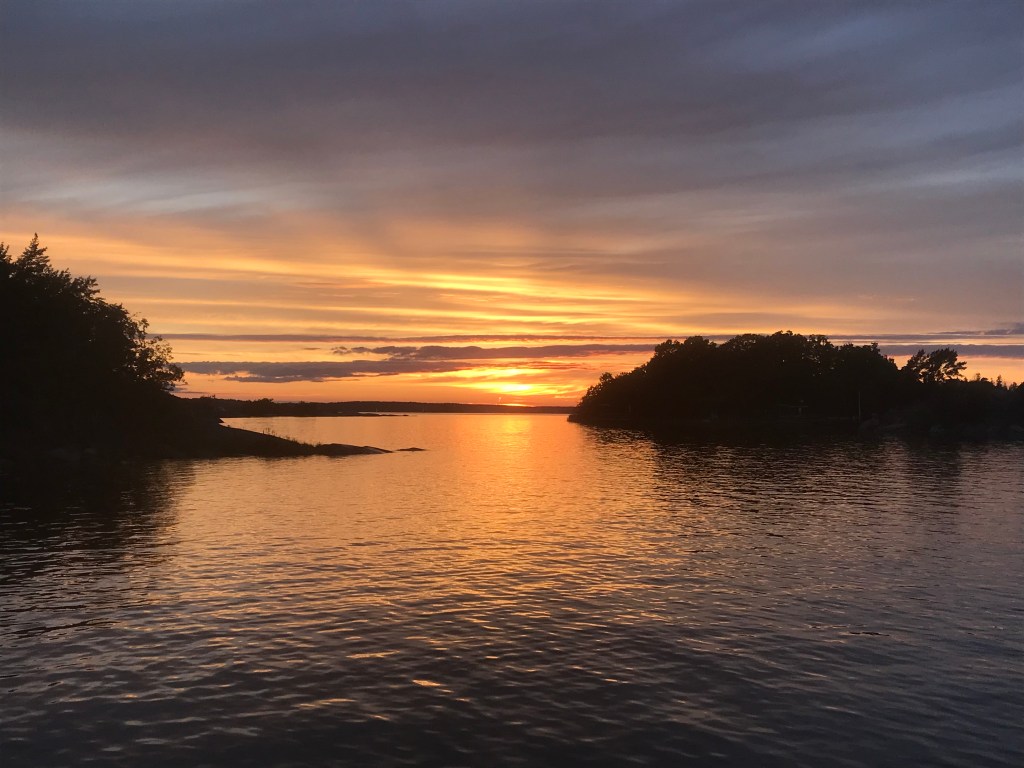
In the evening, we walk up to the Grinda Wärdshus hotel for dinner. It is not too busy, and we find a table on the terrace outside. It turns out to be a good choice, as a half an hour later the sun begins to set. We sit spellbound as we watch the succession of yellows, oranges and reds give way to purples and darkening shades of blue. Then the sun is gone.

Sunset at Grinda.

“It’s stunning”, says Gisela. “The way the sun lights up the sea and silhouettes all the islands. I can see what you mean when you say that the Archipelago is so beautiful.”

The conversation turns to politics in Germany.

“What is worrying is the rise in popularity of the Alternative für Deutschland party”, says Hans. “The AfD. A few years ago we would have been horrified to hear that a far-right party had won a local council election, given our history. But that’s what happened in June in Thuringia. They now have an AfD mayor in one of the towns.”

“It seems to be particularly in the former GDR”, says Gisela. “They feel disadvantaged there after reunification compared to the former West Germany. They are also used to strong authoritarian leaders there rather than democratically elected ones.”

“AfD are also playing on reactions to Germany’s Kollektivschuld, or collective guilt”, says Hans. “For things that happened in WW2. We had it rammed into us at school about the atrocities that were committed by Germany and how it must never happen again. But people are now starting to say that that was something that their parents or grandparents did, and why should they feel any guilt for it?”

Trying to sort out the problems of the world.

“There does seem to be a rise in the far-right throughout Europe”, I say. “Not just Germany. Last year the Sweden Democrats with neo-Nazi origins joined the coalition government here in Sweden, something similar happened in Finland, then there is Austria, Italy and Hungary. The ruling party is Poland is pretty right wing, not to mention the Tories in the UK.”

“The Tories are predicted to lose the next elections in the UK”, chips in the First Mate. “So that might be a swing in the other direction.”

It starts raining heavily in the early morning. I lie for a few minutes listening to the noise of the raindrops on the hatchway overhead. It sounds like it is more than a shower and is setting in. I snuggle back under the duvet and drift off to sleep again.

A wet morning.

In the afternoon, the rain stops and the sun comes out. We cast off and sail eastwards to the island of Svartsö, the Black Island. The small harbour is almost empty, so we moor alongside to one of the pontoons. Just after we are settled and drinking our tea, another sailboat arrives. It ties up to the neighbouring pontoon. After a few minutes, the skipper knocks on our window.

“Could I ask you to move a bit further forward?”, he asks, in the tone of someone who is used to getting his way. “It’s a bit too exposed on the next pontoon. We’d like to go where you are.”

“Sure”, says the First Mate. “Do you mind if we just finish our tea first? Then we are happy to move.”

“I would rather you moved it now”, he says, an edge to his voice. “We have a party to go to on the other side of the island, and we are late already.”

We reluctantly leave our cups of tea to untie our ropes and pull Ruby Tuesday forwards.

“I don’t mind moving”, says the First Mate later. “But it was his attitude that annoyed me. He could have just waited until we had finished our tea. Now it’s all cold. What was wrong with the place that he was at, anyway? It’s no more or less exposed to the wind than where we are.”

“My guess is that he is a lawyer”, I say. “He had that look about him, and they are used to getting what they want.”

“I was thinking that he is a hospital administrator”, says Hans. “They can be pretty bossy too.”

Tied up at Svartsö in our new position.

We finish our lukewarm teas and decide to explore the island. Near the harbour is a small grocery store, with a map of the island attached to its wall.

Svartsö, the Black Island.

“These two lakes in the middle look interesting”, says Gisela. “Let’s walk up to there. By the time we get back it’ll be time to start dinner.”

We follow the road through the woods, passing by some farmland. Cows graze in the fields. We take a small path to the left of the main track and find ourselves at the edge of a lake.

Stortråsk lake, Grinda.

“Look, you can get a good view of it from this rock”, shouts Gisela.

There’s a splash. She has fallen in. She struggles to regain her footing, but falls in again, this time up to her neck. We rush over to help her out.

“Don’t come onto the rock”, she shouts. “It’s really slippery.”

An unintended swim.

She manages to climb out, but she is soaked. We head back to the boat. The First Mate has some warm clothes she changes into while we try to dry the others.

“Well, that’s a lesson to check rocks first and make sure they are not too slippery”, says Gisela. “I feel so silly.”

Luckily her clothes are dry by the morning. Over breakfast, we decide to go for a walk through the forest on the north side of the island.

“We might find some mushrooms”, says Hans. “One of our hobbies is mushroom collecting. Forests are good places for them.”

On the lookout for mushrooms in the forest.

Sure enough, there are mushrooms in abundance.

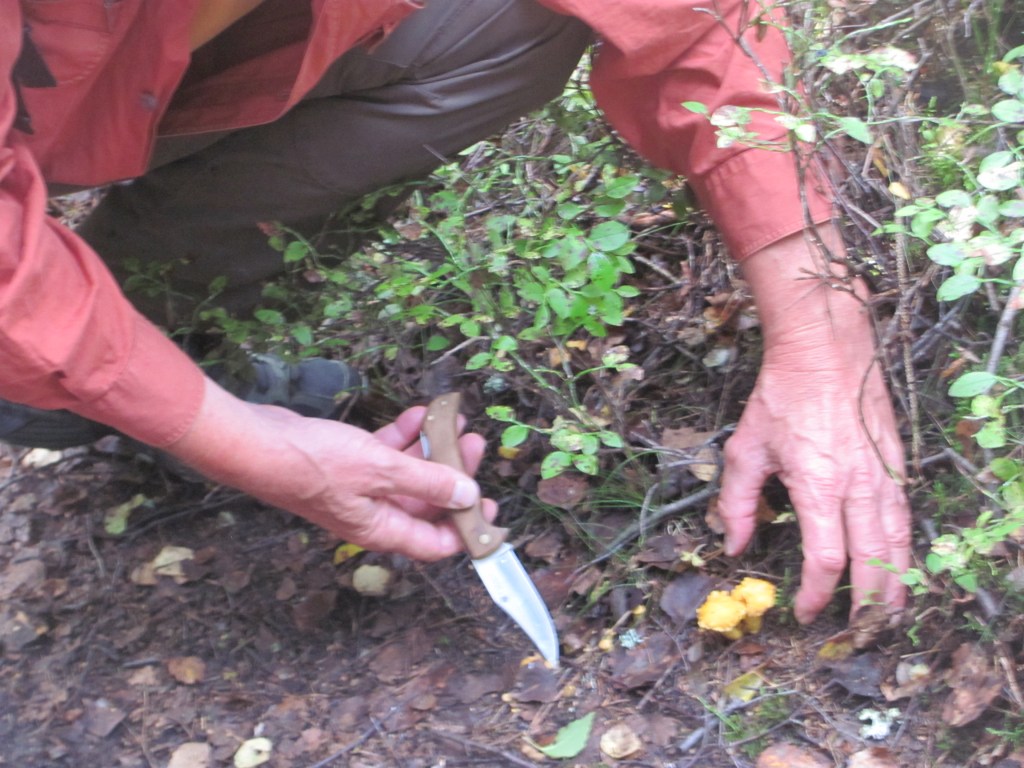
“Look, these are chanterelles”, says Hans. “You can tell them by their shape and colour. They are edible and actually quite tasty. They grow throughout Europe and Asia in woods like this, so we should see quite a few more.”

Collecting chanterelles.

Sure enough there are lots by the side of the track, and before long we have a bag full. Even I am learning to recognise them.

A good haul for dinner.

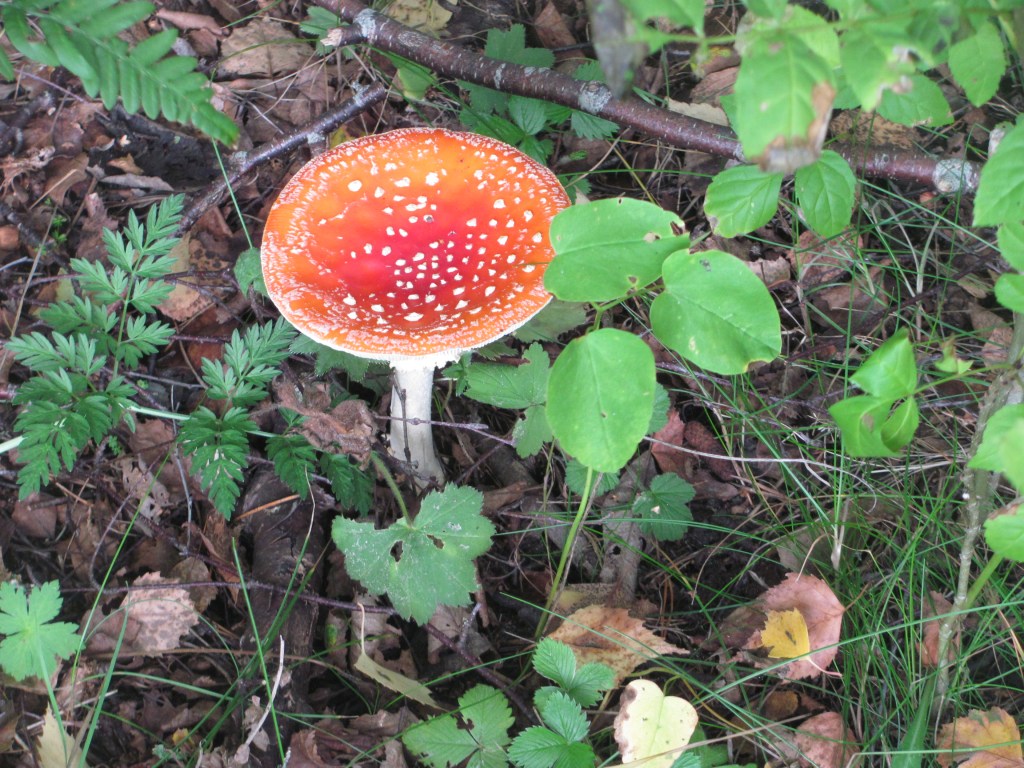
“Here’s a fly agaric”, calls Gisela. “Amanita muscaria. The typical mushroom associated with pixies and fairies. They are poisonous, but you can eat them – very few people die from them. Normally they make you feel a bit nauseous, but in severe cases you can become delirious. But most people recover in 24 hours or so, perhaps with a nasty headache. A lot of cultures eat them for their hallucinogenic properties. The shamans in Siberia, for example, used them to enter into a trance.”

Fly agaric.

“The Vikings were also supposed to eat them before they went into battle”, says Hans. “It made them into berserkers, crazed with extra strength and rage, and oblivious to danger. So much so they often fought without armour. Although a recent theory suggests that it was more likely to be henbane that caused this state.”

Nevertheless, I decide to give fly agaric a miss. I am not really in the mood to do battle at the moment.

“The other ones to watch out for are Death Cap, or Amanita phalloides”, says Hans. “Same genus, different species. I haven’t seen any here yet. But they are supposed to be the most toxic mushroom in existance. Just half of one is enough to kill you.”

“You are starting to put me off mushrooms”, I say.

We leave the forest, and come to small settlement. Near the centre is a restaurant. A tractor is parked near the bar. A motorbike is parked on top of it. Goats roam between the outside tables. It’s all very rustic.

Bistro Sågen.

“It’s called Bistro Sågen”, says Gisela. “It means Saw Bistro. It seems as though it was an old sawmill.”

We decide to have some lunch there. The goats eye us up.

Hungry goats.

At the table next to us are some leather-clad bikers engaged in an intense discussion on some arcane parts of their bikes. At least that is what I assume it to be.

“They must have bought their bikes over on the ferry”, says the First Mate. “I hope they don’t disturb our lunch with their loud talk.”

We scan the menu. I breathe a sigh of relief; there are no mushroom dishes.

“I can recommend the Toast Skågen”, says the waiter. “It’s a very Swedish with hand-shelled prawns mixed with mayonnaise, some sour cream, grated horseradish and a dash of tabasco, topped with caviar, a sprig of dill and a lemon, all served on a large square of sourdough toast. It was created just after the WW2 by a Tore Wretman who owned a restaurant in Gothenburg overlooking the Öresund, and named his creation after the village in Denmark on the opposite side. Now it’s popular all over Sweden. It’s very tasty.”

The goats look at us wistfully, nodding in agreement.

Toast Skågen.

Four plates of Toast Skågen arrive. One of the bikers gives us a thumbs up sign.

Toast Skågen”, he says. And hearing us speaking in English and German, “Gut, sehr gut. Sehr lecker! Very tasty!”

And it is sehr lecker. So much so, I feel I could almost eat another one. The goats look on expectantly.

On the way back, we see what looks like a snake on the road.

Not a snake.

“Ah, that’s a slow worm”, says Gisela. “It’s actually a legless lizard, but a lot of people think they are snakes. They certainly look like them.”

We set off in the morning to sail back in the general direction of Svinninge, but take the long way round to see more of the Archipelago. Eventually we join the main shipping fairway back to Stockholm. Unfortunately the wind is more or less on our nose and we need to make a series of tacks.

“Can I have a go?”, asks Gisela. “I’d like to feel how a large boat handles.”

She is a keen sailor herself and has a small sailboat back home in Denmark. She takes the helm.

“Wow, it feels so much less responsive than our boat”, she says after a few minutes. “More stable in a way. Ours is all over the place with the slightest twitch of the tiller or breath of wind.”

We tack our way up the fairway and eventually arrive back at Storön, our favourite anchorage.

“That was fun”, says Gisela. “I enjoyed that!”

“I wonder if the mystery boat that we saw last week will still be here?”, says the First Mate.

It is. In the same place as we had left it about a week ago. It looks to have been untouched since then. Still no-one appears to be on it. No-one alive, at least.

Still there!

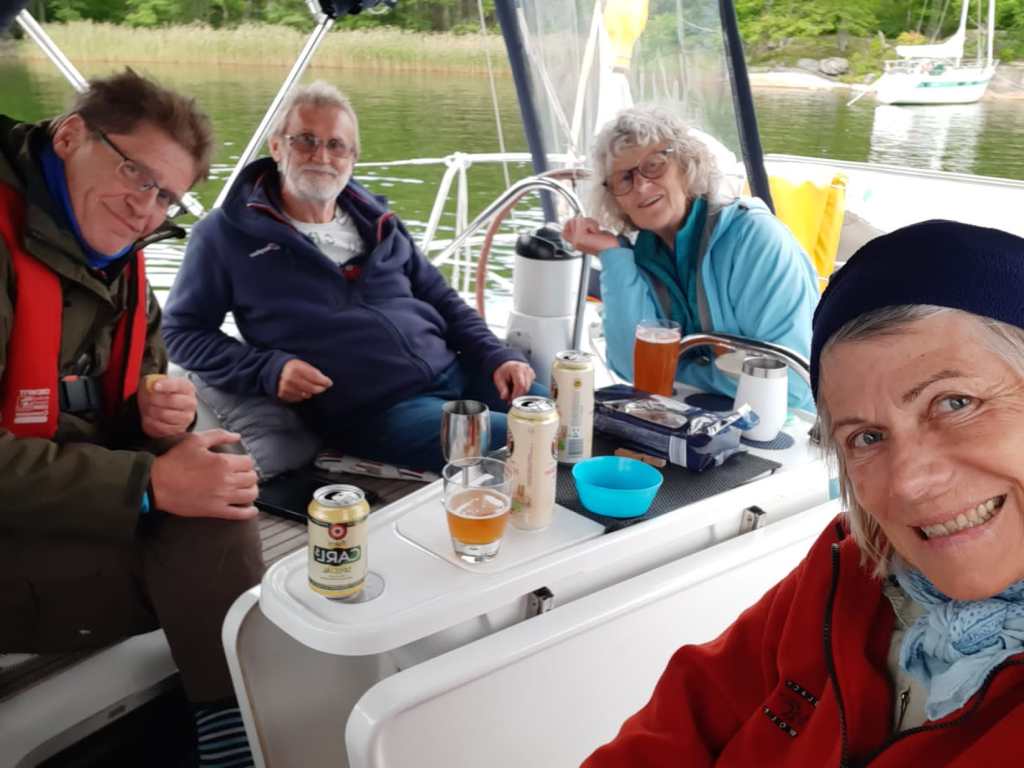
“We think that someone might have been murdered and has been left inside it”, we explain to Hans and Gisela as we bring out the beers. “It’s odd to leave a boat unattended tied up to rocks with only a stern anchor. Especially for more than a week. There’s a risk that the bow might be smashed against the rocks if a storm came.”

“Hmmm, very mysterious”, says Hans, warming to the theme. “Perhaps it belongs to a secret service agent who was on to corruption in the Swedish government and who had to be silenced to protect the guilty parties?”

“Or a sailor who overheard some suspicious foreigners planning to lay charges to destroy a gas pipeline under the Baltic?”, I say. “Perhaps he was just about to alert the authorities in Stockholm when the plotters realised they were being overheard and had to do something.”

“Or someone who has just left their boat here during the week while they are at work?”, says the First Mate. “They are probably coming back for it at the weekend.”

“But how would they get there and back?”, says Gisela. “It’s a long way to row in a small dinghy.”

“And there are no paths away from this bay that they could walk on”, I say. “The boat has been there for more than a week now. I think that there is definitely something suspicious going on. I wonder if we will ever find out?”

“Unlikely”, says the First Mate. “We won’t be back here again until next year. It’ll either have sunk or been moved by then. Come on. Let’s have dinner. It’s spaghetti bolognese tonight.”

Trying to work out why the mystery boat is there.

A noisy harbour, a thunderstorm, and a mystery boat

“I’ll just go up to the hotel and pay the harbour fees” says the First Mate. ”Don’t forget to change the courtesy flag in the meantime. We’re back in Åland again. And you can put on the kettle. Gavin & Catherine are coming over for a cup of tea.”

We are tied up to the pontoon in the small harbour of Gullsviggan, having just arrived from Enskär in Finland. Our plan now is to head back to Stockholm, on the way exploring the northern parts of the Åland archipelago that we hadn’t had time to see when we were here in June on the Cruising Association rally.

Moored in Gullsviggan harbour.

I find the Åland flag in the locker downstairs and hoist it up to the starboard spreader. It adds a touch of colour to Ruby Tuesday.

Switching from the Finnish to the Åland flag.

I put the kettle on. Across the bay, not very far from the harbour, work is under way to build or renovate a bridge. A pneumatic drill on the end of a digger is breaking up the old road with loud staccato blows. Gavin & Catherine arrive, but we can hardly hear ourselves talk.

“I hope – bang-bang-bang-bang – all night”, says Catherine. “We’ll nev – bang-bang-bang-bang – sleep.”

“Pardon?”, I say. “What did you say?”

“Perhaps they knock – bang-bang-bang-bang – five”, says Gavin.

The pneumatic drill doesn’t knock off at five. Or six o’clock either. Only at seven does the noise stop. Peace descends.

“You don’t really appreciate silence until you don’t have it”, I say, trying to sound profound.

“I hope they don’t start too early in the morning”, says the First Mate.

‘Bang-bang-bang-bang!’, goes the drill at 0700.

“Couldn’t they have just waited until after breakfast, at least”, I say.

“Pardon?”, says the First Mate. “What did you say?”

We set off, heading southwards along the main fairway southwards through the Ålands.

“Look, there’s a huge cloud up ahead”, says the First Mate. “It looks like rain.”

“A real anvil-shaped thundercloud”, I say.

Thundercloud over Åland.

Sure enough, we see a squall approaching, and before long the rain is tipping down. Luckily the rain is almost vertical and I manage to keep dry under the bimini. There are dull rumbles of thunder overhead, the wind buffets us, and it is difficult to see our way to each marker buoy. I fight the wheel to keep on the same course, and hope that we don’t miss one and go aground on some hidden shoal. Then just as suddenly, it is all over. The clouds part, and the sun shines through again, bringing with it a warmth that makes the sudden squall a distant memory.

We arrive in a small bay to the south of the island of Barö, and drop anchor. To the east, we can still see the thunderclouds, but they are now past us and heading away. The wind has died down and peace descends.

“It’s amazing how quickly these squalls come and go”, says the First Mate over a cup of tea. “You would hardly believe that it was pelting down and the wind so wild just a short time ago.”

Anchored in Barö after the thunderstorm.

We cook dinner and sit in the cockpit watching dusk descend. A flock of geese fly overhead, their wing-strokes beating a steady rhythm. Over by the rocks on the shore, a pair of swans gracefully search for food. A fish breaks the surface of the water, making ripples that spread out in ever widening circles.

I pick up the book I am reading at the moment, The Soul of the Marionette: A Short Enquiry into Human Freedom, by John Gray. It’s a chaotic mish-mash of ideas drawn from several sources that in my mind don’t quite hang together in every case. His writing is not for everybody, and I am not sure I agree with it all either, but nevertheless it makes for some thought-provoking reading.

He makes the point that true freedom is not actually ‘freedom of choice’ but ‘freedom from choice’, in the same way that a marionette is free from having to make decisions about what it does because it is not self-aware. However, the human race has decided for itself on a different pathway to achieve this freedom of the spirit – by accumulating knowledge that allows us to manipulate the forces of nature. The endpoint of this, according to Gray, will be the ‘final chapter in the history of the world’.

At the moment, however, although we have made impressive technological advances, we are so far from understanding how we ourselves work and why we behave in different ways that this endpoint remains an almost unattainable aspiration. Instead, we content ourselves with illusions and cosy myths about who we are and the way the world operates. We are even prepared to die for the sake of these myths to give our lives meaning – religion, but also dreams of a new humanity with its concepts of communism, fascism, capitalism, democracy, and human rights. This is why conspiracy theories are so popular – they provide our lives with meaning that we are part of someone else’s plans.

But there are also risks with this progression towards an eventual state of perfection. Our knowledge allows us to create artificially intelligent machines, for example, which are making more and more of the decisions that used to be made by humans. While this frees us from the need to make choices, the risk is that these machines might eventually decide that humans are obsolete and that they should be destroyed.

It’s bleak stuff, and leaves me slightly depressed. I had read a previous book of his, Straw Dogs, in which he asserts that while humans have made considerable technological progress, we just go round and round in circles in terms of social organisation and governance. At first I had disagreed with this, but with the recent rise in autocracy and the far-right, I am starting to wonder if he might have a point.

It’s late and my brain is turning to mush. The First Mate has gone to bed. I switch off the lights and snuggle under the duvet to dream uneasily of the future.

We weigh anchor in the morning, and continue our journey eastwards. There’s almost no wind, and we have to motor for much of the way. It is warm and humid, and we pass through a swarm of small flies that cover the boat everywhere we look. They don’t seem to bite, but they are itchy and annoying when they land on our skin.

“It’s amazing how far out they come”, says the First Mate. “We can hardly see land, but they must have flown all this way.”

“They certainly weren’t carried out by the wind”, I say. “There isn’t any.”

But an hour or so later, a breeze springs up, and we manage to have a nice sail. The flies disappear.

“It seems as if they don’t like the wind much”, says the First Mate. “But I wonder where they have gone?”

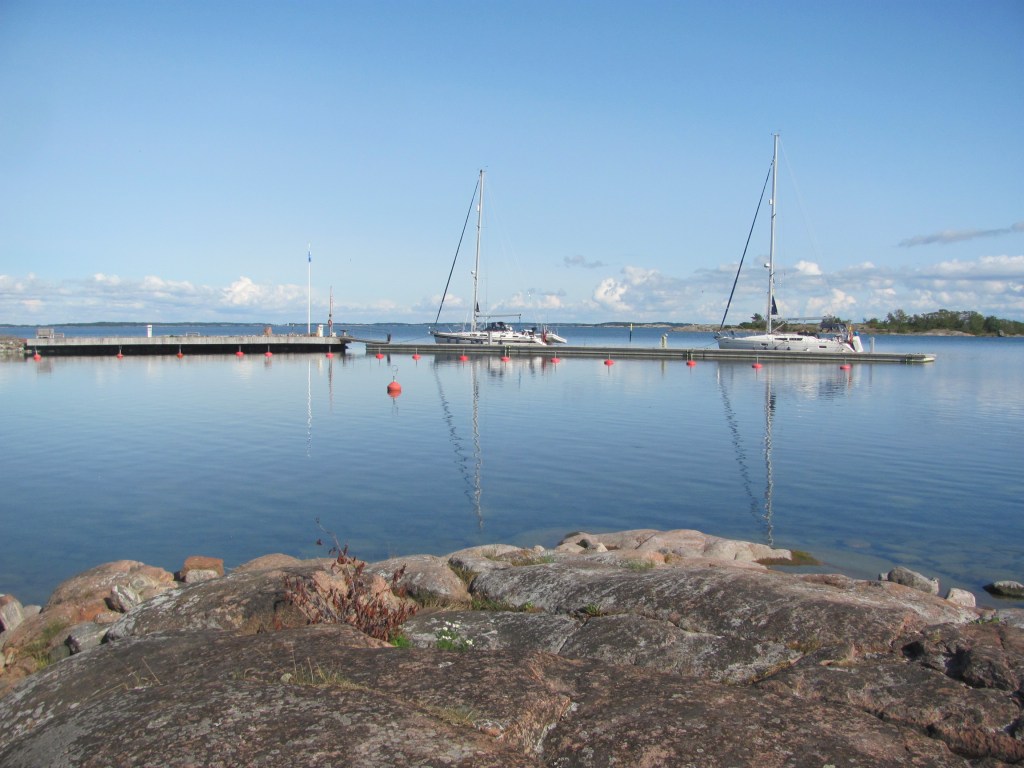
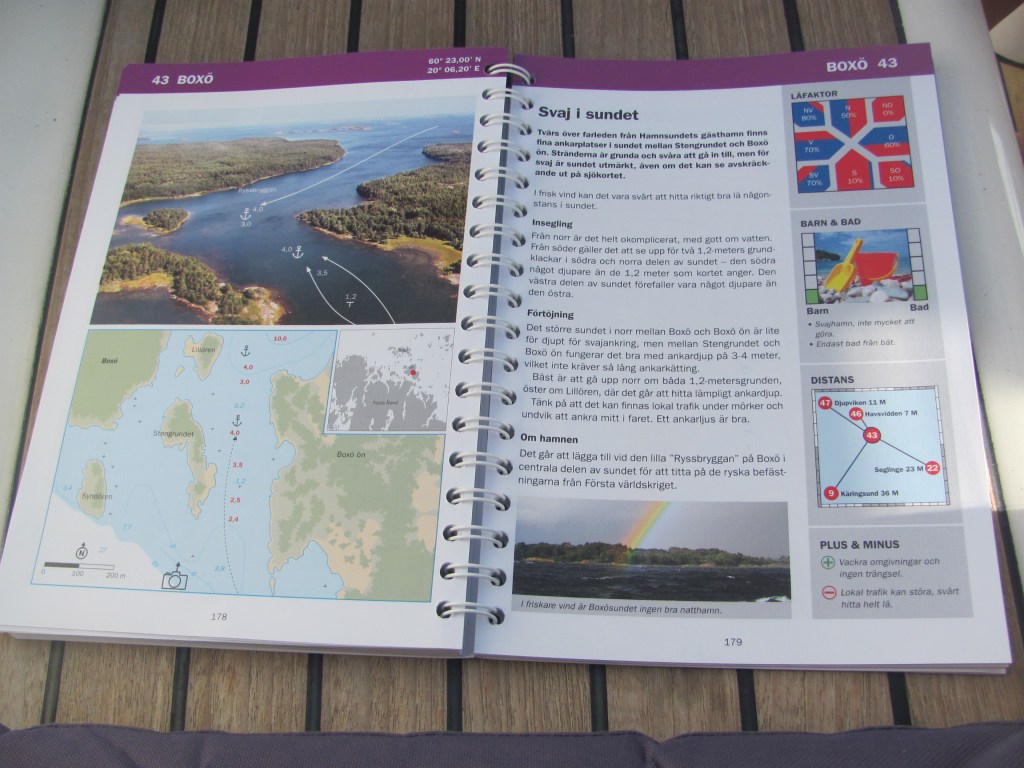
We decide to anchor in a sheltered bay on the island of Boxö, near a small islet at its southern end. The chart shows underwater cables running from one side to the other, so we need to take care not to anchor anywhere near them. We drop the anchor near the top of the bay, but by the time it digs in, we are too close to the small island.

“I think we need to reset it”, I call out to the First Mate at the bow. “It’s difficult to get it right – either we are too close to the cables, or we are too close to the island. Further out in the bay, it is too deep to anchor.”

We eventually manage to find a place, and settle down for the evening.

Working out where to anchor on Boxö.

In the morning, we push on to Havsvidden, a small harbour in the north of Fasta Åland. The entrance is full of rocks, but there is a tight way in not much more than a couple of boat widths wide, and we need to thread ourselves past a nasty looking rock to starboard, and keep close to the rocky shoreline on the post side. It’s not an entrance for faint hearts. According to the harbour guide, there are supposed to be two markers to provide a leading line, but try as we might, we can only see one. There is nothing else to line it ap against.

A tight entrance into Havsvidden.

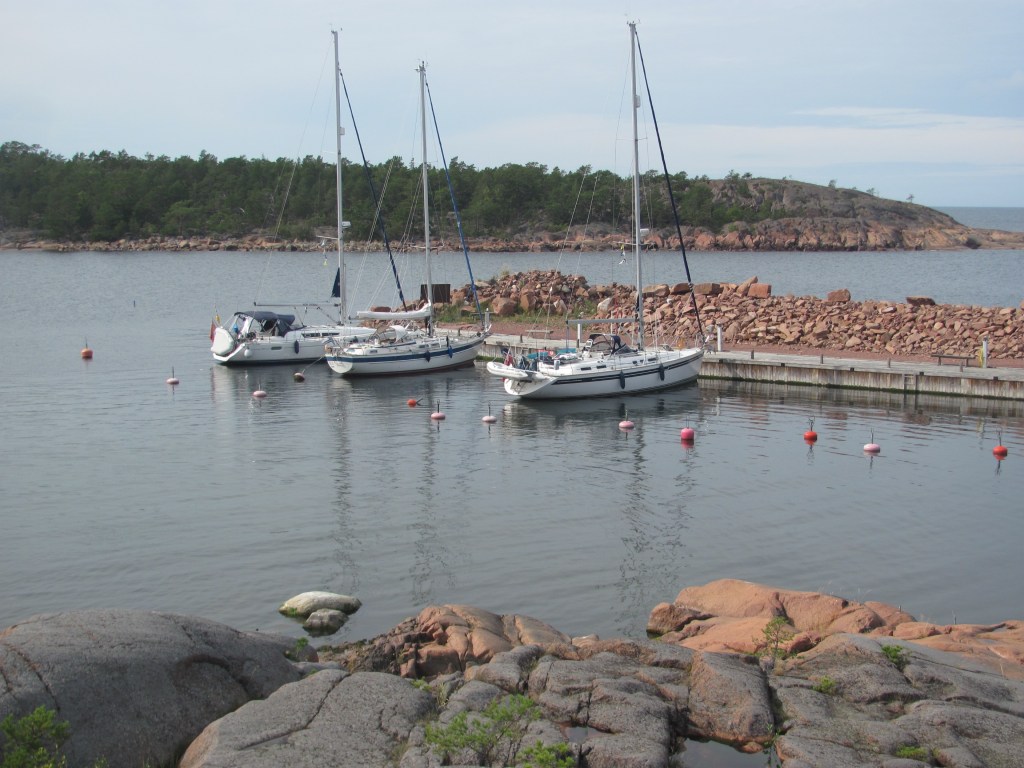
But somehow we make it and find a tiny harbour able to accommodate around five boats. Saluté is already there, having entered first to test the depth. Another boat follows us in.

Tied up in Havsvidden harbour.

“We are from Turku”, one of her crew tells us as we tie up next to each other. “We were planning to get back today, but the weather forecast isn’t good, so we thought that we would put in here for the day and continue tomorrow instead. The sauna is supposed to be very good here.”

Havsvidden hotel.

We go up to the hotel reception to pay.

“We are closing tomorrow”, says the girl at the front desk. “After that the hotel will be only open at the weekends until the end of September, then we close completely for the winter. But you are welcome to stay in the harbour. It is just that there won’t be any facilities available.”

“Another example of the weird holiday system they have here”, says the First Mate afterwards. “Look, there are still plenty of people at the hotel, and the weather is beautiful. Why on earth don’t they stay open?”

We decide to have dinner at the hotel in the evening. It’s a kind of farewell meal as Gavin & Catherine are leaving the next day to sail to Mariehamn to pick up a friend who is joining then for a week. We have decided to stay another day as the winds promise to be better on the following day, then head for Stockholm where we will meet our own friends, Hans & Gisela.

We choose a table in the enclosed balcony overlooking the sea. At the table next to us are two girls talking animatedly to each other. We try and work out what language they are speaking.

“I saw them earlier”, says Gavin. “I am pretty sure they are Russian. Not Finnish, at least.”

“I’m not sure”, says the First Mate. “It sounds more like one of the Baltic States languages. Perhaps Estonian.”

Before we can ask them, they finish their meal and get up and leave.

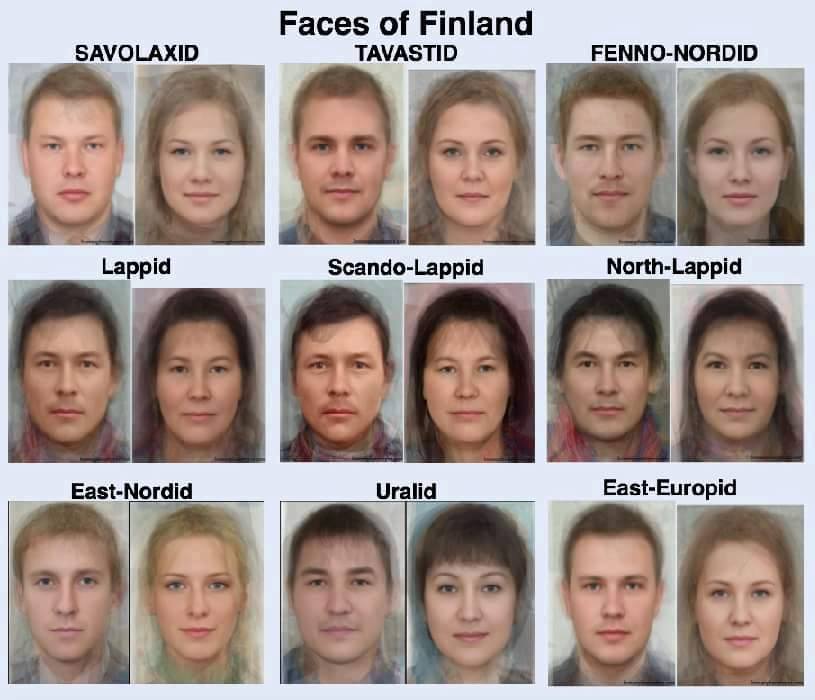
“I suppose a lot of the guests here are foreign”, I say. “But some of them must be Finnish. Do you think that you can tell who is Finnish or not just by looking at them? Is there a Finnish type?”

“Typical Finns have supposed to have blonde hair, blue almond-shaped eyes, round faces, and small round noses“, says Gavin.

I look around. Hardly anyone fits all those criteria. Most wouldn’t be out of place anywhere in Europe or Britain. Even in the Finnish towns we had visited earlier, I am not sure that I have seen many people that fit that type.

“I guess that, like anywhere, there has been a lot of mobility in recent years”, I say. “And people from all over have come to Finland to live.”

Is there a Finnish type?

“If you are looking for other national characteristics, they also pride themselves on not mincing their words and being reserved, modest, humble, polite, and resilient”, continues Gavin.

“The Finns tell a joke that they are so reserved that when the distance rules were lifted after covid, they were really relieved to get back to normal as two metres was much too close to be next to another person”, says Catherine.

Gavin, Catherine and Saluté leave the next day. It’s sad to see them go. We had first met them on the Swedish island of Storjungbrun in mid-June, and had travelled with them more-or less since then. But we may see them again next year, as they are also planning to explore the Baltic States, war (or lack of it) permitting.

The final farewell.

The hotel closes at 1100 on the dot, and the place is deserted by 1130. We are the only boat left in the harbour.

“It feels like a ghost town”, says the First Mate. “A bit weird after all the hustle and bustle at breakfast this morning.”

“Well, at least we can catch up on a few jobs that have accumulated”, I say. “I’m going to work on the blog.”

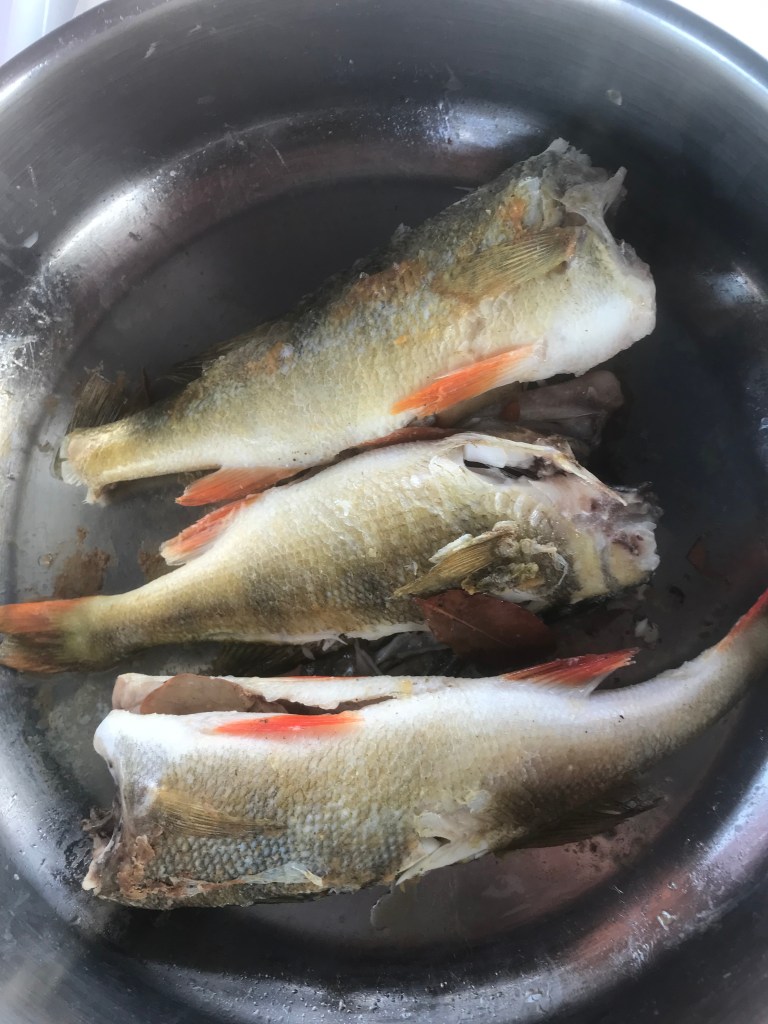
“And we can eat the fish that that little chap gave us”, she says.

A youngster had caught several perch from the pontoon the previous evening and had kindly given us his surplus.

Cooking fresh perch.

We leave the next morning for Arholma in Sweden. The wind is from the southwest, and we have a pleasant sail for a couple of hours before dark clouds gather and the rain starts pouring down. Then we need to turn to the southwest and directly into the wind.

“I thought you said that the weather would be for good sailing today”, complains the First Mate from the cabin.

“Well, the forecast said it was going to from the south”, I say defensively. “I thought the angle would be good enough to be able to sail. But it looks like they might have got it wrong.”

We motor for a bit. Eventually the rain stops and the wind veers more to the south, allowing us to sail close-hauled for another few hours. We are about a mile from the Swedish coast when it stops altogether. We make it to Arholma under motor and anchor in the middle of the bay for the night.

Back in Arholma, Sweden.

“Familiar territory”, I say. “It feels like coming home somehow. We were here at the end of May. We’ve covered a lot of miles and seen a lot of places since then.”

“Look, even the birds remember us”, exclaims the First Mate. “They are welcoming us back.”

A feathery welcome back to Sweden.

The next day, we push on towards Stockholm. We’ve booked in at a fibreglass repair company at a marina to the north of the city in a couple of days’ time for them to look at the damage to the bow. We sail down the main fairway for the ferries to the Åland islands and to Helsinki, and anchor in a small bay in Storön, an island in the archipelago not far from Stockholm.

Passing the ferry on its way to the Åland islands.

We had chilled out here last year for several days, enjoying the good weather, reading, fishing, swimming and exploring in the small dinghy. It feels like coming back to a favourite place. Only one other boat is there, moored bows-to to the rocks on the shore and with a stern anchor.

Only one neighbour.

“I thought we were going to have it to ourselves”, says the First Mate as we sip our glasses of wine and watch the sunset. “But at least they seem quite quiet. Perhaps they have gone ashore for a walk.”

Watching the sun go down from Storön island.

In the morning, I notice that the other boat looks just the same as they night before. No one seems to be around. I peer through the binoculars. There is no sign of life.

“Perhaps they are just sleeping in”, says the First Mate.

“Perhaps they have died on the boat”, I say. “Murdered, even. How would we know?”

“You and you imagination”, she says. “Always looking for the dramatic.”

An unwelcome bump, star-crossed lovers, and a Russian lighthouse

“There’s an empty berth over there”, calls out the First Mate from the bow. “Just on the other side of the boat with the black hull.”

We have just arrived in the town of Uusikaupunki on the Finnish coast, and are in the process of tying up at the city harbour.

I engage forward gear and aim the bow at the berth she is pointing to. As we enter, I move the gear lever to reverse to slow the boat and stop. Nothing happens! We keep moving forward.

“You’re going too fast!”, shouts the First Mate. “Slow down!!”

I wrestle with the lever and manage to get it into neutral. We are not going fast, but there is nothing to counter the forward momentum. There is a sickening crunch as we come to an abrupt stop against the wooden plank of the wharf.

“The throttle jammed somehow”, I shout back. “There was nothing I could do.”
There is a crack in the fibreglass of the bow.

Ooops!

“You’ll need to get that fixed”, says the man from the neighbouring boat. “And the throttle problem too. You’re lucky that there is a very good boatyard just on the other side of the river. They should be able to help you. I am happy to ring them and explain in Finnish what has happened, if you like.”

“We had a similar problem once”, says Gavin. “It turned out to be the clutch not disengaging. It was a big job to replace it, as the whole engine had to come out.”

It starts to rain heavily. Two men arrive from the boatyard, look at the bow, and stroke their chins thoughtfully. One starts the engine and puts the throttle lever into forward and reverse. The other goes downstairs and looks at the propeller shaft.

“They think that it is the propeller itself”, our neighbour translates. “The propeller shaft is rotating in the directions that it should for both forward and reverse. Do you know what sort of propeller it is?”

The propeller is a feathering one, meaning that when the boat is sailing, the blades rotate to line up with the direction of travel to reduce water resistance. When the motor is used, the centrifugal force causes the blades fly out to the angle of a normal propeller, with different configurations for forward and reverse.

“They think they need to lift your boat out and have a look at it”, says our neighbour. “You can take her over to their yard. It’s only ten minutes. But go very slowly, and try not to do anything that requires reverse. You can tie up alongside over there. They’ll help you.”

It’s not easy, knowing that you have nothing to stop forward motion except the friction of the water. Nevertheless, we manage to make it on one piece without hitting anything. A crane arrives, straps are slipped underneath Ruby Tuesday, and she is lifted out.

Out she comes.

Sure enough, the propeller blades are stiff, and are not moving forwards and backwards as they should. They pump grease into the propeller body and manage to free it up.

The cause of the problem.

“You can stay here for the rest of the day”, says the woman from the office. “Keep trying it in forward and reverse to see if you can replicate the problem. As for the crack in the bow, we suggest that you wait until you get back to Stockholm to get it fixed. We are too booked up at the moment. We’ll tape it up in the meantime to stop water getting in.”

We spend the rest of the day putting the gear lever in forward and reverse at periodic intervals. Everything works as it should. Despite my initial scepticism it does seem as if the problem is solved.

“We should at least see a bit of Uusikaupunki”, says the First Mate the next morning. “Why don’t we cycle in and have a look? We can have some lunch there, then sail for Enskär island in the afternoon.”

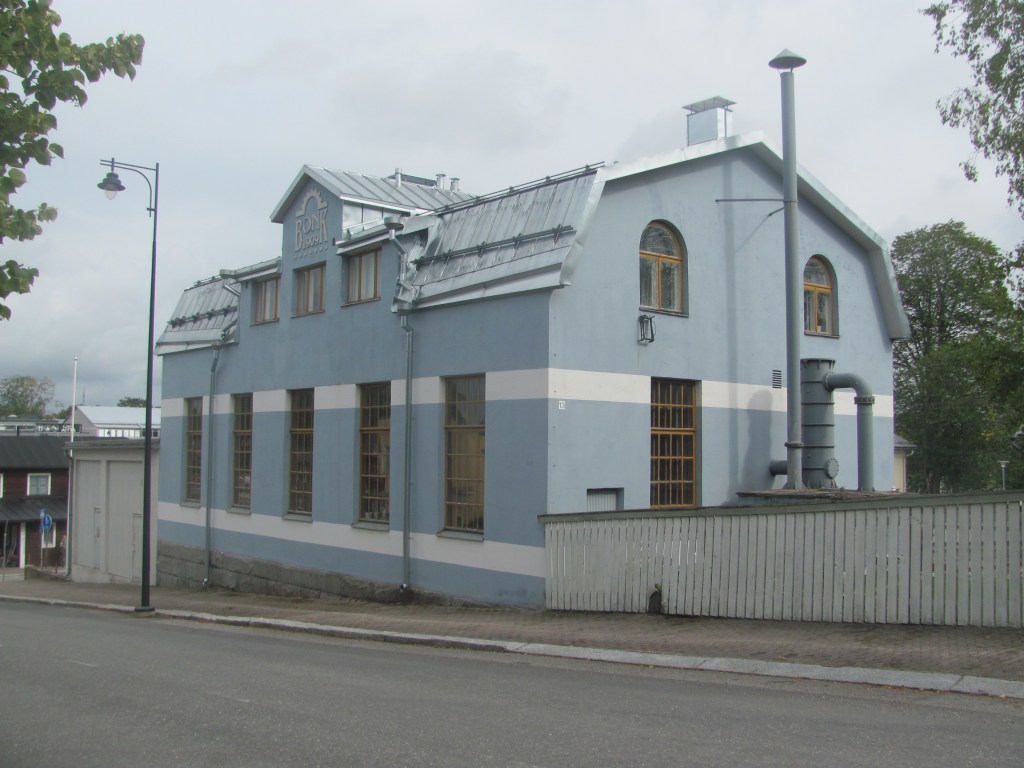
“Good idea”, I respond. “Apparently the Bonk Museum is worth a look.”

“Did you say the Bonk Museum?”, she says. “I am not sure that I want to see anything rude.”

“No, no”, I say hurriedly. “The Bonk Museum is a collection of weird and wonderful machines built by a Finn called Alvar Gullichsen. They are powered by anchovy oil. They look as if they should be really useful for something, but in fact have no purpose whatsoever. There’s a Paranormal Cannon, a Freakwave Transmuter prototype, and a Raba Hiff cosmic therapy dispenser, for example. Sort of the Finnish version of Heath Robinson, I suppose.”

We cycle into town and find the Bonk Museum. It is closed. Apparently it only opens at weekends at this time of year.

The Bonk Museum in Uusikaipunki.

“We’ll just have to give it a miss”, says the First Mate. “We can’t hang around for another five days. Anyway, this looks like one of the machines here, just by the railway. That’ll have to do. ”

One of the Bonk machines.
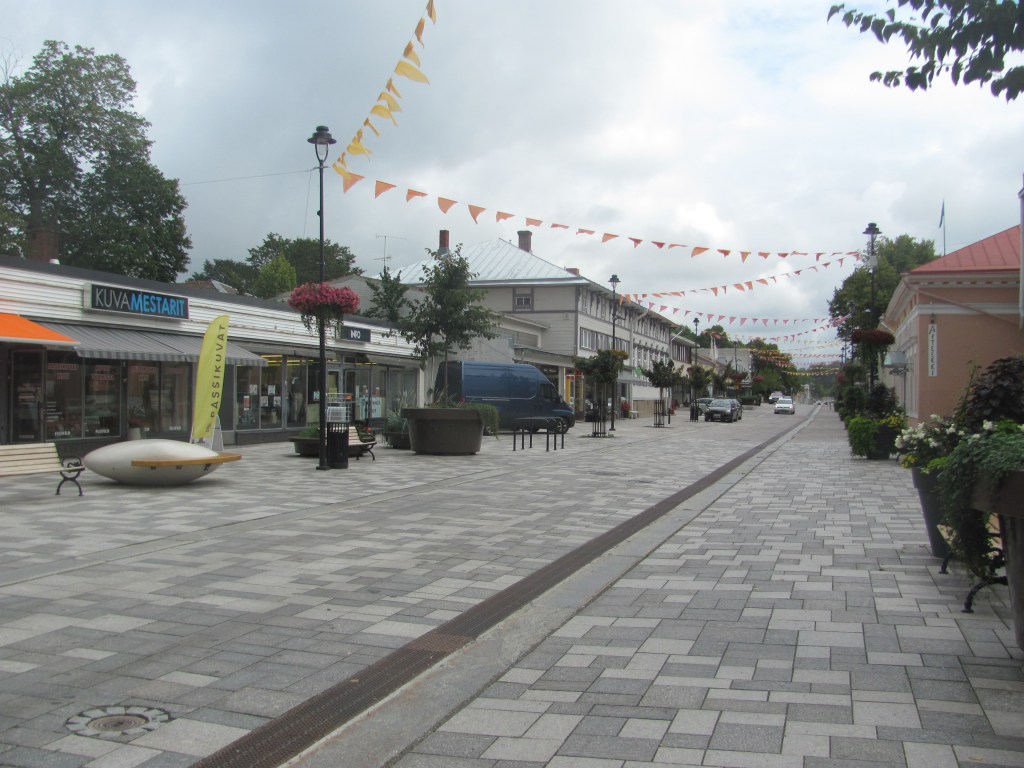
Main shopping street in Uusikaupunki.

We have lunch at a nearby restaurant, then set sail. The propeller continues to work as it should.

We arrive at Enskär island and tie up alongside at the small pier. Gavin and Catherine are already there.

Tied up in the small harbour on Enskär.

“We’ve just been talking to the harbourmaster”, says Gavin. “It’s an old pilot station, and has been in use since the 17th century. They still use it for that even now. He was on his way out to guide a large ship into Uusikaupunki. We passed it on the way. By the way, there is a grill place here just at the top of the pontoon. We could have a barbecue tonight.”

“Good idea”, I say. “We still have some charcoal left. I’ll see if I can find it.”

The pilot station on Enskär.

As I walk along the pier, I pass a young man in his early twenties tinkering with the engine of a small boat tied up alongside.

“There’s a problem with the fuel”, he explains. “It keeps cutting out. I have just come over from Uusikaupunki.”

“That’s quite a way in a small boat”, I say. “Fourteen miles or so. We have just sailed out from there.”

“I am actually from Turku in southern Finland”, he says. “But I have a job on a tall ship at the moment. You might have seen it in Uusikaupunki? I borrowed this boat to come to visit friends who are working here on Enskär. They don’t know I have come, and I have to find them.”

“Good luck”, I say, wondering why he hadn’t contacted them first.

“It’s his girlfriend”, Catherine tells us later. “She is one of the summer workers on the island. Apparently it’s her birthday today, and he wanted to surprise her.”

“Who says romance is dead?”, says the First Mate.

“He has very fine features”, says Catherine. “Almost feminine. He reminds me of that Greek god Adonis.”

“I hope he doesn’t get gored by a wild boar”, I say. “You never know what might be on this island.”

We light the fire. Before long, the charcoal is burning away merrily. Soon there is the aroma of cooking steaks and sausages.

Barbecue.

The conversation turns to the news of the day.

“Did you hear that it has been announced that Prigozhin, the Wagner boss, has been killed”, says Gavin. “Apparently, the plane that he was travelling to St Petersburg crashed. They don’t know yet if it was an accident or whether it was deliberate.”

“If you ask me, I think I know which one it was”, says the First Mate. “It’s too much of a coincidence to be an accident.”

“I am not surprised”, I say. “I was wondering how much longer he would have after that aborted march on Moscow a few weeks ago. What I don’t understand is why he didn’t see it coming. He might have been a bit safer if he had stayed in exile in Belarus, but to go back to Russia as if nothing had happened doesn’t make sense. I wonder how it will affect the war in Ukraine?”

“I don’t expect it will make much difference”, says Catherine. “After all, most of the Wagner troops have been withdrawn from Ukraine now anyway. My guess is that they’ll just be absorbed into the regular army.”

The mosquitoes have now arrived in force, and the flow of conversation is punctuated by continual slapping as we try in vain to protect ourselves from being bitten.

“Time to get back in the boat”, says the First Mate. “Unfortunately, I react badly to mosquito bites. They’ll all be swollen up by the morning.”

As we climb into bed, there is the sound of voices outside, then the noise of an outboard engine starting. I peer out of one of the windows into the darkness. In the pool of light from the single lamp of the pontoon I see Adonis saying goodbye to his Aphrodite. He roars off into the darkness, and she walks slowly back along the path to the lighthouse.

“It looks like he is heading back to Uusikaupunki”, I say. “It’s not something I would like to do at this time of night with all those rocks and reefs in the way.”

“He probably knows the area like the back of his hand”, says the First Mate.

In the morning I wake early, make myself a cup of tea, and sit on deck watching the reds and yellows as the sun peeps above the horizon to start its daily journey. The sea is calm, only the occasional lap of a wavelet as it washes over the rocks of the breakwater. I decide to go for a walk to the other side of the island before the others get up. I follow the rough track along the shoreline, passing a tiny sandy beach before turning towards the centre of the island. To my right, on the higher ground overlooking the beach, is an imposing looking house which I learn later is the old pilot house. Nowadays it is rented out to holidaymakers visiting the island.

The old pilot house on Enskär.

Rounding a corner, I am surprised to be met by a bare-footed woman in her dressing gown, picking her way carefully through the stones of the track.
“I am just going for my morning swim”, she says, almost apologetically. “I have been doing it for 30 years, every day that I have been living on this island. I live in one of the houses near the lighthouse.”

“It must be cold”, I say.

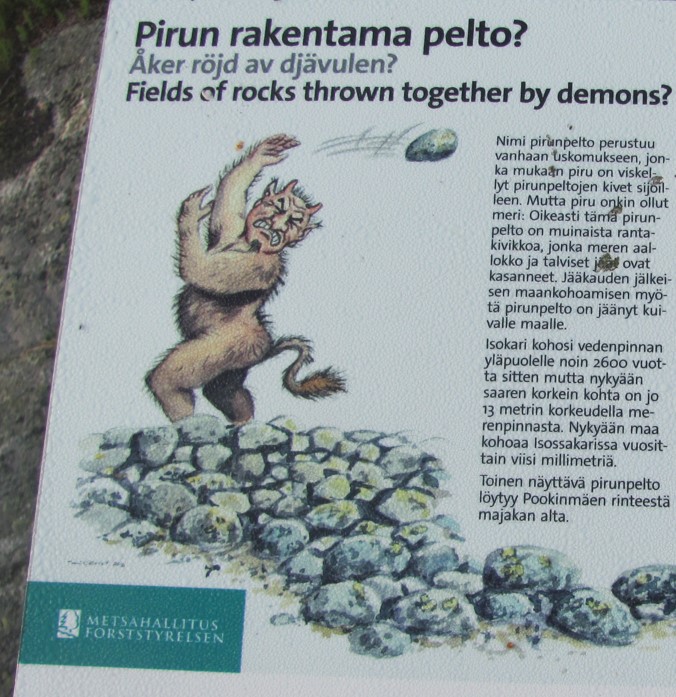
“It gets cold in the winter, that’s for sure”, she answers. “But at this time of year it is beautiful. By the way, you should have a look at the demons’ fields over there. The local people used to call them that, as they believed that the piles of rounded stones were gathered by evil spirits. In reality they were piled up by waves and ice on former beaches that have risen due to land uplift. The whole island was still under water only 2,500 years ago.”

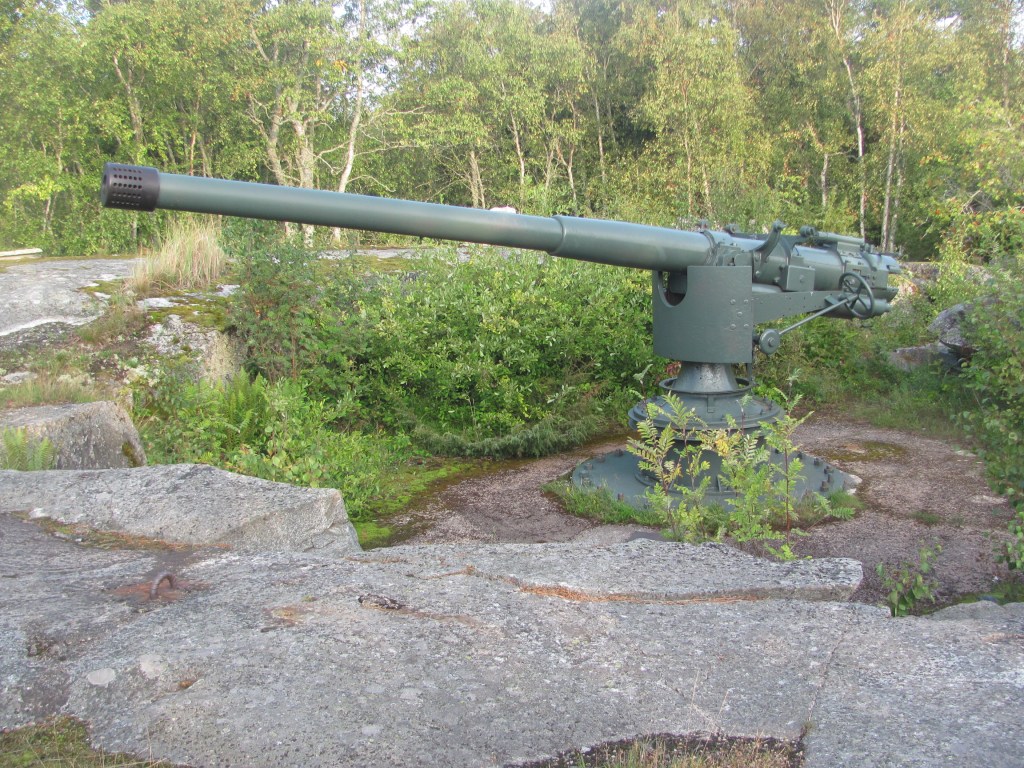
We carry on in our respective directions. Shortly after, I come across my second surprise of the morning – a gun emplacement, the barrel of the gun aimed eastwards. Not quite what one might expect on a quiet little island.

Gun emplacement on Enskär.

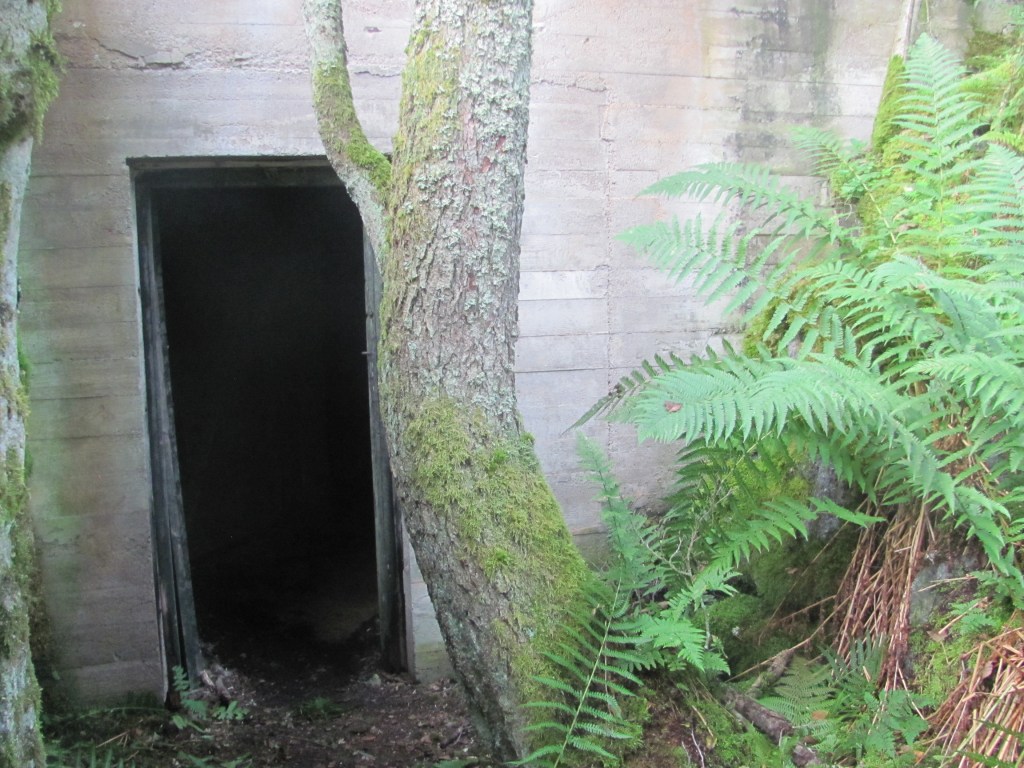
“All the civilians were cleared from the island in 1941”, a placard tells me, “and the gun and an ammunition store were built by the Finnish Defence forces to prevent enemy landings by sea. But there was no military action on the island, and the civilians were allowed back in 1945. Then in the 1970s, a watch tower was built to help direct artillery fire against enemy ships. Nowadays, the tower is used by ornithologists to spot birds on the island. You can visit all three at your own risk.”

No prizes for guessing who the enemy might be in both cases.

Ammunition store.

Eventually I reach the lighthouse, surrounded by a cluster of former lighthouse keepers’ cottages. Built by the Russians in 1838 after Finland became a Grand Duchy of the Russian Empire, it was designed to develop a new sea route independent of the Swedish ones and to project Russian power and prestige westwards, similar to the Post Office that we had seen in June at Eckerö on Åland. At nearly 50 m in height, it is the tallest lighthouse in the Gulf of Bothnia. It is still operational, but is now fully automated, and the cottages are privately owned and used as summer retreats.

The Russian lighthouse on Enskär.
Lighthouse keepers’ cottages.

“Apparently the lighthouse was nearly blown up in WW2”, says Gavin over a coffee later. “The Finns thought that it would act as a landmark for Russian bombers, so they laid explosive charges in the base. Then they realised that the debris from the explosion would probably be an even greater landmark, so it was left as it was.”

“It would be a pity if they had destroyed it”, I say. “It’s pretty impressive.”

“Did you hear Adonis leave last night?”, asks Catherine, changing the subject.

“We did”, says the First Mate. “But we wondered why he didn’t stay the night.”

“He had to get back to work in the morning”, says Catherine. “I was talking to his girlfriend this morning. She was the one that collected our marina fees. She was overjoyed to see him, but rather distraught that he couldn’t stay. Ah, young love!”

We return to Ruby Tuesday and prepare to leave.

“Do you realise just how much of your blog is about the Russians?”, says Spencer to me as I roll up the side panels.

“They certainly had a major influence in the Baltic”, I answer. “And on Finland in particular. It must be difficult to live next to a large, powerful, often hostile, neighbour.”

“You know, I read something interesting about them the other day”, he says. “Of course, we all know that they have a tradition of autocratic rulers – Peter the Great, Catherine the Great, Lenin, Stalin, and now Putin – and they seem to have the mindset that politics is best left to these rulers. But I read also that some of their autocratic leanings are because Russians see themselves as the only true keepers of Christian traditions.”

“You mean the Russian Orthodox Church?”, I ask.

“Yes”, says Spencer. “The first capital of Christianity was Rome, right? But around 330 AD, Constantine abandoned Rome and moved his capital to the newly-built city of Constantinople. That became the ‘Second Rome’. In the Byzantine Empire which followed, church and empire became so inextricably entwined that people couldn’t imagine Christianity without an emperor. That state of affairs lasted more than 1000 years, but Constantinople fell to the Turks in 1453. The Christian traditions practised there survived in the Russian Orthodox Church which adopted Moscow as its centre. Moscow was subsequently promoted as the ‘Third Rome’.”
“And Russia has the sacred mission of preserving Christianity on Earth, I suppose?”, I say.

“Correct”, says Spencer. “That’s why they are quite comfortable with autocracy. Russians see their leaders as divinely chosen by God and charged with keeping the Christian flame burning. Unlike in Western Europe, in Russia any independent thinking, religious or otherwise, was condemned. It also explains why the Russian Orthodox Church is so supportive of the war in Ukraine.”

“Preventing an Orthodox neighbour from falling into the hands of the evil, heretical West”, I say. “It certainly explains a lot.”

The First Mate appears at the companionway.

“Come on”, she calls out. “That’s enough talking to that spider. We need to sail on to the Ålands. The others have already left.”