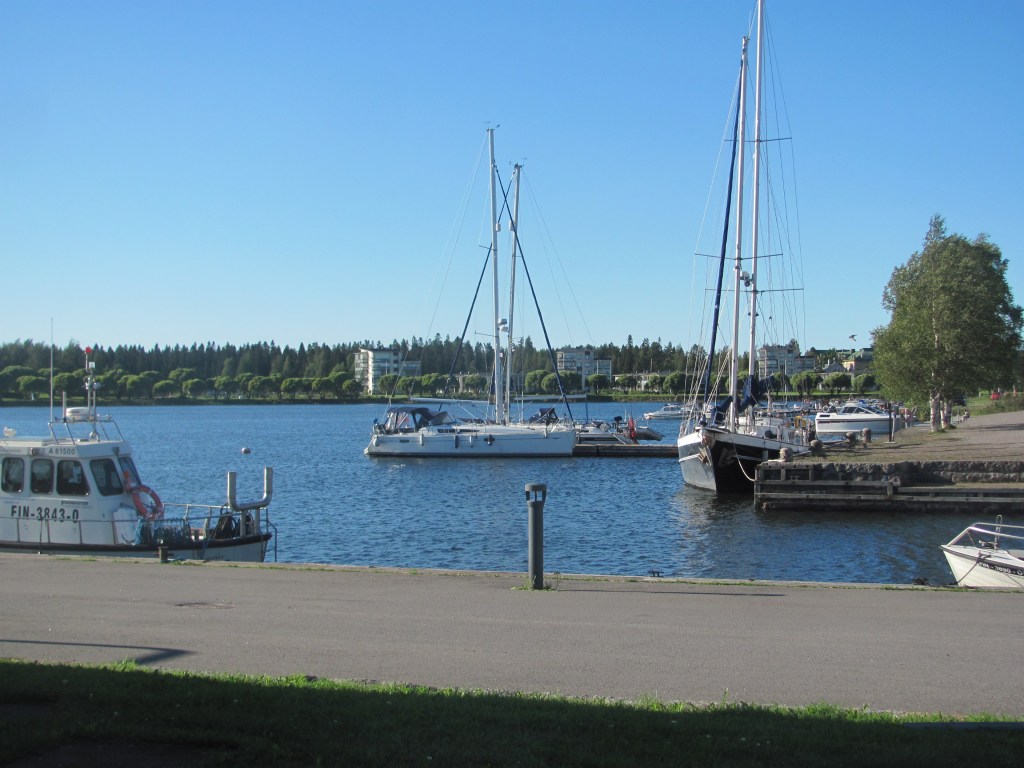
A lost cat, ships in the night, and a UNESCO World Heritage town

I awake in the early morning and lie listening to the lapping of the water against the hull. The wind seems to have gone round to the west, I think, and is driving small wavelets across the bay. I pull on my clothes and struggle on deck, rubbing the sleep from my eyes. Early morning mist arises from the water; the golden glow of the sun catches the mast, giving the fluttering flags an intensity of colour. There is no sign of life on the jetty or the town, everyone is still asleep.
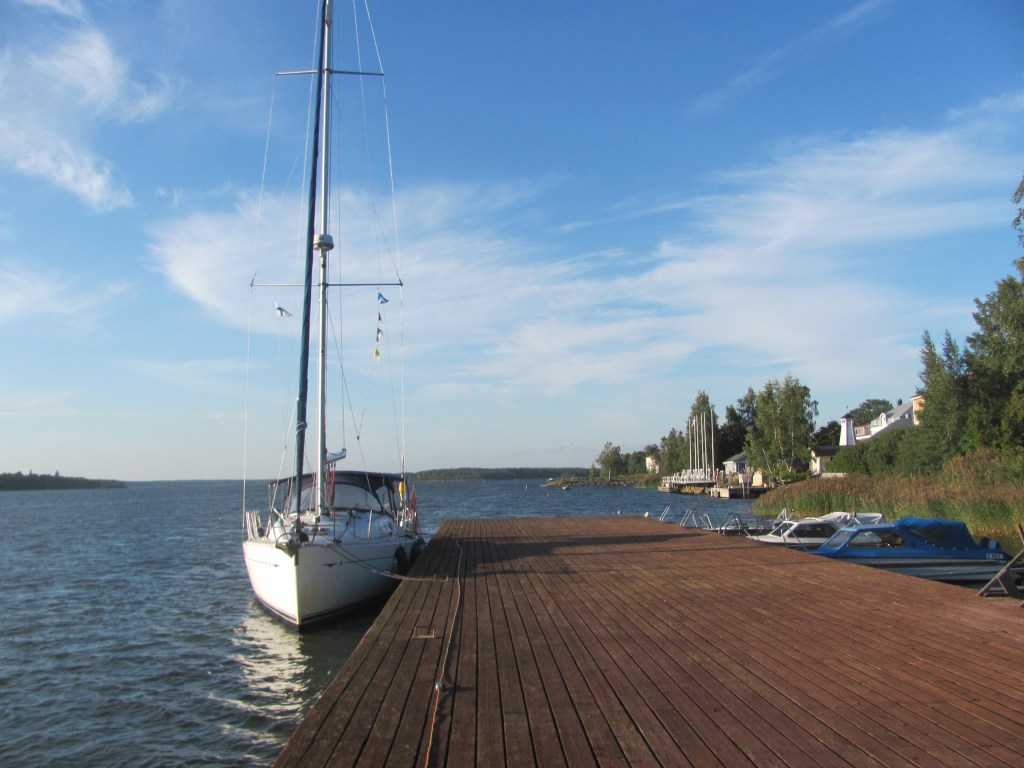
All quiet in Kaskinen.

We are in the harbour of the small town of Kaskinen, having arrived the night before after a lumpy sail down from Vaasa. The wind had been against us and we had had to take long tacks out to sea and back again to make any progress. We had managed it, but had arrived tired and hungry and had tied up at the newly built wooden jetty. A brief recce around the town had been unsuccessful in finding a place to eat, with the sole exception of a mobile takeaway van in the main square in front of the harbour. It was a Monday, and everywhere else was closed. We had bought a pack of fries and had taken it back to the boat to have with the leftovers from the previous day.

I decide to go for a walk and explore.

Kaskinen was founded in 1785, and was a planned town with all the streets laid out in a grid pattern. There were grand ambitions for it in the early days, and it was expected to grow into a bustling and wealthy port town centred around the import and export of tar and timber. But it never really took off, partly because it was on an island and bridges to the mainland took a long time to build, and partly because it was eclipsed by the larger nearby towns of Vaasa and Kristinestad.

Nevertheless, its old wooden houses give a quirky charm to it.

Kaskinen wooden house.

The apothecary is imposing. One wonders why a tower was necessary to dispense medicines.
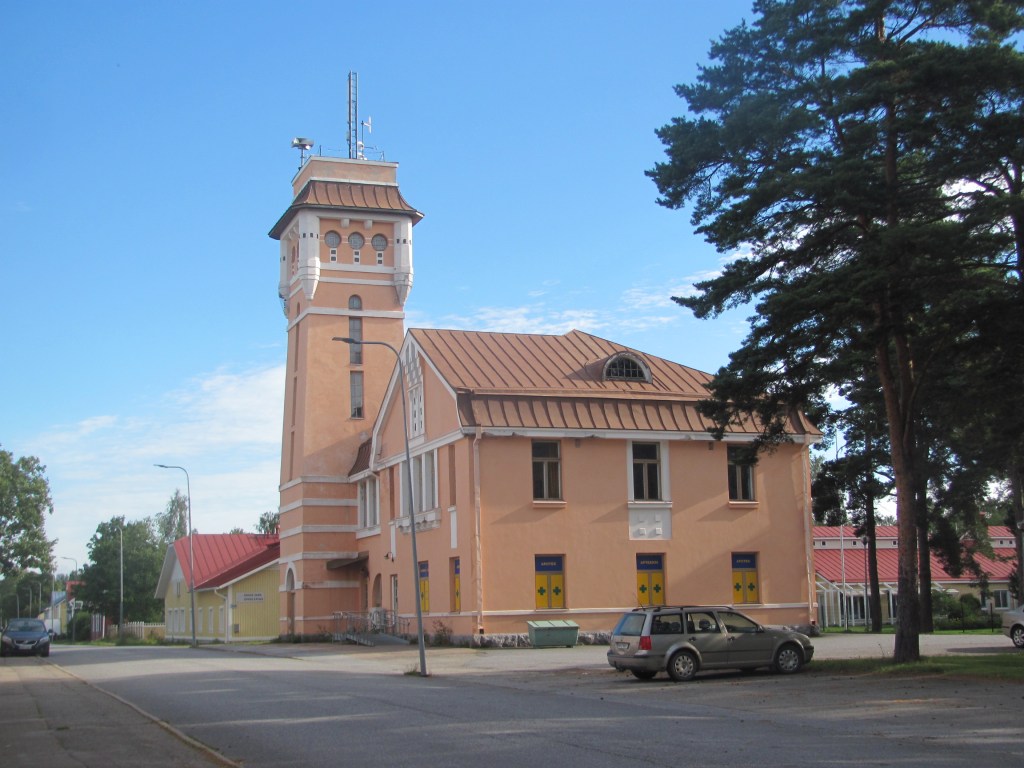
Kaskinen apothecary.

When I get back, there is consternation on the quay.

“We’ve lost our cat”, wails the woman from the boat in front of us. “She wanted to go out, so we let her, and now she has disappeared. She has a GPS tracker around her collar, and it is showing that she is somewhere around your friend’s boat, but they have searched the boat for her and can’t find her. The only other place nearby is under the quay decking, but there is no way for us to get under there, so we will just have to wait for her to come out by herself.”

I have a mosey around the quay making meowing noises, but she is right – there is no way anyone could squeeze underneath and look for a cat, let alone rescue it.

“That’s the problem with having a cat on the boat”, moans the woman’s husband. “They dictate when we are going to leave rather than the winds, as with other sailors.”

“There was a similar occurrence when we were on Junkön near Lulëa”, says Gavin to us later. “We all had to get out and look for a lost cat, but it never turned up before we left. I can’t understand why people take their cats with them. It’s not fair on the cats.”

By the time we leave, the cat still hasn’t been found. There is nothing we can do except offer our condolences and hopes that it might still turn up. We cast off and head south.

The wind is on our nose from the southeast and blowing around 18 knots with gusts up to 26 knots. The sea is also rough, being whipped up by several days of southerly winds. We take a long tack close-hauled out to sea, then back in again. It’s an uncomfortable passage.
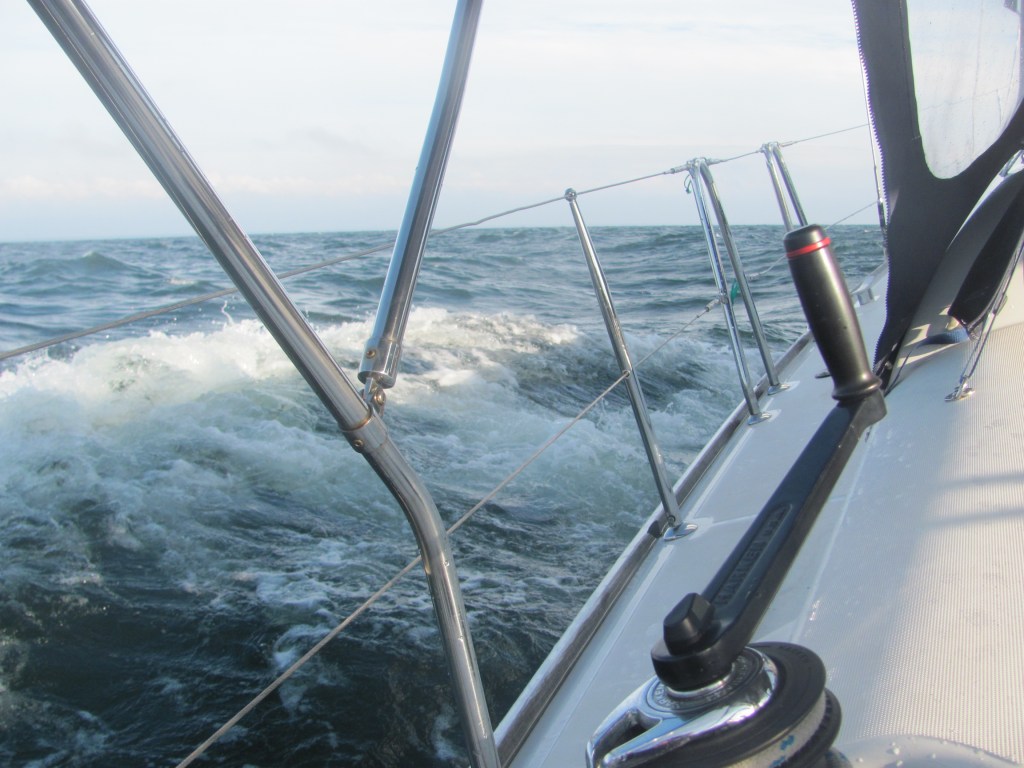
Tough going.

Eventually we reach the relatively sheltered waters of the approach to Kristiinankaupunki, and follow the marker buoys along a narrow channel not much more than two boat-widths wide, past the old harbour building, until we come to a road bridge. There is a marina to the right and to the left.
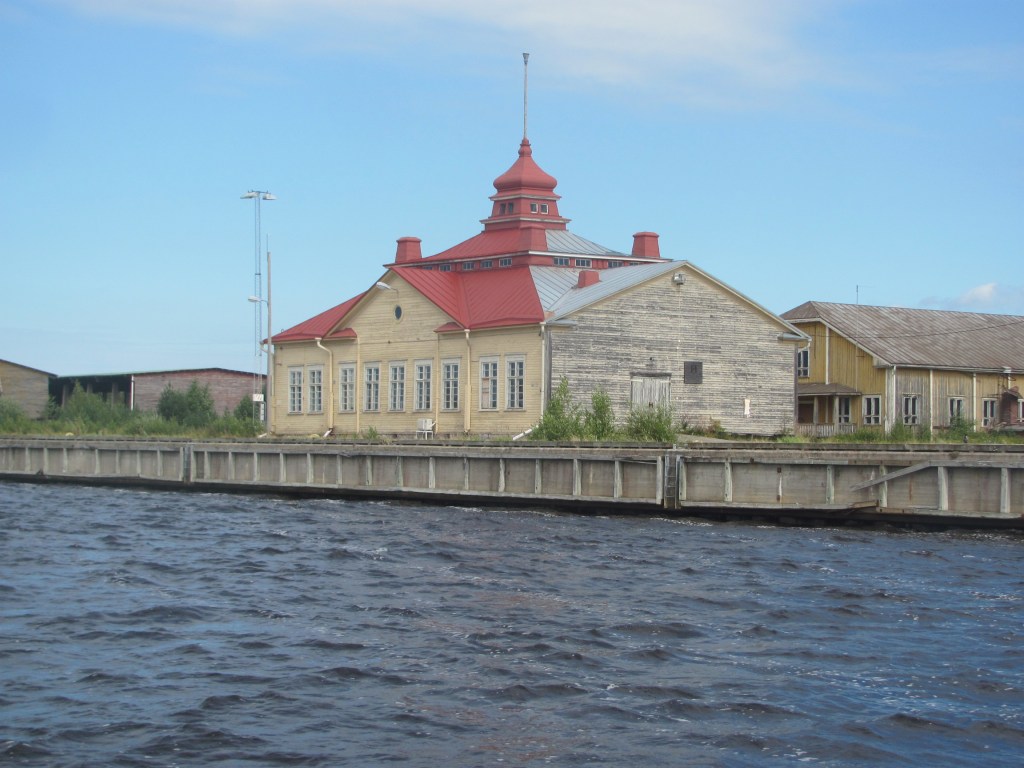
Coming into Kristiianankaupunki.

“We’ve just had a look at the marina on the right”, calls Gavin on the VHF. “There seems to be some construction work going on there. I suggest we go to the town quay on the left. There are limited facilities, but it has the advantage of being closer to the town centre than the other one.”

We tie up in the town quay. A man walking his dog along the jetty gives us a hand.

“Kristiinankaupunki is named after Queen Christiana of Sweden”, he tells us. “Kaupunki means city in Finnish. It is one of the towns founded by Per Brahe, like Raahe, back in the 1600s when this part was ruled by the Swedish. Its Swedish name is Kristinestad.”

Tied up at Kristiinankaipunki town quay.

After a cup of tea we go ashore to explore.

The town hall lies at the end of a stately avenue of trees.

Kristiinankaupunki town hall.

“Come and look at this old water well”, calls the First Mate. “The wheel still goes round. Perhaps it still pumps water.”

It doesn’t.

Town well.

A little bit further on is the Ulrika Eleonora church.

“The church was built in 1700 after the first one was burnt down a few years earlier”, the guidebook tells us. “It was named after the Queen Dowager of the time. Due to construction mistakes, the tower leans to the south. The story is that it is because the Russians tried to pull it down when they occupied it in the early 1700s, but weren’t successful.“

“The Russians don’t seem to be very popular”, says the First Mate. “Did you see the tiles on the roof? They are made of wood.”
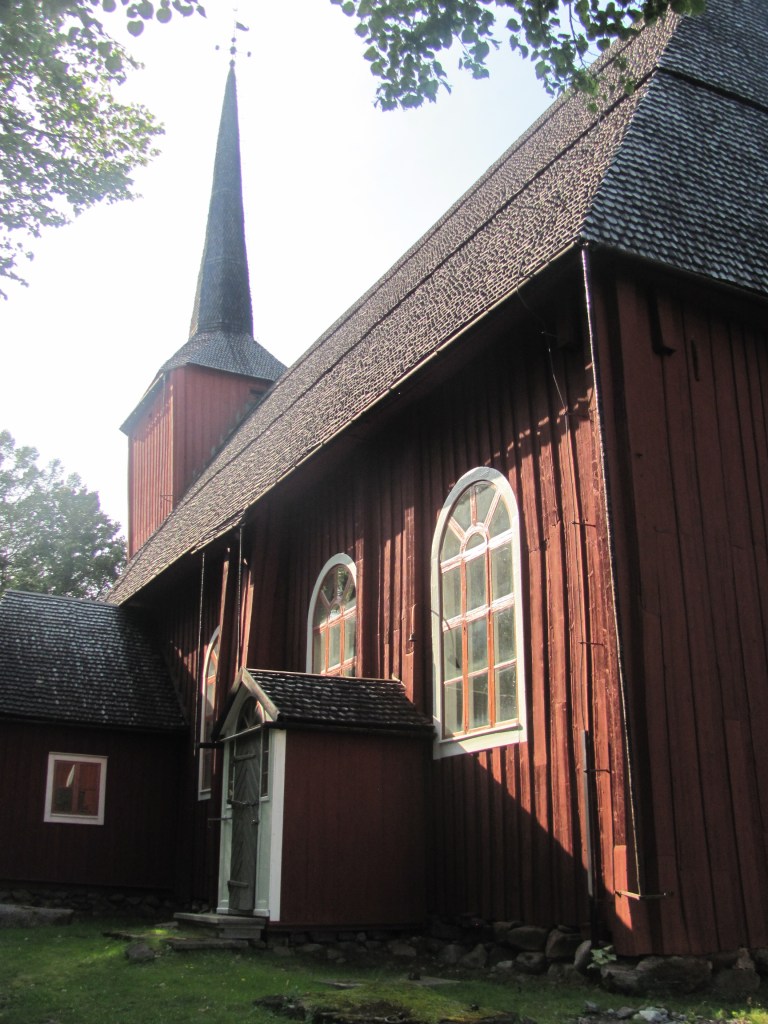
Ulrika Eleonora church in Kristiinankaupunki.

On the way back to the boat, we see a Cittaslow sign.

“Ah, yes, I read about this”, says the First Mate. “Apparently the Cittaslow movement started in Italy in 1999 with the aim of slowing down the pace of city life. It focused on food quality at first, but extended to improve the general quality of city life through the use of space, reducing traffic flow, and opposing cultural standardisation. Kristiinankaupunki was the first Cittaslow town in Finland.”

“That explains the lack of traffic in the streets”, I say. “I thought it was quiet.”

Taking it easy.

Gavin and Catherine come over for a drink later in the evening. It’s starting to get dark earlier now that the summer is waning and we are sailing southwards.

“There’s a boat coming in”, says the First Mate suddenly, pointing. “You can see its lights, but not the boat itself.”

Sure enough, the red port side navigation light is visible in the darkness, moving slowly towards the marina. Suddenly it stops.

“I think that he might have gone aground”, says Gavin. “He looks too close to us to still be in the channel. The problem is that the marker buoys aren’t lit at night, so they are almost impossible to see. And he may not be aware that there two marinas. Perhaps we should try and contact him.”

I fetch the hand-held VHF radio from the cabin.

“The name of the boat is Celinda”, says Catherine. “I have just found it on MarineTraffic.”

I try to call Celinda several times, but there is no response.

“Perhaps we can signal to him with a torch”, says Gavin. “We could try and guide him in.”

The First Mate fetches our torch from the cabin.

“I think he is moving again”, says Catherine. “He must have managed to get back into the channel.”

Gavin goes ashore with the torch and waves it up and down. Sure enough, the boat slowly starts to move along the channel, and turns to come towards us. At last we can see the boat in the lights of the harbour. A woman is standing on the bow with ropes in her hands.

“Thanks so much for your help”, she says gratefully. “We missed the channel somehow and got stuck in the mud. The other marina didn’t look very inviting with all the construction work, and we didn’t realise that you could tie up at the town quay.”

We continue our journey southward the next morning. The wind is almost direct from behind, and there is not much of it. With both sails out in the conventional manner, the genoa flaps uselessly in the wind shadow of the mainsail. We manage a majestic two knots.

“We’ll never get there at this rate”, complains the First Mate. “Look! Saluté is heading off out to sea. Perhaps we should do that.”

Sure enough, Saluté is deviating from the direct route to try and get a better angle on the wind. The AIS shows she is managing five knots, but she will need to gybe back in again at some stage and will travel much more distance.
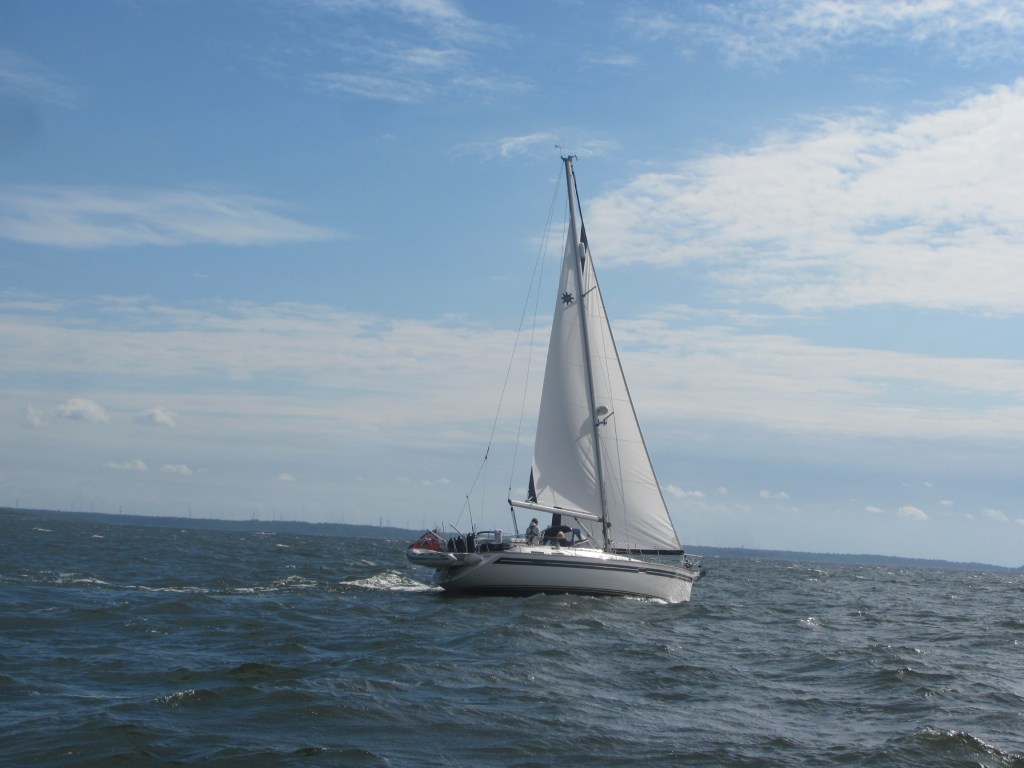
Salute heads out to sea.

“We can pole out the genoa and goosewing”, I say. “They don’t have a pole, so they can’t do that.”

I rig a preventer on the mainsail to stop it from accidentally gybing, then pole out the genoa to windward. The wind catches both sails now and drives Ruby Tuesday forward at a respectable 4½ knots. What’s more, we can maintain the direct course easily, so have less distance to cover.
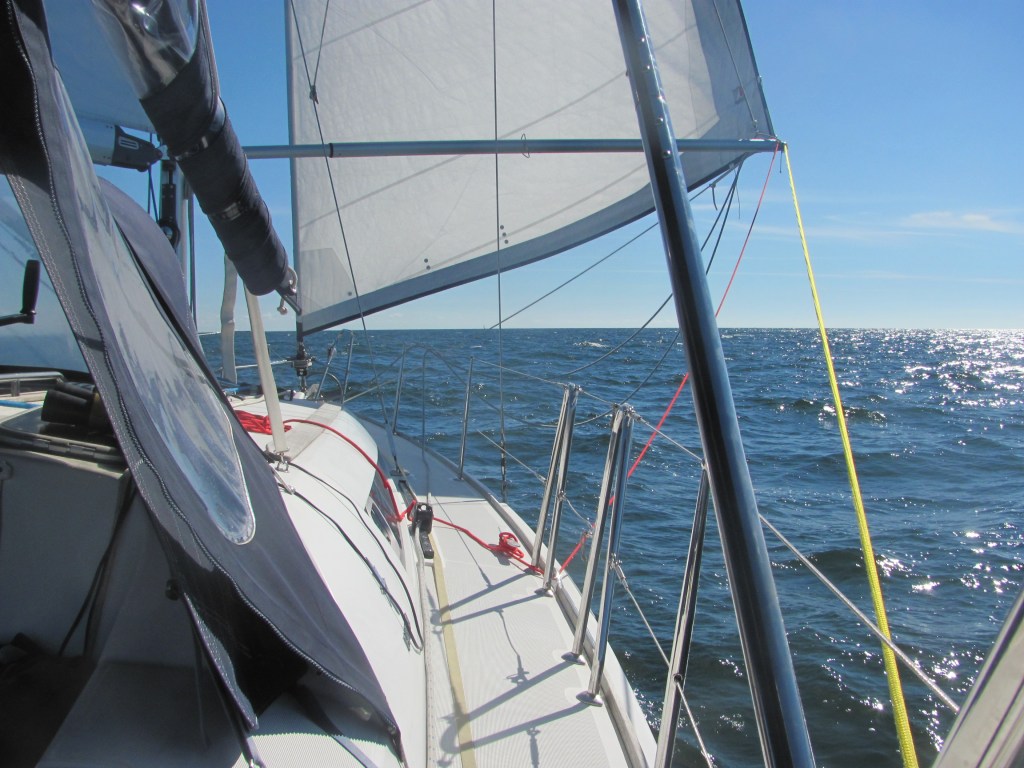
Goosewinging our way to Rauma.

We eventually reach Rauma. Saluté has come back in from out at sea and ends up just in front of us, the same distance as when we set off in the morning. We tie up in the large Syväraumanlahti marina to the west of the town.

“We thought you had had enough of Finland, and had decided to head back to Sweden”, we joke with Saluté over a coffee.

“I couldn’t work out at first how you managed to sail directly downwind and still make a good speed”, says Gavin. “Then I realised that you must have poled out your genoa.”

“It was amazing how the different strategies ended up with the boats in the same relative positions after a whole day’s sailing”, says Catherine. “Almost to the metre.”

In the morning, we unload the bikes and cycle into town.

Although a Franciscan monastery and Catholic church had existed from earlier times, Rauma only became a town in 1442. Its prosperity came from its maritime activities, but it is also famous for its lace-making and paper industries. Latterly, it has been designated a UNESCO World Heritage site for its exquisite old wooden buildings in the town centre. Like many of the other wooden towns along the Finnish coast, the town was burnt down and rebuilt several times. The present old town dates back to the 17th century.

Wooden houses in Rauma.

“Look at these wooden sculptures in the stream”, says Catherine, as we come to the town centre. “Three women looking apprehensively at the frog prince. That’s original.”
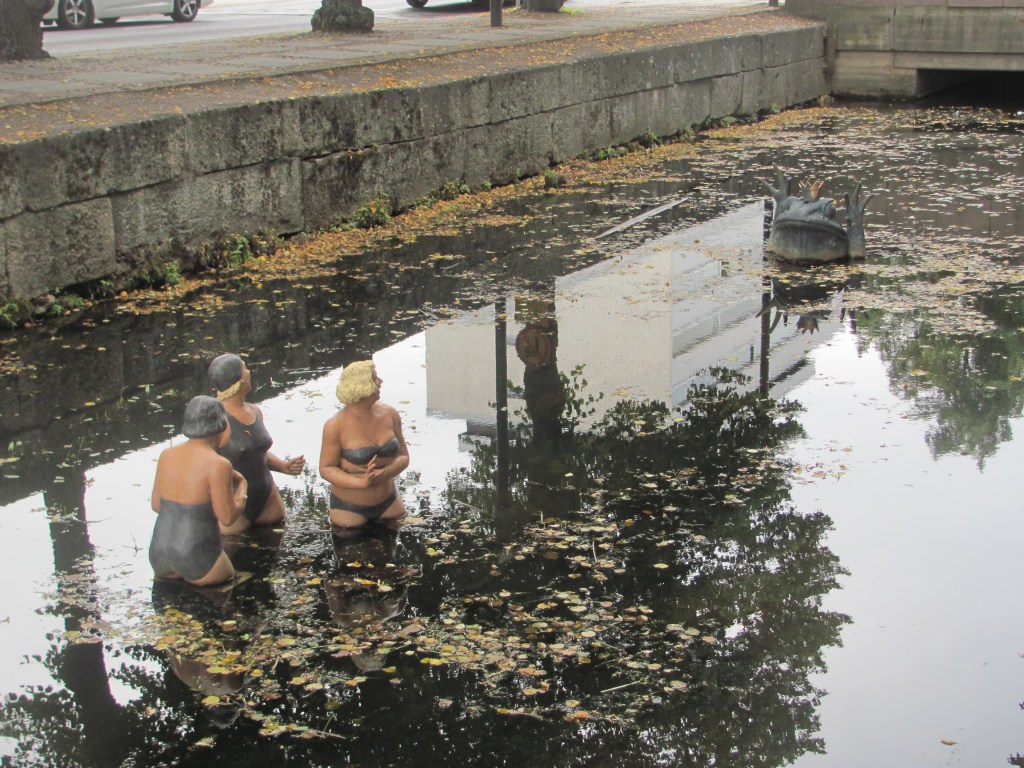
Three women looking at the Frog Prince.

We learn later that it is the work of Kerttu Horila, a sculptor who lives in Rauma, and who has made several figures which are dotted around the town.

“You can see the maritime influence on the town”, says Gavin. “Look, even the Catholic church has a model ship hanging in the entrance, just like the Gavle churches that we saw in Sweden.”
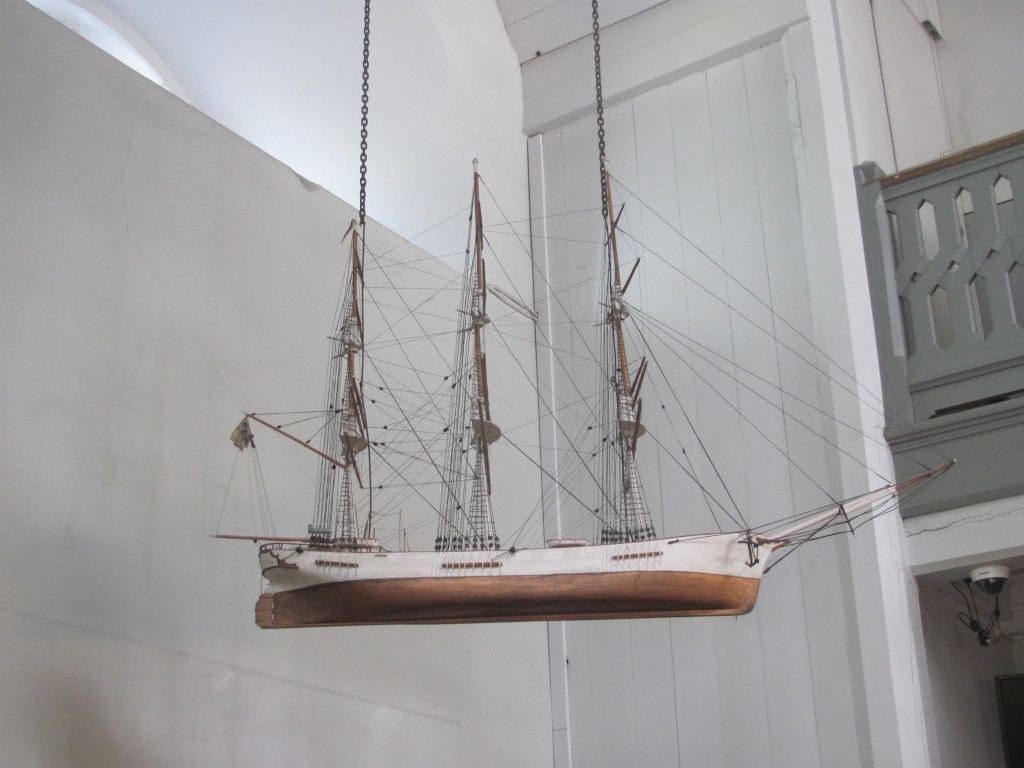
Model ship hanging in the Church of the Holy Cross in Rauma.

“I’m getting a bit peckish”, I say. “Let’s find somewhere to have lunch.”

As we walk back to the market place, an open top American car passes us.
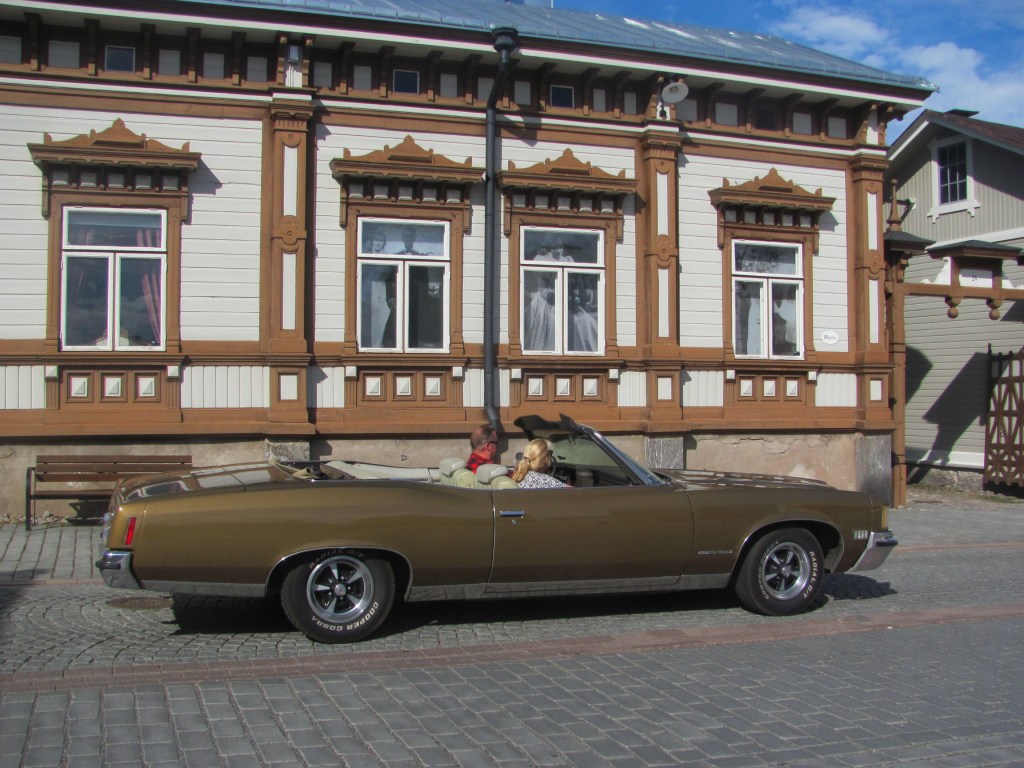
Nostalgia.

“They certainly love their old cars”, says the First Mate. “I have seen several like that around.”

We find a restaurant near the town centre and peruse the menu.

“I can recommend the lapskoussi”, says the waitress. “It’s a traditional Finnish sailors’ dish. It doesn’t look anything special, but it tastes delicious.”

Four identical plates of lapskoussi arrive. It turns out to be a mixture of beef, potatoes, onions, carrots, and various other vegetables, all boiled and mashed together with different spices added, and served with melted butter on top. Sure enough, it doesn’t look particularly exciting.

Tucking into the lapskoussi.

“Well, that was certainly delicious”, says the First Mate, folding her knife and fork and sitting back contentedly. “And also very filling. We definitely won’t need to cook any dinner tonight.”

We decide to split up and explore different parts of the town, and meet up later. The First Mate and I end up at the Maritime Museum.

“Do you want to have a go on the simulator?”, asks the museum attendant in one of the rooms. “You can pretend you are the skipper of a fishing trawler coming back home to Rauma harbour after a successful fishing trip.”

I take the steering wheel.

“I’ll put the throttle on medium speed”, she says. “You don’t want it too fast, especially coming into a harbour.”
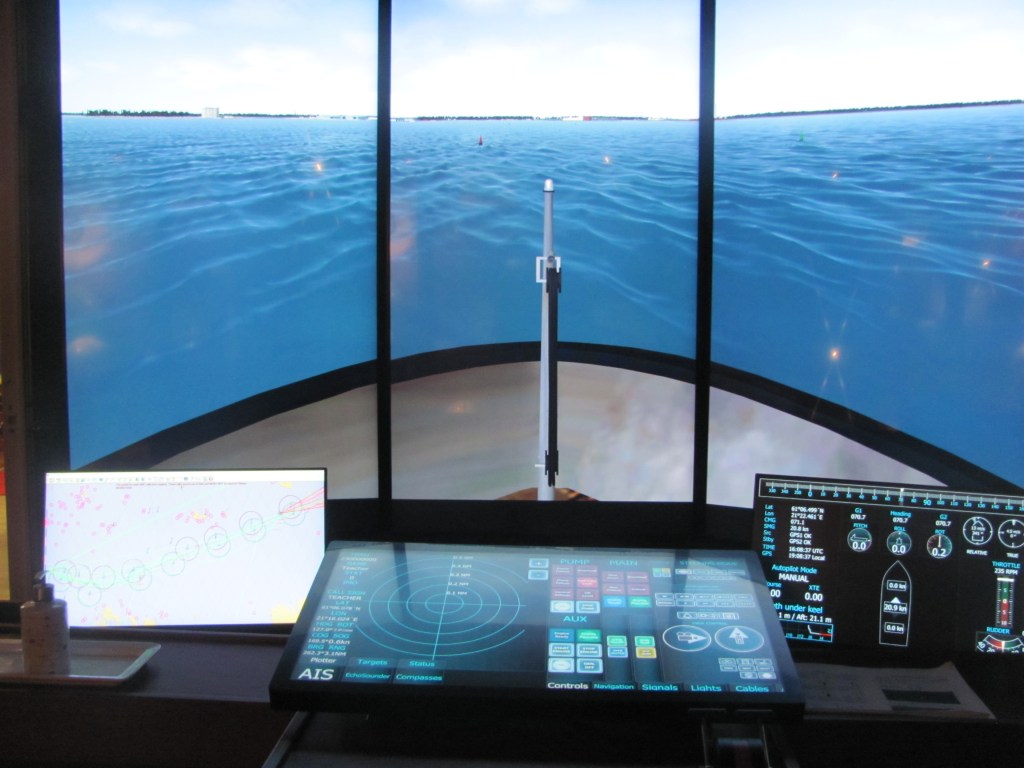
Practising for the real thing.

It is a lot slower to respond than Ruby Tuesday, and nothing seems to happen at first when I rotate the wheel. Then the boat begins to turn faster and faster. I rotate the wheel in the other direction, but again it takes some time to respond, then it turns faster and faster in the other direction. Eventually, I learn to anticipate what the boat will do in a half a minute or so, and manage to control the yo-yoing from side to side enough to enter the harbour without hitting anything.

“You’re pretty good”, says the attendant. “It’s almost as if you have done it before.”

“I have”, I answer. “I did it yesterday in our boat. We are sailing around the Baltic and are here for a couple of days.”

In the next room, I read of the Finnish seamen who were interned in Britain during WW2. Because Finland had decided to fight on the side of Germany against Russia, Britain had declared war on Finland in 1941, so any Finnish crew on ships were considered the enemy and were rounded up and interned on the Isle of Man. It seems they were a rowdy lot, and fights broke out between those that supported Finland and Germany, and those who supported Britain and the Allies. When stabbings started, the authorities had to separate them into two camps. Several of the pro-British Finns joined the British merchant navy.

A little known piece of wartime history that I had been totally unaware of.

“Here’s an interesting view of the World”, says the First Mate as we leave. “The Finnish view.”
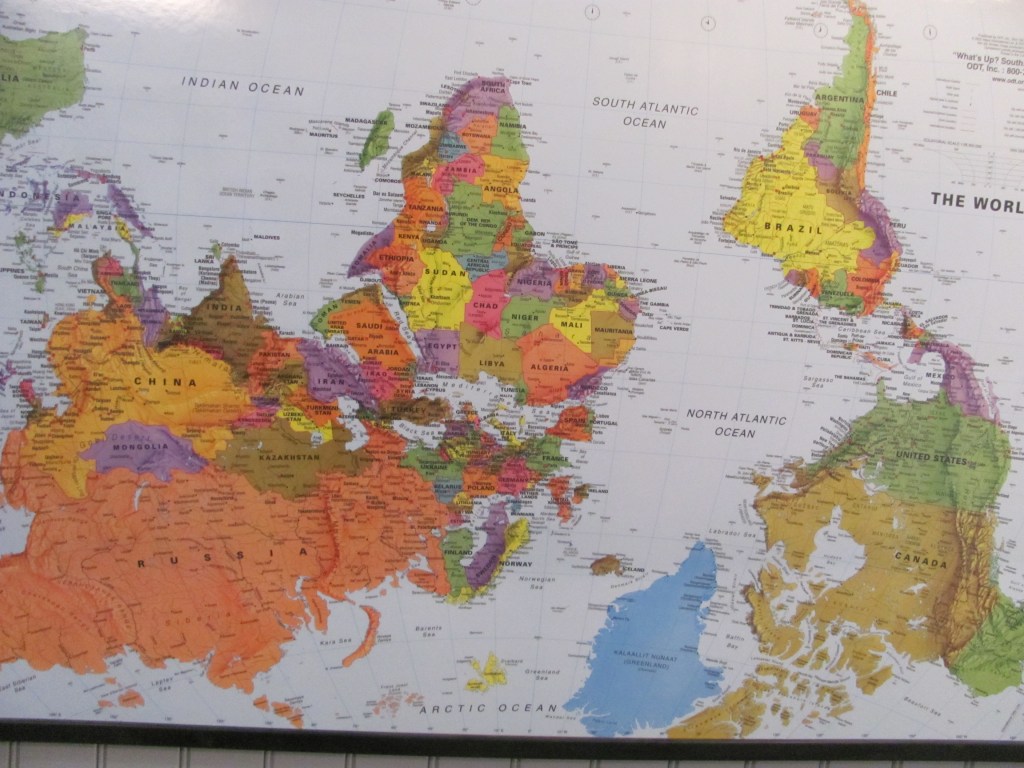
Finnish view of the world.

Next up is Marela, the home of the wealthy ship-owning Granlund family in the centre of town.

“Wow!”, says the First Mate. “The rich certainly knew how to live.”

Dining room at Marela museum.

We meet Gavin and Catherine for a coffee.

“Apparently you can get a good view out over the town from the tower on the hill”, says Gavin. “We can cycle over there.”

We puff our way to the top of the hill. The tower is closed for the winter.

“What a bummer”, says Gavin. “Everything closes so early here.”

“It’s because a lot of the places are staffed by volunteer university students”, says a woman passing. “Now they have all gone back to university, so they have to close them.”

On the way back down again, we notice an intriguing sculpture of doves escaping a series of concentric rings.

Memorial to the Karelian refugees.

It is a memorial to those that had to flee the Karelian region in the Continuation War, says the plaque underneath. When the Russians invaded Finland in WW2, thousands of people living in that part of the country had to be evacuated and were resettled in other parts of Finland, as they didn’t want to live under Russian rule.

“I can understand how they must have felt”, says the First Mate. “My mother also had to flee their home in East Prussia at the end of WW2 to escape the advance of the Russians. She was only eleven years old at the time.”

“They were tough times”, I say.
A captured British gunboat, the Kvarken archipelago, and a cool city

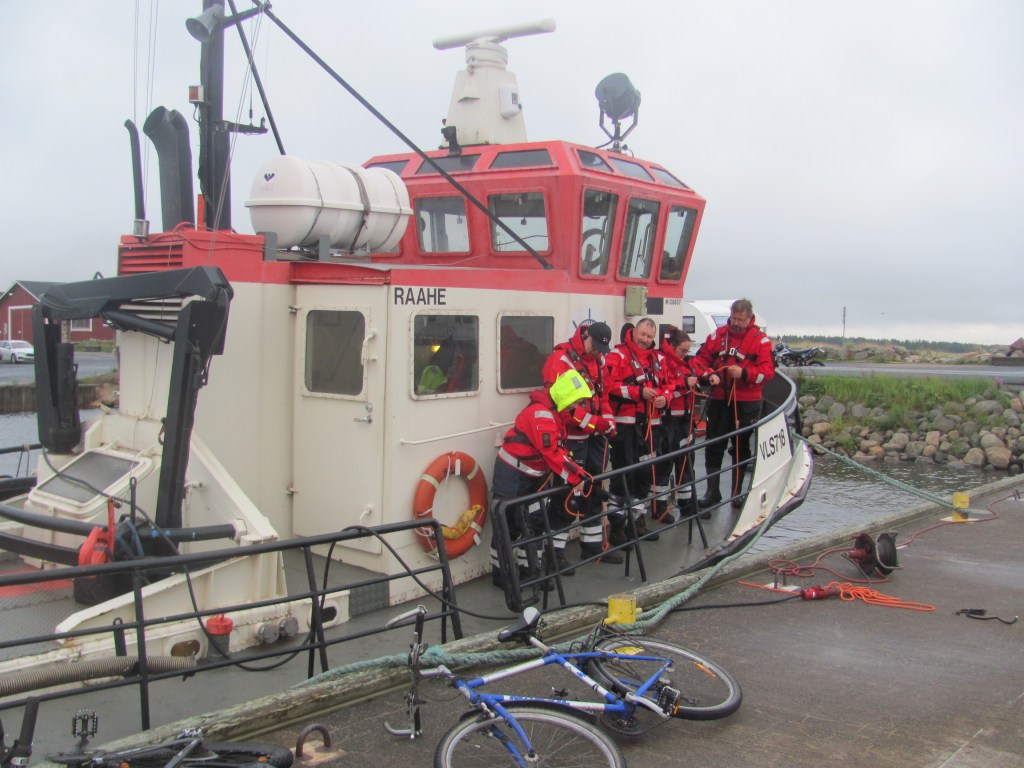
“It seems that they get their lifeboats second-hand from the RNLI in Britain”, says the First Mate.

We are in the small harbour of Marjaniemi island watching a group of Search and Rescue (SAR) trainees being put through their paces by their instructor. The lesson of the moment is on knots, and they are learning how to do a bowline.

“I thought that those boats looked familiar”, I say.

Learning the ropes.

In the morning, we find that Gavin and Catherine have arrived in their boat Saluté and tied up next to us. We had left them in Luleå in the north several days earlier as they had had a friend joining them for a few days’ sailing. They had then sailed through the night, arriving at 0200 in the morning to re-join us.

“We were as quiet as we could be tying up”, says Catherine. “We didn’t want to wake you.”

“It was a beautiful night sail”, says Gavin. “It was a clear sky, the sea was calm, the moon was out, and it all looked ethereal. It never really got totally dark. The only problem was that not all of the buoys on the approach to Marjaniemi were lit, so it was a bit tricky trying to locate the channel. I was worried that we might go aground on a few occasions, but we managed it.”

It’s nice to see them again, and we are looking forward to their company on the long trip back down south.

Unfortunately, strong southerly winds are forecast for the next few days. Ideally, we would sit them out, but we need to make progress southwards again, so we decide to take them full on and tack. With winds gusting up to 26 knots, it’s boisterous, to say the least. We arrive in Raahe exhausted, and tie up in front of the town museum.

“Phew, that was tough”, says the First Mate. “I hope that we don’t have too many sails like that.”

Tied up in the centre of Raahe.

“Raahe was founded by Per Brahe in 1649”, the girl in the museum tells us the next day. “It’s named after him. He was the Governor-General of Finland when it was under Swedish rule back in the 1600s. He did a lot of good things for Finland, like introducing a postal system, promoting education, developing agriculture, and reforming the administrative system. He also founded several other towns besides Raahe, and even has an asteroid named after him.”

“Quite a legacy”, says Gavin.

Statue of Per Brahe in Raahe.

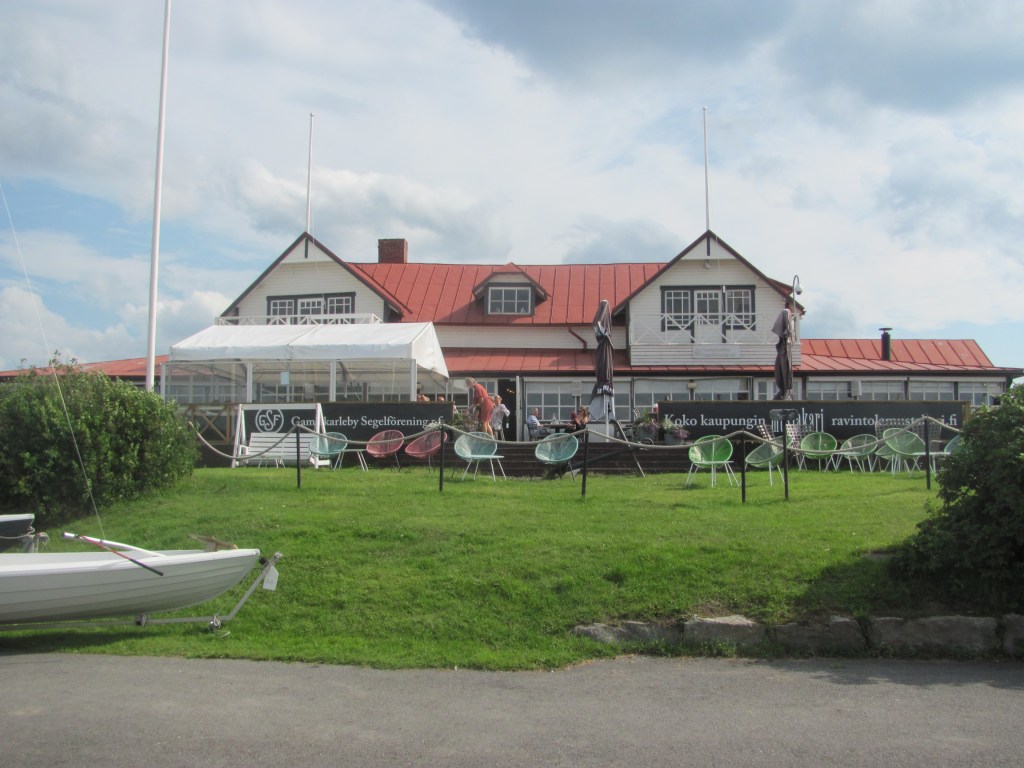
The strong southerlies continue. We battle our way down to Kokkola, the next town. The harbour guide recommends that we stay in the marina of Gamlakarleby Segelförening, the oldest sailing club in the Gulf of Bothnia.

The imposing Gamlakarleby Segelförening clubhouse in Kokkola.

As we tie up, we get talking to one of the club members.

“There’s some British naval history you should see while you are in Kokkola”, he says. “During the Crimean War, there was a bit of a scrap between the British and the Finns in 1854, who were part of the Russian Empire at that time. One of the British gunboats was captured.”

“Ah, yes”, I say. “We have already seen the Russian Fortress at Bomarsund that was destroyed by the French and British ships during the Crimean War. What happened here?”
“Well, the British Navy were carrying our raids on towns up and down the coast along here”, he answers. “Normally they met with very little resistance, but at Kokkola there was quite a large Russian-Finnish contingent of troops who ambushed the British as they sent some landing craft full of their own troops ashore to raid the town. One of the gunboats and several of the British soldiers were captured. Some even died in the fight and are buried here in the town cemetery. It’s referred to as the ‘Skirmish of Halkokari’. You can still see the boat that they captured as you cycle into town. It’s worth a look.”

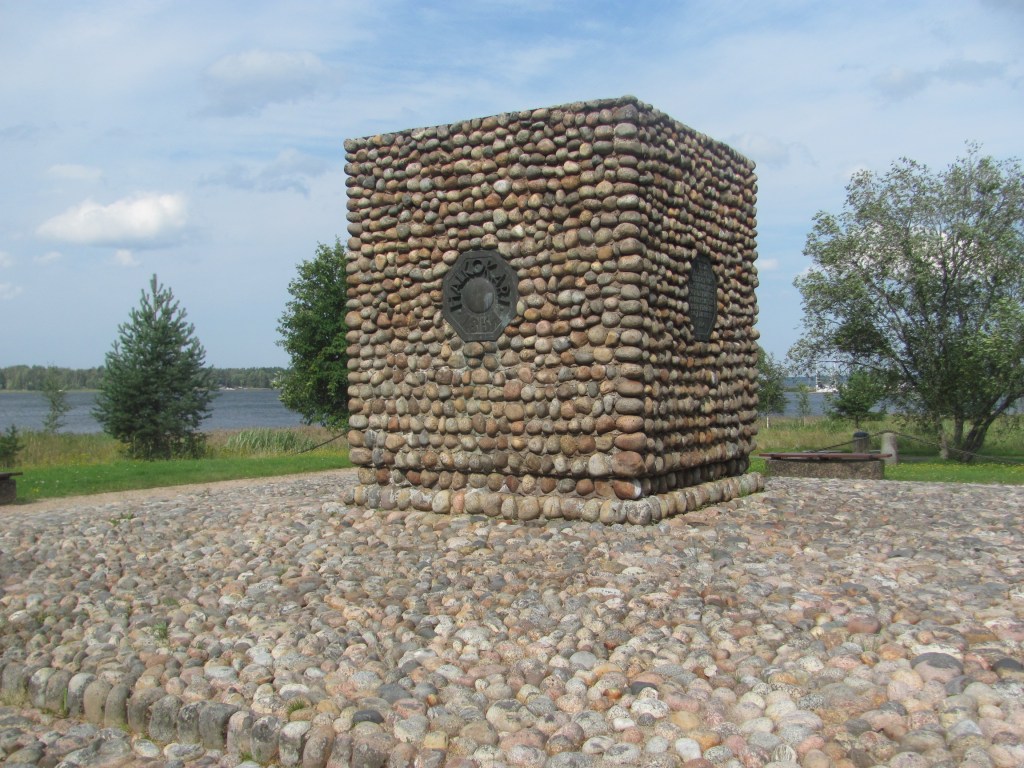
In the morning, we cycle into Kokkola. On the way we pass the monument to the ‘Skirmish of Halkokari’.

Monument to the ‘Skirmish of Halkokari’.

Further on, we come across the ‘English Boat’.

The ‘English Boat’ captured by the Finns in 1854.

“Apparently the British Government still makes a small contribution to Kokkola to maintain the graves of the soldiers who died here”, says Gavin over lunch. “They’ve even asked for their boat back, but the Finnish have refused.”

“It’s amazing to think that the Crimean War was even being fought up here”, I say. “Bomarsund was surprising enough, but Kokkola is much further north than that. And nowhere near Crimea.”

We spend the afternoon exploring the town. In common with many of the towns along this part of the coast, there is an old part of town with quaint houses built in wood.

Wooden house in the old part of Kokkola.

“Did you see these mirrors mounted outside the windows of the  houses?”, says the First Mate. “They were called ‘gossip mirrors’. Apparently, the people of the house could sit inside their living rooms and surreptitiously watch the comings and goings of their neighbours. That gave them something to gossip about.”

“But if everybody knew that that is what they were for, they just wouldn’t do anything worth gossiping about in the street”, I say. ”They could sneak out the back, for example.”

“Whatever”, she says.

‘Gossip mirrors’ in Kokkola.

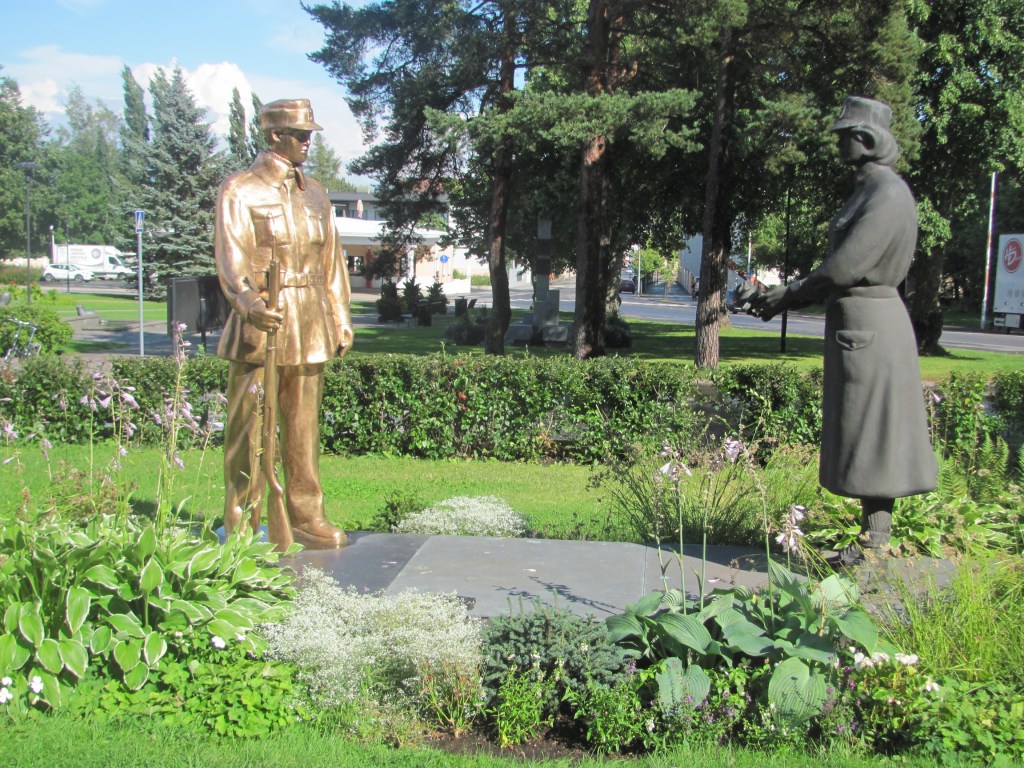
We come to the town theatre. Outside is a statue of a gold-plated soldier and a woman in charcoal grey offering him flowers. There is a sign, but it is in Finnish, and Google refuses to translate it.

“There’s a lot of non-PC symbolism there”, says Gavin. “The man is golden, the woman is grey and drab; the man is a hero, the woman is meek and subservient; the warrior is glorified, the peacemaker is secondary. You can probably think of more. I wonder what the true meaning is?”

“Perhaps they were intending to do them both in gold, but ran out of gold paint?”, I say, knowing that it probably wasn’t.

Symbolism, but of what?

We leave Kokkola at 0700 the next morning, heading south for the Kvarken archipelago that almost divides the Gulf of Bothnia into two. It turns out to be a frustrating sail – sometimes good wind, then nothing, a pattern repeated several times during the day. There is nothing to do but pull the sails out when there is wind, then pull them back in again and start the engine when there is none. But at least the strong southerlies seem to have abated for the time being.

On our way to the Kvarken archipelago.

We reach the island of Kummelskär in the evening and tie up bows-to to the small jetty. Only one other boat is there.

Tied up in Kummelskär.

“Welcome to Kummelskär, the gateway to the Kvarken archipelago”, says the harbourmaster as he helps us secure our lines. “You’re just in time. We close for the winter this coming weekend. If you had come after that, you could have tied up here, of course, but nothing would have been open – no toilets, no sauna, no café, no tower, nothing. Now, can I interest you in some hot salmon and potato soup? It’s my wife’s speciality. I am sure you can do with some after your long voyage.”

We don’t have the heart to refuse.

“It used to be an old coastguard station here”, he explains as we eat the soup. “Now it has been turned into a nature station for this part of the Kvarken Archipelago. My wife and I live here for the summer to look after the place, but we will be going back to our home in Vaasa for the winter. Now, when you are finished, you can come and watch the sunset from the top of the watch tower.”

We climb the stairs and find ourselves in the lookout room of the old coastguard station. It reminds me of the control tower at an airport. We watch in awe as the sun sinks slowly into the sea over the Kvarken archipelago.

Sunset from the coastguard tower at Kummelskär.

Back at the harbour, the barbecue is already on. We bring some sausages and a salad, and join the couple from the other boat. Across on the opposite island, we can hear the screeches of cranes roosting.

Barbecue at Kummelskär harbour.

“We live in Pietersaari”, the man says. “But we are sailing over to the Höga Kusten in Sweden for our holidays. We decided to break the journey here. We’ve been here several times before, and always like it.”

The conversation turns to politics.

“I was surprised when your former Prime Minister was voted out”, I say. “I thought she was very popular. And she stood up for Ukraine and brought Finland into NATO.”

“Yes, Sanna Marin was popular, but probably more so abroad than at home”, the woman says. “Perhaps similar to your Jacinda Ardern in New Zealand, in that respect. She took out a lot of loans, and people were becoming concerned that the country was in too much debt. And she suffered from a lot of scandals – for example, she was accused of spending public money on her family’s grocery bills. Even though she was legally allowed to do so, and even though she paid it back, it left a bad taste in people’s mouths.”

“And the leaked videos of her dancing at that private party?”, I say.

“Most people thought that was something blown up by the media and her political rivals”, she says. “But it probably didn’t help her.”

We leave Kummelskär the next morning, taking the inner route through the skärgård. Rocks and skerries slide by, sometimes only metres from the boat. We follow the marked routes on the charts meticulously, making full use of the conveniently-placed leading lines to keep us on the strait and narrow. It’s nerve-wracking stuff, and we are relieved when we reach the wider waterways for the large ships heading in to Vaasa.

Lining up the leading line markers.

But we relax too soon. The wind has risen since the morning to 20 knots, and is almost on our nose, making us sail close-hauled and tack. Not only that, it begins to rain.

“The weather forecast said occasional showers”, says the First Mate. “But this is a bit more than a shower. We can hardly see where we are going. Here’s your rain jacket.”

We zig-zag our way up the main fairway, keeping a wary lookout for big ships coming from behind and trying to stay within the marked channel. It’s narrow in places, especially under the road bridge we need to pass under. It’s not easy.

Coming into Vaasa.

A strong cross wind is blowing when we arrive at the marina, and it is difficult to manoeuvre into the small berths we see unoccupied. But somehow we manage it, and tie a rope from midships across to the pontoon on the other side to stop the boat from crunching into the pontoon and damaging the fenders. We plug in the power, and are readying ourselves to change out of our wet clothes and boil the water for a hot cup of tea when the harbourmaster arrives.

“Unfortunately, you have tied up in a private berth”, he tells us. “the owner is supposed to be away for the weekend, and normally I would be happy for you to stay here, but there is a chance that he will be back tonight, so I am afraid I will have to ask you to move your boat. You can tie up alongside over there, if you like.”

“I wish he had told me that when I phoned him on the way in”, says the First Mate. “But at least we will be tied up alongside. It’ll make getting the bikes off in the morning easier.”

Arriving in Vaasa.

In the morning, we cycle into Vaasa for lunch with the Salutés.

“Why are you going so slowly?”, says the First Mate to me. “Aren’t you hungry?”

“My back tyre was flat”, I say. “It might be a puncture. I stopped to pump it up. Luckily I had the pump with me.”

Over lunch, we read the guide to Vaasa.

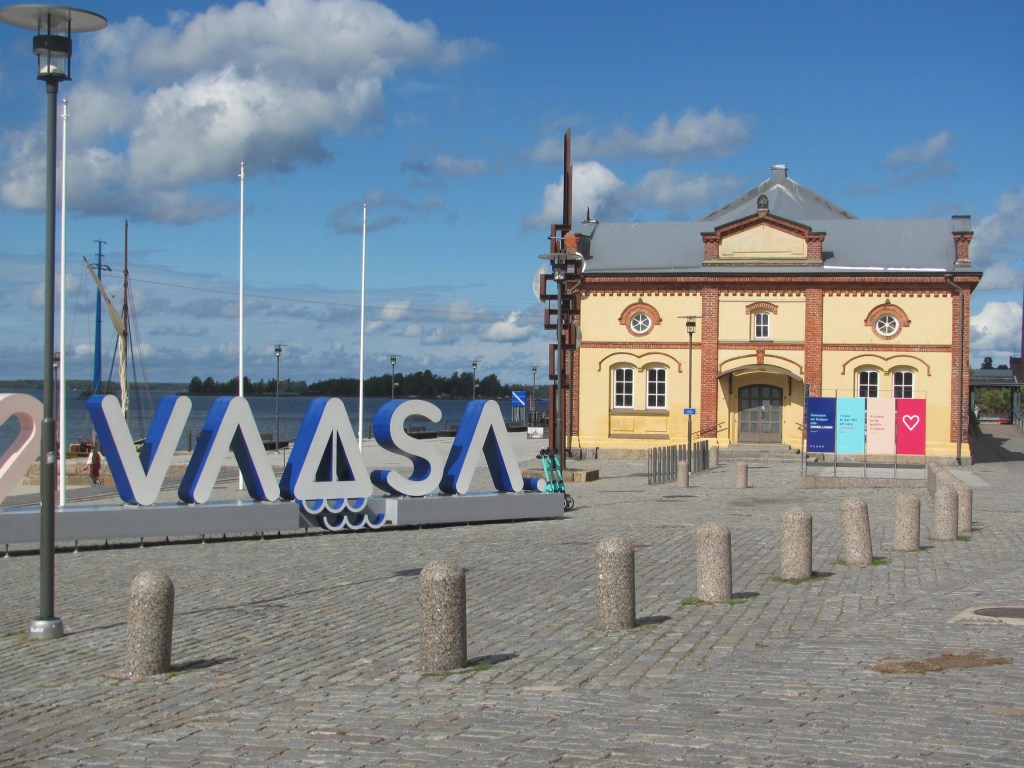
“It was founded in 1606, and was originally called Korsholm by the Swedish and Mustasaari by the Finnish”, Gavin reads. “Since then, it has had several name changes reflecting the politics of the time. In the 1600s, it was changed to Vasa after the Swedish royal family. Then 1855, it was renamed to Nikolajstad in Swedish and Nikolainkaupunki in Finnish in honour of the Russian Czar. Then when Finland became independent in 1917, it reverted to Vasa in Swedish and Vaasa in Finnish. Nowadays it is generally referred to as Vaasa.”

“Wow, it must be confusing for postmen”, says the First Mate. “You wouldn’t want to post your letters too late, or else the address might not exist anymore.”

“All the more complicated to have a Swedish name as well as a Finnish one at the same time”, I say.

“I read somewhere that it is a pretty cool city to live”, says Catherine. “There are three universities here, and there’s quite a student atmosphere with lots of concerts and entertainment going on. In fact, the harbourmaster said that there is a concert tonight on that little island near the marina.”

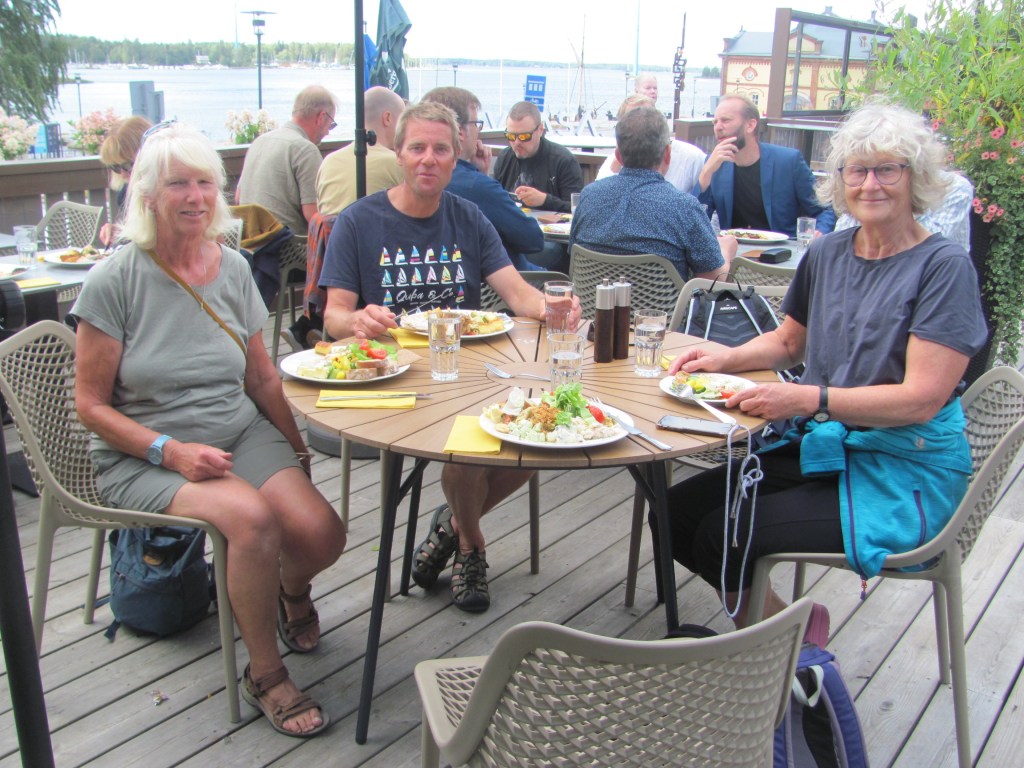
Finding out about Vaasa over lunch.

After lunch the tyre is flat again. “It’s definitely a puncture”, I say. “I’ll have to walk back to the boat and fix it.”

“Well, let’s go to the Ostrobothnian Museum first”, says the First Mate. “It’s only a few minutes’ walk from here. You can push the bike.”

We spend the next hour or so learning about the natural history of the Kvarken archipelago. It turns out that it is an important gathering place for birds preparing to migrate. To build up body fat for their long journey to Northern Africa, cranes, for example, gather in their thousands to graze in the Söderfjärden crater and return to the islands of the Kvarken to roost at night. We had heard them on Kummelskär island.

Cranes, Ostrobothnian Museum.

“There is a modern art exhibition on the top floor”, says the First Mate. “Let’s go and have a look.”

“This one reminds me of work”, I say.

Picture in Ostrobothnian Museum.

“Here’s a good one for you”, says the First Mate.

Artwork in Ostrobothnian Museum.

After the museum, we have a look around the city.

Town Hall, Vaasa.
Sculpture, Vaasa Central Square.

I spend the rest of the afternoon fixing the puncture. In the evening, music starts on the little island near the marina. Youngsters on jet-skis and boats of various shapes and sizes mull around harbour area. A kind of houseboat pushed by a small speedboat lashed to the side and towing three jet-skis finds its way somehow into the marina. There’s lots of shouting and drunken singing from those on board. Worried faces appear on the decks of the nearby boats, boathooks and fenders at the ready to protect their pride-and-joy’s from the revellers.

Partygoers waiting for the music.

“It looks like we are not going to get much sleep tonight”, says Catherine. “At least we will be able to hear the music for free. I hope it’s good.”

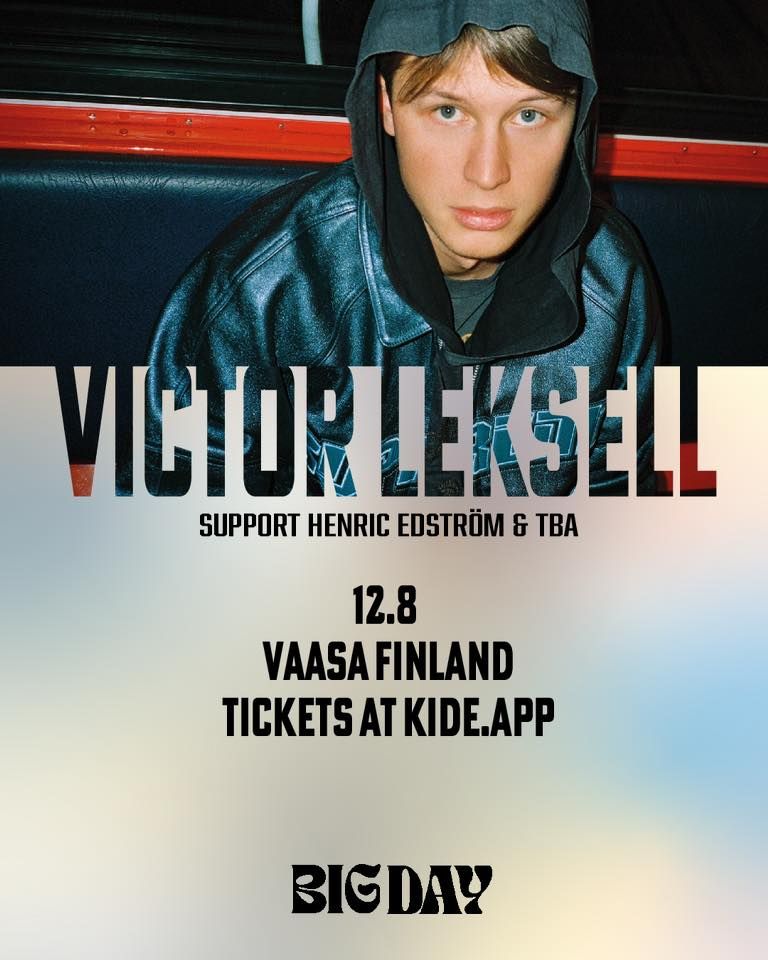
It turns out to be a Swedish singer by the name of Viktor Leksell on tour. It’s all very wholesome and finishes by 2300. Everyone goes home. The houseboat disappears.

“Well, that wasn’t too bad”, says the First Mate. “I thought it might be going on until the early hours of the morning. And I quite enjoyed the music too. We should try and get one of his CDs.”

“Yes, it’s been a good day”, I say. “I even managed to get my bike working again.”

A balancing act, Arctic threats, and no baguettes

“Do you know much about the history of Finland?” asks the First Mate. “It’s a country I am not really familiar with.”

We are sailing across the northern Bay of Bothnia towards Kemi, a town in the north of Finland. It’s a gentle west wind, so we have rigged the sails in a ‘goose-wing’ arrangement with one sail out each side to catch the wind coming from directly behind us.

I have to admit that I don’t know much about it either. I pick up the Lonely Planet guide to Finland and begin reading the history section.

“Finland was under Swedish rule since the 13th century as part of the Swedish Empire”, it tells me. “Then in the early 1700s, the Great Northern War occurred between Sweden on one hand and Russia, Denmark and the other Baltic powers on the other. Sweden was beaten, which marked the beginning of the end of the its empire.”

“I suppose that is why so many people in Finland still speak Swedish as a first language”, says the First Mate. “Especially along the west coast.”

“During that war, Russia occupied Finland in 1714, and although Sweden regained it the final peace treaty in 1721, Russia occupied it again in 1743”, Lonely Planet continues. “After a bit more toing and froing between Russia and Sweden, Sweden finally ceded it to Russia in 1809, when it became a semi-autonomous Grand Duchy within the Russian Empire.”

“The poor old Finns must have been pretty fed up by that stage”, says the First Mate. “Waking up in the morning hardly knowing who was ruling you.”

“Yes, that was the beginnings of Finnish nationalism”, I say. “They had a saying, ‘Swedes we are not, Russians we will not become, so let us be Finns’.”

“Sounds fair enough”, says the First Mate. “So when did they become independent?”

“The Russian Revolution occurred in 1917”, Lonely Planet answers. “So the Finns took advantage of that and declared independence. The communists in Russia actually didn’t mind, as they hoped that Finland would also become communist. This resulted in a civil war in Finland between the Whites, who wanted a monarchy, and the Reds, who wanted a socialist revolution.”

“Didn’t the Germans somehow get involved too?”, asks the First Mate.

“Yes, the Whites asked for help from Imperial Germany and eventually won”, I say. “A German prince became the King of Finland, but only lasted a month before Germany was defeated in WW1. So Finland ended up being a republic instead.”

The wind has shifted around to the north slightly, and I change the sail configuration to a starboard tack. We have crossed the imaginary border and are now officially in Finland. In the distance we can see a giant factory, smoke pouring into the atmosphere.

Sailing across the border into Finland.

“They talk about the Winter War”, asks the First Mate after the sails have been trimmed. “What was that all about?”

“Well, in 1939, the pact between Germany and Russia divided eastern Europe into spheres of influence”, Lonely Planet continues. “Russia gained a free a hand in Finland. The Russians demanded that a piece of territory in south-east Finland, Karelia, become part of Russia. The Finns weren’t too keen about that, so went to war about it. That became known as the Winter War. Despite fierce fighting in harsh conditions by the Finns, the Russians eventually won and took Karelia. But the Finns saw it as a victory, as they had stopped Russia from taking over the whole of Finland as it had threatened.”

Finnish areas ceded to Russia in 1944. (From Wikipedia)

“Sounds very similar to present day events in Ukraine”, says the First Mate. “But I read somewhere that the Nazis also stuck their oar in.”

“Yes, that’s right”, I say. “When the Nazis turned on Russia in 1941, the Finns took advantage and also declared war on Russia to try and gain Karelia back. This became known as the Continuation War. Unfortunately for them, Russia managed to beat them again. In the peace treaty after the war, Finland had to agree to let Russia keep Karelia and other bits and pieces, as well as to pay heavy reparations to Russia. Not only that, the Finns then had to wage war against the Germans to drive them out of Lapland in the far north.”

“Wow, they’ve certainly had their fair share of fighting”, says the First Mate. “Having two powerful neighbours probably didn’t help.”

“We’re coming into Kemi”, I say, checking the chart-plotter. “We need to be careful now.”

The four-mile approach into Kemi is through extremely shallow water of only a few centimetres deep. With our two-metre draft, we need to be careful.

“As long as we keep to the buoyed channels, we’ll be OK”, I say, in response to the First Mate’s worried look, with more confidence than I feel. “The chap back in Gärdsviken said that the channels are dredged to 2.5 m, so we shouldn’t have a problem.”

Nevertheless, I station the First Mate on the bow to keep an eye out for any uncharted rocks.

Approaching Kemi.

Luckily, the buoys are relatively easy to spot, and there is an ingenious system of leading lines with bright fluorescent orange and yellow marker boards to help keep us on the right track. We take it gingerly, and eventually reach the small Vierassatamat, or guest harbour, in Kemi. The couple from the only other boat in the harbour help us tie up next to them.

We strike up a conversation with them over a glass of wine watching the sunset.

Sunset over Kemi.

“Despite all the problems we have had in the past, somehow we have managed to maintain our political independence”, the woman says. “Since WW2, we had to play a very delicate balancing act of not annoying Russia too much, but also integrating more with the west. It was called Finlandization. But we really see ourselves as part of Europe. We joined the EU in the 1990s, and just recently we have become part of NATO.”

“I just read that Finland has been identified as the happiest country in the world”, I say. “For the sixth time, I believe.”

“Yes, we are pretty happy overall”, she says. “We have a beautiful country, people feel close to nature, even those living in the cities, and we have trust in our politicians and each other. And we have a strong national identity, in part because of our unique language. There’s a lot to be happy about.”

There’s a lesson in there somewhere, I think as we prepare the dinner.

How to be happy, Finnish style.

“We really should go and see Rovaniemi”, says the First Mate later that evening. “The home of Santa, and all that. More seriously, there is a good museum on the Arctic that you would like, and an art gallery, I wouldn’t mind seeing. We can get the train up there.”

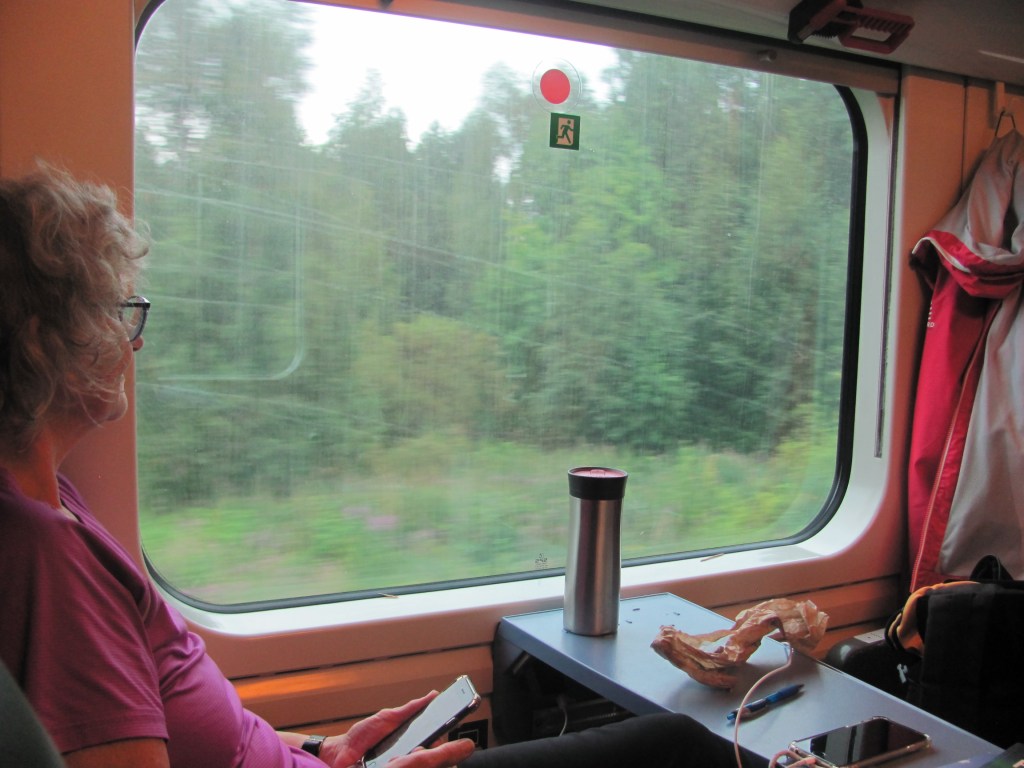
We catch the 0936 train the next morning for Rovaniemi. Soon we are making our way through the great boreal forests of the north, endless birch, spruces and pine. It’s nice to have a break away from the boat.

On the train to Rovaniemi.

“Like the clickety-clack/Of a train on a track/It’s got rhythm to spare”, I hum contentedly to myself.

“Neil Diamond”, says the First Mate. “Why are you humming that? I haven’t heard that one for years.”

“I used to like it when I was younger”, I answer. “The noise of the train as it trundles through the forest suddenly reminded me of it. It’s a beautiful noise, a sound that I love”.

“What did you do with the money?”, asks the First Mate.

“What money?”, I say, knowing the answer already.

“The money your mother gave you for singing lessons”, she says gleefully.

The old ones are the best ones.

Every so often, we pass clearings in the forest where some hardy souls are attempting to make a living from farming. Small isolated cabins have skidoos parked in the driveway, a reminder that the beautiful weather were are currently experiencing is only temporary, and that for much of the year this landscape is covered in snow and ice. Skidoos are the only practical way to travel then.

“Look at that beautiful little lake”, says the First Mate, pointing out the window. “And that little skiff tied up to the wooden jetty. It’s all so picturesque.”

We eventually reach Rovaniemi. The train grinds to a halt, and the passengers spill out onto the platform. The air is cooler than in Kemi, giving the place the air of an alpine resort. Backpackers eager to set off on their treks adjust their packs one last time, families rush to board the bus that goes to Santa’s Village, expectant taxi-drivers wait for their next customer.

The train arrives at Rovaniemi.

“Let’s go and visit the Arktikum first”, says the First Mate. “It’s about 20 minutes’ walk from here. We can have lunch there. Then we can have a quick look at the Pilke forestry place, and come back and do the Korundi art gallery. You can get a Culture Pass ticket that covers all three for little more than the ticket for one of them. Then if there is any time left we can get the bus out to Santa’s Village.”

By the time we arrive at the Arktikum museum, we are feeling peckish. The restaurant is doing a buffet. We pile our plates full of traditional Finnish food.

“I wonder what these little fish are?”, says the First Mate. “They’re absolutely delicious with the dill sauce on them. I think they might be herrings.”

“The menu says that they are muiket”, I say. “Mr Google tells me that’s vendace in English. They are a freshwater fish common in northern Europe, including the upper reaches of the Baltic. And by the way, those are parsnip chips, not potato chips. Anyway, eat up, and we can go and have a look.”

Gluttons for punishment?

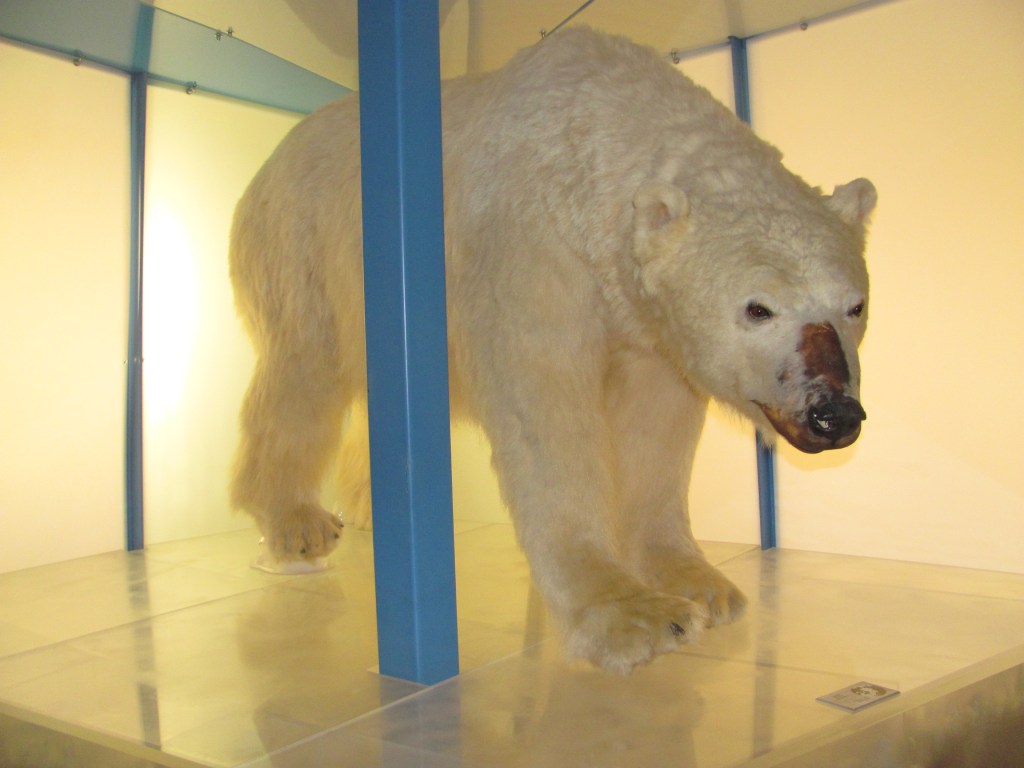
First up is the Northern Lights theatre. We lie back on the comfortable cushions looking up into the night sky. A polar bear forms itself spookily from the Great Bear constellation and walks slowly off to the northern horizon. Gradually the greens, reds and blues of the northern lights appear and move eerily across the sky, folding and stretching themselves like ethereal curtains. We learn that they are formed from ionic particles from the sun crashing into oxygen, hydrogen and nitrogen atoms in the earth’s atmosphere.

In the Northern Lights theatre.

“Come and see the moose”, says the First Mate as we leave the theatre. “We probably won’t see a real live one, but this is the next best thing.”

Moose.

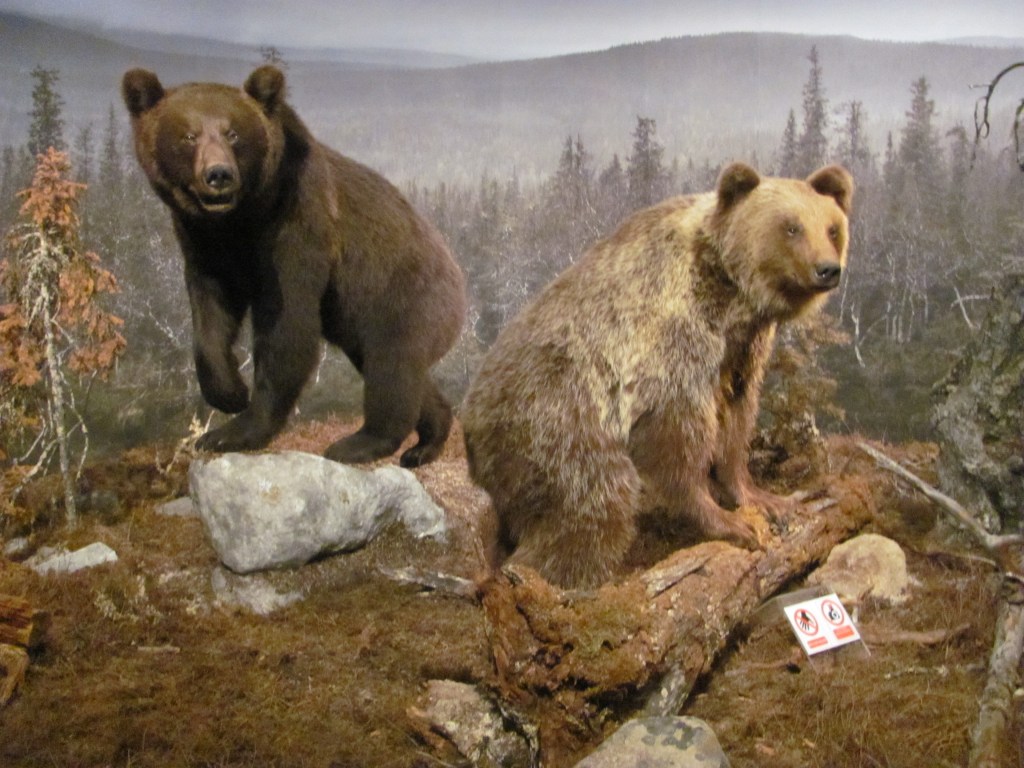
“And these brown bears”, I say. “It says that the ancient Finns revered them due to their divine origin, and saw them as Kings of the Forest. They were hunted in the 1960s, but now are strongly protected.”
After a couple of hours, we have seen all there is to see.

“I suppose the thing that shocked me the most was the effect that man’s activities are having on the Arctic”, says the First Mate over a coffee. ”Apparently around 25% of its area is already affected. There’s the well-known impact of climate change, of course, but what I hadn’t appreciated was the influence of alien species and pollutants there as well.”

“Yes, it is serious that temperatures are rising up here three times faster than the global average”, I say, trying to remember what I had read. “That’s a lot. Usually, the ice reflects much of the sun’s energy back into space, but as it melts it exposes the darker surface underneath. That in turn results in more warming, more ice disappearing, and so the cycle continues. That affects weather patterns elsewhere in the world. It’s all interconnected.”

Under threat from melting ice.

“And did you read that bit on the red king crab?”, she says. “It was purposely introduced into the Barents Sea by the Russians, but because of the lack of natural predators, it has multiplied, and now it is doing lots of damage to the natural ecosystems. Although it is valuable commercially and generates income, it eats everything that it comes across and is creating underwater deserts. It also eats the eggs of a fish species that cod feed on, so the worry is that cod numbers may be affected.”

Red King Crab (from the Alaskan Departmemt of Fish and Game)

“And all those nasty chemicals we are producing that end up in the Arctic”, I say. “Persistent Organic Pollutants or POPs. They take a long time to degrade and are accumulating there, often in the fatty tissues of the animals.”
“Why don’t they do something about them?”, asks the First Mate. “Surely they know they are bad?”

“They are trying”, I say. “There is the Stockholm Convention on Persistent Organic Pollutants to limit chemicals such as PCBs and DDT, but unfortunately not every country sticks to the rules.”

“It’s easy to forget that all the mess we make in our day-to-day lives also affects up here too, even though it is so far away”, she says with a sigh. “At least we are more aware of it now.”

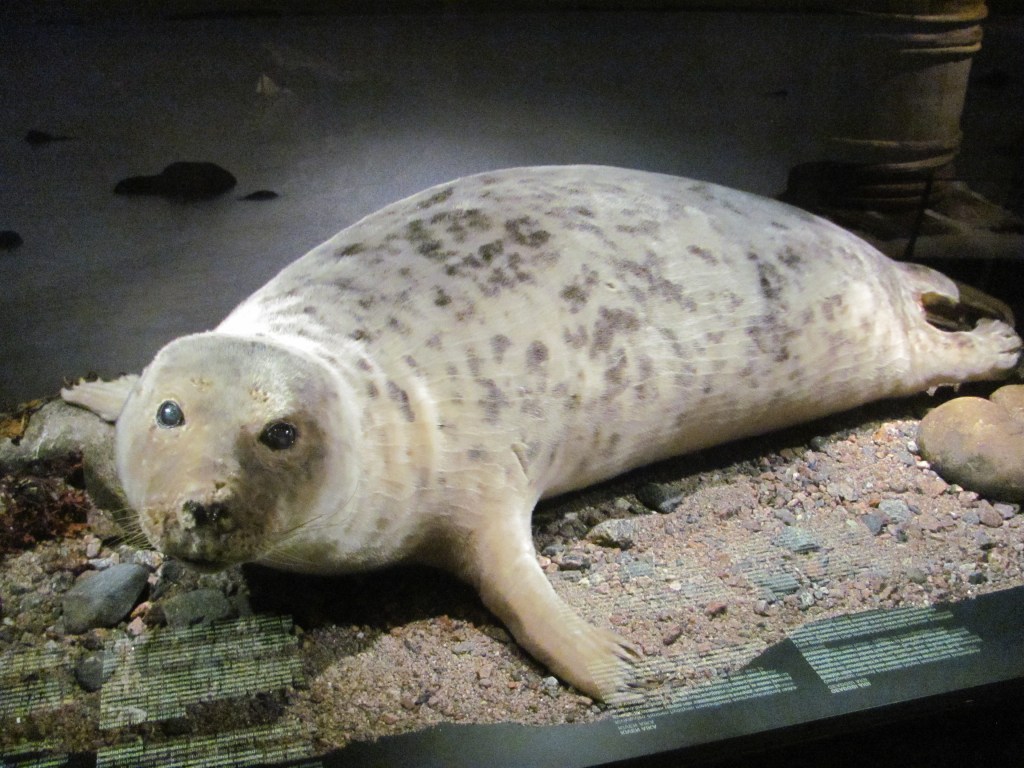
Affected by our pollution.

We catch the train back to Kemi again. Just before we get there, it starts to rain. Torrentially.

“We’re going to get wet”, I say. “We’ll need our rain jackets and umbrellas.”

Magically, it stops raining just as the train pulls into Kemi station. We walk back through the wet streets of the town feeling dismal.

“I know the weather affects your impression of a city”, says the First Mate. “But I have to say that I find Kemi all a bit dreary. It doesn’t really have much character. Perhaps in the winter it is more lively.”

Dreary?

In the morning, I discover we have run out of yoghurt for my muesli.

“Perhaps you can get a baguette as well”, says the First Mate as I leave for the supermarket.

Finding the yoghurt is no problem, but I can’t see any baguettes.

“No, sorry, we don’t have baguettes here”, say the girl when I ask her. “But you could try the supermarket a couple of blocks down.”

They don’t have any baguettes either. Supermarkets, pah! Back on the street, I decide to ask in the nearest shop if there is a bakery in the town that might sell baguettes. It turns out to be a pharmacy. The woman looks at me puzzled.

“No, we don’t sell baguettes here”, she says, in halting English.

“No, I mean, do you know if there is a bakery near here where I can buy baguettes?”, I say.

She calls one of her colleagues over. There is an intense discussion in Finnish. One of the customers joins the conversation too. The second shop assistant makes a shape with her hands of something long and thin. Occasionally, I can work out the word ‘baguette’. The customer gesticulates, pointing down the road. I am starting to regret that I ever asked about the bakery. Then the first shop assistant turns back to me.

“There isn’t a bakery, but we think the supermarket down the road has baguettes”, she says.

It’s the first supermarket I went to. I begin to feel that I am trapped in some endless Groundhog Day.

“Many thanks, I’ll try there”, I say, trying to smile.

I head glumly back to the boat to admit failure.

The top of the Baltic, a poorly laptop, and a Euro city

“Look, here are the labyrinths!”, calls out the First Mate. “Over here.”

We are on the island of Kluntana in the Luleä archipelago, and following a trail marked out on a map. Earlier in the day, we had sailed out from Luleä, and tied up to the small pontoon in the westward facing bay. A church group on an outing are already there, and were singing hymns on the beach as we tied up. Quite a welcome. Shortly afterwards, the ferry had arrived and the congregation had shuffled on board, their day trip to the island over.

Church outing.

The labyrinths are circular whorls of stones built by fishermen. No one quite knows whether it was to while away the time when they couldn’t go fishing, or whether it was to bring good luck when they could. I prefer the latter. Surely there would be a lot more labyrinths if they were just passing the time of day.

Labyrinths on the island of Kluntana.

“And I can see the lookout tower in the distance”, I say. “It must have given a good view out over the sea.”

Lookout tower on Kluntana.

“And here’s the rock that looks like the face of an old man”, calls the First Mate.

“Now that we are so close”, I say over dinner in the evening, “we have to get to Törehamn. It’s the northernmost part of the Baltic that you can sail to. There’s a buoy there that marks it, and apparently you can get a certificate.”

“Let’s do it”, says the First Mate. “It’s what we came for, after all.”

It’s about 30 miles to Törehamn. We set off from Kluntarna early. It’s a gorgeous day, but there’s not much wind, so progress is sedate. On the AIS, we can see Saluté also heading there. They are a little closer than us, having been on another island for a few days.

On our way to Törehamn.

“It’s beautiful up here”, says the First Mate dreamily. “And we have it all to ourselves, more or less. I am surprised that we haven’t seen more boats.”

“It’s such a long way up here”, I say. “That deters a lot of people. It takes at least two weeks to get up here from Stockholm, and at least two weeks to get back, so it doesn’t leave much time to explore. It’s only retirees like ourselves who can afford the time.”
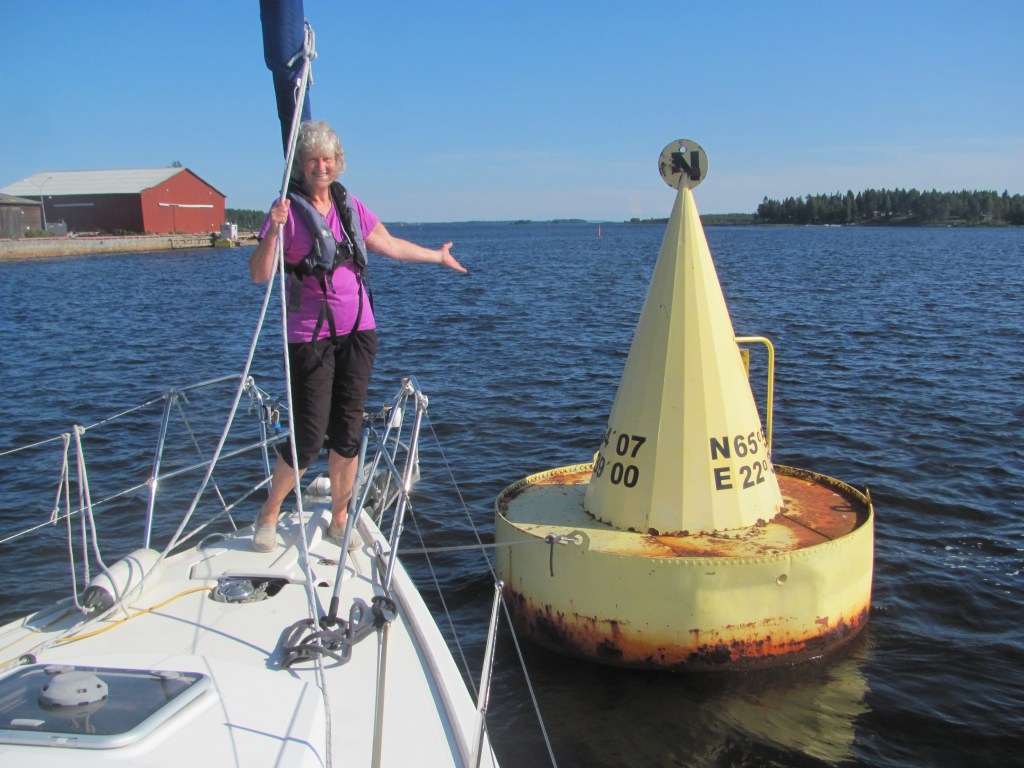
The wind picks up, and we sail the last few miles at a good speed. In the distance we can see the grain silos marking the harbour at Törehamn. Saluté is already there, tied to the buoy.

“We made it!”, shouts Catherine. “You take our photo, and we’ll take yours. Then we can go and collect our certificates from the café.”

The buoy at Törehamn.

“It’s a strange feeling”, says the First Mate, over an ice-cream. “For the last few weeks, we have been working towards getting here. Now we are here, it feels a bit of an anti-climax. From now on, we are heading south again. It’s a pity we don’t have time to explore a bit more up here. It’s so beautiful.”

“We still have all the Finnish side to explore on the way back”, says Gavin. “That should keep us busy.”

Törehamn is rather industrial and not very picturesque, so we decide to head back to Gärdsviken for the night, a small harbour we had passed on the way up. We receive a warm welcome from the harbourmaster.

Gärdsviken harbour.

“We belong to the Törehamn Sailing Club”, he explains. “I am the club chairman, and this is our summer harbour. We are always pleased to welcome visiting sailors. Especially British ones, as we don’t see many of them up here. You two boats are the first ones this year.”

Tied up in Gärdsviken.

“We love coming here and getting away from it all”, another member says. “We don’t have any power, and all the water is collected from rainwater. But we have plenty of wood, so the sauna is woodfired and we have lots of barbecues. And there are lots of nice walks. There are even elk in the forest – some people go hunting for them.”

In the evening, we decide to take a sauna. We strike up a conversation with a club member who is a ‘techie’ working in the energy business.

“We’ve been working on projects to make steel production more sustainable”, he tells us. “We are looking at hydrogen from the ionisation of water as a way of heating the furnaces rather than coal.”

“But hydrogen is not really a source of energy, just a carrier”, I say. “You need lots of energy to ionise the water, and if that energy is from fossil fuels, you just end up shifting the emissions from one place to another, not reducing them.”
“True”, he says. “But we are looking at renewable sources of energy for that. Solar of course, but we also have lots of hydropower in the north of Sweden. Consequently, our electricity costs are substantially lower up here than down south. So much so, Facebook have even located their data servers in Luleä to cut costs.”

It’s getting hot. We take a breather and go and jump into the sea.

“What about the Sámi people up here?”, I ask him when we return. “Are there tensions between them and the mining and energy companies?”

“For sure there are”, he responds. “They want to keep the land for their reindeer herds and traditional way of life. But they are only a small fraction of the national economy. There are vast energy sources and mineral wealth up here that the country needs. You can’t stand in the way of progress.”
It’s a dilemma. Western civilisation needs energy and minerals to function. And yet, our extraction of them is destroying the ancient cultures of indigenous people worldwide, and our use of them is harming the planet by releasing greenhouse gases and pollutants into the environment. All in the name of progress. In this little club harbour with its reliance on natural energy and water, I wonder to myself if another way of life is possible?

A necessary evil?

“It’s ironic that all these folk are only able to enjoy the ‘get back to nature’ and simplistic lifestyle because they have boats to get here and well-paid jobs in the cities to buy the boats”, sniffs Spencer later.

“I think you are being a little bit unfair”, I say. “At least there is a desire to get back to nature. If that could be encouraged more widely it might be possible to live more sustainably.”

“Well, you are welcome to try”, he retorts. “I think you will find it is very difficult to scale up that way of thinking to the global population.”

Our plan is to get to Haparanda, the last town in Sweden before crossing into Finland. The club chairman advises us that the harbour at Haparandahamn is too shallow for our draft, so we are better to moor at Seskarö island and to catch the bus into Haparanda.

The next morning, we sail from Gärdsviken to Seskarö island. The wind has gone round to the south, and we enjoy a pleasant beam reach most of the way. At one stage a helicopter passes overhead with some kind of hopper suspended below it. We learn later that it is carrying fertiliser, but no one quite knows where to or what for. Farms or forest?

Carrying fertiliser.

Eventually we reach Seskarö, and tie up to the small wharf.

“Let’s have a glass of wine and relax”, says the First Mate..

Somehow I manage to tip my drink over the laptop keyboard.

“Quick, turn it upside down”, says the First Mate. “It’ll stop it from going inside and help it drain.”

It helps, but it is too late. Before long, the keys start to feel sticky and to type long repetitive sequences of letters when I press them. But at least the computer itself seems to be still working.

“%%^^^****!!!!&&&”, I say. “It’s a disaster. I depend on the computer so much for everything – route planning, keeping the diary, writing the blog, watching the news. What will I do now?”

“Take it with us when we go into Haparanda tomorrow”, says the First Mate. “We might find someone who can fix it.”

We catch the bus into Haparanda in the morning. It is an interesting town. Originally there was only one town there, called Tornio, on the banks of the Torne River. Then, as a result of the Russian-Swedish War of 1809, Finland, which was Swedish territory at that stage, was ceded to Russia. It was decided to make the border between the two countries along the river, meaning that Tornio came to be in Finland. The Swedes nevertheless decided that they also needed a border town, so built Haparanda on the other side of the river. Nowadays, the two towns together are designated as a ‘Eurotown’, administered separately, but for all intents and purposes, operating as one.

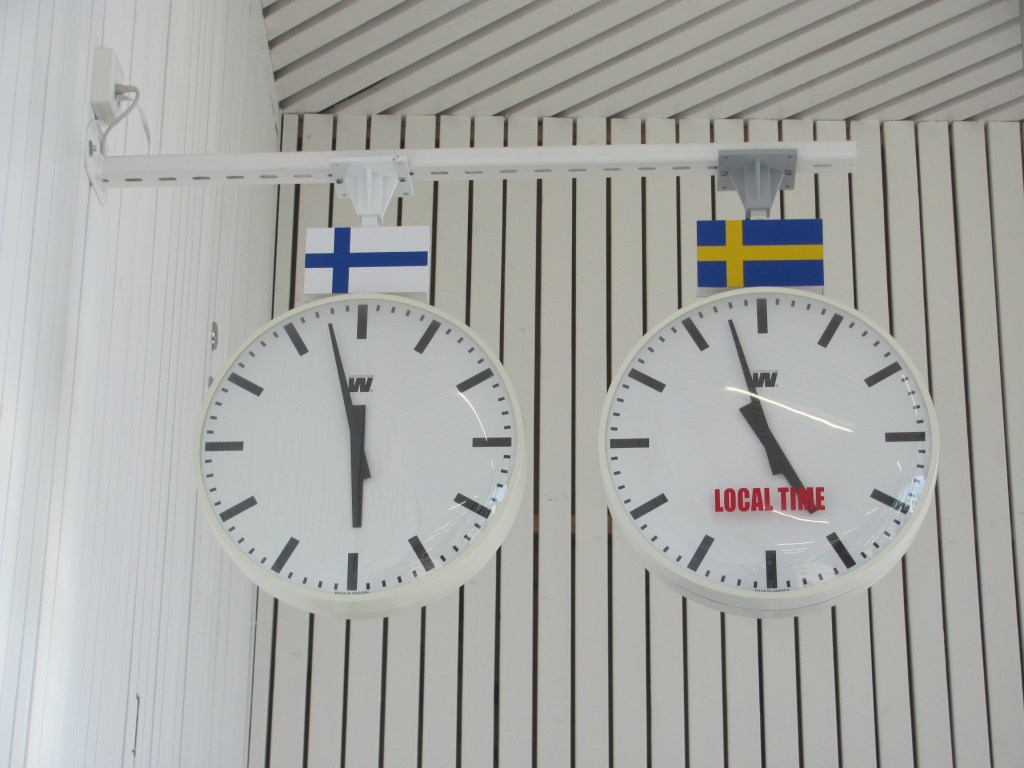
“We mustn’t forget that Finland is one hour ahead of Sweden”, says the First Mate. “We don’t want to miss the bus by an hour. It’s the last bus until the morning.”

One hour difference.

I find a computer repair shop in Tornio. The man sucks in his breath.

“I could fix it”, he says. “But I would have to order a new keyboard. And it has to be the UK version, and we only have Scandinavian ones here. It could take a week. When do you need it by?”

“This afternoon?”, I say hopefully.

“No chance”, he says. “But I tell you what. I could give you an external keyboard to plug in, and you could use that. It won’t be elegant, but at least it would work.”

“It sounds like a good solution”, says the First Mate. “Take it. Now let’s get lunch. I’m famished.”

We find a small café and order the soup.

“It’s funny having to pay in Euros on this side of the river and kroner on that side”, says the First Mate. “And two different time zones. And everything is in Finnish. What a language. Look at this newspaper. I can’t understand a thing. All those double letters everywhere. It’s almost as if someone’s keyboard has stuck.”

“That was a bit below the belt”, I groan.

Trying to read Finnish.

“With Swedish at least, you could kind of work out what it meant because of the similarities with German”, says the First Mate. “Swedish has evolved from the northern German languages, after all. But with Finnish, I don’t know where to start. It’s totally different.”

“Finnish is not an Indo-European language, but instead is a Uralic language because its centre of origin is thought to be the Ural Mountains where the Volga River bends to the west”, Mr Google tells us. “It is related to Hungarian and Estonian. When Finland was ruled by Sweden, the Finnish language was considered inferior – the administrative language was Swedish, and Finnish was only allowed to be spoken and not written.”

“Fascinating”, says the First Mate. “No wonder we can’t understand it. Anyway, let’s pay and go and explore.”

The only thing of note in Tornio is the old wooden Eastern Orthodox church. Unfortunately it is locked.

Eastern Orthodox church in Tornio.

We cross back over the bridge into Haparanda.

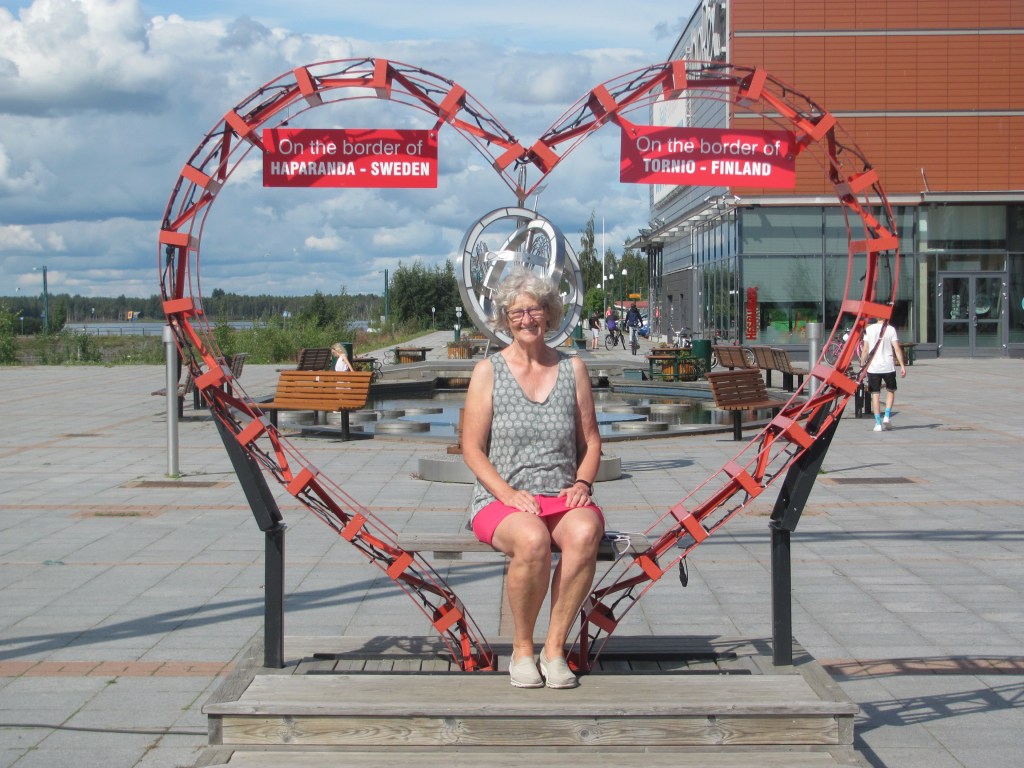
“Look, this is where the border is”, says the First Mate. I can stand with one leg in Finland and the other in Sweden. How cool is that?”

Straddling the border between Haparanda and Tornio.

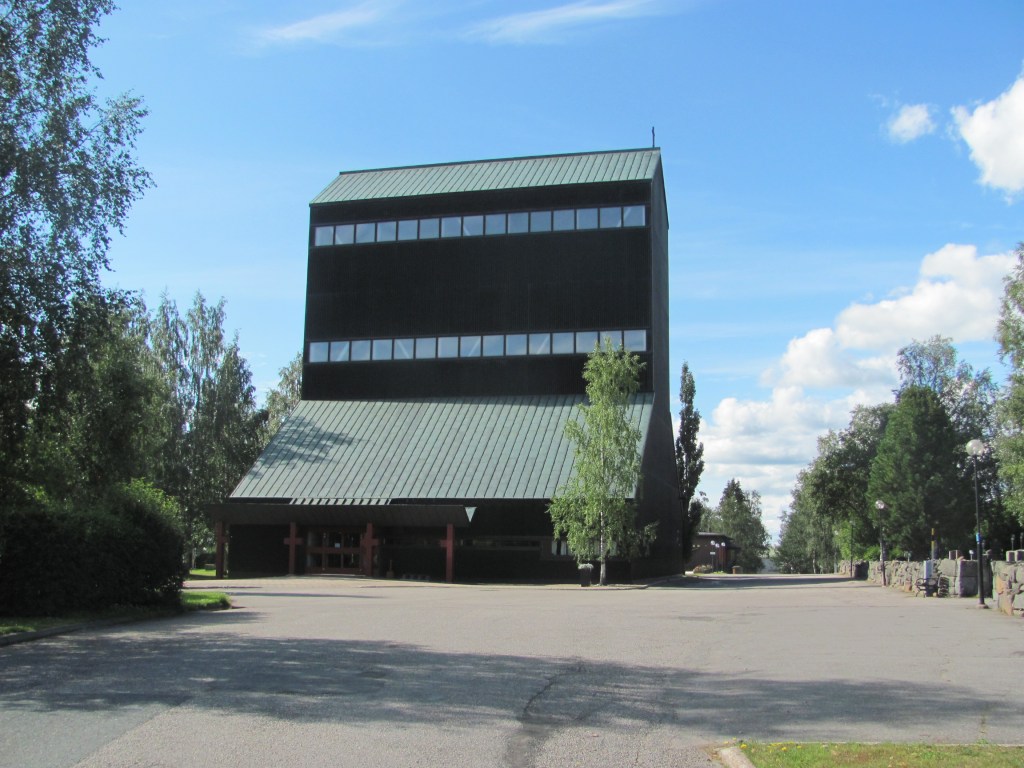
The church in Haparanda is ‘uncompromisingly modern’, the guide book tells us. A must see. It is interesting, to say the least. It reminds me of a warehouse. But I have seen worse.

Church?

Inside it looks a bit more like a church.

Inside the church.

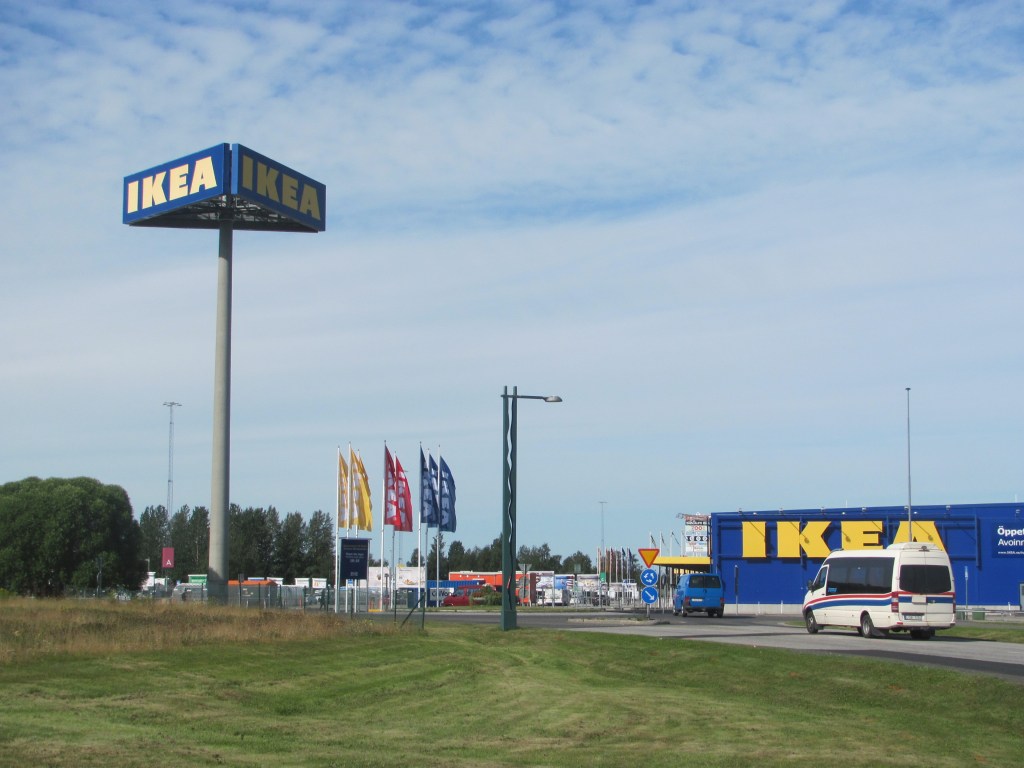
“Look, there is the IKEA store over there”, exclaims the First Mate, pointing to a blue and yellow building as we walk back. “Apparently it is the northernmost IKEA store in the world. Why don’t we have a look around it and have an early dinner before we catch the bus back? I haven’t had meatballs for a while.”

Northernmost IKEA in the world.

Most of Haparanda seems to have had the same idea. The queue is long. Eventually we make it though, and scoff our meatballs down before dashing for the bus station.

“I thought you said that the bus leaves at 1700?”, the First Mate says accusingly, as we arrive breathlessly. “The timetable says 1710. I could have enjoyed my dinner more instead of rushing and getting indigestion.”

“I made a mistake”, I say. “Sorry. It hasn’t been my day.”

In the evening, I try my new keyboard. It works, but is a bit cumbersome.

“At least you can still keep doing the blog”, says the First Mate.

A workaround.