Witches’ trials, dressing the boat, and a Russian fortress

The six women are led out to the wooden platform. I clutch my mother’s dresses tighter. I don’t know what is going to happen, but I know it is bad. The women are guided to the structure on the platform with six ropes hanging from it. Under each there is a box which the women are made to stand on.

“Mother, what’s happening?”, I ask my mother in a shrill voice. “Why are those women being made to stand on those boxes. And what are those ropes for?”

“My little one”, she says. “They are evil women. They confessed to the governor that had attended a Witches’ Sabbath and made a pact with the Devil. Now they have been sentenced to death for their crimes. Good riddance, I say.”

I watch with morbid fascination as one by one, a noose at the end of each rope is placed around the women’s necks.

“Mother, mother”, I cry in alarm. “One of those women is my friend John’s mother. Surely she isn’t a witch? She is always so kind to me. The governor must have made a mistake.”

“No mistake”, replies my mother. “The governor was guided by God, and God can see into every person’s heart and what is going on in it. He must have been able to see that John’s mother had evil there, despite appearing to be kind on the outside.”

Witch trials in Sweden.

There is a fanfare of trumpets and the Governor of the Castle arrives with his retinue. I had already seen him before several times as I tended my father’s sheep, cantering out of the Castle gates on his horse as he went about his business. He speaks something to the women, but his voice is low and I can’t make out he words. They begin to wail in terror.

“I am not a witch”, cries John’s mother. “I have been a good woman all my life. I have had nothing to do with the Devil.”

There is a sudden shout, and a man standing at the side of the platform steps forward. One by one, he kicks away the box each woman is standing on. The cries of terror cease, the women’s bodies convulse, then all is still. The watching crowd lets out a loud cheer. I feel I want to be sick, and try to run, but my mother holds me tight.

“It’s good that you have seen these evil women die”, she says, with little sympathy in her voice. “Let it be a reminder throughout your life to serve God and not the Devil, otherwise a similar fate may befall you.”

“What do you think of this?”, says a voice behind me. I turn. It is one of the Governor’s men wearing his helmet.

The voice seems somehow familiar. It takes me a few seconds to realise that it is not the Governor’s man, but the Cabin Boy, wearing a steel helmet put there for visitors to try on.

One of the Governor’s men?

We are in Kastelholm Castle, and I have been imagining what is might have been like at the end of the Kastelholm witch trials in 1668. Local women accused of witchcraft were brought to the castle where they were forced to confess to the Governor of attending a witches’ Sabbath and making a pact with the Devil. They were then tortured to reveal their accomplices before being hung.

“Hardly a fair trial”, sniffs the First Mate. “At least we have made a bit of progress in justice since then. Come on, let’s go and have an ice-cream.”
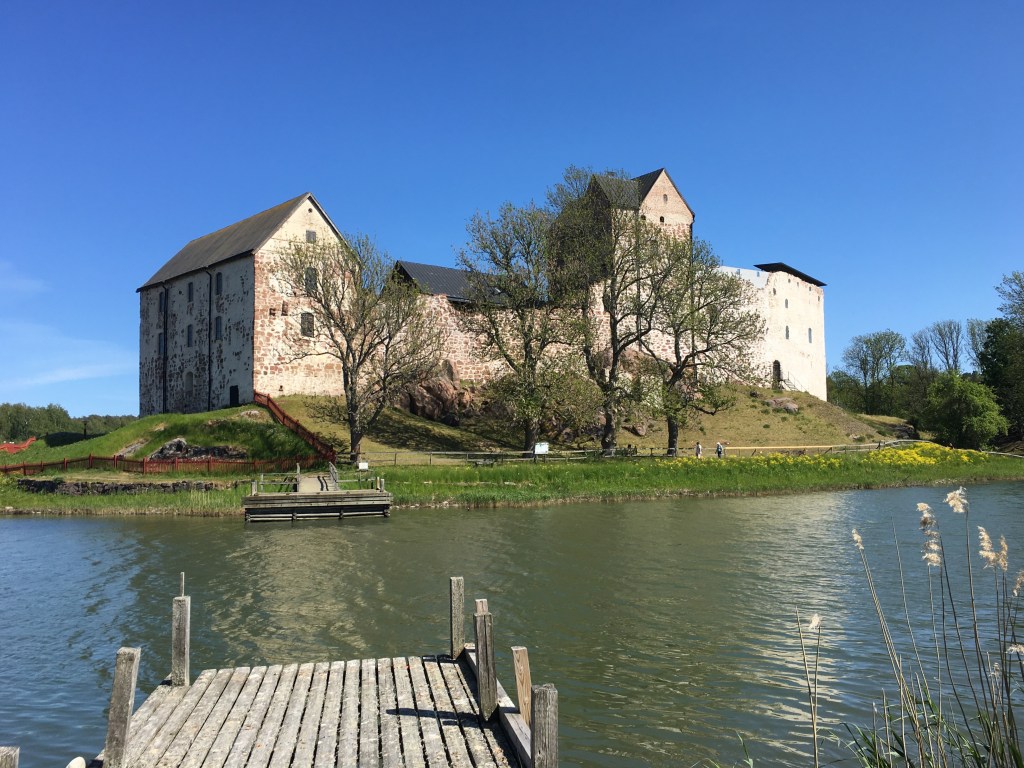
Kastelholm Castle where the Witches’ Trials took place.

We had visited the Åland Gin Distillery that morning, where different herbs and spices are added to the base spirit distilled from grain elsewhere to give a distinctive Åland flavour. We had then been treated to a gin tasting and a lunch of traditional Swedish meatballs and accompaniments.

Learning how Åland gin is made.

“Those were the best meatballs I have tasted in a long time”, says the First Mate, sitting back in her chair contentedly. “Far better than those from a leading furniture retailer I could name.”

After lunch, we had sauntered over to the Castle opposite. A timeline just inside the entrance explained that it had been built in the 1380s as a symbol of Swedish power and prestige, and that King Gustav Vasa had hunted in its grounds. It was then captured by the Danes in 1505, but recaptured by Charles IX of Sweden in 1599. Recently it has been restored and attracts many visitors each year.

Erik XIV.

“It has certainly seen a bit of history”, says the Cabin Boy as we leave. “Did you read that one of the Swedish kings John imprisoned his own brother Erik in there for a while?”

This was the same John III that had been imprisoned by his brother Erik XIV in Gripsholm Castle in Mariefred that we had seen last year, but had returned the favour when he was freed by imprisoning Erik. That hadn’t been all though – Erik died insane, probably from arsenic poisoning by his brother.

“The Windsors aren’t the only Royal Family that are a bit dysfunctional”, I say.

In the evening, we meet for drinks at the dockside bar. I find myself sitting next to Simon. We strike up a conversation on the Vikings.

“The one thing that I don’t understand about the Vikings is what motivated them to expand throughout Europe”, he says. “Look at where they went – much of Britain, France, Spain, Italy. They even got as far as Iceland, Greenland and North America.”

“Yes, and in the other direction they migrated down the Volga and founded Kyiv in present day Ukraine”, I say. “They ruled a large state called Kyivan Rus’, which was the origin of the Russian people.”
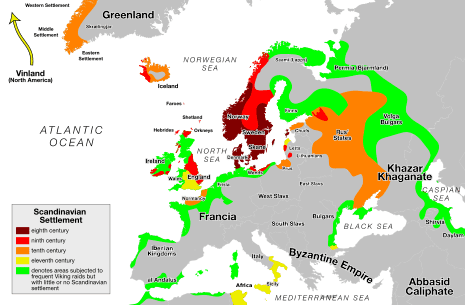
Viking expansion in Europe in the 8th to 11th centuries.

“True, but what made them want do it?”, persists Simon. “Why didn’t they just stay at home in Scandinavia? I have read that overpopulation of the available land was the reason, but I don’t buy that. Sweden has lots of land, and Denmark is very fertile.”

“I don’t think there was a single reason”, I say, trying to remember what I had seen in the History Museum in Stockholm. “Shortage of land was certainly a factor for the Vikings from Norway. They expanded westwards to Britain, Iceland, Greenland and the America to colonise new land. But for the Vikings from Sweden, trade was the main reason. They were particularly keen on silver and traded to get hold of it. And it was mostly the Danish Vikings who did all the raping and pillaging that terrorised Europe at the time.”

“And they had the technology to do all that”, says Simon. “The longboat, I mean. They were fairly robust sea-going vessels. But was there also something in their psyche that made them want to be so ruthless?”

“I suppose the Norse religion contributed to that”, I say. “It glorified violence – only those who died in battle would go to Valhalla. Those who didn’t would go to Hel. That’s a pretty powerful incentive. And their lack of respect for Christian monasteries and the like – the rich pickings they could easily have by purloining the treasures so conveniently collected and stored for them in one place by defenceless monks, would surely be another.”

Valhalla by Max Bruckner (1836-1918).

It’s almost the end of the rally. We slip the lines early the next morning, and head across the Lumparn crater for the Lemström Canal with its swinging bridge. It opens on the hour ever hour between 0900 and 2200. We make it for the 0900 opening and are quickly through to the bay east of Mariehamn. We tie up in a box berth at the Mariehamn East marina.

Entering the Lemström Canal.

“I feel a bit sad that it’s all over”, says the First Mate. “I have to say that I have really enjoyed it. Great weather, great scenery, and great people. What more could we ask for?”

In the afternoon, we ‘dress’ the boat. This involves stringing a line of signal flags from the bow to the masthead and down to the stern.

“You can’t put them in any old order”, says Bob in the boat next to us. “There is a specific order that they have to be in so that you don’t inadvertently send a message you don’t want to. I’ll email it to you.”

We spend the next hour or so linking our code flags together, and hoist the ends of them to the top of the mast with the spare halyards.

‘Dressing’ the boat.

“Oh no”, says the Cabin Boy as we stand and admire our work. “There’s one flag left in the bag. I’ve left out the letter ‘L’. What should we do? It’s a bit of a faff to get them all down again and put it in.”

“Don’t worry”, I say. “No one will notice.”

No-one does.

“It all looks very colourful”, says the First Mate. ”It’s a pity we can’t keep them there all the time as we sail along.”

“The rules say they are only supposed to be used in harbour for special occasions”, I say. “Not when sailing. I assume because they might get tangled up in the sails.”

Rally boats in their finery.

In the evening, before the final Rally dinner together, we gather to say thanks to Andy, the Rally leader, for his wonderful organisational skills in making everything run so smoothly.
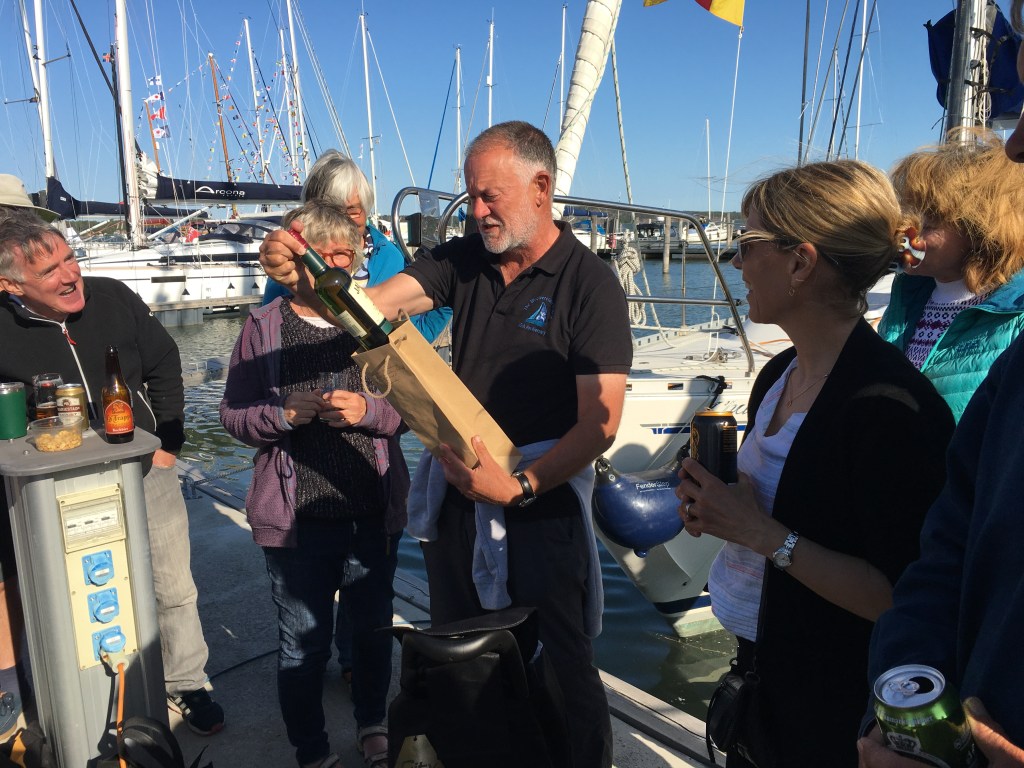
Saying thanks to Andy.

It’s been a great ten days, and we are all a bit sad to see the end of it. But it’s not goodbye to everyone, as several of us plan to continue on to the High Coast area afterwards. Not necessarily together in a rally or exactly at the same time, but we do agree to keep in touch. Bob sets up a WhatsApp group.

“We can swap tips and photos with each other”, he says. “And arrange to meet up if we are not too far away.”

Early next morning, we say goodbye to the Cabin Boy. It’s been great to see him again, but the time with him has flown too quickly. A taxi arrives and takes him to the airport for him to begin his long journey back to Australia.

“I’m going to miss him”, says the First Mate, wiping a tear from her eye.

“Me too”, I say.
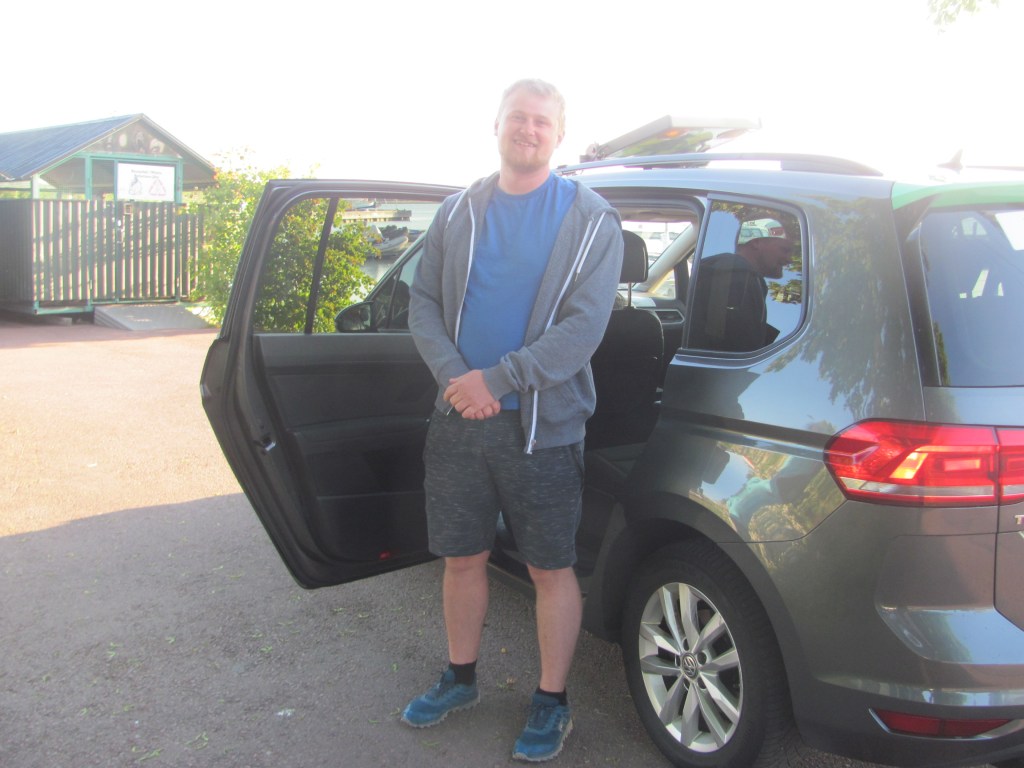
Saying goodbye to the Cabin Boy.

In the afternoon, I take the bus out to the Bomarsund Fortress. We were to have stopped there on the rally, but because of unfavourable winds, we had had to divert from that plan.

The newly constructed Visitors’ Centre gives a good overview of the history of the fortress.

“As a result  of the Finnish War between Sweden and Russia, Finland and Åland were ceded by Sweden to the Russian Empire in 1809”, a video tells me. “But Russia needed to contain Sweden and maintain control over the Eastern Baltic, so in 1830 they began building a large military fortress at Bomarsund. The main fort contained barracks, offices, bakeries, a prison, and an Orthodox church. Nearby, a sizeable town called Skarpans developed to support the fortress.”
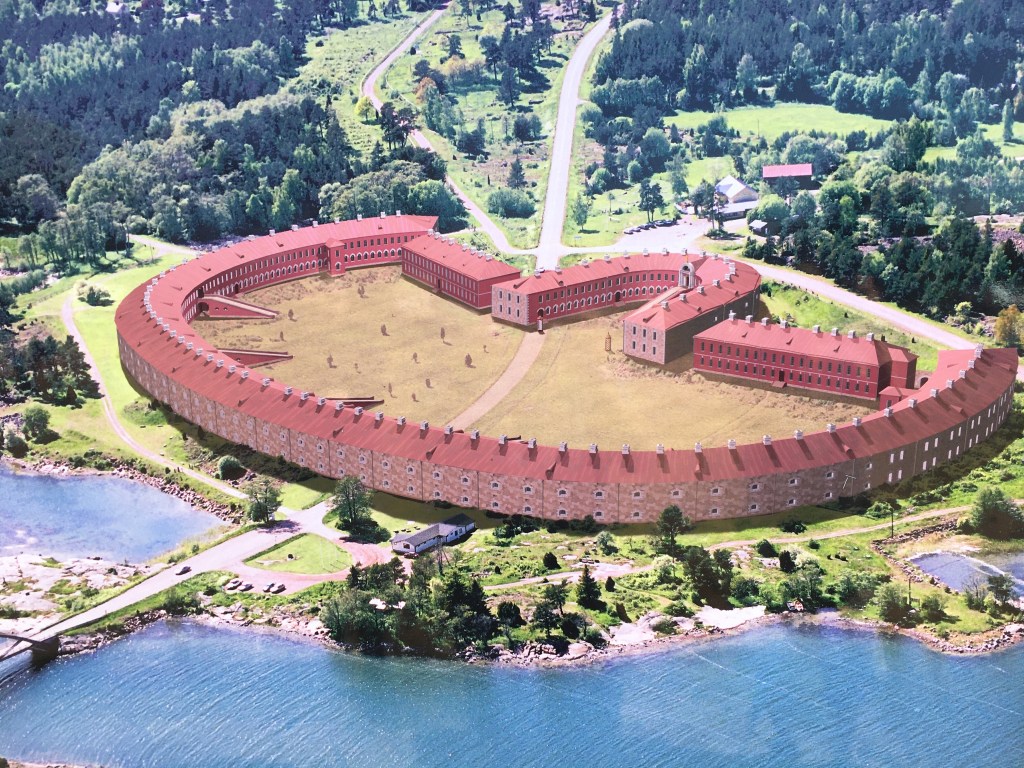
Bomarsund Fortress as it might have looked before being destroyed.

The Åland islanders got used to the Russians being in control, and life continued much the same as it had done under the Swedes. Suspicions lurked, however, and stories circulated that the Devil himself attended parties and even danced with the minister’s wife.
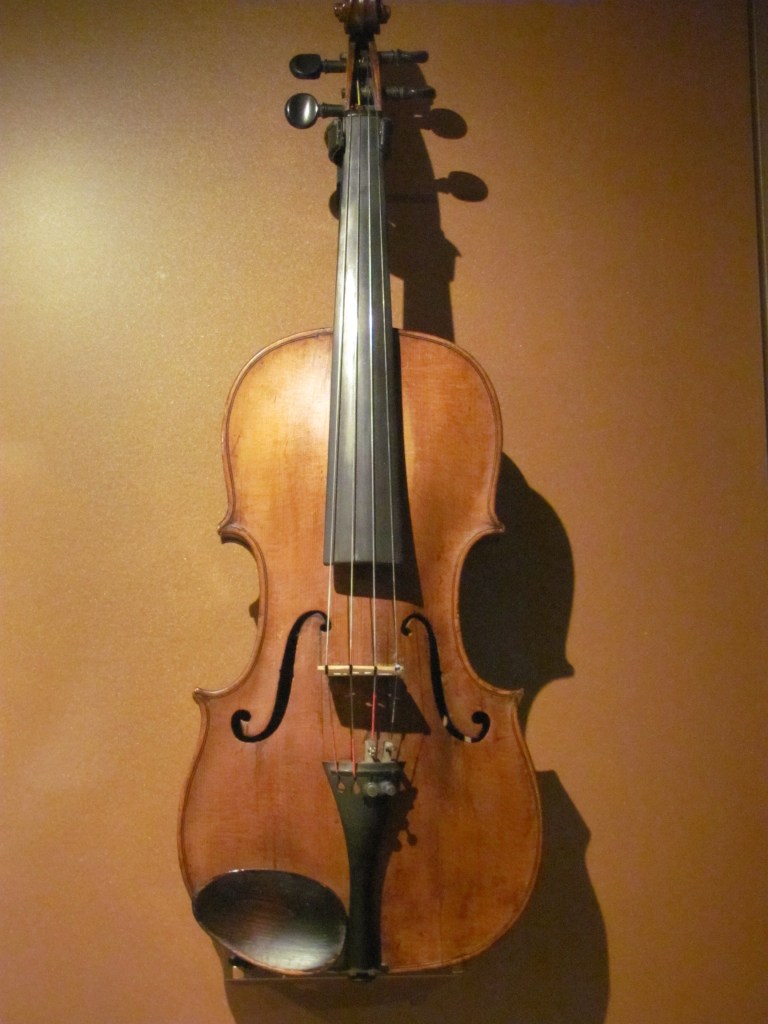
Violin the Devil is supposed to have danced to.

“Then in 1853, the Crimean War between Russia and the Ottoman Empire began”, a nearby panel says. “Britain and France decided to take the side of the Ottomans to contain Russian expansion to the Middle East. The conflict spilled over into the Baltic when the French and British attacked the half-completed Bomarsund fortress in 1854.”

“The Russians believed that an attack by sea from the west was not possible due to the narrow approach routes being too restrictive for sailing ships”, another video tells me. “So they had not fortified that part of the castle very well. But the British had steam ships which were much more manoeuvrable than sail. Consequently, they were able to come close and maintain a continual bombardment on the fortress without sustaining much damage to themselves. Eventually the Main Fort was largely destroyed, and the Russians surrendered. The victorious British and French offered the captured fortress to the Swedes, but they didn’t want it for fear of provoking the Russians, so it was blown up. “
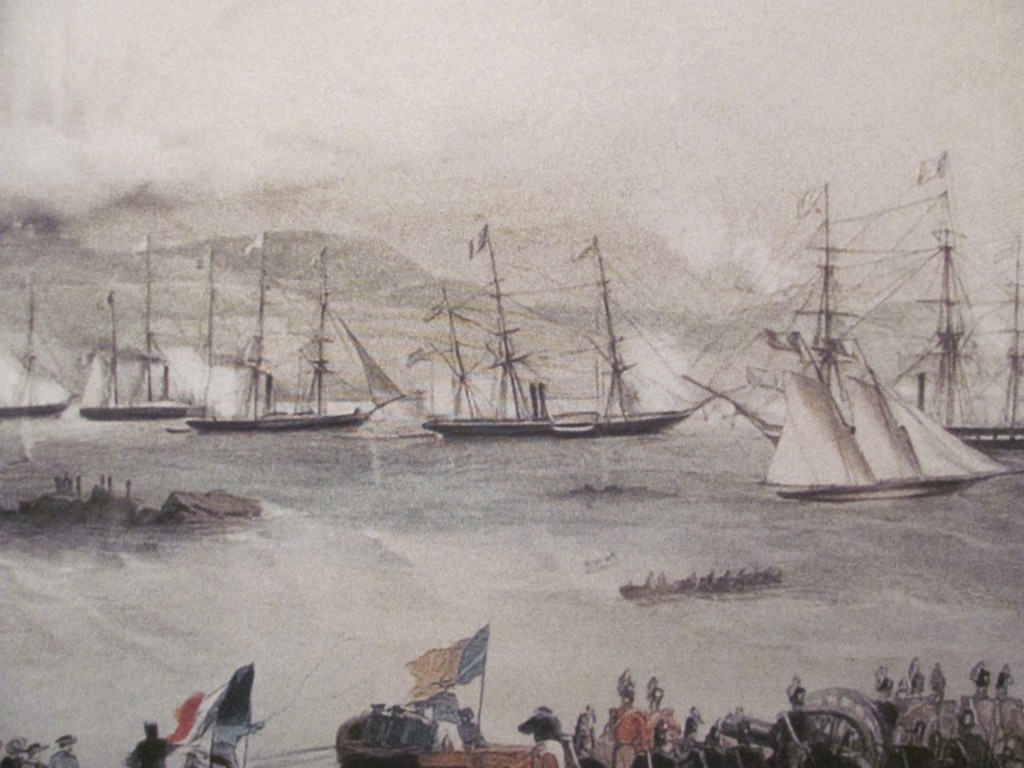
The Battle of Bomarsund, 1854.

I take the 4.5 km walk around the planned periphery of the whole fortress. Only two towers were ever completed, their cannon still forlornly pointing in the direction that the enemy never came from.

Cannons at the North Tower.

I end up back at the ruins of the destroyed Main Fort, and try to imagine what it must have been like for the soldiers defending it from the continual bombardment from the navy ships in the bay to the west. With limited large guns of their own on that side and with no time to move any from other parts of the fortress, all they would be able to do was suffer stoically, and hope that they wouldn’t be in the way of an incoming cannon ball. All in the interests of remote men in Moscow, London and Paris playing the Great Game to balance each other’s power so that no one country in Europe would become too dominant.
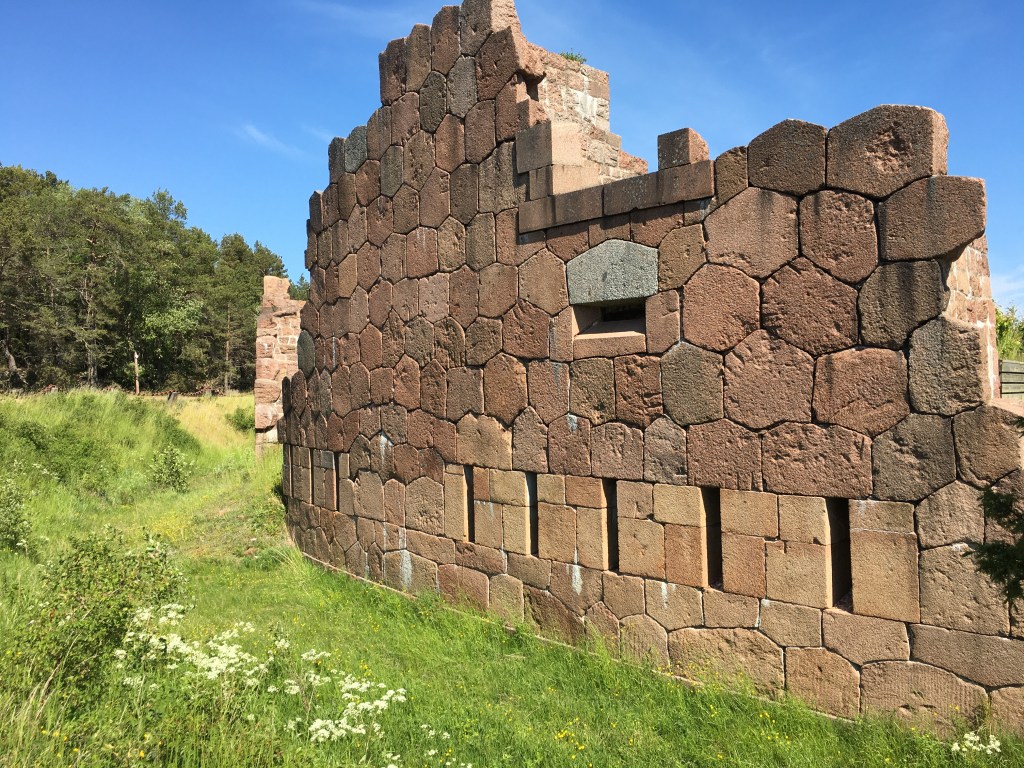
Ruins of the Main Fort at Bomarsund.

“The battle of Bomarsund had far-reaching consequences for  Åland, as in the resulting peace treaty it was agreed that Åland should be demilitarised, which it remains so until this day”, I read in the tourist brochure on the bus ride back again. “Also, after Bomarsund was destroyed, it led to the establishment of Mariehamn as the capital of Åland  in 1861.”

“A bit like a huge game of chess, wasn’t it?”, says the First Mate later. “I feel sorry for the poor soldiers and common people that got killed through no fault of their own.”
Fishy business, a champagne schooner, and an ancient meteorite crater

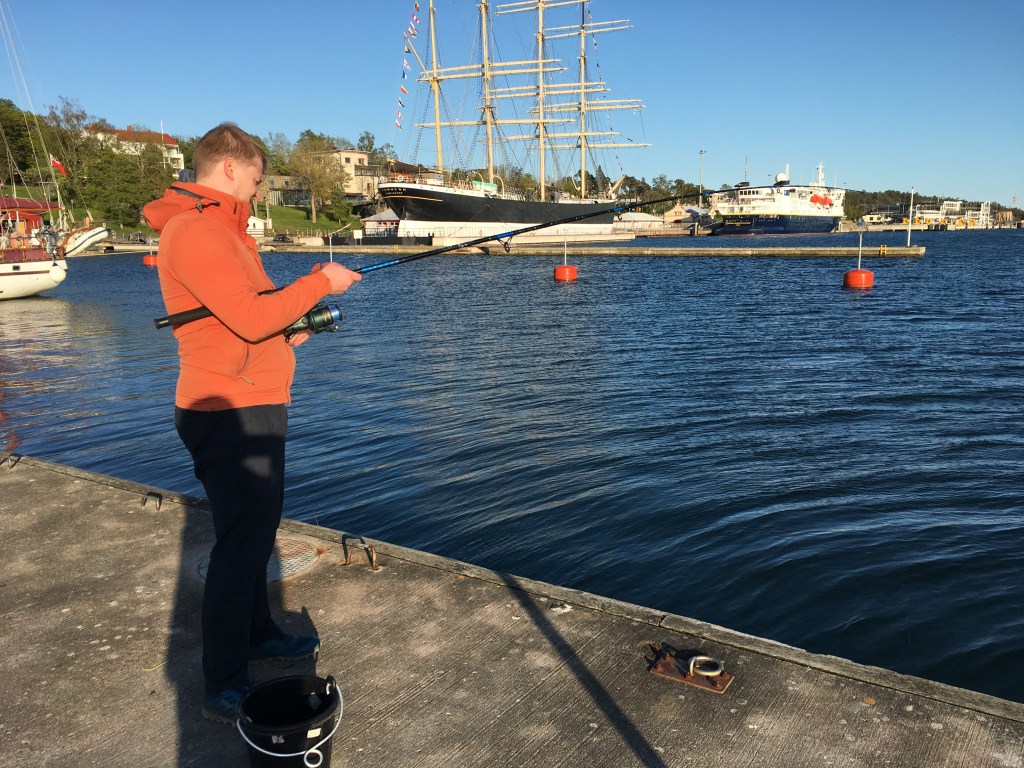
“Why don’t you two go fishing?”, says the First Mate. “I have noticed others catching herring off the end of the pontoon over there. We could eat them for dinner tonight.”

We dig out the fishing rod from the storage room, and the Cabin Boy and I make our way to the end of one of the pontoons.

“I have a herring rig somewhere in the box”, I say. “Here it is. Let me tie it on.”

The Cabin Boy casts the line, and gives it a gentle jiggle up and down.

“I think I’ve got a bite”, he shouts in excitement.

It’s more than one. Five, in fact. We manage to land them all onto the pontoon, de-hook them, and put them into the bucket we brought with us. I have a go, and manage to catch another five, but one wriggles free before we can get it ashore.

“It’s enormous!”

We take turns and land several more.

“I didn’t realise it would be so easy”, says the Cabin Boy. “We’ve probably got enough now. The First Mate will be pleased.”

“Well done”, says the First Mate, taking the bucket. “We have to gut and clean them now. Come and give me a hand.”

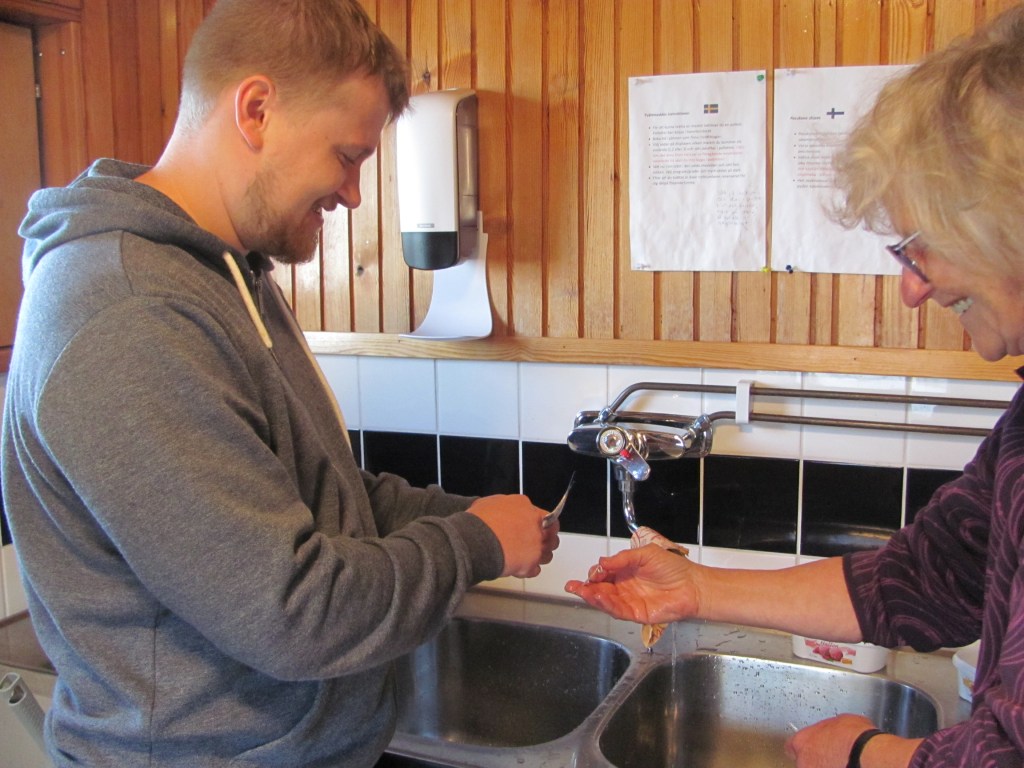
We head for the marina kitchen, and return half an hour later with nicely cleaned herrings.

“It was a bit gruesome”, says the Cabin Boy. “Innards everywhere. I haven’t gutted a fish before. But I am glad I learnt.”

“You can put it on your CV”, I say. “Broadening your skills is always useful.”

That evening, we fry the herrings in butter and salt, and have them with new potatoes. They are delicious.

Cleaning the fish.

“Another British boat has just arrived”, says the First Mate in the morning. “That makes six in total now. I wonder how many more there will be?”

We are awaiting the start of the Cruising Association’s 2023 Baltic Rally. Seven boats have turned up so far, each with between two and four people.

“A few boats have dropped out for various reasons”, Andy, the coordinator of the rally, tells us. “But another one will be joining us during the rally. They are waiting for parts for their boat to arrive, and there’s been a bit of a delay. And don’t forget that we have a visit to the Pommern arranged for this afternoon, and a dinner together tonight.”

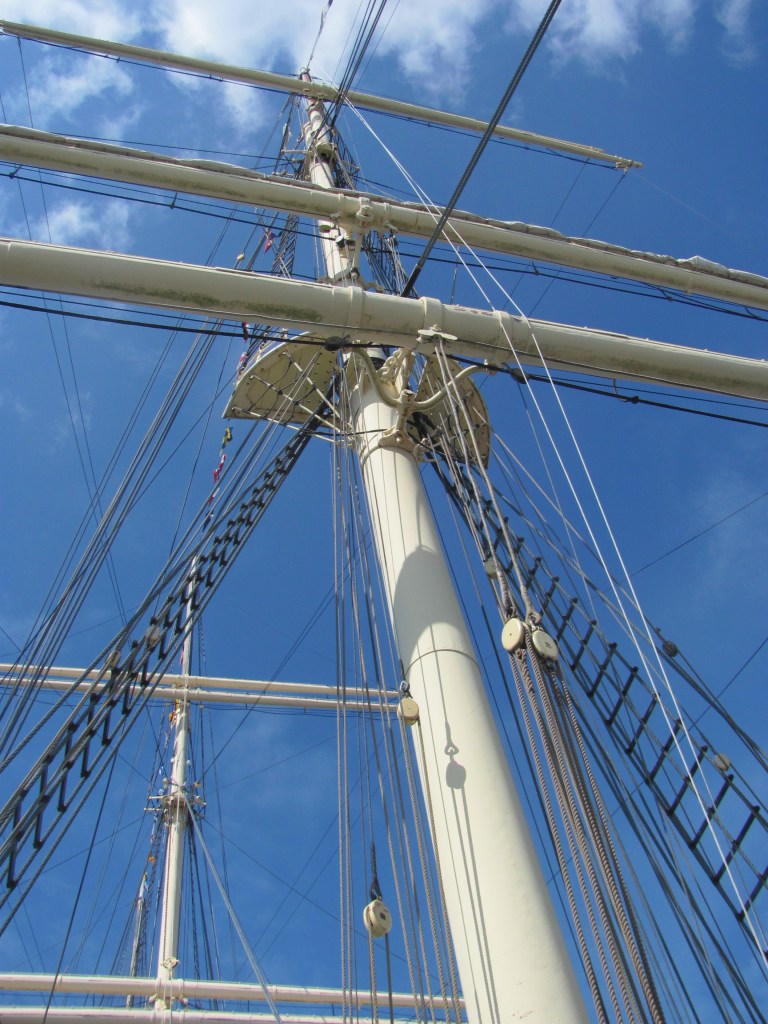
In the afternoon, we gather outside the Pommern, the four-master sailing ship that has dominated our view for the last few days. Built in 1903 in Glasgow as a cargo ship, she shipped timber from Scandinavia, fertiliser from Chile, and grain from Australia. Nowadays, she is part of the Åland Maritime Museum.

The Pommern,

A guide takes us on board, and we are asked to imagine that we are on a voyage from Mariehamn to Port Victoria in Australia in the 1930s to load a cargo of wheat for the return trip. Apparently they sailed out empty, with a full load only on the return journey.

“It seems strange that I have just flown from Australia to join you sailing”, says the Cabin Boy, “and the first thing they do is to ask me to imagine that I am sailing back to Australia again!”

“She probably thinks that you are a convict”, I say. “What with that short haircut.”

“She’s a bit bigger than Ruby Tuesday”, says the First Mate as we stand at the wheel at the stern and try and look forward to the bow nearly 95 m away.

“Yes, and twenty-eight sails would take a bit of managing”, I say. “We have our hands full with just two!”

Masts on the Pommern.

We set sail on the rally proper the next morning. We are free to start when we want and choose which route to take, the only proviso being that we end up in the designated destination in the evening.

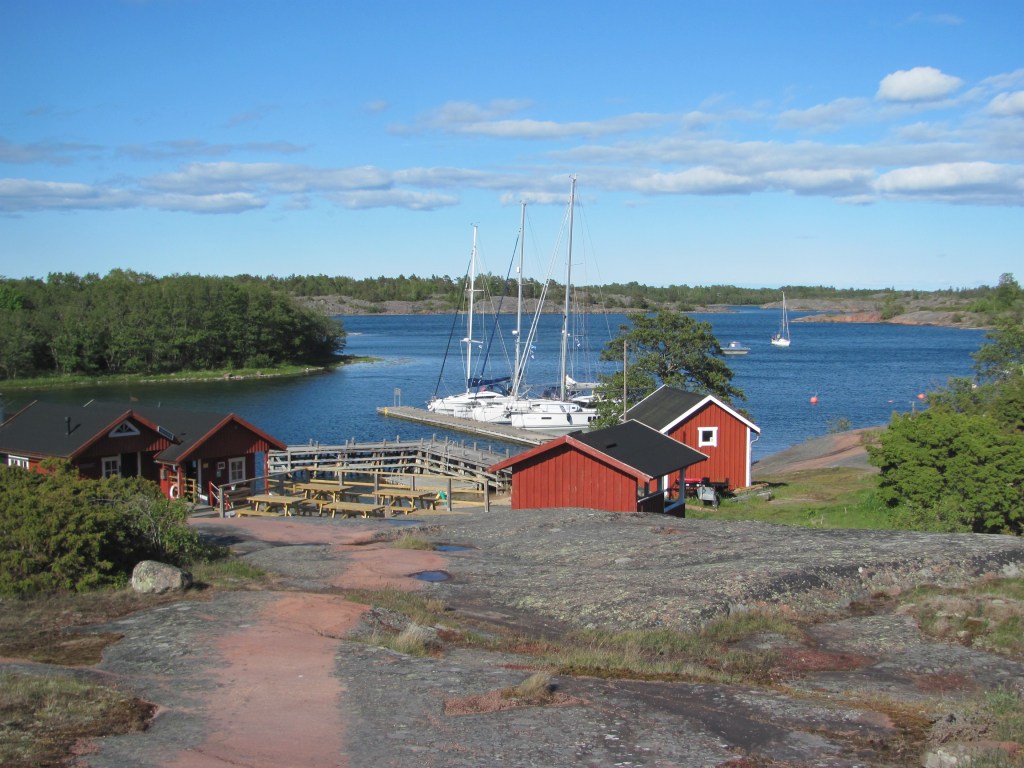
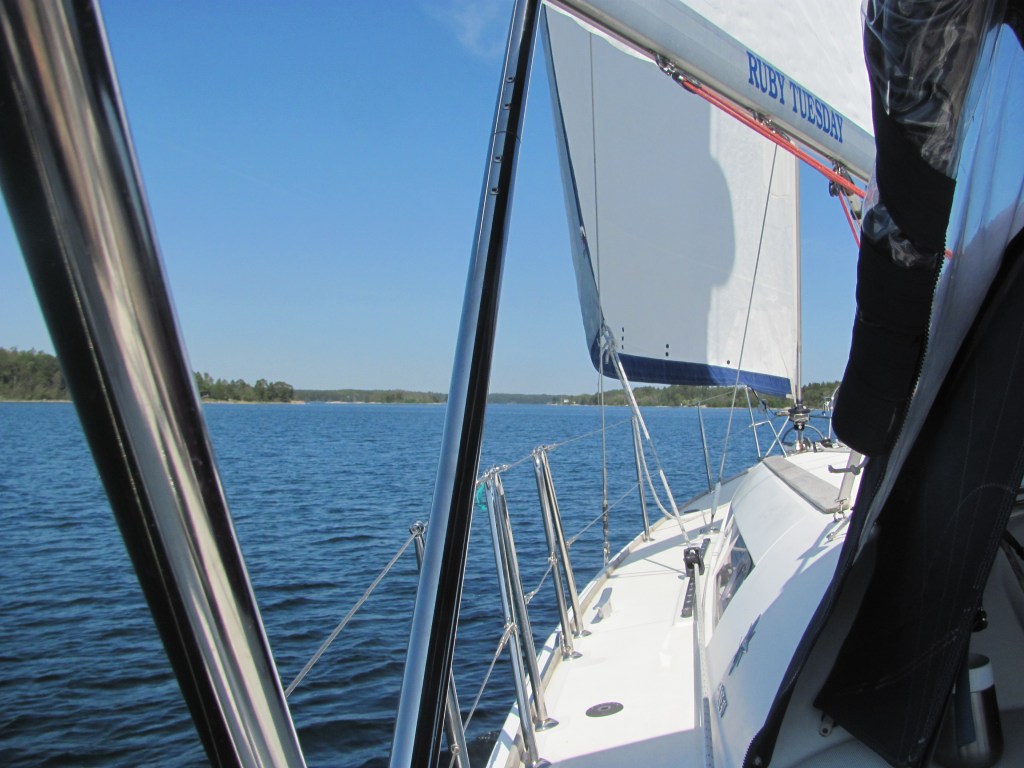
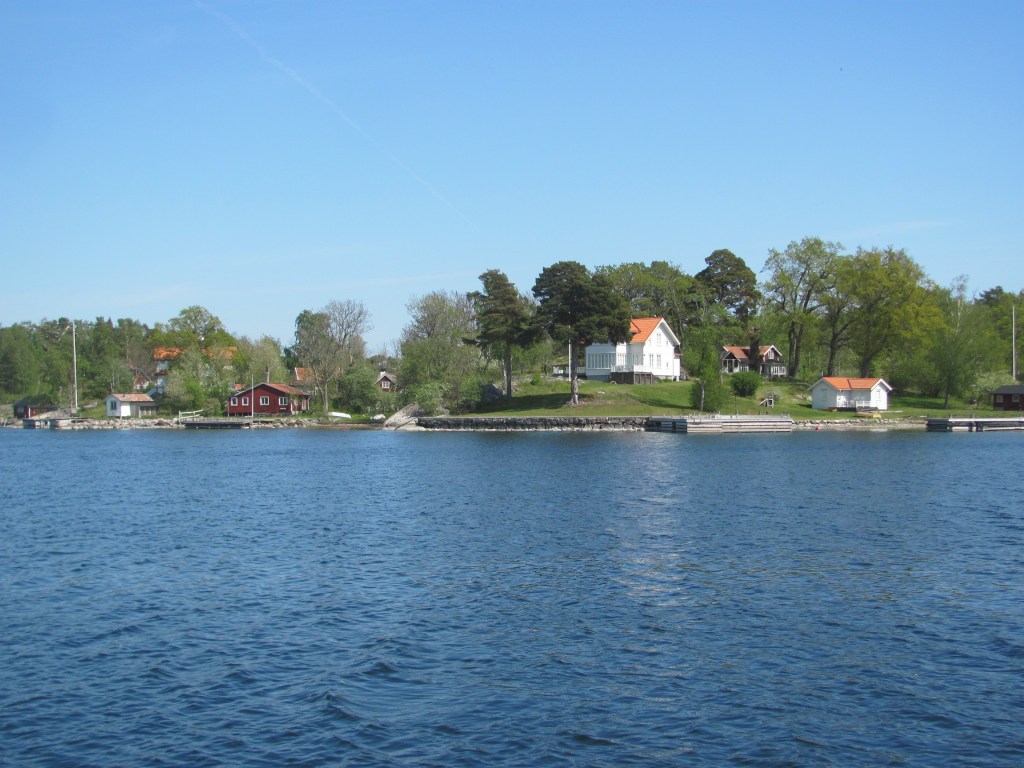
The first leg is a short one, only twelve miles, to get everyone into the way of archipelago sailing. With the wind from the north, directly behind us, we sail with the genoa only, weaving our way around the rocks and skerries on either side. We arrive at the small harbour of Rödhamn, meaning ‘Red Harbour’, named after the red rock that makes up the island.

The harbour at Rödhamn.

We tie up, and have a cup of tea and freshly baked cinnamon rolls all together at the small café next to the harbour. The island was previously a pilot station to guide ships into Mariehamn, but nowadays has only a single inhabitant, the young woman, Annette, who runs the harbour and café.

“My family live on the mainland”, she tells us. “I come here for the summer to look after the island. I love the solitude and living amongst nature. My family come here during the school holidays though, and we work together on little projects on the island.”

Her speciality is freshly baked bread rolls that can be delivered to the boats in the morning. We place an order, as do the other rally participants.

Our tea finished, we explore the tiny island. Above the harbour is the old pilot station, now converted into a club house for a local sailing club. Further on, the former power generation building has been turned into a small museum with faded photos of the island in previous times. We are to see many such museums in these small island villages, all trying to preserve the memory of everyday life in a bygone era for future generations

The museum on Rödhamn.

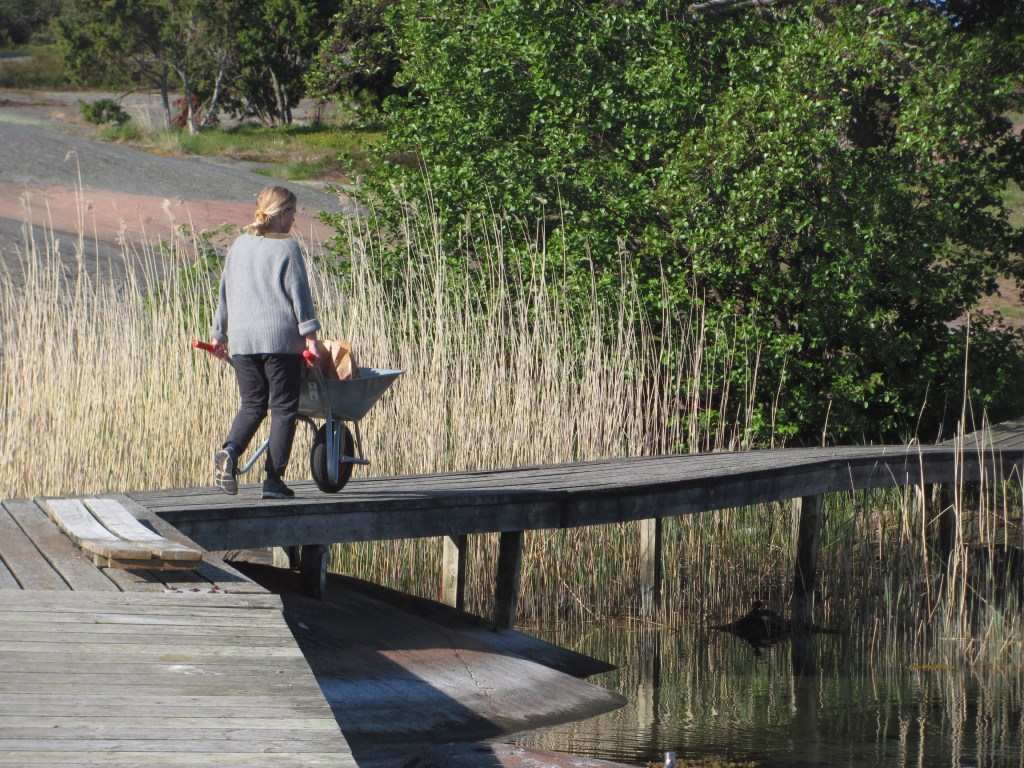
In the morning, we find a bag of fresh bread rolls on the foredeck and see Annette delivering the other orders in an old wheelbarrow.

Fresh breakfast rolls delivered on a wheelbarrow.

“I love fresh rolls and marmalade for breakfast”, says the Cabin Boy.

“Go easy on the marmalade”, I say. “It has to last the whole season. As we saw in the last episode, I get very grumpy if I don’t get my marmalade. And it has to be Wilkin & Sons’ marmalade from Tiptree in Essex. I haven’t found anything as good over here yet.”

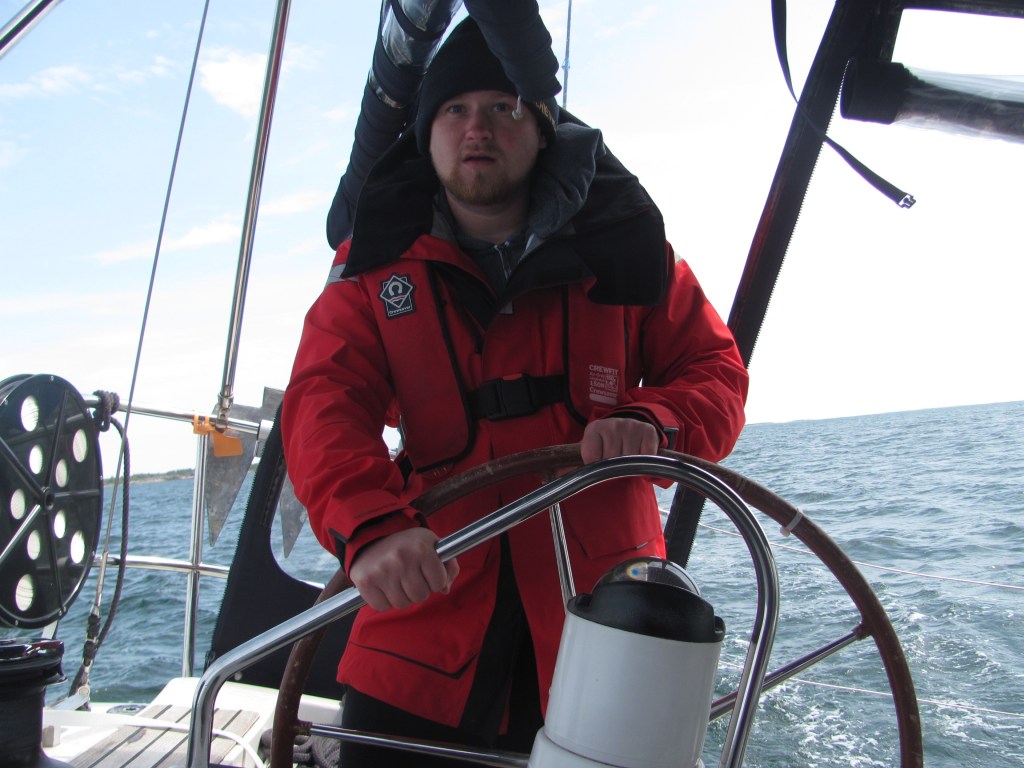
After breakfast, we continue to sail further into the archipelago. The Cabin Boy tries his hand at sailing.

“Whoa! How do I stop her from heeling?.”

Eventually we reach the small harbour of Degerby. The facilities are under refurbishment, and only the female toilets are available.

“I think I will shower on the boat”, says the Cabin Boy. “I am not quite ready for mixed showers yet.”

In the morning, I go for an early morning walk to take some photographs of the village. There isn’t much to it. Most of the activity is clustered around the small harbour, a general store, tourist information, a small museum, and a few small shops selling crafts made by local artists.

House in Degerby.

Before long I have reached the end of the village. On the way back, I meet another early morning riser. He is a sailor from Finland heading for Denmark.

“Have you heard the story of the Champagne Schooner?”, he asks, as we walk back to the harbour.

I tell him I haven’t.

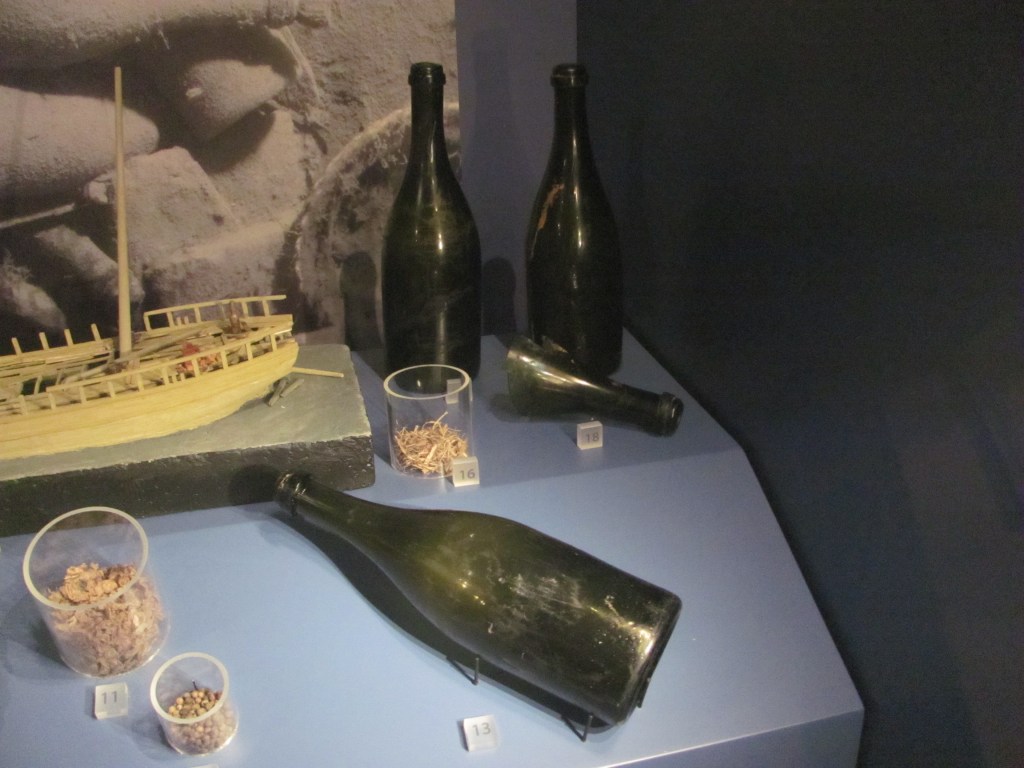
“Well, a ship sank near here back in the 1800s”, he tells me. “It was first discovered in 2003, but no-one really bothered to investigate it. Then in 2010, some champagne bottles were washed up on the beach. This prompted divers to explore the wreck, and, lo-and-behold, they discovered a large number of bottles of champagne and beer on it. It is thought that the cargo was destined for St Petersburg, and maybe even the Russian Imperial court.”

“Was it drinkable?”, I ask.

“Well, that’s the thing”, he responds. “Experts pronounced it undrinkable, but that didn’t stop it fetching record prices at auction. One bottle sold for as much as €30,000.”

“I wouldn’t have minded being the one that found the bottles on the beach”, I say. “At that price.”

“Unfortunately, the bottles were declared the property of the Åland Government”, he says, as we reach the harbour. “So all the proceeds went to them. But some of the bottles are in the Åland Museum in Mariehamn.”

Bottles recovered from the Champagne Schooner, now in Åland museum.

The wind is against us for the next leg to the island of Kumlinge, so we sail close-hauled and make wide sweeping tacks to eventually arrive at the small harbour nestled to one side of a road bridge spanning the inlet. Most of the other rally boats are already there, having left earlier than us.

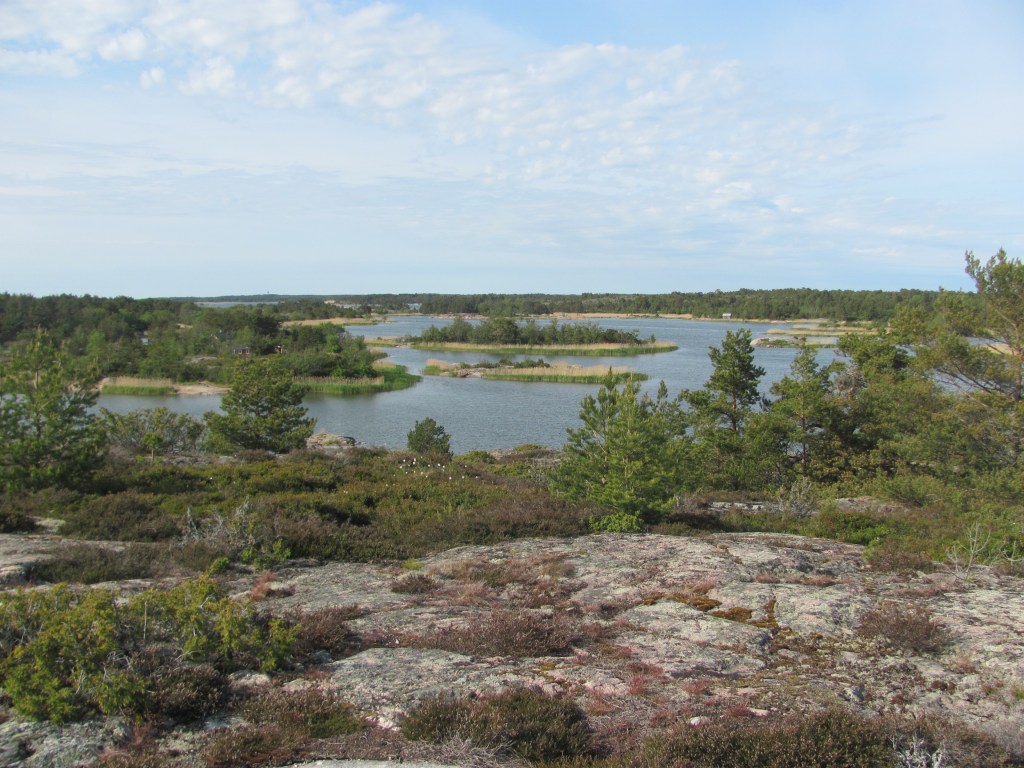
“It’s beautiful”, says the First Mate, after an evening walk to the summit of one of the small hills to the back of the marina. “Imagine waking up to a view like that every morning.”

Kumlinge island.

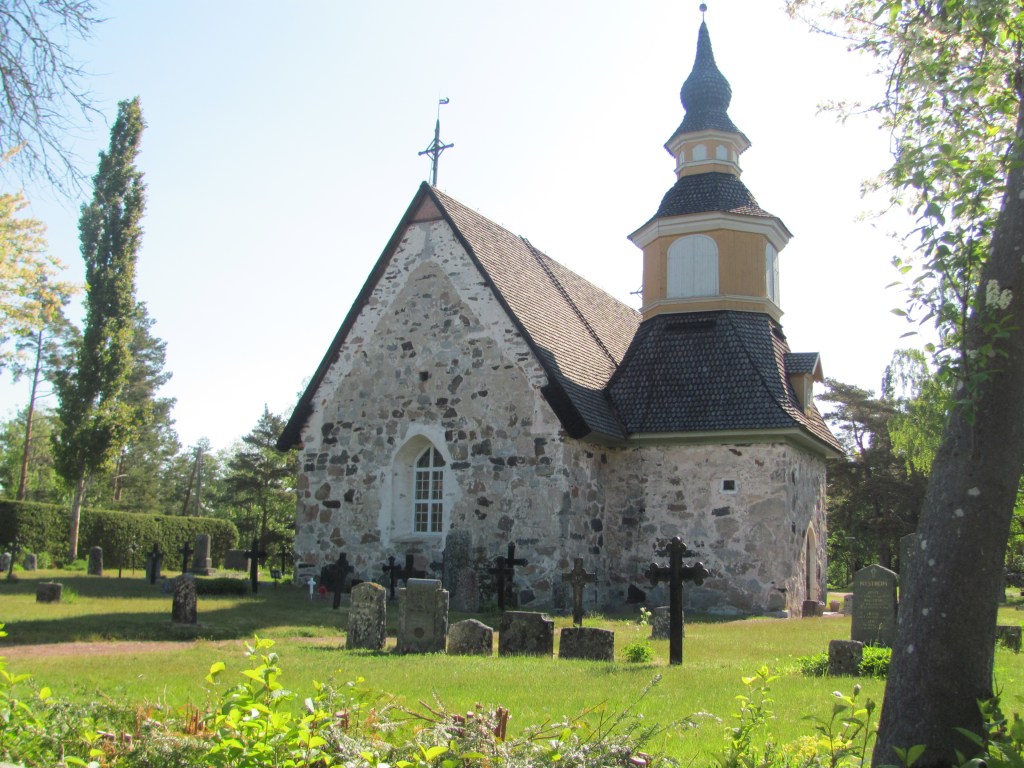
In the morning, the Cabin Boy and I unload the bikes and cycle up to St Anna’s Church nestled in the woods to the north of Kumlinge village. Unfortunately, when we arrive it is closed.

St Anna’s church, Kumlinge.

“There’s someone in the graveyard at the back”, says the Cabin Boy as we walk around the outside. “Perhaps they know how to get in.”

It turns out to be the caretaker of the church. She is from Finland, but loves the island and works there over the summer.

“Normally, we don’t open the church for sightseeing until Midsummer’s Day”, she says with a friendly smile. “But seeing you have come all this way to see it, I am very happy to open it for you.”

“The church dates from the 14th century”, she tells us as she unlocks and pushes open the large wooden door on its creaking hinges. “But there is evidence of an even earlier church dating as far back as the 12th century. No one really knows why it was built here rather than in the centre of the village though. It must have been quite a walk for the villagers every Sunday. And it is not as though the village has moved in the last 600 years or so.”

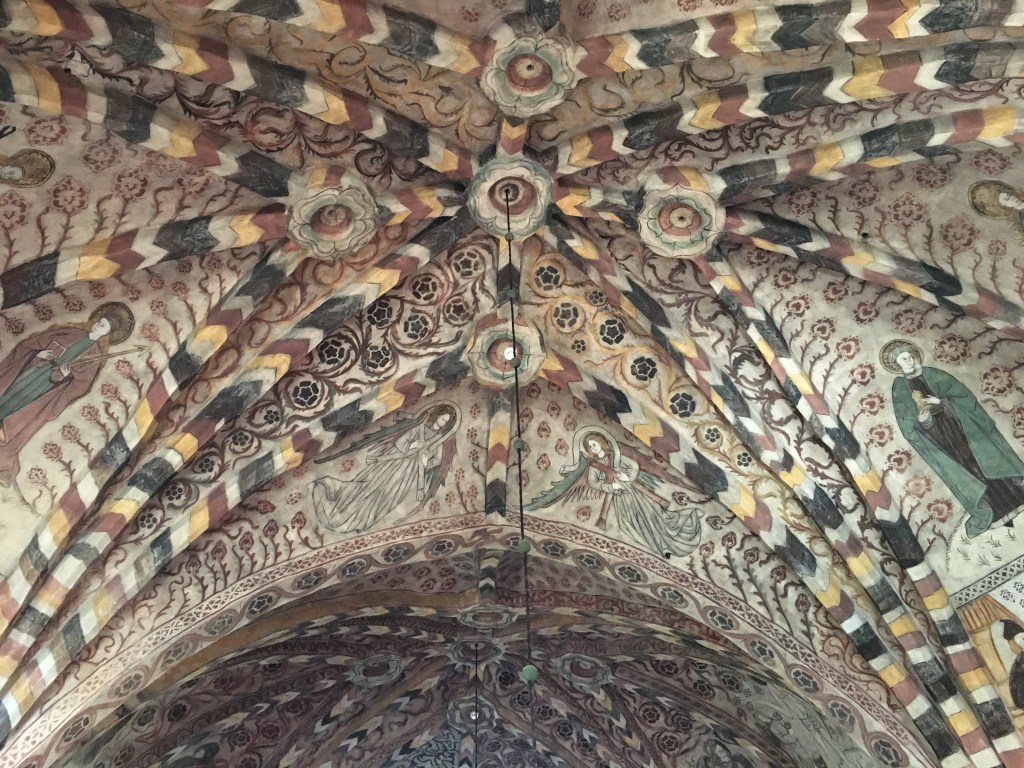
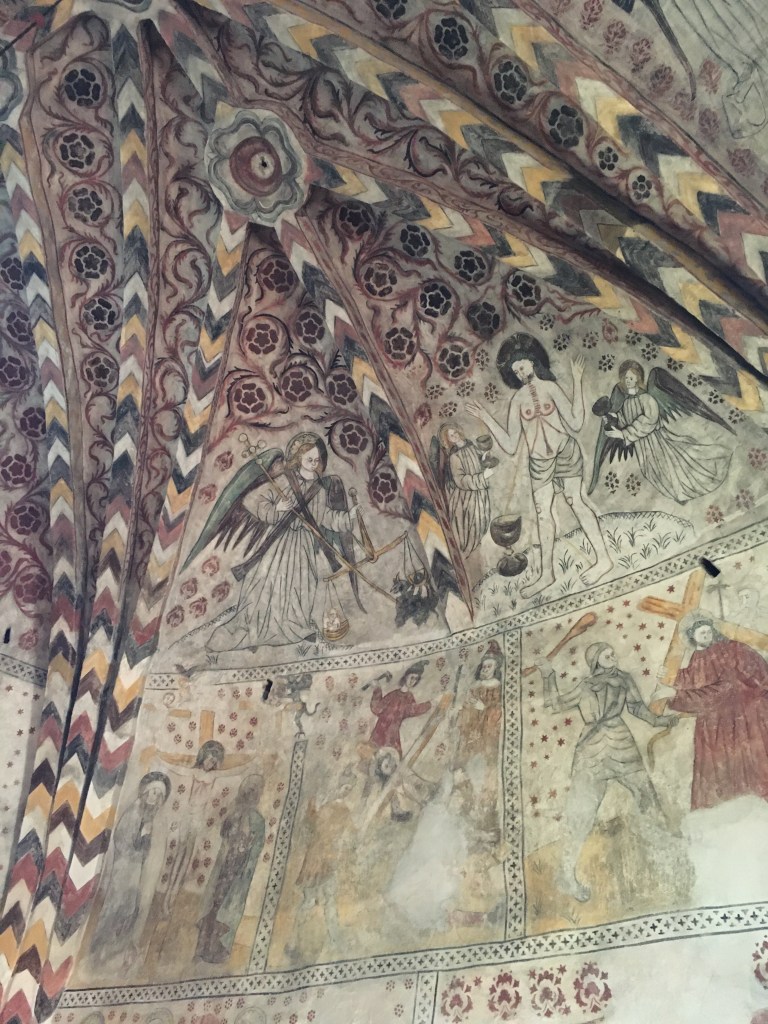
The church is famous for its exquisite paintings in limestone of biblical scenes in the Franciscan style done around 1500 AD.

The painted roof of St Anne’s church, Kumlinge.

”Unfortunately, during the Great Northern War between Russia and Sweden from 1700–1721, Russian troops used it as quarters and a stable”, our guide continues. “They damaged some of the paintings, and most were covered in soot from their fires. They even stole the church bells as they left. After the war, the local people tried to clean the soot away, and inadvertently damaged the paintings. They were painstakingly restored with modern methods in 1961.”

As we walk around, I muse on why so much effort was put by unknown artists into producing these paintings in a remote rural church far from the beaten track. Was it to teach biblical stories to the local people? Or to use their skills to show their devotion to their God?

“I guess we’ll never really know”, says the Cabin Boy as we cycle back.

Detail of the roof paintings.

After lunch, we push on to the next destination, an island by the name of Lappo. This is to be the easternmost island of the Ålands that we will visit.

“I’ve arranged a surprise activity here”, says Andy. “And there will even be prizes!”

The surprise turns out to be a game of DiscoGolf using a frisbee and trying to get it in a metal basket a hundred metres or so away. It isn’t made any easier by a strong cross wind that catches the frisbees and takes them to anywhere except where they are intended to go. As luck would have it, the Cabin Boy manages to get the team Ruby Tuesday frisbee in the shortest number of throws on the first ‘hole’.

“That definitely deserves a prize!”, says Andy.

The Cabin Boy wins a prize!

The rest of the afternoon proceeds with otherwise sensible people throwing frisbees in the general direction of the next hole’s basket, then retrieving then from bushes, from under rocks, tree branches, and other arcane places that the wind has carried them. But everyone enjoys it.

“Right, that’ll do now”, says Andy. “Time for prizes.”

Prizes are awarded for the least number of throws, the longest throw, the most useless throw, the most elegant throw, the least elegant throw, and a few others I can’t remember.

“Now back to the pontoons for a drink”, says Andy. “We’ll meet at six. I’ll bring my drone, and we’ll see if we can get a group photo.”

Group photo at Lappo (from Andy Beharrell).

We cast off the next morning heading back in the direction to Mariehamn. The wind is strong, and the sailing boisterous to say the least. We travel together with Bob and Fiona in Hekla of Banff.

“She was named after a volcano in Iceland”, Bob tells us. “And no, we are not from Banff. But the first owner was. We’re from Plymouth.”

Hekla of Banff.

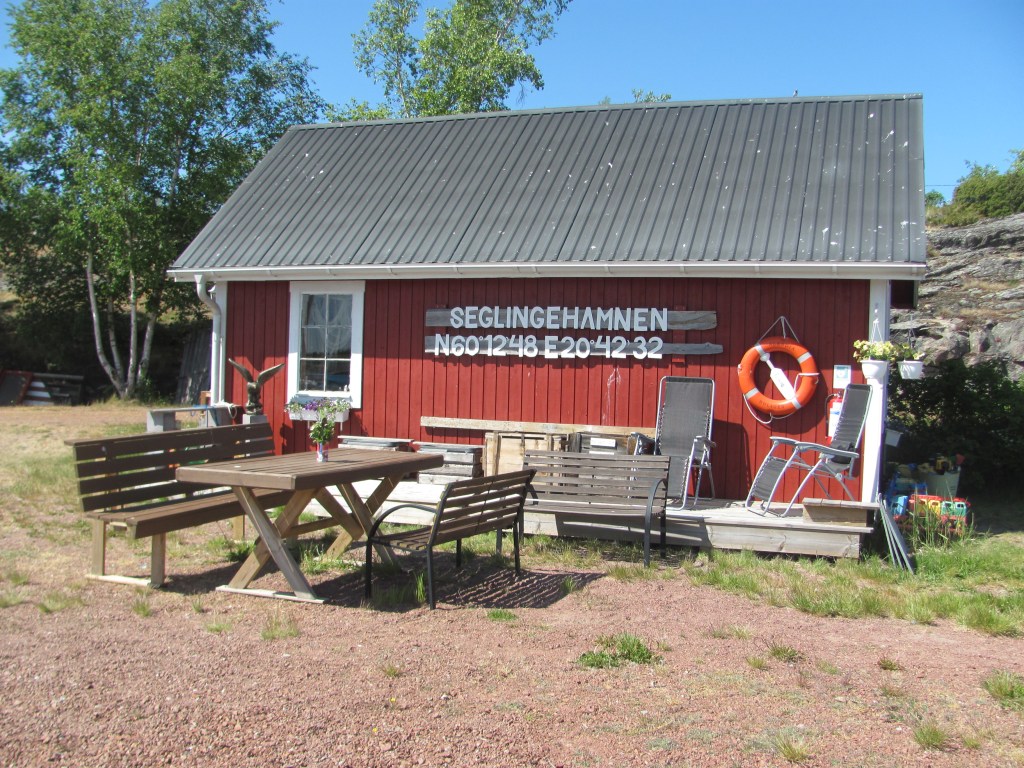
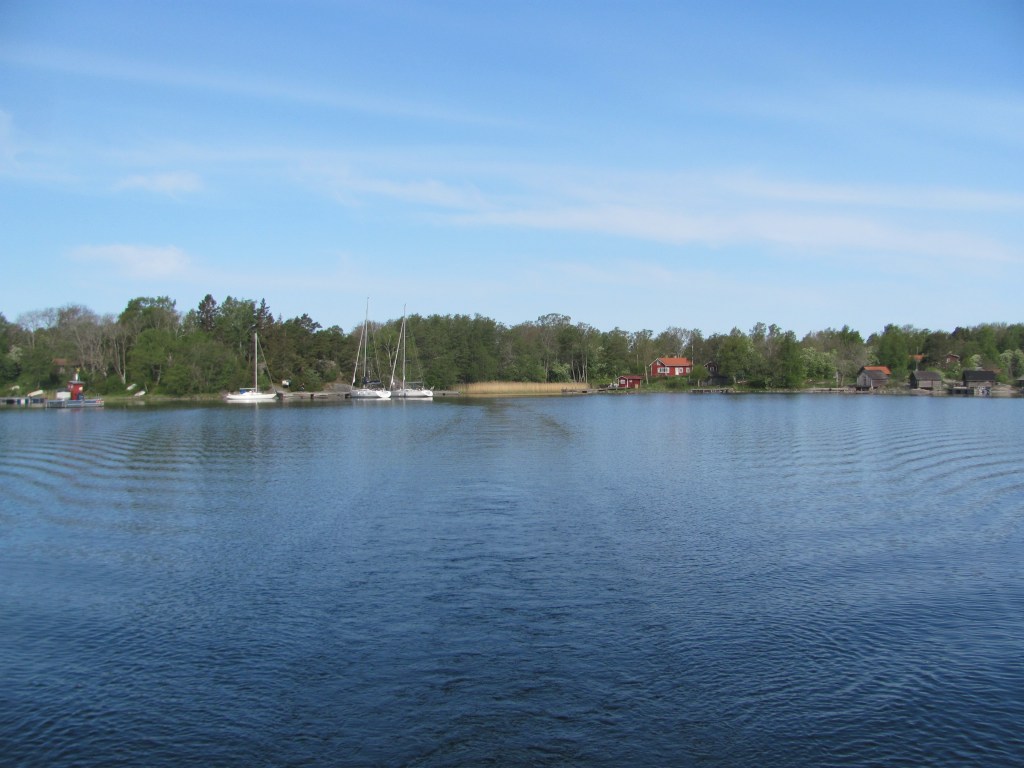
We arrive at the small harbour on the island of Seglinge.

The Harbourmaster’s office at Seglinge.

“No, I wasn’t born here”, the harbour-mistress tells us, in response to our question as she collects the fees. “I am from mainland Finland, but we love Åland, so we decided to come here to live and raise our family.”

It’s not the first time we have heard that.

“I suppose that everyone on the island has more than one job?”, asks the First Mate.

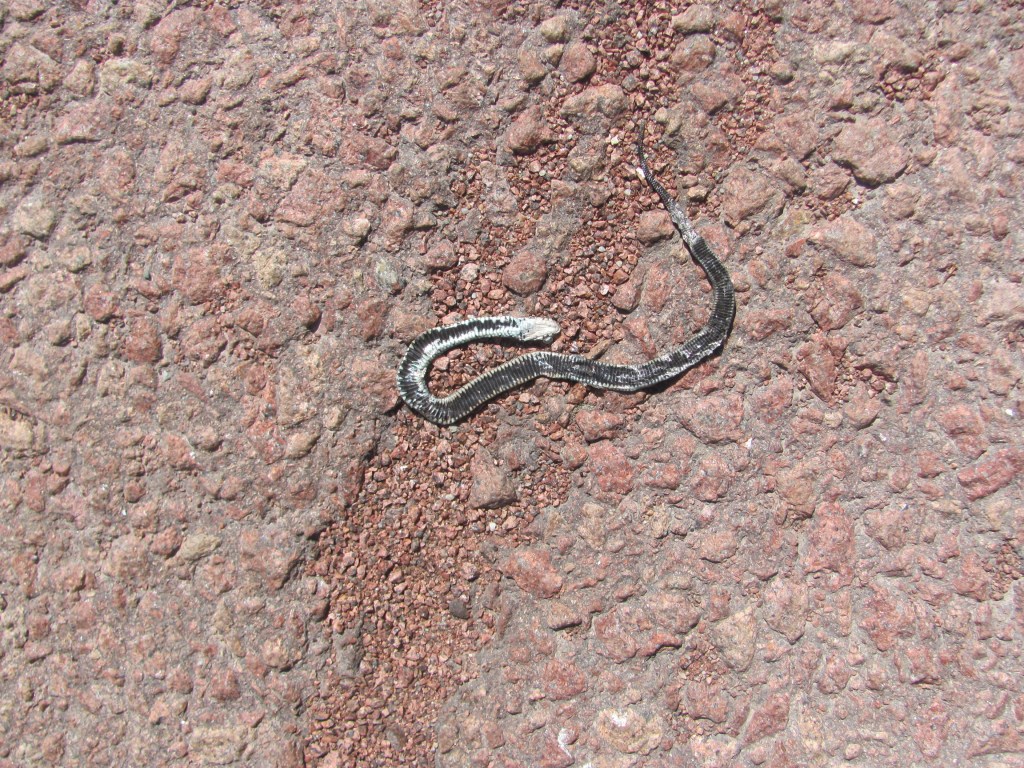
“Yes, that’s right”, she responds. “I, for example, do the school bus run, but I also look after the harbour. We’re trying to make it nice at the moment – there is a family room over there, with children’s toys, and books to read, which you are most welcome to use. My husband is a fisherman, and he also is a mechanic. Our children grew up with boats – first just small ones, but now quite large ones. I have no worries about my fourteen-year-old son being out in his. I am more worried about the snakes on the island.”

“Ah, yes, we saw a dead one on the road when we went for a walk”, says the First Mate.

Dead snake on Seglinge.

“It looks like a windless day”, I say over breakfast in the morning. “Unfortunately we will have to motor for most of the trip.”

We set off. As forecast, there is almost no wind at first, but a breeze does spring up mid-morning. We manage about an hour of sailing, before it dies again.

Trying to catch that puff of wind (from Andy Beharrell).

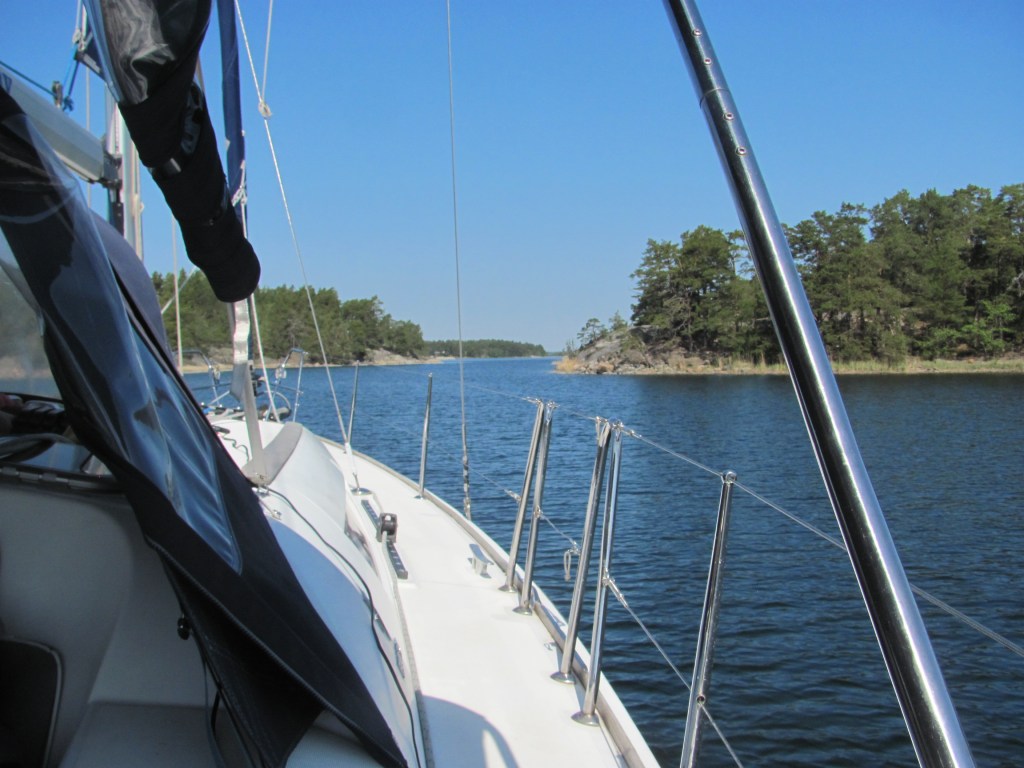
We thread our way through the narrow buoyed channels between the islands, and eventually reach a wide open stretch of water.

“It’s an old meteorite crater”, I say. “Andy told me. It’s called the Lumparn. Apparently it is nine kilometres wide and a billion years old.”

Crossing the Lumparn meteorite crater.

“That’s the second crater we have sailed in”, says the First Mate. “Don’t you remember that one in the Swedish Archipelago that we crossed last year. Tvären crater, I think it was called.”

“A mere baby in comparison”, I say, consulting Mr Google. “That one is only two kilometres wide and 455 million years old.”

“It’s hard to imagine how old these craters are”, says the Cabin Boy. “I used to think that you two were old, but this puts it all into perspective.”

Autonomy, brave postmen, and meat for the future

The early morning mist rises from the still water of the bay, as the First Mate casts off the mooring ropes from the small staging and I haul in the stern anchor. There is no sign of another living creature; the island sleeps before the start of another day. We motor quietly out, ripples spreading out on both sides as we pass. Two swans appear from amongst a reedbed and bid us farewell.

Leaving Arholma.

The forecast is for almost no wind for the first hour or so, then for a light breeze to pick up from the south. We round the small headland at the northern entrance to Arholma and set a course for the Åland Islands some 20 miles away across the Sea of Åland, but invisible now in the haze.

On schedule, the wind arrives, ruffling the smooth surface of the sea with tiny wavelets. We pull out the sails, cut the engine, and enjoy a gentle beam reach.

“This is the sort of sailing that I like”, says the First Mate. “I’ll make some breakfast.”

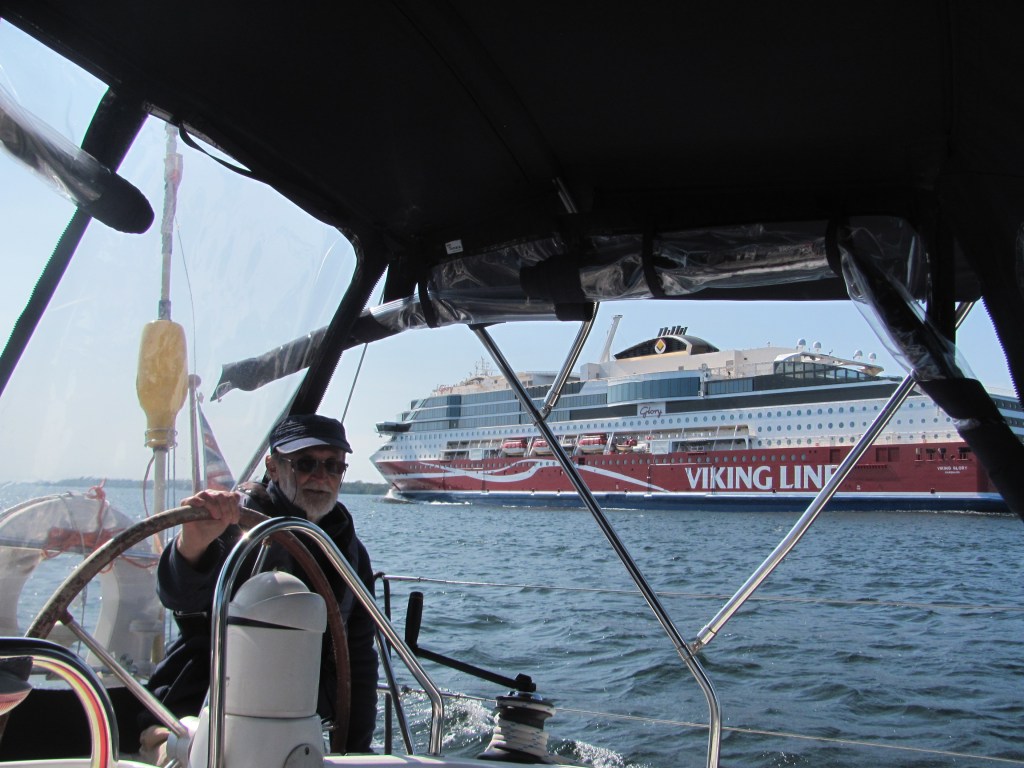
Soon the smell of toast and coffee wafts its way out of the companionway. We sit in the cockpit and bask in the warmth of the sun. On the horizon, we see a ferry heading in the same direction as ourselves.

“We’ll have to watch out for ferries creeping up behind us” says the First Mate. “They go pretty fast.”

“We are further north than the main ferry route between Stockholm and Mariehamn”, I say. “So we should be alright.”

The haze clears slowly and the grey low-lying shapes of the Ålands appear in the distance. Soon we are approaching the western entrance to Mariehamn.

“That’s a strange-looking structure over there”, says the First Mate, pointing to some buildings on a island to our starboard.

“It’s called Kobba Klintar”, I say. “There’s a video on YouTube about it. It’s all that remains of an old pilot station. Apparently if the weather is absolutely calm you can go and moor in its tiny harbour, but there is only just enough room to turn a boat around on its own length, as well as some nasty rocks to avoid, so you have to know what you are doing.”

“Let’s give it a miss”, she says. “For the moment at least. Careful – there are two ferries coming out of Mariehamn. Don’t get too close to them.”

Kobba Klintar on the left, Mahällen light on the right.

The ferries bear down on us intimidatingly, but we are already as far as possible to the edge of the fairway as we can go. They turn away at the last minute and pass by us with only a few metres to spare. Their wash causes Ruby Tuesday to rock violently from side to side for a few moments.

A ferry narrowly avoids us.

We pass the Pommern, an old four-master sailing ship that is now part of the Mariehamn Maritime Museum. We have a visit to it scheduled for the first day of the Cruising Association Rally we are joining at the weekend.

The Pommern.

We reach the marina and tie up alongside. A Brit helps us with the lines.

“I recognised your flag”, he says. “We are also members of the Cruising Association, but unfortunately we are not joining the rally next week. We have to leave our boat here for couple of weeks to go home to attend to some family business. But I hope you all have a good time.”

Tied up in Mariehamn West marina.

We unload the bikes and cycle into town. Mariehamn is on a narrow stretch of land with marinas on each side. We are in the Mariehamn West marina. There is a laidback charm to the town, with its tree-lined avenues and few cars, reminiscent of a bygone era. The houses are mostly wooden and graceful, reminding me of the older colonial-style houses in New Zealand. Each has a fire-escape ladder from a top window to provide an escape route in case of fire.

Wooden house in Mariehamn.

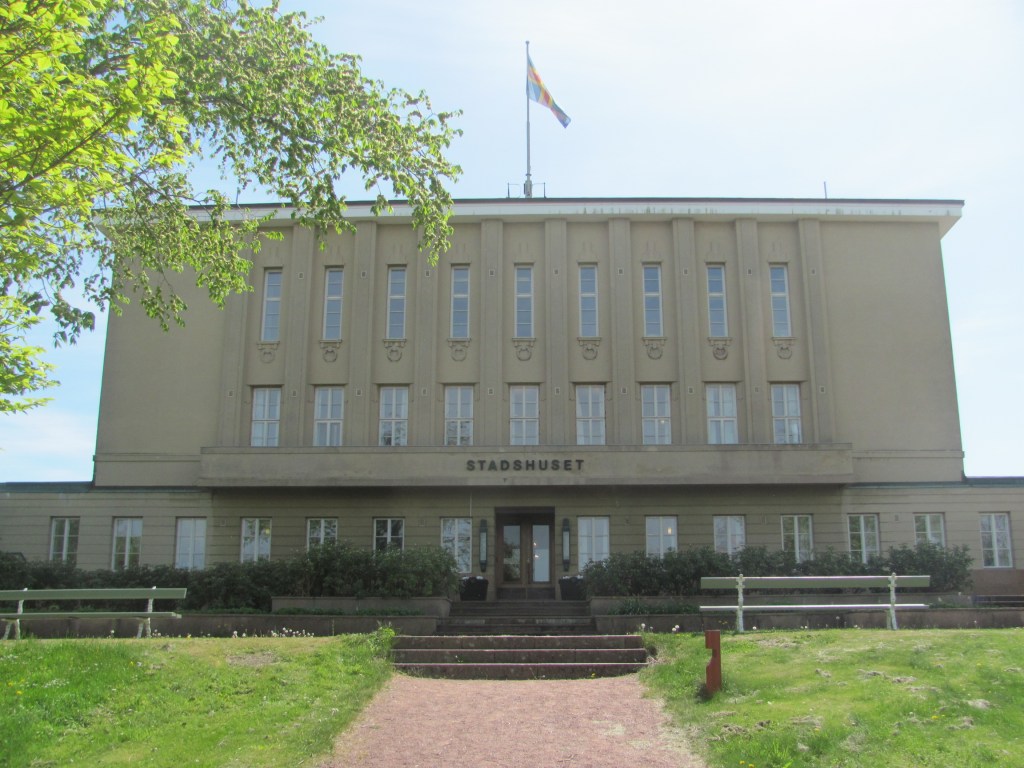
We eventually reach the Town Hall on top of a small hillock to the south of the main street. A display at the entrance tells us  it was built in just over a year and completed in 1939, on the eve of the Second World War. The town administration work there.

Town Hall or Stadshuset.

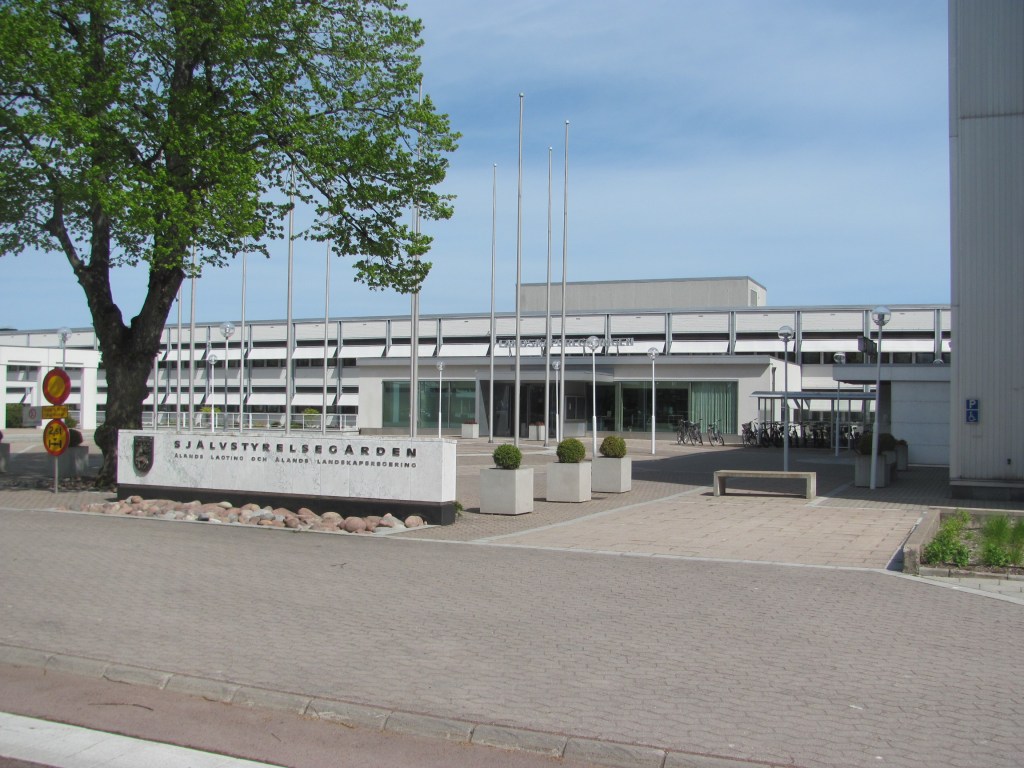
At the bottom of the hill are the modern Parliament Buildings containing the offices of the Lagting, the autonomous regional government of Åland.

Åland Parliament buildings.

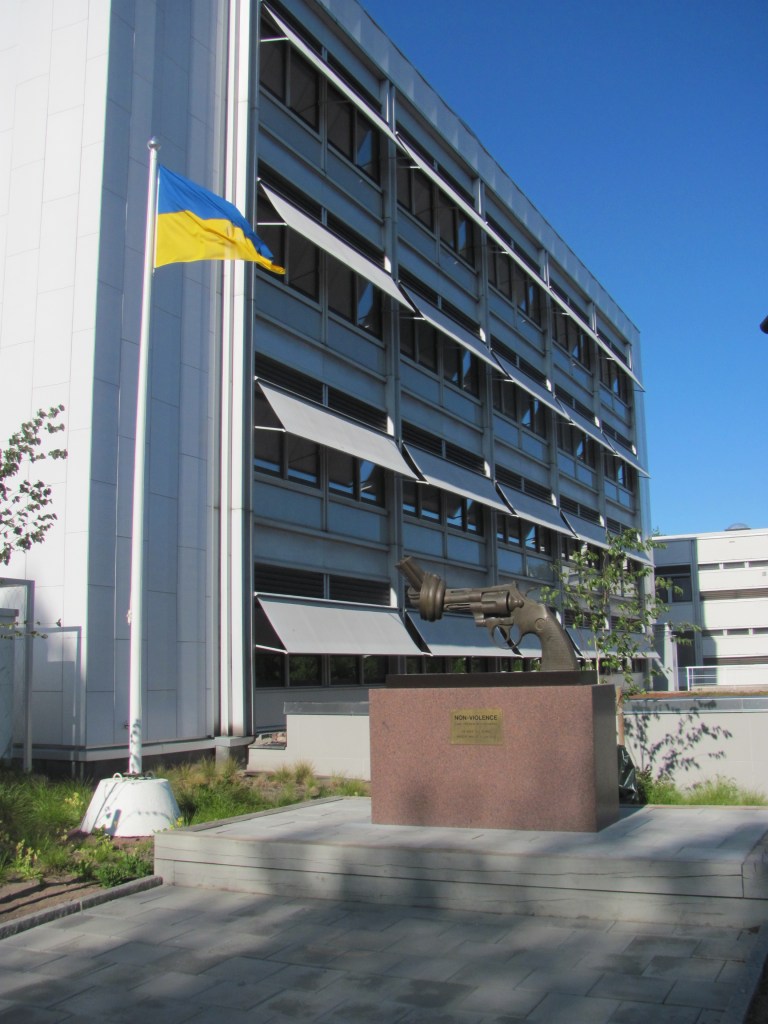
A sculpture of a gun with its barrel knotted to prevent it from firing stands outside the Parliament buildings. A Ukrainian flag flies from a pole nearby.

Say ‘No to War’.

We end up at the museum near the seafront. As luck would have it, it’s a Thursday and entry is free.

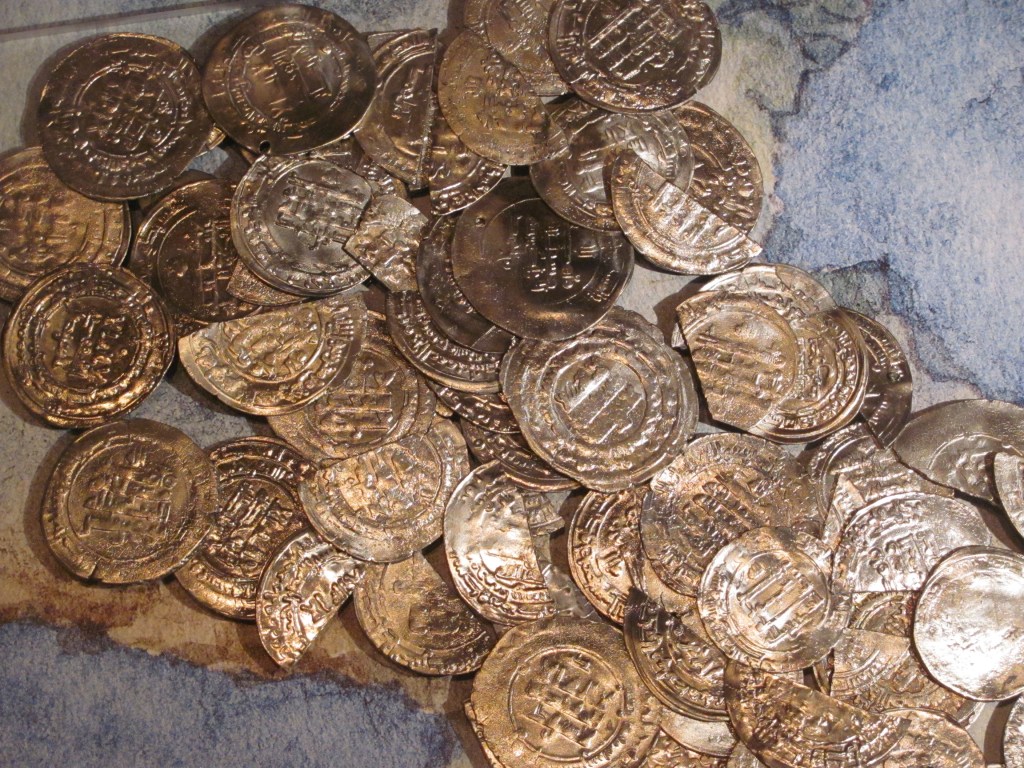
“The Åland islands emerged from the sea just 7000-8000 years ago”, I read in the first display. “It was settled by two Neolithic cultures who practised seal hunting and fishing to survive. This was followed by Bronze Age and Iron Age peoples. These people must have already had good links with the outside world as Arabic coins have been found that date from 400 B.C.”

Arabic coins found in Åland.

“Look, this bit tells all about how Åland became part of the Swedish Empire in 1324”, says the First Mate. “Apparently as a result of a peace treaty between Sweden and the Novgorod Republic in Russia most of Finland and the Ålands were incorporated into Sweden. I suppose that is why they still speak Swedish today, even though they are now part of Finland. Anyway, Sweden went on to become a major European power.”

“Then in 1809, Finland and the islands were ceded to Russia”, the next panel tells us. “Russia built a fortress at Bomarsund, but the British and French destroyed it in 1854 during the Crimean War. In the resulting treaty between the three countries it was agreed to keep the islands demilitarised. After WW1, most of the islanders wanted to be reunified with Sweden rather than Finland, but Finland didn’t want that, so they have remained with Finland to this day despite most of the population speaking Swedish. Nevertheless, they were granted autonomy within Finland by the League of Nations.”

“What a fascinating story”, says the First Mate. “I also read somewhere that they issue their own postage stamps, and that they voted to join the EU in 1995, but negotiated tax exemptions. Apparently goods purchased on ferries to Åland are tax-free, otherwise the ferries wouldn’t be profitable.”

Not sustainable without duty-free.

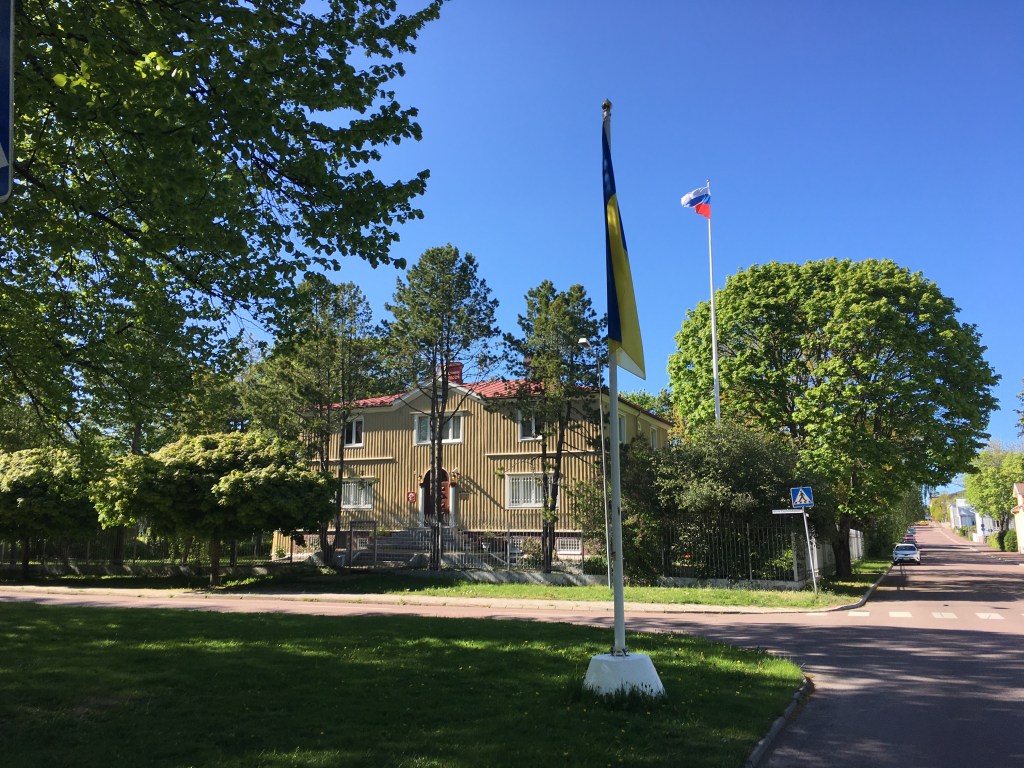
On the way back, we pass the Russian consulate, with the Russian flag flying above. Outside a police car is parked under the trees with the occupants keeping a watchful eye. Opposite a Ukrainian flag flies defiantly. A peace symbol and flower arrangement in Ukrainian colours lie at its foot.

The Russian consulate in Mariehamn.

“There are demonstrations outside the consulate every night at five o’clock”, one of the other sailors at the marina tells us later. “Since Ukraine, the Ålanders are not happy with the Russians being here. Many of them want it to close. There have even been one or two cases where someone tried to set fire to the building.”

The consulate has been in Mariehamn since the 1940s, when it was established to monitor the non-aligned and demilitarised status of the islands.

Expressing support for Ukraine outside the Russian consulate..

In the evening, I decide to have a sauna. There are two other people in there, both Finnish.

“Have you ever tried a sauna before?”, one asks me.

I tell him that I have been in the odd Swedish sauna.

“Ah, Swedish saunas”, he says contemptuously. “They’re not saunas. It like just being in a warm room. You have to try Finnish saunas if you want a real sauna. Do you mind putting some more water on the stones?”

If I was a conspiracy theorist, I might have thought they exchanged winks, but I am not.

I splash a few ladles of water on the hot stones. Steam fills the room.

We chat about sailing for a few minutes. Gradually the conversation slows to a halt like a clockwork toy running down.

“It’s hotter than normal in here”, says the first Finn, beads of sweat all over his body.

“Shall I put on some more water?”, I say innocently. Before he can answer, I splash on another ladle. More steam fills the room.

“I think I’ve had enough now”, says the second, gasping. “I’m going to have a shower.”

“Phew, me too”, says the first.

I look as nonchalant as I can as I go for the ladle again. There is a run for the door. When I hear the showers stop I give them a couple of minutes, and make a rush for them myself. On the way, I pass a mirror. I look like a lobster.

“I don’t feel too good”, I say to the First Mate back at the boat. “I think that the sauna was a bit too hot.”

Braving a Finnish sauna.

“Let’s take the bus up to Eckerö”, says the First Mate over breakfast the next morning. “They only charge €2.50 for bus trips anywhere on the island. We can have a look around the town, then have lunch.”

Eckerö is northeast of Mariehamn, and is where the ferry from Sweden comes in.

We board the bus, and tell the driver to let us off in the town centre. He looks at us quizzically.

“I can drop you off at the Post-Office, if you like”, he says. “I’ll let you know when we get there.”

“That’ll be fine”, I say. Post Offices are usually close to town centres.

On our way to Eckerö.

We sit in the front seat so we can get a good view. The bus takes us through rolling farmlands, forests of Scots Pine, and the occasional small hamlet. Before long, the bus driver turns to us.

“The next stop is yours”, he says. “The Post Office is just a quick walk around the corner to the left.”

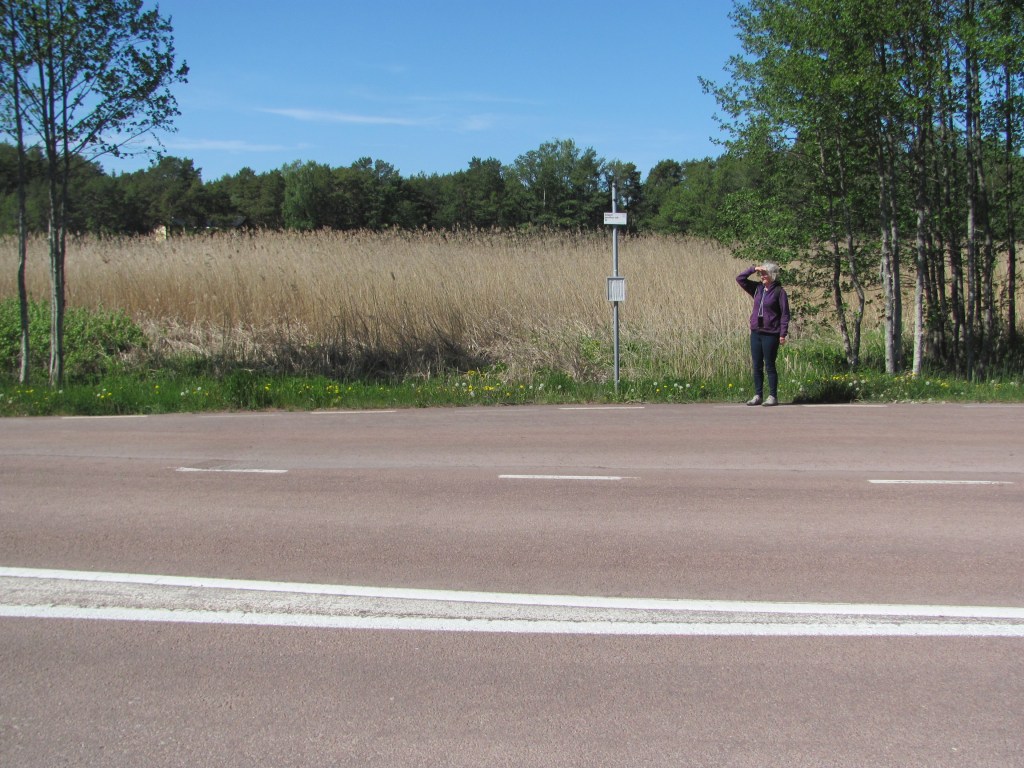
The bus stops in the middle of the countryside. To our right is a swampy area of reeds waving gently in the breeze. A coot swims away in a hurry. On the other side of the road is a small field backed by forest. A cow looks at us nonchalantly over a fence, chewing its cud.

“Why are you stopping here?”, says the cow. “No-one else does.”

I am starting to wonder the same thing.

“This wasn’t quite what I was expecting”, says the First Mate. “Where are the shops and other things in the town centre?”

“There has to be a town centre around here somewhere.”

“This looks like all there is”, I say. “We might as well see if we can find the Post Office at least. Look, there’s the corner the driver mentioned.”

We walk down the little side road. A few hundred meters on is an imposing building in imperial style.

“That’s got to be it”, she says.

It is, but it isn’t any old Post Office. It turns out that it was the westernmost outpost of the Russian Empire, built in 1828 to assert Russian dominance over the Åland Islands, and was purposely ostentatious to send a strong message to Sweden and other nations that they were now entering Russian territory.

Eckerö Post Office.

In the small museum there, we learn about its history. There was actually already a postal route there between Sweden and Finland established by Queen Christina in 1638. Finland and the Baltic States were provinces of the Swedish Empire at that time. On Åland, local farmers were required to provide their services to carry mail between different stages of the route across the islands, rowing across dangerous seas. Many lost their lives.

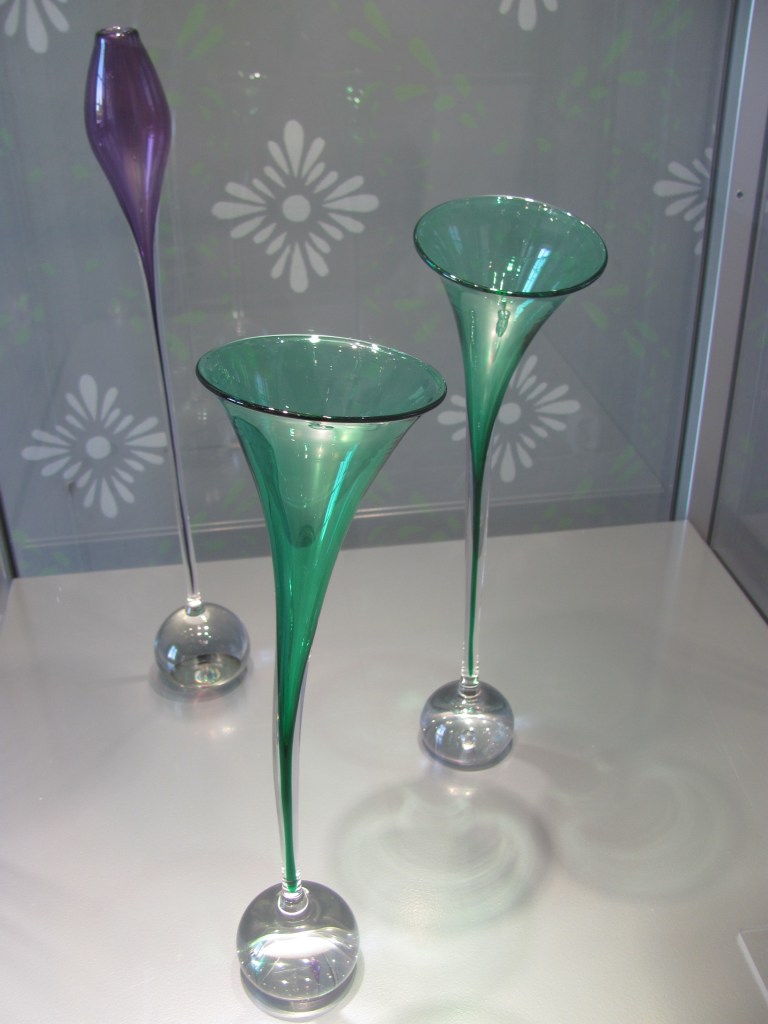
Nowadays it is an art gallery and small museum. There is an exhibition of glassware produced by local artists.

Glassware exhibition.

“I’m starting to get hungry”, says the First Mate after we have finished and are back outside again. “I wonder if there is anywhere to eat around here?”

“There is a restaurant not that far from here”, says a man mowing his lawn in one of the houses next to the Post Office. “Keep on going down this road, then take the first left and carry on there until you come to a junction. It’s just there. But I’m not sure if it will be open.”

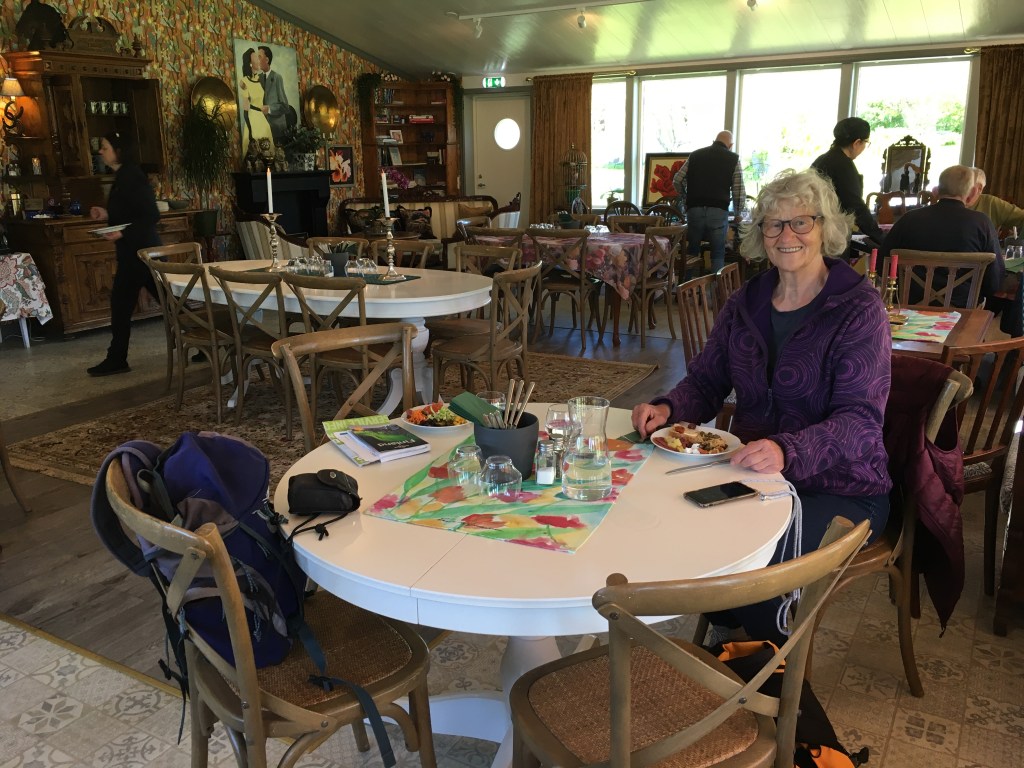
We set off and eventually find Betty’s Restaurant. They are open, and they are doing a buffet lunch. We don’t normally like to eat a lot during the day, but the Swedish way seems to be to eat as much as you can from a buffet at lunchtime and have only a light supper in the evening. We are adapting.

Going for the buffet at Betty’s.

“The meat in the tacos tastes interesting”, says the First Mate. “What do you think it is? It tastes like beef, but there is something about it that is different. Let me ask the waitress.”

“It’s actually artificial meat”, she tells us. “Made from plant protein, I think soya in this case. It’s quite popular as it is supposed to be better for the environment. It’s sometimes difficult to tell the difference, particularly if it has been cooked in a sauce as this has.”

It does taste authentic, and I even get a bit stuck in my teeth.

“But if you really want to try artificial meat, there is a restaurant in Stockholm that serves 3D-printed meat”, she continues. “It’s aimed at people who like their meat, but don’t want animals to suffer for them to have it. It’s still expensive, but they are saying that as it becomes more popular, the price will come down.”

I had read of this technology previously. A company called Juicy Marbles have developed a method to artificially culture animal cells from plants, then use 3D printing technology to reconstruct a steak, building it up layer by layer of muscle fibre, fats and myoproteins. They end up with a piece of meat that has all the genuine animal ingredients, but without going through the process of slaughtering animals to get it.

“It all sounds very sustainable”, says Spencer when I mention it to him later. “But I would be interested in knowing what the energy balance of it is. I wouldn’t be surprised if much more energy goes into producing it that the amount of energy you get out. Not very sustainable if that is the case, especially if energy is going to become more and more expensive in the future.”

He has a point. I make a mental note to check it out.

In the evening, we take a taxi to the airport to meet our son who has flown in from Australia to join us for a couple of weeks. It’s great to see him again.

The Cabin Boy joins the crew.

Swedish holidays, a Cold War relic, and a leaky schooner

“Have you seen the marmalade?”, I ask as I set the table for breakfast. “I can’t find it anywhere.”

“It should be in the Condiments section”, says the First Mate. “Where it always is.”

It’s not. I resign myself to a breakfast without marmalade. The universe feels a bit out of balance.

After breakfast, we weigh anchor, take the north channel from Paradiset, and thread our way gingerly through the rocks and skerries that litter the way. On several occasions it looks as if the obvious route should be straight ahead, but we put our trust in the GPS and the charts and make several dog-legs to skirt around the hazards lurking just below the surface.

Leaving Paradiset.

Our patience is rewarded when we eventually reach clearer water, where we take out the sails to catch the slight breeze that has sprung up and head northwards. Now out of the shelter of the islands, the breeze strengthens, and we skim along at a respectable five knots.

Heading north towards Arholma.

Soon we enter the narrow gap between the islands of Yxlan and Blidö. Elegant houses dot the shores, well-manicured gardens sloping gently to the water. The wind direction becomes more variable as it funnels along the waterway, but we manage to keep the sails full.

Elegant houses.

Soon we reach the end, and enter the main Söderarm fairway used by the ferries from Stockholm to Mariehamn and further.

“The guide books all say that we need to watch out for the numerous ferries that use the route”, warns the First Mate. “They travel fast and can come up behind you before you know it.”

One ferry passes us the whole time we are on the fairway.

“Well, that was a bit of an anti-climax”, says the First Mate, as we cross the fairway and head up a stretch of water call Tjockofjärdin. “Perhaps it’s just the time of day.”

A ferry passes us.

We eventually arrive at the Österhamn harbour on the island of Arholma. There is a small wooden staging against a rock promontory in the south-western part of the bay which requires a stern anchor to hold the boat at right angles to it. It’s time to test our new stern anchor setup that we had fitted in Paradiset. I drop the anchor as we approach and allow the line to pay out. Luckily there is one other boat already there to help us moor the bow. Everything appears to work as it should, and before long we are secured to the staging with the anchor tape holding the stern fast. So far so good. But strong northerly winds are forecast for tomorrow, so that will be the test.

Stern anchor, Scandinavian style.

“I still haven’t found the marmalade”, I say the next morning. “I am not sure I can go without my toast and marmalade.”

“It’ll be there somewhere”, says the First Mate. “Just keep looking.”

We set off to explore the island. There are no cars, and the main forms of transport appear to be unimogs, bicycles or feet. We choose the latter.

Lush fields.

A footpath leads through lush fields decorated with oversize dandelion flowers. Before long, we arrive at the small cluster of buildings on the western side of the island that constitutes the ‘capital’. Only the community-run general store is open. We buy some bread and spreads to make lunch. As we pay, I ask the till lady if there is anywhere else on the island that is open.

Arholma general store.

“They open on midsummer’s day”, she says brightly. “It’s only three weeks now. We are looking forward to it.”

“Why don’t they open earlier?”, I ask.

“There are so few people around, that it isn’t worth it”, she tells me.

We sit in the sun at one of the picnic tables near the small ferry quay, and make our lunch. The small ferry from the mainland arrives and two backpackers and a small family get off. I can see her point.

It has been a puzzle to me for some time now that even though the weather can be beautiful and sunny in May and September, the holiday season in Sweden is really only for the month of July, and shops, restaurants, cafés and museums are mostly closed outside that time, especially in the archipelago. Surely, I think, if they spread the season more, it would be to everyone’s advantage – local people on islands would have more of the year making an income from holiday-makers, and holiday-makers would have a more relaxed time without the intensity of crowds.

“Traditionally, it used to be that everyone had four weeks’ holiday in July with factories and offices closing for the whole period”, says Birgitta, our non-resident ‘go-to’ for information on matters Swedish. “And if you could, you would include the Midsommar weekend in your leave. Then schools start early to mid-August.”

“It does makes sense”, says the First Mate.

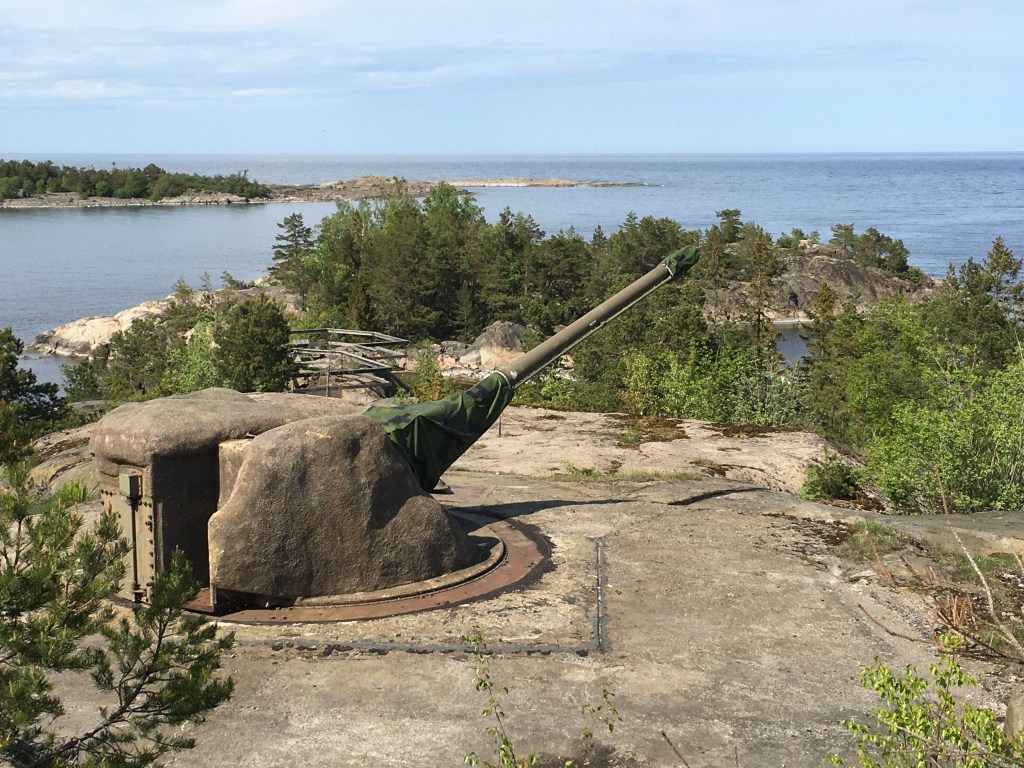
After lunch, we walk through the forests to the northern end of the island where the Arholma Battery is located. Preparations are underway for a wedding there the next day. We climb to the top of a rock outcrop to find the remnants of an early warning system to detect incoming missiles and a large 10.5 cm Bofors gun pointing eastwards out to sea.

Gun disguised as a rock.

We learn later that it was built in the 1930s as part of a chain of coastal fortifications to protect the approaches to Stockholm, and was in service throughout the Cold War. In the 1960s, a cavern was carved out of the rock underneath the battery to house a garrison of 110 soldiers. In the 1990s it was decommissioned, and in 2008 made into a museum and national monument.

“It’s such a beautiful view”, says the First Mate as we sit on a bench and take in the scene. “All this military stuff seems a bit out of place amongst it all.”

“And it always seems that the Russians are involved in some way”, I say. “I wonder if the Swedes are wishing they had kept the battery what with the current situation in Ukraine?”

We walk down the path again, and find the steel gates of the entrance to the underground cavern. At the end of a dimly lit tunnel two people dressed in Gothic style are setting up music equipment.

Entrance to the Arholma Battery bunker.

“We are getting married here tomorrow”, the girl explains.

Surely there must be nicer places to get married than in a dark musty cavern left over from the Cold War, I think to myself.

“It’s cool”, says the male, in response to the look on my face. “And the acoustics are amazing in the big room. Lots of people get married here.”

We wish them all the best for their big day. On the way out I say hello to one of the guests dressed in army uniform and wearing a gas mask. He doesn’t respond.

Wedding guest?

“Come on”, says the First Mate. “Can’t you see that it is only a model?”

“Is it?”, I say. “It’s very realistic.”

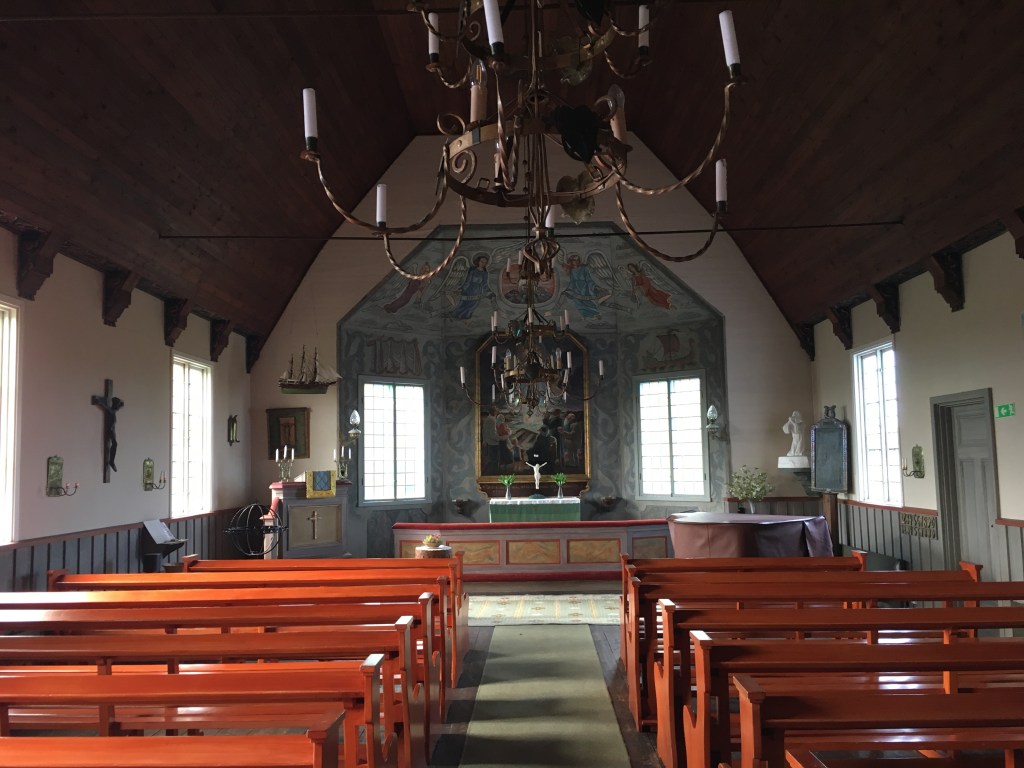
On the way back, we stop off at the church. Apparently, the islanders clamoured for one, so in 1920 a former mission house was moved from central Sweden to Arholma.

Inside Arholma church.

An interesting feature is the use of old mill-wheels as front door steps.

Old millwheels for doorsteps.

A little bit further on is the Arholma beacon. A man walking his two dogs stops to talk to us.

“It was built in the 1760s from stones from the castle on a nearby island called Lidö which the Russians had destroyed during their pillage in 1719”, he tells us. “Apparently Peter the Great wanted to end the Great Northern War between Sweden and Russia, so he sent a fleet of ships to pillage the islands of the archipelago to force Sweden to capitulate. Many of the buildings on the islands up and down the archipelago were razed to the ground. But the Swedish resisted and actually managed to destroy 70% of the Russian fleet and stopped them from attacking Stockholm.”

One of the dogs jumps up on the First Mate, growling.

“He’s afraid of strangers”, he says, hauling the dog back with its leash. “But he won’t hurt you. Anyway, nowadays the beacon is an art gallery open during the summer months. You can get to it up that little path there.”

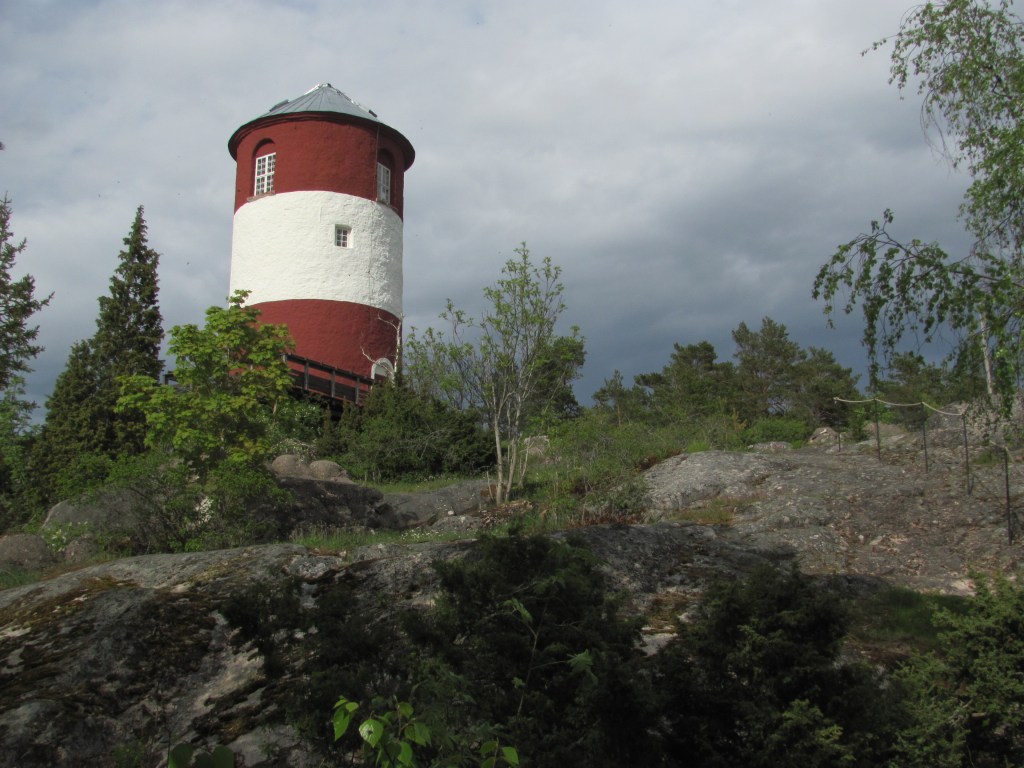
Arholma beacon.

“You get a real sense of the brooding menace of Russia here”, says the First Mate on the way up. “The Battery that we just saw was aimed towards them during the Cold War, that Dalarö Skans fortress that we saw last year, Vaxholm Castle, the effects of the Russian Pillage. And do you remember the Naval Museum in Karlskrona last year? It was very clear from that who the enemy of the Swedish Navy was. I am not surprised they want to join NATO now after the events in Ukraine. Russia always seems to be the enemy, never an ally.”

“Of course, all the European nations have fought and scrapped amongst themselves for centuries too”, I say. “But Russia seems to be the only European country that hasn’t really moved on from that. They still have delusions of empire in an age when empires are a bit passé. The rest of Europe has realised that it is better to have peace and the prosperity it brings, and to trade between sovereign countries rather than trying to conquer and rule them. It makes you wonder if Russia had had a functioning democracy rather than all the power concentrated in the hands of one man, whether the war in Ukraine would have ever happened. But there seems to be something in the Russian psyche that wants autocratic rulers.”

“Well, they didn’t have a very good experience with democracy in the 1990s”, says the First Mate. “So perhaps that explains it.”

That night the wind blows strongly, and the stern anchor drags a little. Luckily I had tied an extra line from the stern to the staging, so the boat doesn’t move much. But it seems that the anchor might be a little bit light. It was only a small one that had come off our previous boat. We’ll need to buy a larger one somewhere.

Extra lines to survive the strong winds.

The next day we decide to walk along the little lane to the top of the bay, where the remains of a wreck are marked on the charts.

The smell of grilled meat wafts over from one of the houses nearby. People are sitting around a table in the garden, while smoke drifts lazily from a barbecue in the corner. The owner of the house sees us and comes to talk to us.

Chatting with an islander.

“Where are you from?”, he asks.

We tell him we are from Scotland, and that we have sailed from there, but not all in one year.

“Ah, are you from that boat over there?”, he asks, pointing across to the other side of the inlet where Ruby Tuesday lies tied up to the jetty. “I saw you come in and tie up, and wondered where you might be from.”

Some of the people in the garden look more Middle-Eastern than Swedish.

“We are just having a barbecue for some friends of friends of ours who live on the island”, he explains, following our gaze. “They are from Afghanistan, and we thought it might be nice to show them a bit of what Swedish island life is like.”

“It must be different from life in Afghanistan”, I say.

“It certainly is”, he responds. “And they are finding it quite cold here.”

“We’ve come to see the wreck over there”, says the First Mate.

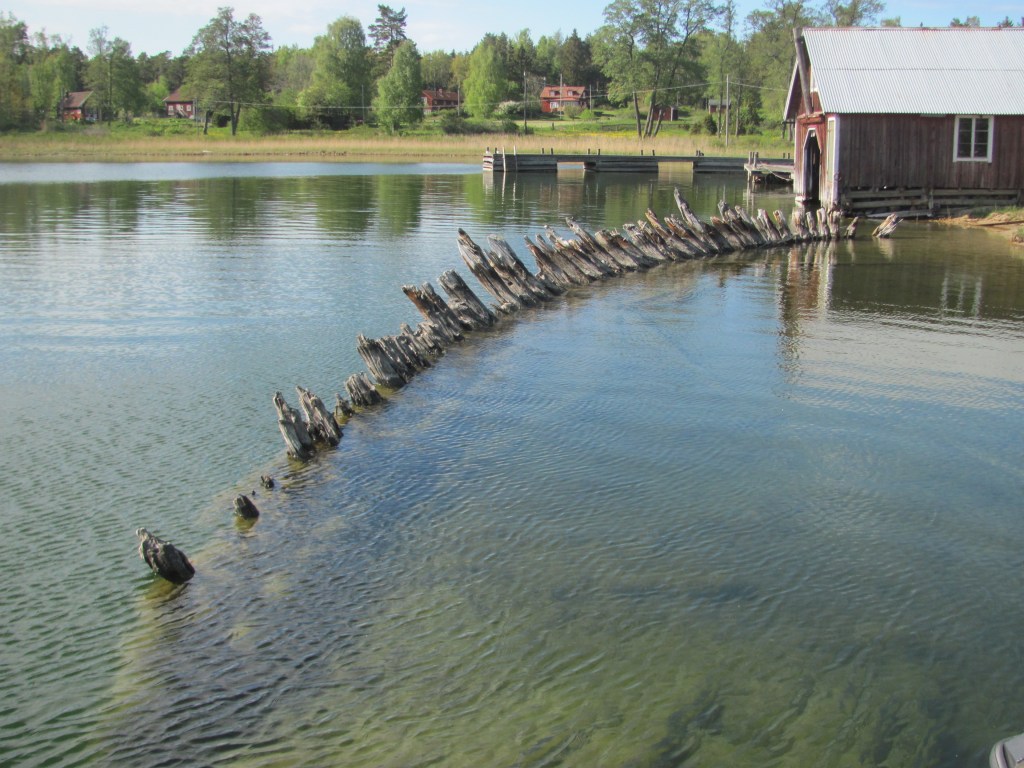
“Ah, that’s the wreck of the Apollonia”, he answers. “She was a square-sailed schooner that was built for one of the island residents back in the 1850s. In those days, Arholma was quite a centre for shipping, and they say that at one stage, there were so many schooners packed into the inlet that you could walk from one side to the other over the boats without getting your feet wet.”

“It’s hard to believe that now”, I say.

“Yes, it is, isn’t it?”, he says . “The Apollonia was 30 m long, made of pine, and carvel built, which means that the planking was butted edge to edge rather than clinker built with the planks overlapping. Caulk was used to seal the joints.”

All that’s left of the Apollonia.

“What sort of boat was she?”, I ask.

“During  her life she mostly carried timber products from Sweden to Germany. But eventually she started leaking through the gaps between the planks where the caulk had deteriorated. One solution to this in those days was to tip buckets of straw and sawdust underneath the boat where the leak was, and the flow of water through the leak would carry this mixture to block it. They could get a few more years of life out of boats in this way. But in 1883, the leaks became too large to plug and it was becoming dangerous to sail her, so they towed her into here to decide what to do with her, and she never sailed again.”
We stand for a few moments looking at all that remains of the Apollonia. I try to imagine the hustle and bustle of the harbour that would have gone on in her heyday – horses and carts bringing sawn timber down from the forests, men loading the planks onto the boats, sailmakers mending the rips in the sails, others bringing the provisions from the farms to be stored below decks. It was poignant to think that all that was left of this busy way of life were a few spars slowly rotting away in this quiet part of the bay.

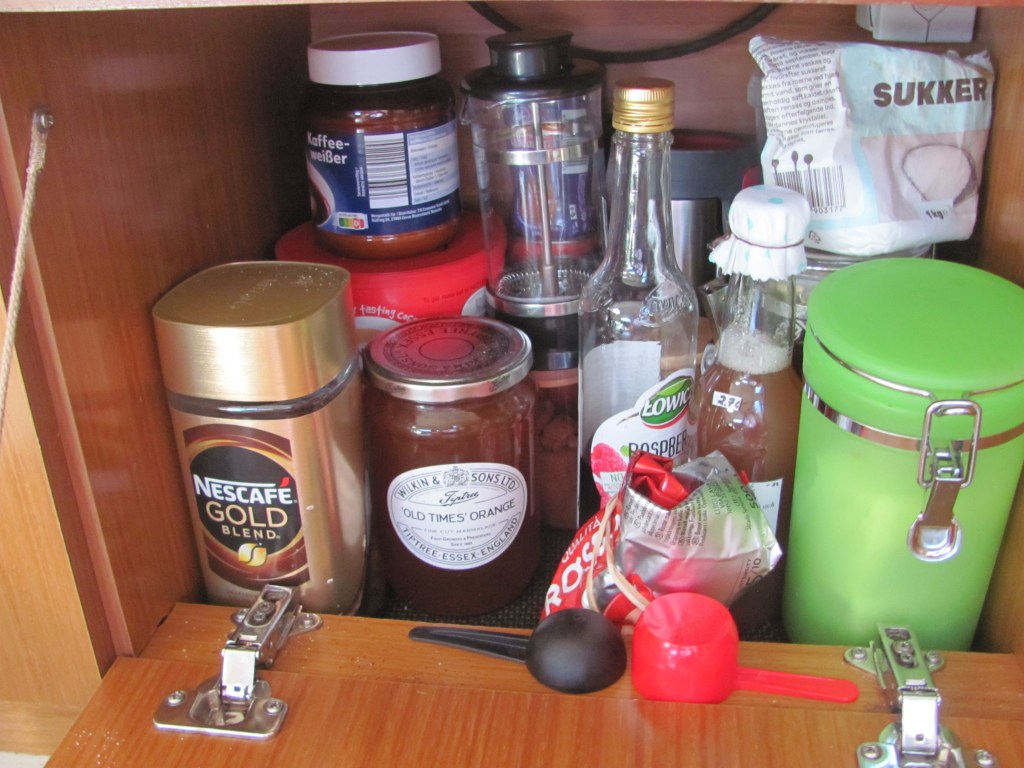
“I’ve found the marmalade”, I say in the morning. “It was hidden behind the coffee jar in the Beverages section. It’s not very logical to keep it there.”

“I must have put it there without thinking”, says the First Mate. “But I told you that you would find it if you just kept looking.”
The balance of the universe is restored.