Three feet hit the white bar simultaneously in time-honoured tradition.
We are in Aberystwyth, my old university town. Back then it had been a ritual for anyone walking along the promenade to ‘kick the bar’ of the white railings when they reached the northern end near Constitution Hill. There are a number of theories about the origins of the tradition, but the one that I like best was that Edward VII had visited the town when he was the Prince of Wales, and while walking along the promenade had put his feet up on the bar to retie his shoelaces. The people of the town had continued the tradition as a mark of respect to their prince.

‘Kicking the bar’ on Aberystwyth’s promenade.
We had left Fishguard around lunchtime the day before and had caught the tidal current northwards. A light breeze had allowed us to hoist the sails to give Peter a chance to hone his sailing skills. Coming into Cardigan, we were amazed at the rock formations and the way that they had been rolled up into a near perfect circle. What forces had caused that, we wondered?

Interesting rock formations near Cardigan.
As we were in no specific hurry, we had decided to anchor in Cardigan and enjoy the sunset with a glass of wine before cooking dinner. An initial attempt on the northern side under a brightly-lit hotel had proved to be too exposed to the slight swell coming in from the south-west, so we had motored across to the south shore near the old lifeboat station and anchored there. Protected from the south, it had been much smoother. We had thought briefly about visiting Cardigan town, but the wide shallow bay had meant that we would have a long way to take the little dinghy before reaching shore, so we decided to stay on board, cook dinner, and retire early.
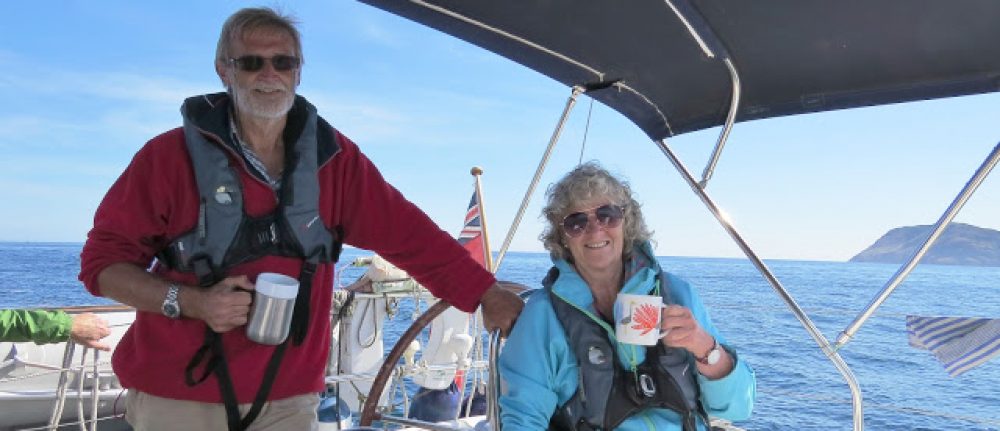
We had left at 0800 the next morning and continued northwards. The sun had come out, and the wind had dropped to a mere puff. The sea had been like a mirror, disturbed only by Ruby Tuesday’s wake. From time to time, we had encountered flocks of black guillemots on the water enjoying the peace and warmth and dispersing only as we neared them to settle a little further away. The light had been ethereal, bathing the sea and sky in a soft glow. Only the billowing clouds of the weak cold front on the horizon we had been warned about on the forecast had reminded us that it would not always be so peaceful.
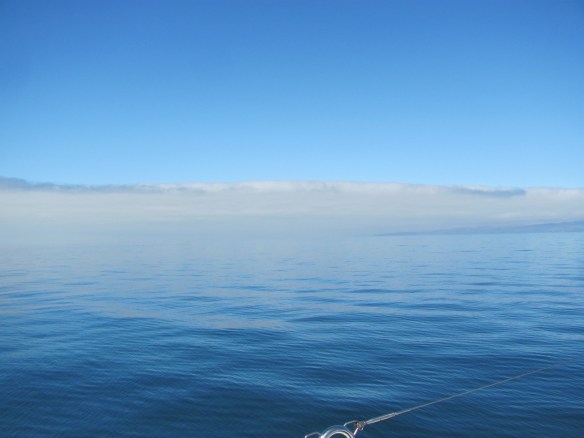
The cold front on the horizon.
I lie on the foredeck in the sun and ponder the ideas in Peter Reason’s book on the relationship between ourselves and nature. At one level, it is not difficult to surmise why this division might have occurred in the first place – nature can be dangerous and life-threatening, and once humans developed an awareness that there is a distinction between life and death and that the latter could be caused by things in the natural world, then it became an enemy, first to be avoided, then to be controlled to meet human needs. I wonder if prehistoric humans conceived of themselves as being different. No one knows for sure, but the cave paintings they left behind would suggest that they worshipped some of the animals around the and therefore saw them as being higher and stronger than themselves. Later we realise that we are cleverer than most animals and we worship other natural objects that we think are stronger – the sun and the moon. The division between nature on earth and humans has begun.
A gannet flaps stiffly over the boat, turning its yellow head this way and that in search of an unsuspecting meal. It reminds me briefly of the annual harvest of guga, or young gannets, by the men of Ness in the Outer Hebrides, carrying on an age-old tradition. Modern civilisation has lost this direct link, and indeed condemns it, but Reason argues that to reconnect to nature, we need to start a new conversation with it. I think back flippantly to my light-hearted chat with my bird friends at Beaulieu River, and am relieved that at least I hadn’t thought of eating them. Perhaps there is hope yet. But I wonder if we can really reconnect again, or whether we are forever separated by our intellect and self-awareness? We can say the words, but does anything really change in our minds? Or is nature just a human construct, able to be changed over time like many more of our worldviews?
We are nearing Aberystwyth now. I awake from my reverie and calculate whether we can enter the harbour yet. There is a sand bar to avoid and we have been warned by the harbour master that the river is quite silted up, so we must enter two hours either side of high water and must carefully follow the transit marks of a west cardinal buoy and a yellow pole behind. It is still three hours to high water, and so we must wait another hour before there is enough depth for our draft. We anchor for lunch just outside the harbour and wait.
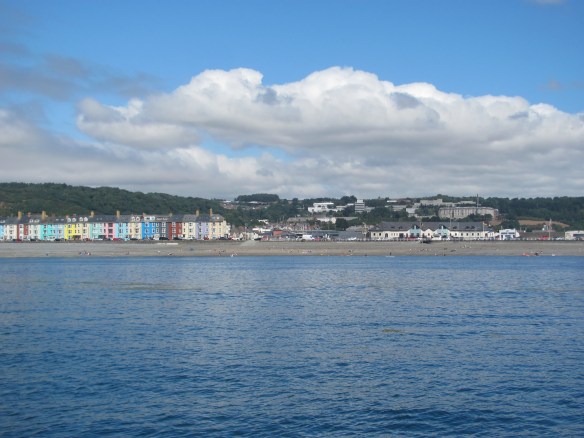
Aberystwyth.
Eventually we enter without any trouble and tie up to our pontoon alongside another couple who are heading north to watch the end of the Round the World Clipper race in Liverpool. He had been one of the crew on a previous leg.
We set off for the town to see the sights. I explain that before we do anything else, we have to complete the tradition of ‘kicking the bar’, so first up is the promenade. Duty done, we wander back to the pier and have an ice cream in the hot sun.
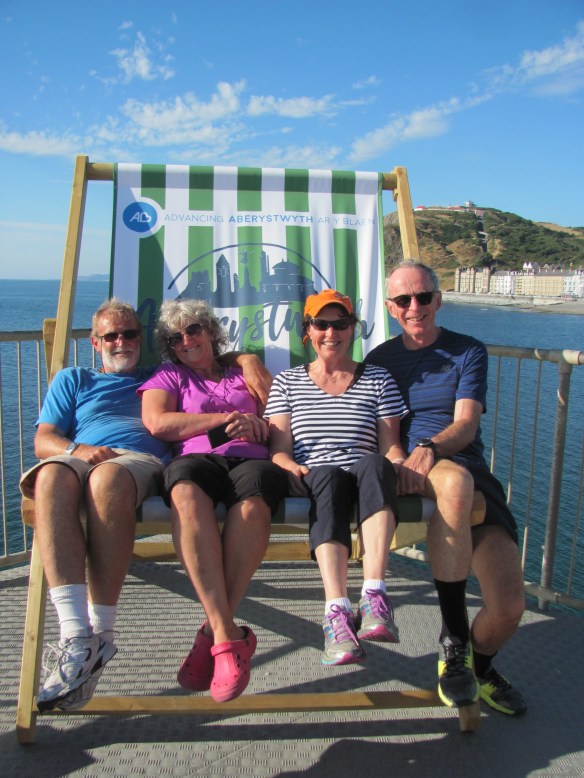
On the Aberystwyth Pier.
I point out the places I used to frequent, and talk about the people I used to know and the things we got up to. We even find one of the student houses I used to stay in –it is in a state of disrepair, but looks like it is being refurbished from the scaffolding around it.

One of the houses I used to live in.
Further on, we come across the chippie that sustained us when we couldn’t be bothered to cook. It had been an enjoyable stage of my life, an awakening of self, so it is a time of nostalgia for me now – 40 years is a long time ago, and a lot of water has flowed under the Rheidol bridge since then.

The Central Chippie.
Our sightseeing done, we traipse our way wearily back from the town and sit and have a drink watching the sun go down over Cardigan Bay.
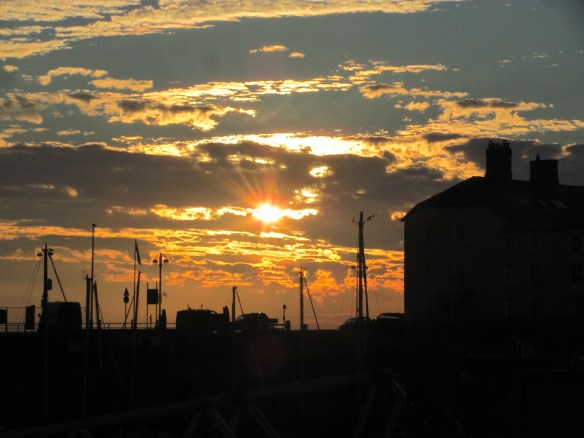
Sunset over Aberystwyth marina.


 Ruby Tuesday