We help the army

There is a bump. I wake up and look out of the boat, half expecting another boat to have collided with us. Nothing, although there is a new boat has appeared during the night and anchored not far away from us. We had heard stories of people smugglers using Lulworth Cove as a secluded spot to deposit their cargo after a fast trip from France in the early morning, but this boat doesn’t look like one of those.

It has been a rough night. The wind had gone around to the north at some point and had strengthened. Rather than being sheltered from northerly winds in Lulworth Cove as one might expect, it seems to act as a funnel instead. I had checked our position a couple of times during the night and we had seemed fine, but when I check the chart-plotter now I see that we have definitely moved from where we had anchored the night before. It seems the anchor has dragged, and we are closer to the rocks at the entrance to the Cove now. We decide to leave now rather than trying to re-anchor.
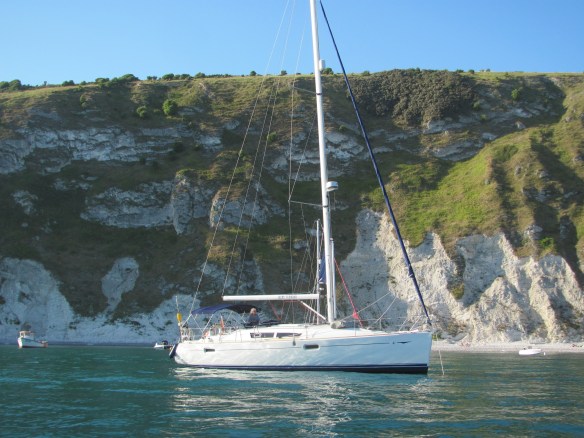
The anchor had dragged in the night somehow.

By the time we reach Weymouth, the sun comes out, and the town looks welcoming and cheerful. Even the harbour master  on the VHF sounds friendly when we call him to tell him of our arrival. The sun always seems to have that effect for me. To reach the marina, we must pass under a traffic bridge that lifts up every two hours. We are instructed to tie up temporarily to a holding pontoon and await the next time of lifting, which just happens to be in a half-an-hour or so.
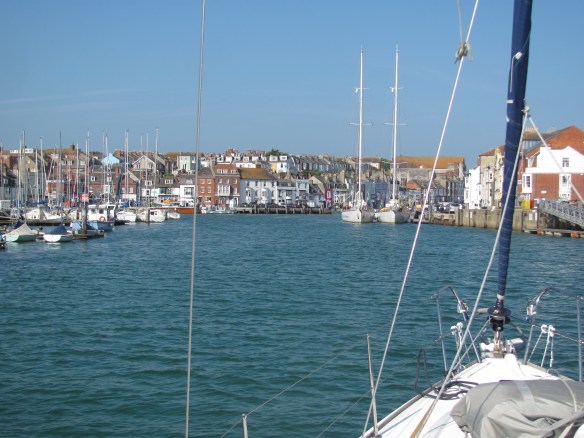
Coming into Weymouth harbour.

Just as we moor, we are accosted by a group of fit looking individuals who tell us that they are army cadets taking part in a competition and one of the challenges they have been told to do is to find a yacht and pose for a photograph with the owners. Would we mind? And we mustn’t allow any of the other teams to do the same. Momentarily thinking it might be a hoax and looking around for the hidden cameras, we don’t have the heart to refuse, and let them clamber on to Ruby Tuesday for their photo. Then just as they thank us and leave, a second team arrives with the same request. The word has clearly got around, and another and then another team arrives. Five teams in all. By this stage we are wondering if there is anyone left in the British Army that is defending the country, but it is all a bit of fun and we agree. At least we have done our bit for the morale of the troops.
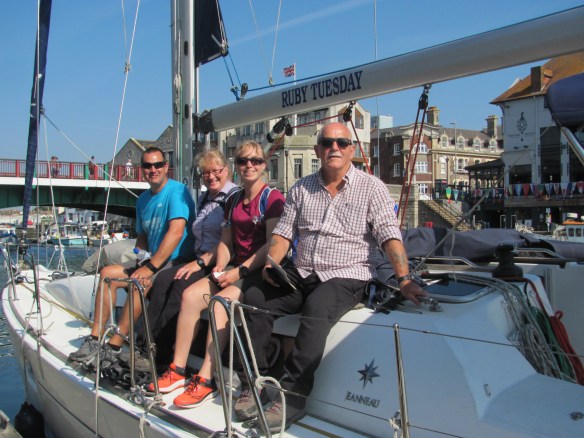
The army have their photos taken on a yacht.

Eventually, a bell rings and the imminent lifting of the bridge is announced, so we need to focus our attention elsewhere. The traffic stops, the bridge lifts, boats coming out sail through, then it is our turn. We have arrived in the marina.

Lulworth Cove

We watch the patrol boat approaching with some trepidation. Have we made a mistake with our calculations of where we are? We are on the edge of the Lulworth Firing range and we know from the maritime safety information broadcast that it is active today. From time to time we have heard the rattle of gunfire from the land, and although we half wondered if we might see the splash of large shells hitting the water, we had thought that we were outside the exclusion zone. I had even called the Duty Officer earlier to confirm the route we should take,

The Range Firing Officer at Lulworth pays us a visit.

We needn’t worry. The patrol boat comes in close, and there are friendly smiles from the two occupants. They enquire if we are OK and where we are heading for, and reassure us that we are fine if we stick to the latitude of 50° 33’N that we are on at the moment, and that we should turn north at 02° 16W to get to Lulworth Cove. They wish us all the best and head off to intercept another boat that is approaching a mile or so away. We hear more shots in the distance.

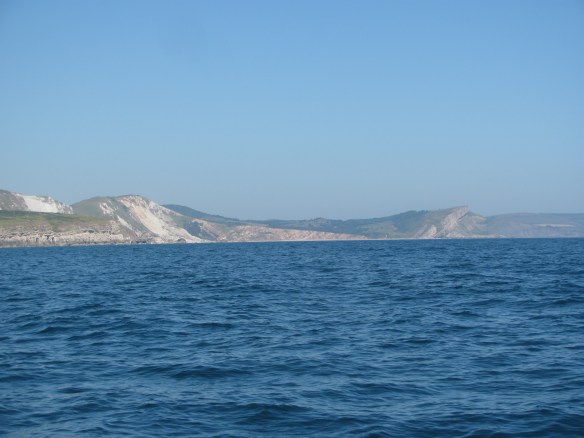
Trying to avoid the Firing Range and looking for Lulworth Cove at the same time.

We approach Lulworth Cove under power as the wind has dropped. The entrance is not easy to see from the sea, but we have the waypoint coordinates and steer towards it. Suddenly the entrance opens out and we see several other boats anchored in there. We cruise in slowly and are momentarily taken aback to see that the beach and water are thronging with people. For some reason, we had naively assumed that we would have it all to ourselves. The relative solitude of being at sea has made us forget that there are many other people in the world too.

Anchored in Lulworth Cove.

We find a spare place and drop the anchor, paying out lots of chain. It seems to hold. We sit and have a coffee in the sunshine, taking stock of the situation. This is Jurassic Coast country. The entrance to the cove is a narrow cut where the sea has broken through the limestone and allowed the waves to erode the softer clay and sands behind into a bulbous shape, while at the back of the cove are the steep chalk cliffs that have resisted erosion. We can see why geologists like coming here, and indeed we see a geology student with her hammer examining rocks in the eastern corner.

Interesting geological formations in Lulworth Cove.

A catamaran arrives and tries to anchor next to us. We think it is too close, especially when there is plenty of room in the rest of the Cove. Its skipper is alone and is trying to wrestle with the anchor winch at the front with no one to help him on the helm. The winch operates with a lever arm and seems to be jammed. I stand on our bow ready to fend him off if he drifts towards us. The skipper looks across the narrow gap between us and grins sheepishly.

“I am a little bit close to you, I think?”, he says, probably interpreting the look of alarm on my face. The accent is unmistakably German.

“A little”, I say, trying not to appear too concerned. The catamaran edges closer. There is perhaps five meters between us now.

“This winch is giving me problems and I am by myself”, says the Kapitan. “I have just bought the boat and haven’t anchored before.”

“If I could get across to you I could give you a hand”, I say, thinking that I need to protect Ruby Tuesday somehow. “But our tender isn’t inflated.”

“That’s no problem, I have a dinghy, and will blow it up and come and fetch you”, says the Kapitan. That saves us the job of pumping up our own dinghy then.

“Perhaps you could just move your boat a little further away from us before that?”, I say.

Soon we hear the puffing sounds of an inflatable pump. The Kapitan rows across and I clamber into the dinghy. We row back to the catamaran. I am not sure what I can really help with anyway, but I direct the Kapitan to a spot a bit further away and drop the anchor. It seems to hold. The Kapitan offers to show me around the boat. It is nearly 40 years old, but has been looked after well. He tells me how he has modified it by converting half of the living area into a sleeping area.

Helping to reanchor the catamaran.

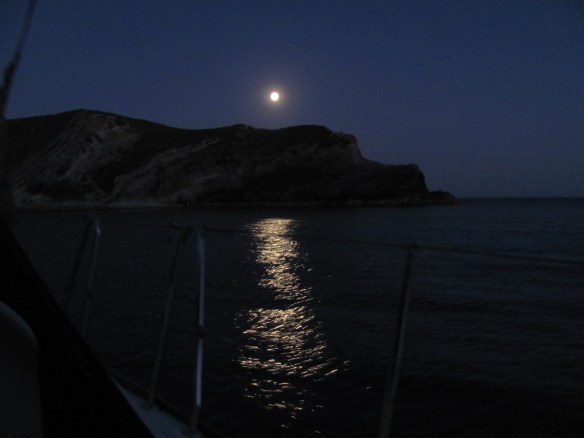
The Kapitan drops me back to Ruby Tuesday. We invite him in for a beer. He is from Munich, but has worked in the Caribbean and elsewhere. He has always wanted a boat, and bought his catamaran in Walton-on-the-Naze in the Thames estuary. He is now wanting to sail the world with it. His immediate plan is to get to Dartmouth, but he is thinking of Spain after that, then an Atlantic crossing. We think he is terribly brave to be doing all this single-handed. The Kapitan shrugs. It’s not all the time – a friend joined him last week, and his girlfriend is joining him next week. She hasn’t sailed before, so we wants her to enjoy it. There is something about his attitude that we like. “Catch your dreams before they fly away”, I think. We sit and try and solve the world’s problems until the moon starts to rise over the cove entrance.

Moonrise over Lulworth Cove.

Poole

I awake with a start. The loud lapping of the waves against the side of the boat can only mean one thing. They are coming from the beam rather than the bow as they would if we were swinging freely. I quickly dress and go on deck. The wind is coming from the east, and all the other boats next to us are aligned east west except us, aligned north south. I switch on the depth sounder. It reads zero. We are grounded.

Grounded off Green Island in Poole harbour.

We are in Poole Harbour. Rather than stay in a marina, we had decided on peace and solitude and had taken the left turn after entering the harbour and followed the narrow South Deep channel around the south of Brownsea Island, and had found a nice place to anchor with a few other boats  just on the edge of the channel near Green Island. I had done my tidal calculations and had estimated that we would have 40 cm under the keel at low tide at 0430 in the morning. Not a lot, but enough. I had gambled on the wind staying in the east as was forecast, which would have kept us aligned at the edge of the channel, but at some time during the night either the wind or the current had changed and we had swung round to where it was shallower. Then at low tide, the keel had settled gently into the mud. No matter, it is a rising tide. I make a cup of tea and sit down to wait.

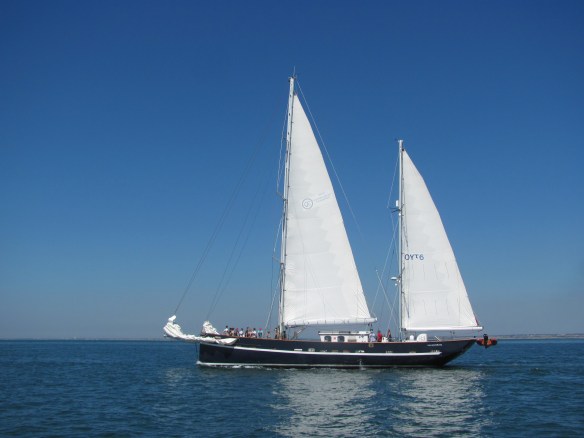
We had arrived in Poole the night before. We had left our paradise on the Beaulieu River in the morning, and had caught the start of the west flowing current down towards the Needles. Before long we were passing Yarmouth to our left, then Keyhaven to our right, each with their respective fortifications guarding the entrance to the Solent, Fort Albert and Hurst Castle. At some point we had noticed a tall ship following us and hoped that she would catch us up so we could get a good view of her.

Tall ship passing us near the Needles.

We had passed the Needles, chalk stacks extending out from the western end of the Isle of Wight. To our right had been the dangerous pebble reef called the Shingles, so we had steered a route between two buoys that took us safely through the two hazards.

Passing the Needles off the Isle of Wight.

From there, we had set a course directly west to Poole. The wind had strengthened to 10-12 knots and we had whizzed along, helped by a favourable current which had taken us in a looping arch northwards then southwards across Christchurch Bay and Poole Bay. A couple of hours later, we were approaching Old Harry Rocks at the bottom end of Studland Bay, more chalk stacks that are the same stratum as the Needles. The sails in, we had had a brief stop for a cuppa in Studland Bay, then had pushed on up the dredged channel into Poole harbour, then to our anchoring spot.

Old Harry Rocks, Studland Bay, near Poole.

There is a slight tremor and Ruby Tuesday detaches herself from the mud below and begins to swing freely, out in the deeper water and aligning herself with the other boats. The depth sounder suddenly reads 2 metres. We are free again!