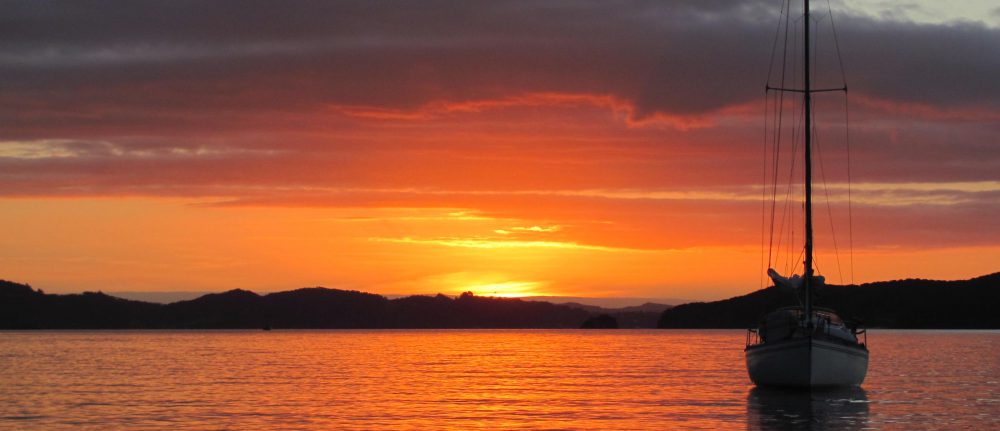
“Ruby Tuesday, Ruby Tuesday”, crackles the VHF radio. “You are cleared to leave the harbour. Please proceed carefully. Good watch.”
It’s five o’clock in the morning, and still dark. I have just called the Ventspils Harbour Control to request permission to leave the harbour. It all sounds a bit formal, but Ventspils Harbour is a busy commercial harbour, and it wouldn’t do to get run over by a giant container ship leaving at the same time. For a start, the First Mate would never forgive me.
“Harbour Control”, I call back. “Thank you. We’re leaving now. Out.”
Navigation lights on, we edge out from the marina into the main harbour. I can hardly see the dimly-lit instruments in front of me, but I steer for the red and green blinking lights at the harbour entrance. There are a lot of different lights in a harbour, and it’s not always easy to pick out the ones that we need. But somehow we make it, and a few minutes later we are in the open sea and following the line of winking buoys marking the narrow deep-water channel out of the harbour.
“I think that our Danish neighbours are following us”, says the First Mate. “I can see their lights just coming out of the harbour. They are also heading for Fårösund.”
“Ruby Tuesday, this is Agnete”, says the VHF. “We are behind you. We are going to head for the middle of Gotland, then turn north once we get there.”
“OK”, I respond. “We are heading northwards now. We will see you in Fårösund.”
The wind is from the north, but is predicted to back to the northwest, which will force us to turn in a more southerly direction, so I want to have some north up my sleeve so that we can make it into Fårösund without beating against the wind. I am puzzled as to why Agnete wants to go south and beat against the wind near Gotland. They must know something we don’t.
“I hope your readers will understand all that”, says the First Mate.

The sun sets the clouds on fire over the receding land, and before long, it is a new day. The sea is calm, and with her sails trimmed, Ruby Tuesday settles into a comfortable close reach. We are on our way to Gotland, 90 nautical miles away. Agnete disappears over the horizon to the south.
“I was talking to one of our neighbours in the marina yesterday”, says the First Mate. “She was saying that it took her father and her 22 hours to come over in the opposite direction earlier in the week. The wind was more-or-less against them all the way, and it was very rough. Her father is getting on in years, and thinks that he is still up to it, but he isn’t really. She said never again.”
That’ll be me in a few years’ time, I think. I wonder if I will be honest enough to know when I am ‘past it’?
“Here’s your breakfast”, she continues, handing me a bowl of muesli topped with a sliced banana. “I’ll get your cup of tea in a minute.”
What would I do without her?
The miles slide under our keel effortlessly. As forecast, the wind backs to the north-west in the mid-afternoon, and we need to adjust our course southwards. But we are far enough northwards that we should be able to reach Fårösund without tacking.
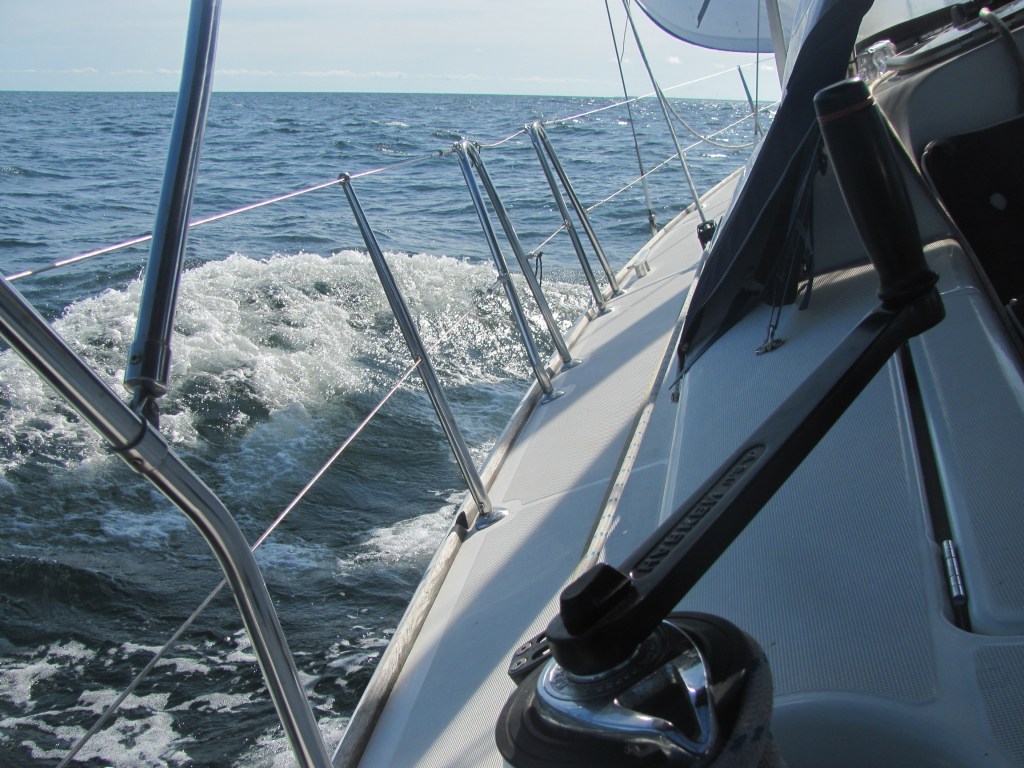
But as we approach Gotland, the wind gradually dies. We try to keep sailing for as long as we can, but eventually the wind drops to almost nothing and the sails flap uselessly. There is no option but to motor for the last little bit into Fårösund. Miraculously, Agnete appears from over the horizon sailing at an impossible angle and beats us to the harbour.
“What was the rationale for going south?”, I ask them after we have tied up.
“Normally the wind will curve around the bottom of Gotland and blow northwards parallel to the east coast”, they say. “We were hoping to catch that to take us into Fårösund. But because of that big area of calm, it didn’t work. We just motored for the last couple of hours.”
Our friends, Simon & Louise, whom we had last seen in Kökar in the Åland Islands, arrive in the mid-morning. They have sailed through the night from Saaremaa island in Estonia.
“It was absolutely beautiful”, says Louise. “It was pitch black, and you could see the Milky Way and every star clearly. No other lights anywhere to be seen for most of the time, apart from the occasional ship in the distance. An experience I wouldn’t have missed. But the wind dropped to almost nothing at about four o’clock. We had to motor the rest of the way.”
It was the same lull that we had experienced in the afternoon, just moved north a bit.
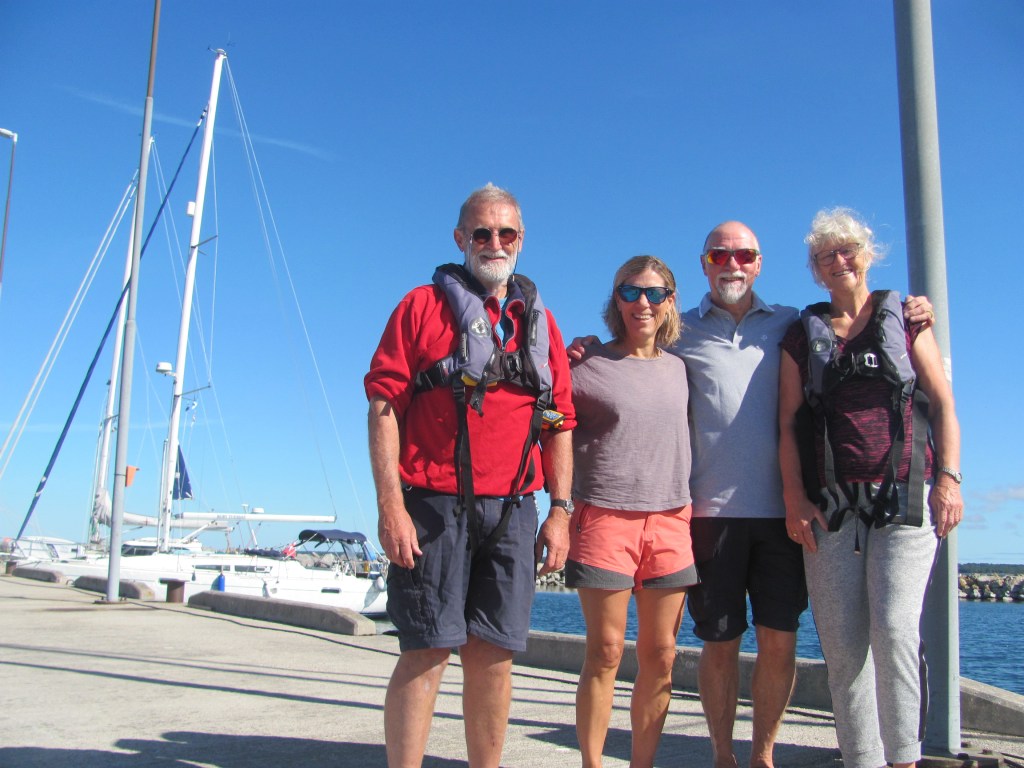
“I read that there is a musical performance on tonight in the next village”, says Simon. “Folk music. Would you be interested in going to it?”
In the evening, we cycle up to the next village about five kilometres away. We are a little late, but it hasn’t started yet.
“We waited especially for you”, jokes the man on the door, taking our money and giving us the tickets. “But it’s pretty packed. There are only four seats left.”
We cram into the small wooden barn, and, with all eyes on us, take our places somewhat self-consciously in the front row. The musicians, a group of four girls, introduce themselves straightaway. Two of them are from Canada, the other two are from Sweden.
“We met at a festival in Glasgow”, one of the Canadian girls tells us. “We found out that our repertoires were very similar, so we decided to work together for a season and tour around Sweden first, then Canada. When we are together, we call ourselves ‘Atlantic Crossing’ to indicate that we are collaborating across both sides of the ocean.”
For the next two-and-a-half hours, we are treated to an exquisite performance of familiar and unfamiliar folk songs, sung and played on two fiddles, a cello and a harp. One of the Canadians also entrances us with her step-dancing skills.

Unfortunately, it starts to rain just as we retake our seats after the interval. After the performance finishes, it is pouring down. We consider waiting for a bit to see if it eases, but, if anything, it seems to be intensifying.
“I think we will just have to brave it”, says the First Mate. “Come on. Let’s get going.”
We arrive back at the boats completely drenched.
“They were fantastic, weren’t they?”, says Simon as we lock the bikes. “Well worth getting wet for. The Canadian girl had such a beautiful smile.”
The rain stops overnight, and the next day dawns bright and sunny.
“We were thinking of getting the bikes out and doing a cycle around Fåro island”, I say. “We were going to make some sandwiches and have a picnic. Interested?”
“Definitely”, says Louise.
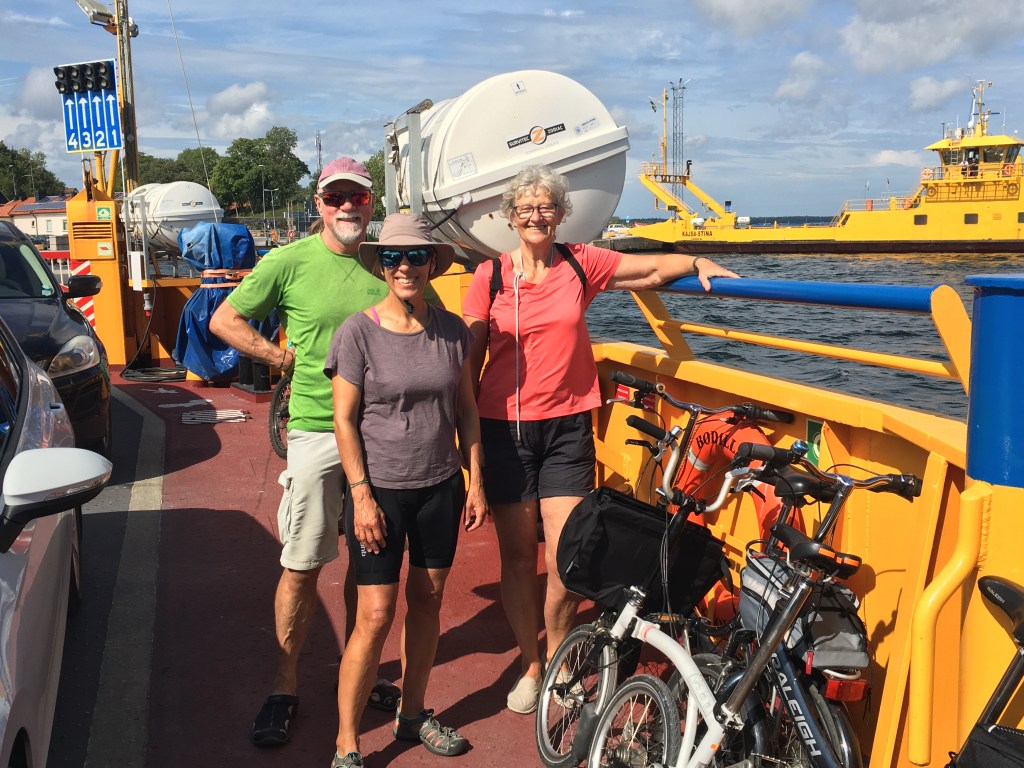
Fåro is the small island to the north of Gotland, separated by the Fårosund. We take the free ferry across to the small landing on the other side, and start pedalling.
First stop is the so-called English Cemetery where English seamen who had died of cholera during the Crimean War were buried in 1854.
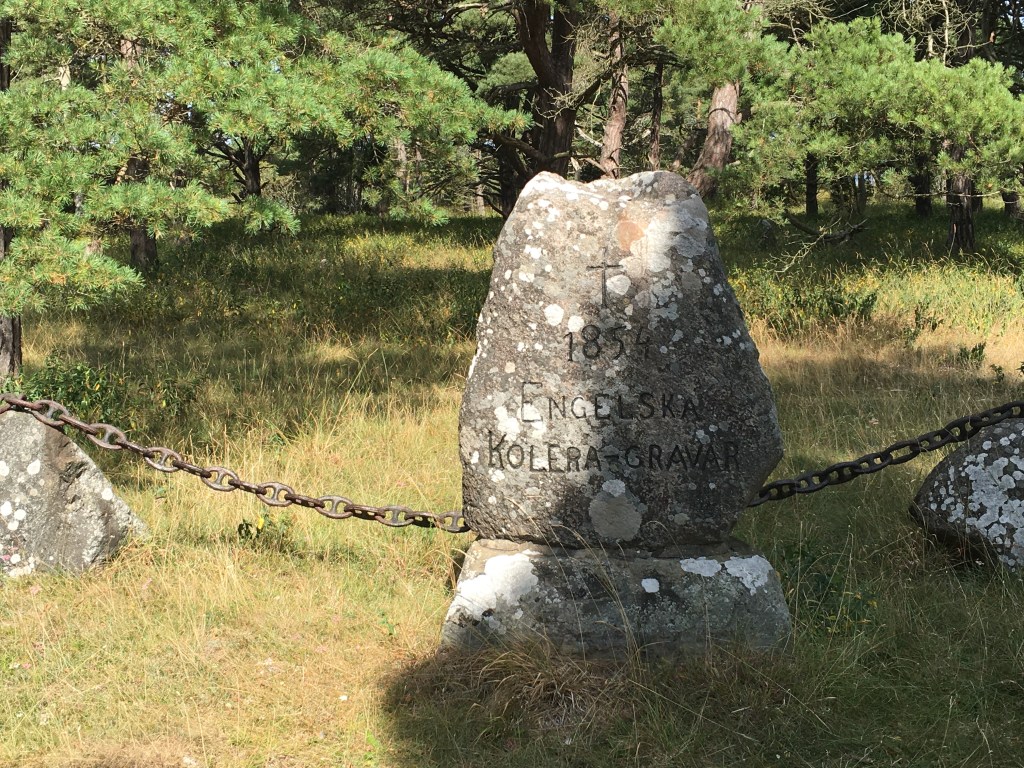
Further on, we pass the church in the village of Fåro in the centre of the island. Ingmar Bergman is buried in the churchyard.

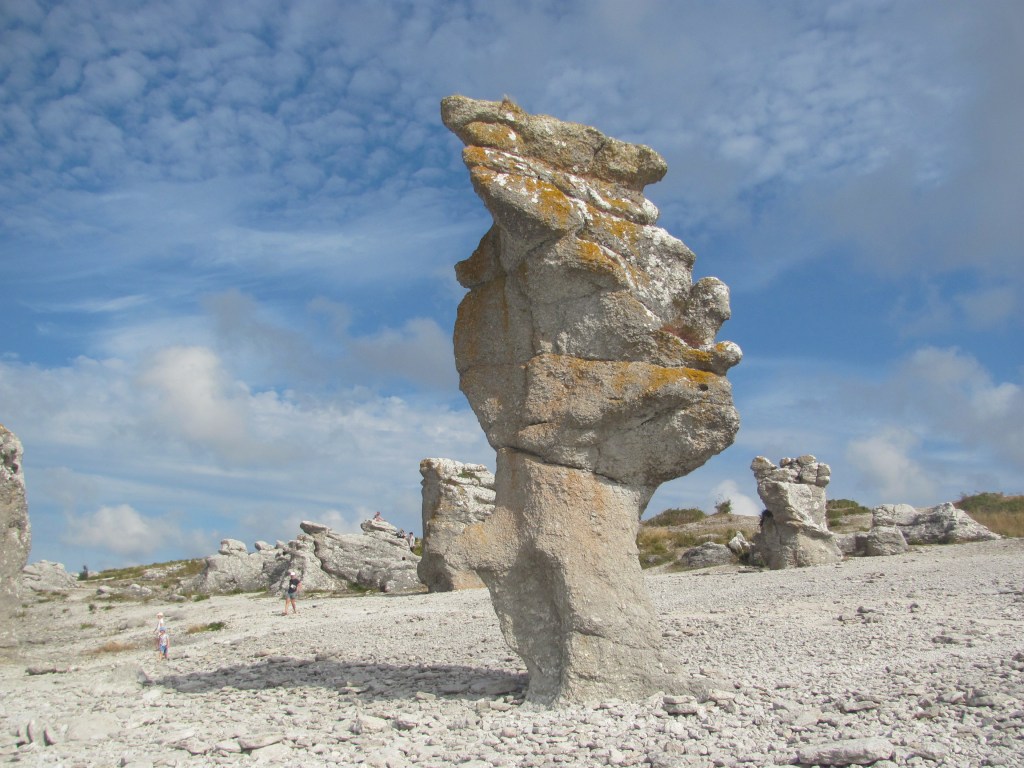
We eventually reach the spectacular sea-stacks at Langhammersgubben at the top of the island.
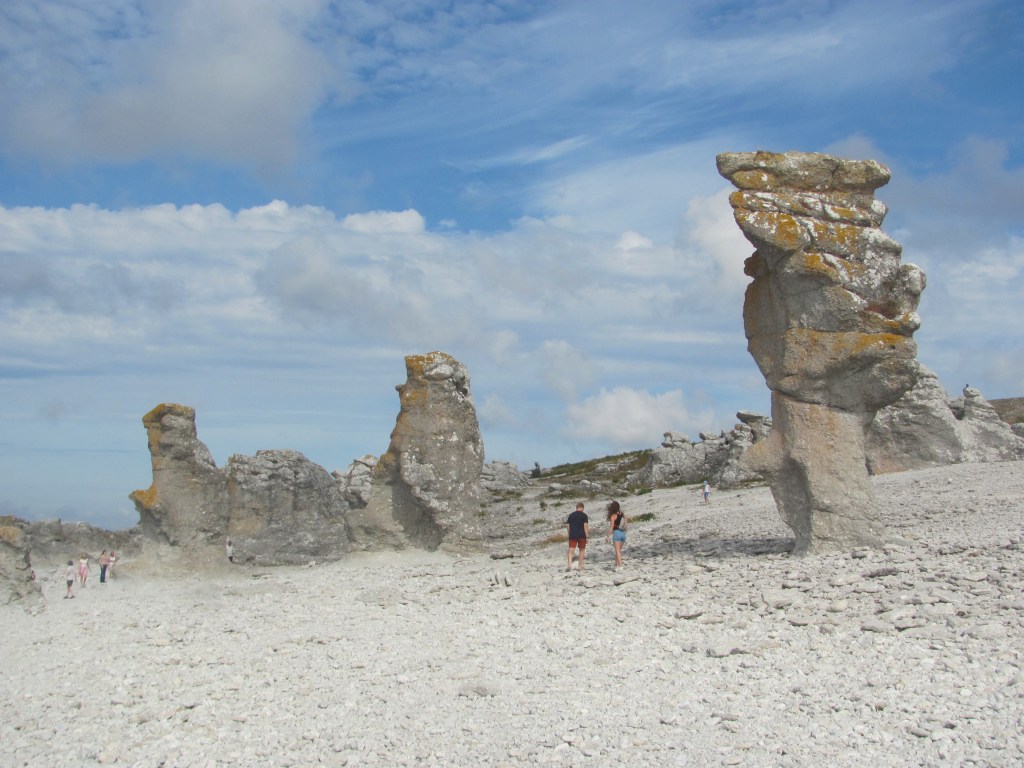
“Gotland was the bed of a shallow tropical sea during the Silurian period, about 430 million years ago”, the guide book says. “When the creatures in the sea died, their bodies sank to the bottom and were slowly transformed into limestone. Over time, plate tectonics moved the seabed from the tropics to where it is now, and also pushed it up above sea-level, exposing it to the forces of wind and wave erosion. Limestone varies in its hardness depending on what it was formed from, and these amazing shapes, called rauks, were sculpted after the softer limestone was eroded away, leaving the more resistant standing.”
“Let’s have a swim and then have our picnic on the beach”, says Louise.
After lunch, we cycle back along the coastal route. On the way, we pass Helgumannens fishing camp. Apparently it is named after a monk who used to hold services there every morning and evening. Nowadays it is used as a base for sturgeon fishing.

After a quick stop for some coffee and cakes, we are soon back to the ferry.
“Well, I enjoyed that”, says the First Mate. “I wonder how far it was?”
I work out later that it was 44 km. Not too bad for the small folding bikes.
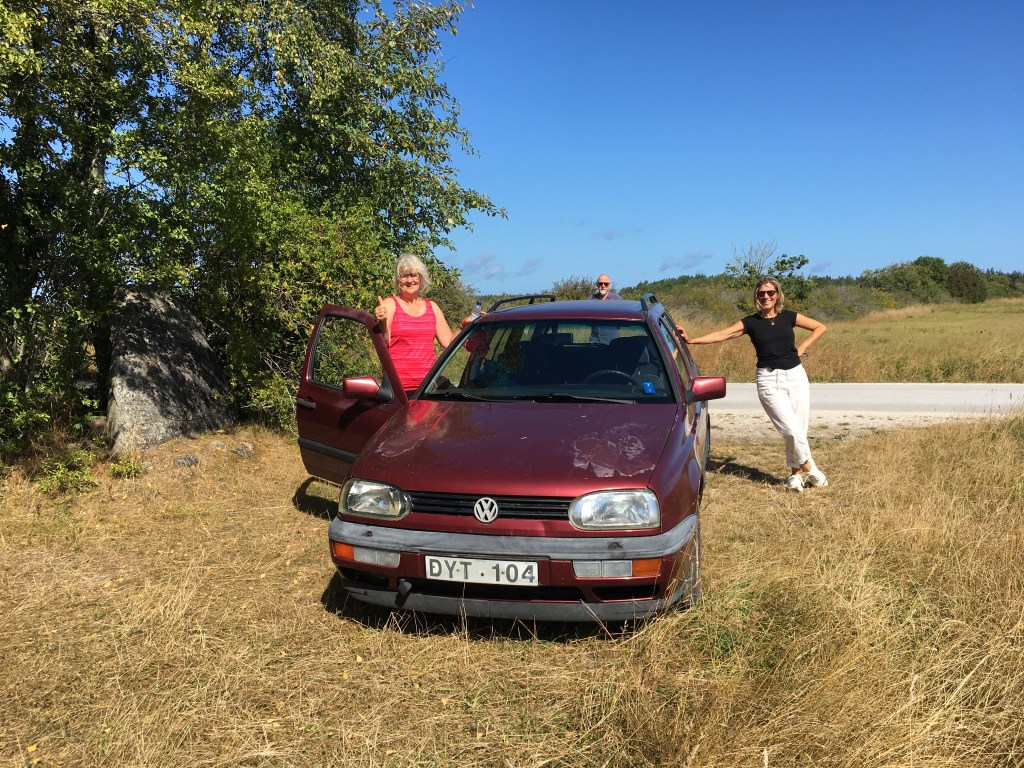
Strong winds are forecast for the next few days, so we decide to stay put in Fårösund and use the opportunity to explore other parts of the island by car and bus. The car hire firm takes pride that all of its cars are pre-loved, and even refers to itself on the website as “Rent-a-Wreck”. But it does us proud.
The sun starts to rise, casting a cold light over the forest. Through the early morning mist, I see the dim shapes of people moving amongst the trees, making their way to the clearing to attend the ceremony. Yesterday, we had prepared the old king’s body, laying it on the oaken bier, dressing it in the finest furs, and placing his sword, bronze shield, and treasured possessions that had served him well during his life alongside it.
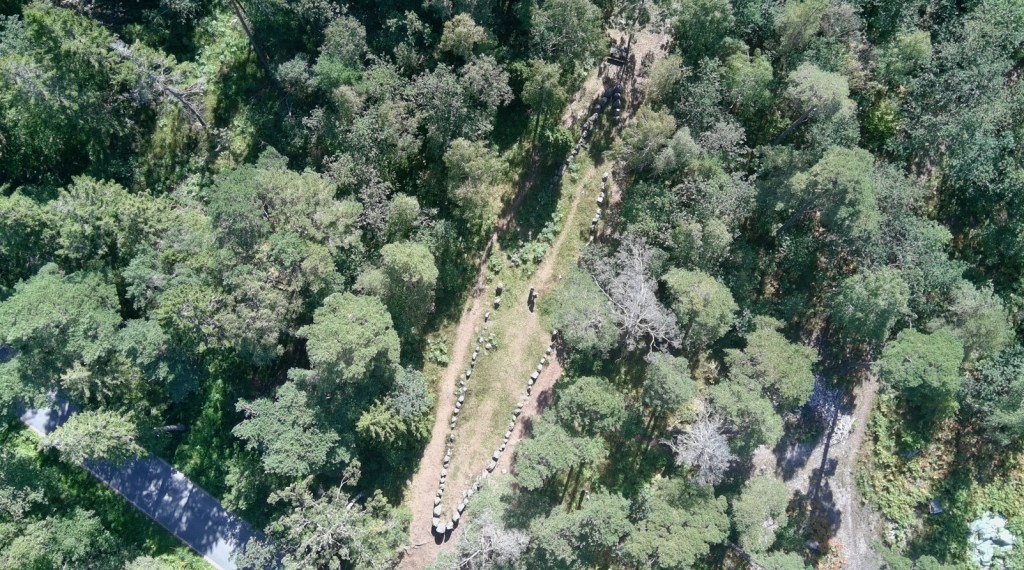
The stone ship we had built for him stands in the centre of the clearing, its great stones forming the outline of a vessel that will carry him to the gods. They have been gathered from all over the island, with only the best stones selected as befits a beloved king.
The sun rises higher, and the chants begin, recounting the stories of Tjelvar’s deeds, how he had brought fire to our island and given it life, breaking the ancient curse that once bound Gotland to the sea. We had told and listened to these stories many times, but today there is a finality to them, as we begin to realise that it is the end of an era.
The young men lift the bier and carry it to the stone ship, laying it in the centre. The women approach, their torches lit from the sacred flame, and circle the ship, lighting the pyres as they go. The flames crackle as they take hold, their light illuminating the sombre faces with a ghostly glow. The smoke rises, carrying our prayers to the gods, the scent of burning wood and herbs filling the air. The heat of the fire reaches us, reminding us of the gift that Tjelvar had brought to our cold, dark island.
When the last of the flames has died down, we cover the ashes with stones. The people slowly leave, and the clearing is silent once more, the great stone ship standing as a monument to the man we had revered and followed. The world is different now that he has gone, the future more uncertain, but I know that his spirit will always be with us, guarding Gotland as he had in life, from now until the end of days.

“Are you day dreaming again?”, a familiar voice says. “Hurry up. It’s time for lunch.”
I awake from my reverie. It’s the First Mate. We are at Tjelvar’s Grave, a remarkable stone ship burial in central Gotland. I am imagining what the burial might have been like. The story behind the grave is told in the Gutasaga, a saga of Gotland’s pre-Christian history. Apparently the island of Gotland was once under a powerful curse that made it rise above the water every evening and sink beneath it again every morning. This obviously was a problem for anyone who was wanting to settle on it. One day, a seafarer called Tjelvar, had the brilliant idea of landing on the island during the night and lighting a fire to break the spell so that the island wouldn’t sink back into the depths in the morning. It worked, and Tjelvar is credited not only with ensuring Gotland became permanently dry land for people to live on, but also that they would have fire to cook, keep warm, and smelt metal. He became the first king of Gotland, ruled his people wisely, and lived a long and contented life.
There are other stone ship burials on the island too. Particularly impressive is the line of three in a row all pointing to a Neolithic dolmen.
The next day, we decide to take the bus down to the capital, Visby.
“Visby is another of the cities that were part of the Hanseatic League in the 1200s, and became prosperous on the back of it”, I read on the way down. “In 1361, Gotland was conquered by the Danes, but Visby was taken over not long after by pirates by the name of the Victual Brothers. They also didn’t last long as in 1398 the Teutonic Knights came and chased them off, but in the interests of peace with the Kalmar Union, the Knights sold it to Queen Margaret of Sweden, Denmark and Norway. With the breakup of the Kalmar Union in 1523, it remained in Danish hands, but was returned to Sweden in 1645 and has stayed with them since, apart from a brief three-week occupation by the Russians in 1808.”
As we arrive, we see the city walls, which have been remarkably well preserved.

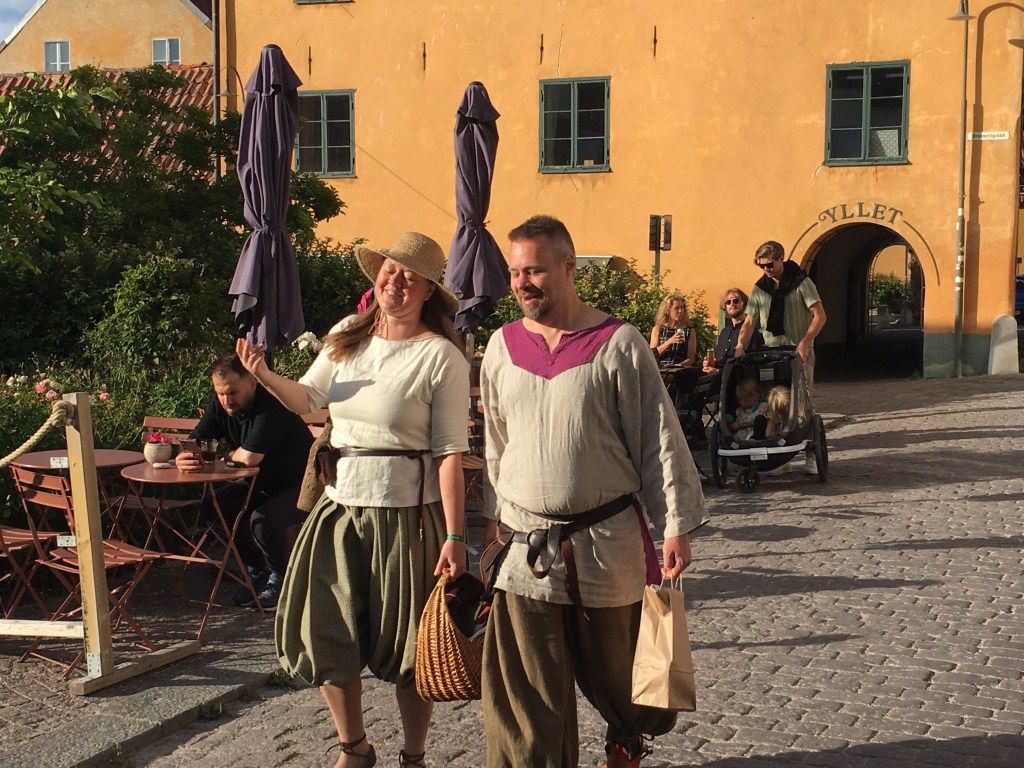
As it turns out, it is Medieval Week, an annual event in which the locals all dress up in medieval clothes, speak Gutnish, and do medievally kinds of things.
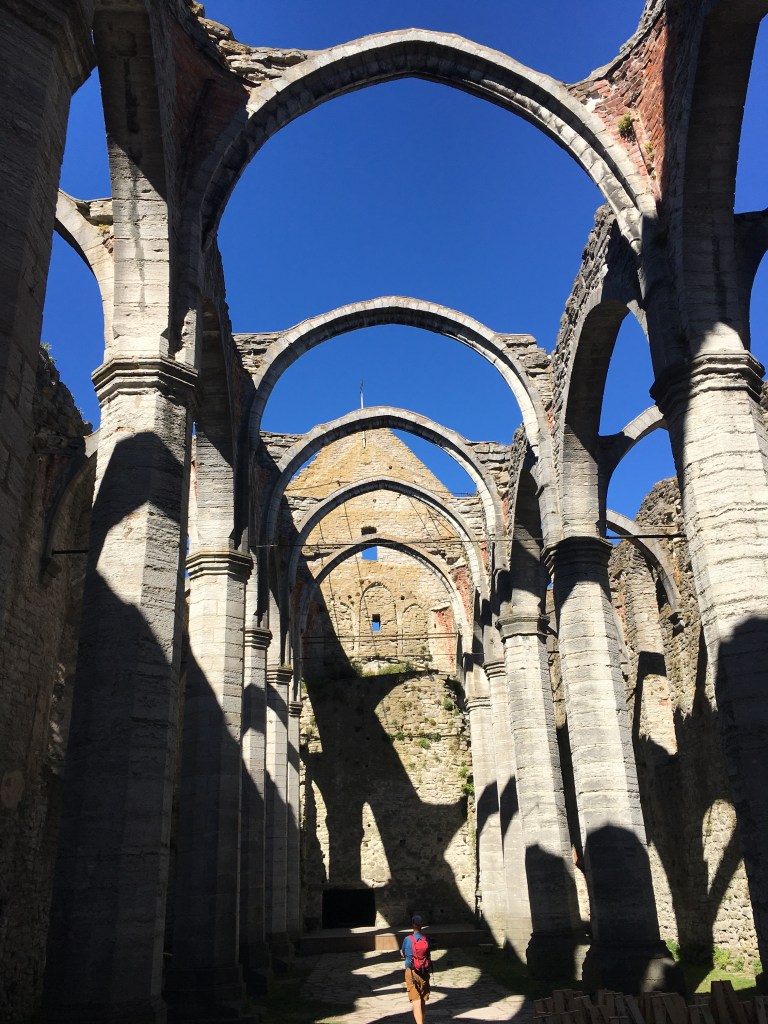
We start off in the Market Square dominated by the impressive ruins of St Karins Kyrka. Concerts are held in the ruins in the summer – indeed, we even see a poster showing ‘Atlantic Crossing’ performing here last week.

Through a narrow street off the Market Square is the Sankta Maria Kyrka, with its ornate interior and three towers capped by baroque cupolas.

We wander through the narrow cobbled streets lined with Hanseatic warehouses. It isn’t difficult to picture what it must have been like in medieval times with all the costumes around.

After lunch, we visit the Gotland Museum, itself an old Hanseatic warehouse, and spend an absorbing couple of hours learning about the history of Gotland.
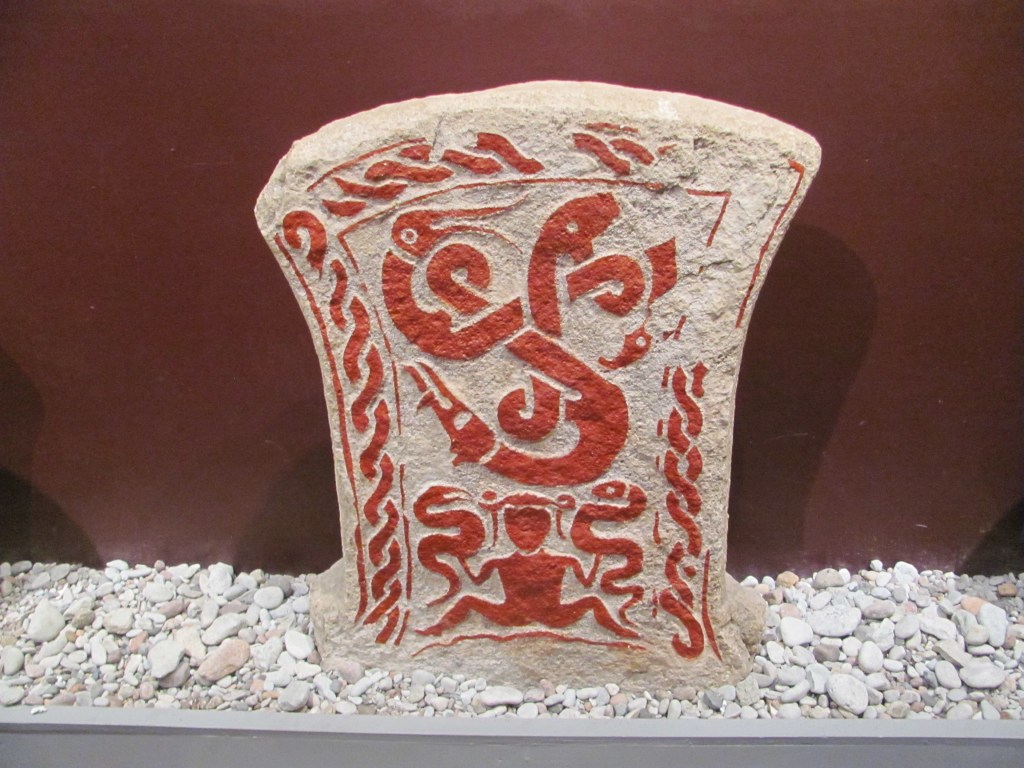
First up is a particularly fine collection of picture stones depicting legends and everyday life in Viking times. Thought to be memorial stones of some kind, they differ from rune stones in that they have no text on them.
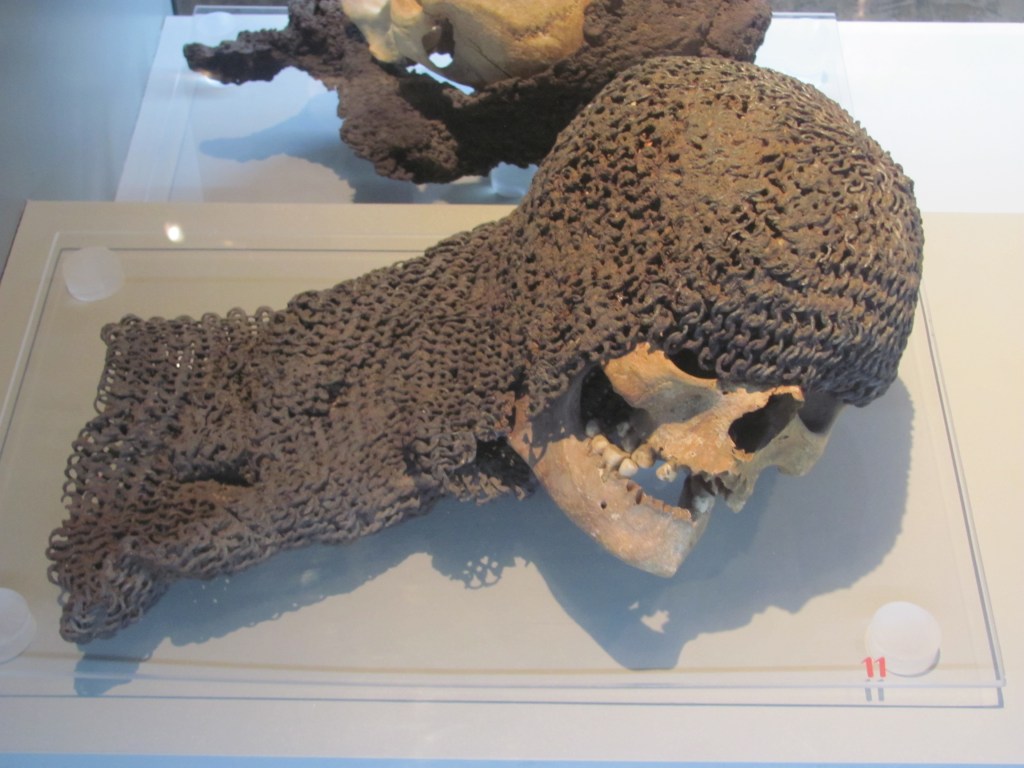
We learn of the Battle of Mästerby in 1361 – when the Danes under Valdemar IV invaded Gotland. The Gotland farmers got together to resist them, hoping that the swamps nearby would stop the Danish soldiers, but unfortunately it had been a dry summer and the swamps had dried out. The Gotlanders were massacred by the more professional well-armed soldiers, with 1500 farmers killed.
We see the Spillings Viking silver hoard, so called because it was discovered on Spilling farm in the north of Gotland. The hoard had been buried under the floorboards of a Viking storage building on the farm sometime in the AD 800s. A lot of the hoard consists of coins from the Islamic world.

“That was all really interesting”, says the First Mate in the bus on the way home. “I never really knew much about Gotland before. It’s a fascinating island. But I guess we need to press on.”
“The weather looks good for sailing for the next few days”, I say. “I suggest we sail down from Fårösund to Visby tomorrow, stay overnight, then head across to Byxelkrok on the island of Öland.”
“Byxelkrok”, she says. “What a funny name. I wonder what it means?”
 Ruby Tuesday
Fascinating! Makes me want to visit Gotland again!
LikeLike
Hi Birgitta
Yes, it’s an interesting place. Sounds like you have already been there?
LikeLike
Yes, but never as an adult with time on her hands!
LikeLike