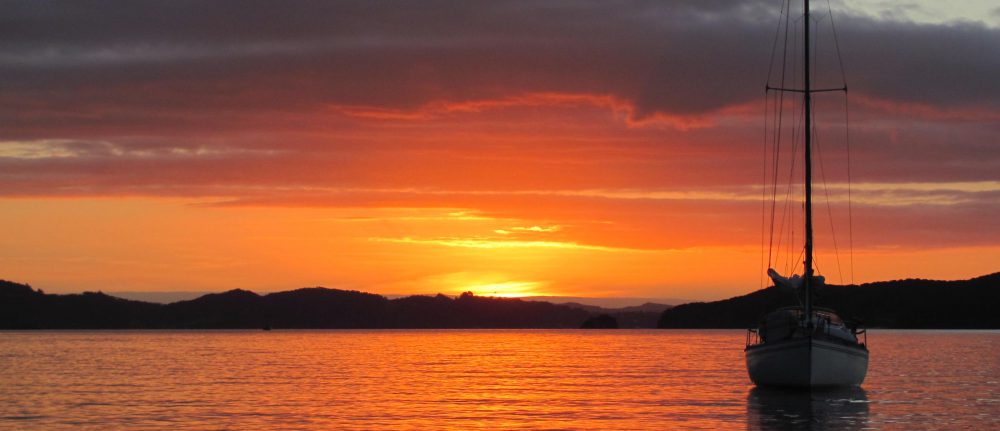
“Russia is on the up”, says Mike. “Its GDP is growing, it has new markets for its oil and gas in China and India. It will win the war in Ukraine. No doubt. Time is on its side. The West doesn’t have the stamina.”
We have arrived in Riga, the capital of Latvia, and are talking to Mike, an ethnic Russian living here. His parents were sent to Russia during the Soviet period as a part of Stalin’s Russification policy to increase the proportion of ethnic Russians in the Baltic States and the other Soviet republics compared to their indigenous populations. He is an IT teacher at a local school.
“But the only reason the GDP is growing is because the economy is moving towards a war footing”, I say. “Export revenues have decreased by 30%, so most of that growth is due to vast sums of public money being used to fund growth in armaments factories. And much of that money is coming from Russia’s strategic reserve fund. Already half of that has been used. Benefits to ordinary Russians are being sacrificed to support an illegal war. It’s not sustainable.”
I had read all this in the newspaper the day before.
“Latvia made a big mistake when it chose to be independent and turned its back on Russia”, he continues. “It’s only a small country and it would do much better if it was part of a larger country like Russia. There’s a lot of corruption in government here now, and inflation is very high.”
“But it chose to join the EU and NATO”, I say. “In that sense it is both independent and part of a larger grouping. The best of both worlds. It’s interesting that almost all of the former Soviet Socialist Republics opted for independence when the USSR fell apart. That must say something about Russia. People want to make their own decision and determine their own futures. They just didn’t want to be ruled and occupied by Russia.”
I had had similar discussions at the time that various African countries were becoming independent.
“Well, yes”, says Mike. “But what’s the point in being independent if your country is going down the tubes?”
In the morning, we unload the bikes and cycle into town over the Vanšu Bridge that crosses the Daugava River.
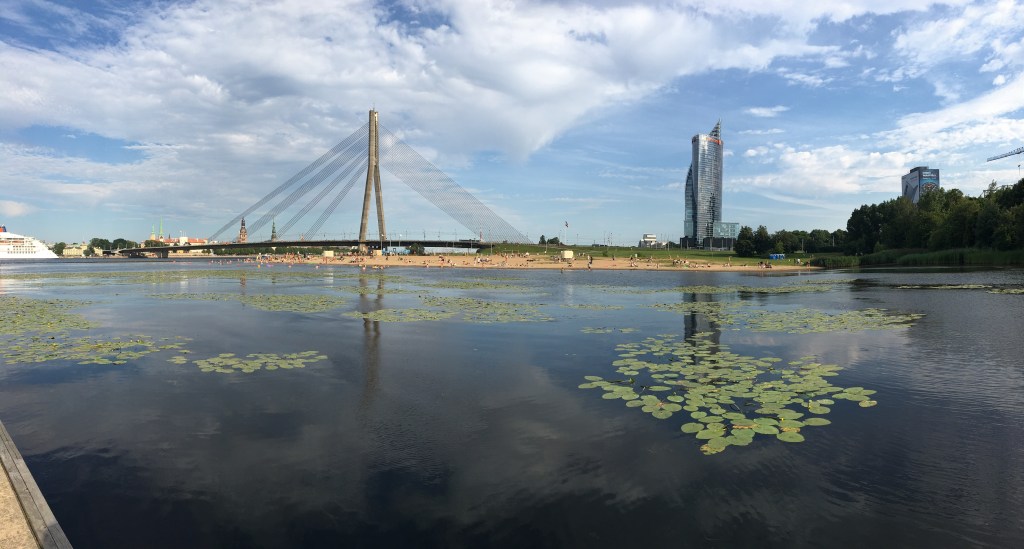
On the way, we pass Riga Castle, now the official residence of the President of Latvia.

We decide to take one of the free city walking tours coordinated by the Tourist Information Centre. Our guide is Liga.
“You can remember it by thinking of Riga, the city we are in”, she says by way of introduction. “Then just replace the ‘R’ with an ‘L’.”
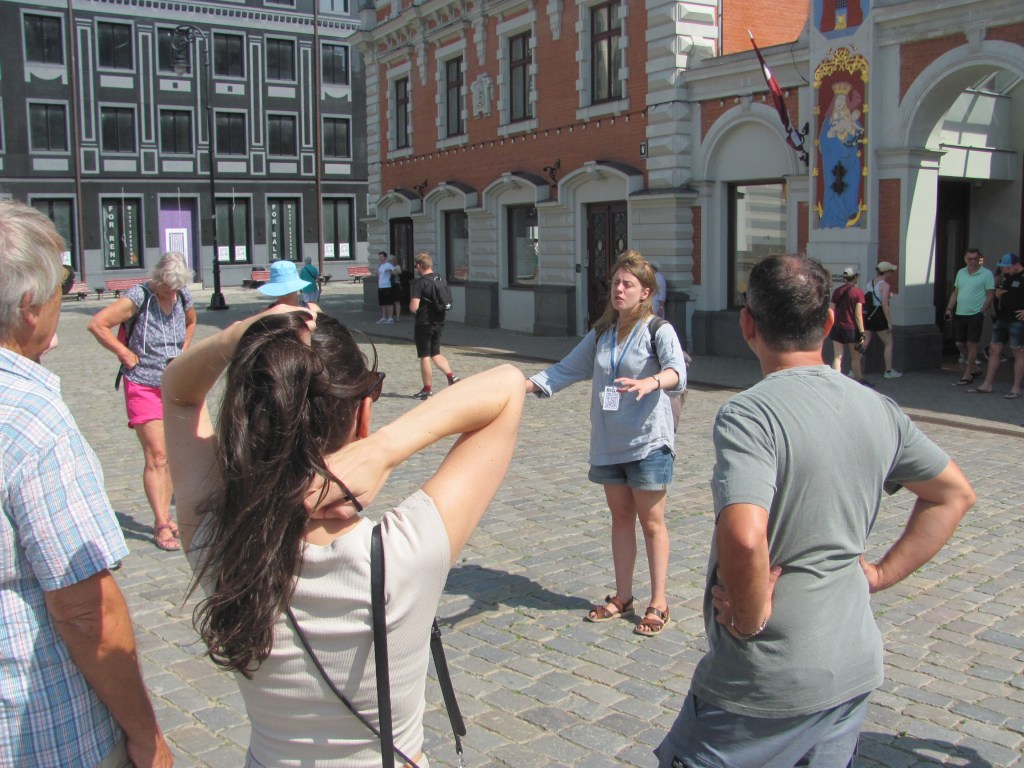
We start in front of the House of the Blackheads. Just as in Tallinn, the Blackheads was the name given to unmarried merchants and various other professional men.
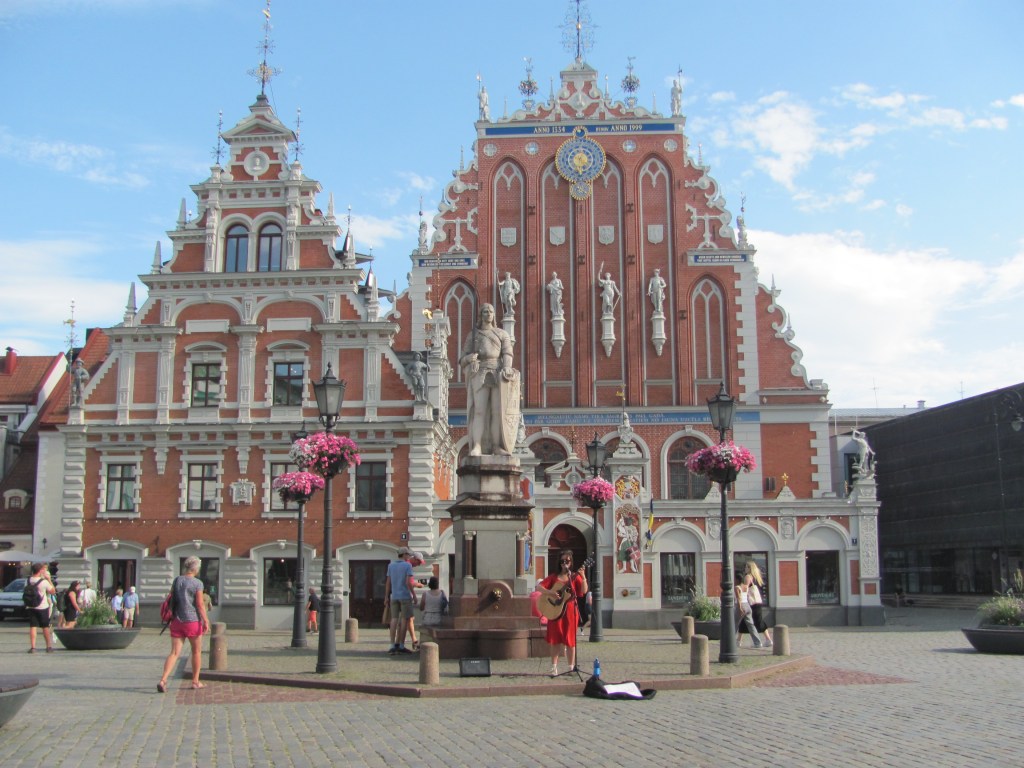
“They weren’t allowed to join the Great Guild until they were married”, Liga tells us. “So they had their own Brotherhood. Originally they were a military organisation protecting Christianity, but evolved into a more social organisation doing good works in the city. They were called the Blackheads because their Patron Saint was St Maurice, an Egyptian Christian, and not because they were spotty adolescents.”
There are gentle titters from the group.

“They are credited with starting the custom of decorated trees at Christmas time”, she continues. “The story goes that during one of their drunken parties they decided that it would be a good idea to go to the forest and cut a tree down and stand it up in front of their clubhouse. They then decorated it with all sorts of things. After Xmas, they set fire to it. The custom of decorating trees has continued at Xmas time, but for some reason setting fire to it afterwards hasn’t.”
“I thought decorating Christmas trees was first done in Germany”, whispers the First Mate to me.

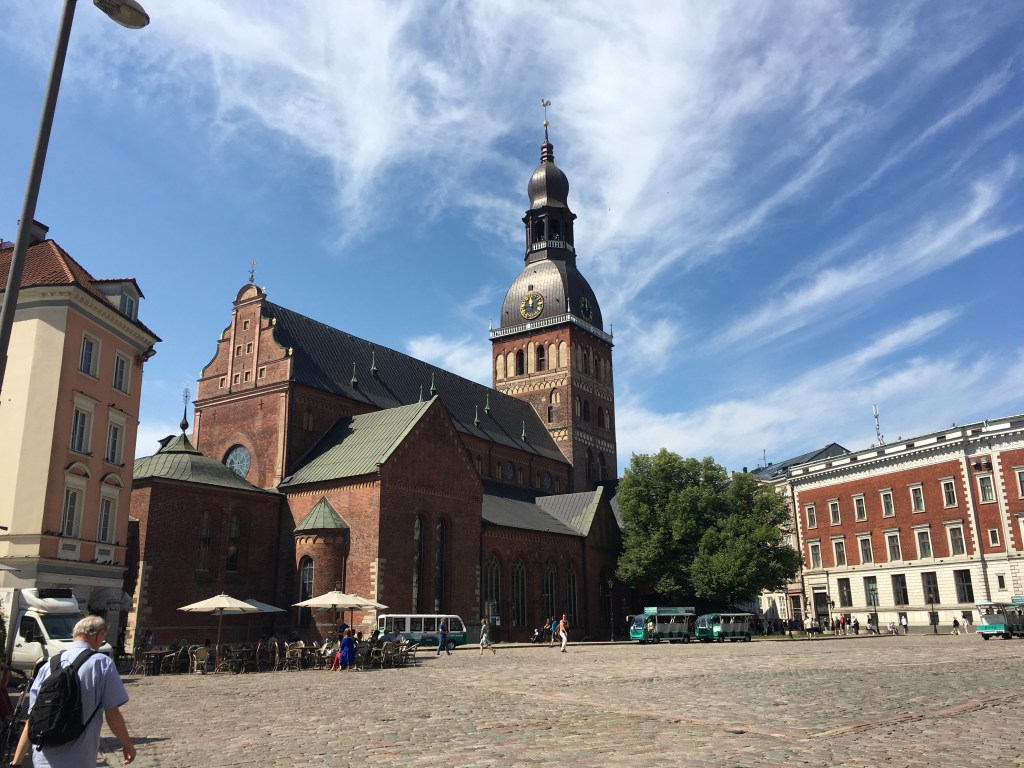
We arrive at the Riga Cathedral.
“The Cathedral was built in the 1200s by one of the Bishops of Livonia, which the country was called in those days”, Liga tells us. “It is supposed to be the largest cathedral in the Baltic States. When it was built, it was Catholic, but became a Lutheran cathedral during the Reformation. During the Soviet era, it was prohibited to hold services there, and it was used as a concert hall. However, since independence in 1991, it has been re-consecrated.”
As we walk to the next stop, I ask Liga about current beliefs in Latvia.
“A lot of people are turning back to the old ways”, she says. “A lot of my friends have houses in the countryside, and are more into revering nature rather than going to a church. Many see Christianity as an imposition by foreigners on the native Latvians. In many ways, revering nature makes a lot of sense, as we depend so much on it for our own well-being. And you can see it all around you, rather than imagining some invisible being somewhere up in the sky. Something like 20% of the population identify with their pagan past.”
We arrive at the Three Brothers. The story here is that, not to be outdone by the Three Sisters in Tallinn, Riga decided to have the Three Brothers, a group of residential buildings built next to each other in different centuries, starting in 15th century. They currently house the Museum of Architecture.

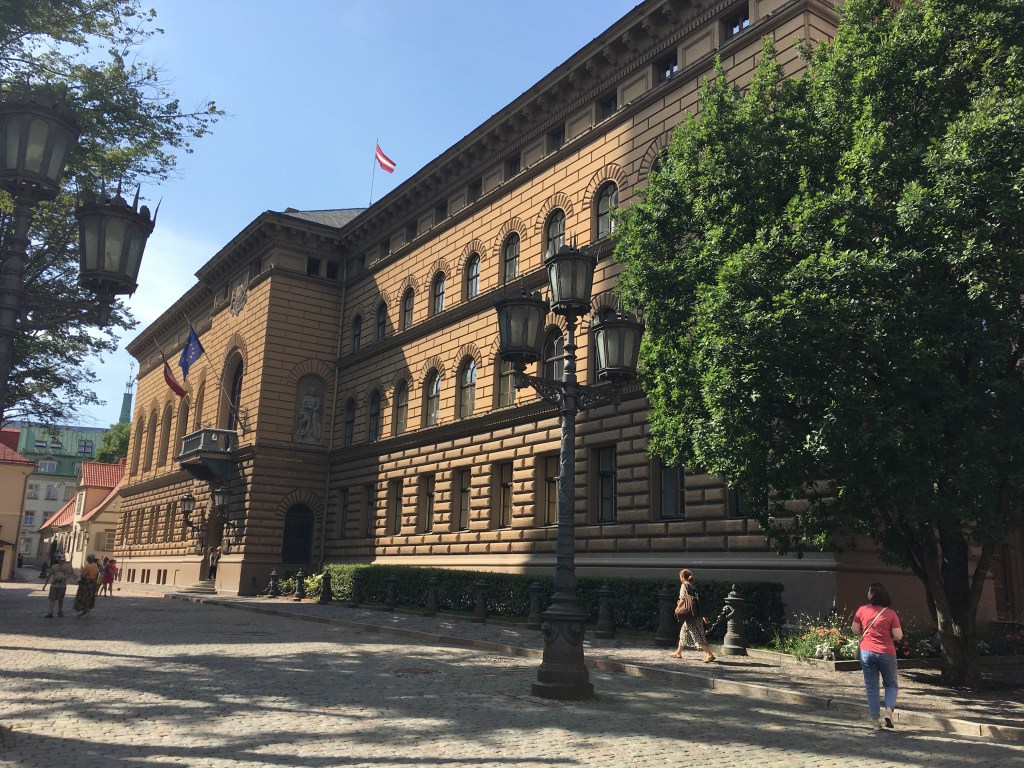
“And here we have the Latvian Parliament Building”, says Liga at the next stop. “We pride ourselves on being the only parliament in Europe without armed guards outside. You can see a couple of policemen in that car over there, that’s all.”
“What about corruption in government?”, someone asks. “Is that a problem in Latvia?”
“Unfortunately, there is a lot of corruption in Latvian politics”, she responds. “We are not the worst in Europe, but we are definitely not the best. The main problem is the relationship between the government and business – many people think that it is too close, and that business people are being offered lucrative government contracts if they have good friends in government.”
Sounds a bit like in Britain during Covid, I think.
A little bit further on, we stop in front of an eerie looking sculpture.

“This the ‘Ghost of Riga’”, says Liga. “It’s a modern sculpture, but it is based on an old story about a young girl who fell in love with a young Swedish soldier. Although such a relationship was forbidden by the authorities, they would meet each other at night near the Swedish Gate back there. Unfortunately, one night they were discovered, and the girl was brought before the town’s leaders. They decided that her punishment was to be bricked up in the city wall. Ever since, her ghost has roamed the streets looking for her lost lover.”
“Another tale of someone being bricked up in a wall”, I say to the First Mate. “It definitely seems to have been a custom in this part of the world.”
“And all because of sex again”, says the First Mate. “LIke you said in the last post.”
Round the corner we come to the Great Guild building and sit on the steps looking at the house on the other side of the street.
“That is the Cat House”, Liga tells us. “Apparently a rich merchant was refused entry to the Grand Guild, so he took his revenge by building a house on the other side of the street of the Guild building. Because he liked cats, he had statues of two cats made and mounted them on top of his house with their bums facing towards the Guild. The members considered this a great insult, so after a great deal of wrangling, they agreed to give him membership if he turned them around. So he got what he wanted in the end.”

We end up at a sculpture of a rooster standing on a cat standing on a dog standing on a donkey.

“It’s the Bremer Musikanten, the Town Musicians of Bremen”, says the First Mate to me.
“Yes, that’s right”, says Liga, overhearing her. “It was a gift from the city of Bremen, which Riga is paired with. The story is that as in the Grimm fairy tale of them looking into the robbers’ house that they are planning to frighten away so they can eat their feast, in the sculpture they are looking through the Iron Curtain at all the wealth of the West that they would like to share.”
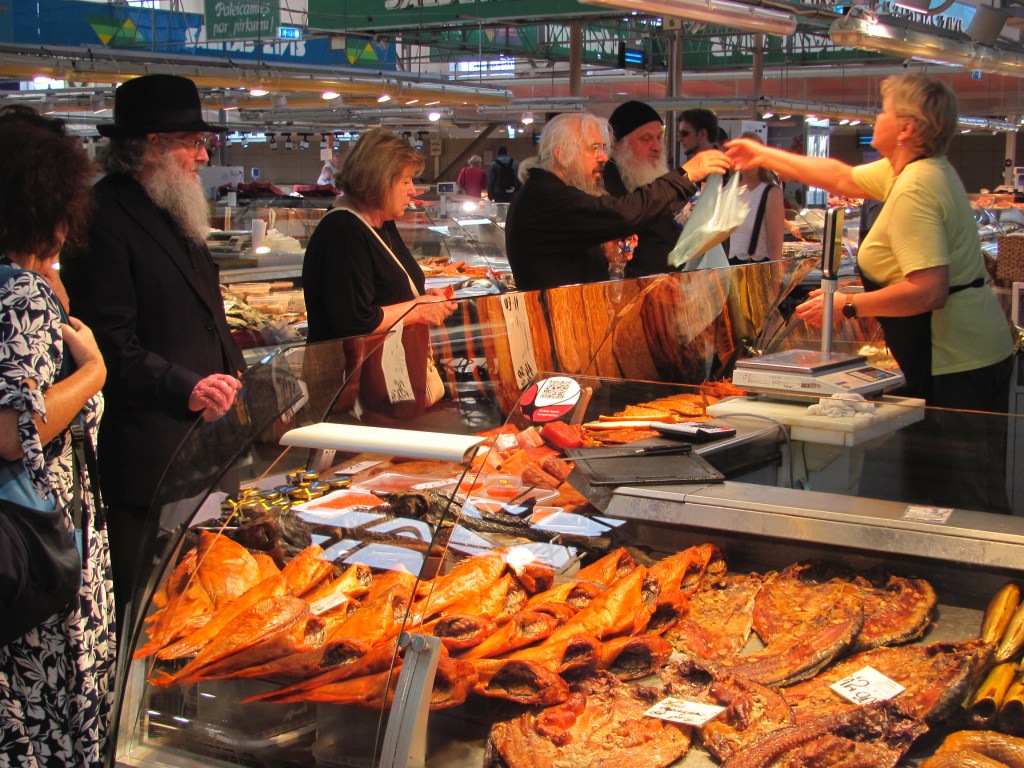
It’s the end of the tour. We thank Liga and decide to cycle to the City Market for lunch.

We watch fascinated as a group of Orthodox Jews taste the samples and buy their weekly supply of fish.
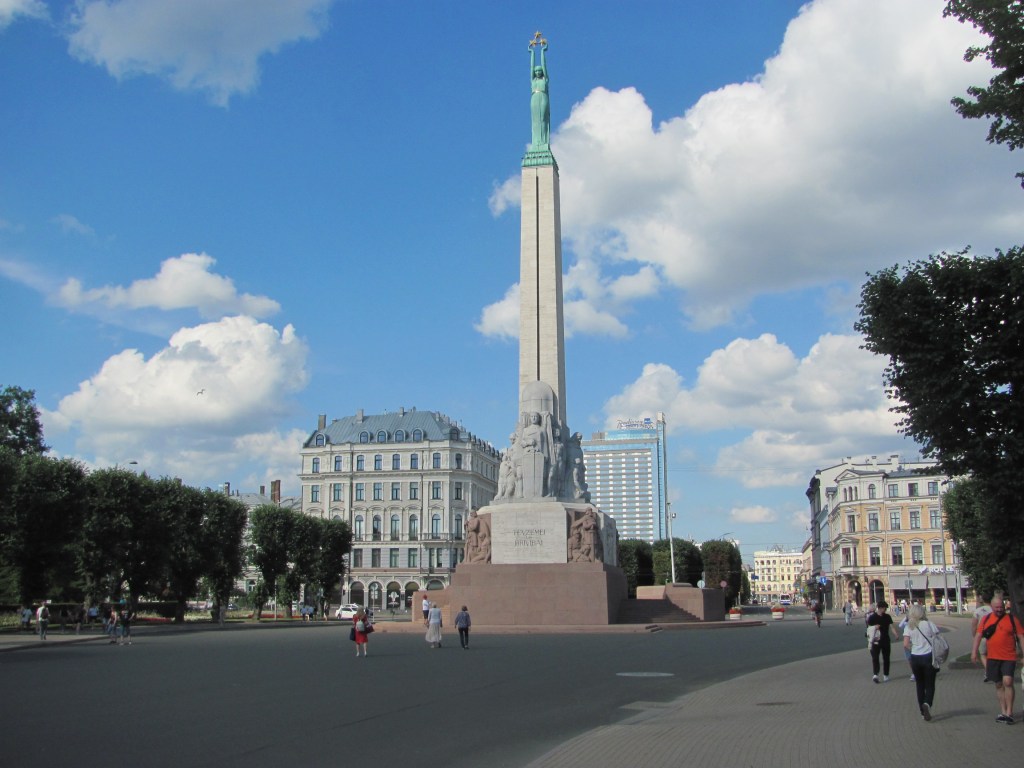
On the way back, we swing past the Freedom Monument. This was built in 1935 to celebrate those who died in the battles to gain Latvia’s independence in 1918, and became a focus for the country’s struggle for freedom and national unity. During the Soviet era, there was talk of removing it, but it never happened for fear of provoking too much civic unrest.
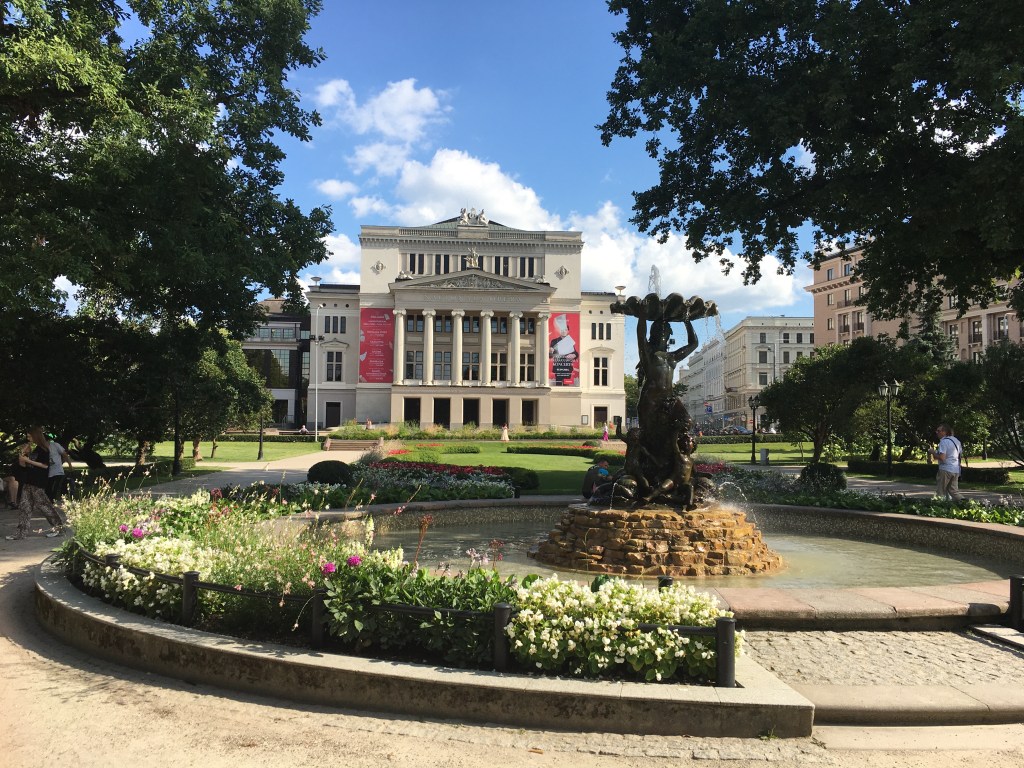
Nearby is the Latvian National Opera.
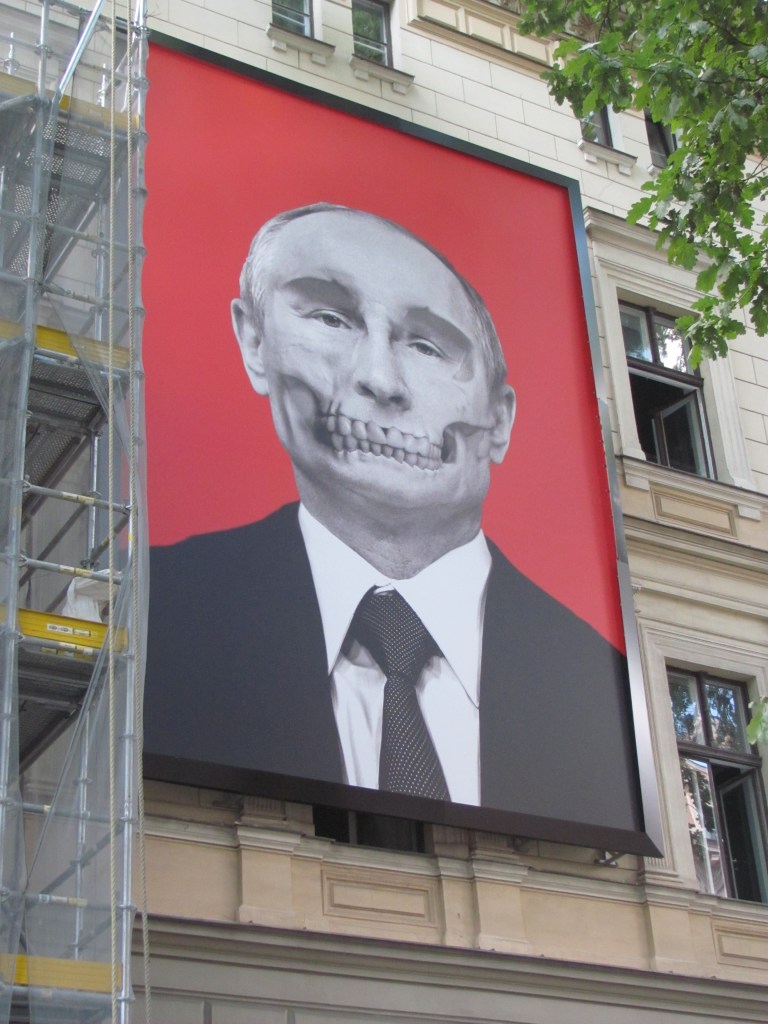
Not far away is the Russian Embassy. As in Tallinn, there are posters condemning the war in Ukraine.
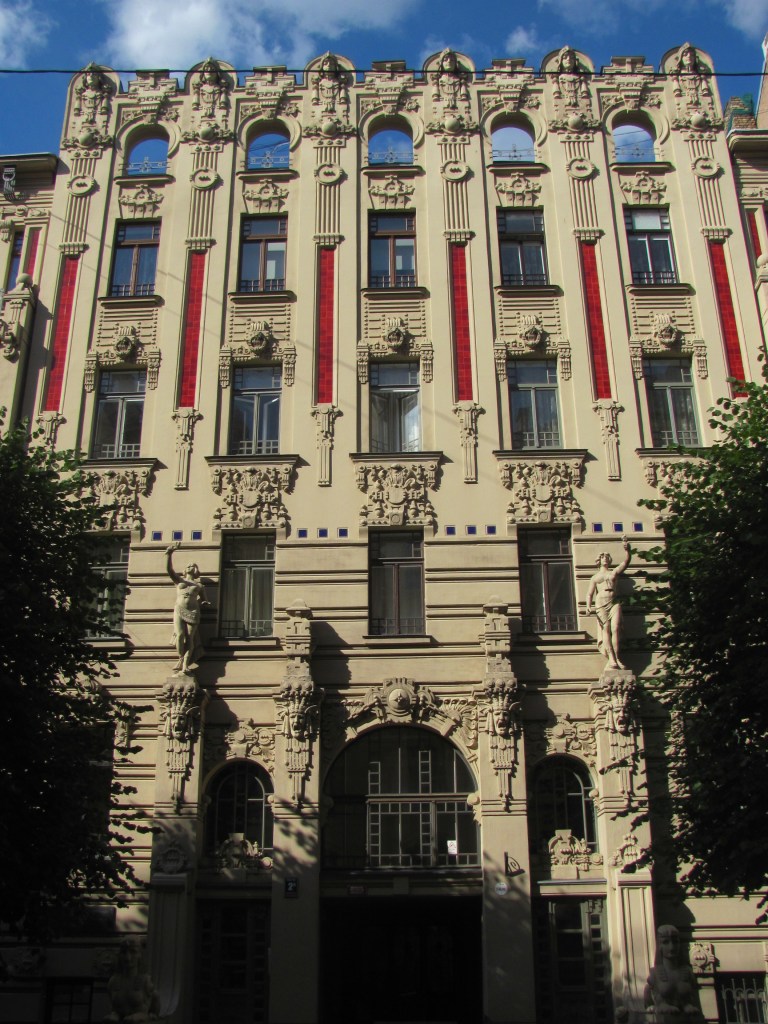
A little bit further on is Alberta Street and its Art Nouveau houses.
“It was interesting what the walking tour guide was saying about the resurgence in the old religious beliefs in Latvia”, says Spencer that evening. “I was reading on the web that there is even a Latvian religion based on the old ways. It’s called Dievturiba.”

“Yes, I have heard of it”, I say. “Tell me more about it.”
“Well, it was founded in the 1920s at the time of the first Independence. It makes no pretence of being the same as the ancient religion, but is a synthesis of Latvian legends, folklore and folk songs, and so provided a focus for Latvian nationalism. It was suppressed during the Soviet era, but there has been a revival since the second independence in 1991.”
“Interesting”, I say. “What do they believe?”

“Well, it depends who you talk to”, he answers. “Some believe there is only one god, Dievs, but he has two aspects, Mara, representing the maternal aspect, and Laima, representing fate and fortune. Others believe that the latter two are separate gods in their own right, and there are also a number of lesser gods. Humans have a physical body, an astral body, and an eternal soul. The purpose of life is to find an individual ‘Path to God’. If you are successful, the eternal soul reunifies with Dievs when you die. The physical body decays, of course, and the astral body also eventually fades away.”
“Not a lot different from many religions”, I say. “But the astral body bit sounds a bit unnecessary. What’s its purpose? Why don’t they just keep it simple?”
“Well, that’s the thing”, he says.” A lot of people don’t really buy all the theology stuff but quite like the idea of reconnecting to the old ways and revering nature. Personally, I quite like the revering nature bit, as us spiders would get a bit more recognition for all the good that we do!”
In the morning, we cycle over to the Riga Ghetto and Latvian Holocaust museum located in an old warehouse building not far from the market.
“You can have one of these museum guides in English and German”, the young man at the desk says. “And since you live in Scotland, we even have one in Gaelic. One of my colleagues is a linguist, and he translated it.”
I had to admit that I don’t speak or read Gaelic apart from a few place names on Ordnance Survey maps.
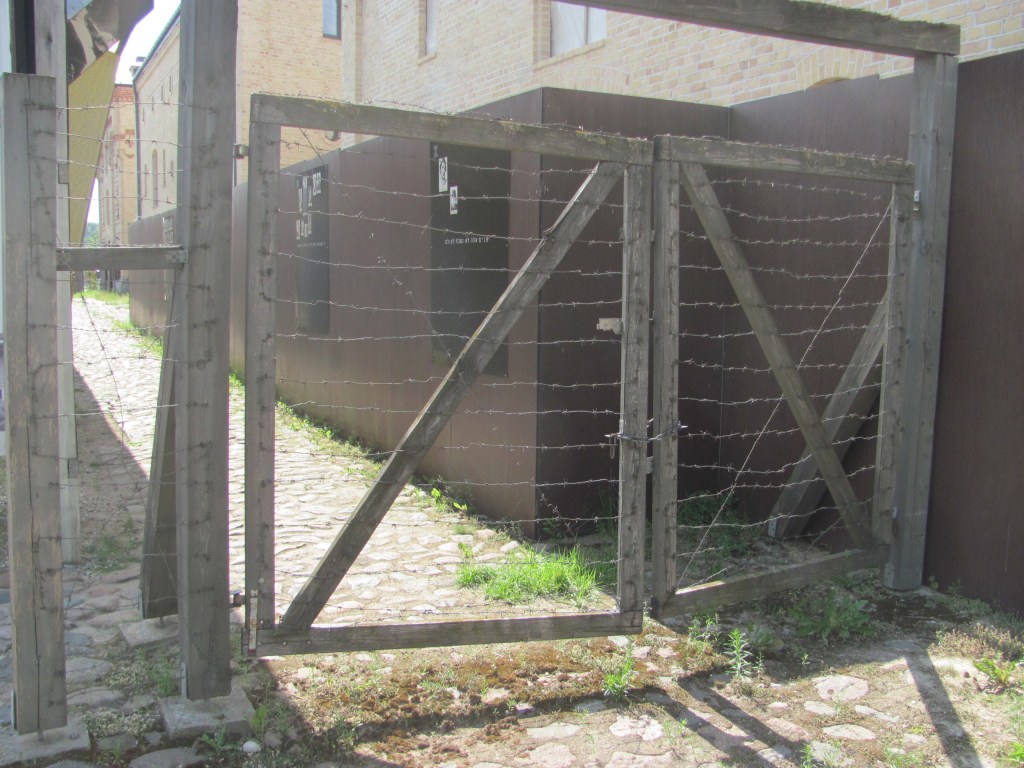
We spend the next couple of hours learning of the history of Jews in Riga, the creation of the ghetto, and the mass murder of Jews. The ghetto was created within a Riga suburb fenced off by barbed wire by the Nazis when they occupied Latvia in 1941. Initially it was for the Latvian Jews, but after more than 25,000 of these were killed in the nearby Rumbula forest within three days, Jews from other parts of Nazi-occupied Europe were also sent there. Many of these were also killed by shooting in Rumbula forest.


We learn of the ‘Butcher of Latvia’, a Latvian by the name of Herberts Cukurs, who was the deputy commander of the Arajs Kommando, a Nazi collaboration unit that was responsible for the largest number of murders of Latvian Jews. Despite supposedly being an ‘all round good chap’ before the war and a noted aviator who flew solo to Gambia and Japan, Cukurs turned out to be particularly brutal, shooting Jewish children and babies in captivity, burning Jews alive, and sexually assaulting Jewish women. After the war, he fled to Brazil, but was tracked down by Israeli agents and assassinated. Amazingly, there have since been efforts in Latvia to rehabilitate his memory.

We enter a railway wagon similar to those used to transport Jewish people to the Riga ghetto. Inside, mirrors line the walls to give infinite reflections of a few tree saplings in the centre, giving an impression of a large forest. Perhaps it was memories of the lands they were leaving knowing that they were heading for certain death, or perhaps it represented the last view they had before they were shot in Rumbula forest. Everyone can interpret it how they want.
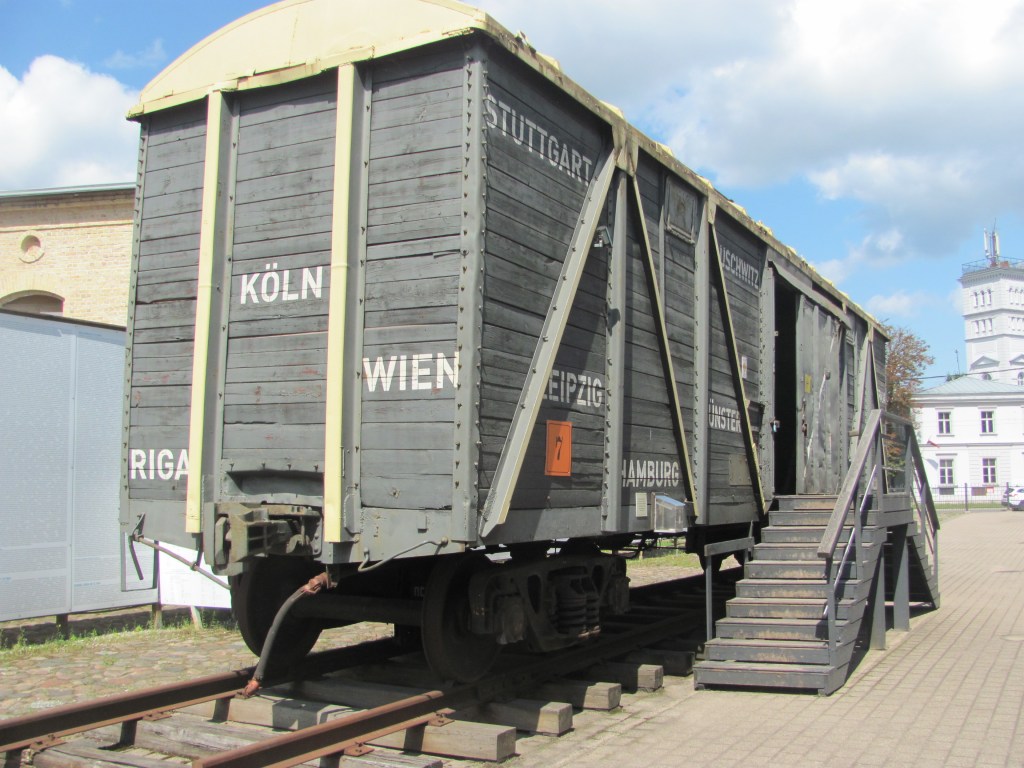
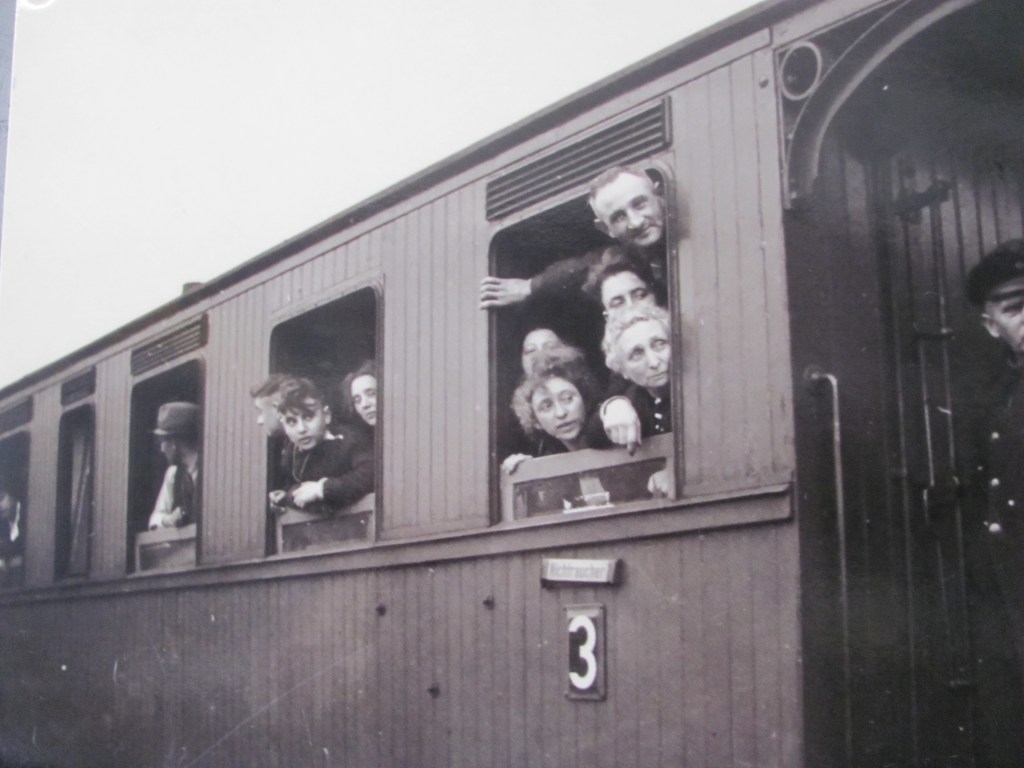
On the wall outside is a list of the names of Jewish people killed in Latvia, indicating where they originated from.

Particularly poignant is a room with suspended cubes lit from within with the names and details of many of those killed written on the cubes’ faces. All ordinary people whose only crime was to be born Jewish.

The actual ghetto itself is a few streets away from the museum.

“It’s amazing that the street names are still the same”, says the First Mate. “I would have thought they might have renamed them, to try and forget the terrible things that happened here. Imagine buying a house in Ludzas Street nowadays knowing what happened there.”
“That may be just why they kept them”, I say. “To stop people forgetting what happened.”
Nearby is the Russian Orthodox church. We have a quick look.

On the way back, we pass the remains of the Great Choral Synagogue that was one of the first synagogues to be burnt down by the Nazis and the Arajs Kommando in 1941, reportedly with Jewish people locked in its basement.
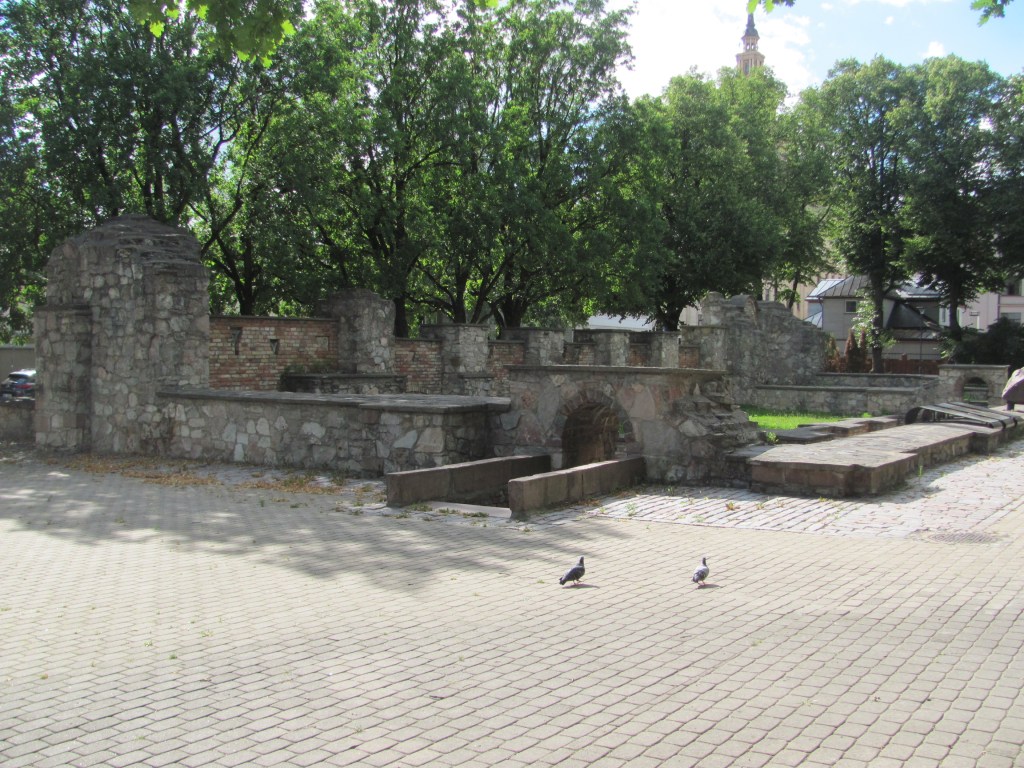
Back in the city centre, we peek into the modern-day Jewish synagogue.
“I have never seen inside a synagogue before”, says the First Mate. “It’s certainly a lot more minimalist than the Orthodox church.”

On the way back to the boat, we decide to visit the intriguing-looking National Library of Latvia on the left bank of the Daugava River.
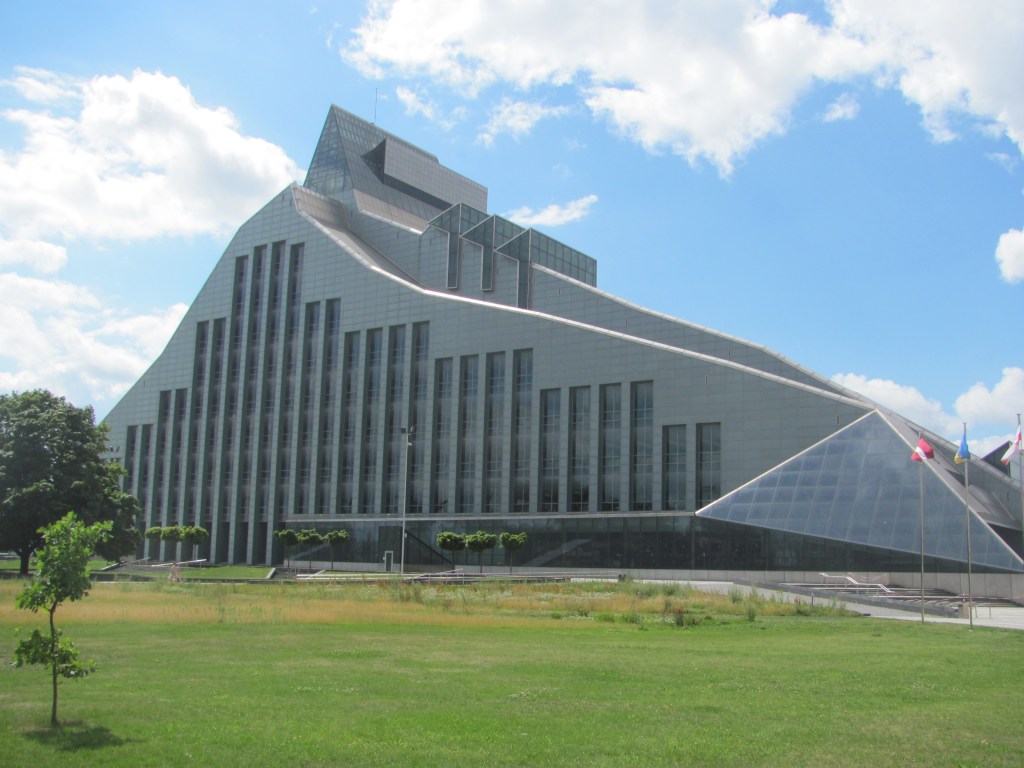
“You can become temporary members of the library if you want to look around”, says the woman at the front desk. “I’ll give you a card each, which will give you access to most, but not all, of the rooms. I suggest you take the lift to the top, have a look at the view, then make your way down each level by the stairs. Here’s a brochure of what is on each level.”
The view out over the river to the Old City is stunning.

We make our way down each level. It’s quite a different concept to the Oodi library we had seen in Helsinki. Rather than a community library, this one is more of a traditional repository of Latvian art, music, folklore, literature, and history. Earnest scholars pore over old tomes, librarians reverently return books to the shelves, visitors speak to each other in hushed tones.

“I bought some of this Riga Black liqueur today”, says the First Mate that evening, as we unwind in the cockpit. “It’s pretty popular here. We can try some.”

“You know, I can’t quite reconcile in my mind what Mike was saying yesterday”, she continues, taking a sip. “On one hand, he is intelligent, helpful, and thoughtful, but I was quite disturbed by his views on Russia and Latvia. How can a nice person like that hold such views?”
“When you have been brought up with a particular mindset, it’s difficult to see the world in any other way”, I say.
 Ruby Tuesday
As always, so interesting!
LikeLike
Thanks Birgitta. They are certainly interesting countries. Would like to come back sometime and do them in more detail.
LikeLike
Again very interesting! I saw that article on ‘the interweb’ about the Butcher of Riga. That place has piqued my interest since reading a long time ago, the book by Frederick Forsyth (who I think is the BEST thriller writer around), called The Odessa File. The character (German sleuth) finds his father (Wehrmacht) murdered by the Butcher at Riga! Interesting that Spencer uses the ‘web’ for his theories too!
LikeLike
H, yes, I remember reading Odessa File years ago too. And yes, Spencer is well-connected via his web!
LikeLike