“Look at that old car over there!”, says the First Mate excitedly. “He’s parked it there just where everyone can see it.”
“It’s an Auburn Speedster”, I say, quickly doing an image search on Google. “Supercharged in-line eight cylinder from the 1930s. Beautiful.”

We are having coffee and cakes in the main street of the picturesque city of Haapsalu in western Estonia. We had left Tallinn a few days earlier, and followed Arthur Ransome’s route in Racundra down the west coast of Estonia as much as possible, passing Baltic Port (now Paldiski) and the Pakri Islands. We had overnighted at Dirhami marina, just over the other side of the small peninsula from Spithami where Racundra had anchored. Ransome had gone for a walk to the top of the dividing ridge and looked down on Dirhami, an anchorage in those days, commenting that it was a better anchorage than where he was, but it was extremely risky coming in with only a narrow channel between dangerous rocks. Even today with all the electronic navigation equipment we have, we still had had to take care lining up the transit marks on the shore until we were safely in the marina. Rocks don’t move much.
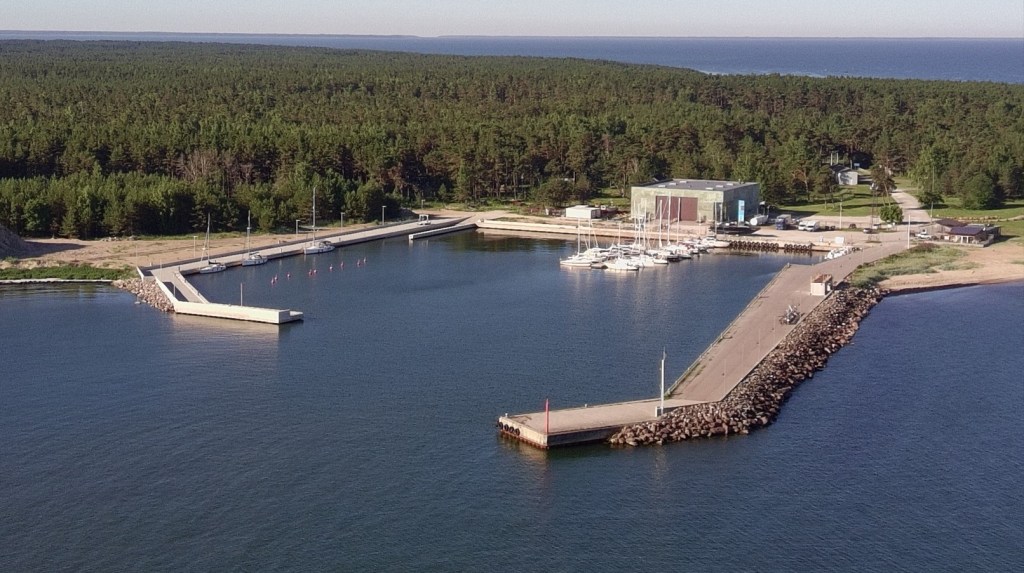
From Dirhami, we had then followed the buoyed route down the Nukke channel between the mainland and the island of Vormsi, passing the place where Racundra had anchored overnight as it was too difficult to tack through the narrow channel in the gathering dusk. Then into the channel itself, with its twists and turns and gleaming black rocks breaking the surface on each side, ready to impale themselves on any boat that strays too close. To do all this by tacking against a head wind with only someone hanging over the bow and shouting if they saw any rocks coming, as Ransome had done, was nothing short of foolhardy, fearless, or both. But they had made it, and so had we.
“Come on”, says the First Mate, finishing her cake and jumping to her feet. “Enough daydreaming. Let’s go and see the Bishop’s Castle. It is one of the sights of Haapsalu, after all.”
Haapsalu is another old medieval town dating from before the early 1200s. When none other than our old friends, the Livonian Brothers of the Sword, had conquered the region, they installed a bishop in Haapsalu in a magnificent castle with a cathedral. Although originally just a church official, over time his successors came to own all the lands, forests, rivers and lakes of the region, which included the island of Saaremaa in the west and quite a large chunk of mainland Estonia. They also gained the power to administer it and make and enact laws.

“Then in the 1500s, the then Bishop sold everything to the Danish Crown, but after a short time, it was lost to the Swedish in the Livonian War”, the audio guide tells me. “The Swedes had it until 1721, when they lost it to the Russians in the Great Northern War. The castle was destroyed by fire in 1688, but since 1889, the cathedral and castle has slowly been restored.”

“Wow, it’s certainly had its ups and downs”, says the First Mate. “But I have to say, being a bishop in those days seemed to be a good career choice. I wouldn’t mind living in a pad like this. I have always had a soft spot for turrets, ever since I was a little girl.”
The cathedral is attached to the western side of the castle. Its claim to fame is a window halfway up a small tower, where at full moon the shape of a woman dressed in white appears.

“The story is that there was once a monk who lived in the castle as part of the bishop’s entourage”, a nearby panel says. “Unfortunately, he fell in love with a beautiful young maiden who lived in the village outside. To be together, he dressed her as a choirboy and brought her into the castle. The plan worked for some time, but one day the bishop became suspicious, and after an investigation, discovered the hapless girl in the monk’s room in her female clothes. It was decided that her punishment was to be walled into the tower just being built, with only a loaf of bread and a jug of water to sustain her. Needless to say, she didn’t last long, and ever since then her white ghost appears in the window of the tower at full moon.”
“I am always amazed at how they managed to devise some pretty gruesome punishments in those days”, says the First Mate, shuddering. “And being Christians too. Imagine the last few hours of the poor girl’s life in there knowing she would never get out.”

In the same tower are a collection of books with the names of all the Estonians who were deported to Siberia during and after WW2. Although I know none of the people, it is nevertheless moving to see whole families taken from their homes and sent to the barren wastes of the east, many never to return. Even more poignant are those families that were split up, with some members being told to stay in Estonia, and others being deported. All ordinary people caught up in the forces of global geopolitics – decisions concerning their lives being made by faceless bureaucrats blindly following leaders driven by ideology.

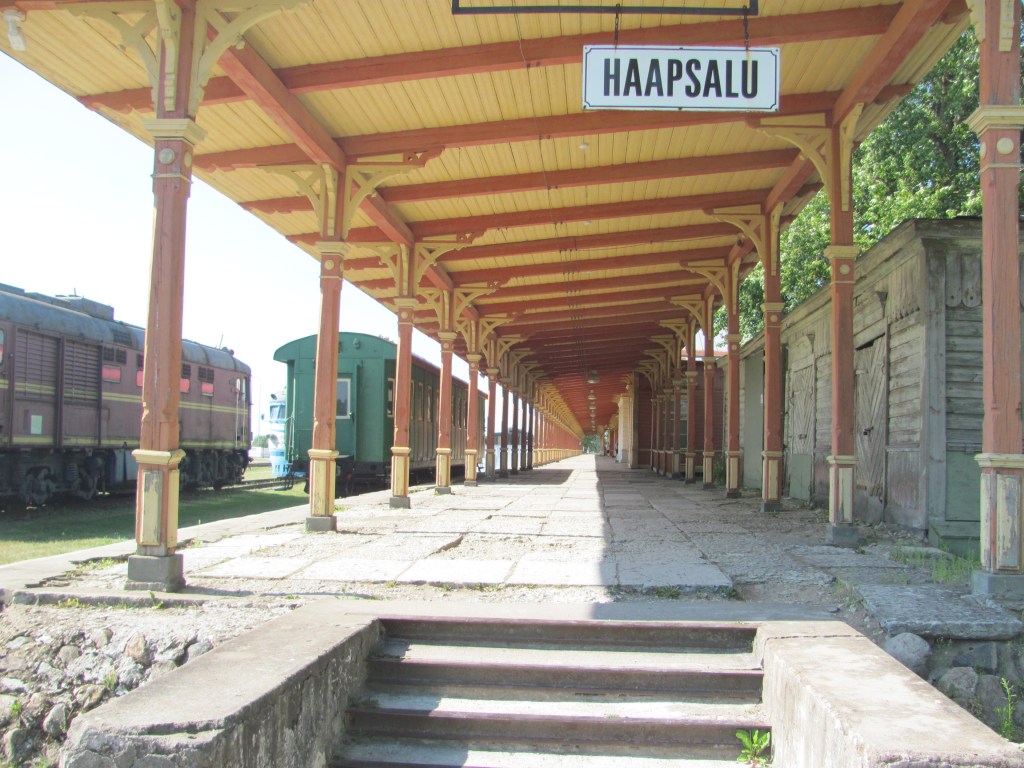
We explore the rest of the town. The railway station is now defunct, but has been converted into a museum of life on the railways during Russian Empire and Soviet times. I try and imagine Arthur Ransome catching the train here after being transported from Vormsi island in Captain Konga’s skiff.
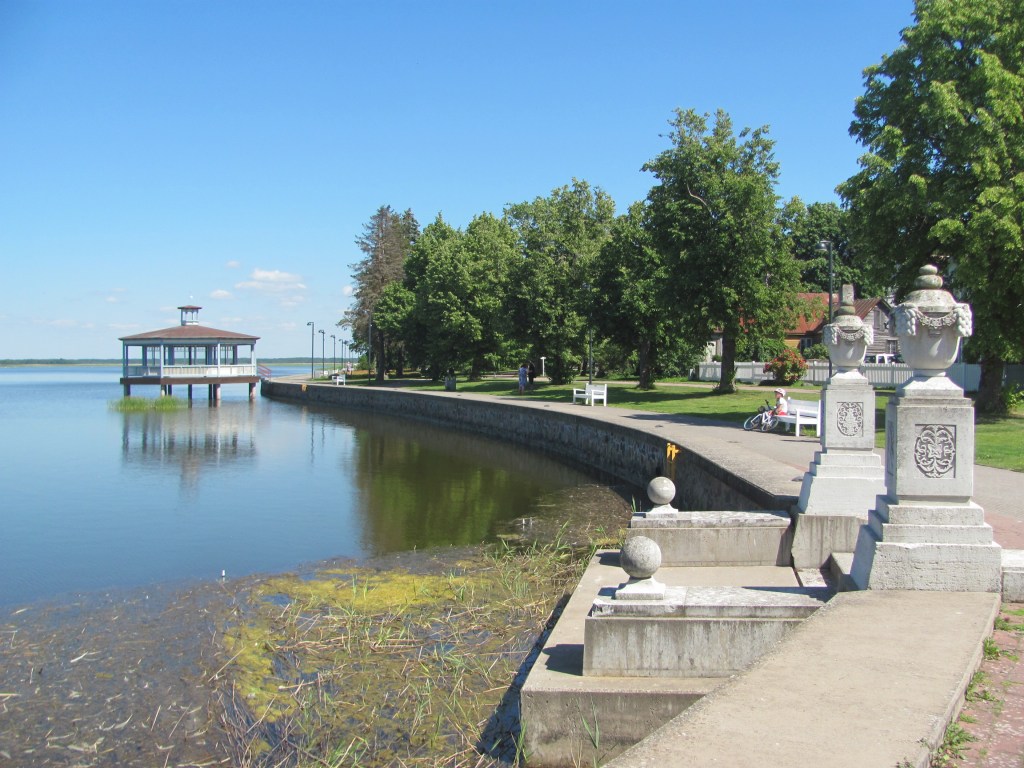
Along the waterfront is the attractive promenade where the well-to-do ladies and gentlemen would parade to see and be seen.
At the end of the promenade we find the Kuursaal where those feeling in need of a pick-me-up could treat themselves to a mud-bath. Apparently the sea-mud in Haapsalu is of superior quality to anywhere else in Estonia, and would draw the rich and famous of the Russian Empire and Soviet Union from far and wide.
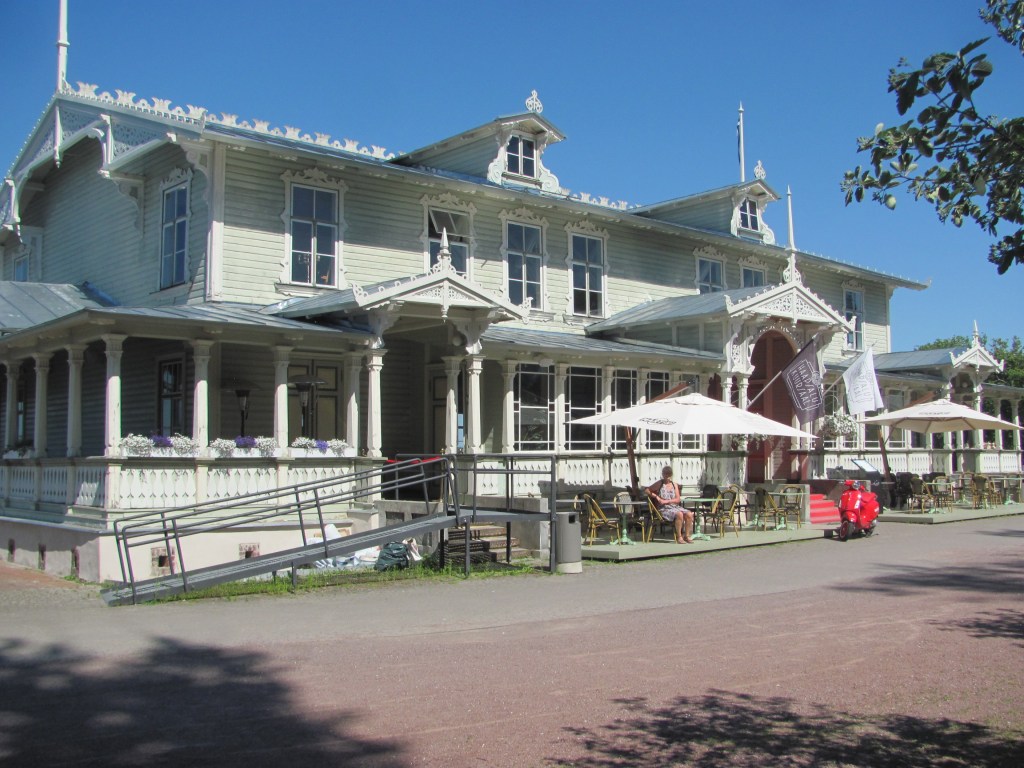
As luck would have it, there is a lunchtime concert next to the Kuursaal, so we stop and listen to the music and try a spiral potato chip.


A little bit further on is Tchaikovsky’s bench, where the great composer would relax after his mud-bath and dream up his next symphony.

“Yes, yes, I thought of that one too”, I say before the First Mate can get a word in, a minor achievement in itself. “Now he is decomposing, surrounded by all the mud he could wish for, wherever he is buried.”
She groans. So do I. But someone had to say it.
We end up at the Rannarootsi Museum, with its Bayeux-like tapestry dedicated to preserving the memory of the small Swedish fishing and sealing communities that had settled on the west coast of Estonia in the 1200s, possibly earlier. They had carried on living there for generations under the various rulers that came and went, somehow managing to preserve their distinct culture. This was helped by the granting of a charter by the kings of Sweden which allowed them to live free from serfdom under Swedish law rather than the local laws.

“In some cases, these charters were lost”, it says on one of the panels. “When that happened, the local landed-gentry would take advantage and pay the Swedes the lower wages and charge them the higher taxes they did with the local Estonians.”
“In 1781 under Catherine the Great, some of the Swedish islanders were forced to relocate to a specially prepared village and lands in Ukraine”, I read. “Half of them died en route, but when the survivors got there, they found everything that had been promised was lies. Nevertheless, some stayed on and built it up. Now that village has been almost completely destroyed by Russian artillery fire in the current war in Ukraine.”
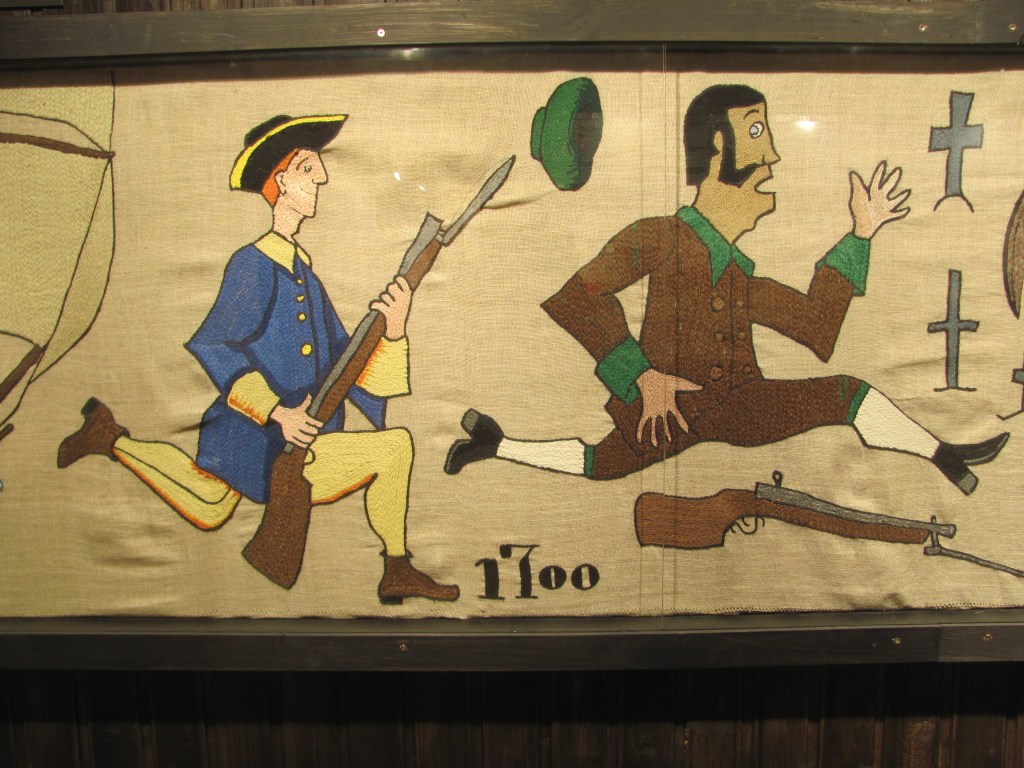
“Look at this one”, says the First Mate. “It says that missionaries came out from Sweden to make sure that these islanders were staying on the straight and narrow. They made the women wear blouses with long sleeves and high collars, and taught that dancing was the work of the devil. One missionary even collected all the musical instruments and burnt them on a bonfire. What killjoys!”
In 1944, almost all of the remaining Swedish-speaking islanders fled to Sweden to escape the Russians, and their houses and farms were taken over by Estonians fleeing from the eastern part of the country. Nowadays only a few descendants remain, and few speak the original colonial Swedish.
A poignant and interesting little footnote of history, I think.
The next morning we sail for the island of Hiiumaa, 20 miles west of Haapsalu, still following Racundra’s route.
We pass the lonely lighthouse on Rukkirahu island on our port side (referred to as Rukeraga by Ransome), and to starboard, the low-lying islands of Eerikulaid, where the British ship Toledo had run aground in the 1920s. Its Captain Konga and his crew had remained on it for two years, living on fish and seals and the occasional vegetables bought on Hiiumaa after a brief row ashore. Eventually it floated off and was towed off to Helsinki for scrap.

We reach the red and green buoys marking the beginning of the long and narrow buoyed channel to the small harbour of Heltermaa. The ferry is coming at speed behind us, so we wait for it to pass us, as there is hardly enough room in the channel for the two of us together.
In the evening we go for a walk along the road leading from the harbour. We reach a multi-windowed wooden building which may have been the Russian posthouse/inn that Ransome tried to obtain milk from. A man is working in the garden, but he doesn’t speak English and so is not able to tell me anything about the background of the house.
“History repeating itself”, I tell the First Mate. “The inhabitants in Ransome’s day also could only speak Estonian. He ended up buying some very expensive eggs instead of milk.”
“We have plenty of eggs”, says the First Mate. “So don’t go buying any more.”

The next day, we take the bus up to Kärdla, the main town of the island. The town’s prosperity was based on a broadcloth factory started in the 1830s by a Baltic German baron.
“He probably made his money by exploiting the cheap local labour”, sniffs the First Mate. “Germans always love a good bargain.”
A little bit further on is the unusual war memorial with an Estonian soldier sitting on blocks of stone inscribed with the names of those who died fighting in world wars.

We stop at the marina and have lunch at a small café there.
“I read that Kärdla is one of the jumping off places for sailing between Estonia and Finland across the Gulf of Finland”, says the First Mate. “It’s only about 50 miles or so.”
We amble back to the town square where the buses leave from.
“Quickly”, says the First Mate. “The bus is just about to leave. Get on!”
We climb on and sit in the front seats to get a good view. The bus wends its way through rolling countryside of forests, ripening crops, and occasional small hamlets.
“It’s beautiful scenery”, says the First Mate dreamily. “So green and peaceful.”

Something doesn’t seem quite right. We seem to be heading away from where I think the harbour is. More to the west of the island.
“Are you sure this is the right bus?”, I ask.
“I think so”, says the First Mate. But she doesn’t sound very sure.
“Are you going to Heltermaa?”, I ask the bus driver at the next stop, a village called Käina.
He looks at me blankly.
“Heltermaa?”, he says, in broken English. “No Heltermaa going. This bus Emmasta go.”
Emmasta is a village in the south-west of the island. Panic! We decide to get off and try and catch another bus either to Heltermaa harbour or back to Kärdla. In any case, there is no point going even further away.

“You just missed the last bus back to Kärdla”, says a man seeing us trying to decipher the bus timetable. “And the next bus to Heltermaa goes in the morning.”
More panic! We are stuck in a village in the middle of the island with no public transport until tomorrow, and with nearly 20 km to walk.
“The best thing to do it to walk out to the roundabout on the main road and see if you can thumb a lift”, the man suggests helpfully.
Twenty minutes later, we are standing at the side of the road with our thumbs out.
“Tidy up your hair”, says the First Mate. “I wouldn’t stop if I saw someone looking like you wanting a lift.”
Despite having seen a car pass just before we reached the roundabout, there are no further cars going in our direction. I glance around, looking for a place in the fields where we might have to sleep the night. I earmark a soft looking spot under one of the hedgerows.
After half-an-hour or so, a car stops. Two young Estonian girls are in it.
“Sure, we can take you”, they say. “We’re heading down that way to meet some friends at a restaurant. It’s no problem.”
Instant sighs of relief!
“I work in Boston in the USA”, the driver says, after we have clambered into the back seat. “I am in public health. There are a lot more jobs to choose from over there than here, and the pay is better. But I am back here for a few weeks to visit my family and friends. That’s what tonight’s dinner is for.”
They drop us off at the harbour. All’s well that ends well. I decide that I prefer my own bed to under a hedgerow somewhere.

“You know that Arthur Ransome was a spy, don’t you?”, says Spencer from the canopy that evening. “He went to live in Russia at the time of the 1917 Revolution and became close to Trotsky and Lenin. He even married Trotsky’s secretary, Evgenia Shelepina, after his marriage to his first wife ended in divorce. Evgenia was one of his companions on the Racundra cruise. He passed information on the progress of the Revolution to the British Government.”
“Yes, I had read that somewhere”, I say. “And that he might even have been a double-agent passing information back to the Russians. It’s hard to imagine that the author of such wholesome children’s books as Swallows and Amazons could have been such a complex character.”
 Ruby Tuesday
Another interesting chapter in your wonderful journey!
LikeLike
Thanks Birgitta. Yes, we are enjoying it all. How’s your sailing going? By all accounts, the summer hasn’t been up to much back there?
LikeLike
We’re having a slow summer in Cornwall, which is such a gorgeous place and we keep finding new places to visit, new walks to enjoy. Yea weather has been a bit disappointing and the winds fickle…
LikeLike