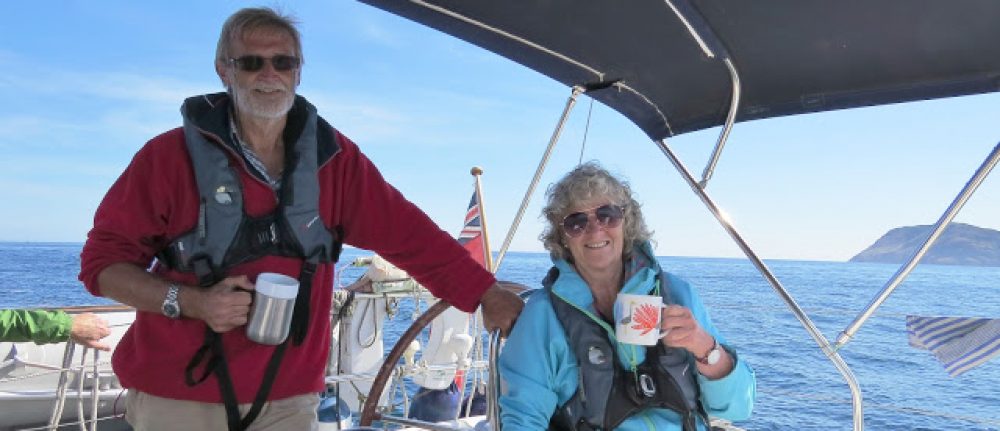
“It’s a bit scary”, says the First Mate. “We can hardly see anything. I just hope that there’s nothing else coming our way.”
We had left Mellanfjardin earlier in the morning, and for about an hour or so we had had a good sail in ten knots of wind. Then it had died to three or four knots and fog had rolled in. At first, it was light, and we could still see several hundred metres. But then it had thickened, and our visibility was down to a few tens of metres.
“We should have got the radar working”, says the First Mate. “I keep telling you to look at it.”
“We’ll be fine”, I say, trying to sound more confident than I felt. “We can see any big ships in the area on the Automatic Identification System. There’s none around at the moment. It’s the little boats that don’t have AIS that we have to worry about. But I think we should be able to see them if they get too close. I’m staying off the main fairway just to be sure.”
I renew my efforts to peer into the gloom in front of us.

“But what about rocks and islands?”, says the First Mate. “We will have to be careful not to hit any of those.”
“I can see where those are on the chart-plotter”, I say. “So we should be able to miss them too.”
The wonders of modern technology, I think to myself. In the former days of sail, when knowledge of a ship’s position had only been approximate, fog had been a real killer. Now we have instruments that can tell us where we are with pinpoint accuracy, with the ability to see where our own eyes can’t, warning us of any dangers that lie ahead. If you trust them. There is still no place for complacency.
Hour after hour we sail along in our own little fog-world. Sea and sky merge into one, disorienting our senses, reminiscent of the whiteout I had once experienced on the top of Ben Nevis. Up and down and left and right cease to have any meaning.
Eventually we approach Sundsvall. The huge road bridge connecting one side of the inlet to the other looms out of the fog. High above I can hear the noise of the traffic, but can’t see it. I start the engine to motor the last little bit into the marina. Already the fog is clearing, and the sun is trying to peer through. Waiting hands grab our lines and we are secure.

We unload the bikes and cycle into town.
“There’s something about this town I really like”, says the First Mate, licking her ice-cream. “It’s quite different from the other places that we have seen along this coast. More substantial looking.”
We are sitting in the town centre of Sundsvall, one of the main towns of the Virgin Coast of Sweden, enjoying the sun after a visit to the museum.
Like many Swedish towns we had seen already, Sundsvall had originally been built of wood, making use of the plentiful supply of timber in the northern part of Sweden. But over the centuries, it had burnt down four times. Each time it had been rebuilt in wood. Then, in 1888, after it had burnt down yet once again because of a spark from a steamship, the town authorities had decided that enough was enough. This time the town would be rebuilt in stone, not wood. It had been expensive, but worth every kronor to make sure that their town would never go up in flames again.


“It’s just a pity that it was so expensive that only the rich people could afford to live in the town centre”, says the First Mate. “The poorer people who also used to live there were forced to live on the outskirts.”
Later I cycle to a boat accessory shop on the other side of town to buy a heavier stern anchor. The one that we already have from our previous smaller boat is too light to hold the weight of Ruby Tuesday in all but the calmest conditions.
“You’ll need some heavier chain as well”, the man tells me. “This five metre length of 8 mm chain should do the job. You can attach your reel tape to it. Both tape and chain have a breaking strain of 2500 kg. And you will probably need this container to hold the chain in. You can attach it to your stern pulpit. Oh, and these shackles to attach the chain to the anchor and the tape.”
It all costs a small fortune. I start wondering if it is all worth it, but the man assures me that many of the small harbours northwards from here require boats to tie up bows-to to a jetty and use a stern anchor rather than a buoy to keep the boat in line.
“And, of course, if you want to moor your bow to the rocks in the natural harbours, you also need a stern anchor”, he says. “You can’t tie up stern-to like they do in Greece, or else you run the risk of damaging your rudder against the rocks.”
The next problem is getting it all back to the boat. I load the anchor on to the small carrier on the bike, and tie it on with bits of string. The chain, its container and other bits and pieces I had bought all go into my rucksack. It’s all quite heavy and the front of the bike feels quite light. It reminds me of the ‘big shop’ episode in Flensburg two years ago.

I take it slowly, but eventually I make it.
“We didn’t think that you were going to manage all that weight”, say Robert and Helen next to us. “But we saw you peddling furiously with your head down, so we knew you were determined.”
The next morning, we leave for Härnösand, further up the coast. Strong winds are forecast in a couple of days’ time, and we need to make sure we are somewhere safe for them.
“At least there will be something to do in Härnösand”, says the First Mate. “We might get a bit bored stuck for two days in a small harbour somewhere.”
The winds come from the northeast in the early morning. The marina is not particularly well protected from the north, but at least it is better than being out at sea. I need to get up and re-tension the stern line to stop being blown into the boat next to us.

“I think I might go and visit the Bilmuseum”, I say over breakfast. “It’s only 15 minutes’ walk from here, and it is supposed to be the largest car museum in Sweden. Do you want to come?”
“I‘ll give it a miss”, says the First Mate. “It’s not really my scene. I’ll have a browse around Härnösand.”
I cross the bridge and search for the Bilmuseum nestled behind the Lidl store. Outside an American car stands impaled like a cherry on the end of a cocktail stick. It looks like it might be the right place.

I spend the next couple of hours in a petrolhead’s heaven. A fest of cars of every shape and size from all over the world. De Dions, Packards, Buicks, Plymouths and Rolls Royces stand next to each other, painstakingly restored to their original condition. Ferraris, Trabants, Model-T Fords, Renaults, Humbers and Jaguars all jostle for space in the vast halls. Mercedes, Volvos and Saabs vie for attention, as brightly polished as the day they rolled out of the factory.


And then I see her in all her glory. A 1973 MGB Roadster, one of my first cars, in immaculate condition. Except someone had painted her yellow; she was blue when I had her.
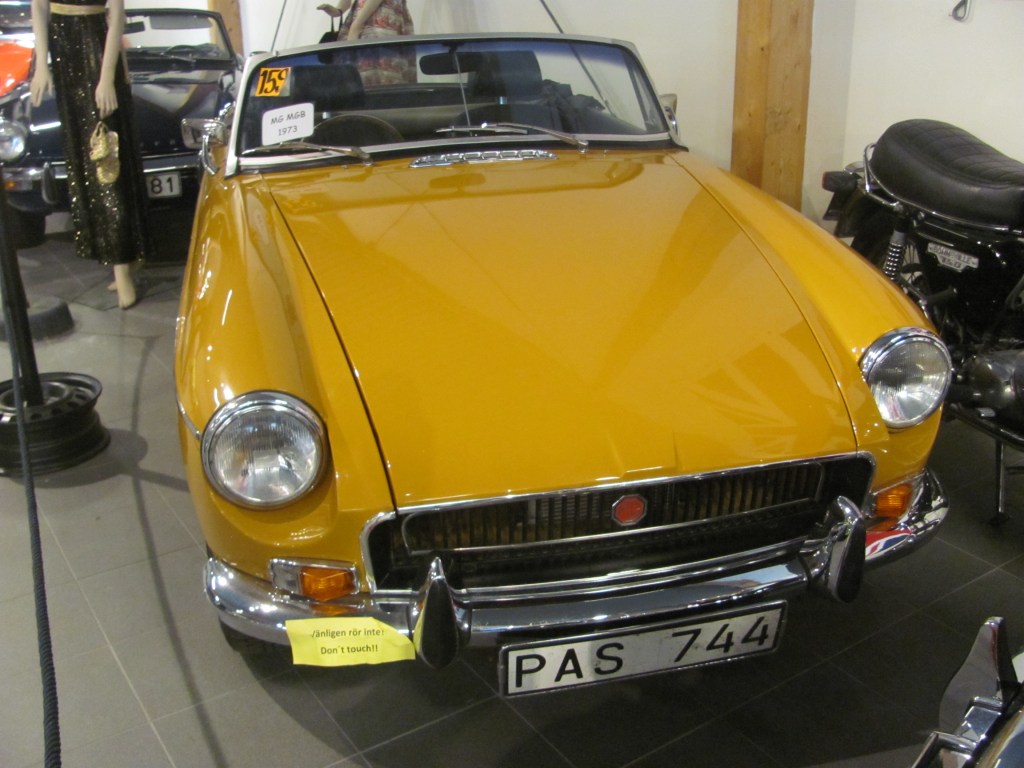
I press the accelerator to the floor. The car surges forward with a throaty roar, the wind blowing back the golden tresses of the girl beside me. Trees flash past us; houses come and go. Sheep grazing in the paddocks look at us bemusedly as we speed past. I flick the electric switch into overdrive, and the engine settles into a comfortable burble. The girl grins.
“Let’s go to the Port Hills”, she says. “I’ve never seen the city from up there before.”
“Your wish is my command”, I say.
We reach the base of the road leading to the hills, and I shift down a gear and gun the engine. Tyres slide around the hairpin corners as we climb the narrow road to the summit of the ancient volcano rim, only just avoiding the occasional car coming downhill.
“Please, please! Not so fast!” shouts the girl above the noise of the wind, gripping my knee. But the twinkle in her eyes tells me she is enjoying it.
The rev-counter climbs into the red and I change up again.
We park in the small carpark on the summit, the city sprawling out below us. To our left, the Pacific Ocean stretches to the horizon, its white breakers rolling slowly in to come to a stop on the sandy beaches of the coast. In the distance, the snow-capped mountains of the Southern Alps provide a majestic backdrop, their forest-covered foothills giving way to the shelter belts and ripening crops on the plains.
“If you look carefully, you can see where we live”, I say. “Just north of the Waimakariri River.”
“It’s stunning”, she says. “It’s all so flat where I live.”
I lean over to kiss her …

“Excuse me!”, says a voice with a Scandinavian accent. “Do you mind?”
I snap out of my reverie.
“Sorry”, I say to the Swedish woman standing next to me. “I was just dreaming. It was my first car.”
“We all dream of lost loves”, she laughs knowingly. “It doesn’t do any harm.”
The excitements and disappointments of first love. It hadn’t lasted. I wonder fleetingly where she is and what she looks like now.
The winds abate overnight. We slip the bow lines, and I pull back the boat on the stern line until I can disengage the metal hook from the buoy. We edge our way gently between the row of stern buoys until we are clear, pull out the sails and head northwards toward the High Coast area proper.
“The ‘uplifting landscape’, they call it”, says the First Mate. “It’s beautiful. All those shades of blue and purple of the hills upon hills. It’s quite different from what we have seen before in the archipelago. I can see why the Swedes are proud of this area. It’s a little bit like the west coast of Scotland.”

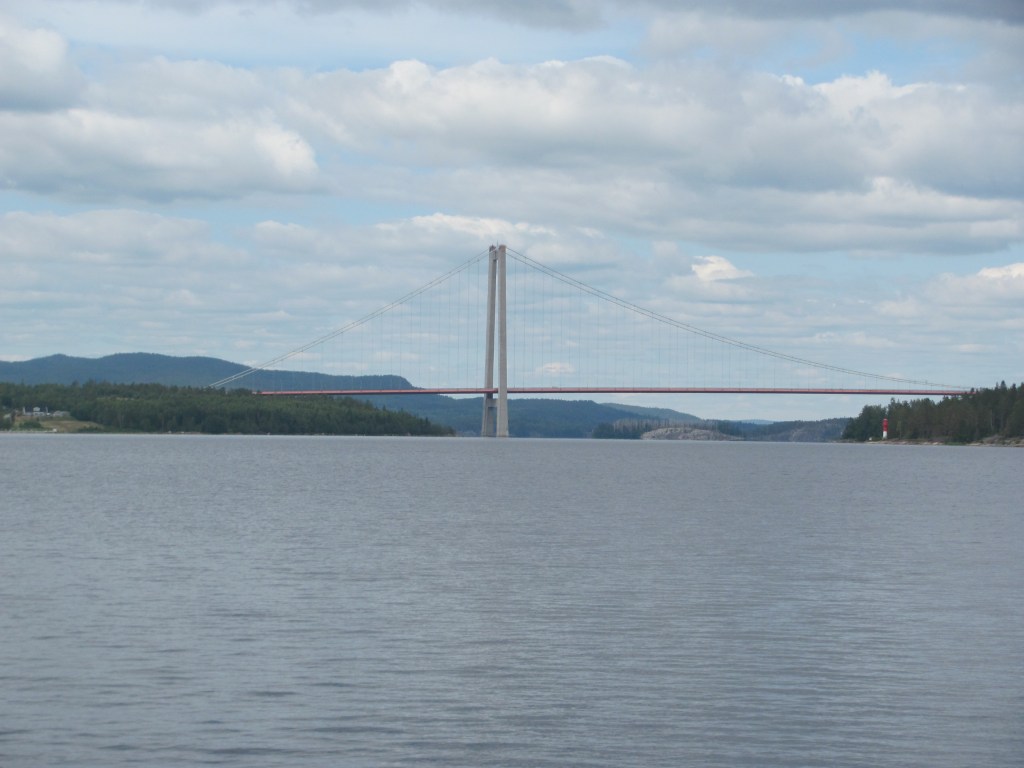
“We can take the long way around so that we can see the Högaküstenbron”, I say. “The High Coast Bridge. By all accounts it is quite spectacular.”
We round a promontory and the bridge comes into view. Tiny trucks seemingly suspended in space cross slowly from one side to the other. Yachts sailing underneath are dwarfed by it.
“It was completed in 1997”, the First Mate reads out from the guide book. “It is 180 m tall, nearly 1.9 km long, and is the third longest suspension bridge in Scandinavia. It carries European Route E4.”
A cold wind starts to blow.
“Come on”, says the First Mate. “It looks like rain. Let’s get going to Lövvik before it starts.”
Before long, we are in the inlet leading to the tiny harbour of Lövvik. A few boats are already there, one of which is Anna. There doesn’t look like there is a lot of room for us. We approach the small jetty and suddenly see one space left, mooring bows-to with stern anchor. Two young men appear in swimming costumes to give us a hand. One has a beard.
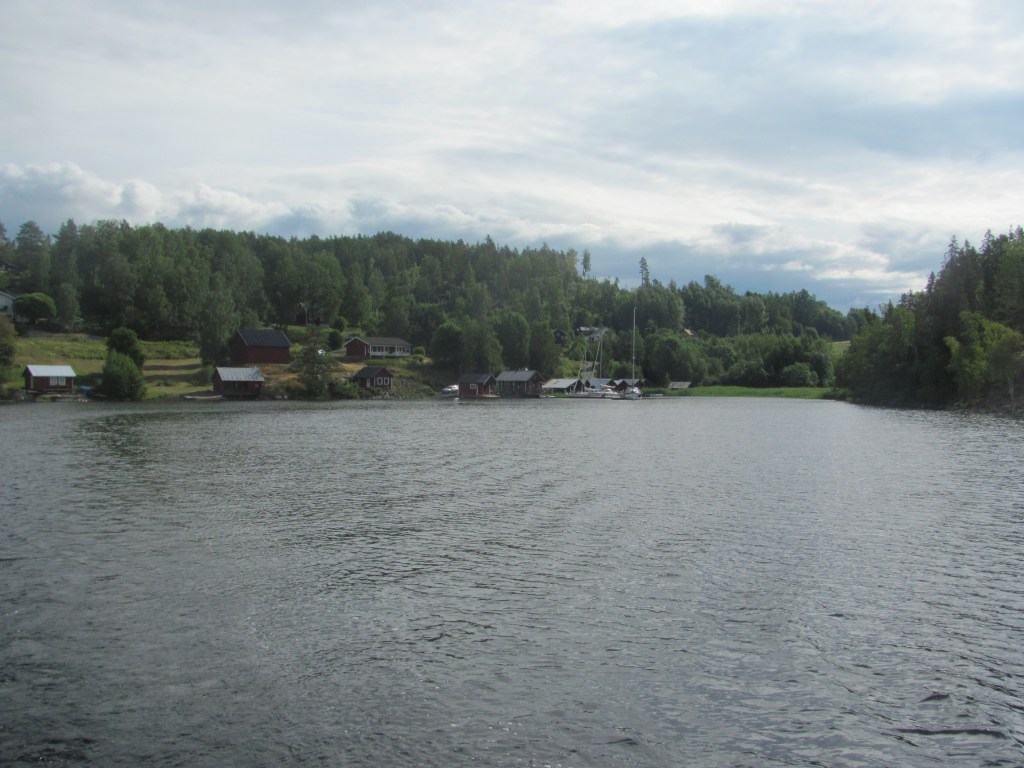
“Do you think it is deep enough?”, I call out to the First Mate on the bow. Our keel is two metres deep, so we need at least that so as not to touch the bottom.
“I’ll dive down and check”, says the Man with the Beard, hearing me.
He dives in, and a few seconds later reappears.
“It’s four metres”, he calls out. “Plenty of water.”
I drop the stern anchor, and let the reel pay out. We manage to tie up with no drama, and thank the diver warmly for his help.
“People are so helpful”, says the First Mate over a cup of coffee. “Imagine diving down to check the depth for us. It has reaffirmed my faith in human nature.”
Later we chat to the two men relaxing after coming out of the small sauna on the dockside. They are from the huge motor boat tied up on the other side of the pontoon to us. Two Samoyed dogs lounge on the foredeck. A young woman tans herself on a sun lounger on the rear deck. We ask them where they are from.
“I am from England. But my father was from Glasgow”, says one of them, noticing our flag.
“And I was educated in England”, says the Man with the Beard, with a slight trace of an ‘east-of-Berlin’ accent. “But I am Russian. After this trip, I am going back to Russia to live.”
The conversation falters.
“With the present situation?”, the First Mate manages to stutter eventually, obviously stuck for words.
“Oh yes”, he responds. “Russia is a great place to live. It’s on the rise. It’s the rest of the world that is going south.”
Neither of us quite knows what to say to this.
“Anyway, we need to get back into the sauna”, the Man with the Beard says. “It was nice talking to you.”
“It’s amazing how quickly one’s view of a person can change just with a few words”, the First Mate whispers to me when they are gone. “He seemed such a nice person. I wonder if he is an oligarch? With a boat like that, and an attitude like that?”
“Yes, it was certainly an interesting viewpoint”, I say, also a bit nonplussed. “We must try and catch him later and find out why he thinks that way.”
Unfortunately, they leave that evening and we don’t get a chance.
“Ah well”, says the First Mate. “It’s probably for the best. It might have ended in an international incident. By the way, I haven’t seen much of Spencer recently. Do you think he is all right?”
“He’s around”, I say. “He’s just been catching up on his reading. He’ll be back soon.”
 Ruby Tuesday
Lovely to read about everyday life on Ruby Tuesday again. And so well written Robin – you definitely have a book in you!
Sweden is growing on me. 😀
LikeLike
Thanks, Uli. Yes, Sweden is a great country. Lots of beautiful scenery and friendly people. You should visit it some time.
LikeLike
Fog!! We had the same recently; supposed to be a bit of mist in the morning and we had 7 hours of thick fog! Was both scary and strangely wondrous. And I’ll never forget the ghostly shapes of yachts gliding by at the edge of our field of sight. One second there, then gone, never to be seen again.
LikeLike
Birgitta, yes, we had the same feeling, although luckily we didn’t see another boat the whole time. Or anything else, for that matter!
LikeLike
Glad you are both safe. You have become very skilled in getting your selves out of difficult situations. Happy travels and hope we can meet up again soon xxx
LikeLike
Thanks, Ayer. Nice to hear from you. Yes, we muddle along somehow.
LikeLike
Do you remember your MG being in our garage at Latimer Square, with the engine out, the bonnet being wrecked as you didn’t secure it properly? Working on it while we were fixing motorbikes. I often tell my son there were 7 motorbikes in the garage being repaired and your MG in the caravan shed.
LikeLike
Hi Hamish, yes remember those days well. We had a lot of fun.
LikeLike