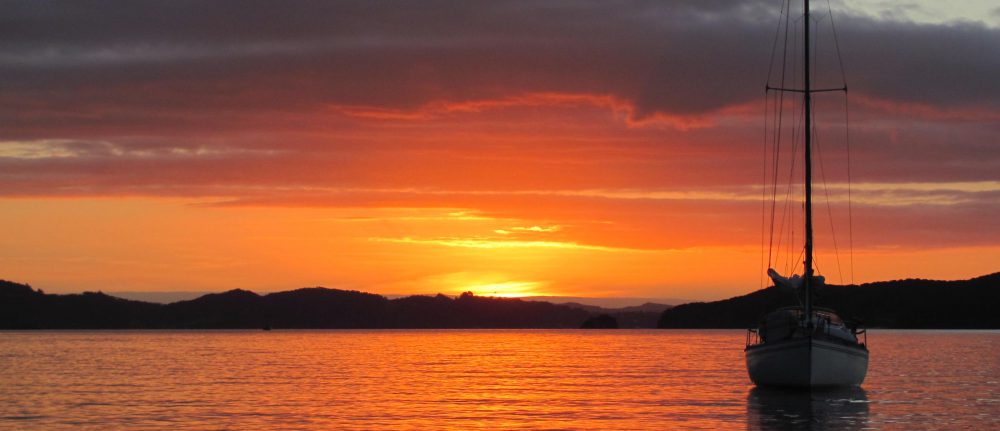
It is a glorious morning as we motor out of Mariehamn at 0700, heading south to round the peninsula before turning westwards towards Öregrund in Sweden. A faint breeze springs up, enough to justify taking the sails out and cutting the engine, and we sail along at a sedate three knots, enjoying the warmth of the early morning sun on our skins.
As we round the end of the peninsula, the wind picks up. The only problem is that it is coming from the north-west, the same direction as we want to go. It’s not exactly what the forecasts said.
“Unless we want to motor all the way, there is nothing we can do except tack”, I say.
We trim the sails and sail close-hauled in a series of two to three mile-long tacks. We make progress towards our destination, but it is slow. By the late afternoon, we are only as far as a small group of islands to the northwest of Åland, and we are getting tired.

“I think that it is a bit ambitious to try and get to Öregrund in Sweden now”, I say. “The wind has veered round to the north, so we would probably be able to do it, but we wouldn’t get there until around eleven o’clock tonight. Why don’t we stay here in these islands for the night and carry on in the morning? The harbour guide says there’s a good anchorage on Enskär island.”
“Sounds like a good idea”, says the First Mate.
We find a place to anchor in a small bay on the south side of Enskär. It is peaceful and quiet, with good holding in mud, and relatively well protected from the northerly wind. Two swans swim off in consternation as we reverse to set the anchor.
At the end of the promontory of the bay stands a lonely house.
“I wonder who on earth lives there?”, asks the First Mate, as we sip our wine in the cockpit. “It’s pretty remote. I can imagine that it would be the ideal place for a murder.”
“Or a hideout for drug smugglers”, I joke.
“Or Russian spies”, she says.
“It’s the house at the end of the Universe”, I say.

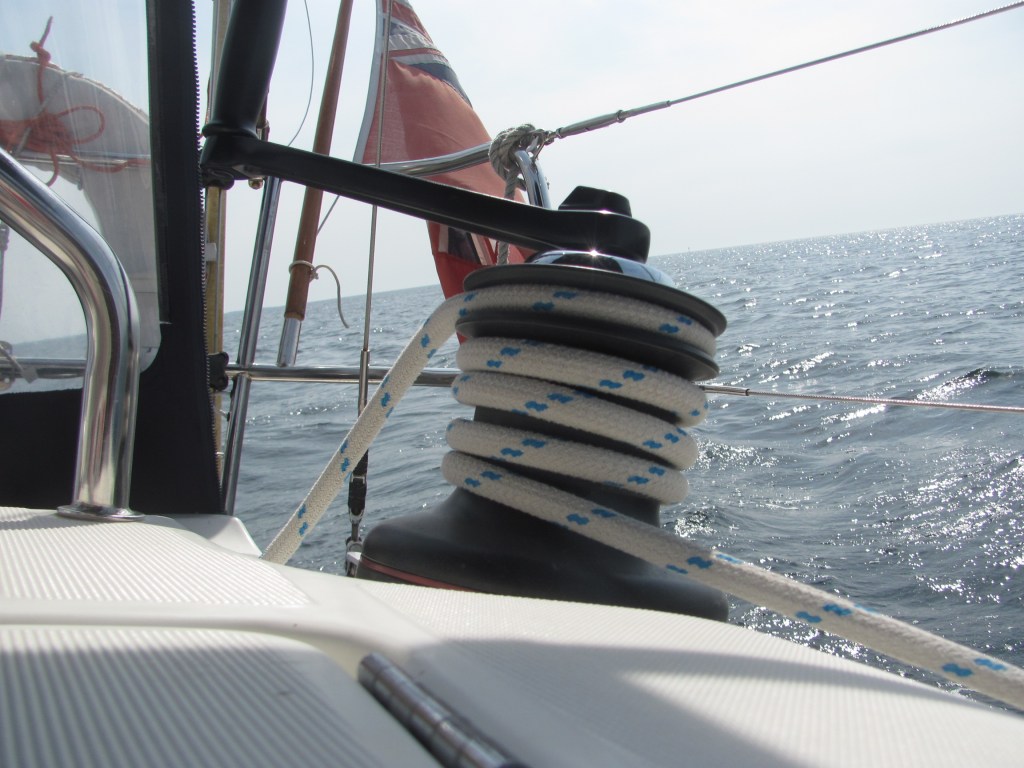
In the morning, the wind is still from the north. After a leisurely breakfast, we unfurl the sails and set off on a nice beam reach. Ruby Tuesday settles into a groove and speeds along comfortably at seven knots, covering mile after mile effortlessly.
“I like this sort of sailing”, says the First Mate. “Not too much heeling.”
“Yes, quite a difference from yesterday”, I say.
We reach Öregrund in the mid-afternoon, and tie up in the small guest harbour.

Öregrund has only 1500 inhabitants, but it is still designated a city. In 1500, after Denmark conquered Stockholm, the Swedish under Gustav Ericsson tried to mount resistance from Öregrund. The Danes weren’t well pleased with this, so they stormed it and burnt it to the ground. When Ericsson eventually beat the Danes and became King Gustav Vasa I, he granted permission for a new city to be built there. For a while it was the main harbour from which pig iron was exported to all over the world, but it then fell back to relying on fishing. In the nineteenth century, it attracted the attention of the rich and famous, who built beautiful houses for their summer residences. Nowadays it is a busy summer resort.
“It’s the only place in Sweden that you can sit and watch the sun set over the sea”, the woman in the tourist information office tells us.
“I am sure she is right, but I would have thought that there would be plenty of places on the west coast of Sweden that you could do that too”, says the First Mate later.
The two most notable features of the city are the medieval church and the clock tower.

“Let’s go and see that lightship over where the ferry comes in”, says the First Mate. “Look, you can see its masts over there.”
It turns out that the lightship is just the topsides set in a concrete base overlooking the ferry harbour. It is used as a venue for visiting music bands.

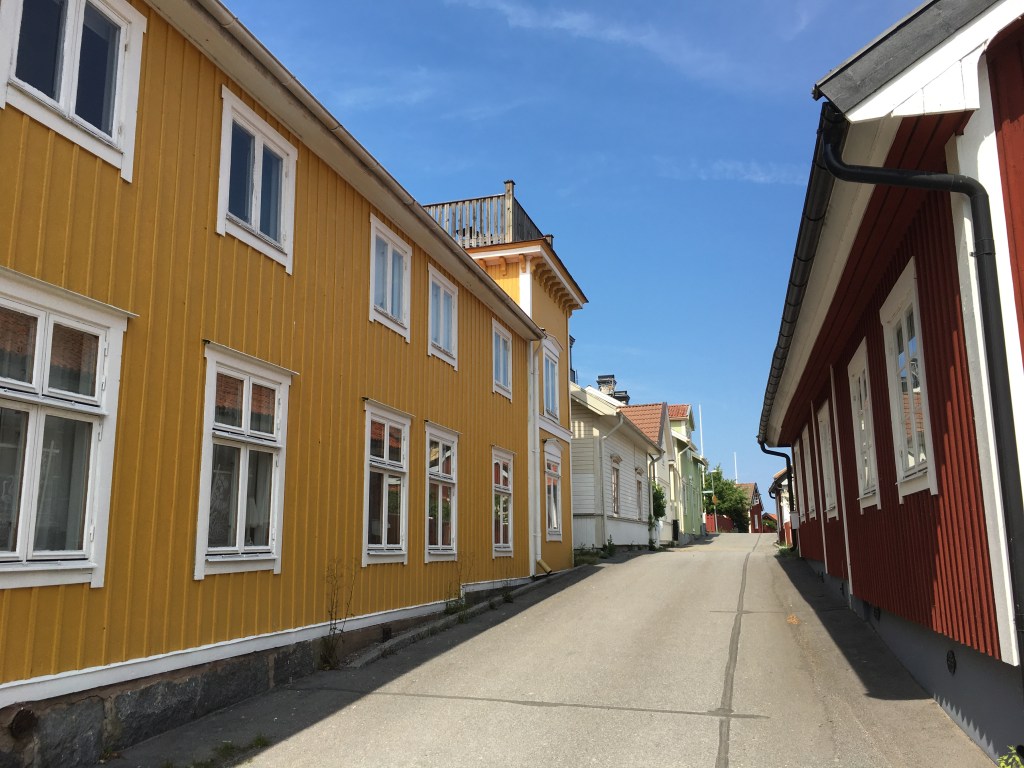
We find ourselves in the old quarter of town. The aroma of fresh roses fills the air, and quaint little cottages proudly boast a riot of colour. From an upstairs window the strains of ‘The House of the Rising Sun’ filter out. Life is good for the Öregrunders.
In the evening, we decide to motor across to a little inlet opposite Öregrund.
“It’ll save one night’s harbour fees”, says the First Mate. “And it will make it easier to get started in the morning. All we will have to do is pull the anchor up without all the faff of worrying about slip ropes and stern lines.”
When we get there, there is one other boat anchored, a German-flagged boat called Anna.
“They probably have the same idea”, says the First Mate. “You know how we Germans like to save a few pfennigs when we can.”
“Cents”, I say. “Nowadays you like to save a few cents when you can, not pfennigs.”
“Whatever”, she says.
We weigh anchor the next morning and set off northwards for Gävle. We are now entering the Jungfrukusten, or the Virgin Coast, stretching 200 km from Öregrund to the Höga Kusten, and so named because of its unspoilt nature. According to the travel guide, there are more than 4,500 islands, lots of of beautiful sandy beaches; and picturesque fishing hamlets.
“It all sounds very idyllic”, says the First Mate. “I’m looking forward to exploring it. By the way, did you know you are supposed to pronounce it ‘Yevleh’ in Swedish, not ‘Gavle’ like we do in English.”
“Yes, I read that too”, I say.
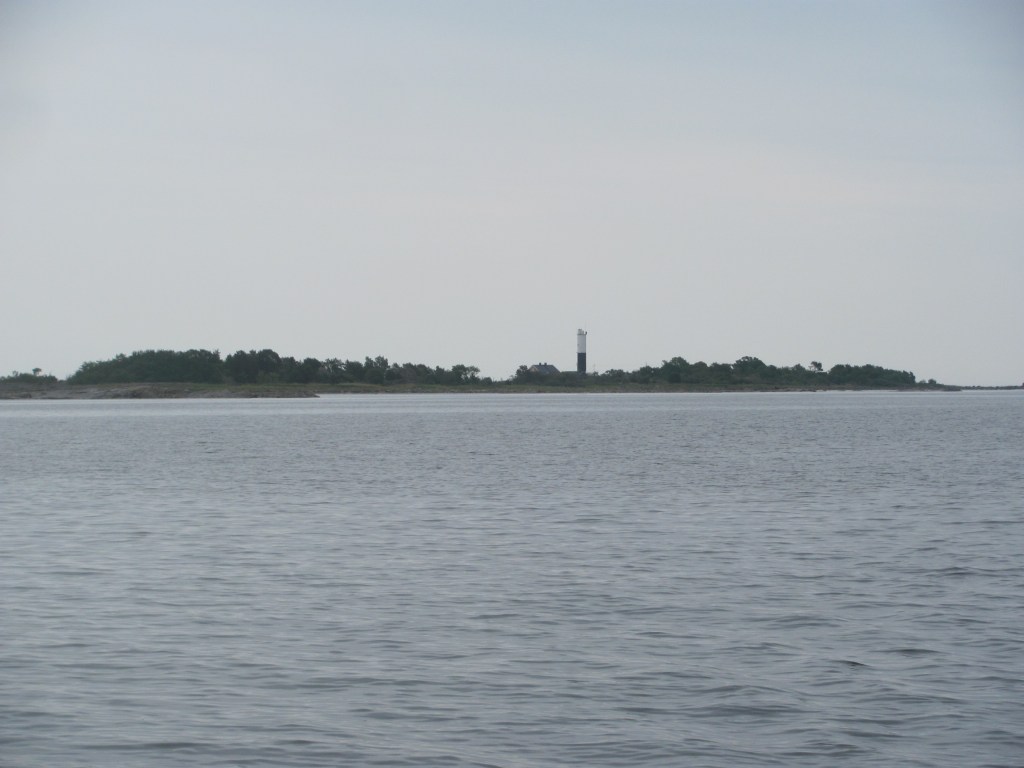
We reach a small island called Björn with its prominent lighthouse, where there are supposed to be two Swedish Cruising Club (SXK) buoys which we are entitled to use.
“Let’s break the journey here”, I say. “We can chill out and keep going in the morning. The wind is supposed to be more from the south tomorrow, so it’ll be better for us.”
We follow a narrow buoyed channel between submerged rocks and find the two SXK buoys. It’s idyllic – the water is calm, birdlife abounds, and the haze over the land to the west hints at mystery and intrigue.
“There’s another boat coming behind us”, says the First Mate, as we tie up to one of the buoys. “It looks like it has the same idea. I was kind of hoping we would be the only ones.”
I check the AIS. It is Anna, the same boat that was anchored next to us opposite Öregrund. They tie up to the other buoy. It’s too far away to talk to them.
“It’s the Germans we were next to last night”, I say. “They must have been following us all of the way.”
We spend the evening watching the birdlife through the binoculars. Gradually the haze makes the sea and sky appear to merge into one, giving the impression that we are floating in space.
“Surreal”, says the First Mate. “We are so lucky to see it.”
The next morning, we continue towards Gävle. We tie up at the Huseliiharen marina just outside the city. The next day we take the No. 95 bus into the centre.
“It’s a pity we’ll miss the Gävle Goat”, I say, on the way in. “Apparently, every year at Christmas time, they construct a goat out of straw in front of the castle near the city centre. It’s supposed to be a Yule goat from German pagan times. In recent years it has become a bit of a thing for it to be burnt down, even though it is illegal to do so. People have been fined for vandalism and even sent to prison for it. But it still carries on getting burnt down.”

“You would think that in this day and age that they could protect with cameras and guards and the like”, says the First Mate.
“They do all that”, I say. “They even tried coating the straw in flame-retardant material one year. But people still find ways of setting it alight. And there’s more. There are actually two goats – one is built by local businessmen and the other by the local school. They compete to see who can build the largest goat for the Guinness Book of Records. There has even been quite a bit of bad feeling with accusations from both sides of cheating.”
“Clearly more goes on in Gävle than you might expect from its docile appearance”, says the First Mate, as we step off the bus in the city centre. “Look, there’s a goat sculpture. Get a picture of it for the blog.”

We continue our voyage north. Half-an-hour out of Gävle, we see a familiar name on the AIS. It’s Anna. We had last seen them as we were entering Gävle, but they hadn’t come to our marina and we had almost forgotten about them.
“They must have gone to the marina in the city centre”, I say. “S’funny, I thought that it was silted up and too shallow for our boats.”
“They’re like our shadow”, says the First Mate. “I wonder if we will ever get to meet them?”
We reach the small island of Storjungfrun, after which the Virgin Coast is named, and use the two leading marks to enter the tiny harbour dominated by the lighthouse towering above it. One other boat is already there. The sole occupant gives us a hand to tie up.
“I’ve come from Sundsvall up north”, he says. “and heading south to Stockholm. I thought I would break my journey here. Welcome to Storjungfrun.”
Three other boats arrive shortly after us. One of them is Anna.
“It’s nice to meet at last”, says the blond-haired skipper. “We have been following you for the last few days. It looks as if we are heading in the same direction. We are aiming to get to Umeå, but we have to be back in Stockholm at the end of August. My name is Holger, and this is my wife Annette.”

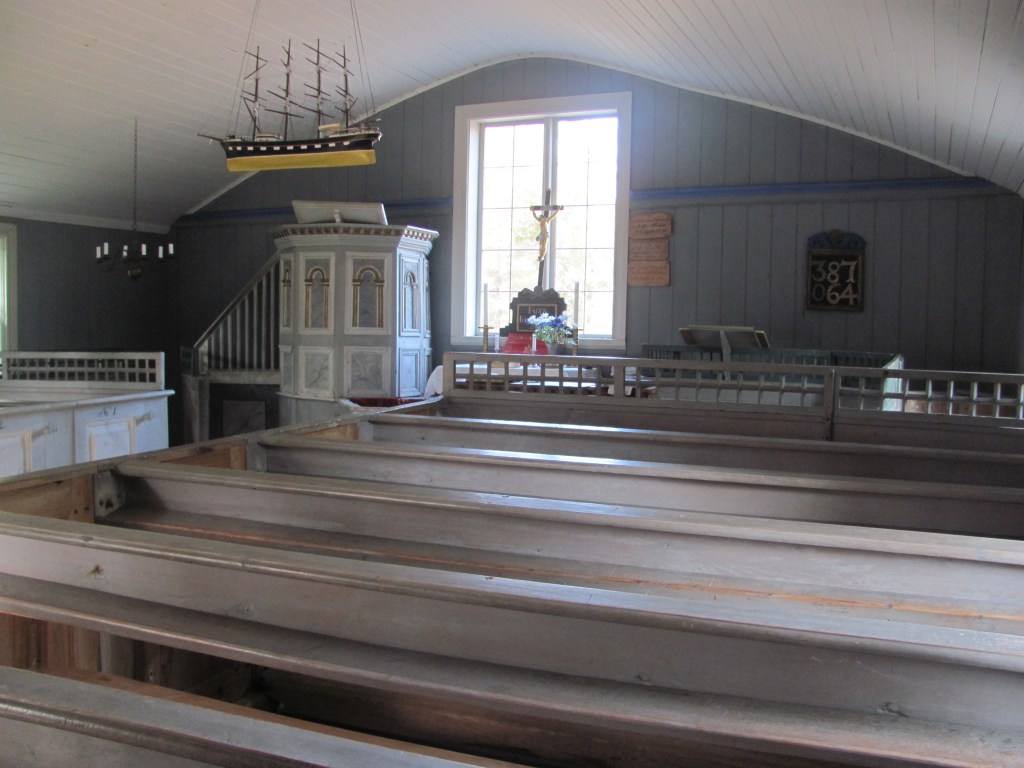
After exchanging pleasantries, we climb up to the lighthouse and explore the few red-painted houses clustered around it. At one end of the village is a small church built by the Gävle fishermen who used to use the island as a summer base.
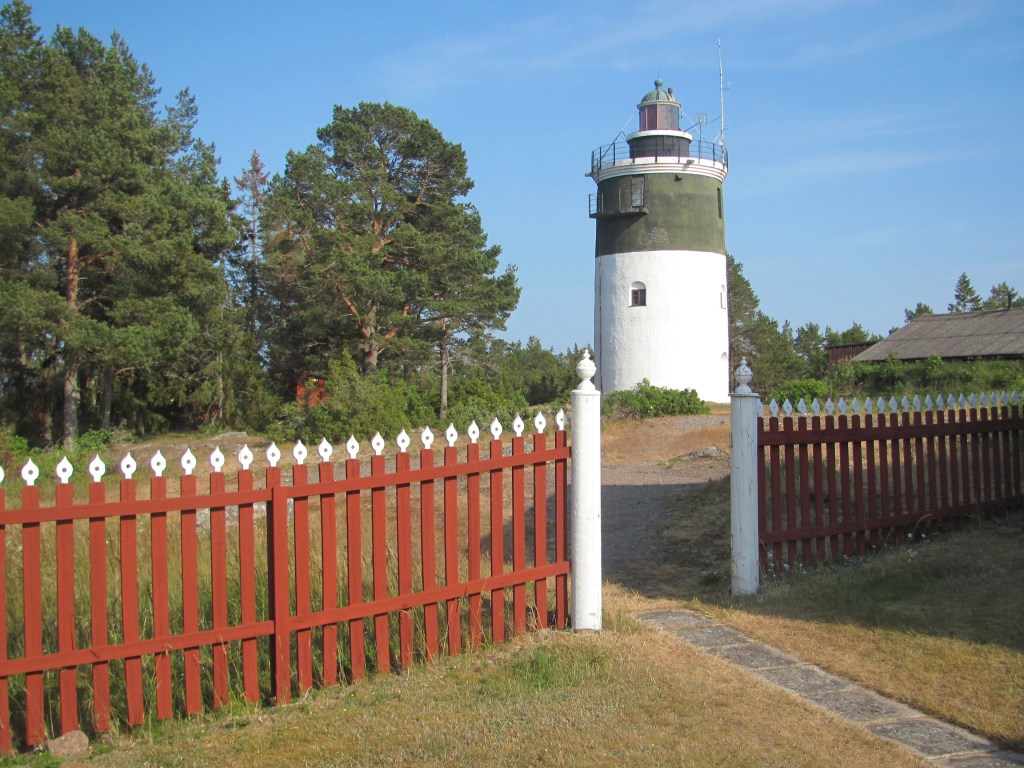
“Ah, I read about the Gävle fishermen in the travel guide”, I say. “Apparently in 1577, King Gustav Vasa gave the fishermen from Gävle exclusive rights to fish for Baltic herring up and down this coast in return for giving every tenth barrel to him. It was the Gävle fishermen who established these pretty little fishing villages wth small churches to worship in, like this one. The local people were prohibited by law from fishing where they had done so for generations.”
“It seems a bit unfair”, says the First Mate.
“They did relax the rules a bit later”, I say. “But, yes, it caused a lot of resentment.”
We walk back to the boat.
“What do you think the weather will do tomorrow?”, asks the First Mate over dinner in the evening. “My app says that the winds will be quite strong from the west.”
I look abstractly past her at the scene unfolding on the other side of the harbour. A naked man has emerged from the small hut billowing smoke from its chimney. He is followed by two naked women. All three walk starkers to the end of the jetty, and dive into the water.
“Well?”, says the First Mate. “Do you think the winds will be too strong for us?”
“Hmmmm, yes”, I say. “I mean no. Possibly.”
All three people are now climbing up a ladder to the jetty. They dry themselves in the last rays of the evening sun.
“Where’s your mind tonight?”, the First Mate asks. “You seem to be on a completely different planet.”
She follows my gaze.
“Oh, those ones”, she says dismissively. “They are just having a sauna. I saw it earlier when we went for our walk. You have to light the fire yourself, and wait for a bit before the stones heat up. It’s included in the price for the mooring.”
“But they are completely naked, and it’s mixed”, I say. “And in public too! I didn’t know that was allowed.”
“Well, obviously it is”, she responds. “I read that in the big towns it is usually separate saunas for males and females, but here in these remote islands there is usually only one sauna and you can more-or-less do what you want. As long as it doesn’t offend anyone.”
“Well, I am not sure I can finish my dinner after that”, I say. “Especially the sausage.”
“We don’t have any sausage tonight”, says the First Mate, looking perplexed.
“So we don’t”, I say, distractedly. “I wonder why I said that?”
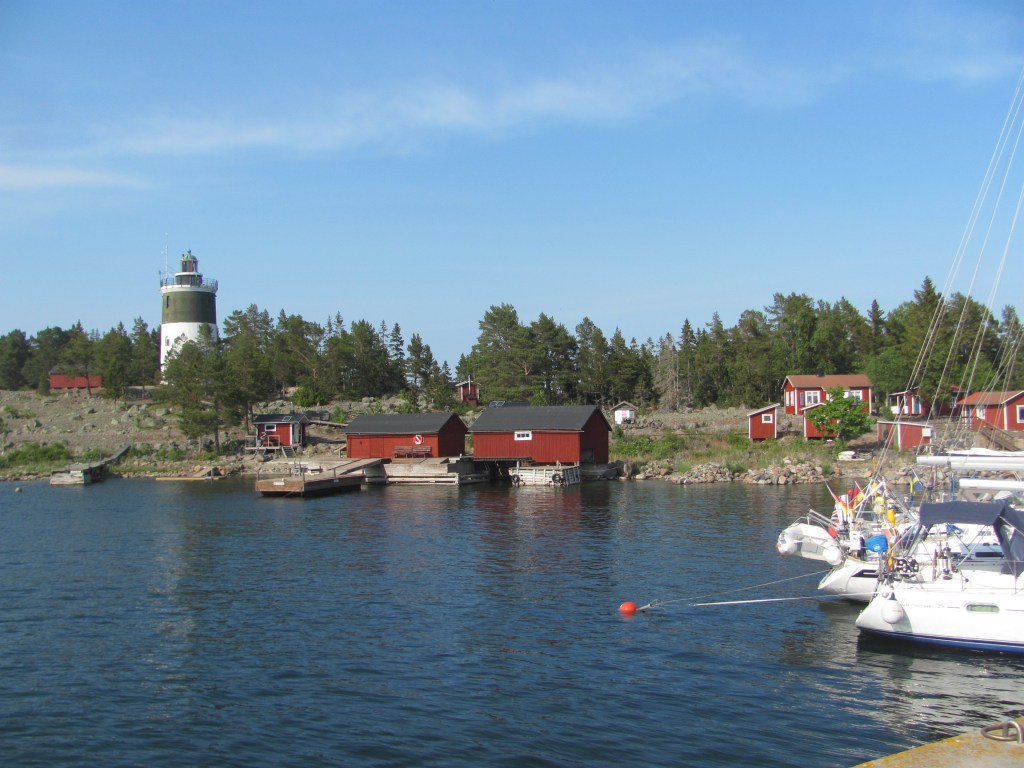
We spend the next few days working our way northwards along the Virgin Coast, stopping off to anchor in secluded bays, and tying up in small, picturesque fishing villages and remote disused harbours.

We seem to have synchronised our passages with Holger and Annette of Anna.
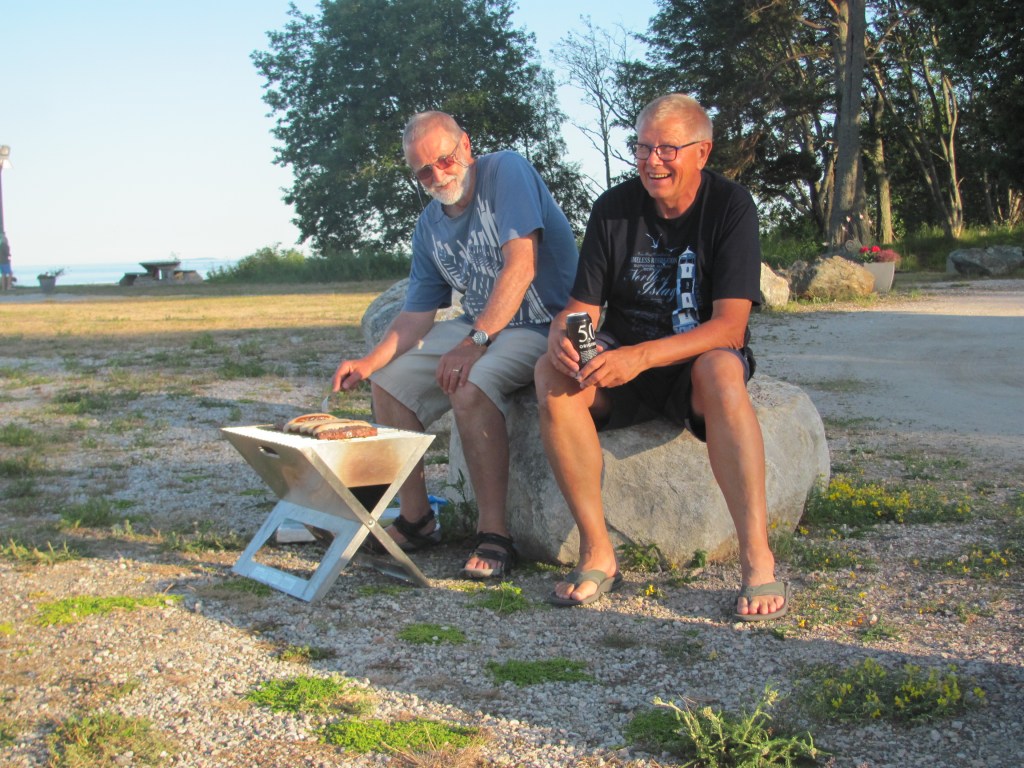
“Why don’t we have a barbecue tonight?”, says Holger one night. “I have a grill and charcoal we can use, so just bring along some meat to cook on it and some drinks.”
We are in the small harbour of Galtström, having edged our way timidly through the narrow entrance and tied up alongside to the wharf earlier in the afternoon.
“We’ve got some bratwurst”, says the First Mate to me. “And I can make a salad. You get some beers out of the fridge.”
“You should visit the iron-smelting village”, says Holgar, as he lifts the smoking cheese from the grill. “It’s just a short walk along that road over there. They used to bring the pig-iron down here to the harbour to the waiting ships.”
“Oh, no!”, shouts the First Mate to me. “You’ve burnt the bratwurst! Can’t you concentrate instead of nattering?”
“They’re not burnt”, I protest lamely. “They are just a bit black.”
In the morning, we walk along the small road from the harbour to the village. It looks deserted, but the café is open.
“This used to be a major source of iron in Sweden”, the girl tells us. “It helped to provide the wealth to make it a European Great Power in the 17th century. You can just walk around and explore. There are signs in English to explain each bit. Here’s a map.”
We find ourselves in front of the massive iron smelter. Charcoal made from the local forests was used to smelt the iron ore brought from mines in central Sweden.

“The ore was first ‘dressed’ by heating it up to drive off the water and other impurities”, we read. “Then it was crushed into smaller pieces ready to be smelted. For that the furnace stack was packed with alternating layers of coal and iron ore. Quartz or limestone were also added to bind the impurities together. The temperature at the bottom of the furnace would reach 1300 °C, and the molten iron would begin to flow out of a tap at the bottom of the stack, while the slag would flow out further up. The iron would cool and harden into ingots, or ‘pigs’.”
“Look, here’s the little railway that would have taken the ‘pigs’ down to the ships in the harbour”, says the First Mate.

“It must have been quite a hive of activity in its heyday”, I say. “Come on, let’s treat ourselves to lunch at the restaurant. I am sure they won’t burn it!”
 Ruby Tuesday

Whats happened to Spencer. Has he abandoned ship?
LikeLike
No, he is still around, but we haven’t had too much time to chat to each other lately. My fault really. Hopefully in the near future.
LikeLike
You’re getting closer to my old stomping grounds! I was in Gävle on Saturday, incidentally. Did you see me wave? (Though admittedly I was at the railwaystation!) Enjoy!
LikeLike
Yes, making our way gradually northwards. Fancy you being in Gävle! It’s a pity we couldn’t have met up. Although we were in Härnösand by that stage waiting out the strong winds. Now in the Högaküsten.
LikeLike
Did you go in to Hudiksvall at all? That’s the nearest coastal town to where I grew up (in Färila) and where we would go swimming once a year as my mum loved swimming in the sea.
LikeLike
Unfortunately, we didn’t actually go into Hudiksvall as we had a bit of a time frame to get to the Högaküsten to meet my sister and husband. We would have liked to, so perhaps on the way back if we come back this way. We did overnight on Agön though.
LikeLike
ooh nice, enjoy being with your famiily!
LikeLike
Dear Brigitte & Robin,
as always informative and witty with the right pinch of humor, you two have a really good summer with the right mixture of nature, good company, family time and nautical experiences, happy sailing (and hopefully better weather) further north!
Axel&Claudia
LikeLike
Thanks for your kind words, A&C. Yes, we have to say that we have enjoyed it so far. Although there seems to be either too much wind or too little. So on average it is just right 😉!
LikeLike
… that is a good way to see it ⛵️🌬️…
LikeLike