“Why don’t you two go fishing?”, says the First Mate. “I have noticed others catching herring off the end of the pontoon over there. We could eat them for dinner tonight.”
We dig out the fishing rod from the storage room, and the Cabin Boy and I make our way to the end of one of the pontoons.
“I have a herring rig somewhere in the box”, I say. “Here it is. Let me tie it on.”
The Cabin Boy casts the line, and gives it a gentle jiggle up and down.
“I think I’ve got a bite”, he shouts in excitement.
It’s more than one. Five, in fact. We manage to land them all onto the pontoon, de-hook them, and put them into the bucket we brought with us. I have a go, and manage to catch another five, but one wriggles free before we can get it ashore.
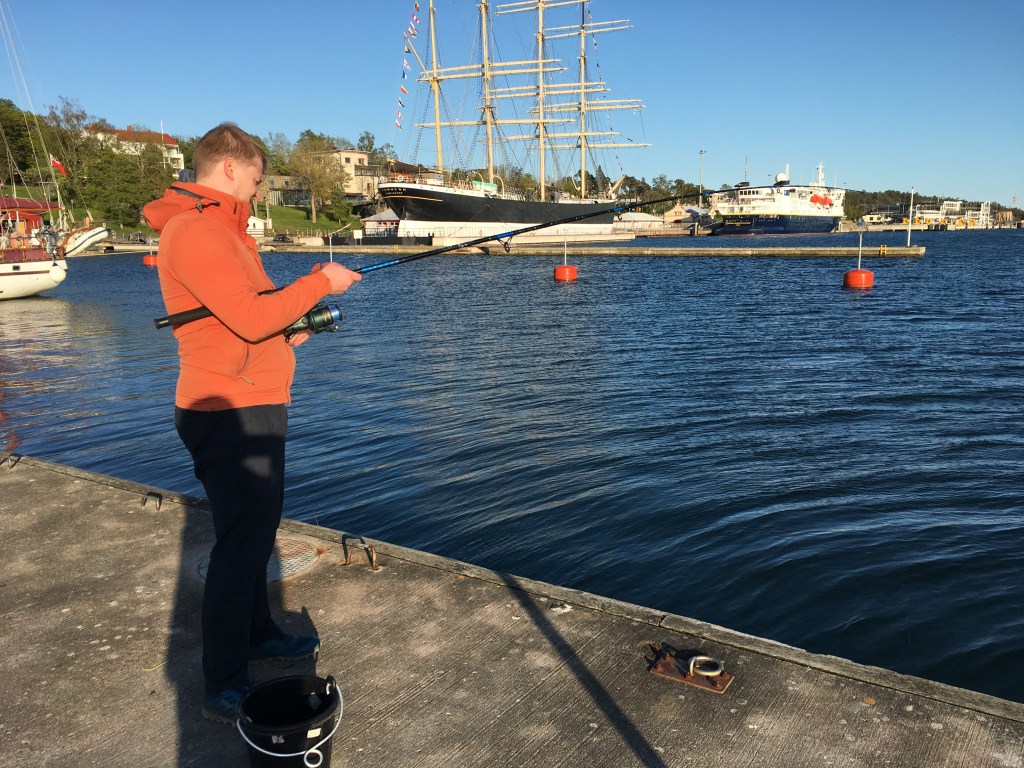
We take turns and land several more.
“I didn’t realise it would be so easy”, says the Cabin Boy. “We’ve probably got enough now. The First Mate will be pleased.”
“Well done”, says the First Mate, taking the bucket. “We have to gut and clean them now. Come and give me a hand.”
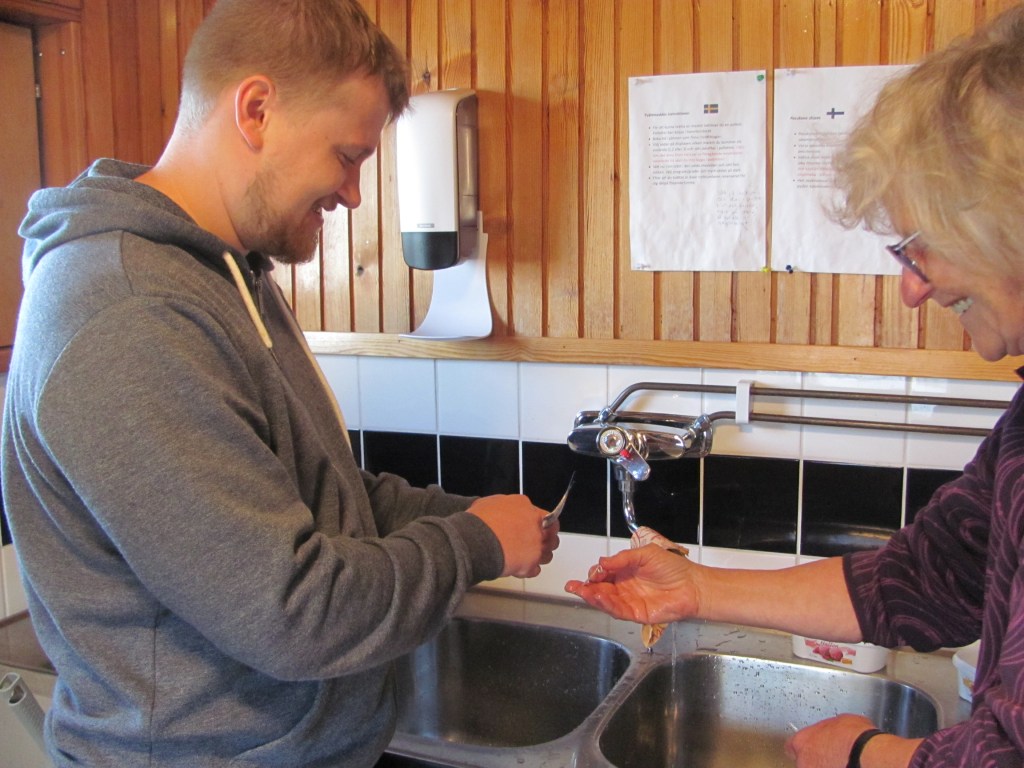
We head for the marina kitchen, and return half an hour later with nicely cleaned herrings.
“It was a bit gruesome”, says the Cabin Boy. “Innards everywhere. I haven’t gutted a fish before. But I am glad I learnt.”
“You can put it on your CV”, I say. “Broadening your skills is always useful.”
That evening, we fry the herrings in butter and salt, and have them with new potatoes. They are delicious.
“Another British boat has just arrived”, says the First Mate in the morning. “That makes six in total now. I wonder how many more there will be?”
We are awaiting the start of the Cruising Association’s 2023 Baltic Rally. Seven boats have turned up so far, each with between two and four people.
“A few boats have dropped out for various reasons”, Andy, the coordinator of the rally, tells us. “But another one will be joining us during the rally. They are waiting for parts for their boat to arrive, and there’s been a bit of a delay. And don’t forget that we have a visit to the Pommern arranged for this afternoon, and a dinner together tonight.”
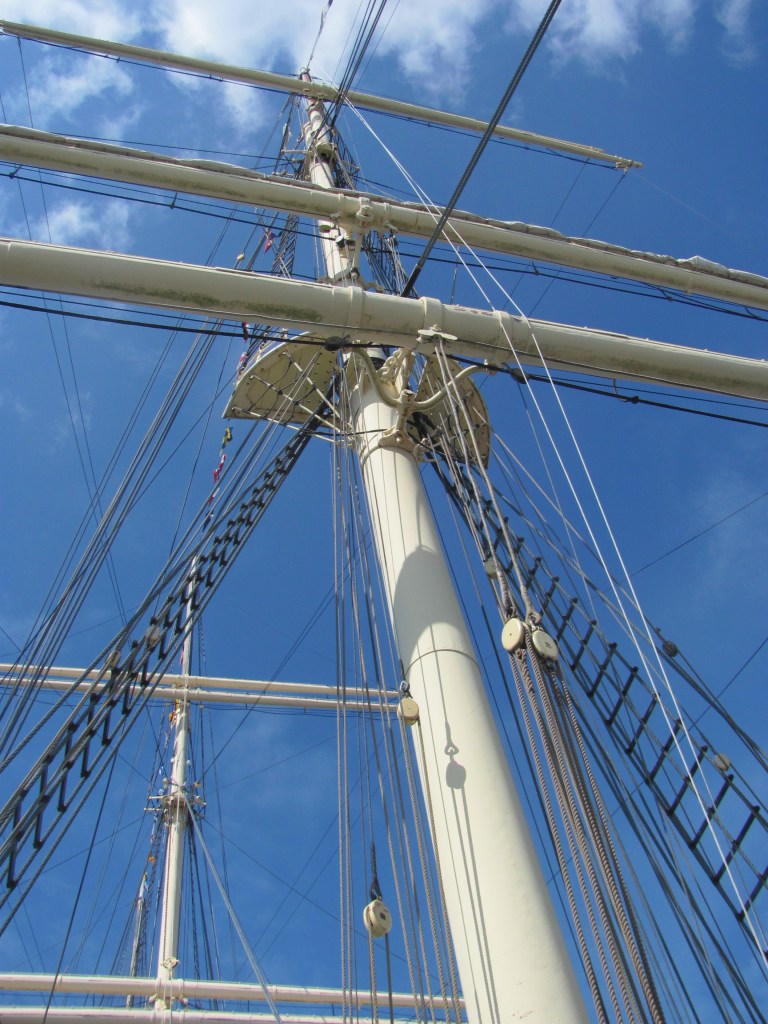
In the afternoon, we gather outside the Pommern, the four-master sailing ship that has dominated our view for the last few days. Built in 1903 in Glasgow as a cargo ship, she shipped timber from Scandinavia, fertiliser from Chile, and grain from Australia. Nowadays, she is part of the Åland Maritime Museum.

A guide takes us on board, and we are asked to imagine that we are on a voyage from Mariehamn to Port Victoria in Australia in the 1930s to load a cargo of wheat for the return trip. Apparently they sailed out empty, with a full load only on the return journey.
“It seems strange that I have just flown from Australia to join you sailing”, says the Cabin Boy, “and the first thing they do is to ask me to imagine that I am sailing back to Australia again!”
“She probably thinks that you are a convict”, I say. “What with that short haircut.”
“She’s a bit bigger than Ruby Tuesday”, says the First Mate as we stand at the wheel at the stern and try and look forward to the bow nearly 95 m away.
“Yes, and twenty-eight sails would take a bit of managing”, I say. “We have our hands full with just two!”
We set sail on the rally proper the next morning. We are free to start when we want and choose which route to take, the only proviso being that we end up in the designated destination in the evening.
The first leg is a short one, only twelve miles, to get everyone into the way of archipelago sailing. With the wind from the north, directly behind us, we sail with the genoa only, weaving our way around the rocks and skerries on either side. We arrive at the small harbour of Rödhamn, meaning ‘Red Harbour’, named after the red rock that makes up the island.
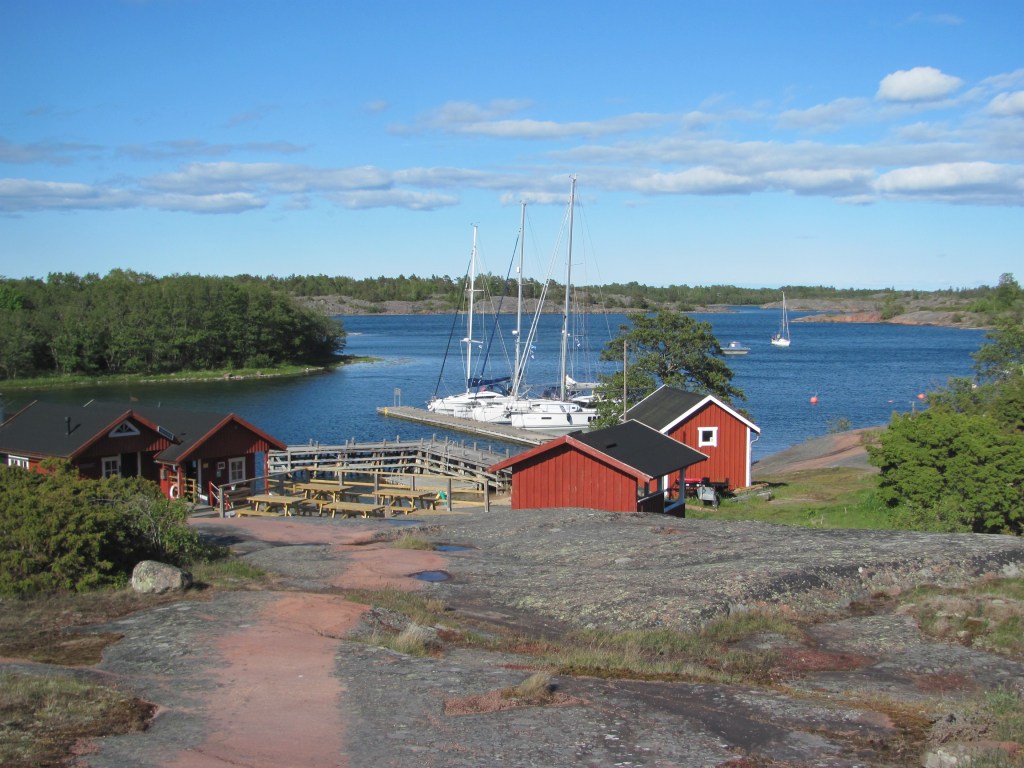
We tie up, and have a cup of tea and freshly baked cinnamon rolls all together at the small café next to the harbour. The island was previously a pilot station to guide ships into Mariehamn, but nowadays has only a single inhabitant, the young woman, Annette, who runs the harbour and café.
“My family live on the mainland”, she tells us. “I come here for the summer to look after the island. I love the solitude and living amongst nature. My family come here during the school holidays though, and we work together on little projects on the island.”
Her speciality is freshly baked bread rolls that can be delivered to the boats in the morning. We place an order, as do the other rally participants.
Our tea finished, we explore the tiny island. Above the harbour is the old pilot station, now converted into a club house for a local sailing club. Further on, the former power generation building has been turned into a small museum with faded photos of the island in previous times. We are to see many such museums in these small island villages, all trying to preserve the memory of everyday life in a bygone era for future generations

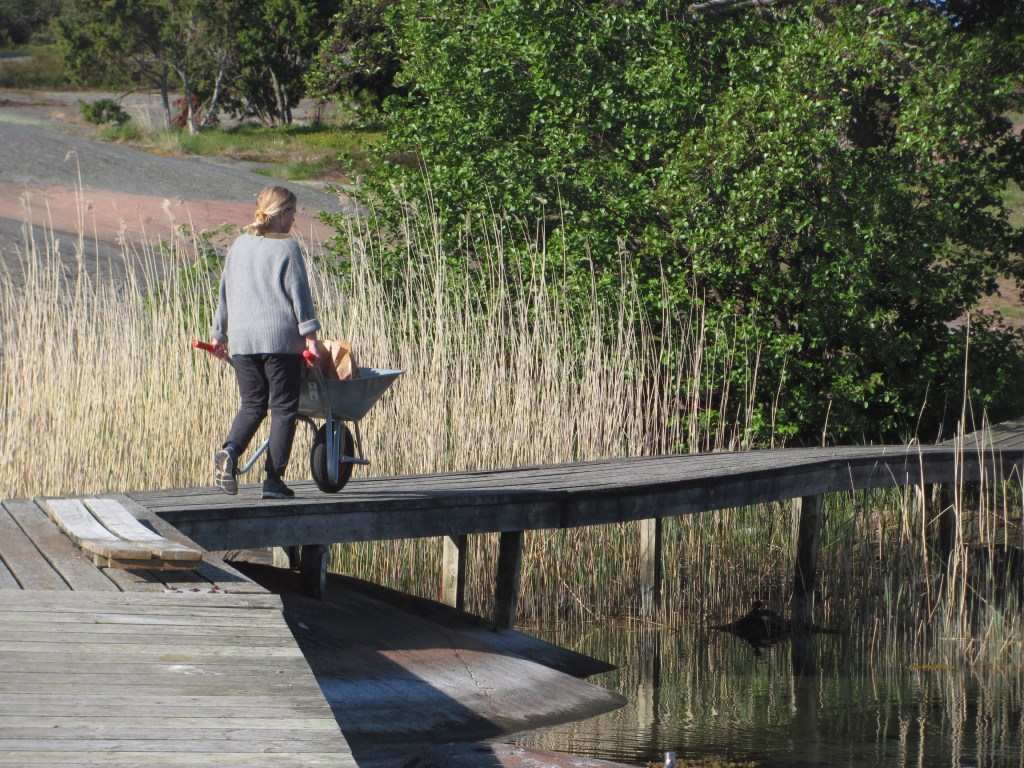
In the morning, we find a bag of fresh bread rolls on the foredeck and see Annette delivering the other orders in an old wheelbarrow.
“I love fresh rolls and marmalade for breakfast”, says the Cabin Boy.
“Go easy on the marmalade”, I say. “It has to last the whole season. As we saw in the last episode, I get very grumpy if I don’t get my marmalade. And it has to be Wilkin & Sons’ marmalade from Tiptree in Essex. I haven’t found anything as good over here yet.”
After breakfast, we continue to sail further into the archipelago. The Cabin Boy tries his hand at sailing.
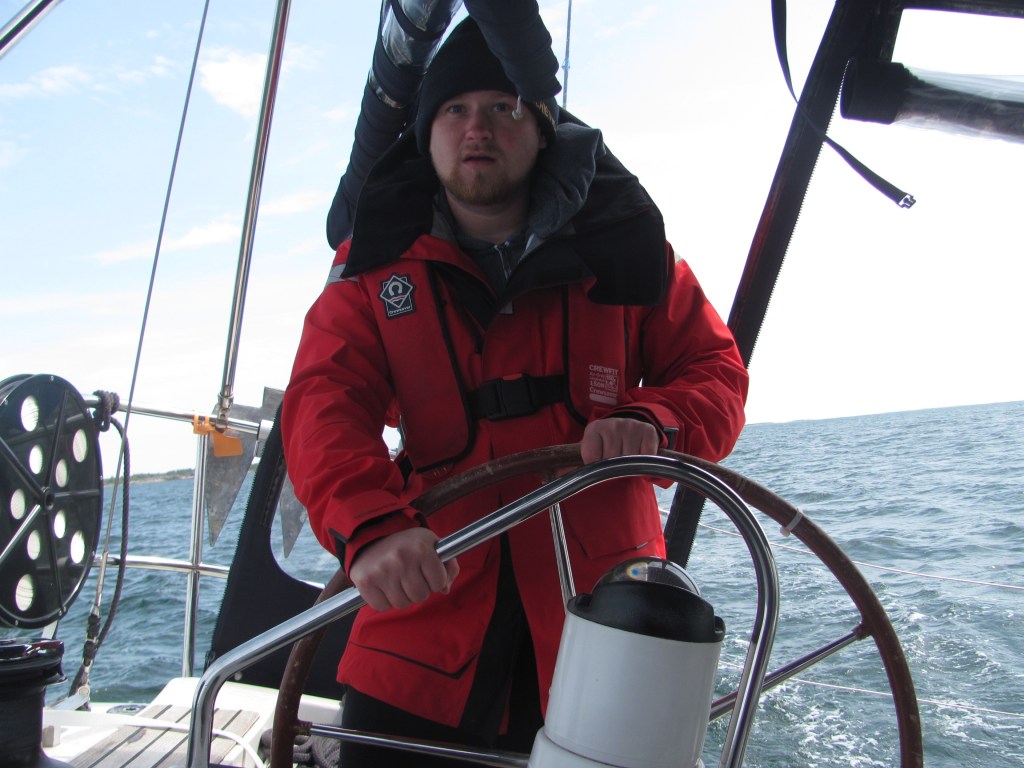
Eventually we reach the small harbour of Degerby. The facilities are under refurbishment, and only the female toilets are available.
“I think I will shower on the boat”, says the Cabin Boy. “I am not quite ready for mixed showers yet.”
In the morning, I go for an early morning walk to take some photographs of the village. There isn’t much to it. Most of the activity is clustered around the small harbour, a general store, tourist information, a small museum, and a few small shops selling crafts made by local artists.

Before long I have reached the end of the village. On the way back, I meet another early morning riser. He is a sailor from Finland heading for Denmark.
“Have you heard the story of the Champagne Schooner?”, he asks, as we walk back to the harbour.
I tell him I haven’t.
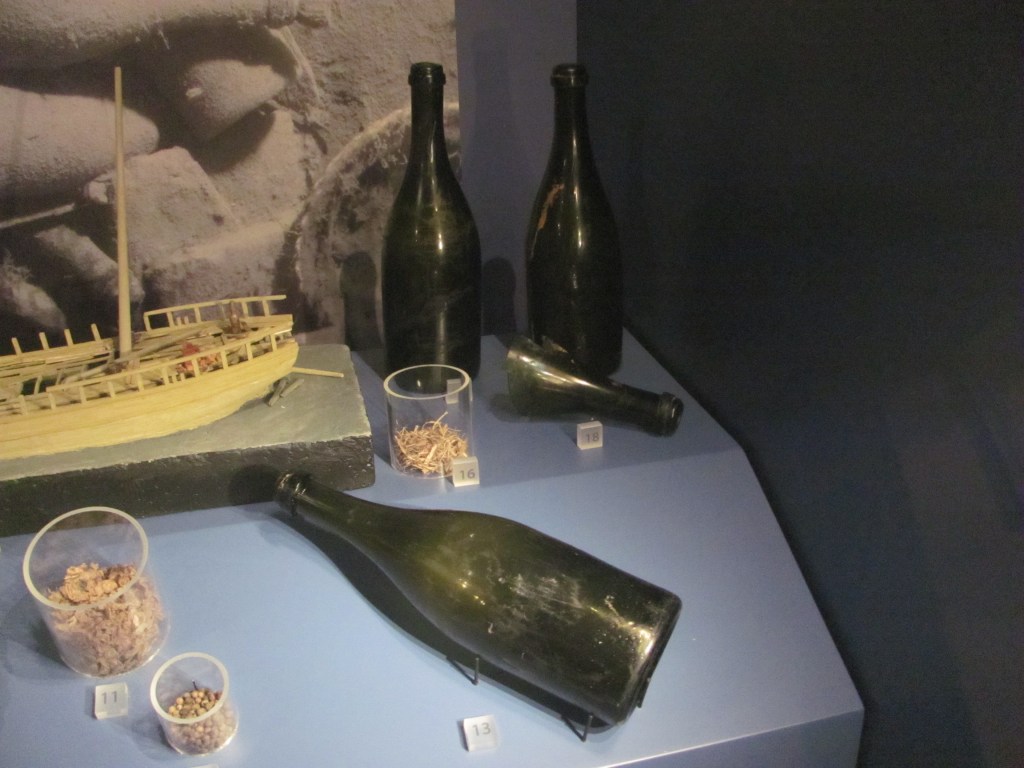
“Well, a ship sank near here back in the 1800s”, he tells me. “It was first discovered in 2003, but no-one really bothered to investigate it. Then in 2010, some champagne bottles were washed up on the beach. This prompted divers to explore the wreck, and, lo-and-behold, they discovered a large number of bottles of champagne and beer on it. It is thought that the cargo was destined for St Petersburg, and maybe even the Russian Imperial court.”
“Was it drinkable?”, I ask.
“Well, that’s the thing”, he responds. “Experts pronounced it undrinkable, but that didn’t stop it fetching record prices at auction. One bottle sold for as much as €30,000.”
“I wouldn’t have minded being the one that found the bottles on the beach”, I say. “At that price.”
“Unfortunately, the bottles were declared the property of the Åland Government”, he says, as we reach the harbour. “So all the proceeds went to them. But some of the bottles are in the Åland Museum in Mariehamn.”
The wind is against us for the next leg to the island of Kumlinge, so we sail close-hauled and make wide sweeping tacks to eventually arrive at the small harbour nestled to one side of a road bridge spanning the inlet. Most of the other rally boats are already there, having left earlier than us.
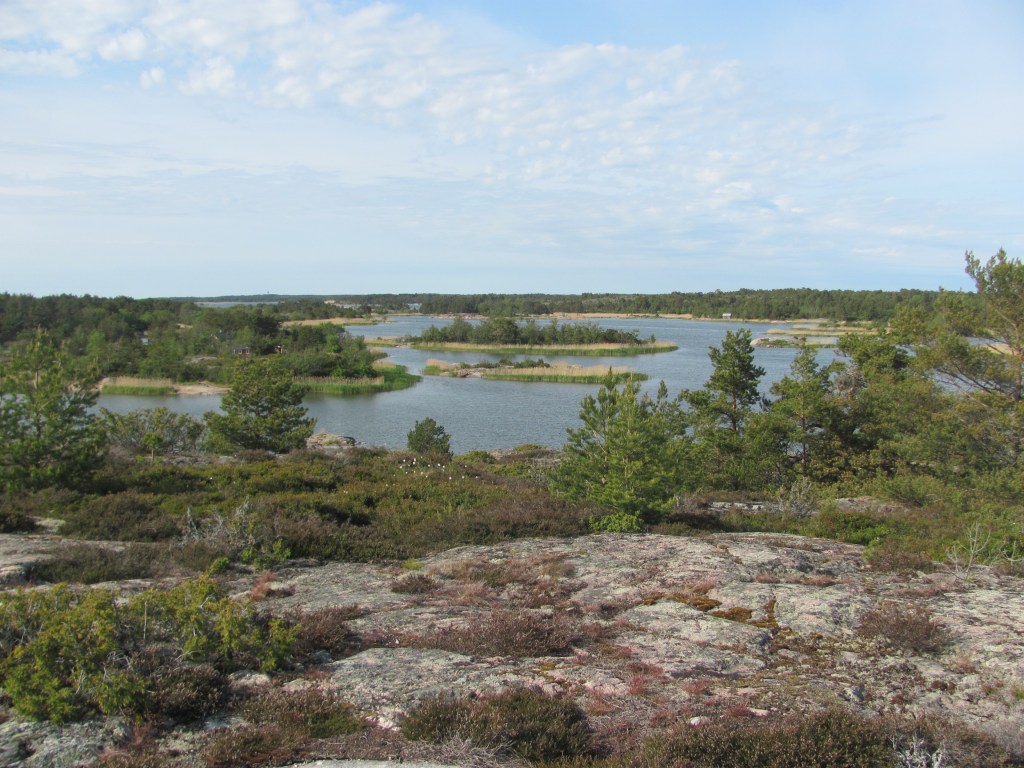
“It’s beautiful”, says the First Mate, after an evening walk to the summit of one of the small hills to the back of the marina. “Imagine waking up to a view like that every morning.”
In the morning, the Cabin Boy and I unload the bikes and cycle up to St Anna’s Church nestled in the woods to the north of Kumlinge village. Unfortunately, when we arrive it is closed.
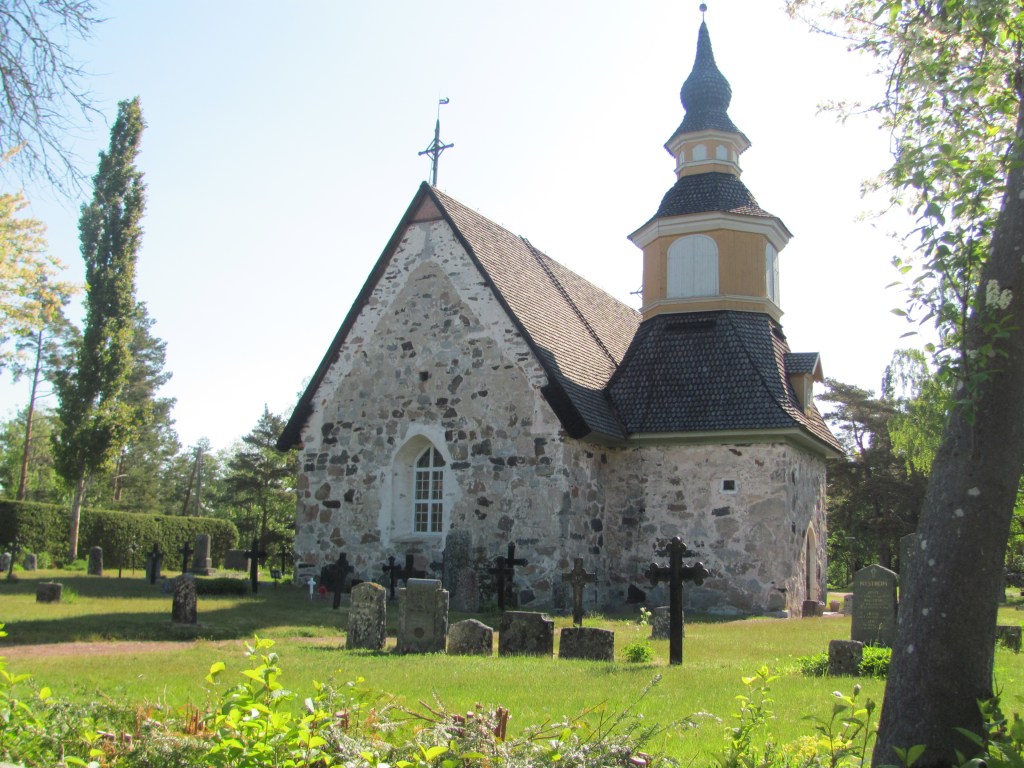
“There’s someone in the graveyard at the back”, says the Cabin Boy as we walk around the outside. “Perhaps they know how to get in.”
It turns out to be the caretaker of the church. She is from Finland, but loves the island and works there over the summer.
“Normally, we don’t open the church for sightseeing until Midsummer’s Day”, she says with a friendly smile. “But seeing you have come all this way to see it, I am very happy to open it for you.”
“The church dates from the 14th century”, she tells us as she unlocks and pushes open the large wooden door on its creaking hinges. “But there is evidence of an even earlier church dating as far back as the 12th century. No one really knows why it was built here rather than in the centre of the village though. It must have been quite a walk for the villagers every Sunday. And it is not as though the village has moved in the last 600 years or so.”
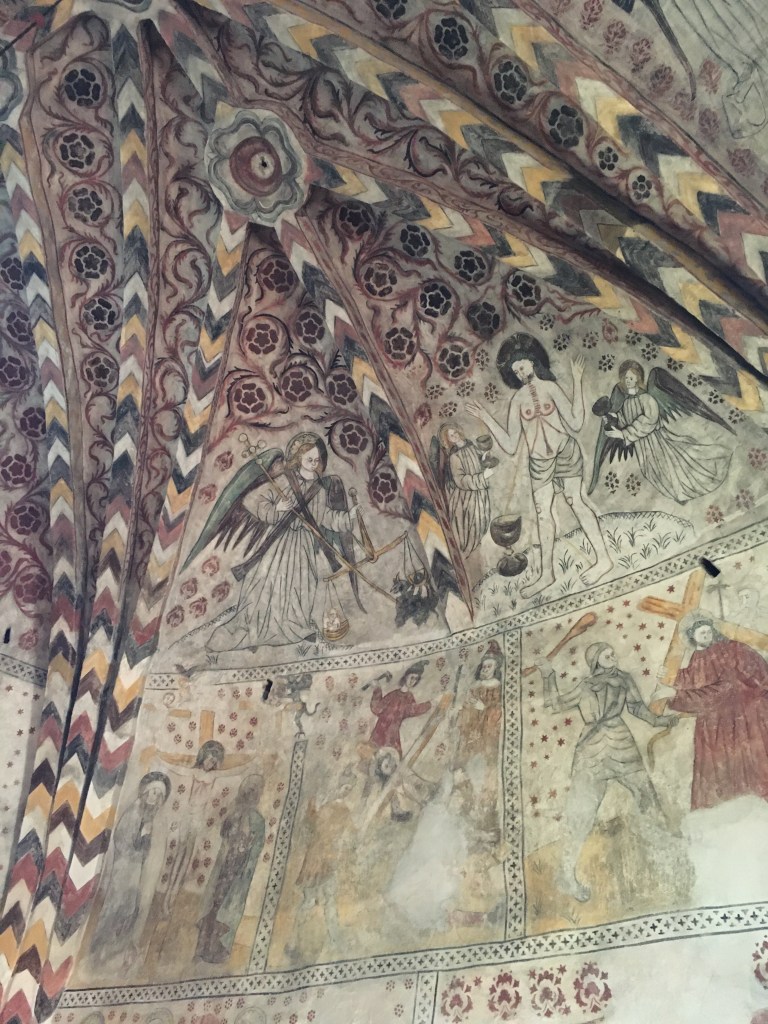
The church is famous for its exquisite paintings in limestone of biblical scenes in the Franciscan style done around 1500 AD.
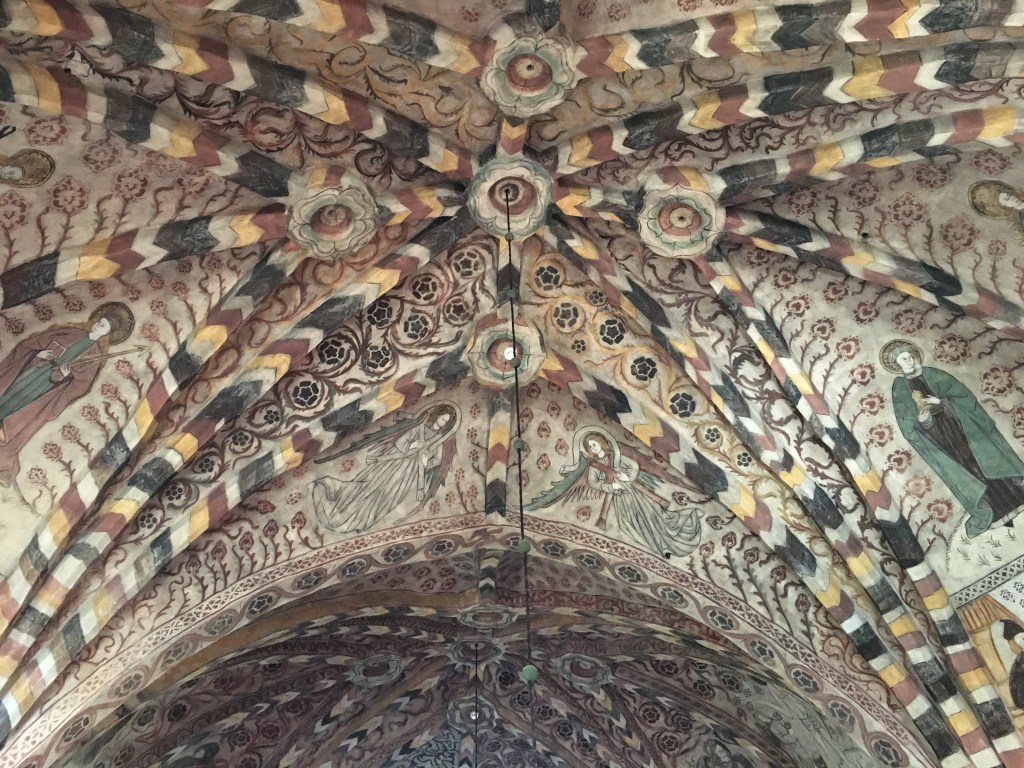
”Unfortunately, during the Great Northern War between Russia and Sweden from 1700–1721, Russian troops used it as quarters and a stable”, our guide continues. “They damaged some of the paintings, and most were covered in soot from their fires. They even stole the church bells as they left. After the war, the local people tried to clean the soot away, and inadvertently damaged the paintings. They were painstakingly restored with modern methods in 1961.”
As we walk around, I muse on why so much effort was put by unknown artists into producing these paintings in a remote rural church far from the beaten track. Was it to teach biblical stories to the local people? Or to use their skills to show their devotion to their God?
“I guess we’ll never really know”, says the Cabin Boy as we cycle back.
After lunch, we push on to the next destination, an island by the name of Lappo. This is to be the easternmost island of the Ålands that we will visit.
“I’ve arranged a surprise activity here”, says Andy. “And there will even be prizes!”
The surprise turns out to be a game of DiscoGolf using a frisbee and trying to get it in a metal basket a hundred metres or so away. It isn’t made any easier by a strong cross wind that catches the frisbees and takes them to anywhere except where they are intended to go. As luck would have it, the Cabin Boy manages to get the team Ruby Tuesday frisbee in the shortest number of throws on the first ‘hole’.
“That definitely deserves a prize!”, says Andy.

The rest of the afternoon proceeds with otherwise sensible people throwing frisbees in the general direction of the next hole’s basket, then retrieving then from bushes, from under rocks, tree branches, and other arcane places that the wind has carried them. But everyone enjoys it.
“Right, that’ll do now”, says Andy. “Time for prizes.”
Prizes are awarded for the least number of throws, the longest throw, the most useless throw, the most elegant throw, the least elegant throw, and a few others I can’t remember.
“Now back to the pontoons for a drink”, says Andy. “We’ll meet at six. I’ll bring my drone, and we’ll see if we can get a group photo.”

We cast off the next morning heading back in the direction to Mariehamn. The wind is strong, and the sailing boisterous to say the least. We travel together with Bob and Fiona in Hekla of Banff.
“She was named after a volcano in Iceland”, Bob tells us. “And no, we are not from Banff. But the first owner was. We’re from Plymouth.”

We arrive at the small harbour on the island of Seglinge.
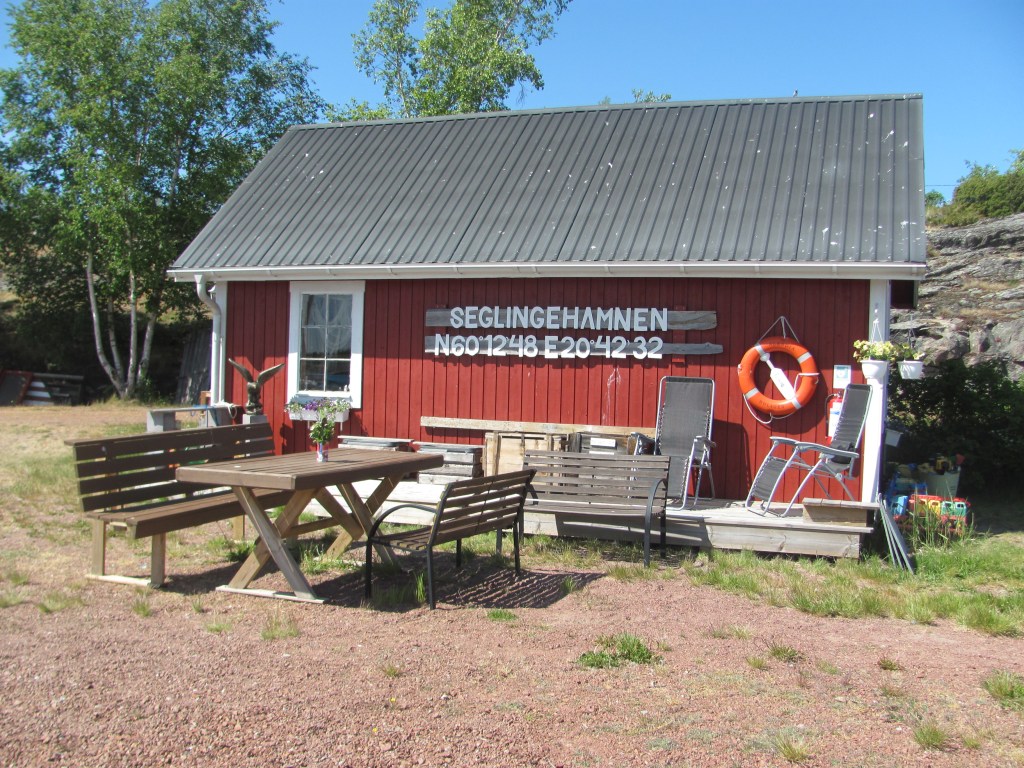
“No, I wasn’t born here”, the harbour-mistress tells us, in response to our question as she collects the fees. “I am from mainland Finland, but we love Åland, so we decided to come here to live and raise our family.”
It’s not the first time we have heard that.
“I suppose that everyone on the island has more than one job?”, asks the First Mate.
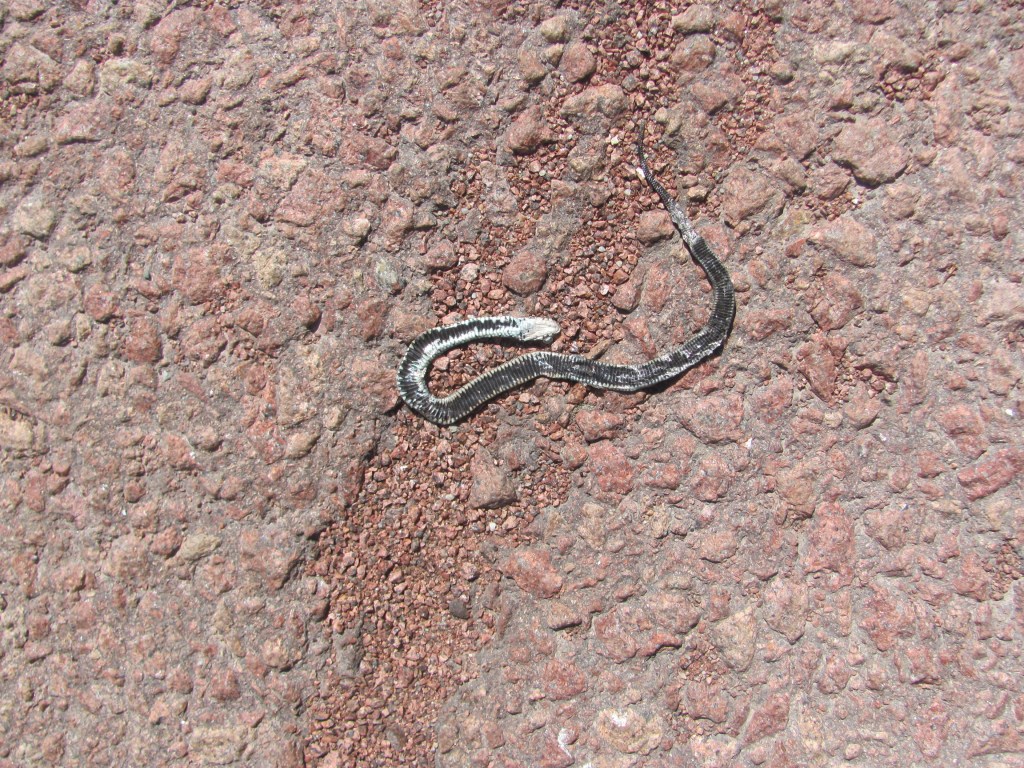
“Yes, that’s right”, she responds. “I, for example, do the school bus run, but I also look after the harbour. We’re trying to make it nice at the moment – there is a family room over there, with children’s toys, and books to read, which you are most welcome to use. My husband is a fisherman, and he also is a mechanic. Our children grew up with boats – first just small ones, but now quite large ones. I have no worries about my fourteen-year-old son being out in his. I am more worried about the snakes on the island.”
“Ah, yes, we saw a dead one on the road when we went for a walk”, says the First Mate.
“It looks like a windless day”, I say over breakfast in the morning. “Unfortunately we will have to motor for most of the trip.”
We set off. As forecast, there is almost no wind at first, but a breeze does spring up mid-morning. We manage about an hour of sailing, before it dies again.

We thread our way through the narrow buoyed channels between the islands, and eventually reach a wide open stretch of water.
“It’s an old meteorite crater”, I say. “Andy told me. It’s called the Lumparn. Apparently it is nine kilometres wide and a billion years old.”

“That’s the second crater we have sailed in”, says the First Mate. “Don’t you remember that one in the Swedish Archipelago that we crossed last year. Tvären crater, I think it was called.”
“A mere baby in comparison”, I say, consulting Mr Google. “That one is only two kilometres wide and 455 million years old.”
“It’s hard to imagine how old these craters are”, says the Cabin Boy. “I used to think that you two were old, but this puts it all into perspective.”
 Ruby Tuesday
The Cabin Boy is going to be arriving on next years voyage as Im sure he has had an amazing trip…….hope he got his sea legs quickly !!!!! We have had an amazing few weeks – yes sun and heat in aberdeen….last night it rained heavily but sun is already back out !!!! How lovely it all is in the sun….the grass and weeds will be in their element now!!!!!!!!!!!!
LikeLike
Hi Lynne, yes we all had a great time and really enjoyed having him with us. We will see what happens next year! Sounds like you have had some good weather there. Hope the weeds are not too bad.
LikeLike
Hi, sounds likev you had great fun on your rally
LikeLike
Hi Uli, yes it was very enjoyable, great bunch of people, beautiful islands, and warm and sunny weather. What more could we ask for? And of course, it was nice to see the Cabin Boy again.
Sent from Outlook for iOShttps://aka.ms/o0ukef ________________________________
LikeLike
Nice read Ruby Crew! Thank you, Martin
LikeLike
Thanks Martin. It’s an interesting part of the world there.
LikeLike