The early morning mist rises from the still water of the bay, as the First Mate casts off the mooring ropes from the small staging and I haul in the stern anchor. There is no sign of another living creature; the island sleeps before the start of another day. We motor quietly out, ripples spreading out on both sides as we pass. Two swans appear from amongst a reedbed and bid us farewell.
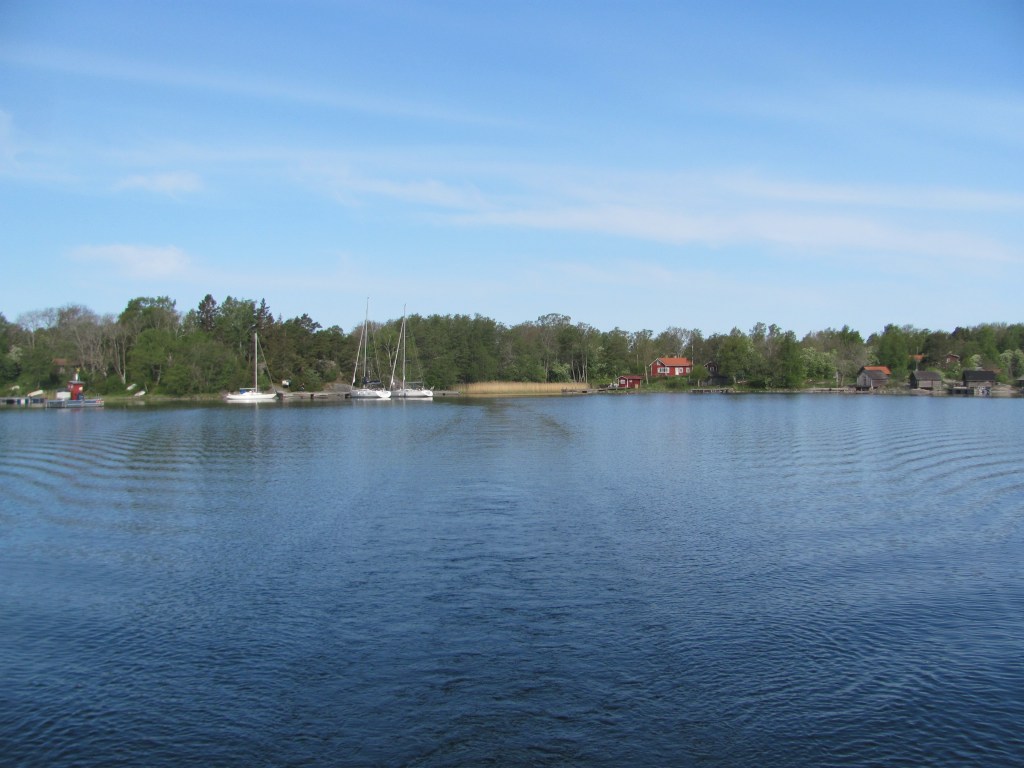
The forecast is for almost no wind for the first hour or so, then for a light breeze to pick up from the south. We round the small headland at the northern entrance to Arholma and set a course for the Åland Islands some 20 miles away across the Sea of Åland, but invisible now in the haze.
On schedule, the wind arrives, ruffling the smooth surface of the sea with tiny wavelets. We pull out the sails, cut the engine, and enjoy a gentle beam reach.
“This is the sort of sailing that I like”, says the First Mate. “I’ll make some breakfast.”
Soon the smell of toast and coffee wafts its way out of the companionway. We sit in the cockpit and bask in the warmth of the sun. On the horizon, we see a ferry heading in the same direction as ourselves.
“We’ll have to watch out for ferries creeping up behind us” says the First Mate. “They go pretty fast.”
“We are further north than the main ferry route between Stockholm and Mariehamn”, I say. “So we should be alright.”
The haze clears slowly and the grey low-lying shapes of the Ålands appear in the distance. Soon we are approaching the western entrance to Mariehamn.
“That’s a strange-looking structure over there”, says the First Mate, pointing to some buildings on a island to our starboard.
“It’s called Kobba Klintar”, I say. “There’s a video on YouTube about it. It’s all that remains of an old pilot station. Apparently if the weather is absolutely calm you can go and moor in its tiny harbour, but there is only just enough room to turn a boat around on its own length, as well as some nasty rocks to avoid, so you have to know what you are doing.”
“Let’s give it a miss”, she says. “For the moment at least. Careful – there are two ferries coming out of Mariehamn. Don’t get too close to them.”

The ferries bear down on us intimidatingly, but we are already as far as possible to the edge of the fairway as we can go. They turn away at the last minute and pass by us with only a few metres to spare. Their wash causes Ruby Tuesday to rock violently from side to side for a few moments.

We pass the Pommern, an old four-master sailing ship that is now part of the Mariehamn Maritime Museum. We have a visit to it scheduled for the first day of the Cruising Association Rally we are joining at the weekend.

We reach the marina and tie up alongside. A Brit helps us with the lines.
“I recognised your flag”, he says. “We are also members of the Cruising Association, but unfortunately we are not joining the rally next week. We have to leave our boat here for couple of weeks to go home to attend to some family business. But I hope you all have a good time.”

We unload the bikes and cycle into town. Mariehamn is on a narrow stretch of land with marinas on each side. We are in the Mariehamn West marina. There is a laidback charm to the town, with its tree-lined avenues and few cars, reminiscent of a bygone era. The houses are mostly wooden and graceful, reminding me of the older colonial-style houses in New Zealand. Each has a fire-escape ladder from a top window to provide an escape route in case of fire.

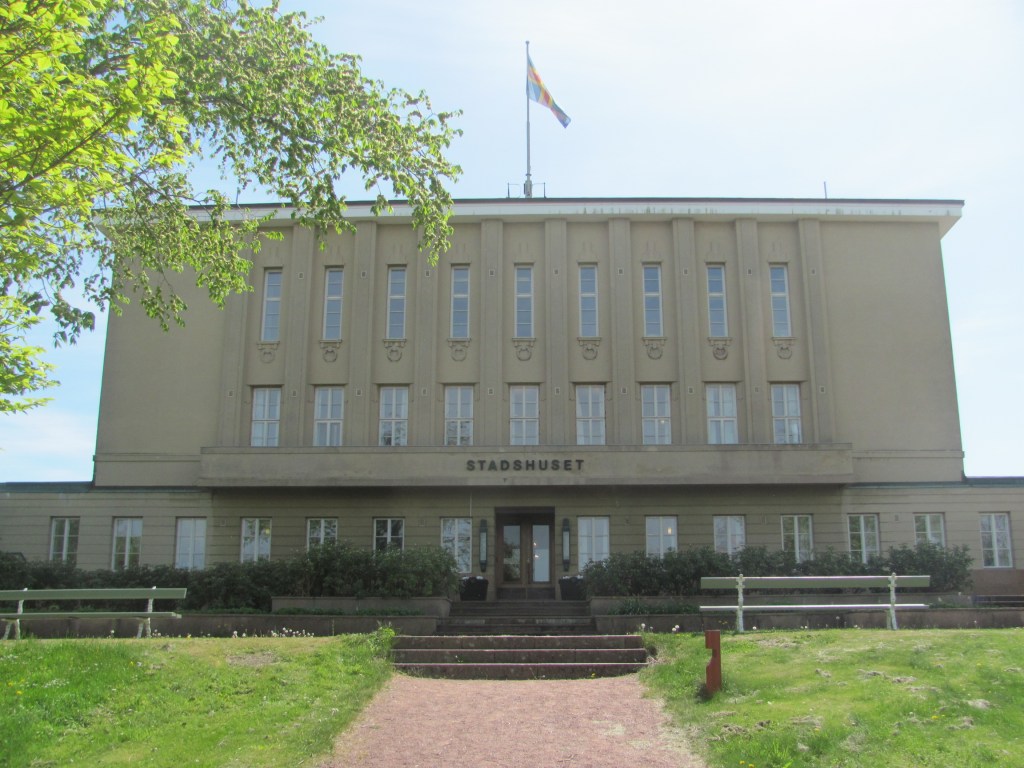
We eventually reach the Town Hall on top of a small hillock to the south of the main street. A display at the entrance tells us it was built in just over a year and completed in 1939, on the eve of the Second World War. The town administration work there.
At the bottom of the hill are the modern Parliament Buildings containing the offices of the Lagting, the autonomous regional government of Åland.
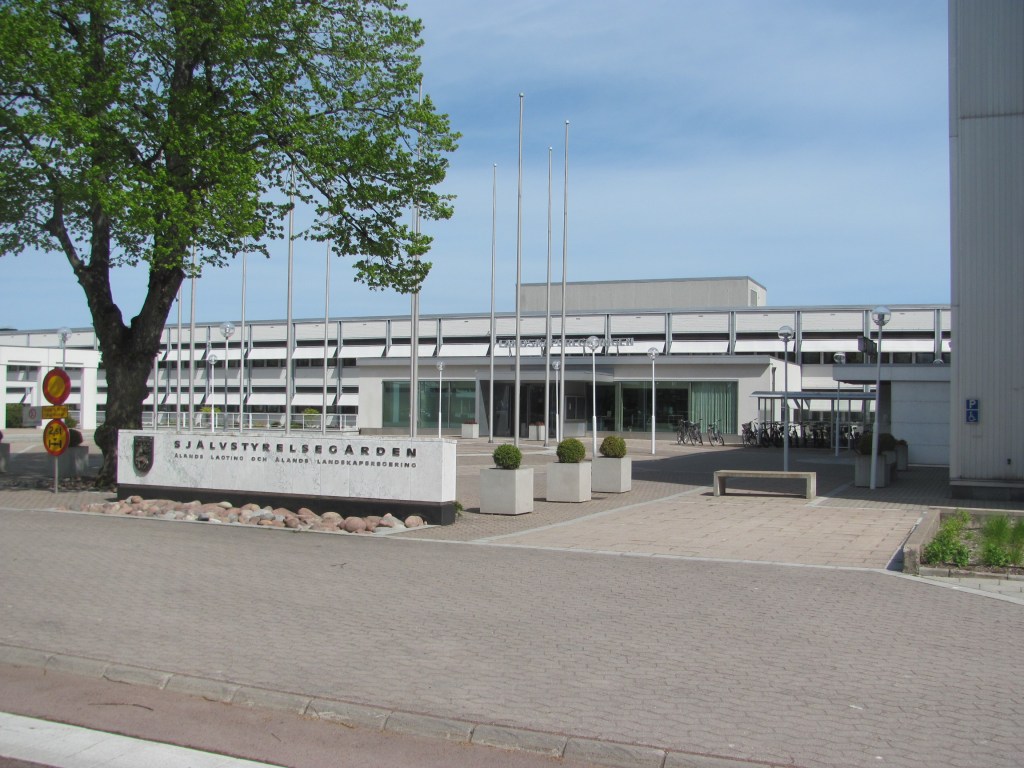
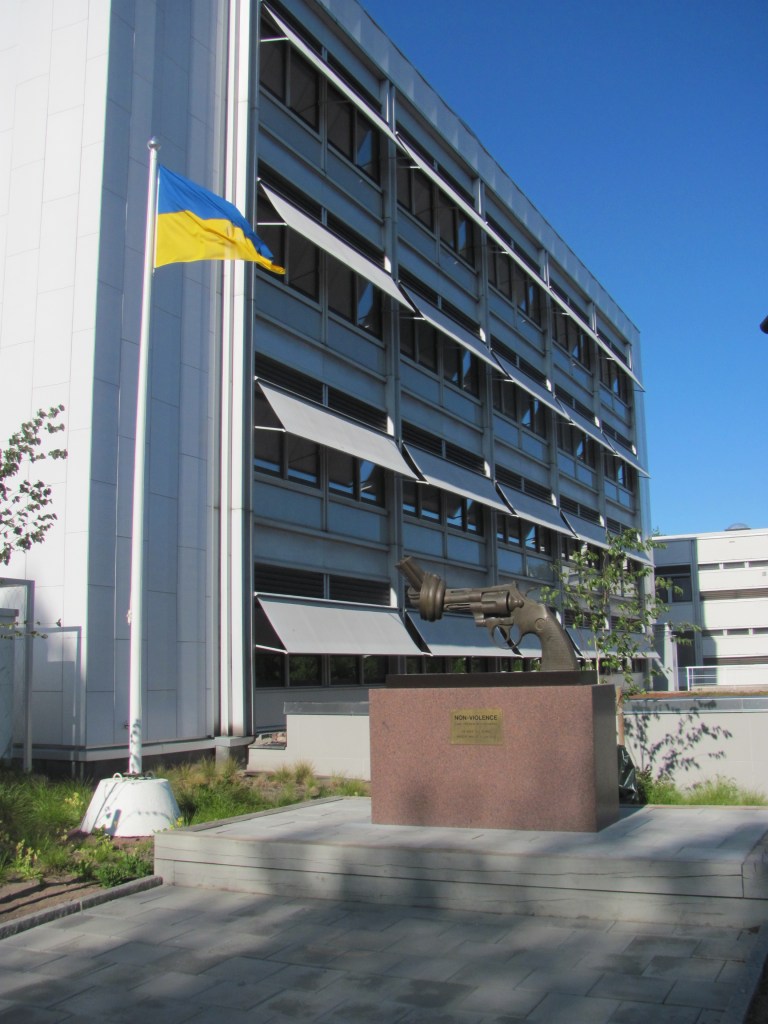
A sculpture of a gun with its barrel knotted to prevent it from firing stands outside the Parliament buildings. A Ukrainian flag flies from a pole nearby.
We end up at the museum near the seafront. As luck would have it, it’s a Thursday and entry is free.
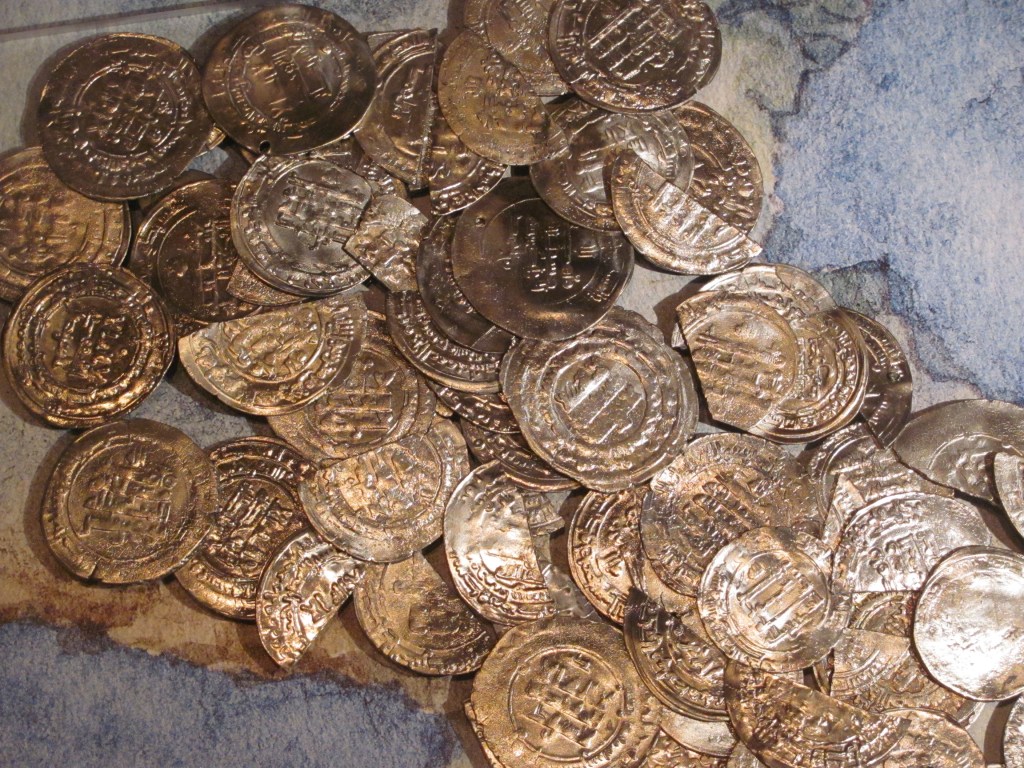
“The Åland islands emerged from the sea just 7000-8000 years ago”, I read in the first display. “It was settled by two Neolithic cultures who practised seal hunting and fishing to survive. This was followed by Bronze Age and Iron Age peoples. These people must have already had good links with the outside world as Arabic coins have been found that date from 400 B.C.”
“Look, this bit tells all about how Åland became part of the Swedish Empire in 1324”, says the First Mate. “Apparently as a result of a peace treaty between Sweden and the Novgorod Republic in Russia most of Finland and the Ålands were incorporated into Sweden. I suppose that is why they still speak Swedish today, even though they are now part of Finland. Anyway, Sweden went on to become a major European power.”
“Then in 1809, Finland and the islands were ceded to Russia”, the next panel tells us. “Russia built a fortress at Bomarsund, but the British and French destroyed it in 1854 during the Crimean War. In the resulting treaty between the three countries it was agreed to keep the islands demilitarised. After WW1, most of the islanders wanted to be reunified with Sweden rather than Finland, but Finland didn’t want that, so they have remained with Finland to this day despite most of the population speaking Swedish. Nevertheless, they were granted autonomy within Finland by the League of Nations.”
“What a fascinating story”, says the First Mate. “I also read somewhere that they issue their own postage stamps, and that they voted to join the EU in 1995, but negotiated tax exemptions. Apparently goods purchased on ferries to Åland are tax-free, otherwise the ferries wouldn’t be profitable.”

On the way back, we pass the Russian consulate, with the Russian flag flying above. Outside a police car is parked under the trees with the occupants keeping a watchful eye. Opposite a Ukrainian flag flies defiantly. A peace symbol and flower arrangement in Ukrainian colours lie at its foot.
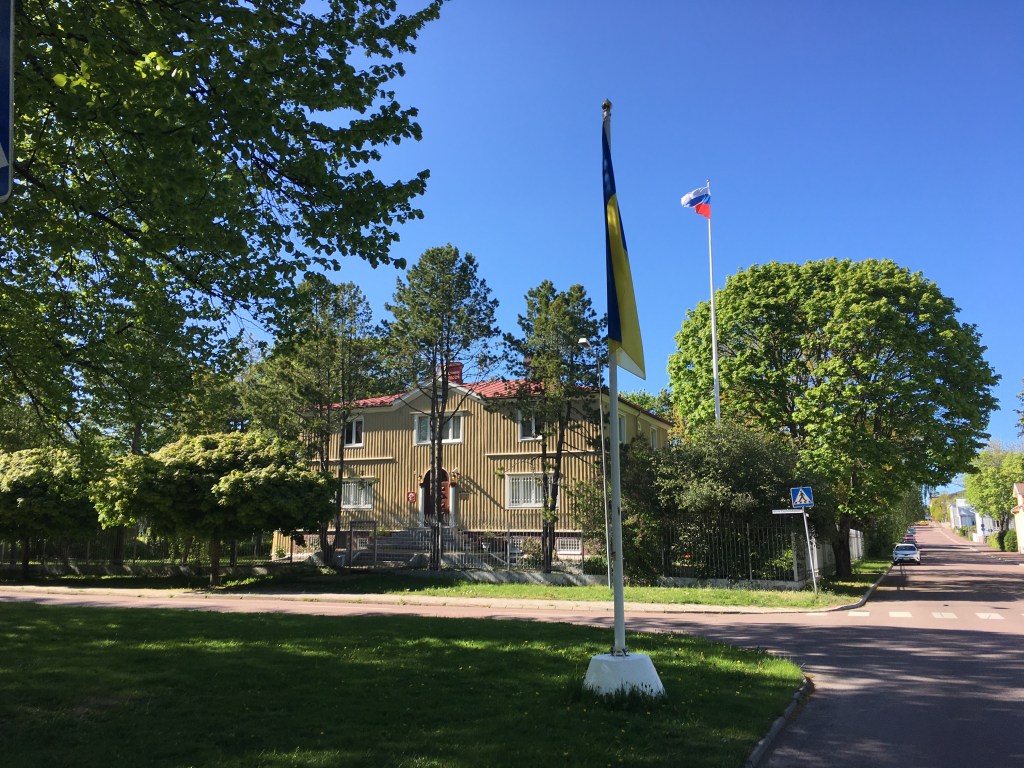
“There are demonstrations outside the consulate every night at five o’clock”, one of the other sailors at the marina tells us later. “Since Ukraine, the Ålanders are not happy with the Russians being here. Many of them want it to close. There have even been one or two cases where someone tried to set fire to the building.”
The consulate has been in Mariehamn since the 1940s, when it was established to monitor the non-aligned and demilitarised status of the islands.

In the evening, I decide to have a sauna. There are two other people in there, both Finnish.
“Have you ever tried a sauna before?”, one asks me.
I tell him that I have been in the odd Swedish sauna.
“Ah, Swedish saunas”, he says contemptuously. “They’re not saunas. It like just being in a warm room. You have to try Finnish saunas if you want a real sauna. Do you mind putting some more water on the stones?”
If I was a conspiracy theorist, I might have thought they exchanged winks, but I am not.
I splash a few ladles of water on the hot stones. Steam fills the room.
We chat about sailing for a few minutes. Gradually the conversation slows to a halt like a clockwork toy running down.
“It’s hotter than normal in here”, says the first Finn, beads of sweat all over his body.
“Shall I put on some more water?”, I say innocently. Before he can answer, I splash on another ladle. More steam fills the room.
“I think I’ve had enough now”, says the second, gasping. “I’m going to have a shower.”
“Phew, me too”, says the first.
I look as nonchalant as I can as I go for the ladle again. There is a run for the door. When I hear the showers stop I give them a couple of minutes, and make a rush for them myself. On the way, I pass a mirror. I look like a lobster.
“I don’t feel too good”, I say to the First Mate back at the boat. “I think that the sauna was a bit too hot.”

“Let’s take the bus up to Eckerö”, says the First Mate over breakfast the next morning. “They only charge €2.50 for bus trips anywhere on the island. We can have a look around the town, then have lunch.”
Eckerö is northeast of Mariehamn, and is where the ferry from Sweden comes in.
We board the bus, and tell the driver to let us off in the town centre. He looks at us quizzically.
“I can drop you off at the Post-Office, if you like”, he says. “I’ll let you know when we get there.”
“That’ll be fine”, I say. Post Offices are usually close to town centres.

We sit in the front seat so we can get a good view. The bus takes us through rolling farmlands, forests of Scots Pine, and the occasional small hamlet. Before long, the bus driver turns to us.
“The next stop is yours”, he says. “The Post Office is just a quick walk around the corner to the left.”
The bus stops in the middle of the countryside. To our right is a swampy area of reeds waving gently in the breeze. A coot swims away in a hurry. On the other side of the road is a small field backed by forest. A cow looks at us nonchalantly over a fence, chewing its cud.
“Why are you stopping here?”, says the cow. “No-one else does.”
I am starting to wonder the same thing.
“This wasn’t quite what I was expecting”, says the First Mate. “Where are the shops and other things in the town centre?”
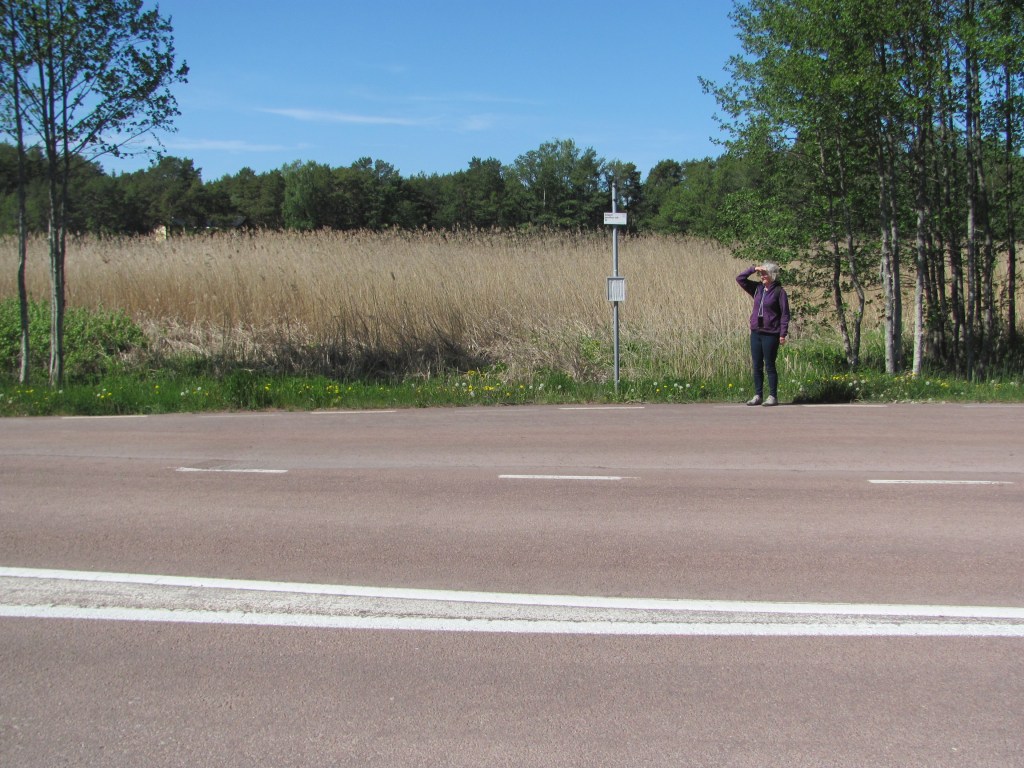
“This looks like all there is”, I say. “We might as well see if we can find the Post Office at least. Look, there’s the corner the driver mentioned.”
We walk down the little side road. A few hundred meters on is an imposing building in imperial style.
“That’s got to be it”, she says.
It is, but it isn’t any old Post Office. It turns out that it was the westernmost outpost of the Russian Empire, built in 1828 to assert Russian dominance over the Åland Islands, and was purposely ostentatious to send a strong message to Sweden and other nations that they were now entering Russian territory.

In the small museum there, we learn about its history. There was actually already a postal route there between Sweden and Finland established by Queen Christina in 1638. Finland and the Baltic States were provinces of the Swedish Empire at that time. On Åland, local farmers were required to provide their services to carry mail between different stages of the route across the islands, rowing across dangerous seas. Many lost their lives.
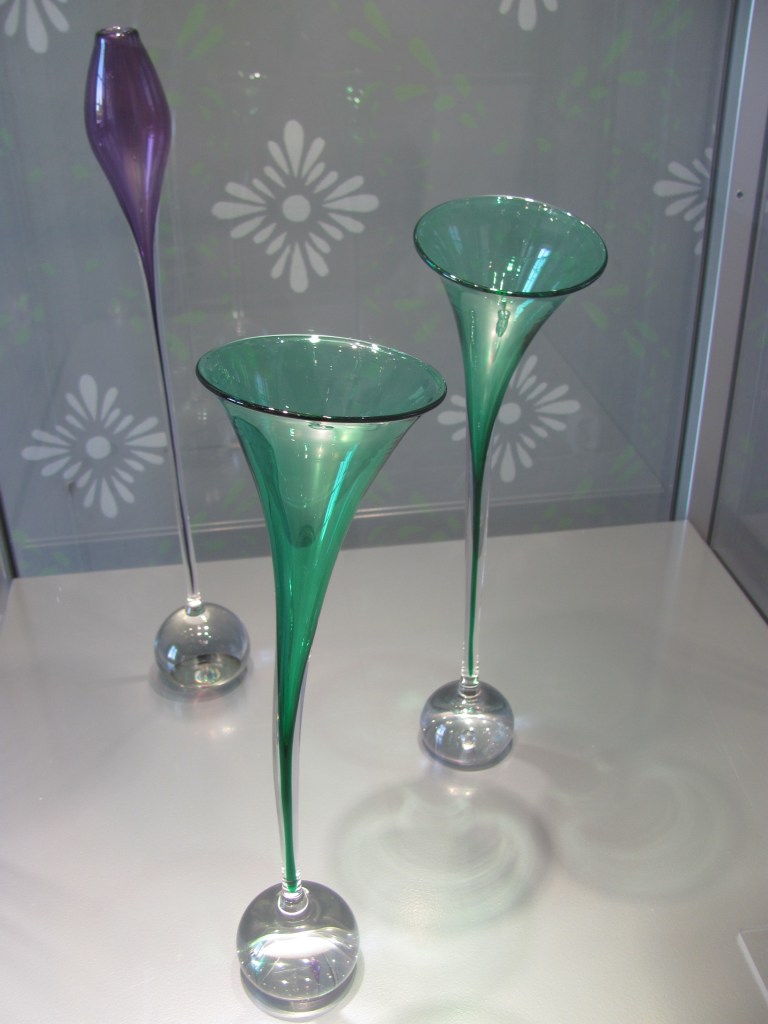
Nowadays it is an art gallery and small museum. There is an exhibition of glassware produced by local artists.
“I’m starting to get hungry”, says the First Mate after we have finished and are back outside again. “I wonder if there is anywhere to eat around here?”
“There is a restaurant not that far from here”, says a man mowing his lawn in one of the houses next to the Post Office. “Keep on going down this road, then take the first left and carry on there until you come to a junction. It’s just there. But I’m not sure if it will be open.”
We set off and eventually find Betty’s Restaurant. They are open, and they are doing a buffet lunch. We don’t normally like to eat a lot during the day, but the Swedish way seems to be to eat as much as you can from a buffet at lunchtime and have only a light supper in the evening. We are adapting.
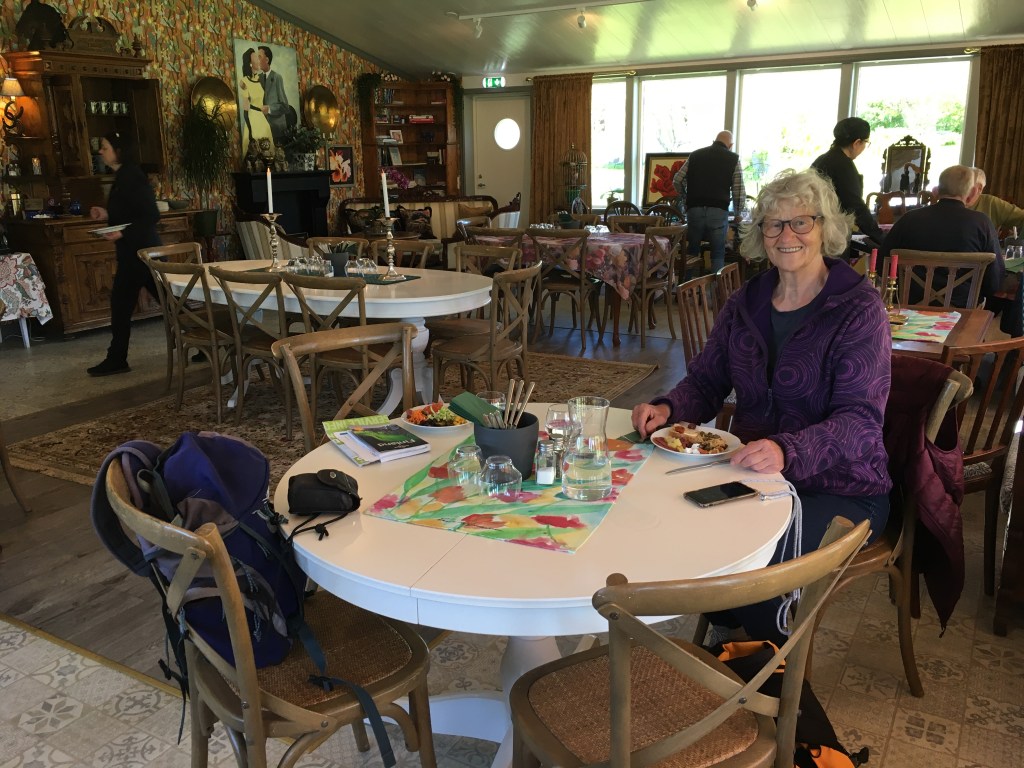
“The meat in the tacos tastes interesting”, says the First Mate. “What do you think it is? It tastes like beef, but there is something about it that is different. Let me ask the waitress.”
“It’s actually artificial meat”, she tells us. “Made from plant protein, I think soya in this case. It’s quite popular as it is supposed to be better for the environment. It’s sometimes difficult to tell the difference, particularly if it has been cooked in a sauce as this has.”
It does taste authentic, and I even get a bit stuck in my teeth.
“But if you really want to try artificial meat, there is a restaurant in Stockholm that serves 3D-printed meat”, she continues. “It’s aimed at people who like their meat, but don’t want animals to suffer for them to have it. It’s still expensive, but they are saying that as it becomes more popular, the price will come down.”
I had read of this technology previously. A company called Juicy Marbles have developed a method to artificially culture animal cells from plants, then use 3D printing technology to reconstruct a steak, building it up layer by layer of muscle fibre, fats and myoproteins. They end up with a piece of meat that has all the genuine animal ingredients, but without going through the process of slaughtering animals to get it.
“It all sounds very sustainable”, says Spencer when I mention it to him later. “But I would be interested in knowing what the energy balance of it is. I wouldn’t be surprised if much more energy goes into producing it that the amount of energy you get out. Not very sustainable if that is the case, especially if energy is going to become more and more expensive in the future.”
He has a point. I make a mental note to check it out.
In the evening, we take a taxi to the airport to meet our son who has flown in from Australia to join us for a couple of weeks. It’s great to see him again.

 Ruby Tuesday
Have a very enjoyable time with your son!
LikeLike
Thanks for your good wishes, Birgitta. We’re looking fiorward to it!
LikeLike
So lovely to see the photo with your son…you’ve been apart for so long…have a great time xxx
LikeLike
Hi Lynne, thanks, and nice to hear from you. Yes, we enjoyed seeing him again. He found it a bit cooler than Australia, though!
LikeLike