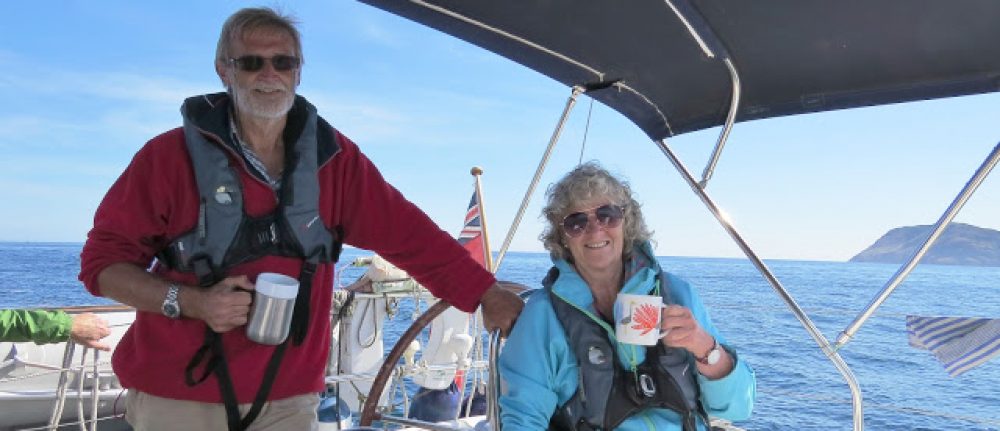
“Hello, hello!”, a voice calls to us from the queue waiting for the cable car to arrive. “Fancy seeing you again here!”
We look around surprised. We had just arrived in Bergen a couple of hours ago, and we know no-one here. At least to our knowledge.
It’s the Kazakhstani doctor and her husband that we had met at the Baroniet in Rosendal.
“We live here in Bergen”, she says. “We are just on our way home. My parents are cooking dinner.”
“What a nice coincidence”, says the First Mate. “Out of all the people we could have met in Bergen, we happen to meet you again! I wonder what the chances of that are?”
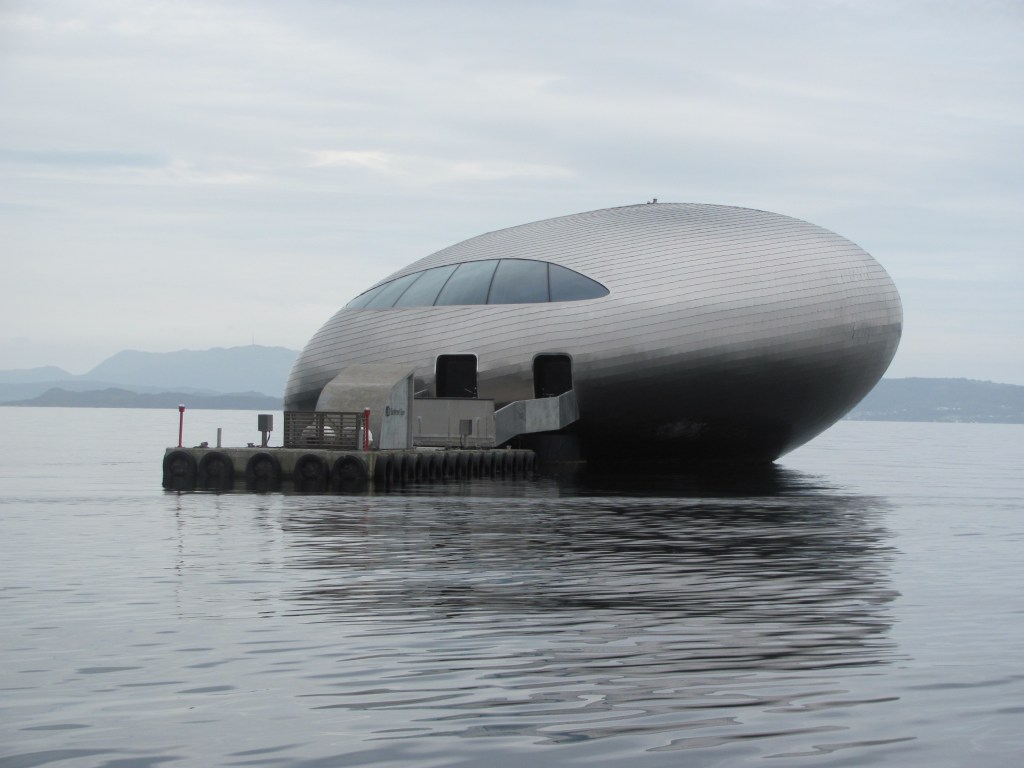
We had left Rosendal a couple of days earlier, and had sailed from there through the narrow Lukksundet, overnighted in the small lagoon of Gripnesvågen, and had arrived in Bergen in the late afternoon, tying up at the World Heritage-listed Bryggen harbour. On the way, we had passed the intriguing Salmon Eye, offering guided tours only through exhibitions on aquaculture and salmon farming. We had tried earlier to book places on one of the tours, but unfortunately they were booked out for a week in advance.
Bergen has the reputation of being the wettest city in Norway, with apparently more than 230 rainy days in a year. It is an old Hanseatic City, being part of the vast Northern European trading network in the 13th century. In fact, it was one of four headquarters outside the main one in Lübeck, but was run mainly by German merchants who were not permitted to intermarry with Norwegians. The Hanseatic League declined in the 15th century, but still continued in Bergen in a reduced form right up to 1899, when its offices there closed. By this time, descendants of the German merchants had integrated with the local population. Hanseatic warehouses still line the waterfront around the Bryggen.


We seem to have struck one of the 130 days that it is not raining, in fact it is bright and sunny, and sweltering. And the tourists are out in force. There is a huge queue for the Fløibanen funicular railway up to the Fløyen viewpoint over the city.

“I can’t be bothered to wait for this”, says the First Mate. “Come on, we need some exercise. We should walk up rather than taking the funicular.”
We wend our way through the quaint little cobbled alleyways and steep staircases between impressive houses redolent of the old wealth of the old Hanseatic merchants, until we reach the cool, lush forest.

From time to time we cross the funicular railway, feeling slightly smug that we are taking the real way up, not the wimps way.

Finally we reach the Fløyen viewpoint, and the whole city and harbour spread out below us, nestled between the seven hills and seven fjords.

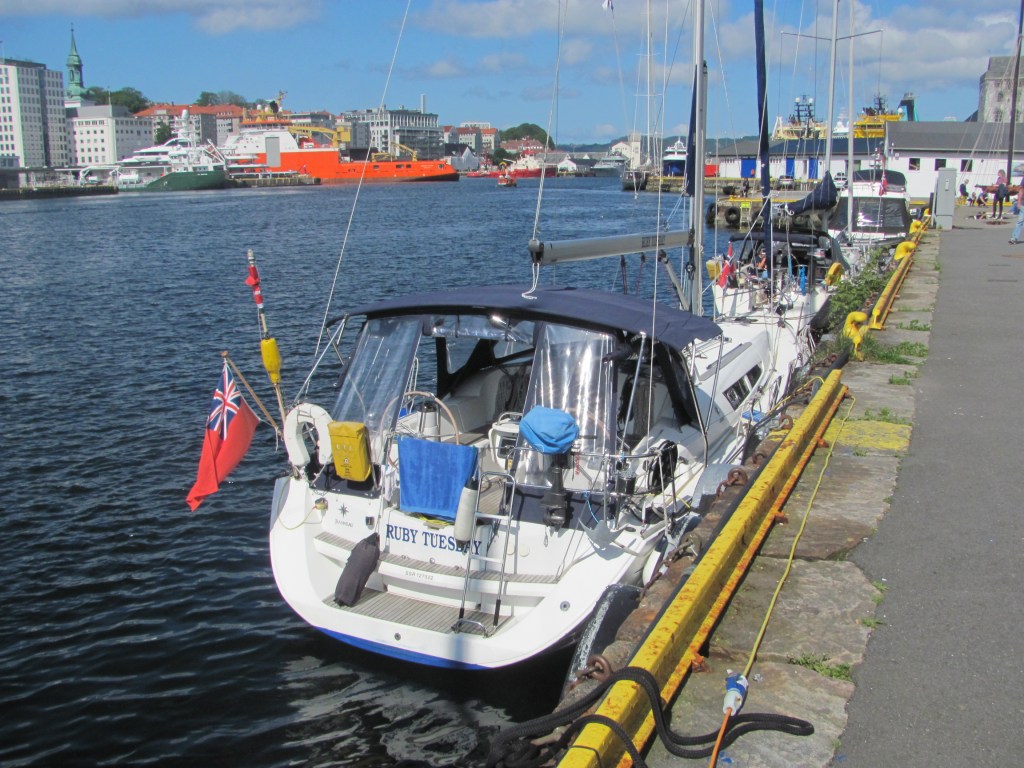
“Look, you can see Ruby Tuesday from here”, I say, pointing to the harbour area. “At least, you can see her mast, as her hull is hidden below the wharf.”
“Let’s have some lunch”, says the First Mate. “I’ve packed some sandwiches. Why don’t you go and get two coffees from that kiosk over there?”
“Don’t eat all the sandwiches yourself when I am away”, I joke. “You might start looking like that chap sitting at the next table!”
The elderly man looks at the wares on offer in the Fish Market. He isn’t a great one for seafood. Too many bones to choke on, and all that effort to get the tiny amount of meat out of the crab legs is hardly worth it. Give him a good plate of roast beef, roast potatoes, carrots and peas all smothered in gravy any day. You couldn’t go wrong with that. But there was a vibrancy about the market that he liked. The fishermen unloading their catch at the quayside, the farmers arranging their produce, the shouts of the vendors trying to attract customers, the bustle of the crowds – those looking for bargains, or the merely curious. All of life is here. And had been since the 1200s, if his companion Mr Fairlie was to be believed.

He walks further, finds the Post Office, and asks if there has been any mail left for him, showing his passport. There are a few letters and a newspaper from friends back in Ayrshire, but nothing from Meg. Or the rest of the family, for that matter. He feels a pang of disappointment, it would have been nice to know how things were back at the Manse.
And Thomas out in New Zealand. With sadness, he knew that he would probably never see his son again. But at least he wrote home every three months or so. It didn’t seem an easy life he had out there. The farm that he had bought didn’t seem to be on the best of land, and needed hard work to clear the native bush. And there were the vagaries of the market for him to deal with too – he was finding out the hard way that if he followed everyone else in planting a particular crop, the prices would fall because of the surplus. He wondered what sort of woman his newly-married wife was. She had presented him with a son soon enough. His grandson. He would never see him, but at least he would keep the line going. He thought sometimes of future generations. Would they ever be interested in who he was and what he did?
“I’ll just walk up to the shop and collect the mail”, I say to the First Mate, back in the city again after our walk to the lookout. “I can meet you after that for an ice-cream.”
We had arranged for our mail to be posted in a large envelope to the Poste Restante in Bergen. Actually, it should have reached us while we were with our friends Ståle and Gunvor in Gjorvik, but it had arrived a few days after we left. They had kindly posted it on to Bergen. I am half-expecting a post office building, but it turns out to be in a corner of a busy Extra supermarket.
A young man with a ponytail and beard appears from behind a cupboard. He enters the code I have been given.
“Ah, yes”, he says. “It arrived yesterday. Here we are. Do you have some ID?”
He finds it quickly on one of the shelves. I open the envelope. Not much of importance – just bank statements, bills, and various other bits of officialese.
“We need to change more over to using email”, says the First Mate later. “It would be good if we could cut out our snail mail completely. It’s always a bit of a hassle trying to work out where we are going to be in a couple of weeks. Not to mention the delays that we had this time.”
It had taken almost two weeks for the mail to be sent from the UK to Norway, and a further few days for it to arrive in Bergen. Another benefit of Brexit, no doubt.
On the way back from the Post Office, he stops at the Domkirke. A bit grander than his own church back home. But then it is the episcopal seat of the diocese. He is particularly impressed by the rococo interiors which had been returned to their medieval glory by the renowned Norwegian architects, Christie and Blix, just a few years ago. They had done a good job. He wondered if they would come to Scotland and renovate his church as well.

The next morning, I ring the sail repair company about fixing the VHF aerial.
“Ah yes, I remember”, says the girl who answers the phone. “But the rigger who will do the job is going on holiday tomorrow. If you can make it by 1400 today, he will try and do it this afternoon for you.”
It is about 11 miles by sea to their yard at Litlebergen. We can make it, but it means that we have to ditch our plans to explore the rest of Bergen and leave now.
“We had better do it”, says the First Mate. “We need to have it fixed. We have already seen a bit of Bergen yesterday, and we can always come another time and see the rest. Perhaps on the way back.”
We frantically prepare everything to leave. Fifteen minutes later, we slip the lines and head out of the harbour. The wind is just enough off the bow to allow us to sail close-hauled.
“We need to go under a bridge with 22 m clearance to get to their harbour”, I say. “Otherwise we will have to go the long way round. We normally allow 20 m for our height, but then there is the tide to consider. I reckon we are close to high tide now, which will add another metre. Shall we give it a go?”
“I guess we have to”, says the First Mate. “But be very careful. Take it slowly.”
We reach the bridge. From down on the boat, it looks as if the mast won’t fit under. It always does. But in this case, there isn’t much room for error. I slow down and edge our way forward. Visions of the mast hitting the bridge and crashing down on top of us enter my mind. I decide to look straight ahead and trust that my figures are correct.
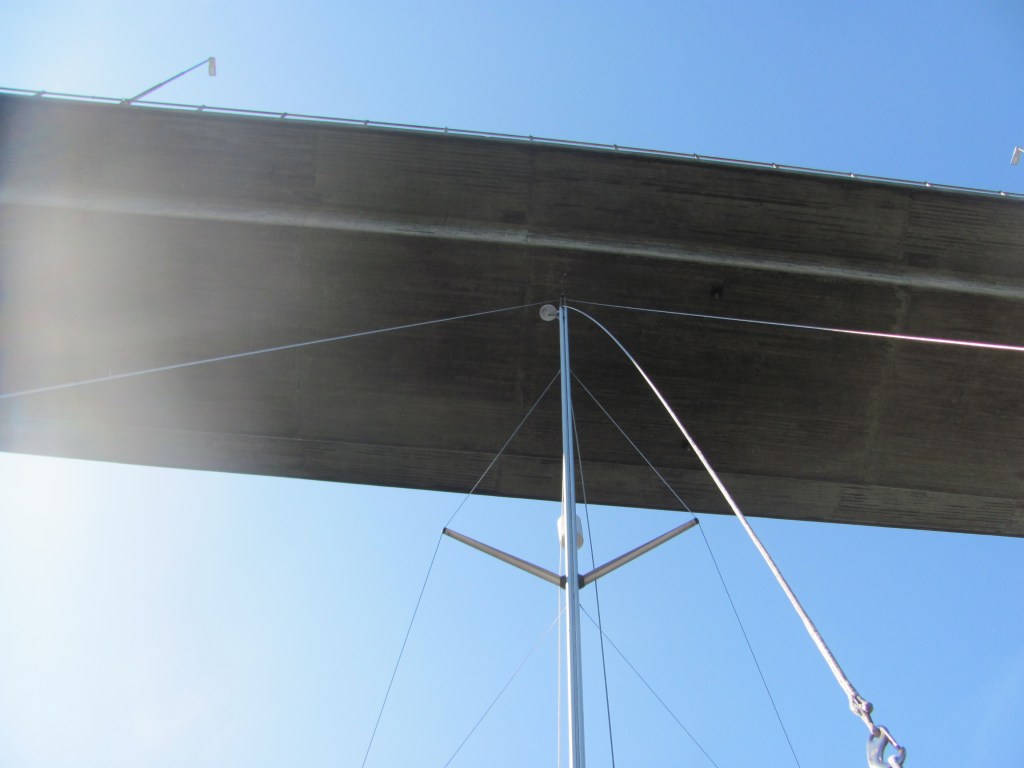
Somehow we manage it, and are on the other side. We tie up to the outer pontoon in the small harbour, with a few minutes to spare before 1400. I look around to see if I can see a riggery looking person, who might be waiting for us.
“What would a riggery sort of person actually look like?”, asks the First Mate.
“It’s not a proper word”, I explain. “I just used it because I liked the sound of it. But I suppose he would be thin and wiry, with thick black hair.”
Ten minutes later a man appears. He is thin, wiry, and has black hair.
“Hi, I am Piotr”, he says. “Are you the ones needing their VHF aerial to be repaired?”
His accent doesn’t sound Norwegian.
“I am originally from Poland”, he explains. “But I have been here for 12 years. I like it, but it is expensive – I actually live on my boat over there to cut the cost of accommodation. But even Poland is becoming more expensive now – they are catching up with the rest of Europe. Anyway, let’s look at this aerial.”
I show him the drone shots I took of it.
“Ah, it looks a lot simpler than I thought it might be”, he says. “I think that it is only the securing nut that has come loose. I should be able to fix that in no time.”
He puts on his climbing gear. Soon he is climbing to the top of the mast. Twenty minutes later he is down again.

“All done”, he says. “Just the restraining nut had come loose, or hadn’t been put on properly in the first place. Should be OK now.”
While he is untying himself from his ropes, we ask him if he is going anywhere nice for his holidays.
“Just to the south of Norway”, he answers. “But it’s half work and half holiday. I am actually a juggler in my spare time, and I have been asked to perform at a few summer festivals.”
Somehow it seems to fit. I imagine he might be a dab hand on the trapeze as well.
The next day, it rains heavily the whole day.

“We’ll just have to stay put”, the First Mate. “I don’t really want to sail if it is like this. The scenery is so beautiful on a sunny day and I don’t want to miss any of it. It’s supposed to be better tomorrow.”
A family of ducks swims past the window, their bills in the water, feeding as they go.
“I don’t mind”, I say. “I can work on the blog and do a few boaty jobs.”
The ducks swim past again, going in the opposite direction.
“I am going to make a coffee”, says the First Mate mid-morning. “Do you want a cup of tea?”
Back swim the ducks.
“Do you think that ducks have a sense of humour?”, I ask at lunch time.
“Which ducks?”, she asks, giving me one of her withering looks.
Out of the corner of my eye, I see the ducks flying off southwards.
“Never mind”, I say.
“Are you all right?”, she asks, looking at me carefully. “You haven’t got cabin fever, have you?”
 Ruby Tuesday