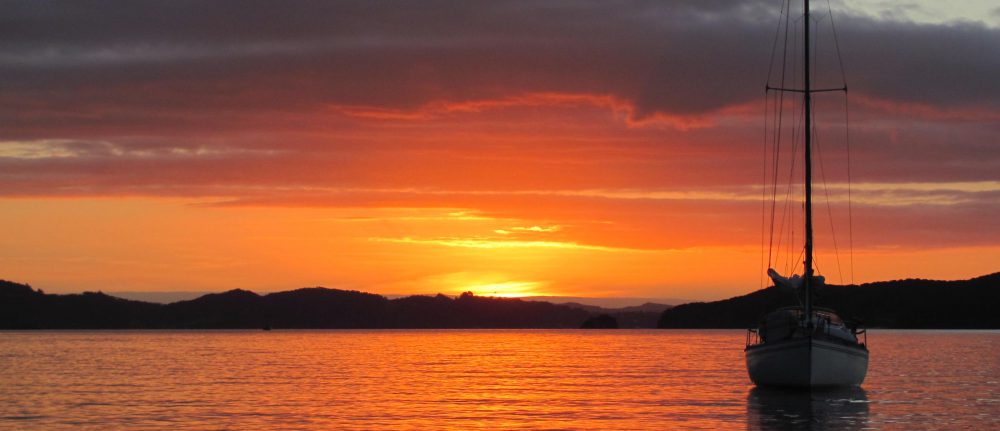
“I’ll try and get some fuel here”, I say to the First Mate, as we arrive at the small marina at Docksta and tie up alongside to the outside pontoon. “Apparently there is a filling station in the village. If the marina has a trolley I’ll take the jerrycans up there and fill them up.”
We had tried to buy diesel in Härnösand, but even though the machine had accepted our cards, no fuel came out of the nozzle despite repeated attempts.
“It must have run out”, the First Mate had said. “Never mind. We can try and get some at the next place that has a filling station.”
Luckily, the Docksta marina has a small trolley. I tie the three empty jerrycans on using an ingenious criss-cross system of rope fastened by knots hitherto unknown to mankind.
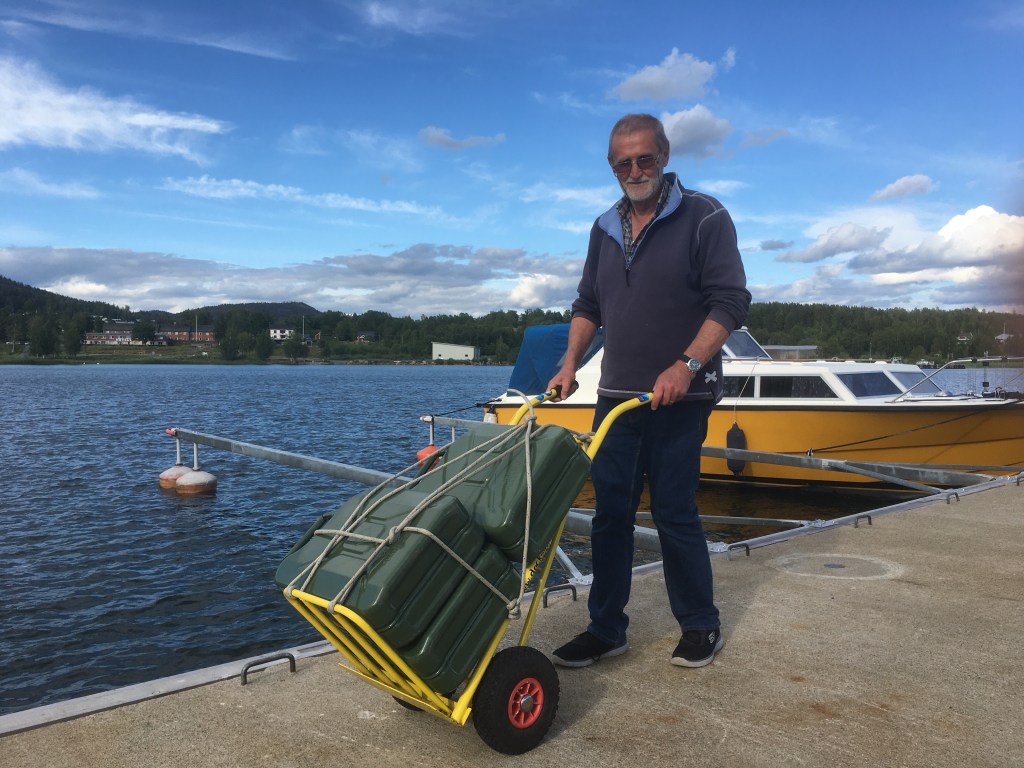
“I don’t think that they are going to come off”, says Robert, tied up next to us. “But I’ll be interested to see how you manage to bring three full jerrycans back on that small trolley. It’s almost a kilometre to the filling station, and some of that is uphill.”
He’s right. Pushing 50 kg of sloshing liquid on a small trolley is not easy. Especially uphill along a shingle track. With one of the tyres flat. But I eventually make it.
“Your face is looking very red”, says the First Mate. “I hope you don’t have a heart attack.”
In the evening, my sister Joanne and her husband Peter arrive by bus from Härnosand. They have flown from New Zealand to Stockholm, and then have taken the train from Stockholm to Härnosand.

“It’s been a long journey”, says Joanne. “But it’s great to be here.”
We had sailed together several times before – in New Zealand, Wales, the Mediterranean, as well as last year in the Stockholm Archipelago. It’s nice to see them again.
“I think we need to have an early night”, says Peter after dinner. “I am not sure we will be able to sleep well anyway with the hours of darkness so short.”
It’s true. At this time of year, it is still light enough to read well after midnight, then again in the morning at about 0300. Even the one to two hours in between are light enough to see from one side of the marina to another. But they are exhausted and sleep well.
The next afternoon, we decide to walk to the top of Skuleberget, the 295 m high mountain overshadowing Docksta.

“It’s funny that they call it a mountain”, says Joanne at breakfast. “It’s not even 300 m high. In New Zealand we would think of that as a hill.”
“It reminds me of a person we used to know from Holland”, I say. “His name was Marco van den Berg, which means ‘Marco from the Mountain’. He used to say that you could see over the ‘mountain’ near where he lived if you stood on top of your car!”
“Well, this is a bit higher than that”, says the First Mate. “Come on. Let’s get going. We can buy some sandwiches from the shop and find somewhere on the trail to eat them for lunch.”
On the way, we swing past the Naturum Höga Küsten Information Centre.
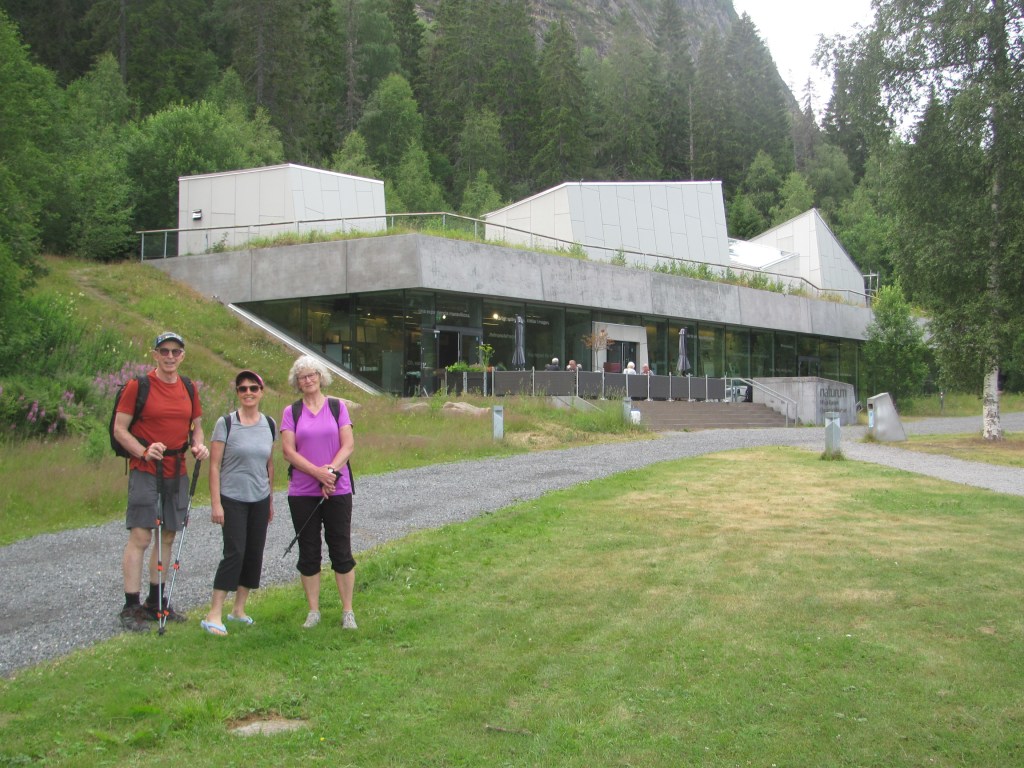
“Well, that was very interesting”, says the First Mate after we come out. “It’s amazing to think that just after the Ice Ages, Skuleberget was a small island only 9 m above sea level. Then as the ice receded, the release of its weight allowed the land to rebound back to its previous position at the rate of around 10 mm per year. It’s still rising, apparently.”
“It’s also one of the few places that has glacial till on its summit”, I add. “All the other hills in the area were under water at that time.”
“Look at that garage there”, says Peter. “You can see how the land is rising. It’ll disappear in a few years or so.”

We climb the rocky path through the trees, and eventually reach the top. The view is superb. We try and make out where Ruby Tuesday is lying far below. I get the wrong bay.
“I hope your navigation is better tomorrow”, says Joanne. “We are trusting you to keep us safe.”

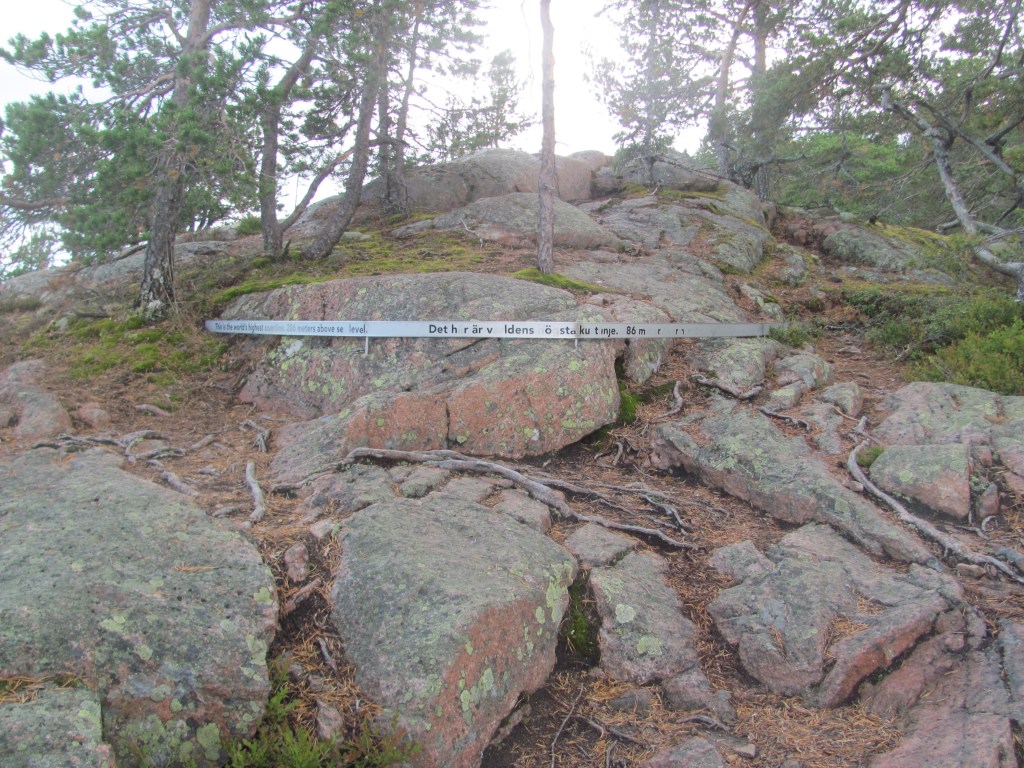
“Come over here”, calls out the First Mate. “There’s a band here showing where the shoreline was 10,500 years ago.”
As we peer over the sheer cliff, it brings home just how much the land has risen in the relatively short time since the Ice Ages.
The next morning we decide to sail to Mjältön, a small island to the east of Docksta. The wind is little more than a breeze, but we manage to make a sedate two knots.
“Don’t forget that it is supposed to rain heavily this afternoon”, says the First Mate. “We need to make sure that we get there before it starts.”
We head for the small teardrop-shaped bay of Baggviken on the south-east corner of Mjältön. The entrance is narrow, but it opens out wider with staging for mooring on the northern and eastern shores. Already it is reasonably full with other boats. We find an empty berth, drop the stern anchor, and edge forward gently until the First Mate and Peter can throw the bowlines to a waiting neighbour.

“Only half the island is a protected nature reserve”, our neighbour tells us as we tie up. “The other half is privately owned and used for agriculture. But they have made a complete mess of it. The trees have all been chopped down and it looks like the surface of the moon. The soils are no good for growing crops. If you ask me, the government should have made the whole island into a nature reserve. But at least there is a nice beach you can walk to through the nature reserve. Now, if you will excuse me, I need to get the canopy up. It’s starting to look like rain.”
Sure enough. a few drops begin to fall, then the rain cascades down. It’s monsoonal. All we can do is to sit inside the cockpit tent and have lunch until it goes off.
“We’ve got a new holiday in New Zealand”, Peter tells us, cutting a slice of cheese. “It started officially last year. It’s called Matariki, and it celebrates the Māori New Year, when the Pleiades constellation rises above the horizon. It is supposed to be a time of endings and beginnings, coming together, remembrance of the dead, and the planning of crops and planting. But a lot of employers aren’t happy about it, as they think that it is just another excuse not to work and cut into their profits.”
“I suppose it depends on how many public holidays in total you have”, says the First Mate, getting out her phone. “It says here that New Zealand has twelve compared to around ten in the UK. But most countries have a lot more than either of these. Nepal has 35. Can you imagine?”
“Māori believe that you can understand just about everything in the natural world from the positions of the stars and the moon”, says Joanne. “But a lot of that knowledge was lost or suppressed when the Europeans arrived. Nowadays, there’s quite a resurgence of interest in indigenous knowledge. But in my view, Matariki is really more about giving more prominence to Māori culture in everyday life.”
“There’s a real drive to redress past Māori grievances”, explains Peter. “Especially to do with land, but also culture. That’s not a bad thing in itself, but many people fear that it has gone too far. Māori seem to have more rights than Europeans these days. And you only have to have one-eighth Māori ancestry in you to claim to be Māori. A lot of people are trying to find a Māori great-grandparent in their lineage so that they can claim the benefits.”
The rain stops, the clouds clear, and the sun returns. The smell of wet soil pervades the small bay. Mist rises off the forest canopy as the sun evaporates the water.
“Come on”, says the First Mate. “Now that the rain has stopped, let’s go and find that beach our neighbour was talking about.”
We find the track leading up from the back of the beach, and trudge through the drying woods. Eventually we come to a branch in the path to the left.

“This is probably it”, I say. “The other way looks like it is going over to the other side of the island.”
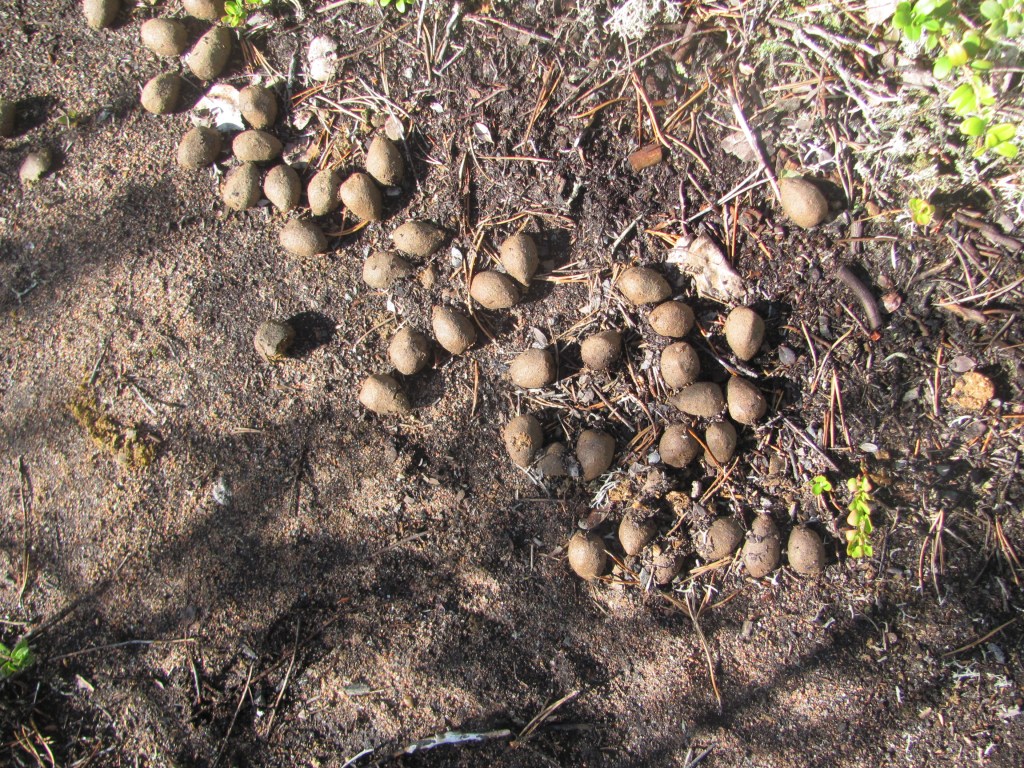
We take the path to the left. A little bit further on, we come to a pile of pear-shaped droppings. And another. And another.
“They look like deer’s”, says Peter. “We might see one.”
We eventually reach the beach without seeing any deer. It’s a beautiful long stretch of sand and we have it to ourselves apart from two kayaks and a tent about halfway along. But no people.

The next morning we sail from Mjältön to Ulvön, another island further to the east. The wind is from the south-east and we need to sail close-hauled, tacking once to reach the narrow entrance between the two halves of Ulvön. We pass Anna heading in the opposite direction, hands waving wildly.
Ulvön is crowded. There doesn’t seem to be any room at the gästhamn for us to tie up. The First Mate’s phone rings. It’s Catherine from Salute.
“We saw you coming on the AIS and saved a place for you to squeeze in next to us”, she says. “It’s where Anna was, but they left this morning.”
We had somehow not seen Salute in the throng of boats.
“There’s no way we can get in there”, says Peter, looking at the tiny gap of less than a metre between Salute and the next boat. “Far too narrow.”
We drop the stern anchor and inch forward. Hands on the boats either side guide us in. Fenders squeal as both boats move sideways to accommodate us. It’s a snug fit, but we are there.
“Our neighbour on Mjältön said there used to be wolves on the island”, says the First Mate, as we tie up. “The name Ulvön means Wolf Island in Old Norse. I’m glad they aren’t around anymore.”
“It’s a bit like the island of Ulva in the Inner Hebrides in Scotland”, I say. “That also comes from the Old Norse for Wolf Island. They say that wolves used to be there too.”
“Haven’t seen any wolves here”, says Gavin from Salute. “But it’s a pretty little place. There is an interesting church with painted scenes, and there is a nice walk to the old pilot station on top of that hill. Both worth a visit.”

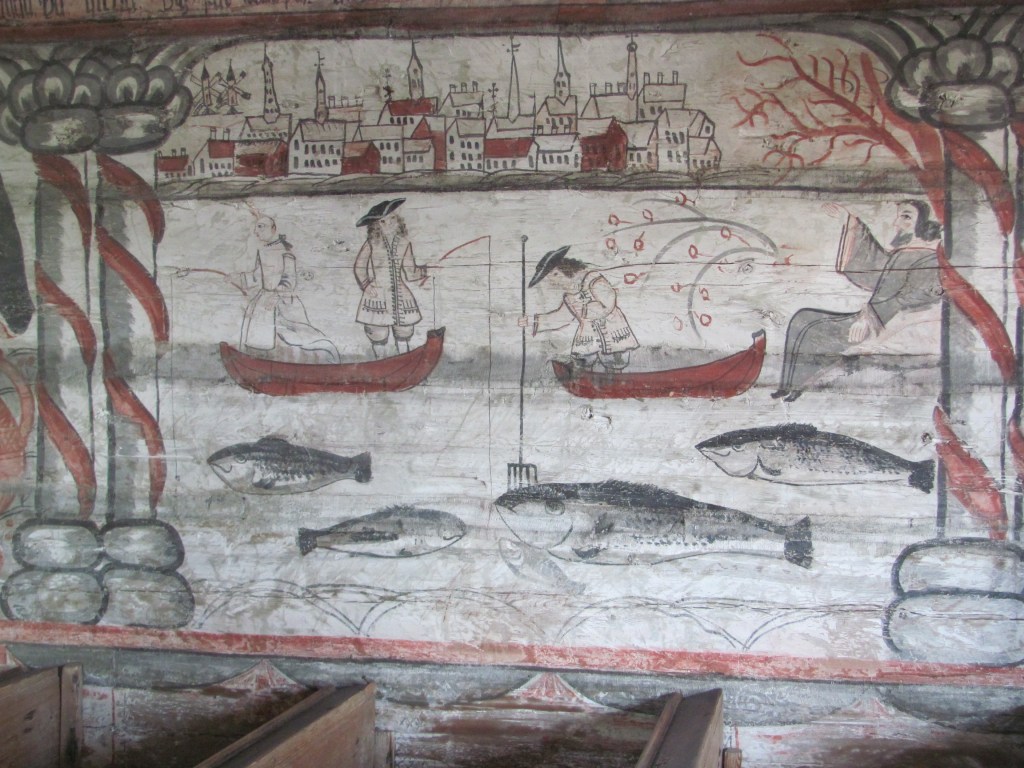

On the way back from the pilot station, we stop off in the little fishing museum with its eclectic collection of fishing gear.
“It’s a pity that we can’t taste the surströmming” says the First Mate, pointing to a tin. “It says that it isn’t ready until the middle of August.”
“Phew!”, I say, relieved. “That gives me an excuse not to try it, at least.”

Surströmming is Ulvön’s special delicacy. Known as the world’s most putrid-smelling food, it is made from herring allowed to ferment for between three and six months.
“Only herring caught before spawning in April and May are used”, the woman in the museum tells us. “They are covered lightly in salt to prevent them from rotting, then they must ferment for three months. They shouldn’t be sold until the third Thursday in August, Surströmming day. You can eat them with tunnbröd with potatoes, onions, tomatoes and cheese. But I have to warn you that they are an acquired taste.”

There is a blast of a ship’s horn, and a crowd of youngsters rush past us clutching suitcases and rucksacks, heading for the ferry dock. One or two look a bit queasy. They’ve probably had some surströmming, I think. Before long, the ferry edges away from the dock to take them back to the mainland, their brief stay on Ulvön over.

At dinner, the conversation continues from yesterday.
“There’s a lot of discussion at the moment about the first people to come to New Zealand”, says Peter. “Europeans have growing angst about being newcomers and displacing the First People. Hence the trying to put things right. But it’s not so simple. No-one really knows where the Māori come from, for example. Their mythical homeland was Hawaiki, but it’s not clear where that was.”
“I thought that it was generally thought to be Tahiti”, I say. “But even if it wasn’t, perhaps Hawaiki referred to an area rather than a specific island.”
“And then there’s the question of the Moriori”, says Joanne. “They were in New Zealand before Māori. Perhaps they were the First People, and not Māori?“
“I know that was what we were taught at school”, I say. “But I thought that the modern view is that they were Māori who had arrived earlier than the main waves, were almost wiped out by the latter due to their pacifist nature, and then escaped to the Chatham Islands where their language and culture evolved differently.”
“Does it really matter anyway?”, says the First Mate. “There seems to be little doubt that Polynesians of various types were the First People of New Zealand, and that Europeans were the newcomers.”
“It matters”, says Peter, “as whoever is designated as First People get rights that the others don’t.”
The problems between indigenous peoples and the colonisers are similar the world over, I think as I climb into bed that evening. I make a mental note to check what the relationship is like here in Sweden between the Sámi people and the rest of the country.

Another day, another Högaküsten island, another Gävle fishermen’s church, and more picturesque red-painted fishermen’s cottages. This time it is Trysanda, reputedly the most beautiful of the Högaküsten islands.

We join Gavin & Catherine of Salute and Holger & Annette of Anna for a walk around the island. We come to a long sandy beach and strip off for a swim. It isn’t as cold as I thought it would be.
Holger and Annette have decided to make this their northernmost point and head back south. They need to be back in Stockholm to meet family. It’s sad to see them go. We had first met them in Öregrund nearly a month ago, and had travelled more-or-less continuously with them since then. Back at the harbour, someone suggests a barbecue for the evening.
This time Holger doesn’t burn the halloumi. “My secret is to get someone else to look after it!”, he says, meaning me. I manage to char it. But not too much.

“I’ll miss them”, says the First Mate. “They have been good company.”
“We can keep in touch with them”, I say. “Hopefully we’ll meet them again.”
 Ruby Tuesday
Hi Peter and Jo
Good on you for sailing round the Baltic, a far cry from sailing from Tauranga out to Mayor Island back in 1990ish! Or in the Malborough Sounds with Les and co.
LikeLike
Loving your journey
We are sitting at stonehaven harbour with our sandwiches…..looking at a few yachts / boats and wondering what size your vessel is…..
Everything fine in peterculter….got your brown bin emptied today…. weather hasn’t been very warm
LikeLike
Hi Lynne & Graham, yes, we are enjoying it all immensely. Great scenery, friendly people, good weather! Our boat is 39 feet (11.8 m) in length. Thanks for keeping an eye on things. Hope you are both keeping well. R&B.
LikeLike